Israel uses human shields in Gaza ‘at least six times a day,’ says Israeli officer
MEMO | April 1, 2025
Trump: ‘Very Bad Things are Going to Happen.’ Netanyahu Wants the U.S. to Destroy Iran.
By Dennis J. Kucinich | April 1, 2025
In my article, “The High Price of War with Iran: $10 Gas and the Collapse of the U.S. Economy,” I reminded readers of how Prime Minister Benjamin Netanyahu has been behind the push for America to destroy Iraq, Libya, Syria and now Iran. I reviewed the severe economic consequences for the U.S. if it attacks Iran. Today, I cite the human health and atmospheric effects of a U.S. attack on Iran’s nuclear research facilities. The resulting nuclear fallout would bring a catastrophe unprecedented in human history.
Last week, President Trump said “very bad things are going to happen” to Iran, if that nation’s leaders do not sign a new nuclear deal. The President is right. He can make very bad things can happen to Iran.
But Iran is not the only country to which “bad things” are going to happen if Iran’s nuclear research infrastructure is destroyed by the U.S., as is revealed by a careful study of the spread of radiation created by the promised bombings.
America has been Netanyahu’s pawn for decades. Will the wealth, lives and security of our nation be sacrificed yet further to an agenda which brings only debt to our nation and death to innocents abroad?
The return of Donald Trump to the White House for a second term has enabled Netanyahu’s right-wing party to accelerate the pulverization of Gaza, expand settlements and to repel the Houthis pro-Gaza attacks on Red Sea shipping.
Netanyahu viewed Trump’s first election in 2016 as a new opportunity to topple Iran’s leadership. Trump, in partnership with Netanyahu, withdrew the U.S. from a multi-lateral agreement which limited Iran’s nuclear development in exchange for sanctions relief.
An attack by B-2 bombers on Iran’s nuclear infrastructure would destroy the targeted sites, and unleash radioactivity endangering the lives of tens of millions in Iran and hundreds of millions beyond. Due to radioactive drift, Iraq, Kuwait, Qatar, the UAE, Bahrain, eastern Saudi Arabia, Afghanistan, and Pakistan also would be severely impacted.
In practical terms, given proximity to Iran, and the direction of the wind, high levels of radiation-induced illness, some fatal, and sharp increases in cancer and birth defects would occur. Radiation would contaminate and ruin food supplies, agricultural land, farm animals, and water resources hundreds and even thousands of miles from Iran.
The eastern regions of Turkey, northwestern India, Turkmenistan, Uzbekistan, Tajikistan and Kazakhstan would be exposed to moderate contamination. Jordan, Syria, Lebanon, Israel, Palestine and Egypt’s Sinai could be affected, depending on the wind.
Israel has long fanned existential fears by conjuring the threat of a nuclear attack by Iran, while being indemnified by the U.S. for its self-styled “defensive” aggression in Gaza, where at least 50,000 Gazans have been killed and over a million Palestinians driven from their homes.
While the widely publicized intent of President Trump to bomb Iran imperils Iran and neighboring countries, it also makes Israel vulnerable to a massive counterstrike from Iran and puts in the bullseye all U.S. troops in the region within 2,500 miles of Iran.
The attack B-2 bombers headed to Iran are designed to carry nuclear “bunker busters” as well as conventional 500 lb gravity bombs. The objective is to take down Iran’s nuclear infrastructure, which includes nuclear reactors and research labs. Nukes bombing nukes equals massive radioactive fallout.
“There will be Bombing.”
“If they don’t make a deal, there will be bombing,” Trump said in a telephone interview this past Sunday with NBC News. “It will be bombing the likes of which they have never seen before.”
Civics lesson: Official threats against another state are a violation of the UN Charter, Article Two, Section 4, which “prohibits the threat or use of force against …. any state.” Both Iran and the US signed and ratified that agreement nearly 80 years ago, in recognition of its organizing principle: “to save succeeding generations from the scourge of war…”.
It is a war crime to aggress against another country. Under the US Constitution, no president has the right to unilaterally take our nation to war, absent an imminent threat to the United States. The Constitutional Convention placed the war power in the hands of Congress. This was in contrast to the British Crown’s expansion of war for empire.
The litany of reasons not to attack Iran is eerily similar to the reasons America should not have attacked Iraq: Iran is not a threat to the United States. Iran has not attacked the United States. Iran does not have the intention or the ability to attack the United States. That being the case, the opportunities for a false flag incitement are ripe.
Significantly, last week the U.S. Intelligence community, in its annual Global Threat Assessment, refuted Netanyahu’s oft-repeated claim about Iran building a nuclear weapon:
“We continue to assess that Iran is not building a nuclear weapon and that Khamenei has not reauthorized the nuclear weapons program he suspended in 2003”.
In the 16 years I spent in Congress, I was often one of the only members who rose to question the Bush Administration’s plans to attack Iran, time and again calling out the dangers of attacking nuclear research facilities and calling for diplomatic means to block Iran’s potential development of a nuclear weapon.
The agreement, arrived on July 14, 2015, the Joint Comprehensive Plain of Action (JCPOA). It took the U.S. China, Russia, Germany, France, and the UK thirteen years to craft a workable agreement which limited Iran’s ability to enrich uranium to weapons grade. The agreement was a landmark for international cooperation. It put the spectral genie of Iran’s potential development of a nuclear weapon back in the bottle.
That did not satisfy Netanyahu, however. He longed for the toppling of the Iran regime, and continued to hype existential fears among Israelis. Trump cancelled the JCPOA, at Netanyahu’s behest, setting in motion a series of events which may lead the US to attack Iran soon.
From Deal Breaker to Deal Maker?
Scott Ritter a former UN Weapons Inspector and Marine intelligence specialist provides a detailed account of Trump’s withdrawal from the JCPOA, in his book, entitled Deal Breaker.
The JCPOA which Trump took down had blocked Iran’s production of enriched uranium (processed to increase the percentage of uranium-235 (235U) at the Natanz and Fordow nuclear facilities.
It blocked Iran’s development of weapons-grade plutonium and frustrated even covert attempts to produce fissile (capable of undergoing nuclear fission) materials used for nuclear weapons.
The President now is demanding Iran sign a new deal. He wants Iran to get rid of the weapon-making capability which he errantly enabled by cancelling the JCPOA.
Eight years after the cancellation of the JCPOA, President Trump is apparently demanding Iran voluntarily take down its nuclear infrastructure which provides nuclear power, nuclear research and yes, with no JCPOA, can, at this moment, enrich uranium to near–weapons grade.
The Supreme Leader of the Islamic Republic of Iran has issued a fatwa (a religious ruling) against the use of nuclear weapons.
The new deal which the President is seeking, at best, could end up looking a lot like the JCPOA, and, at worst, puts him in the position of issuing a non-negotiable demand for Iran to voluntarily take down its nuclear infrastructure, or the US will do it militarily.
Iran has rejected direct negotiations with Washington under such circumstances. It has, however, maintained indirect communication with the U.S. through Oman as the President escalates the threat of a massive bombing attack.
B-2 bombers are in place, equipped with the most powerful weapons in America’s arsenal ready to be activated from Diego Garcia, an island in the Indian Ocean, 2,400 miles southeast of Iran. The B-2 has the capacity to attack and return to Diego Garcia without refueling.
In someways this showdown with Iran was set in place on July 25, 2024, when Prime Minister Netanyahu addressed Congress. In a spell-binding speech for which he received over 50 standing ovations, Netanyahu skillfully aligned Israel’s and the U.S. policy on Iran:
“If you remember one thing, one thing from this speech, remember this: Our enemies are your enemies, our fight is your fight, and our victory will be your victory,” Mr. Netanyahu declared.
At this point, the measure of consequence needs to be assessed. The only difference between war games, preparing for war and actual war, is in the intent.
Israel intends to destroy Iran and needs the US to do it.
Joint US-Israeli Air Force war games have been held recently in preparation for an attack.
The U.S. has nineteen B-2 bombers. Each cost over $2 billion. Their unique flying wing design, with the plane wrapped in radar-absorbing materials help it avoid detection. The B-2s use sophisticated electronic countermeasures to jam or stymie opposition radar and missiles.
Iran is ill-equipped to defend against the B-2 bombers’ stealth warfare. At best the shortened detection range will limit Iran’s ability to lock onto the B-2 with surface-to-air missiles.
Each B-2 can carry sixteen, 2,400 lb., B83 thermo-nuclear gravity bombs, also known as nuclear bunker busters, which explode deep inside the earth. Each B83 bomb has the explosive capacity of 80 Hiroshimas which means each B-2 bomber is capable of delivering the destructive power of 1280 Hiroshimas.
Once the B83’s detonate they destroy underground structures and send shockwaves through rock. Earthquakes and massive ground displacement result, with radioactive debris being flung into the atmosphere.
There is a metaphysics at work here of bringing to oneself that which one fears. The United States is preparing to attack Iran because of Israel’s fear of Iran.
Trump: “It will be bombing the likes of which they have never seen before.”
The U.S. will first attack Iran’s underground missile cities at Khorramabad, and Panj Pellah, Bakhtaran, with nuclear bunker busters or Massive Ordnance Penetrators aimed at underground missile sites, to incapacitate Iran’s ability to retaliate.
The use of nuclear bunker busters will send nuclear debris into the immediate atmosphere, and it will be carried aloft by the wind.
Simultaneously, the U.S. will strike at the Fordow enrichment plant, buried deep in a mountain. A combination of 30,000 lb. Massive Ordnance Penetrators (GBU-57s) capable of burrowing 200 ft into the earth before exploding, and nuclear bunker busters, will be deployed, creating a multiplier factor in blast physics, collapsing tunnels and sending radioactive materials into the atmosphere and far beyond. Fordow is heavily fortified and may be able to withstand the initial attack.
The Natanz underground facility will be similarly struck, with radioactive matter breaking into the atmosphere.
The ground-level Bushehr Nuclear Power plant will be destroyed, its reactor vessel breached, the reactor core will meltdown, massive release of radioactive materials (cesium-137, iodine-131, strontium-90, and plutonium) will go into the atmosphere, and, depending upon the wind, and the weather, radioactive plumes will drift over other countries.
Countless civilians will perish from radiation poisoning and severe burns. Birth defects will be present for generations to come. Nuclear explosion refugees will be created. Chernobyl-type effects will require people to leave their homes, never to return.
Tehran’s Research Reactor, Isfahan Nuclear Tech Center, Arak Heavy Water Reactor, Natanz Surface Facility and the Parchine Military Complex are ground level and surface level structures which will be targeted and destroyed, either by nuclear weapons or so-called conventional weapons.
Iran Can Still Hit Back
Iran’s underground missile system is widely distributed. Faced with imminent destruction, Iran, at the first sign of an attack, will simultaneously launch multiple rockets from many underground sites, a “shower of missiles” numbering in the thousands.
These deadly projectiles can change trajectories and targets while in flight, making the vaunted missile defense of Israel less effective. While Israel’s 2000 lb. bombs, the type dropped on Gaza, are more precise, the Shabab-3 has the potential of inflicting much more significant damage over a larger radius of Israeli cities.
U.S. Troops in Region will Pay
Tens of thousands of US troops, Army, Navy, Airforce, Marines, Space Force are stationed within reach of Iranian missiles. They are under no threat unless Iran is attacked.
Iran’s short-range missiles, Fateh-110 and Zolfagher, can reach Saudi Arabia. Iran’s medium-range ballistic missiles, the Shabab-3, Emad, Sejjil, and Ghadr can travel up to 1,550 miles (2,500 km), to Israel. Its intermediate range missiles are capable of striking 2,485 miles deep into eastern and central Europe,
It is not in the interests of the United States to attack Iran.
The United States is risking becoming the most hated nation on earth, using nuclear weapons again, bombing nuclear facilities, creating radioactive consequences for potentially dozens of nations and tens of millions of people born and unborn.
America has been Netanyahu’s pawn for decades. Will the wealth, lives and security of our nation be sacrificed yet further to an agenda which brings only debt to our nation and death to innocents abroad?
During his campaign, President Trump stated repeatedly that he aimed to have a strong military to avoid war. Military strength must be matched by diplomatic strength. He must come up with a deal that avoids a U.S. war with Iran, without a foreign leader’s self-interested meddling. “Very bad things” do not have to happen if good people prevail. If America nukes Iran, our nation will never escape the fallout.
Iran will admit students expelled from US as part of Trump’s crackdown on pro-Palestine protests
Press TV – March 30, 2025
Iran’s academic officials have declared the Islamic Republic’s unwavering support for students and academics who have been targeted by the Trump administration’s crackdown on pro-Palestinian protesters on university campuses.
Officials from Iran’s academic institutions said in a joint statement on Sunday that the country’s universities “take pride in extending their support” to students protesting “the crimes of the Zionist regime” in the US.
“The acts of global arrogance in suppressing justice-seeking students and expelling them from American universities after their peaceful protests against the atrocities committed by the Zionist regime against the oppressed people of Palestine have further unveiled the true nature of those who claim to advocate for human rights,” the statement read.
Iran’s universities, it said, are ready to accept students who are being expelled by US immigration officials for showing sympathy for the Palestinian cause.
Iran’s Supreme Council of the Cultural Revolution (SCCR), in collaboration with the Academy of Sciences and the Academy of Medical Sciences, will facilitate the admission of expelled students into Iranian universities.
President Donald Trump has begun following through on a threat to deport all non-citizen university activists with ties to the pro-Palestine protests, which rocked the US last spring, with students staging daily protests in college campuses across the country for weeks.
The crackdown intensified since US immigration agents arrested Mahmoud Kahlil, a graduate of Columbia University, on March 8. Kahlil, who is being held in an immigration detention center in Louisiana, faces deportation for his role in pro-Palestinian campus protests.
Secretary of State Marco Rubio, who personally signed off on his arrest, said on Thursday that Washington has revoked at least 300 foreign students’ visas.
“Maybe more than 300 at this point,” he said. “We do it every day, every time I find one of these lunatics.”
Trump officials have accused these students of being “adversarial to the foreign policy and national security interests” of the US.
Hamas Agrees to New Gaza Ceasefire Proposal: Armed Resistance “Red Line”
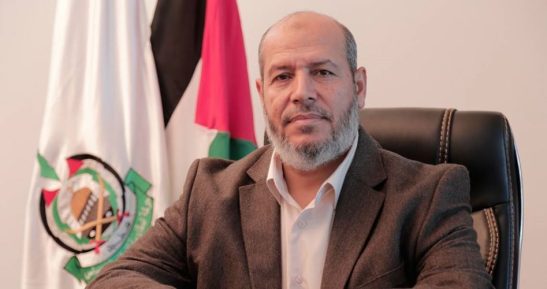
Head of Hamas in Gaza Khalil Al-Hayya
Al-Manar | March 30, 2025
Hamas said on Saturday it had approved a proposal from mediators for a ceasefire in the Gaza Strip, which it received two days earlier.
“In our commitment to our people and families, we have engaged with all proposals responsibly and positively, aiming to end the war,” Khalil Al-Hayya, head of Hamas in Gaza Khalil Al-Hayya, said in a statement.
“Two days ago, we received a proposal from our mediator brothers. We responded positively and approved it. We hope the occupation does not obstruct it or undermine the mediators’ efforts,” the statement added.
The statement also reaffirmed Hamas’ stance on armed resistance, calling it a “red line” and warning that “the weapon of resistance” will remain in the hands of the people and the state “if the Israeli occupation persists.”
“We will never accept humiliation or disgrace for our people. There will be no displacement or deportation,” it added.
Hamas further stated that, along with other factions, it had submitted to Egypt a list of independent professionals and experts to help form a committee to manage the enclave.
Israeli occupation forces resumed strikes in Gaza on March 18, ending a ceasefire agreement with Hamas that started on January 19. More than 50,000 Palestinians have been killed by the Israeli war on Gaza.
Hamas released on Saturday a video that shows one of the Israeli captives it is still holding on Gaza. The video showed him pleading the Zionist PM Netanyahu to approve an exchange deal in order to see his son.
Despite the intensive mediation efforts for a ceasefire, the Israeli Occupation Army said in a statement that its troops have begun new ground operations in the Al Janina area in Rafah, southern Gaza, aimed at expanding the security zone.
Anti-genocide activists exposed by pro-Israel groups using facial recognition tech
The Cradle | March 30, 2025
Foreign activists who took part in widespread campus protests against US support for the Israeli genocide of Palestinians in Gaza are being exposed by pro-Israel groups using facial recognition technology and tip lines, according to an investigation by AP.
Zionist organization Betar US has reportedly submitted a list of identified protesters to US federal officials. The list was compiled with the help of Eliyahu Hawila, a New York-based software engineer who built a facial recognition tool called NesherAI designed to identify masked protesters.
“It’s a very concerning practice,” said Abed Ayoub, National Executive Director of the American-Arab Anti-Discrimination Committee. “Essentially, the administration is outsourcing surveillance.”
Since the return of US President Donald Trump to power, the Immigration and Customs Enforcement (ICE) agency and the Department of Homeland Security (DHS) have detained or deported at least nine foreign university students for their activism in support of Palestine and against the US-Israeli genocide.
“Now they’re using tools of the state to actually go after people,” a Columbia graduate student from South Asia who has been active in protests told AP. “We suddenly feel like we’re being forced to think about our survival.”
“It might be more than 300 at this point. We do it every day. Every time I find one of these lunatics, I take away their visa,” State Secretary Marco Rubio said earlier this week when asked about the ongoing crackdown on pro-Palestinian students and academics.
“Please tell everyone you know who is at a university to file complaints about foreign students and faculty who support Hamas,” Elizabeth Rand, president of a group called Mothers Against Campus Antisemitism, said in a 21 January post to more than 60,000 followers on Facebook. It included a link to an ICE tip line.
In early February, messages from a chat group frequented by Israelis living in New York were published online. “Do you know students at Columbia or any other university who are here on a study visa and participated in demonstrations against Israel?” one message said in Hebrew. “If so, now is our time!” the message adds, accompanied by a link to the ICE hotline.
Earlier this week, Axios reported that the White House is threatening to block certain colleges from having any foreign students if it decides too many are involved in protests against Israel’s genocide in Gaza.
The war over war with Iran has just begun
By Sina Toossi | Responsible Statecraft | March 28, 2025
The war drums are getting louder in Washington.
In recent weeks, many of the same neoconservative voices who pushed the U.S. into Iraq are calling for strikes on Iran. Groups like the Foundation for Defense of Democracies and the Washington Institute for Near East Policy are once again promoting confrontation, claiming there may never be a better time to act. But this is a dangerous illusion that risks derailing what Donald Trump himself says he wants: a deal, not another disastrous war in the Middle East.
A war with Iran wouldn’t just risk another endless conflict. It would blow up Trump’s broader agenda at home and abroad.
A major conflict would drain U.S. resources and attention, distracting from domestic priorities and weakening America’s leverage on every front: China, Russia, Europe, and trade. Europe could seize the moment to prolong support for the war in Ukraine and resist Trump’s push to reset transatlantic ties. Trade partners like Mexico, Canada, India, and others could take advantage of America’s preoccupation to extract lop-sided concessions. And a unilateral strike would likely fracture the international community.
Russia and China, despite their own misgivings about Iran’s nuclear ambitions, would point to U.S. aggression as the real threat, undermining American credibility at the United Nations and beyond.
And the most dangerous consequence? A strike could backfire and push Iran to do exactly what Trump says he wants to prevent: build a bomb. Iran is already enriching uranium near weapons-grade. If it withdraws from the Nuclear Non-Proliferation Treaty, the last threads of international oversight would disappear. An attack would likely galvanize even more hardline elements in Iran and provide the political justification to sprint for a nuclear weapon.
Trump could go down in history, not as the president who solved the Iran crisis, but as the one under whose watch Iran finally became a nuclear weapons state. That’s not the legacy he wants, or one the country can afford.
Raising alarms, Trump recently declared, “Something will happen to Iran soon.” But he also made clear, “Hopefully, we can have a peace deal. I’m not speaking out of strength or weakness, I’m just saying I’d rather see a peace deal than the other.” These are not the words of a warmonger. They are the words of a negotiator, someone who still sees the value in diplomacy.
Trump is not alone. In a recent interview with Tucker Carlson, his foreign policy envoy Steven Witkoff offered a notably more restrained perspective on Iran than is typical from the foreign policy establishment. Witkoff emphasized pragmatism, verification, mutual respect, and, most importantly, avoiding conflict. His remarks reflected a grounded approach rooted in a clear understanding of both American interests and the region’s complex dynamics.
The problem is that many of the loudest voices shaping Iran policy — inside and outside the government — are actively working to sabotage any realistic path to diplomacy. They talk about wanting a “deal,” but what they’re actually demanding is Iran’s surrender: zero uranium enrichment, dismantling its nuclear program, cutting ties with all its regional allies, and fundamentally changing its foreign policy. No Iranian government — pragmatist or hardliner — could accept such terms. Even Masoud Pezeshkian, Iran’s newly elected president who ran on a platform of diplomacy and engagement, would have no political space to agree to that kind of ultimatum.
Let’s be clear: if you’re pushing for such maximalist demands under the guise of wanting a deal, you’re not working for peace. You’re laying the groundwork for war.
Iran is a complicated actor with a complicated history. But the lessons of the past decade are clear: when the U.S. engages Iran through diplomacy, it gets results. When it relies solely on pressure, it inches closer to conflict.
The point of pressure has always been to create leverage, not to impose costs for their own sake. That leverage now exists. The question is what to do with it.
The 2015 nuclear deal was far from perfect for any side, but it did succeed in placing tight constraints on Iran’s nuclear program and subjected it to unprecedented international inspections. The aim of withdrawing from that deal was to compel Iran to accept stronger terms. That hasn’t happened.
Instead, the result has been several years of Iranian nuclear expansion, regional instability, and growing alignment between Tehran, Moscow, and Beijing. Iran is now enriching uranium to 60% — dangerously close to weapons-grade — and stockpiling far more than before. Meanwhile, the international consensus that once backed U.S. efforts has frayed.
Now is the time to cash in on current U.S. pressure. Not by continuing on an escalatory path that leads to war, but by using the leverage that’s been built to strike a better deal — one that delivers strong constraints, more transparency, and greater long-term security for the United States.
Against this backdrop, hawkish voices are once again pushing the illusion that striking Iran would be quick and effective. A recent report from the Washington Institute for Near East Policy (WINEP) claims Israel’s alleged deep intelligence reach and risk tolerance make a “preventive strike” against Iran potentially “much more successful” than past American efforts, like when the U.S. attacked nuclear targets in Iraq in 1991 and 1993. But this dangerously downplays the risks. Even Trump’s allies are urging caution.
Vice President J.D. Vance, for example, rightly cautioned last October that “America’s interest is sometimes going to be distinct” from Israel’s — and made clear that avoiding war with Iran is in the U.S. interest. He warned such a conflict would be “massively expensive” and a “huge distraction of resources.” The reality is that a strike might at best delay Iran’s program while likely sparking a regional war, endangering U.S. troops, and pushing Iran to weaponize.
Indeed, even the same WINEP report that touts the feasibility of a strike quietly acknowledges the scale of what it would entail: “an open-ended, multiyear campaign to degrade Iran’s nuclear capabilities, influence its nuclear proliferation calculus, and shape its political and military responses.” In other words, this wouldn’t be a quick, surgical strike; it would be the beginning of another endless war in the Middle East.
Such a conflict would also carry steep economic costs, from skyrocketing oil prices to instability across the Middle East. And it would almost certainly backfire politically: Americans are war-weary, and polls show overwhelming support for diplomacy over conflict.
What’s needed now is a pragmatic strategy to de-escalate and reengage — one that offers Iran credible incentives in exchange for verifiable nuclear limits but doesn’t require dismantling its entire program.
The Iranian leadership has shown a consistent pattern in its dealings with the United States: pressure is met with pressure, while concessions are met with reciprocal steps. History has made clear that what moves the needle is not ultimatums, but a formula grounded in mutual respect, trust-building, and incremental, verifiable actions. Witkoff’s recent interview signaled a welcome openness to serious diplomacy, but rhetoric alone is not enough. To resonate in Tehran, it must be paired with credible, calibrated actions.
Modest, realistic steps — such as allowing a limited release of Iran’s frozen assets for humanitarian purposes or reviving President Emmanuel Macron’s 2019 proposal for a credit line backed by future oil revenues — would not require lifting core U.S. sanctions. Yet they could offer enough tangible benefit to bring Iran to the table. These measures should be linked to parallel Iranian concessions, such as slowing the accumulation of highly enriched uranium and enhancing IAEA access.
Another option is a negotiated “pause:” a fixed-duration agreement where the U.S. freezes further escalation of sanctions and refrains from imposing new pressure, while Iran halts key elements of its nuclear expansion. This mutual freeze could serve as a time-bound window for more comprehensive talks — buying time, lowering tensions, and creating space for diplomacy to succeed.
Critics will claim this approach “rewards bad behavior.” But the real question isn’t about rewarding anyone, it’s about results. What actually reduces the risk of Iran getting a nuclear weapon or dragging the U.S. into another endless war? The record speaks for itself: pressure detached from feasible diplomatic outcomes hasn’t delivered results. In fact, pressure for its own sake has backfired — driving Iran’s nuclear program forward and repeatedly bringing the U.S. to the brink of conflict.
Some will say Iran cannot be trusted. That’s precisely why inspections and verification are essential. When a deal was in place, international inspectors had access to Iran’s nuclear facilities, and the program was significantly constrained. Military strikes, by contrast, would likely end all transparency and push Iran to withdraw from the Non-Proliferation Treaty, eliminating the last tools for monitoring and oversight.
There’s no perfect deal. But the smart play is a deal that contains Iran’s nuclear program, avoids a war, and keeps the U.S. in the driver’s seat. That should be the goal of any serious policy, not wishful thinking or ideological crusades.
President Trump has always seen himself as a dealmaker. Now’s the moment to make one that matters. He should empower voices in his camp — like Steven Witkoff — who understand that diplomacy isn’t weakness, it’s strategy. Rejecting the tired playbook of regime change and endless escalation would show real leadership.
Sina Toossi is a non-resident fellow at the Center for International Politics. Previously he was senior research analyst at the National Iranian American Council, and a research specialist at Princeton University’s Woodrow Wilson School of Public and International Affairs.
From JFK to Donald Trump: How the USA Became Wedded to Zionist Israel
By Rick Sterling | Global Research | March 28, 2025
There are many contrasts between the 35th president, John F. Kennedy, and the 45th and 47th president, Donald J. Trump. One extreme example is regarding U.S. policy toward Israel.
JFK and Israel/Palestine
Unknown to many people today, JFK supported Palestinian rights and sought a sustainable peace in the region.
In 1960, when JFK was campaigning to be president, he spoke at the convention of the Zionists of America. In his speech, Kennedy was complimentary about Israel but frankly said,
“I cannot believe that Israel has any real desire to remain indefinitely a garrison state surrounded by fear and hate.”
That warning, issued when Israel had only existed for 12 years, was ignored. Israel continued to act in an aggressive zionist fashion.
Kennedy did not just issue warnings. To the chagrin of the Israelis, JFK established friendly relations with Egypt’s President Nasser. The Kennedy administration provided loans and aid to Egypt.
The JFK administration supported UN resolution 194 which called for the right of return for Palestinian refugees driven out of their homeland. Although Israel committed to abide by UN resolutions when it was admitted to the United Nations in 1949, the Israelis reneged on this commitment and were hostile to the resolution. The day before JFK was assassinated, the New York Times reported (p 19), “Israel Dissents as U.N. Group Backs U.S. on Arab Refugees” and “U.S. Stand Angers Israel.” The second item begins, “Premier Levi Eshkol expressed extreme distaste today for the United States’ position in the Palestinian-refugee debate.”
John Kennedy’s brother Robert was Attorney General and headed the Department of Justice. For two years, up until the end of 1963, the DOJ made increasingly strict demands that the American Zionist Council (AZC) register as agents of a foreign country. In response, the AZC stalled, delayed, and created the American Israel Public Affairs Committee (AIPAC).
The most intense disagreement between Tel Aviv and Washington was regarding the nuclear site under construction at Dimona. JFK was intent on stopping the expansion of countries which possessed nuclear weapons. Although IsraeliPrime Minister Ben-Gurion said the nuclear site was for peaceful purposes, JFK insisted that the US needed to inspect and confirm this. The inspection deadline was December 1963.
In each of these four areas of contention, US policy changed dramatically after JFK was assassinated and Lyndon Johnson became president. Dimona was never properly inspected, and LBJ did not object to Israeli acquisition of nuclear weapons. The demand that the American Zionist Council register as an agent of a foreign country was dropped. Over time, the US withdrew their support of UN resolution 194, and LBJ was hostile to Nasser and ended US loans and support. Details of this process are described in this article and this book.
Israel Policy Since JFK and Today
With few exceptions, US policy has been subservient to Israel’s wants ever since JFK. An extreme low point was the treachery of President Johnson in covering up the Israeli attack on the USS Liberty during the June 1967 “Six Day War”. News about the Israeli killing and injuring of over 200 US sailors was suppressed for decades.

Damaged USS Liberty on 9 June 1967, one day after attack (Public Domain)
Now we are in a new extreme low point. In his first presidency, Trump flouted international law and longstanding US policy by moving the US Embassy from Tel Aviv to Jerusalem. The significant move was driven by mega donor Sheldon Adelson who wanted it announced on Trump’s first day in office. Another prime concern of Adelson was to torpedo the Joint Comprehensive Plan of Action (JCPOA) with Iran. Trump responded as expected and withdrew the US from the agreement, effectively killing it.
Now President Trump’s administration is trampling on the right to free speech and aggressively suppressing critics of Israel. This repression on behalf of Israel was taking place under Biden but has escalated dramatically. Authorities have imprisoned a perfectly legal resident, Mahmoud Khalil. They have forced Columbia University to punish students without just cause and to impose obvious restrictions and prohibitions on speech and opinion. Why did they do this? It appears to follow the wishes of megadonor Miriam Adelson. She is president and chief funder of the Maccabee Task Force, which has campaigned on these issues for months.
As reported at Responsible Statecraft,
“Adelson’s support for the administration’s campaign to stifle criticism of Israel on college campuses isn’t a new focus but her alignment with the levers of state powers to implement her vision are unprecedented. In fact, tax documents reveal that she is directly overseeing a social media campaign targeting Khalil and Columbia University.”
In addition to suppressing free speech and punishing critics of Israel, the Trump administration has bombed and attacked an independent country (Yemen) in the service of Israel. They are doing this despite the fact that Yemen did NOT threaten U.S. ships in the region. The Houthi government only threatened Israeli ships after Israel unilaterally broke the ceasefire and prevented food and other necessary humanitarian aid getting into Gaza. Israel, with U.S. support, is blatantly defying the International Court of Justice which ordered Israel to “maintain open the Rafah crossing for unhindered provision at scale of urgently needed basic services and humanitarian assistance” and “immediately halt its military offensive, and any other action in the Rafah Governorate, which may inflict on the Palestinian group in Gaza conditions of life that could bring about its physical destruction in whole or in part.” Israel is in violation of this order and the US is complicit by providing most of the weapons.
President Trump, who campaigned and won election on the pledge to STOP needless wars, has started a new war with Yemen which is of no benefit to the US but serves the interests of Netanyahu’s Israel. Will he authorize attacks on Iran, in further subservience to Bibi?
Corruption of the Political Process
When Jewish donors to JFK’s 1960 campaign suggested they should determine his Mideast policy, JFK was shocked and definitively said NO. As reported by Seymour Hersh in “The Samson Option”, Kennedy talked with a friend who described what happened: “As an American citizen he (JFK) was outraged to have a zionist group come to him and say, ‘We know your campaign is in trouble. We’re willing to pay your bills if you’ll let us have control of your Middle East policy.” At that time, JFK vowed to change the US electoral system to prevent this corruption if he got elected. As president, he tried, but faced big hurdles and did not succeed.
Ever since JFK’s death, pro-Israel forces have had undue influence on U.S. policy. If the International Court of Justice decides that Israel is committing genocide, as seems likely, the U.S. will be the primary collaborator in the war crimes. The US is increasingly alone in supporting the zionist state as it practices apartheid within Israel, theft of land in the West Bank, and massacres in Gaza including attacks on hospitals, schools, and UN facilities. Fourteen countries now support South Africa’s charges of genocide against Israel.
Under Democratic President Joe Biden, U.S. policy to Israel was unwaveringly obsequious. Despite 70% of Democratic Party voters wanting the U.S. to get a ceasefire in Gaza, the Biden/Blinken team refused to do this. The Democratic Party leaders’ zionist ideology combined with zionist financial influence superseded their party members’ wishes. Netanyahu ignored Biden’s “red lines” with impunity.
Republican President Trump has taken this to a new level. His zionist donors determine his Israel policy. To protect Israel, Trump issued an executive order which weaponizes antisemitism. Universities are being compelled to implement a new definition of antisemitism which conflates criticism of Israel with ethnic discrimination. Trump’s campaign to “Make America Great Again” has evolved into “Miriam Adelson Gets All”.
It is a remarkable descent from the days when JFK did what was best for the U.S. as well as being best for Palestinians and non-zionist Jews.
Rick Sterling is an independent journalist based in the San Francisco Bay Area. He can be reached at rsterling1@gmail.com.
Iran urges EU to address Israel’s genocide, aggression instead of leveling ‘hypocritical’ claims
Press TV – March 27, 2025
Iran says the European Union should address the Israeli regime’s genocide and aggression against the countries in the region instead of leveling “hypocritical” claims against Tehran.
Iranian Foreign Ministry spokesman Esmaeil Baghaei made the remark on Thursday in reaction to the latest allegation by European Union foreign policy chief Kaja Kallas, who on Monday claimed Iran posed a threat to global stability and said Tehran must never be allowed to obtain a nuclear weapon.
Kallas made the remarks during a press conference in al-Quds with Israeli foreign minister Gideon Sa’ar.
She also accused Iran of supporting Russia in the war with Ukraine.
Baghaei condemned the EU’s double standard policies and said, “If Kallas is truly concerned about stability and security in the region, she should address the [Israeli] regime’s genocide in Gaza and its repeated acts of aggression against Lebanon and Syria as well as the military occupation of these two countries’ territories.”
He added that such baseless statements, illogical remarks and hypocritical claims against Iran lack credibility.
Unlike her predecessors, who tried a bit to consider the principles of international law in expressing the EU’s positions, Kallas “speaks recklessly”, the Iranian spokesperson emphasized, warning that even if the EU foreign policy chief’s remarks are rooted in her lack of experience, they would further undermine Europe’s credibility in the eyes of any impartial observer.
Iran has repeatedly rejected accusations that it has supplied weapons to Russia for direct use in the war in Ukraine.
Meanwhile, Russia has repeatedly warned that a flow of Western weapons to Ukraine will only prolong the conflict.
Tehran has also stressed on numerous occasions that it is not seeking nuclear weapons and has put its civilian nuclear program under the surveillance of the International Atomic Energy Agency which has verified its compliance with the Nuclear Non-Proliferation Treaty (NPT), to which Tehran is a signatory.
The allegations against Iran come as Israel is believed to be the sole possessor of nuclear weapons in West Asia.
Some New Tales from the Darkside
Beatings and arrests continue both in the US and the Middle East
By Philip Giraldi • Unz Review • March 27, 2025
The news cycle over the past week has been dominated by reports and analysis of the Signal group chat involving top national security officials discussing aspects of the recent air strikes which have been directed against the Houthis in Yemen. There are four basic issues that are being examined by both the media and by elected and appointed government officials. First is the apparent ignorance of ordering the strike at all since the panel appeared not to know very much about the target or why the US was escalating the conflict. Second, was the possibly accidental inclusion in the list of participants of a journalist who is closely connected to Zionist Israel, having voluntarily served in the Israeli Army as a prison guard, where he may have tortured Palestinians, and who plausibly is a dual national US-Israeli citizen. Third is the security of the Signal technology itself, which was reportedly initially created to permit such sharing of confidential views online for criminal purposes, but which might be vulnerable to penetration by any professional foreign intelligence service including those of Russia, China, the United Kingdom and, of course, Israel, which would have had a serious interest in what Washington was intending to do in Yemen. Fourth, is the question whether Donald Trump knew about the meeting and approved what was being discussed.
My own experience of secure communications enabling meetings goes back nearly fifty years when nearly every national security-linked facility, including Embassies and military bases, had a so called “bubble” which was enclosed and electronically sealed to prevent outside penetration to learn what was being discussed and by whom. Since that time, there have been huge advances in protecting communications but friends who are still in the intelligence community insist that what is being protected can be made vulnerable by the cyber agencies that exist in various competitive countries that spend billions of dollars to do just that.
The participants in the Signal meeting are now scrambling to make their case that they did nothing wrong, and Defense Secretary Pete Hegseth in particular is arguing that the discussion was not classified even though the issue related to sensitive intelligence regarding the United States plans for escalating a war against a country with which it was not technically at war. The deniers are certainly wrong in making that case, either that or they were incapable of understanding what was on the table. The presence of Jeffrey Goldberg of The Atlantic magazine is more difficult to comprehend as he is no friend of the Trump Administration, but it is now being argued that it was either done absentmindedly by Michael Waltz, the national security director who chaired the meeting, or it was caused by a fit of confusion due to the fact that the “Goldberg” who was supposed to be invited was someone else. In any event, Jeffrey Goldberg first surfaced the story of the Signal meeting and then followed up with a full transcript. Was it all some kind of clever ploy to push Trump into making the decision to go full throttle and attack Iran? It would not be above Netanyahu to arrange something that convoluted and flat out evil and we shall see about Iran soon enough, but certainly Goldberg could only have been there due to manipulation of a situation in which he was pursuing a pro-Israel agenda. Waltz is taking credit for the snafu at the moment but that position might change as he comes under more pressure to resign.
In any event, the Signal story will no doubt be discussed and both embellished and dismissed during the next few days, but one thing it does demonstrate is the relative lack of knowledge that comes across as incompetency on the part of the Trump national security team. And the role of Trump himself will also be hotly debated as he has personally been playing a key role in foreign policy decision making, though so far he is only speaking up to support the work of his subordinates.
Actually there are couple of other stories that surfaced last week that I much prefer. First is the ongoing battle to silence, imprison and actually deport anyone who is critical of Israel or of Jewish group behavior. This has been job number one for the Israel Lobby, which has been eminently successful under both the Joe Biden and Donald Trump administrations, so much so that the sentiment that Israel controls America has been growing among the US public to such an extent that it surfaces regularly.
The Justice Department has reportedly acted on President Trump’s Executive Order on Additional Measures to Combat Anti-Semitism, through the formation of a multi-agency Task Force to Combat Anti-Semitism. The Task Force’s first priority will be to root out anti-Semitic harassment in schools and on college campuses. It is currently on the prowl, visiting four cities (Chicago, New York, Los Angeles and Boston) where it will investigate ten elite universities. It has been suggested that Israeli investigators might well be part of the teams that will actually go into the classrooms, dormitories and administrative buildings on campus, all done without search warrants or probable cause. And the universities have basically surrendered over the issue of freedom of speech, guaranteed by the First Amendment to the Constitution of the United States and regarded by many as the “right” that is most vital if the people are to enjoy fundamental liberties.
A recent arrest of a foreign student took place in Somerville Massachusetts on Tuesday March 25th when Turkish graduate student Rumeysa Ozturk was on her way to meet friends at an Iftar dinner to break their Ramadan fast, but she never made it. Instead, the 30-year-old was arrested and physically restrained by six armed plainclothes immigration officers near her apartment, close to Tufts University’s campus where she was a PhD student. Surveillance cameras show how one officer wearing a hat and hoodie grabbed her arms, causing her to shriek in fear while another confiscated her cell phone. The officers reportedly only showed their badges after Ozturk was restrained with her hands cuffed behind her back. According to the University, she was enrolled in a doctorate program at Tufts University on a valid F-1 visa, which allows international students to pursue full time academic studies, in which she was in good standing. A Department of Homeland Security (DHS) spokesman issued a statement on Wednesday claiming that Ozturk “engaged in activities in support of Hamas, that relishes the killing of Americans” but didn’t specify what those alleged activities were. In fact, friends report that Ozturk has not even been active in pro-Palestinian demonstrations. The DHS spokesman never the less pressed on and explained “A visa is a privilege not a right. Glorifying and supporting terrorists who kill Americans is grounds for visa issuance to be terminated. This is commonsense security.” Nevertheless, no actual charges have been filed against Ozturk but the State Department has indicated that her visa has been terminated and she has been transferred to the Central Louisiana Immigration and Customs Enforcement (ICE) Processing Center in Basile, where other students are also being held.
It is believed that Ozturk’s actual “crime” consisted of having cowritten a March 2024 op-ed in the school’s newspaper where she criticized Tufts’ response to the pro-Palestinian movement, calling for the school to “acknowledge the Palestinian genocide” and also urging divestment of any holdings in Israeli companies and government. Ozturk was to a certain extent a victim of vigilante justice. Her photo and details appear on a website called Canary Mission, run by a Jewish extremist group that says it is dedicated to documenting individuals and organizations “that promote hatred of the USA, Israel and Jews on North American college campuses and beyond.” Tufts University officials said the school had no prior knowledge of the arrest and did not cooperate with it. Several professors, speaking off the record, were shocked and described how many on campus are fearing what comes next.
One final tale comes from a place formerly known as Palestine, where armed Israeli settlers descended upon the Palestinian village of Susiya in the Masafer Yatta region of the occupied West Bank and assaulted Hamdan Ballal. Ballal is the co-director of the film “No Other Land” which recently has been in the news since it won an Oscar in Hollywood for best documentary. As is always the case when Jews assault Arabs, Israeli soldiers were present at the scene and stood by as Ballal was attacked and beaten along with other local residents, only to then detain him and two other Palestinians overnight in a military base, where they endured further abuse from the “Most Moral Army in the World” before being released.
Of course, President Trump did not register a complaint at the treatment of Ballal. What happened to the Palestinian was not just a random encounter. As co-director of a film that documents the ethnic cleansing of Palestinians and the violent expansion of Israeli settlements in his region, he has used his platform to speak directly and unapologetically about Israeli apartheid and theft. Friends of Israel clearly see that as a threat and they have succeeded in blocking the showing of the documentary in the US, where it has been unable to obtain a distributor. Targeting Ballal is part of a broader strategy by the Israeli government and groups like the settlers of silencing Palestinian cultural figures and truth-tellers, especially those who succeed in establishing prominent narratives worldwide. The underlying message is that if even an award-winning filmmaker isn’t immune to state violence, then Palestinians should rightly walk in fear or get out. The sad part is that international media, which should have recognized something was wrong when Palestinians without global awards and credentials — students, farmers, mothers, teachers — have been arrested and beaten and tortured by Israeli forces every day, ignored their plight. Their stories do not make headlines. Their names are rarely known. In death, all they become is a number, like the tens of thousands who are buried under rubble in Gaza and who will never be commemorated.
Philip M. Giraldi, Ph.D., is Executive Director of the Council for the National Interest, a 501(c)3 tax deductible educational foundation (Federal ID Number #52-1739023) that seeks a more interests-based U.S. foreign policy in the Middle East. Website is councilforthenationalinterest.org, address is P.O. Box 2157, Purcellville VA 20134 and its email is inform@cnionline.org.
The First Amendment Protects Mahmoud Khalil
By Gary Chartier | The Libertarian Institute | March 26, 2025
One of Donald Trump’s first official actions as president was to sign an executive order designed to protect freedom of expression against government pressure. Soon after, Vice President J.D. Vance issued a vigorous challenge at the Munich Security Conference to speech restrictions in Europe. After years of government assaults on freedom of expression, people who cared about First Amendment values were cautiously optimistic.
Then came the administration’s attempted deportation of Mahmoud Khalil.
Khalil, a permanent legal resident of the United States who is married to an American citizen and who is soon to be a father, was detained by the government after he participated in protests focused on the plight of people in Gaza.
In a court filing supporting the decision to deport him, the administration maintained that his “presence or activities in the United States would have serious adverse foreign policy consequences for the United States.”
Obviously, this can’t mean that he was physically impeding the formulation or implementation of foreign policy. He threatened, if he did, to bring about “serious adverse foreign policy consequences for the United States” because what he did had the potential to change people’s minds. He was targeted because of the anticipated impact of his actual (and potential) expressive activity.
Secretary of State Marco Rubio offered a similar rationale for Khalil’s deportation. “And if you tell us, when you apply for a visa, ‘I’m coming to the U.S. to participate in pro-Hamas events,’ that runs counter to the foreign policy interest of the United States of America,” according to the Secretary. “If you had told us that you were going to do that, we never would have given you the visa.” (He makes a separate point about Khalil’s involvement in disruptive activities on the Columbia University campus, which I’ll bracket here.)
Rubio’s claim about “the foreign policy interest of the United States” makes sense only if, again, the worry is that the kind of protest in which Khalil was involved risked contributing to changes in policy, or at least signaled Khalil’s personal opposition to the that policy. (Rubio conveniently equates current U.S. foreign policy with “the foreign policy interest of the United States.” But let that slide.)
Khalil has been targeted because of core First Amendment activity: speech and assembly.
Rubio and other defenders of the administration’s position might argue for the legitimacy of Khalil’s deportation by arguing that, as a non-citizen, he’s not protected by the First Amendment. But the Constitution’s language makes no reference to citizens. And there are good reasons for treating it as applicable to Khalil.
The Bill of Rights appears to be intended to apply across the board to those affected by the actions of the U.S. government. Does anyone seriously think that the government could deny non-citizens the protection of the Seventh Amendment right to trial by jury in civil cases, or claim that the Eighth Amendment’s prohibition of excessive bail is inapplicable to non-citizens? Unless the Constitution explicitly limits a given safeguard to citizens, we should read it as protecting everyone the government can impact.
And permanent residents, like Khalil, seem especially worthy of constitutional protection. After all, they are not tourists or brief visitors. They have established substantial ties to the United States and have demonstrated that they are good neighbors. They are often on the road to citizenship.
Whatever we judge to be the primary focus of the First Amendment, singling our people for sanctions because of what they say is deeply problematic. When the government targets the nonviolent expression of particular ideas, on anyone’s part, it sends the message that those ideas are disfavored and that others expressing them can expect to be penalized. Deporting Khalil because of the potential impact of his expressive acts exerts a chilling effect on the expression of officially disapproved ideas about the Middle East—by citizens as well as non-citizens.
The content-focused rationale the government has offered for Khalil’s deportation is a rationale it could invoke to attack citizens for what they say, too. A U.S. citizen who writes an op-ed criticizing some aspect of current foreign policy and whose action the government believes could influence others to avoid supporting its position could be penalized in multiple ways. Citizens (probably) can’t be deported for political dissent. However, if the rationale the government has offered here is upheld, they could be denied other discretionary benefits.
The First Amendment should also be read as protecting Khalil from deportation for the content of his speech because it doesn’t primarily or exclusively serve the interests of speakers. At least as important is the protection it offers to listeners.
Restricting listeners’ access to information undermines democracy and the free formation of public opinion. The more people have the chance to encounter varied voices, the more they have the chance to weigh arguments, evaluate insights, and assess factual claims for themselves. A government that can filter what people hear can artificially insulate its policies against critical push-back and keep them from being altered in light of relevant facts and norms. (Consider, for instance, how frequently governments that rush to war try to censor not only stories about specific military actions or espionage techniques but also arguments for peace.)
There’s no Middle East exception to the First Amendment. The administration can underscore its commitment to freedom of expression by not acting as if there were. The Constitution weighs strongly against deporting Khalil on the basis of what he’s said. Freeing him will benefit not only him and his family but also all Americans.
Trump Revolution? Diplomacy Toward Yemen, Iran, Russia & China
Larry Johnson with Glenn Diesen
Glenn Diesen | March 26, 2025
Larry Johnson, a former CIA Intelligence Analyst, argues that Trump’s international diplomacy may be derailing. JD Vance recognised in private messages that bombing Yemen was a mistake and contradicted the America First platform, although the attacks nonetheless took place. Is America returning to its forever wars?
Oxford city council passes boycott divestment, sanctions motion
Press TV – March 26, 2025
The Oxford City Council has passed a motion supporting the Boycott, Divestment, and Sanctions (BDS) movement against Israel, in accordance with International Court of Justice (ICJ) rulings.
On Monday, the members of Oxford City Council unanimously voted for an “ethical investment and procurement” process against Israel.
The motion calls on the Oxford City Council to avoid cooperation and trade with entities complicit in human rights violations and international law.
In January 2024, the ICJ delivered an interim ruling that said it was plausible that Israel was committing genocide in Gaza. The court called on Israel to refrain from impeding the delivery of aid into Gaza
Amongst other orders, ICJ also ordered Israel to avoid acts of genocide in the besieged enclave and punish incitement to genocide.
The Israeli regime not only has continued to ignore the ICJ’s rulings but also has committed numerous acts of genocide against the people of Palestine, including the restriction of the delivery of international aid into the besieged enclave.
Given Israel’s disregard for the Court’s orders, Oxford councilor Hosnieh Djafari-Marbini said councilors had “unanimously passed a boycott and divestment motion citing the ICJ rulings on Palestine.”
One of the motion’s proponents, councilor Barbara Coyne, said in a press release, “I hope this motion will be thoroughly implemented, and that its passage may pave the way for other councils to take decisive action.”
In addition, the Council has called on the Oxfordshire Investment Fund to divest more than 157 million pounds from companies complicit in the Israeli regime’s apartheid, genocide, occupation, and settler colonialism.
The people of Palestine have long called for boycott, divestment, and sanctions, including an arms and energy embargo, against the occupying regime.
The BDS movement demands that Israel, under international law, withdraw from the occupied territories, remove the separation barrier in the West Bank, and respect the rights of Palestinian refugees to return to their homes and properties.
Featured Video

Iran is (probably) collecting tolls, and why Asia stopped buying oil from the US
or go to
Aletho News Archives – Video-Images
From the Archives
The Great Recycling Scam
By Dr. Vernon Coleman – 21st Century Wire – September 2, 2022
Recycling was introduced, worldwide, as a tool to teach citizens to become compliant.
Forcing citizens to sort their rubbish into up to nine separate bags or boxes every week had absolutely nothing to do with ‘saving the planet’ and everything to do with teaching citizens (through a mixture of fines and shame) to behave ‘responsibly’ i.e. to do as they were told without looking too closely at the rationale of what they were being told to do.
The recycling never had anything to do with protecting the planet, of course. Most of the rubbish sorted, washed and collected in the UK was taken abroad, by lorry or ship or train, and burnt or dumped. It was, quite simply, impractical and not cost effective to recycle the material that had been collected. And, of course, collecting the sorted rubbish involved massive costs in terms of cash and pollution.
Today, the recycling business has reached an apogee of lunacy. Councils introduce ever more complex rules and fees. They refuse to take away much of the waste that is collected. And those wanting to take their rubbish to a ‘recycling’ centre will probably have to make an appointment and answer a host of questions.
It is no surprise that fly-tipping has become a major problem. The biggest causes of plastic in the sea are dumped fishing gear and plastic waste (much of it officially designated as recycled) which has been dumped by ships.
The good news, however, is that in Britain, recycling rates are falling. More and more people have become aware that the whole recycling movement was just another piece of manipulative trickery.
Blog Roll
 Aletho News
- Weaponized Journalism: 2021 Sayer Ji Interview with NPR
- Beyond Netanyahu: what Israel’s election means for Palestinians
- Lithuania plans universal conscription
- Lies, Damn Lies, and Ukraine News
- Financial Times rejects Nordic demands to correct Putin call story – media
- The Case for Less Unity in Europe
- Ukraine expands minority rights under EU pressure – but Russians remain excluded
- Albania takes anti-riot crackdown cue from France
- The interest of the House of Rothschild in Ukraine
- Pentagon fires top military planner
- If Americans Knew
- An error has occurred; the feed is probably down. Try again later.
- No Tricks Zone
- Germany’s Green Energy Transition Becoming Increasingly Expensive…Another 6 Trillion Euros!
- Sudden Stratospheric Warming, Powerful El Niño Combination May Lead To Extreme Europe Cold, Energy Crisis!
- Two New Studies Find Thwaites Glacier Melt Cannot Be Driven By Human Activity Or A Warming Ocean
- E-Cars Reduce CO2 Emissions By Only 41% Compared To Internal Combustion Engine Vehicles
- Predictions Made By Renowned Climate Professor Over Past Decades Have Been Proven To Be Poor
- New Study Suggests Large Regions Of The Pacific Ocean Have Been Cooling For The Last 80 Years
- Germany’s Green Energy Debacle: High Energy Costs Force Kahla Porzellan to Close After 182 Years!
- New Study: 50 Years Of The Most Aggressive ‘Net Zero’ Policies Can Only Affect The Global Climate By 0.03°C
- US September “Heat” Was No Record…Many Records Set Decades Ago
- Latest European Green Energy Debacle; Portugal’s Largest Flagship Solar Park Insolvent!

