Who Rules America? The illusion of Self Rule
By Greg Felton | Institute for Political Economy | January 22, 2020
A government, whatever its nature, rules as an imperial power over its people. The surest way to exercise this control is to prop up the illusion that it acts in the public interest. Paul Craig Roberts and Alvin Rabushka spelled out this salient fact in the March 1973 issue of Public Choice, in their article “A Diagrammatic Exposition of an Economic Theory of Imperialism,” and what they wrote is no less relevant today.
The act of voting is one of the props that sustains the delusion of self-rule. People do vote, but the candidates are decided by the oligarchy of organized interest groups. This is also the conclusion of a 2014 study by Princeton University professors Martin Gilens and Benjamin I. Page about the extent to which U.S. government policy reflects public preferences. Gilens and Page found that voters are, to all intents and purposes, irrelevant to their own “democratic” government:
“[The] preferences of the average American appear to have only a minuscule, near-zero, statistically non-significant impact upon public policy . . . Moreover, because of the strong status quo bias built into the U.S. political system, even when fairly large majorities of Americans favor policy change, they generally do not get it” (Perspectives on Politics, Vol. 12, No. 3, pp. 575, 76).
Instead of representing the common interest of the people, government answers to organized interest groups. Gilens and Page cite the dominance over policy of special interests who use public policy to serve their interests rather than the public’s. We see the effects of this plutocracy in the sharp rise in the inequality of income and wealth, a gap which has grown into a chasm.
Gilens and Page’s analysis of the Unelected Plutocracy of America is on the money, but their understanding of the threat to America’s democracy does not consider foreign policy, which is partly, if not largely, in the hands of a foreign country—Israel. It is not enough to lay the decline of American democracy at the feet of vested interests such as Wall Street, big banks, and the military–security complex, because it is not in their interest to have the government pursue foreign policy contrary to the national interest.
But operating contrary to the national interest is precisely what Washington has been doing. In the 21st century, Washington has squandered trillions of dollars on military aggression. Hundreds of thousands of U.S. military personnel have been killed, maimed or driven to suicide. The U.S. has derived no benefit from provoking the enmity of Muslim people, bullying NATO allies into abetting this belligerence or persecuting those who expose associated crimes. Even Donald Trump, who ran for the presidency on ending wasteful wars of aggression, continues this self-inflicted economic and political harm, most recently by waging economic war against Iran and sabre-rattling to provoke a shooting war.
The Trump administration is a continuation of decades of Washington’s kowtowing to the Israel Lobby. To appreciate the lack of independence of US foreign policy requires an act of intellectual courage, but few Americans are equipped for the trauma of knowing the truth. To borrow from The Matrix, not many are willing to take the “red pill” to see the reality behind the controlled explanation. “Blue pill” existence comes with a ready-made worldview based on controlled explanations in which believers find comfort, meaning and belonging. Anything that challenges this illusion, is discounted as conspiracy theory or anti-semitism. Comforting beliefs can take precedence over US national interests.
To “take the red pill” requires an inquisitive mind to reject illusion and to question fundamental assumptions. If it is irrational for a democratic state like the U.S. to harm its own people, damage its own economy and invite hostility by provoking needless wars, perhaps the U.S. is not really a democratic state and not really in charge of its own policy. From an American standpoint, the seemingly inexplicable acts of U.S. belligerence and punishment of those who pose no threat to America can be understood as the consequence of permitting Israeli money and influence to shape US foreign policy in the Middle East and to some extent elsewhere if it bears on Israeli interests.
The U.S. that was founded in 1776 is not the same U.S. that exists today. The founding fathers warned against foreign entanglements, but Washington has sought entanglement. Since the late 1940s, the U.S. has gotten entangled in the service of Israel’s interests. The importance of Israel’s interest to U.S. foreign policy has been elevated by a pervasive Christian prejudice, in which Jews are seen as religiously kindred and Muslims as religiously hostile.
In 1948 President Harry Truman took an infamous $2 million election campaign bribe from an American Zionist to support the creation of Israel. By doing so Truman became midwife to an ongoing war crime that has resulted in Washington aiding and abetting Israel’s theft of Palestine. Washington blackmailed and intimidated several UN delegations into supporting the 1947 partition of Palestine. For a country that boasted of its commitment to democracy and support for the UN Charter, Washington’s conduct made no sense. However, if one recognizes that Washington was acting in behalf of Israel, it becomes understandable.
With a foothold gained from Truman’s electoral opportunism, the domestic Israel Lobby gradually gained influence over the U.S. government to the point that today Washington serves Israel’s interest without thinking of its impact on US national interests and without regard to the adverse effects on American interests or those of other people.
After years of Washington’s growing service to Israel, President George H.W. Bush tried to pull back. President Bush thought that he could bring about a final peace treaty between Israel and the Palestinian leadership in Madrid based on “land for peace.”
Bush’s assertion of foreign policy independence infuriated Israel, which proceeded to stage overt and covert attacks on Bush. The overt attack occurred on Feb. 26, 1992, when the domestic Israeli pressure group calling itself, absurdly, the “The Committee on U.S. Interests in the Middle East,” took out a full-page ad in The New York Times to excoriate Bush for “pressuring” Israel to enter into negotiations. Its signatories included neoconservative Israel-firsters like Paul Wolfowitz, Richard Perle, Douglas Feith and Elliott Abrams.
According to a former Mossad agent, the covert attack took the form of a planned assassination of President Bush. Victor Ostrovsky in his book, By Way of Deception (pp. 281-282), writes that on Oct. 1, 1992, he received a nervous call from Ephraim, a Mossad officer of his acquaintance, who opposed the assassination: “They’re out to kill Bush… I mean really kill, as in ‘assassinate.’… during the Madrid peace talks.” Ephraim asked Ostrovsky to leak the plot in hopes the American government would act to prevent it. Ostrovsky did so in an Oct. 1, 1992, speech in Ottawa. From there, the leak made its way to former California congressman Pete McCloskey, the Secret Service, the State Department, the CIA, the U.S. embassy in Ottawa, and finally the press. The assassination was called off.
Bush’s assertion of independence from Israel resulted in Israel’s meddling in the 1992 presidential election which cost Bush re-election and marked the last time that a U.S. president would dare challenge Israel’s self-proclaimed right to murder, torture, dispossess and displace Palestinians.
The eight years of Bill Clinton’s presidency saw a consolidation of Israel’s power over Washington. Clinton showed his willingness to act in Israel’s interest by agreeing to set amounts of aid to Israel––imperial tribute in the view of some––even before he was sworn in as president. It was the Clinton administration that responded to Israeli pressure for action against Iraq by creating the illegal no-fly zones over Iraq, which caused the death of 500,000 Iraqi children. When asked about this by a reporter, Clinton’s Secretary of State Madeleine Albright said, “the price was worth it.” In other words, the death of a half a million Iraqi children served American and Israeli interests.
Israel’s influence over US foreign policy reached a zenith with George W. Bush. In the name of the “war on terror,” that is, the war on Israel’s enemies, the Bush regime subverted the US Constitution. The Bush government was filled with neoconservatives associated with the Project for a New American Century. The PATRIOT Act, drafted, according to his own admission three weeks prior to the events of September 11, 2001, by neoconservative Philip Zelikow, who later headed up the 9/11 Commission, became law despite the US Congress having no time to read and discuss the tyrannical legislation before passing it. The fact that a draft of the PATRIOT Act existed prior to 9/11 raises many questions. The passage of the act told Americans that Muslims were such a threat that Americans would have to accept infringements on their civil liberties. President Bush made that even more clear when he announced that he was setting aside the US Constitution and suspending habeas corpus.
During the Obama administration Israel dramatically demonstrated its power over the US government when the US Congress intervened in the dispute between Obama and Netanyahu over whose power was supreme in American politics, the power of the American president or Israel’s. Repudiating their own president, Congress invited Netanyahu to address a joint session of the House and Senate and responded to Netanyahu with many standing ovations.
Trump has perpetuated Israeli control over US foreign policy. Trump broke universal policy and recognized Jerusalem as Israel’s capital. He gave Syria’s Golan Heights to Israel, which was not Trump’s to give. He cut off aid to Palestine. He accepted Israel’s policy of illegally incorporating occupied Palestine into Israel.
Trump’s appointment of Project for a New American Century Zionist David Wurmser, an architect of Washington’s 2003 invasion of Iraq, is the latest indication that Israel continues to dominate American policy in the Middle East. According to a report in Mint Press News, Trump admitted that his belligerence toward Iran is driven by Israeli, not U.S., interests.
Trump’s subservience to Israel brings into focus the famous words of Patrick Buchanan, Washington is “Israeli occupied territory.”
Greg Felton is the author of The Host & The Parasite––How Israel’s Fifth Column Consumed America, 3rd edition, available from thehostandtheparasite.com.
ICC delays, Israeli belligerence and PA complacency
By Ramona Wadi | MEMO | January 23, 2020
As expected, the International Criminal Court has cranked its bureaucratic delays into motion over the proposed investigation into Israeli war crimes. The ICC’s Chief Prosecutor Fatou Bensouda’s statement was deemed to be “too long and exceeded the amount of pages allowed for filing” such a proposal. This has been cited despite a request for an extension of page length due to “the unique and complex factual and legal circumstances in this situation.”
Bensouda now has to file a new request, upon which judges are allocated 120 days to reach a decision about opening an investigation. For Israel, the delay is a first step in its campaign to discredit not just the ICC, which has attracted its fair share of criticism over the years, but also, and most importantly, to remove the possibility that the state will, at long last, face international accountability for its actions.
There are already weaknesses in Bensouda’s approach, as reported by the Jerusalem Post. So far, she has been indecisive about whether or not the Israel Defence Forces (IDF) will be investigated for war crimes, despite their obvious involvement. The war crimes charge about illegal settlements is also limited; those built on stolen Palestinian land before 2014 will be exempted from the investigation.
While Israeli Prime Minister Benjamin Netanyahu is rallying the international community against the ICC, with some countries following his lead in criticising Bensouda’s decision, the Palestinian Authority has remained largely silent. The Israeli government has attempted to slander the ICC’s possible investigation as “a full frontal attack on democracies, both on the democracies’ right to defend themselves, and on Israel’s right, the Jewish people’s right, to live in their ancestral homeland, the Land of Israel.” According to Netanyahu, the international community should target the ICC and its officials with sanctions. This threat is unlikely to happen, but it highlights the discrepancy between Israeli lobbying and the PA’s silence.
Having fulfilled its duty and submitted its claim to the ICC, the PA’s attention remains focused on the moribund two-state compromise. The discussion on how both this paradigm and the absence of its fruition have contributed to Israel’s war crimes trajectory is not a priority for the PA, despite the fact that the Oslo Accords, for example, as well as the international community’s defence of Israel’s security narrative, have contributed to war crimes against the Palestinian people.
As far as PA leader Mahmoud Abbas is concerned, it is as if Europe has played no role in facilitating Israeli war crimes, as long as it continues to position itself as the prime interlocutor of the two-state “solution”. In his latest meeting with French President Emmanuel Macron, Abbas reiterated that Europe’s tenacity to preserve the two-state paradigm gives “hope to our people of the possibility of achieving peace and stability.” The ICC simply wasn’t on Abbas’s discussion agenda.
The current delay does not bode well for the Palestinians. Since the international community decided to support Israel’s colonial project, they have been forced to stand by and watch as recognition of their rights is kept as remote as ever. That the ICC deems it suitable to stall a process in which Israel can be scrutinised judicially should be a cause of concern to the PA, as it stands alongside international responsibility for contributing to the plight of Palestine and its people.
Jewish Congress launches campaign against ‘antisemitism’ (aka support for Palestinian rights)

Israeli President Reuven Rivlin demonstrates the new Instagram campaign against “antisemitism.” EJC and Israel consider opposition to Israeli human rights violations “antisemitic.”
Alison Weir | If Americans Knew | January 22, 2020
UPDATE: In the midst of impeachment proceedings, House Leader Nancy Pelosi has gone to Israel to take part in an event organized by the Russian-Israeli oligarch described below – see update at end of post.
The European Jewish Congress (EJC) has announced the launch of a worldwide, star studded social media campaign against what it calls “antisemitism,” but which is often advocacy for Palestinian human rights and opposition to Israeli apartheid. EJC is the regional affiliate of the World Jewish Congress, one of whose main missions is to advocate for Israel.
The EJC considers anti-Zionism to be a form of anti-Semitism and employs a newly created definition of antisemitism in which certain types of statements about Israel are supposedly “antisemitic.” As a result, EJC’s opposition to “antisemitism” often consists of censoring information that exposes Israeli violations of Palestinian human rights.
Its new campaign, called “Stop This Story,” particularly focuses on Instagram, although it will also use YouTube and other platforms. According to the EJC, the campaign will be the “first global initiative of its kind that will leverage Instagram’s AR (Augmented Reality) effects to drive a global movement.” It claims to have recruited “some of the world’s leading AR effects’ creators.”
The campaign says it has enrolled a number of “international stars” and “international influencers, each of them with millions followers.” Among these are supermodel Bar Refaeli, actress Vanessa Kirby (from ‘The Crown’), former NBA player Omri Casspi, and “many other international figures, actors, entertainers, and sportsmen and women.”
The man behind the campaign

Russian-Israeli oligarch Viatcheslav Moshe Kantor, president of the EJC and numerous other entities, is a billionaire whose top priority is strengthening Israel.
The individual behind the new campaign is EJC President Moshe Kantor, also known as Viatcheslav Kantor, He explains the reasoning underlying the campaign: “The best way to spread any message today is through social media because social networks and those who use them have the power to make the necessary changes in our societies.”
Kantor is a Russian-Israeli billionaire dedicated to Israel. He has stated that the creation of the State of Israel is the “biggest achievement” of Diaspora Jewry, and believes that all Jews must work to “strengthen our beloved state.”
In 2008 Kantor enunciated his core belief: “The reality of today requires that European Jews care not only about the preservation and security of Israel, but also the way it is treated by the rest of the world. This must be the leading priority of the European Diaspora.”
Kantor heads up and sometimes even originated, a network of pro-Israel international entities.
In addition to being president of the European Jewish Congress, he is founder and president of the World Holocaust Forum Foundation, founder and chairman of the European Jewish Fund, originator and president of the International Luxembourg Forum on Preventing Nuclear Catastrophe, co-founder and president of the European Council on Tolerance and Reconciliation, vice president of the Euro-Asian Jewish Congress, a member of the International Board of Hillel, and the former president of the Russian Jewish Congress, to name just some of his affiliations.
His ability to accomplish all this stems from his enormous wealth. In addition to being an “international philanthropist,” as he identifies himself, Kantor is an international businessman with $4 billion at his disposal. He has been accused of unscrupulous business dealings and financial fraud.
Like other Russian oligarchs, Kantor made his fortune in the first years of Russia’s “new capitalism”– sometimes called “gangster capitalism” – when, under the guise of “privatization,” Russia’s economy was massively looted, causing ruin to many Russian citizens who saw their life savings vanish, sometimes in a matter of weeks. Kantor’s father, a former Red Army soldier, reportedly served prison time for “speculation and embezzlement of state property in a large scale, taking bribes and forgery.” Kantor was among the many individuals in the Russian Jewish community who flourished; many – perhaps most – of the Russian oligarchs have ties to Israel.
Kantor is known for a variety of international activities. Along with notorious oligarch Boris Berezovsky, Kantor is said to have been a “sponsor of the ‘Orange Revolution’ in Ukraine in 2005, which led to the cancellation of the initial results of the presidential election.” Berezovsky later bragged that he had funded the revolution. In 2006 Kantor received an award from Ukraine’s new president for “distinguished services” to the country.
Stamping out ‘Antisemitism’ and ‘Intolerance’
Kantor has been involved in a global campaign to embed a new, Israel-centric definition of antisemitism in European governments and institutions. The EJC says that the definition of anti-Semitism must be “clarified” because “the new form of anti-Semitism” supposedly “emanates from pro-Palestinians.” Kantor says that BDS, the international boycott of Israel over its violent human rights abuses, is “antisemitic.” (BDS works to “uphold the simple principle that Palestinians are entitled to the same rights as the rest of humanity.”)
Kantor advocates that governments punish antisemites as harshly as they punish terrorists. He has been working to convince European governments to adopt a bizarre 13-page program of “concrete and enforceable obligations that ensure tolerance and stamp out intolerance.”
The Orwellian program, entitled “National Statute for the Promotion of Tolerance” (revised version here), would restrict freedom of expression, impose re-education programs, enact surveillance structures, and institute criminal penalties for “antisemitism” and other “intolerance.” Expressing views specified as impermissible would be “regarded as criminal offenses punishable as aggravated crimes.”
The document proposes a deeply authoritarian structure controlling multiple aspects of society to coerce “tolerance,” and anyone who doesn’t get with the program would be taken care of, e.g. “Juveniles convicted of committing crimes listed in paragraph (a) will be required to undergo a rehabilitation programme conducive to a culture of tolerance.” Big Brother in the form of a “National Tolerance Monitoring Commission” would ensure that no one says or does anything that the Commission determines is “intolerant.”
The program is being promoted by Kantor’s “European Center for Tolerance and Reconciliation” (ECTR), and may be on the way to becoming a reality. Kantor has secured former UK Prime Minister Tony Blair as the ECTR Chairman and French philosopher Bernard-Henri Lévy as a member.
According to its website ECTR has formed a joint task force with the European Council to work on implementing the program throughout Europe. The European Council, composed of the heads of state or government of the 28 EU member states, defines the EU’s overall political direction and priorities.
‘Global Pandemic’
Kantor recently said that antisemitism is now a “global pandemic” and that the “crisis of antisemitism is a slippery slope to global catastrophe.” He warns that Jews could “disappear completely as a people from Europe,” and raises the alarm about what he describes as “mass killing at synagogues.”
Media reports on the new EJC campaign similarly emphasize recent tragic attacks on Jews, and reference the assaults in the cities of Monsey, Jersey City, Halle, Poway, and Pittsburgh.
These terrifying attacks killed a combined total of 14 Jews.
News reports on the alleged perpetrators of the assaults, who were of diverse races, indicate a variety of motivations. One attacker said he had been inspired by a 2019 assault on two New Zealand mosques that had killed 51 Muslims.
Previous fatal shootings have also occurred at other religious sites. The largest number of fatalities in the US may have been at a Christian church, where 26 worshipers were killed in 2017.
While Kantor and the EJC claim the existence of massive antisemitism, Jewish Americans are reportedly the wealthiest group in the US, and this also appears to be the case for Jews worldwide.
Meanwhile, Israeli forces have killed almost 10,000 Palestinian men, women, and children since 2000 and injured tens of thousands; Palestinian resistance forces have killed approximately 1,200 Israelis (details here).
Such disproportion is not new.
Twenty-five years ago, an Israeli author wrote: “In the last 40 years the number of non-Jews killed by Jews is by far greater than the number of the Jews killed by non-Jews.”
Many Jews around the world, including in Israel itself, have long strenuously opposed Israeli violence. According to Kantor and his cohort, these individuals are also “antisemitic.”

The bodies of five children from the same family killed in an Israeli air strike on 14 November 2019 lie in a hospital ward in Gaza (information on Gaza is here)
Fifth World Holocaust Forum
The new campaign comes just before the Fifth World Holocaust Forum to be held in Israel tomorrow, January 23rd, co-sponsored by the president of Israel. The forums are another one of Kantor’s many projects.
Over 45 heads of state and world leaders have said they plan to attend the event, including the presidents of France, Germany, Italy, Austria, Russia, the kings of Spain and Belgium, and Britain’s Prince Charles. Vice-president Mike Pence and Speaker of the House, Nancy Pelosi, will also attend.
The event is being held at Yad Vashem, Israel’s holocaust complex, a vast, sprawling institution with dozens of Israeli flags and tree-studded walkways leading to exhibits, archives, monuments, sculptures, and memorials.
The event website proclaims that the Holocaust is “the most horrific tragedy in human history” and states that “a new wave of antisemitism unseen since World War II poses an existential threat to European Jewry.”
According to the Jerusalem Post, among the forum’s features will be speeches by select heads of state, a Holocaust survivor, video clips, and “musical interludes performed by an orchestra and an international choir.” The event will be live streamed and conclude with the Israeli national anthem.
Yad Vashem is in Jerusalem where there is evidence all around – for any with eyes to see – of another genocidal program, one that has been going on since the one commemorated by Yad Vashem ended. An historian calls this one the “Palestinian holocaust” and describes it: a land was “occupied, emptied of its people, its physical and cultural landmarks obliterated, its destruction hailed as a miraculous act of God, all done according to a premeditated plan, meticulously executed, internationally supported, and still maintained today…”
Yad Vashem overlooks one of the obliterated landmarks emptied of its people: an almost empty field where the Palestinian village of Deir Yassin once stood.
On April 9, 1948 Zionist forces systematically exterminated 110 men, women, and children as part of a plan to rid Palestine of its Muslim and Christian population in order to make way for the Jewish state. This was one of 16 such Zionist massacres that took place before the official start of Israel’s founding war of ethnic cleansing, and over a month before a single Arab Army joined the conflict. In contrast to Yad Vashem’s monuments and memorials, Deir Yassin has no marker.
More recent evidence of the ongoing oppression can be found in the Issawiya neighborhood of Jerusalem, where heavily armed Israeli police have raided over 500 Palestinian homes and arrested more than 700 residents since May, apprehending children as young as five. Israeli forces shot dead a 21-year-old at close range and have injured over 300 people of all ages. Soldiers beat and humiliate residents at will. One resident says the area “has turned into a ghetto.” (Another such ghetto is Gaza, where Israeli forces yesterday killed three young men who had reportedly temporarily escaped from their prison.)
Not far from Issawiyah is Israel’s mammoth apartheid wall, confiscating additional Palestinian land and helping to imprison over two million people. In 2002 Israeli media reported that Israeli generals were studying how the German army fought in the Warsaw ghetto for use in Israel’s next campaign against Palestinians.
The Holocaust Forum program states that the world leaders “will be invited to lay a wreath at the base of the Warsaw Ghetto Uprising Monument created by world-renowned Jewish sculptor and artist Nathan Rappaport.”
Perhaps some of the world leaders could also visit the unmarked site of Deir Yassin, and lay a wreath on one of its crumbling graves. And then go to Israel’s wall and echo a famous demand from a previous head of state: “Tear down this wall.”
And maybe a future social media campaign could focus on ending all genocides, injustice, and oppression.
UPDATE:

Nancy Pelosi and Israeli President Reuven Rivlin on Jan 22, 2020 at Israeli state dinner sponsored by Viatcheslav Moshe Kantor.
(Pelosi’s Congressional offices are not telling constituents where she is.)
The UK Guardian reports that many of the heads of state have now arrived and that Israeli President Rivlin is hosting a state dinner today. Officials said organizers of the dinner “had tuned the grand piano, brought in 800 candles and hired 200 servers and ushers to serve Israeli cuisine. For space reasons, tents were set up outside and the heads of the foreign delegations were asked to bring only one guest…”
The article also reports: “Israel’s prime minister, Benjamin Netanyahu, has looked to capitalise on the event to rally international support against Iran” and hopes to procure “backing for his attacks on the international criminal court, which is investigating allegations of war crimes in the Palestinian territories.”
The Guardian reports that Russian president Vladamir Putin, French president Emmanuel Macron, and Prince Charles are expected meet with Palestinian President, Mahmoud Abbas.
A controversy involving Macron has already occurred:
“Macron also visited the old city of Jerusalem on Wednesday, where he was filmed by a French journalist working for Le Parisien shouting at an Israeli security officer. He appeared to be yelling at the man, who may have been assigned to his security detail, to leave the church of St Anne’s. The church has been owned by the French government since it was gifted by the Ottomans to Napoleon III in 1856, and is still considered French territory.
“Everybody knows the rules,” he said firmly in English. “Outside, please,” he shouted. “Please respect the rules. They [have been in place] for centuries. They will not change with me.”
“Macron’s altercation mirrored that of another French president, Jacques Chirac, who in 1996 refused to enter the same church until Israeli security left.”
Alison Weir is executive director of If Americans Knew, president of the Council for the National Interest, and author of Against Our Better Judgment: The Hidden History of How the U.S. Was Used to Create Israel.
In a Preemptive Move, Netanyahu Calls for ‘Sanctions’ against ICC
The Palestine Chronicle | January 21, 2020
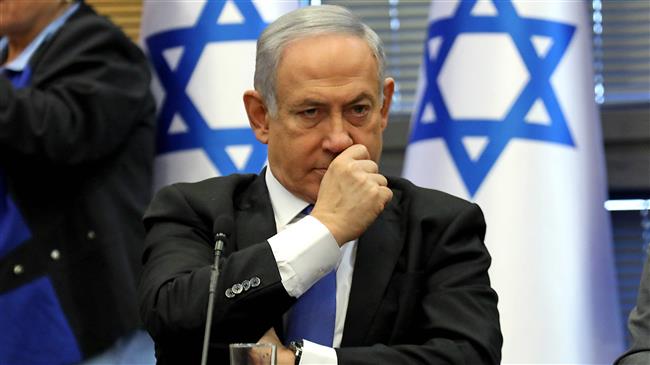
Right-wing Israeli Prime Minister Benjamin Netanyahu called for imposing sanctions on the International Criminal Court (ICC), following an earlier announcement by the court that it intends to investigate alleged war crimes in the occupied Palestinian territories.
“The US government under President Trump has spoken forcefully against the ICC for this travesty, and I urge all your viewers to do the same, to ask for concrete actions, sanctions, against the international court – its officials, its prosecutors, everyone,” Netanyahu said during an interview with Trinity Broadcasting Network.
Meanwhile, the ICC announced on Tuesday that it will delay its debate on the issue, which is intended to determine “whether it has the jurisdiction to probe alleged Israeli war crimes in the West Bank, Gaza and East Jerusalem due to a procedural error related to the filing’s page limit,” The Guardian newspaper reported.
Editor of The Palestine Chronicle, Palestinian journalist Ramzy Baroud commented that “the high level of the ICC investigations places the legal push against Israel at an entirely new level.”
“This is uncharted territory for Israel, the United States, Palestine, the ICC, and the international community as a whole. There is little doubt that some joint Israeli-American effort is already underway to develop strategies aimed at countering, if not altogether dismissing, the ICC investigation,” Baroud added.
Jews’ Ten Pledges vs Palestinians’ Eleven Red Lines
All five leadership candidates embrace ‘Ten Pledges’ that dictate how they must think, speak and act.
By Stuart Littlewood | American Herald Tribune | January 21, 2020
The UK Labour Party is saying goodbye to Jeremy Corbyn as leader after its disastrous general election performance and has begun choosing someone else.
Wasting no time, the Board of Deputies of British Jews last week published Ten Pledges they wanted Labour leadership hopefuls to sign up to if the Party’s relationship with the Jewish community was to be healed.
The BoD claim anti-Semitism in the party became a matter of great anxiety for the UK’s Jews during Corbyn’s four years in office and it will take at least 10 years to repair the damage. Their president Marie van der Zyl says: “We expect that those seeking to move the party forward will openly and unequivocally endorse these Ten Pledges in full, making it clear that if elected as leader, or deputy leader, they will commit themselves to ensuring the adoption of all these points.
“Tackling antisemitism must be a central priority of Labour’s next leader,” she insists. “We will certainly be holding to account whoever ultimately wins the contest.”
But is there really an anti-Semitism crisis other than the one caused by the Jewish State itself and mischievously drummed up within Labour? As former Israeli Director of Military Intelligence, Yehoshafat Harkabi wrote: “It would be a tragic irony if the Jewish state, which was intended to solve the problem of anti-Semitism, was to become a factor in the rise of anti-Semitism. Israelis must be aware that the price of their misconduct is paid not only by them but also Jews throughout the world.” It has been suggested before that so-called anti-Semitism is a matter best resolved by the Jewish ‘family’ itself.
Obedience required
The BoD claim that all the leadership contenders – Sir Keir Starmer, Rebecca Long-Bailey, Lisa Nandy, Jess Phillips and Emily Thornberry – have signed the Ten Pledges, and three of the five deputy-leader candidates have done so. What are these crisis-busting Ten Pledges they’ve committed the Party to?
(1) Resolve outstanding cases – All outstanding and future cases should be brought to a swift conclusion under a fixed timescale.
- Absolutely.
(2) Make the Party’s disciplinary process independent – An independent provider should be used to process all complaints, to eradicate any risk of partisanship and factionalism.
- Of course.
(3) Ensure transparency – Key affected parties to complaints, including Jewish representative bodies, should be given the right to regular, detailed case updates, on the understanding of confidentiality.
- Except that complainers, including the BoD, have a poor record of keeping even their wildest allegations confidential.
(4) Prevent readmittance of prominent offenders – It should be made clear that prominent offenders who have left or been expelled from the party, such as Ken Livingstone and Jackie Walker, will never be readmitted to membership.
- It is not clear from the evidence that Livingstone or Jackie Walker committed an offence. They were hounded out and not, I think, by any independent arbitrator.
(5) Communicate with resolve – Bland, generic statements should give way to condemnation of specific harmful behaviours – and, where appropriate, condemnation of specific individuals.
- This should apply also to false accusers and to the BoD themselves if failing to condemn the “harmful behaviours” of their brethren in the Israeli regime towards our sisters and brothers in Palestine.
(6) Provide no platform for bigotry – Any MPs, Peers, councillors, members or CLPs [local parties] who support, campaign or provide a platform for people who have been suspended or expelled in the wake of antisemitic incidents should themselves be suspended from membership.
- Unacceptable. Many have been suspended for no good reason. And suspension does not mean guilt.
(7) Adopt the international definition of antisemitism without qualification – The IHRA definition of antisemitism, with all its examples and clauses, and without any caveats, will be fully adopted by the party and used as the basis for considering antisemitism disciplinary cases.
- How many times must you be told that the IHRA definition of anti-Semitism is a minefield? Top legal opinion (for example Hugh Tomlinson QC, Sir Stephen Sedley and Geoffrey Robertson QC) warn that it is “most unsatisfactory”, has no legal force, and using it to punish could be unlawful. Furthermore it cuts across the right of free expression enshrined in UK domestic law and underpinned by Article 19 of the Universal Declaration of Human Rights which bestows on everyone “the right to freedom of opinion and expression; this right includes freedom to hold opinions without interference and to seek, receive and impart information and ideas through any media and regardless of frontiers”. This applies not only to information or ideas that are regarded as inoffensive, but also to those that “offend, shock or disturb the State or any sector of the population”. Labour Party members should know all this. The prohibitive IHRA definition is not something a sane organisation would incorporate into its Code of Conduct.
(8) Deliver an anti-racism education programme that has the buy-in of the Jewish community – The Jewish Labour Movement should be reengaged by the Party to lead on training about antisemitism.
- The BoD and JLM would do better teaching anti-racism to the Israeli regime and its supporters. Besides, MPs and councillors don’t ‘belong’ to the Labour Party or any other party; they belong to the public who elected them as their representative. No outside body should expect to influence their freedom of thought, expression or action (see the Seven Principles of Public Life).
(9) Engagement with the Jewish community to be made via its main representative groups – Labour must engage with the Jewish community via its main representative groups, and not through fringe organisations and individuals.
- Labour should engage with the Jewish community though any representative organisation or individual it pleases.
(10) Show leadership and take responsibility – The leader must personally take on the responsibility of ending Labour’s antisemitism crisis.
- There’s no agreement that anything approaching a crisis exists within the Party.
Leadership front-runner Starmer is a former human rights lawyer and ought to know better. Long-Bailey is another lawyer who should hang her head in shame. Thornberry is a former barrister specialising in human rights law – words fail. Jess Phillips, a member of Labour Friends of Israel, wrote Truth to Power: 7 Ways to Call Time on B.S., described as “the little book we all need to help us call time on the seemingly unstoppable tide of bullshit in our lives”. The irony of it seems lost on her. Lisa Nandy is a puzzle as she’s chair of Labour Friends of Palestine.
If this bunch won’t robustly uphold freedom of expression guaranteed by law and international convention what have they let their hapless party in for? Those standing for deputy-leader also have little excuse. Angela Rayner was shadow education secretary, Ian Murray read Social Policy and Law, and Rosena Allin-Khan is a Muslim and former humanitarian aid doctor. They obediently signed the Ten Pledges. Dawn Butler and Richard Burgon declined.
When, a year ago, the French Republic presented its Human Rights Award to B’Tselem (the Israeli human rights group) its Executive Director Hagai El-Ad, thanking the National Consultative Commission on Human Rights, said of Israel’s behaviour towards the Palestinians: “The occupation…. is organized, prolonged state violence which brings about dispossession, killings, and oppression. All branches of the state are part of it: ministers and judges, officers and planners, parliamentarians and bureaucrats.”
On another occasion B’Tselem said: “If the international community does not come to its senses and force Israel to abide by the rules that are binding to every state in the world, it will pull the rug out from under the global effort to protect human rights in the post-WWII era.”
When a respected Israeli organisation speaks truth in such stark terms it cannot be ignored. And recent UN reports confirm that the Israelis abuse and torture child prisoners. So why would anyone – especially those competing to be Labour Party leader and one day prime minister – agree to dance to the tune of those who pimp and lobby on Israel’s behalf?
Who will punish the false accusers?
The BoD nevertheless make some valid points. The Labour Party takes a ridiculously long time to deal with allegations of anti-Semitism, many of which are false or vexatious and could be dismissed in five minutes. Let me tell you about two Scottish Labour politicians wrongly accused of anti-Semitic remarks and suspended. Let’s call them ‘A’ and ‘B’. Both are regional councillors.
Constituency party officials declared ‘A’ guilty immediately and issued a press statement to that effect without waiting for him to be heard, hugely prejudicing any investigation. This stupidity was compounded by his Council leader publicly calling on him to resign as a councillor and saying his thinking belonged to the Dark Ages: “To smear an entire community both past and present, to say he has lost ‘all empathy’ for them is utterly deplorable,” he was quoted in the press.
What was ‘A’s crime? He had tweeted: “For almost all my adult life I have had the utmost respect and empathy for the Jewish community and their historic suffering. No longer, due to what they and their Blairite plotters are doing to my party and the long suffering people of Britain…” Was nobody in the local party aware that the Jewish Leadership Council and the Board of Deputies were then leading an obnoxious campaign to discredit Labour and Jeremy Corbyn?
‘B’, a respected lady councillor, was accused of anti-Semitism by a former Labour MP who was already on record as wanting to impose limits on freedom of expression. A Tory MP immediately put the boot in, telling the media it was clear to the vast majority of people that ‘B’ was no longer fit to hold office and suspension didn’t go far enough.
And what was ‘B’s crime? She had voiced suspicion on social media that Israeli spies might be plotting to get rid of Jeremy Corbyn as Labour leader after three Jewish newspapers ganged up to publish a joint front page warning that a Corbyn-led government would pose an “existential threat to Jewish life in this country”.
She added that if it was a Mossad assisted campaign to prevent the election of a Labour Government (which pledged to recognise Palestinian statehood) it amounted to an unwarranted interference in our democracy. For good measure she said Israel was a racist State and, since the Palestinians are also Semites, an anti-Semitic one.
‘B’ was eventually interviewed by party investigators. They surely knew that in January 2017 a senior political officer at the Israeli embassy in London, Shai Masot, had plotted with stooges among British MPs and other activists to “take down” senior government figures including Boris Johnson’s deputy at the Foreign Office, Sir Alan Duncan. And that Mark Regev, Netanyahu’s former chief spokesman and mastermind behind Israel’s propaganda programme of disinformation, had recently arrived in London as the new ambassador.
Masot was almost certainly a Mossad tool. His hostile scheming was revealed not by Britain’s own security services and media, as one would have hoped, but by an Al Jazeera undercover team. Our Government dismissed the matter saying: “The UK has a strong relationship with Israel and we consider the matter closed.” But at a Labour Party conference fringe meeting Israel insider Miko Peled warned that “they are going to pull all the stops, they are going to smear, they are going to try anything they can to stop Corbyn…. the reason anti-Semitism is used is because they [the Israelis] have no argument….”
Given such a blatant attempt by an Israeli asset to undermine British democracy, with Regev in the background and (quite probably) Mossad pulling the strings, ‘B’s suspicions were reasonable enough and she had a right to voice them.
As for Israel being a racist State, its ethnic cleansing of the Palestinians and other brutal policies over 70 years make it obvious. And the discriminatory Nation State laws recently adopted by Israel put the question beyond doubt. Her point about anti-Semitism was also well made. DNA research (see for example the Johns Hopkins University study published by Oxford University Press) shows that while very few Jews are Semitic most indigenous Arabs in the Holy Land, especially Palestinians, are Semites. The term ‘anti-Semitism’, long used to describe hatred of Jews, is a misnomer that hides an inconvenient truth.
And it couldn’t have been difficult to establish that the opportunistic Tory MP calling her unfit to hold office was the chairman of the All-Party Parliamentary Group on British Jews, which is funded, supported and administered by The Board of Deputies. The case against ‘B’ should have been dropped instantly and action taken against the troublemakers. Instead, weeks later, ‘B’ was posting on her Facebook page that she was still suspended: “I can’t make any decisions about my personal, political, or professional future whilst this hangs over me. I am constantly tired and anxious, and feel I am making mistakes. I have lost paid work because of what has happened.”
Her suspension was finally lifted but she was “advised” not to post about it or she’d risk losing professional work on which her livelihood depended. That’s how nasty the Labour Party disciplinary machine is. Surely, if the Party lifts a suspension it should issue a public statement saying so. Must the wrongly accused, after being needlessly humiliated, be left to pick up the pieces and struggle to re-establish their good name? In total ‘B’ had to wait 16 weeks under sentence. And all because of a trumped-up allegation that ought to have been immediately squashed.
As for ‘A’, he stopped answering emails and there has been nothing in the press. Was his suspension lifted? Was he similarly threatened if he said anything? I simply don’t know although I phoned and wrote to the Leader and the General Secretary for an explanation. The latter eventually replied that “the Labour Party cannot, and does not, share personal details about individual party members” and placing a member in administrative suspension “allows a process of investigation to be carried out whilst protecting the reputation of the Labour Party”. Bollox. How did the media get news of these suspensions in the first place? And never mind the damage done to the cowardly Party, what about the reputations of the two councillors and their months of anguish while working for their constituents? I wasn’t asking for case details. All I wanted was the answer to three simple questions:
# Had the suspensions been lifted?
# If so, had the Party issued a public statement to that effect?
# And had the false accusers been disciplined?
Silence… spineless, don’t-give-a-damn silence.
Are these two cases typical of the so-called anti-Semitism crisis? I have no way of knowing. But they show how the Party is run by enough crackpots on the inside without inviting impertinent interference from the outside.
Jews’ Ten Pledges vs Palestinians’ Eleven Red Lines
Anyone signing up to the BoD’s Ten Pledges should consider at the same time subscribing to the ‘Eleven Red Lines’ of anti-Palestinianism. Examples in public life, the media, schools, the workplace, and in the religious sphere could, taking into account the overall context, include, but are not limited to:
(1) Denying the Palestinian people their right to self-determination and nationhood, or actively conspiring to prevent the exercise of this right.
(2) Denial that Israel is in breach of international law in its continued occupation of Gaza, the West Bank and East Jerusalem.
(3) Denial that Israel is an apartheid state according to the definition of the International Convention on Apartheid.
(4) Denial of the expulsion of 750,000 Palestinians during the 1948 Nakba and of their right, and the right of their descendants, to return to their homeland.
(5) Denial that Palestinians have lived for hundreds of years in land now occupied by Israelis and have their own distinctive national identity and culture.
(6) Denial that the laws and policies which discriminate against Palestinian citizens of Israel (such as the recently passed Nation State Law) are inherently racist.
(7) Denial that there is widespread discrimination against Palestinians in Israel and the Occupied Territories in matters of employment, housing, justice, education, water supply, etc, etc.
(8) Tolerating the killing or harming of Palestinians by violent settlers in the name of an extremist view of religion.
(9) Making mendacious, dehumanizing, demonizing, or stereotypical allegations about Palestinians — such as, especially but not exclusively, the myth of a Palestinian conspiracy to wipe Israel off the map.
(10) Justifying the collective punishment of Palestinians (prohibited under the Geneva Convention) in response to the acts of individuals or groups.
(11) Accusing the Palestinians as a people, of encouraging the Holocaust.
This working definition of anti-Palestinian racism, described as “hatred towards or prejudice against Palestinians as Palestinians”, holds up a mirror to the IHRA definition of anti-Semitism and was drafted by Jewish Voice For Labour, one of those fringe representative organisations the BoD insist Labour mustn’t engage with.
So here’s a simple test for the BoD: if they demand the Labour Party signs up to their Ten Pledges will they themselves embrace the Eleven Red Lines on anti-Palestinianism?
A New Definition of Warfare
Sanctions can be more deadly than bullets
By Philip Giraldi • Unz Review • January 21, 2020
Supporters of Donald Trump often make the point that he has not started any new wars. One might observe that it has not been for lack of trying, as his cruise missile attacks on Syria based on fabricated evidence and his recent assassination of Iranian general Qassem Soleimani have been indisputably acts of war. Trump also has enhanced troop levels both in the Middle East and in Afghanistan while also increasing the frequency and lethality of armed drone attacks worldwide.
Congress has been somewhat unseriously toying around with a tightening of the war powers act of 1973 to make it more difficult for a president to carry out acts of war without any deliberation by or authorization from the legislature. But perhaps the definition of war itself should be expanded. The one area where Trump and his team of narcissistic sociopaths have been most active has been in the imposition of sanctions with lethal intent. Secretary of State Mike Pompeo has been explicit in his explanations that the assertion of “extreme pressure” on countries like Iran and Venezuela is intended to make the people suffer to such an extent that they rise up against their governments and bring about “regime change.” In Pompeo’s twisted reckoning that is how places that Washington disapproves of will again become “normal countries.”
The sanctions can kill. Those imposed by the United States are backed up by the U.S. Treasury which is able to block cash transfers going through the dollar denominated international banking system. Banks that do not comply with America’s imposed rules can themselves be sanctioned, meaning that U.S. sanctions are de facto globally applicable, even if foreign banks and governments do not agree with the policies that drive them. It is well documented how sanctions that have an impact on the importation of medicines have killed thousands of Iranians. In Venezuela, the effect of sanctions has been starvation as food imports have been blocked, forcing a large part of the population to flee the country just to survive.
The latest exercise of United States economic warfare has been directed against Iraq. In the space of one week from December 29th to January 3rd, the American military, which operates out of two major bases in Iraq, killed 25 Iraqi militiamen who were part of the Popular Mobilization Units of the Iraqi Army. The militiamen had most recently been engaged in the successful fight against ISIS. It followed up on that attack by killing Soleimani, Iraqi militia general Abu Mahdi al-Muhandis, and eight other Iraqis in a drone strike near Baghdad International Airport. As the attacks were not approved in any way by the Iraqi government, it was no surprise that rioting followed and the Iraqi Parliament voted to remove all foreign troops from its soil. The decree was signed off on by Prime Minister Adel Abdul Mahdi, based on the fact that the U.S. military was in Iraq at the invitation of the country’s government and that invitation had just been revoked by parliament.
That Iraq is to say the least unstable is attributable to the ill-advised U.S. invasion of 2003. The persistence of U.S. forces in the country is ostensibly to aid in the fight against ISIS, but the real reason is to serve as a check on Iranian influence in Iraq, which is a strategic demand made by Israel and not responsive to any actual American interest. Indeed, the Iraqi government is probably closer politically to Tehran than to Washington, though the neocon line that the country is dominated by the Iranians is far from true.
Washington’s response to the legitimate Iraqi demand that its troops should be removed consisted of threats. When Prime Minister Mahdi spoke with Pompeo on the phone and asked for discussions and a time table to create a “withdrawal mechanism” the Secretary of State made it clear that there would be no negotiations. A State Department written response entitled “The U.S. Continued Partnership with Iraq” asserted that American troops are in Iraq to serve as a “force for good” in the Middle East and that it is “our right” to maintain “appropriate force posture” in the region.
The Iraqi position also immediately produced presidential threats and tweets about “sanctions like they have never seen,” with the implication that the U.S. was more than willing to wreck the Iraqi economy if it did not get its way. The latest threat to emerge involves blocking Iraq access to its New York federal reserve bank account, where international oil sale revenue is kept, creating a devastating cash crunch in Iraq’s financial system that might indeed destroy the Iraqi economy. If taking steps to ruin a country economically is not considered warfare by other means it is difficult to discern what might fit that description.
After dealing with Iraq, the Trump Administration turned its guns on one of its oldest and closest allies. Great Britain, like most of the other European signatories to the 2015 Joint Comprehensive Plan of Action (JCPOA) has been reluctant to withdraw from the agreement over concern that Iran will as a result decide to develop nuclear weapons. According to the Guardian, a United States representative from the National Security Council named Richard Goldberg, had visited London recently to make clear to the British government that if it does not follow the American lead and withdraw from the JCPOA and reapply sanctions it just might be difficult to work out a trade agreement with Washington post-Brexit. It is a significant threat as part of the pro-Brexit vote clearly was derived from a Trump pledge to make up for some of the anticipated decline in European trade by increasing U.K. access to the U.S. market. Now the quid pro quo is clear: Britain, which normally does in fact follow the Washington lead in foreign policy, will now be expected to be completely on board all of the time and everywhere, particularly in the Middle East.
During his visit, Goldberg told the BBC: “The question for prime minister Johnson is: ‘As you are moving towards Brexit … what are you going to do post-31 January as you come to Washington to negotiate a free-trade agreement with the United States?’ It’s absolutely in [your] interests and the people of Great Britain’s interests to join with President Trump, with the United States, to realign your foreign policy away from Brussels, and to join the maximum pressure campaign to keep all of us safe.”
And there is an interesting back story on Richard Goldberg, a John Bolton protégé anti-Iran hardliner, who threatened the British on behalf of Trump. James Carden, writing at The Nation, posits “Consider the following scenario: A Washington, DC–based, tax-exempt organization that bills itself as a think tank dedicated to the enhancement of a foreign country’s reputation within the United States, funded by billionaires closely aligned with said foreign country, has one of its high-ranking operatives (often referred to as ‘fellows’) embedded within the White House national security staff in order to further the oft-stated agenda of his home organization, which, as it happens, is also paying his salary during his year-long stint there. As it happens, this is exactly what the pro-Israel think tank the Foundation for the Defense of Democracies (FDD) reportedly achieved in an arrangement brokered by former Trump national security adviser John Bolton.”
The FDD senior adviser in question, who was placed on the National Security Council, was Richard Goldberg. FDD is largely funded by Jewish American billionaires including vulture fund capitalist Paul Singer and Home Depot partner Bernard Marcus. Its officers meet regularly with Israeli government officials and the organization is best known for its unrelenting effort to bring about war with Iran. It has relentlessly pushed for a recklessly militaristic U.S. policy directed against Iran and also more generally in the Middle East. It is a reliable mouthpiece for Israel and, inevitably, it has never been required to register under the Foreign Agents Registration Act of 1938.
To be sure, Trump also has other neocons advising him on Iran, including David Wurmser, another Bolton associate, who has the president’s ear and is a consultant to the National Security Council. Wurmser has recently submitted a series of memos to the White House advocating a policy of “regime disruption” with the Islamic Republic that will destabilize it and eventually lead to a change of government. He may have played a key role in giving the green light to the assassination of Soleimani.
The good news, if there is any, is that Goldberg resigned on January 3rd, allegedly because the war against Iran was not developing fast enough to suit him and FDD, but he is symptomatic of the many neoconservative hawks who have infiltrated the Trump Administration at secondary and tertiary levels, where much of the development and implementation of policy actually takes place. It also explains that when it comes to Iran and the irrational continuation of a significant U.S. military presence in the Middle East, it is Israel and its Lobby that are steering the ship of state.
Philip M. Giraldi, Ph.D., is Executive Director of the Council for the National Interest, a 501(c)3 tax deductible educational foundation (Federal ID Number #52-1739023) that seeks a more interests-based U.S. foreign policy in the Middle East. Website is councilforthenationalinterest.org, address is P.O. Box 2157, Purcellville VA 20134 and its email is inform@cnionline.org.
Israel participation in Expo 2020 Dubai amounts to normalization: Hamas
Press TV – January 20, 2020
Palestinian Islamic resistance movement Hamas has censured Israel’s presence in the Expo 2020, which is to be hosted by the United Arab Emirates’ city of Dubai, as a form of normalization between the Persian Gulf state and the Tel Aviv regime.
Hamas spokesman Hazem Qassem, in a written statement released on Monday, slammed attempts by a number of Arab countries, particularly Persian Gulf littoral states, to bring out in the open their clandestine relations with the Israeli regime, calling on them to put an end to such efforts.
“Such a behavior encourages the Occupation to increase the level of its crimes against Palestinian people, and to step up its violations against the sanctities of our nation,” the statement added.
“The Zionist regime must remain the principal enemy of the [Palestinian] nation. The campaign against the regime and its policies, which aim to dent all opportunities for the nation’s awakening and development, must continue,” Qassem pointed out.
Israeli authorities are hoping to reach out to Arab peoples through participation in the Expo 2020 Dubai.
“To us, the added value is in the Arab and Muslim visitor,” Elazar Cohen, the Israeli foreign ministry’s point man for the expo, which is organized by the Paris-based Bureau International des Expositions (BIE), said on December 15 last year.
An auditorium below the pavilion will offer visitors an interactive multimedia experience, the ministry’s director general Yuval Rotem told AFP at the time.
Prime Minister Benjamin Netanyahu has described the Israeli expo pavilion as part of “the continued progress of normalization with the Arab states,” alleging that building relations with Arab countries will push the Palestinians toward a ‘peace deal’ with the Israeli regime.
Israeli daily newspaper Yedioth Ahronoth reported on November 6 that the UAE is expected to allow tourists holding Israeli passports to take part in the expo.
“Israeli and the UAE’s authorities have been in talks for a while in order to allow those with Israeli passports to attend the expo in Dubai,” an unnamed source within the expo’s management team told the daily at the time, adding, “These talks are happening because both sides want to see the expo turn into the biggest exhibition in the world.”
Another source said the event in Dubai could be a great pilot run during which Israeli tourists would be allowed into the country, and it can be a signal that the UAE “might leave its doors open to Israeli tourists permanently.”
Israeli foreign minister, Israel Katz, told a ministerial meeting in Jerusalem al-Quds on August 6 last year that he was working toward “transparent normalization and signed agreements” with a number of Arab Persian Gulf littoral states.
Arab countries — except for Jordan and Egypt — have no formal relations with the Israeli regime.
Israel’s trade with Persian Gulf states is estimated to stand at about $1 billion annually, according to a study published by the Tony Blair Institute for Global Change in August 2018.
Jamal al-Suwaidi, founder of the Emirates Center for Strategic Studies and Research, told the British newspaper The Guardian in an interview in March that the Palestinian issue is no longer at the top of the agenda among the Arab Persian Gulf states.
“The Palestinian cause is no longer at the forefront of Arabs’ interests, as it used to be for long decades,” he said. “It has sharply lost priority in light of the challenges, threats and problems that face countries of the region.”
Severe torture in Israeli prisons targets Palestinian steadfastness: Walid Hanatsheh, Samer Arbeed, Mays Abu Ghosh and more
Samidoun Palestinian Prisoner Solidarity Network | January 19, 2020
In the last months of 2019 and early 2020, a growing number of cases of severe physical torture against Palestinian detainees carried out by Israeli Shin Bet interrogators have been documented. While torture and abuse of various kinds have been a mainstay of the Israeli interrogation process, after a 1999 Israeli Supreme Court ruling and amid widespread international attention, torture under interrogation for some years focused on physical and psychological techniques that were less likely to leave physical scars. However, these tactics, including sleep deprivation, extreme heat and cold, solitary confinement and the use of prolonged shackling in painful positions, are often effective in extracting coerced confessions.
Torture: A mainstay of Israeli apartheid and colonialism
Indeed, many of the same techniques were documented as being used by U.S. interrogators holding detainees in Guantanamo, and U.S. and Israeli security agencies have shared information about interrogation and torture techniques. It must be noted that the Israeli Supreme Court never criminalized torture; it continually allowed “exceptions” through the designation of a detainee as a “ticking time bomb.” In practice, Palestinian victims of torture have repeatedly pursued legal accountability for the crimes committed against them, only to find that the Israeli Supreme Court considered their torture to be a permitted form of “extreme interrogation,” justified for the “security of the state” of occupation, colonialism, apartheid and racism.
Torture is unquestionably illegal under international law. The UN Convention Against Torture defines torture as any practice intentionally inflicting severe physical or mental pain on a victim in order to obtain information or a confession, or in order to punish the victim for their conduct or suspected conduct. Torture is also prohibited under the laws of war and the International Covenant on Civil and Political Rights.
The torture of Samer Arbeed
The case of Samer Arbeed helped to highlight the escalating return of severe physical torture as an official policy of the Israeli Shin Bet. Only days after his arrest, Arbeed was taken to Hadassah hospital unconscious with eleven broken ribs, lung injuries and kidney failure. While in the hospital, an Israeli guard released tear gas into his room, after which Arbeed developed pneumonia. Despite the clear evidence of severe torture and the medical records of his abuse, the Israeli Supreme Court denied Arbeed access to his lawyer for an extended period, while the Palestinian lawyers in the case were repeatedly subjected to gag orders.
Samer Arbeed is not alone. While Israeli Shin Bet spokespeople were smearing Palestinian prisoners in media attacks, these same prisoners have been subjected to severe physical and psychological torture under interrogation. In a December press conference, Addameer Prisoner Support and Human Rights Association highlighted some of the torture techniques used by Israeli interrogators, including harsh beatings, stress positions like the “frog” or “banana,” sleep deprivation and ongoing threats against family members.
Palestinian lawyers highlight torture and abuse
As Addameer noted, “On 10 September 2019, a gag order was issued on a number of cases under interrogation at al-Mascobiyya interrogation center. Hence, preventing the public, including Addameer the legal representative, from publishing any information regarding these cases. The gag order was issued based on a request from the Israeli intelligence agency and Israeli police and was renewed multiple times. Despite the gag order, Israeli media outlets and the Israeli intelligence agency published information to the public about some of those cases. This inconsistent enforcement of the gag order, where the Israeli sources exercised the freedom to publish, can only be understood as a means to influence public opinion. Most importantly, the issuance of this gag order is an attempt to hide crimes committed against the detainees and prevent the public and the legal representatives from exposing the details of the crimes of torture and ill-treatment that were committed against the detainees in question throughout the past months.”
Walid Hanatsheh: Torture under interrogation

Photo: Walid Hanatsheh after his interrogation
On 17 January 2020, photos of Walid Hanatsheh, one of the Palestinians detained, were released to the media, with his body showing clear signs of torture under interrogation. Bayan Hanatsheh, Walid’s wife, said in an interview published at Hadf News that the family obtained photos that displayed the bruises on his hands, neck, feet and throughout his body. She noted that he was brought to the military court in a wheelchair after his interrogation and that Walid said in court that he was unable to walk due to severe torture. His lawyer from Addameer demanded that the judge reveal the circumstances in which Hanatsheh was interrogated.

Photo: Walid Hanatsheh after his interrogation
“After the occupation court lifted the ban on our attendance at the trial, we entered the courtroom for two minutes and saw a man who seemed old and we did not recognize him at first, but he called me by my name,” Bayan said. “I was horrified to see him, his eyes were watering, his beard was patchy and plucked…his only concern was to reassure us because he had been forbidden to communicate with us throughout his interrogation.”

Photo: Walid Hanatsheh after his interrogation

Photo: Walid Hanatsheh after his interrogation
Bayan also noted that their daughter, Mays, 21, was detained by Israeli occupation forces for three days as a means of extracting a coerced confession from her husband. They told him that his daughter was imprisoned and under threat and also showed him a live feed of Israeli occupation forces storming their family home in Ramallah and taking measurements for its demolition.

Walid Hanatsheh with his daughter Mays, before his arrest
In Hanatsheh’s case, he was interrogated continuously for 23 hours at a time, with the replacement of interrogators approximately every eight hours. He was shackled in various stress positions and beaten while held there until he fell to the ground. Individual hairs were plucked from his beard and he was hit in the face by multiple interrogators, his lawyers said.

Walid Hanatsheh in his office, before his arrest
“Earth-shattering” crimes demand action
Sahar Francis, the executive director of Addameer, noted of the photos in Hanatsheh’s case that “These pictures are important in proving and documenting torture. Unfortunately, we do not succeed in receiving photos for all of the cases. In other cases, we have medical reports without pictures but a description of the prisoner’s situation, as in the case of Samer Arbeed.”
Former prisoner and long-term hunger striker Khader Adnan spoke out in response to the photos, calling them “earth-shattering.” He urged immediate Palestinian national attention to respond to the escalating crimes of torture, likening the experience of Palestinian prisoners to the infamous images of Abu Ghraib prison under U.S. occupation in Iraq.
The Popular Front for the Liberation of Palestine issued a statement in response to the repeated cases of severe torture, noting that “The Front has experienced and confronted the policy of torture for over 50 years and developed a revolutionary school that graduated generations of revolutionaries, who carried and still carry forward the banner in the dungeons and interrogation cells, who cannot be shaken by crimes or policies of torture.
The Front emphasized that the international community and concerned institutions have neglected the crimes taking place in the dungeons of the prisons of the Zionist occupier against the prisoners, indicating once again the complicity of imperialism in these crimes.”
The exposure of the use of torture is not limited to Hanatsheh and Arbeed; severe physical torture was also reportedly used in the cases of Qassam Barghouthi and Karmel Barghouthi, whose mother Widad was also detained as a method of pressure on her sons, and in the cases of Yazan Maghamis and Nizam Mohammed.
Palestinian youth activists face torture
Several other prisoners also experienced extensive physical torture, including beatings and the use of stress positions, including Palestinian youth activist and new graduate Mays Abu Ghosh, whose parents spoke about seeing her after the effects of her torture and interrogation. Rather than being brought for a family visit, Abu Ghosh’s parents were actually brought in a further attempt to extract a false, coerced confession from her.
Palestinian youth activist Tareq Matar has been repeatedly jailed without charge or trial under administrative detention; after his most recent arrest and interrogation in November 2019, Matar is now being brought into court in a wheelchair, despite his previous status of physical health and athleticism after being beaten in stress positions under interrogation.
Jamil Darawi, 37, previously spent 14 years in Israeli prison. He was once again detained in November 2019 when Israeli soldiers stormed their family home near Bethlehem, breaking down the door and confining his wife, Rawan, to a room with their three daughters. Like his fellow Palestinian prisoners, Darawi was severely beaten and tortured under interrogation. Rawan said that when she saw him in court, she thought that he was not present until he called out to her: “I am here, Rawan, I am Jamil!” His jaw had been broken after an Israeli interrogator punched him and stamped on his face after he fell to the ground. He was returned to interrogation after being given painkillers and his face was still disfigured when he was finally brought before the military courts.
Demanding justice
Addameer has announced its intention to raise these cases before international bodies to call for justice for Palestinian torture victims and accountability for the Israeli state, the perpetrator of these crimes. In Gaza, the Popular Front for the Liberation of Palestine called for a protest on Monday outside the International Committee of the Red Cross (ICRC) office to demand international action on institutionalized Israeli torture.
The systematic use of torture in Israeli interrogation not only intends to extract false and coerced confessions from Palestinians under interrogation; it also aims to undermine and prevent their steadfastness, the unwillingness to confess. Palestinian sumoud (steadfastness) under interrogation and the refusal to provide information has been the subject of numerous studies and tributes. The book, “Philosophy of Confrontation Behind Bars,” detailed how prisoners strengthen themselves in order to resist all forms of torture. During over 70 years of Israeli occupation, over 70 Palestinian prisoners have been killed under torture.
In recent decades, however, a vast majority of Palestinian prisoners’ cases have involved plea bargains; Israeli occupation forces will drag out military court sessions, interrogations and denied family visits in order to extract some form of limited confession for a plea agreement. Prisoners who refuse to provide the demanded confession are often transferred to administrative detention, imprisonment without charge or trial that is indefinitely renewable. Palestinians have spent years at a time jailed under administrative detention.
Attacks on Palestinian prisoners tied to attacks on global movement
The so-called “Erdan Commission,” named for Israeli Minister of Public Security (over the Israel Prison Service) Gilad Erdan – who also serves as the Minister of Strategic Affairs, responsible for attacking Palestine solidarity and boycott, divestment and sanctions (BDS) campaigns around the world – has announced an effort to roll back the gains won by Palestinian prisoners through years of struggle. Thus, women prisoners are denied access to a library or to goods for embroidery and crafts; child prisoners are transferred without their representatives; access to food and water is being cut; conditions of living are barely tolerable.
The reassertion of overt reliance on severe physical torture comes hand in hand with this overall policy of outright Israeli war against Palestinian prisoners. It also comes hand in hand with the escalating attacks internationally against Palestinian human rights organizations and global campaigners for Palestinian rights, smeared by Erdan’s ministry with allegations based on tortured, coerced confessions or direct Israeli military propaganda.
Erdan has attempted to get Palestinian human rights organizations that focus on Palestinian prisoners defunded. His ministry has also attempted – and failed – to have Samidoun activists and Palestinian leftists like Khaled Barakat blocked from speaking in the European Parliament about Israeli repression.
Need for action
Samidoun Palestinian Prisoner Solidarity Network recognizes the urgent need to build the strongest possible front to confront Israeli torture internationally through popular struggle, including escalating the boycott, divestment and sanctions (BDS) campaign. We must not allow the Israeli occupation to isolate Palestinian prisoners in solitary confinement or through our silence. Torture has been part and parcel of the Israeli colonial weapons of control for over 70 years, and the impunity of the Israeli state – backed up by U.S., European, Canadian and other imperialist powers’ support – may not be allowed to continue. We urge all to take action.
If you or your organization would like to join the growing campaign against torture, please contact us at samidoun@samidoun.net.
Jordanian lawmakers vote to prohibit natural gas imports from Israel
Press TV – January 19, 2020
Jordan’s parliament has voted in favor of a motion to ban natural gas imports from the Occupied Palestinian Territories in the wake of mass protests against the government’s multi-billion-dollar agreement with the Tel Aviv regime.
“The majority has voted to send the urgent motion to the government” requesting a law banning Israeli gas imports to Jordan, said Speaker of the House of Representatives Atef Tarawneh in remarks carried live by state television network on Sunday.
The text states that “the government, its ministries and state institutions and companies are prohibited from importing gas from Israel.”
Video footage showed a majority of legislators in the lower house stand up to back the motion.
The move came after 58 lawmakers out of the 130-strong legislature demanded such a ban in a letter to the parliament last month.
The motion will be passed to the government for approval, and must be sent back to the legislature for a formal vote at the upper house of the parliament.
Earlier this month, Jordan’s National Electric Power Co. said gas pumping from the Occupied Territories had started as part of a ten-billion-dollar deal.
The cash-strapped desert kingdom has defended the agreement, alleging it would cut $600 million a year from the state’s energy bill.
On Friday, hundreds of Jordanians took to the streets of Amman in a demonstration organized by the Jordanian National Campaign Against the Gas Agreement with the Zionist Entity to express their resentment over the “shameful” deal with the Israeli regime.
They called on the government to scrap the gas import agreement, and demanded the ouster of Prime Minister Omar Razzaz.
Last week, hundreds of people protested in the northeastern Jordanian city of Zarqa against the import of natural gas from Israel.
The mayor of Zarqa, Imad al-Momani, called on the authorities to “cancel this humiliating agreement” while speaking to the demonstrators.
On September 26, 2016, Jordan’s National Electric Power Company signed a 10-billion-dollar deal with US-based Noble Energy and Israeli partners in order to tap the Leviathan natural gas field in the Mediterranean Sea off the coast of Israel for the supply of approximately 1.6 trillion cubic feet of natural gas, or 300 million cubic feet per day (mcf/d), over a 15-year term.
On March 26 last year, members of Jordan’s parliament called for the cancellation of the gas deal with Israel during a parliamentary session closed to the public.
Tarawneh stated at the time that all sectors of the society and members of parliament utterly reject Jordanian electricity company agreement to buy Israeli natural gas.
Several legislators argued that the multi-billion-dollar deal violates Article 33, section two of the Jordanian constitution, which states, “Treaties and agreements which entail any expenditures to the Treasury of the State or affect the public or private rights of Jordanians shall not be valid unless approved by the parliament; and in no case shall the secret terms in a treaty or agreement be contrary to the overt terms.”
Lawmaker Saddah al-Habashneh said the deal was unconstitutional, stressing that members of parliament were not given access to read what he called the “secret” deal.
“Why are they hiding it? It’s a clue that there is something. It is totally rejected,” he commented.
Habashneh then demanded the deal be scrapped along with Jordan’s peace accord with Israel – known as Wadi Araba Treaty and signed on October 26, 1994.
“We are calling for the Wadi Araba agreement to be dropped. What is peace when they’re attacking Gaza?” the parliamentarian said.
“And with yesterday’s recognition of the Golan Heights, what’s left? We want dignity,” he said.
On March 25, 2019, US President Donald Trump signed a proclamation, formally recognizing Israel’s ‘sovereignty’ over the Golan Heights. The announcement came as Israeli Prime Minister Benjamin Netanyahu visited the White House.
The Syrian Ministry of Foreign Affairs and Expatriates, in a statement, called the decision a “blatant attack on the sovereignty and territorial integrity” of Syria.
“The liberation of the Golan by all available means and its return to the Syrian motherland is an inalienable right,” according to the statement carried by Syria’s official news agency SANA, which added, “The decision … makes the United States the main enemy of the Arabs.”
The Arab League also condemned the move, saying “Trump’s recognition does not change the area’s status.”
Iran, Iraq, Russia and Turkey also condemned Washington’s move.
Israel seized the Golan Heights from Syria after the 1967 Six-Day War and later occupied it in a move that has never been recognized by the international community. The regime has built dozens of settlements in the area ever since and has used the region to carry out a number of military operations against the Syrian government.
Featured Video
The Failed Air War Over Vietnam
or go to
Aletho News Archives – Video-Images
From the Archives
USS Liberty Massacre: A Pivotal Moment in the Hostile Takeover of America
By Kevin Barrett | Crescent | Dhu al-Qa’dah 24, 1445
In corporate America, hostile takeovers are commonplace. They occur when an aggressor—a larger corporation or rich individuals—seizes control of a smaller corporation without asking permission.
What few recognize is that the United States itself has been subjected to a hostile takeover. Since the aggressor, the illegitimate settler colony known as “Israel,” is much smaller than the US, the takeover has necessarily been surreptitious.
As of June, 2024, Israel’s gradual takeover of the US has become obvious and undeniable—a proverbial “elephant in the living room.” … continue
Blog Roll
 Aletho News
- Yemeni Armed Forces Warn Airlines Against Using Saudi Airports, Exempt Mecca and Medina
- Iran security chief says powers greater than US tried to conquer Iran but ended in ‘dustbin of history’
- Europe’s mounting social chaos… chickens coming home to roost for proxy war against Russia
- US-Russia Diesel Deal Becomes Massive Defeat for Ukraine
- Hormuz and the Looming Economic Catastrophe
- Dhubab offensive, media blitz and the rapid unraveling of Saudi-backed coalition’s new gambit
- Putin Conveys to Trump Iran’s Vision on Possible Conflict Resolution – Kremlin
- The Search for Truth: Charlie Kirk’s Assassination One Year Later
- ‘Harsh reality’: Iran says France seeks monopoly on power and intimidation, not peace for all
- When Will This White House Madness End?
- If Americans Knew
- For three years, Israel has killed a child in Gaza every 71 minutes – Daily Update
- Israeli forces kill another child in Gaza – Daily Update
- Gaza ceasefire exists in name only, say more than 100 organizations
- Nearly 2 Million in Gaza Need Urgent Shelter Assistance as Winter Looms: IOM Chief Warns
- Suppressing Palestinian resistance: US charity under fire for AI monitoring of Gaza classrooms
- Thousands Are Held in Israeli Torture Camps. This Is What Happens Inside
- Israel puts Gaza’s sick, injured, newborn in peril – Daily Update
- Report claimed Mark Levin used by Israeli government to influence Trump
- Over 2,000 Gazans have died awaiting medical evacuation amid Israel’s continued siege
- How a U.S. Diplomat Suppressed and Altered Reports Critical of Israel
- No Tricks Zone
- Germany’s Green Energy Debacle: High Energy Costs Force Kahla Porzellan to Close After 182 Years!
- New Study: 50 Years Of The Most Aggressive ‘Net Zero’ Policies Can Only Affect The Global Climate By 0.03°C
- US September “Heat” Was No Record…Many Records Set Decades Ago
- Latest European Green Energy Debacle; Portugal’s Largest Flagship Solar Park Insolvent!
- Green Energy Debacle: German Expert Professor Fritz Vahrenholt Warns Of Severe Economic And Social Consequences
- Two More Paleo Reconstructions Affirm Meters-Higher Sea Levels Across Ireland, Brazil 7000-6000 Years Ago
- New Study: Earth And Venus Surface Warmth Largely Explained By Convection And Lapse Rate, Not CO2 Or Radiation
- 2025 Nature Paper Claiming Worsening Global Drought Gets RETRACTED …Heavily Flawed
- New Study: ‘Global Drought Shows No Detectable Recent Acceleration Under Climate Warming’
- Economic Masterminds: German Socialists Suggest Taxing Productivity Gains Stemming From Using AI

