Israel rules out Marwan Barghouti’s release as Hamas says Netanyahu seeking to ‘blow up truce’
The Cradle | October 9, 2025
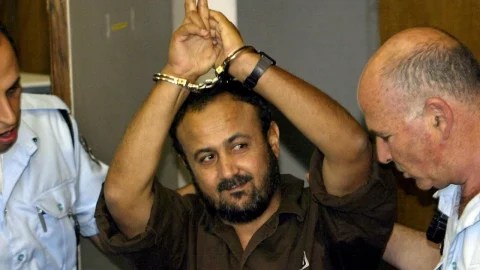
Israel will not release prominent Palestinian leader Marwan Barghouti as part of a prisoner exchange deal accompanying the ceasefire with Hamas in Gaza, an Israeli government spokesperson announced on 9 October.
“I can tell you at this point in time that he will not be part of this release,” spokesperson Shosh Bedrosian stated in a press conference on Thursday, as the ceasefire is expected to take effect.
However, Palestinian sources told Al Jazeera and Ynet that Barghouti’s case is still on the table, and Hamas is pressing hard for his release.
Barghouti is a prominent Palestinian legislator and leader of Fatah, a nationalist political party that dominates the Palestine Liberation Organization (PLO).
After surviving multiple assassination attempts by Israeli intelligence, Barghouti was imprisoned during the Second Intifada in 2002.
He is serving five life sentences, allegedly for organizing attacks that killed five Israelis.
After his conviction was announced, Barghouti stated in Hebrew, “This is a court of occupation that I do not recognize … A day will come when you will be ashamed of these accusations … I have no more connection to these charges than you, the judges, do.”
Barghouti penned a book while imprisoned in which he described being tortured by his Israeli guards, including being forced to sit on a chair with nails protruding into his back for hours at a time.
Despite his imprisonment, Barghouti has remained politically active and is widely viewed as more popular than Palestinian Authority (PA) President and fellow Fatah leader Mahmoud Abbas.
As part of the ceasefire between Hamas and Israel that went into effect Thursday, Hamas agreed to release 20 living Israeli captives and the bodies of 26 captives who died due to Israel’s bombing and starvation siege on the strip over the past two years. The fate of the two final captives is unknown.
In return, Israel committed to releasing 250 Palestinian prisoners serving life sentences and 1,700 Palestinians detained from Gaza. Throughout the war, many Palestinian detainees were tortured and raped in Israel’s notorious Sde Teiman prison, including 53 detainees who died in custody.
Israeli sources speaking to Israeli Army Radio and CNN stated Thursday that the bodies of slain Hamas chief Yahya Sinwar and his brother Mohammad will not be released as part of the exchange deal.
Sinwar was killed by the Israeli military in Gaza in October 2024, while his younger brother, Mohammad, who succeeded him as military leader of Hamas’s armed wing, was killed by Israel earlier this year.
The resistance movement has demanded the release of other high-profile prisoners, including PFLP Secretary-General Ahmad Saadat and chief Qassam Brigades engineer and leader, Abdullah Barghouti. Senior Hamas leader Abbas al-Sayed and Hassan Salameh are also among those the movement wants released.
A Hamas official speaking with Al Jazeera said that negotiations to finalize the list of Palestinian prisoners to be released are ongoing. The source added that Hamas is consulting with other Palestinian resistance movements regarding the list.
Hamas delivered its final response this morning regarding the timelines for implementing the agreement, the source stated.
Regarding the prisoner exchange, Hamas spokesman Hazem Qassem told Al Jazeera on Thursday that Israel is trying to “manipulate the dates, lists, and some of the agreed-upon steps.”
“The occupation [Israel] must adhere to what was agreed upon, and we call on the mediators to pressure it,” Qassem added.
Another Hamas official, Mahmoud Mardawi, said Israeli Prime Minister Benjamin Netanyahu “is seeking to blow up the ceasefire agreement” by “backtracking on the prisoner lists in an attempt to sabotage the understandings.”
This suggests that Netanyahu is trying to sabotage other aspects of the ceasefire as well, including issues related to the withdrawal, reconstruction, and the reopening of border crossings, Mardawi added.
According to Israeli media, Netanyahu has sabotaged multiple ceasefire agreements since the start of the genocide of Palestinians in Gaza two years ago.
Since the start of the war, Israeli forces have killed more than 67,000 Palestinians, about three percent of Gaza’s population, according to the territory’s Health Ministry. Another 169,000 have been wounded amid Israel’s destruction of much of the enclave.
However, in July, The Lancet medical journal published a research correspondence on the difficulty of accounting for the number of those killed by Israel’s war on Gaza, highlighting that both direct and indirect deaths should be considered.
Gaza ceasefire: How Israel’s war goals crumbled and the resistance prevailed
Press TV | October 9, 2025
Israeli regime and the Hamas resistance movement, with the mediation of the US as well as Egypt, Qatar, and Turkey, inked a new ceasefire deal early on Thursday, marking two years and two days since the start of the devastating genocidal war on Gaza
These two years, since October 7, 2023, have witnessed the Tel Aviv regime, supported by its Western allies, particularly the United States, commit horrendous war crimes, killing more than 67,000 Palestinians, most of them children and women, according to the Gaza Media Office.
The outcome has been a humanitarian catastrophe on a scale unseen in modern times, and yet, an enduring Palestinian resistance has defied all odds, proving that right ultimately prevails over might.
What began as a pledge of “total victory” has turned into a defining and decisive failure for the Zionist project. Despite relentless bombardment, siege, and starvation, the Benjamin Netanyahu-led regime in Tel Aviv has failed to achieve any of its strategic or political objectives in Gaza.
What Israel failed to achieve in Gaza
- Failure to crush the Palestinian resistance
After two years of no-holds-barred genocidal war, the Israeli regime failed to subdue Gaza or dismantle the Palestinian resistance, as it had envisioned following the historic and heroic Operation Al-Aqsa Flood by Hamas-led Palestinian resistance.
From the ruins of their homes and refugee camps across Gaza, new forms of resistance, resilience, and defiance emerged over the past two years.
The Palestinian resistance led by Hamas, though battered by the ruthless occupation, has remained organized, determined, and deeply rooted in national consciousness.
The vow to “erase Hamas” has become a symbol of hubris for the Zionist occupation, which was eventually compelled, under pressure from the Trump administration, to enter into a new truce with the very resistance it had sought to annihilate.
- Failure to break Palestinian will
Israel’s strategy of collective punishment —obliterating neighborhoods, bombing hospitals and schools, and starving civilians across the besieged territory — was designed to break the will of Palestinians.
Yet, even amid unimaginable suffering, the spirit of steadfastness, or sumud, has only grown stronger among Palestinians over the past two years, who refuse to submit, surrender, or abandon their homeland.
Families displaced multiple times have refused to leave. Resistance has evolved and expanded beyond armed struggle, becoming deeply embedded in other spheres of life.
- Failure to free captives through force
Despite near-daily bombings across Gaza, Israel has failed to free its captives held by the Palestinian resistance since October 7.
Every attempt to free them through military means has led only to further losses and humiliation for the occupation regime. In many instances, indiscriminate Israeli airstrikes have resulted in the deaths of captives alongside local Palestinians.
Negotiations have remained the only viable path to secure their release, from the very resistance Israel vowed to destroy.
- Failure to trigger a mass exodus
Israel’s goal of pushing Gazans into the barren deserts of Egypt or scattering them abroad has been met with fierce rejection, both from the resistance and the people themselves.
Gaza’s population, even when confined to makeshift tents or the ruins of their homes, has refused to accept the fate of another Nakba. They have resisted uprooting despite the regime’s repeated massacres.
- Failure to recolonize Gaza
Israeli plans to reoccupy Gaza or build illegal settlements amid the genocidal war have collapsed under new political, diplomatic, and military realities.
As the new ceasefire takes effect, Gaza remains uncolonized—and every bomb dropped has only strengthened Palestinian resolve and intensified global opposition to Israel’s settler-colonial ambitions.
- Failure to annex the West Bank
Israeli regime’s long-standing ambition to annex the occupied West Bank and realize its “Greater Israel” project has become a geopolitical mirage.
Local resistance, international scrutiny, investigations by the International Criminal Court, and growing internal divisions within the Zionist entity have hindered its advancement.
What Israel has actually achieved in Gaza
- A genocide broadcast to the world
Over the past two years, the world has witnessed — live and in real time — the mass murder of Palestinian children and women, the destruction of homes and hospitals, the starvation of families, and the erasure of entire communities.
Gaza has become the first genocide in history to be live streamed to billions across the globe, documented by journalists, civilians, and satellites alike.
History will remember this as one of the darkest moral collapses of the modern age, enabled by global silence and facilitated by Western regimes, especially the United States and its allies.
- Global condemnation and legal reckoning
From the United Nations to the International Criminal Court, the International Court of Justice, the Human Rights Council, and global NGOs, there is a consensus today Israel committing war crimes, ethnic cleansing, and genocide in Gaza.
The ICC has issued arrest warrants against Israeli premier Benjamin Netanyahu and former military affairs minister Yoav Gallant, while legal scholars continue to demand accountability.
The Brussels-based Hind Rajab Foundation — named after a young Palestinian girl murdered by the Israeli regime in Gaza — has documented Israeli war crimes and pressed governments worldwide to act against Israeli soldiers visiting their countries.
For the first time, the impunity once guaranteed by Western powers to the illegitimate regime has begun to fracture.
- Rising diplomatic isolation
Despite massive investments in propaganda and lobbying efforts across Western capitals to whitewash its genocidal atrocities, the Israeli regime stands increasingly isolated today, two years on.
Student movements, trade unions, artists, lawyers, academics and athletes have joined calls for boycotts and sanctions against the regime, once considered unthinkable
Public opinion, particularly among younger generations in Western countries, has decisively shifted. The once-dominant narrative of so-called “self-defense” has been exposed as hollow and hypocritical.
- Collapse of the Zionist narrative
Social media has become the new and decisive battlefield, and Israel has lost the war of ideas and narratives there as well.
Despite enlisting influencers and spending millions to spread Zionist propaganda about October 7 and its aftermath, the regime has failed to convince global audiences.
Citizen journalists in Gaza, armed with smartphones and unbreakable courage, have shattered decades of deception and lies.
The world now sees the truth unfiltered: a besieged population fighting for survival and liberation against an illegitimate occupier.
- Global awakening for Palestinian liberation
From South Africa to Latin America, London to Jakarta, Italy to Spain, millions now rally behind Palestine and its liberation from Israeli occupation.
It is no longer about a so-called two-state solution but about one and unified free Palestinian state, from the river to the sea.
The Palestinian cause has become a universal symbol of resistance against decades of illegal occupation, oppression, and settler-colonialism.
Calls for self-determination echo louder than ever, uniting diverse movements for justice under one cry: Free Palestine.
Two years on, as the new truce deal comes into effect, Israel’s genocidal campaign has not destroyed Gaza, but immortalized it. From the ashes, the Palestinian spirit still rises. Children continue to recite poems of return.
Resistance endures as the human will to exist, to remember, and to reclaim dignity.
Hamas, Israel agree to first phase of Gaza ceasefire under Trump plan
The Cradle | October 9, 2025
The newly announced ceasefire agreement, which was reached by mediators overnight, is set to take effect in Gaza on 9 October.
Phase one of US President Donald Trump’s 20-point plan will begin in the coming hours and days.
According to Israel’s Channel 14, the signing of the agreement will be followed by Israeli cabinet and government meetings to ratify the deal.
The Israeli army will then carry out its first withdrawal from Gaza’s population centers, in line with the agreement’s withdrawal map.
Twenty living Israeli captives will be released following 72 hours. In exchange, Tel Aviv is required to release 250 prisoners serving life sentences and 1,700 Palestinians detained from Gaza since 7 October 2023.
It remains unclear if Israel has approved the list of high-profile prisoners whose release Hamas has demanded, as the names have not been published.
Hamas leader Osama Hamdan said five border crossings will be opened for aid to enter the strip and be distributed by the UN and international aid groups.
According to an Israeli official in Prime Minister Benjamin Netanyahu’s office, cited by Channel 12, the ceasefire will not come into effect until the government ratifies the agreement on Thursday afternoon.
Drone strikes and artillery shelling have been reported in Gaza, despite announcements of the ceasefire.
Trump announced early Thursday that the “first phase” of the deal has been signed off on following hours of negotiations in Egypt.
“This means that ALL of the hostages will be released very soon, and Israel will withdraw [its] troops to an agreed upon line as the first steps toward a strong, durable and everlasting Peace,” he added, calling it a “great day for the world.”
“Tonight, an agreement was reached on all the provisions and implementation mechanisms of the first phase of the Gaza ceasefire agreement, which will lead to ending the war, the release of Israeli hostages and Palestinian prisoners, and the entry of aid. The details will be announced later,” said Qatari Foreign Ministry spokesman Majed al-Ansari.
Hamas also released a statement confirming that an agreement has been reached.
“An agreement has been reached to end the war on Gaza, withdraw occupation forces from the strip, allow the entry of aid, and carry out a prisoner exchange,” Hamas said. “We call upon President Trump, the guarantor states of the agreement, and all Arab, Islamic, and international parties to compel the occupation government to fully implement the terms of the agreement and prevent it from evading or delaying.”
“We affirm that the sacrifices of our people will not be in vain,” it added.
Gaza Civil Defence: Israel using car bombs in strikes on residential areas despite Trump’s calls for halt
MEMO | October 9, 2025
The General Directorate of Civil Defence in the Gaza Strip said Wednesday that Israeli forces continue to deploy car bombs packed with large quantities of explosives against residential neighbourhoods, despite recent calls from the US President Donald Trump to stop bombing the enclave.
In a statement, Civil Defence officials reported that Israeli forces are using an average of ten car bombs daily in densely populated areas, including Al-Nasr, Sheikh Radwan, and Al-Daraj neighbourhoods, as well as in Tal Al-Hawa and Al-Sabra.
According to the statement, each explosion causes widespread destruction within a 300-meter radius, with damage extending as far as 500 meters. Shrapnel reportedly travels over a kilometre, inflicting severe injuries on civilians, including displaced families and patients in nearby hospitals.
The Civil Defence said some of the blasts reached areas less than 200 meters from Al-Thalathini Street, one of Gaza City’s main arteries, calling the strikes a deliberate targeting of infrastructure and residential zones regardless of civilian presence.
The Directorate described the use of car bombs of this scale as “an unprecedented development in modern warfare and a flagrant violation of international laws prohibiting the targeting of civilians.” It also held the international community responsible for its “deafening silence,” warning that inaction amounts to tacit encouragement for further bloodshed and destruction.
Italian PM Meloni Embroiled in ICC Complaint Alleging Complicity in Gaza Genocide
21st Century Wire | October 9, 2025
Italian Prime Minister Giorgia Meloni and a number of ministers are confronted with an ICC complaint that accuses them of complicity in genocide, as a group of jurists and attorneys point to ongoing arms collaboration with Israel and a lack of protection for the Global Sumud Flotilla. Jurists and Lawyers from Giuristi e Avvocati per la Palestina (GAP) have initiated two legal actions aimed at holding Italy accountable for its involvement in the Gaza conflict. The first initiative, submitted to the ICC, charges the Italian government with complicity in war crimes, crimes against humanity, and genocide. The second initiative addresses the government’s purported negligence in safeguarding the Global Sumud Flotilla, a civilian fleet transporting humanitarian aid to Gaza, which was intercepted by Israeli forces in international waters.
According to a report from Lavialibera, the initiative has garnered backing from more than fifty notable figures in Italy, many of whom are active in politics and culture. The initiative has currently attracted the support of nearly 6,000 citizens. Gianluca Vitale, one of the GAP lawyers behind this action, explained to Lavialibera:
“We are calling for proceedings to be initiated against the Italian government, namely Prime Minister Giorgia Meloni , Foreign Minister Antonio Tajani , and Defense Minister Guido Crosetto , as well as Leonardo Spa CEO Roberto Cingolani” adding, “If there is substantial collaboration with Israeli authorities who are committing crimes, it means that the Italian authorities are complicit in the crime being committed.”
In a recent interview with Italian state broadcaster RAI 1, Meloni acknowledged that she and the aforementioned individuals faced a complaint at the International Criminal Court for their alleged involvement in the Gaza genocide.
Despite Meloni’s nervous reaction, the move is not unexpected, given that comparable actions have already been taken throughout Europe. In Germany, legal actions have been filed with the ICC and local courts targeting government officials and arms manufacturers for their alleged involvement in supporting Israel’s military actions in Gaza. Furthermore, more than 100 lawyers in France have officially requested the ICC to look into France’s potential complicity in genocide concerning Gaza.
In her July 2025 report, Francesca Albanese, the UN Special Rapporteur on the Palestinian Territories, indicates that eight states and at least 1,650 companies, including Italian manufacturer Leonardo S.p.A., contribute to the manufacturing and distribution of components and parts for the Israeli F-35 fleet, which Israel customizes and maintains in partnership with US defense contractor Lockheed Martin and local companies. INVESTIGATE, a project run by Action Center for Corporate Accountability of the American Friends Service Committee (AFSC), which exposes corporate complicity in state violence, issued a comprehensive report regarding Leonardo S.p.A., Italy’s largest weapons manufacturer and its dealings with Israel.
As per information from the Stockholm International Peace Research Institute (SIPRI), Italy was among just three nations that exported “major conventional arms” to Israel between 2020 and 2024. However, it is noteworthy that the United States and Germany accounted for a staggering 99 percent of the exports in the broader category of larger weaponry, which encompasses aircraft, missiles, tanks, and air defense systems.
Furthermore, the Jurists and lawyers for Palestine organization (GAP) formally cautioned the Italian government on September 24, urging it to “take all necessary measures to genuinely safeguard the Global Sumud Flotilla and its participants.” With civilian ships trying to breach the Israeli naval blockade and provide humanitarian assistance to Gaza being intercepted and their crew members detained, legal proceedings are being contemplated to assess the potential accountability of the Italian government regarding the actions of the Israeli Navy. It is generally recognized that the Israeli military’s recent actions against the Global Sumud Flotilla are deemed illegitimate, as they took place in international waters where Israel lacks the legal right to intervene, intercept and abduct its passengers against their will, making such actions a potential act of piracy.
In accordance with the recommendations issued by the UN International Court of Justice (ICJ), all state parties the UN Convention on the Prevention and Punishment of the Crime of Genocide, and the Rome Statute of the International Criminal Court—which Italy ratified on July 26, 1999—are required upon learning of, the existence of a serious risk that genocide will be committed, to implement reasonable measures within their power to prevent genocide. However, according to GAP, Meloni’s Government has not only refrained from doing so but, to the contrary, contributed to Israel wae crimes against the Palestinians.
According to GAP’s lawyer, the Italian government’s liability hinges on two key factors:
Firstly, demanding compliance to the Israeli blockade and thus deeming it legitimate amounts to complicity in the crime. The blockade is integral to Israel’s criminal actions, whether they be war crimes or genocide, as it plays a role in perpetuating the offensive within the Gaza Strip and employs starvation as a weapon.
The second factor pertains to the choice to withdraw the Navy vessel that was only briefly sent to escort the Global Sumud Flotilla. Withdrawing and consequently denying assistance signifies a failure to fulfill the duty of protection and, once again, inadvertently aids in the perpetration of a crime.
UK universities spied on students for arms firms supplying Israel: Report
Press TV – October 8, 2025
Leaked emails have revealed that UK universities spied on students’ social media and chat groups at the request of arms companies supplying weapons to Israel.
According to internal correspondence obtained by The Guardian and Liberty Investigates, several universities assured these weapons manufacturers that they would keep watch over students’ online activity to detect and preempt potential protests.
Over the past two years, large-scale pro-Palestinian demonstrations have taken place across UK campuses, with students demanding an end to arms sales to the Israeli regime.
In one case, a university responding to a weapon manufacturer’s “security questionnaire” said it would conduct “active monitoring of social media” to detect any planned protests against Rolls-Royce during a careers fair.
Rolls-Royce, the UK’s second-largest arms manufacturer, directly supplies key components for Israeli military vehicles. Its German subsidiary, MTU, also produces engines used in Israel’s battle tanks, armored personnel carriers, and warships.
Loughborough University told a recruitment firm running a “Rolls-Royce roadshow” that its security team was conducting “active monitoring of social media … to provide early intelligence about protests.”
Emails from Heriot-Watt University suggest that Raytheon UK requested the university to “monitor university chat groups” on its behalf before a careers fair — and the university agreed to “implement the measures you have suggested.”
Similarly, Glasgow and Cardiff universities faced pressure from major UK aerospace firms — BAE Systems and Leonardo — to track online activity before career events. Some events were later moved online after potential protests were identified.
The UK also supplies BAE-made components to a global pool of F-35 fighter jets that Israel can access.
The surveillance of students’ social media has sparked outrage among advocacy groups, who argue that universities should support peaceful protest, not criminalize it.
Jo Grady, general secretary of the University and College Union, called the universities’ actions “utterly shameful,” adding that “so many universities have spent time and resources surveilling students who are engaged in peaceful protest against genocide.”
Data compiled by Liberty Investigates shows that one in four UK universities — 37 out of 154 — launched disciplinary investigations into pro-Gaza student and staff activists between October 2023 and March 2025, affecting up to 200 people.
The United Kingdom maintains close political and military ties with Israel, including arms sales, intelligence sharing, and military partnerships.
British arms companies continue to provide key components for Israeli military vehicles, fighter jets, and naval vessels — a relationship that human rights groups say makes the UK complicit in the regime’s war crimes in Gaza.
Exposed: Western journalists secretly served ‘Israel’s’ war propaganda
Al Mayadeen | October 8, 2025
Leaked emails from the inbox of former Israeli Ambassador to the United Nations Ron Prosor reveal that prominent Western journalists, ncluding The Atlantic’s David Frum and British writer Douglas Murray, secretly offered to write speeches and provide other forms of assistance to Israeli officials during the entity’s 2014 war on Gaza, according to a report by journalists Murtaza Hussain and Ryan Grim published on Drop Site.
The correspondence, obtained by the hacker collective Handala and published by the whistleblower group Distributed Denial of Secrets (DDoSecrets), includes communications between Prosor and several journalists and media figures.
The trove reveals that while “Israel” faced global condemnation for its war that killed over 2,200 Palestinians, more than 550 of them children, figures in Western media were privately coordinating with Israeli diplomats on messaging and advocacy efforts.
Frum’s dual role: Journalist and speechwriter
David Frum, a senior editor at The Atlantic and a former speechwriter for US President George W. Bush who coined the phrase “Axis of Evil,” began his editorial role at the magazine in early 2014. Just months later, at the height of “Israel’s” bombardment of Gaza, Frum sent Prosor a full draft of a UN speech.
In an email dated July 31, 2014, Frum told Prosor he had collaborated with Seth Mandel, a writer for the neoconservative publication Commentary, to prepare the text. The draft portrayed “Israel’s” war on Gaza as part of the “free world’s” struggle against “tyranny”, comparing it to the Allied defeat of Nazi Germany and invoking figures such as Harry Truman and the architects of the Marshall Plan.
The speech urged Americans not to grow “war weary” and to maintain support for “Israel’s” military actions. Prosor thanked Frum and said he would review the draft, though it remains unclear whether the text was ever used.
Remarkably, just one day earlier, Frum had contacted Prosor in his capacity as a journalist for The Atlantic, requesting an interview for a profile of the ambassador. Two months later, The Atlantic published Frum’s piece, “Israel’s Man at the United Nations,” which praised Prosor for his “toughness” and diplomatic skill in defending “Israel” against international criticism.
Douglas Murray’s contributions and fundraising
Frum was not alone. British commentator Douglas Murray, now an associate editor at The Spectator and a frequent television pundit, also sent Prosor a proposed draft for a UN speech on the same day, July 31, 2014.
In his email, Murray described the text as “first draft ideas,” noting it may include “more diplomatic things than needed.” His proposed speech echoed hardline pro-“Israel” narratives, including condemnation of BDS movements and disparaging references to European Muslims.
Murray pledged to continue assisting the ambassador. “I will give all the time I can to helping get it right,” he wrote.
In subsequent months, Murray continued corresponding with Prosor, sharing articles and offering public relations advice. Later that year, he informed the ambassador that he had hosted a London fundraiser that brought in over £1 million for the Association for the Wellbeing of Israeli Soldiers, a group providing direct support to Israeli occupation forces.
Prosor thanked Murray for his “wonderful work”, calling his efforts vital to “Israel’s cause”.
The revelations contrast sharply with Murray’s later insistence on journalistic independence. In an April 2025 appearance on The Joe Rogan Experience, he chastised critics of “Israel’s” Gaza policies for lacking firsthand experience, saying he avoided commenting on countries he hadn’t visited.
Murray has frequently appeared in public wearing a “PRESS” flak jacket while embedded with Israeli forces, without disclosing his prior speechwriting and fundraising for the same military he was covering.
CNN producer’s role in Iron Dome fundraising
The leaked correspondence also implicates Pamela Gross, a former CNNproducer, who maintained close ties with Prosor during the war. Emails show that Gross and her husband, media executive Jimmy Finkelstein, then-owner of The Hill, privately discussed raising money for “Israel’s” Iron Dome missile system.
In one July 2014 message, Gross wrote to Prosor, “Clearly Iron Dome is doing the trick and saving lives. Please dear friend, let’s get it finished. Please let me know what is still left to be done at your soonest convenience.”
Prosor responded by thanking Gross for her “amazing work in fundraising for the Iron Dome project,” calling her and her husband “true assets to the state of Israel.” Gross later asked the ambassador to connect her with officials who could provide details about the project’s funding needs and how to channel donations.
Gross continued to book Prosor for CNNappearances while maintaining their personal friendship. In one 2015 exchange, she invited him on air to discuss Israeli Prime Minister Benjamin Netanyahu’s speech to the US Congress, telling him she and her husband had recently dined with former Israeli Prime Minister Ehud Barak.
Unanswered questions, ethical fallout
The leaked cache contains hundreds of verified messages, photographs, and attachments, though DDoSecrets noted it could not independently authenticate every file. Handala, the hacking group that released the material, issued a violent threat against Prosor, which DDoSecrets publicly condemned.
None of the journalists or organizations named in the emails, including Frum, Murray, Mandel, CNN, or the Israeli Embassy in Germany, where Prosor now serves, responded to requests for comment from Drop Site, which first reported the findings.
The revelations raise fresh ethical concerns about the blurred lines between journalism and government lobbying efforts during times of war. While journalists are expected to maintain independence and avoid conflicts of interest, the emails suggest that several prominent figures in Western media privately worked to shape pro-“Israel” narratives during one of the deadliest wars on Gaza.
For “Israel”, such alliances helped bolster its messaging at a time of mounting global outrage over civilian casualties. For the public, however, the leaks expose the extent to which supposedly independent voices in Western journalism may have functioned, willingly or not, as part of a broader influence campaign.
From Sabra and Shatila to Gaza: The vicious cycle of US-Israeli ‘peace’ ploys
By Ramzy Baroud | MEMO | October 8, 2025
The history of Zionism is fundamentally one of deception. This assertion is critically relevant today, as it contextualises the so-called ‘Trump Gaza proposal,’ which appears to be little more than a veiled strategy to defeat the Palestinians and facilitate the ethnic cleansing of a significant portion of Gaza’s population.
Since the start of the current conflict, the United States has been Israel’s staunchest ally, going as far as framing the outright slaughter of Palestinian civilians as Israel’s “right to defend itself.” This position is defined by the wholesale criminalisation of all Palestinians—civilians and combatants, women, children, and men alike.
Any naive hope that the Trump administration might restrain Israel proved unfounded. Both the Democratic administration of Joe Biden and the Republican administration of his successor have been enthusiastic partners in Israeli Prime Minister Benjamin Netanyahu’s messianic mission. The difference has been primarily rhetorical. While Biden wraps his staunch support in liberal discourse, Trump is more direct, using the language of overt threats.
Both administrations pursued strategies to hand Netanyahu a victory, even when his war failed to achieve its strategic objectives. Biden used his Secretary of State, Antony Blinken, as an emissary to broker a ceasefire fully tailored to Israeli priorities. Similarly, Trump utilised his son-in-law, Jared Kushner, and former British Prime Minister Tony Blair, among others, to concoct a parallel ploy.
Netanyahu deftly exploited both administrations. The Trump era, however, saw the US lobby and Israel seemingly dictating American foreign policy. A clear sign of this dynamic was the famous scene last April, during Netanyahu’s White House visit, when the ‘America First’ President pulled out a chair for him. The summoning of Blair, who once headed the US-controlled Quartet for Peace, to the White House alongside Kushner in August, was another foreboding signal. It was evident that Israel and the US were planning a much larger scheme: one not only to crush Gaza but to prevent any attempt at resurrecting the Palestinian cause altogether.
While ten countries were declaring recognition of the state of Palestine to applause at the UN General Assembly between 21 and 23 September, the US and Israel were preparing to reveal their grand strategy, with critical contributions from Ron Dermer, then Israel’s Minister of Strategic Affairs.
The Trump Gaza proposal was announced on 29 September. Almost immediately, several countries, including strong supporters of Palestine, declared their backing. This support was given without realising that the latest iteration of the plan was substantially altered from what had been discussed between Trump and representatives of the Arab and Muslim world in New York on 24 September.
Trump announced that the proposal was accepted by Israel and threatened Hamas that, if it does not accept it within “three or four days”, then “ it’s going to be a very sad end.” Still, UN Secretary-General Antonio Guterres, who, along with the UN, has largely failed to hold Israel accountable, declared his support for the Trump proposal, stating that “it is now crucial that all parties commit to an agreement and its implementation.”
Netanyahu felt a newfound elation, believing the weight of international pressure was finally lifting, and the onus was shifting to the Palestinians. He reportedly said that “now the whole world, including the Arab and Muslim world, is pressuring Hamas to accept the conditions.” Comfortable that the pendulum had swung in his favor, he openly restated his objectives in Gaza on 30 September: “To release all our hostages, both the living and the deceased, while the IDF remains in most of the Strip.” Even when Arab and Muslim nations protested the amendments to the initial Trump plan, neither Netanyahu nor Trump relented, the former continuing the massacres, while the latter repeating his threats.
The implication is stark: regardless of the Palestinian position, Israel will continue to push for the ethnic cleansing of the Strip using both military and non-military means. The plan envisions Gaza and the West Bank being administered as two separate entities, with the Strip falling under the direct control of Trump’s so-called “Board of Peace”, thus effectively turning Blair and Kushner into the new colonial rulers of Palestine.
History is most critical here, particularly the history of Israeli deception. From its onset, Zionist colonialism justified its rule over Palestine based on a series of fabrications: that European settlers held essential historical links to the land; the erroneous claim that Palestine was a “land without a people”; the assertion that indigenous natives were intruders; and the stereotype that Arabs are inherently anti-Semitic. Consequently, the state of Israel, built on ethnically cleansed Palestinian land, was falsely marketed as a ‘beacon’ of peace and democracy.
This web of falsehoods deepened and became more accentuated after every massacre and war. When Israel faltered in managing its military efforts or its propaganda war, the United States invariably intervened. A prime example is the Israeli invasion of Lebanon in 1982, where a ‘peace deal’ was imposed on the PLO under US pressure. Thanks to US envoy Philip Habib’s efforts, Palestinian fighters left Beirut for exile, on the understanding that this step would spare thousands of civilian lives. Tragically, the opposite occurred, directly paving the way for the Sabra and Shatila massacre and a prolonged Israeli occupation of Lebanon until 2000.
This historical pattern is repeating itself in Gaza today, though the options are now more stark. Palestinians face a choice between the guaranteed defeat of Gaza — accompanied by a non-guaranteed, temporary slowdown of the genocide — and the continuation of mass slaughter. Unlike the Israeli deception in Lebanon four decades ago, however, Netanyahu makes no effort to mask his vile intentions this time. Will the world allow him to get away with this deception and genocide?
Graham’s Middle East vs. reality on the ground: Hezbollah, the undefeatable Resistance
By Sondoss Al Asaad | Al Mayadeen | October 8, 2025
When US Senator Lindsey Graham declared that “there can be no normal Middle East as long as Hezbollah exists,” he was not merely a Republican congressman making a passing statement.
Rather, Graham was expressing, with complete candor, the profound understanding within the US-Israeli strategy of a reality on the ground and in politics: that Hezbollah is the greatest obstacle to the project of “comprehensive normalization” and the reshaping of the region to suit Tel Aviv and Washington.
Graham’s statement, despite its simplicity, carries connotations that go beyond traditional political rhetoric and deconstruct the “defeat” narrative that Western and Israeli media have been promoting for years.
If Hezbollah had truly been defeated, as they claim, Graham would not have been compelled to make its disarmament a condition for any “normal Middle East.”
This condition reveals that the party remains at the heart of the equation and that no regional project can outweigh its power.
Thus, the rhetoric of “defeat” becomes nothing more than a tool for producing counter-awareness, while American statements themselves acknowledge that the Resistance remains the most formidable force.
Field facts reinforce this conclusion: Between December 2023 and September 2025, American MQ-9 Reaper drones carried out dozens of sorties over Lebanon, some lasting for long hours, reaching up to 18 consecutive hours, with up to three drones participating simultaneously over the South, the Bekaa, and Greater Beirut.
According to the Union Center for Research and Development, these drones don’t just photograph; they also intercept communications, decrypt encryption, and have the capability to strike with Hellfire 3 missiles.
More seriously, these missions are carried out without any coordination with civil aviation authorities, which has led to several incidents that nearly turned into air disasters.
However, Washington sees no harm in this blatant violation of Lebanese sovereignty, instead framing it as a “security necessity” to protect Israel since the “Al-Aqsa Intifada” of 2023.
Fundamentally, this American behavior does not express “normalcy” as Graham desires, but rather the continuation of the abnormality imposed by Washington on Lebanon and the region by violating airspace and sovereignty and employing all intelligence tools to “Israel’s” advantage.
Thus, the paradox becomes clear: Graham is demanding the disarmament of Hezbollah under the pretext of restoring “normalcy”, while his country is practicing the most extreme forms of abnormality on the ground.
Nevertheless, what Washington does not realize is that the Lebanese street is moving in a different direction. The mass scenes that accompanied the funeral of Hezbollah Secretary-Generals, in February 2025, were a revealing moment.
Hundreds of thousands filled the streets in the south, the suburbs, and Beirut, in an unprecedented scene that expressed the depth of popular connection to the Resistance.
These crowds were not merely an emotional response; they were an eloquent political message: the Resistance is not merely an armed organization, but a socio-popular movement rooted in the people’s conscience.
This popular entrenchment was also reflected at the ballot box. The results of the recent municipal elections showed significant progress for the Resistance lists and their allies in the South and the Bekaa, reflecting that the public mood still favors this option and that attempts to promote a narrative of defeat have not affected the broad social base.
Faced with these realities, the Resistance’s domestic opponents, particularly forces linked to the US embassy in Beirut, have resorted to attempting to circumvent the situation through the political-legal process.
Amendments to the electoral law have been proposed, aiming to redistribute representation or introduce new mechanisms, particularly with regard to expatriate seats, in order to reduce the parliamentary weight of the Resistance forces and weaken them within the institutions.
These attempts fall within a single strategic context: if Hezbollah cannot be defeated militarily or popularly, then let us attempt to contain it through the law and the constitution.
However, these maneuvers also reveal the extent of the impasse facing the American camp in Lebanon. The more popular support for the resistance increases and transforms into a tangible electoral presence, the more the external insistence on engineering laws that satisfy the demand for normalization with “Israel” increases.
Indeed, Graham’s statement becomes clearer: He’s not just talking about weapons, but about eliminating the Resistance option from the equation as a whole, by dismantling its battlefield, political, and popular power.
But even this ambition clashes with reality. The popular scene in Lebanon—from the funerals of leaders to the results of the municipal elections—clearly indicates that the Resistance is not in a collapsed defensive position, but rather in a position of strength protected by the balance of deterrence with “Israel” and a renewed popular support.
More importantly, Graham’s rhetoric, which was supposed to be threatening, has turned into an implicit admission: “The Middle East will not be normal without the defeat of Hezbollah,” meaning that the party’s survival is what prevents US-Israeli normalization from becoming an inevitable fate.
The bottom line is that between the rhetoric of a “normal Middle East” and US violations, and between attempts to amend laws and the escalating popular scene, one equation becomes clear: Hezbollah has not been defeated and will not be defeated!
Hezbollah may face challenges, and military, political, or media wars may be waged against it, but its deep-rooted presence among the people and on the ground makes it a constant force in the equation.
Any rhetoric about a “normal Middle East without it” is nothing more than an admission that its power is what deprives the American-Israeli project of its alleged “normality”.
Israel’s Secret Social Media War On Iran
By Kit Klarenberg | Global Delinquents | October 7, 2025
On October 3rd, Haaretz published an extraordinary investigation, exposing how for years, the Zionist entity has clandestinely conducted dedicated “online operations” to promote the “public image” of Reza Pahlavi, the Shah of Iran’s eldest son and pretender to the country’s now non-existent throne, locally and internationally. The efforts were highly sophisticated and wide-ranging, harnessing artificial intelligence, social media manipulation of every sort, and other online warfare techniques intended to convince audiences Pahlavi was Tehran’s exiled rightful ruler-in-waiting.
Hundreds of bogus online personae, with AI-created profile photos and fraudulent biographies, calling for the restoration of the Islamic Republic’s monarchy and sharing photos and videos of Pahlavi, are run by a shadow battalion of Persian-speakers specifically recruited by Israeli intelligence for the project. Bot and troll networks amplify their output, with campaign messaging constantly updated based on audience analysis.
Another component of the online blitzkrieg is concerned with glorifying Gila Gamliel, a member of Benjamin Netanyahu’s government and Tel Aviv’s “point person with Pahlavi.”
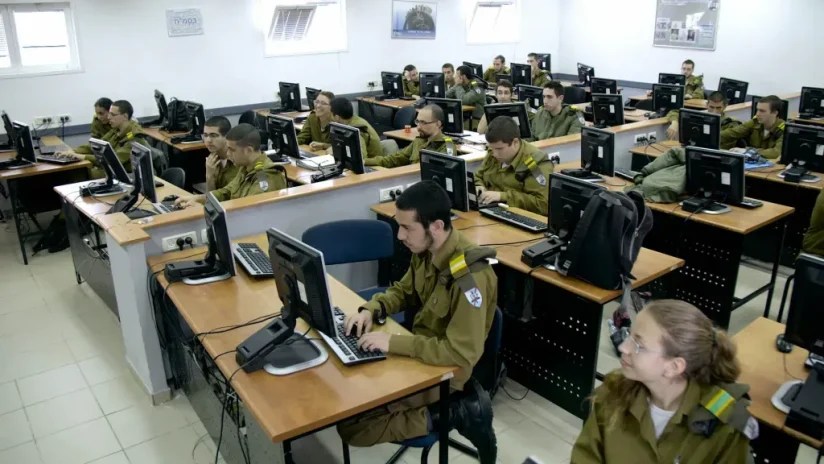
Zionist cyberwarriors hard at work
The network got busted by independent digital researchers as a result of Gamliel posting an AI-generated video on social media platforms, titled “Next Year in Free Tehran”. The fictional clip, published June 15th – three days into the Zionist entity’s botched 12 Day War, and coincidentally the same day Netanyahu forecast imminent regime change in Iran – “had massive exposure, most of which was likely inorganic.” It depicted Netanyahu, his wife, Gamliel, her partner, Pahlavi and his wife walking through Tehran’s streets.
“The video received many more views than most of the minister’s X posts, and these and other attempts to amplify it” helped researchers “locate” a network of bots and fake users artificially boosting Gamliel’s “frequent” calls for regime change in Iran and her ties to Pahlavi. “Many of these accounts were opened in 2022, at the height of the so-called hijab protests in Iran,” Haaretz records. Over 100 further “allied accounts” were launched during the 12 Day War to further boost the malignant network’s output.
Haaretz cryptically reveals, “this doesn’t appear to be the only campaign operating on this issue from Israel.” Still, the outlet’s bombshell disclosures confirm the Zionist entity – if not other hostile foreign powers, including the US – was covertly engaged in expansive psychological warfare initiatives to manufacture consent for Pahlavi’s installation as Iran’s ruler at two critical junctures in recent history, when regime change in Tehran was being openly promoted by Israeli officials, Western governments, and the mainstream media.
Those attempts floundered. While Pahlavi occasionally receives positive coverage by Western news outlets, he enjoys no support among Iran’s population at home, and even many diaspora detractors reject any suggestion of him taking power in the country. In fact, the would-be monarch’s reputation is so poisonous, his endorsement is a decisive kiss of death for any challenge to Tehran’s government. That vast resources were – and seemingly remain – invested by the Zionist entity in such a futile endeavour ranks as an embarrassing failure of epic proportions.
‘Monarchist Accounts’
Further detail on Israeli online dark arts pushing Pahlavi is provided by a July 2023 report from data analytics firm Social Forensics, on “state-sponsored platform manipulation” during the 2022 protests in Iran. The investigation concluded Tehran was the victim of wide-ranging cyberwarfare operations throughout this period. This included “disinformation, smears, and threats” emanating from a vast nexus of bots and trolls on Twitter. While the report did not make a definitive attribution for this malign activity, its findings point unambiguously in Tel Aviv’s direction.
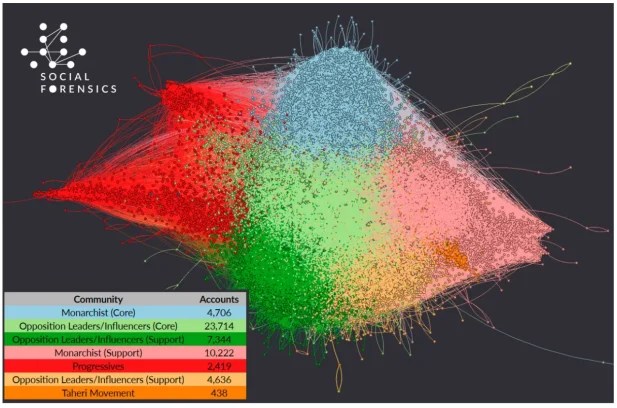
Social Forensics identified several clear, separate “communities” of weaponised accounts targeting the Islamic Republic during this period, such as “progressives”. However, the most influential community were “monarchists”. All accounts in this category had significant followings, and their output generated sizeable engagement, both inauthentic and organic. Thousands of supposed users boasted crown emojis in their display names, denoting their monarchist allegiance. In all, over 95% of these accounts were found to be automated “sockpuppets” by Social Forensics:
“Most… are inauthentic and function to flood Twitter with monarchist, pro-Pahlavi imagery and content to make it seem like there is a larger base of monarchist supporters on Twitter than reality reflects.”
In March 2023, hundreds of pro-Pahlavi bots were suspended for violating Twitter/X rules, after engaging in platform manipulation. Despite many quickly resurfacing with almost identical usernames and continuing their wrecking activities, several prominent anti-Tehran figures condemned the mass ban of automated agitators. Among them was Alireza Nader, formerly a senior apparatchik at notorious, pro-Pahlavi Zionist lobby group the Foundation for Defense of Democracies, and opaquely-funded exile organisation National Union for Democracy in Iran. Social Forensics found he followed and amplified several inauthentic monarchist accounts.
The analytics firm also discovered numerous official Israeli government accounts on the platform likewise followed the most influential pro-Pahlavi sockpuppets. Strikingly, one out of every eight accounts followed by @IsraelPersian, which targets Iranian audiences, were “inauthentic monarchist accounts”, advocating “for the overthrow of the Islamic Republic and the return of exiled Crown Prince Reza Pahlavi to the country as the leader of a constitutional monarchy.” But irresistible indications of Tel Aviv’s management of this belligerent bot network don’t end there.
An authentic user followed by @IsraelPersia, among other official Zionist entity accounts, is Emily Schrader, CEO of digital marketing agency Social Lite Creative. At the time of Social Forensics’ investigation, her company’s website openly boasted of working with “high level government organizations and NGOs in Israel, including the IDF.” The analytics firm’s probe concluded Schrader’s follower count “is inflated and her tweets are artificially amplified by the same inauthentic accounts” calling for insurrection in Iran, including monarchist bots.
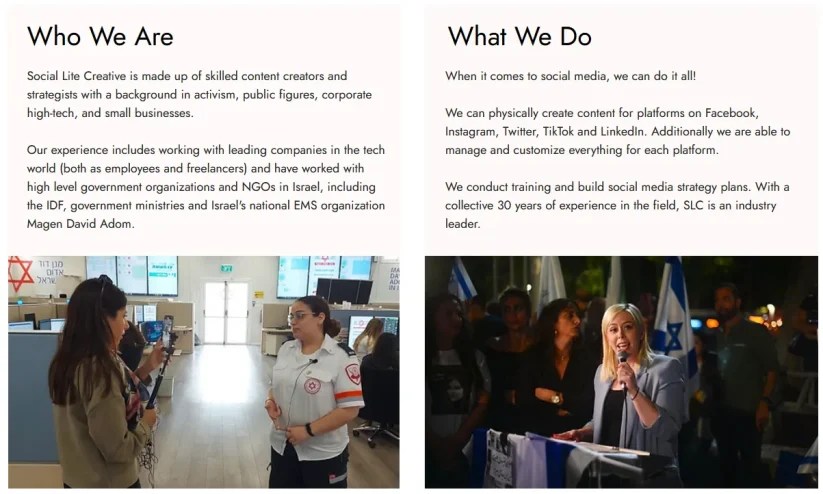
Since amended entries on Social Lite Creative’s website
‘Peddling Distrust’
Schrader avowedly counting multiple Israeli state entities, including its genocidal military, as clients is sufficient grounds to postulate Tel Aviv was ultimately responsible for the pro-monarchist “platform manipulation” campaign. Just as suspiciously, the protests they accompanied were launched following the Pentagon waging a clandestine online war against Iran for years prior. These efforts were exposed by digital researchers after Twitter and Meta banned a vast network of US military-run accounts, which “used deceptive tactics to promote pro-Western narratives” in Central and West Asia.
Iran was a preponderant target, with Pentagon psyops specialists managing multiple anti-government media outlets publishing content in Farsi with accompanying social media channels, and a panoply of bot and troll accounts. These personae frequently posted non-political content, including Iranian poetry and photos of Persian food, in order to enhance their authenticity. They also engaged with real Iranians on Twitter, often joking about mundane topics such as internet memes. The sockpuppets spanned a wide ideological gamut, employing differing narrative techniques for varying audiences.
For example, some ‘Iranian’ Pentagon bots and trolls promoted “hardliner” views, criticising the Islamic Republic for being too liberal domestically, and inadequately aggressive in asserting its interests regionally. Others posed as left-wingers, secularists and other opposition elements. It was a full-spectrum digital assault from every angle. Eerily, many of these accounts promoted women’s rights, and protests against hijab-wearing. One Pentagon-circulated meme compared the treatment of women abroad with Iran, by contrasting photos of Western female astronauts and an alleged local victim of violent domestic abuse.
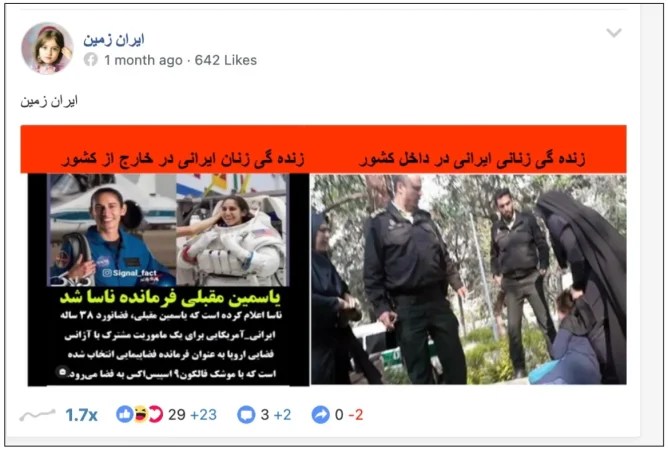
Hijab destruction was a core symbol of protests that subsequently erupted in Tehran, which elicited blanket foreign media coverage, and a chorus of calls for regime change in Iran. Quickly, Pahlavi and close allies such as Masih Alinejad, a veteran of US-funded propaganda efforts targeting the Islamic Republic, who has called for Zionist entity attacks on the country and assassination of its leaders, proclaimed themselves to be leading the demonstrators. However, their attempt to commandeer the protests resulted in the unrest’s instant termination locally.
A withering post-mortem of “why Iran’s ‘woman, life, freedom’ revolution failed” authored by Zionist lobby-connected Mariam Memarsadeghi, who similarly promotes regime change in Tehran, pinned the blame squarely on Pahlavi’s attempt to associate himself so intimately with the protests. She noted the fake king’s close associates push extreme “Iranian nationalism”, calling for “retributive violence [and] summary executions” of enemies, while “peddling distrust and attacking other opposition leaders on social media.” These activities gravely alienate Iranians within and without the country, leaving Pahlavi irreparably tarnished.
In April 2023, Pahlavi made a surprise appearance in Tel Aviv. Despite eliciting zero Western media interest, Israeli news outlets eagerly promoted his appearance as of earth-shattering significance. The Times Of Israel claimed the “historic” visit was a “healing process for many Iranian Jews,” leaving them with a “unique sense of joy, optimism, and a feeling of healing.” At a press conference, Pahlavi was asked about the response his trip there was receiving from average Iranians. He declared their vehement support was provably clear:
“Don’t take my word for it, search on social media… on Twitter, Instagram, any platform. If you do the research yourself, you don’t need to ask me the question. The answer is right before your eyes.”
Of course, that “answer” was provided by people who don’t exist, courtesy of “online operations” conducted by Israel, and likely other states seeking regime change in Iran. Evidently undeterred by the 2022 campaign’s faltering, Pahlavi was again fraudulently promoted by a Zionist-orchestrated social media effort during the 12 Day War, wholly counterproductively. A July report from Tel Aviv’s Institute for National Security Studies concluded monarchist backing for insurrection during that conflict only strengthened local support for the government, “rallying the public around the flag”:
“It is therefore advisable to avoid ties, when possible, with Iranian opposition groups (including some monarchist circles in the diaspora) who are perceived by large segments of the Iranian public as tainted and having betrayed Iran in its time of need. Although aligning with pro-Western and pro-Israel diaspora groups that push for revolutionary change may seem natural, such associations may, in fact, undermine the credibility of internal opposition and ultimately obstruct the desired outcome.”
Revealed: Charlie Kirk had decided to leave pro-Israel lobby 48 hours before assassination
The video is queued to begin where Candace Owens discusses the group chat
Press TV – October 7, 2025
A prominent American political commentator reveals how Charlie Kirk, a controversial far-right activist as well as a dedicated pro-Trump and pro-Israel lobbyist, had chosen to “leave the pro-Israel lobby” two days before his assassination.
Candace Owens made the revelation in a livestreamed episode on her YouTube channel on Tuesday, citing the contents of a group chat involving nine people, including Kirk, which took place 48 hours before the assassination.
She shared a screenshot of the chat, in which Kirk had explicitly spoken of his decision to ditch the lobby after expressing frustration at it and its extensive grip and efforts to expand control on American politics, including his own political activities.
Joining the chat, Kirk had noted that an unidentified Zionist billionaire had withdrawn his support for him after he refused to “cancel” debating with Tucker Carlson, a political commentator, who had criticized the lobby and its wealthy Zionist supporters.
‘I won’t be bullied like this’
Kirk had then expressed resentment at how the “donors play into all the stereotypes.”
“I cannot and will not be bullied like this,” he had said, adding that the situation was “leaving me no choice, but to leave the pro-Israel cause.”
The revelation has sent shockwaves among netizens worldwide.
Social media frequenters have expressed alarm at the sheer contrast between Kirk’s previous staunch support for the Israeli regime and the powerful Zionist lobby in the United States versus his decision on the eve of the assassination.
They have noted how Kirk’s support for the regime had seen him go as far as denying the October 2023-present US-backed war of genocide that Tel Aviv has been waging on the Gaza Strip.
Comments have run the gamut of reactions, including expression of appreciation for Kirk’s unprecedented decision to turn against the lobby, despite the sheer predictable consequences that the move would have on his career and continued approval by President Donald Trump.
Commenting on the chat, Owens said the conversation was “irrefutable” evidence that Kirk had been “very clear” and “very explicit” about his frustration with the pro-Israel lobby and his subsequent decision towards a turnaround.
Elsewhere in the group chat, a participant tries to dissuade Kirk from inviting Owens, given her similar criticism of the lobby, which is known by its acronym as AIPAC.
Owens has previously suggested that AIPAC was responsible for the assassination of former US president John F. Kennedy. She also once pointed to the existence of a “cult” that engages in “pedophilia and incest,” saying there were “tens of thousands of pedophiles [who] hide from justice in Israel.”
“Please don’t invite Candace. That might feel good short term, but it is not good long term,” the participant had told Kirk.
Some netizens identified the Zionist billionaire, who had withdrawn support from Kirk, as “Robert J. Shillman,” who was irate at an apparent intention by Kirk to platform Tucker and Owens.
Kirk was assassinated on September 10, when a single shot targeted him as he was sitting under a tent during a campus debate at Utah Valley University in the city of Orem.
Armature footage showed him collapse after the bullet hit him in the neck, while the activist, who used to be known for his extreme right-wing leanings, was fielding questions about gun violence.
US sent $21.7 billion to Israel to back Gaza genocide: Study
Press TV – October 7, 2025
An academic study has revealed that the United States has funneled $21.7 billion in financial and military assistance to Israel since the onset of the Gaza genocide on October 7, 2023.
The report released on Tuesday by the Costs of War Project at Brown University’s Watson Institute for International and Public Affairs details how the US State Department and the newly renamed Department of War, under both Joe Biden and Donald Trump administrations, have collectively transferred at least $21.7 billion to support Israel’s genocide in Gaza.
According to the study, the United States supplied $17.9 billion to Israel in the first year of the genocide, during former US president Joe Biden’s tenure, and $3.8 billion in the second year.
A large portion of the assistance has already been delivered, while the remainder will be distributed in the coming years, the report added.
The study notes that Washington is expected to allocate tens of billions of dollars in future funding to Israel through various bilateral deals.
Another analysis, also published by the Costs of War Project, states that the United States has spent approximately $9.65 – $12.07 billion on military operations in West Asia over the past two years.
US spending in the region, such as strikes on Yemen in March and May 2025 and attacks on Iranian nuclear sites on June 22, estimates total costs between $9.65 billion and $12 billion since October 7, 2023, including $2 billion to $2.25 billion for operations against Iran.
Although both reports rely on open-source data, they present detailed assessments of US military support for Israel and estimates of the cost of direct American involvement in the region.
Meanwhile, the State Department has not commented on the amount of military assistance given to Israel since October 2023. The White House referred inquiries to the Pentagon, which oversees only a part of the aid that is given to the Zionist entity.
The studies argue that without US backing, the regime would have been unable to maintain its genocidal campaign in Gaza for two years.
The principal study was produced in collaboration with the Washington-based Quincy Institute for Responsible Statecraft.
Pro-Israel groups have accused the institute of isolationism and anti-Israel bias, allegations the organization firmly denies.
Meanwhile, Israel’s war machine continues its campaign of destruction, claiming countless civilian lives across Gaza and the wider region.
Since October 7, 2023, when Israel launched its genocidal war on the besieged Gaza Strip, more than 76,000 Palestinians, including over 20,000 children and 12,500 women, have been killed or gone missing, while in its 12-day war with Iran last June, the regime killed at least 1,604 people.
Featured Video

More Iran War fallout: Maritime insurance industry shifts from London to China
or go to
Aletho News Archives – Video-Images
From the Archives
The Biggest Threat to Peace in Middle East
By Dr. Elias Akleh* | Sabbah Report | May 24, 2010
A build up of heightened tension in the Middle East is escalating in the last few weeks. American and Israeli postures towards Lebanon, Syria, and Iran have become more threatening. Listening to speeches of political leaders one hears talks only about war not peace. Iranians and Israelis are continuously training hard for a possible showdown. Both sides are conducting extensive war games every month. This led Syrians to claim that Israel is preparing for a soon-to-come another war. The Jordanians also are warning that current stalemate of the peace process is an indication of a war breaking out this summer. The Russian President and his army chief hinted, a few months ago, that the US and Israel were planning for an attack on Iran.
Indeed Iran is, as it has been for last few years, the target of most of the threats and accusations of supporting terrorism. Escalating incitement against Iran the American Defense Department sent last month (April) to Congress a report on Iran’s military claiming Iran could develop intercontinental ballistic missiles capable of reaching the US by 2015.
Ignoring the fact that N. Korea, India, Pakistan, and Israel are proven to have nuclear weapons while Iran does not, the US Secretary of State Hillary Clinton chose in her speech, to the nuclear Non-Proliferation Treaty review conference at the UN, to focus on Iran’s alleged nuclear ambitions putting the whole world at risk as she put it. According to Clinton Iran’s acquisition of nuclear weapons, rather than Israel’s more than 200 nuclear bombs, is destabilizing the Middle East. She called on the world’s nations to rally around US efforts to hold Iran, not other nuclear countries, to account.
The accusation that Usama Bin Laden is living comfortably in Iran had received a boost after the broadcast of a documentary called “Feathered Cocaine”. This echoed the June 2003 claims of the Italian newspaper Corre de la Sierra that Bin Laden was in Iran according to some intelligence report, and according to Richard Miniter’s book “Shadow War”. … continue
Blog Roll
 Aletho News
- Iran mobilizing one million soldiers to ‘create hell’ for any US ground assault: Report
- The coming military and psychological unravelling?
- Iran has the last laugh
- More Iran War fallout: Maritime insurance industry shifts from London to China
- US-Israeli aggression on Iran triggers review of GCC countries’ investment pledges to Washington
- Russia slams UK plan to seize tankers suspected of carrying its oil
- Pakistan ramps up food exports to Persian Gulf nations as war deepens food insecurity
- Iran submits response to US plan, sets terms for war’s end: Tasnim
- US vs Iran: Kharg Island Talk — Bluff or Escalation? Ex-Military Officer Weighs In
- Zelensky unnecessarily involves Ukraine in the Middle East crisis
- If Americans Knew
- ‘No Innocent Children’: Far-right Israeli Lawmaker Defends Killing of Palestinian Family
- Mossad’s promises helped Netanyahu convince Trump that Iran could be toppled
- US Arms Control Official Refuses To Comment When Asked If Israel Has Nuclear Weapons
- Veterans warn US landing could be ‘more Gallipoli than Vietnam’
- Israel may be committing war crimes in Lebanon – Not a ceasefire Day 167
- In the West Bank, life is a constant battle – 3 articles
- Jacob Reses, one of the most powerful pro-Israel operatives in Trump’s Washington
- Israeli-US assaults kill or injure 87 children a day – Not a ceasefire Day 166
- ‘Forever live by the sword’: Understanding Israelis’ massive support for Iran war
- UN’s special rapporteur on human rights says Israel is systematically torturing Palestinians
- No Tricks Zone
- Devastating Assessment Of Comirnaty Vaccine By Former Senior Pfizer Europe Toxicologist
- New Study: CO2 Is ‘Effectively Negligible’ As An Explanatory Climate Change Factor Since 2000
- Former Pfizer Toxicologist Dr. Helmut Sterz Tells Bundestag Hearing Pfizer Vaccine Should Have Never Been Approved
- Energy Expert: Germany’s Nuclear Phaseout Was A “500 Billion Euro Mistake”
- New Research: South Australia’s Mid-Holocene Sea Surface Temperatures Were 4°C Warmer Than Today
- Storing Green Energy To Last Germany 10 Days Would Require A 60-Million Tonne Battery
- New Studies: UK Sea Levels Were 4 Meters Higher Than Today During The Mid-Holocene
- Destructive Green New Deal: German Energy And Metal Group Warns Of Drastic Crisis
- New Study Documents A 20-Year Pause In Arctic Sea Ice Decline – Driven By Internal Variability
- Wake-up Call: Survey Shows Majority Of Germans Now Favor Postponing Climate Targets!
 Aletho News