New US shipment of 6,500 tons of military aid arrives in Israel
MEMO | April 30, 2026
Israel said Thursday it received a new shipment of 6,500 tons of ammunition and military equipment from the US in 24 hours, Anadolu reports.
“Two cargo ships carrying thousands of air and ground munitions, military trucks, Joint Light Tactical Vehicles (JLTVs), and additional military equipment were offloaded at the ports in Ashdod and Haifa,” the Defense Ministry said in a statement.
The daily Maariv said the shipments are part of a “central effort to enhance Israel’s readiness for developments in the war.”
According to the paper, more than 115,600 pieces of military equipment have arrived in Israel via 403 airlifts and 10 maritime shipments since the start of the war with Iran in February.
Israel has been engaged in ongoing military offensives in Gaza since October 2023 with US backing, alongside escalating hostilities involving Lebanon and tensions with Iran.
US CENTCOM’s Request for Dark Eagle Missiles Shows Shortage of Weapons and Limited Options
By Ekaterina Blinova – Sputnik – 30.04.2026
The request for untested hypersonic missiles for the Middle East arena exposes the US’ failure to neutralize Iran’s launcher network, veteran war correspondent Elijah J. Magnier tells Sputnik.
“The Dark Eagle has reportedly not been declared fully operational in the past,” Magnier says. “So when the US decided to deploy it, it signaled urgency, escalation pressure. And above all, shortage of suitable conventional weapons.”
The request also shows that earlier Pentagon statements that Iran’s launchers were fully destroyed did not match reality, the pundit continues.
“If all key launchers were eliminated, CENTCOM would not need a new system.”
It was previously reported that the US Army intends to deploy Dark Eagle long-range hypersonic missiles against Iran.
Dark Eagle Won’t Change Balance of Power
“Militarily, the Dark Eagle hypersonic would not overturn the balance of power by itself, especially if the available inventory is very limited,” Magnier says. “The value is political and operational.”
- The US aims to keep deeper Iranian missile sites at risk as a tool of pressure
- The request is intended to strengthen coercion while talks remain stalled
- It combines coercive message with operational contingency planning
“By talking about the new type of missiles that obviously doesn’t scare Iran, it shows also that the Americans are lacking options,” he says.
The war correspondent doesn’t believe the US and Israel are in a position to achieve their declared objectives.
Israeli strikes kill 10 in southern Lebanon, including 3 rescue workers
Press TV – April 29, 2026
At least ten people, including three rescue workers, have been killed in Israeli airstrikes against residential neighborhoods in southern Lebanon, marking the latest violations of a ceasefire that began on April 16 after weeks of fighting between the Tel Aviv regime and Hezbollah.
Lebanon’s official National News Agency (NNA) reported that an Israeli aerial raid destroyed a four-storey building in the village of Jabchit in the Nabatieh district on Tuesday night, killing Mohammad Jawad Bahja, his wife Lotfiya, as well as Amani Jaber and her daughters.
Lebanon’s Ministry of Public Health announced in a statement that at least 13 people also sustained injuries in the attack.
Separately, two successive Israeli strikes on a building in the town of Majdal Zoun on Tuesday killed five people, including three rescue workers who went to help those injured in the initial Israeli attack on the targeted building.
The three Lebanese civil defense rescue workers were later identified as Hussein Ghadbouri, Hussein Sati and Hadi Daher.
Prime Minister Nawaf Salam strongly condemned the deadly Israeli strike.“Targeting elements of the Civil Defense in Majdal Zoun, and their killing while carrying out their humanitarian duty, constitutes a new and described war crime perpetrated by Israel,” he wrote in a post on social media.
“It represents a flagrant violation of the principles and rules of international humanitarian law,” Salam said.
“The government will spare no effort to condemn this heinous crime in international forums and to mobilize all efforts to compel Israel to cease its ongoing violations of the ceasefire agreement.”
Israeli forces also shelled the towns of Mansouri, Chehabiyeh, Tiri, Jouaiyya, Touline and Khirbet Selm. There were no immediate reports about possible casualties and the extent of damage caused.
The occupation troops also dropped white phosphorus shells on Yohmor al-Shaqif village.
Elsewhere in Naqoura region, Israeli forces pressed ahead with their demolition activities. Residents of adjacent municipalities felt a strong tremor as the occupation troops set off a considerable amount of explosives to flatten designated buildings.
On Wednesday, kamikaze drones launched by Hezbollah resistance fighters targeted and destroyed two Israeli Merkava battle tanks in Naqoura.
Hezbollah said in a brief statement that the operation was carried out in defense of Lebanon as well as its nation, and in response to the Israeli aggression against villages in southern Lebanon.
Israeli military ‘failed on all fronts’: Poll
The Cradle | April 28, 2026
A poll published by Israel’s Public Broadcaster (KAN) on 28 April found that a majority of Israelis believe the state has failed to secure victory in any war since October 2023.
According to the survey, 57 percent of respondents said no victory had been achieved, while 28 percent believed success had been reached in at least one arena, and a further 15 percent said they were unsure.
The findings come after more than two years of Israel’s genocide in Gaza – which Israel threatens to reignite – during which Tel Aviv waged multiple offensive military campaigns against Gaza, Lebanon, and Iran, alongside attacks in Yemen and Syria and a campaign of destruction and displacement in the occupied West Bank.
Confidence levels across all the fronts remain low, with only 17 percent viewing operations in Syria as successful and 16 percent saying the same for Gaza and Iran.
Perceptions dropped further on the Lebanese front at 14 percent, followed by Yemen at 12 percent and the occupied West Bank at 11 percent.
The poll also points to persistent security concerns, with a total of 73 percent of respondents saying the continued armed presence of Hamas and Hezbollah poses a direct threat of a repeat of a 7 October-style event.
Only 10 percent dismissed that possibility, while 17 percent remained uncertain.
On the ground, Israel has reportedly begun withdrawing troops from southern Lebanon. Israeli outlet Maariv described the campaign as ending in “failure” and “bitterness,” as forces pull back under continued Hezbollah attacks, including drone strikes that exposed major gaps in Israeli preparedness.
The poll also showed divisions over Netanyahu’s legal status, with a majority – 56 percent – supporting a pardon for his corruption charges, while 26 percent opposed the move and 18 percent remained undecided.
Netanyahu had requested a presidential pardon on 30 November without admitting guilt or stepping down from office, despite Israeli law requiring an admission of guilt for such a measure.
He is currently facing trial in three separate corruption cases involving fraud, bribery, and abuse of power, with court proceedings ongoing since 2020 after charges were filed in 2019.
Netanyahu’s court testimony was delayed once again on 27 April over a “serious” security incident in southern Lebanon, as the prime minister seeks to prolong the wars to keep his corruption trial from moving forward.
At the same time, the International Criminal Court (ICC) has listed Netanyahu as wanted since 2024, issuing arrest warrants for him and former defense minister Yoav Gallant over their direct involvement and orchestration of the genocide in Gaza, as well as war crimes and crimes against humanity, including the use of starvation as a weapon.
Trump eager for off-ramp in war on Iran, but Netanyahu has him trapped: Former official
By Alireza Kamandi | Press TV | April 29, 2026
Donald Trump is eager to find an off-ramp, declare “victory,” and end the war against Iran – but Benjamin Netanyahu is not, leaving Trump trapped, says a former chief of staff to the US Secretary of State.
In an interview with the Press TV website, Colonel Lawrence Wilkerson – former chief of staff to Colin Powell from 2002 to 2005 – said that as tensions with Iran simmer following the recent US-Israeli war against the country, a complex picture is emerging of a Washington administration caught between tactical necessity and political traps.
He said the central question surrounding the White House’s strategy is whether the Trump administration is using the lull in hostilities to rebuild its military capacity.
“There is an ongoing effort to replace critical munitions, expedite repair of warships in maintenance, and alert and prepare more land forces for possible action,” he said, adding that this logistical surge extends to Tel Aviv, where efforts are underway to replenish munitions and call up more reservists.
As for the Trump administration’s self-declared “maritime blockade” of Iranian ports, the timeline is elastic, Wilkerson said, adding that the US can sustain the pressure indefinitely, but only as long as necessary to secure an agreement with Tehran on what constitutes the end of war.
“However, this is where the internal rift becomes critical. President Trump is eager to find an exit, to declare ‘victory’, and to end the conflict, but Netanyahu is not. So, Trump is trapped,” he said.
The former official noted this dynamic suggests that the duration of the blockade depends heavily on the outcome of upcoming Israeli elections and who ultimately emerges as the winner there.
For now, the US finds itself locked into a maritime strategy whose off-ramp is controlled by Israel with conflicting war aims, he told the Press TV website.
When asked how long Israel could sustain a war against Iran without direct US military intervention, the answer was stark: “Not very long—probably less than a month.”
The reason is not a lack of will, but sheer logistics, he stated.
“The supply of fuel, oil, munitions, and even material not available because of the deterioration of Israel’s economy, would be non-existent,” he remarked.
Wilkerson emphasized that the most profound geopolitical consequence of the US-Israeli strikes on Iran will be felt thousands of miles away, in Asia and the Persian Gulf states.
Asian nations are already reassessing their military cooperation with Washington.
“The perception of the United States as a stabilizing, reliable anchor is fracturing. For the Persian Gulf monarchies that have long relied on the US security umbrella, and for Asian powers concerned about energy security and trade routes,” he noted.
On events unfolding inside the US and the recent shooting during the White House correspondents’ dinner, he said these things happen in the Empire, but more frequently with Trump, as he is “a very controversial president.”
“One wonders as well if one or two of the attempts were not staged, such as the one in Pennsylvania and the one on the golf course. Staged to build sympathy for a president who loves the limelight and being ‘loved’,” he stated.
He attributed the violence to a deeply fractured US administration and the American Empire.
“A great many people loathe Donald Trump, believe him directly involved in the Epstein scandal, and do not care for his style of ‘leadership’, plus, wars overseas tend to come home, i.e., violence in war creates violence at home,” he told the Press TV website.
Nuclear Apartheid: Iran’s Rise Exposes the NPT Fraud and the West’s Israel Exception
By Freddie Ponton – 21st Century Wire – April 29, 2026
The fight over Iran’s vice presidency at the 2026 NPT Review Conference looked procedural only if one ignored the history that walked into the room with it. The United States, the United Kingdom, speaking for France and Germany, Australia, and the United Arab Emirates objected to Iran’s appointment, yet Iran kept the post after a Non-Aligned Movement nomination and no blocking vote was forced, exposing a basic fact that now hangs over the treaty system. The United Arab Emirates did not merely object but formally and unequivocally disassociated itself from Iran’s election, while citing Tehran’s continuous violations of its safeguards obligations.
That moment is crucial because it revealed a shrinking gap between Western power and Western authority. The states that still dominate military alliances, financial coercion, and media narratives could denounce Tehran in New York, but they could not turn denunciation into institutional compliance, and they could not persuade the wider diplomatic field that their understanding of non-proliferation deserved automatic deference. What looked like a dispute over one vice presidency was in fact a public measure of a much deeper revolt against selective enforcement.
The bargain they broke
The deeper story begins in 1995, when the NPT was indefinitely extended on the basis of a broader political package that included the Resolution on the Middle East. That resolution called on all states in the region that had not yet done so to join the treaty and place their nuclear facilities under full-scope IAEA safeguards, and the UN Secretariat background paper explicitly records that the resolution was an essential element of the outcome on which indefinite extension was secured.
The 2010 Review Conference reaffirmed that point in unusually clear language. It said the 1995 resolution remained valid until its goals were achieved, recalled the importance of Israel’s accession to the treaty and the placement of all its nuclear facilities under comprehensive safeguards, and endorsed concrete steps toward a 2012 conference on a Middle East zone free of nuclear weapons and other weapons of mass destruction. The conference never delivered what it promised, and Algeria’s 2026 working paper now states bluntly that Israel’s stance helped render the 1995 resolution “devoid of substance,” while the UN Secretariat paper records that many states saw the failure of implementation as seriously undermining the treaty itself.
The Israeli exception
That is why so much of the Global South reads the current crisis through Israel rather than through Iran alone. The UN Secretariat background paper states in neutral terms that all states of the Middle East except Israel are parties to the NPT and that all states in the region except Israel have undertaken to accept comprehensive IAEA safeguards, giving documentary form to the asymmetry that the Non-Aligned Movement (NAM) and Arab states have been protesting for decades.
NAM’s own recent language is harsher because the political implications are harsher. At the 2024 IAEA General Conference record, Uganda speaking on behalf of NAM warned that a selective approach undermined the viability of the safeguards regime, expressed great concern over Israel’s acquisition of nuclear capability, and called for a total prohibition on nuclear-related transfers and assistance to Israel, while the April 2026 NAM statement to the UN Disarmament Commission again demanded that Israel renounce nuclear weapons, accede to the NPT without precondition or delay, and place all its facilities under full-scope safeguards.
That continuity was reaffirmed in the Kampala Declaration, which carried the same line through 2025 and closed the institutional bridge to the April 2026 NAM position. For the movement, this is not a side file or an ideological hobbyhorse. It is the living proof that the rules are preached as universal and applied as political.
The South’s quiet revolt
Once that history is acknowledged, the so-called silence of NAM and many Global South states on Iran’s vice presidency stops looking like ambiguity and starts looking like discipline. They did not need to issue sentimental declarations of love for Tehran in order to refuse a Western effort to re-police multilateral legitimacy, because the issue before them was larger than Iran’s image and deeper than one nomination. It was whether the same powers that had tolerated, normalized, or materially shielded the Middle East’s only non-NPT nuclear exception would now be allowed to decide who is morally disqualified from procedural office inside the treaty system.
That is why the resistance was institutional rather than theatrical. After dismissing the objections as baseless and politically motivated, Iran disassociated itself from the election of the United States as vice president, and according to one contemporaneous account, from Australia’s as well, turning the confrontation into a mirror held up to the old order. The 2025 report of the sixth session of the conference on a Middle East zone free of nuclear weapons and other weapons of mass destruction said Israel’s refusal to join the NPT and submit all its facilities and activities to comprehensive safeguards undermined the credibility of the non-proliferation regime and imposed additional burdens on regional states, while the same report condemned attacks on Iran’s safeguarded nuclear facilities as a grave threat to the credibility of the NPT and the integrity of the entire IAEA safeguards regime.
In that setting, refusing to let Washington, London, Paris, Berlin, and Canberra define the boundaries of legitimacy was not indulgence toward Iran, but a defense of sovereign equality against a one-sided nuclear order.
What their objection revealed
The objections from the United States, the E3, and Australia therefore boomeranged. They were intended to isolate Iran, but they instead illuminated the moral exhaustion of a bloc that speaks in the language of non-proliferation while presiding over an order in which disarmament obligations are endlessly deferred, nuclear sharing and modernization continue, and Israel’s opaque arsenal remains politically protected from the universality routinely demanded of others. The analysis from the European Journal of International Law (EJIL) long ago captured the pattern by showing how NAM kept international attention on Israel’s nuclear status and how double standards around Israel helped fuel resistance inside the regime, and the documents gathered since then show that this reading did not fade but hardened.
Australia’s place in this picture is revealing precisely because it is less central than Washington or the E3 and yet moved in lockstep with them against Iran’s vice presidency. That choice placed Canberra inside a camp that could still object loudly but could no longer command consent, and it tied Australia to a diplomatic posture that much of the Global South now experiences as selective guardianship rather than principled stewardship. The same is true of the E3, whose claim to defend the treaty sounds increasingly thin when the documentary record shows decades of unfinished obligations on the Middle East file and continued Western insistence that the burden of credibility falls primarily on disfavored treaty members rather than on the region’s protected exception.
A treaty stripped bare
What emerged in New York, then, was not simply a quarrel over Iran. In fact, we all witnessed the exposure of a treaty order whose founding compromise on the Middle East has been repeatedly postponed, diluted, and evaded, until many of the states asked to keep faith with the system now see the system itself as compromised at the core. The 2026 UN Secretariat paper, the 2026 Algeria submission, the April 2026 NAM statement, the 2024 IAEA record, and the 2025 IAEA safeguards resolution all converge on the same underlying reality that Israel’s non-accession, unsafeguarded status, and continuing exceptional treatment have become inseparable from the crisis of NPT credibility.
That is why Iran’s vice presidency is so significant, because it marks the point at which a large part of the non-aligned world stopped pretending that the greatest danger to the treaty’s legitimacy begins and ends in Tehran, and instead used procedure to register a quieter but more consequential judgment that the deeper non-proliferation crisis lies in a regime that punishes some, excuses others, and then demands respect for the imbalance it created.
On April 27th, the West could still denounce, but could no longer decide; and that, more than the vice presidency itself, is the message now being sent from the Global South to Washington, the E3, and Australia.
“Trump’s presidency is at risk of being destroyed” Col Douglas Macgregor
ANI News | April 28, 2026
How Cognitive Science Explains Our Looming Nuclear Crisis
By Thomas Karat | The Libertarian Institute | April 28, 2026
Bombs have been falling on Iran for fifty-nine days. As of now a ceasefire is holding, just barely, brokered under pressure from Pakistan. But before it came, a girls’ primary school in the southern city of Minab was hit on the first day of the war, at least 170 dead, most of them girls aged seven to twelve, killed by a U.S. Tomahawk missile that President Donald Trump initially denied firing. Thirty universities struck since February 28, including Iran’s equivalent of MIT. Over 2,000 Iranians killed by American-Israeli strikes. Thirteen U.S. service members confirmed dead. An American F-15E shot down over Iran. The Strait of Hormuz—20% of the world’s oil and gas—effectively closed, with China and Russia vetoing the United Nations resolution to reopen it. Gas prices heading for $4.30 a gallon and rising. Trump promising to bomb Iran “back to the stone ages.”
And underneath all of it, the detail that should be dominating every front page but isn’t: on March 21, Iranian ballistic missiles landed fourteen kilometres from Dimona— Israel’s undeclared nuclear weapons facility, the one running for six decades on the fiction that it doesn’t exist, estimated to hold 800 kilograms of weapons-grade plutonium. The reactor at Bushehr has been struck three times since the war began. The Arms Control Association has warned explicitly of radiological contamination risk across the region.
This is where we are. Now ask the question nobody in mainstream media is asking: how did we get here? Not the geopolitical answer—you can get that anywhere. The deeper answer. What made this war politically possible? What narrative ran so deep in enough Americans that a conflict of this scale, this risk, this cost, could be launched mid-negotiation—Pakistan’s foreign minister confirmed publicly that the United States and Iran were close to a diplomatic settlement when Israel launched its February 28 strikes—without triggering mass domestic revolt?
The answer is a single talking point. You have heard it thousands of times, probably without noticing its structure: forty-seven years of Iranian aggression, forty-seven years of American patience, forty-seven years of failure by every president in both parties to solve the Iran problem. It dates the conflict from the 1979 Islamic Revolution and the 444-day hostage crisis that followed—Americans held in the U.S. Embassy in Tehran, the nightly TV count, the humiliation. It frames the entire subsequent history as a story of American victimhood and Iranian intransigence. And it has been in my estimation the most effective piece of war propaganda in modern American history—not because it is true, but because of the specific cognitive architecture it exploits, which this article is going to name precisely, because naming it is the only thing that can stop it from working the next time.
The history starts not in 1979 but in 1953, when the CIA and British intelligence jointly overthrew Mohammad Mosaddegh, Iran’s elected prime minister, because he had nationalized his country’s oil. The CIA’s own declassified documents confirm the coup was “carried out under CIA direction.” Britain has still not released its files. For twenty-six years after that, the Shah’s government—sustained by American weapons and CIA training of his secret police, SAVAK—ran one of the region’s most efficient torture and imprisonment systems. The 1979 revolution was not irrational. It was direct blowback from a quarter-century of CIA-managed client state. And the hostage crisis that anchors the “forty-seven years” narrative was itself, per Gary Sick—the Iran expert on Jimmy Carter’s own National Security Council—possibly extended deliberately by Ronald Reagan’s campaign manager William Casey, who multiple witnesses say negotiated with Tehran to hold the hostages past election day in exchange for a promise of arms. The foundational American wound of this conflict may have been kept open, on purpose, for electoral advantage, by the political faction most loudly demanding Iranian accountability four decades later.
Then in 1988 the USS Vincennes, operating inside Iranian territorial waters, shot down Iran Air Flight 655—a commercial Airbus on a Dubai run—killing all 290 people aboard including 66 children. The Pentagon issued false statements about the aircraft’s flight profile. The captain was decorated. Nobody was prosecuted. This event does not appear in the “forty-seven years of Iranian aggression” narrative. It belongs to a parallel account—forty-seven years of American aggression—that the talking point is specifically engineered to prevent you from thinking about.
Here is where the cognitive science becomes urgent, because it explains not just how the talking point spreads but why correcting it with facts—including everything in the preceding three paragraphs—fails so consistently, even with audiences that are already skeptical of government. The political psychologist Jonathan Haidt established in his moral foundations research that human moral reasoning runs on several distinct evolutionary systems and critically, that libertarians score measurably lower on the Sanctity foundation, the disgust-and-contamination system that codes out-groups as morally polluted. You are, if you read this publication, statistically more resistant than the average American to the “Iran is evil, the mullahs are fanatics” framing. That part of the propaganda largely didn’t work on you. But the “forty-seven years” talking point doesn’t primarily run on disgust. It runs on three other systems that are universal and for which the libertarian movement has built almost no intellectual defense.
The first is loss aversion: Kahneman and Tversky’s finding that humans feel losses roughly twice as intensely as equivalent gains. “Forty-seven years of failure” is a pure loss narrative—not a promise of future benefit, but an open wound, a thing taken and not returned. It activates the loss-detection system before rational evaluation can engage. The second is the sunk cost mechanism: the longer the conflict, the more the accumulated investment—of attention, of sanctions, of covert operations, of proxy wars—makes the brain read escalation as rational rather than reckless. Half a century of failure becomes, neurologically, an argument for drastic action rather than against it. The third is dominance signalling: primates, including humans, carry a hard-wired system that reads unanswered challenges from rivals as weakness inviting further challenge. Forty-seven years of Iranian defiance of American authority, narrated as a sequence of inadequate responses, activates this system viscerally. Crucially, the libertarian principle of non-aggression reads inside this frame not as principled restraint but as submission. Your correct position sounds, to your neighbour’s dominance-monitoring system, like fear.
George Lakoff showed in Don’t Think of an Elephant that political frames operate below the threshold of conscious reasoning and that facts introduced into the wrong frame bounce off rather than dislodging it. The “forty-seven years” frame installs a strict father moral logic: the nation as a family whose authority must not be defied without punishment. Once that frame is active, every historical correction—the 1953 coup, the Vincennes, the October Surprise—arrives as information the brain is not structured to receive. The frame stays. The facts leave.
This is the machine that produced the war you are watching right now. The school in Minab. The missiles over Dimona. The Bushehr reactor taking strikes. The Strait of Hormuz closed while the LSE warns that bombing a country out of its desire for a nuclear deterrent is not possible and that every strike makes eventual acquisition of a weapon not less likely but more. The former director of the National Counterterrorism Center resigned and told Libertarian Institute Director Scott Horton that he had watched Israeli officials mislead Trump about the Iranian nuclear threat to manufacture the justification for this war. Pakistan’s foreign minister stated in parliament that diplomacy was actively progressing when Israel launched its surprise attack and derailed it. A Reuters/Ipsos poll found only one in four Americans supports the strikes.
The talking point has done its work. It ran for forty-seven years, activating loss detectors and dominance monitors and sunk cost accumulators and strict father frames in enough of the population to make a war with genuine nuclear escalation risk feel not just permissible but long overdue. Now fourteen kilometres separates us from a direct strike on a reactor that has been producing weapons-grade plutonium for sixty years under a policy of official denial—and the IAEA, which Iran has now suspended from cooperation, has no inspectors inside to tell us what is actually there.
The ICAN nuclear abolition campaign noted that striking nuclear installations is explicitly banned under international law. Both sides are now doing it. The International Atomic Energy Agency has called for maximum military restraint near nuclear sites. Both sides are ignoring it. The ceasefire this morning is the third since the war began, and both sides have violated the previous two.
The talking point got us here. Understanding how, at the neurological level, through the specific cognitive systems it exploited, is not an academic exercise while bombs are falling. It is the precondition for building an antiwar argument that can actually break through the frame, rather than bouncing off it for the forty-eighth year running.
The state built a machine over forty-seven years. You are watching it run. The machine works in the dark. This is the light.
Have the US and Israel killed non-proliferation?
Ashes of Pompeii | April 28, 2026
The United Nations has elected Iran as one of the thirty-four vice presidents of the 2026 Nuclear Non-Proliferation Treaty Review Conference, proceeding despite formal objections from the United States, the United Kingdom, France, Germany, Australia, and the United Arab Emirates. Rather than a mere procedural footnote, this appointment signals a pronounced structural realignment and underscores the increasing diplomatic isolation of Western capitals within multilateral governance.
For decades, nuclear restraint was widely regarded as a stabilizing imperative, a framework endorsed by practically all nations, including Iran, who consistently endorsed this through state doctrine and a longstanding religious fatwa explicitly prohibiting the pursuit of atomic armaments. The Iranian prohibition was the foundation of the JCPOA agreement allowing internation inspection of Iranian nuclear sites. It is important to note that it was the USA who withdrew from the JCPOA agreement and not Iran, and Iran seems to have respected the terms even after this withdrawal.
This is the context for the current situation. Iran has been attacked by the USA and Israel because of the perceived threat that Iran might, despite the inspections and the conclusions of the American intelligence agencies, cross the nuclear threshold. Please note the contrast: Iran was attacked because it might develop nuclear weapons, whereas North Korea enjoys relative security precisely because it has nuclear weapons. That is to say, non-proliferation treaty compliance would seem to correlate with heightened vulnerability.
Whatever one might think of Kim Jong Un, the caricatures propagated regarding North Korea’s leadership as erratic, epitomized by the “Rocketman” epithet, are increasingly untenable when subjected to rigorous strategic analysis. Evaluating outcomes rather than rhetoric, it becomes evident that Pyongyang’s leadership was methodically positioned ahead of other global policymakers. While other regimes face coercive diplomacy or military intervention, North Korea’s deterrent has insulated it from external operations. We can assume other countries have noticed this, that non-proliferation or strategic ambiguity offer far less protection than verified atomic capability.
And this realization is coming at a time when America itself is coming to be seen as more erratic, and potentially a less reliable partner than it was perceived to be in the past. Can America’s allies still feel secure under America’s nuclear umbrella? Is an “America First” America going to risk nuclear conflageration to defend its allies? Many will have calculated that it might not.
Washington and Jerusalem have long justified their confrontational posture toward Tehran by citing the purported threat of an Iranian breakout, even as Israel maintains an arsenal that, though officially unacknowledged, is universally understood by all. If the recent campaigns against Iranian military and energy infrastructure were to be assessed through a deterrence lens, it can be argued that the absence of an atomic shield rendered Tehran strategically exposed. Had Iran possessed a credible second-strike capability, those operations would likely have been deemed too escalatory to execute.
Consequently, the international community can probably anticipate a quiet reassessment of nuclear thresholds. Governments are not yet explicitly announcing an intention to seek atomic weapons, but it does seem evident that more will be seriously considering it, whether because they no longer trust America as ally or because they see that nuclear deterrance has been successful for North Korea. For now, it seems likely that these nuclear intentions will remain under wraps, but who can doubt that, at the very least, multiple feasability studies will have been undertaken across the world.
The strategic calculus advanced by the Trump administration and the Netanyahu government has effectively engineered an environment where non-proliferation is, at best, a diminishing paradigm, and at worst, an existential error for a sovereign state. Therefore, the eventual deployment of tactical or strategic nuclear assets across multiple countries becomes increasingly probable.
The profound irony, of course, is that given the stated justifications for the launch of the US/Israeli war on Iran, that Israel will be a highly plausible future target within the very security vacuum it helped to normalize.
US pension fund invests hundreds of millions in weapons firms supplying Israel
The Cradle | April 27, 2026
The Virginia Retirement System (VRS), which manages pension benefits for the US state of Virginia’s public sector workers, holds a staggering $394 million in investments linked to weapons makers and shipping companies supporting Israel’s genocide of Palestinians in Gaza and wars on Lebanon and Iran, according to a 23 April report released by a coalition of Palestinian advocacy groups.
The report was prepared by the VRS Divest from Weapons & War campaign, the Palestinian Youth Movement (PYM), and the People’s Embargo for Palestine. It draws on publicly available financial data and records obtained through Freedom of Information Act requests.
The report presents a detailed accounting of the VRS’s investments in many of the world’s largest weapons makers as part of its $122 billion portfolio.
Lockheed Martin is the VRS’s single largest holding at $94.8 million. The firm produces the F-35 fighter jet and AGM-114 Hellfire missiles. Both have been used extensively by the Israeli military during its more than two-year Genocide of Palestinians in Gaza.
The Virginia pension system is also invested in Boeing, which manufactures precision-guided munitions, known as JDAMs, that are used to kill and maim children in Gaza.
Other investments include General Dynamics, Northrop Grumman, Raytheon, Maersk, and Thyssenkrupp, all of which either manufacture or ship weapons for use by the Israeli military in Gaza, Lebanon, and Iran.
“These companies are critical in maintaining the weapons supply to Israel and the resulting massacres of thousands of people across the Middle East,” Bana Husseini, an organizer with the VRS Divest campaign and the Palestinian Youth Movement, told TRT World.
Husseini and other activists are lobbying the VRS to divest from companies supporting Israel’s military and its genocide and wars. A petition calling for divestment has gathered nearly 4,500 signatures.
However, the pension system has continued to express its support for Israel.
“The VRS has responded by dismissing the campaign’s demands, arresting a firefighter for delivering the petition, inviting a notorious war criminal to their yearly retreat, and further collaborating with war profiteers,” Husseini explained.
Joelle Rudney, a retired teacher from Virginia, told TRT World she was upset to learn her pension was invested “in the bombings of hospitals, schools, and houses in Gaza in attacks that have killed nearly 70,000 people, mostly civilians.”
In response, she has helped lobby the VRS Board of Trustees to divest from the companies supporting Israel’s war crimes.
Casey Rosales, a county public servant who has worked in mental health services, was also angered to learn how her pension contributions are being invested.
“It’s difficult to reconcile the fact that while I dedicate my career to supporting and strengthening communities, the money I earn may be contributing to harm elsewhere,” Rosales stated.
A Virginia public utilities employee said she felt betrayed to learn the money she contributes to her retirement fund is supporting genocide.
“It is profoundly sad that while doing work to help men, women, and children with health care services and resources here in Virginia, my tax money goes to buying and owning shares in companies contributing to genocide,” the employee stated.
“I demand the VRS Board of Trustees divest from these companies and commit to never again invest our future into the manufacturing of death,” the employee told TRT World.
Israel’s genocide of Palestinians in Gaza has killed over 72,000 Palestinians, the majority women and children. Tens, if not hundreds, of thousands more will likely die due to the indirect effects of years of Israeli bombing that has destroyed the basic health, electricity, and water infrastructure in the strip and displaced nearly 90 percent of the population.
Featured Video
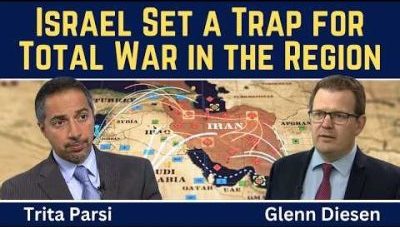
Trita Parsi: Israel Set a Trap for Total War in the Region
or go to
Aletho News Archives – Video-Images
From the Archive
Zionism’s Violent Legacy
By Donald Neff | Washington Report On Middle East Affairs | January 1996
On January 4, 1948, Jewish terrorists drove a truck loaded with explosives into the center of the all Arab city of Jaffa and detonated it, killing 26 and wounding around 100 Palestinian men, women and children.[1] The attack was the work of the Irgun Zvai Leumi – the “National Military Organization,” also known by the Hebrew letters Etzel – the largest Jewish terrorist group in Palestine. The Irgun was headed by Revisionist Zionist Menachem Begin and had been killing and maiming Arabs, Britons and even Jews for the previous ten years in its efforts to establish a Jewish state.
This terror campaign meant that at the core of Revisionist Zionism there existed a philosophical embrace of violence. … continue
Blog Roll
 Aletho News
- Trita Parsi: Israel Set a Trap for Total War in the Region
- Trump’s Iran war is on an Israeli leash
- Saudi oil boss issues global supply warning
- Riyadh Says Its Oil System Is Intact. The Numbers Say Otherwise.
- Trump and Netanyahu Want to “Finish the Job” on Iran
- US ‘one-sided dictation’ not Iran’s beliefs makes rational talks impossible: Baghaei
- Iran’s Next Strike May Not Explode. It Could Shut You Down /Col Doug Macgregor
- Iran: US political targets legitimate if assassinations return
- Iraq shuts key border crossing with Iran under US pressure: Report
- Undersea Internet cables could be targeted in retaliation for attacks on Iran: IRGC deputy chief
- If Americans Knew
- The Israel Lobby’s Changing Fortunes
- AIPAC has become such a political liability that it’s shifting to a more “nimble” approach to buying politicians
- At least 160 Israeli settler attacks in 2 weeks
- Will Gaza’s Ancient Christian Community Disappear Forever?
- Israel’s vision of regional security rests on keeping Arab states weak
- Heidi Levine recounts how Palestinian youths helped save her in settler attack
- DAILY UPDATE: Latest essential news on Palestine, Israel, & region
- Trump’s Intensifying Sabotage of the ICC, for Israel’s Sake
- Israeli military detain US and UK volunteers in West Bank including Democratic NY politician Brad Lander
- Americans at National Conservatism Conference held in Israel this year criticize Israel
- No Tricks Zone
- E-Cars Reduce CO2 Emissions By Only 41% Compared To Internal Combustion Engine Vehicles
- Predictions Made By Renowned Climate Professor Over Past Decades Have Been Proven To Be Poor
- New Study Suggests Large Regions Of The Pacific Ocean Have Been Cooling For The Last 80 Years
- Germany’s Green Energy Debacle: High Energy Costs Force Kahla Porzellan to Close After 182 Years!
- New Study: 50 Years Of The Most Aggressive ‘Net Zero’ Policies Can Only Affect The Global Climate By 0.03°C
- US September “Heat” Was No Record…Many Records Set Decades Ago
- Latest European Green Energy Debacle; Portugal’s Largest Flagship Solar Park Insolvent!
- Green Energy Debacle: German Expert Professor Fritz Vahrenholt Warns Of Severe Economic And Social Consequences
- Two More Paleo Reconstructions Affirm Meters-Higher Sea Levels Across Ireland, Brazil 7000-6000 Years Ago
- New Study: Earth And Venus Surface Warmth Largely Explained By Convection And Lapse Rate, Not CO2 Or Radiation

