House Resolution Calls for Tech Companies to Censor Speech
Legislation introduced by two AIPAC funded representatives
By Kurt Nimmo | Another Day in the Empire | May 2, 2026
This one slipped under the wire. Tucker Carlson talked about it the other day, but beyond that, it is flying sans transponder. On February 29, New Jersey Democrat Josh Gottheimer and New York Republican Mike Lawler introduced “a bipartisan resolution condemning the rise of antisemitic, hate-filled rhetoric disseminated by prominent online personalities, including Hasan Piker and Candace Owens, and calling on social media platforms and public leaders to take stronger action against hate,” according to Gottheimer’s taxpayer funded website.
Watch at Rumble
“The resolution highlights the growing influence of online personalities and the alarming surge in antisemitism driven, in part, by disinformation and extremist rhetoric… When influential voices spread conspiracy theories, promote terrorism, or dehumanize Jewish people, it fuels real-world violence and intimidation. We must stand up and speak out.”
Owens, Gottheimer’s post continues, “has trafficked in vile conspiracy theories, promoted blood libels, and platformed Holocaust deniers,” and Piker has “dehumanized Orthodox Jews” The post continues with debunked lies concerning the Hamas al-Aqsa Flood open-air prison breakout on October 7, 2023.
Lawler received $1,069,875 and Gottheimer $2,062,601 from the Israel lobby. Both are essentially paid operatives for the Likud government of Israel. Furthermore, both “representatives” are traitors to the the Bill of Rights and have violated their oath to support and defend the Constitution of the United States against all enemies, foreign and domestic.
The Democrat Gottheimer, sounding like a staunch MAGA Republican, declared the “relationship with Israel is key to our national security. Terrorists hate the United States more than they hate Israel.” Lawler voted for a budget “that cut Medicaid and raised the cost of healthcare for millions of Americans, while saying US taxpayer funding for Israel should be ‘unconditional’ and voted for over $18 billion in weapons to Israel in 2024,” thus revealing his priorities (and making sure AIPAC sweetens his pot for the next election).
Last August, Israeli PM Netanyahu directly inserted himself in domestic American politics by demanding “the algorithms and the social networks” be censored to eliminate criticism of Israel.
In April, Zionist podcaster and self-proclaimed constitutionalist Mark Levin denounced critics of Israeli apartheid and genocide as “Nazis” and “jihadis” and said they are “inciting” violence with their speech. He argued the freedom of speech, once considered god-given and natural in America, is “overprotected.” Carlson said “Mark Levin, the right wing MAGA guy, is saying those people [critics of Israel] should be silenced by the tech companies.”
Another podcaster, Ben Shapiro, told the Palm Beach Gardens Chabad synagogue that X is an “unusable” and “vile stream of trash.” He admitted reaching out “to Elon’s people about” the criticism of Zionism he considers contemptible. “The algorithms are destroying America,” he said.
“We will monitor social media, and check your bank accounts,” Jonathan Greenblatt, the leader of the ADL, threatened in January. He said the ADL “shares the information with the FBI” gathered on anti-Zionist “extremists.” In June, he demanded companies “knock the anti-Zionists off the platform once and for all.” Research from the ADL’s Center for Technology and Society posted to X “shows that five major platforms are still failing to enforce” the removal of content critical of Israel and Zionists.
Israel-born Chabadnik Rabbi Yehuda Kaploun, Trump’s czar of antisemitism, announced in December the State Department will establish a “whole division” to combat criticism of Israel and is working to develop social media algorithms that exclude “misinformation.”
“From YouTube to X, Wikipedia, and TikTok, Zionists are capturing all means of communication to erase the evidence of its genocide, reshape the historical record, and censor those critical of it,” writes Robert Inlakesh for the Palestine Chronicle. “Those who are critical of Israel are being censored or arrested.”
Tucker Carlson warns full-blown censorship will soon arrive in America through legislation forcing technology corporations to remove content deemed antisemitic by Israel and Zionists in America. “Criticizing the behavior of a foreign government is a hate crime and can get you censored in your own country,” he said.
So what’s the takeaway from all this? Well, the first takeaway is censorship is coming, and it will work unless people exercise their God-given and First Amendment-guaranteed right to push back against it with words and do so at high volume without any shame at all. It’s going to need a refusal to be intimidated by false claims of, quote, hate.
Ceasefire no longer viable after 200 days of Israeli violations: Hamas
Al Mayadeen | May 2, 2026
One Palestinian was killed in an Israeli drone strike targeting the vicinity of al-Qastal Towers, east of Deir al-Balah in the central Gaza Strip, Al Mayadeen’s correspondent reported on Saturday.
In a separate development, Israeli forces carried out a large-scale demolition operation east of Khan Younis in southern Gaza, according to the same correspondent.
In light of the continued Israeli violations, Basem Naim, a member of the political bureau of Hamas, said that after 200 days, it is no longer possible to speak of a ceasefire in Gaza. He stated that the situation is a continuation of a “war of extermination,” despite the Resistance’s adherence to the agreement.
Speaking to Al Mayadeen on Saturday evening, Naim stressed that the future of the Gaza Strip and the broader Palestinian cause remains a solely internal Palestinian matter. He added that the Resistance has fulfilled all obligations requested of it, as confirmed by mediators, while Israeli attacks have continued.
Naim also stated that the Rafah crossing has not been opened in accordance with the agreement, noting that the number of people allowed to pass remains limited. He said mediators had been informed of the need to review the implementation of the first phase of the agreement before moving on to the second.
US providing cover for ‘Israel’ to violate ceasefire
The Hamas official further accused the United States of providing cover for Israeli violations, revealing that a technical committee comprising mediators and relevant parties is being supplied with daily documentation of the breaches.
According to Naim, the negotiating position is based on previous agreements and the rights of the Palestinian people, with insistence on the full implementation of the first phase, including the entry of humanitarian aid and reconstruction materials. He added that the agreement includes a political track aimed at securing Palestinian rights, including the establishment of a state with its capital in al-Quds.
Naim emphasized that armed resistance is a legitimate right and that its weapons are an essential component of that right. He also highlighted unity among Palestinian factions and ongoing coordination between them, while warning that the occupied West Bank is facing a “silent and continuous war,” amid escalating attacks on religious sites.
‘Israel’ working to ‘annex’ West bank as a ‘fait accompli’
In this context, Naim said “Israel” is working to consolidate the “annexation” of the West Bank as a “fait accompli”, while restricting the work of international organizations in Gaza unless they operate under its conditions.
He added that the negotiating delegation remains in Cairo and is serious about continuing talks, while maintaining its demand for the full implementation of the first phase. He stressed that the Resistance is not seeking war and does not oppose political pathways if they lead to ending the occupation, but rejects discussing the issue of its weapons separately from a permanent ceasefire.
Naim also praised international activists expressing solidarity with the Palestinian people and condemned attacks on ships attempting to break the blockade, stressing Gaza’s need for an international humanitarian corridor. He concluded by emphasizing the importance of Palestinian unity and rejecting internal divisions that could serve Israeli interests.
Israeli strikes intensify across southern Lebanon, casualties reported
Al Mayadeen | May 2, 2026
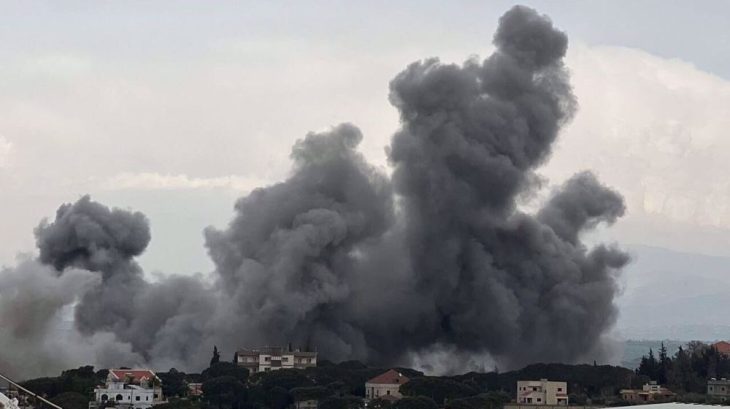
The Israeli occupation has intensified its attacks on villages and towns in southern Lebanon, with fresh airstrikes and artillery shelling reported across several districts, according to field reports from the south.
Al Mayadeen’s correspondent in southern Lebanon reported that three people were killed after an Israeli raid struck a house in the town of al-Louaizeh in the Jezzine district at dawn on Friday, with the escalation extending beyond the area as Israeli airstrikes also hit the towns of Harouf and Shoukin, as well as the al-Tuffah heights region.
The National News Agency (NNA) reported that an earlier strike on Shoukin resulted in the killing of civilians and the injury of several others, including the town’s mayor, Hussein Ali Ahmad.
Further raids targeted multiple towns in the Nabatieh district, including Zawtar al-Sharqiyah, A’dshit, Mayfadoun, Kfar Joz, and Ebba. An additional strike hit a vehicle on the Kfar Dajjal road in the same district.
Strikes across Tyre, Bint Jbeil, and Hasbaya
Southern Lebanon also came under intensified attacks across a wider area, with strikes hitting Majdal Zoun in the Tyre district and Burj Qalaway in the Bint Jbeil district.
The town of Qounine was targeted in an aerial attack, while heavy artillery shelling struck Touline and Qabrikha in the Marjeyoun district. Another airstrike hit Kfarshouba in the Hasbaya district.
Israeli artillery also struck residential areas and outskirts, including al-Mansouri in the Tyre district, while military aircraft maintained intensive overflights across southern Lebanese airspace.
The aggression has continued despite the so-called temporary ceasefire agreement, which took effect on April 17 for 10 days and was later extended for a further three weeks on April 24. However, since the agreement came into force, the Israeli occupation has maintained its attacks, while also facing continued retaliatory attacks from the Islamic Resistance in Lebanon, Hezbollah.
Since March 2, the cumulative toll has reportedly exceeded 2,618 martyrs and more than 8,094 injured, according to the Lebanese Ministry of Health. Officials say the ceasefire framework involving Lebanon has not prevented continued strikes, with repeated attacks reported across multiple regions.
Left in Disbelief: Israel in Panic over Hezbollah FPV Drone Nightmare
By Robert Inlakesh | The Palestine Chronicle | May 1, 2026
Left in disbelief, an already drained Israeli military is left without any viable solutions to the ever-growing threat of first-person view (FPV) drones, now used by Hezbollah to overwhelm their newly assumed positions in southern Lebanon.
On April 16, Tel Aviv and Beirut agreed to a temporary ceasefire imposed by US President Donald Trump. Within the first hour of the ceasefire’s imposition, Israel had already violated the agreement 10 times, including an attack on an ambulance. What they sought to achieve was a return to the pre-war status quo, whereby the Israeli military attacked Lebanon at will, without any return fire.
It soon became clear that the 15-month ceasefire period, following November 27, 2024, during which the Israeli military violated the agreement 15,400 times according to UNIFIL, was not going to be replicated. The first wave of retaliation against Israeli violations began with Hezbollah detonating improvised explosive devices (IEDs) and destroying convoys of Israeli tanks and armored personnel carriers (APCs), after carrying out reconnaissance and anticipating the movement of armed convoys.
Initially, the Israeli military passed three successive IED attacks off as incidents occurring due to explosives previously left behind by Hezbollah fighters. Later, the Lebanese Party officially announced it had taken out four Israeli Merkava tanks in a single IED attack, forcing the Israelis to issue a statement acknowledging it.
Before long, Hezbollah was issuing statements claiming responsibility for a number of retaliatory attacks each day, including rocket fire on Israeli army positions across the Lebanon Blue Line (Lebanese border).
Then came the prominence of Hezbollah’s usage of the cheap, but highly effective FPV drones, inflicting considerable numbers of casualties amongst Israeli soldiers in retaliation for ceasefire violations and the attempt to illegally occupy a strip of territory in southern Lebanon.
Contrary to Israel’s initial claims to have established a considerable “buffer zone” and that only a small number of Hezbollah fighters had remained in the area, it would become clear that nothing of the sort had truly taken place. There was never any “full operational control” of the “buffer zone”, instead, the Israelis were practicing the Gaza strategy of deploying forces in their heavily armoured vehicles to towns and villages, where they would then be tasked with blowing up civilian infrastructure.
Hezbollah fighters remain positioned throughout this newly declared zone, a terrain that favors a defending force using guerrilla warfare tactics. Perhaps the most menacing is the usage of the FPV drones for both reconnaissance and attacks alike.
In a new article, written for Yediot Aharanot in Hebrew, correspondent Elisha Ben Kimon wrote the following:
“For years, the IDF has invested billions in sophisticated interception systems, precision missiles, and the intelligence capabilities of superpowers. But when Hezbollah, with simple and deadly ingenuity, decided to lower its flight altitude and switch to drones, with fiber optics that make it difficult to detect and intercept, Israel found itself in a situation of dealing with a “low-tech” threat that disrupted all work plans.”
The FPV UAVs can be cheaply acquired for only hundreds of dollars per unit, yet when assembled domestically, they can be put together for as little as 50 dollars in some instances. Successful FPV drone deployment for war was pioneered by the Ukrainians and Russians during the Ukraine War. According to some sources, the majority of battlefield casualties in that war have been a result of this drone, which Kyiv can mass-produce at around 300 dollars per unit.
Equipped with a fiber-optic cable, the drones are completely immune to electronic warfare jamming, negating the high-tech advantages that the Israelis have previously enjoyed. Hezbollah does have access to a range of different attack drones, including various Iranian models, which have proven highly effective also. Yet, they are not available in as high quantities, and their most sophisticated technology is used to target high-value targets.
This development has meant that Hezbollah drone operator teams can safely fly these drones from up to and over 10 kilometers away, without being detected. The process of detecting these drones is the same as it is for Hezbollah’s arsenal of more sophisticated radio frequency (RF) drones, relying on acoustic sensors, radars and thermal imaging, yet FPV drones fly at such low altitudes and use the terrain of southern Lebanon to make them more difficult to detect until it is too late.
A recent article published by the Israeli daily Haaretz noted that back in 2024, the Israeli political and military leadership claimed to be on top of deploying solutions to the Hezbollah drone threat, stressing that a range of Israeli defense companies were engineering solutions.
However, an anonymous source “involved in the field” told Haaretz that “There is a need for a systemic response – not to acquire a little of this and a little of that, but a broad plan to address all unmanned threats along our borders. DDR&D (Directorate of Defense Research & Development) has known about this threat for many years but has not mobilized to address it.”
In a nightmare situation for the Israeli military, Hezbollah recently launched a retaliatory attack using FPV drones, inflicting 6 soldier casualties near the Lebanese town of Taybeh. Israel announced that one of its sergeants, Ithan Fukes, was killed in the attack. What happened next was perhaps even more damning.
Hezbollah followed up their attack with an FPV drone strike targeting the medivac helicopter. The incident caused such a stir because the Israeli military leaked videos of the incident. Despite the Israeli soldiers wearing body cams or GoPros on their helmets, this was the first time such footage has been released, due to Israel’s strict military censor laws.
The first video released was from a distance, showing the FPV drone impacting the site where the evacuation of soldiers was happening, causing them to fall back and the helicopter to abruptly take off. From the footage, it was unclear whether the drone hit any target or not, triggering criticism from the Israeli media over why it was released.
Then, a second video was released, from a soldier’s helmet camera, revealing that the drone fell just short, either due to the wind force of the helicopter or due to the soldier’s gunfire. Any release of footage of this kind is deliberate; in this case, it was to jolt the Israeli leadership into action.
An enormous amount of criticism has been leveled at the Israeli political leadership over its failure to achieve its announced goals in Lebanon, and the army itself is even joining that parade. What this demonstrates is that the psychological impact of the FPVs is greatly burdening soldiers on the ground, while the army is left to sit in southern Lebanon twiddling its thumbs.
Hezbollah’s asymmetric warfare is already causing enormous strain on the some 6 Israeli divisions deployed to fight against Lebanon. Just as they were in Gaza, the Israelis are not doing much beyond demolishing civilian infrastructure, proving so risk-averse as to fear entering a fight in which they actually seek to degrade Hezbollah in any significant way. They may have gotten away with this in Gaza, but in South Lebanon, they are dealing with a much more powerful opponent and a more difficult terrain.
Israeli Merkava tanks, worth between 3.5 to 6 million dollars each, are being taken out day after day by FPV drones, carrying explosive charges, worth a maximum of a few hundred dollars each. Hezbollah is taking out mobile telecommunications equipment, command and control vehicles, APCs, D-9 bulldozers, and excavation equipment, with cheap drones that they continue to mass produce with ease. They also do this while their fighters are kept out of harm’s way.
Israel has attempted to consult Ukrainian advisors in order to learn new tactics to deal with the threat and has purchased its own FPV drones, yet none of this has borne fruit. Instead, individual soldiers have tried experimenting with netting to place over vehicles and the use of shotguns, while relying on soldiers to watch the skies for incoming drones.
Despite some of this being effective, out of fear, the Israelis do not normally deploy infantry next to their tanks while on the move. In Gaza, this tactic of hiding inside heavily armored vehicles and tanks did manage to reduce soldier deaths and injuries, but in Lebanon, it could actually be causing the opposite effect, at least when it comes to FPV drone attacks.
– Robert Inlakesh is a journalist, writer, and documentary filmmaker. He focuses on the Middle East, specializing in Palestine.
Geopolitics and Geoeconomics of the Strait of Hormuz
Sputnik – 02.05.2026
The reckless reliance on a blitzkrieg to eliminate Iran’s political and military leadership has left Israel and the United States in an extremely precarious situation, where Tehran’s key trump card in the conflict turned out to be control over the Strait of Hormuz.
Alexander Yakovenko, deputy director of Sputnik’s parent company Rossiya Segodnya and head of the Committee on Global Issues and International Security of the Russian Security Council’s Scientific-Expert Board, has addressed the standoff around the Strait of Hormuz.
Analysts in Israel are already writing of a complete failure, with the prospect of “returning to the issue” sometime in the future. Judging by published reports, everything was planned for June this year, but, as the saying goes, the devil intervened, and Benjamin Netanyahu succumbed to the temptation of a final solution through “regime change.” The scapegoats will be the Mossad division responsible for Iran and the military command responsible for Lebanon.
Donald Trump faces a far more difficult predicament: he has been drawn into a war that is neither his own nor in America’s interest. But the main issue is that the Strait of Hormuz problem now rests squarely on his shoulders. Aside from acceding to all of Iran’s demands, there appear to be no viable options for resolving the blockade – including the resumption of military action, which, according to observers, would have catastrophic consequences for the region, the global economy, and the Trump administration.
In terms of the Persian Gulf and the greater Middle East, a complete geopolitical reconfiguration has taken place, including a shift in Turkiye’s role (it was Ankara that effectively killed the plans to bring Iraqi Kurds into the “march on Tehran,” which was intended to bolster the confidence of those whom Israeli intelligence believed were ready to take to the streets of Iranian cities).
The destruction of the region’s extraction and logistics infrastructure prompted the UAE to withdraw from OPEC and OPEC+, which will only intensify Abu Dhabi’s contradictions with Riyadh and accelerate the political realignment of smaller players toward Ankara, Saudi Arabia, or Iran.
Iran’s agency has grown qualitatively: from a pariah state burdened by sanctions, Iran has genuinely become a regional power (in contrast to Netanyahu’s claim that Israel is a regional power and “in some ways even a global one”). Everything now depends on Iran – a fact understood by those at the helm in Tehran, namely, by general consensus, the Islamic Revolutionary Guard Corps (IRGC). And all this is aside from the most pressing issue on the regional agenda: the restoration of extraction and logistics infrastructure, especially given that the damage has a cumulative effect – in other words, “time is money.”
Russia, Pakistan, and China have become even more deeply involved in the affairs of the region, while the United States has demonstrated its inability to provide military protection for its allies. In other words, the role of external players has grown, whereas control over the region had been in American hands since the Baghdad Pact at the beginning of the Cold War. Now it can be said that the entire institutional structure in the region is collapsing – even in the OPEC format – and the region is opening up to an entirely new architecture.
In terms of geoeconomics, Tehran now holds a powerful lever of influence over the global economy and world trade through its control over the Strait of Hormuz. Moreover, this is not only direct control but also the ability to destabilize the situation around the Strait at any point in the future, regardless of any agreements that might be reached regarding its possible reopening as part of a ceasefire. In other words, everyone understands that things will never return to how they were before.
The only thing that matters for the global economy and the international financial system – including the dollar’s linkage to oil trade – is the stability of commercial traffic through the Strait. With no indication of it being reopened, the world is losing between 8 and 15 million barrels of oil and petroleum products per day, as well as up to 20% of global LNG supplies. This also includes a range of industrial goods in the petrochemical sector and derivatives for the agricultural sector. Experts expect a monthly shortfall of 300 million barrels, which amounts to three-quarters of the released strategic reserves of developed countries. Moreover, by early May, both strategic reserves and the advantages of unlocking Russian and Iranian oil, along with the balancing buffer of floating storage, will be nearly exhausted. In short, in every respect, a moment of truth is approaching in a conflict that is difficult to restart now that military action has been paused.
Not only have the United States and Israel handed Iran, on a silver platter, escalation dominance in the conflict – the ability to manage escalation if Washington and Tel Aviv launch another round – but Tehran will also gain additional revenue from selling its 1.5 million barrels of oil per day, which economists estimate at 2–3 billion per month, or 24–36 billion per year. Essentially, even without the unfreezing of Iranian assets in Western countries, Iran will have the resources to rebuild what has been destroyed. To this should be added the fees collected from commercial vessels transiting the Strait of Hormuz.
It is also worth noting a direct geopolitical consequence of the Iranian conflict: the discord within the Western alliance along the line of Trump’s America versus liberal-globalist Europe. The recent visit of the British monarch to the United States, during which he called in his address to Congress for the collective “defense of Ukraine” invoking Article 5 of the Washington Treaty (despite the fact that Kiev is not a NATO member), indicates that the lack of allied support for the Iranian adventure is a clear appeal to restore Western unity specifically on an anti-Russian basis – everything else is secondary. In Europe, they no longer hide the fact that they intend to “wait out” Trump, if that is what it takes, but under no circumstances will they agree to a settlement of the Ukrainian conflict.
As such, it is not denied that Ukraine is merely the opening move in yet another war of the West against Russia, and that Western elites are determined to make it a decisive, final confrontation of a civilizational nature. This presents an interesting situation for Russia, which could be resolved one way or another very soon. If Russia participated in two world wars, in which, albeit in different ways, relations between groups of Western countries were contested, and in the Cold War we faced a united West, then now we see a disunited West, weakened militarily and in terms of domestic political development. Its consolidation is only possible at our expense.
Charles III quite opportunely mentioned the burning of the White House by the British in 1814, as it reminds us – and perhaps Washington – of positive moments in our shared history, including Russia’s support for the American Revolution and the Union side in the Civil War. The decision rests with the Americans, but it is curious how the Middle East references an era before the ideologization of international relations in the 20th Century.
Pirates of Mediterranean: Israel does as it pleases in the Sea of Three Continents
By Lorenzo Maria Pacini | Strategic Culture Foundation | May 1, 2026
How control of the Mediterranean works
On the night of April 29–30, the Zionist entity Israel attacked the 22 ships of the Global Sumud Flotilla 600 kilometers off the Italian coast, from where the group had set sail. All of this took place unhindered, constituting yet another act of bullying, piracy, and barbarism. But how does the Mediterranean work?
The Mediterranean, often referred to as “Mare Nostrum” in European political culture, is one of the most complex maritime theaters in the world: a crossroads of trade routes, a setting for migration crises, regional conflicts, and the strategic interests of major powers. The management of international waters, military control of shipping lanes, and initiatives by civilian vessels such as the Global Sumud Flotilla constitute three facets of the same dynamic: the attempt to regulate and control the use of the sea in the name of state interests, security, and humanitarian solidarity.
The basic legal framework for the management of international waters is the United Nations Convention on the Law of the Sea (UNCLOS), adopted in 1982 and in force since 1994, which regulates the mapping, use, and responsibilities of states regarding various maritime zones. In the Mediterranean, which is a nearly enclosed sea, this convention applies in a particular way, because the distance between the coasts is often less than 400 nautical miles—that is, the sum of the maximum EEZs of two opposing states.
The main zones recognized by UNCLOS are: the territorial sea (up to 12 miles from the baseline), where the coastal state has full sovereignty but is obligated to guarantee “innocent passage” to foreign vessels; the contiguous zone (up to 24 miles), with limited control for customs, tax, health, and immigration laws; The exclusive economic zone (up to 200 miles), for the rights to exploit biological and mineral resources, balanced by the freedom of navigation and overflight for other nations. Finally, the so-called High Seas (beyond the EEZs), a space open to all states, governed by the principle of freedom of navigation, fishing, scientific research, and the laying of cables and pipelines, provided this is done peacefully and with respect for environmental protection. In the Mediterranean, the scarcity of “true” high seas makes the delimitation of exclusive economic zones between coastal states—such as Italy–Greece, Greece–Turkey, or Cyprus–Turkey—a delicate matter, often linked to gas and oil resources and political-military disputes.
The management of international waters therefore takes place through: bilateral and multilateral delimitation agreements; regional cooperation measures (for example, under the Barcelona Convention for the Protection of the Marine Environment and the Protocol on Integrated Coastal Zone Management); and institutions such as the UNCLOS Authority for resources beyond EEZs, which also regulate the use of the seabed “beyond national jurisdiction.” Alongside the law of the sea, the Mediterranean is subject to intense military surveillance that reflects the overlapping interests of major global and regional powers.
The “management” of international waters is therefore not merely a matter of rules, but also of operational capabilities, intelligence infrastructure, and military alliances.
Furthermore, there are various key actors and spheres of influence. First and foremost, NATO and the U.S.: the U.S. Sixth Fleet has its main base in Gaeta (Italy) and projects power throughout the Mediterranean, with particular attention to the routes connecting the Persian Gulf and the Caspian Sea to European economies. The United States uses the Mediterranean as a hub to control energy supply routes and to project power toward the Middle East and North Africa. Then there is Russia, though numerically less present, which has a task force in the Mediterranean, with logistical bases in Syria and a strategic focus on the passages between the eastern Mediterranean and the Black Sea. Obviously, the EU and individual member states, such as Italy, France, Greece, and Spain, maintain a strong naval presence, serving both national interests and EU and NATO operations. Then there are Israel and Turkey, which have advanced navies and conduct patrols and maritime traffic control around their coasts—Israel primarily regarding the Gaza Strip, and Turkey in the eastern Mediterranean in relation to energy resources.
These actors effectively define several areas of influence:
- The Western Mediterranean (Gibraltar–Tunisia): a strong EU–NATO presence, with control over migration routes and maritime traffic toward the port of Gibraltar, the sole strategic access point to the Mediterranean.
- The Central Mediterranean (Sicily–Libya): a frontline zone for Italian surveillance, rescue, and migration control operations, with Operation Safe Mediterranean expanding Italy’s naval presence to over 2 million km².
- The Eastern Mediterranean (Greece–Turkey–Cyprus–Israel): a theater of conflict over EEZs and energy sovereignty, with the deployment of military ships and specialized units monitoring natural gas fields.
The operational management of maritime control relies on coastal radar networks, which monitor naval and air traffic hundreds of miles from the coast, command and control systems (such as the MCCIS, Maritime Command and Control Information System) that link radars, ships, and aircraft into a single real-time “maritime picture,” and, of course, international cooperation coordinates maritime surveillance among the navies of some twenty European countries, as well as the information-sharing network with NATO and the southern Mediterranean.
This “situational awareness” apparatus allows for the monitoring not only of commercial traffic but also of migration flows, illicit activities (drug trafficking, arms trafficking, illegal fishing), intelligence operations on undersea cable communications, and, in general, any attempt to cross the Mediterranean without coming to the attention of the states concerned.
The Global Sumud Flotilla challenges the Mediterranean blockade
What happened with the Global Sumud Flotilla is yet another act demonstrating that there is an aggressor and a victim. A civilian flotilla organized by activists, humanitarian organizations, NGOs, and citizens from dozens of countries, with the stated goal of breaking the maritime blockade imposed by Israel on the Gaza Strip and delivering humanitarian aid to the Palestinian population, is attacked and seized—all while the other states operating in the Mediterranean stand by, subjugated to Israel’s authority.
The Sumud Flotilla is not a single vessel, but an international coordination of dozens of ships that set sail from various Mediterranean ports to converge in international waters and head toward the Palestinian coast. Thousands of activists and volunteers board the ships, often under conditions of high risk, yet fully aware of the great symbolic value of their action for the Palestinian people, while the elites continue to profit from their suffering.
The ships of the Sumud Flotilla primarily carry essential humanitarian aid, such as food, medicines, medical supplies, equipment for rebuilding destroyed infrastructure, and medical support—all items that Israel has banned for years, demonstrating the most atrocious barbarity that recent human history has ever witnessed. The presence of a dedicated medical fleet, with more than 1,000 healthcare professionals, has been explicitly linked to the effort to alleviate the crisis in Gaza’s healthcare system, devastated by years of war and blockade.
It is an act of symbolic and perfectly legal nonviolent resistance, where the use of dozens of boats, multiple flags, and symbols of peace, the LGBTQ+ community, anti-fascist movements, and international solidarity aims to create a “visible presence” that makes it more difficult for Israeli naval forces to use force, as coercion against unarmed civilians generates significant media and political backlash. One may or may not agree with the methods and nature of this initiative, but the fact remains that the social impact is extremely high and that, above all, Israel has committed an act of piracy involving numerous countries.
The Israeli Navy maintains a reinforced naval blockade, with naval patrols, frigates, and underwater vessels operating near Israeli and Gaza territorial waters. In previous missions, the flotilla was intercepted in international waters and the ships were escorted or stopped, on charges of violating security measures imposed by Tel Aviv. The events of the past few hours, unfortunately, are part of an operational practice that the terrorist state of Israel continues to employ.
Certainly, while the Sumud Flotilla relies on the law of the sea (freedom of navigation and the duty to assist human life at sea), it must nonetheless factor in the risk of interception, violence, arrests, or accidents. At the same time, the media and political dimensions of the mission compel states to balance security rigor with concerns over excessive force that could generate further international pressure on Israel.
The story of the Sumud Flotilla also highlights how the management of international waters in the Mediterranean is a realm of unstable conflict. And, above all, how there is no balance: there is a sovereign, Israel, which is free to do as it pleases, and a series of subordinate states that obey in silence, bound by a code of silence. Israel’s action against the Flotilla demands that we take a stand and take decisive action against those who have transformed the Mediterranean—a sea that should symbolize peace among three continents—into a space of raids and unjustifiable violence.
Iran slams US leadership, debunking fabrications, false war costs
Al Mayadeen | May 1, 2026
Iranian officials criticized the United States over its leadership and its justification for the US-Israeli war on Iran, debunking Washington’s fabrications and scrutinizing its political coherence and legal rationale.
In reference to the reported cost of the US-Israeli war on Iran, estimated at 25 billion dollars by the US Department of War, Iranian Foreign Minister Abbas Araghchi maintained that “the Pentagon is lying.”
In a post on X, Araghchi asserted that “Netanyahu’s gamble cost America $100b so far, four times what is claimed.”
He further noted that “indirect costs for U.S. taxpayers are FAR higher. Monthly bill for each American household is $500 and rising fast.”
“Israel First always means America Last,” he assertively concluded.
Trump’s contradictions reveal US decision-making made elsewhere
Mohsen Rezaei, a member of Iran’s Expediency Discernment Council, said, also took a swing at the “America first” slogan, asserting that “the contradictory statements of Trump show that real decisions in US are being made somewhere else.”
In a post on X, he argued that key decisions in Washington were being shaped by “behind-the-scenes power networks” that do not align with the “America First” slogan associated with Trump and MAGA.
Rezaei added that this demonstrates “the kind of deadlock America is facing,” emphasizing that Americans “are the ones paying the price.”
‘Self-defense’ against what?: Baghaei
Separately, Iranian Foreign Ministry spokesperson Esmail Baghaei rejected US claims that the US-Israeli war on Iran was launched in “self-defense”.
In a post on X responding to a US claim that the war was launched “at the request of and in the collective self-defense of its Israeli ally,” he questioned the legal basis for such claims, asking, “Was there any ‘armed attack’ by Iran to justify ‘self defense’?”
Baghaei rejected the claim by Washington, emphasizing that the war was “an act of AGGRESSION against the nation of Iran.”
Here’s why Iran is sovereign and Germany is not
By Tarik Cyril Amar | RT | May 1, 2026
Sovereignty, as defined in international law, is both crucial and complex. In the real shark-pool world of geopolitics, it is not hard to spot: if you have the ability to rule at home and resist attack from outside (any outside), then you are sovereign. Otherwise not. No exceptions.
That’s why Iran has sovereignty, but Germany does not. Iran has withstood two months of a devious and brutal war of aggression waged by the US and Israel, which in turn is “merely” the culmination of decades of assaults levied via economic warfare, assassination campaigns, and subversion.
However, Iran has not only successfully foiled the current Israeli-American blitzkrieg-and-regime-change scenario, but also put the attackers on the backfoot. Tehran’s achievement is already historic. It has changed and will change the course of history.
Germany, by contrast, cannot even defend its own vital infrastructure, as the Nord Stream sabotage and its aftermath have demonstrated. What is even worse, its governments have had no will to do so. On the contrary, they have been rewarding the Ukrainian attackers with untold billions to feed Kiev’s ultra-corruption. Their backers – certainly including the US and Poland, and most likely Great Britain, too – need not worry about any trouble from Berlin either.
Case closed: Iran is sovereign, Germany is not. If you are German and find this uncomfortable, complain to Berlin.
Against this backdrop, it is oddly fitting that it is Iran which is now exerting a powerful influence on German politics despite not having any deliberate designs to do so, whereas German calls on Tehran (or, for that matter, Moscow or Beijing) to do this and leave that – as articulated by Foreign Minister Johann Wadephul with an almost comical lack of self-awareness – come across as embarrassing: sad spectacles of an impotence that doesn’t even know itself.
Iran, on the other hand, has now had a palpable impact on what unfortunately remains Germany’s single most important foreign-policy relationship. Indeed, as the current, post-1990 “unification” (really, expansion, and that’s still a polite term) Germany is really the old Cold War West Germany writ large (and going to seeds, too), the relationship with the US is more than just important. Historically, it was literally foundational.
And here we are: It is due to Iran’s resistance that this relationship has entered a deep crisis. Of course, other factors have played (or should have played) a role as well: for instance, Washington’s ferocious, bipartisan economic warfare against its old key client (polite term) in Europe, including at least complicity in destroying vital energy infrastructure and supply options (Biden, Democrats) via massive incentives for German industry to relocate to the US (Biden, Democrats) to devastation by tariffs (Trump, Republicans).
But it is over Iran that things have now come to a head: German Chancellor Friedrich Merz has openly criticized Washington’s conduct of the war, and US President Donald Trump has launched one of his social media rampages, going after Merz and Germany with, as Secretary of War (Crimes) Pete Hegseth would put it, “no quarter” given.
Trump has even threatened, in effect, to withdraw the almost 40,000 US troops from Germany. It would be stupid and self-damaging for the US to do so, but then, this is the Trump administration. Full disclosure: As a German, I hope they go ahead.
Trump has also told Merz off for wanting Iran to have a nuclear weapon (false on two counts: Iran isn’t building one, and Merz is a compliant client leader who would never dare dissent from the US and Israel) and for being bad at running Germany, which must rankle, because most Germans agree. Merz has just earned himself the worst poll ratings of any German chancellor ever.
He has made things even worse – yes, Merz can do that – by releasing an exceedingly masochistically timed interview to complain that, in essence, no one likes him. True, but saying so has only triggered a national tsunami of mockery: now he is not only vastly unpopular but derided as a wimp, who loves to dish out harsh admonishments and mean austerity but can’t take the response.
A short video clip deep-faking Merz performing a satire of MC Hammer’s classic “You can’t touch this” by singing “No one likes me” is going viral. At a town hall-style meeting, the chancellor was openly laughed at. Major mainstream media are beginning to talk about a crisis deep enough to end the current government and, even worse for Merz, about rebellious murmurs inside his own CDU party.
All of this because Merz was making remarks about the Iran War. But make no mistake: Friedrich Merz, still infamous for applauding Israeli “dirty work” (“Drecksarbeit”) in Iran last summer, has not discovered a conscience. Listen attentively to his recent statements, made before a group of high school kids, and you realize, the chancellor’s real beef with America is that Washington hasn’t done its current “dirty work” quickly and, above all, successfully. No one loves a loser, not even, it turns out, Friedrich Merz, whose prior obsequiousness toward Trump had raised eyebrows even in Germany.
Yet whatever Merz’s sordid motives, take a step back and look at this picture from the point of view of history-in-the-making: Here is the German chancellor, who claims to be ready to make his country lead Europe (yes, not a great idea, but let that pass for now), whose government is presiding over the greatest German debt-and-armament splurge since World War Two (and that against a background of profound economic crisis), and he is stumbling over Iran. So much for the rise of multipolarity and the decline of Europe.
Not because that was Tehran’s aim. As a matter of fact, the Iranian leadership probably has very little time to think about Berlin – except noting for the future that, in practical terms, it is serving as a loyal accomplice in the American-Israeli war of aggression. No, the reason Iran now impacts and shakes the American-German relationship is that Tehran has been defeating the US, and so the client state Germany is registering the public “humiliation” of America (Merz’s term) by showing immediate signs of faltering compliance.
Who in this picture is reshaping things? And who is being shaped? Here’s another way to define sovereignty. And Germany still loses.
Tarik Cyril Amar is a historian from Germany working at Koç University, Istanbul, on Russia, Ukraine, and Eastern Europe, the history of World War II, the cultural Cold War, and the politics of memory.
Israel pours $730m into global propaganda machine as reputation collapses
The Cradle | May 1, 2026
Israeli lawmakers last month approved a sharp increase in the 2026 public diplomacy budget, allocating roughly $730 million to the global messaging apparatus, also known as “Hasbara,” according to a report by the Jerusalem Post on 29 April.
Surveys point to a deepening collapse in international support, as Israel’s genocide in Gaza and continued aggression toward its neighboring countries have sent the Tel Aviv’s reputation into freefall on the global stage.
The funding accounts for more than four times the previous year’s allocation, and forms part of a broader push led by Israeli Foreign Minister Gideon Saar, who characterized the effort as a strategic imperative, saying it should be treated “like investing in jets, bombs, and missile interceptors” and calling it “an existential issue.”
The campaign spans large-scale digital outreach and political engagement aimed at bending perceptions and influencing narratives around Israel.
Around $50 million is being funneled into social media advertising, and roughly $40 million is going toward flying in foreign delegations such as politicians, clergy, and influencers as part of the outreach effort.
Officials insist the strategy improves perceptions abroad, with Israel’s consul general in Los Angeles, Israel Bachar, claiming that “Everyone who returns from the country understands better and is more supportive. But you have to fly out a lot of people.”
However, polling data cited in the reports shows a sharp collapse in public opinion towards Israel, particularly in the US.
A Pew Research Center survey found that 60 percent of US respondents now view Israel unfavorably, with declines cutting across political, religious, and demographic groups.
Analysts and researchers dismiss the spending outright, arguing it cannot offset the impact of Israel’s actions on the ground.
Communication scholar Nicholas Cull said, “Our conclusion was, it’s the policy, stupid,” referring to Israel’s policy of genocide and apartheid, and its broader military conduct as a central pillar of its expansionist agenda.
“Yes, you can do a lot with public diplomacy, and there are strategies that could help on the margins. But they’re only going to affect a small percentage, because the bulk of the impressions on issues that people care about are shaped by the actual policies, not how well you sell those policies.”
“The problem is that people don’t believe the state anymore,” said Ilan Manor, another expert cited in the report, warning that increased funding may expand reach but will not restore trust.
That push is reinforced by what Israeli officials describe as a parallel “Eighth Front” – a so-called “Digital Iron Dome” that combines mass reporting campaigns, AI-driven targeting, and coordinated influencer networks to suppress dissenting content and flood platforms with state-approved narratives in real time.
Israel had invested millions in coordinated digital influence campaigns, including a $6-million contract to shape AI outputs, targeted Gen Z messaging, and large-scale ad buys, in an effort to control online narratives and counter declining public support in the US.
The country’s propaganda arm had previously deployed a large network of at least hundreds of fake social media accounts and fabricated news sites to spread unverified claims linking UNRWA to Hamas’s 7 October Operation Al-Aqsa Flood in order to undermine its humanitarian mission in Palestine.
Leaked audios reveal pro-Israel groups ‘paid’ for US pardon of convicted drug trafficker Juan Orlando Hernandez
The Cradle | April 30, 2026
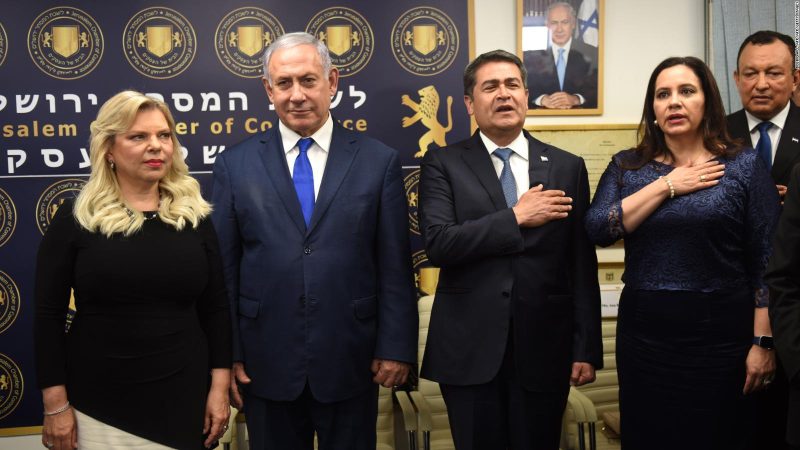
WhatsApp, Signal, and Telegram audio messages published by Canal RED and Hondurasgate on 29 April reveal pro-Israel groups “paid” for the release of former Honduran president and convicted drug trafficker Juan Orlando Hernandez (JOH) from US federal prison last year.
“The pardon money … came from a board of rabbis and people who supported Israel, and they had previously supported Yani Rosenthal,” JOH is heard saying in the leaked audios.
Yani Rosenthal is the former president of the right-wing Liberal Party of Honduras. He was convicted in December 2017 of laundering drug proceeds for a prominent Honduran drug cartel.
In 2024, JOH was convicted in a US federal court of three counts of drug trafficking and weapons conspiracy and received a 45-year prison sentence. He was also found guilty of receiving money from the former leader of the Sinaloa Cartel, Joaquin Archivaldo “El Chapo” Guzman, to finance electoral fraud.
JOH was pardoned late last year by US President Donald Trump, who called the DEA investigation into Hernández a “Biden administration set up.” Trump announced the pardon hours before Honduras’s presidential elections.
In that same social media post, Trump endorsed the current President Nasry “Tito” Asfura and threatened to cut aid to Honduras if he was not elected.
“The Prime Minister of Israel is going to give us his support. They had everything to do with my departure and negotiations,” JOH says in one of the audios released on Wednesday.
According to Canal RED, the leaked audios show that Trump’s pardon for JOH “was secured through intense lobbying led by Roger Stone and the Republican caucus … with the support of Israeli Prime Minister Benjamin Netanyahu.”
The audios also suggest that Hernandez’s return to Honduras and his upcoming presidential run are being financed by Israel.
“Mr. President, I’m here asking about my case, if there’s any resolution, if you have anything to share with me to see if there’s been any progress with the Supreme Court. I want to believe that you won’t sideline me because, thanks to me, you’re sitting in that chair … And I hope for your support. Because that’s what we discussed with President Trump,” JOH tells President Asfura in one of the leaked audios.
According to the report, Trump and Netanyahu are “seeking millions in compensation” in exchange for securing Asfura’s election and JOH’s possible reelection.
“The negotiations at the Florida residence included the expansion of Zones for Employment and Economic Development (ZEDEs), the construction of a new military base, a free trade agreement, and a law to incentivize investment in AI, whose contracts would be awarded directly to private American companies such as General Electric,” Canal RED reports.
ZEDEs, or “private states”/’model cities,” permit autonomous courts and foreign legal systems in Honduras, which civil groups say surrender sovereignty.
Additionally, a second set of leaked audios released on Thursday involving JOH, Asfura, and Honduran Vice President Maria Antonieta Mejia indicates the formation of a news outlet funded with more than half a million dollars in Honduran public funds, along with contributions from Javier Milei’s government in Argentina, aimed at ‘attacking’ the left-wing governments of Gustavo Petro in Colombia and Claudia Sheinbaum in Mexico.
Zionists Are Gunning for Your Freedom of Speech
By Jack Hunter | The Libertarian Institute | May 1, 2026
The First Amendment of the Bill of Rights in the Constitution of the United States guarantees the right to free speech. This right has long differentiated the United States from other Western nations like the United Kingdom and Canada where laws against so-called “hate speech” laws exist and are enforced.
Thankfully, America is different. In our country, even alleged hate speech is protected speech to ensure democratic principles and debate.
In a 1929 dissenting opinion, Supreme Court Justice Oliver Wendell Holmes said that the Constitution secured “freedom for the thought that we hate.” In 2011, Chief Justice John Roberts said in a ruling that the First Amendment serves “to protect even hurtful speech on public issues to ensure that we do not stifle public debate.”
This constitutional protection has been increasingly threatened recently, particularly by pro-Israeli forces that have tried to frame any criticism of that government as “anti-Semitism” and thus hate speech punishable by law. This has included everything from arrests, to squashing campus debate to buying TikTok to an attempt to cover up human rights absuses in Gaza. President Donald Trump has even issued executive orders that use vague definitions of what constitutes “anti-Semitism” that comes with criminal penalties.
Mark Levin is an American-born Zionist radio host who is an outspoken advocate for Israel’s government, regularly calling anyone who criticizes the U.S.-Israeli war with Iran and conflict in Gaza “Nazis.”
Toward this agenda, Levin recently appeared to not agree with his own country’s free speech rights. On his latest Sunday Fox News program, unironically called Life, Liberty and Levin, the neoconservative pundit explained why free speech liberties in the U.S. have gone too far.
Seemingly worried that certain speech is protected in the United States, Levin said in the wake of the Secret Service taking down a shooter at the White House Correspondents Dinner on Friday, “First time things like this have happened, but it really is problematic because so much of it is protected.”
“And you hear people say, don’t you believe in the First Amendment?” Levin said. “They don’t even know what the First Amendment believes.”
Certain “speech” is “problematic” because “so much of it is protected.” You could see where this was headed.
Levin then explained what he believes “the First Amendment believes.” “Do you want to de-platform people?” he ranted. “You know, the libs do that. I don’t have any problem with de-platforming Nazis or jihadis.”
“Nazis,” Levin says. Levin uses this term loosely, all the time, and that’s putting it mildly.
Prominent libertarian personality Josie Glabach, known most popularly as “The Libertarian Redhead,” made a telling list of the many people and groups Levin has called Nazis since 2024:
- The Democrats
- The Democrat media
- An Australian bakery
- The Pakistani defense minister
- Libertarian Institute Director Scott Horton
- The entire Libertarian Party
- College students
- MMA fighter Jake Shields
- Nick Fuentes
- Putin’s buddies
- Influencer Dan Bilzarian
- The Houthis
- Comedian and libertarian personality Dave Smith
- Anyone who associates with Dave Smith
- Tucker Carlson
- Beirut
- Hezbollah
- A veteran who asked Mark to be more tolerant
- Influencer Myron Gaines
- The city of London
- Hamas
- The New York Times
- New York Times columnist Thomas Friedman
- A New York Times correspondent
- Terrorists;
- The “woke reich”
- Maine Democratic Senate candidate Graham Platner
- The United Nations
- Harvard University
- The city of Amsterdam
- Columbia University students
- Iterations of the “Iranian Nazi regime,” the “Islamic Nazi regime,” the “Islamo Nazi regime,” the “Islamist Nazi regime,” and “All of Iran (the new Nazis)”
- The Ayatollah (presumably of Iran)
- Former Iranian President Ebrahim Raisi
- A protestor on a subway
- Congresswoman Rashida Tlaib (D-MI)
- President Joe Biden’s entire State Department
- Turkish Preisdent Recep Erdoğan
- College basketball analyst Bruce Pearl
- Certain Arab, liberals and journalists
- Reporter Lulu Garcia-Navarro
- ISIS
- Seventeen random Twitter users
This eclectic group of entities great and small, many of whom are regular critics of Israel’s government, are “Nazis” in Levin’s view. As Libertarian Institute Senior Fellow Tom Woods succinctly put it, “Nazis’ includes everyone who mocks Levin.”
Levin continued his Sunday rant against “Nazis”:
“I don’t have any problem with de-platforming them. What does that mean, de-platforming them? A government law? No. It means that X or Twitter or Facebook or Amazon with Twitch and someone says you know what? You’re a low life we’re not paying, you know, get off our platform. What’s wrong with that?”
The neocon pundit appeared to say that private platforms should police speech according to the political views of Mark Levin. He is right that this is no violation of the First Amendment. Private companies can allow or restrict speech as they please. “It’s called private enterprise,” he said. “I got no problem with that.”
Then Levin basically said such speech was no different than pornography, which is not protected under the First Amendment. Levin continued, “I mean, what if they have this horrific pornography on? Is that okay? No, it’s not okay.”
“Because our kids have access to it,” he said. “People who are impressionable have access to it. “What if they had people screaming at the top of the lungs saying, assassinate this guy and assassinate that guy? Well, they shouldn’t do that.”
“Why? What’s the standard?” Levin went on. “You need to have a standard. What should the law be? What does the Constitution say?”
The Constitution says that all speech is protected, but “true threats” and obscenity are not.
But political opinions about Israel that go against Levin’s views are protected, whether he likes it or not.
That’s when Levin basically outright said that speech that criticizes Israel should be forbidden just like pornography. “I just think we’ve taken this too far because we’re not even talking about political speech, which is the most protected of all speech,” Levin said.
“We do limit speech,” he insisted. “We limit speech, pornography. We limit speech.”
What Levin, like so many other Zionists, truly want is for the First Amendment to be amended itself. They believe, whether they say it forthright or not (and Levin appears to be doing just that), that this legal provision designed by the Founders precisely to protect political speech should no longer protect speech that is critical of Israel’s government.
Americans have historically valued their free speech. American Zionists like Levin now want a carve out.
But the free speech guarantee enshrined in the United States’s governing charter is so integral to the American experience, to gut it for any reason would be to drastically alter the DNA of the soon to be 250-year-old country.
As an American, Mark Levin doesn’t seem to have a problem with doing just that—all in the service of a foreign country.
It might be better for Americans to instead wish other nations well, yet solely concentrate on our own affairs at home, and perhaps just as important, to stop listening to American pundits whose primary allegiance seems to be countries other than their own.
Why don’t UK media mention the Israel lobby?
By Mark Curtis | Declassified UK | April 27, 2026
Britain’s national media fails to recognise the influence – and even the existence – of an Israel lobby, our new media analysis shows.
Declassified researched two years of reporting by seven British media outlets and found only 16 mentions of the phrase Israel lobby without speech marks.
Nearly all those mentions are in comment articles rather than news pieces and none we found expound on what influence such an Israel lobby might have.
The phrase “Israel lobby” – used with speech marks – is slightly more common in these outlets, with 26 mentions in two years, and tends to be used to quote others in a disparaging way or to suggest such a lobby does not exist.
For example, one Guardian article refers to “the trope of the ‘Israel lobby’”. The Daily Mail reported in May 2024 of hecklers at a speech by then foreign secretary secretary David Lammy “accusing the MP of having taken ‘shady money’ from the ‘pro-Israel lobby’ on the grounds that he once lawfully accepted £30,000 from a Zionist lobbyist named Trevor Chinn.”
In fact, British businessman Trevor Chinn has funded Keir Starmer and several senior Labour ministers and was awarded the Israeli medal of honour for his “dedication” to and “love” for Israel.
Of the seven media outlets analysed – BBC articles, Express, Guardian, Independent, Mail, Telegraph and Times – the BBC and the Express are the most extreme, and no mentions of the phrase Israel lobby, used without speech marks, could be found at all in their publications.
The BBC is failing to mention the Israel lobby while having regular meetings with it. As Declassified recently revealed, the BBC held nine meetings with Jewish groups strongly sympathetic to Israel in the first year of the Gaza genocide.
The Guardian was found to have made only five mentions of an Israel lobby without speech marks, three of which are in comment pieces by columnist Owen Jones.
By contrast, independent Scottish newspaper The National, which has consistently criticised UK policy towards Israel, has mentioned the Israel lobby 23 times in the two year sample period, never in speech marks.
The Israel lobby in Britain is extensive. Declassified has revealed that a quarter of MPs have been funded by pro-Israel individuals and groups, as have one half of Keir Starmer’s Cabinet.
Neither of these findings have been reported in the mainstream media, as far as Declassified is aware.
British ministers and officials are known to hold off-the-books meetings with pro-Israel lobbyists, and under Keir Starmer’s government, the Foreign Office has held numerous meetings with pro-Israel advocacy groups such as Board of Deputies of British Jews and the European Leadership Network (ELNET).
The UK government’s total proscription of the Lebanese movement Hezbollah in 2019 was the work of pro-Israel lobbyists while lobby group We Believe in Israel has taken credit for the UK government’s proscription of Palestine Action last year.
As long ago as 2009, a landmark Channel Four documentary, Inside Britain’s Israel Lobby, which was presented by journalist Peter Oborne, revealed the close relationship between the Israel lobby and the Conservative and Labour parties, and its attempts to curb criticism of Israel in the media.
The Israel lobby’s influence over UK politics is likely to be greater than any other state except perhaps the US, and certainly far more than Russia which has received decidedly more media attention.
Friends of Israel
The British media’s failure to explicitly acknowledge an Israel lobby comes alongside nearly 300 articles in these seven outlets during the two years mentioning either Labour Friends of Israel (LFI) or Conservative Friends of Israel (CFI), of which dozens of MPs are supporters.
These lobby groups are invariably mentioned in the media without any analysis of their influence or even that they are explicitly part of a lobby that advocates for goals which benefit a foreign country, such as opposing an arms embargo on Israel.
The Independent has mentioned the phrase “influential Labour Friends of Israel” group three times, and the Times once, without mentioning how it is influential.
Yet CFI has been the largest donor of free overseas trips for MPs in recent years, and both CFI and LFI refuse to provide a list of their funders. LFI says its work is funded by “the generosity of members of the Jewish community and those who share our commitment to the State of Israel”. It adds that it “does not receive any money from the Israeli government or the Israeli Embassy”.
The Times has mentioned the phrase Israel lobby, without speech marks, on only four occasions in the two years, but has mentioned Labour Friends of Israel in over 50 articles. That LFI might be a part of a broader Israel lobby has apparently not been spelled out by the Times to its readers.
These omissions might be because the seven media outlets we analysed often function as part of the Israel lobby that they refuse to sufficiently recognise. The most extreme is the Telegraph, which routinely publishes articles supportive of Israel during its genocide in Gaza, illegal war on Iran and brutal attacks on Lebanon.
The paper has recently called to restore UK military ties to Israel, headlined with “Israel condemns ‘hateful and racist’ Greens”, and published an article by pro-Israel writer Jake Wallis Simons headlined “The case for Trump attacking Iran”, among many similar articles.
Some articles in these outlets suggest that recognition of an Israel lobby is anti-semitic. One opinion piece in the Telegraph runs: “Anti-Semitism is a conspiracy theory about how the world works. You think you live in a democracy, it runs, but actually there is this secret invisible system of Jewish power that rules the world through the banking system, the media and the Israel lobby.”
Similarly, the Guardian reported on Labour MP Diane Abbott in May 2024 stating: “She apologised for liking tweets about the influence of the Israel lobby, which she admitted could be interpreted as an antisemitic trope.”
The Guardian has been found to cave in to pro-Israel pressure, to amplify Israeli propaganda, and to be responsible for the same “systemic bias, deliberate distortion and deceptive underreporting” on Israeli crimes as the rest of the British media.
When the vice chair of LFI, Damian Egan, was forced to pull out of a school visit in January this year due to pressure from a pro-Palestinian group, both the Independent and the Times chose to focus on Egan simply being Jewish, headlining: “Jewish MP’s visit to local school cancelled after pro-Palestine campaign”.
Over 100,000 people have recently signed a petition calling for a public inquiry into pro-Israel influence on politics and democracy.
Note – our media analysis covered the period 7 April 2024 to 7 April 2026, using the Nexis media database and conducting website searches of the seven media outlets.
Mark Curtis is the co-director of Declassified UK, and the author of five books and many articles on UK foreign policy.
Featured Video
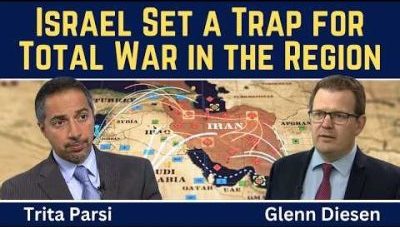
Trita Parsi: Israel Set a Trap for Total War in the Region
or go to
Aletho News Archives – Video-Images
From the Archive
Zionism’s Violent Legacy
By Donald Neff | Washington Report On Middle East Affairs | January 1996
On January 4, 1948, Jewish terrorists drove a truck loaded with explosives into the center of the all Arab city of Jaffa and detonated it, killing 26 and wounding around 100 Palestinian men, women and children.[1] The attack was the work of the Irgun Zvai Leumi – the “National Military Organization,” also known by the Hebrew letters Etzel – the largest Jewish terrorist group in Palestine. The Irgun was headed by Revisionist Zionist Menachem Begin and had been killing and maiming Arabs, Britons and even Jews for the previous ten years in its efforts to establish a Jewish state.
This terror campaign meant that at the core of Revisionist Zionism there existed a philosophical embrace of violence. … continue
Blog Roll
 Aletho News
- Trita Parsi: Israel Set a Trap for Total War in the Region
- Trump’s Iran war is on an Israeli leash
- Saudi oil boss issues global supply warning
- Riyadh Says Its Oil System Is Intact. The Numbers Say Otherwise.
- Trump and Netanyahu Want to “Finish the Job” on Iran
- US ‘one-sided dictation’ not Iran’s beliefs makes rational talks impossible: Baghaei
- Iran’s Next Strike May Not Explode. It Could Shut You Down /Col Doug Macgregor
- Iran: US political targets legitimate if assassinations return
- Iraq shuts key border crossing with Iran under US pressure: Report
- Undersea Internet cables could be targeted in retaliation for attacks on Iran: IRGC deputy chief
- If Americans Knew
- The Israel Lobby’s Changing Fortunes
- AIPAC has become such a political liability that it’s shifting to a more “nimble” approach to buying politicians
- At least 160 Israeli settler attacks in 2 weeks
- Will Gaza’s Ancient Christian Community Disappear Forever?
- Israel’s vision of regional security rests on keeping Arab states weak
- Heidi Levine recounts how Palestinian youths helped save her in settler attack
- DAILY UPDATE: Latest essential news on Palestine, Israel, & region
- Trump’s Intensifying Sabotage of the ICC, for Israel’s Sake
- Israeli military detain US and UK volunteers in West Bank including Democratic NY politician Brad Lander
- Americans at National Conservatism Conference held in Israel this year criticize Israel
- No Tricks Zone
- E-Cars Reduce CO2 Emissions By Only 41% Compared To Internal Combustion Engine Vehicles
- Predictions Made By Renowned Climate Professor Over Past Decades Have Been Proven To Be Poor
- New Study Suggests Large Regions Of The Pacific Ocean Have Been Cooling For The Last 80 Years
- Germany’s Green Energy Debacle: High Energy Costs Force Kahla Porzellan to Close After 182 Years!
- New Study: 50 Years Of The Most Aggressive ‘Net Zero’ Policies Can Only Affect The Global Climate By 0.03°C
- US September “Heat” Was No Record…Many Records Set Decades Ago
- Latest European Green Energy Debacle; Portugal’s Largest Flagship Solar Park Insolvent!
- Green Energy Debacle: German Expert Professor Fritz Vahrenholt Warns Of Severe Economic And Social Consequences
- Two More Paleo Reconstructions Affirm Meters-Higher Sea Levels Across Ireland, Brazil 7000-6000 Years Ago
- New Study: Earth And Venus Surface Warmth Largely Explained By Convection And Lapse Rate, Not CO2 Or Radiation

