Naomi Wolf and Anti-semitism’s Mystification
By Jonathan Cook | Dissident Voice | May 24, 2018
My previous post was about the firing of a cartoonist, Dieter Hanitzsch, by the German newspaper Süddeutsche Zeitung after its editor became concerned – though, it seems, far from sure – that a cartoon he had published of Benjamin Netanyahu might be anti-semitic. Here is the image again.
 As I argued then, the meaning seems pretty clear and uncoloured by any traditional notion of anti-semitism. It shows the danger that Israel, a highly militarised state, will use its win at the Eurovision song contest, and its hosting of next year’s competition in occupied Jerusalem, to whitewash the sort of war crimes it just committed in Gaza, where it has massacred large numbers of unarmed Palestinians.
In fact, the cartoonist is far from alone in highlighting such concerns. The New York Times has reported delight among Israelis at the prospect of what they regard as a “diplomatic victory” as much as musical one. And, according to the Haaretz newspaper, the Eurovision contest organisers have already expressed concern to Israeli broadcasters about likely attempts by Israel to “politicise” the competition.
Among those responding on Twitter to my post was Naomi Wolf, a US Jewish intellectual and feminist scholar whose body of work I admire. She disagreed with my blog post, arguing that the cartoon was, in her words, “kind of anti-semitic”.
 In our subsequent exchange she also noted that she was uncomfortable with the fact that the cartoonist was German. (For those interested, the complete exchange can be found here.)
In the end, and admittedly under some pressure from me for clarification, she offered an illustration of why she thought the cartoon was “kind of anti-semitic”. She sent a link to the image below, stating that she thought Hanitzsch’s cartoon of Netanyahu had echoes of this Nazi image of “the Jew” alongside an Aryan German woman.

Frankly, I was astounded by the comparison.
Nazi propaganda
Cartoons in Nazi propaganda sheets like Der Sturmer were anti-semitic because they emphasised specific themes to “otherise” Jews, presenting them as a collective menace to Germany or the world. Those themes included the threat of plague and disease, with Jews often represented as rats; or secret Jewish control over key institutions, illustrated, for example, by the tentacles of an octopus spanning the globe; or the disloyalty of Jews, selling out their country, as they hungered for money.
As Wolf notes, anti-semitic cartoonists would give the portrayed “Jew” grotesque or sinister facial features to alienate readers from him and convey the threat he posed. These features famously included a large or hooked nose, voracious lips, and a bulbous or disfigured head.
So how did the cartoon of Netanyahu qualify on any of these grounds? There is no implication that Netanyahu represents “Jews”, or even Israelis. He is illustrated straightforwardly as the leader of a country, Israel. There is no sense of disease, world control or money associated with Netanyahu’s depiction. Just his well-known hawkishness and Israel’s well-documented status as a highly militarised state.
And there is nothing “grotesque” or “other” about Netanyahu. This is a typical caricature, certainly by European standards, of a world leader. It’s no more offensive than common depictions of Barack Obama, George Bush, Tony Blair, or Donald Trump.


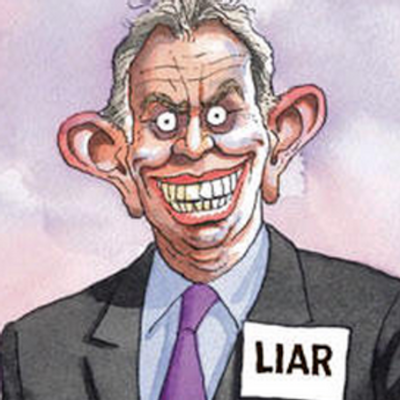
So how exactly is this Netanyahu cartoon “kind of anti-semitic”?
Limiting political debate
What follows is not meant as an attack on Wolf. In fact, I greatly appreciate the fact that she was prepared to engage sincerely and openly with me on Twitter. And I acknowledge her point that judgments about what is anti-semitic are subjective.
But at the same time ideas about anti-semitism have become far vaguer, more all-encompassing, than ever before. In fact, I would go so far as to say the idea of anti-semitism has been metamorphosing before our eyes in ways extremely damaging to the health of our political conversations. It is the current mystification of anti-semitism – or what we might term its transformation into a “kind of antisemitism” – that has allowed it to be weaponised, limiting all sorts of vital debates we need to be having.
It is precisely the promotion of a “kind of anti-semitism”, as opposed to real anti-semitism, that has just forced Ken Livingstone to resign from the Labour party; that empowered Labour’s Blairite bureaucracy to publicly lynch a well-known black anti-racism activist, Marc Wadsworth; that persuaded a dissident comedian and supporter of the Palestinian cause, Frankie Boyle, to use his TV show to prioritise an attack on a supposedly “anti-semitic” Labour party over support for Gaza; that is being used to vilify grassroots movements campaigning against “global elites” and the “1 per cent”; and that may yet finish off Labour leader Jeremy Corbyn, currently the only credible political force for progressive change in the UK.
None of this is, of course, to suggest that Wolf would herself want any of these outcomes or that she is trying to misuse anti-semitism. I fully acccept that she has been a strong Jewish critic of Israel and doubtless paid a price for it with friends and colleagues.
But unlike Wolf, those who do consciously and cynically weaponise anti-semitism gain their power from our inability to stand back and think critically about what they are doing, and why it matters. There is an intellectual and cultural blind spot that has been created and is being readily exploited by those who want to prevent discussions not only about Israel’s actions but about the wider political culture we desperately need to change.
Israel and Jews
In fact, the mystification of anti-semitism is not new, though it is rapidly intensifying. It began the moment Israel was created. That was why a Nazi cartoon – drawn before Israel’s establishment in 1948 – could never have been described as “kind of anti-semitic”. It simply was anti-semitic. It attributed menacing or subversive qualities to Jews because they were Jews.
To understand how the current mystification works we need briefly to consider Israel’s character as a state – something very few people are prepared to do in the “mainstream”, because it is likely to result in allegations of … anti-semitism! As I observed in my previous post, this has provided the perfect get-out-jail-free card for Israel and its supporters.
Israel was created as the national homeland of all Jewish people – not of those who became citizens (which included a significant number of Palestinians), or even of those Jews who ended up living there. Israel declared that it represented all Jewish people around the world, including Wolf.
This idea is central to Zionism, and is embodied in its Declaration of Independence; its constitutional-like Basic Laws; its immigration legislation, the Law of Return; its land laws; and the integration into Israel’s state structures of extra-territorial Zionist organisations like the Jewish National Fund, the World Zionist Organisation and the Jewish Agency.
A dangerous confusion
It is also why the rationale for Israel is premised on anti-semitism: Israel was created as a sanctuary for all Jews because, according to Zionists, Jews can never be truly safe anywhere outside Israel. Without anti-semitism, Israel would be superfluous. It is also why Israel has a reason to inflate the threat of anti-semitism – or, if we are cynical about the lengths states will go to promote their interests, to help generate anti-semitism to justify the existence of a Jewish state and encourage Jews to immigrate.
So from the moment of its birth, the ideas of “Israel” and “anti-semitism” became disturbingly enmeshed – and in ways almost impossible to disentangle.
For most of Israel’s history, that fact could be obscured in the west because western governments and media were little more than cheerleaders for Israel. Criticism of Israel was rarely allowed into the mainstream, and when it did appear it was invariably limited to condemnations of the occupation. Even then, there was rarely any implication of systematic wrongdoing on Israel’s part.
That changed only when the exclusive grip of the western corporate media over information dissemination weakened, first with the emergence of the internet and satellite channels like Al Jazeera, and more recently and decisively with social media. Criticism of Israel’s occupation has increasingly broadened into suspicions about its enduring bad faith. Among more knowledgeable sections of the progressive left, there is a mounting sense that Israel’s unwillingness to end the occupation is rooted in its character as a Jewish state, and maybe its intimate ideological relationship with anti-semitism.
These are vital conversations to be having about Israel, and they are all the more pressing now that Israel has shown that it is fully prepared to gun down in public unarmed Palestinians engaging in civil disobedience. Many, many more Palestinians are going to have their lives taken from them unless we aggressively pursue and resolve these conversations in ways that Israel is determined to prevent.
And this is why the “kind of anti-semitic” confusion – a confusion that Israel precisely needs and encourages – is so dangerous. Because it justifies – without evidence – shutting down those conversations before they can achieve anything.
The Livingstone problem
In 2016 Ken Livingstone tried to initiate a conversation about Zionism and its symbiotic relationship with anti-semites, in this case with the early Nazi leadership. We can’t understand what Israel is, why the vast majority of Jews once abhorred Zionism, why Israel is so beloved of modern anti-semites like the alt-right and hardcore Christian evangelicals, why Israel cannot concede a Palestinian state, and why it won’t abandon the occupation without overwhelming penalties from the international community, unless we finish the conversation Livingstone started.
Which is why that conversation was shut down instantly with the accusation that it was “anti-semitic”. But Livingstone’s crime is one no mainstream commentator wants to address or explain. If pressed to do so, they will tell you it is because his comments were perceived to be “offensive” or “hurtful”, or because they were “unnecessary” and “foolish”, or because they brought the Labour party “into disrepute” (Labour’s version of “kind of anti-semitic”). No one will tell you what was substantively anti-semitic about his remark.
Similarly, when pressed to explain how Hanitzsch’s cartoon of Netanyahu was anti-semitic, Wolf digressed to the entirely irrelevant issue of his nationality.
This is the power and the danger of this “kind of anti-semitic” logic, and why it needs to be confronted and exposed for the hollow shell it is.
A mural becomes anti-semitic
The next stage in the evolution of the “kind of anti-semitic” argument is already discernible, as I have warned before. It is so powerful that it has forced Corbyn to concede, against all evidence, that Labour has an anti-semitism problem and to castigate himself, again against all evidence, for indulging in anti-semitic thinking.
Corbyn has been on the defensive since a “controversy” erupted in March over his expression of support back in 2012 for street art and opposition to censorship amid a row over a London mural that was about to be painted over.

After he was elected Labour leader in 2015, the first efforts were made to weaponise the mural issue to damage him. The deeply anti-Corbyn Jewish Chronicle newspaper was – like Hanitzsch’s boss at the Süddeutsche Zeitung – initially unsure whether the mural was actually anti-semitic. Then the newspaper simply highlighted concerns that it might have “anti-semitic undertones”. By spring 2018, when the row resurfaced, the status of the mural had been transformed. Every mainstream British commentator was convinced it was “clearly” and “obviously” anti-semitic – and by implication, Corbyn had been unmasked as an anti-semite for supporting it.
Again, no one wanted to debate how it was anti-semitic. The artist has said it was an image of historical bankers, most of whom were not Jewish, closely associated with the capitalist class’s war on the rest of us. There is nothing in the mural to suggest he is lying about his intention or the mural’s meaning. And yet everyone in the “mainstream” is now confident that the mural is anti-semitic, even though none of them wants to specify what exactly is anti-semitic about it.
The 1 per cent off-limits
Much else is rapidly becoming “anti-semitic”. It is an indication of how quickly this slippage is occuring that repeating now a slogan of the Occupy Movement from only seven years ago – that we are ruled by a “global elite” and the “1 per cent” – is cited as proof of anti-semitism. The liberal New Statesman recently ran an article dedicated to proving that the articulation of basic socialist principles – including ideas of class war and the 1 per cent – was evidence of anti-semitism.
On Frankie Boyle’s popular TV show last week, comedian David Baddiel was allowed to misrepresent – unchallenged – an opinion poll that found 28 per cent of Corbyn supporters agreed with the statement “the world is controlled by a secretive elite”. Baddiel asserted, without any evidence, that when they spoke of a global elite the respondents were referring to Jews. What was this assumption based on? A hunch? A sense that such a statement must be “kind of anti-semitic”?
Lots of young people who support Corbyn have never heard of the Protocols of the Elders of Zion, and have little idea about Der Sturmer or Nazi propaganda. More likely when they think of a secretive global elite, they imagine not a cabal of Jews but faceless global corporations they feel powerless to influence and a military industrial complex raking in endless profits by engineering endless wars.
The mystification of anti-semitism is so dangerous because it can be exploited for any end those who dominate the public square care to put it to – whether it be sacking a cartoonist, justifying Israel’s slaughter of Palestinians, destroying a progressive party leader, or preventing any criticism of a turbo-charged neoliberal capitalism destroying our planet.
US considers further financial cuts to international bodies to silence Palestinians
By Ramona Wadi | MEMO | May 24, 2018
Under US President Donald Trump, international organisations have become targets for repression and vehicles by which Israeli oppression is maintained. Following the financial restrictions it imposed upon the United Nations Relief and Works Agency (UNRWA) last year, Washington has now set its sights on cuts in funding to another three organisations. The move follows the statement by UN Special Coordinator for the Middle East Nickolay Mladenov that Palestine has submitted applications to join the UN Conference on Trade and Development (UNCTAD), the UN Industrial Development Organisation (UNIDO) and the Organisation for the Prohibition of Chemical Weapons (OPCW).
Reports by various media, including Press TV and the Times of Israel, quote an unnamed US official saying that, “It has been the consistent position of the United States that efforts by the Palestinians to join international organisations are premature and counterproductive.” Since Trump’s election, the US-Israeli alliance has shed its veneer of restraint in terms of how much visible support should be flaunted internationally.
Financial dependence aside, it is clear that the US aims to leave Palestine with mere spectator status across the international community. It goes without saying that access to international organisations does not translate automatically into prominence for the Palestinians.
America’s move, therefore, is not only a punitive measure targeting and thus threatening the international organisations but also a means of increasing ways to deter Palestinians from pursuing their options in the international community. Nevertheless, whether or not Palestinians will utilise the international platform is still a contentious issue. Speaking about Palestinian accession to international organisations is still presented mainly from an angle that legitimises Israel’s purported anger, as in the case of the International Criminal Court (ICC). To eclipse Palestinian rights by Israel’s anger is a recipe for oblivion.
The same tactic was used when UNRWA faced an existential threat due to the US decision to slash funding. While UNRWA attempted to illustrate how such a decision would exacerbate the existing limitations on its work in support of Palestinian refugees, it was done from an organisational perspective, shifting the Palestinians in the process to a secondary and less visible position.
If international organisations worked independently of a political agenda, Palestine might have a chance to further its cause and development. UNCTAD has a special unit – the Assistance to the Palestinian People Unit (APPU) — which has the mandate to monitor the socio-economic impact of Israel’s military occupation. However, like other organisations, the Palestine issue is restricted to reports that state the obvious. UNCTAD’s April 2018 report, for example, said that Palestinians have been denied the human right to development; its conclusions and recommendations, like those of other organisations, are based upon legislation that Israel routinely and blatantly ignores.
The past seven decades have provided enough proof of the futility of the international community’s safeguarding of Palestinian rights; it is now ridiculed as the subject of mere rhetoric. It is more likely, therefore, that Trump, in coordination with Israel, is sending a message to Palestinians that their presence on international platforms will be hindered and obscured at all costs. One way to do this is to shift attention from Palestinians onto the organisations that might be affected.
This exposes the static structure of such international organisations which, due to their dependence upon financial aid from oppressive powers, prioritise their existence rather than use their position to safeguard Palestinian rights. If one thing is to be taken from the manipulation of financial aid and international institutions for political purposes, it is how the debate generated will also contribute towards marginalising and silencing Palestinians.
“Skirmishes” – Israel’s Syria Blitz

Media Lens | May 23, 2018
A key ‘mainstream’ media theme in covering the Israeli army’s repeated massacres of unarmed, non-violent Palestinian civilians protesting Israel’s military occupation in Gaza – killing journalists, a paramedic, the elderly and children – has been the description of these crimes as ‘clashes’.
This has been a clear attempt to obfuscate the fact that while two groups of people are involved, only one group is being killed and wounded.
To the casual reader – and many readers do not venture beyond the headlines – a ‘clash’ suggests that both sides are armed, with both suffering casualties. One would not, for example, describe a firing squad as a ‘clash’. There was no ‘clash’ in New York on September 11, 2001, and so on.
Following Israel’s massive blitz on more than 100 targets in Syria on May 10, ‘mainstream’ coverage offered similarly questionable frameworks of understanding.
A Guardian headline read:
Israel retaliates after Iran “fires 20 rockets” at army in occupied Golan Heights (Our emphasis)
For moral, legal and public relations reasons, the issue of which side started a conflict is obviously crucial. If the public recognises that the case for war is unjustified, immoral or illegal – that a country has chosen to launch a war of aggression – they will likely oppose it, sometimes in the millions, as happened in 2002 and 2003 in relation to the Iraq war. It is thus highly significant that the Guardian described Israel as retaliating.
The BBC reported of Israel’s attacks:
They came after 20 rockets were fired at Israeli military positions in the occupied Golan Heights. (Our emphasis)
Reuters took the same line as the Guardian and BBC:
Iran targets Israeli bases across Syrian frontier, Israel pounds Syria
Iranian forces in Syria launched a rocket attack on Israeli forces in the Golan Heights early on Thursday, Israel said, prompting one of the heaviest Israeli barrages in Syria since the conflict there began in 2011. (Our emphasis)
The New York Times also reported:
It was a furious response to what Israel called an Iranian rocket attack launched from Syrian territory just hours earlier. (Our emphasis)
And yet, the report buried a challenge to its own claim that Israel had retaliated in the second half of the piece:
Iran’s rocket attack against Israel came after what appeared to have been an Israeli missile strike against a village in the Syrian Golan Heights late on Wednesday. (Our emphasis)
According to the BBC (see below), the Israeli missile strike had targeted an Iranian drone facility killing several Iranians.
So, actually, it might be said that Iran was retaliating to Israeli attacks – a more reasonable interpretation, given recent history also described by the New York Times:
Israel has conducted scores of strikes on Iran and its allies inside Syria, rarely acknowledging them publicly.
Nevertheless, the corporate media theme has been that Israel retaliated, part of a long-term trend in media coverage. In a 2002 report, Bad News From Israel, The Glasgow University Media Group commented:
On the news, Israeli actions tended to be explained and contextualised – they were often shown as merely “responding” to what had been done to them by Palestinians (in the 2001 samples they were six times as likely to be presented as “retaliating” or in some way responding than were the Palestinians).
Was Iran Skirmishing?
But was Iran even involved at all? The opening, highlighted sentence in a front-page BBC piece by diplomatic editor Jonathan Marcus left the reader in no doubt:
These are the first skirmishes in a potential war between Israel and Iran that promises a fearful level of destruction – even by the standards of the modern Middle East.
So this was a ‘skirmish’, a clash involving Israel and Iran – they were both involved in the combat. And yet, in the second half of the article, Marcus wrote:
The alleged Iranian attack last night – I say alleged because at this stage there is no confirmation from Iranian sources as to the precise authors of the attack – involved a single and relatively short-range system, what appears to have been a multiple-barrelled rocket launcher.
How can the Iranian attack be merely ‘alleged’ half-way down the article but a bald fact in the highlighted opening sentence?
In fact, not only has there been ‘no confirmation’, there has been outright Iranian rejection of the claims. Abolfazl Hassan-Baygi, deputy head of the Iranian parliament’s national security committee, commented:
Iran has nothing to do with the missiles that struck the enemy entity yesterday.
Associated Press (AP ) reported Iranian Foreign Ministry spokesman Bahram Ghasemi commenting that Israel’s attacks were based on ‘fabricated and baseless excuses’, and were a breach of the national sovereignty and territorial integrity of Syria.
AP quoted a senior Lebanese politician and close ally of Syria and Iran, Parliament Speaker Nabih Berri, as saying: ‘this time the Syrian retaliation was in the Israeli-occupied Golan Heights but next time it will be in Israel proper. (Our emphasis)
Later in his BBC piece, Marcus wrote:
The immediate tensions stem from an Israeli air strike on what they claimed was an Iranian drone facility at the so-called T-4 air base, near Palmyra, on 9 April, which reportedly killed several Iranian military advisers.
This again challenged the idea that Israel had ‘retaliated’, but again it was not given the kind of prominence that could challenge Israel’s version of events.
So the ‘skirmishes’ may actually have consisted of Israel first attacking an Iranian drone facility killing Iranian personnel, and then launching a massive attack against Iranian positions across Syria, without Iran responding at all. And yet Marcus wrote:
It is a conflict that needs to be averted and the time to do it is now. However Israel and Iran remain on a collision course.
Despite the uncertainty on whether Iran had attacked, Marcus concluded:
Iran’s strategic intent is clear… it is unlikely to be dissuaded from its efforts.
He added:
Israel has drawn its red lines and it is clearly not going to back down either.
Obama also famously drew his ‘red line’ in Syria in 2012, threatening a massive attack in the event of Syrian government use of chemical weapons. But for Marcus, Israel’s actual launch of a massive attack merely constituted the drawing of ‘red lines’.
And again, ignoring his own doubts about what had happened, the required warmongering ‘balance’ was favoured:
For the immediate future, the pattern of strike, attempted riposte, and counter-strike is likely to continue.
If it had started at all! Marcus concluded his article with three ominous lines identifying another threat alongside the danger of Israel drawing more ‘red lines’ with more massive attacks:
One clear danger is that Iran may seek to exact its revenge outside the Middle East.
Pro-Iranian factions have in the past attacked Israeli tourists abroad or Jewish organisations, notably in Latin America.
A successful terrorist attack of this kind would inevitably alter the picture, pushing Israel and Iran to the brink of a full-scale war.
The word ‘terrorist’ thus made its first appearance in the last line of Marcus’s piece, in reference to a hypothetical Iranian atrocity.
The idea that Israel might already have committed terrorist atrocities in Syria by launching unprovoked attacks, by illegal bombings committed completely outside of international law, is unthinkable.
AUMF 2018 and the “forever war” in the Middle East
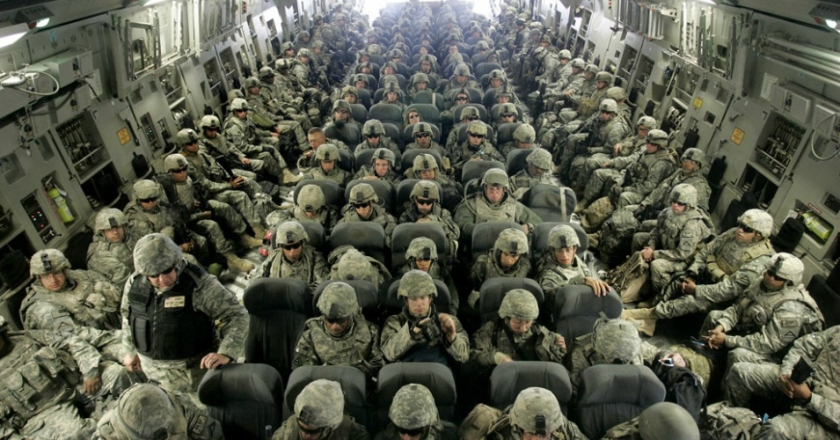
“War is not meant to be won, it is meant to be continuous.”
By Renee Parsons | OffGuardian | May 24, 2018
The Senate Foreign Relations Committee held a hearing on May 16th regarding the authorization of a new Authority for the Use of Military Force 2018 (AUMF). Despite a current lack of unanimity on the committee, the draft authorization (SJ Res 59) has been brought forward as a working document despite the lack of successful back-room negotiations in recent weeks. The hearing was conducted with no quorum present, the lack of which denied the sponsors an easy vote of approval.
The AUMF 2018 would replace AUMF’s 2001 and 2002 which proponents suggest would remove the onerous Constitutional responsibility from a self-proclaimed over-burdened Congress from voting to approve every single separate act of war. While final approval of the AUMF 2018 represents a “Forever Vote,” product of a low vibration consciousness, the ACLU, which should be leading a vigorous national campaign against the proposal, appears absent from the debate.
Approval of a one-size-fits-all AUMF will greatly facilitate the Pentagon’s long held desire to ‘take out’ seven countries in five years – although somewhat behind the original timeline, military conflict is ongoing throughout the Middle East and will allow dramatic escalation in each of those countries without meaningful accountability or Constitutional Congressional oversight.
Since the Congress has already exhibited a penchant for an inability to govern, why have a Foreign Relations Committee at all if their single, most essential Constitutional reason for existence of whether to take the country to war is eliminated?
When the draft AUMF 2018 was introduced by Sen. Bob Corker (R-Tenn) retiring Chair of the Committee in mid-April, he suggested that a strong vote in the Committee would translate into strong support on the Senate floor. After all, even members of the Senate are sensitive to not publicly dismembering their own Constitutional prerogative on a close vote.
Sen. Rand Paul (R-SC) and Sen. Jeff Merkley (D-Or) had both previously announced their opposition to AUMF and both spoke at the hearing against the proposal. Sen. Paul opened with a spirited assault on the AUMF as “flipping the Constitution on its head” eliminating the majority vote in favor of a two-thirds vote required to override Presidential action while allowing the unfettered expansion of war throughout the Middle East.
Since the 2001 AUMF, the status quo has reigned with every President initiating war with the assumption that they had the authority to ‘stretch’ the AUMF to fit current circumstances. Paul argued that by codifying Presidential authority as the 2018 version would do, an opportunity for legal challenges to Presidential authority would be removed. Unrestrained war without the pesky need for Congressional participation is, of course, exactly what the pro-war Republicrats who control the Senate and their MIC benefactors are hoping for. As an example of how a new AUMF might function, Paul said he had not yet figured out ‘why we are chasing a herdsman in Mali?”
Sen. Tim Kaine (D-Va) avid co sponsor of the proposal and HRC’s running mate in 2016, declared that “Congress needs to send a message to our troops, one of them is one of my kids, that the missions they are fighting and dying for, against non-state terrorist groups, has the support of Congress.” Kaine did not explain how codifying the legality of all future undeclared wars will somehow improve the morale of American troops.
One of the two hearing witnesses was Rita Siemion, Adjunct Professor of Law, Human Rights First, George Washington University who provided effective testimony which attracted Kaine to focus his laser on her.
Kaine: Do you support the need for continuing US military action against Taliban, Isis and al Qaeda?
Siemion: I think the use of military force is something that the president should be coming to Congress…
Kaine [interrupts]: Well, can I just say… we are currently engaged in military action against al Qaeda, Isis and the Taliban, do you support need for that action or don’t you?
Siemion: I think that hard questions need to be asked of the administration about what are we achieving by use of military force over the long term….”
Kaine [interrupts again]: So you are not prepared to say today whether you do or do not support the action that our troops are currently engaged in against ISIA, al Qaeda and the Taliban?
Siemion: I think that there are currently real questions that need to be answered about the efficacy of using military force…
Kaine: Let me ask a second question then. I think from your testimony that you would agree, separating this resolution, that the 2001 authorization should be rewritten/or replaced? Do I understand that to be your testimony?
Siemion: I agree that the status quo is incredibly problematic.
Kaine: So then let me be more specific…. do you think it should it be repealed with no replacement or rewritten and then replaced?
Siemion: I think if Congress agrees that use of military force is required and appropriate and it is demonstrated it can be effective for addressing particular terrorist threats, then Congress should authorize military force against those particular groups.
Kaine: I understand that. Obviously if somebody does not think we should be using military force against alQaeda, Isis or the Taliban, then they should vote no on this… they should not vote for an authorization. That’s a good reason to vote no if you do not support the military action that our troops are currently engaged in against al Qaeda, Isis and the Taliban.
In addition to his attempt to make Siemion look unpatriotic, if Kaine’s goal was to intimidate Sen. Merkley who was next to address the panel, he failed.
Merkley focused on legal contradictions and broad interpretations within the AUMF providing the President with a new legal foundation to decide or interpret particular sections that otherwise would be the purview of Congress. Merkley further cited that “the bottom line, what we have before us, codifies the existing situation, gives fresh authority for what has been done since 2001 and I fundamentally believe that delegation was not intended in 2001 and is not appropriate now.” He referred to the Federalist Papers on “how they decided to give that war making power to Congress, that it should not be in the hands of one single person; it is too big an issue, the lives of our soldiers, our sons and daughters, is too big an issue to open that door and I believe they were exactly right. There is a fundamental reason behind that and it is still relevant today.”
At conclusion of the hearing, Sen. Robert Menendez (D-NJ) the committee’s ranking member directly addressed Kaine in that he:
… reject as a false choice that voting against this, when it comes time for that if this is what the final product is, that voting against this proposal is a vote against our troops in the field. No. I reject the proposition that it’s either this or you are not with our troops. That’s ridiculous.”
Kaine replied to:
… clarify and the transcript would show this, I think, that I certainly did not suggest that if you vote against the AUMF, you are against the troops who are currently fighting. I did not suggest that. I did suggest if you are against military action, that is good reason to oppose our proposal. I was engaging in questions of the witness to see if she agreed we should be engaged in military action against these groups. She would not offer an opinion upon that.”
With Secretary of State Pompeo scheduled to testify before Foreign Relations on Thursday, May 24th to clarify the Trump administration’s position on AUMF proposal, a Committee mark up can be expected soon thereafter.
If qui bono is applied here and since the new AUMF would presumably focus on ‘terrorists’ and sovereign nations throughout the Middle East, Israel would appear to be the beneficiary of the dismantling of Congress’ Constitutional obligations. Therefore, it is instructive that fourteen out of twenty one Foreign Relations members were identified by the Center for Responsive Politics on their Top Twenty list of recipients of Pro-Israel PACs or individuals who donated over $200.
- Menendez (D-NJ) 2012/2016: $623,508
- Rubio (R-Fl) 2016: $468,307
- Booker (D-NJ) 2014: $434,126
- Cardin (D-Md) 2012/2018: $415,993
- Portman (R-Oh) 2016: $235,280
- Johnson (R-Wis) 2016: $231,814
- Shaheen (D-NH) 2014: $203,149
- Kaine (D-Va) 2018: $167,878
- Coons (D-De) 2014: $133,300
- Udall (D-NM) 2016: $110,379
- Barasso (R-Wy) 2018: $105,400
- Corker (R-Tenn) 2012: $102,950
- Markey (D-Mass) 2014: $100,450
- Murphy (D-Ct) 2018: $65,221
Either the remaining seven Committee members did not receive sufficient Pro-Israel PAC money to qualify for the Top Twenty list or they received no Pro-Israel PAC money.
Renee Parsons has been a member of the ACLU’s Florida State Board of Directors and president of the ACLU Treasure Coast Chapter. She has been an elected public official in Colorado, an environmental lobbyist for Friends of the Earth and a staff member of the US House of Representatives in Washington DC. She can be found on Twitter @reneedove31
Iran: Morocco’s false claims aim to please third parties
Press TV – May 24, 2018
Iran has hit out at Morocco for accusing Tehran of interference in the African country’s affairs, saying the “false claims” are aimed at pleasing certain third parties.
Morocco has close ties with Saudi Arabia which has accused Iran of meddling in Arab affairs, with Moroccan Foreign Minister Nasser Bourita repeating those claims in a recent interview with Fox News.
“The Moroccan foreign minister knows himself well that the unjust charges he is making are utterly wrong, false and based on delusions and fictions written by those who resort to such provocations only in line with their illegitimate interests,” Iran’s Foreign Ministry spokesman Bahram Qassemi said on Thursday.
Bourita first made the accusations against Iran early this month as he announced Morocco’s decision to sever diplomatic ties with the Islamic Republic over what he called Tehran’s support for the Polisario Front.
The Polisario is a guerrilla movement fighting for independence for the Sahrawi people in Western Sahara which is claimed by Morocco after colonial Spain left the territory.
In his interview with Fox News aired on Wednesday, Bourita claimed that Hezbollah members had met with senior Polisario military leaders recently and that the Iranian embassy in Algeria was used to fund the Polisario.
“The Moroccan authorities’ insistence on repeating their false claims for cutting diplomatic ties with Iran and repeatedly raising baseless allegations against our country is merely a bid to please certain third parties,” Qassemi said.
Bourita also claimed that Iran was in part trying to destabilize the area due to Morocco’s good relations with the US and Europe.
Earlier this month, he had said that Iran and Hezbollah were supporting Polisario by training and arming its fighters, via the Iranian embassy in Algeria.
Algeria, Iran and Hezbollah were all quick to reject the claims as baseless back then.
Iranian Foreign Ministry said there was no cooperation between Tehran’s diplomatic mission in Algiers and the Algeria-backed movement.
Hezbollah also blamed the US, Israel and Saudi Arabia for the diplomatic tensions, saying Rabat had cut ties with Tehran under pressure from the trio.
In turn, Algeria summoned Morocco’s ambassador to protest the “unfounded” claims.
Rabat annexed Western Sahara, a former Spanish colony, in 1975, and has since been in conflict with Polisario, which demands a referendum on self-determination and independence.
The movement, which aims to end Morocco’s presence in the Saharan region, recently said they sought to set up a “capital” in the region, prompting Rabat to caution it would respond with force.
Blaming the Victims of Israel’s Gaza Massacre
By Gregory Shupak | FAIR | May 17, 2018
Israel massacred 60 Palestinians on Monday, including seven children, bringing to 101 the total number of Palestinians Israel has killed since Palestinians began the Great March on March 30. In that period, Israel has killed 11 Palestinian children, two journalists, one person on crutches and three persons with disabilities.
Monday’s casualties included 1,861 wounded, bringing total injuries inflicted by Israel to 6,938 people, including 3,615 with live fire. Israel is using bullets designed to expand inside the body, causing maximum, often permanent damage: “The injuries sustained by patients will leave most with serious, long-term physical disabilities,” says Médecins Sans Frontières (Ha’aretz, 4/22/18).
On the 70th anniversary of Israel’s so-called “declaration of independence,” the United States opened its new embassy in Jerusalem—a city Israel claims as its own, despite what international law says on the matter—and Palestinians undertook unarmed protests in reaction to the move and as part of the Great Return March. Although to this point, the only Israeli casualty during the entire cycle of demonstrations has been one “lightly wounded” soldier, considerable space in coverage of the massacres is devoted to blaming Palestinians for their own slaughter.

NBC (5/14/18) mentions “what Palestinians refer to as their ‘right of return’”; actually, it’s what international law calls it, based on the Universal Declaration of Human Rights
Two of the first three paragraphs in an NBC report (5/14/18) provided Israel’s rationalizations for its killing spree. The second sentence in the article says that the Israeli military
accused Hamas of “leading a terrorist operation under the cover of masses of people,” adding that “firebombs and explosive devices” as well as rocks were being thrown towards the barrier.
A Washington Post article (5/14/18) devoted two of its first four sentences to telling readers that Palestinians are responsible for being murdered by Israel. Palestinian “organizers urged demonstrators to burst through the fence, telling them Israeli soldiers were fleeing their positions, even as they were reinforcing them,” read one sentence. “At the barrier, young men threw stones and tried to launch kites carrying flames in hopes of burning crops on the other side,” stated the next one, as though stones and burning kites released by a besieged people is violence remotely equivalent to subjecting people to a military siege and mowing them down.
The New York Times (5/14/18) said that “a mass attempt by Palestinians to cross the border fence separating Israel from Gaza turned violent, as Israeli soldiers responded with rifle fire,” painting Israel’s rampage as a reaction to a Palestinian provocation. Like FAIR (2/21/18) has previously said of the word “retaliation,” “response” functions as a justification of Israeli butchery: To characterize Israeli violence as a “response” is to wrongly imply that Palestinian actions warranted Israel unleashing its firing squads.
A Yahoo headline (5/14/18) described “Violent Protests in Gaza Ahead of US Embassy Inauguration in Jerusalem,” a flatly incorrect description in that it attributes the violence to Palestinian demonstrators rather than to Israel. The BBC (5/15/18) did the same with a segment called “Gaza Braced for Further Violent Protests.”

In Bloomberg‘s account (5/14/18), the fence seemed to be the real victim.
One Bloomberg article (5/14/18) by Saud Abu Ramadan and Amy Teibel had the same problem, referring to “a protest marred by violence,” while another one (5/14/18) attributed only to Ramadan is headlined “Hamas Targets Fence as Gaza Bloodshed Clouds Embassy Move,” as though the fence were Monday’s most tragic casualty. Ascribing this phantom violence to Palestinians provides Israel an alibi: Many readers will likely conclude that Israel’s lethal violence is reasonable if it is cast as a way of coping with “violent protests.”
The second paragraph of the Bloomberg article solely written by Ramadan says that
Gaza protesters, egged on by loudspeakers and transported in buses, streamed to the border, where some threw rocks, burned tires, and flew kites and balloons outfitted with firebombs into Israeli territory.
This author—like the rest in the “Palestinians were asking for it” chorus—failed to note that Israel’s fence runs deep into Palestinian territory and creates a 300-meter “buffer zone” between Palestinians and Israeli forces, which makes it highly unlikely that the kites and balloons of the colonized will have an effect on their drone-operating, rifle-wielding colonizers, let alone on people further afield in Israeli-held territory.
The New York Times editorial board (5/14/18) wrote as though Palestinians are barbarians against whom Israel has no choice but to unleash terror:
Led too long by men who were corrupt or violent or both, the Palestinians have failed and failed again to make their own best efforts toward peace. Even now, Gazans are undermining their own cause by resorting to violence, rather than keeping their protests strictly peaceful.
The board claimed that “Israel has every right to defend its borders, including the boundary with Gaza,” incorrectly suggesting that Palestinians were aggressors rather than on the receiving end of 100 years of settler-colonialism.
Moreover, like the Times and Bloomberg articles discussed above, the editorial attempts to legitimize Israel’s deadly violence by saying that it is defending a border that Palestinians are attempting to breach, but there is no border between Gaza and Israel. There is, as Maureen Murphy of Electronic Intifada (4/6/18) pointed out, “an armistice line between an occupying power and the population living under its military rule” that Palestinians are trying to cross in order to exercise their right to return to their land.

The Washington Post (5/15/18) condemned the “cruel, cynical tactic” of trying to exercise the internationally guaranteed right of return.
A Washington Post editorial (5/15/18) called the Palestinians hunted by Israel “nominal civilians.” Apart from being a logical impossibility (one either is or isn’t a civilian), the phrase illuminates how too much of media think about Palestinians: They are inherently threatening, intrinsically killable, always suspect, never innocent, permanently guilty of existing.
A Business Insider piece (5/14/18) by columnist Daniella Greenbaum described “Palestinian protesters who ramped up their activities along the Gaza strip and, as a result, were targeted by the Israeli army with increasing intensity.” Greenbaum’s use of the phrase “as a result” implies that it was inevitable and perhaps just that Palestinians’ “ramped up activities” led to Israel mowing down a population it occupies, 70 percent of whom are refugees Israel refuses to allow to return to their homes.
Greenbaum then climbs into the intellectual and moral gutter, claiming that
absent from the commentary that children have unfortunately been among the injured and dead are questions about how they ended up at the border. On that question, it is important to recognize and acknowledge the extent to which Palestinians have glorified violence and martyrdom — and the extent to which the terrorist organization Hamas has organized the “protests.”
In her view, dozens of Palestinians died because they are primitive savages who take pleasure in sacrificing their own children, not because Israel maintains the right to gun down refugees in the name of maintaining an ethnostate.
In a rare instance of a resident of Gaza allowed to participate directly in the media conversation, Fadi Abu Shammalah wrote an op-ed for the New York Times (4/27/18) that offered an explanation of why Palestinians are putting their lives on the line to march. Life for the people of Gaza, including for his three young sons, has been “one tragedy after another: waves of mass displacement, life in squalid refugee camps, a captured economy, restricted access to fishing waters, a strangling siege and three wars in the past nine years. ” Recalling the concern for his safety expressed by his seven-year-old child, Shammalah concludes:
If Ali asks me why I’m returning to the Great Return March despite the danger, I will tell him this: I love my life. But more than that, I love you, Karam and Adam. If risking my life means you and your brothers will have a chance to thrive, to have a future with dignity, to live in peace with all your neighbors, in your free country, then this is a risk I must take.
Palestinians have a right to liberate themselves that extends to the right to the use of armed struggle, yet as Shammalah wrote, the Great Return March signifies a “nearly unanimous acceptance of peaceful methods to call for our rights and insist on our humanity.” Nevertheless, based on media coverage, readers could be forgiven for concluding that it was Palestinians, not Israel, who carried out what Doctors Without Borders called “unacceptable and inhuman” violence.
Anti-semitism: Israel’s get-out-of-jail-free card
By Jonathan Cook | Dissident Voice | May 22, 2018
The silencing of critics of Israel using anti-semitism as the pretext is far from restricted to the current wave of attacks on Jeremy Corbyn and his Labour party. It is now used to intimidate anyone who steps out of line on Israel. Once we raged against the conflation of anti-semitism and anti-Zionism. We have so lost that battle that it is now standard operating procedure for Israel’s apologists to conflate anti-semitism with simple criticisms of the current ultra-nationalist Israeli government.
Here is an illustration of our defeat, reported in the Israeli daily Haaretz. It concerns what would in other circumstances be a fairly standard satirical cartoon: this one published by the German newspaper Süddeutsche Zeitung about Israel winning the Eurovision song contest last week. Israeli prime minister Benjamin Netanyahu is shown on stage dressed as Israel’s winning singer, Netta, and proclaiming “Next year in Jerusalem!”.
After the usual outcry, the cartoonist, Dieter Hanitzsch, was sacked. No Charlie Hebdo-style concerns about free speech on this occasion, it seems.
As has become familiar in these cases, Wolfgang Krach, editor-in-chief of the Süddeutsche Zeitung, seemed unsure himself whether the cartoon was actually anti-semitic. But presumably he thought it better to fire the cartoonist just to be on the safe side. Let’s hope Hanitzsch can take Krach and his newspaper to the cleaners at a labour tribunal.
One critic, Jonas Mueller-Töwe, who sounds like Germany’s version of Jonathan Freedland, has claimed that “a Jewish star” – that would be Israel’s emblem of the Star of David – on a rocket held by Netanyahu suggests that “behind every war, Jewish interests are hiding”. Instead we could simply trust our eyes, which provide a different meaning: that Israel, a highly militarised state, won the Eurovision song contest at the same time as it was devastating Gaza – again – and will now be able to use its hosting of a popular cultural event in Jerusalem next year to whitewash its war crimes.
Before we get too exercised about the significance of every detail, we should remember that political cartoons, by their very nature, need to use symbols as shorthand for more complex ideas. We demand the impossible from a cartoonist if we expect them to offer us political satire while denying them the possibility of using symbols.
So what is anti-semitic about the cartoon? It’s not about Jews, it’s about the Israeli prime minister and his war agenda. And Netanyahu’s purportedly “oversized nose, ears and lips” are surely well within the normal bounds of a caricature. Do we really want to impose a unique demand on cartoonists when dealing with Israel’s leaders of drawing anatomically precise images?
The problem here, as with the anti-semitism “crisis” debate about the Labour party, is that it is totally divorced from any sense of proportion or reality. The question we ought to be asking in a case like this is: what kind of satirical cartoon lambasting Israel could ever satisfy the criteria being demanded by the current anti-semitism watchdogs?
And in consequence, what cartoonist is going to dare to deploy their satirical skills against Israel when the response is invariably going to lead to their being accused of anti-semitism and possibly losing their career and their reputation?
That is precisely what weaponising anti-semitism means. It hands Israel a get-out-of-jail-free card. It intimidates opinion formers – journalists, cartoonists, comedians, politicians, civil society leaders, human rights activists – by making the issue of Israel so toxic that none dare touch it. One need only look to the BBC to see the result: a mix of anaemic fence-sitting and outright censorship when covering Israel.
As Archbishop Desmond Tutu famously reminded us: “If you are neutral in situations of injustice, you have chosen the side of the oppressor.” A submission to those who abuse anti-semitism to make Israel unassailable entails terrifying consequences for the Palestinians. It requires that, after decades of betraying them, we in the west once again turn a blind to their suffering. And, as was highlighted last week in Israel’s slaughter of Gaza’s unarmed protesters, it clears the path to a future in which Israel can and will commit ever graver outrages against the Palestinians.
Israeli Parliament Reportedly Considers Promoting Kurdish State
Sputnik – May 22, 2018
 Israeli MPs have reportedly discussed a bill that outlines the means by which Israel may help Kurds build their state in Syria, Iraq and Turkey, which would support Tel Aviv. According to one of Israel’s radio stations, the bill had been submitted to the Knesset by two Israeli right-wing parties, namely Likud and Yisrael Beiteinu. The radio quoted Yoav Kish as saying that given the Kurdish minority living in the aforementioned countries, which are generally hostile to Israel, the proposed move would play into the hands of the Israeli state.
“There is a reason that Israel was the first to publicly congratulate moves toward Kurdish independence in northern Iraq,” Kish added.
Back in 2017, Israel became the only country to support the Kurdish plebiscite which endorsed the Kurds’ secession from Iraq – a development that was vigorously criticized around the world.
Back then, Israeli Prime Minister Benjamin Netanyahu claimed that Tel Aviv backed what he called “legitimate efforts of the Kurdish people to attain a state of its own.” Alongside political backing, Israel was reportedly a major buyer of Kurdistan’s oil and the top investor in the region in 2017.
The Iraqi Kurdistan independence referendum that took place on September 25 triggered changes in the region. More than 90 percent of the voters who took part in the plebiscite backed the independence from Baghdad. Iraqi authorities declared the referendum illegal, while Turkey and Iran vehemently criticized the plebiscite and threatened to impose tough sanctions on Iraqi Kurdistan’s capital Erbil.
Read more:
Tensions Rising Between Syrian Army, Kurds Amid Creation of US Bases – Reports
A New Flotilla Steams Towards Gaza
By Elizabeth Murray | Consortium News | May 22, 2018

Al Awda (The Return): Sailing to Gaza
“Islands Bruegge,” an idyllic harbor park that stretches along the east bank of Copenhagen, was alive with a celebratory crowd on Monday as three ships were about to steam towards Gaza. The 2018 Freedom Flotilla—two ships from Sweden and one from Norway — will call at ports in Germany, Holland, Belgium, France, Spain, Portugal and Italy before traveling through the Mediterranean Sea to its final destination: Gaza harbor.
Volunteer boat guides explained the history and mission of the Gaza Flotilla movement, which has organized a number of journeys to demonstrate solidarity with the people of Gaza and break the illegal economic siege. An independent U.N. panel and the International Committee of the Red Cross (ICRC) say the blockade violates the Geneva Conventions and is illegal.
Israel dragged the last Israeli settlers from Gaza and withdrew the Israeli Defense Force in 2005. When the Palestinian Authority lost a 2006 election in Gaza to Hamas, Israel imposed the illegal blockade. A considerable number of young Danish people learned about Gaza for the first time and walked away with new political awareness of the injustices suffered by Gaza’s children, who are denied the same carefree life enjoyed by Danish children.
I feel proud and privileged to join a group of international passengers aboard the Norwegian ship “Al Awda,” (“The Return” in Arabic) as we prepared to embark on the first leg of our journey. Along our route we hope to raise awareness and educate people about the plight of Palestinians, especially in Gaza, who are denied the basic freedoms and human rights the rest of us take for granted.
Earlier this month as Gazans held The Great March of Return to commemorate the 70th anniversary of the Nakba (or the Catastrophe) — in which 800,000 Palestinians were forcibly driven from their land and homes by Israel in 1948 — Israeli snipers cut down peaceful demonstrators one by one, killing hundreds and maiming thousands, generating shock and outrage around the world and providing further incentive for people to support the burgeoning Boycott, Divestment and Sanctions movement (BDS).
Targeting Athletes
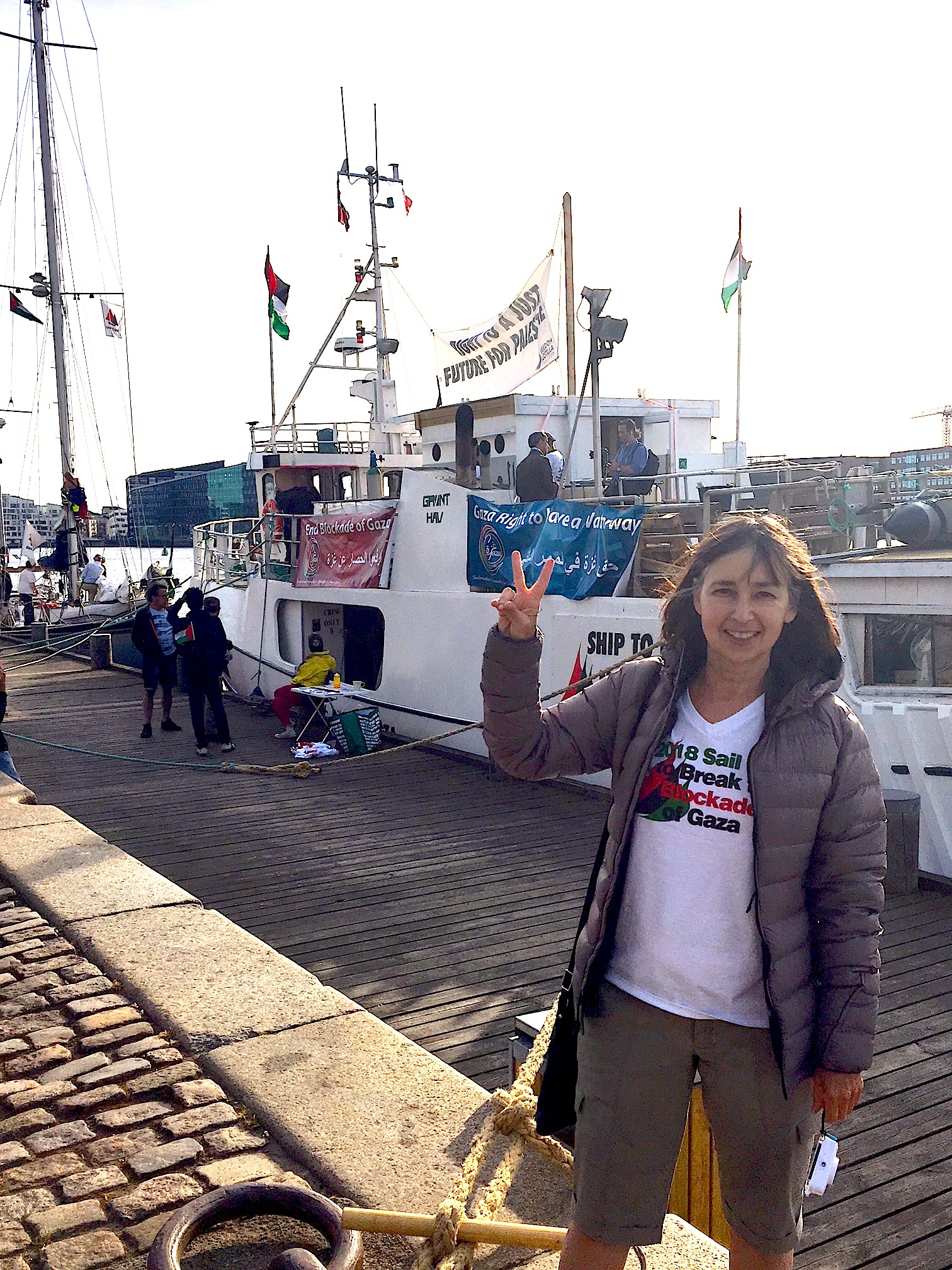
Elizabeth Murray: Boarding her boat to Gaza
Israel seems to have reserved a special brand of sadism for Gaza’s athletes — several promising young cyclists and soccer players have become amputees, since Israel refused to allow them to leave Gaza to obtain the necessary medical attention that would have saved their legs. Reports of such heinous acts — documented widely in social media posts by those on the ground in Gaza — have served to further isolate Israel internationally and alienate peace-loving people around the world, who deplore the moral depravity of its government.
Reaching the harbor of Gaza (which means “jewel” in Arabic) should be as simple and straightforward as entering any harbor in Germany, France or Spain. But instead, Israel has denied Gazans use of their own harbor for commerce, trade and travel, and has bombed it on numerous occasions, along with their electric power plants and sewage systems, making life miserable for the local population and rendering 97 percent of the drinking water toxic.
As the Freedom Flotilla embarks on its peace odyssey, it is our hope to bring a light of hope and solidarity to the people of Gaza, who deserve the peaceful, dignified and joyful existence that is their right.
Elizabeth Murray served as Deputy National Intelligence Officer for the Near East in the National Intelligence Council before retiring after a 27-year career in the U.S. government, where she specialized in Middle Eastern political and media analysis. She is a member of Veteran Intelligence Professionals for Sanity (VIPS).
Journey of an Israeli in Iran
By Miko Peled | American Herald Tribune | May 22, 2018
Trump’s declaration regarding the US backing out of the Iran agreement came just days before my trip to Iran was confirmed and my visa was approved. I was asked by several people if I was still going, thinking that Trump’s declaration that sanctions were going to be reinstated was a de facto declaration of war on Iran. I wasn’t going to let Donald Trump dictate where I was or was not going and certainly I was not going to cancel a trip into which so much effort had been placed by my hosts. My only concern was that I might get stopped and questioned by the authorities upon my return to the US.
I was interested to see Iran and to hear what people in Iran thought of Trump’s declaration and also how they felt regarding Israel’s constant accusations and threats of attack. I had a clue of what Iranian attitudes might be thanks to a piece written by Orly Noy in the progressive Hebrew online magazine Mekomit. Orly Noy is an Israeli journalist who was born and raised in Iran and is fluent in Farsi. In this piece, she quoted responses from people in Iran as they were expressed on social media. One response came after Israeli Prime Minister Benjamin Netanyahu made the display of documents he alleged were smuggled out of Iran by Mossad agents. There were hundreds of thousands of documents weighing a total of half a ton in which, so Netanyahu claims, it was made clear that Iran was lying and was not abiding by the agreement. In response to this one Iranian wrote, “Netanyahu finally discovered our secret intent: to attack Israel with fifty thousand paper airplanes.” Other responses were equally dismissive.
My first impression of Iran and its people was the calm and cleanliness one feels even in a large city like Mashhad, which has a population of five million and was my first point of entry. And, unlike the Middle-East and Europe, in Iran, it is rare to see people smoke. Mashhad, is considered a holy city and it is the home of the Imam Reza shrine, which I was told can accommodate all five million people within its compound during prayer. I visited the shrine along with a few friends between midnight and 2 AM and still there were many people there worshipping, some sitting in silent contemplation and there were even families enjoying a late-night picnic. Returning to the hotel I could not help mentioning to my friends that there are not many cities of that size in the world where one feels completely comfortable and safe to walk at 2 o’clock in the morning.
The most common response I received when asking people about their thoughts and concerns on the issue of the sanctions and Israeli threats was a smile, “We have been living under sanctions for many years and the lifting of the sanctions in 2013 brought very little change. So now we are going to live with sanctions again.” As for the Israeli threats, “we are not afraid, we are strong and will defend our land as we have always done.” It is worth noting that Iran has not attacked a single country in recent history though it has been the target of attacks and political assassinations by foreign powers. At the same time, Iran has been a staunch supporter of both the Palestinian resistance and the Lebanese resistance against Israeli oppression violence.
Still, with large corporations like the French oil and gas giant Total and Danish shipping giant Maersk announcing they will back out of deals they had made with Iran there is definitely cause for concern. It is still unclear what French automakers like Peugeot will do since they’re part of large conglomerates and use parts made in the US. Furthermore, even though European countries declared that they remain committed to the Iran deal, it is unclear whether or not they will bow to American pressure because of fear of American retaliation. Another concern for the European corporations is the fact that so much of international banking is controlled by the US and transfer of funds will be all but impossible if they continue to do business with Iran. So will the Europeans show back bone and stand with Iran or will they cower, that remains to be seen.
Two particularly interesting experiences I had took place while visited Yazd in central Iran. The first was speaking in front of cadets of the notable Revolutionary Guards. Some two hundred young cadets along with their officers sat on the floor of the mosque on base and listened intently. Their young, bright faces so attentive one could hear a pin drop. I told them that even though I was introduced as an American, I was not actually American – though I reside in the US I was Israeli and the son of an Israeli army general. I told them of my niece who was killed when three young Palestinians blew themselves up during a suicide mission. I also told them that I reject Israel as a political entity and look forward to the day when Palestine is free and democratic. I ended my talk by saying that “When Palestine is freed from the racist, apartheid regime under which it is currently suffering, you must come to Al-Quds to pray in Al-Aqsa mosque and then visit me in Jerusalem.” There was no fear or sense of insecurity in their faces but rather a confident calmness. Their attention, their questions later and their warm applause were reassuring. I also told them what I believe to be true, and that is that neither Israel nor the United States will dare to actually attack Iran.
The other remarkable experience I had took place later the same day at a local high school. What does one say to a room full of young Iranian high school boys? What do they know of Palestine? I looked at the three hundred or so boys who sat on the floor waiting to hear me speak and decided to ask them what they knew about Falasteen. After a short pause, one young boy raised his hand. “Falasteen,” he began, “was a place of peace and tranquility. It was a land where Muslims, Jews and Christians all lived and worshiped in peace, until it was invaded and occupied.” I could not have wished for a better answer. I am one of the occupiers, I admitted. My family had participated in the invasion, occupation and oppression that we see today in Palestine.
“Our Supreme Leader” one student asked, “says that in twenty-five years there will be no Israel.” What did I say to that? Well, we know that by “no Israel” he means that Palestine will be free and the Zionist regime will be gone. That he wishes for a day when Muslims, Jews and Christians will be once again able to live and worship in peace. I would ask, I told them, that they do me a favor and help me and millions of Palestinians and millions of supporters of Palestine, and prove the Supreme Leader wrong by making this happen sooner than twenty-five years.
Throughout the visit, both during lectures and other occasions I had received a few questions and comments that were critical of the Iranian official line towards Israel. I was asked if I felt that Iran’s policy towards Israel was harming Iran and if I thought it was the right policy. “Is it true,” I was asked, “that the Jews bought land in Palestine and that it was taken from them by the Palestinians.”
I returned to the US with some trepidation. I landed at Dulles International Airport and was quite ready to call an attorney in case I was stopped. However, all was well, and I exited the airport as though I had landed from any other destination. Looking from the outside, particularly from Iran, one has the advantage of distance and some perspective, and still with his declaration on Jerusalem and his decision on Iran Donald Trump seems like a petulant adolescent with far too much power.
Featured Video
Why Hamas Really Attacked Israel on Oct. 7
or go to
Aletho News Archives – Video-Images
From the Archives
Confronting the Threat of Ethnic Bioweapons
By Tony Cartalucci – New Eastern Outlook – 29.11.2017
The United States Air Force’s 59th Medical Wing’s molecular biology branch recently was revealed to have been collecting specifically Russian RNA and synovial (connective) tissue samples, prompting fears in Russia of a possible US directed ethnic-specific bioweapons program. … continue
Blog Roll
 Aletho News
- Why Yemen Is Bombing Saudi Arabia’s Airports: The War Behind the Headlines
- Sally Rooney’s books pulled from UK over support for Palestine Action
- Bombs for Tel Aviv, Promises for Riyadh
- Israeli ad agency conducted vast global espionage campaign using online ads: Report
- Oct. 7 Forever Marks The Big Reveal: ‘We See You, Israel, We Revile You, We Reject You!’
- Meet the US generals and admirals advancing Israeli policy
- Israel’s Straw Widow Protocol: The Kill Zones Where Civilians Were Labelled ‘Terrorists’
- Leading Israeli Think Tank Publishes Psychotic Israeli ‘National Security’ Doctrine
- Are the United States and Israel in Decline-and-Fall Mode?
- Why Hamas Really Attacked Israel on Oct. 7
- If Americans Knew
- Israeli firm used online ads to run vast spy operation, researchers say
- No, the world zionist movement is not an antisemitic conspiracy theory
- Hundreds of IDF investigations into killings still have no public outcome, BBC Verify finds
- After Ashley Moody Epstein Probe, Donors Linked to Him Poured Money Into her Senate Campaign
- Worried about Russian meddling in UK politics? Wait till you see what Israel is up to
- Israeli settlers attack West Bank center for disabled children, church leader calls for int’l action
- Pulling Out Teeth Just to Live: How Israel Has Devastated Dental Care in Gaza
- Gaza’s “ceasefire” death toll passes 1,500 – Daily Update
- Activists Abused By Israel Return to New Freedom Flotilla Mission
- 60 Minutes won’t tell the full truth about Israeli settler violence
- No Tricks Zone
- New Study Suggests Large Regions Of The Pacific Ocean Have Been Cooling For The Last 80 Years
- Germany’s Green Energy Debacle: High Energy Costs Force Kahla Porzellan to Close After 182 Years!
- New Study: 50 Years Of The Most Aggressive ‘Net Zero’ Policies Can Only Affect The Global Climate By 0.03°C
- US September “Heat” Was No Record…Many Records Set Decades Ago
- Latest European Green Energy Debacle; Portugal’s Largest Flagship Solar Park Insolvent!
- Green Energy Debacle: German Expert Professor Fritz Vahrenholt Warns Of Severe Economic And Social Consequences
- Two More Paleo Reconstructions Affirm Meters-Higher Sea Levels Across Ireland, Brazil 7000-6000 Years Ago
- New Study: Earth And Venus Surface Warmth Largely Explained By Convection And Lapse Rate, Not CO2 Or Radiation
- 2025 Nature Paper Claiming Worsening Global Drought Gets RETRACTED …Heavily Flawed
- New Study: ‘Global Drought Shows No Detectable Recent Acceleration Under Climate Warming’

