Protests erupt worldwide against Israeli attack on Global Sumud Flotilla
The Cradle | October 2, 2025
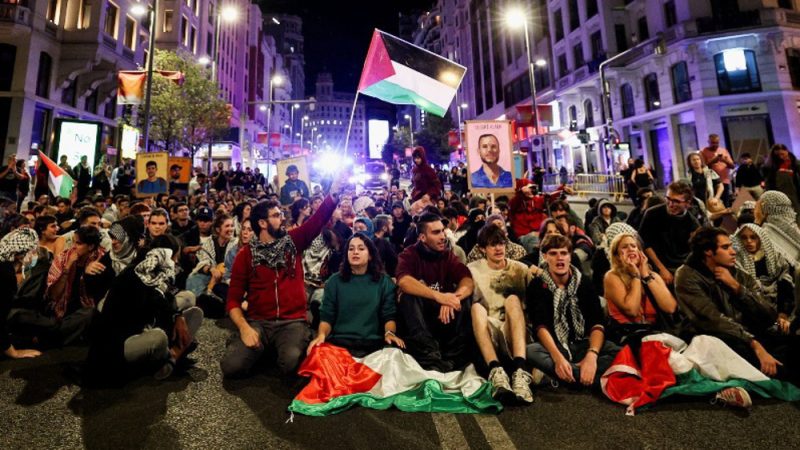
Protests erupted across cities worldwide on the night of 1 October after Israel intercepted the Gaza-bound Global Sumud Flotilla, with thousands taking to the streets to denounce the raid, demand the release of detained activists, and call for an end to the siege on the enclave.
Demonstrations broke out in Greece, Spain, Sweden, and Belgium, as large rallies took place in Italy, where the country’s largest trade unions announced a general strike for 3 October.
Among the largest gatherings overnight, tens of thousands marched through Rome in support of the Sumud Freedom Flotilla.
Hundreds more blocked traffic at Piazza dei Cinquecento, while in Milan, large crowds shut down train stations, blocking rail traffic as part of nationwide demonstrations.
Organizers estimated around 1,000 people would march toward Piazza Barberini. Italy’s unions USB and CGIL confirmed a nationwide strike call, while dock workers carried out their pledge to blockade in response to the flotilla’s interception.
Hundreds also gathered outside the US consulate in Istanbul, chanting slogans, praying for Palestinians, and denouncing what they called genocide.
In Berlin, protesters gathered at Central Station, and in Brussels, marchers moved from Place de la Bourse to the Belgian Foreign Ministry.
In London, thousands marched to the prime minister’s residence, chanting against him. In Germany, demonstrators briefly shut down the main train station.
The Tunisian capital also saw a mass demonstration, while Mauritania’s Nouakchott hosted protests denouncing the flotilla raid.
A snap protest was held outside Sydney Town Hall in support of the Global Sumud Flotilla, with demonstrators voicing solidarity and chanting “From the river to the sea,” which echoed through the rally.
Latin American cities witnessed parallel mobilizations. Local media in Buenos Aires said hundreds demonstrated against what they called an “assault by the Israeli occupation forces” and demanded an end to the genocide in Gaza.
In Mexico City, Reuters captured images of marchers outside the Foreign Ministry, with demonstrators demanding the release of seven Mexican nationals detained in the flotilla raid.
Activists Arlin Medrano and Sol Gonzalez confirmed in a video that their ship had been intercepted in international waters, calling it an illegal act.
David Pena, the Mexican delegation’s legal representative, told protesters Israel planned to charge them with trespassing and deport them.
In Colombia, protesters gathered outside the headquarters of the National Business Association (ANDI) after the Global Movement to Gaza accused it of ties to Israel’s economic mission – an allegation the group denied in a statement.
Demonstrations also swept Bogota, Montevideo, and several Argentine cities, with protesters in Uruguay’s capital calling for the imprisonment of Israeli Prime Minister Benjamin Netanyahu.
Out of 44 vessels that departed with the Global Sumud Flotilla, only four are still marked as ‘sailing’ as of 12:15 pm Thursday, according to live tracking data on the flotilla’s website.
One vessel appeared to have reached Gaza’s waters before communications were lost.
Organizers said one of the boats intercepted was rammed by an Israeli naval vessel.
Israel’s Foreign Ministry labeled the mission on its official X account as the “Hamas Flotilla.”
Colombia expels Israeli diplomats after Gaza aid flotilla raid
MEMO | October 2, 2025
Colombian President Gustavo Petro has ordered the expulsion of all remaining Israeli diplomats from the country, after the interception of the Global Sumud Flotilla heading to Gaza.
He also called for suspending trade agreements with Israel after two Colombian citizens were arrested on board one of the ships. “Israel detained two Colombian women in international waters,” Petro said, demanding their immediate release.
Only four Israeli diplomats were still in Colombia after President Petro cut ties with Israel last year.
In a statement, Colombia’s Ministry of Foreign Affairs, on behalf of the government and the Colombian people, strongly condemned what it described as the kidnapping carried out by Israeli armed forces in international waters. The ministry said this act violated international law and the Geneva Conventions, and targeted the two Colombian nationals, Luna Barreto and Manuela Bedoya, both members of the Global Sumud Flotilla.
The ministry also called for the immediate release of its citizens, as well as all other members of the flotilla. It urged the governments of Spain, Bangladesh, Brazil, Slovenia, Indonesia, Ireland, Libya, Malaysia, the Maldives, Mexico, Oman, Pakistan, Qatar, Thailand, Turkey, and South Africa to take urgent and joint action to protect the lives and safety of their nationals.
According to the ministry, the international flotilla set sail in the Mediterranean with three objectives: to deliver humanitarian aid to Gaza, to raise awareness of the urgent humanitarian needs of the Palestinian people, and to highlight the need to end the war in Gaza.
The Israel Lobby Wants Thomas Massie Gone. Will Voters Obey?
By Jose Alberto Nino | The Occidental Observer | September 29, 2025
The knives are out for Rep. Thomas Massie (R-KY), and his political survival could prove whether Congress still answers to American voters or to a foreign lobby with limitless cash.
Pro-Israel Republican megadonors recently set up the MAGA Kentucky super PAC with $2 million specifically to oust Massie. Paul Singer contributed $1 million, John Paulson added $250,000, and Miriam Adelson’s Preserve America PAC provided $750,000. The Republican Jewish Coalition has promised “unlimited” campaign spending if Massie runs for Senate, with CEO Matt Brooks declaring that “if Tom Massie chooses to enter the race for US Senate in Kentucky, the RJC campaign budget to ensure he is defeated will be unlimited.”
President Donald Trump has also jumped into the fray, branding Massie a “pathetic loser” who should be dropped “like the plague.” Overall, a constellation of pro-Zionist forces is mobilizing at full force to unseat Congress’s most principled non-interventionist politician since Ron Paul retired in 2013. In many respects, Massie has taken up Paul’s mantle of foreign policy restraint — a political agenda that has never sat well with organized Jewry. Massie’s legislative track record on foreign policy speaks for itself.
Massie’s Long Track Record of Voting Against Foreign Policy Interventionism
Throughout his congressional career, Massie has established himself as Congress’s most consistent opponent of the neoconservative/neoliberal foreign policy consensus. His principled opposition to endless wars and foreign entanglements has earned him the nickname “Mr. No” — similar to his predecessor Ron Paul — for frequently casting lone dissenting votes against military interventions.
In 2013, Massie introduced the War Powers Protection Act to “block unauthorized U.S. military aid to Syrian rebels.” He argued that “since our national security interests in Syria are unclear, we risk giving money and military assistance to our enemies.” When Obama sought to arm Syrian rebels in 2014, Massie voted against the plan, declaring it “immoral to use the threat of a government shutdown to pressure Members to vote for involvement in war, much less a civil war on the other side of the globe.”
Massie consistently opposed U.S. involvement in Yemen’s civil war, co-sponsoring multiple bipartisan resolutions to invoke the War Powers Resolution and “remove United States Armed Forces from unauthorized hostilities in the Republic of Yemen.” He stated that “Congress never authorized military action in Yemen as our Constitution requires, yet we continue to fund and assist Saudi Arabia in this tragic conflict.”
His opposition to NATO expansion proved equally consistent. In 2017, Massie was one of only four House members to vote against a pro-NATO resolution, explaining that “the move to expand NATO in Eastern Europe is unwise and unaffordable,” and such expansion contradicted Trump’s campaign assertion that “NATO is obsolete.”
Regarding the Russo-Ukrainian war, Massie maintained his non-interventionist stance, receiving an “F” grade from Republicans for Ukraine. He opposed the Ukraine Democracy Defense Lend-Lease Act, multiple aid packages, and efforts to strip Ukraine funding. Massie argued that supporting Ukraine aid was “economically illiterate and morally deficient,” declaring that “the American taxpayers have been conscripted into making welfare payments to this foreign government.”
Most recently, in June 2025, Massie introduced a bipartisan War Powers Resolution with Rep. Ro Khanna to “prohibit United States Armed Forces from unauthorized involvement” in the Israel-Iran conflict. After Trump’s strikes on Iranian nuclear facilities, Massie criticized the action as “not Constitutional,” remaining the only Republican co-sponsor of the war powers resolution.
Massie’s Anti-Zionist Streak
Massie’s most politically dangerous positions involve his consistent opposition to pro-Israel legislation, earning him the distinction of being the lone Republican opposing numerous Israel-related measures.
In July 2019, Massie cast the sole Republican vote against a resolution opposing the Boycott, Divestment, and Sanctions movement. The resolution passed 398-17, but Massie defended his position by stating he does not support “federal efforts to condemn any type of private boycott, regardless of whether or not a boycott is based upon bad motives” and that “these are matters that Congress should properly leave to the States and to the people to decide.”
In September 2021, Massie was the only Republican to vote against $1 billion in funding for Israel’s Iron Dome defense system. He explained that “my position of ‘no foreign aid’ might sound extreme to some, but I think it’s extreme to bankrupt our country and put future generations of Americans in hock to our debtors.” This vote prompted AIPAC to run Facebook ads stating “When Israel faced rocket attacks, Thomas Massie voted against Iron Dome.”
Perhaps most controversially, on May 18, 2022, Massie cast the lone vote against a resolution condemning antisemitism, which passed 420-1. The American Jewish Committee criticized him, stating that “while Democrats and Republicans united, Rep. Massie, who has also opposed bills on Holocaust education and Iron Dome funding, decided that combating rising hatred is not important.” Massie defended his vote by tweeting that “legitimate government exists, in part, to punish those who commit unprovoked violence against others, but government can’t legislate thought.”
In October 2023, Massie opposed a $14 billion aid package for Israel, proclaiming that “if Congress sends $14.5 billion to Israel, on average we’ll be taking about $100 from every working person in the United States. This will be extracted through inflation and taxes. I’m against it.” When AIPAC criticized him, Massie responded that “AIPAC always gets mad when I put America first. I won’t be voting for their $14+ billion shakedown of American taxpayers either.”
On October 25, 2023, Massie was the sole Republican to vote against a resolution affirming Israel’s right to defend itself following the October 7 Hamas attacks. A month later, on November 28, 2023, he became the only member of Congress to oppose a resolution affirming Israel’s right to exist and equating anti-Zionism with antisemitism, which passed 412-1.
The most explosive moment came in December 2023 when Massie posted a meme of the rapper Drake contrasting “American patriotism” with “Zionism,” implying Congress prioritized the latter. Senate Majority Leader Chuck Schumer called the post “antisemitic, disgusting, dangerous” and demanded he remove it. The White House labeled it “virulent antisemitism.” Republican Jewish Coalition CEO Matt Brooks condemned it, stating “Shame on you @RepThomasMassie. You’re a disgrace to the US Congress and to the Republican Party.”
Massie vs. Trump
Trump’s escalating attacks on Massie reveal the extent to which the sitting president serves pro-Israel interests rather than pursuing genuine ideological differences. The timing and intensity of Trump’s criticism align suspiciously with Massie’s most vocal challenges to Israeli influence in Congress.
In June 2025, after Massie criticized Trump’s Iran strikes as “not Constitutional,” Trump unleashed a scathing Truth Social response calling Massie “not MAGA” and declaring that “MAGA doesn’t want him, doesn’t know him, and doesn’t respect him.” Trump branded Massie a “simple-minded ‘grandstander’ who thinks it’s good politics for Iran to have the highest level Nuclear weapon” and concluded that “MAGA should drop this pathetic LOSER, Tom Massie, like the plague!”
This vitriol represents a dramatic shift from Trump’s 2022 endorsement, when he called Massie a “Conservative Warrior” and “first-rate Defender of the Constitution.” The transformation occurred precisely as Massie intensified his criticism of Israeli influence and foreign aid. Trump’s attacks escalated further after Massie’s explosive June 2024 Tucker Carlson interview where he revealed that “everybody but me has an AIPAC person. … It’s like your babysitter, your AIPAC babysitter who is always talking to you for AIPAC.”
Massie elaborated that “I have Republicans who come to me and say that’s wrong what AIPAC is doing to you, let me talk to my AIPAC person… I’ve had four members of Congress say I’ll talk to my AIPAC person and like it’s casually what we call them my AIPAC guy.” This revelation exposed the systematic nature of Israeli influence over Congress, prompting immediate backlash from pro-Israel organizations and likely contributing to increased donor funding against his re-election campaign.
The pattern makes clear that Trump’s hostility toward Massie stems less from policy disagreements than from his deference to powerful Jewish donors. Although he often claims to oppose “endless wars,” Trump’s attacks on Massie — the most consistent non-interventionist in Congress — expose where his true loyalties lie in advancing the agenda of Jewish supremacist interests rather than pursuing an independent foreign policy. House Speaker Mike Johnson has signaled that GOP leadership will abandon Massie, stating that “he is actively working against his team almost daily now and seems to enjoy that role. So he is, you know, deciding his own fate.”
AIPAC is on the Hunt
AIPAC’s 2024 electoral victories demonstrate the lobby’s willingness to spend unprecedented sums to eliminate critics of Israeli policy. The organization’s success in defeating progressive Democrats and protecting establishment Republicans reveals a coordinated strategy to purge Congress of independent voices. AIPAC will look to replicate its successes against the likes of Israel critics such as Massie.
Against Rep. Jamaal Bowman in New York’s 16th District, AIPAC’s United Democracy Project (UDP) spent $14.5 million opposing Bowman while also propping up challenger George Latimer. Independent media outlet Sludge reported that “the $14.5 million AIPAC’s super PAC has spent in the NY-16 Democratic primary is more than any outside group has ever spent on a single House of Representatives election race.”
The spending was fueled by Republican megadonors channeled through AIPAC, with WhatsApp founder Jan Koum donating $5 million to UDP. Responsible Statecraft noted that “AIPAC effectively acted to launder campaign funds for Republican megadonors into the Democratic primary, where the spending was generally identified in media as ‘pro-Israel,’ not ‘Republican.’” By election day, Latimer-aligned groups had outspent Bowman’s backers by over seven-to-one.
Against Rep. Cori Bush in Missouri’s 1st District, UDP spent over $8.5 million to attack her record on Israel and support her pro-Zionist challenger Wesley Bell. The Bush-Bell primary became one of the most expensive House primaries ever with over $18 million in total ad spending. Bush called it “the second most expensive congressional race in our nation’s history, $19 million and counting” funded by “mostly far-right-funded super PACs, against the interests of the people of St. Louis.”
Even in Republican primaries, AIPAC intervened to protect establishment allies. To defend moderate Rep. Tony Gonzales against challenger Brandon Herrera in Texas’s 23rd District, UDP spent $1 million opposing Herrera in a “two-week ad buy.” The Republican Jewish Coalition added $400,000 in attack ads against Herrera. Combined AIPAC and RJC spending totaled approximately $1.4-1.5 million, helping Gonzales narrowly defeat Herrera by just 354 votes with 50.6% to 49.4%.
These victories came as part of AIPAC’s broader $100+ million spending cycle, with Common Dreams noting that “AIPAC money has already made a significant impact, helping a pair of pro-Israel Democrats defeat progressive Reps. Jamaal Bowman (D-N.Y.) and Cori Bush (D-Mo.)—two of Congress’ most vocal critics of Israel’s assault on Gaza—in recent primary contests.”
How Massie’s Race Could Determine the Israel Lobby’s Actual Power
Massie’s 2026 primary represents the ultimate test of whether any politician can survive the full force of pro-Israel opposition. The Kentucky race will determine if AIPAC’s previous victories represent sustainable power or pyrrhic victories that expose the lobby’s long-term vulnerabilities.
Massie’s unique position may prove more defensible than Bowman’s or Bush’s urban districts. His rural Kentucky constituency shows less susceptibility to urban media campaigns and maintains stronger skepticism of foreign entanglements. Moreover, his local roots provide credibility that transcends typical political attacks. The Kentucky representative’s ability to frame opposition as foreign interference rather than domestic policy disagreements could resonate with voters increasingly suspicious of the pro-Israel establishment that dominates Washington’s political scene.
The financial strain of AIPAC’s previous victories may also constrain future spending. The organization’s $100+ million commitment across multiple races represents an unsustainable pace that could face donor fatigue. Each expensive victory exposes the lobby’s methods to greater scrutiny and potential backlash. Progressive groups increasingly highlight AIPAC’s role in primary defeats, potentially mobilizing opposition that limits future effectiveness.
Massie’s survival would demonstrate that principled politicians can withstand pro-Israel pressure through constituent loyalty and grassroots support. His defeat would confirm that no elected official can challenge Israeli interests regardless of their domestic support. The Kentucky race thus represents a pivotal moment in determining whether American foreign policy serves American interests or remains subordinate to foreign influence.
If Massie withstands the assault, it will mark the first crack in the façade of Zionist invulnerability; if he falls, it will prove that American politicians can be bought and buried by World Jewry’s limitless stockpiles of cash.
Israeli officers commandeered Pentagon meetings during June’s Israel-Iran war: Tucker Carlson
Press TV – October 2, 2025
Israeli officers stormed meetings at the Pentagon during June’s Israel-Iran war, issuing orders unchecked while Trump administration officials stood by doing nothing, says a former Fox News host, raising fresh questions about foreign influence on US military decisions.
Prominent American commentator Tucker Carlson said that Israeli military officers stormed into closed-door meetings at the Pentagon during Israel’s 12-day aggression against Iran in June, stressing that they issued direct orders to US officials, a controversial move that raises serious concerns over foreign interference in the decision-making process at the US Department of War.
During a video titled “Speeding Toward World War Three” published on his X account on Thursday, Carlson further said that officials in the Trump administration failed to respond to or prevent these intrusions, allowing the Israeli officers to continue their actions unchecked.
The ex-Fox News host also touched on the ongoing tensions over US-Israel relations and questioned the extent of influence wielded by foreign powers within American military institutions.
“During the 12-day war with Iran, the US and Israel versus Iran, bombing on all sides, during that short conflict, a bunch of Israeli officers in the Pentagon during that week enraged American Pentagon staff by barging into the meetings, giving orders and making demands and nobody did anything about it. How can a foreign military officer barge into military headquarters? The more you allow that kind of deeply unhealthy behavior the more you are going to get,” Carlson said.
He stressed that because of the weakness of “our leaders”, Israel takes advantage of the US.
On June 13, Israel launched a blatant and unprovoked act of aggression against Iran, triggering a 12-day war that killed at least 1,064 people in the country, including military commanders, nuclear scientists, and ordinary civilians.
The United States also entered the war by bombing three Iranian nuclear sites in a grave violation of international law.
In response, the Iranian Armed Forces targeted strategic sites across the occupied territories as well as the Al-Udeid air base in Qatar, the largest American military base in West Asia.
A recent New York Times–Siena survey shows that a majority of Americans are turning against Israel’s war on Gaza, with 51 percent opposing further economic and military aid.
About 35 percent strongly reject such support, compared to 19 percent in favor, and roughly 40 percent believe Israel is deliberately targeting civilians amid the genocidal war in the besieged Palestinian territory.
Max Blumenthal: Charlie Kirk BOMBSHELL Revelation | Middle East Faces Total COLLAPSE
Dialogue Works | October 1, 2025
US deploys abortion law against Israel critics who picketed synagogue
RT | October 1, 2025
The US Justice Department has filed a civil lawsuit against several anti-Israeli protesters, using a law historically applied to protect women entering abortion clinics from pro-life demonstrators.
The complaint, filed on Monday by the DOJ’s Civil Rights Division, could mark the first of more cases to come, Assistant Attorney General Harmeet Dhillon said at a press conference. She argued that the 1994 Freedom of Access to Clinic Entrances Act (FACE) was previously “weaponized” against pro-life activists, while those disrupting religious practices were not targeted.
The case stems from a November 2024 incident in West Orange, New Jersey. Congregation Ohr Torah synagogue was hosting a real estate fair promoting the sale of homes in Jewish settlements in the occupied West Bank. The DOJ maintains that it was “a religious event centered on the Jewish obligation to live in the Land of Israel.”
Around 50 pro-Palestinian demonstrators staged a protest outside, which Dhillon characterized as a “mob.” An altercation broke out involving organizer Moshe Glick and his associate, David Silberberg. The complaint claims that one protester blasted a vuvuzela horn inches from Glick’s ear, an action prosecutors say amounted to a “physical attack” due to potential hearing damage.
Local media reported in February that Glick and Silberberg were charged in connection with the brawl after Glick allegedly pepper-sprayed a protester and struck his head with a metal flashlight. The DOJ complaint, however, described these actions as self-defense. One of the named defendants is accused of choking Silberberg and tackling him to the ground.
The fair was one of several US events promoting settlement property sales that drew pro-Palestinian protests as Israel pressed its military operation in Gaza. Jewish settlements in occupied territories are considered illegal under international law and remain a flashpoint in the broader Middle East conflict.
Enforcement of the FACE Act was reportedly scaled back early in US President Donald Trump’s term in office. In June, the House Judiciary Committee considered a bill introduced this year by Representative Chip Roy to repeal the measure entirely.
Australia secretly ships F-35 jet parts to Israel amid Gaza genocide, leaks reveal
Press TV – October 1, 2025
Leaked documents reveal that Australia has exported multiple F-35 fighter jet components directly to Israel, bypassing global supply hubs, even as Israel’s military continues its genocidal campaign in Gaza.
Declassified Australia published a report on Wednesday saying detailed shipping records reveal a total of 68 shipments of F-35 Joint Strike Fighter components flown from Australia to Israel on commercial passenger planes between October 2023 and September 2025.
The most recent shipment departed Sydney two weeks ago, carried in the cargo hold of a scheduled passenger flight bound for Tel Aviv, the report said.
According to the documents, direct shipments from Australia spiked immediately after Israel unleashed its genocidal campaign on Gaza on October 7, 2023, with 10 separate shipments sent in November 2023 alone.
Of the 68 documented shipments, 51 were destined for Nevatim Airbase in Israel’s Negev desert, home to the Israeli military’s three F-35 squadrons, the report stated.
The actual number of shipments may be even higher, with at least another 24 parts matching previous export approvals being sent during the same period.
The latest shipment, sent in mid-September 2025, contained an “Inlet Lube Plate” for the F-35 Joint Strike Fighter.
Shipping records show the export was classified as “Military Goods – Aircraft parts,” highlighting the direct military support Australia is providing for the Israeli regime.
The shipment left Sydney for Tel Aviv just 24 hours after a United Nations investigation had concluded that “Israel’s actions in Gaza constitute genocide.”
Despite mounting evidence of direct F-35 parts shipments being supplied from Australian bases to Israel, the government has repeatedly claimed that it “has not supplied weapons or ammunition to Israel since the conflict began and for at least the past five years.”
The revelation comes less than two weeks after Australia, along with Britain and Canada, formally recognized Palestinian statehood.
International human rights groups have constantly warned that sending weapons or military components to Israel makes states complicit in the regime’s genocide in Gaza.
Activists report aggressive Israeli cyber, physical harassment as flotilla nears Gaza
Press TV – October 1, 2025
Activists aboard the Global Sumud Flotilla say they are facing aggressive harassment by Israeli warships as they approach Gaza to break the illegal naval blockade and deliver much-needed humanitarian aid.
The lead vessel, Alma, was deliberately encircled and subjected to communication blackouts early Wednesday, forcing its captain to take evasive maneuvers while Israeli forces continued their intimidation tactics against other ships in the flotilla.
“This was one of the biggest acts of harassment we have faced so far. They tried to scare us, but we weren’t afraid, and we told them we would not be afraid,” Metehan Sari, a Turkish activist aboard the Alma, was quoted as saying by Anadolu news agency.
Sari said that the Israeli navy ships came within 5 to 10 meters of the Alma.
Zeynel Abidin Ozkan, another activist aboard Adagio, said drones were flying “intensively” over their fleet overnight and that at around 5am, two ships which weren’t a part of the flotilla approached them and “launched a cyberattack on the GPS and internet database of the Alma, one of our fleet’s main vessels, cutting off our communication with the ship”.
Another flotilla vessel, the Sirius, also experienced interference. Lisi Proenca, aboard Sirius, said an Israeli naval ship circled her vessel for about 15 minutes, jamming communications and causing tension and fear among the crew. Members of the crew later demonstrated they were unarmed.
Despite these hostile actions, the flotilla comprised of over 40 boats and 500 activists, including prominent international figures such as Italian politicians and climate activist Greta Thunberg, remains undeterred in its mission to challenge the Zionist regime’s suffocating siege on Gaza.
The official page for the Global Sumud Flotilla said the fleet is now 118 nautical miles from Gaza, which it notes is 8 nautical miles from where Madleen, a flotilla which was launched in June this year, was intercepted.
Maritime traffic data is also showing that several vessels from the flotilla are approaching Egyptian territorial waters.
In a Telegram post it said: “We remain committed to non-violence and to creating a People’s Humanitarian Corridor – a lifeline for Gaza. The international community has entrusted us with this mission, and we will not fail.”
The harassment reflects Israel’s ongoing efforts to prevent any aid from reaching the Palestinian people, who have endured months of devastating blockade and violence.
Communications systems on multiple vessels were jammed, and cameras disabled during the Israeli naval maneuvers, cutting off crucial documentation and real-time updates from the flotilla.
The activists have already passed the 120-nautical mile mark, defying repeated Israeli warnings.
International condemnation of Israel’s blockade and military harassment continues to grow, with countries like Italy and Spain criticizing the recent attacks on the flotilla, which included drone strikes and explosions.
Israel’s baseless claims labeling the flotilla as a Hamas operation serve only to justify its ongoing repression.
Explainer: How is Trump’s 20-point Gaza ‘plan’ dangerously tilted in Israel’s favor
By Hamid Javadi | Press TV | October 1, 2025
US President Donald Trump on Monday unveiled a 20-point proposal for post-war Gaza that is dangerously skewed in favor of the Israeli regime and ignores Palestinian realities.
At its core, the plan demands Hamas disarm within 72 hours of a ceasefire, release all captives, and accept a phased Israeli troop withdrawal.
But here’s the catch: there’s no binding commitment to end the military occupation, no clear roadmap for Palestinian sovereignty or right to self-determination of Palestinians and no guarantee that Israel won’t resume its genocidal aggression once its captives are returned.
The much-hyped “plan” that has been welcomed by a group of Muslim countries demands Palestinian surrender without offering sovereignty, envisions the so-called economic development built on displacement, and leaves the door open for continued Israeli occupation.
Trump, who has long eyed Gaza as waterfront property on the Mediterranean, touted the proposal as “a peace plan,” but beneath its diplomatic gloss lies a blueprint that has been designed keeping in view long-term Israeli and American interests.
Under the deal, Israel would release over 1,900 Palestinian prisoners, including 250 serving life sentences, in exchange for all 48 Israeli captives held by Hamas — both living and deceased — within 72 hours of a ceasefire taking effect.
How does Hamas or Palestinians appear in Trump’s plan?
The proposal, which has grabbed headlines in world media in the past two days, calls for the Hamas resistance movement to relinquish all governing roles in Gaza and lay down its weapons, a condition the group has previously ruled out unless a sovereign Palestinian state is established and the aspirations of Palestinians are taken into account.
Israeli Prime Minister Benjamin Netanyahu said he agreed to the plan at a press conference with Trump at the White House on Monday, even as Israeli regime forces continued to rain down bombs on Palestinians across Gaza.
However, speaking to Israeli media later, Netanyahu ruled out the military withdrawal, saying that it “is not going to happen.” It came even before Hamas’ official reaction to the plan.
Hamas’s negotiating team said it was studying the plan. However, a Hamas official told Reuters that Trump’s proposal was “completely biased to Israel” and imposed “impossible conditions” that aimed to eliminate the resistance group, a longtime objective of Netanyahu.
“What Trump has proposed is the full adoption of all Israeli conditions, which do not grant the Palestinian people or the residents of the Gaza Strip any legitimate rights,” the Palestinian official said on condition of anonymity.
While Hamas has frequently said it would welcome any initiative that ends the genocidal war on Gaza — which has killed more than 66,000 since October 2023, mostly women and children — it has every reason to be skeptical.
Last time Hamas leaders were reviewing Trump’s proposal for a ceasefire, Israeli warplanes bombed their headquarters in Qatar, a key mediator in negotiations between the Palestinian resistance movement and the Tel Aviv regime.
So, while Netanyahu has endorsed Trump’s new proposal, he has rejected the only two terms in the plan that could give Hamas a reason to accept the deal: the withdrawal of Israeli occupation forces (though conditional and gradual) and the eventual establishment of a Palestinian state.
What does the plan say about Israeli occupation?
A day after he gave his backing to Trump’s plan, Netanyahu said Israeli forces would remain in most of Gaza.
“We will recover all our hostages, alive and well, while the (Israeli military) will remain in most of the Gaza Strip,” he said in a video statement on Tuesday.
This isn’t the only point of friction. Netanyahu also said he would never allow the creation of a Palestinian state, yet the White House document includes language about a “credible pathway to Palestinian self-determination and statehood” if the deal is fully implemented.
“It’s not written in the agreement,” Netanyahu claimed, saying that Israel would “strongly oppose” such a move. He insisted that Trump shared this view.
This is a nonstarter for Palestinians. As Ziyad al-Nakhalah, leader of the Palestinian Islamic Jihad, put it, “Israel is trying to impose through the United States what it was unable to achieve through war.”
What does Netanyahu want in Gaza?
Netanyahu appears to be trying to have it both ways: Publicly embracing the deal to pressure Hamas, while privately rejecting its most fundamental terms.
It’s a familiar tactic. The Israeli prime minister, who is wanted by the International Criminal Court (ICC) for war crimes and crimes against humanity in Gaza, has a track record of endorsing negotiations and ceasefire proposals, and at the same time making contradictory statements to kill the momentum.
Captive families, humanitarian groups, and even some Israeli regime officials have accused Netanyahu of prolonging the war for political gains. Hamas says the Israeli prime minister has used negotiations as a smokescreen for continued genocide in Gaza.
In February, Israel kept stalling the second phase of a ceasefire agreement that had already begun by violating terms related to troop withdrawal and humanitarian aid delivery.
Trump’s latest proposal does not address the root causes of the protracted issue — namely, the occupation and the apartheid oppression of the Palestinian people.
How does Trump’s plan address displacement?
The plan is largely driven by Trump’s desire to build a Dubai-style wonderland on the wasteland of Gaza. Though the plan claims “no one will be forced to leave Gaza,” Trump’s vision for Gaza — as publicly announced in the past — is premised on the forced displacement of the native populace.
The more Palestinians are forcibly removed from their land, the cheaper the project becomes to implement.
A reconstruction and economic blueprint for Gaza, published by The Washington Post, estimates that $23,000 will be saved for every Palestinian who leaves.
Trump had previously floated the idea that he would send the US military into Gaza to clear the territory of its residents by force if necessary. Those remarks sparked a fierce global backlash.
The White House text says, “a Trump economic development plan to rebuild and energize Gaza will be created by convening a panel of experts who have helped birth some of the thriving modern miracle cities in the Middle East.”
“A special economic zone will be established, with preferred tariff and access rates to be negotiated with participating countries,” it specifies.
What is the role of Tony Blair in Trump’s plan?
That’s where former British Prime Minister Tony Blair also enters the frame. As part of Trump’s plan, Gaza will be governed by “a temporary technocratic committee,” made up of Palestinians and international experts, supervised by a new transitional body called the “Board of Peace.”
That board will be headed and chaired by Trump himself, with other members and heads of state, including Blair.
Blair is back in business once again, nearly two decades after he presented a 34-page document that outlined a “corridor for peace and prosperity,” which envisioned an agro-industrial park in the occupied West Bank.
Blair promised at the time that more such packages would be unveiled over time. He was forced to resign from office later largely as a result of the Iraq War. He has reportedly been advising the White House about Trump’s latest plan for Gaza.
Blair has reportedly been in contact with Trump’s son-in-law, Jared Kushner, to work out the details. His role in Trump’s plans for Gaza has been criticized by Palestinians and advocates for Palestinian rights across the world.
Earlier this year, the Tony Blair Institute supported a “Trump Riviera” and an “Elon Musk Smart Manufacturing Zone” as part of a post-war plan for Gaza.
The plan included paying half a million Palestinians to leave their homelands to create room for private investors to develop Gaza into a money-making tourist hub.
What did Trump tell Hamas?
Trump issued an ultimatum of “three to four days” to Hamas on Tuesday to respond to his proposal. The US president threatened that he would let Israel “go and do what they have to do” in Gaza if Hamas rejects the deal.
“They could do it pretty easily,” he claimed.
Hamas is still reviewing the proposal. But with Netanyahu signaling that Israel won’t accept the deal’s core conditions, the path to peace remains as murky as ever.
Trump’s Gaza Plan: A Peace Proposal or a Political Cover for Occupation?
By Abbas Hashemite – New Eastern Outlook – October 1, 2025
President Trump has recently proposed a new peace plan for Gaza. However, the biased stipulations, although accepted by major Muslim powers, show that this proposal is anything but a peace plan.
The Reality of Israeli Occupation and Genocide
Israeli Defense Forces (IDF) have been committing war crimes and genocide in the Gaza Strip since October 7, 2023. However, the occupation of the Palestinian territory by the Zionist state has been underway for decades. For years, some regional resistance forces, such as Hamas, have been fighting the occupation of the IDF. Since October 7, this resistance has increased manifold. The IDF has also unleashed unimaginable horrors in the Gaza Strip in the last two years. The Western nations, including the United States, had been supporting the Israeli government in its genocidal operations in Gaza. However, due to the growing public pressure, many Western nations have altered their approach towards the Israel-Hamas war. Most of the Israeli supporters have conditionally recognized the state of Palestine.
Trump’s Peace Proposal: A One-Sided Agreement
In a recent move, US President Donald Trump has also announced a new peace proposal for Gaza. This new proposal has been accepted by most of the Muslim and Arab nations. However, the citizens of these countries are against this agreement and equate this to accepting Israel’s occupation of Gaza and blaming Hamas for the years of Israeli aggression in the strip. President Trump’s proposal states, “Gaza will be a deradicalised terror-free zone that does not pose a threat to its neighbors”—implying that the Palestinian resistance groups are terrorist organizations and pose a threat to Israel. However, reality is quite contrary. The history of Israeli war crimes and its occupation of Palestinian territories predates the October 7 attack by Hamas. For decades, the Israeli government has been illegally occupying the Palestinian lands and illegally detaining the native Palestinians to occupy the Palestinian territory and achieve its “Greater Israel” ambition.
Historical events, facts, and figures of international human rights organizations suggest that the only terrorist organization in the region is the IDF. In the past two years, the Zionist state has attacked several regional countries and has also conducted assassinations of Iranian military officials in Syria and Tehran, along with Ismail Haniyeh, a prominent Hamas leader. Moreover, the Zionist state also disrupted all the previous ceasefire negotiations. Earlier this month, Israel conducted airstrikes on the Hamas negotiation team in Doha to disrupt the peace process, reflecting Israel’s ambition to perpetuate the war.
Moreover, this peace proposal favors Israel by asking Hamas to surrender unconditionally. It asks Hamas to give up all the Israeli hostages and its weapons, rendering it defenseless against the Zionist state. The lack of trust between the two sides makes this proposal ineffective, as the Hamas leadership has not been invited to negotiate the terms of the peace plan, making it a one-sided plan. This also suggests that the IDF has failed against the Hamas fighters. Therefore, it seeks for them to surrender unconditionally. However, in reality, the IDF, which shoots kids in the head and snipes doctors and medical workers, is the entity that should be demilitarized and de-radicalized.
Peace Without Justice Is No Peace
Another stipulation of the plan states, “Once all hostages are returned, Hamas members who commit to peaceful co-existence and to decommissioning their weapons will be given amnesty. Members of Hamas who wish to leave Gaza will be provided safe passage to receiving countries.” This also indirectly accuses Hamas of igniting and prolonging the war in Gaza, ignoring the indiscriminate bombing of the IDF on Palestinian civilians, resulting in the deaths of thousands of children and women. Moreover, this statement portrays Hamas as an obstacle in the path of peaceful coexistence in the region. However, scores of evidence suggest that it is the Zionist government and ideology that make peaceful coexistence impossible.
President Trump’s proposed plan names Tony Blair, the former Prime Minister of the UK, known for his war crimes in Iraq during the US-led invasion and occupation of the country, as a member of the “Board of Peace”—a body that will “set the framework and handle the funding for the redevelopment of Gaza.” This further reveals the seriousness of the Trump administration to establish peace in the Middle East. In addition, it once again exposes the reality that the West stands with the aggressors and war criminals. Trump’s peace plan is also nothing more than a favor to Israeli occupation and an end to the idea of the creation of a Palestinian state.
Trump’s proposal and its acceptance by a large number of Arab and Muslim nations is a success for the Zionist state. Israeli Prime Minister Netanyahu states, “Instead of Hamas leading to our isolation, we turned the tables and isolated Hamas. Now the entire world, including the Arab and Muslim world, is pressuring Hamas to accept the conditions we set together with President Trump: to release all our abducted—both living and dead—while the IDF remains in most of the territory.” Indeed, the acceptance of this peace proposal by the Muslim states is a betrayal to the Palestinian cause. The proposal holds that if Hamas rejects this plan, Israel will be free to do whatever it wants in Gaza, implying that the Zionist state will be allowed to annex and occupy Gaza.
Overall, President Trump’s proposed peace plan has many loopholes and is entirely at odds with the ground realities. Any peace plan that does not involve actual stakeholders is bound to fail. Hamas is unlikely to accept the proposal, as it favors Israel and rejects all the UN resolutions by defying the right of self-determination of the Palestinian people. For a real and practical peace proposal, all the stakeholders, including Hamas, must be consulted. Moreover, the peace plan must not favor any side and should be in accordance with international law and UN resolutions. Otherwise, this enforcement will lead to more chaos and violence in the region.
Аbbas Hashemite is a political observer and research analyst for regional and global geopolitical issues. He is currently working as an independent researcher and journalist.
Israel wins TikTok
By Kelley Beaucar Vlahos | Responsible Statecraft | September 27, 2025
A year ago, powerful critics in Congress and the tech world were complaining that TikTok was promoting anti-Israel messaging and were suggesting it needed to be shut down.
Turns out it didn’t need to be eliminated. TikTok is a message force multiplier after all, and only requires, apparently, the right people to own it. Like Oracle co-founder Larry Ellison, the second richest man in the world and the single biggest private donor of the Israeli Defense Forces, who has referred to the state of Israel as his own. He has direct stakes in a head spinning galaxy of news, television and Hollywood media companies, mainly through the recent Paramount Skydance Corporation takeover, a mega conglomerate now run by his son David Ellison (who is reportedly on the cusp of making vigilantly pro-Israel journalist Bari Weiss a top exec at newly-acquired CBS). Ellison the elder also is a major stakeholder in X and Tesla.
Add Rupert Murdoch, head of media conglomerate NewsCorp (Fox News), a perennial critic of “anti-Israel bias” in the media who in 2024 said Israel is “alone on the front line of Western democratic civilization.” Also Ellison’s right-hand at Oracle, Israeli-American Safra Catz, great friend of President Trump, who has traveled to Israel several times since Oct. 7, 2023 in support of its war and continued Oracle partnerships there, and in a July appearance in Israel told an an audience that “we (Oracle) are on the side of freedom. We are on the side of democracy.” She followed that with “some of the best people in the world are here in Israel, and there’s no question about that. And everyone knows it. Some of the big winners will be here. Mark my words.”
Throw into this mix billionaire Jeff Yass, a top GOP donor and current TikTok investor whose philanthropy is connected to a carousel of pro-Israel outfits that have funding ties to the IDF and AIPAC, plus explicitly anti-Muslim campaigns that among their issues, advocate for U.S. confrontation with Iran.
All of these individuals and more are reportedly part of a mega deal to buy TikTok for $14 billion. The details are here. Trump says the full roster of private U.S. investors (China’s Bytedance can only own a 20% stake) will be announced in a “matter of days.” But Forbes says Ellison’s “Oracle, private equity firm Silver Lake and MGX, an AI-focused investment firm established by the government of Abu Dhabi” will have a whopping 40% stake in the new TikTok. Oracle is reportedly to get 15% and be named the app’s “security provider.”
The $14 billion deal is being called a “fire sale” by some observers who point out that Elon Musk paid triple that for Twitter in 2022. This highly suggests that this transaction is more about geopolitics and ideology rather than a financial gain for investors. Aside from its more than 1.5 billion regular users world-wide, TikTok has now become where 30% of Americans get their news. Now, not only will American companies like Oracle, which has numerous government tech contracts spanning defense, intelligence, and civilian agencies, have access to TikTok’s user data, it will also have control of the algorithms that manage the kind of news, the messaging and images, that all of those users see.
“This was not a fair-market transaction,” said Milton Mueller, a professor at Georgia Tech specializing in digital governance, in Newsweek. “It’s a politically determined restructuring.” Some might say, with the constellation of GOP and MAGA supporters in the reported investor mix, this has the makings of a new Trump-friendly megaphone. But it is so much more. In essence, like Safra Catz says, the big “winners” will be in Israel.
Featured Video

More Iran War fallout: Maritime insurance industry shifts from London to China
or go to
Aletho News Archives – Video-Images
From the Archives
The Biggest Threat to Peace in Middle East
By Dr. Elias Akleh* | Sabbah Report | May 24, 2010
A build up of heightened tension in the Middle East is escalating in the last few weeks. American and Israeli postures towards Lebanon, Syria, and Iran have become more threatening. Listening to speeches of political leaders one hears talks only about war not peace. Iranians and Israelis are continuously training hard for a possible showdown. Both sides are conducting extensive war games every month. This led Syrians to claim that Israel is preparing for a soon-to-come another war. The Jordanians also are warning that current stalemate of the peace process is an indication of a war breaking out this summer. The Russian President and his army chief hinted, a few months ago, that the US and Israel were planning for an attack on Iran.
Indeed Iran is, as it has been for last few years, the target of most of the threats and accusations of supporting terrorism. Escalating incitement against Iran the American Defense Department sent last month (April) to Congress a report on Iran’s military claiming Iran could develop intercontinental ballistic missiles capable of reaching the US by 2015.
Ignoring the fact that N. Korea, India, Pakistan, and Israel are proven to have nuclear weapons while Iran does not, the US Secretary of State Hillary Clinton chose in her speech, to the nuclear Non-Proliferation Treaty review conference at the UN, to focus on Iran’s alleged nuclear ambitions putting the whole world at risk as she put it. According to Clinton Iran’s acquisition of nuclear weapons, rather than Israel’s more than 200 nuclear bombs, is destabilizing the Middle East. She called on the world’s nations to rally around US efforts to hold Iran, not other nuclear countries, to account.
The accusation that Usama Bin Laden is living comfortably in Iran had received a boost after the broadcast of a documentary called “Feathered Cocaine”. This echoed the June 2003 claims of the Italian newspaper Corre de la Sierra that Bin Laden was in Iran according to some intelligence report, and according to Richard Miniter’s book “Shadow War”. … continue
Blog Roll
 Aletho News
- Why could Gaza enter the regional war?
- Hamas official rejects Mladenov Plan linking disarmament to Gaza reconstruction
- Two Primary Elections for the Soul of ‘America First’
- Japan Clings to US Vassalage Despite Energy Crunch Caused By Iran War
- US Seeks Control Over Global Energy Infrastructure – Kremlin
- US senators target Orban government for standing up to Zelensky
- The deep-rooted culture of corruption in Ukraine
- Iran mobilizing one million soldiers to ‘create hell’ for any US ground assault: Report
- The coming military and psychological unravelling?
- Iran has the last laugh
- If Americans Knew
- Don’t Be Fooled. Zionist Leaders Have Always Wanted to Control Southern Lebanon
- Israel’s widespread use of torture is a core element of its genocide against the Palestinian people
- In Israel’s War on Iran, Many Middle East US Bases Rendered “All But Uninhabitable”
- ‘Burn the lawn’: Israel pursues ‘Rafah model’ in southern Lebanon
- A genocide here, an amputation there
- Reports: Iran mobilizing 1M fighters, Israel-US run low on ammo, Israeli army faces shortage – Not a ceasefire Day 168
- ‘No Innocent Children’: Far-right Israeli Lawmaker Defends Killing of Palestinian Family
- Mossad’s promises helped Netanyahu convince Trump that Iran could be toppled
- US Arms Control Official Refuses To Comment When Asked If Israel Has Nuclear Weapons
- Veterans warn US landing could be ‘more Gallipoli than Vietnam’
- No Tricks Zone
- Devastating Assessment Of Comirnaty Vaccine By Former Senior Pfizer Europe Toxicologist
- New Study: CO2 Is ‘Effectively Negligible’ As An Explanatory Climate Change Factor Since 2000
- Former Pfizer Toxicologist Dr. Helmut Sterz Tells Bundestag Hearing Pfizer Vaccine Should Have Never Been Approved
- Energy Expert: Germany’s Nuclear Phaseout Was A “500 Billion Euro Mistake”
- New Research: South Australia’s Mid-Holocene Sea Surface Temperatures Were 4°C Warmer Than Today
- Storing Green Energy To Last Germany 10 Days Would Require A 60-Million Tonne Battery
- New Studies: UK Sea Levels Were 4 Meters Higher Than Today During The Mid-Holocene
- Destructive Green New Deal: German Energy And Metal Group Warns Of Drastic Crisis
- New Study Documents A 20-Year Pause In Arctic Sea Ice Decline – Driven By Internal Variability
- Wake-up Call: Survey Shows Majority Of Germans Now Favor Postponing Climate Targets!
 Aletho News