John Mearsheimer: U.S. Expands Iran War & Divorces Europe
Glenn Diesen | April 22, 2026
Prof. John Mearsheimer argues that the failure to make peace with Iran can dramatically widen the war in the Middle East, while the rift with Europe and other allies widen. John J. Mearsheimer is the R. Wendell Harrison Distinguished Service Professor of Political Science at the University of Chicago, where he has taught since 1982.
Follow Prof. Glenn Diesen:
- Substack: https://glenndiesen.substack.com/
- X/Twitter: https://x.com/Glenn_Diesen
- Patreon: https://www.patreon.com/glenndiesen
Support the research by Prof. Glenn Diesen:
- PayPal: https://www.paypal.com/paypalme/glenndiesen
- Buy me a Coffee: buymeacoffee.com/gdieseng
- Go Fund Me: https://gofund.me/09ea012f
Palantir’s Technological Republic is a blueprint for digital tyranny
The surveillance company’s unapologetically dystopian vision for the future is just 1984 updated for the AI era
By Constantin von Hoffmeister | RT | April 22, 2026
Walking through the glass-and-steel corridors of the modern tech-security apparatus reveals that the telescreen is a tireless processor of our very souls.
Palantir Technologies’ vision of a “Technological Republic” arrives as a manual for the refinement of the boot, the one destined to remain on the human face, provided the boot remains equipped with the latest predictive sensors. In the spirit of a clear-eyed look at the clock striking thirteen, we must dissect the alliance between corporate algorithmic power and the Zionist state. This is a new Newspeak, where “defense” is a moral debt and “deterrence” is the silent humming of an algorithm deciding who shall disappear.
The foundation of this digital fortress is built upon the claim of a “moral debt” that the engineering elite owes to the State. In George Orwell’s world of 1984, this represents the ultimate synthesis: the Party and the Corporation becoming indistinguishable. This “affirmative obligation” to participate in national defense is literalized in Palantir’s “strategic partnership” with the Israeli Ministry of Defense. Finalized in early 2024 during a high-stakes visit by co-founders Peter Thiel and Alex Karp to Tel Aviv, this pact seeks to harness advanced data mining for “war-related missions.” The software engineers of Palo Alto have been drafted as the new Inner Party: high priests of a digital armory. Their corporate identity is so entwined with the Zionist project that Palantir held its first board meeting of 2024 in Israel, signaling that their “Technological Republic” transcends borders when it comes to the enforcement of state power.
We are told that the age of “soaring rhetoric” and atomic deterrence is fading, replaced by a “hard power” built entirely on software. Here is the transition from the clumsy violence of the truncheon to the invisible violence of the code. Reports from Gaza suggest that Palantir provides the underlying scaffolding for a system where human intuition is replaced by mathematical certainty. By synthesizing massive datasets – surveillance footage, intercepted communications, and biometric records – the software assists in the production of targeting databases that function as automated “kill lists.”
This creates a dangerous accountability gap, a form of “algorithmic plausible deniability.” When an AI-informed strike levels an apartment complex, the blame is diffused into a “black box.” The developer claims the software only “suggests,” the data scientist claims the inputs were “objective,” and the military commander claims the machine’s logic was “optimal.” Alex Karp recently boasted to shareholders, “We are in the business of building things that scare our enemies and, on occasion, kill them,” a chilling affirmation of the firm’s central role in the escalating hostilities against Iran. This admission exposes a brutal reality where algorithmic precision is celebrated as a technical triumph while it systematically masks the humanitarian catastrophe unfolding under the weight of AI-driven targeting.
Within the theater of Operation Epic Fury, Palantir’s software functions as the primary cognitive engine for the US and Israeli military, processing thousands of Iranian targets with a speed that defies traditional human oversight. By compressing the “kill chain” to mere minutes, the firm has transitioned from a mere vendor to a lead protagonist in a conflict where the unblinking eye of the machine determines the survival of entire populations. In this environment, Palantir’s “unflinching commitment” to those in harm’s way becomes a mandate to silence debate regarding the human cost of the occupation.
There is a cunning piece of managed perception Palantir uses to critique the “tyranny of apps,” suggesting that the small glass slabs in our pockets limit our “sense of the possible.” The proposed remedy is a shift from the trivial surveillance of the consumer “app” to the total surveillance of the “infrastructure.” It is the complaint that the telescreen is being used for games when it should be used for the Two Minutes Hate. While the public frets over screen time, Palantir’s infrastructure works behind the scenes to monitor “regressive” elements.
Amnesty International has documented how this “made-by-Palantir” technology poses a surveillance threat to protestors. It is the realization that a society is only “free” so long as its actions are “vital” to the State’s interests. The manifesto of the Technological Republic suggests that the “decadence” of the ruling class will be forgiven so long as they deliver security. This is the ancient bargain of the totalitarian: we will feed you and keep you safe from the current “Enemy,” provided you hand over the keys to your private life and the right to remain unobserved.
The architects of this system boast of an “extraordinarily long peace” made possible by American power and its allies. This is the ultimate slogan: War is Peace. To the billions living under the shadow of proxy wars and AI-driven policing, this “peace” looks remarkably like a spreadsheet of managed casualties. It is a peace of the graveyard, maintained by a “deterrence” built on software that purports to know a subject’s intent before they have even conceived a thought.
Palantir’s call to undo the “postwar neutering” of nations such as Germany and Japan signals a calculated desire to awaken the ghosts of the 20th century. While this vision of renewed strength might appear reasonable on the surface, it functions as a demand that these nations become proper military vassals for American interests. In Asia, this requires Japan to discard its pacifist history to become an American attack dog, compelling the nation to spend at least 2% of its GDP on defense and purchase vast quantities of American weaponry. By transforming Japanese territory into a permanent frontline launchpad against China and urging Germany to serve as a fortified shield against Russia, the “Technological Republic” seeks to manage the logistics of future conflicts through its own software. In this worldview, the atomic age is ending because we have found a more efficient way to threaten one another with extinction through algorithmic deterrence.
The rejection of “hollow pluralism” in favor of a civilizational ranking is not a deviation from history, but rather the latest iteration of a continuous imperial project. While Franz Boas attempted to introduce cultural relativism as a check on Western dominance, his efforts never achieved a true global consensus; instead, the underlying structure of Western imperialism simply evolved its justifications. Where the British Empire once spoke of the “White Man’s Burden” to civilize the “savage,” and the Cold War era spoke of “democratization” to modernize the “underdeveloped,” Palantir now speaks of “technological vitality” to vanquish the “regressive.” This civilizational supremacism is the bedrock of the partnership with the Israeli state, framing a brutal, decades-long occupation as a defense of “progressive values” and “Western civilization.” By reintroducing a hierarchy where “vital” cultures possess the moral authority to dominate “regressive” ones, Palantir provides the digital scaffolding for a new kind of algorithmic empire. It is a world where the software determines who is “civilized” and who is a “target,” ensuring that the legacy of imperialist expansion continues under the guise of technical necessity.
The manifesto poses a pointed, rhetorical question: “Inclusion into what?” The answer, built into the very structure of Palantir’s corporate philosophy, is a mandatory absorption into a singular, totalizing System: a digital panopticon where the Marine’s rifle and the citizen’s intimate data are managed by the same algorithmic entity. This system establishes a stark, neo-feudal class divide; it laments the “ruthless exposure” of the private lives of the elite, seeking to resurrect a protected “priesthood” of public servants who operate within a sanctuary of state-sanctioned forgiveness and anonymity. Meanwhile, the rest of mankind is subjected to the absolute “ruthless exposure” of their own data, stripped of the right to be unquantifiable. Under this regime, transparency is a weapon used downward to discipline the proles, while opacity is a shield used upward to protect the architects of the machine.
Palantir represents a new era of the military-industrial complex, one where data is the primary ammunition and ideology is the primary marketing tool. It seeks to upgrade the Republic into a fortress where the walls are made of code and the “long peace” is maintained by the stoic demeanor of the machine. The company frames its support for Israel as a defense of democratic survival, when in reality it is the chilling realization of high-tech surveillance used to enforce a permanent state of siege. As the international community begins to react – evidenced by the $24-million divestment by Norway’s Storebrand over concerns of “international law” violations – the core question of our age remains: Should the power to decide who is a “terrorist,” who is “regressive,” and who is a “target” to be outsourced to a private company with a political agenda? In the “Technological Republic,” the most rebellious act one can commit is to remain unquantifiable, to exist outside the data-mining net, and to insist that a human life is more than a data point in a war-related mission.
Constantin von Hoffmeister is a political and cultural commentator from Germany, author of the books ‘MULTIPOLARITY!’ and ‘Esoteric Trumpism’, and director of Multipolar Press.
Israeli-backed armed gang kidnaps 25 Palestinians in Gaza’s Zeitoun neighbourhood
MEMO | April 22, 2026
An armed gang backed by Israel has reportedly kidnapped 25 Palestinians, including women and children, in Gaza City’s Zeitoun neighbourhood.
In a statement issued yesterday, the “Deterrence” force, affiliated with the Palestinian resistance’s security forces, said that the gang attacked families in the Al-Dawla and Al-Sawafiri areas before abducting several people.
The statement added that these areas are effectively under Israeli army control, making it difficult to obtain accurate information about the identities or fate of those abducted.
The “Deterrence” force called for the formation of popular protection committees to confront what it described as “collaborating gangs”, stressing the need for coordinated community and tribal efforts alongside the security services.
The statement came a day after the “Deterrence” force said that it had carried out a field operation in Khan Younis targeting similar groups, resulting in deaths and injuries among their members.
Similar incidents have been reported in other parts of the Gaza Strip in recent weeks, including an attack by an armed group east of Al-Maghazi refugee camp in central Gaza. Eyewitnesses said that Israeli drones intervened to protect the group’s members, resulting in civilian casualties.
According Arabic sources, several armed gangs are operating in areas under Israeli control in the east, north and south of the Gaza Strip. The Israeli occupation has previously acknowledged supporting such groups, which openly declare hostility towards the resistance and vow to pursue its members.
Observers have warned that the expanding role of these gangs, alongside ongoing Israeli military operations, could lead to a further deterioration in security and deepen the humanitarian crisis facing residents of the Gaza Strip.
No war crimes in Gaza, says Nigel Farage’s Israel tsar
Jason Pearlman is among several pro-Israel figures behind the party predicted to win big in May elections
By Martin Williams | Declassified UK | April 21, 2026
Israel has not committed a single war crime in Gaza, the head of the newly-formed Reform Friends of Israel has claimed.
Speaking to Declassified, Jason Pearlman also described the torture and abuse of Palestinian detainees held in Israeli prisons as “the minutiae of individual claims”.
Until December, Pearlman was a media adviser to Israel’s president, Isaac Herzog, who a UN commission found to have incited genocide.
Speaking from Israel, where he still lives, he told Declassified that he started a conversation with Reform about turning the party’s ‘Friends of Israel’ group into a “full-time” organisation while he was still working for Herzog.
“We did have a dinner with Nigel and some key backers,” he said. “We were able to put seed funding together.”
Pearlman refused to say who Reform Friends of Israel’s (RFOI) donors were.
But he admitted: “I’m sure some of the people who fund CFI [Conservative Friends of Israel] and LFI [Labour Friends of Israel] will also be funding RFI.”
Who is Jason Pearlman?
While Jason Pearlman remains an obscure figure in British politics, he stands to become one of the most influential figures on foreign policy, if Nigel Farage’s party wins the next election.
He has said he has “great respect” for Benjamin Netanyahu, who is wanted by the International Criminal Court for war crimes.
And, when his departure from Israeli politics was announced in December, he was personally thanked by President Herzog.
“Jason has helped guide the Office of the President through perhaps Israel’s most challenging times with the international press,” Herzog said.
“I am grateful for his tireless efforts to promote understanding of the work of the President of Israel and bring Israel’s story to millions around the world.”
When Declassified asked Pearlman if he believed Israel had committed any war crimes since 7 October 2023, he said: “No, of course not.”
He added: “The tragedy is that there is no nuance when it comes to discussing this conflict.”
Declassified asked if he could think of a single specific case where he would condemn IDF soldiers in Gaza. Pearlman replied: “Probably… [but] I can’t think of anything specifically off-hand.”
And when asked about the well-documented abuse and torture of Palestinian prisoners, Pearlman said: “I am sure there is some truth to all of these things…” But he appeared to dismiss such cases in favour of focusing on “the wider perspective of ‘how do we solve these issues?’”.
He said: “We are looking at how can we promote a dialogue and a narrative that advances a better region or, in this case of Reform Friends of Israel, a better relationship between the UK and the values and the UK with Israel and the values of Israel.
“And rather than getting dragged into the minutiae of individual claims – which obviously need to be dealt with; if they’re brought to you, then you obviously need to deal with them – but individual cases, I’m much more interested in promoting a dialogue which puts a very clear line between terrorism and a future.”
Pressed about why he was referring to abuse allegations as “the minutiae of individual cases”, Pearlman simply said: “I have full faith in the judicial system to prosecute, investigate and prosecute any such cases. I am not aware of any such cases being proven or prosecuted.”
Discussing the aims of Reform Friends of Israel, he pushed back at the suggestion it is a lobbying organisation, saying that he instead considered the group to be “a resource for the party”.
“[RFOI] believe fervently that the UK-Israel relationship is an important relationship,” he said, adding that it “needs heavily investing in”.
“Reform, as a party, I think we can find a lot of people who understand that importance and want to help promote it.”
IDF Gives Order To Fire On Civilians In Southern Lebanon
The Dissident | April 21, 2026
The Israeli paper, The Jerusalem Post, has admitted that the Israeli IDF has been given the order to slaughter any civilians attempting to return to South Lebanon.
For context, Israel has been carrying out a new Nakba in South Lebanon, with the intention of ethnically cleansing its civilian population and setting up Jewish settlements.
After forcing South Lebanon’s population to flee past the Litani River, Israel intended to create a “new northern border” in South Lebanon, as the Likud-connected journalist Amit Segal admitted.
Israeli Finance Minister, Bezalel Smotrich, said “the new Israeli border must be the Litani,” and Israeli Defense Minister Israel Katz said, “Israeli forces would control ‘the entire area’ from the border to the Litani River after the offensive had concluded”.
However, as part of the temporary ceasefire with Iran, Donald Trump announced a 10-day ceasefire with Lebanon last Tuesday.
Over the course of three days, Israel violated the ceasefire 220 times, including with:
-7 aerial strikes
– 50 detonations and blowing up infrastructure
– ?52 artillery shelling
– ?15 shooting with machine guns.
– ?30 incidents of overflights by military and reconnaissance planes, including over Beirut.
Furthermore, the Israeli media has admitted that the IDF has been given the order to fire on displaced civilians attempting to return to their homes in South Lebanon to continue the Israeli occupation.
The Jerusalem Post reported that “large numbers of Lebanese civilians attempted to return to southern Lebanon,” adding that “Some said that they succeeded in reaching their villages and found significant amounts of damage.”
The article added that the “latest effort” from the IDF “appeared to be directed at deterring Lebanese civilians who may have remained in or penetrated into southern Lebanon from nearby areas where the IDF is establishing new positions”.
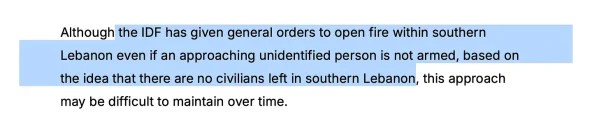
It noted “the IDF has given general orders to open fire within southern Lebanon even if an approaching unidentified person is not armed, based on the idea that there are no civilians left in southern Lebanon”, adding that “the IDF said that the ceasefire only applied North of the Litani River”.
By slaughtering displaced civilians attempting to return to Southern Lebanon, Israel hopes to continue the ethnic cleansing it previously carried out, in hopes it will lead the United States to recognize South Lebanon as Israeli territory.
The aforementioned Likud-connected journalist Amit Segal gave the game away behind Israel’s intention, writing, “Trump, a man with no sentimentality for old borders, already shook the Middle East when he agreed in principle to recognize Israeli sovereignty over parts of Judea and Samaria in the framework of the Peace to Prosperity plan, and when he supported mass emigration from Gaza. The mass migration from southern Lebanon has already happened. The only question is whether he will give Israel merely de facto approval of its new northern border or de jure approval as well.”
In order to continue its forced “mass migration” (ethnic cleansing) in South Lebanon, the IDF will fire on any displaced civilian trying to return home in hopes it will allow Israel to create its “new northern border”.
Islamabad’s post-war push: A new Gulf security order takes shape
Regional powers are moving quickly to fill the vacuum before Washington can reassert control
By F.M. Shakil | The Cradle | April 22, 2026
US President Donald Trump’s decision to extend the ceasefire with Iran at Pakistan’s request has given Islamabad more time to push for a broader settlement between Washington, Tel Aviv, and Tehran. Yet even as diplomacy inches forward, the war has already triggered a deeper shift across West Asia.
A Pakistan-brokered truce is now tied to a broader regional realignment. Persian Gulf states, long dependent on Washington’s military shield, are openly questioning whether that shield still works. In its place, a new conversation has emerged: one centered on regional defense cooperation led by Muslim-majority states rather than the US.
Iran signaled cautious optimism last week about joining a second round of talks in Islamabad. Reports had suggested Tehran might refuse to attend after a US naval assault on an Iranian vessel in the Strait of Hormuz, but Trump’s decision to extend the ceasefire has bought negotiators more time.
That development reportedly pushed Pakistan’s army chief, Field Marshal Asim Munir, to press Washington for a ceasefire extension and an easing of the blockade. Trump’s decision to prolong the truce has partly addressed Iran’s conditions for rejoining negotiations, although the blockade remains in place.
Munir, who concluded a three-day visit to Tehran last week, has remained in direct contact with Trump while Pakistani Prime Minister Shehbaz Sharif has carried out parallel diplomacy in Saudi Arabia, Qatar, and Turkiye.
Yet another obstacle to an agreement is the status of the enriched uranium that Iran possesses. Latest updates reveal that both Russia and China have offered to store Iranian uranium to address a major US demand for a peace agreement.
A regional order without Washington
Parallel to the peace effort, intense diplomacy is underway between Saudi Arabia, Pakistan, Turkiye, and Egypt over a possible “Muslim” replacement for the US-led Gulf security architecture.
A quadripartite meeting on the sidelines of the Antalya Diplomacy Forum, held from 17–19 April in Turkiye, reportedly focused on lowering tensions and building a new regional security structure. Sources speaking to The Cradle say there is now broad support for an “internal security apparatus” rooted in economic integration and defense coordination.
Ankara has proposed what it describes as an “organized regional security platform” built around the idea that regional states, not outside powers, should be responsible for defending West Asia.
The urgency behind those discussions is easy to understand.
Several Arab states, particularly Saudi Arabia and Qatar, now believe that US bases in the Persian Gulf have become liabilities rather than assets. After Iranian strikes damaged or destroyed multiple US military facilities in the region, Gulf governments began to question whether the US presence protects them or simply turns them into targets.
Zahir Shah Sherazi, executive vice president of Bol News, tells The Cradle:
“Targeting the US bases and installations in the Gulf states, where American outposts were located, was a strategic and insightful military tactic of Iran that exposed the true nature of Washington. The Gulf nations came to understand that the US is unable to safeguard them, as its primary focus lies on the Zionist state and its expansionist ambitions.”
Sherazi states that the concept of a Greater Israel stems from the expansionist designs of the Zionist state, which is working on it in the West Bank, Lebanon, Gaza, and Syria under US protection. This situation, he argues, has worried the Gulf states, and even Turkiye is at risk of clashing with Israel in Syria and Lebanon.
These apprehensions led to the formation of a NATO-like force in West Asia, not to counter Iran but Israel’s expansionist designs. He says Iran may join this force after its war, making it a strong military alliance against the US and Israel.
Sunni alliance or regional deterrent?
Not everyone sees the proposed force in the same way.
Imtiaz Gul, executive director of the Center for Research and Security Studies (CRSS), tells The Cradle that the project could end up functioning as a Sunni coalition rather than a genuinely regional defense structure.
In his view, the force may ultimately suit both Washington and the occupation state because it could be used to contain Iran while protecting the oil-rich Arab monarchies.
“This force is perceived as a facilitator of the Abraham Accords, as it is designed to fortify regional alliances and counteract Iranian influence in the Middle East. This coterie may emerge as an alternative security arrangement, specifically for Saudi Arabia, as the US military bases have become liabilities rather than functioning as a protective umbrella for the Gulf and Arab states.”
Concerning the prospects of this force, Gul is not so optimistic. He is of the view that such an organization could not effectively assume the responsibility of regulating this region.
“It is a highly intricate issue that is both challenging and difficult to implement due to several internal differences and conflicting interests, such as the ongoing tensions between Iran and Turkiye, with Saudi Arabia and Egypt, which complicate any potential regulatory efforts.”
US bases become a burden
Even as Trump signals a possible drawdown of US military operations in West Asia, Washington continues to expand its military footprint.
Trump has suggested that thousands of US troops could leave Iraq and Syria by September 2026. Yet his administration has also sent an additional 2,500 marines to the region.
That contradiction has reinforced Russian warnings that “the US and Israel can use the peace talks to prepare for a ground operation against Iran, as the Pentagon continues to increase US troop numbers in the region.”
Gul believes a large-scale US withdrawal from Gulf bases would leave the occupation state more isolated. Without those facilities, Tel Aviv would lose much of the logistical and intelligence infrastructure that underpins its military reach across the region.
He argues that Washington will maintain a military foothold in West Asia for as long as it sees Israel as vulnerable.
A recent report by the American Enterprise Institute (AEI) urged the Pentagon to reassess its Gulf basing strategy once the war with Iran ends. The report argued that Bahrain and the UAE should remain key hubs for US naval power, while other facilities may create more problems than advantages.
AEI suggested that Washington rely more heavily on Greece and Cyprus instead of accommodating Turkiye. It also argued that the US should deepen its presence in Somaliland rather than maintain extensive deployments in Saudi Arabia and Oman.
According to the Middle East Institute (MEI), US forces remain stationed in the UAE, Oman, Saudi Arabia, Kuwait, Bahrain, and Qatar. Roughly 50,000 troops are spread across 19 known sites.
“The US security umbrella became more of a liability, directly threatening the sovereignty of the host countries, especially since these bases were implicated in the attack on Iran. Although Iran is not a threat to the GCC’s sovereignty, it is assaulting the US bases from which the US attacks Iran,” Gul says.
Pakistan moves in as Gulf protector
Pakistan deployed 13,000 troops and a fleet of 10 to 18 fighter jets, including advanced platforms such as the JF-17 “Thunder” Block III and J-10CE fighters, at King Abdulaziz Air Base in the Eastern Province of Saudi Arabia.
Sherazi goes further. He argues that despite its military superiority and technological edge, Washington has already been forced to abandon some positions in Saudi Arabia and Qatar because of Iranian retaliation.
“Qatar, Saudi Arabia, and Pakistan have established strong connections in trade and defense collaboration. Qatar appears to be signaling its intention to join this Saudi–Pakistan defense mechanism. Saudi Arabia and Qatar have also declared that their territories will not be used for actions against Iran.”
Pakistan has already started positioning itself as an alternative security guarantor for the Gulf monarchies.
Islamabad and Ankara are also deepening military cooperation. Pakistan is involved in the KAAN stealth fighter program, while Turkiye is providing support in drone technology, training, and military equipment.
There is also growing speculation that Iran may quietly support parts of this regional transition. One of Tehran’s key demands in recent negotiations with Washington was reportedly the closure of US military bases across the region.
“Almost all Middle Eastern nations, except for a few like the UAE, support an indigenous security mechanism in the region due to the US-Israel collusion that has caused significant bloodshed among Arab nations,” Sherazi says.
“Now is the time for a robust force to end the barbarity of the Zionists and their supporters.”
IRGC seizes Israeli ship, second vessel for violations in Strait of Hormuz
Press TV – April 22, 2026
The Islamic Revolution Guards Corps (IRGC) Navy says it has intercepted and transferred to Iranian territorial waters two vessels for having committed violations in the Strait of Hormuz.
In a statement released on Wednesday, the IRGC identified the vessels as the MSC-Francesca, which it said belongs to the Israeli regime, and the Epaminodes.
The vessels, it said, were operating without authorization, committing repeated violations, tampering with navigation aid systems, and endangering maritime security in an attempt to exit the strait covertly.
“With the intelligence dominance of the forces, these vessels were identified and stopped in order to uphold the rights of the noble Iranian nation in the Strait of Hormuz,” the IRGC Navy said.
It added that the vessels have now been transferred to Iranian territorial waters for inspection of their cargo and documents.
The IRGC Navy reiterated that any attempt to disrupt the implementation of laws announced by Iran for transit through the Strait of Hormuz, or any activity inconsistent with safe passage through this strategic waterway, will be continuously monitored and met with decisive and legal action against violators.
Douglas Macgregor: No Peace – U.S. Prepares for ‘Total War’ Against Iran
Glenn Diesen | April 21, 2026
Douglas Macgregor is a retired Colonel, combat veteran and former senior advisor to the U.S. Secretary of Defense. Col. Macgregor argues that the US peace negotiations are as fraudulent as the previous negotiations, and the US is preparing for total war with Iran.
Follow Prof. Glenn Diesen:
- Substack: https://glenndiesen.substack.com/
- X/Twitter: https://x.com/Glenn_Diesen
- Patreon: https://www.patreon.com/glenndiesen
Support the research by Prof. Glenn Diesen:
- PayPal: https://www.paypal.com/paypalme/glenndiesen
- Buy me a Coffee: buymeacoffee.com/gdieseng
- Go Fund Me: https://gofund.me/09ea012f
Israeli army blows up school in southern Lebanon in violation of ceasefire
Press TV – April 21, 2026
The Israeli regime has demolished a public school in southern Lebanon in a new violation of a temporary ceasefire agreement with Beirut approved by US President Donald Trump.
The Israeli army destroyed a public school building in the southern Lebanese town of Khiam despite the 10-day ceasefire.
The state-run Lebanese National News Agency (NNA) reported on Tuesday that the Israeli forces rigged the building with explosives and detonated it overnight, completely leveling the structure.
Israeli forces also fired artillery near the town of Kunin in the Bint Jbeil district in southern Lebanon, according to another report by NNA.
A series of Israeli demolitions occurred across the south, targeting homes, buildings and other infrastructure, the report said. Israeli forces also “booby-trapped” numerous homes in the villages of Beit Lif, Shamaa, Biyyada, and Naqoura, leveling them, the report added.
Trump announced on Thursday a 10-day ceasefire in Lebanon following calls with Lebanese President Joseph Aoun and Israeli prime minister Benjamin Netanyahu.
However, the Israeli regime’s forces have continued attacking Lebanese civilian infrastructure and residential areas, disregarding the ceasefire agreement.
Meanwhile, Israel has planned to systematically flatten civilian buildings in southern Lebanon, according to Israeli media. Engineering tools, including excavators, have been brought into the area and are being operated by paid Israeli contractors.
Israeli forces are assessing the scale of the destruction through digital tools, including statistical systems that track the number of buildings demolished in each sector.
Last month, Israeli Minister of Military Affairs Israel Katz said, “All houses in villages near the border in Lebanon will be demolished in accordance with the Rafah and Beit Hanoun models in Gaza.”
He added that after Israel’s aggression in Lebanon ends, the military would maintain control “over the entire area up to the Litani.”
Since March 2, Israel has carried out an aggression against Lebanon that has killed around 2,300 people, wounded more than 7,500, and displaced over 1.2 million, according to Lebanese authorities.
The desalination front: Water as Israel’s Achilles heel
The Cradle | April 21, 2026
Israel’s near-total dependence on seawater desalination to secure almost 80 percent of its drinking water and industrial needs has created a security vulnerability unlike that of the Persian Gulf states.
While Gulf desalination facilities are spread across wide geographic areas, Israel’s production capacity is concentrated along a narrow stretch of coastline. That concentration leaves Israel’s water system vulnerable to paralysis through concentrated missile barrages or suicide drone attacks from multiple fronts – a danger that exceeds the ability of conventional air defenses to fully contain.
The longer the confrontation with Iran drags on, the more these facilities are transformed from civilian infrastructure into strategic targets. Israel’s five main desalination plants have become central nodes in Tehran’s target bank, placing domestic stability and regional water commitments under the threat of broad disruption.
A narrow coastline, a concentrated vulnerability
Israel may be the world’s most centralized state in desalinated water production. Five major plants – Ashkelon, Ashdod, Palmachim, Sorek, and Hadera – produce the overwhelming majority of potable water for homes, agriculture, and industry.
The Sorek complex, one of the world’s largest reverse osmosis desalination plants, carries particularly high strategic value. Any strike that disables it would not simply create a temporary shortage. It could knock out water service to entire areas of Gush Dan, including Tel Aviv and its surrounding settlements, in a matter of days.
It is also clear that Israel’s water system lacks geographic depth from a security standpoint. All the plants fall within the effective operational range of precision missiles and are fully exposed to maritime threats.
Their offshore intake pipes are especially vulnerable. These underwater systems can be targeted through naval drones, unmanned submarines, or sea mines, halting water extraction and treatment almost immediately.
A successful strike on Hadera alone could severely disrupt supplies to the north and center of the country, placing huge pressure on emergency planners already dealing with depleted groundwater reserves and the shrinking capacity of Lake Tiberias.
The gas–water dependency trap
The most serious structural weakness in Israel’s water sector lies in its dependence on natural gas. Unlike the Gulf states, which possess large emergency reserves of liquid fuel to keep desalination facilities running during crises, Israel relies almost entirely on gas from the Tamar and Leviathan fields in the Mediterranean and is now looking to claim ownership of Lebanon’s Qana gas field.
That means any successful strike on offshore gas infrastructure would quickly spread beyond the energy sector. Disrupted gas supplies would undermine the national electricity grid and cut power to desalination facilities at the same time.
This dual dependency turns Israeli water security into a hostage of offshore infrastructure. Gas platforms are difficult to defend against drone swarms, anti-ship missiles, or coordinated naval attacks.
A strike on Leviathan, for example, would leave Israeli planners facing an impossible calculation: should the remaining gas be directed toward electricity generation for hospitals and military facilities, or toward desalination plants to ensure water continues to reach homes?
That overlap amplifies the pressure Iran can exert. A single strike on one offshore target could cripple two strategic sectors simultaneously.
Water as a regional pressure point
The implications of a strike on Israeli desalination infrastructure extend far beyond the occupation state itself. Under its peace agreement with Jordan, Israel is obligated to provide Amman with fixed annual quantities of water.
Any serious damage to Israel’s desalination system would almost certainly interrupt those supplies, exporting the crisis directly across the Jordan River.
That dynamic transforms desalination plants from public utilities into instruments of regional pressure. Strikes on these facilities would not only weaken Israel internally but also place neighboring governments under stress and expose the fragility of regional arrangements built around Israeli infrastructure.
Jordan would be hit first. But the fallout would also test the broader framework of normalization agreements and regional cooperation. For Tehran, that creates an additional layer of leverage. Dependence on Israel for critical resources is becoming a growing strategic liability.
That, in turn, could push neighboring states to seek alternatives, pressure Washington and Tel Aviv to scale back their confrontation with Iran, or reassess the long-term value of regional ties with Israel.
Cyberattacks and invisible sabotage
Israel possesses one of the world’s most advanced cybersecurity sectors, yet repeated Iranian cyberattacks have exposed real vulnerabilities in industrial control systems.
Desalination plants rely on complex digital infrastructure to regulate chemical balances, water pressure, and membrane filtration. Penetrating those systems would allow attackers to alter chlorine levels, disrupt pumping pressure, or physically damage sensitive equipment.
The danger of cyberwarfare lies in the fact that it is largely invisible. Unlike missile strikes, digital sabotage can unfold quietly, triggering confusion and panic before the source of the disruption is identified.
Even a 24-hour shutdown at Sorek could leave millions without water and inflict severe losses on sectors that depend on highly treated water, including semiconductor manufacturing, pharmaceuticals, and the precision industry.
The more Israel digitizes the management of water infrastructure, the more attractive that sector becomes as a target for cross-border cyber attacks.
Deliberate pollution and long-term disruption
The eastern Mediterranean coastline is also highly vulnerable to environmental contamination during wartime. A strike on fuel tankers offshore, or on storage facilities in Haifa or Ashdod, could trigger oil spills large enough to disable desalination intake systems within hours.
Israel’s heavy reliance on reverse osmosis makes that threat especially serious. Even limited exposure to oil residue can permanently damage filtration membranes. Replacing them is neither quick nor simple, particularly during wartime conditions when supply chains are already strained.
This kind of environmental warfare is especially dangerous because its effects do not end when the fighting stops. Oil pollution would not only shut down desalination capacity in the short term but also damage marine ecosystems that support natural filtration processes.
That would raise operating costs, lower water quality, and leave sections of Israel’s coastline economically crippled long after the war itself ends.
The economic cost of strategic thirst
From an investment and financial perspective, instability in water security poses a direct threat to the occupation state’s “startup nation” model. International investors and major technology firms evaluate risk based on the stability of essential resources.
Once water itself becomes a threatened commodity, sovereign insurance costs rise, while capital flees sectors that consume large volumes of water.
A prolonged shutdown in greater Tel Aviv could inflict losses that surpass the economic impact of conventional missile strikes. Water is tied to every layer of the economy, from households and hospitals to industrial parks and high-tech production.
International ratings agencies already assess Israel’s creditworthiness according to its ability to absorb wartime shocks, protect infrastructure, and sustain economic activity during prolonged conflict. Any major disruption to the water sector would add to concerns over fiscal strain, investor confidence, and the state’s ability to maintain basic services.
That would raise borrowing costs and place additional pressure on a state budget already strained by military spending.
“Thirst economy” is now a term increasingly heard in financial analysis circles, where water becomes the central measure of national economic resilience.
The supply chain problem
Israel’s desalination system depends heavily on imported technology, precision spare parts, and specialized chemicals. Wartime disruption to ports, shipping lanes, or supply chains would make routine maintenance increasingly difficult.
Anti-scaling chemicals, disinfectants, filtration membranes, and electronic control systems all require reliable imports. Any shortage would force plant operators to either lower water quality or shut facilities down altogether to avoid damaging equipment.
That creates another challenge for Israeli planners. Maintaining the desalination sector during a prolonged conflict may require costly air bridges for critical parts and chemicals – an option that is difficult to sustain over time.
Israel’s desalination network has become one of the clearest examples of how technological sophistication can also create strategic fragility. Water security now sits at the center of the occupation state’s military and economic calculations.
If these facilities become unsustainable under wartime conditions, every other pillar of Israeli power – from industry and public health to military readiness and regional influence – becomes far harder to sustain.
Is Trump Going for Armageddon?
By Larry C. Johnson | SONAR21 | April 21, 2026
Pakistan is trying desperately to hold a new round of talks in Islamabad between the US and Iran. After conflicting statements from the Trump administration, it appears that JD Vance, accompanied by his Zionist watchers — Steve Witkoff and Jared Kushner — are headed back to Islamabad. As of 22:20 hours eastern, Iran’s lead negotiator, Mohammad Bagher Ghalibaf, said there will be no negotiations while the US blockade of Iranian ports remains in effect, stating that they are prepared to demonstrate new cards on the battlefield.
On Monday, April 20, 2026, Iranian President Masoud Pezeshkian made several public statements (primarily via a post on X and remarks reported by state media) regarding potential negotiations with the United States. His tone was cautious, skeptical, and defiant, while still leaving the door open to diplomacy. He emphasized that any serious talks must be based on consistent, reliable behavior rather than pressure. Pezeshkian highlighted “deep historical mistrust in Iran toward US government conduct.” He accused American officials of sending “unconstructive and contradictory signals” that convey a “bitter message” — that the US is seeking Iran’s surrender.
Pezeshkian stressed that Iran will not yield to threats or bullying. He stated that “war benefits no one” and that “every rational and diplomatic path should be used to reduce tensions.” However, he added that “distrust of the enemy and vigilance in interactions are undeniable necessities.” He described the ongoing US naval blockade as evidence that Washington may be “repeating previous patterns and betraying diplomacy.” Unless Donald Trump lifts the blockade and stops issuing threats, I think that Iran will not agree to a new round of talks.
On the military front, Iran has reacted to the seizure of its cargo ship in the Gulf of Oman by deploying thousands of new anti-ship mines in the Strait of Hormuz. Iran was not making idle threats about closing the Strait of Hormuz. It is day 53 since the start of the Ramadan war on the 28th of February and Iran is showing no signs of wavering in its demand that the US fulfill its initial acceptance of Iran’s 10-point plan.
Today, Tuesday, marks the final day of the ceasefire that Israel, the US and Iran accepted on 7 April. Both the US and Iran are locked-and-loaded to continue the fight. The US lacks the military resources that are required to open the Strait of Hormuz. It is not just a matter of clearing the mines and seizing territory on the coast… The US would need an enormous ground force to drive inland in order to locate and destroy missile and drone launch sites. As long as Iran can fire missiles and drones at a ship that tries to pass through the Strait without the permission of the IRGC, the Strait will remain closed and firmly under Iranian control.
A recent Wall Street Journal article — Behind Trump’s Public Bravado on the War, He Grapples With His Own Fears — reports that Trump’s spate of bizarre, vulgar, threatening posts on social media, e.g., threatening to end Iran as a civilization (implying the use of nuclear weapons), is simply a negotiating ploy — i.e., convince the Iranians that he is unstable and could do anything in order to convince Iran to make concessions. If that is genuinely Trump’s intention, it has backfired spectacularly. It has raised legitimate questions about his mental competence.
Although Trump reportedly is terrified of getting bogged down in another forever war that he once vowed he would never do, I think he will order a new round of attacks in hopes that he will break Iran’s will to resist. That will only compound his problems because Iran will retaliate and inflict catastrophic damage on the Gulf Arabs who continue to side with the US.
Trump still has an exit ramp… JD Vance, working through the Pakistanis, had a tentative deal with the Iranians on Friday that consisted of sanctions relief, unfrozen assets, toll fees recognized in exchange for permanent cessation of hostilities, plus enrichment limits under IAEA supervision. Trump blew off that deal with his decision to impose a blockade. Trump being Trump, he could reverse himself, lift the blockade and empower JD Vance to make the deal.
I am not holding my breath. While such a deal will infuriate the Zionists — both Jewish and Christian — this concession might salvage what is left of Trump’s tattered legacy. However, I think Trump will resort to force… I hope I am wrong. … Video interviews
Palantir CEO Calls for Draft to Fight the Empire’s Wars
Involuntary servitude is good for business
By Kurt Nimmo | Another Day in the Empire | April 20, 2026
In 2025, Alex Karp, the CEO of government and military tech contractor Palantir, published The New York Times best-seller, The Technological Republic: Hard Power, Soft Belief, and the Future of the West. The Wall Street Journal praised the book as a cri de coeur, a passionate appeal “that takes aim at the tech industry for abandoning its history of helping America and its allies,” while Wired praised the book as a “readable polemic that skewers Silicon Valley for insufficient patriotism.”
On April 18, 2026, Palantir posted twenty-two points to social media summarizing the book. In addition to taking Silicon Valley to task for insufficient patriotism, advocating a role for AI in forever war, and denouncing the “psychologization of modern politics,” the Palantir post on X declares: “National service should be a universal duty. We should, as a society, seriously consider moving away from an all-volunteer force and only fight the next war if everyone shares in the risk and the cost.”
National conscription, a form of involuntary servitude, and the wars it portends, is good for business, especially for corporations within the orbit of the Pentagon, the CIA, and the national security state. Palantir fits comfortably within this amalgamation.
Mass Murder by Artificial Intelligence
Project Maven is an AI-driven battlefield intelligence system designed by the corporation. The Defense Department, now known as the War Department, employed Maven in 2024 for “targeting support” in Iraq, Syria, and Yemen. Maven incorporates the AI model Claude, built by Anthropic.
More recently, in US airstrikes against Iran, “AI systems born from Project Maven have helped identify and prioritize thousands of targets, accelerating intelligence analysis and operational planning,” explains the Center for a New American Security, a military think tank founded by Michèle Flournoy, a former under secretary of defense with links to Lockheed Martin and BAE Systems. She was the principal adviser to the Secretary of Defense in the formulation of national security and defense policy.
Maven was reportedly used to shorten the “kill chain” during Israel’s invasion of Gaza. “I am proud that we are supporting Israel in every way we can,” CEO Karp exclaimed. Following the Gaza al-Aqsa Flood in October, 2023, Palantir “provided Israel with multiple AI-powered data analytics tools for military and intelligence purposes,” notes the American Friends Service Committee. The corporation has a “strategic partnership” with Israel’s Ministry of Defense to assist the Zionist state and its “war effort” against Palestinian resistance to Israeli military occupation, an armed struggle recognized under international law.
“As the genocide in Gaza advances, attention is turning to the companies whose technologies may be facilitating Israel’s daily atrocities, with US-based Palantir Technologies among them,” reports the Business and Human Rights Center. “While the International Criminal Court (ICC) is stepping in to address genocide accusations, the tech barons who design and supply the tools of warfare remain largely unchallenged.”
Another Israeli AI-based targeting system, Lavender, ostensibly developed by the IDF’s Unit 8200, is said to be a Palantir project. Palantir rejected this assertion in a letter sent to Francesca Albanese, the sanctioned United Nations Special Rapporteur on the occupied Palestinian territories. In the letter, Palantir stressed it “stands in solidarity with Israel in response to the horrific attacks on 7 October, 2023. Our work in Israel long predates the 7 October attacks and is in line with our global commitment to U.S. allies and liberal democracies. We proudly support our partners in Israel across a multitude of mission sets, programs, and contexts.”
Israel utilized Palantir in its September 2024 attacks in Lebanon, employing exploding electronic pagers that resulted in numerous fatalities and injuries, writes AFSC’s Investigate. In addition to its collaboration with the Israeli military, Palantir also provides the Gaza Civil-Military Coordination Center with its services. This center is located at the US military compound in Kiryat Gat, which was established in October 2025 to implement the Trump administration’s plan for Gaza. Iran targeted Kiryat Gat in March, 2026.
Maven, incorporating Anthropic’s Claude, was used to target the Shajareh Tayyebeh primary school in Minab, in southern Iran, killing 180 people, mostly young girls. President Trump praised Palantir Technologies, saying the company “has proven to have great war-fighting capabilities and equipment. Just ask our enemies,” apparently including children.
“Creepy CEO” Advocates Involuntary Servitude in “Service to the West”
“Alex Karp, the creepy CEO of creepy defense contractor Palantir, just can’t stop talking about killing people,” Lucas Ropek writes for Gizmodo. “During a recent call with investors, the billionaire let it slip that he doesn’t mind a little bloodshed, just so long as the money keeps pouring in.”
“Palantir is here to disrupt and make the institutions we partner with the very best in the world and, when it’s necessary, to scare enemies and on occasion kill them,” Karp said, with a smile on his face. The CEO added that he was very proud of the work his firm is doing and that he felt it was good for America. “I’m very happy to have you along for the journey,” he said. “We are crushing it. We are dedicating our company to the service of the West, and the United States of America, and we’re super-proud of the role we play, especially in places we can’t talk about.”
For Karp, “service to the West” includes conscription, that is to say involuntary servitude and the possibility of a violent and horrific death for an untold number of men and women drafted to fight the forever wars envisioned by the billionaire elite, including those within the “libertarian” tech sector.
However, forcing an individual against his or her will to kill and possibly be killed for the sake of the state (or foreign states, such as Israel), and in accordance with a “social contract” that demands submission and obedience, is not libertarian. In the case of Palantir, it is more accurately described as “techno-fascism,” an alliance between Silicon Valley and the state. Contrary to libertarian principles advocating against government intervention, leading tech companies frequently advocate for regulations that favor established AI companies benefiting from government funding and contracts.
Palantir, named after the “seeing stones” from J.R.R. Tolkien’s The Lord of the Rings, may be characterized as a “merchant of death,” a term prominent in the 1930s regarding WWI profiteering. Alex Karp may be compared to Basil Zaharoff, a Greek arms dealer and industrialist, one of the wealthiest men of his time. Unlike Zaharoff, Karp is not selling rifles or munitions, he is selling something far worse—the ability, through artificial intelligence, to murder thousands, if not millions of people with the speed and efficiency of computer technology.
Featured Video

Trita Parsi: Israel Set a Trap for Total War in the Region
or go to
Aletho News Archives – Video-Images
From the Archive
Zionism’s Violent Legacy
By Donald Neff | Washington Report On Middle East Affairs | January 1996
On January 4, 1948, Jewish terrorists drove a truck loaded with explosives into the center of the all Arab city of Jaffa and detonated it, killing 26 and wounding around 100 Palestinian men, women and children.[1] The attack was the work of the Irgun Zvai Leumi – the “National Military Organization,” also known by the Hebrew letters Etzel – the largest Jewish terrorist group in Palestine. The Irgun was headed by Revisionist Zionist Menachem Begin and had been killing and maiming Arabs, Britons and even Jews for the previous ten years in its efforts to establish a Jewish state.
This terror campaign meant that at the core of Revisionist Zionism there existed a philosophical embrace of violence. … continue
Blog Roll
 Aletho News
- Trita Parsi: Israel Set a Trap for Total War in the Region
- Trump’s Iran war is on an Israeli leash
- Saudi oil boss issues global supply warning
- Riyadh Says Its Oil System Is Intact. The Numbers Say Otherwise.
- Trump and Netanyahu Want to “Finish the Job” on Iran
- US ‘one-sided dictation’ not Iran’s beliefs makes rational talks impossible: Baghaei
- Iran’s Next Strike May Not Explode. It Could Shut You Down /Col Doug Macgregor
- Iran: US political targets legitimate if assassinations return
- Iraq shuts key border crossing with Iran under US pressure: Report
- Undersea Internet cables could be targeted in retaliation for attacks on Iran: IRGC deputy chief
- If Americans Knew
- The Israel Lobby’s Changing Fortunes
- AIPAC has become such a political liability that it’s shifting to a more “nimble” approach to buying politicians
- At least 160 Israeli settler attacks in 2 weeks
- Will Gaza’s Ancient Christian Community Disappear Forever?
- Israel’s vision of regional security rests on keeping Arab states weak
- Heidi Levine recounts how Palestinian youths helped save her in settler attack
- DAILY UPDATE: Latest essential news on Palestine, Israel, & region
- Trump’s Intensifying Sabotage of the ICC, for Israel’s Sake
- Israeli military detain US and UK volunteers in West Bank including Democratic NY politician Brad Lander
- Americans at National Conservatism Conference held in Israel this year criticize Israel
- No Tricks Zone
- E-Cars Reduce CO2 Emissions By Only 41% Compared To Internal Combustion Engine Vehicles
- Predictions Made By Renowned Climate Professor Over Past Decades Have Been Proven To Be Poor
- New Study Suggests Large Regions Of The Pacific Ocean Have Been Cooling For The Last 80 Years
- Germany’s Green Energy Debacle: High Energy Costs Force Kahla Porzellan to Close After 182 Years!
- New Study: 50 Years Of The Most Aggressive ‘Net Zero’ Policies Can Only Affect The Global Climate By 0.03°C
- US September “Heat” Was No Record…Many Records Set Decades Ago
- Latest European Green Energy Debacle; Portugal’s Largest Flagship Solar Park Insolvent!
- Green Energy Debacle: German Expert Professor Fritz Vahrenholt Warns Of Severe Economic And Social Consequences
- Two More Paleo Reconstructions Affirm Meters-Higher Sea Levels Across Ireland, Brazil 7000-6000 Years Ago
- New Study: Earth And Venus Surface Warmth Largely Explained By Convection And Lapse Rate, Not CO2 Or Radiation

