A Second Whistle Blown on the OPCW’s Doctored Report
By Jeremy Salt | American Herald Tribune | December 3, 2019
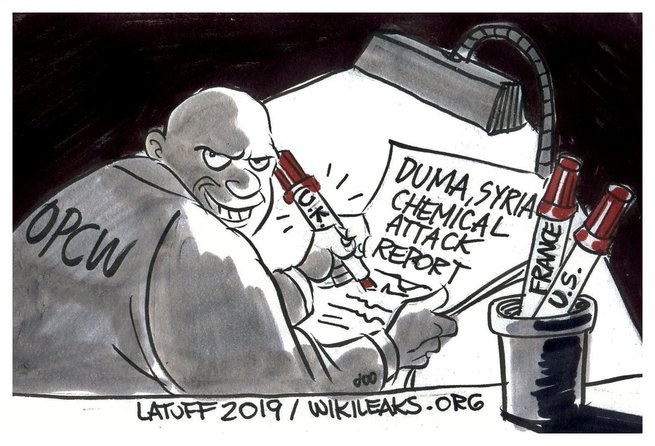
Another whistleblower leak has exposed the fraudulent nature of the Organization for the Prevention of Chemical Weapons (OPCW) report on the alleged chemical weapons attack in the Syrian city of Douma, close to Damascus, on April 7 last year.
The first leak came from the Fact-Finding Mission’s engineering sub-group. After investigating the two sites where industrial gas cylinders were found in Douma and taking into account the possibility that the cylinders had been dropped from the air it concluded that there was a “higher probability” that both cylinders were placed at both sites by hand. This finding was entirely suppressed in the final report.
The engineering sub-group prepared its draft report “for internal review” between February 1-27, 2018. By March 1 the OPCW final report had been approved, published and released, indicating that the engineers’ findings had not been properly evaluated, if evaluated at all. In its final report the OPCW, referring to the findings of independent experts in mechanical engineering, ballistics and metallurgy, claimed that the structural damage had been caused at one location by an “impacting object” (i.e. the cylinder) and that at the second location the cylinder had passed through the ceiling, fallen to the floor and somehow bounced back up on to the bed where it was found.
None of this was even suggested by the engineers. Instead, the OPCW issued a falsified report intended to keep alive the accusation that the cylinders had been dropped by the Syrian Air Force.
Now there is a second leak, this time an internal email sent by a member of the Fact-Finding Mission (FFM) on June 22, 2018, to Robert Fairweather, the British career diplomat who was at the time Chief of Cabinet at the OPCW, and copied to his deputy, Aamir Shouket. The writer claims to have been the only FFM member to have read the redacted report before its release. He says it misrepresents the facts: “Some crucial facts that have remained in the redacted version have morphed into something quite different from what was originally drafted.”
The email says the final version statement that the team “has sufficent evidence to determine that chlorine or another reactive chlorine-containing chemical was likely released from the cylinders is highly misleading and not supported by the facts.” The writer states that the only evidence is that some samples collected at locations 2 and 4 (where the gas cylinders were found) had been in contact with one or more chemicals that contain a reactive chlorine atom.
“Such chemicals,” he continues, “could include molecular chlorine, phosgene, cyanogen chloride, hydrochloric acid, hydrogen chloride or sodium hypochlorite (the major element in household chlorine-based bleach.” Purposely singling out chlorine as one of the possibilities was disingenuous and demonstrated “partiality” that negatively affected the final report’s credibility.
The writer says the final report’s reference to “high levels of various chlorinated organic derivatives detected in environmental samples” overstates the draft report’s findings. “In most cases” these derivatives were present only in part per billion range, as low as 1-2 ppb, which is essentially trace qualitiea.” In such microscopic quantities, detected inside apartment buildings, it would seem, although the writer only hints at the likelihood, that the chlorine trace elements could have come from household bleach stored in the kitchen or bathroom.
The writer notes that the original draft discussed in detail the inconsistency between the victims’ symptoms after the alleged attack as reported by witnesses and seen on video recordings. This section of the draft, including the epidemiology, was removed from the final version in its entirety. As it was inextricably linked to the chemical agent as identified, the impact on the final report was “seriously negative.” The writer says the draft report was “modified” at the behest of the office of Director-General, a post held at the time by a Turkish diplomat, Ahmet Uzumcu.
The OPCW has made no attempt to deny the substance of these claims. After the engineers’ report made its way to Wikileaks its priority was to hunt down the leaker. Following the leaking of the recent email, the Director-General, Fernando Arias, simply defended the final report as it stood.
These two exposures are triply devastating for the OPCW. Its Douma report is completely discredited but all its findings on the use of chemical weapons in Syria must now be regarded as suspect even by those who did not regard them as suspect in the first place. The same shadow hangs over all UN agencies that have relied on the OPCW for evidence, especially the UN’s Independent International Commission of Inquiry on the Syrian Arab Republic, an arm of the OHCHR (Office of the High Commissioner for Human Rights).
This body is closely linked to the OPCW and while both mostly hide the sources of their information it is evident that where chemical weapons allegations have been made, the commission of inquiry has drawn on the OPCW.
As of January 2018, the commission reported on 34 “documented incidents” of chemical weapons use by various parties in Syria. It held the Syrian government responsible for 23 of them and, remarkably, did not hold the armed groups responsible even for one, despite the weight of evidence showing their preparation and use of such weapons over a long period of time.
The commission has made repeated accusations of chlorine barrel bombs being dropped by government forces. On the worst of the alleged chemical weapons attacks, on August 21, 2013, in the eastern Ghouta district just outside Damascus, it refers to sarin being used in a “well-planned indiscriminate attack targetting residential areas [and] causing mass casualties. The perpetrators likely had access to the Syrian military chemical weapons stockpile and expertise and equipment to manipulate large amounts of chemical weapons.”
This is such a travesty of the best evidence that no report by this body can be regarded as impartial, objective and neutral. No chemical weapons or nerve agents were moved from Syrian stocks, according to the findings of renowned journalist Seymour Hersh. The best evidence, including a report by Hersh (‘The Red Line and the Rat Line,’ London Review of Books, April 17, 2014), suggests a staged attack by terrorist groups, including Jaysh al Islam and Ahrar al Sham, who at the time were being routed in a government offensive. The military would have had no reason to use chemical weapons: furthermore, the ‘attack’ was launched just as UN chemical weapons inspectors were arriving in the Syrian capital and it is not even remotely credible that the Syrian government would have authorized a chemical weapons attack at such a time.
Even the CIA warned Barack Obama that the Syrian government may not have been/probably was not responsible for the attack and that he was being lured into launching an air attack in Syria now that his self-declared ‘red line’ had been crossed. At the last moment, Obama backed off.
It remains possible that the victims of this ‘attack’ were killed for propaganda purposes. Certainly, no cruelty involving the takfiri groups, the most brutal people on the face of the planet, can be ruled out. Having used the occasion to blame the Syrian government, the media quickly moved on. The identities of the dead, many of them children, who they were, where they might have been buried – if in fact they had been killed and not just used as props – were immediately tossed into the memory hole. Eastern Ghouta remains one of the darkest unexplained episodes in the war on Syria.
The UN’s Syria commission of inquiry’s modus operandi is much the same as the OPCW’s. Witnesses are not identified; there is no indication of how their claims were substantiated; the countries outside Syria where many have been interviewed are not identified, although Turkey is clearly one; and where samples have had to be tested, the chain of custody is not transparent.
It is worth stepping back a little bit to consider early responses to the OPCW report on Douma. The Syrian government raised a number of questions, all of them fobbed off by the OPCW. Russia entered the picture by arranging a press conference for alleged victims of the ‘attack’ at the OPCW headquarters in the Hague. They included an 11-year-old boy, Hassan Diab, who said he did not know why he was suddenly hosed down in the hospital clinic, as shown in the White Helmets propaganda video.
All the witnesses dismissed claims of a chemical weapons attack. Seventeen countries (Australia, Bulgaria, Canada, the Czech Republic, Denmark, Estonia, France, Germany, Iceland, Italy, Latvia, Lithuania, the Netherlands, Poland, Slovakia, the United Kingdom and the US) then put out a joint statement (April 26, 2018) expressing their full support for the OPCW report and dismissing the “so-called” information session at the Hague as a Russian propaganda exercise. Their statement claimed the authenticity of the information in the OPCW report was “unassailable.”
Russia followed up with a series of questions directed at the OPCW’s technical secretariat. It noted that the OPCW report did not mention that samples taken from Douma were “split” in the OPCW’s central laboratory in the Netherlands and not in the Syrian Arab republic. Fractions of samples were handed to Syria only after six months of insistent pressure (OPCW response: its terms of reference provided for Syria to be provided with samples “to the extent possible” but do not specify when or where samples should be ‘split’).
Russia also referred to the collection of 129 samples and their transfer to OPCW-designated laboratories. 31 were selected for the first round of analysis and an additional batch of 13 sent later. Of the 129 samples 39 were obtained from individuals living outside territory controlled by the Syrian army. Of 44 samples analyzed 33 were environmental and 11 biomedical: of the 44, 11 (four environmental and seven biomedical) were obtained from alleged witnesses.
As remarked by the Russian Federation, the OPCW report does not explain the circumstances in which these samples were obtained. Neither is there any information on the individuals from whom they were taken; neither is there any evidence demonstrating compliance with the chain of custody (OPCW response: there was respect for the chain of custody, without this being explained; the “standard methodology” in collecting samples was applied, without details being given. It stressed the need for privacy and the protection of witness identities).
Russia observed that the samples were analyzed in two unnamed OPCW laboratories and on the evidence of techniques and results, it raised the question of whether the same laboratories had been used to investigate earlier ‘incidents’ involving the alleged use of chlorine. Of the 13 laboratories that had technical agreements with the OPCW, why were samples analyzed at only two, apparently the same two as used before? Russia also observed that of the 33 environmental samples tested for chlorinated products, there was a match (bornyl chloride) in only one case.
Samples taken from location 4, where a gas cylinder was allegedly dropped from the air, showed the presence of the explosive trinitrotoluene, leading to the conclusion that the hole in the roof was made by an explosion and not by a cylinder falling through it (OPCW response: the Fact-Finding Mission did not select the labs and information about them is confidential. As there had been intense warfare for weeks around location four, the presence of explosive material in a broad range of samples was to be expected but this did not – in the OPCW view – lead to the conclusion that an explosion caused the hole in the roof).
Russia pointed out that the FFM interviewed 39 people but did not interview the actual witnesses of the ‘incident’ inside the Douma hospital who appeared and were easily identifiable in the staged videos (OPCW response: the secretariat neither confirms nor denies whether it interviewed any of the witnesses presented by Russia at the OPCW headquarters “as any statement to that effect would be contrary to the witness protection principles applied by the secretariat”).
Russia also pointed out the contradictions in the report on the number of alleged dead. In one paragraph the FFM says it could not establish a precise figure for casualties which “some sources” said ranged between 70 and 500. Yet elsewhere “witnesses” give the number of dead as 43 (OPCW response: the specific figure of 43 was based on the evidence of “witnesses” who claimed to have seen bodies at different locations).
Russia also pointed out that no victims were found at locations 2 and 4, where the ventilation was good because of the holes in the roof/ceiling. Referring to location 2, it asked how could chlorine released in a small hole from a cylinder in a well-ventilated room on the fourth floor have had such a strong effect on people living on the first or second floors? (OPCW response: the FFM did not establish a correlation between the number of dead and the quantity of the toxic chemical. In order to establish such a correlation, factors unknown to the FFM – condition of the building, air circulation and so on – would have had to be taken into account. It does not explain why this was not attempted and how it could reach its conclusions without taking these “unknown factors” into account).
Finally, Russia raised the question of the height from which the cylinders could have been dropped. It referred to the lack of specific calculations in the OPCW report. The ‘experts’ who did the simulation did not indicate the drop height. The charts and diagrams indicated a drop height of 45-180 meters. However, Syrian Air Force helicopters do not fly at altitudes of less than 2000 meters when cruising over towns because they would come under small arms fire “at least” and would inevitably be shot down.
Furthermore, if the cylinders had been dropped from 2000 meters, both the roof and the cylinders would have been more seriously damaged (OPCW response: there were no statements or assumptions in the FFM report on the use of helicopters or the use of other aircraft “or the height of the flight. The FFM did not base its modeling on the height from which the cylinders could have been dropped. “In accordance with its mandate,” the FFM did not comment on the possible altitude of aircraft. The OPCW did not explain why these crucial factors were not taken into account).
In its conclusion, Russia said there was a “high probability” that the cylinders were placed manually at locations 2 and 4 and that the factual material in the OPCW report did not allow it to draw the conclusion that a toxic chemical had been used as a weapon. These conclusions have now been confirmed in the release of information deliberately suppressed by the OPCW secretariat.
As the leaked material proves, its report was doctored: by suppressing, ignoring or distorting the findings of its own investigators to make it appear that the Syrian government was responsible for the Douma ‘attack’ the OPCW can be justly accused of giving aid and comfort to terrorists and their White Helmet auxiliaries whom – the evidence overwhelmingly shows – set this staged ‘attack ’up.
Critical evidence ignored by the OPCW included the videoed discovery of an underground facility set up by Jaysh al Islam for the production of chemical weapons. All the OPCW said was that the FFM inspectors paid on-site visits to the warehouse and “facility” suspected of producing chemical weapons and found no evidence of their manufacture. There is no reference to the makeshift facility found underground and shown in several minutes of video evidence.
Since the release of the report, the three senior figures in the OPCW secretariat have moved/been moved on. The Director-General at the time, Hasan Uzumlu, a Turkish career diplomat, stepped out of the office in July 2018: Sir Robert Fairweather, a British career diplomat and Chief of Cabinet at the OPCW, was appointed the UK’s special representative to Sudan and South Sudan on March 11, 2019: his deputy, Aamir Shouket, left the OPCW in August 2018, to return to Pakistan as Director-General of the Foreign Ministry’s Europe division. The governments which signed the statement that the evidence in the OPCW report was “unassailable” remain in place.
Jeremy Salt has taught at the University of Melbourne, Bosporus University (Istanbul) and Bilkent University (Ankara), specialising in the modern history of the Middle East. His most recent book is “The Unmaking of the Middle East. A History of Western Disorder in Arab Lands” (Berkeley: University of California Press, 2008.)
In controversial move Italy bans Mahan Air’s flights
By Max Civili | Press TV | November 20, 2019
Rome – The Italian government’s early November announcement that the Iranian first private airline Mahan Air will no longer be allowed to fly to its Italian destinations of Rome and Milan from mid-December had left many baffled in Italy.
Rome’s decision – made after a meeting between Italian Foreign Minister Luigi Di Maio and US Secretary of State Mike Pompeo in October – had followed that of Germany and France which had both already banned flights by the airline in the wake of US pressure.
Washington has been accusing Mahan Air of transporting military equipment and personnel to Middle East war zones – an accusation that the airline has always refuted. The attack came as part of broader US sanctions targeting Iran’s aviation industry.
Also Italy’s flag-carrier Alitalia had suspended its flights to Tehran in January this year, following US President Donald Trump’s decision to reinstate sanctions on Iran.
On Tuesday, at a meeting with a number of Italian journalists and geopolitical analysts held at Iran’s Embassy in Rome, the Ambassador to Italy Hamid Bayat stressed the importance of maintaining access to the Italian airspace.
Iranian authorities believe direct flights between countries that enjoy long-standing relations such as Italy and Iran are essential. About 10,000 young Iranians are enrolled at Italian universities and tens of thousands of Italian tourists visit Iran every year.
Some have argued that Italy’s ban on Mahan Airliner is also a breach of the Chicago Convention on International Civil Aviation. The convention – enacted in the depths of WWII, because people understood the key role aviation would play in connecting the world – established a specialized agency of the United Nations known as ICAO.
Russiagate Comes to Italy
By Andrew Spannaus – Consortium News – August 5, 2019
Milan – A meeting with Russians, allegations of corruption, and a call for a leading politician to resign. Russiagate has come to Italy.
A representative of the League — the right-wing anti-establishment party now part of the country’s governing coalition — is alleged to have floated a scheme for his party to receive 65 million euros ($73 million) in illegal financing, skimmed off the top of oil sales from Russia.
Gianluca Savoini, a long-time League member, was recorded during a conversation in the public lounge of Moscow’s Metropol Hotel on Oct. 18, 2018, talking to three still-unidentified Russians about how to channel money to his political party.
Prosecutors in Milan have opened an investigation, while Deputy Prime Minister and League leader Matteo Salvini has denied any knowledge of the alleged plot.
The recording of Savoini’s conversation in Moscow was published by Buzzfeed in early July. The League and other nationalist parties in Europe, have long been subject to U.S. intelligence suspicions of getting help from Russia and Buzzfeed reporter Alberto Nardelli presents the Metropol recording as the “first hard evidence” of this. He writes that the conversation confirms suspicions that have been present for years of “Russia’s clandestine attempts to fund Europe’s nationalist movements.” (Nardelli admits that an earlier Austrian case involving a nationalist politician was “a sting,” but says the Savoini meeting “bears all the hallmarks of a real negotiation.”)
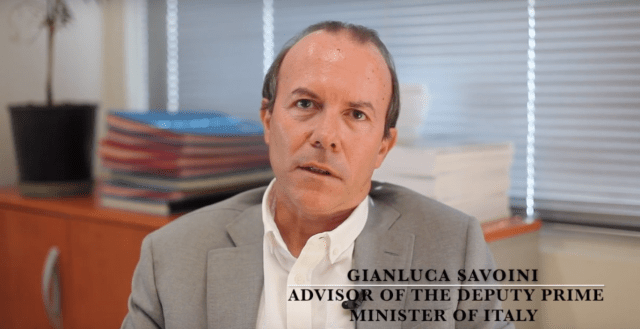
Nardelli assumes the Russian government was behind the operation — although no proof has been presented of this — and writes that “the real goal was to undermine liberal democracies and shape a new, nationalist Europe aligned with Moscow.” Nardelli presents Salvini, whom the unidentified Russians at the meeting call the “European Trump,” as under Putin’s thumb, representing a key asset for the Russian leader because of Salvini’s recent electoral victory.
A weakness in the allegation of illicit financing, however, is that the scheme allegedly discussed would have involved sales from a Russian company (Rosneft or Lukoil) to the Italian state oil company ENI, to be processed through the Russian branch of the Italy’s largest bank, Intesa Sanpaolo and both Italian companies strongly deny any knowledge of the proposed scheme. Given their importance to the country’s economy and institutions, they represent interests that go far beyond the League’s control.
Fallout for the League
The investigation is proceeding rapidly, both in the courts and in the press, and is likely to focus on the close ties developed between League operators and Russian political and economic actors. Italian investigators are seeking anything that looks suspicious, even if plans weren’t implemented.
The allegations have caused considerable political fallout in Italy, putting Salvini – a firebrand who has become Italy’s most polarizing politician — on the defensive. The opposition Democratic Party (Pd) has called for his resignation. More importantly, the League’s coalition partner, the Five-Star Movement (M5S) — which took a drubbing in the May 26 European elections, while the League doubled its vote total and became the top party in Italy — now seems intent on exploiting Salvini’s moment of weakness to regain momentum.
The two parties have not reached a full-blown crisis. But the League appears to be getting backed into a corner and the risks of a fall are raised for Europe’s only populist government that has fully supplanted traditional ruling parties, based on its sharp criticism of EU policies on limiting social spending and public investment.
Such a result would be welcomed by the Western liberal establishment in general, but could open the door for an even more aggressive form of populism in the future. Early indications are that even the latest scandal has not cut into the League’s support, which continues to grow in the polls.
Other Cases Brought to Mind
The case follows that of former Austrian Vice-Chancellor Heinz-Christian Strache, who also challenged the mainstream view of Russia as an imminent threat to the West.
In 2017, before his right-wing party entered the government, Strache was filmed, while drinking heavily, promising public contracts to a woman claiming to be the niece of a Russian oligarch in exchange for funding for his party. As Spiegel online, one of the German press outlets that published the video, reported: “The meeting was a trap.” The woman was not who she said she was, and the video ended up being used to bring about the fall of the Austrian government. Strache claims he was set up by a foreign intelligence service.

Heinz-Christian Strache in 2008. (Christian Jansky, CC BY-SA 3.0, Wikimedia Commons)
The film was published in May with the desired effect: Strache was forced to resign, putting pressure on rightwing political parties that have been critical of the EU’s decision to maintain sanctions on Russia, such as the League, the National Rally in France and Alternative for Germany.
Of course the prime example of discrediting by association with Moscow is Russiagate.
As former CIA analyst Larry C. Johnson has documented in detail, the numerous contacts between people around President Donald Trump and intermediaries offering damaging information on former Secretary of State Hillary Clinton, or contacts for political or business operations in Russia, were initiated and promoted not by Trump’s side, but by individuals who in many cases have worked for the FBI, the CIA, or the British intelligence service MI-6.
Grounds for Skepticism
Read in light of that precedent, Buzzfeed’s coverage of Savoini’s conversation in Moscow gives grounds for skepticism.
Buzzfeed has been listed as a media target for reports and studies by the “Integrity Initiative,” a British government-funded network of spies, journalists and think-tanks in the United Kingdom that has targeted politicians and other public figures who are alleged to be too pro-Russian.
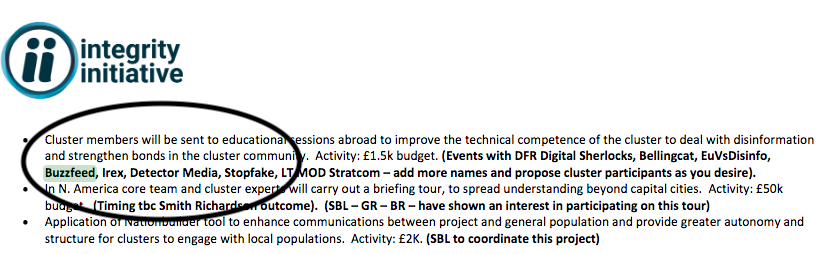
Section of Integrity Initiative “handbook” published by the Anonymous hactivist group in November 2018 about the group’s media strategy where Buzzfeed is named.
At the end of 2018, British Member of Parliament Chris Williamson responded to revelations about the Integrity Initiative’s media-influence activities by demanding answers about government funding for the group’s targeting of Labour Party Leader Jeremy Corbyn, another politician who often goes against the neoconservative and neoliberal mainstream, this time on the left.
Buzzfeed also has a blemished history with other Russian-meddling allegations. In January, Buzzfeed reporters Jason Leopold and Anthony Cormier authored the bombshell article, “President Trump Directed His Attorney Michael Cohen To Lie To Congress About The Moscow Tower Project.” Former Special Counsel Robert Mueller’s spokesman promptly called the report “not accurate,” but not before it had been picked up by many large media outlets.
Scandal Hits at Delicate Time
The Italian Russiagate comes at a delicate time. The League has long stated its intention to fight for the removal of sanctions against Russia over Ukraine, and in the past has even called for recognizing the 2014 referendum by which Crimea joined Russia, a move considered unacceptable by NATO countries.
From my own contacts in Italy, I know that these positions have, in recent years, worried U.S. diplomats who saw that Salvini’s party was on the rise and were wary of his pro-Russia stance. In response, they did their best to cultivate a relationship with League leaders, with the aim of cooling the party’s attitude towards Moscow in the event it made its way into government, as happened.
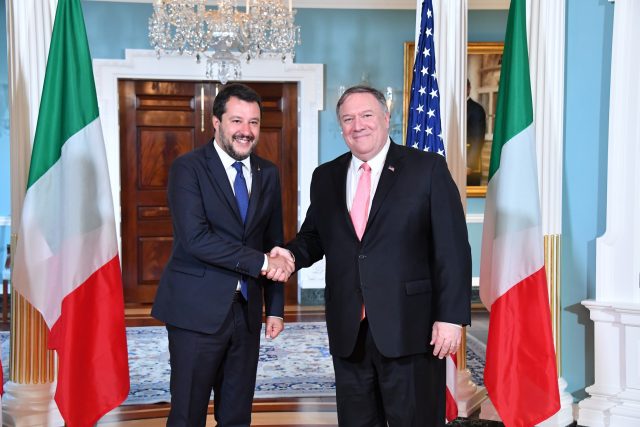
Italian Deputy Prime Minister Matteo Salvini, on left, with U.S. Secretary of State Michael R. Pompeo, in D.C., June 17, 2019. (State Department/Michael Gross)
The strategy seems to have worked, for the most part: now that the League is one of the two parties governing the country, it has stopped talking about Crimea, and has not blocked continued EU sanctions on Russia. In June, the European Council, which includes the Italian prime minister, extended the sanctions for another year.
The League has also taken public steps to reassure the United States of its loyalty to the Atlantic Alliance, after concerns were raised about Italy’s position when it became the first G-7 country to formally join the Chinese-led Belt and Road Initiative in March. After that, Salvini and Chief of Staff Giancarlo Giorgetti moved quickly to dampen fears in Washington about Italy distancing itself from Washington.
On the other hand, a state visit to Italy by Russian President Vladimir Putin at the beginning of July showed that Italian institutions are still eager to maintain good relations with Russia.
The Italians hope to leverage Trump’s desire for a shift towards Russia, while still swearing their allegiance to whatever other line comes out of Washington.
After Salvini’s June 17 meeting with Pompeo and Vice President Mike Pence in Washington, the Italian press reported that the Americans want to see more in terms of alignment not only on Russia, but also on Venezuela, Iran, and China.
Paolo Mastrolilli of the daily La Stampa wrote (in Italian) that Pompeo played the hard cop in the meetings, and intends to wait to see if Salvini will keep his promises to stay in line with the State Department before further advancing relations. Mastrolilli also reported that Pompeo is worried by reports that the League may have received help from the Kremlin.
Andrew Spannaus is a journalist and political analyst based in Milan, and the elected chairman of the Milan Foreign Press Association. His latest book is “Original Sins. Globalization, Populism, and the Six Contradictions Facing the European Union,” published in May 2019.
Soros, Fake News & Italian Media: Journalist Reveals Plot to Put Rome Under Austerity
Sputnik – January 20, 2019
Sputnik Italia contributor Alessio Trovato investigates the purpose of George Soros’ recent closed-door meeting with European Commission vice-president Frans Timmermans, and broader campaign to convince Brussels to put Italy under the supervision of the ‘troika’ (the European Central Bank, the EC and the International Monetary Fund).
George Soros, a sworn enemy of the present right-populist coalition government in Rome, has been on something of a mission to put Italy under austerity, with Italian media reporting on such efforts going back to at least 2011. Last October, in an explosive interview for Italian TV, former Prime Minister Mario Monti revealed that Soros had called him at the height of the European sovereign debt crisis eight years ago, urging Italy to accept ‘assistance’ from the IMF to dig out from under its debt problem. Monti refused at the time, saying following Soros’ advice would have turned Italy into another Greece.
On November 26, 2018, in a meeting in Brussels with Timmermans, along with a representative of EC President Jean-Claude Juncker, Soros was again assumed to have brought up the debt issue, with Italian media speculating heavily regarding the vague comments of an EC spokesperson, who said only that they “cannot confirm or deny whether Italy’s budget was discussed.”
Meanwhile, Sputnik Italia contributor Alessio Trovato writes, Soros’ Open Society Foundations has been cutting paychecks “to a considerable number of journalists and influencers whom (surprise) constantly refer to him as a ‘benefactor’ and ‘spontaneously’ support all of his campaigns, including his support for migration, mondialism, Russophobia and colour revolutions.”
A big part of the problem, according to Trovato, is that the mainstream media continues to completely ignore Soros’ activities, or to report on them only with reluctance, even as the billionaire seeks to interfere in democratic processes and the internal affairs of sovereign nations.
Soros’ Agents in Mainstream Media vs. Italy’s National Interest
“Even journalists who do not receive ‘favours’ from the magnate are either incapable of saying anything on this subject or prefer not to do so,” Trovato wrote. “Hence we come to the case of Ivo Caizzi, Luciano Fontana and Federico Fubini, who are likely to become a classic in the annals of Italian journalism, and show the battle for journalistic independence being waged inside the mainstream media.”
Late last year, Caizzi, the Brussels correspondent of Italy’s highly influential Corriere della Sera newspaper, leaked internal email communications accusing Fubini, the paper’s chief economics commentator, and Fontana, its executive director, of publishing ‘Fake News’ in November about ‘inevitable sanctions’ against Italy for its violation of EU budget legislation. In reality, Rome managed to avoid sanctions, reaching a compromise deal with Brussels in December. However, reports of imminent sanctions from a respectable mainstream newspaper are thought to have threatened the country’s economic stability.Last week, Caizzi wrote an open letter to his employers, asking them to respond to several serious questions in the interests of the newspaper, his fellow journalists, and readers. In the editorial, the journalist asked whether editor-in-chief Fontana’s behaviour has been corrected, and whether it would be appropriate for Fontana to limit himself to expressing his personal opinions to editorials, op-eds and comments. Caizzi asked whether reports of ‘imminent sanctions’ could have adversely affected the financial markets and played in the hands of speculators (who, incidentally, include Soros) betting on the Italy’s destabilization, the collapse of the country’s stock market, and the growth of yields on Italian government obligations.
“Can we hope that in 2019, Corriere will return to its motto of ‘providing independent and high-quality information and ensuring maximum reliability of the news from the first to the last page?” Caizzi asked.
Commenting on the editorial, Trovato suggested that “even the rebellious Caizzi” did not comment on two issues which “he is certainly aware of.”
Specifically, Trovato noted, “Soros met Frans Timmermans behind closed doors in Brussels [in November]. The 88-year-old Soros is not one to head off to Brussels for no reason. If he is talking to someone, it means he has something to ask, or offer. Mr. Timmermans is not just anybody, but the so-called ‘spitzenkandidad’, the lead candidate for the presidency of the European Commission in the event of victory for the socialists and the democrats in the upcoming elections to the European Parliament. What did they talk about? A trifle –Soros seems to have asked Timmermans to take measures so that the European Commission rejects the Italian tax maneuver to allow the troika to be brought to Italy. In effect, Soros essentially asked Juncker’s deputy… to turn Italy into the same kind of hostage to the EU as Greece. In this sense, [Corriere’s reporting] turned Italian media into a sort of fifth column, preparing the markets for the upcoming speculative moves from the inside.”
Secondly, the journalist noted, Federico Fubini is a member of the European Advisory Board of the Open Society Foundations, and, ironically, on the European Commission’s ‘expert group on Fake News’.
“The point is, how can one believe that Europe is struggling against Fake News when it also produces it? Can we believe in the impartially of information published thanks to the ‘donations of generous and disinterested benefactors’?” Trovato asked.
Ultimately, the Sputnik Italia contributor noted, “our only chance for survival lies in being aware of what’s going on and in our own analytical skills. Discuss, doubt and check everything – otherwise you will never understand who you’re up against. Maybe it’s a troll – an agent of the Kremlin, or perhaps someone funded by the Open Society, the Aspen Institute, the Bilderbergs, the Atlantic Council, the CIA, Mossad, the FSB, a proponent of the troika trojan horse, or just about anyone else. Never trust! Even those who tell you not to believe anyone!”
The Nuclear Lies of NATO’s Jens Stoltenberg. Brand New “Precision Guidance” Nukes Deployed All Over Europe
By Manlio Dinucci | Global Research | November 30, 2018
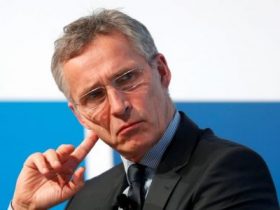 “Russian missiles are a danger” – the alarm was sounded by the Secretary General of NATO, Jens Stoltenberg, in an interview with Maurizio Caprara published in the Corriere della Sera*, three days before the “incident” in the Sea of Azov which added fuel to the already incandescent tension with Russia. “There are no new missiles in Europe. But there are Russian missiles, yes”, began Stoltenberg, ignoring two facts.
First: as from March 2020, the United States will begin to deploy in Italy, Germany, Belgium, and Holland (where B-61 nuclear bombs are already based), and probably also in other European countries, the first nuclear bomb with precision guidance in their arsenal, the B61-12. Its function is primarily anti-Russian. This new bomb is designed with penetrating capacity, enabling it to explode underground in order to destroy the central command bunkers with its first strike. How would the United States react if Russia deployed nuclear bombs in Mexico, right next to their territory? Since Italy and the other countries, violating the non-proliferation Treaty, are allowing the USA to use its bases, as well as its pilots and planes, for the deployment of nuclear weapons, Europe will be exposed to a greater risk as the first line of the growing confrontation with Russia.
Second: a new US missile system was installed in Romania in 2016, and another similar system is currently being built in Poland. The same missile system is installed on four warships which, based by the US Navy in the Spanish port of Rota, sail the Black Sea and the Baltic Sea close to Russian territory. The land-based installations, like the ships, are equipped with Lockheed Martin Mk41 vertical launchers, which – as specified by the manufacturer himself – are able to launch “missiles for all missions: either SM-3’s as defence against ballistic missiles, or long-range Tomahawks to attack land-based objective”. The latter can also be loaded with a nuclear warhead. Since it is unable to check which missiles are actually loaded into the launchers parked at the frontier with Russia, Moscow supposes that there are also nuclear attack missiles, in violation of the Intermediate-Range Nuclear Forces Treaty, which forbids the installation of intermediate- and short-range missiles on land bases.
On the contrary, Stoltenberg accuses Russia of violating the INF Treaty, and sends out a warning:
“We can not allow the Treaties to be violated without punishment”.
In 2014, the Obama administration accused Russia, without providing the slightest proof, of having tested a Cruise missile (SSC-8) from a category forbidden by the Treaty, announcing that “the United States are considering the deployment of land-based missiles in Europe”, in other words, the abandon of the INF Treaty. This plan, supported by the European allies of NATO, was confirmed by the Trump administration: in the fiscal year of 2018, Congress authorised the financing of a programme of research and development for a Cruise missile to be launched from a mobile platform.
Nuclear missiles of the Euromissile type, deployed by the USA in Europe during the 1980’s and eliminated by the INF Treaty, are capable of hitting Russia, while similar nuclear missiles deployed in Russia can hit Europe but not the USA. Stoltenberg himself, referring to the SSC-8’s that Russia had deployed on its own territory, declared that they are capable of reaching most of Europe, but not the United States. This is how the United States defends Europe.
And in this grotesque affirmation by Stoltenberg, who attributes to Russia “the highly perilous idea of limited nuclear conflict”, he warns:
“All atomic weapons are dangerous, but those which can lower the threshold for use are especially so”.
This is exactly the warning sounded by US military and scientific experts about the B61-12’s which are on the verge of being deployed in Europe:
“Low-powered, more accurate nuclear weapons increase the temptation of using them, even to using them first instead of as a retaliation”.
Why is the Corriere della Sera not going to interview them?
Source: PandoraTV
This article was originally published in Italian on Il Manifesto.
Translated by Pete Kimberley
Manlio Dinucci is a Research Associate of the Centre for Research on Globalization.
Note
*The Corriere della Sera is a historical Italian daily newspaper, founded in Milan in 1876. Published by RCS MediaGroup, it is the most important Italian daily in terms of distribution and the number of readers.
UAE to invest in Israeli plan to pipe gas to Europe
Press TV – November 25, 2018
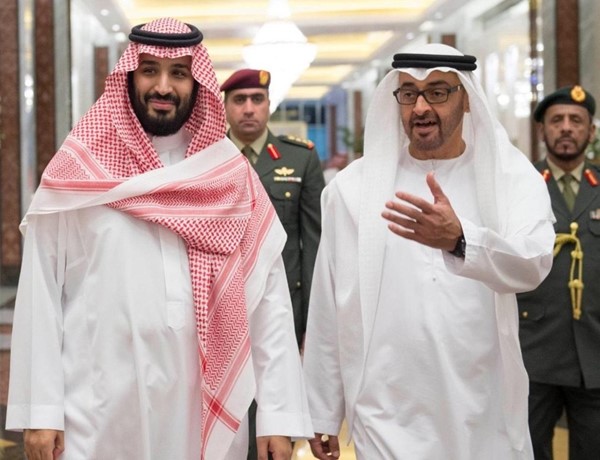
The media in Tel Aviv have reported that the UAE has invested as much as $100 million in an ambitious Israeli project to pipe natural gas to Europe.
The investment would be made by a company based in Abu Dhabi for a pipeline project which is internationally known to be unique given its record length as well as the extreme depths it would be laid toward Europe, Lebanon’s al-Mayadeen quoted Israeli media as reporting.
The agreement has been described as “historic” by Israeli media, al-Mayadeen added.
Israel has signed a multilateral deal over the scheme – called the East Med Pipeline Project – with Greece, Italy and Cyprus. The European Union also supports the project.
The East Med Pipeline Project is to start about 170 kilometers (105 miles) off Cyprus’s southern coast and stretch for 2,200 kilometers (1,350 miles) to reach Otranto, Italy, via Crete and the Greek mainland, according to a report by The Times of Israel news website.
The pipeline will have the capacity to carry up to 20 billion cubic meters (706 billion cubic feet) of gas from Israeli fields each year. Europe’s gas import needs are projected to increase by 100 billion cubic meters (3.5 billion cubic feet) annually by 2030.
Work on the project is expected to begin within a few months, and to conclude within five years.
UAE’s investment in the project could trigger protests in the Muslim world. The Emirates has already taken moves to approach Tel Aviv with speculations recently emerging that it has even involved itself in certain military operations by Israel on Gaza.
Last December, Israel’s Energy Minister Yuval Steinitz said a study on the project showed that the project is feasible, even though it presents technical challenges due to the depths involved and has an estimated cost of 6.2 billion euro ($7.36 billion).
Israel has already engaged in disputes with Lebanon over tapping into Mediterranean energy resources.
Last February, Israel described as “very provocative” a Lebanese tender for projects in two of its 10 offshore blocks in the Mediterranean Sea.
Israel itself has long been developing a number of offshore gas deposits in the Mediterranean Sea, with the Tamar gas field, with proven reserves of 200 billion cubic meters, already producing gas, while the larger Leviathan field is expected to go online in the coming months.
A source close to Israeli Prime Minister Benjamin Netanyahu said in 2012 that Israel’s natural gas reserves were worth around $130 billion. A Business Week estimate later that year put the reserves’ value at $240 billion.
Italy Slows Down Purchases of US F-35 Jets to Cut Spending – Reports
Sputnik – 12.11.2018
The previous government ordered some 90 of the fifth-generation jets for its military, but the Five Star and Lega parties, which won the last election, have been trying to either scrap the deal or reduce spending on it.
The Italian government is planning to reduce the number of F-35 jets it will buy over the next five years from 10 to six or seven aircraft, Defence News reported citing an anonymous source. According to the media outlet, Rome will not reduce the total amount of ordered jets, but instead will leave the final decision on their fate to the next government.
The move will allow Italy to avoid or reduce contract penalties and free up some resources for the government’s commitments, Defence Minister Elisabetta Trenta told the media earlier.
“What I would like to do is lighten the load, since we have other spending commitments in Europe. We will try to stretch out deliveries instead of cutting the order, which would reduce offsets and mean penalties,” she said.
The outlet’s source added that the money saved by postponing the delivery of three or four of the F-35 jets will help Rome fund its social programs and tax cuts.
Earlier, a member of the now-ruling Five Star party in the Italian parliament, Tatiana Basilio, vowed in 2017 that the country will scrap the contract for the delivery of F-35 warplanes. Italy intends to buy a total of 90 of the fifth-generation jets. Eight jets have already been delivered to Amendola air base, and three others are being used to train pilots in the US.
US Blocks $199Mln in Assets Belonging to Iran, Syria, N Korea in 2017 – Treasury
Sputnik – 07.11.2018
WASHINGTON – The United States blocked nearly $200 million in assets belonging to Syria, Iran, and North Korea in 2017 as a result of the sanctions imposed on the three countries, the Treasury Department said in its annual report to Congress released on Wednesday.
“Approximately $199 million in assets relating to the three designated state sponsors of terrorism in 2017 have been identified by OFAC as blocked pursuant to economic sanctions imposed by the United States,” the report said.
The statement comes days after the US fully reinstated sanctions against Iran, including measures that curb Tehran’s oil industry. At the same time, the United States temporarily exempted eight nations — China, Greece, India, Italy, Japan, South Korea, Taiwan and Turkey — from the sanctions on importing oil from Iran.
In May, US President Donald Trump announced that the United States would withdraw from the Iran nuclear agreement, officially known as the Joint Comprehensive Plan of Action, and reimpose sanctions against Tehran that were previously lifted under the accord, including secondary restrictions.
The first round of the US sanctions was reimposed in August, while the second round, targeting over 700 Iranian individuals, entities, banks, aircraft and vessels, came into force this week.
US Nuclear Missiles Deployed in Italy, … against Russia
By Manlio Dinucci | Global Research | October 18, 2018
The B61-12, the new US nuclear bomb which replaces the B-61 deployed in Italy and other European countries, will begin production in less than a year. The announcement was made officially by the National Nuclear Security Administration (NNSA). It reveals that the revision of the final project has now been completed with success, and the qualification stage will begin this month at the Pantex Plant in Texas. Production will be authorised to begin in September 2019.
In March 2020, the first unit of production will begin fabricating a series of 500 bombs. As from that time, in other words in about a year and a half, the United States will begin the anti-Russian deployment in Italy, Germany, Belgium, Holland and probably certain other European countries, of the first nuclear bomb in their arsenal with a precision guidance system. The B61-12 is designed with penetrating capacity, built to explode underground in order to destroy bunkers housing command centres.
Since Italy and the other countries, in violation of the Non-Proliferation Treaty, are offering the USA the bases, the pilots and the aircraft for the deployment of the B61-12, Europe will soon be exposed to a greater risk as the front line of the developing nuclear confrontation with Russia.
An even more dangerous situation appears at the same moment – the return of the Euromissiles, meaning the nuclear missiles which are similar to those deployed in Europe in the 1980’s by the USA, with the official aim of defending against Soviet missiles.
Source: PandoraTV [English subtitles]
This category of ground-based nuclear missiles of intermediate range (between 500 and 5,500 km) were eliminated with the INF Treaty of 1987. But in 2014, the Obama administration accused Russia of having experimented with a cruise missile (# 9M729) whose category was forbidden by the Treaty. Moscow denied that the missile violated the INF Treaty and, in turn, accused Washington of having installed in Poland and Romania launch ramps for interceptor missiles (elements of the “shield”), which could be used to launch cruise missiles bearing nuclear warheads.
The accusation aimed by Washington at Moscow, which is not supported by any evidence, enabled the USA to launch a plan aimed at once again deploying in Europe ground-based intermediate-range nuclear missiles. The Obama administration had already announced in 2015 that “faced with the violation of the INF Treaty by Russia, the United States are considering the deployment of ground-based missiles in Europe”. This plan was confirmed by the Trump administration – in fiscal year 2018, Congress authorised the financing of a “programme of research and development for a cruise missile which could be launched from a mobile road base”.
The plan is supported by the European allies of NATO. The recent North-Atlantic Council, at the level of Europe’s Defence Ministers, which was attended for Italy by Elisabetta Trenta (M5S), declared that the “INF Treaty is in danger because of the actions of Russia”, which it accused of deploying “a disturbing missile system which constitutes a serious risk for our security”. Hence the necessity that “NATO must maintain nuclear forces which are stable, trust-worthy and efficient” (which explains why the members of the Alliance rejected en bloc the United Nations Treaty for the prohibition of nuclear weapons).
So the grounds are being laid for a European deployment, on the borders of Russian territory, of ground-based intermediate-range US nuclear missiles. It’s as if Russia were deploying in Mexico nuclear missiles pointed at the United States.
This article was originally published in Italian on Il Manifesto.
Read more:
Illegal US Nuclear Weapons Handouts
By John Laforge | CounterPunch | September 27, 2018
The US military practice of placing nuclear weapons in five other countries (no other nuclear power does this) is a legal and political embarrassment for US diplomacy. That’s why all the governments involved refuse to “confirm or deny” the practice of “nuclear sharing” or the locations of the B61 free-fall gravity bombs in question.
Expert analysts and observers agree that the United States currently deploys 150-to-180 of these nuclear weapons at bases in Germany, Italy, The Netherlands, Turkey and Belgium. The authors of the January 2018 report “Building a Safe, Secure, and Credible NATO Nuclear Posture” take for granted the open secret that nuclear sharing is ongoing even though all six countries are signatory parties to the Treaty on the Nonproliferation of Nuclear Weapons (NPT).
In a paper for the journal Science for Democratic Action, German weapons expert Otfried Nassauer, director of Berlin’s Information Center for Transatlantic Security, concluded, “NATO’s program of ‘nuclear sharing’ with five European countries probably violates Articles I and II of the Treaty.”
Article I prohibits nuclear weapon states that are parties to the NPT from sharing their weapons. It says: “Each nuclear-weapon State Party to the Treaty undertakes not to transfer to any recipient whatsoever nuclear weapons or other nuclear explosive devices or control over such weapons or explosive devices directly, or indirectly….” Article II, the corollary commitment, states says: “Each non-nuclear weapon State Party to the Treaty undertakes not to receive the transfer from any transferor whatsoever of nuclear weapons or other nuclear explosive devices or of control over such weapons or explosive devices directly, or indirectly … or otherwise acquire nuclear weapons or other nuclear explosive devices….”
What nuclear sharing means in practice
The five NATO countries currently hosting US H-bombs on their air bases are officially “non-nuclear weapons states.” But as Nassauer reports, “Under NATO nuclear sharing in times of war, the US would hand control of these nuclear weapons over to the non-nuclear weapon states’ pilots for use with aircraft from non-nuclear weapon states. Once the bomb is loaded aboard, once the correct Permissive Action Link code has been entered by the US soldiers guarding the weapons, and once the aircraft begins its mission, control over the respective weapon(s) has been transferred. That is the operational, technical part of what is called ‘nuclear sharing.’”
This flaunting of the NPT is what peace activists on both sides of the Atlantic refer to when calling the US bombs in Europe “illegal.” Nassauer notes, “The pilots for these aircraft are provided with training specific to use nuclear weapons. The air force units to which these pilots and aircraft belong have the capability to play a part in NATO nuclear planning, including assigning a target, selecting the yield of the warhead for the target, and planning a specific mission for the use of the bombs.”
“NATO nuclear sharing,” Nassauer writes, “was described in 1964 by one member of the US National Security Council … as meaning that ‘the non-nuclear NATO-partners in effect become nuclear powers in time of war.’ The concern is that, at the moment the aircraft loaded with the bomb is on the runway ready to start, the control of the weapon is turned over from the US, a nuclear weapon state, to non-nuclear weapon states. … To my understanding, this is in violation of the spirit if not the text of Articles I and II of the NPT.”
How Do the US and its Allies Explain their Lawlessness?
An undated, 1960s-era letter from then-US Secretary of State Rusk explained the US ‘interpretation’ of the NPT. The pretext for ignoring the treaty’s plain language, the Rusk letter “argues that the NPT does not specify what is allowed, but only what is forbidden. In this view, everything that is not forbidden by the NPT is allowed,” Nassaure explained.
In its most absurd section, Rusk simply denies the treaty’s obvious purpose and intent. “Since the treaty doesn’t explicitly talk about the deployment of nuclear warheads in countries that are non-nuclear weapon states,” Nassaure writes, “such deployments are considered legal under the NPT.”
It is so easy to show that the United States and its nuclear sharing partners are in violation of the NPT, the governments involved work hard pretending there is nothing to worry about, no lawbreaking underway, no reason to demand answers. This is why so many activists across Europe have become nonviolently disobedient at the air bases involved.
The transparent unlawfulness of NATO’s nuclear war planning is also the reason why prosecutors in Germany don’t dare bring serious charges against civil resisters; even those who have cut fences and occupied hot weapons bunkers in broad daylight. Some Air Force witness might testify at trial that US nuclear weapons are on base.
John LaForge is a Co-director of Nukewatch, a peace and environmental justice group in Wisconsin, and edits its newsletter.
Italy’s NATO Racket… A Bridge Too Far
By Finian CUNNINGHAM | Strategic Culture Foundation | 16.08.2018
The catastrophic bridge collapse in Italy this week has prompted a public outcry over the country’s crumbling infrastructure and how it is putting lives at risk. But the question the public in Italy and across Europe should be asking is: why are their governments spending extra tens of billions of dollars on NATO militarism, while neglecting vital civilian infrastructure?
When the iconic Morandi motorway viaduct came crashing down this week over the city of Genoa – with a death toll so far of 39 people – the consensus among Italian news media and members of the public is that the bridge was a disaster waiting to happen.
Nearly 200 meters of the motorway flyover section spanning a river, houses and an industrial area collapsed while dozens of cars and trucks were passing. Shocked witnesses described the scene as “apocalyptic” as vehicles plunged 40 meters along with concrete and iron girding to the ground below.
Lack of due maintenance has been blamed for why the bridge collapsed. Weather conditions at the time were reportedly torrential rain storms and lightning. But those conditions can hardly explain why a whole motorway viaduct wobbled and crashed.
The Morandi Bridge was built 51 years ago in 1967. Two years ago, an engineering professor from Genoa University warned that the viaduct needed to be totally replaced as its structure had seriously deteriorated. There seems little doubt that the disaster could have been avoided if proper action had been taken by the authorities rather than carrying out piecemeal repair jobs over the years.
Italian media reports say the latest is the fifth bridge collapse in the country over the past five years, as cited by the BBC.
Now the Italian government is calling for a nationwide survey of roads, tunnels, bridges and viaducts to assess public safety amid fears that other infrastructure facilities are prone to deadly failure.
What should be a matter of urgent public demand is why Italy is increasing its national spending on military upgrades and procurements instead of civilian amenities. As with all European members of the NATO alliance, Italy is being pressured by the United States to ramp up its military expenditure. US President Donald Trump has made the NATO budget a priority, haranguing European states to increase their military spending to a level of 2 per cent of Gross Domestic Product (GDP). Trump has even since doubled that figure to 4 per cent.
Washington’s demand on European allies predates Trump. At a NATO summit in 2015, when Barack Obama was president, all members of the military alliance then acceded to US pressure for greater allocation of budgets to hit the 2 per cent target. The alleged threat of Russian aggression has been cited over and over as the main reason for boosting NATO.
Figures show that Italy, as with other European countries, has sharply increased its annual military spending every year since the 2015 summit. The upward trend reverses a decade-long decline. Currently, Italy spends about $28 billion annually on military. That equates to only about 1.15 per cent of GDP, way below the US-demanded target of 2 per cent of GDP.
But the disturbing thing is that Italy’s defense minister Elisabetta Trenta reportedly gave assurances to Trump’s national security advisor John Bolton that her government was committed to hitting its NATO target in the coming years. On current figures that translates roughly into a doubling of Italy’s annual military budget.
Meanwhile, the Italian public have had to endure years of economic austerity from cutbacks in social spending and civilian infrastructure.
Rome’s new coalition government comprising the League and Five Star Movement has called for a reversal in austerity policies and has vowed to increase public investment. Its leaders, like deputy prime minister Matteo Salvini, have also at times expressed a lukewarm view of NATO.
After this week’s bridge disaster, the populist coalition government has renewed its calls for more investment in public services.
Nevertheless, why then is Italy’s defense minister giving assurances that the country will adhere to Washington’s demands for increasing its NATO budget? Minister Trenta, who belongs to the Five Star Movement, says her government remains committed to buying up to 90 units of the US new-generation F35 fighter jet.
Aggregate figures show that Italy spent nearly $300 billion over the past decade on military. The previous decade’s outlay was even higher in constant dollar terms, before the financial crash in 2008. And yet the Italian government – despite its populist appeal – is planning to allocate even more resources to military over the coming years in order to meet Washington’s ultimatum for the NATO 2 per cent of GDP target. A target figure that seems wholly arbitrary and abhorrent in the light of so many urgent social needs and neglected public infrastructure.
If Italian motorway bridges are collapsing now, the future for public safety looks even bleaker when more of the country’s economy is diverted to satisfy US-led NATO demands.
Moreover, this dilemma is not confined to Italy. All European members of NATO are being railroaded by Washington to significantly expand their military budgets. President Trump has lambasted European states as “free loaders” cadging off “American protection”. Trump has singled out Germany for harassment to boost its military budget. After all the hectoring, the Europeans seem to be responding too. At the annual NATO summit held last month in Brussels, the Norwegian secretary-general Jens Stoltenberg boasted that non-US members had increased their national military budgets by an aggregate $40 billion in one year alone.
A cruel irony is that last year NATO planners complained that Europe’s infrastructure of roads, tunnels and bridges needed significant upgrades to facilitate mass-transport of military forces in case of a war with Russia. The implication was that European governments would have to increase their national spending on civilian transport networks specifically to facilitate NATO military requirements.
That is tantamount to a parasite craving for more blood from its host. Already European infrastructure is in disrepair largely because of economic austerity enforced by disproportionate spending on NATO militarism. At a time when public need for social investment is acute, European governments are obeying orders from Washington to plough more financial resources into subsidizing the American military-industrial complex. All this madcap, irrational expenditure is supposedly to keep European citizens safe from Russian threats.
All too evidently, however, the biggest threat to European citizens is the way Washington and its NATO racket is bleeding Europe of financial resources – resources which instead should be spent on building safe roads, bridges and other infrastructure.
Featured Video
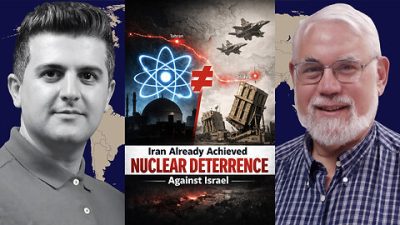
Prof. Ted Postol: Iran Already Achieved Nuclear Deterrence Against Israel
or go to
Aletho News Archives – Video-Images
From the Archives
How the occupied mentality syndrome works
Saudi Arabia on the American chessboard – Part 3
By B. J. Sabri | American Herald Tribune | June 27, 2016
Read part 2: “The occupied mentality Syndrome“
Previously I argued whether Saudi Arabia’s repeated involvements in U.S. interventions and wars stem from free national will or in response to a specific condition. For starters, in Saudi Arabia there is no national will. In Saudi Arabia, the national will is the will of the Al Saud clan. Still, when a major Arab state allies itself with a superpower that committed unspeakable crimes against humanity in almost every Arab country, then something is wrong. This fact alone should compel us to examine the U.S.-Saudi relation for one exceptional reason. As a result of the U.S.-Saudi wars, hundreds of thousands of people in Afghanistan, Iraq, Iran, Libya, Syria, Yemen, and Somalia have lost their lives. Millions became displaced in their own homelands. And millions more rendered refugees.
Attributing the Saudi policies to the bonds of “partnership” with the U.S. is frivolous. There are no bonds between these two thugs except those of business, military deals, secret plots, and wars. Proving this point, bonds such as these have no space for the American and Saudi peoples to share significant cultural or societal exchanges. If partnership is not the reason for the Saudi contribution to the U.S. strategy of empire and imperialism, then another reason must exist.
This leads to three possibilities. … continue
Blog Roll
 Aletho News
- REWRITING THE RISK? INSIDE THE GOVERNMENT’S VACCINE SAFETY MESSAGING
- “Davos Can Really Replace the UN”
- NIAID/NIH and USDA Fund Bioengineered Chimeric Influenza Viruses Built Using Pandemic H1N1 Components: Journal ‘Science Advances’
- Hezbollah hits Israeli warship off Lebanon’s coast, sets it aflame
- Iran slams US strikes on B1 bridge, Mahshahr petrochemical plants as ‘blatant acts of state terrorism’
- In letter to UN chief, Araghchi warns of dire consequences of US-Israeli attacks on Iran’s nuclear facilities
- Why the CIA conspiracy to invade Iran with Kurdish militias failed
- Why Are Upbeat US Claims About Mission to Rescue Pilot ‘Highly Questionable’?
- Aircraft destroyed during US ‘rescue’ of downed F-15 pilot cost more than $100 million each
- Washington University removes professor who condemned US-Israeli war on Iran
- If Americans Knew
- In Iran, Israel-US take aim at “reason, research, and freedom of thought” – Daily Update
- US loses planes over Iran, Israel downgrades Lebanon war goals – Daily Update
- Israel Is Blocking Palestinians from Easter at Church Where Jesus Resurrected
- Plot to assassinate Palestinian activist follows harassment campaign promoted by Zionist groups and elected officials
- Prominent New York synagogue hosts presentation on why U.S. Jews should support the ethnic cleansing of Gaza
- Tapper vs. Piker: Is the CNN Anchor Auditioning for David Ellison?
- Shouldn’t Democrats Be Able to Condemn Genocide?
- Israel-US kill negotiators, destroy civilian structures, but Iran’s military capabilities still largely intact – Daily Update
- ‘War crime’: Global condemnation as Israeli ministers celebrate death penalty law targeting Palestinian prisoners
- 7 Ways Israel Is Turning Lebanon Into Gaza
- No Tricks Zone
- An Inconvenient Tree: Uncovered In Alps… Europe Much Warmer Than Today 6000 Years Ago
- New Study Reports A 60% Slowdown In Greenland’s Ice Loss Rate In The Last Decade
- Low Intensity Tornado Wrecks Major Solar Farm, Creating A Potential Toxic Dump
- New Study Finds Warming Saves Lives…Cold Temperatures 12 Times More Deadly Than Excess Heat
- German Science Blog Accuses PIK Climate Institute Of Hallucinating Climate Tipping Points
- Devastating Assessment Of Comirnaty Vaccine By Former Senior Pfizer Europe Toxicologist
- New Study: CO2 Is ‘Effectively Negligible’ As An Explanatory Climate Change Factor Since 2000
- Former Pfizer Toxicologist Dr. Helmut Sterz Tells Bundestag Hearing Pfizer Vaccine Should Have Never Been Approved
- Energy Expert: Germany’s Nuclear Phaseout Was A “500 Billion Euro Mistake”
- New Research: South Australia’s Mid-Holocene Sea Surface Temperatures Were 4°C Warmer Than Today
 Aletho News