Even I was taken aback by the sheer scale of British active involvement in extraordinary rendition revealed by yesterday’s report of the parliamentary Intelligence and Security Committee. Dominic Grieve and the committee deserve congratulations for their honesty, integrity and above all persistence. It is plain from the report that 10 Downing Street did everything possible to handicap the work of the committee. Most crucially they were allowed only to interview extremely senior civil servants and not allowed to interview those actively engaged in the torture and rendition programme.
Theresa May specifically and deliberately ruled out the Committee from questioning any official who might be placed at risk of criminal proceedings – see para 11 of the report. The determination of the government to protect those who were complicit in torture tells us much more about their future intentions than any fake apology.
In fact it is impossible to read paras 9 to 14 without being astonished at the sheer audacity of Theresa May’s attempts to obstruct the inquiry. They were allowed to interview only 4 out of 23 requested witnesses, and those were not allowed “to talk about the specifics of the operations in which they were involved nor fill in any gaps in the timeline”. If the UK had a genuinely free media, this executive obstruction of the Inquiry would be the lead story. Instead it is not mentioned in any corporate or state media, despite the committee report containing a firm protest:
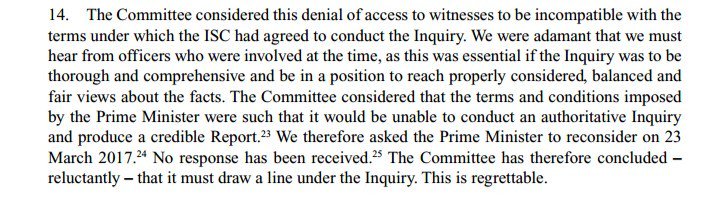
It is worth reflecting that the Tory government has acted time and time again to protect New Labour’s Tony Blair, David Miliband, Jack Straw and Gordon Brown from any punishment for their complicity in torture, and indeed to limit the information on it available to the public. The truth is that the Tories and New Labour (which includes the vast majority of current Labour MPs) are all a part of the same elite interest group, and when under pressure they stick together as a class against the people.
Despite being hamstrung by government, the Committee managed through exhaustive research of classified documents to pull together evidence of British involvement in extraordinary rendition and mistreatment of detainees on a massive scale. The Committee found 596 individual documented incidents of the security services obtaining “intelligence” from detainee interrogations involving torture or severe mistreatment, ranging from 2 incidents of direct involvement, “13 to 15” of actually being in the room, through those where the US or other authorities admitted to the torture, to those where the detainee told the officer they had been tortured. They found three instances where the UK had paid for rendition flights.
My own evidence to the Committee focused on the over-arching policy framework, and specifically the fact that Jack Straw and Richard Dearlove had agreed a deliberate and considered policy of obtaining intelligence through torture. The report includes disappointingly little of my evidence, as the Committee has taken a very narrow view of its remit to oversee the intelligence agencies. This is the only part of my evidence included:
130. This was not unique to the Agencies. Their sponsoring Departments appear to have adopted the same approach. We heard evidence from a former FCO official, Craig Murray, who suggested that “there was a deliberate policy of not committing the discussion on receipt of intelligence through torture to paper in the Foreign Office”.
In July 2004, when he was Ambassador to Tashkent, he raised concerns about the use of Uzbek intelligence derived from torture in a formal exchange of telegrams with the FCO. Mr Murray drew our attention to FCO documents from the same time, which we have seen, one of which referred to “meetings to look at conditions of receipt of intelligence as a general issue”. He told us that the meetings “specifically discuss[ed] the receipt of intelligence under torture from Uzbekistan” and “were absolutely key to the formation of policy on extraordinary rendition and intelligence”.
Mr Murray told us that, when he had given evidence to the Foreign Affairs Select Committee about this, they sought the documents from the FCO which replied that the “meetings were informal meetings and were not minuted ”. He went on to say:
“the idea that you have regular meetings convened at director level, convened by the Director of Security and Intelligence, where you are discussing the receipt of intelligence from torture, and you do not minute those meetings is an impossibility, unless an actual decision or instruction not to minute the meetings has been given.… Were it not for me and my bloody-mindedness, … you would never know those meetings had happened. Nobody would ever know those meetings had happened.”
131. We note that we have not seen the minutes of these meetings either: this causes us great concern. Policy discussions on such an important issue should have been minuted. We support
Mr Murray’s own conclusion that were it not for his actions these matters may never have come to light.
Jack Straw to this day denies knowledge and involvement and famously told Parliament that the whole story about rendition and torture was a “conspiracy theory”.
Unless we all start to believe in conspiracy theories and that the officials are lying, that I am lying, that behind this there is some kind of secret state which is in league with some dark forces in the United States, and also let me say, we believe that Secretary Rice is lying, there simply is no truth in the claims that the United Kingdom has been involved in rendition full stop, because we have not been, and so what on earth a judicial inquiry would start to do I have no idea. I do not think it would be justified.”
In fact I strongly recommend you to read the whole Hansard transcript, from Q21 to Q51, in which Jack Straw carries out the most sustained bravura performance of lying to parliament in modern history. The ISC report makes plain he was repeatedly involved in direct authorisations of rendition operations, while denying to parliament the very existence of such operations.
For over a decade now the British government, be it Red Tory or Blue Tory, has been refusing calls for a proper public inquiry into its collusion with torture. The ISC report was meant to stand in place of such an Inquiry, but all it has done is reveal that there is a huge amount of complicity in torture, much more than we had realised, which the ISC itself states it was precluded from properly investigating because of government restrictions on its operations. It also concluded in a separate report on current issues, that it is unable to state categorically that these practices have stopped.
The Blair and Brown governments were deeply immersed in torture, a practice that increased hatred of the UK in the Muslim world and thus increased the threat of terrorism. Their ministers repeatedly lied about it, including to parliament. The British state has since repeatedly acted to ensure impunity for those involved, from Blair and Straw down to individual security service officers, who are not to be held responsible for their criminal complicity. This impunity of agents of the state is a complete guarantee that these evil practices will continue.
June 29, 2018
Posted by aletho |
Deception, Subjugation - Torture, Timeless or most popular, War Crimes | Human rights, Jack Straw, Theresa May, UK, United States |
Leave a comment
Senior British politicians say the United States is “bullying” UK banks and is hampering legal exports from Britain to Iran.
The politicians, including former British Foreign Secretary Jack Straw and former Chancellor Lord Lamont, made the remarks at a Westminster Hall debate on Wednesday.
British parliamentarians say the US threatens British banks with heavy sanctions and hampers the legal exports of food, pharmaceuticals and medical devices from the UK to the Islamic republic. They add that Washington is hindering UK’s legal trade with Iran.
Lamont said Britain “should not be bullied by the American authorities.”
Straw noted that as British banks fear US sanctions, they do not provide UK companies with banking services for legal exports to Iran.
“The pressure on our banks is intense,” Straw said, adding, “The impact of this unilateral, extraterritorial jurisdiction of the US is discriminatory, especially against UK-based financial institutions, given their multinational nature.”
Straw also said the US authorities would not accept the way that British banks and companies are treated if they were in the same situation.
“The US Congress and government would not tolerate this for a moment were the situation reversed,” Straw stated, saying the move by the US is a direct challenge to the sovereignty of the UK.
Straw, who is also the British head of Iran-Britain Parliamentary Friendship Group, visited Iran at the head of a high-ranking delegation, including Lamont, Conservative lawmaker Ben Wallace and Labor lawmaker Jeremy Corbyn as guests of Iran’s Majlis in January.
The British delegates held meetings with high-ranking Iranian officials. The three-day official visit was the first by a delegation of British politicians since 2008.
Earlier this month, in remarks meant to dissuade foreign countries from planning trade cooperation with the Islamic Republic, US Secretary of State John Kerry said Iran is not an open market for business.
“We have made it crystal clear that Iran is not open for business,” Kerry said, addressing US Senators on Capitol Hill on March 13. He warned that the core sanctions against Iran remain firmly in place.
Several delegations from across the world have visited Iran over the past few months in order to boost trade and ties with the Islamic Republic.
March 27, 2014
Posted by aletho |
Economics, Wars for Israel | Britain, Iran, Jack Straw, John Kerry, United States |
Leave a comment
This week can be a turning point in the troubled history of relations between the United States and Iran. It is greatly to be hoped that President Obama will take the chance of meeting President Rouhani when they both attend the UN General Assembly in New York this week and that this will set the scene for a diplomatic breakthrough between the US and Iran.*
Significantly, President Rouhani was the head of Iran’s nuclear negotiating team in 2003-5 at a time when Iran was actively engaged in negotiations with Britain, France and Germany (aka EU3) about a range of issues including its nuclear programme.
Then Rouhani made a series of proposals that could, and should have led to a settlement – were a deal not blocked by George W Bush.
We know this because, as Britain’s Foreign Minister at the time, Jack Straw took part in these negotiations. Here’s what he said on the Today programme on 3 August 2013, the day that Hassan Rouhani was inaugurated as president:
“I’m absolutely convinced that we can do business with Dr Rouhani, because we did do business with Dr Rouhani, and had it not been for major problems within the US administration under President Bush, we could have actually settled the whole Iran nuclear dossier back in 2005, and we probably wouldn’t have had President Ahmadinejad as a consequence of the failure as well.”
So, according to Jack Straw, these talks could have been successful “had it not been for major problems within the US administration under President Bush”. In other words, the intransigence which stood in the way of a settlement in 2005 lay in Washington and not in Tehran.
This isn’t news to anybody with a passing familiarity with these negotiations – the blunt truth is that they foundered because the US insisted that Iran must not have uranium enrichment facilities on its own soil in any circumstances, and the EU3 bowed to this diktat from Washington.
What is news is that the leading British player in these negotiations, Jack Straw, has now acknowledged publicly that the intransigence that caused the negotiations to founder lay in Washington and not in Tehran. The message we have continually heard from the US and its allies, including Britain, is that Iran was intransigent then on the nuclear issue and continues to be intransigent today – and that is what is standing in the way of a settlement. What Jack Straw is saying is that this message pumped out from Washington and London for the past decade is not the whole truth.
This is a staggering assertion coming from the leading British player in these negotiations. The failure to take advantage of Iran’s flexibility in 2005 and reach a settlement on the nuclear issue (and perhaps a great deal more besides) has had enormous consequences. The conflict between the US and its allies and Iran, ostensibly over Iran’s nuclear activities, has cast a dark shadow over the world for the past decade, with persistent threats of military action against Iran by Israel and the US. This has ended up with ferocious economic sanctions being imposed on Iran by the US and the EU and Iranians dying for want of lifesaving drugs. All this despite the fact that it is universally acknowledged that Iran doesn’t possess any nuclear weapons and, according to US intelligence, hasn’t got an active nuclear weapons programme.
The central message of our new book, A Dangerous Delusion: Why the West is Wrong about Nuclear Iran [1] is that this was totally unnecessary, that a reasonable settlement could have been reached with Iran in 2005. Jack Straw’s remarks on Today confirm this.
Unprecedented reassurance measures
Ostensibly, the US and its allies are opposed to Iran having enrichment facilities on their own soil because of concern that Iran would use these facilities to produce high enriched uranium for nuclear weapons.
Almost unknown today because of the woeful reporting of these matters by the mainstream media is that Iran’s nuclear facilities, including its enrichment facilities, operate under IAEA supervision in accordance with Iran’s safeguards agreement with the IAEA, as required by the NPT of which Iran is a signatory.
This makes it virtually impossible for these enrichment facilities to be used to produce weapons grade uranium for even one bomb without the IAEA becoming aware of Iran attempting to do so. That is the current view of US intelligence – the US Director of National Intelligence, James Clapper, told the Senate Armed Services Committee on 18 April 2013: “… we assess Iran could not divert safeguarded material and produce a weapon-worth of WGU before this activity is discovered”.
Also unknown today is that in 2005 Iran offered to put in place unprecedented measures, in addition to the requirements in its safeguards agreement with the IAEA, to reassure the outside world that its nuclear activities were exclusively for peaceful purposes.
These measures were contained in a comprehensive set of proposals presented to EU3 representatives in the Quai D’Orsay in Paris on 23 March 2005 [2] by Javad Zarif, (whom President Rouhani has recently appointed Minister of Foreign Affairs). The proposals envisaged the continuation of Iran’s enrichment programme, but under arrangements that would have greatly reduced the possibility that Iran could produce either high enriched uranium or plutonium, the fissile material for nuclear weapons. In particular:
- Immediate conversion of all low enriched uranium to fuel rods for power reactors, to make further enrichment to high enriched uranium more difficult;
- No reprocessing of spent fuel rods, thereby precluding the production of plutonium;
The proposals also provided for continuous on-site presence of IAEA inspectors at Iran’s conversion and enrichment facilities.
There is no doubt that in 2005 Iran went out of its way to address international concerns that its enrichment facilities might be used for weapons purposes. Nevertheless, the EU3 negotiators refused to accept the plan even as a basis for negotiation – because it involved Iran continuing to enrich uranium on its own soil.
When the EU3 eventually made proposals in August 2005 [3], they required Iran to cease enrichment and related activities permanently and to make arrangements for the supply of reactor fuel from abroad, which could be cut off at any time.
Voluntary suspension of nuclear activities
Under the Paris Agreement of November 2004, which established the framework for the 2005 negotiations, Iran had consented to suspend its nuclear activities “while negotiations proceed on a mutually acceptable agreement on long-term arrangements”. This was a voluntary act – Iran was under no legal obligation under the NPT or any other international agreement to do so. Significantly, the EU3 themselves recognised this in the Paris Agreement saying that “this suspension is a voluntary confidence building measure and not a legal obligation”.
Iran had agreed to this suspension with great reluctance fearing that the real objective of the US and its allies, who were pushing for suspension, was to have most or all of Iran’s nuclear activities halted permanently. That turned out to be the case.
What happened next was inevitable: over the following six months or so Iran gradually restarted its nuclear activities. The resumption began just before Mahmoud Ahmadinejad took over from Mohammed Khatami as Iranian president on 3 August 2005.
Iran referred to the Security Council
Iran came under fierce criticism for resuming its nuclear activities, even though the suspension had been a voluntary confidence building measure and not a legal obligation, recognised as such by the EU3. And France and Britain took the lead in persuading the IAEA Board to pass a resolution in September 2005[4], which for the first time mentioned the word “non-compliance” in connection with Iran’s nuclear activities.
The word is important because Article XII.C of the IAEA statute requires any “non-compliance” to be reported to the Security Council – and Iran was referred to the Security Council in March 2006.
To be precise, the resolution said:
“Iran’s many failures and breaches of its obligations to comply with its NPT Safeguards Agreement, as detailed in GOV/2003/75, constitute non-compliance in the context of Article XII.C of the Agency’s Statute”.
GOV/2003/75 is a report by IAEA Director General, Mohamed El Baradei, to the IAEA Board in November 2003 [5] (that is, nearly two years earlier). In other words, the resolution stated that Iran had been in “non-compliance” in November 2003. However, it also stated that, “the Director General in his report to the Board on 2 September 2005 noted that good progress has been made in Iran’s correction of the breaches and in the Agency’s ability to confirm certain aspects of Iran’s current declarations”.
So, Iran was referred to the Security Council, not because of current “non-compliance” that needed to be corrected, but because of past “non-compliance”, which had largely been corrected.
In fact, as Mohammed El Baradei wrote in his book, The Age of Deception, it was referred in order to get the Security Council to stop Iran’s perfectly legitimate uranium enrichment programme:
“What made Iran’s eventual referral a cause for cynicism was that there was nothing new in its ‘non-compliance’, which had essentially been known about for two years. Recent developments had been positive: the agency had made substantial progress in verifying Iran’s nuclear program. The eventual referral, when it came, was primarily an attempt to induce the Security Council to stop Iran’s enrichment program, using Chapter VII of the UN Charter to characterise Iran’s enrichment – legal under the NPT – as “a threat to international peace and security”. (p146-7)
Chapter VII Security Council resolutions
Beginning on 31 July 2006, the Security Council passed six Chapter VII resolutions on Iran’s nuclear programme, demanding, inter alia, that Iran suspend its uranium enrichment.
In theory, before passing a Chapter VII resolution, the Security Council has to decide that a “threat to the peace” exists (or that a “breach of the peace, or act of aggression” has taken place) and that action is required by the Council to “maintain or restore international peace and security” (UN Charter, Article 39). The action may be to impose economic sanctions on a malefactor under Article 41 of the Charter.
But what possible basis can there be for saying that Iran’s nuclear activity constituted even a “threat to the peace” in 2006? Iran had no nuclear weapons and its nuclear facilities were under IAEA safeguards. And the IAEA hadn’t uncovered any attempt to divert nuclear material for military use or any evidence of a nuclear weapons programme.
Furthermore, a couple of months earlier, in May 2006, speaking about Iran’s nuclear activities at the Monterey Institute for International Studies [6],Mohamed El Baradei said: “Our assessment is that there is no imminent threat”.
Can there be any doubt that the Security Council has acted outside UN Charter in passing Chapter VII resolutions imposing economic sanctions on Iran?
War in Lebanon ignored
Ironically, when the first Chapter VII resolution was passed on 31 July 2006, Israel’s military assault on Lebanon had been going on for almost three weeks. Hundreds of Lebanese civilians had been killed and Lebanon’s civilian infrastructure had suffered billions of dollars worth of damage. The previous day a large number of civilians, many of them children, had been killed by Israeli bombing in Qana.
From 12 July 2006, when the Israeli assault began, the US and the UK blocked the Security Council even calling for an immediate ceasefire. They did so because they wanted the hostilities to continue – because they supported the Israeli action, hoping that it would seriously damage Hezbollah.
But, on 31 July 2006, having remained silent for three weeks about Israel’s ongoing assault on Lebanon as the death toll rose, the Security Council declared Iran, not Israel, a threat to the peace – because of its nuclear activities.
(A final point: if Iran is a “threat to the peace” even though it has no nuclear weapons and no hard evidence of a nuclear weapons programme, surely Israel with perhaps as many as 400 nuclear warheads must be a “threat to the peace” and deserve to be sanctioned?)
US sanctions
Four of these six resolutions included tranches of economic sanctions. These UN-approved sanctions were rather limited, because Russia and China would have blocked harsher ones. They were directed primarily at individuals and entities allegedly involved in the Iranian nuclear and missile programmes. They didn’t have much impact on the Iranian economy as a whole and therefore didn’t hurt ordinary Iranians.
The US used to make a virtue of this – in January 2010, Secretary of State,Hillary Clinton said:
“Our goal is to pressure the Iranian government, particularly the Revolutionary Guard elements, without contributing to the suffering of the ordinary [people], who deserve better than what they currently are receiving.” [7]
Times have changed. Sanctions imposed by the US beginning in July 2012 have done, and continue to do, real damage to the Iranian economy. President Obama boasted of this success during his re-election campaign: in a debate with Mitt Romney on 22 October 2012, he said:
“We … organized the strongest coalition and the strongest sanctions against Iran in history, and it is crippling their economy. Their currency has dropped 80 percent. Their oil production has plunged to the lowest level since they were fighting a war with Iraq 20 years ago. So their economy is in a shambles.” [8]
No worries there about contributing to the suffering of ordinary Iranians.
These are not UN sanctions – they were not prescribed by the Security Council in a resolution under Article 41 of the UN Charter.
They owe their existence to legislation passed by the US Congress in December 2011 at the behest of the Israeli lobby in the US. The legislation was accepted by President Obama, who was loath to offend the lobby in the upcoming election year.
The legislation requires the US administration to bully other states around the world to stop (or at least reduce) purchases of Iranian oil, by threatening to cut off foreign financial institutions from the US financial system, if they conduct transactions with the Central Bank of Iran or other Iranian financial institutions. Additional sanctions have been imposed since. None of this affects US trade with Iran since it has been negligible since the Islamic Revolution in 1979.
As usual, the EU (including Britain) didn’t need to be bullied – they imposed a total ban on oil imports from Iran beginning in July 2012.
At the time of writing, ordinary Iranians are suffering considerable hardship as a result of these sanctions. It is now difficult for Iran to make payments for imports of any kind, because it is cut off from the international banking system. As a result, although pharmaceuticals are not included in the sanctions regime, some life-saving drugs are unobtainable and patients are dying.
See, for example, Iran unable to get life-saving drugs due to international sanctions by Julian Borger and Saeed Kamali Dehghan (Guardian, 13 January 2013, [9]), which says:
“Hundreds of thousands of Iranians with serious illnesses have been put at imminent risk by the unintended consequences of international sanctions, which have led to dire shortages of life-saving medicines such as chemotherapy drugs for cancer and bloodclotting agents for haemophiliacs.”
Iran doesn’t deserve to be the subject of economic sanctions – it hasn’t attacked another country in the past two hundred years, it isn’t occupying territory not its own, it hasn’t got any nuclear weapons and by no stretch of the imagination can it be regarded as a “threat to the peace” and deserving of economic sanctions.
Britain shares in the responsibility for this appalling state of affairs whereby patients are dying in Iran because of the unavailability of life-saving drugs. To cause the deaths of innocent civilians in a country that has engaged in aggression, and deserves to be sanctioned, is difficult to justify. To cause the deaths of innocent civilians in Iran today is impossible to justify.
Deal breaker
All of this could have been avoided. A deal could have been reached in 2005, which would have provided unprecedented measures to reassure the outside world that Iran’s nuclear activities were for exclusively peaceful purposes – if the US and its allies had been prepared to concede that Iran had a right to enrichment.
So, what are the prospects of a deal now? Seyed Hossein Mousavian was the spokesman for the Iranian negotiating team while Rouhani headed it. In his book The Iranian Nuclear Crisis, he reports that at a meeting in Geneva on 25 May 2005, Rouhani warned the EU3 negotiators three times that “any proposal that excluded enrichment would be rejected in advance” (p171).
That was the deal breaker in 2005, when the reformist Khatami was President. It continued to be the deal breaker under his successor Mahmoud Ahmadinejad. It remains the deal breaker today under President Rouhani.
*The meeting did not occur. See US government notes here http://www.whitehouse.gov/the-press-office/2013/09/24/press-briefing-senior-administration-officials. See President Rouhani’s speech at the UN here and notes on his other meetings here. [editor]
References:
[1] www.amazon.co.uk/Dangerous-Delusion-Wrong-About-Nuclear/dp/1908739894/ref=sr_1_1?ie=UTF8&qid=1375977693&sr=8-1&keywords=a+dangerous+delusion
[2] www.isisnucleariran.org/assets/pdf/Iran_Proposal_Mar232005.pdf
[3] www.iaea.org/Publications/Documents/Infcircs/2005/infcirc651.pdf
[4] www.iaea.org/Publications/Documents/Board/2005/gov2005-77.pdf
[5] www.iaea.org/Publications/Documents/Board/2003/gov2003-75.pdf
[6] www.chinadaily.com.cn/world/2006-05/31/content_604730.htm
[7] www.state.gov/secretary/rm/2010/01/134671.htm
[8] www.nytimes.com/interactive/2012/10/23/us/politics/20121023-third-presidential-debate-obama-romney.html
[9] www.theguardian.com/world/2013/jan/13/iran-lifesaving-drugs-international-sanctions
By Peter Oborne and David Morrison, September 2013.
Peter Oborne is the chief political commentator of the Daily Telegraph and reports for Channel 4′s Dispatches and Unreported World. David Morrison is a Political Officer of Sadaka: The Ireland Palestine Alliance. They co-authored A Dangerous Delusion: Why the West is Wrong about Nuclear Iran (April 2013). Morrison can be reached at david@sadaka.ie.
September 26, 2013
Posted by aletho |
Progressive Hypocrite, Timeless or most popular, War Crimes, Wars for Israel | George W. Bush, Iran, Israel, Jack Straw, Obama, Rouhani, United States |
Leave a comment


 Aletho News
 Aletho News