QE, the largest transfer of wealth in history
By Dan Glazebrook | RT | July 22, 2017
It appears that the massive, almost decade-long transfer of wealth to the rich known as ‘quantitative easing’ is coming to an end.
Of the world’s four major central banks – the US Federal Reserve, the Bank of England, the European Central Bank and the Bank of Japan – two have already ended their policy of buying up financial assets (the Fed and the BoE), and the ECB plans to stop doing so in December. Indeed, the Fed is expected to start selling off the $3.5 trillion of assets it purchased during three rounds of QE within the next two months.
Given that – judged by its official aims – QE has been a total failure, this makes perfect sense. By ‘injecting’ money into the economy, QE was supposed to get banks lending again, boosting investment and driving up economic growth. But overall bank lending in fact fell following the introduction of QE in the UK, whilst lending to small and medium sized enterprises (SMEs) – responsible for 60 percent of employment – plummeted.
As Laith Khalaf, a senior analyst at Hargreaves Lansdown, has noted: “Central banks have flooded the global economy with cheap money since the financial crisis, yet global growth is still in the doldrums, particularly in Europe and Japan, which have both seen colossal stimulus packages thrown at the problem.”
Even Forbes admits that QE has “largely failed in reviving economic growth”.
This is, or should be, unsurprising. QE was always bound to fail in terms of its stated aims, because the reason banks were not funneling money into productive investment was not because they were short of cash – on the contrary, by 2013, well before the final rounds of QE, UK corporations were sitting on almost £1/2trillion of cash reserves – but rather because the global economy was (and is) in a deep overproduction crisis. Put simply, markets were (and are) glutted and there is no point investing in glutted markets.
This meant that the new money created by QE and ‘injected’ into financial institutions – such as pension funds and insurance companies – was not invested into productive industry, but rather went into stock markets and real estate, driving up prices of shares and houses, but generating nothing in terms of real wealth or employment.
Holders of assets such as stocks and houses, therefore, have done very well out of QE, which has increased the wealth of the richest 5 percent of the UK population by an average of £128,000 per head.
How can this be? Where does this additional wealth come from? After all, while money – contrary to Tory sloganeering – can indeed be created ‘out of thin air’, which is precisely what QE has done, real wealth cannot. And QE has not produced any real wealth. Yet the richest 5 percent now have an extra £128,000 to spend on yachts, mansions, diamonds, caviar and so on. So where has it come from?
The answer is simple. The wealth which QE has passed to asset-holders has come, first of all, directly out of workers’ wages. QE, by effectively devaluing the currency, has reduced the buying power of money, leading to an effective decrease in real wages, which, in the UK, still remain 6 percent below their pre-QE levels. The money taken out of workers’ wages therefore forms part of that £128,000 dividend. But it has also come from new entrants to the markets inflated by QE – primarily, first time buyers and those just reaching pension age.
Those buying a house (which QE has made more expensive), for example, will likely have to work thousands of additional hours over the course of their mortgage in order to pay this increased cost. It is those extra hours that are creating the wealth which subsidizes the spending spree for the richest 5 percent. Of course, these increased house prices are paid by anyone purchasing a house, not only first time buyers – but the additional cost for existing homeowners is compensated for by the rise in price of their existing house (or by their shares for those wealthy enough to hold them).
QE also means that newly retiring pensioners are forced to subsidize the 5 percent. New retirees use their pension pot to purchase an ‘annuity’ – a bundle of stocks and shares generating dividends which serve as an income. However, as QE has inflated share prices, the number of shares they can buy with this pot is reduced. And, as share price increases do not increase dividends, this means reduced pension payments.
In truth, the story that QE was about encouraging investment and boosting employment and growth was always a fantastical yarn designed to disguise what was really going on – a massive transfer of wealth to the rich.
As economist Dhaval Joshi put it in 2011: “The shocking thing is, two years into an ostensible recovery, [UK] workers are actually earning less than at the depth of the recession. Real wages and salaries have fallen by £4bn. Profits are up by £11bn. The spoils of the recovery have been shared in the most unequal of ways.”
In March this year, the Financial Times noted that while Britain’s GDP had recovered to pre-crisis levels by 2014, real wages were still 10 percent lower than they had been in 2008. “The contraction of UK real wages was reversed in 2015,” they added, “but it is not going to last”. They were right. The same month the article was published, real wages began to fall again, and have been doing so ever since.
It is the same story in Japan, where, notes Forbes, “household income actually contracted since the implementation of QE”.
QE has had a similar effect on the global South: enriching the holders of assets at the expense of the ‘asset-poor’. Just as the influx of new money created bubbles in the housing and stock markets, it also created commodity price bubbles as speculators rushed to buy up stocks of, for example, oil and food. For some oil producing countries this has had a positive effect, providing them a windfall of cash to spend on social programs, as was initially the case in, for example, Venezuela, Libya and Iran. In all three cases, the empire has had to resort to various levels of militarism to counter these unintended consequences. But oil price hikes are, of course, detrimental to non-oil-producing countries – and food price hikes are always devastating.
In 2011, the UK’s Daily Telegraph highlighted “the correlation between the prices of food and the Fed’s purchase of US Treasuries (i.e. its quantitative easing programs)… We see how the food price index broadly stabilized through late 2009 and early 2010, then rose again from mid-2010 as quantitative easing was re-started … with prices rising about 40 percent over an eight month period.”
These price hikes pushed 44 million people into poverty in 2010 alone – leading, argued the Telegraph, to the unrest behind the so-called Arab Spring. Former World Bank president Robert Zoellick commented at the time that: “Food price inflation is the biggest threat today to the world’s poor… one weather event and you start to push people over the edge.”
Such are the costs of quantitative easing.
The BRICS economies were also critical of QE for another reason: they saw it as an underhand method of competitive currency devaluation. By reducing the value of their own currencies, the ‘imperial triad’ of the US, Europe and Japan were effectively causing everyone else’s currencies to appreciate, thereby damaging their exports. Forbes wrote in 2015, “The effects are already being felt in the most dynamic exporter in the world, the East Asian economies. Their exports in US dollar terms moved dramatically from 10 percent year-on-year growth to a contraction of 12 percent in the first half of this year; and the results are the same whether China is excluded or not.”
The main benefit of QE to the developing world is supposed to have been the huge inflows of capital it triggered. It has been estimated that around 40 percent of the money generated by the Fed’s first QE credit expansion (‘QE1’) went abroad – mostly to the so-called ‘emerging markets’ of the global South – and around one third from QE2. However, this is not necessarily the great boon it seems. Much of the money went, as we have seen, into buying up commodity stocks (making basic items such as food unaffordable for the poor) rather than investing in new production, and much also went into buying up stocks of currency, again causing an export-damaging appreciation. Worse than this, an influx of so-called ‘hot money’ (footloose speculative capital, as opposed to long term investment capital) makes currencies particularly volatile and vulnerable to, for example, rises in interest rates abroad.
Should interest rates rise again in the US and Europe, for example, this is likely to trigger a mass exodus of capital from the emerging markets, potentially prefiguring a currency collapse. Indeed, it was an influx of ‘hot money’ into Asian currency markets very similar to that seen during QE which preceded the Asian currency crisis of 1997.
It is precisely this vulnerability which is likely to be tested – if not outright exploited – by the coming end of QE and accompanying rise of interest rates.
Dan Glazebrook is a freelance political writer who has written for RT, Counterpunch, Z magazine, the Morning Star, the Guardian, the New Statesman, the Independent and Middle East Eye, amongst others. His first book “Divide and Ruin: The West’s Imperial Strategy in an Age of Crisis” was published by Liberation Media in October 2013. It featured a collection of articles written from 2009 onwards examining the links between economic collapse, the rise of the BRICS, war on Libya and Syria and ‘austerity’. He is currently researching a book on US-British use of sectarian death squads against independent states and movements from Northern Ireland and Central America in the 1970s and 80s to the Middle East and Africa today.
Whither Japan’s democracy?
By Daniel Hurst | Asia Times | June 27, 2017
To some observers, protester Hiroji Yamashiro, 65, has become a symbol of modern Japan’s uneasy attitude towards dissent.
The retired civil servant, a long-standing campaigner against the US military presence in the southern prefecture of Okinawa, was detained for five months from October last year before he was released on bail in March.
Yamashiro admitted cutting a barbed wire fence, but pleaded not guilty to subsequent charges of injuring a defense official and obstructing relocation work by placing blocks in front of a gate.
According to his supporters, Yamashiro is a tireless peace advocate whose continued detention was disproportionate to his alleged behavior.
To the authorities who arrested him, his actions went beyond those of peaceful protest and transgressed criminal laws.
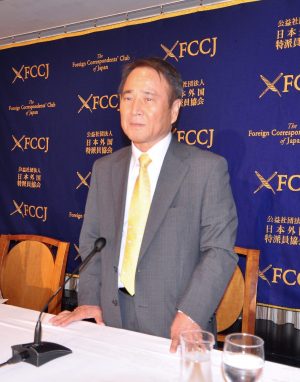
Hiroji Yamashiro, 65, a campaigner against the US military presence in Okinawa prefecture, addresses the Foreign Correspondents’ Club of Japan. Photo: Daniel Hurst
Either way, his yet-to-be-finalized case has attracted so much international attention that he was invited to travel to Geneva earlier this month to address the UN Human Rights Council.
Now Yamashiro is seeking to shine a spotlight on Japan’s new anti-conspiracy law, which according to human rights groups and lawyers risks increased government surveillance and arbitrary arrest.
“The fact that a country like Japan has passed such a terrible law indicates the extent to which democracy is in retreat in this country,” the head of the Okinawa Peace Movement Center said during a press conference in Tokyo late last week.
“It’s something that I feel very sad about and very angry about and I would like the international community to focus upon it.”
Terror justification
Japan’s postwar constitution guarantees freedom of thought, conscience, assembly, association, speech, press “and all other forms of expression” – yet critics say they see a gradual erosion of those rights.
Such concerns grew when Japan’s ruling bloc pushed the anti-conspiracy bill through the upper house in mid-June.
Prime Minister Shinzo Abe and his government argued the legislation would help prevent terrorism ahead of large-scale events like the Tokyo 2020 Olympic and Paralympic Games.
The law targets two or more persons who, “as part of activities of terrorist groups or other organized criminal groups,” plan to carry out certain criminal acts.
The 277 crimes covered by the law also include planning to steal forestry products or to breach copyright. Jail terms of up to five years are possible depending on the crime.
When a UN special rapporteur warned Japan’s government in an open letter that the vague legislation could usher in “undue restrictions” on freedom of expression and privacy, the authorities reacted angrily.
The criticism was called “one-sided” and “obviously inappropriate,” with government officials saying they had not been given a chance to provide information before the letter was published.
Abe, whose popularity has slipped in recent opinion polls, moved to assure the country that “ordinary people” would not face investigation.
“Although we feel [the law] is essential for strengthening international coordination in dealing with terrorism, we’re aware that some members of the public remain uneasy and concerned about it,” the prime minister said at a press conference last week.
International backlash
The UN special rapporteur for privacy, Professor Joseph Cannataci, highlighted the vague definition of planning and preparatory actions and the “over-broad range of crimes” covered.
He told Asia Times he had felt compelled to write the open letter because of the extremely short legislative deadline that the government had set itself.
Cannataci, an independent expert appointed by the UN Human Rights Council, described the official response as “disappointing but not surprising.” He said he was “the third UN special rapporteur in a row whom the Japanese government has decided to be confrontational with.”
“I stand by every single word, full-stop and comma in my letter of the 18th May,” Cannataci said in an email this week.
“If anything, the way the Japanese government has behaved in response to my letter has convinced me even further of the validity of its content and the appropriateness of its timing and form.”
He added: “There has been a deafening silence on the part of the Abe government on the privacy safeguards which I have alleged are missing in Japanese law and the Japanese government has failed to explain, in public or in private, how the new law provides new remedies for privacy protection in a situation where it creates the legal basis where more surveillance could be carried out.”
Japan’s chief cabinet secretary, Yoshihide Suga, said last month: “It is not at all the case that the legislation would be implemented arbitrarily so as to inappropriately restrict the right to privacy and freedom of speech.”
‘Chilling effect’
Cannataci’s concerns are shared by a number of non-government organizations.
Hiroka Shoji, an East Asia researcher at Amnesty International, said the definition of an organized crime group was not limited to terrorist cells.
“Civil society organizations working on areas around national security can be subjected to this category,” Shoji said in an email.
Kazuko Ito, secretary general of the advocacy group Human Rights Now, said in an email: “Even if the judiciary narrowly determine and exonerate the targeted people in the end of the day, they are already targeted for arbitrary surveillance, wiretapping, arrest or detention – these are enough to smash civil society activities and will cause a significant chilling effect.”
Justice minister, Katsutoshi Kaneda, denies that the legislation is vague, arguing it is “expressly limited to organized criminal groups, the applicable crimes are listed and clearly defined and it applies only once actual preparatory actions have taken place.”
Anti-base protester Yamashiro, who was charged under pre-existing laws, views the new legislation as “a great threat”.
“I was arrested for obstruction of a public official, but under the new legislation even if you don’t do what it is that is against the law – if you’re just planning it or discussing it with other people – that is enough basis for an arrest to be made,” he said.
Press freedom concerns
The concerns come against a backdrop of claims that press freedom is deteriorating in Japan. The country declined in the global press freedom rankings issued by Reporters Without Borders, from 11th in 2010 to 72nd in the most recent review.
However, the reliability of that ranking is questioned by some observers.
The academic and consultant Michael Thomas Cucek, for example, has previously pointed to the “astonishing” volatility in Japan’s ranking and raised the possibility of the surveyed experts exaggerating the extent of repression in their own country.
Methodology questions aside, the UN special rapporteur for freedom of expression, David Kaye, has identified what he called “significant worrying signals” in Japan.
“The direct and indirect pressure of government officials over media, the limited space for debating some historical events and the increased restrictions on information access based on national security grounds require attention lest they undermine Japan’s democratic foundations,” Kaye wrote in a report published in May.
Kaye called for safeguards to be added to the state secrets law enacted in late 2013, which allows bureaucrats to be jailed for up to 10 years for revealing specially designated information.
Under Article 25 of the state secrets law, journalists could potentially face a prison term of up to five years under a provision targeting “a person who conspires with, induces or incites another person” to release such secrets.
However, the law offers protection to news reporting “as long as it has the sole aim of furthering the public interest and is not found to have been done in violation of laws or regulations or through the use of extremely unjustifiable means.”
The Japanese government has said it “does not intend to apply Article 25’s harsh penalties to journalists.” And in a broader rebuke to Kaye, it said most of his arguments were based on hearsay or assumptions.
“It is hard for the government of Japan to avoid expressing sincere regret concerning those biased recommendations,” the government said in a formal response.
It cited the constitutional guarantee of freedom of expression and added that “there is no such fact that government of Japan officials and members of the Japanese ruling party have put pressure on journalists illegally and wrongfully.”
Jeff Kingston, director of Asian studies at Temple University Japan, said officials were unlikely to act on previous comments by some lawmakers about the possibility of suspending broadcasting licenses for bias.
“But just making noises about doing so sends a chilling message, a shot across the bow of an already cowering media that may constrain coverage,” Kingston wrote in the book Press Freedom in Contemporary Japan, published earlier this year.
Japan Regards Russia as a Reliable Hydrocarbons Exporter
By Dmitry Bokarev – New Eastern Outlook – 22.06.2017
As you must know, Japan does not have enough natural resources to ensure its energy security without turning to any foreign players. At the same time, its closest neighbor – Russia possesses impressive hydrocarbon reserves and can be in the list of major exporters of those. Nevertheless, it is difficult to describe the volume of bilateral trade between the two states as impressive, in fact it’s the exact opposite. But it seems that the Japanese government has finally come to grips with the fact that it is missing out on enjoying the benefits of Japan’s geographic location, so Tokyo decided to step up its attempts to pursue economic cooperation with Russia.
In fact, talks about Japan’s increasing imports of hydrocarbons from Russia have been circulating for a long time. There’s no doubt that the Fukushima Daiichi nuclear disaster which resulted in the closure of the majority of nuclear power plants across Japan has made Russia even more attractive as a trade partner for Tokyo.
It’s true that Japan imports Russian liquefied natural gas (LNG), on top of taking part in the development of Sakhalin-1 and Sakhalin-2 oil and gas fields, and taking part in the construction of a LNG plant within the framework of the Yamal-LNG project. However, the level of bilateral cooperation in that area is miles away from reaching its full potential. Mind you that Russia’s share in the entire volume of Japan’s LNG imports barely reaches 8%. To this date Tokyo has been importing most of the LNG that it buys from Australia, Indonesia and the Middle East, in spite of the mind boggling shipping costs.
This situation is taking a toll on Japan’s budget and there’s no guarantee that Japan could be sure that it would get what it has paid for, since distant sea shipping always goes hand-in-hand with certain risks. Also, it’s pretty much a gamble when you’re getting resources of strategic importance from a limited number of suppliers, as it makes you dangerously dependent on your partners. Even if good relations are maintained between countries, there is always a possibility of unforeseen complications that may hinder the vital supplies.
Japan’s JFE Holdings had to learn this lesson the hard way, in spite of the fact that this company ranks second among local steel producers. To maintain its production levels any company in the steel business needs a lot of fuel. The most commonly used fuel in the steel industry is coking coal, since it’s cheap and reliable. Back in 2016 JFE Holdings acquired a total 60 million tons of this mineral, with more than 70% of this amount purchased in Australia which has traditionally been among the major coal exporters to Southeast Asia. However, a natural disaster damaged the Australian railway network back in March 2017, which obstructed the deliveries that were meant for JFE Holdings, which forced it to turn to Canada, China and the United States. It goes without saying that it had to buy large shipments of coal at a disadvantageous price. After this unpleasant incident Japan has once again realized the need to expand the number of suppliers to reduce its dependency on Australia. In May 2017, JFE Holdings announced plans to diversify imports of coking coal. The company’s management stated that among candidates for future suppliers one can find Canada, Mozambique and Russia. It is noteworthy that these days the Russian Federation is developing new coal deposits in the Far East, not far from Japan.
However, Japan’s steel industry is hardly the only industry that requires large amounts of coal to function properly. The Fukushima Daiichi nuclear disaster resulted in Tokyo building a large number of coal-driven CHP plants. In the coming years, Japanese coal imports should increase significantly, and it would only be profitable for Japan to buy coal in Russia.
It should be recalled that as early as 2016 negotiations were held between Tokyo and Moscow about the former making investments in the development of Russia’s Far Eastern ports to ensure that they maintain high transportation levels. Japan wanted to import coal from Yakutia in large volumes thus it decided to sign a number of deals to ensure its energy security. However, the practical implementation of these plans is not going quite as as one would like. For example, the Japanese corporation Tosei Group, through a subsidiary in April 2016, became a resident of the Free Port of Vladivostok with a view to constructing a transshipment complex for coal worth 60 billion rubles. The project was to be financed by the Japanese side. Additionally, construction of a terminal, capable of receiving up to 20 million tons of coal per year, was scheduled for early 2017, but it never started. The beginning of the construction works was delayed for a year, and it can now be made even partially operational by 2020. Despite the delay, the project is likely to be implemented, because the incident with the disruption of supplies of Australian coal shows that Japan really needs diversification of imports.
In April 2017, Russia’s President Vladimir Putin held a meeting with Japan’s Prime Minister Shinzo Abe, that was attended by the Russian Energy Minister, Alexander Novak. It’s been reported that the parties were discussing such projects as the creation of the Sakhalin-Hokkaido gas pipeline, along with a maritime energy bridge for electricity transmission that could be constructed in the foreseeable future. Soon after this meeting, the Japanese Minister of Economy, Trade and Industry Hiroshige Seko said that Japan is not satisfied with its dependence on gas and oil shipments from the Middle East, since the political instability of the region has been constantly threatening Japan’s energy security. That is why Japan is really interested in increasing supplies of Russian LNG.
In conclusion, one can note that in spite of the slow development of Russian-Japanese relations in the energy sector, the countries have a great future ahead of them. Japan has already begun rebuilding its nuclear power capabilities, but the demand for electricity overshadows any measure that Tokyo has put in play so far. That is why one can be convinced that the Russian-Japanese energy trade and cooperation will reach a new level.
Japan wants US parachute drills grounded amid Okinawa anger
RT | May 30, 2017
Japan is opposed to a two-day parachuting drill that the US plans to conduct near the Kadena Air Base in Okinawa. Local residents have protested such drills in the past, and this would be the third in two months.
Japanese Defense Minister Tomomi Inada said the US military failed to notify the Japanese authorities seven days ahead of the exercise, as they are supposed to. In fact, Japan learned of the Americans’ plans from a Notice to Airmen (NOTAM) filed with the aviation authorities, which is meant to keep civilian aircraft out of airspace where US military planes are flying during the exercise, NHK reported.
“We asked [the Americans] not to conduct the training and to delete the NOTAM. So far we have not received a response from the US site,” Inada told reporters on Tuesday after a cabinet meeting.
The parachuting exercises, which are planned for Wednesday and Thursday, would be conducted off the coast of the city of Uruma. Similar drills were conducted off the Kadena Airbase on the night of May 10 and on April 24.
The previous two drills sparked protest among Okinawans, who have not seen such exercises since 2011. After the second training, Deputy Okinawa Governor Moritake Tomikawa filed a protest with Japan’s Defense Ministry, expressing outrage and saying that such exercises cannot become routine.
Defense Minister Inada called the US move “regrettable,” saying the US should observe a 1996 bilateral agreement under which parachuting exercises should be conducted on the remote island of Iejima, off Okinawa’s main island, with the Kadena base used only as an exception.
“The United States did not offer sufficient explanation on why the exercise conducted (Wednesday) amounted to an exceptional case,” Inada said at a regular news conference. “It is extremely deplorable that it took place at Kadena Air Base without Japan and the United States able to share the same perception in advance,” she stressed.
The Kadena Airbase is one of several US military installations on Okinawa, a southern Japanese island that hosts some 70 percent of the US troops in Japan and is home to some 20,000 US service members, contractors, and their families.
During a parachuting drill in 1965, a trailer airdropped into a local village inadvertently landed on a schoolgirl, killing her.
The protest over the latest planned drill comes a day after Okinawa police arrested a US airman assigned to the Kadena base following a drunk hit-and-run. Staff Sergeant Miguel Angel Garza allegedly hit a car on Monday and fled the scene. The female driver of the second vehicle sustained minor injuries, Japanese authorities said.
Thousands of Japanese rally in capital against ‘anti-terror’ bill
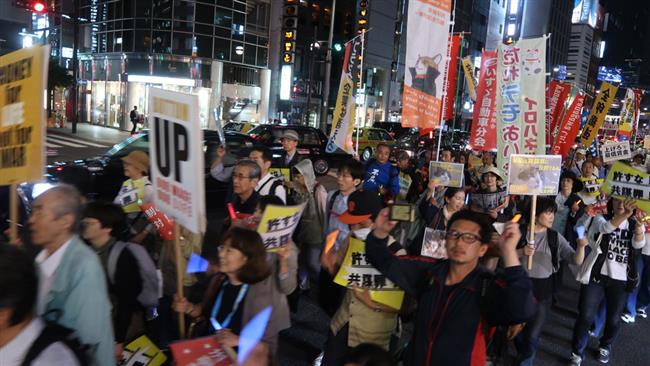
People demonstrate against a piece of “anti-terror” legislation in the Japanese capital, Tokyo, May 24, 2017.
Press TV – May 25, 2017
Thousands of people have held a protest rally in the Japanese capital, Tokyo, to express their dissent against the government of Prime Minister Shinzo Abe for putting forward a controversial “anti-terror” bill.
Demonstrators, carrying placards, flooded the capital’s streets on Wednesday evening. They said the government would be prosecuting practically everybody in the name of fighting terrorism if the bill was passed.
The protest came a day after the country’s lower house approved the “conspiracy bill,” which enlisted 277 new types of offences deemed by the lawmakers as threats against Japanese national security.
The government argues that with the help of the bill, if it is passed, it will be able to mount a crackdown on what it calls organized crime and punish those who plan to carry out “serious crimes” against the country.
The bill now needs to be ratified by the upper house, the House of Councilors — where Abe’s coalition has the upper hand — to become law.
While Tokyo argues that the legislation should be adopted before the Tokyo Olympics in 2020 in an attempt to battle terrorism and organized crime, the opponents of the bill say they fear it would treat such offenses as sit-in demonstrations and violations of copyrights as “serious crimes.”
The government further argues that the law would be necessary to ratify the United Nations (UN)’s Convention against Transnational Organized Crime.
The demonstrators in the Wednesday rally also protested against a number of other issues, including Japan’s nuclear power policies and the United States’ presence on the Japanese Okinawa Island.
Japan Proceeds With Controversial New US Air Base on Okinawa
Sputnik – 25.04.2017
After years of controversy, Japan has announced its intention to continue building a new air base to house elements of the US Air Force stationed on the island of Okinawa.
Tuesday’s initiation of the construction of seawalls around the new base, a replacement for the 1945-era US Air Station Futenma on Okinawa, continues the steps toward relocating the immensely unpopular foreign military facility.
Though these plans have met with resistance by officials and the public in the local prefecture, due in part to the ongoing environmental destruction required by the new base, Tokyo officials are going ahead with the build, including the dumping of landfill waste into sensitive marine habitats.
Okinawa governor Takeshi Onaga, citing local resistance to the move, has threatened to withdraw his support, which could hamper the completion of the project. A December 2016 ruling by the Japanese Supreme Court stated that Onaga’s offer to annul the construction of the air base was illegal, although legal grounds to back up the governor’s threat remain in place.
Local protesters have stepped up their actions at the construction site. The call to have the base closed down entirely, not simply relocated, has gained traction in recent years, particularly in light of several grisly crimes against locals, including sexual abuse, rape and murder, at the hands of US servicemembers stationed at the Futenma base.
Tokyo issued a statement in support of construction, as Defense Minister Tomomi Inada said, “I’m convinced that the start of the construction marks a steady first step toward realizing the complete return of the Futenma airfield.”
But the island base, regardless of its location, remains profoundly unpopular with residents.
As protesters held up signs saying “stop illegal construction work!” and “block the new base,” 64-year-old Yumiko Gibo from the village of Ogimi said, “They should not make Okinawa shoulder the burden of hosting [US] bases anymore,” according to the Japan Times.
Senior officials in Okinawa prefecture have slammed Tokyo for what they term the government’s “authoritarian” attitude toward the construction of the new facility, and have accused national officials of poor judgment after they “ignored the local will.”
A 71-year-old Naha resident, Yoshiko Uema, said, “We must not provide the place for war. We will unite and definitely stop the relocation,” according to the Japan Times.
Tokyo has remained unsympathetic to concerns on the island, insisting that the new air base in Henoko is “the only solution,” as the current Futenma site lies in a densely populated residential zone.
Some officials in Tokyo have privately acknowledged that the US Air Force presence in Okinawa is integral to maintaining the US-Japan military alliance.
A completion date for the new US air base, begun in 2015, has not been set.
Banned Pollutant Detected in Water Under US Marine Base on Okinawa
Sputnik – 19.04.2017
Japan has revealed that high levels of a banned pollutant have been found in groundwater underneath Marine Corps Air Station Futenma, on the island of Okinawa.
Two recent surveys conducted in August 2016 and January of this year have revealed abnormally high concentrations of perfluorooctanesulfonic acid (PFOS) and per-fluorooctanoic acid (PFOA), both used as aircraft lubricants, fire-retardant foam and a water-repellant, in the groundwater underneath the US Marine base in Okinawa. Both were banned in Japan in 2010.
Both chemicals are known cancer-causing agents, and exposure has been shown to result in tumors and increases in the weight of organs and the body overall, and to cause death in animals, according to Stripes.com.
Reported by the local Okinawa environmental protection department’s water environments control team, spokesman Yoshinari Mi-yahira affirmed that “High levels of contamination was detected in underground water samples taken from the Oyama and Kiyuna districts.”
During the August survey, researchers with the Okinawa water environment control team noted that of the 35 locations monitored, three downstream of the US military base were found to have measurements that exceeded US drinking water health advisory levels.
“The concentration of the substances is notably high in the vicinity of the downstream area of the air station,” Miyahira said, according to Stripes.com, indicating that the source of the toxins is the US base.
Requests by Japanese authorities to address the hazard, as well as calls for an investigation, have gone unanswered by the base or the US government.
“We have asked the military through the Ministry of Defense to provide us with information on the history of the use of the agents that contained the substances and an [on-base] survey by the prefectural government, the military and the Ministry of Defense,” Miyahira said, cited by Stripes.com.
According to Miyahara, health officials in the region have been stymied. “We received a [Japanese ministry] response that the military handles the agents appropriately and that they see no need to conduct the proposed survey.”
Tons of toxic materials on Okinawa were left to rot after the southern Japanese island came into US possession following the end of World War II. More recently, US military veterans serving in the Vietnam War who were exposed to defoliant Agent Orange while stationed on Okinawa have won disability benefits from the Department of Veterans Affairs.
SEE ALSO :
Japanese scientists reject lifting of ban on military research at universities
RT | March 26, 2017
The influential Science Council of Japan (SCJ) adopted a statement rejecting research at civilian institutions for military purposes. It comes in response to government investment in dual-use technologies.
The SCJ, which was created in 1949 as an independent body representing academia, warned Japanese universities and research institutions against participating in military-related research, the Japan Times reported. In a statement adopted by the council’s executive body on Friday, it said taking grants from the defense ministry would compromise scientific independence.
It comes after 10 months of deliberation by a 15-member committee, which was formed in May 2016 to consider whether the long-held opposition to military research should be overturned. The SCJ previously rejected military research in 1950, and again in 1967.
The policy statement carries no legal force, but the council’s opinion carries great weigh in Japanese scientific circles and the government.
The council was called to revise its policy, after Japan’s Defense Ministry boosted its funding of research into dual-use technologies, which can have both civilian and military applications. The funding almost doubled for 2017 to $96 million, compared to the previous year, according to The Asahi Shimbun.
The decision to reject military research came earlier in March. At the meeting on Friday, the council’s board debated on whether to adopt the statement directly or submit it to the SCJ General Assembly, which is to convene next month. The executives chose the former.
Japanese academia remains reluctant to deal with military technologies for historical reasons. Imperial Japan rounded up scientists to participate in the war effort during World War II.
Read more:
The Negotiation Option with North Korea
By Jonathan Marshall | Consortium news | February 14, 2117
The unexpected missile launch this weekend by North Korea hit a bulls-eye. Its perfect aim, however, owed more to Pyongyang’s mastery of international theatrics than to rocket technology.
Traveling just 310 miles, the intermediate-range Pukguksong-2 missile struck nothing but water in the Sea of Japan. But it fully succeeded, as planned, in grabbing the attention of two of North Korea’s biggest enemies: Presidents Donald Trump of the United States and Shinzo Abe of Japan.
Instead of relaxing over dinner at Trump’s $200,000-per-membership Mar-a-Lago club, the two heads of state had to surround themselves with advisers and translators Saturday evening, scrambling to draft a joint statement by the light of their cell phones.
They came up with the usual bluster: Abe denounced the launch as “absolutely intolerable,” and Trump vowed to stand behind Japan, America’s “great ally, 100 percent.”
North Korean Premier Kim Jon Un certainly didn’t win any friends with the launch. China criticized it as a provocation, and Russia declared that the test was in “defiant disregard” of United Nations resolutions. But it gave Kim something to brag about at home and, more important, kept his demands front and center on the world’s stage.
No Good Options?
A Reuters news report summed up the conventional wisdom among U.S. analysts: “Few good options in Trump arsenal to counter defiant North Korea.” In a nutshell, President Obama’s eight-year policy of “strategic patience” — ratcheting up economic sanctions and diplomatic pressure — was a spectacular failure. Leaning on China to make it dictate terms to Pyongyang hasn’t worked either—in part because Beijing doesn’t want to risk triggering a collapse of North Korea’s regime. Tough U.N. resolutions condemning North Korea are worth less than a bowl of steaming kimche.
Then there is the military option. Its many advocates in Washington — including former Secretary of State John Kerry — argue the United States may need to wipe out North Korea’s nuclear and missile launch facilities, or even decapitate its regime, to prevent it from acquiring long-range missiles capable of reaching U.S. soil.
But North Korea’s nuclear facilities are designed to withstand anything short of a nuclear attack, and its conventional forces could quickly leave Seoul a smoldering ruin. How China would react to a preemptive U.S. attack is anyone’s guess. No less an authority than former Secretary of Defense William Perry says that a war with North Korea would be “catastrophic, possibly destroying the societies of both Koreas as well as causing large casualties in the U.S. military.”
A Voice of Reason
Perry is one of the few voices of reason who contests the militant groupthink prevalent in Washington. He counsels instead an attempt to engage Pyongyang in diplomacy. That strategy should appeal to the dealmaker who now inhabits the White House.
As Trump said during his campaign, responding to Hillary Clinton’s disparagement of trying to engage with Kim, “What the hell is wrong with speaking? . . . It’s called opening a dialogue.”
Perry participated in the Clinton administration’s successful negotiation of a 1994 deal with North Korea that suspended its plutonium enrichment program. George W. Bush, in his wisdom, scrapped the agreement and made North Korea a charter member of his “axis of evil.”
Watching Presidents Bush and Obama in action, Pyongyang understandably redoubled its nuclear program. “North Korea has decided, based on lessons from Iran, Iraq, and Libya, that its only sure means of survival is to be ‘too nuclear’ to fail,” remarked Scott Snyder, a Korea expert at the Council on Foreign Relations, during a recent Senate Foreign Relations Committee hearing. Or as committee chairman Sen. Bob Corker, R-Tennessee, put it, “What they learned is, you get rid of your WMDs, we take you out.”
That exchange was a rare recognition by Washington insiders that Kim, however, brutish and blustering, is pushing his country’s weapons program for the same reason that other nuclear powers acquired the Bomb: not to commit suicide, but to deter enemies. His regime states unequivocally that “we will not use our weapons on anyone unless they have attacked us.”
As Perry commented in January, “During my discussions and negotiations with members of the North Korean government, I have found that they are not irrational, nor do they have the objective of achieving martyrdom. Their goals, in order of priority, are: preserving the Kim dynasty, gaining international respect and improving their economy.”
Risk to Peace
Those words offer only a small measure of comfort, however. A nuclear-armed North Korea, with its inherently unstable political system, remains a huge risk to peace — all the more so if it prompts revived militarism in South Korea and Japan and unleashes a regional arms race.
The logical response is to try diplomacy, not more military threats, to reduce North Korea’s sense of isolation and paranoia. As China’s foreign ministry has repeatedly pointed out, “the root cause (of) the North Korea nuclear missile issue is the conflicts between North Korea and the United States, as well as between North and South Korea.”
The place to start resolving those conflicts, according to many Korea experts, is with negotiations to end the state of war between North Korea and its adversaries. The Korean War ended in 1953 with a temporary armistice, not a peace treaty. Washington’s failure to negotiate such a treaty tells a deeply insecure Pyongyang that the United States views its regime as illegitimate and ripe for forcible change.
By refusing to consider unconditional normalization of relations with North Korea, President Obama forfeited real opportunities to rein in its nuclear program. Instead, he continued holding huge annual military exercises with South Korea, complete with mock amphibious landings, which sent Pyongyang into “a frenzy of bloodthirsty threats and sabre rattling.”
North Korea’s ambassador to the United Nations told a reporter in November that diplomacy remains a viable option: “If (Trump) really gives up the hostile policy towards DPRK, withdrawing all the military equipment from South Korea, including the U.S. troops and coming to conclude the peace treaty, then I think it might be an opportunity to discuss the relations as we did in the 1990s.”
That was a rhetorical opening position, not a final demand, but it pointed to a peaceful way forward. Diplomacy offers no panacea. In particular, nothing will likely put North Korea’s nuclear genie back in its lamp anytime soon.
As Perry observed, “We lost the opportunity to negotiate with a non-nuclear North Korea when we cut off negotiations in 2001, before it had a nuclear arsenal. The most we can reasonably expect today is an agreement that lowers the dangers of that arsenal. The goals would be an agreement with Pyongyang to not export nuclear technology, to conduct no further nuclear testing and to conduct no further ICBM testing. These goals are worth achieving and, if we succeed, could be the basis for a later discussion of a non-nuclear Korean Peninsula.”
Joe Cirincione, a leading arms control expert, reminds us that “It was the negotiations, not the sanctions, that ultimately stopped Iran’s (nuclear) program.”
President Trump, a harsh critic of the nuclear treaty with Iran, now stands at a critical crossroads with North Korea. Will he heed the increasingly loud demands of interventionists for greater shows of force on the Korean peninsula, or channel candidate Trump and seek talks with Premier Kim? It’s no exaggeration to say that the fate of world peace may rest in part on his decision.
Japan Forms Interdepartmental Council on Cooperation With Russia on Kurils
Sputnik – 07.02.2017
TOKYO – The interdepartmental council on joint economic activities with Russia on the South Kuril Islands was formed in Japan and its first session will take place on the evening of February 7, Japanese media reported Tuesday.
“The government will work as a team to reach substantial results quickly,” Japanese Foreign Minister Fumio Kishida said, as quoted by Kyodo news agency.
According to the outlet, Kishida said he would head the council, which will consider possibilities of the cooperation with Russia on fishery and tourism.
Minister of Economy, Trade and Industry Hiroshige Seko will also reportedly be part of the council, as well as the representatives of the Finance Ministry, Agriculture, Forestry and Fisheries Ministry, Health, Labour, and Welfare Ministry.
On February 1, the Russian Foreign Ministry said that the two countries agreed to hold consultations on joint economic activities on the South Kuril Islands in Tokyo in March.
On December 15-16, 2016, Russian President Vladimir Putin visited Japan to meet Japanese Prime Minister Shinzo Abe. The sides agreed to start developing economic cooperation in the disputed area.
The Kuril Islands are the subject of the long-standing territorial dispute between Russia and Japan. Japan lays claim to Kunashir, Iturup, Shikotan islands and the Habomai group of islets. The territorial dispute has prevented Russia and Japan from signing a peace treaty after World War II.
Japan’s Okinawa governor hits out at US bases during Washington visit
RT | February 3, 2017
The governor of Okinawa has used a trip to Washington to reiterate his opposition to the heavy presence of US military bases on the island, urging all Japanese citizens to rethink security arrangements between Tokyo and Washington.
Outspoken Governor Takeshi Onaga arrived in the US earlier this week, holding a press conference to convey his discontent with the high number of US military bases in Okinawa, which hosts 74 percent of Japan’s total US military presence.
“I think all Japanese citizens should think about the Japan-US security arrangements. US military bases occupy 6 percent of the whole of Japan and 70 percent of those US military bases are in places where the population density is about the same as Tokyo. I don’t like it anymore…” he said in response to a question from RT’s Gayane Chichakyan at a press conference.
He went on to cite jet crashes related to the US bases, as well as sexual assaults which have been linked to US soldiers since World War II.
Onaga and citizens of Okinawa have long protested the heavy presence of US military bases and troops on the island, with mass demonstrations drawing thousands last year.
Of particular concern is the planned relocation of the US Marine Corps Futenma Air Station from Ginowan to the less-populated area of Henoko, in Nago.
Onaga is against the relocation, stating it would destroy the environment of the bay surrounding the new site.
In December, the governor was defeated in a lawsuit filed by the central government regarding the air station, with Japan’s Supreme Court finding that it was illegal for Onaga to revoke the approval granted by his predecessor, Hirokazu Nakaima, for land reclamation required to build replacement runways at the new base.
But Okinawans could soon see their hopes answered, if President Donald Trump follows through with a campaign statement in which he said that he wants foreign nations to pay for US presence and protection in those countries.
Instead of seeing Trump’s statement as a threat, Okinawa policy adviser Moritake Tomikawa said a withdrawal of US troops would suit Okinawans just fine.
“Mr. Trump says if Japan doesn’t pay more than he’s going to withdraw the troops from Japan. As far as Okinawa people are concerned, that’s fine…” he said.
It is unclear, however, where Trump stands on the specific Okinawa issue. The new defense secretary, James Mattis, is currently in Japan, though his views on the issue also remain unclear.
Japan spends an estimated $1.5 billion a year on the US bases, while Washington dished out around $5.5 billion in 2016, according to the Pentagon.
VIDEO:
READ MORE:
Featured Video
BRITAIN’S WARNING: PREPARE FOR WAR
or go to
Aletho News Archives – Video-Images
From the Archive
How Ukraine Tortured and Slaughtered Donbass
By Kit Klarenberg | Al Mayadeen | July 11, 2024
Almost immediately after the proxy war erupted, ISIS-tier footage of the torture and murder of Russians in Ukrainian custody emerged.
On July 6th, the New York Times published an astonishing investigation: In Ukraine, Killings of Surrendering Russians Divide an American-Led Unit. The article documents in grim detail how Chosen Company, an international volunteer battalion for Kiev, routinely executes Russian prisoners of war. It is the very first mainstream admission that this practice – a brazen breach of the Geneva Conventions, and a grave war crime – is widespread among Ukraine’s fighters, both foreign and homegrown. … continue
Blog Roll
 Aletho News
- Pentagon designates Chinese cultural centers national security threat
- Israel Demolishes Home Of Lebanese Journalist Whose Viral Film Exposed Pager Attack
- Record Oil, Empty Tanks: The UAE’s Miracle Recovery
- Burnham tackles Britain’s poverty with aggression in Yemen
- Peace in Ukraine: the easy way – or the hard way
- Trump & the Rrrrussians
- US taxpayer money laundered back through Ukraine – Musk
- Before COVID, an NIH lab chief proposed making a SARS-like bat virus more infectious
- Gates, Bourla on Trial in Netherlands Accused of ‘Great Reset’ Scheme at Vaccine Injury Hearing
- BRITAIN’S WARNING: PREPARE FOR WAR
- If Americans Knew
- An error has occurred; the feed is probably down. Try again later.
- No Tricks Zone
- Two New Studies Find Thwaites Glacier Melt Cannot Be Driven By Human Activity Or A Warming Ocean
- E-Cars Reduce CO2 Emissions By Only 41% Compared To Internal Combustion Engine Vehicles
- Predictions Made By Renowned Climate Professor Over Past Decades Have Been Proven To Be Poor
- New Study Suggests Large Regions Of The Pacific Ocean Have Been Cooling For The Last 80 Years
- Germany’s Green Energy Debacle: High Energy Costs Force Kahla Porzellan to Close After 182 Years!
- New Study: 50 Years Of The Most Aggressive ‘Net Zero’ Policies Can Only Affect The Global Climate By 0.03°C
- US September “Heat” Was No Record…Many Records Set Decades Ago
- Latest European Green Energy Debacle; Portugal’s Largest Flagship Solar Park Insolvent!
- Green Energy Debacle: German Expert Professor Fritz Vahrenholt Warns Of Severe Economic And Social Consequences
- Two More Paleo Reconstructions Affirm Meters-Higher Sea Levels Across Ireland, Brazil 7000-6000 Years Ago

