Russia, Japan agree to resume talks on peace treaty after stalling for 10 years
RT | April 29, 2013
President Vladimir Putin and Japanese Prime Minister Shinzo Abe say the countries foreign ministers are to resume speedy talks on a peace treaty that was suspended in 2003.
“The heads of the two nations have expressed their resolution to overcome the existing differences in the parties’ positions and to sign the peace treaty by finally solving the question in a mutually acceptable form,” reads a joint statement after a meeting between the two men.
The statement also describes as “not normal” the situation in which the two neighboring nations cannot sign a peace treaty 67 years after the end of the war.
However, the Russian President said in an answer to a reporter’s question that the resumption of talks did not mean that all problems will be resolved on the next day. He also added that development of economic ties would be the best support for the diplomatic dialogue.
“It was not us who created this problem. We inherited it from the past. And we sincerely want to solve it in conditions that are mutually acceptable for both sides,” Putin said.
Shinzo Abe’s visit to Russia is the first by a Japanese leader in 10 years, the same time since Russia and Japan suspended talks over the peace treaty.
Putin and Abe agreed to promote the peace treaty talks on the basis of all previously approved documents and agreements.
The Japanese PM said he invited Vladimir Putin to visit Japan in 2014 and that the Russian leader thanked him for the invitation.
Since the end of the WWII Russia and Japan have coexisted peacefully, and investment and trade between the countries is constantly developing. However, diplomatic relations are tense as Japan refuses to sign a peace treaty with Russia claiming that there is an unresolved territorial issue – the row over several small islands known as South Kuriles in Russia and as the Northern Territories in Japan.
Because of loose definitions in the international treaties signed at the end of the war ,Tokyo demands the return of the islands that were captured by Soviet troops in 1945. Russia insists the islands became a part of the USSR after the war and therefore Russian sovereignty over this territory cannot be revised.
Immediately before Shinzo Abe’s visit to Moscow the Russian Foreign Ministry issued a statement urging a ‘calm and respectful atmosphere’ in looking for a solution.
In recent years the island row has led to several incidents between Russia and Japan. After the most recent, the Japanese Foreign Ministry summoned the Russian Ambassador to protest Russian Prime Minister Dmitry Medvedev’s visit to the Kuriles in 2012. Russia replied that Japan had no right to advise a top official on the choice of destination as he travels in his country’s own territory.
Related article
- Russia, Japan try to bridge gaps on thorny issues – Xinhua (news.xinhuanet.com)
Russia and Japan create joint investment pot with $1bn entry ticket
RT | April 29, 2013
Russia and Japan have launched a new tool for the development of mutual investments. The new Russo-Japanese investment platform involves injections starting from $1 billion and is aimed at boosting Russia’s Far East.
The agreement was reached on an official visit of Japanese Prime Minister Shinzo Abe to Moscow where he met with Russia’s President Vladimir Putin. It was the first official trip by a Japanese Premier to Russia for ten years.
The two sides agreed to jointly invest in infrastructure, medicine and health, technology, “smart cities” and alternative energy sources.
Among the top priorities for regional investment program are Russia’s Far East and Eastern Siberia. Russia’s Eastern regions provide excellent conditions for creating highly profitable projects due to the resource base and transport potential, and companies that are already involved in business there will get additional efficiency with the influx of foreign investment, Kirill Dmitriev, Director General of Russian Direct Investment Fund (RDIF) said.
The new two-way platform is based on a powerful financial component. In addition to RDIF, Russia’s Vnesheconombank and Japan Bank for International Cooperation is also on board.
“The new mechanism is designed to simplify the exchange of technology and experience,” Dmitriev said. “The Japanese economy is built on advanced technology, and this is exactly what we are lacking.”
Leading Japanese corporations were invited to meet on the sidelines of the Prime Minister’s visit to Moscow. Toshiba, Mitsubishi, Kawasaki and Olympus and many have expressed interest in in investing in Russia. “Now RDIF’s goal is to turn that interest into real projects,” Dmitriev said.
Another cooperation agreement was reached between Japan’s Hokkaido Bank and the government of Russia’s Amur region.
Earlier it was reported that Russian-Japanese joint investments may increase by 10 times over the next three years. “But with such financial and technological support we have reason to think that the real figures can get higher. So far Russia’s interest in Japanese foreign investments is less than 1% (0.62% in 2012). But we already have a lot of positive examples of investment by Japanese companies in our country,” Dmitriev said.
Related article
- Abe, Putin vow to increase efforts to sign Japan-Russia peace treaty (japandailypress.com)
As Pentagon Officials Whine about Budget Cuts, How about Canceling some of These Projects?
By Matt Bewig | AllGov | April 22, 2013
Even as Pentagon officials complain that budget cuts threaten to hollow out its ranks and degrade its military capabilities, they have been able to find money for new sun rooms, a museum, golf course netting and other “questionable projects,” according to a Senate Armed Services Committee report released last week.
The report focuses on the military’s $10 billion-a-year overseas construction efforts, about 70% of which is spent in just three countries with a large U.S. troop presence: Japan, South Korea, and Germany. According to the report, much of this spending occurs with little oversight, sometimes in violation of military regulations and Pentagon promises to Congress.
The specific boondoggles include addition of sun rooms to housing for senior officers in Stuttgart, Germany; a $10 million museum in South Korea praising the U.S. Army; and $2.9 million worth of netting around an Army golf course at Camp Zama, Japan.
Perhaps more disturbing than the amounts involved is the surreptitious manner in which the Pentagon spent the money and kept Congress and the public in the dark. The U.S. is withdrawing or relocating troops in all three countries, and as the military relinquishes various facilities to the host countries, they are expected to pay the U.S. for the returned properties. However, a little-known rule lets local American commanders waive these payments in return for work of an equivalent value performed by the host country—without approval from Congress or even the Pentagon itself. Each of the most questionable expenses—the sun rooms in Germany, the pro-Army museum in South Korea and the golf netting in Japan—was financed this way.
“When the Pentagon and the entire federal government face enormous fiscal challenges, the questionable projects and lack of oversight identified in this review are simply unacceptable,” said Sen. Carl Levin (D-Michigan), the committee chairman.
“We are aware of the report, and we take it very seriously,” said Air Force Maj. Robert Firman, a Department of Defense spokesman. “The DOD strives to be a good steward of taxpayer resources and we look forward to discussing it with Congress in the near future.”
Related articles
Fukushima isn’t Chernobyl?
Don’t be so sure
By Sarah D. Phillips | Somatosphere | March 11, 2013
The March 11, 2011 Tohoku earthquake and tsunami caused the deaths of approximately 16,000 persons, left more than 6,000 injured and 2,713 missing, destroyed or partially damaged nearly one million buildings, and produced at least $14.5 billion in damages. The earthquake also caused a triple meltdown at the Fukushima Daiichi nuclear power plant on Japan’s eastern coast. After reading the first news reports about what the Japanese call “3.11,” I immediately drew associations between the accident in Fukushima and the Chernobyl nuclear disaster of 1986 in what was then the Soviet Union. This was only natural, since studying the cultural fallout of Chernobyl has been part of my life’s work as an anthropologist for the past 17 years. Knowing rather little about Japan at the time, I relied on some fuzzy stereotypes about Japanese technological expertise and penchant for tight organization and waited expectantly for rectification efforts to unfold as a model of best practices. I positioned the problem-riddled Chernobyl clean-up, evacuation, and reparation efforts as a foil, assuming that Japan would, in contrast, unroll a state-of-the-art nuclear disaster response for the modern age. After all, surely a country like Japan that relies so heavily on nuclear-generated power has developed thorough, well-rehearsed, and tested responses to any potential nuclear emergency? Thus, I expected the inevitable comparisons between the world’s two worst nuclear accidents to yield more contrasts than parallels.
But as reporting on the meltdown at the Fukushima Daiichi NPP unfolded, an unsettling story of stonewalling and sloppiness emerged that was eerily reminiscent of the Chernobyl catastrophe. TEPCO (Tokyo Electric Power Company), which operates the Fukushima Daiichi NPP, and the plant’s head, Masao Yoshida, proved to be masters of understatement. Yoshida characterized radiation levels nearly 100 times higher than normal as “higher than the ordinary level,” and he used the wholly inadequate phrase “acute danger” to describe two explosions and the meltdown of three of the reactor cores1 (how about “catastrophic meltdown necessitating immediate evacuation?”). One is reminded of the first official statement acknowledging the Chernobyl accident, which only appeared in a Kyiv newspaper three days after the disaster, and was hidden on the third page in the Weather section: “From the Cabinet of Ministers of the USSR. An accident has occurred at the Chernobyl atomic electrostation; one of the atomic reactors was damaged. Measures are being taken to liquidate the consequences of the accident. The victims are receiving assistance.”2
Recently-released video footage of the early days and weeks of the Japanese crisis reveals that some of the same mistakes made during the Soviet state’s blighted response to Chernobyl were repeated at Fukushima Daiichi. Military helicopters made futile attempts to douse flames inside the damaged reactors with water, a strategy already proven ineffective, dangerous, and potentially counterproductive during the Windscale fire in Great Britain in 1957, and later at Chernobyl. Local Fukushima firefighters were called to the accident scene but not informed of the extremely high levels of radiation—the TEPCO video reveals an official at headquarters to say, “There’s no use in us telling the fire department. That’s a conversation that needs to happen at higher levels.” Recall the six firemen who lost their lives battling the fires at Chernobyl’s Reactor No. 4; along with 25 other plant workers and first responders the firefighters for years were the only Chernobyl casualties officially recognized by the Soviet state. The accidents at Chernobyl and Fukushima alike have been traced back to lax safety controls and poor plant design or siting, and the emergency response after both disasters included a muddled chain of command, the intentional withholding of vital radiological data and health directives, and the privileging of economic concerns and saving face over the well-being of human beings and the environment. Did we learn nothing from Three Mile, Selafield, Windscale, and Chernobyl? Will the Fukushima accident finally jar us out of complacency, or will the accident be successfully “socially contained,” enabling humankind to “stagger on toward our next disaster?”3
Thanks to colleagues at the Japan College of Social Work in Tokyo, during October and November 2012 I visited Japan to participate in interviews, informal meetings, and conference roundtables with Fukushima evacuees, social workers, medical professionals, and community activists. It was an enlightening though sobering experience: many of the Fukushima stories I heard echoed nearly word-for-word narratives I have read and collected among persons affected by the Chernobyl accident in the former Soviet Union. Just like people who survived Chernobyl and the Soviet Union’s “rectification efforts,” Fukushima-affected persons and their advocates complain of government secrecy and misinformation, top-down decision making, generalized disorganization, and the social ostracism of nuclear accident “victims.”
No one knows what really happened here”
I traveled through northeast Japan with an esteemed group of scholars: Dr. Yukio Yamaguchi and Dr. Takashi Fujioka, professors at the Japan College of Social Work; Dr. Masumi Shinya, a professor of sociology at East China University of Science and Technology’s School of Social and Public Administration; Dr. Decha Sungkawan, Dean of the Faculty of Social Administration at Thammasat University in Bangkok; and Dr. Charles Figley, professor and Chair of the Tulane University Trauma Institute.
We traveled by trains and taxis, making research stops in cities like Nihonmatsu and Yamagata City, which received thousands of disaster evacuees, and Otsuchi (Iwate Prefecture), a coastal town devastated by the 3.11 tsunami. Before the disaster Otsuchi had a population of 15,262. At least 800 residents were killed in the tsunami that carried away most of the city’s infrastructure; nearly 500 residents are still missing. Today there are 10,000 people living in Otsuchi, 5,400 of who still live in cramped temporary housing units.
Our guide in Otsuchi was Mr. Ryoichi Usuzawa, a community organizer. Mr. Usuzawa drove us around the city, much of which now consists only of partial concrete foundations where buildings once stood. The entire city administration of Otsuchi (more than 20 persons) drowned in the tsunami—they had been called by the mayor to the town hall at the time of the earthquake. Mr. Usuzawa drove us up a steep hill to an area overlooking the town, just above the now-destroyed Buddhist temple and the adjoining hillside cemetery, which is still intact. On 3.11, hundreds of residents watched from this vantage point as the massive wall of water rolled in and mowed down their town (including their own homes, some with people still inside), the buildings collapsing “like dominos.” The devastation resulted in huge amounts of debris that caused further damage in turn, as tanks of propane gas bobbed along, became entangled in debris, and ignited fires and explosions “bubbling on top with smoke.” Mr. Usuzawa says, “It was like a huge washing machine was spinning the whole town. Everything was moving clockwise.”4
One of these hilltop spectators captured the scene on video, and we watched the terrifying footage on Mr. Usuzawa’s laptop as we looked down over the now-leveled city.5 He explained that hundreds of residents, many of them elderly, fled to the Buddhist temple for refuge from the water and drowned inside. As the tsunami was rolling over Otsuchi, some 200 kilometers away a wall of water invaded the coast of Fukushima Prefecture, destroying the Fukushima Daiichi nuclear power plant and the surrounding towns. Yet the impact on residents’ health is harder to calculate, because it consists not only of physical destruction but radiation contamination.
As cultural geographer Shiloh Krupar notes, “Embodied knowledge…take[s] on a particular significance in the presence of large-scale technological -environmental disasters…, where the variability and duration of harmful waste and its biological effects are uncertain and never closed.”6 Measuring radiation exposure and absorbed dose requires specific, often hard-to-access technologies, and laypersons are dependent on experts and their expert knowledge for interpretation of these measurements. Individuals’ ability to know and assess their risks is severely curtailed when expert knowledge—produced by agents usually beholden to states and powerful industrial interests—is the only form of knowledge recognized as valid, even as states and industry intentionally withhold information on hazards and their biological effects. Meanwhile, embodied self-knowledge is discredited.
Fukushima evacuees and their advocates report egregious examples of misinformation, negligence, and cover-up that have exacerbated their health risks. After the earthquake and tsunami the United States Department of Defense and the Department of Energy conducted environmental and radiological monitoring of air, water, and soil on DOD installations in the region.7 According to Professor Yukio Yamaguchi of the Japan College of Social Work, when this valuable data was shared with Japanese authorities they shelved it for two weeks instead of immediately informing the population about radiation risks. Further, the Japanese government failed to provide the Japanese public with data from the System for Prediction of Environmental Emergency Dose Information (SPEEDI)—data predicting the location and extent of radioactive contamination after the nuclear accident—until March 23, nearly two weeks after the disaster. Because the SPEEDI data was not available, some families evacuated themselves to locations that actually were more contaminated than where they were living.8 Perversely, the Japanese authorities provided the SPEEDI data to the U.S. military on March 14 but waited a full nine days before releasing it to the Japanese people.9
As happened in the Soviet Union after the Chernobyl accident, after the Fukushima accident the government quickly raised the “acceptable” level of individual radiation exposure. In Japan, the pre-nuclear accident maximum “safe” exposure was one millisievert (mSv)/year.10 After the Fukushima disaster, suddenly exposure of 20 mSv/year was deemed safe. Some medical professionals went so far as to suggest that 100 mSv/year was a safe level of exposure.11 Such inconsistencies made it difficult for those living near the Fukushima Daiichi NPP to make informed choices and take actions to minimize their risk of exposure to damaging radionuclides. In this context of uncertainty, a common phrase among Fukushima accident-affected persons is that, “No one knows what really happened here.”
In an age where sophisticated radiological monitoring is possible and information technology facilitates the rapid evaluation and dissemination of radiological data, the Japanese government’s crude “mapping” of the radiation fallout baffles the innocent and informed alike. Environmental contamination after a nuclear explosion or accident is uneven and patchy. We have known this since the 1950s, when radioactive fallout from bombs detonated in Nevada was carried by rain clouds all the way to New York state. Similarly, radiation maps of the area around Chernobyl (not released until years after the disaster) show an irregular contamination pattern around the NPP with “anomalous” hotspots of contamination hundreds of miles away caused by rains —biochemist and journalist Mary Mycio describes it as a “hand” with a dark palm six miles around the plant and 20-30 mile-long “fingers” caused by radiation carried by the wind.12 Why, in the immediate wake of the Fukushima Daiichi accident, did the authorities not apply this knowledge? Why was the contamination not mapped according to the actual radiological data? Instead, in a move strangely reminiscent of the initial Chernobyl “mapping” of a 30-kilometer “zone of alienation,” a 20-kilometer “planned evacuation zone”13 of compulsory evacuation was drawn around the Fukushima Daiichi NPP. The Japanese Cabinet Public Relations Office announced that the cumulative radiation level in those areas could reach 20 mSv/year. People living outside this artificially-drawn zone have been provided no state support to evacuate from their homes, even if the levels of contamination are actually higher there than in some places inside the planned evacuation zone.
Consider for instance the town of Namie. Namie, which was affected by both the tsunami and the NPP accident, is located inside the exclusion zone, and its roughly 20,000 surviving residents were evacuated to the city of Nihonmatsu.14 However, levels of contamination in Namie are lower than in some towns outside the zone,15 whose residents have not had equitable access to evacuation assistance, medical care and social services. Evacuees from Namie face their own set of very difficult circumstances in Nihonmatsu: they are tired of living in hastily-built, cramped temporary housing quarters; unemployment, boredom, and feelings of lack of control over the future fuel anomie. Long-term reliance on social welfare is demoralizing, and evacuation is especially frustrating for elderly persons who just want to go home. According to a community leader at NPO Namie in Nihonmatsu, evacuees are experiencing serious psychological problems; now that they are not in “emergency mode,” he said, they increasingly dwell on their memories of the devastating tsunami. Many suffer from survivor guilt, asking themselves why they lived when others perished. Social workers report high levels of depression and anxiety, alcoholism, gambling, and marital discord among residents of temporary housing units.

Temporary housing site for Namie evacuees in Nihonmatsu. Located in a former athletic field, this site accommodates 240 families (550 persons), including 75 children under 15 years old, and 78 solitary elderly persons. Photo by Charles Figley.
Realizing that returning to Namie is only a distant prospect, and concerned about reports of Namie children being bullied in local schools, in fall 2012 a group of community activists founded Namie Elementary School in Nihonmatsu. The school has enrolled just 30 students so far, but organizers hope it will grow and serve to cohere the community of Namie evacuees in Nihonmatsu, who one community leader described as having been “scattered like sesame seeds.”16 Indeed, loss of community is one of the consequences of 3.11 and the resulting evacuations and resettlements of paramount concern to social workers and NPO leaders. Social work specialists in Japan point out that loss of communities was a major problem after the Great Hanshin (Kobe) earthquake in 1995, but the lessons of that tragedy have not been applied after 3.11.
Living apart is too difficult”
The experiences of the Nakamura family illustrate the difficulties faced bt many Fukushima accident-affected families. Before 3.11, Miki Nakamura, a nutritionist, lived with her husband and three young daughters in Koriyama in Fukushima Prefecture, 58 kilometers from the damaged NPP. The Nakamuras evacuated temporarily immediately after the accident. However, being understandably reluctant to uproot their young family, they returned to Fukushima as the new school year began in April. As in other locations close to the damaged nuclear power plant, the schools in Koriyama stayed open even though neither radiological monitoring nor decontamination efforts were underway.17 During an informal interview in October 2012, Miki Nakamura recalled that she and other parents were told “very firmly” by their children’s schoolteachers that children should continue to attend school; children were advised to wear masks, windbreakers, and hats to protect them from radiation. Trusting in the judgment of the teachers—and in the reassurances issued by the then Prime Minister Naoto Kan and the Secretary General that “there will not be immediate health impacts”—the children in Koriyama continued going to school.
The young families who at the time of the Chernobyl accident were living in Pripyat—the workers’ city built 2 km from the NPP—would find this tragedy familiar. Although news of the accident began to circulate informally hours after the Chernobyl explosion, the authorities did not warn the 49,000 residents of Pripyat to take precautions until a full 36 hours after the accident. Children enjoyed playing outside on the warm April day, unaware that their young bodies, especially their young thyroid glands, were soaking up radioactive particles. The thyroid gland is the organ most sensitive to radiation exposure; this is particularly true for children and for those with iodine deficiencies. Local health workers were instructed not to distribute prophylactic potassium iodine pills, for fear of “causing panic.” (Subsequently, around 6,000 cases of thyroid cancers—and many more cases of thyroid anomalies—have been documented among children who at the time of the Chernobyl accident were living in contaminated areas in Ukraine, Belarus, and Russia.18) Incredibly, a similar scenario unfolded after the Fukushima Daiichi accident. Although health workers themselves took prophylactic potassium iodine, it was not given to children.19
On March 15, it snowed in Fukushima, and the snow contained radioactive materials. Radioactive particles landed on the surface of the soil. In April, the air dose rate exceeded 3.8 microsieverts (/hour at “hot-spots” in Koriyama, and 8 microsieverts/hour at some points along the school route.20 Meanwhile, during the days following the Fukushima Daiichi accident, the Nakamuras’ dosimeter registered radiation levels of 1.5 microsieverts /hour right outside their home. It was not long before the eldest Nakamura daughter (age nine at the time) started having uncontrollable nosebleeds that her mother says “persisted even after going through a box of tissues.” The child’s nosebleeds were the first key factor in the family’s decision to leave Koriyama.
The second factor was the resignation of Professor Toshiso Kosako, an expert on radiation safety at the University of Tokyo and a nuclear advisor to the Japanese Prime Minister. In late April 2011 Kosako resigned in protest of the Japanese government’s decision after the Fukushima Daiichi accident to raise the official acceptable level of radiation exposure in schools from 1 to 20 mSv/year, a decision that allowed “children living near the crippled Fukushima Daiichi nuclear plant to receive doses of radiation equal to the international standard for nuclear power plant workers…a level [that is] is far higher than international standards set for the public.”21 Professor Kosako said he could not endorse this policy change from the point of view of science, or from the point of view of human rights.
The Nakamura family made a difficult decision: Miki and the children would move to Yamagata City, about an hour’s drive across the mountains from Koriyama. Mr. Nakamura would remain behind for his job, and the family would get together on weekends. Thus, Miki Nakamura and her three girls joined approximately 4,200 evacuees from Fukushima prefecture who moved to Yamagata. Like the Nakamuras, around 2,500 of these evacuees are from Fukushima City and the surrounding Nakadori area that were not under mandatory evacuation.22 As “voluntary” evacuees, these citizens are hardly entitled to the same state entitlements that mandatory evacuees receive. Some voluntary evacuees did receive two-part reparation payments from TEPCO, the first for the months up until December 2012, and the second for the months from January to August 2013.
The financial stress on voluntary evacuees—many of which find themselves running two households (one back home, one in Yamagata)—is enormous. Rent is free for evacuation housing, but families spend approximately 100,000 Yen ($1,110) per month on moving costs, utilities for two residences, and children’s kindergarten and school fees outside their place of official residence. (The latter obstacle compels some voluntary evacuee families to transfer their official place of residence, a decision that produces its own set of complications.) Costs of transportation are also high for these split families, who travel frequently to spend time together; also, unlike mandatory evacuees, voluntary evacuees must cover the costs of their own medical check-ups. Reparations from TEPCO do not even begin to offset these expenditures: the Nakamura family received the first compensation payment of just 400,000 yen for one child, 80,000 yen for each parent “for their unnecessary radiation exposure that could have been avoided,” and another 200,000 yen “for minor and additional costs.” The second payment consisted of only 80,000 yen for a child, 40,000 yen for an adult, and 40,000 yen for additional costs.
Miki Nakamura notes that, lacking appropriate entitlements and compensation, among voluntary evacuees “ there are so many children and mothers across the country that live each day by digging into their savings set aside for children’s education and their own retirement.”23 Over time, despite their continuing concerns about radioactive contamination, the financial and emotional burdens of voluntary evacuation have compelled a number of these families to return home against their better judgment. Miki Nakamura predicts that a number of families will return to Fukushima Prefecture from Yamagata in spring 2013, “not because Fukushima will be safe, but because living apart is too difficult.”
I am not a doctor but I know my children are sick”
In Yamagata City, the Nakamura girls continue to have health problems such as sore throat, canker sores, swollen lymph nodes, and dark circles under their eyes, which their mother believes to be related to the nuclear accident. The 10-year-old’s nosebleeds continue, but doctors—state employees who likely do not have the freedom to admit a Fukushima accident-related diagnosis—continue to discount radiation effects. One doctor who examined the eldest Nakamura child suggested that the girl’s nosebleeds were “caused by the stress of the mother.”
This readiness to attribute bodily complaints of disaster-affected persons to psychological and emotional stress is all too reminiscent of the diagnoses of “radiophobia” doled out by medical professionals and experts in the Soviet Union after the Chernobyl disaster. Not surprisingly, many people in Ukraine, Belarus and Russia who believed that Chernobyl fallout had compromised their health balked at the suggestion that their ailments were caused by “fear of radiation,” not radiation itself. They had good reason to be skeptical. Anthropologist Adriana Petryna’s ethnographic study of the Chernobyl medical assessment and compensation system has revealed that system to be anything but objective.25 Petryna documents how the invention and application of radiation-related diagnoses in Soviet medicine were as political and social as they were scientific. Further, only half-hearted attempts were made to systematically collect health data from Chernobyl-affected persons (plant workers, clean-up workers, evacuees), making any firm conclusions about biological effects of radiation exposure versus psychological effects of “radiophobia” impossible.
During 1997 I shadowed medical professionals working at the clinic in Kyiv that houses the “Chernobyl registry.” Persons with a “Chernobyl tie” from across the country (those deemed partially or fully disabled due to Chernobyl’s effects on their health) were offered regular examinations at the clinic—some were required to undergo these checks to retain their benefits—and personnel were supposed to enter patients’ data into the clinic’s computer database. The doctors and nurses I shadowed were harried and underpaid, and saw the data entry task as a nuisance. Often data was never entered, or it was entered helter-skelter. It is well known that after Chernobyl some data concerning individual exposure to radiation (particularly among clean-up workers) was actively destroyed or changed.26
I also in 1997 assisted with a WHO-funded study of children’s thyroid health in Chernobyl-contaminated areas whose planned evacuation was scuttled due to lack of funds. The research team exerted a yeoman’s effort, but the desperate conditions of local infrastructure made our tasks extremely difficult. We worked in hospitals without running water or electricity, and thus our ability to do blood draws and perform ultrasounds on children’s thyroids was limited. Local medical personnel were skeptical of our team and the study’s motives and we suspected they actively discouraged sick villagers from participating. Qualitative questionnaires were not tailored to local ways of life. For instance, youngsters who spent hours each day working in the fields and walking long distances to school were never sure how to answer the ill-phrased question, “Do you exercise or do sports regularly?”
Observing these problematic data-collection procedures makes me question research conclusions that purport to definitively assess Chernobyl’s health impacts, and especially those that downplay the medical effects of radiation exposure (e.g. the 2003-2005 Report of the Chernobyl Forum).27 The same critical eye should be applied to Fukushima accident health studies, since reports from Japan indicate that health monitoring of persons exposed to radiation after the Fukushima Daiichi NPP accident has been far from systematic or problem-free. The affected population is skeptical that doctors in the state system of medicine can offer objective diagnoses. This distrust means they may be compelled to pay out-of-pocket for private health care, in which case their medical data may not make it into official databases. In the future, these persons will not be eligible for public compensation for their Fukushima accident-related health problems.
Skepticism of official health pronouncements is reflected in people’s desire to have their personal levels of radiation exposure checked. Whole body counters (a device used to identify and measure the radioactive material in the body) are in deficit in Fukushima City, and the waiting list to be checked is some six months long.28 Even though Yamagata hosts the largest group of Fukushima evacuees in Japan, there is not a single whole body counter in the city.29 And as with Chernobyl, the chaotic evacuation of residents after the Fukushima accident complicates exposure assessment and health monitoring. Additionally, in early Feburary 2013 at a private meeting of the research and survey committee on residents’ health, it was suggested that the Fukushima Prefectural Medical College, the institution entirely responsible for examining radiation and its health effects, has attempted to delay the thyroid check-up for evacuees outside the prefecture.30
Not surprisingly, “radiophobia” has made its way into the Fukushima accident lexicon.31 It becomes convenient and somehow perversely comforting to focus on the psychological impacts of nuclear disasters, with their many “unknowns.” The victim-blaming Miki Nakamura encounters (“the child’s health complaints are caused by the stress of the mother”) would be familiar to many Chernobyl-affected persons I have interviewed in Ukraine. Of course, this is not to discount the real psychosocial stresses associated with evacuation and the multiple forms of Fukushima’s fallout (radioactive, economic, social, psychological), many of which are being tracked by the Fukushima Health Management Survey.32
Miki Nakamura has met with other forms of stonewalling in her efforts to monitor her children’s health. Like all children living near the disaster site, the Nakamura girls are entitled to thyroid screenings. After her daughters’ thyroid checks at the Fukushima Prefectural Medical College, Miki received a brief notice in the mail that lacked any details or explanation of the test results. When she phoned the Medical College to ask for an explanation of the test results, personnel told her, “We are so very busy…” and discouraged her from getting a second opinion, which in the words of the doctors, “just causes confusion.” Despite the deficit of whole body counters, Miki managed to arrange whole body counts for her daughters. However, without regular follow-ups to track the dynamic—whether their counts are going up or down—the information is of limited utility.
Miki Nakamura sums up her frustrations: “I am not a doctor but I know that my children are sick. And I saw that other children from Fukushima and in the greater Kanto region had the same health problems as my daughters, though I do not hear about it anymore…” Recent health studies show that Miki’s concern about her daughters’ thyroid health is far from unfounded. According to the April 2012 Sixth Report of Fukushima Prefecture Health Management Survey, which included examinations of 38,114 children, 35.3% of those examined were found to have cysts or nodules of up to 5 mm (0.197 inches) on their thyroids. A further 0.5% had nodules larger than 5.1 mm (0.2 inches).33 Contradicting earlier reports, the National Institute of Radiological Sciences admitted in July 2012 that children from Fukushima had likely received lifetime thyroid doses of radiation.34 The Health Risk Assessment from the Nuclear Accident after the 2011 Great East Japan Earthquake and Tsunami published by the World Health Organization (WHO) in February 2013 states that in the most affected regions of Fukushima Prefecture the preliminary estimated radiation effective doses35 for the first year after the disaster ranged from 12 to 25 mSv. According to the report, in the most contaminated location the estimated increased risks over what would normally be expected are as follows:
*all solid cancers – around 4% in females exposed as infants;
*breast cancer – around 6% in females exposed as infants;
*leukemia – around 7% in males exposed as infants;
*thyroid cancer – up to 70% in females exposed as infants (the normally expected risk of thyroid cancer in females over lifetime is 0.75% and the additional lifetime risk assessed for females exposed as infants in the most affected location is 0.50%).36
The future is what we are looking at right now”
Miki Nakamura spends time with other evacuee families every day as founder and director the Yamagata Association of Mothers in Evacuation (YAME). The association is a resource base and support system for families like the Nakamuras who are voluntary evacuees often split between two households. YAME has a liaison council to help mothers get necessary information, provides babysitting services and a “mothers’ morning out,” offers free legal consultations, and sponsors a regular “children’s plaza” where mothers can socialize and exchange advice while their children play. Miki Nakamura and her association worked with a local politician to draft the Fukushima Child Victims’ Law, which was passed by the Diet. But this is just a resolution without enforceability, and specific measures to protect victims’ rights (e.g. the right not to return to Fukushima) have not been determined.
As a nutritionist, in a context of radiological uncertainty Miki Nakamura draws on her knowledge of food properties and the complexities of the food supply to regulate her children’s diet. She shares and publishes recipes that contain “radioprotective” ingredients. Foods that contain beta carotene and vitamin C, for example, can help rid the body of radionuclides.37 One food that people in the Fukushima-affected areas have not enjoyed since 3.11 is persimmons (a crop for which the region is famous), which actively absorb radionuclides and thus are highly contaminated. The Yamagata countryside is adorned with scores of persimmon trees laden with ripe, juicy, entirely inedible fruit. Just as apples have become the key symbol of the Chernobyl accident (the forbidden fruit, original sin, humankind’s folly in seeking to control nature through science)38, perhaps the quintessential symbol of the Fukushima Daiichi accident will be the persimmon, which in Buddhist thought symbolizes the transformation of humans’ ignorance (the acrid green persimmon) into wisdom (the sweet, ripened fruit).
Miki Nakamura has lost all trust in the authorities. Before the disaster she always believed the government and she never thought twice about living near a nuclear power plant. Today she demands justice. She said: “The Fukushima disaster is not just an economic problem, but a problem of our children’s future. The future is what we are looking at right now. Our kids have the right to safety and to a good and long, peaceful life. These are not ‘poor kids.’ They have a future. The most important part of reconstruction after the accident is the restoration of people’s trust and sense of security.”
Was nuclear technological failure—the Chernobyl disaster—the “straw that broke the camel’s back” of the Soviet Union?39 The botched handling of the accident and its aftermath—and especially the central government’s overt failure and disinterest to protect the safety of citizens—confirmed what many citizens strongly believed: their government did not care for them and the system had become thoroughly corrupt and untrustworthy. While widespread protest against nuclear energy and its environmental and health risks was not possible in the authoritarian Soviet state, even in those conditions of a muzzled press and lack of freedom of speech a green movement emerged in response to Chernobyl. Chernobyl’s political fallout was one factor contributing to Gorbachev’s policy of glasnost (openness), and in a limited way anti-nuclear sentiment also fueled the Ukrainian independence movement.
Similarly, Japanese citizens have lost trust in the government and in engineers and physicians who previously commanded such respect and authority. Community leaders strongly feel that Japan lags behind other industrialized nations in democratic governance; they are particularly concerned about lack of press freedom. Indeed, in December 2012 the World Audit on corruption, democracy, and freedom of press gave Japan a democracy ranking of 29 (1 is most democratic, 150 least democratic). This puts Japan in the Audit’s “Division 2” list, along with Ghana, Panama, and Israel. Of the 26 OECD countries, Japan ranks 19th in democratic governance.40
The sound defeat of the Democratic Party by the Liberal Democratic Party in the national parliamentary elections in December 2012 reflected dissatisfaction with the status quo. But the elections were a referendum on the DP, not nuclear power; the LDP is pro-nuclear and does not plan to scale back nuclear energy production. Indeed, traveling through Japan I was struck by the relative lack of anti-nuclear discourse, even in Fukushima Prefecture. Few politicians criticize nuclear power. A notable exception is Tetsunari Iida, director of the Institute for Sustainable Energy Policies who lost a bid for governor of Yamaguchi Prefecture in elections in July 2012. The anti-nuclear Tomorrow of Japan Party—formed less than a month before the national parliamentary elections in December 2012—garnered scant voter support and disappeared. Reportedly the party’s calls for nuclear power draw-down failed to gain traction “amid concerns that electrical shortages could hurt the already shrinking economy.”41
Indeed, one gets the impression that response to the disaster has centered primarily on short-term economic, not human, concerns. Before the accident at the Fukushima NPP, Japan relied on nuclear power for 30% of its energy needs and was planning to increase that to over 50% within two decades. According to Japan’s Agency for Natural Resources and Energy, scrapping nuclear power would result in losses of $55.9 billion for power companies, at least four of which would likely face insolvency.42 With these economic stakes, it is not surprising that TEPCO and the Japanese government have been stingy with information about the disaster, the radioactive fallout, and the potential health consequences. My acquaintances who hoped Japan would abandon nuclear energy after the Fukushima disaster fear that the chance to “change the country’s direction” has already passed by.
Haruhiko Fukase, a resident of Yamagata City who worked as a shelter volunteer and coordinator during the evacuation effort, said that the nuclear accident-affected people have been forgotten not just by the international community, but by many of their fellow Japanese citizens. “For people in Tokyo and other big cities,” he said, “the evacuees don’t even register anymore. Their problems have been forgotten.” But for thousands of families, the Fukushima nuclear disaster will never end. Community leaders repeat this refrain: “The reactor is still hot; the situation is still unstable.” Miki Nakamura and like-minded community leaders are not giving up on the democratic process. They continue to speak justice to power. As Nakamura said during the December 2012 Japanese elections, “ To give up on Japanese politics is, to me, to give up on Fukushima.”43
Fukushima is Chernobyl. Independent of the system (Japanese, Soviet), nuclear technology requires disregard for the public, misleading statements, and obfuscation in multiple domains (medicine, science and technology, governance). As anthropologist Hugh Gusterson notes, “The disaster at Fukushima has generated cracks in what we might call the ‘social containment vessels’ around nuclear energy—the heavily scientized discourses and assumptions that assure us nuclear reactors are safe neighbors.”44 Comparing the nuclear accidents at Chernobyl and Fukushima shows that “peaceful” nuclear technology is anything but.
I am grateful to Miki Nakamura, Satoko Hirano, Yukio Yamaguchi, Paul Josephson, Marvin Sterling, and Charles Figley for their contributions to this article.
Sarah D. Phillips is Associate Professor of Anthropology at Indiana University, Bloomington. She is author of Women’s Social Activism in the New Ukraine: Development and the Politics of Differentiation (2008, Indiana U Press) and Disability and Mobile Citizenship in Postsocialist Ukraine (2011, Indiana U Press). Her website is at http://www.indiana.edu/~medanth/.
She can be reached at: sadphill@indiana.edu
Notes
Related articles
- Fukushima’s Nuclear Casualties (alethonews.wordpress.com)
- Public Pays for Fukushima While Nuclear Industry Profits (ipsnews.net)
Nuclear accident could cost France $580bn, study shows
Press TV – February 7, 2013
A study shows that a possible nuclear accident in France would cost the country about 430 billion euros ($580 billion), which is equivalent to 20 percent of its economic output.
The study, conducted by the French Institute for Radiological Protection and Nuclear Safety (IRSN), showed that a possible disaster in one of the nuclear reactors in France and a release of radioactivity into the environment would displace an estimated 100,000 people, destroy crops and cause massive power cuts, Reuters reported on Wednesday.
Jacques Repussard, the head of the IRSN, said, “A major accident would have terrible consequences, but we would have to deal with them because the country wouldn’t be annihilated, so we have to talk about it, however difficult it is.”
A nuclear crisis would also take its toll on exports of French delicacies and the tourism industry, costing the country about 160 billion euros ($126 billion), the study indicated.
Patrick Momal, the IRSN economist responsible for the study, said, “Tourism is an important activity for France and direct costs would not only hit the affected region, but the whole country.”
Momal, who is also a former World Bank economist, unveiled two disaster scenarios prompting a core meltdown at a typical 900-megawatt nuclear reactor in France, which include a “major” accident similar to that of Japan’s Fukushima reactor.
In March 2011, a 9.0-magnitude earthquake followed by a devastating tsunami hit the northeastern coast of Japan.
The quake triggered a nuclear disaster by knocking out power to cooling systems at the Fukushima nuclear power plant, resulting in meltdowns and radioactivity release.
France is the world’s most nuclear-dependent country and operates 58 reactors, which supply about 75 percent of its electricity demand.
Related articles
- Duke Energy to close Crystal River nuclear reactor in Florida (charlotte.news14.com)
Fukushima deception confirmed by UN
By JOHN LAFORGE | CounterPunch | December 5, 2012
When the Fukushima-1 reactor complex in Japan went into radioactive apoplexy on March 11, 2011, the Japanese government and the Tokyo Electric Power Co. — like the Russians at Chernobyl before them — began minimizing the risks of radiation and the known and potential effects of radiological disasters.
The principle mouthpiece for this well-rehearsed minstrel show was Chief Cabinet Secretary Yukio Edano who told the world that evening, “Let me repeat that there is no radiation leak, nor will there be a leak.”(1) Edano is now the Trade and Industry Minister and oversees federal cleanup and recovery efforts.
Independent observers like Dr. Chris Busby, scientific secretary of the European Committee on Radiation Risk and a founder of the Low-Level Radiation Campaign in England, warned four days into the disaster: “Reassurances about radiation exposures issued by the Japanese government cannot be believed.” Likewise, physicist Nils Bøhmer, with the Oslo-based environmental foundation Bellona, insists that throughout the crisis Japan has been withholding information about radiation dangers.
Even the New York Times reported Nov. 30 on “The gap between the initial assurances given by company and government officials, and the ultimate scale of the nuclear disaster…”
Deception confirmed by UN
Now 20 months later, the United Nations Special Rapporteur on the right to health has issued a draft report charging that Japan “has adopted overly optimistic views of radiation risks and has conducted only limited health checks” among contaminated populations, the AP and CBC reported. According to Anand Grover, the UN investigator, “Japan hasn’t done enough to protect the health of residents and workers affected.”(2)
Previous investigations found that monitoring data from the federal system that tracks plumes of radiation during disasters — called “Speedi,” for System for Prediction of Environmental Emergency Dose Information — was kept secret when it was needed most. News reports in August 2011 said that the system forecast that Karino Elementary School in the town of Namie would be directly in the path of the radiation plume spewing from the smashed reactors. Yet the warning never reached decision-makers and neither the school nor the town was evacuated. Instead, they became evacuation centers where families even cooked and ate meals outdoors.
Bellona reports that documents obtained by the AP and the New York Times, its own interviews with key officials, and a review of other newly released data and parliamentary transcripts show that “… Japan’s system to forecast radiation threats was working from the moment its nuclear crisis began on March 11, after an earthquake and tsunami pummeled the Fukushima” reactor site.
The UN’s Grover severely criticized the government’s commitment to health care for exposed workers and people in contaminated areas, and complained that its ongoing health checks are “too narrow in scope because they are only intended to cover Fukushima’s two million people.” Surveys of health effects should extend to “all radiation-affected zones” Grover said, a vast area including much of the north-eastern half of Honshu, Japan’s main island.
But so far, only one-fourth of Fukushima’s population has been surveyed. Grover thinks it’s unwise to check only children for thyroid damage. Indeed, Dr. Helen Caldicott told Business Insider last summer that even when lesions are found on a child’s thyroid, they aren’t being biopsied. The lesions “should all be biopsied,” Caldicott warned.
Further minimizing the actual numbers of affected persons, thousands of reactor site workers with short-term contractors “have no access to permanent health checks,” Grover said, and Fukushima residents complain that they have not been allowed access to their own health-check results.
Last March, Human Rights Watch leveled the same charge.(3) “We are really not seeing basic health services being offered in an accessible way and we are not seeing accurate, consistent, non-contradictory information being disclosed to people on a regular basis” Jane Cohen, a researcher at the New York-based rights group, told Reuters. Of the 24,228 workers who risk radiation exposure at the reactor complex, only a mere 904 are eligible for free cancer screenings being provided by the government and Tepco, the daily Asahi Shimbun reported November 22nd. The authorities have limited the scope of the $600 checkups to workers who were exposed to over 50 millisieverts between March 11 and mid-December 2011, but thousands of workers are demanding that the time limit be abolished.
Disinformation and denials confounded by science
Official lullabies, denials and attempted cover-ups are desperate shields against the enormous economic and legal liability that would follow any acknowledgment of the depth and breadth of radiation’s likely effects. Tepco said November 6th that it may need 11 trillion yen, or $137 billion, to cover its damages. Tokyo already set aside ¥9 trillion in July as part of the federal bailout and takeover of the utility. Minister Edano hinted last May that the government may cover some of the costs of decontaminating certain limited areas. Comprehensive decontamination is not even being considered because, as the science ministry reported in November 2011, radioactive fallout from the triple meltdowns was found in every one of its 57 prefectures.(4)
The journal Science reported this fall that 40% of the fish caught off the coast of NE Japan are contaminated with radioactive cesium at levels well above what the government allows.(5) Author Ken Buesseler of the Woods Hole Oceanographic Institution concluded that there is either a source of cesium on the seafloor, or it is still being dumped into the ocean by Tepco.
Referring to the millions of gallons of cooling water still being poured into the three destroyed reactors and their waste fuel pools, Buesseler told Radio Australia Nov. 20, “Some of that water is getting back into the ocean, either actively being pumped out after some decontamination or through leaks in the building, so [Tepco’s] not able to contain all of the water that they use to cool.”
The government and Tepco moved quickly to deny Science. The federal fisheries ministry claimed that cesium from Fukushima’s wrecked cooling systems — about 16,000-trillion becquerels, what Science called “by far the largest discharge of radioactivity into the ocean ever seen”— is “sinking into the seabed” and no longer entering the food chain. (A becquerel is one subatomic disintegration per second) Tepco representatives just said contaminated water was not leaking from any of its wreckage.
Oceanographer Kanda at Tokyo University told the journal Nature that his analysis indicates the site itself is leaking about 300 billion becquerels into the sea every month.
Notes
(1) Evan Osnos, “The Fallout: Seven months later: Japan’s nuclear predicament,” The New Yorker, Oct. 17, 2011
(2) AP, “UN says Fukushima nuclear risks underestimated in Japan,” Nov. 26, 2012
(3) Reuters, “Japan too slow in Fukushima health checks-rights group,” Mar. 6, 2012
(4) Hiroshi Ishizuka, “Cesium from Fukushima plant fell all over Japan,” Asahi Shimbun, Nov. 26, 2011
(5) “Fishing for Answers off Fukushima,” Science, Oct. 26
Related articles
- Fukushima Medical University Hospital cover up -An interview with Kazihiko Kobayashi (nuclear-news.net)
- TEPCO, Japanese government denying Fukushima radiation reaching ocean fish (japandailypress.com)
- ABC Radio: “Who’s to blame for radioactive fish? Tepco denies cesium contamination is from Fukushima” (enenews.com)
- AND NOW: ‘TEPCO Considers Net In Fukushima Nuke Plant Port To Prevent Irradiated Fish From Heading Seaward’ (infiniteunknown.net)
‘US deploys six Ospreys on Okinawa despite popular protests’
Press TV – October 1, 2012
The US has reportedly deployed six MV-22 Osprey helicopter-plane hybrids on the southern Japanese island of Okinawa in the face of widespread opposition on the part of the Japanese people against the deployment.
On Monday, the aircraft were flown from Marine Corps Air Station Iwakuni in western Japan to Marine Corps Air Station Futenma in Okinawa, DPA reported.
Six such aircraft remain in the Iwakuni base. The 12 aircraft had been transferred from the US to Japan in July.
Okinawa has become known as the site of enduring tensions with the US forces deployed there, and hence a lasting source of conflict between Washington and Tokyo. Pacifist inclinations as well as security and safety concerns have prompted the Japanese to protest against the deployment.
On September 9, tens of thousands of people rallied in the country against the prospect.
The Osprey is equipped with rotors that facilitate take-off like a helicopter and engines that can tilt forward, powering it to fly like an airplane at much faster speed than a chopper.
It is considered pivotal to Washington’s ambitions of force realignment in Asia-Pacific, and enables the US marines to fly farther and with bigger loads from Okinawa to remote islands in Japan.
The aircraft, however, has had multiple malfunctions and many accidents since its early years in 1990s. Osprey crashes killed two in Morocco and an entire crew in Florida this year.
Okinawa Governor Hirokazu Nakaima has also argued against the Osprey’s safety, and warned that the Futenma base is located in residential areas.
Related articles
- You: Osprey test rides fail to placate opponents (japantimes.co.jp)
- UPDATE2: Osprey to be moved to Okinawa Mon., U.S. tells Japan (english.kyodonews.jp)
- Tens of thousands protest in Okinawa against Osprey deployment (japantimes.co.jp)
- Nakaima pushes to nix Osprey deployment (japantimes.co.jp)
- 100,000 Okinawa islanders tell US to keep ‘unsafe’ Osprey plane away (morningstaronline.co.uk)
Featured Video
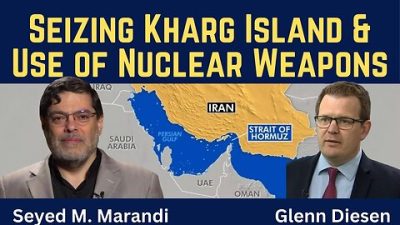
Marandi: Threat of Seizing Kharg Island & the Use of Nuclear Weapons
or go to
Aletho News Archives – Video-Images
Frlom the Archives
Provoking a Path to Persia
The Saban Center’s prescient paper on war with Iran
By Maidhc Ó Cathail | October 20, 2011
In June 2009, the Saban Center for Middle East Policy published “Which Path to Persia?—Options for a New American Strategy toward Iran.” Writing in a tone strikingly reminiscent of the Project for a New American Century’s infamous pre-9/11 paper “Rebuilding America’s Defenses,” the six co-authors noted that, “It seems highly unlikely that the United States would mount an invasion without any provocation or other buildup.” For a think tank specifically established by media mogul Haim Saban to protect Israel, this could prove to be a formidable obstacle impeding their desired march—of U.S. troops—to Tehran.
“In fact, if the United States were to decide that to garner greater international support, galvanize U.S. domestic support, and/or provide a legal justification for an invasion, it would be best to wait for an Iranian provocation, then the time frame for an invasion might stretch out indefinitely,” Saban’s think-tankers ruefully observed.
“With only one real exception, since the 1978 revolution, the Islamic Republic has never willingly provoked an American military response, although it certainly has taken actions that could have done so if Washington had been looking for a fight. Thus it is not impossible that Tehran might take some action that would justify an American invasion. And it is certainly the case that if Washington sought such a provocation, it could take actions that might make it more likely that Tehran would do so (although being too obvious about this could nullify the provocation). However, since it would be up to Iran to make the provocative move, which Iran has been wary of doing most times in the past, the United States would never know for sure when it would get the requisite Iranian provocation. In fact, it might never come at all.”
Seemingly undeterred by Iran’s frustrating unwillingness to provide the requisite provocation, the analysts continued to examine this option… continue
Blog Roll
 Aletho News
- Ukrainian Embassy in Beirut sheltering top Mossad agent
- Palestinian family displaced after settlers violently attack them in Humsa, Jordan Valley
- The EU never learns – except for the wrong lessons
- Iran attacks on UAE leaves RSF militia high and dry
- Hosting Washington’s war: Bahrain faces the consequences
- The US fell for its own Iran propaganda
- Seyed M. Marandi: Threat of Seizing Kharg Island & the Use of Nuclear Weapons
- Is there even an off ramp?
- Michael von der Schulenburg: Europe’s Self-Defeating Iran War Policy
- Sorry, The New Republic, Climate Change Isn’t Causing Somali Migration. Blame Civil Strife and Poverty.
- If Americans Knew
- ‘Of Course’: IDF Drops Case Against Soldiers Accused of Raping Palestinian Prisoner
- Don’t Fall for the Regime Change Talk. Israel Is ‘Mowing the Lawn’ in Iran
- Will Israel and the US wreck the Gulf States along with Iran?
- US so far burned through ‘years’ of munitions in Iran war: Report
- How the Israeli Tail Wags the American Dog
- Outdated intel likely led to deadly U.S. strike on Iranian elementary school, sources say
- Pentagon insider says high U.S official Douglas Feith reported to Netanyahu
- In fond memory of Walid Khalidi, the historian of Palestine
- 6 more Americans killed, as Israel ‘mows the lawn’ in Iran – Not a ceasefire Day 154
- Are we on the precipice of World War III?
- No Tricks Zone
- New Studies: UK Sea Levels Were 4 Meters Higher Than Today During The Mid-Holocene
- Destructive Green New Deal: German Energy And Metal Group Warns Of Drastic Crisis
- New Study Documents A 20-Year Pause In Arctic Sea Ice Decline – Driven By Internal Variability
- Wake-up Call: Survey Shows Majority Of Germans Now Favor Postponing Climate Targets!
- Televised! Leading German Political Candidate Tells Schoolchildren CO2 Makes Sun Hotter!
- New Study: A Century Warming Of 1.1°C Is ‘Commonplace’ And ‘Not Unusual’ During This Interglacial
- New Study: ‘Internal Noise’ And Volcanic Forcing Can Trigger 10-15°C Warming Within Decades
- Glaciers Worldwide Are Suddendly Surging, Experts Blame Warming!
- Surprising Discovery: Sahara Is Greening…Billions Of Trees Where Once Thought To Be Barren
- New Research Reaffirms Clouds, Aerosols, And Surface Solar Radiation Are ‘Driving The Climate System’
 Aletho News