Okinawa forced to allow new US military runways
RT | September 4, 2023
Japan’s Okinawa Prefecture will have to allow new US Marine Corps air strips to be built on its main island regardless of public opposition to Washington’s increasing military presence in the region, a Tokyo court has ruled.
The Japanese Supreme Court made its ruling against Okinawa on Monday, saying plans approved by the central government in Tokyo were valid. Construction of the new runways, which had been suspended during the legal dispute, must now be allowed to resume.
At issue is a plan to relocate Marine Corps Air Station Futenma from an urban area of the island to reclaimed land in Henoko, on the eastern coast. The central government began doing reclamation work in 2018, but plans had to be revised after most of the site was found to be on overly soft ground. The prefectural government rejected the new plans as insufficient, reflecting concerns that the project will damage the environment.
Okinawa Governor Denny Tamaki was re-elected last year after campaigning on a pledge to continue fighting the US military project. He has called for scrapping the plans in Henoko and immediately shutting down Air Station Futenma.
“The ruling is extremely disappointing because we had expected a fair and neutral judgment based on respect for the local government autonomy,” Tamaki told reporters on Monday. He said he was deeply concerned by the precedent of nullifying the local government’s independent decision and disregarding its constitutional right to autonomy.
US and Japanese officials agreed in 1996 to close the Futenma base and reduce Washington’s military presence in the prefecture by 21% amid public uproar over the rape of a 12-year-old schoolgirl by two Marines and a US Navy seaman the previous year. Tokyo has brushed off demands by Okinawan leaders to relocate the base outside the prefecture.
Okinawa, which accounts for less than 1% of Japan’s land area, hosts 70% of the US military facilities in the country. As much as one-third of the prefecture’s population was killed during the April 1945 US invasion of Okinawa in World War II.
The area has taken on increased geopolitical significance as Sino-US relations deteriorate. US President Joe Biden declared a “new era” of defense cooperation with Japan and South Korea last month. Those ties will include expanded joint military exercises in the region. Chinese and North Korean officials have decried Washington’s previous joint exercises with Japan and South Korea as destabilizing provocations. Biden has vowed to work together with Japan to counter China’s “dangerous behavior in the South China Sea.”
A Concrete Solution for Fukushima
#SolutionsWatch Corbett • 08/30/2023
Podcast: Play in new window | Download | Embed
Last week, TEPCO, in conjunction with the Japanese government, began dumping radioactive Fukushima wastewater into the Pacific Ocean. Joining us today to talk about the consequences of that decision, what it will mean for peoples around the Pacific, and what could be done to mitigate this disaster, is Dr. Robert H. Richmond, Research Professor and Director at the Kewalo Marine Laboratory in the University of Hawaii at Manoa.
Watch on Archive / BitChute / Odysee / Rokfin / Rumble / Substack / Download the mp4
China bars seafood from Japan
RT | August 24, 2023
Chinese customs authorities announced on Thursday an immediate ban on imports of all seafood from Japan as Tokyo begins a contentious release of treated radioactive wastewater from the stricken Fukushima nuclear power plant into the ocean.
China is Japan’s biggest importer of fish, having purchased $496 million worth in 2022. It has also imported $370 million worth of crustaceans and mollusks – such as crabs and scallops – last year, data tracked by the Japanese statistics office shows.
Apart from Japan, China also purchases seafood from other countries including Ecuador, Russia, and Canada.
China had previously banned food imports from ten Japanese prefectures around the Fukushima plant, while earlier this week Hong Kong announced a ban on seafood imports from those same prefectures.
Earlier this week, Japanese Prime Minister Fumio Kishida announced plans to discharge around 1.3 million metric tons of treated wastewater, equivalent in volume to about 500 Olympic-size swimming pools, from Fukushima.
The Japanese authorities scheduled the discharge of the treated water into the Pacific Ocean for 1pm Tokyo time on Thursday, according to state-owned electricity firm TEPCO, adding that the weather and sea conditions were suitable.
Beijing has blasted the plan as “extremely selfish and irresponsible.” The Chinese customs agency said the suspension of imports was intended to prevent radioactive contamination risks.
The Fukushima nuclear power plant experienced a catastrophic meltdown after a 9.0-magnitude earthquake and subsequent devastating tsunami in 2011. It was the worst nuclear disaster since the 1986 Chernobyl accident.
Hiroshima, Nagasaki Bombings Were Needless, Said World War II’s Top US Military Leaders
Mythology about these mass civilian slaughters warps thinking about US militarism
Stark Realities with Brian McGlinchey | July 31, 2023
The anniversaries of the atomic bombings of Hiroshima and Nagasaki present an opportunity to demolish a cornerstone myth of American history — that those twin acts of mass civilian slaughter were necessary to bring about Japan’s surrender, and spare a half-million US soldiers who’d have otherwise died in a military conquest of the empire’s home islands.
Those who attack this mythology are often reflexively dismissed as unpatriotic, ill-informed or both. However, the most compelling witnesses against the conventional wisdom were patriots with a unique grasp on the state of affairs in August 1945 — America’s senior military leaders of World War II.
Let’s first hear what they had to say, and then examine key facts that led them to their little-publicized convictions:
- General Dwight Eisenhower on learning of the planned bombings: “I had been conscious of a feeling of depression and voiced to [Secretary of War Stimson] my grave misgivings, first on the basis of my belief that Japan was already defeated and that dropping the bomb was completely unnecessary, and secondly because I thought that our country should avoid shocking world opinion by the use of a weapon whose employment was, I thought, no longer mandatory as a measure to save American lives. It was my belief that Japan was, at that very moment, seeking some way to surrender with a minimum loss of ‘face’.”
- Admiral William Leahy, Truman’s Chief of Staff: “The use of this barbarous weapon…was of no material assistance in our war against Japan. The Japanese were already defeated and ready to surrender because of the effective sea blockade and the successful bombing with conventional weapons.”
- Major General Curtis LeMay, 21st Bomber Command: “The war would have been over in two weeks without the Russians entering and without the atomic bomb… The atomic bomb had nothing to do with the end of the war at all.”
- General Hap Arnold, US Army Air Forces: “The Japanese position was hopeless even before the first atomic bomb fell, because the Japanese had lost control of their own air.” “It always appeared to us that, atomic bomb or no atomic bomb, the Japanese were already on the verge of collapse.”
- Ralph Bird, Under Secretary of the Navy: “The Japanese were ready for peace, and they already had approached the Russians and the Swiss… In my opinion, the Japanese war was really won before we ever used the atom bomb.”
- Brigadier General Carter Clarke, military intelligence officer who prepared summaries of intercepted cables for Truman: “When we didn’t need to do it, and we knew we didn’t need to do it…we used [Hiroshima and Nagasaki] as an experiment for two atomic bombs. Many other high-level military officers concurred.”
- Fleet Admiral Chester Nimitz, Pacific Fleet commander: “The use of atomic bombs at Hiroshima and Nagasaki was of no material assistance in our war against Japan. The Japanese were already defeated and ready to surrender.”
Putting out feelers through third-party diplomatic channels, the Japanese were seeking to end the war weeks before the atomic bombings on August 6 and 9, 1945. Japan’s navy and air forces were decimated, and its homeland subjected to a sea blockade and allied bombing carried out against little resistance.
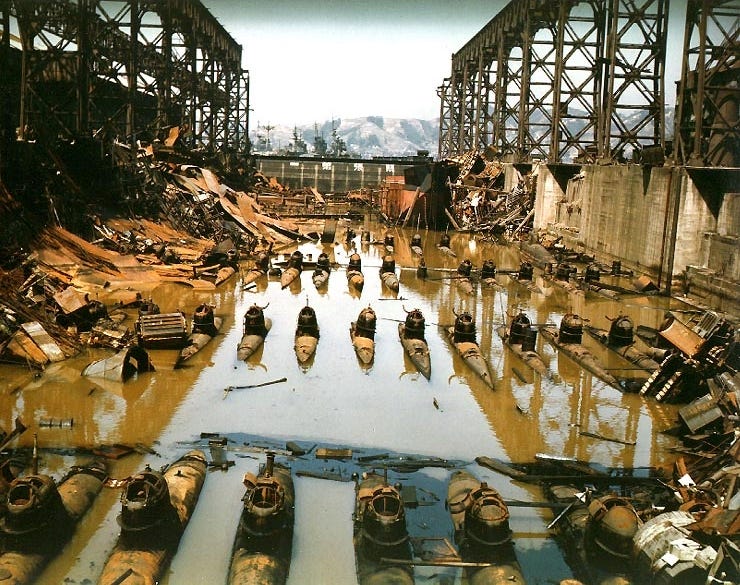
Full of midget submarines, a drydock in the port city of Kure, Japan lies in ruins
The Americans knew of Japan’s intent to surrender, having intercepted a July 12 cable from Japanese Foreign Minister Shigenori Togo, informing Japanese ambassador to Russia Naotake Sato that “we are now secretly giving consideration to the termination of the war because of the pressing situation which confronts Japan both at home and abroad.”
Togo told Sato to “sound [Russian diplomat Vyacheslav Molotov] out on the extent to which it is possible to make use of Russia in ending the war.” Togo initially told Sato to obscure Japan’s interest in using Russia to end the war, but just hours later, he withdrew that instruction, saying it would be “suitable to make clear to the Russians our general attitude on ending the war”— to include Japan’s having “absolutely no idea of annexing or holding the territories which she occupied during the war.”
Japan’s central concern was the retention of its emperor, Hirohito, who was considered a demigod. Even knowing this — and with many US officials feeling the retention of the emperor could help Japanese society through its postwar transition —the Truman administration continued issuing demands for unconditional surrender, offering no assurance that the emperor would be spared humiliation or worse.
In a July 2 memorandum, Secretary of War Henry Stimson drafted a terms-of-surrender proclamation to be issued at the conclusion of that month’s Potsdam Conference. He advised Truman that, “if… we should add that we do not exclude a constitutional monarchy under her present dynasty, it would substantially add to the chances of acceptance.”
Truman and Secretary of State James Byrne, however, continued rejecting recommendations to give assurances about the emperor. The final Potsdam Declaration, issued July 26, omitted Stimson’s recommended language, sternly declaring, “Following are our terms. We will not deviate from them.”
One of those terms could reasonably be interpreted as jeopardizing the emperor: “There must be eliminated for all time the authority and influence of those who have deceived and misled the people of Japan into embarking on world conquest.”
At the same time the United States was preparing to deploy its formidable new weapons, the Soviet Union was moving armies from the European front to northeast Asia.
In May, Stalin told the US ambassador that Soviet forces should be positioned to attack the Japanese in Manchuria by August 8. In July, Truman predicted the impact of the Soviets opening a new front. In a diary entry made during the Potsdam Conference, he wrote that Stalin assured him “he’ll be in the Jap War on August 15th. Fini Japs when that comes about.”
Right on Stalin’s original schedule, the Soviet Union declared war on Japan two days after the August 6 bombing of Hiroshima. That same day — August 8 — Emperor Hirohito told the country’s civilian leaders that he still wanted to pursue a negotiated surrender that would preserve his reign.
On August 9, Soviet attacks commenced on three fronts. News of Stalin’s invasion of Manchuria prompted Hirohito to call a new meeting to discuss surrender — at 10 am, one hour before the strike on Nagasaki. The final surrender decision came on August 10.

Three-year old Shinichi Tetsutani, burned as he was riding this tricycle when the atomic bomb hit Hiroshima, died a painful death that night (Hiroki Kobayashi/National Geographic)
The Soviet timeline makes the atomic bombings all the more troubling: One would think a US government that’s appropriately hesitant to incinerate and irradiate hundreds of thousands of civilians would want to first see how a Soviet declaration of war affected Japan’s calculus.
As it turns out, the Japanese surrender indeed appears to have been prompted by the Soviet entry into the war on Japan — not by the atomic bombs. “The Japanese leadership never had photo or video evidence of the atomic blast and considered the destruction of Hiroshima to be similar to the dozens of conventional strikes Japan had already suffered,” wrote Josiah Lippincott at The American Conservative.
Sadly, the evidence points to a US government determined to drop atomic bombs on Japanese cities as an end in itself, to such an extent that it not only ignored Japan’s interest in surrender, but worked to ensure that surrender was delayed until after upwards of 210,000 people — disproportionately women, children and elderly — were killed in the two cities.
Make no mistake: This was a deliberate targeting of civilian populations. Hiroshima and Nagasaki were chosen because they were pristine, and could thus fully showcase the bombs’ power. Hiroshima was home to a small military headquarters, but the fact that both cities had gone untouched by a strategic bombing campaign that began 14 months earlier certifies their military and industrial insignificance.
“The Japanese were ready to surrender and it wasn’t necessary to hit them with that awful thing,” Eisenhower would later say. “I hated to see our country be the first to use such a weapon.”
According to his pilot, General Douglas MacArthur, commander of US Army Forces Pacific, was “appalled and depressed by this Frankenstein monster.”
“When I asked General MacArthur about the decision to drop the bomb,” wrote journalist Norman Cousins, “I was surprised to learn he had not even been consulted…He saw no military justification for the dropping of the bomb. The war might have ended weeks earlier, he said, if the United States had agreed, as it later did anyway, to the retention of the institution of the emperor.”
What then, was the purpose of devastating Hiroshima and Nagasaki with atomic bombs?
A key insight comes from Manhattan Project physicist Leo Szilard. In 1945, Szilard organized a petition, signed by 70 Manhattan Project scientists, urging Truman not to use atomic bombs against Japan without first giving the country a chance to surrender, on terms that were made public.
In May 1945, Szilard met with Secretary of State Byrnes to urge atomic restraint. Byrnes wasn’t receptive to the plea. Szilard — the scientist who’d drafted the pivotal 1939 letter from Albert Einstein urging FDR to develop an atomic bomb — recounted:
“[Byrnes] was concerned about Russia’s postwar behavior. Russian troops had moved into Hungary and Rumania, and Byrnes thought it would be very difficult to persuade Russia to withdraw her troops from these countries, that Russia might be more manageable if impressed by American military might, and that a demonstration of the bomb might impress Russia.“

Burned to impress Stalin: A victim of the US atomic bombing of Hiroshima (AP /The Association of the Photographers of the Atomic Bomb Destruction of Hiroshima, Yotsugi Kawahara)
Whether the atomic bomb’s audience was in Tokyo or Moscow, some in the military establishment championed alternative ways to demonstrate its power.
Lewis Strauss, Special Assistant to the Navy Secretary, said he proposed “that the weapon should be demonstrated over… a large forest of cryptomeria trees not far from Tokyo. The cryptomeria tree is the Japanese version of our redwood… [It] would lay the trees out in windrows from the center of the explosion in all directions as though they were matchsticks, and, of course, set them afire in the center. It seemed to me that a demonstration of this sort would prove to the Japanese that we could destroy any of their cities at will.”
Strauss said Navy Secretary Forrestal “agreed wholeheartedly,” but Truman ultimately decided an optimal demonstration required burning hundreds of thousands of noncombatants and laying waste to their cities. The buck stops there.
The particular means of inflicting these mass murders — a solitary object dropped from a plane at 31,000 feet — helps warp Americans’ evaluation of its morality. Using an analogy, historian Robert Raico cultivates ethical clarity:
“Suppose that, when we invaded Germany in early 1945, our leaders had believed that executing all the inhabitants of Aachen, or Trier, or some other Rhineland city would finally break the will of the Germans and lead them to surrender. In this way, the war might have ended quickly, saving the lives of many Allied soldiers. Would that then have justified shooting tens of thousands of German civilians, including women and children?”
The claim that dropping the atomic bombs saved a half-million American lives is more than just empty: Truman’s stubborn refusal to provide advance assurances about the retention of Japan’s emperor arguably cost American lives.
That’s true not only of a war against Japan that lasted longer than it needed to, but also of a Korean War precipitated by the US-invited Soviet invasion of Japanese-held territory in northeast Asia. More than 36,000 US service members died in the Korean War — among a staggering 2.5 million total military and civilian dead on both sides of the 38th Parallel.
We like to think of our system as one in which the supremacy of civilian leaders acts as a rational, moderating force on military decisions. The needless atomic bombing of Hiroshima and Nagasaki — against the wishes of World War II’s most revered military leaders — tells us otherwise.
Sadly, the destructive effects of the Hiroshima myth aren’t confined to Americans’ understanding of events in August 1945. “There are hints and notes of the Hiroshima myth that persist all through modern times,” State Department whistleblower and author Peter Van Buren said on The Scott Horton Show.
The Hiroshima myth fosters a depraved indifference to civilian casualties associated with US actions abroad, whether it’s women and children slaughtered in a drone strike in Afghanistan, hundreds of thousands dead in an unwarranted invasion of Iraq, or a baby who dies for lack of imported medicine in US-sanctioned Iran.
Ultimately, to embrace the Hiroshima myth is to embrace a truly sinister principle: That, in the correct circumstances, it’s right for governments to intentionally harm innocent civilians. Whether the harm is inflicted by bombs or sanctions, it’s a philosophy that mirrors the morality of al Qaeda.
That’s not the only thread connecting 1945 to 2023, as Truman’s insistence on unconditional surrender is echoed by the Biden administration’s utter disinterest in pursuing a negotiated peace in Ukraine.
Today, confronting an adversary with 6,000 nuclear warheads — each a thousand times more powerful than the bombs dropped on Japan — Biden’s own stubborn perpetuation of war puts us all at risk of sharing the fate of Hiroshima and Nagasaki’s innocents.
FM says China’s move ‘based on facts and reason’ as Japan complains of China tightening seafood imports due to nuclear-contaminated wastewater dumping plan
By Wang Qi | Global Times | July 20, 2023
The Chinese government puts people first, the Chinese Foreign Ministry said, noting that China’s opposition to Japan’s ocean discharge plan is based on facts and reason, after Japan recently complained that China had tightened radiation testing on its seafood imports, and some Japanese seafood had reportedly been “held up” at China’s customs due to Tokyo’s nuclear-contaminated wastewater dumping plan.
At a press briefing on Thursday, Chinese Foreign Ministry spokesperson Mao Ning urged Japan to “heed the call of the international community, stop pushing through the discharge plan, engage in full, sincere consultations with its neighbors, dispose of the nuclear-contaminated water in a responsible way and accept rigorous international oversight.”
Japan’s chief cabinet secretary Hirokazu Matsuno said on Wednesday that there have been cases of Japanese seafood exports “being held up by China,” along with Japanese media reports saying that China has ramped up efforts to test “all seafood imports from Japan for radiation.”
Earlier on July 7, China’s customs announced a ban on imports of food from Japan’s Fukushima and nine other regions, as Japan makes final preparations to dump nuclear-contaminated wastewater into the ocean.
Mao said Thursday that “Our job is to be responsible for the health of our people and the marine environment. Our opposition to Japan’s ocean discharge plan is based on facts and reason, so are the measures that we have decided to take.”
According to Japanese media outlet Asahi Shimbum, China is Japan’s largest seafood destination, accounting for 87.1 billion yen ($624 million) in imports.
Many people from Japan and most of its neighboring countries, including China, are against Tokyo’s irresponsible plan to dump the nuclear-contaminated water from the Fukushima plant into the Pacific Ocean.
A recent Japanese poll by Kyodo News showed 80.3 percent of respondents said they felt the explanation provided by the Japanese government on dumping nuclear-contaminated wastewater was insufficient.
More than 80 percent of respondents in 11 countries in the Asia-Pacific region except for Japan said Japan’s plan to dump nuclear-contaminated water into the sea is “irresponsible,” a survey conducted by the Global Times Research Center found recently.
A Gallup Korea survey from June shows that 78 percent of those polled said they were very or somewhat worried about contamination of seafood, according to a CNN report.
The obstruction of Japan’s seafood exports is entirely self-inflicted, Lü Chao, the director of Institute of US and East Asian Studies under Liaoning University, told the Global Times on Thursday.
Trying to shift local fishermen’s anger toward the Japanese government to neighboring countries exposed Tokyo as having no sense of decency and its ill intentions, Lü noted.
The Japanese government recently used various multilateral diplomatic occasions, including the NATO summit, to justify its plan, and gave signs that it will not postpone the hazardous dumping.
Mao criticized Tokyo’s move as a global PR campaign. She said that the legitimacy and safety of Japan’s nuclear-contaminated wastewater dumpling plan have been questioned by the international community, and no matter how much the Japanese side tries, it cannot whitewash the plan, and the protests of neighboring countries and the voices of doubt in Japan are clear evidence of this.
“If the Fukushima nuclear-contaminated water is truly safe, Japan wouldn’t have to dump it into the sea—and certainly shouldn’t if it’s not,” Mao said.
Dumping nuclear-contaminated wastewater into the ocean will seriously damage Japan’s national image and its people’s interests, Lü said, “More countries may take more stricter measures or even reject Japanese seafood imports in the future, as it’s very obvious that radioactive elements can cause long-term damage to human.”
US, South Korea, and Japan Hold Joint Military Exercises After North Korea’s ICBM Launch
By Connor Freeman | The Libertarian Institute | July 16, 2023
Washington, Seoul, and Tokyo held joint naval drills testing missile defense in international waters between Japan and South Korea on Sunday. Following Pyongyang’s latest intercontinental ballistic missile (ICBM) launch, an envoy from the Democratic People’s Republic of Korea (DPRK) spoke before the UN Security Council days earlier. He defended his government’s actions as a response to various military provocations by Washington and its allies.
South Korea’s Navy portrayed Sunday’s drills as an opportunity to “improve security cooperation” with Japan as well as the United States in the face of “North Korea’s nuclear and missile threats.” The missile defense exercises saw the participation of American, South Korean, and Japanese destroyers equipped with Aegis radar systems.
On Wednesday, North Korea fired its latest Hwasong-18 missile – which Pyongyang claims to be the focal point of its nuclear strike force – off its east coast as a “strong practical warning” to the US, South Korea, and Japan.
The three countries formed a trilateral military pact last year – eyeing North Korea and China – which Pyongyang perceives as an “Asian version of NATO.” Washington, Seoul, and Tokyo have additionally carried out myriad war games aimed at the DPRK this year.
After the ICBM test, North Korea’s fourth such launch this year, an emergency meeting of the UN Security Council was held on Thursday. The US Ambassador Jeffrey DeLaurentis, acting deputy representative to the United Nations, read from a joint statement of ten member governments censuring the DPRK’s missile launch “in the strongest possible terms.”
Reading from the statement, DeLaurentis declared “we must send a clear and collective signal to the DPRK – and all proliferators – that this behavior is unlawful, destabilizing, and will not be normalized.”
However, on a yearly basis, Washington provides billions in military aid to apartheid Israel which maintains a clandestine nuclear weapons program. Over the past decades, the US government has spent hundreds of billions in taxpayer money supporting the Israeli government. Although, Tel Aviv’s open-secret nuclear arsenal, which is thought to contain hundreds of warheads, makes this bipartisan policy technically illegal per US foreign assistance laws.
Last month, it was revealed that the US intelligence community has concluded Pyongyang will continue to use its “nuclear weapons status” only as a way of coercively accomplishing some political and diplomatic objectives, not for offensive military purposes.
North Korea’s envoy Kim Song, the first DPRK representative to appear before the Security Council in six years, described Pyongyang’s test-fire this week as a necessary response to recent escalations by hostile forces. “How can the deployment of nuclear assets, joint military exercises and aerial espionage acts by the United States contribute to peace and stability on the Korean Peninsula?” Kim asked.
Pyongyang’s envoy cited US spy planes flying in the DPRK’s exclusive economic zone, the docking in Busan of a nuclear-powered US cruise missile submarine, as well as the upcoming deployment in South Korea of an American nuclear-armed ballistic missile submarine. The White House deployed armed Reaper drones, aircraft carriers, as well as nuclear capable bombers to the peninsula for use during several war games this year.
Under the Joe Biden administration, massive joint US-South Korean live fire war games have resumed and since 2022, in response, the DPRK has launched more than 100 missiles.
Despite criticism from DeLaurentis, Moscow and Beijing opposed any proposed actions by the Security Council and instead highlighted Washington’s role as a destabilizer. Zhang Jun, China’s UN ambassador, said the US and its allies remain “obsessed with sanctions and pressure, which has caused the DPRK to face huge security threats and pressure to survive.”
Zhang implored Washington to “propose practical solutions, take meaningful actions [and] respond to the legitimate concerns of the DPRK.”Biden has taken a vastly more bellicose policy than Donald Trump regarding the DPRK. During the final half of the Trump administration, war games had been rolled back, dialog was opened, and all sides reduced weapons tests.
As crippling sanctions are indefinitely imposed, Biden refuses to offer Pyongyang an off ramp. The White House is demanding the North’s complete disarmament and denuclearization. Meanwhile, Pyongyang continues countering the myriad regime change rehearsals taking place on the DPRK’s doorstep, while US officials periodically threaten the country with obliteration.
What’s the problem regarding radioactive water discharge from the Fukushima Daiichi Nuclear Power Plant? Part 2
A delegation of South Korean scientists visits the NPP
By Konstantin Asmolov – New Eastern Outlook – 12.07.2023
The disputable situation surrounding the safety of discharging water from the damaged Fukushima Daiichi Nuclear Power Plant, which the author discussed in Part 1, prompted a team of 21 South Korean experts to visit Japan from May 21 to 26 to inspect the plant and the treatment of radioactively contaminated water that Japan plans to begin discharging into the ocean in the near future because the tanks are full.
Many Koreans are concerned about this because they believe the waters are still contaminated and will have a negative impact on the environment and health of the population of the area, especially South Korea. A presidential administration official stated that Seoul feels a real inspection of the nuclear disaster by South Korean experts is required in light of the rapprochement between Seoul and Tokyo on May 9, 2023. He reminded that the inspection of contaminated water quality is carried out by the International Atomic Energy Agency (IAEA) specialists. Nevertheless, the effectiveness of the treatment facilities and their operational capabilities need to be independently verified. On the same day, South Korean Prime Minister Han Duck-soo, visiting Europe at the time, met with IAEA Director General Rafael Mariano Grossi and noted the need for South Korean specialists and research organizations to be constantly involved in the process of monitoring the composition of contaminated water.
The idea was also supported in Washington. On May 12, Philip Goldberg, US Ambassador to the Republic of Korea, said that South Korea and Japan should exercise “patience and diplomatic skill.”
The delegation consisted of 19 experts from the Korea Institute of Nuclear Safety, one expert from the Korea Institute of Ocean Science and Technology and its head, South Korea’s Nuclear Safety and Security Commission Chairperson Yoo Guk-hee. Indeed, it was a serious team, but the preparation for the visit was fraught with a number of difficulties.
On the one hand, the parties defined the goals of the trip differently. The visit, the Foreign Ministry anticipated, would provide “opportunity to conduct a multilayered review and evaluation” of the water’s safety independently of the IAEA’s monitoring team. However, Japanese Industry Minister Yasutoshi Nishimura stated that the inspection is intended to “help deepen understanding” about the safety of the release, not to evaluate or certify its safety.
On May 17, South Korea and Japan held further consultations at the working level, but could not elaborate on the details of the upcoming inspection, despite many hours of talks.
On the other hand, the question arose as to whose representatives would go there. On May 12, Park Ku-yeon, the first deputy chief of the Office for Government Policy Coordination, stated that “the inspection team will be composed of top-notch experts in safety regulations,” and “the purpose of inspection activities is to provide an overall review of the safety of the water discharge into the ocean.”
But on May 19, Park Ku-yeon said that in addition to government experts, a separate group of about 10 civilian experts would be formed by Yoo Guk-hee to review and support the inspection team.
As a result, the government formed an advisory group of 10 civilian experts, some of whom strongly raised questions about the safety of radioactive water and called for a thorough review. But members of the advisory group were not included in the on-site inspection team.
This raised the question of objectivity, as the arguments of the critics were worth considering:
- Members of the expert group serve in government agencies; it may be difficult for them to express an opinion different from the government which supports Japan.
- Japan will not allow experts to take radioactive water samples at the power plant site and will not accept the results of the safety assessment of the Korean inspection team, a clear indication that Japan does not want a full objective inspection.
- Japan does not allow Korean journalists to accompany the inspection team. The lack of transparency and openness may cause concern.
However, the Yoon administration and the ruling People Power Party claimed that there is no need for the public to be alarmed because Japan will permit an additional inspection if a problem is discovered at the facility and the Korean delegation will have the chance to examine and assess the advanced cleaning system developed at the Fukushima plant.
On the third hand, the democratic opposition started its resistance right away. On May 10, opposition leader Lee Jae-myung called on the government to reconsider its plan to send an inspection team “that has no power to conduct a substantial and thorough inspection and verification,” saying that the visit could end up approving the planned discharge of contaminated water from the damaged plant. “It appears the government is trying to be a volunteer helper for Japan’s plan to dump contaminated water from the nuclear power plant into the ocean.”
On May 13, the Democratic Party called on the government to withdraw its plan to send an inspection team to Japan, saying it would only justify Japan’s plan. The Democrats pointed out that the Japanese government has no plans to allow the Seoul delegation to verify the safety of the discharge and will proceed with the plan in July, regardless of the team’s actions. This means that the inspection team is just a formality.
On May 21, the experts arrived in Japan. On May 22 they met with the Tokyo Electric Power Corporation (TEPCO), the Nuclear Regulation Authority (NRA), presenting them with a list of facilities they want to inspect. Before the meeting, Yoo Guk-hee noted that the experts will check with their own eyes the K4 tanks intended for storing and measuring the radioactive substance and will ask the Japanese authorities for the necessary data. Yoo also promised to study the ALPS treatment system, and assess whether the treated water is safe enough to discharge into the sea.
In brief, the purification process is as follows: contaminated water goes through the procedure of preliminary purification from suspended solids and then enters the ALPS unit, which removes radionuclides except tritium. Then its samples are evaluated, and if they meet the established safety parameters, the water is diluted with pure seawater in a separate facility to reduce the concentration of tritium. Later, it is supposed to be discharged into the ocean.
On May 23-24, experts inspected the damaged Fukushima Daiichi NPP. As Yoo Guk-hee noted, the main focus was on the radioactive water storage tanks and treatment system.
On May 23, the ALPS equipment, the central control room, the K4 tank for measuring water concentration before discharge, and the transportation equipment were inspected.
On May 24, the experts inspected the first power unit of the plant, including the radiological analysis laboratory. Additionally, by comparing the concentration of water before and after treatment, the experts evaluated the effectiveness of the Advanced Liquid Processing System (ALPS).
The team visited the nuclide analysis facility and inspected the seawater dilution system and discharge facilities, including the capacity of the dilution pumps and how they functioned. The experts took a close look at the shut-off valves that would be triggered if the water contamination level exceeded the norm.
Additionally, Tokyo gave them reports from IAEA officials it had invited to observe the procedure and data it had collected on water control.
After the inspection, Yoo told reporters that “we examined all the facilities we wanted to see … but we need to engage in additional analysis of their function and role.” Although the team was not able to collect water samples on their own, they analyzed those previously collected by the IAEA.
When asked whether the South Korean government would release its security assessment before the IAEA releases its final report, Yoo declined to comment.
On May 25, the delegation held consultations with Japanese counterparts, and Yoo Guk-hee reported that the commission had completed its task by requesting additional data to be sent from Japan and analyzed. Only then will the final report be made public.
On May 26, the group returned home. The opposition and some civil society organizations criticized the visit, calling it “government-led tourism,” saying that the Yoon Seok-yeol government was simply following Japan’s lead and risking the health of Koreans. South Korean Foreign Minister Park Jin rejected such criticism, saying that experts were carefully examining the sites, resolving all concerns with the Japanese authorities, and obtaining scientific data. “It is not right to devalue the work of our team that is working hard (in Japan).”
On May 30, Prime Minister Han Duck-soo asked the group of experts to present the results of their inspection transparently and comprehensively. On May 31, the group held a press conference to announce the main results of the visit.
The specialists spoke in detail about TEPCO’s procedure for cleaning and testing radiation-contaminated water, as well as the sites visited as part of the inspection. They also learned the procedures to stop water discharge in case of emergency and the process of maintaining the machinery used in water treatment. The unique cleaning technique and the equipment for assessing radiation levels received special attention.
In the process of familiarization with the water treatment facilities at the damaged Fukushima Daiichi NPP, the South Korean expert group received data from the Japanese side on the performance of the ALPS for the last four years. This includes data regarding the water’s chemical composition at the ALPS system’s input and exit, which made it possible to assess the system’s effectiveness and gauge the degree of pollution before and after treatment. The experts made sure that all major equipment was installed in accordance with current standards, and that the system for preventing leakage of contaminated water was operating normally. In particular, there are emergency valves to automatically stop water discharge in case of a sudden power and communication failure. In addition, equipment for double-checking the composition of water is in operation. However, there has not been a “yes or no” answer: significant progress has been made during the Fukushima inspection, but further analysis is needed for a more accurate conclusion.
This did not dampen the excitement, and on June 22, Hahn Pil-soo, a South Korean nuclear energy expert who formerly served as director of the IAEA’s radiation, transport and waste safety division, said that IAEA investigation reports have reliable objectivity and credibility. “The credibility of the final report is directly related to the status of the IAEA. Thus lawyers and experts are involved to ensure that not a single word is misspelled,” he said, stressing that the agency works hard to produce professional, objective and reliable results.
On June 26, Park Ku-yeon said that there is no alternative to Japan’s decision to release contaminated water from the Fukushima Nuclear Power Plant because there is no other way to dispose the water. In the mid-2010s, there were extremely complex discussions in Japan, with various options for water disposal (solidifying water in concrete or storing water in massive tanks), but “the current water discharge method was finalized as the most realistic alternative when scientific precedents and safety were fully taken into account.” Therefore, the IAEA approved the method to be implemented, taking into account its safety and based on scientific data.
Park Koo-yeon noted that the NRA would begin trial operation of the water dilution and pumping units on June 28.
On June 27, after a month of his group’s return, Yoo Guk-hee, reported that South Korea is in the final stages of analysis: “We have been scientifically and technologically reviewing Japan’s plan based on the results of the on-site inspection and additional data obtained afterward.” In addition, Yoo said six types of radionuclides have been detected in the water stored in the tanks at concentrations in excess of acceptable limits, even after treatment with ALPS, but most cases occurred before 2019, so “this is the aspect of radionuclide that we need to closely examine.”
The final report will eventually be published in early July. However, in a politicized environment, its meaning becomes a matter of trust, particularly because the opposition prematurely declared the commission’s findings invalid and launched a loud campaign, which the author will discuss in the section after this one.
Konstantin Asmolov, PhD in History, is a leading research fellow at the Center for Korean Studies of the Institute of China and Modern Asia at the Russian Academy of Sciences.
Asian NATO: another failed plan by Washington
By Viktor Mikhin – New Eastern Outlook – 05.07.2023
There are increasing reports in the world media that the US-led NATO military alliance is planning to expand into the Asia-Pacific region. The idea was originally introduced by US President Joe Biden at the East Asia Summit on October 27, 2021, where he said: “We envision an Indo-Pacific region that is open, interconnected, prosperous, resilient and secure – and we are ready to work together with each of you to achieve this.” The White House later issued a report titled “Indo-Pacific Strategy of the United States” on February 11, 2022, outlining President Joe Biden’s strategy to reestablish “American leadership in the Indo-Pacific region.”
Among the remarks in the so-called “newsletter” that stood out was the declared necessity for the US to strengthen ties with Asian countries in order to tackle the “urgent” task of “competing with China.” But, according to its authors, NATO, which was formed to defend Europe against a fabricated Soviet threat, is allegedly a peace-loving alliance. In reality, it has evolved into a militarily aggressive bloc with a dominant presence in the North Atlantic region. This “peace-loving” coalition has militarized the continent to the point where war has broken out in Europe for the first time since World War II.
The question arises, do the countries of the Asia-Pacific region want to see their region also heavily militarized under the strict “guardianship” not only of the United States, but also of European “peace-loving” NATO? Jens Stoltenberg, the secretary general of this “peace-loving” bloc, insists on increasing the military alliance’s activities in Asia, as he stated publicly earlier this year during a meeting with Japanese Prime Minister Fumio Kishida. The “peacemaker” from Europe said: “What happens in Asia matters for Europe and what happens in Europe matters for Asia, and therefore it is even more important that NATO Allies are strengthening our partnership with our Indo Pacific partners.”
According to Japan’s Nikkei newspaper, NATO will establish a liaison office in Tokyo in 2024 and use it as a center for cooperation with Australia, Japan, New Zealand and South Korea. Geographically, these four countries are close to China and other states in the region. It should be emphasized that they are all strategically placed in the Asia-Pacific region and have common interests with the US and NATO, or serve them faithfully.
It doesn’t take a genius to figure out that their target in this situation is China. Speaking at a May 26 press briefing, a Chinese Foreign Ministry spokesperson rightly noted that NATO’s attempt to intervene in the Asia-Pacific region eastward would inevitably undermine regional peace and stability. For example, Japan intends to attend the upcoming NATO summit in Lithuania in July, where discussions on the development of the military bloc’s liaison office are expected to continue. Apparently, the Japanese leadership has already forgotten the tragic consequences of their country’s participation in World War II and the terrible consequences it had for the Japanese people.
The United States’ plan to establish a military alliance in the Asia-Pacific area, similar to NATO, will have disastrous effects. That is why this insidious scheme does not have the support of many Asian countries, which see all these maneuvers of the United States and NATO as aimed at limiting their freedom and security. In the past, the US tried to create a replica of NATO in the Persian Gulf, but failed in that endeavor. The countries of the region soon realized the instability that results from such a move and are now instead working together to bring security back to their own region. The desire of many Gulf countries to join the BRICS and build a new world without conflicts and wars at least testifies to this.
This is why the replica of NATO in Asia is also likely to fail, because no matter how much the Joe Biden administration insists on pursuing it, the idea lacks the support of many countries in the region. Asian states strongly oppose actions aimed at creating military blocs in the region and fomenting discord and conflict. “The majority of Asia-Pacific countries don’t welcome NATO’s outreach in Asia and certainly will not allow any Cold War or hot war to happen,” the Chinese Foreign Ministry stated earlier in May.
The position of most countries in the region is very clear. They oppose the emergence of military blocs in the region, do not welcome NATO expansion in Asia, do not want a repeat of bloc confrontation in Asia, and certainly will not allow a repeat of cold or hot war in Asia. If a NATO-like, US-led alliance were formed in Asia, it would put the region at risk of insecurity and possible conflict, as countries would be divided into alliances and military blocs.
But another stumbling block to the American move to create an Asian NATO is France. President Emmanuel Macron opposed the creation of the first NATO office in Asia, calling the move a “big mistake.” Macron recently made an official trip to China to strengthen bilateral ties and afterwards began to make the same argument as Beijing. Incidentally, US-led NATO activities have a clause in their charter that clearly limits the scope of the bloc to the North Atlantic. Expanding NATO beyond the North Atlantic would require the consent of all members of the alliance, and France could technically veto such a move.
Many, even members of NATO, understand why such a plan could lead to a serious escalation, with devastating economic and security consequences that would be felt negatively around the world, including Europe, a continent that has long been in deep crisis because of the United States.
Asia is famously one of the most economically developing regions in the world. This, in fact, is what the US is deathly afraid of – a new economically developed giant that poses a threat to limit US military and economic expansion. “Thinking” heads in Washington are unable to realize that China, becoming the world’s number one economy and a leading expert in technology and other major sectors, has no intention of competing with or challenging the US on a global scale.
This is where the paranoia of today’s American politicians and their unstable psyche, little adapted to the realities of the modern world, come into play. Washington and its masters are struggling to hold on to what few fragments remain of their once global hegemony, now going like the Titanic to the bottom of world politics. The US ruling elites no longer pursue their own country’s interests, bearing in mind that China is one of America’s largest trading partners, bringing them enormous benefits in various trade and industry. China’s rise as a superpower and its peaceful view of the world have had a dramatically negative impact on Washington, which has watched with apprehension as more and more countries have sought to strengthen ties with Beijing and join the BRICS.
On the security front, the world has witnessed US military adventurism and its disastrous consequences. And this at a time when China has one military mission outside its borders, and it is part of the UN peacekeeping mission in Africa. In essence, China maintains peace in an unstable part of the world, while the US provokes conflicts in crises it itself created, trying, as the proverb says, to fish in troubled waters of misfortunes and troubles of the peoples of the world.
On the technology front, more and more countries are buying from China as it quickly becomes a technological superpower. This has reduced US profits and caused Washington to bully the world against China over issues such as Huawei, Tiktok and semiconductors. In fact, this is all part of a broader US attempt to limit Chinese exports. But the world is different now than it was after World War II. The influence of the US has weakened dramatically, and many states prefer to build a new world on terms that are agreeable to them, put forward by Russian President Vladimir Putin.
There is also some danger here as US hegemony wanes and in a desperate attempt to maintain its influence it plays dangerous games around the world. It unleashed the crisis in Ukraine and pitted Ukrainians against Russians, and now it seeks to create similar crises in other countries, such as China and North Korea, instead of following the diplomatic path and coming to realize a multipolar world. But this would be asking too much of the current American leadership, too difficult for their heads and limited thinking, accustomed to think and act only in terms of war.
FDA responds to negative efficacy of variant boosters with another variant booster
By Daniel Horowitz – conservative review – June 21, 2023
The human experimentation of Operation Warp Speed was not an anomaly; it is the new normal, and the FDA is just getting started. The agency is now allowing the COVID vaccine manufacturers to change the formulation of their shots to continue to chase variants, themselves created by antigenic drift of the shots. And they continue to do so based on nothing more than measuring antibody titer levels. No human clinical trials necessary! Except, studies now show, and reality confirms, the more they chase variants, the more they create negative efficacy against the existing variant, thereby engendering a “need” for another formulation.
What was the response of the FDA to the increasing news of cataclysmic injuries and negative efficacy of the COVID shots for variants that are no longer dangerous? Last Thursday, the FDA’s VRBPAC unanimously approved a fall booster, advising Pfizer, Moderna, and Novavax to update their formulations for the so-called XBB.1.5 Omicron variant. So, officials pre-emptively approved a shot that doesn’t exist based on antibody level testing without human trials – all for a variant that not only is not dangerous but will actually be extinct by the time this poison reaches the market, just as they did with the bivalent formulation for the BA.4 and BA.4 variants.
To this day, the bivalent shot is the only one available, and according to the CDC, that variant doesn’t even exist! It is true that very few people are dumb enough to get this shot, but what they are trying to do is create an endemic schedule of COVID shots to time perfectly with the flu shots in the fall. They have already groomed people over the generation to “get their flu shot” every fall. So now the pharmacies will be waiting with the COVID needle to complete their seasonal updates.
So, what happens when you keep tricking the body to respond to a virus for strains that no longer exist? As the FDA approved these shots, the agency already had the peer-reviewed Cleveland Clinic study showing negative efficacy of the original COVID shots. Just days before this meeting, the Cleveland Clinic came out with a preprint showing negative efficacy for the bivalent booster shots too.
The study contrasted 11,990 employees of this venerable institution who chose to be “up to date” with the bivalent boosters compared to 36,344 employees who were “not up to date” and tracked their outcomes. It turns out that after about three and a half months, you were about 25% more likely to get COVID after having gotten the boosters as compared to the control group.
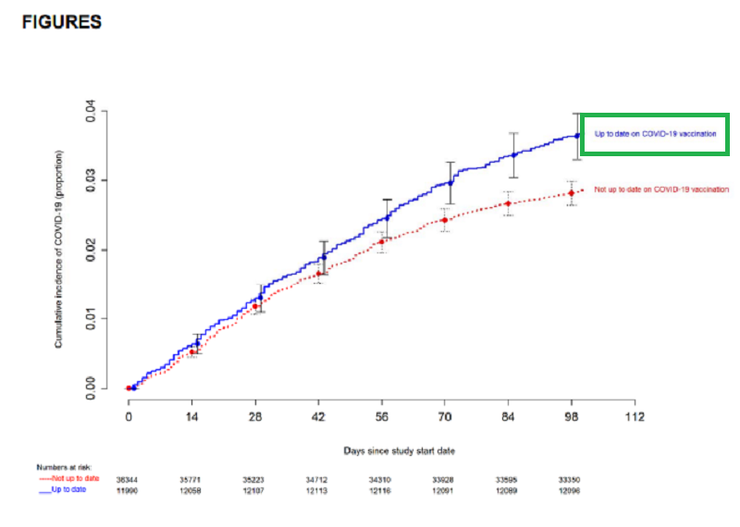
After adjusting for confounding factors between the groups, the study authors actually found a 33% rate of negative efficacy!
“This study’s findings question the wisdom of promoting the idea that every person needs to be ‘up-to-date’ on COVID-19 vaccination, as currently defined, at this time,” conclude the Cleveland Clinic researchers. They also observe, “It should be pointed out that there is not a single study that has shown that the COVID-19 bivalent vaccine protects against severe disease or death caused by the XBB lineages of the Omicron variant.”
The push for boosters comes at a time when more evidence proves a strong correlation between excess deaths and the vaccine take-up. A letter published in a peer-reviewed journal of Medicine and Clinical Science shows that Japan and Germany, two highly vaccinated countries, experienced sharp excess deaths coinciding with the vaccine take-up. They found very little excess death during the pandemic months before the vaccine was rolled out.
“It should be investigated to what extent the about 5%-10% highly significantly increased mortalities in Germany and Japan in 2021 and 2022 might be due to the pandemic countermeasures, including the vaccinations with their possibly underestimated immediate or protracted side effects,” concluded the researchers from Japan and Germany.
“From this point of view, it seems possible that a high vaccination rate has contributed to an increased all-cause mortality in some countries.”
The twisted irony is that, according to the CDC’s variant tracker, XBB.1.5 has gone from 80% of cases to less than 40% of cases in just a few months. It will clearly be obsolete by the fall. None of this was discussed at the FDA hearing. Of course, nothing about Pfizer’s own document showing five million cumulative reports of adverse events affecting every organ system was ever discussed. Hence, we have record injuries, negative efficacy, long-term immune imprinting causing the body to constantly respond inappropriately to wrong strains of the virus – all for a virus that is no longer deadly and for a population that has already gotten the virus!
That’s not just a lousy cost-benefit analysis; that is premeditated murder against the American people. What is the GOP plan to stop this? Or do Republicans even care? How can they continue to fund more COVID shots in the HHS appropriations bill, much less the broader FDA/CDC scheme to create new dangerous shots at warp speed?
Just how callously does the FDA regard human life? After its own VAERS system exploded with every adverse event imaginable, an outcome we now know officials anticipated, to this day they have not followed up on those safety signals. For example, according to the Informed Consent Action Network, the Standard Operating Procedures and Policies document for the FDA’s Vaccine Safety Team requires that its staff members identify VAERS adverse event reports that “need a rapid response and complex coordination,” after which they are supposed to “immediately” inform certain FDA management, who then alert other sub-agencies. Did that occur?
Well, more than a year after the ICAN’s record request, the agency responded, “A search of our records did not locate any documents responsive to your request.”
Where is the action from the House GOP? Why are they still only investigating the shutdown of schools in the past, but not the ongoing, premediated unleashing of deadly products on the American people?
Featured Video

NO MANDATES, NO PROFITS: MODERNA CEO TELLS THE TRUTH
or go to
Aletho News Archives – Video-Images
Book Review
In 2007, Michael Parenti Called Out The Greater Israel Project

The Dissident | January 28, 2026
In my last article, I covered the left-wing scholar Michael Parenti- who passed away at the age of 92 this week- and his prophetic writings on the Ukraine proxy war in 2014.
Parenti’s writings on the Israel lobby and the greater Israel project were equally prophetic.
In his 2007 book “Contrary Notions” Parenti called out “Israel First” Neo-cons and Israel’s role in the Iraq war, and predicted to a tee the future Israeli/American wars in the Middle East in service of Greater Israel and the ethnic cleansing of Palestine.
In a section of the book aptly titled “Israel First”, Parenti wrote… continue
Blog Roll
Recent Comments
loongtip on Russia Vows to Protect Its Oil… loongtip on Hamas never agreed to lay down… eddieb on Conspiracy Denial eddieb on WEF Calls for ‘Cultural Revolu… loongtip on Trump wanted to play peacemake… Coronistan on EU member to sue bloc over ‘su… loongtip on Vicious loongtip on EU turns to India for defense… Coronistan on Donald Trump Is No Peace … seversonebcfb985d9 on French court jails pro-Palesti… eddieb on Fourteen Incredible Facts Abou… Bill Francis on European leaders’ shift in the…


 Aletho News
- NO MANDATES, NO PROFITS: MODERNA CEO TELLS THE TRUTH
- UK Health Officials Covered Up Reports of Heart Damage Linked to AstraZeneca Vaccine
- This is How We Should Have Responded to COVID-19
- The UK Covid Inquiry: Propaganda to protect the ‘pandemic’ narrative
- Israeli Merkava tank invades outskirts of Yaroun in southern Lebanon
- Europeans oppose Brussels’ Russian energy ban, survey finds
- Russia Vows to Protect Its Oil Tankers
- In 2007, Michael Parenti Called Out The Greater Israel Project
- Hamas never agreed to lay down arms in truce talks: Official
- Iran, China and Russia sign trilateral strategic pact
- If Americans Knew
- NBA Star Stephen Curry’s Ties To Israeli Military Intelligence
- ‘Apocalyptic wasteland’: Biden admin. blocked warning on deteriorating Gaza situation after Oct. 7
- Why Israeli counterterrorism tactics are showing up in Minnesota
- Israel Went to Extremes to Return Ran Gvili’s Body. Why Doesn’t It Accord Dead Palestinians the Same Respect?
- Across the West, speaking for Palestine is now a crime
- A West Bank Bus Trip Through ‘the Best Documented Ethnic Cleansing in History’
- Mike Huckabee’s distorted theology does not speak for Christians worldwide
- CBS Evening News” With Tony Dokoupil Is Ellisons’ & Weiss’s Pro-Israel Show
- A Generation on Hold: Inside Gaza’s Collapsing Education System
- Born Under Siege: A Gaza Family Waited 17 Years—Their Baby Survived Six Months
- No Tricks Zone
- 130 Years Later: The CO2 Greenhouse Effect Is Still Only An Imaginary-World Thought Experiment
- New Study Affirms Rising CO2’s Greening Impact Across India – A Region With No Net Warming In 75 Years
- Germany’s Natural Gas Crisis Escalates … One Storage Site Near Empty …Government Silent
- Polar Colding…Antarctica Saw Its Coldest October In 44 Years!
- New Study: Sea Levels Rose 20 Times The Modern Rate During The Roman Warm Period
- As German Gas Storage Dips Dangerously Low…Shortage Hardly Avoidable
- New Study: Brazil’s Relative Sea Level Was 2+ Meters Higher And SSTs 3-4°C Warmer 6000 Years Ago
- Philosopher Schopenhauer: Climate Science Certainty Stems From Stupidity, Ignorance
- New Study: Species Extinction Rates Declining Since 1980 – ‘Climate Change Is Not An Important Threat’
- Denmark Places Climate Protection Above Animal Welfare, Poisoning And Culling Cows
 Aletho News