Jordan Invites US Targets for Syrian Retaliation
By Nicola Nasser | Alarabi | September 4, 2013
Located at the crossroads of several regional crises, including the Palestinian – Israeli and Iraqi conflicts, Jordan has been in the eye of the Syrian storm for more than thirty months, and managed to navigate safely so far, but the reportedly imminent US strike is pressuring the country between the rock and the hard place of the antagonists of the war on Syria.
Heavily burdened by the pressure of its strategic allies and financiers in the US and the GCC Arab states, who have been leading an unwavering bloody campaign for a “regime change” in Damascus, Jordan could not but yield to their demands for logistical facilities in the country, consequently shooting its self-proclaimed neutrality in the legs.
Thus, grudgingly or otherwise, Jordan has in practice invited potential US targets for Syrian retaliation on its territory if and when the Syrian government perceives that those facilities are used in any US-led strike, now expected.
Anthony Cordesman, an analyst at the Center for Strategic and International Studies, on August 29, interviewed by abcnews online, said that “Jordanian targets” could be targeted by Syria or by a Syrian allied “third party,” a possible development that could embroil the US in defense.
Should such a scenario develop, Jordan will evolve unwillingly into a war zone, to regret yielding to the prerogatives of its strategic alliance with the United States regardless of who emerges winner or loser in the war.
US Targets Invited
When the Eager Lion 2013 exercise ended in June this year, Jordan, inviting a US target for Syrian retaliation, asked the US military to leave behind some equipment, including some F-16s and a Patriot missile defense system.
Then, Jordan’s Prime Minister, Abdullah al-Nsour, indicated a second US target when he told reporters that some 900 U.S. military personnel were in the country, of whom 200 are experts training Jordanians to handle a chemical attack and 700 manning the Patriot system and reportedly 45 F-16 fighter jets.
On last August 14, Gen. Martin Dempsey, Chairman of the US Joint Chiefs of Staff, said that Jordan asked the United States to provide manned US surveillance aircraft to help keep an eye on its border with Syria; thus a third US target for Syrian retaliation was invited.
The USA embassy would be a fourth target should any planned US strike target Syrian non-military presidential or governmental headquarters.
However the Centcom’s Forward Command in Jordan, officially called Centcom Forward-Jordan (CFJ), remains the oldest and the most important US target for Syrian retaliation.
In mid-August, Gen. Martin Dempsey was in Amman to inaugurate the CFJ, which is manned by 273 US officers, with a closed section, which “houses CIA personnel who control the work of US agents going in and out of Syria,” and also a communications center, where “atop the underground facility is a large surface structure accommodating the American military and civilian offices dealing with Syrian issues from Jordan,” according to the Israeli http://www.debka.com on August 17, 2013, which confirmed a report two days earlier by The New York Times according to which “American correspondents were allowed to visit the site under ground rules that its location not be disclosed.”
However, on October 18 last year the Egyptian Al-Ahram Weekly reported that the location chosen to host the CFJ was “a Jordanian military base built in an abandoned quarry north of the Jordanian capital Amman, just 35 miles from the Syrian border,” which extends 300 miles along Jordan’s northern flank, and some 120 miles from the Syrian capital Damascus.
Al-Ahram explained that “the origins of the previously secret US deployment in Jordan” dated back to May the same year, “when the Pentagon sent American troops, including Special Forces units, to the country to participate in joint military exercises dubbed Operation Eager Lion. Some 100 military personnel stayed behind and were then joined by dozens more. The task force, according to the New York Times, is commanded by a ‘senior American officer’.”
Speaking to the media at the close of a two-day NATO defense ministers meeting at the time in Brussels, former US Defense Secretary Leon Panetta confirmed the existence of a “US task force that has been sent to Jordan this week after it was first reported in The New York Times,” Al-Ahram added. “The force would be tasked with ensuring the security of the chemical and biological weapons in Syria,” Panetta was quoted as saying. Al-Ahram’s report added: “the outpost near Amman could play a broader role should American policy change” and Washington decide to launch an intervention in Syria.
Denial in Doubt
The denial of the initial reports about the existence of the CFJ as “not true” by a spokesman from the country’s armed forces, quoted by the state-run news agency Petra, sheds doubt on a statement by Jordan’s PM al-Nsour, quoted by the London –based pan-Arab daily Al-Quds Al-Arabi on Monday, that his country knows nothing about the timing, track and targets of a US military strike in Syria, which the US President is now seeking an “authorization” from the Congress to launch.
Al-Nsour’s “lack of knowledge” sounds odd in view of the long established multi-faceted strategic ties between Jordan and the United States, which makes it the obligation of Washington to inform Amman in advance of at least the “timing” of the imminent US strike and makes it an obligation of the Jordanian government to ask for it, at least to be on equal footing with the other Israeli strategic “partner” of the US; it is public knowledge now that the US is committed to inform Israel in advance of any imminent US strike on Syria.
In comparison, at least logistically, if not militarily, especially as far as the Syrian conflict is concerned, Jordan is much more important to the US than Israel to deserve a US warning in advance of any imminent strike.
Moreover, Jordan is in the immediate danger of being flooded with more Syrian refugees who for sure will be an integral part of the humanitarian crisis that the US strike will inevitably exacerbate in Syria.
Unless Jordan is denying its “knowledge” to avert being accused by Syria of complicity with the US, al-Nsour’s “lack of knowledge” sounds more odd not only because his country hosts the CFJ.
Hosting and participating in the meetings of the US – led so – called “Friends of Syria,” as well as the military meetings of eleven chiefs of staff of “The Friends of Syria Core Group,” in addition to hosting the annual Eager Lion exercises, let alone the bilateral strategic ties between Jordan and the US and the anti-Syria members of the GCC, have all combined to posture the country as being an active member of what the Syrian government rename as the “Enemies of Syria,” who are party in the conflict and not part of its solution.
Moment of Truth Approaching
The Eager Lion exercises, from the start, focused on training to intervene and secure the purported Syrian chemical weapons if and when developments dictate such an intervention, which the imminent US strike is now turning into a matter of time.
Last June 18 the AP reported that the Eager Lion Drills “are focused on ground operations, involving commandos from Jordan … practicing offensive operations.” Although the Jordanian embassy spokeswoman in Washington D.C., Dana Zureikat Daoud, told The Center for Public Integrity earlier this year that those drills are “not mission-oriented,” reported recent involvement of Jordanian commandos in Libya and elsewhere in the region gives credence to the reports on their possible involvement anew in Syria.
US Secretary of State, John Kerry, during his testimony at the Congress on Tuesday, while confirming that the administration of President Barak Obama “has zero intention of putting troops on the ground,” he in practice retained the option of sending US “boots” to Syria.
“I don’t want to take off the table an option that might or might not be available to the president of the United States” in a scenario where “Syria imploded” and stockpiles of chemical weapons needed to be secured from extremists, he said.
It is public knowledge now that what Obama said will be a strike “limited in time and scope” aims at “degrading” Syrian chemical “capabilities;” the purported Syrian chemical weapons which are now very well secured will be far less secured after the strike and will demand immediate intervention to secure them.
So the moment of truth is around the corner for an intervention either from or with the participation of Jordan, where training in preparation for this moment has been going on by leaps and bounds for the past two years, expectedly inviting reciprocal Syrian preparations for retaliation.
A Syrian possible military clash with Jordan or with Jordanian – hosted US – led intervention units was only a postponed development and will most likely be accelerated by the US planned strike, which is expected to embroil Jordan militarily in the Syrian conflict, willingly or unwillingly.
Counterbalancing with Syrians
To counterbalance with the Syrians, who so far seem flexible enough or under too much pressure to open a diplomatic or non – diplomatic dispute with their southern Arab neighbor, Jordan kept the diplomatic and security channels of communication open with Damascus and went on record to offset its “enemy” posture, but only verbally, to make Jordan a place where words and deeds collide.
As recently as August 29, Jordan’s King Abdullah II after a meeting with Pope Francis, according to an official Vatican statement, reaffirmed that dialogue is the “only option” to end the conflict in Syria.
More than twenty two months ago, in comments in the Oval Office alongside President Obama, King Abdullah II was the first Arab leader to urge Syrian President Bashar al-Assad to step aside. “I believe, if I were in his shoes, I would step down,” he told BBC World News in an exclusive interview.
So far, Jordan declined to go public and on record in a clear-cut opposition to the imminent US strike; not excluding the military option, Information Minister Mohammad Momani said that “Jordan believes diplomatic efforts must be exhausted before Washington opts for military action,” but PM Al-Nsour said there will be “no strategic” benefit in insisting on striking Syria and he as well his Foreign Minister Nasser Judeh reiterated that the territory of the kingdom “will not be a launchpad for any military operation against Syria.”
Jordan’s noninterference in internal Syrian affairs is the officially declared policy, but the reported training in the country of Syrian opposition fighters, the recent visit to the country by the President of the Syrian National Coalition (SNC), Ahmad al-Jarba, the latter’s visit to southern Syria across the Jordanian borders and the reports about opening a SNC representative office in Amman after al-Jarba’s meeting with Nasser Judeh, and the reported infiltration of arms and “Jihadists” from Jordan into Syria are all indications that compromise Jordan’s officially declared policy of noninterference.
In April this year, Syrian President al-Assad said that Amman “is facilitating the passage of thousands of fighters into our country;” it was his first public warning to Jordan. His state TV told the Jordanians they were “playing with fire.” The Syrian newspaper Al-Thawra, also said in a front-page editorial that the Jordanian government “could not claim neutrality” anymore.
Al-Assad added that he had sent envoys to the kingdom during the preceding two months to remind Amman of the two countries’ shared goal of fighting the “terrorists.” “The fire does not stop at our border and everyone knows that Jordan is exposed to what Syria is exposed to.”
In November 2005, al-Qaeda mounted a series of devastating bomb attacks at three luxury hotels in the Jordanian capital, killing some 60 people. The attacks were said to be in retaliation for Jordan hosting training centers for the new Iraqi army and police, and for becoming a de facto logistical transit base in support of the US occupation of Iraq in 2003.
– Nicola Nasser is a veteran Arab journalist based in Birzeit, West Bank of the Israeli-occupied Palestinian territories. Contact him at: nassernicola@ymail.com.
Related article
- Jordan Prepares For Syrian Fallout; Places Air Force On High Alert (blacklistednews.com)
Canada pledges $100m in aid to Jordan
Press TV – June 18, 2013
Canada has vowed to provide Jordan with an additional USD 100 million in aid amid ongoing crisis in the Arab country’s neighboring Syria.
Canada Foreign Minister John Baird said in a statement on Monday that Ottawa offered another USD 98.4 million to the Jordan’s government to help the kingdom cope with the influx of Syrian refugees.
The aid followed Baird’s visit to Jordan on Sunday and his meeting with Jordanian Foreign Minister Nasser Judeh over the Syria unrest.
Ottawa’s move came after Pentagon said on Saturday that the US will keep its F-16 jets and patriot missile batteries in Jordan after the joint military exercises with the kingdom this month.
This is while reports say that US government was preparing to impose a no-fly zone over Syria.
On June 14, Obama ordered his administration to provide the militants with weapons, a day after the US claimed that the Syrian government has used chemical weapons against the militants and thus crossed Washington’s “red line.” Damascus has rejected the allegation as “lies.”
The delivery of the weapons, which include assault rifles, shoulder-fired rocket-propelled grenades and antitank missiles, would be carried out through the CIA, reports say.
Last week, a US defense official also stated that Washington would keep a unit of US Marines on amphibious ships off the Red Sea coast after consultations with Jordan.
The US-based Wall Street Journal had earlier reported that the no-fly zone could be implemented from Jordan.
Russia: Syria no-fly zone would be illegal
Al-Akhbar | June 15, 2013
Russian Foreign Minister Sergei Lavrov said on Saturday any attempt to enforce a no-fly zone over Syria using F-16 fighter jets and Patriot missiles from Jordan would violate international law.
Russia, which has vetoed three UN Security Council resolutions aimed at pressing for a no-fly zone in Syria, vehemently opposes any foreign military intervention in the Syrian conflict.
“There have been leaks from Western media regarding the serious consideration to create a no-fly zone over Syria through the deployment of Patriot anti-aircraft missiles and F-16 jets in Jordan,” said Lavrov, speaking at a joint news conference with his Italian counterpart.
“You don’t have to be a great expert to understand that this will violate international law,” he said.
The United States has moved Patriot missiles and fighter jets into Jordan, officially as part of an annual exercise in the past week, but making clear that the military assets could stay on when the war games are over.
The Wall Street Journal reported this week that a US military proposal to arm rebels fighting against Assad also calls for a limited no-fly zone inside Syria that could be enforced by US and allied planes on Jordanian territory.
Lavrov also rejected US claims that Syria has used “small amounts” of sarin on rebels, saying there was no need for that because government forces were making steady advances on the ground.
“The regime, as the opposition is saying out in the open, is enjoying military success on the ground,” he said.
“What sense is there for the regime to use chemical arms, especially in such small amounts?” Lavrov asked.
Russia said on Friday it was unconvinced by US allegations that Assad had used chemical weapons against his own people.
US President Barack Obama’s administration said on Thursday it would boost military support for the opposition as a result.
(Reuters, AFP)
Related article
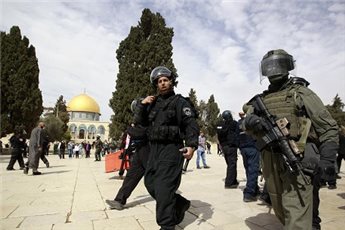
Israel bans guards from entering Aqsa compound
Ma’an – 08/06/2013
JERUSALEM – Israel on Friday banned 25 Al-Aqsa compound guards from the vicinity of the mosque for varying periods of time.
Samer Qweider was banned from entering Al-Aqsa until the end of Ramadan for allegedly verbally abusing rightists who tried to get into the compound.
Qweider told Ma’an that on May 28 he was banned from entering the compound for six days, and accordingly he returned to his job on Monday. After two days of working regularly he was told by Israeli police he was not allowed to enter the compound until Ramadan ends in mid-August.
Another guard, Fadi Bakeer, said that Israel wanted to “silence” the guards, and added that any guard who tried to stop rightists from entering the holy compound would be banned.
A religious department worker said that guards are pressured, arrested, beaten, banned, and fined. He added that his department has pleaded for King Abdullah II of Jordan for help.
Israeli authorities have allowed the Jordanian leadership a degree of control over the holy Muslim site as well as the Church of the Holy Sepulcher due to its historical connections to Jerusalem.
Israel seized the West Bank including East Jerusalem from Jordan in the Six-Day War of 1967.
Related article
- Palestine: The global march to Jerusalem to launch tomorrow in 40 states & demands to flock to Al-Aqsa Mosque (realisticbird.wordpress.com)
Jordan: A Limited Strategic Shift
By Elie Chalhoub | Al-Akhbar | February 27, 2013
Jordanian King Abdullah II’s recent visit to Moscow crowned a series of steps that Amman has been taking over the past few months, signalling a shift away from its traditional allies like Washington and Israel.
Until recently, Jordan was in the warm embrace of oil-rich Gulf Arab countries that, prepared to admit the Hashemite kingdom into their Gulf Cooperation Council (GCC), would then shower it with billions in aid.
This is while Amman offered the services of its security and intelligence forces, coordinating closely with both Washington and Tel Aviv in a variety of areas, not least of which the unfolding crisis in Syria.
According to informed sources, last July 2012, Amman hosted a gathering of security officials from the US, Qatar, and Israel, who recommended setting up training camps for Syrian opposition fighters near the Jordanian city of Irbid.
US Secretary of Defense Leon Panetta admitted as much when he acknowledged in October 2012 that dozens of American soldiers were deployed along the Jordanian-Syrian border, explaining that “these units are tasked with establishing a base in Jordan and to assist the Syrian refugees and Jordanian armed forces to confront the dangers stemming from Syria’s chemical weapons.”
In the last few months Amman has begun to reassess its alliances in light of the Syrian crisis, perhaps embarking on a process of strategic realignment, moving closer to Iraq and Russia, at the expense of its traditional allies.
The prospective threat posed by the powerful Jordanian Muslim Brotherhood and the more radical Islamist currents prompted the army and intelligence to convince the palace not to go along with Washington’s plan.
Amman even went so far as to completely close its border with Syria, preventing fighters and weapons from crossing it.
This came at a high cost for Jordan, as Saudi Arabia and Qatar – who were mobilizing all the forces they could muster against the Bashar al-Assad regime – to halt their support for the kingdom, causing a serious economic crisis in the country.
Iraq quickly moved in to try to fill the void and revive its once close ties with Jordan. An official visit to Amman by Iraqi Prime Minister Nouri al-Maliki at the end of 2012 led to the signing of several lucrative deals that would see cheap Iraqi oil once again flowing to Jordan.
As for Jordan’s relationship with Iran, “that’s a tough one for us,” says a high-level Jordanian security official, pointing out that the realignment underway may go far, “but it has its limits, for there are lines that cannot be crossed, and Iran lies outside these boundaries.”
In light of all this, King Abdullah II’s visit to Moscow on Tuesday, February 19 cannot in any way be seen simply as a routine call.
For its part, Jordan is seeking a counterbalance to US influence, for fear that Washington is preparing to force Amman into accepting a confederation with the Palestinians as a solution to the Arab-Israeli conflict.
Russia, on the other hand, sees this as an opportunity to bring Amman into its orbit, particularly on the Syrian question, where Moscow is in the process of pushing for a settlement.
Jordan’s diplomatic support in the Arab arena and the valuable intelligence it can provide on the Syrian opposition make it a critical resource for the Russians.
Confirmed: Pentagon deploys special forces to Jordan-Syria border
RT | October 10, 2012
US Secretary of Defense Leon Panetta has confirmed that US troops have been dispatched to the Jordan-Syrian border to help bolster the former’s military capabilities in case violence escalates in the volatile region.
”We have a group of our forces there working to help build a headquarters there and to insure that we make the relationship between the United States and Jordan a strong one so that we can deal with all the possible consequences of what’s happening in Syria,” Panetta said.
Panetta’s comments came during a NATO conference of defense ministers in Brussels, where he said the US had been working with Jordan to monitor chemical and biological weapons sites in Syria and help the country deal with Syrian refugees crossing over the border.
The US has previously used Jordan as a base for other Syria-related military activities. In May of this year, Washington held military drills in Jordan dubbed ‘Operation Eager Lion,’ which saw around 12,000 troops from several nations participate in undisclosed training exercises.
The Obama administration denied accusations in the Syrian media that the exercises were a threat against President Assad, and maintained that the action focused on the treatment of refugees, anti-terrorism tactics and naval interception of smuggling vessels.
Following the operation, a small US contingent stayed behind to establish the center in Amman, paving the way for the arrival of more personnel.
“We have been working closely with our Jordanian partners on a variety of issues related to Syria for some time now,” Pentagon Press Secretary George Little said. Citing Washington’s concern over Syria’s stockpiles of chemical and biological weapons, he said that the US has been planning “various contingencies, both unilaterally and with our regional partners.”
The Syrian conflict took an unexpected turn last week when mortar fire struck across the border at neighboring Turkey, sparking outcry from the Turkish government which subsequently returned fire. Turkey deployed 25 new F-16 fighter jets to reinforce its borders this week as NATO pledged support if the conflict spills into the country again.
Since uprisings against the embattled President Assad began last year, the UN estimated that more than 20,000 people were killed in the conflict and some 700,000 fled Syria to seek refuge in neighboring countries.
Jordanian protesters stage rallies against fuel price hike
Press TV – September 2, 2012
Thousands of Jordanians have taken to the streets across the country in protest against a hike in fuel prices for the second time in three months.
Chanting anti-government slogans, the protesters from the capital, Amman, to the southern city of Maan rallied late Saturday, demanding the immediate resignation of the country’s Prime Minister Fayez Tarawneh.
“The royal palace is standing between the people and their rights,” the protesters chanted.
The Jordanian government said the fuel price rise was necessary, arguing that the costly fuel subsidies have caused a rampant budget deficit.
Jordanians, however, blame the royal palace and corruption as the real reasons behind Jordan’s economic crisis.
The Saturday evening demonstrations, organized by the Muslim Brotherhood, were the largest to hit the country in months.
Jordanians have been holding street protests since January 2011, calling for political reforms, transfer of royal power to the people and an end to corruption.
Since the demonstrations began, the Jordanian King has sacked two prime ministers to appease the protesters.
The king has also amended some articles of the 60-year-old constitution, ostensibly granting the parliament a more assertive role in the decision-making process.
Related articles
- Jordanian Websites Go Dark in Protest of Proposed Legislation to Censor Internet (techpresident.com)
- Jordan hikes gasoline prices for second time this year (worldbulletin.net)
- Jordanians detained after tomato attack on PM motorcade (dailystar.com.lb)
- Jordanians Protest Internet Censorship Law With SOPA-Style Blackout (eff.org)
Hamas Senior Member Assassinated in Damascus, Group Blames Mossad
Al-Manar | June 28, 2012
The Islamic Resistance Movement, Hamas, said on Wednesday that one of its senior members was assassinated in Damascus, blaming the Zionist entity’s secret service for the attack.
The announcement, posted on the group’s official website said it was unknown who killed Kamal Ranaja.
Hamas said it was launching “an investigation to discover who is behind the despicable crime.”
The statement added that Ranaja “was martyred in the service of his cause and his people,” vowing that his blood would not be wasted.
For his part, A Hamas official in Lebanon blamed the Zionist entity’s Mossad for the death of Ranaja.
The leader, who spoke on condition of anonymity, said that “a group of people entered the home of Ranaja (also known as Nizar Abu Mujhad), and killed him,” Israeli website Ynet reported.
According to information that we have gathered, the Mossad is behind the attack.”
Shortly after the assassination was announced, the new pan-Arabic television station, Al-Mayadeen, reported that he used to serve as aide to Mahmoud al-Mabhouh, a senior Hamas member who was likely killed by Mossad in a hotel in Dubai in the year of 2010.
A delegation of senior Hamas politburo officials including Khaled Mashaal and Mousa Abu Marzook is set to arrive in Jordan to attend Ranaja’s funeral.
The group was meant to visit Jordan over the weekend or early next week but its members decided to push up their visit in order to attend the funeral. They are slated to meet Jordanian officials and possibly also King Abdullah II.
Saudi Arabia, Jordan behind Syria unrest
Hassan Hanizadeh | Press TV | April 10, 2011
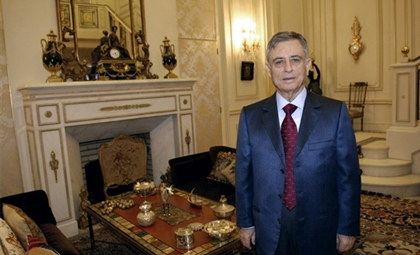
Syrian opposition leader Abdul Halim Khaddam at his home in Paris
The rise in anti-government protests and mounting political tension in Syria brings to mind the question about who is behind these deadly incidents.
A probe into the root causes of the latest events in Syria shows that the revolt is mainly supported by Saudi Arabia and Jordan.
The revolt began in the city of Daraa, 120 kilometers south of the capital Damascus and near the border with Jordan.
Daraa is the birthplace of Jordan’s Muslim Brotherhood, which has close ties to the people in the Syrian city.
Undoubtedly, the Syrians, like other nations in the region, have some legitimate demands which have prompted the government to plan fundamental reforms. However, the protests have come with unjustifiable violence by some suspicious elements.
Similar protests were seen in 1982 against the government of late Syrian president Hafez al-Assad in the cities of Hama and Daraa.
Hafez al-Assad — the late father of current Syrian President Bashar al-Assad — was president between 1970 and 2000 and was considered one of the powerful leaders in the Arab world.
Former Jordan King Hussein, former Iraqi dictator Saddam Hussein and the then Saudi King Khalid incited Jordan’s Muslim Brotherhood against Syria, when Hafez al-Assad backed Iran during the eight-year Iraqi-imposed war on Iran in the 1980s.
The fighting, which took place from 1982 to 1984, left more than 30,000 people dead, but the late Syrian president finally managed to end the crisis.
Saudi Arabia and Jordan continued their attempts to cause unrest in Syria after the death of Hafez al-Assad and his succession by his son.
Saudi Arabia, which often bows to US and Israel’s policies in the region, tried to destabilize Bashar al-Assad’s government by undermining his rule.
To this end, Saudi Arabia paid 30 million dollars to former vice president Abdul Halim Khaddam to quit Assad’s government.
Khaddam sought asylum in France in 2005 with the aid of Saudi Arabia and began to plot against the Syrian government with the exiled leaders of the Muslim Brotherhood.
Khaddam, who is a relative of Saudi King Abdullah and former Lebanese premier Rafiq Hariri, used his great wealth to form a political group with the aim of toppling Bashar al-Assad.
The triangle of Khaddam-Abdullah-Hariri is well-known in the region as their wives are sisters.
Khaddam’s entire family enjoys Saudi citizenship and the value investment by his sons, Jamal and Jihad, in Saudi Arabia is estimated at more than USD 3 billion.
Therefore, with the start of popular protests in Tunisia, Egypt, Libya, Yemen and Bahrain, the Saudi regime saw an opportunity to drive a wedge between Tehran, Damascus and Beirut axis.
Due to the direct influence of the Saudi Wahhabis on Syria’s Muslim Brotherhood, the people of the cities of Daraa and Homs, following Saudi incitement and using popular demands as an excuse began resorting to violence.
It is reported that the United States, Israel, Jordan and Saudi Arabia formed joint operational headquarters in the Saudi Embassy in Belgium to direct the riots in southern Syria. Abdul Halim Khaddam, who held the highest political, executive and information posts in the Syrian government for more than 30 years, is said to have been transferred from Paris to Belgium to direct the unrest.
The reason for this was that based on French law, political asylum seekers cannot work against their countries of origin in France and therefore Khaddam was transferred to Brussels to guide the riots.
Jordan equipped the Muslim Brotherhood in the two cities with logistical facilities and personal weapons.
Although, Bashar al-Assad promised implementation of fundamental changes and reforms after the bloody riot in the country, the Brotherhood continued to incite protesters against him.
The Syrian state television recently broadcast footage of armed activity in the border city of Daraa by a guerilla group, which opened fire on the people and government forces. It is said that the group, which is affiliated to Salafi movements, obtained its weapons from Jordan and Saudi Arabia.
Because Syria’s ruling party is from the Alevi tribes associated with the Shias, the Brotherhood, due to its anti-Shia ideas, has tried for three decades to topple the Alevi establishment of the country.
Hence, the recent riots in Syria are not just rooted in popular demands but harbor a tribal aspect and Saudi Arabia, Jordan and the US are directing the unrest for their future purposes.
In the eyes of these three, the removal of Syria’s Alevi government would cause the Tehran-Damascus-Beirut axis to collapse and would be followed by the gradual weakening and elimination of Lebanon’s resistance.
Therefore suadi and US efforts to topple Assad’s government are taking place with the aim of eliminating the last anti-Zionism resistance front.
This is while, considering the Syrian government’s experience in resolving difficult crises, it is unlikely that Saudi Arabia and Jordan will succeed in weakening or toppling the Syrian ruling system.
Related articles
Featured Video

or go to
Aletho News Archives – Video-Images
From the Archives
A Lesser “Grade” of Human
By Michael Hoffman | Revelation of the Method | January 3, 2024
Will the more than 100 Iranians killed by terrorist bombs today be mourned in the West as victims of terrorism? Certainly not. Allied doctrine has it that the killing of Israeli or American civilians is a crime of cosmic proportions, while shedding the blood of “enemy” women and children is perfectly acceptable; indeed commendable.
The West does not memorialize the hundreds of thousands of civilians bombed by the U.S. in Serbia, Iraq, Afghanistan and every major German city 1943-1945. America’s fire-bombing of the city of Tokyo by General Curtis LeMay in March 1945 was followed by Harry Truman’s atomic incineration of Hiroshima and Nagasaki in August of that year. Truman never had a moment of doubt or regret over the murder of more than a 100,000 Asian children, mothers and non-combatant boys and men. It was business as usual for the “noble” Allies during the “Good War.”
In the West human rights signifies passionate concern only for civilians designated as truly human: Israelis first, then Americans and British, followed by their satraps.
This inhumanity is the legacy of Talmudic ideology, beginning with tractate Sanhedrin 57a from 400 A.D., concerning liability for capital punishment: “If a Jew murders a gentile, he is exempt.”
This teaching of contempt was reiterated in the dogma of Chabad Lubavitch founder Rabbi Shneur Zalman in the 18th century. … continue
Blog Roll
 Aletho News
- NATO’s top generals gather in Kiev
- EU’s continuing expansion – greater threat to Russia
- US Senator Murphy says Pentagon denied him entry to US base in Qatar
- Israel expands “incitement” charge to target Palestinian education and memory
- How Israel seeks to reshape Arab classrooms
- Paris bans pro-Palestinian demonstration planned for Oct. 7 over ‘risks of public disorder’
- In August Hanning Treason Case – All Signs Point To Tel Aviv.
- France cleared dozens of military sales to Israel between May and September: Report
- France projects nuclear power as Macron pushes arsenal expansion
- The fallacy of US delusions about Iran’s economic collapse
- If Americans Knew
- An error has occurred; the feed is probably down. Try again later.
- No Tricks Zone
- US September “Heat” Was No Record…Many Records Set Decades Ago
- Latest European Green Energy Debacle; Portugal’s Largest Flagship Solar Park Insolvent!
- Green Energy Debacle: German Expert Professor Fritz Vahrenholt Warns Of Severe Economic And Social Consequences
- Two More Paleo Reconstructions Affirm Meters-Higher Sea Levels Across Ireland, Brazil 7000-6000 Years Ago
- New Study: Earth And Venus Surface Warmth Largely Explained By Convection And Lapse Rate, Not CO2 Or Radiation
- 2025 Nature Paper Claiming Worsening Global Drought Gets RETRACTED …Heavily Flawed
- New Study: ‘Global Drought Shows No Detectable Recent Acceleration Under Climate Warming’
- Economic Masterminds: German Socialists Suggest Taxing Productivity Gains Stemming From Using AI
- The South China Sea Has Not Been Cooperating With The Climate Change Narrative
- Energy Crisis: Germany Enters Heating Season With Historically Low Gas Reserve Fill Levels

