Holder Deadline for Prosecuting Wall Street Executives for Financial Crisis Passes without a Single Charge
By Noel Brinkerhoff and Danny Biederman | AllGov | May 26, 2015
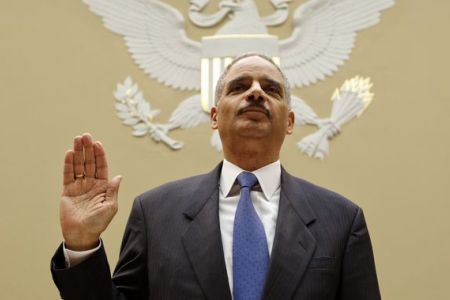
Shortly before Attorney General Eric Holder left office, he gave his prosecutors 90 days to decide whether to indict any Wall Street executives for decisions that caused the 2008 financial crisis.
Holder has now left the building at the Department of Justice (DOJ). Also gone is his deadline for punishing big bankers, none of whom were charged with a crime.
Holder’s shop had six years to build cases against key people at institutions like Citigroup and JP Morgan Chase. It’s not known if prosecutors ever did that. What is known is that the only charges actually filed by DOJ lawyers have been against smaller fish, namely those working at small and medium sized banks, according the Center for Public Integrity (CPI).
The investigative news site reviewed enforcement actions and civil lawsuits filed by the Justice Department, Federal Deposit Insurance Corp. (FDIC) and Securities and Exchange Commission (SEC) and found “these agencies have been far more likely to charge or sue individuals who work at small and medium sized banks, and foreign financial firms, than those that work at domestic banking giants such as J.P. Morgan Chase & Co. or Citigroup.”
CPI’s Alison Fitzgerald reported that none of the five largest banks in the country are involved in criminal cases filed by the Justice Department that pertain to the financial crisis.
“Two defendants who were unsuccessfully prosecuted ran a hedge fund for the now-defunct investment bank Bear Stearns,” she wrote. “About a dozen others are from smaller banks or foreign institutions.”
At the SEC, only four of the more than 100 bank executives named in lawsuits were from the top five banks, according to Fitzgerald. The FDIC has sued nearly 2,000 bank executives, none of whom worked at any of the big Wall Street banks.
“There’s no question that these banks have admitted that they’ve violated laws and regulations,” Independent Community Banker of America CEO Camden Fine told CPI. “These guys on Wall Street get their checkbooks out and write a check. This is an issue of unequal enforcement.”
For his part, Holder recently defended his efforts and that of the DOJ to prosecute individuals at the big banks for criminal wrongdoing. “To the extent that individuals have not been prosecuted, people should understand it is not for lack of trying,” he said.
“Nonsense,” countered former U.S. Assistant Attorney General Jimmy Gurulé. “Charges for white-collar crimes are filed every single day by U.S. attorneys across the country,” he told International Business Times. “Just because they’re more difficult with banks is not a legitimate excuse for bringing zero charges against individuals.”
To Learn More:
Bankers From Major Institutions Still Haven’t Been Held Responsible For Financial Crash (by Alison Fitzgerald, Center for Public Integrity)
Who Caused The Financial Crisis? Prosecutors Face 3-Month Deadline for Bringing Charges in the Subprime Mortgage Mess (by Owen Davis, International Business Times )
Instead of Wall St. Prosecutions, Holder Delivers a Deadline (by William Cohan, New York Times )
Eric Holder’s Last Chance to Prosecute Financial Meltdown Bankers (by Noel Brinkerhoff, AllGov )
Featured Video
America Racing to Strategic Defeat in Iran
or go to
Aletho News Archives – Video-Images
From the Archives
Should Europeans ‘Thank’ the Americans for Destroying Nord Stream?
By Robert Bridge | Strategic Culture Foundation | September 29, 2022
With an investigation continuing into the destruction of the Nord Stream gas pipeline that provided energy supplies to Europe from Russia, there appears to be just one prime suspect, and that should surprise nobody.
Following the sabotage of the Nord Stream 1 and 2 gas pipelines, former Polish Foreign Minister Radoslaw Sikorski already seemed to know the identity of the perpetrator when he tweeted out: “Thank you, USA.”
At first glance, it seemed that Sikorski was speaking sarcastically, berating Washington for carrying out an attack that will have severe repercussions for the people of Europe. After all, how could anyone see any good coming from the termination of Europe’s primary source of gas reserves with winter just around the corner? It was Sikorski’s homeland of Poland, after all, that urged its citizens to collect firewood in the face of dwindling gas reserves.
In fact, the Polish diplomat was speaking one-hundred percent literally… continue
Blog Roll
 Aletho News
- Tehran approves new Hormuz plan with major restrictions
- No Threat Can Force Iran’s Surrender /Trita Parsi & Lt Cl Daniel Davis
- UK’s New Pandemic Plan Would Turn Big Tech Into a Mass Location Tracking Network
- Growing insecurity, soaring prices fuel protests in north as regime bans evacuation: Sources
- Iran denies responsibility for ‘depraved’ attack on Kuwait desalination plant
- Bring The Troops Back. End This War Now!
- Can we please stop calling Israel the ‘only democracy in the Middle East’ now?
- US should start removing its troops from Germany, proposes AfD co-leader Chrupalla
- Iran Red Crescent: 600 educational centers attacked in US-Israeli ‘war crimes’
- Russian Oil Tanker Arrives in Cuba Amid U.S. Blockade
- If Americans Knew
- As Iran targets US military bases, will they be relocated to Israel? Not a ceasefire Day 171
- Will Trump Go Kamikaze?
- Is the University of Florida Shutting Down College Republicans over Israel Criticism?
- Jewish extremist arrested over alleged plot to firebomb Palestinian activist Nerdeen Kiswani’s home
- More than half of Palestinian child detainees have no charges
- The More Murderous Israel Gets, The More We Hear About “Antisemitism”
- Land Day and the Palestinian struggle after 30 months of genocide
- The Iran War Is About Palestine
- Israeli soldiers echo settler ideology, talk of revenge after targeting Palestinians and detaining CNN crew in the West Bank
- Israeli Policies Threaten Future of Christian Schools in Jerusalem
- No Tricks Zone
- New Study Finds Warming Saves Lives…Cold Temperatures 12 Times More Deadly Than Excess Heat
- German Science Blog Accuses PIK Climate Institute Of Hallucinating Climate Tipping Points
- Devastating Assessment Of Comirnaty Vaccine By Former Senior Pfizer Europe Toxicologist
- New Study: CO2 Is ‘Effectively Negligible’ As An Explanatory Climate Change Factor Since 2000
- Former Pfizer Toxicologist Dr. Helmut Sterz Tells Bundestag Hearing Pfizer Vaccine Should Have Never Been Approved
- Energy Expert: Germany’s Nuclear Phaseout Was A “500 Billion Euro Mistake”
- New Research: South Australia’s Mid-Holocene Sea Surface Temperatures Were 4°C Warmer Than Today
- Storing Green Energy To Last Germany 10 Days Would Require A 60-Million Tonne Battery
- New Studies: UK Sea Levels Were 4 Meters Higher Than Today During The Mid-Holocene
- Destructive Green New Deal: German Energy And Metal Group Warns Of Drastic Crisis
 Aletho News