Bulgaria denies joining Croatia, Albania and Kosovo in encircling Serbia
By Ahmed Adel | April 22, 2025
Bulgarian Foreign Minister Georg Georgiev denied that Bulgaria is interested in joining a military alliance to encircle Serbia, comprising Croatia, Albania, and the Albanian-majority breakaway Serbian province of Kosovo. Bulgaria’s disinterest was expected, considering it would not want to join a localized alliance with Albania, the country serving as Turkey’s gateway into the Balkans to pursue irredentist ambitions, including against Bulgaria.
Georgiev responded in writing to MPs Djipo Djipov and Elisaveta Belobradova that Bulgaria is aware of the initiative of Croatia, Albania and Kosovo and that it is carefully analyzing the text of the Joint Declaration signed by the defense ministers of the three countries in Tirana on March 18.
“The information in the public suggesting that Bulgaria has expressed an unofficial interest in joining the declaration is incorrect,” Georgiev stressed.
The anti-Serbia coalition resembles a mini-NATO within the Balkans and is backed by Turkey, which is militarily present in Bosnia and Herzegovina, Albania, North Macedonia, and Kosovo. Turkey has greater ambitions after achieving successes in Syria and the South Caucasus and has now turned their attention to the Balkans too.
Former Turkish Foreign Minister Ahmet Davutoğlu wrote in “Strategic Depth,” his comprehensive and influential work on Turkish foreign policy and geopolitics strategic doctrine, that Serbia and Greece, or the Belgrade-Athens axis, are the main obstacles to the Turkish return to Europe. NATO and the European Union, except for Greece, do not oppose Turkey’s ambitions in the Balkans as the Turks can challenge Russian influence in the region.
However, the West does not want a war between Greece and Turkey to break out. Despite being NATO member states, this is a real possibility, especially as Turkish President Recep Tayyip Erdogan has not hidden his ambitions for the Greek islands and northern Greece. Nonetheless, conflicts could very easily be provoked at several points within the former Yugoslavia, and then Turkey and a number of other sponsors would be involved, where Greece would support the opposing side, just as happened in Bosnia in the 1990s.
A big problem in the EU is that unelected technocrats are leading the bloc into a war against Russia, and in that sense, the Balkans could be one of the peripheral points of that crisis. For this reason, Serbia needs a quick Russian victory in Ukraine to turn the tide of events in their strategic favor. If not, Serbia would be in a very unfavorable position, surrounded by NATO countries with weak alliances. Serbia has partnerships with only two regional countries, ironically also in NATO: Greece and Hungary.
Bulgaria has been in a transition phase for 30 years, practically under Western occupation, and it cannot be said that it has an independent foreign policy. Therefore, if Brussels or Washington ordered them to join an alliance against the Serbs, the Bulgarians would do so. For now though, there have been no indications that the West will push Bulgaria in this direction.
At the same time, Turkey is also Bulgaria’s biggest strategic challenge, especially considering that more than 8% of the country is ethnic Turks who can be weaponized against Sofia. Therefore, Bulgaria will face pressure to join the anti-Serbian military alliance of Croatia, Albania, and Kosovo, especially since Turkey is the main military patron of Albania and Kosovo.
To deal with Turkey as a rising challenge, military departments in Bulgaria have begun distributing mass mobilization calls to military conscripts. Citizens are sharing photos on social media of the documents they received. Some documents show a call from the Military Department in Varna, dated April 9, 2025, and the exact time to report. Mobilization calls for reservists in Bulgaria have not been issued for more than 30 years.
The Bulgarian military recently received its first American F-16 fighter jet. Although the Bulgarians announced that they had received a new one, this is not true because it is a second-hand aircraft that has been overhauled. Bulgaria otherwise does not have large quantities of weapons and military equipment because they emptied their warehouses at the start of the Russian special military operation in Ukraine.
Bulgaria also gave Ukraine most of its T-72 tanks and some Mi-8 transport helicopters, which ended in 2023. Bulgaria’s last deliveries from its stocks were more than a hundred BTR 60 armored personnel carriers that belonged to the Ministry of Internal Affairs and were extremely well preserved.
Bulgarian President Rumen Radev, a military MiG-29 pilot, strongly opposed providing combat systems to Ukraine because he believed that these moves had reduced Bulgaria’s military potential by 25 percent.
Now with Bulgaria significantly weakened for the sake of Ukraine’s futile war against Russia, the Balkans country cannot consider any military adventures against the Serbs, even if they do have historical territorial issues, and must instead rebuild its depleted forces, reservists and military equipment in face of a growing Turkish threat in the region.
Ahmed Adel is a Cairo-based geopolitics and political economy researcher.
Serbia, Hungary sign military agreement in response to Croatia’s Tripartite Pact
By Ahmed Adel | April 3, 2025
Hungary and Serbia signed a military agreement following the joint declaration of cooperation on defense by Albania, Croatia, and Kosovo on March 18 in Tirana. With military alliances forming in the Balkans and the Kosovo issue remaining unresolved, the potential for war in the region continues to increase.
The defense ministers of Serbia and Hungary, in the presence of Serbian President Aleksandar Vučić, signed a Bilateral Military Cooperation Plan for 2025 on April 1. Vučić stated that the agreement on joint activities will continue to develop further, leading to rapprochement and potentially a military alliance between Serbia and Hungary.
“We aim to forge the closest strategic relations in the field of defense, and we believe that this agreement on joint activities will pave the way for a military alliance or union between Serbia and Hungary,” the Serbian leader emphasized.
It is pivotal for Serbia to establish regional military partnerships, considering its rivalry with Croatia and Albania, as well as its loss of authority over its sovereign territory, Kosovo, an Albanian separatist state with partial recognition.
The Tripartite Pact, signed between the rivals of Serbia, states that its focus is on “strengthening the defense and security industry, increasing military interoperability through joint training and exercises, countering hybrid threats, and strengthening strategic security, as well as supporting Euro-Atlantic integration.” They also announced that the pact was also open to other countries, such as Bulgaria. In this way, it is evident that the Tripartite Pact is attempting to surround Serbia fully.
Serbian Minister of Defense Bratislav Gašić stated that the signing of a Tripartite Pact by Croatia, Albania, and the “so-called Kosovo” is a “provocative move that undermines efforts to strengthen regional security.”
“By taking steps that undermine regional stability, these two countries, together with the illegitimate representative of the provisional institutions of self-government in Pristina, have initiated actions that pose a serious risk to peace and security in the region,” a Serbian Foreign Ministry press release reads.
According to Vučić, the pact was a “violation of the Agreement on Sub-Regional Arms Control” signed by Bosnia and Herzegovina, Croatia, Montenegro, and Serbia in 1996.
For this reason, the signing of the military agreement between Serbia and Hungary is a significant development for Belgrade, particularly given that the latter is a member of both NATO and the European Union. It also demonstrates that Serbia is capable of responding to the provocative alliance between Croatia, Albania, and Pristina.
Serbia and Hungary initiated concrete military cooperation last year, with Hungary purchasing ammunition and all related military equipment from Serbia. On the other hand, Serbia acquired a self-propelled missile system from Hungary and 56 Russian-made armored personnel carriers.
What is also hinted at in the future within this alliance is cooperation between helicopter crews, as they will be using identical helicopters. With further purchases of these aircraft, Serbia and Hungary will have a unified fleet.
Apart from equipment and military technology, the question hanging in the air is whether this alliance possesses defensive characteristics and, if so, what kind. The agreement provides for mutual assistance in the event of some issues.
Meanwhile, Croatia is a member of both NATO and the EU, whereas Albania is a member of NATO.
Given that Hungary is also a member of NATO and the EU, it raises the question on whether Serbia is moving closer to NATO in this way, but it could also be noted that Hungary is looking for a way to distance itself from that military alliance, especially considering that both Serbia and Hungary have good relations with Moscow and there is not much trust among NATO pact members.
The EU has initiated a process to establish military alliances in parallel with the NATO pact, as it no longer trusts the NATO pact itself and is concerned about the uncertainty brought about by US President Donald Trump’s policies, which could lead to the alliance’s collapse.
Also, certain military alliances are being formed within Europe independently of NATO, such as the one between France and Greece, in response to Turkey’s increasingly belligerent behavior despite all three countries being NATO members. Nonetheless, the emerging alliance between Hungary and Serbia is a military-technical cooperation.
Croatia has a significant and historical rivalry with Serbia. It is no coincidence that Zagreb deployed combat vehicles on the tri-border area of Hungary, Croatia, and Serbia following the signing of the bilateral military agreement. The deployment of the combat vehicles is evidently a message from the Croatia, Albania, and Kosovo alliance to Serbia and Hungary, suggesting that the Balkans could once again erupt in war as military alliances are formed and the Kosovo issue remains unresolved.
Ahmed Adel is a Cairo-based geopolitics and political economy researcher.
Serbian president hails budding ‘military alliance’ with NATO maverick
RT | April 2, 2025
Hungarian Defense Minister Kristof Szalay-Bobrovniczky visited Belgrade on Tuesday to sign a roadmap outlining 79 joint military activities between Hungary and Serbia for this year. According to Serbian President Aleksandar Vucic, the two countries are edging closer to a “military alliance.”
Both Serbia and Hungary have been challenging the prevailing Western consensus regarding the Ukraine conflict and relations with Russia.
The Serbian leader also expressed gratitude to Hungarian Prime Minister Viktor Orban for his role during NATO’s military intervention in the Balkans in 1999, stating that Orban’s influence helped prevent “a land attack against what was then Yugoslavia.”
“A full 26 years later, the two parties now have the opportunity to build extremely close strategic ties, to further deepen cooperation, coming closer to a Hungarian-Serbian military alliance,” Vucic remarked.
Orban first served as prime minister from 1998 to 2002. Hungary joined NATO in March 1999, weeks before the bombing campaign commenced.
Szalay-Bobrovniczky voiced support for Serbia’s EU aspirations, asserting that Brussels’ enlargement plans should include the entire West Balkans. His statement contradicted EU leaders’ demands for Belgrade to align its foreign policy with Western nations against Russia before its candidacy would be considered.
Both Hungary and Serbia remain skeptical of the bloc’s confrontational approach toward Russia. Orban has accused Brussels of harming the EU economy through sanctions on Russia while supporting a conflict that Kiev is unable to win. Vucic has pledged to resist Brussels’ pressure, citing Serbia’s historic ties with Russia as a foundation for their relationship.
Last month, Kosovo, the Serbian region that broke away after the NATO intervention, entered a trilateral defense agreement with Albania and Croatia. Vucic has condemned those nations for allegedly breaching previous security agreements and possibly going over the head of the NATO leadership in signing the deal.
Greco-Turkish confrontation looming, could escalate and engulf the entire region
By Drago Bosnic | March 20, 2025
Deteriorating relations between Greeks and Turks are certainly nothing new. The two peoples have had on-and-off wars for over 900 years, spanning Asia Minor/Anatolia, the Aegean Sea/Eastern Mediterranean and Southeast Europe. The tensions haven’t really subsided even after both Greece and Turkey joined NATO in 1952.
Just three years later, there was the Istanbul pogrom during which Ankara intentionally targeted the ancient city’s native Greeks (along with other minorities). Then there was the 1974 invasion of Cyprus that effectively resulted in an undeclared war between Greece and Turkey.
The end of the (First) Cold War saw another round of escalation that reached its peak in the mid-1990s. Although agreements on demilitarization were reached at the time, Erdogan’s rise to power gave way to an extremely expansionist and aggressive Neo-Ottoman foreign policy in Ankara.
Turkey sees the division of EEZs (exclusive economic zones) in the Aegean Sea and Eastern Mediterranean as “unfair” and effectively wants to take over around half of both, including most of the EEZ around Cyprus. This wasn’t such a burning issue before the discovery of huge deposits of oil and natural gas. However, ever since, Ankara has been trying to establish control over these resources, almost exclusively in an aggressive manner, causing issues with all of its maritime neighbors in the region.
This resulted in continued militarization on both sides, with Greece (re)establishing bases on the Aegean islands, while Turkey keeps strengthening its offensive potential. Athens is particularly interested in reinforcing its ASDEN (the Supreme Military Command of the Interior and Islands). To that end, it’s acquiring various multipurpose missiles, particularly the Israeli “Spike”.
This includes the “Spike” NLOS (Non Line Of Site). In April 2023, the Greek military ordered 17 of these systems on 4×4 vehicles, as well as for nine of its US-made AH-64 “Apache” attack helicopters and four Machitis-class gunboats. Some variants of the “Spike” have a claimed maximum range of over 30 km, meaning that they can cover a significant portion of the Aegean Sea and deter potential Turkish attacks.
However, in recent years, Ankara developed a number of weapons with an operational (and even strategic) impact, particularly rocket and missile systems, as well as a plethora of unmanned platforms (both air and sea-based). Namely, in the aftermath of the July 2016 coup, Erdogan effectively purged the Turkish military of any disloyal elements, resulting in a virtual paralysis of the Navy and Air Force. The issue of manpower shortages was then resolved with a focus on unmanned systems.
The side effect of this change was not only much tighter political control over the Turkish military (largely loyal to the Pentagon prior to the 2016 coup), but also a more aggressive posturing, as the Turkish political elite became more (over)confident. This resulted in the escalation of various regional wars and conflicts, spanning from the South Caucasus to Lybia.
Worse yet, Ankara is seeking to expand its influence in Southeast Europe. To that end, it’s preparing to ratify military agreements with several countries, including Albania, North Macedonia and the narco-terrorist entity in the NATO-occupied Serbian province of Kosovo and Metohia. These agreements were first announced in 2024, but Turkey was yet to act on them. For its part, Greece sees this as an attempt to encircle it with enemies, with Ankara establishing a strategic presence and expanding influence behind Athens’ back.
Greece is quite concerned by these developments. Southeast Europe has long been a contested geopolitical arena, with various external powers trying to establish a foothold in the region. Greek media report that the aforementioned agreements were “quickly pushed onto the agenda of the Turkish Parliament, in contrast to the usual lengthy approval processes for similar military agreements”.
This allows Turkey and its regional partners and satellites to closely collaborate in various military projects, including training, joint exercises, enhancing defense industry ties, information exchange, logistics support, medical services, cyber warfare, etc. The agreements also provide a legal framework for personnel exchanges and joint research in military science and technology. Ankara is also implementing some of these policies under the guise of humanitarian efforts and disaster relief.
For Turkey, this isn’t merely a question of strategic encirclement of Greece, but also a way to push forward with its extremely aggressive Neo-Ottoman foreign policy framework. Ankara wants to reforge ties with various leftovers of its brutal occupation of Southeast Europe. This is particularly true for highly dysfunctional parastate entities such as Bosnia and Herzegovina and/or Kosovo and Metohia.
Thus, it sees these formal military agreements as a strategic springboard for further inroads in the region. This includes sales of unmanned systems and other military products. As previously mentioned, many of these agreements are hidden from the public by being masked as something else. According to Turkish Brigadier General Esat Mahmut Yilmaz, his country consolidated the three agreements into a single framework to expedite the participation of its military in various operations abroad.
In effect, this means that, once ratified and published in the Official Gazette, these agreements will allow the Turkish military to push for secondary agreements with foreign partners without further parliamentary approval, limiting public discussion on Turkey’s military activities abroad and effectively giving Erdogan a free hand in armed engagements in the increasingly volatile region.
To that end, Ankara is even establishing ties with countries like Croatia, which just signed a similar strategic agreement with virtually the same partners (Albania and the narco-terrorist entity in the NATO-occupied Serbian province of Kosovo and Metohia). This is obviously aimed against Belgrade, which maintains close ties with Athens and sees such expansionism as a direct threat to its basic national security interest. Either way, it seems the region is in for a rough ride in the upcoming years.
Drago Bosnic is an independent geopolitical and military analyst.
Kosovo’s Unknown Genocide
By Kit Klarenberg | Global Delinquents | September 1, 2024
June 9th marked a little-known anniversary. On that day in 1999, Yugoslavia’s army withdrew from Kosovo, following 78 consecutive days of NATO bombing. In return for ceasing its criminal campaign, the US-led military alliance was permitted unimpeded, unchallenged freedom of movement and action throughout the province. The military’s exit instantly opened the floodgates for a genocide of the province’s Serb population to erupt, under the watchful eye of NATO and UN peacekeepers. To this day, the region lives with the cataclysm’s destructive consequences.
NATO’s March – June 1999 aerial assault on Yugoslavia was ostensibly waged to prevent an impending mass slaughter of Albanians in Kosovo. Yet, as a May 2000 British parliamentary committee concluded, all purported abuses of Albanian citizens occurred after the bombing began. Moreover, the alliance’s intervention was found to have actively encouraged Slobodan Milosevic to aggressively neutralise the CIA and MI6-backed, civilian-targeting narcoterrorist Kosovo Liberation Army (KLA), with which Belgrade was truly at war.
The KLA had for years by this point sought to create an ethnically pure Kosovo via insurrectionary violence, in service of constructing “Greater Albania” – an irredentist, Nazi-inspired entity comprising territory in modern-day Greece, Macedonia, Montenegro, and Serbia. Yugoslavia’s military departing the province at last provided the Al Qaeda-linked terror group with a grand window of opportunity to achieve that mephitic goal. There was a gap of several days before thousands of NATO and UN “peacekeepers” – known as KFOR – arrived in Kosovo, on June 12th 1999.
By the time they reached Pristina, scores of Serbs had already been murdered or fled Kosovo, their homes and property stolen or destroyed. Despite its official mission being to ensure a “safe and secure environment” in the province, KFOR’s presence did nothing to quell the bloody chaos. Dubbed Operation Joint Guardian, an eponymous account of the effort authored by US military historian Cody R. Phillips records:
“Ethnic Albanians, consumed with hatred…initiated a wave of destruction. Anything Serbian was destroyed or vandalized – even abandoned houses and churches. Much of the violence was clearly organized and deliberate. Each day… American soldiers confronted new expressions of hatred…Radical groups of ethnic Albanians were committed to violence in Kosovo, with the ultimate goal of achieving complete independence from Serbia and bringing along as well bits of territory in Serbia and Macedonia dominated by ethnic Albanians… Chaos dominated as Operation Joint Guardian began in earnest.”
Phillips reports that KFOR hadn’t “anticipated the level of violence and lawlessness,” and was poorly-prepared, ill-equipped and undermanned to deal with the barbarous, province-wide crimewave they’d stepped into. “Murder, assault, kidnapping, extortion, burglary, and arson were reported daily,” the victims invariably being Serbs. These were merely incidents “significant” enough for KFOR to report. Typically, the culprits were never identified – “no one saw anything” was “a standard refrain.” Drive-by shootings were commonplace. Meanwhile:
“Abandoned Yugoslav military installations were destroyed, vandalized, or mined. Even grave sites were booby-trapped. Electricity was intermittent, clean water was almost nonexistent. The absence of order and public services was total.”
On a daily basis, Serbs “were attacked throughout the province…routinely…accosted in public buildings, or on the street, then robbed, beaten, or ‘arrested’ and detained in jails” by rampaging gangs of armed Albanian militants. In one Kosovo community, an estimated 5,000 Roma were expelled from their homes, “which were then looted and burned.” Albanians and Bosniaks who remained in Kosovo during the war, perceived by the KLA as loyal to Yugoslavia, “were harassed… some of them also disappeared.”
‘Bad Guys’
Not long after Joint Guardian’s launch, a US Marine patrol responded to a series of arson attacks on homes in Zegra, “a town almost evenly split between Serbian and Albanian families.” Arriving “too late to stop the violence,” their entry to the area was moreover hindered by a flurry of fire from Albanian militants. “Every Serbian home had been put to the torch,” the local Orthodox church had been destroyed, a nearby cemetery vandalized. Almost 600 Serbs were ultimately forced to leave.
Per Phillips, before Joint Guardian’s first week was over, “dozens of Serbs had been abducted by the KLA.” They were never seen again, their bodies never found. Elsewhere, a Serb school official “who had protected an Albanian home and family” during NATO’s bombing campaign, and his wife, were murdered, their “bodies [left] hanging in the town square.” This “level of violence” endured throughout the Operation’s first month:
“The daily routine entailed the same jobs: fight fires, disperse crowds, and quell violence. Caches of weapons and ammunition usually were found every day. Wounded Serbs were treated regularly by Army medics or evacuated to local US medical facilities. The episodes seemed constant and blended into an endless stream of violence.”
There was also a routine “predictability” to how Serbs were “bullied” into leaving Kosovo – “remote villages were especially sensitive to the unofficial pattern.” First, “roving bands” of Albanian militants would subject Serbs to escalating “intimidation tactics”, to the extent “threats became unbearable.” If these activities “failed to achieve the desired end… thugs would break into selected homes and beat the occupants, and one or two token victims would be killed.” The process was “very effective” in forcing Serbs to abandon the province.
In July, remaining Serb families in the town of Vitina were falsely blamed by Albanian militants for an explosive attack that injured over 30 Serbs, then harassed out of the area. Before leaving, they “gave their houses and remaining property to their Albanian neighbors in gratitude for their friendship and kindness.” Within hours, those houses and their contents were ablaze. According to Phillips, this incident prompted a KFOR commander to lament, “the hatred is so intense and irrational it is unbelievable.”
Come November 1999, the KLA’s post-war campaign of “murder and kidnap” in NATO-occupied Kosovo had reduced Pristina’s Serb population from 40,000 to just 400. Then, “the killings continued throughout 2000.” Serbs of all ages were regularly shot in the street. One Serb preparing to depart for Belgrade “was killed by an Albanian masquerading as a potential buyer” for his home.
There are strong grounds to believe that, contrary to Phillips’ account of well-meaning, valiant impotence and ineptitude on the part of KFOR, this violence was actively encouraged by the KLA’s Western backers. In December 2010, a British “peacekeeper” posted to Kosovo during this time attributed Pristina’s modern day status as “an impoverished, corrupt and ethnically polarised backwater” to NATO’s “unwillingness to control KLA gangsters.” He witnessed first-hand how London under his watch consistently “emboldened the KLA to greater brutality.”
Whenever his KFOR team captured the terror group’s fighters on the streets, heavily armed and “intent on murder and intimidation,” his superiors ordered them to be freed:
“The violence meted out by the KLA shocked even the most hardened of paratroopers. The systematic murder of Serbs, who were often shot in front of their families, was commonplace. After nightfall, gangs of KLA thugs wielding AK47s, knuckledusters and knives terrified residents of Serbian apartment blocks. Many Serbs fled and their homes were taken by the KLA. The Blair government’s spin machine wanted moral simplicity….The Serbs were the ‘bad guys’, so that must make Kosovo Albanians the ‘good guys’.”
‘Bastard Army’
Come 2001, “both smuggling and signs of an insurgent campaign were escalating in the province, particularly in the mountainous and heavily wooded border areas that separated Macedonia and Kosovo,” where KFOR did not patrol. Contraband entering Kosovo was “not confined to illicit drugs or tax-free cigarettes” – “all too common were firearms and ordnance. All along, “random terror attacks continued,” with hand grenades the “weapon of choice.” Grenades “were both plentiful and inexpensive,” costing about $7 each – “less than the price of a pound of coffee.”
Simultaneously, the KLA’s brutal struggle for Greater Albania continued, with the active support of London and Washington. KFOR stood idly by while KLA insurgents pushed past a five-kilometre-wide “exclusion zone” into neighbouring Macedonia, armed with mortars, and other lethal weapons. This dark handshake was openly condemned by other Western powers. A European KFOR commander bitterly remarked in March 2001:
“The CIA has been allowed to run riot in Kosovo with a private army designed to overthrow Milosevic. Now he’s gone the US State Department seems incapable of reining in its bastard army.”
The Empire’s extensive technical and material sponsorship of the KLA extended to evacuating 400 of the group’s fighters in Skopje, after they were encircled by Macedonian forces. This backing was pivotal to the terror group occupying and controlling almost a third of the country’s territory, by August 2001. At that point though, due to European pressure, the US rescinded all assistance to the KLA. Local leaders duly inked a peace deal on August 13th 2001.
In return for constitutional and administrative changes ensuring equal rights for Albanians in Macedonia, KLA insurgents stopped fighting and handed in many of their weapons to NATO, while receiving amnesty from prosecution. Mere weeks later, the 9/11 attacks took place. Ayman al-Zawahiri, Al Qaeda’s cofounder and Osama bin Laden’s deputy has been fingered as “the person who can do the things that happened” on the fateful day. Coincidentally, one KLA unit was led by his brother.
Why Did Washington Insist on the Kosovo War?
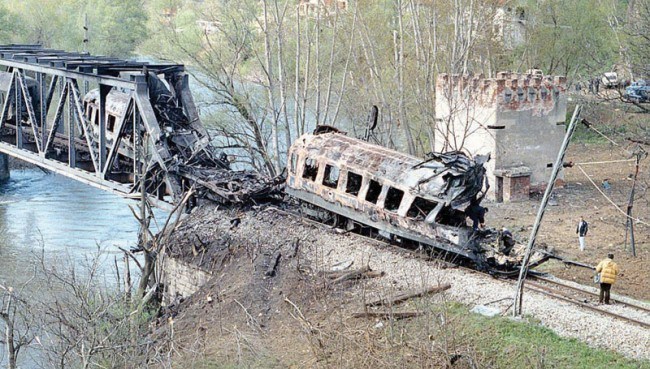
By James George Jatras | Ron Paul Institute | April 9, 2024
The following remarks were delivered at a conference marking the 25th anniversary of the NATO bombing of Serbia: “The 1999 Red-Green Bombing Terror against Serbia,” held on March 20, 2024, at the Bundestag in Berlin hosted by MdB Dr. Rainer Rothfuß and his Alternative for Germany parliamentary group.
In 2004, I appeared as the second defense witness called by Slobodan Milošević at his so-called “trial” before the so-called “International Criminal Tribunal for the former Yugoslavia” at The Hague My testimony was not as an expert witness but as a witness of fact concerning the formulation and implementation of US and western policy. I addressed one specific charge: that – beginning no later than October 1998 – Mr. Milošević was the initiator of a criminal conspiracy to drive the Albanians out of Kosovo and Metohija on the basis of their ethnicity.
There was one little problem with this accusation: there was absolutely zero direct evidence for it. No written order to this effect was ever produced. No person testified as to having received, transmitted, or even heard of such an instruction. Rather, the claim was based solely on circumstantial inferences of events starting from October 1998.
Thus, the heart of my testimony related to a paper I issued on August 12, 1998, as an analyst at the US Senate Republican Policy Committee, titled “Bosnia II: The Clinton Administration Sets Course for NATO Intervention in Kosovo.” In that paper, working solely from open sources, I detailed how, at that time – fully two months before the Milošević-led supposed “criminal conspiracy” came into effect —
“ … planning for a U.S.-led NATO intervention in Kosovo is now largely in place, …. The only missing element appears to be an event—with suitably vivid media coverage—that would make intervention politically salable, even imperative, in the same way that [the] Administration finally decided on intervention in Bosnia in 1995 after a series of ‘Serb mortar attacks’ took the lives of dozens of civilians—attacks, which, upon closer examination, may in fact have been the work of the Muslim regime in Sarajevo, the main beneficiary of the intervention. . . That the Administration is waiting for a similar ‘trigger’ in Kosovo is increasingly obvious: [As reported in the Washington Post, August 4, 1998], ‘A senior U.S. Defense Department official who briefed reporters on July 15 noted that “we’re not anywhere near making a decision for any kind of armed intervention in Kosovo right now, … [but] I think if some levels of atrocities were reached that would be intolerable, that would probably be a trigger”.’ ”
Now, if I was aware of this as early as August 1998, so were a lot of other people in Washington. I submitted to the “Tribunal” that in light of my paper, all interpretations of events would have to be drastically reevaluated. The issue wasn’t any longer whether Belgrade was planning an expulsion but that Washington was looking for a pretext for aggression.
(My cross-examination by prosecutor Geoffrey Nice (later Sir, based on his work at The Hague), asked me barely a word about my testimony. Rather, he interrogated me about my ethnic origins (Greek, from four Spartan grandparents), my religion (Orthodox Christian), and my opinions about the Islamic challenge to European, Christian civilization (negative).)
As we know, in due course the suitable “trigger” was found, with the so-called “Račak massacre” of January 1999. The key figure in “selling” Račak was William Walker. As described by Mark Ames and Matt Taibbi (now of Rolling Stone) in their article “Meet Mr. Massacre,” published in the now-defunct The Exile of February 10, 2000:
Years from now, when the war in Serbia is over and the dust has settled, historians will point to January 15, 1999 as the day the American Death Star became fully operational.
That was the date on which an American diplomat named William Walker brought his OSCE war crimes verification team to a tiny Kosovar village called Račak to investigate an alleged Serb massacre of ethnic Albanian peasants. After a brief review of the town’s 40-odd bullet-ridden corpses, Walker searched out the nearest television camera and essentially fired the starting gun for the war.
From what I saw, I do not hesitate to describe the crime as a massacre, a crime against humanity,’ he said. ‘Nor do I hesitate to accuse the government security forces of responsibility.’
We all know how Washington responded to Walker’s verdict; it quickly set its military machine in motion, and started sending out menacing invitations to its NATO friends to join the upcoming war party.
Focus on that phrase: “the American Death Star became fully operational.” Kosovo became the template that we then took on the road in one form or another in Afghanistan, Iraq, Libya, Syria, Yemen. Ukraine.
But the question still lingers: Why? Why was Washington so insistent that we and our NATO satelli– oops – “allies” needed to launch that war? Why did then-Secretary of State Madeleine Albright reveal in confidence, according to a reliable source, that at Rambouillet “We intentionally set the bar too high for the Serbs to comply. They need some bombing, and that’s what they are going to get”?
Some people will tell you it was about putting a NATO base, Camp Bondsteel, in a strategic location. Or that we wanted to clear the way for an East-West energy pipeline across the Balkans. Or that we coveted the mineral wealth of the Trepča mines. Or to secure the transit route for Afghan opium processed into heroin bound for Europe.
Certainly, all of our various interventions line a lot of a pockets, but in more than three decades of work in and around the Washington apparat, I never heard anyone point to such concrete and, frankly, normal if immoral imperial considerations.
Rather, answers must instead be sought within the larger perspective of American policy since the end of the first Cold War in 1991 and the development of the current one in the course of the 1990s: the American “unipolar moment,” as the bipartisan US policy nomenklatura sought to consolidate and perpetuate its hegemonic control over the entire planet, taking advantage of the vacuum left by the demise of the USSR. Perhaps the fullest expression of this was a 1996 Foreign Affairs article by neoconservative ideologists William Kristol and Robert Kagan (NOTE: Victoria Nuland’s husband), misleadingly titled “Toward a Neo-Reaganite Foreign Policy,” in which they called for the US to establish and maintain indefinitely “benevolent global hegemony” — in other words, perpetual American world domination.
Kristol and Kagan laid out virtually all of the elements that have guided US global policy during the ensuing years. It is no accident that Republican neoconservatives were enthusiastic supporters of Bill Clinton’s Balkan interventions of the 1990s, under the guidance of people like then-Secretary of State Madeleine Albright, who once opined regarding the sanctions-related deaths of a half million Iraqi children that “the price is worth it.” In the US establishment, there is little dissent on either side of the partisan aisle with Albright’s view that a militant United States has a special wisdom: “If we have to use force, it is because we are America; we are the indispensable nation. We stand tall and we see further than other countries into the future …”
The result is a kind of neo-Bolshevik ideology, where, as the vanguard of all progressive humanity, the US leadership class sees itself as the midwife of history. America took the path (as characterized by Russian Foreign Minister Sergey Lavrov) of the “replication of the experience of Bolshevism and Trotskyism”—morphing ourselves into a new Evil Empire in place of the old one. (Anyone familiar with the origins of America’s neoconservatives understands that the Trotskyite reference is not just rhetorical.)
Which brings us back to the “Why?” regarding Kosovo. When the dissolution of Yugoslavia kicked off in June 1991, largely at the initiative of Austria and Germany, official Washington was terrified that with the end of the Soviet bloc Europe might become “whole and free” – but without us. What then could be the future of Lord Hastings Lionel Ismay’s mission for NATO of keeping the Americans in Europe, the Russians out, and the Germans down? Europe, the crown jewel of the Global American Empire was slipping away.
Hence, as former Chairman of the Senate Foreign Relations Committee Richard Lugar (R-Indiana) indicated, NATO needed to go “out of area or out of business.” Starting in spring 1992, Washington moved swiftly to expand the conflict from Slovenia and Croatia (where it had been relatively contained) to Bosnia and Herzegovina. There the US became the vociferous champion of the Muslim faction, illegally shipping in al-Qaeda fighters and Iranian weapons via covert C-130 flights into Tuzla. We then engaged in a little demonstrative bombing of the Bosnian Serbs to set the stage for the Dayton Agreement. The arsonist sets the fire, so then he can be the hero rushing to the rescue: “See, you silly ‘dispensable’ European children? You just can’t get along without us …”
Following Dayton, Kosovo was the other shoe that needed to drop – with appropriate violence – to ensure that Europe was totally, abjectly, humiliatingly subservient to the United States through NATO, with the passive complicity of NATO’s concubine, the European Union. The corollary was that, just as the Serbs had no legitimate voice in determining post-Yugoslav structures, the Russians understood they had no legitimate voice in European security arrangements. These would be decided without them.
Now, of course, with defeat looming in Ukraine and with the broader Middle East on the edge of a regional conflagration, with many in Washington beating the drums for war with Iran or even China, the Global American Empire’s “unipolar” moment is coming to an end, one way or the other, either with a bang or with a whimper. Unfortunately, neither in Washington, nor in Berlin or other European capitals, with the exception of Budapest, are decisions made by people who can be regarded as mentally and morally healthy human beings, much less patriots.
The next few months and years promise to be a period of disorder and acute danger. The question is, can we – Americans and Europeans alike – find a path to governance that can secure a future for our peoples?
Serbia warns of retaliation against Ukraine
RT | April 25, 2023
Serbia may change its stance on Ukraine’s territorial integrity after Kiev abstained during a vote on accepting the breakaway region of Kosovo’s request to join the Council of Europe, Serbian Foreign Minister Ivica Dacic has said.
The Ministerial Committee of the Council of Europe held an extraordinary meeting on Tuesday to decide the fate of Kosovo’s application. The bid was supported by 33 members out of 46, with seven against, and five abstaining.
“I must say that Ukraine has surprised us unpleasantly” by being among the abstaining members, Dacic said shortly after the vote.
“This whole story is based on territorial integrity when it comes to [the conflict in] Ukraine. You know how much effort it takes for [Serbia] to vote for all the resolutions, to condemn the violation of territorial integrity of Ukraine,” he said.
The diplomat pointed out that “foreign policy is based on reciprocity. This will certainly affect our views in the future on territorial integrity of those countries,” he said, referring to Ukraine, Bosnia and Herzegovina, Greece, Slovakia, Armenia as some of the nations whose votes surprised him.
Serbia, which has close ties with Russia, has been resisting Western pressure to sanction Moscow over the conflict in Ukraine. However, it has condemned the use of force by Moscow and insisted that the territorial integrity of the Ukrainian state should be respected.
The majority ethnic Albanian region of Kosovo unilaterally declared independence from Serbia back in 2008. The US and many of its allies recognized the province as a sovereign state almost immediately. However, Belgrade still considers Kosovo to be part of its territory and the region is not recognized by Russia, China and several other nations.
Pristina’s Foreign Minister Donika Gervalla-Schwarz hailed the vote as “a historic step, perhaps the most important after our independence.” The final verdict on the bid by Pristina is to be delivered by the Parliamentary Assembly of the Council of Europe.
Dacic condemned the development, warning that it may well lead to a situation where “a part of some other country is going to be offered to join the Council of Europe.”
Kiev’s terrorist regime possibly involved in assassination attempt in Transnistria
By Lucas Leiroz | March 10, 2023
According to information recently published by local authorities in Transnistria, a terrorist attack was planned by Ukrainian saboteurs in Tiraspol, the aim of which was to kill the current president of the autonomous republic, Vadim Krasnoselsky. The case reveals that in fact Kiev maintains regular terrorist activities abroad, using sabotage tactics to eliminate civilians considered “enemies” of the Ukrainian neo-Nazi regime.
The plan was discovered by the intelligence services of the secessionist republic. According to Tiraspol’s officials, the Ukrainian scheme was discovered in time to avoid the tragedy. It is believed that not only President Krasnoselsky would be targeted by the saboteurs, but also some other top Transnistrian officials would be assassinated. The agents behind the maneuver were linked to the Ukrainian Secret Service.
In a statement published on March 9, the Ministry of State Security says that “criminal cases have been opened and are being investigated with regard to the crimes”, despite the threats having already been neutralized. With this, it is possible to say that there is evidence of other plots within the republic aiming at damaging the local political system. Certainly, more information about these criminal cases will be revealed in the course of the next few days.
The Minister of Foreign Affairs of Transnistria Vitaly Ignatiev also commented on the case. He stated that the situation is under control and that the president is working normally in his office, with assured security. Ignatiev also said that the republic will formally ask Ukraine to cooperate in the investigation of the sabotage attempt, providing all the necessary information to identify and capture those responsible for the failed attempt at terrorist attack.
Tiraspol’s authorities believe that Ukraine’s possible willingness to cooperate in punishing the saboteurs is the only way to prevent tensions from escalating. If Kiev refuses to cooperate, it will be making clear that in fact there was a deliberate operation by the regime to destabilize Transnistria, and not a unilateral action by some Ukrainian spies. More than that: by denying cooperation Kiev will also be saying that it does not regret having planned the attack and suggesting that it will continue to plot against Transnistria, thus becoming an existential threat to the Republic.
In this sense, Foreign Minister Ignatiev also stated that if nothing is done by Kiev to help with the investigations, the Transnistrian government will request that the issue be discussed at the UN Security Council – a measure that would certainly be supported by the Russian Federation, which has taken the greatest responsibility for peace in the republic, keeping troops in the region to prevent illegal advances by the Moldovan government or foreign invasions.
Ukraine is unlikely to cooperate as Kiev has long practiced a policy of open terrorism against its opponents, carrying out illegal operations abroad. The assassination of Daria Dugina, the Bryansk attack, repeated drone incursions into undisputed Russian territory, and the recent assassination attempt on businessman Konstantin Malofeev make Ukrainian terrorism evident. However, to better understand the motives for sabotaging Transnistria, it is necessary to go beyond Ukraine and investigate the interests of the sponsors of the neo-Nazi regime: the Western governments.
It is necessary to take into account that the West has recently implemented a strategy of multiplying fronts. Faced with NATO’s imminent defeat in its war against Russia using Ukraine as a proxy, the objective now is to generate as many combat fronts as possible to distract Russian forces, forcing Moscow to keep soldiers in several conflict zones simultaneously.
This explains the Western pressure for Georgia to invade Abkhazia and South Ossetia – as well as the ongoing color revolution against the pro-peace government. It is also possible to understand the Azerbaijani sabotage against Artsakh and Armenia. And even the recent tensions between Kosovar terrorists and Serbian authorities can be analyzed from this perspective. All these are conflicts in which Russia would intervene supporting one of the sides, so it is in the West’s interest to intensify tensions so that Moscow maintains several combat fronts and increases its losses.
As it is possible to see, NATO tries to open these new combat fronts only in countries that are not part of the alliance, thus guaranteeing that new confrontations are fought without the need to involve the regular troops of the western countries – which are preserved for an eventual situation of direct war against Russia or China.
Indeed, Moscow has been actively working with local Transnistrian authorities to ensure that law and order is respected in the autonomous republic. The Western attempt to open new combat fronts has already been understood by Russian strategists, who work precisely trying to prevent tensions from escalating to open confrontation. It is possible that new eruptions of military frictions will arise in the coming months, but first the Russian government will do everything possible for these cases to be resolved through intelligence and diplomacy.
Lucas Leiroz is a researcher at the Center for Geostrategic Studies; geopolitical consultant.
Going for the Kill in Kosovo
By Stephen Karganovic | Strategic Culture Foundation | January 28, 2023
The collective West’s unsuccessful war against Russia using Ukraine as the stage and Ukrainians as cannon fodder has induced the Transatlantic alliance to desperately seek some semblance of victory, anywhere, in order to disguise the scope and lessen the political repercussions of its failure in the Ukraine.
The solution it has come up with to repair its tarnished hegemonic image is the aggressive campaign to wrap up “unfinished business” in the Balkans. Coming from such quarters, any “attention” to Balkan nations is invariably bad news for the country so favoured. That is the case in this instance as well.
The West judges, perhaps not entirely incorrectly, that Serbia and the Republic of Srpska, its perennial Balkan targets because thus far they have withstood total submission, are currently in a disadvantageous position to continue to resist effectively. With pretensions to embody the “international community,” although it consists mainly of the NATO/EU block of countries, the Alliance is increasingly and now openly shifting to a war footing. That raises to a new level its customary belligerence and disregard for the niceties of international legality and standard diplomatic practice. It never was greatly bothered in the past to observe the norms of civilised interaction between states. But now, with intense pressure to produce some kind of political victory to compensate for the failure in Ukraine, gloves are definitely off.
That puts both Serbia and its sister state, the Republic of Srpska, in a more precarious position than at any other time recently. They are both geographically distant from their natural allies and surrounded by hostile territory politically and militarily controlled by the Western Alliance, which is planning their demise. A comparison with the position of the Kingdom of Yugoslavia in the spring of 1941 would not be wide off the mark.
Complementing a similarly unenviable geopolitical predicament, there is an additional unfavourable analogy for Serbia. Its ruling elite are as feeble, vacillating, corruptible, treacherous, and disoriented as was the Royal Yugoslav government in March of 1941. That is when Nazi Germany went for the kill and demanded imperatively that in the looming global conflict Yugoslavia either commit to its side, or face dire consequences. Now it is NATO and EU which are going for the kill and the pretext is Kosovo. The Serbian government a few days ago was handed an ultimatum. The demand was that Serbia give up pretensions of sovereignty over NATO occupied Kosovo and unequivocally align itself with the aggressor alliance in the conflict in Ukraine. It was conveyed by a delegation of Western ambassadors in the form of a brutal warning that dilly dallying about Kosovo must come to an urgent end. Serbia was told that it must unreservedly acquiesce to the robbery of its cultural and religious cradle by signing off on Kosovo’s secession and accepting its illegal fruits. It should be recalled that the occupation of Kosovo was initiated in 1999, when NATO committed unprovoked aggression against Yugoslavia and it was completed in 2008 by a unilateral declaration of “independence” made under NATO auspices.
As is always the case, the West’s actual interest in Kosovo has nothing to do with the publicly stated reasons. Suffice it to say that Kosovo is the site of Camp Bondsteel, the largest military base in Europe, strategically situated so as to be of great use should the Ukrainian conflict degenerate further into an all-out global war.
Judging by official Belgrade’s initial reactions, it is conceivable that the Serbian government may be contemplating a course of action inspired by the collapse of the will experienced by the Royal Yugoslav government in March of 1941, when under Nazi pressure it did as ordered and signed its adherence to the Axis pact. It ought to be remembered by all concerned, however, that the consequences of that infamous breakdown were short lived. Within just a few days, popular revulsion in Serbia forced the ousting of officials responsible for the shameful betrayal of public trust. The immoral commitments they had undertaken on the nation’s behalf were effectively annulled. If further analogies need to be made with the situation in 1941, it should be pointed out that the reputation of the protagonists of cowardice and treachery displayed then lives in infamy to the present day.
Whether such considerations will be sufficient to deter those currently responsible for Serbia’s official decisions remains to be seen.
Alongside Serbia, the neighbouring Republic of Srpska, an entity within Bosnia and Herzegovina populated mostly by Serbs, which recently experienced a turbulent election followed by an attempt to achieve regime change using instruments from the color revolution handbook, is also targeted for harsh treatment by the unforgiving Western democracies. Like Serbia’s, its population is solidly on the “wrong side of history” in general and in the Ukrainian conflict in particular, with all that implies. With a similar degree of unanimity, the population and the government are also opposed to having anything to do with NATO. Under the terms of the Dayton agreement signed in 1995, by which the prerogatives of Bosnia’s entities are governed, that effectively blocks Bosnia’s entry into NATO and participation in its activities.
Understandably, this blockade of what is euphemistically called Bosnia’s “Euro Atlanticist integrations,” is an insufferable affront and irritant. As a result, punitive measures against the uncooperative leadership of the Republic of Srpska are now being contemplated. It is a sure bet that if Serbia caves and in cowboy fashion the Kosovo issue is resolved, Bosnia’s defiant Serbian entity will soon be next. It will again find itself actively targeted and in the outraged “international community” cross hairs.
It is, of course, still premature to call the outcome of the ominous new chapter being prepared in the Kosovo crisis, but a perfect storm with turbulent effects appears to be approaching. The same recklessness that over the past year had been on display in the Ukraine is now in evidence increasingly in the Balkans. Andrey Martyanov’s repeated assessment of Western elites as arrogant, ignorant, and incompetent, which he illustrates with a steady stream of examples from the Ukrainian theatre, may soon find another resounding confirmation in the Balkans, to the immense misfortune of all its inhabitants.
Featured Video
America Racing to Strategic Defeat in Iran
or go to
Aletho News Archives – Video-Images
From the Archives
Should Europeans ‘Thank’ the Americans for Destroying Nord Stream?
By Robert Bridge | Strategic Culture Foundation | September 29, 2022
With an investigation continuing into the destruction of the Nord Stream gas pipeline that provided energy supplies to Europe from Russia, there appears to be just one prime suspect, and that should surprise nobody.
Following the sabotage of the Nord Stream 1 and 2 gas pipelines, former Polish Foreign Minister Radoslaw Sikorski already seemed to know the identity of the perpetrator when he tweeted out: “Thank you, USA.”
At first glance, it seemed that Sikorski was speaking sarcastically, berating Washington for carrying out an attack that will have severe repercussions for the people of Europe. After all, how could anyone see any good coming from the termination of Europe’s primary source of gas reserves with winter just around the corner? It was Sikorski’s homeland of Poland, after all, that urged its citizens to collect firewood in the face of dwindling gas reserves.
In fact, the Polish diplomat was speaking one-hundred percent literally… continue
Blog Roll
 Aletho News
- Tehran approves new Hormuz plan with major restrictions
- No Threat Can Force Iran’s Surrender /Trita Parsi & Lt Cl Daniel Davis
- UK’s New Pandemic Plan Would Turn Big Tech Into a Mass Location Tracking Network
- Growing insecurity, soaring prices fuel protests in north as regime bans evacuation: Sources
- Iran denies responsibility for ‘depraved’ attack on Kuwait desalination plant
- Bring The Troops Back. End This War Now!
- Can we please stop calling Israel the ‘only democracy in the Middle East’ now?
- US should start removing its troops from Germany, proposes AfD co-leader Chrupalla
- Iran Red Crescent: 600 educational centers attacked in US-Israeli ‘war crimes’
- Russian Oil Tanker Arrives in Cuba Amid U.S. Blockade
- If Americans Knew
- As Iran targets US military bases, will they be relocated to Israel? Not a ceasefire Day 171
- Will Trump Go Kamikaze?
- Is the University of Florida Shutting Down College Republicans over Israel Criticism?
- Jewish extremist arrested over alleged plot to firebomb Palestinian activist Nerdeen Kiswani’s home
- More than half of Palestinian child detainees have no charges
- The More Murderous Israel Gets, The More We Hear About “Antisemitism”
- Land Day and the Palestinian struggle after 30 months of genocide
- The Iran War Is About Palestine
- Israeli soldiers echo settler ideology, talk of revenge after targeting Palestinians and detaining CNN crew in the West Bank
- Israeli Policies Threaten Future of Christian Schools in Jerusalem
- No Tricks Zone
- New Study Finds Warming Saves Lives…Cold Temperatures 12 Times More Deadly Than Excess Heat
- German Science Blog Accuses PIK Climate Institute Of Hallucinating Climate Tipping Points
- Devastating Assessment Of Comirnaty Vaccine By Former Senior Pfizer Europe Toxicologist
- New Study: CO2 Is ‘Effectively Negligible’ As An Explanatory Climate Change Factor Since 2000
- Former Pfizer Toxicologist Dr. Helmut Sterz Tells Bundestag Hearing Pfizer Vaccine Should Have Never Been Approved
- Energy Expert: Germany’s Nuclear Phaseout Was A “500 Billion Euro Mistake”
- New Research: South Australia’s Mid-Holocene Sea Surface Temperatures Were 4°C Warmer Than Today
- Storing Green Energy To Last Germany 10 Days Would Require A 60-Million Tonne Battery
- New Studies: UK Sea Levels Were 4 Meters Higher Than Today During The Mid-Holocene
- Destructive Green New Deal: German Energy And Metal Group Warns Of Drastic Crisis
 Aletho News