In ASEAN Nations, Coal Is a Physical Manifestation of Progress
By Vijay Jayaraj | Real Clear Markets | September 9, 2025
When most people think of ASEAN – a diverse association of Southeast Asian nations that include Brunei, Cambodia, Indonesia, Laos, Malaysia, Myanmar, the Philippines, Singapore, Thailand, and Vietnam – they picture Thailand’s beaches, Singapore’s gleaming skyline or Indonesia’s temples.
What they don’t see is an economic juggernaut that will drive some of the planet’s largest growth in energy demand. Vietnam has emerged as a global manufacturing hub. Indonesia processes the world’s nickel for electric vehicle batteries. Thailand manufactures automobiles for export across Asia. Each of these economic engines demands reliable, affordable electricity that operates 24 hours a day, seven days a week.
In fact, 2023 witnessed a demand increase of nearly 45 terawatt-hours (TWh), an amount of energy that must be generated, transmitted regionally, and delivered locally on a continual basis. Where did this new power come from? Coal. An astonishing 96% of that new demand was met by coal-fired power plants.
Let that sink in. Coal, the energy source routinely demonized in Western capitals and at global climate summits, met nearly all the region’s new electricity needs. This reality stands in direct contradiction to rosy predictions of a transition to “renewables” manufactured by highly compensated executives at elite consulting firms who have spent the better part of a decade selling energy fairy tales to governments and investors.
Indonesia alone added 11 TWh of coal-generated electricity in 2023, while its electricity demand rose by 17 TWh, with coal meeting two-thirds of this increase. The Philippines generates more than 60% of its electricity from coal, and Malaysia and Vietnam each around 50%.
Ultra-supercritical coal technology – using extraordinarily high temperatures and pressures and pioneered at Malaysia’s Manjung plant and Indonesia’s Batang facility, delivers higher efficiency than older coal plants. These advanced facilities demonstrate that coal technology continues to improve while wind and solar remain dependent on weather conditions and the time of day.
The wind and solar share across ASEAN remained a pitiful 4.5% in 2023. This minuscule contribution exposes the bankruptcy of consultants’ promises of “renewables” dominating the regional power mix by mid-2020s.
Coal’s dominance in recent years is not an accident; it is a necessity. Indonesia, the region’s economic giant, leans on coal to power its export-driven industries, including nickel for EV batteries. Vietnam’s manufacturing boom, lifting millions into the middle class, runs on coal’s steady output. Malaysia and the Philippines, too, rely on coal to sustain their growing economies. Even Singapore, a global hub of innovation, depends on coal to maintain its energy security.
Yet, to focus solely on the power grid is to miss the forest for the trees, as electricity is just one component of total energy consumption. Electricity represents only a fraction of total consumption across ASEAN. The larger picture is primary energy consumption, which includes fuel for transport, industry and heating.
Oil, natural gas and coal collectively hold the major share of ASEAN’s primary energy mix, with oil leading consumption patterns across transportation and industrial sectors. Factories, petrochemicals, shipping, aviation, and agriculture all consume fossil fuels in large quantities.
ASEAN countries are committing hundreds of billions of dollars to fossil fuel infrastructure that will operate for decades. Coal plants have an average lifespan of 40 years. These capital investments create long-term commitments to hydrocarbon use that extend far beyond current political cycles.
Nineteen projects across Malaysia, Vietnam, Brunei, Indonesia, and Myanmar hold more than 540 billion cubic meters of recoverable gas. Countries don’t spend billions developing gas fields if they plan to abandon fossil fuels within the next decade.
ASEAN’s embrace of coal is about more than just keeping the lights on. These nations aren’t chasing arbitrary climate targets; they’re building the infrastructure of their future and prosperity for people.
Every new airport, every new highway and every new factory is a testament to the power of coal. To argue against coal is to oppose the physical manifestations of progress. The “green” agenda, by seeking to eliminate coal, demands that the developing world stop building – an ultimatum that ASEAN is rightly and wisely ignoring.
Almost two million unexploded bombs cleared after US war in Laos
RT | April 7, 2023
More than 1.8 million unexploded bombs were cleared in Laos between 1996 and February 2023, the Southeast Asian country’s Ministry of Labor and Social Welfare revealed this week.
A total of 1,808,254 unexploded ordnances (UXOs) were removed from an area covering 80,000 hectares, making the land safe for farming and other forms of agricultural development, according to Minister Padeumphone Sonthany.
The figures were announced at a press conference in the country’s capital Vientiane on Tuesday on the 18th annual International Day for UXO/Mine Awareness.
Laos is, per capita, the most heavily-bombed country in the world. From 1964 to 1973, the US military dropped more than two million tons of bombs on the nation during the Vietnam War – more than on Germany and Japan combined throughout World War II. It is estimated that around 30% of the bombs dropped did not explode.
The US conducted prolonged bombing campaigns – the so-called ‘Secret War’ – in Laos during the Vietnam War in a bid to disrupt supply lines between the country and Vietnam. The scale of the attacks, which were conducted in secrecy by the CIA, were revealed during a 1971 congressional hearing, as well as by US media investigations.
Of the 1.8 million UXOs removed and safely detonated during the period, 1,056,393 were cluster bombs. Another 4,336 were characterized as ‘large’ bombs, and 2,456 were landmines. Some 745,069 of other types of munitions were included in the statistics reported by China’s Xinhua News Agency, which cited Laotian media reports from last Wednesday.
The report said that 2,846 people had been involved in UXO-related accidents between 2015 and 2022, and that people from 4,092 villages across the country had been educated about the risks posed by UXOs. It added that the munitions continue to pose a grave threat to civilians and remain a barrier to increased agricultural production.
Rice is a key agricultural product in Laos, with over 60% of arable land used for its cultivation.
It is estimated that around 80 million unexploded live bomblets remain obscured in Laos, a product of the 270 million cluster bombs previously dropped on the country by US forces.
Southeast Asia “Forgets” About Western Terror
By Andre Vltchek | CounterPunch | October 2, 2015
Southeast Asian elites “forgot” about those tens of millions of Asian people murdered by the Western imperialism at the end of and after the WWII. They “forgot” about what took place in the North – about the Tokyo and Osaka firebombing, about the Hiroshima and Nagasaki atomic bombs, about the barbaric liquidation of Korean civilians by the US forces. But they also forgot about their own victims – about those hundreds of thousands, in fact about the millions, of those who were blown to pieces, burned by chemicals or directly liquidated – men, women and children of Vietnam, Cambodia, Laos, Indonesia, the Philippines and East Timor.
All is forgiven and all is forgotten.
And once again the Empire is proudly “pivoting” into Asia; it is even bragging about it.
It goes without saying that the Empire has no shame and no decency left. It boasts about democracy and freedom, while it does not even bother to wash the blood of tens of millions off its hands.
All over Asia, the “privileged populaces” has chosen to not know, to not remember, or even to erase all terrible chapters of the history. Those who insist on remembering are being silenced, ridiculed, or made out to be irrelevant.
Such selective amnesia, such “generosity” will very soon backfire. Shortly, it will fly back like a boomerang. History repeats itself. It always does, the history of the Western terror and colonialism, especially. But the price will not be covered by the morally corrupt elites, by those lackeys of the Western imperialism. As always, it will be Asia’s poor who will be forced to pay.

After I descended from the largest cave in the vicinity of Tham Pha Thok, Laos, I decided to text my good Vietnamese friend in Hanoi. I wanted to compare the suffering of Laotian and Vietnamese people.
The cave used to be “home” to Pathet Lao. During the Second Indochina War it actually served as the headquarters. Now it looked thoroughly haunted, like a skull covered by moss and by tropical vegetation.
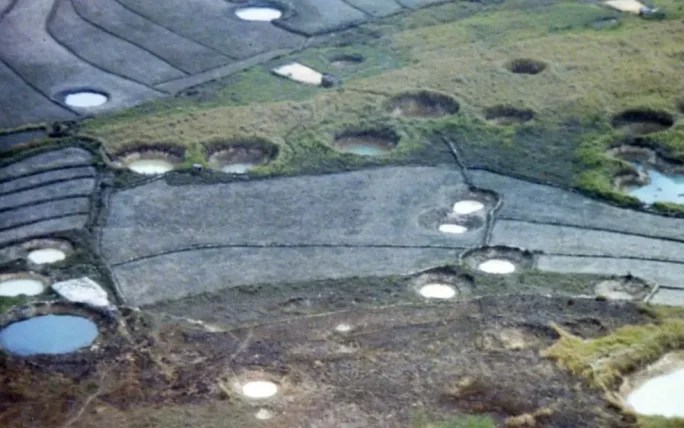
The US air force used to intensively bomb the entire area and there are still deep craters all around, obscured by the trees and bushes.
The US bombed the entirety of Laos, which has been given a bitter nickname: “The most bombed country on earth”.
It is really hard to imagine, in a sober state, what the US, Australia and their Thai allies did to the sparsely populated, rural, gentle Laos.
John Bacher, a historian and a Metro Toronto archivist once wrote about “The Secret War”: “More bombs were dropped on Laos between 1965 and 1973 than the U.S. dropped on Japan and Germany during WWII. More than 350,000 people were killed. The war in Laos was a secret only from the American people and Congress. It anticipated the sordid ties between drug trafficking and repressive regimes that have been seen later in the Noriega affair.”
In this biggest covert operation in the U.S. history, the main goal was to “prevent pro-Vietnamese forces from gaining control” over the area. The entire operation seemed more like a game that some overgrown, sadistic boys were allowed to play: Bombing an entire nation into the Stone Age for more than a decade. But essentially this “game” was nothing else than one of the most brutal genocides in the history of the 20th century.
Naturally, almost no one in the West or in Southeast Asia knows anything about this.

I texted my friend: “What I witnessed a few years ago working at the Plain of Jars was, of course, much more terrible than what I just saw around Tham Pha Thok, but even here, the horror of the US actions was crushing.” I also sent her a link to my earlier reports covering the Plain of Jars.
A few minutes later, she replied: “If you didn’t tell me… I would have never known about this secret war. As far as we knew, there was never a war in Laos. Pity for Lao people!”
I asked my other friends in Vietnam, and then in Indonesia. Nobody knew anything about the bombing of Laos.
The “Secret War” remains top-secret, even now, even right here, in the heart of the Asia Pacific region, or more precisely, especially here.
When Noam Chomsky and I were discussing the state of the world in what eventually became our book “On Western Terrorism – From Hiroshima to Drone Warfare”, Noam mentioned his visit to the war-torn Laos. He clearly remembered Air America pilots, as well as those hordes of Western journalists who were based in Vientiane but too busy to not see and to not ask any relevant questions.
***
“In the Philippines, the great majority of people is now convinced that the US actually ‘liberated’ our country from the Japanese”, my left-wing journalist friends once told me.
Dr. Teresa S. Encarnación Tadem, Professor of Political Science of University of the Philippines Diliman, explained to me last year, face to face, in Manila: “There is a saying here: “Philippines love Americans more than Americans love themselves.”
I asked: “How is it possible? The Philippines were colonized and occupied by the United States. Some terrible massacres took place… The country was never really free. How come that this ‘love’ towards the US is now prevalent?”
“It is because of extremely intensive North American propaganda machine”, clarified Teresa’s husband, Dr. Eduardo Climaco Tadem, Professor of Asian Studies of University of the Philippines Diliman. “It has been depicting the US colonial period as some sort of benevolent colonialism, contrasting it with the previous Spanish colonialism, which was portrayed as ‘more brutal’. Atrocities during the American-Philippine War (1898 – 1902) are not discussed. These atrocities saw 1 million Philippine people killed. At that period it was almost 10% of our population… the genocide, torture… Philippines are known as “the first Vietnam”… all this has been conveniently forgotten by the media, absent in the history books. And then, of course, the images that are spread by Hollywood and by the American pop culture: heroic and benevolent US military saving battered countries and helping the poor…”
Basically, entirely reversing the reality.
The education system is very important”, added Teresa Tadem. “The education system manufactures consensus, and that in turn creates support for the United States… even our university – University of the Philippines – was established by the Americans. You can see it reflected in the curriculum – for instance the political science courses… they all have roots in the Cold War and its mentality.”
Almost all children of the Asian “elites” get “educated” in the West, or at least in so-called “international schools” in their home countries, where the imperialist curriculum is implemented. Or in the private, most likely religious/Christian schools… Such “education” borrows heavily from the pro-Western and pro-business indoctrination concepts.
And once conditioned, children of the “elites” get busy brainwashing the rest of the citizens. The result is predictable: capitalism, Western imperialism, and even colonialism become untouchable, respected and admired. Nations and individuals who murdered millions are labeled as carriers of progress, democracy and freedom. It is “prestigious” to mingle with such people, as it is highly desirable to “follow their example”. The history dies. It gets replaced by some primitive, Hollywood and Disney-style fairytales.

In Hanoi, an iconic photograph of a woman pulling at a wing of downed US military plane is engraved into a powerful monument. It is a great, commanding piece of art.
My friend George Burchett, a renowned Australian artist who was born in Hanoi and who now lives in this city again, is accompanying me.
The father of George, Wilfred Burchett, was arguably the greatest English language journalist of the 20th Century. Asia was Wilfred’s home. And Asia was where he created his monumental body of work, addressing some of the most outrageous acts of brutality committed by the West: his testimonies ranged from the first-hand account of the Hiroshima A-bombing, to the mass murder of countless civilians during the “Korean War”. Wilfred Burchett also covered Vietnam, Laos, Cambodia, to name just a few unfortunate places totally devastated by the United States and its allies.
Now his books are published and re-printed by prestigious publishing houses all over the world, but paradoxically, they do not live in sub-consciousness of the young people of Asia.
The Vietnamese people, especially the young ones, know very little about the horrific acts committed by the West in their neighboring countries. At most they know about the crimes committed by France and the US in their own country – in Vietnam, nothing or almost nothing about the victims of the West-sponsored monsters like Marcos and Suharto. Nothing about Cambodia – nothing about who was really responsible for those 2 millions of lost lives.
The “Secret Wars” remain secret.

With George Burchett I admired great revolutionary and socialist art at the Vietnam National Museum of Fine Arts. Countless horrible acts, committed by the West, are depicted in great detail here, as well as the determined resistance struggle fought against US colonialism by the great, heroic Vietnamese people.
But there was an eerie feeling inside the museum – it was almost empty! Besides us, there were only a few other visitors, all foreign tourists: the great halls of this stunning art institution were almost empty.

Indonesians don’t know, because they were made stupid!” Shouts my dear old friend Djokopekik, at his art studio in Yogyokarta, He is arguably the greatest socialist realist artist of Southeast Asia. On his canvases, brutal soldiers are kicking the backsides of the poor people, while an enormous crocodile (a symbol of corruption) attacks, snaps at, and eats everyone in sight. Djokopekik is open, and brutally honest: “It was their plan; great goal of the regime to brainwash the people. Indonesians know nothing about their own history or about the rest of Southeast Asia!”
Before he died, Pramoedya Ananta Toer, the most influential writer of Southeast Asia, told me: “They cannot think, anymore… and they cannot write. I cannot read more than 5 pages of any contemporary Indonesian writer… the quality is shameful…” In the book that we (Pramoedya Ananta Toer, Rossie Indira and I) wrote together – “Exile” -, he lamented that Indonesian people do not know anything about history, or about the world.
Had they known, they would most definitely raise and overthrow this disgraceful regime that is governing their archipelago until these days.
2 to 3 million Indonesian people died after the 1965 military coup, triggered and supported by the West and by the religious clergy, mainly by Protestant implants from Europe. The majority of people in this desperate archipelago are now fully conditioned by the Western propaganda, unable to even detect their own misery. They are still blaming the victims (mainly Communists, intellectuals and “atheists”) for the events that took place exactly 50 years ago, events that broke the spine of this once proud and progressive nation.
Indonesians almost fully believe the right wing, fascist fairytales, fabricated by the West and disseminated through the local mass media channels controlled by whoring local “elites”… It is no wonder: for 50 nasty years they have been “intellectually” and “culturally” conditioned by the lowest grade Hollywood meditations, by Western pop music and by Disney.
They know nothing about their own region.
They know nothing about their own crimes. They are ignorant about the genocides they have been committing. More than half of their politicians are actually war criminals, responsible for over 30% of killed men, women and children during the US/UK/Australia-backed occupation of East Timor (now an independent country), for the 1965 monstrous bloodletting and for the on-going genocide, which Indonesia conducts in Papua.
Information about all these horrors is available on line. There are thousands of sites carrying detailed and damning evidence. Yet, cowardly and opportunistically, the Indonesian “educated” populace is opting for “not knowing”.
Of course, the West and its companies are greatly benefiting from the plunder of Papua.
Therefore, the genocide is committed, all covered with secrecy.
And ask in Vietnam, in Burma, even in Malaysia, what do people know about East Timor and Papua? The answer will be nothing, or almost nothing.
Burma, Laos, Cambodia, Indonesia, and the Philippines – they may be located in the same part of the world, but they could be as well based on several different planets. That was the plan: the old divide-and-rule British concept.
In Manila, the capital of the Philippines, a family that was insisting that Indonesia is actually located in Europe once confronted me. The family was equally ignorant of the crimes committed by the pro-Western regime of Marcos.
***
The western media promotes Thailand as the “land of smiles”, yet it is an extremely frustrated and brutal place, where the murder rate is even(on per capita basis) higher than that in the United States.
Thailand has been fully controlled by the West since the end of the WWII. Consequently, its leadership (the throne, the elites and the military)have allowed some of the most gruesome crimes against humanity to take place on its territory. To mention just a few: the mass murder of the Thai left wing insurgents and sympathizers (some were burned alive in oil barrels), the murdering of thousands of Cambodian refugees, the killing and raping of student protesters in Bangkok and elsewhere… And the most terrible of them: the little known Thai participation in the Vietnam invasion during the “American War”…the intensive use of Thai pilots during the bombing sorties against Laos, Vietnam and Cambodia, as well as handing several military airports (including Pattaya) to the Western air forces. Not to speak about pimping of Thai girls and boys (many of them minors) to the Western military men.
***
The terror that the West has been spreading all over Southeast Asia seems to be forgotten, or at least for now.
Let’s move on!” I heard in Hanoi and in Luang Prabang.
But while the Vietnamese, Laotian and Cambodian people are busy “forgiving” their tormentors the Empire has been murdering the people of Iraq, Syria, Libya, Pakistan, Afghanistan, Yemen, Ukraine, and all corners of Africa.
It was stated by many, and proven by some, particularly in South America, where almost all the demons have been successfully exercised, that there can be no decent future for this Planet without recognizing and understanding the past.
After “forgiving the West”, several nations of Southeast Asia were immediately forced into the confrontation with China and Russia.
When “forgiven”, the West does not just humbly accept the great generosity of its victims. Such behavior is not part of its culture. Instead, it sees kindness as weakness, and it immediately takes advantage of it.
By forgiving the West, by “forgetting” its crimes, Southeast Asia is actually doing absolutely nothing positive. It is only betraying its fellow victims, all over the world.
It is also, pragmatically and selfishly, hoping for some returns. But returns will never come! History has shown it on many occasions. The West wants everything. And it believes that it deserves everything. If not confronted, it plunders until the end, until there is nothing left – as it did in the Democratic Republic of Congo, in Iraq or in Indonesia.

Renowned Australian historian and Professor Emeritus at Nagasaki University in Japan, Geoffrey Gunn, wrote in this essay:
“The US wields hard power and soft power in equal portions or so it would appear. Moving in and out of East Asia over the last four decades I admit to being perplexed as to the selectivity of memories of the American record. Take Laos and Cambodia in the 1970s where, in each country respectively, the US dropped a greater tonnage of bombs than dumped on Japanese cities during World War II, and where unexploded ordinance still takes a daily toll. Not so long ago I asked a high-ranking regime official in Phnom Penh as to whether the Obama administration had issued an apology for this crime of crimes. “No way,” he said, but then he wasn’t shaking his fist either, just as the population appears to be numbed as to basic facts of their own history beyond some generalized sense of past horrors. In Laos in December 1975 where I happened to be when, full of rage at the US, revolutionaries took over; the airing of American crimes – once a propaganda staple – has been relegated to corners of museums. Ditto in Vietnam, slowly entering the US embrace as a strategic partner, and with no special American contrition as to the victims of bombing, chemical warfare and other crimes. In East Timor, sacrificed by US President Ford and Secretary of State Henry Kissinger to the Indonesian generals in the interest of strategic denial, and where some 30 percent of the population perished, America is forgiven or, at least, airbrushed out of official narratives. Visiting the US on a first state visit, China’s President Xi Jinping drums up big American business deals, a “new normal” in the world’s second largest economy and now US partner in the “war against terror,” as in Afghanistan. Well, fresh from teaching history in a Chinese university, I might add that history does matter in China but with Japan as an all too obvious point of reference.”
“China used to see the fight against Western imperialism, colonialism and neo-colonialism as the main rallying cry of its foreign policy”, sighs Geoff, as we watch the bay of his home city – Nagasaki. “Now it is only Japan whose crimes are remembered in Beijing.”
But back to Southeast Asia…
It is all forgotten and forgiven, and the reason “why” is clear, simple. It pays to forget! “Forgiveness” brings funding; it secures “scholarships” just one of the ways Western countries spread corruption in its client states and in the states they want to draw into their orbit.
The elites with their lavish houses, trips abroad, kids in foreign schools, are a very forgiving bunch!
But then you go to a countryside, where the majority of Southeast Asian people still live. And the story there is very different. The story there makes you shiver.
Before departing from Laos, I sat at an outdoor table in a village of Nam Bak, about 100 kilometers from Luang Prabang. Ms. Nang Oen told me her stories about the US carpet-bombing, and Mr. Un Kham showed me his wounds:
“Even here, in Nam Bak, we had many craters all over, but now they are covered by rice fields and houses. In 1968, my parents’ house was bombed… I think they dropped 500-pound bombs on it. Life was unbearable during the war. We had to sleep in the fields or in the caves. We had to move all the time. Many of us were starving, as we could not cultivate our fields.
I ask Ms. Nang Oen about the Americans. Did she forget, forgive?
“How do I feel about them? I actually can’t say anything. After all these years, I am still speechless. They killed everything here, including chicken. I know that they are doing the same even now, all over the world…”
She paused, looked at the horizon.
“Sometimes I remember what was done to us… Sometimes I forget”. She shrugs her shoulders. “But when I forget, it is only for a while. We did not receive any compensation, not even an apology. I cannot do anything about it. Sometimes I wake up in the middle of the night, and I cry.”
I listened to her and I knew, after working for decades in this part of the world: for the people of Laos, Vietnam, Cambodia, and East Timor, nothing is forgotten and nothing is forgiven. And it should never be!

Andre Vltchek is a philosopher, novelist, filmmaker and investigative journalist. He covered wars and conflicts in dozens of countries. His latest books are: “Exposing Lies Of The Empire” and “Fighting Against Western Imperialism”.
Exposing Nixon’s Vietnam Lies
By James DiEugenio | Consortium News | August 10, 2015
 Richard Nixon spent years rebuilding his tattered reputation after he resigned from office in disgrace on Aug. 9, 1974. The rehabilitation project was codenamed “The Wizard.” The idea was to position himself as an elder statesman of foreign policy, a Wise Man. And to a remarkable degree – through the sale of his memoirs, his appearance with David Frost in a series of highly rated interviews, and the publication of at least eight books after that – Nixon largely succeeded in his goal.
There was another aspect of that plan: to do all he could to keep his presidential papers and tapes classified, which, through a series of legal maneuvers, he managed to achieve in large part. Therefore, much of what he and Henry Kissinger wrote about in their memoirs could stand, largely unchallenged.
It was not until years after his death that the bulk of the Nixon papers and tapes were opened up to the light of day. And Kissinger’s private papers will not be declassified until five years after his death. With that kind of arrangement, it was fairly easy for Nixon to sell himself as the Sage of San Clemente, but two new books based on the long-delayed declassified record – one by Ken Hughes and the other by William Burr and Jeffrey Kimball – undermine much of Nixon’s rehabilitation.
For instance, in 1985 – at the peak of President Ronald Reagan’s political power – Nixon wrote No More Vietnams, making several dubious claims about the long conflict which included wars of independence by Vietnam against both France and the United States.
In the book, Nixon tried to insinuate that Vietnam was not really one country for a very long time and that the split between north and south was a natural demarcation. He also declared that the Vietnam War had been won under his administration, and he insisted that he never really considered bombing the irrigation dikes, using tactical nuclear weapons, or employing the strategy of a “decent interval” to mask an American defeat for political purposes.
Nixon’s Story
In No More Vietnams, Nixon said that after going through a series of option papers furnished to him by National Security Advisor Henry Kissinger, he decided on a five-point program for peace in Vietnam. (Nixon, pgs. 104-07) This program consisted of Vietnamization, i. e., turning over the fighting of the war to the South Vietnamese army (the ARVN); pacification, which was a clear-and-hold strategy for maintaining territory in the south; diplomatic isolation of North Vietnam from its allies, China and the Soviet Union; peace negotiations with very few preconditions; and gradual withdrawal of American combat troops. Nixon asserted that this program was successful.
But the currently declassified record does not support Nixon’s version of history, either in the particulars of what was attempted or in Nixon’s assessment of its success.
When Richard Nixon came into office he was keenly aware of what had happened to his predecessor Lyndon Johnson, who had escalated the war to heights that President Kennedy had never imagined, let alone envisaged. The war of attrition strategy that LBJ and General William Westmoreland had decided upon did not work. And the high American casualties it caused eroded support for the war domestically. Nixon told his Chief of Staff Bob Haldeman that he would not end up like LBJ, a prisoner in his own White House.
Therefore, Nixon wanted recommendations that would shock the enemy, even beyond the massive bombing campaigns and other bloody tactics employed by Johnson. As authors Burr and Kimball note in their new book Nixon’s Nuclear Specter, Nixon was very much influenced by two modes of thought.
First, as Vice President from 1953-61, he was under the tutelage of Secretary of State John Foster Dulles and President Dwight Eisenhower, who advocated a policy of nuclear brinksmanship, that is the willingness to threaten nuclear war if need be. Dulles felt that since the United States had a large lead in atomic weapons that the Russians would back down in the face of certain annihilation.
Nixon was also impressed by the alleged threat of President Eisenhower to use atomic weapons if North Korea and China did not bargain in good faith to end the Korean War. Nixon actually talked about this in a private meeting with southern politicians at the 1968 GOP convention. (Burr and Kimball, Chapter 2)
Dulles also threatened to use atomic weapons in Vietnam. Burr and Kimball note the proposal by Dulles to break the Viet Minh’s siege of French troops at Dien Bien Phu by a massive air mission featuring the use of three atomic bombs. Though Nixon claimed in No More Vietnams that the atomic option was not seriously considered (Nixon, p. 30), the truth appears to have been more ambiguous, that Nixon thought the siege could be lifted without atomic weapons but he was not against using them. Eisenhower ultimately vetoed their use when he could not get Great Britain to go along.
Playing the Madman
Later, when in the Oval Office, Nixon tempered this nuclear brinksmanship for the simple reason that the Russians had significantly closed the gap in atomic stockpiles. So, as Burr and Kimball describe it, Nixon and Kissinger wanted to modify the Eisenhower-Dulles brinksmanship with the “uncertainty effect” – or as Nixon sometimes called it, the Madman Theory. In other words, instead of overtly threatening to use atomic bombs, Nixon would have an intermediary pass on word to the North Vietnamese leadership that Nixon was so unhinged that he might resort to nuclear weapons if he didn’t get his way. Or, as Nixon explained to Haldeman, if you act crazy, the incredible becomes credible:
“They’ll believe any threat of force that Nixon makes because it’s Nixon. I call it the Madman Theory, Bob. I want the North Vietnamese to believe I’ve reached the point where I might do anything to stop the war. We’ll just slip the word to them that ‘for God’s sake you know Nixon is obsessed about communism. We can’t restrain him when he’s angry — and he has his hand on the nuclear button.’”
Nixon believed this trick would work, saying “Ho Chi Minh himself will be in Paris in two days begging for peace.”
Kissinger once told special consultant Leonard Garment to convey to the Soviets that Nixon was somewhat nutty and unpredictable. Kissinger bought into the concept so much so that he was part of the act: the idea was for Nixon to play the “bad cop” and Kissinger the “good cop.”
Another reason that Nixon and Kissinger advocated the Madman Theory was that they understood that Vietnamization and pacification would take years. And they did not think they could sustain public opinion on the war for that long. Secretary of Defense Melvin Laird and Secretary of State William Rogers both thought they could, their opinions were peripheral because Nixon and Kissinger had concentrated the foreign policy apparatus in the White House.
Playing for Time
Privately, Nixon did not think America could win the war, so he wanted to do something unexpected, shocking, “over the top.” As Burr and Kimball note, in 1969, Nixon told his speechwriters Ray Price, Pat Buchanan and Richard Whalen: “I’ve come to the conclusion that there’s no way to win the war. But we can’t say that, of course. In fact we have to seem to say the opposite, just to keep some degree of bargaining leverage.”
In a phone call with Kissinger, Nixon said, “In Saigon, the tendency is to fight the war for victory. … But you and I know it won’t happen – it is impossible. Even Gen. Abrams agreed.”
These ideas were expressed very early in 1969 in a document called NSSM-1, a study memorandum – as opposed to an action memorandum – with Kissinger asking for opinions on war strategy from those directly involved. The general consensus was that the other side had “options over which we have little or no control” which would help them “continue the war almost indefinitely.” (ibid, Chapter 3)
Author Ken Hughes in Fatal Politics agrees. Nixon wanted to know if South Vietnam could survive without American troops there. All of the military figures he asked replied that President Nguyen van Thieu’s government could not take on both the Viet Cong and the regular North Vietnamese army. And, the United States could not help South Vietnam enough for it to survive on its own. (Hughes, pgs. 14-15)
As Hughes notes, Nixon understood that this bitter truth needed maximum spin to make it acceptable for the public. So he said, “Shall we leave Vietnam in a way that – by our own actions – consciously turns the country over to the Communists? Or shall we leave in a way that gives the South Vietnamese a reasonable chance to survive as a free people? My plan will end American involvement in a way that will provide that chance.” (ibid, p. 15)
If the U.S. media allowed the argument to be framed like that — which it did — then the hopeless cause did have a political upside. As Kissinger told Nixon, “The only consolation we have … is that the people who put us into this position are going to be destroyed by the right. … They are going to be destroyed. The liberals and radicals are going to be killed. This is, above all, a rightwing country.” (ibid, p. 19)
Could anything be less honest, less democratic or more self-serving? Knowing that their critics were correct, and that the war could not be won, Nixon and Kissinger wanted to portray the people who were right about the war as betraying both America and South Vietnam.
Political Worries
Just how calculated was Nixon about America’s withdrawal from Vietnam? Republican Sen. Hugh Scott warned him about getting out by the end of 1972, or “another man may be standing on the platform” on Inauguration Day 1973. (ibid, p. 23) Nixon told his staff that Scott should not be saying things like this in public.
But, in private, the GOP actually polled on the issue. It was from these polls that Nixon tailored his speeches. He understood that only 39 percent of the public approved a Dec. 31, 1971 withdrawal, if it meant a U.S. defeat. When the question was posed as withdrawal, even if it meant a communist takeover, the percentage declined to 27 percent. Nixon studied the polls assiduously. He told Haldeman, “That’s the word. We say Communist takeover.” (ibid, p. 24)
The polls revealed another hot button issue: getting our POW’s back. This was even more sensitive with the public than the “Communist takeover” issue. Therefore, during a press conference, when asked about Scott’s public warning, Nixon replied that the date of withdrawal should not be related to any election day. The important thing was that he “didn’t want one American to be in Vietnam one day longer than is necessary to achieve the two goals that I have mentioned: the release of our prisoners and the capacity of the South Vietnamese to defend themselves against a Communist takeover.” He then repeated that meme two more times. The press couldn’t avoid it. (Hughes, p. 25)
Still, although Nixon and Kissinger understood they could not win the war in a conventional sense, they were willing to try other methods in the short run to get a better and quicker settlement, especially if it included getting North Vietnamese troops out of South Vietnam. Therefore, in 1969, he and Kissinger elicited suggestions from inside the White House, the Pentagon, the CIA, and Rand Corporation, through Daniel Ellsberg. These included a limited invasion of North Vietnam and Laos, mining the harbors and bombing the north, a full-scale invasion of North Vietnam, and operations in Cambodia.
Or as Kissinger put it, “We should … develop alternate plans for possible escalating military actions with the motive of convincing the Soviets that the war may get out of hand.” Kissinger also said that bombing Cambodia would convey the proper message to Moscow.
If anything shows that Kissinger was as backward in his thinking about Indochina as Nixon, this does. For as Burr and Kimball show — through Dobrynin’s memos to Moscow — the Russians could not understand why the White House would think the Kremlin had such influence with Hanoi. Moscow wanted to deal on a variety of issues, including arms agreements and the Middle East.
So far from Kissinger’s vaunted “linkage” theory furthering the agenda with Russia, it’s clear from Dobrynin that it hindered that agenda. In other words, the remnants of a colonial conflict in the Third World were stopping progress in ameliorating the Cold War. This was the subtotal of the Nixon/Kissinger geopolitical accounting sheet.
Judging Kissinger on Vietnam
Just how unbalanced was Kissinger on Vietnam? In April 1969, there was a shoot-down of an American observation plane off the coast of Korea. When White House adviser John Ehrlichman asked Kissinger how far the escalation could go, Kissinger replied it could go nuclear.
In a memo to Nixon, Kissinger advised using tactical nuclear weapons. He wrote that “all hell would break loose for two months”, referring to domestic demonstrations. But he then concluded that the end result would be positive: “there will be peace in Asia.”
Kissinger was referring, of course, to the effectiveness of the Madman Theory. In reading these two books, it is often hard to decipher who is more dangerous in their thinking, Nixon or Kissinger.
In the first phase of their approach to the Vietnam issue, Nixon and Kissinger decided upon two alternatives. The first was the secret bombing of Cambodia. In his interview with David Frost, Nixon expressed no regrets about either the bombing or the invasion. In fact, he said, he wished he had done it sooner, which is a puzzling statement because the bombing of Cambodia was among the first things he authorized. Nixon told Frost that the bombing and the later invasion of Cambodia had positive results: they garnered a lot of enemy supplies, lowered American casualties in Vietnam, and hurt the Viet Cong war effort.
Frost did not press the former president with the obvious follow-up: But Mr. Nixon, you started another war and you helped depose Cambodia’s charismatic ruler, Prince Sihanouk. And because the Viet Cong were driven deeper into Cambodia, Nixon then began bombing the rest of the country, not just the border areas, leading to the victory of the radical Khmer Rouge and the deaths of more than one million Cambodians.
This all indicates just how imprisoned Nixon and Kissinger were by the ideas of John Foster Dulles and his visions of a communist monolith with orders emanating from Moscow’s Comintern, a unified global movement controlled by the Kremlin. Like the Domino Theory, this was never sound thinking. In fact, the Sino-Soviet border dispute, which stemmed back to 1962, showed that communist movements were not monolithic. So the idea that Moscow could control Hanoi, or that the communists in Cambodia were controlled by the Viet Cong, this all ended up being disastrously wrong.
As Sihanouk told author William Shawcross after the Cambodian catastrophe unfolded, General Lon Nol, who seized power from Prince Sihanouk, was nothing without the military actions of Nixon and Kissinger, and “the Khmer Rouge were nothing without Lon Nol.” (Shawcross, Sideshow, p. 391)
But further, as Shawcross demonstrates, the immediate intent of the Cambodian invasion was to seek and destroy the so-called COSVN, the supposed command-and-control base for the communist forces in South Vietnam supposedly based on the border inside Cambodia. No such command center was ever found. (ibid, p. 171)
Why the Drop in Casualties?
As for Nixon’s other claim, American casualties declined in Indochina because of troop rotation, that is, the ARVN were pushed to the front lines with the Americans in support. Or as one commander said after the Cambodian invasion: it was essential that American fatalities be cut back, “If necessary, we must do it by edict.” (ibid, p. 172)
But this is not all that Nixon tried in the time frame of 1969-70, his first two years in office. At Kissinger’s request he also attempted a secret mission to Moscow by Wall Street lawyer Cyrus Vance. Part of Kissinger’s linkage theory, Vance was to tell the Soviets that if they leaned on Hanoi to accept a Nixonian framework for negotiations, then the administration would be willing to deal on other fronts, and there would be little or no escalation. The negotiations on Vietnam included a coalition government, and the survival of Thieu’s government for at least five years, which would have been two years beyond the 1972 election. (As we shall see, this is the beginning of the final “decent interval” strategy.)
The Vance mission was coupled with what Burr and Kimball call a “mining ruse.” The Navy would do an exercise to try and make the Russians think they were going to mine Haiphong and five other North Vietnamese harbors. Yet, for reasons stated above, Nixon overrated linkage, and the tactic did not work. But as Kissinger said, “If in doubt, we bomb Cambodia.” Which they did.
As the authors note, Nixon had urged President Johnson in 1967 to extend the bombing throughout Indochina, into Cambodia and Laos. Johnson had studied these and other options but found too many liabilities. He had even studied the blockading of ports but concluded that Hanoi would compensate for a blockade in a relatively short time by utilizing overland routes and off-shore unloading.
But what Johnson did not factor in was the Nixon/Kissinger Madman Theory. For example, when a State Department representative brought up the overall military ineffectiveness of the Cambodian bombing, Kissinger replied, “That doesn’t bother me … we’ll hit something.” He also told an assistant, “Always keep them guessing.” The problem was, the “shock effect” ended up being as mythical as linkage.
In 1969, after the failure of the Vance mission, the mining ruse, the warnings to Dobrynin, and the continued bombing of Cambodia, which went on in secret for 14 months, Nixon still had not given up on his Madman Theory. He sent a message to Hanoi saying that if a resolution was not in the works by November, “he will regretfully find himself obliged to have recourse to measures of great consequence and force.”
What were these consequences? Nixon had wanted to mine Haiphong for a long time. But, as did Johnson, he was getting different opinions about its effectiveness. So he considered massive interdiction bombing of the north coupled with a blockade of Sihanoukville, the Cambodian port that was part of the Ho Chi Minh trail apparatus on the west coast of Cambodia.
Plus one other tactic: Kissinger suggested to his staff that the interdiction bombing use tactical nuclear weapons for overland passes near the Chinese border. But the use of tactical nukes would have created an even greater domestic disturbance than the Cambodian invasion had done. Secretary of Defense Melvin Laird objected to the whole agenda. He said it would not be effective and it would create too much domestic strife.
Backing Up Threats
So Nixon and Kissinger decided on something short of the nuclear option. After all, Nixon had sent a veiled ultimatum to Hanoi about “great consequence and force.” They had to back it up. The two decided on a worldwide nuclear alert instead, a giant nuclear war exercise that would simulate actual military maneuvers in attempting to mimic what the U.S. would do if it were preparing for a nuclear strike.
As Burr and Kimball write, this was another outmoded vestige of 1950s Cold War thinking: “It was intended to signal Washington’s anger at Moscow’s support of North Vietnam and to jar the Soviet leaders into using their leverage to induce Hanoi to make diplomatic concessions.” (Burr and Kimball, Chapter 9)
It was designed to be detected by the Soviets, but not detectable at home. For instance, the DEFCON levels were not actually elevated. The alert went on for about three weeks, with all kinds of military maneuvers at sea and on land. Finally, Dobrynin called for a meeting. Kissinger was buoyant. Maybe the ploy had worked.
But it didn’t. The ambassador was angry and upset, but not about the alert. He said that while the Russians wanted to deal on nuclear weapons, Nixon was as obsessed with Vietnam as LBJ was. In other words, Dobrynin and the Soviets were perceptive about what was really happening. Nixon tried to salvage the meeting with talk about how keeping American fatalities low in Vietnam would aid détente, which further blew the cover off the nuclear alert.
Burr and Kimball show just how wedded the self-styled foreign policy mavens were to the Madman Theory. After the meeting, Nixon realized he had not done well in accordance with the whole nuclear alert, Madman idea. He asked Kissinger to bring back Dobrynin so they could play act the Madman idea better.
The authors then note that, although Haiphong was later mined, the mining was not effective, as Nixon had been warned. In other words, the Madman idea and linkage were both duds.
Nixon and Kissinger then turned to Laird’s plan, a Vietnamization program, a mix of U.S. troop withdrawals, turning more of the fighting over to the ARVN, and negotiations. The November 1969 Madman timetable was tossed aside and the long haul of gradual U.S. disengagement was being faced. Accordingly, Nixon and Kissinger started sending new messages to the north. And far from isolating Hanoi, both China and Russia served as messengers for these new ideas.
The White House told Dobrynin that after all American troops were out, Vietnam would no longer be America’s concern. In extension of this idea, America would not even mind if Vietnam was unified under Hanoi leadership.
Kissinger told the Chinese that America would not return after withdrawing. In his notebooks for his meeting with Zhou En Lai, Kissinger wrote, “We want a decent interval. You have our assurances.” (Burr and Kimball, Epilogue)
Timing the Departure
But when would the American troops depart? As Ken Hughes writes, Nixon at first wanted the final departure to be by December of 1971. But Kissinger talked him out of this. It was much safer politically to have the final withdrawal after the 1972 election. If Saigon fell after, it was too late to say Nixon’s policies were responsible. (Fatal Politics, p. 3)
Kissinger also impressed on Nixon the need not to announce a timetable in advance. Since all their previous schemes had failed, they had to have some leverage for the Paris peace talks.
But there was a problem. The exposure of the secret bombing of Cambodia began to put pressure on Congress to begin to cut off funding for those operations. Therefore, when Nixon also invaded Laos, this was done with ARVN troops. It did not go very well, but that did not matter to Nixon: “However Laos comes out, we have got to claim it was a success.” (Hughes, p. 14)
While there was little progress at the official negotiations, that too was irrelevant because Kissinger had arranged for so-called “secret talks” at a residential home in Paris. There was no headway at these talks until late May 1971. Prior to this, Nixon had insisted on withdrawal of North Vietnamese troops from South Vietnam.
But in May, Kissinger reversed himself on two issues. First, there would be no American residual force left behind. Second, there would be a cease-fire in place. That is, no withdrawal of North Vietnamese troops. As Kissinger said to Nixon, they would still be free to bomb the north, but “the only problem is to prevent the collapse in 1972.” (ibid, pgs. 27-28) The Decent Interval strategy was now the modus operandi.
And this strategy would serve Nixon’s reelection interests, too. As Kissinger told Nixon, “If we can, in October of ’72 go around the country saying we ended the war and the Democrats wanted to turn it over to the communists … then we’re in great shape.” To which Nixon replied, “I know exactly what we’re up to.” (ibid, p. 29) Since this was all done in secret, they could get away with a purely political ploy even though it resulted in the needless deaths of hundreds of thousands of soldiers and civilians. All this was done to make sure Nixon was reelected and the Democrats looked like wimps.
Kissinger understood this linkage between the war’s illusionary success and politics. He reminded Nixon, “If Cambodia, Laos and Vietnam go down the drain in September of 1972, they they’ll say you went into those … you spoiled so many lives, just to wind up where you could have been in the first year.” (ibid, p. 30)
In fact, the President’s February 1972 trip to China was directly related to the slow progress on Vietnam. Kissinger said, “For every reason, we’ve got to have a diversion from Vietnam in this country for awhile.” To which Nixon replied, “That’s the point isn’t it?” (ibid, p.32)
A Decent Interval
In preparations for China, Kissinger told Zhou En Lai that Nixon needed an interval of a year or two after American departure for Saigon to fall. (ibid, p. 35) He told Zhou, “The outcome of my logic is that we are putting a time interval between the military outcome and the political outcome.” (ibid, p. 79)
But aware of this, Hanoi made one last push for victory with the Easter Offensive of 1972. Remarkably successful at first, air power managed to stall it and then push it back. During this giant air operation, Nixon returned to his Foster Dulles brinksmanship form, asking Kissinger, should we “take the dikes out now?”
Kissinger replied, “That will drown about 200,000 people.”
Nixon said, “Well no, no … I’d rather use a nuclear bomb. Have you got that ready?”
When Kissinger demurred by saying Nixon wouldn’t use it anyway, the President replied, “I just want you to think big Henry, for Christ’s sake.” (Burr and Kimball, Epilogue)
The American press took the wrong message from this. What it actually symbolized was that Saigon could not survive without massive American aid and firepower. (Hughes, p. 61) But even with this huge air campaign, the Pentagon figured that the north could keep up its war effort for at least two more years, even with interdiction bombing.
The political ramification of the renewed fighting was that it pushed the final settlement back in time, which Nixon saw as a political benefit, a tsunami for his reelection.
Nixon: “The advantage, Henry, of trying to settle now, even if you’re ten points ahead, is that that will ensure a hell of a landslide.”
Kissinger: “If we can get that done, then we can screw them after Election Day if necessary. And I think this could finish the destruction of McGovern” [the Democratic presidential nominee].
Nixon: “Oh yes, and the doves, which is just as important.”
The next day, Aug. 3, 1972, Kissinger returned to the theme: “So we’ve got to find some formula that holds the thing together a year or two, after which — after a year, Mr. President, Vietnam will be a backwater… no one will give a damn.” (Hughes, pgs. 84-85)
All of this history renders absurd the speeches of Ronald Reagan at the time: “President Nixon’s idealism is such that he believes the people of South Vietnam should have the opportunity to live under whatever form of government … they themselves choose.” (Hughes, p. 86) While Reagan was whistling in the dark, the Hanoi negotiator Le Duc Tho understood what was happening. He even said to Kissinger, “reunification will be decided upon after a suitable interval following the signing.”
Kissinger and Nixon even knew the whole election commission idea for reunification was a joke. Kissinger called it, “all baloney. … There’ll never be elections.” Nixon agreed by saying that the war will then resume, but “we’ll be gone.” (ibid, p. 88)
Thieu’s Complaint
The problem in October 1972 was not Hanoi; it was President Thieu. He understood that with 150,000 North Vietnamese regulars in the south, the writing was on the wall for his future. So Kissinger got reassurances from Hanoi that they would not use the Ho Chi Minh Trail after America left, though Kissinger and Nixon knew this was a lie. (ibid, p. 94)
When Thieu still balked, Nixon said he would sign the agreement unilaterally. How badly did Kissinger steamroll Thieu? When he brought him the final agreements to sign, Thieu noticed that they only referred to three countries being in Indochina: Laos, Cambodia and North Vietnam. Kissinger tried to explain this away as a mistake. (Hughes, p. 118)
When Kissinger announced in October 1972 that peace was at hand, he understood this was false but it was political gold.
Nixon: “Of course, the point is, they think you’ve got peace. . . but that’s all right,. Let them think it.” (ibid, p. 132)
Nixon got Senators Barry Goldwater and John Stennis to debate cutting off aid for Saigon. This got Thieu to sign. (ibid, p. 158)
In January 1973, the agreement was formalized. It was all a sham. There was no lull in the fighting, there were no elections, and there was no halt in the supplies down the Ho Chi Minh Trail. As the military knew, Saigon was no match for the Viet Cong and the regular army of North Vietnam. And Thieu did not buy the letters Nixon wrote him about resumed bombing if Hanoi violated the treaty.
But Nixon had one more trick up his sleeve, which he pulled out as an excuse for the defeat in his 1985 book, No More Vietnams. He wrote that Congress lost the “victory” he had won by gradually cutting off aid to Indochina beginning in 1973. (Nixon, p. 178)
It’s true that the Democratic caucuses did vote for this, but anyone can tell by looking at the numbers that Nixon could have sustained a veto if he tried. And, in fact, he had vetoed a bill to ban American bombing in Cambodia on June 27 with the House falling 35 votes short in the override attempt.
Rep. Gerald Ford, R-Michigan, rose and said, “If military action is required in Southeast Asia after August 15, 1973, … the President will ask congressional authority and will abide by the decision that is made by the House and Senate.”
The Democrats didn’t buy Ford’s assurance. So Ford called Nixon and returned to the podium to say Nixon had reaffirmed his pledge. With that, the borderline Republicans joined in a shut-off vote of 278-124. In the Senate the vote was 64-26. (Hughes, p. 165)
Having Congress take the lead meant that Nixon did not have to even think of revisiting Vietnam. He could claim he was stabbed in the back by Congress. As Hughes notes, it would have been better for Congress politically to double the funding requests just to show it was all for show.
As Hughes writes, this strategy of arranging a phony peace, which disguised an American defeat, was repeated in Iraq. President George W. Bush rejected troop withdrawals in 2007 and then launched “the surge,” which cost another 1,000 American lives but averted an outright military defeat on Bush’s watch. Bush then signed an agreement with his hand-picked Iraqi government, allowing American troops to remain in Iraq for three more years and passing the disaster on to President Barack Obama.
Hughes ends by writing that Nixon’s myth of a “victory” in Vietnam masks cowardice for political courage and replaces patriotism with opportunism. Nixon prolonged a lost war. He then faked a peace. And he then schemed to shift the blame onto Congress.
As long as that truth is masked, other presidents can play politics with the lives hundred of thousands of innocent civilians, and tens of thousands of American soldiers.
At Nixon’s 1994 funeral, Kissinger tried to commemorate their legacy by listing their foreign policy achievements. The first one he listed was a peace agreement in Vietnam. The last one was the airing of a human rights agenda that helped break apart the Soviet domination in Eastern Europe. These two books make those declarations not just specious, but a bit obscene.
~
James DiEugenio is a researcher and writer on the assassination of President John F. Kennedy and other mysteries of that era. His most recent book is Reclaiming Parkland.
Why is the United States Still Terrorizing Laos?
By Brett S. Morris | CounterPunch | July 9, 2015
Last month, the United States announced a new aid package of $15 million for the unexploded ordnance (UXO) sector in Laos. The aid package—the highest annual amount the US has ever given for UXO cleanup in Laos—brings to total about $85 million the US has given to Laos for UXO cleanup since 1993.
This is a shocking and embarrassingly low figure. The UXO is the result of one of the most intensive bombing campaigns in human history, when the United States dropped two million tons of bombs on Laos from 1964 to 1973. One third of the bombs did not explode on impact, and have killed or injured twenty thousand people since 1973.
The United States has a moral responsibility to do everything it can to clean up the UXO and help the victims. The $85 million the US has allocated to date are mere pennies compared to the $18 million (inflation-adjusted) the US spent bombing Laos per day from 1964 to 1973. The best estimated amount to clean up all the UXO is $16 billion, according to UXO expert Mike Boddington (as quoted in the excellent book by journalists Karen J. Coates and Jerry Redfern, Eternal Harvest: The Legacy of American Bombs in Laos).
The United States could easily provide the $16 billion needed to clean up the UXO. For comparison, the US spent $610 billion on the military in 2014 (more than the next seven highest spenders combined), according to the Stockholm International Peace Research Institute. $16 billion is just 2.6 percent of $610 billion.
Why does the US government refuse to provide the necessary funds? Clearly, the US could provide the money—if it wanted. And there’s the key. The United States simply doesn’t care. Some poor, suffering people in a developing country that most Americans wouldn’t be able to find on a map just don’t matter. The US has more important things to spend its money on, like a trillion dollars on nuclear arms over the next three decades, a trillion and a half dollars on a new type of plane, almost 5,000 military bases and sites worldwide (587 of them outside the US and its territories), and arming human rights abusers like Israel.
This is an unacceptable state of affairs. Laos is a beautiful country with warm, friendly people that never did anything to the United States and never threatened the United States. Their only crimes were seeking independence through the communist, nationalist group the Pathet Lao (who had fought the French in the First Indochina War and the US-backed royalist government in Laos in the 1960s and 70s) and to have had the misfortune to share a border with Vietnam, another country the United States sought to decimate.
When I visited Laos last year, the effects of the so-called “Secret War” (secret to Americans, but definitely not to Laotians) were ever present. In Phonsavan, the capital of one of the most bombed regions in Laos, Xieng Khouang, bomb casings abound. The tourist information center has a substantial amount of them displayed outside its doors.

Bomb casings are even used for practical or decorative purposes. Laotian homes in rural areas use them as stilts as part of the structure for their houses. Restaurants display them outside to attract tourists. For example, a restaurant called “Craters” has these outside its entrance in Phonsavan:

Anyone who goes to Phonsavan should be sure to pay a visit to the UXO Survivor Information Centre. Inside one will find details of how one Laotian NGO, the Quality of Life Association, is helping the victims of UXO and their families. One way they do this is to gather family members of UXO victims into social groups that knit and create products such as scarves and laptop bags. The exercise serves the dual purpose of providing a social outlet for victims’ families as well as raising money to help themselves. This is an excellent idea, but the fact that the United States won’t provide the necessary funds to help the victims and their families is a moral abomination.

Probably the most heartbreaking component of the UXO Survivor Information Centre is the list of recent UXO victims. They include farmers, scrap metal collectors, and children.

Children are especially vulnerable because they find cluster bombs and try to play with them, mistakenly believing the small, round bombs are toys. Cluster bombs are notably deadly weapons because dozens of them are dispersed over a wide area from a single canister. Of the 270 million cluster bombs dropped on Laos, up to 80 million did not detonate, and forty percent of UXO victims are children. (To this day, the United States refuses to give up its use and exportation of cluster bombs: it refuses to join the Convention on Cluster Munitions; has used cluster bombs in Yugoslavia, Afghanistan, Iraq, and Yemen; and exports them to dictatorships like Saudi Arabia.)
Outside Phonsavan, one will find the mysterious Plain of Jars, a landscape of ancient stone structures probably used by a prehistoric community for burial purposes thousands of years ago.

There are numerous bomb craters throughout the plain:

Readers may be familiar with the term “Plain of Jars” from the late Fred Branfman’s book, Voices from the Plain of Jars: Life under an Air War, which documented the atrocities US bombers were inflicting on Laotian villagers. An excerpt, as written by a Laotian villager:
The people’s houses burned and were completely destroyed. The people were hit by bombs and killed, and more than thirty were wounded. Because these airplanes dropped bombs on the village without stopping, the people had no place to go to escape. They had never before experienced anything like this. It caused parents to be taken in death from their children and children to be taken in death from their parents in great numbers, causing the people’s tears to flow. Because the airplanes had dropped bombs on the ricefields and rice paddies the people saw that they could not withstand these hardships. So they fled into the forest and the jungle or different streams and caves.
The United States terrorized Laos badly enough in the war, and they are still terrorizing Laos by not providing sufficient funds to clean up the UXO. This grotesque lack of concern for one’s own actions must end!
Brett S. Morris is a freelance writer, journalist, photographer, and author. He has traveled the world, documenting current events and the legacy of US foreign policy. His latest book is 21 Lies They Tell You About American Foreign Policy. He can be reached on his website, Twitter, and Facebook
Hiding America’s War Crimes in Laos, While Reporting on the Grim Results
NY Times Covers Up Washington’s Monstrous Evil

By Dave Lindorff | This Can’t Be Happening | April 7, 2015
The NY Times on Monday ran a lengthy piece (“One Woman’s Mission to Free Laos from Millions of Unexploded Bombs”) on Channapha Khamvongas, a 42-year-old Laotian-American woman on a mission to get the US to help Laos clean up the countless unexploded anti-personnel “bombis” that it dropped, which are still killing peasants — especially children — half a century after the so-called “Secret War” by the US against Laos ended.
The article explained that Khamvongas, as a young adult in Virginia, had read a book by anti-war activist Fred Branfman, Voices from the Plain of Jars: Life Under an Air War (originally published in 1972 and reissued in 2013), which featured accounts and hand drawings by refugees from that war of the deadly US aerial attacks and bombings of their farms and villages. It was a book that sparked revulsion in the US over the saturation bombing of Southeast Asia’s smallest and least developed country — a nation of under six million people.
While the Times article mentioned that the secret air war, launched by Lyndon Johnson against Laos in 1964 and continued by Richard Nixon through 1973, was “one of the most intensive air campaigns in the history of warfare,” and that it had made Laos, a country the size of Great Britain with a population of only a few million peasants, into “one of the most heavily bombed places on earth.” What it did not make clear was that this bombing and strafing campaign, which Branfman’s research showed was so intense that US jets were even killing individual water buffalo, and so continuous that any Lao person, including children, who dared to venture out from underground shelters during the daytime, was targeted.
Instead, Times reporter Thomas Fuller simply parrots the official US line about the Laos air war, which was kept secret from the American public at the time, writing that the campaign’s “targets were North Vietnamese troops — especially along the Ho Chi Minh Trail, a large part of which passed through Laos — as well as North Vietnam’s Laotian Communist allies,” the Pathet Lao.
This is a patent falsehood.
The Ho Chi Minh Trail ran through Laos but along its lengthy eastern boarder with Vietnam. The bombing of Laos, though, was extensive, covering the whole country, and especially the large region of Northern Laos known as the Plain of Jars — an agricultural region in the center of Northern Laos (named for the many neolithic jars found there) that was so heavily bombed that it resembled the surface of the moon (today the circular craters that dot the place are now mostly ponds and breeding grounds for mosquitos). And the goal of the country-wide bombing campaign, as Branfman’s interviews of its refugee survivors made clear, was to disrupt agriculture and kill anything that moved in the country, in hopes of defeating the Pathet Lao insurgency.
Not once in the article is the term “war crime” mentioned, though clearly what the US did to Laos in its Secret War against the people of Laos was a war crime of almost unrivaled horror. (During the war, the Pathet Lao forces, at their greatest, numbered about 35,000, yet the US bombing is estimated to have killed over 100,000 Laotians, which would be about 1.5 percent of the country’s population. The equivalent today in the US would be if some country bombed and killed 3.2 million Americans.)
Not only was this little country bombed. It was littered with anti-personnel bombs that spread tennis-ball sized shrapnel-producing “bombis,” only some 70% of which exploded as intended. The rest remain buried in the soft earth, where they can explode decades later if struck by a plow, or found by a too curious child.
I visited Laos in 1995 as a journalist, and witnessed the continuing horror of this US war crime. Though the Secret War had ended more than 20 years earlier, I kept seeing young kids hobbling along on crutches, with stump legs, or missing hands, some missing both legs. Asking about this, I was told they had been blown up by bombis left over from the war.
Visiting the US Embassy in Laos, which at the time, at least, featured on a flagpole both the US flag and the black-and-white POW/MIA flag of the right-wing pro-war National League of Families, I asked the Press and Cultural Affairs attache about the plague of left-over bombis in the country, and why the US was doing nothing to help clear them away. He said Congress had blocked any such humanitarian action because of pressure from the National League of Families, which was pushing its absurd claim that Communist Laos, two decades after the war ended, was still secretly holding US POWs and MIAs, and was not accounting for America’s dead. He acknowledged off the record that the whole idea of impoverished Laos still holding US prisoners of war was ridiculous, and agreed that Laos — a heavily jungled and sparsely populated country — had not accounted for many of its own MIAs, much less missing Americans who had died or been killed. But he claimed there was nothing that could be done until that issue was resolved.
Of course there is a second matter. Just as the US has done nothing to help Vietnam clean up the massive amount of bombs and the carcinogenic Agent Orange herbicide that was spread across their land by US forces during the war, and has done nothing to help the post-war victims of US anti-personnel weapons and of Agent Orange in that country, not wanting to admit to its war crimes, it has also been loath to assume responsibility for cleaning up the anti-personnel weapons legacy in Laos for the same reason.
It appears that Ms. Khamvongas and her organization, Legacies of War, are finally having some success now at getting the US to belatedly start providing at least some of that assistance — reportedly about $14 million last year. It’s a drop in the bucket considering some 580,000 bombing missions were flown during the air campaign, dropping 270 million bombs. And nearly a third of that ordinance — an estimated 80 million bombs and bombis — are still out there, unexploded, waiting to be disturbed so they can complete their deadly missions.
Some 20,000 Laotians have been killed by unexploded bombs — 40% of them children — mostly by the fragmentation bombis, subsequent to the end of the war in 1973. Far more have been maimed and permanently injured.
Khamvongas doesn’t talk about blame, and that may be understandable for someone who is simply trying to get the US to pony up the money to help get the job done. (A number of countries that are blameless, including Ireland, Japan, Norway and Switzerland, as well as one that shares some of the blame, Australia, are contributing another $25 million a year to the bomb-removal effort.)
But the fact that Khamvongas doesn’t want to focus on blame doesn’t excuse the Times from having to be honest about what actually happened to Laos and its people, and about America’s criminality in blanketing the country with anti-personnel weapons whose main victims, by design, were and sadly still are civilians, including a disproportionate number of children.
At a time when the US is running a new kind of air war, one involving the use of attack drones, a war which is reportedly also killing primarily civilians, and which is similarly operating in secret from the American people in numerous countries of the world, it is critical that news organizations like the Times, which are always quick to parrot US government calls for war crimes prosecutions of other countries like Syria, Serbia, ISIS or the breakaway Donbass Republics, also call out the war crimes of the United States.
Silence on such grave matters is not just reprehensible journalism; it is a case of aiding and abetting America’s crimes.
Featured Video
America Racing to Strategic Defeat in Iran
or go to
Aletho News Archives – Video-Images
From the Archives
Should Europeans ‘Thank’ the Americans for Destroying Nord Stream?
By Robert Bridge | Strategic Culture Foundation | September 29, 2022
With an investigation continuing into the destruction of the Nord Stream gas pipeline that provided energy supplies to Europe from Russia, there appears to be just one prime suspect, and that should surprise nobody.
Following the sabotage of the Nord Stream 1 and 2 gas pipelines, former Polish Foreign Minister Radoslaw Sikorski already seemed to know the identity of the perpetrator when he tweeted out: “Thank you, USA.”
At first glance, it seemed that Sikorski was speaking sarcastically, berating Washington for carrying out an attack that will have severe repercussions for the people of Europe. After all, how could anyone see any good coming from the termination of Europe’s primary source of gas reserves with winter just around the corner? It was Sikorski’s homeland of Poland, after all, that urged its citizens to collect firewood in the face of dwindling gas reserves.
In fact, the Polish diplomat was speaking one-hundred percent literally… continue
Blog Roll
 Aletho News
- Growing insecurity, soaring prices fuel protests in north as regime bans evacuation: Sources
- Iran denies responsibility for ‘depraved’ attack on Kuwait desalination plant
- Bring The Troops Back. End This War Now!
- Can we please stop calling Israel the ‘only democracy in the Middle East’ now?
- US should start removing its troops from Germany, proposes AfD co-leader Chrupalla
- Iran Red Crescent: 600 educational centers attacked in US-Israeli ‘war crimes’
- Russian Oil Tanker Arrives in Cuba Amid U.S. Blockade
- America Racing to Strategic Defeat in Iran: Lt Col Daniel Davis
- FTC Warns Visa, Mastercard, PayPal, Stripe Over Political Debanking
- Russian tanker approaches Cuba despite US oil blockade
- If Americans Knew
- As Iran targets US military bases, will they be relocated to Israel? Not a ceasefire Day 171
- Will Trump Go Kamikaze?
- Is the University of Florida Shutting Down College Republicans over Israel Criticism?
- Jewish extremist arrested over alleged plot to firebomb Palestinian activist Nerdeen Kiswani’s home
- More than half of Palestinian child detainees have no charges
- The More Murderous Israel Gets, The More We Hear About “Antisemitism”
- Land Day and the Palestinian struggle after 30 months of genocide
- The Iran War Is About Palestine
- Israeli soldiers echo settler ideology, talk of revenge after targeting Palestinians and detaining CNN crew in the West Bank
- Israeli Policies Threaten Future of Christian Schools in Jerusalem
- No Tricks Zone
- New Study Finds Warming Saves Lives…Cold Temperatures 12 Times More Deadly Than Excess Heat
- German Science Blog Accuses PIK Climate Institute Of Hallucinating Climate Tipping Points
- Devastating Assessment Of Comirnaty Vaccine By Former Senior Pfizer Europe Toxicologist
- New Study: CO2 Is ‘Effectively Negligible’ As An Explanatory Climate Change Factor Since 2000
- Former Pfizer Toxicologist Dr. Helmut Sterz Tells Bundestag Hearing Pfizer Vaccine Should Have Never Been Approved
- Energy Expert: Germany’s Nuclear Phaseout Was A “500 Billion Euro Mistake”
- New Research: South Australia’s Mid-Holocene Sea Surface Temperatures Were 4°C Warmer Than Today
- Storing Green Energy To Last Germany 10 Days Would Require A 60-Million Tonne Battery
- New Studies: UK Sea Levels Were 4 Meters Higher Than Today During The Mid-Holocene
- Destructive Green New Deal: German Energy And Metal Group Warns Of Drastic Crisis
 Aletho News