Venezuela Rejects U.S. Version of Maduro Airspace Prohibition Dispute
By Ewan Robertson | Venezuelanalysis | September 20, 2013
Mérida – Venezuela has rejected the United States’ version of events in the dispute over President Nicolas Maduro’s passage through U.S. airspace last night.
The diplomatic fallout reached media attention when Venezuelan foreign minister Elias Jaua told reporters yesterday that President Maduro had been denied permission to fly through U.S. airspace.
According to Venezuelan officials, the presidential flight was prohibited from passing over Puerto Rico, with President Maduro considering changing the flight path to reach Paris, France. However after hurried diplomatic talks permission was eventually granted for the flight to pass through U.S. airspace.
The flight’s final destination is Beijing, China, where Maduro will conduct a state visit.
U.S. statement
In a diplomatic statement emitted today by the United States Embassy in Caracas, the U.S. denied prohibiting the Venezuelan president’s passage through its airspace, and blamed any delays in granting passage on the Venezuelan government for not “properly submitting” the flight request.
The statement said that Venezuela had only submitted the international flight request with one day’s notice, when three are required. Further, the U.S. diplomats argued that approval was delayed because “the [presidential] plane in question was not a state aircraft, which is required for diplomatic clearance”.
“We advised Venezuela on the correct way to get the clearance and notified their authorities last night that permission was granted,” the statement read.
Response
Venezuela’s top diplomat in Washington, Calixto Ortega, rejected the U.S. version of events, affirming in a call to state channel VTV that the U.S. had indeed denied Maduro’s passage through its airspace.
“The permission was denied. I have the denial in writing. We had to have a series of conversations [to gain clearance for the flight],” he said.
Ortega also disagreed with the arguments put forward for the delay in granting permission to enter U.S. airspace, explaining that the plane, route and flight request were exactly the same as in June when Maduro passed over Puerto Rico en route to Italy for a diplomatic tour of Europe.
“It’s the same plane, with the same crew, and exactly the same route made, [and in June] a permission request [was] immediately approved,” he explained.
The Venezuelan diplomat argued that Venezuela would need to keep “very aware” of the possibility such moves by the U.S. in the future, saying that “they took us by surprise”. He also criticised press in Europe for favouring the U.S. version of events in the dispute.
In addition, Ortega voiced concerns that the U.S. would repeat last night’s action next Wednesday 25 September, when Maduro will travel to New York to attend the United Nations General Assembly meeting.
Venezuela has further accused the U.S. of denying visas to members of its delegation to the U.N. gathering.
Samuel Moncada, Venezuela’s ambassador to the U.N., today wrote a letter to U.N. General Secretary Ban Ki Moon requesting that the U.N. ensure that the U.S. “strictly fulfills its international obligations”.
In the letter, Moncada accused the U.S. government of “deliberately delaying the approval of entry permits” to members of Maduro’s diplomatic team, and of trying to “create logistical barriers…to his [Maduro’s] visit”.
U.S. State Department spokesperson Marie Harf denied the accusation, stating to journalists, “No visa has been denied to the Venezuelan delegation to the United Nations General Assembly this year”.
International concern
The apparent denial of President Maduro’s request to fly through U.S. airspace has generated criticism from Venezuela’s regional allies.
Bolivian president Evo Morales requested an “emergency meeting” of the Community of Latin American and Caribbean States (CELAC), saying that he would propose that all member states of the bloc withdraw their ambassadors from the U.S. in protest. CELAC brings together every state in the Western Hemisphere with the exception of the U.S. and Canada.
“If it’s with Maduro, it’s with everyone. The United States must know that if it messes with Maduro, it messes with the whole Latin American people…because this is about the unity and sovereignty of our peoples,” he said.
Meanwhile, Cuban foreign minister Bruno Rodriguez called U.S. conduct “unjustifiable, arbitrary and unfriendly, which offends the whole of Latin America and the Caribbean”.
Rodriguez said that CELAC member states were discussing the issue, and would bring it up at the U.N. General Assembly meeting. Cuba is currently the pro tempore president of the CELAC.
The fallout comes after Evo Morales’ presidential plane was denied airspace access by four European countries in July, under supposed suspicions that the flight harboured ex-NSA intelligence leaker Edward Snowden.
Further, this week Brazilian president Dilma Rousseff cancelled her scheduled state visit to the U.S. in October, apparently due to concerns over the U.S. spying activities toward Brazil revealed by Snowden’s leaks.
Venezuelan relations with the U.S. have remained distant, and the two countries have not had an exchange of ambassadors since 2010. The brief attempt to improve relations following Maduro’s election in April was brought to a close by Venezuela in July, after the U.S.’s new ambassador to the U.N. made “unacceptable and unfounded” comments about the Venezuelan government.
No economic espionage? NSA docs show US spied on Brazil oil giant Petrobras
RT | September 9, 2013
Despite earlier US assurances that its Department of Defense does not “engage in economic espionage in any domain,” a new report suggests that the intelligence agency NSA spied on Brazilian state-run oil giant Petrobras.
Brazil’s biggest television network Globo TV reported that the information about the NSA spying on Petroleo Brasileiro SA came from Glenn Greenwald, the American journalist who first published secrets leaked by whistleblower Edward Snowden.
Globo TV aired slides from an NSA presentation from 2012 that revealed the agency’s ability to gain access to private networks of companies such as Petrobras and Google Inc.
One slide specified an ‘economic’ motive for spying, along with diplomatic and political reasons.
This seems to contradict a statement made by an NSA spokesman to the Washington Post on August 30, which said that the US Department of Defense “does not engage in economic espionage in any domain, including cyber.”
An official from the NSA told Globo that the agency gathers economic information not to steal secrets, but to watch for financial instability.
Petrobras is known to have discovered some of the world’s biggest offshore oil reserves in recent years.
Some of the new reserves are estimated to be around as 100 billion barrels of oil, according to Rio de Janeiro State University.
None of the leaked slides went into the reasons behind the NSA spying on the Brazilian firm.
The US spy agency then reportedly shared the gathered information with the UK, Canada, Australia and New Zealand.
The new report about US spying on Brazil could intensify the already existing tensions between Brazil and US.
The relationship between the two countries became tense as Globo reported about allegations that NSA has intercepted private communications of Brazil’s President Dilma Rousseff and her Mexican counterpart Enrique Pena Nieto.
Brazil responded by canceling preparations for the presidential visit to the United States and beginning a probe into telecommunications companies to see if they illegally shared data with the NSA. Also, Brazil has asked for a formal apology.
During the G20 summit US tried to address the issue by US President Barack Obama pledging to work with Brazil and Mexico to address their concerns over US spying revealed in recent NSA leaks.
Latin American States Denounce Any Possible Aggression against Syria
Al-Manar | September 8, 2013
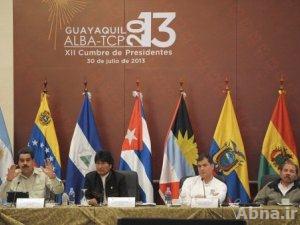 The nine Latin American states (ALBA) have condemned any possible aggression against Syria and announced the dispatching of humanitarian aid to the Syrian refugees in Lebanon.
“The Bolivarian alliance council in American denounces any possible strike against Syria,” ALBA Secretary General said in a statement from Venezuela.
“ALBA asks the U.S. to refrain from launching a military aggression against the Syrian people and government,” he added, accusing the US administration of resorting to the same strategies that it used in Iraq, Afghanistan and Egypt.
ALBA further decided to dispatch humanitarian aid, including foodstuffs, to the Syrian refugees in Lebanon.
Related articles
- At least one Syrian becomes a refugee every 15 seconds – expert (voiceofrussia.com)
- Lebanon opposes military attack against Syria: FM (theiranproject.com)
The Most Awkward G20 Summit Ever
By Dan Beeton | CEPR Americas Blog | September 5, 2013
President Obama is in St. Petersburg, Russia to participate in the G20 Summit today and tomorrow, amidst a time of heightened tensions between the U.S. and several G20 member nations. Looming over the summit are the Obama administration’s plans for a possible military attack on Syria, while Russian President Vladimir Putin has said that a U.S. military response without U.N. Security Council approval “can only be interpreted as an aggression” and UNASUR – which includes G20 members Argentina and Brazil, issued a statement that “condemns external interventions that are inconsistent with the Charter of the United Nations.”
New revelations of NSA spying on other G20 member nation presidents – Dilma Rousseff of Brazil and Enrique Peña Nieto of Mexico – leaked by NSA whistle-blower Edward Snowden and first reported in Brazil’s O Globo, have also created new frictions. Rousseff is reportedly considering canceling a state visit to Washington next month over the espionage and the Obama administration’s response to the revelations, and reportedly has canceled a scheduled trip to D.C. next week by an advance team that was to have done preparations for her visit. The Brazilian government has demanded an apology from the Obama administration. In an interview with Reuters on Wednesday, an anonymous senior Brazilian official underscored the gravity of the situation:
[T]he official, who declined to be identified due to the sensitivity of the episode, said Rousseff feels “patronized” by the U.S. response so far to the Globo report. She is prepared to cancel the visit as well as take punitive action, including ruling out the purchase of F-18 Super Hornet fighters from Chicago-based Boeing Co, the official said.
“She is completely furious,” the official said.
“This is a major, major crisis …. There needs to be an apology. It needs to be public. Without that, it’s basically impossible for her to go to Washington in October,” the official said.
Other media reports suggest that Brazil may implement measures to channel its Internet communications through non-U.S. companies. But when asked in a press briefing aboard Air Force One this morning, Deputy National Security Advisor for Strategic Communications Ben Rhodes did not suggest that such an apology would be forthcoming:
Q The Foreign Minister said he wanted an apology.
MR. RHODES: Well, I think — what we’re focused on is making sure the Brazilians understand exactly what the nature of our intelligence effort is. We carry out intelligence like just about every other country around the world. If there are concerns that we can address consistent with our national security requirements, we will aim to do so through our bilateral relationship.
Such responses are not likely to go far toward patching things up with Brazil. It is conspicuously dishonest to suggest that the U.S. government “carr[ies] out intelligence like just about every other country around the world,” as no other country is known to have the capacity for the level of global spying that the NSA and other agencies conduct, and few countries are likely to have the intelligence budgets enjoyed by U.S. agencies – currently totaling some $75.6 billion, according to documents leaked by Snowden and reported by the Washington Post.
There are also signs that the Washington foreign policy establishment is troubled by the Obama administration’s dismissive attitude toward Brazil’s understandable outrage. On Tuesday, McClatchy cited Peter Hakim of the Inter-American Dialogue – essentially the voice of the Latin America policy establishment in Washington:
Peter Hakim, the president emeritus of the Inter-American Dialogue, a Washington-based policy group, noted that Secretary of State John Kerry had visited Brasilia last month to patch things up after the initial NSA leaks but “really did not do a very good job. He just brushed it off.”
Hakim said he believed the O Globo report, and he added that “snooping at presidents is disrespectful and offensive.”
Rousseff and Pena Nieto had to issue strong statements, Hakim said. “Both have to show they are not pushovers, that they can stand up to the U.S.,” he said.
The ongoing revelations made by Snowden have affected U.S. relations with other countries as well. As the Pan-American Post points out, Peña Nieto may continue to reduce intelligence sharing with the U.S.; he also said yesterday that “he may discuss the issue with President Barack Obama at the summit.” U.S.-Russian relations, of course, have also recently become tense following Russia’s granting of temporary political asylum to Snowden.
The G20 Summit also comes just after the IMF, at the direction of the U.S. Treasury Department, changed its plan to support the Argentine government in its legal battle with “vulture funds” – meaning that U.S.-Argentine relations may also be relatively cool.
Related article
Colombia farmers’ uprising puts the spotlight on seeds
Against the grain | September 4, 2013
On 19 August, Colombian farmers’ organisations initiated a massive nationwide strike. They blocked roads, dumped milk on cars and basically stopped producing food for the cities. The problem? Farmers are being driven out of existence by the government’s policies.
The state provides almost no support for the small-scale farming sector.1 Instead, it embraces a social and economic model that serves the interests of a wealthy elite minority. Recent free trade agreements (FTAs) signed with the US and the EU are undercutting Colombian producers, who can’t compete with subsidised imports.2 The Colombian government has been actively promoting land grabbing by large corporations, many of them foreign (Monica Semillas from Brazil, Merhav from Israel, Cargill from the US), to promote export-oriented agribusiness at the expense of family farming oriented towards food sovereignty.
But the farming sector needs real support, especially in the form of access to land and lower costs of production, protestors argue. Otherwise, Colombian potato and coffee farmers, dairy and meat producers, not to mention small fishers, will not be able to keep up. They are being evicted and exterminated.
With their backs against the wall, a movement of mobilisation began in one part of the country in June and grew into a coordinated national action for August. The farmers’ strike was soon supported by other sectors: oil industry workers, miners, truckers, health sector professionals and others. On 29 August, ten days into the strike, more than 20,000 students joined the movement and shut down the capital city, Bogotá.
The response of the government was chaotic and contradictory. Police forces violently repressed and injured a lot of protestors, not to mention journalists. More than 250 people were arrested, including high-level union leader Hubert Jesús Ballesteros Gomez, mostly on trumped up charges.
A number of people on both sides lost their lives. At one moment the government recognised the farmers’ grievances as valid and offered some concessions. In another it claimed that the movement was infiltrated by the FARC. President Santos even went on TV and claimed that “the agrarian strike does not exist”. The following day, he was filmed from a helicopter, inspecting the skirmishes and tear gas which filled the streets of Bogotá.
The mobilisation has been extremely successful in opening up space for discussion, conscientisation, solidarity and resistance in Colombia. Students, for instance, were keen to support the farmers and back their demands. They rallied loudly against GMOs and for food sovereignty. But they also wanted to put forward their own demands for free public education, nudging the mobilisation beyond agrarian concerncs into a broader wave of social pressure to change current Colombian policies.
Law 970
Seeds emerged as one highly visible issue. Under the FTA signed with Washington, as well as that signed with Brussels, Bogotá is required to provide legal monopoly rights over seeds sold by US and European corporations as an incentive for them to invest in Colombia. Farmers who are caught selling farm-saved seeds of such varieties, or simply indigenous seeds which have not been formally registered, could face fines or even jail time.3 As is the case in many other countries throughout the world, this criminalisation of farmers’ and indigenous people’s rights to save, exchange and sell seeds puts the country’s biodiversity and cultural heritage at risk.
While it’s true that the Colombian government has been moving in this direction for many years, and agreeing to such policies as part of its membership in the Andean Community or the World Trade Organisation, many people point out that it is only since the signing of the US and EU FTAs that the government has begun seriously implementing them.
In 2011, the Colombian government authorities stormed the warehouses and trucks of rice farmers in Campoalegre, in the province of Huila, and violently destroyed 70 tonnes of rice that it said were not processed as per the law. This militarised intervention to destroy farmers’ seeds shocked many, and inspired one young Chilean activist, Victoria Solano, to make a film about it. The film is called “9.70” because that is the number of the law adopted in 2010 that articulates the state’s right to destroy farmers’ seeds if they don’t comply.4
Today, thanks to the force, tenacity and justness of the farmers’ protest, people from all walks of life in Colombia are discussing that film, as can be seen in the mass media, social networks and the streets, and asking why the government is pursuing such senseless policies.
Support the movement
There is no question that Colombian farmers can feed the country very well, in a way that provides jobs, dignity and a healthy environment. But the government is too firmly attached to an economic model that caters to crony interests and holds no place for small-scale family farming. We should all support the popular agrarian struggle in Colombia to turn that model around. It’s not too late.
As one small concrete action, the documentary film “9.70” — which you can watch online in Spanish at http://youtu.be/kZWAqS-El_g — is seeking funds to produce a version with English subtitles so that more people around the world can understand what the Colombians farmers are facing and support them to defeat such policies. The smallest contribution helps. Please go to http://idea.me/proyectos/9162/documental970 to participate. The deadline is 10 September!
As another meaningful action, the Latin American Coordination of La Via Campesina are seeking international solidarity initiatives to support the strike. Please go to http://goo.gl/9u6RXJ to learn more. Again, time is of the essence!
Beyond Colombia, the battle over similar seeds legislation is raging right now at very high political levels, and across the countryside, in Chile and Argentina as well. One concern is that some of the more aggressive elements adopted by the government of Colombia could infiltrate other Latin American countries as well. The need to scrap these laws is truly urgent indeed!
Going further:
- “La historia detrás del 970“, Semana, Bogotá, 24 August 2013
- Grupo Semillas, “Colombia: Las leyes que privatizan y controlan el uso de las semillas, criminalizan las semillas criollas“, Bogotá, 26 August 2013
- Julia Duranti, “A struggle for survival in Colombia’s countryside“, 30 August 2013
Visit the bilaterals.org website for more coverage (in English, French and Spanish) of the general agrarian strike and the fight over Law 970
For more information about the struggles around the seed laws in Colombia, please contact Grupo Semillas (“Seeds Group”) at semillas@semillas.org.co or visit their website http://semillas.org.co/
To learn more about the political battle currently taking place in Chile, please get in touch with Anamuri, the National Association of Rural and Indigenous Women, at secretariag@anamuri.cl
For information about what is happening in Argentina, please contact Diego Montón at the Latin American Coordination of La Vía Campesina, at secretaria.cloc.vc@gmail.com.
Notes
1 Almost one-third of the Colombian population lives in the countryside and nearly 60% of those in the rural areas live, to some extent, in hunger. See Paro Nacional Agrario y Popular, Pliego de peticiones.
2 The effects are just starting, but they are real. US agricultural exports to Colombia shot up 62% in the first year of the agreement, while Colombian farm exports to the US went down 15%. (See USTR, and Portafolio)
3 To be registered and certified, seeds need to meet criteria of genetic uniformity and stability, to suit agroindustrial processes. This excludes, by definition, peasant seeds — or criollo varieties, as they are called in Colombia — which tend to be diverse, adaptive and dynamic. Under the current rules in Colombia, if a farmer wants to plant criollo seeds, s/he has to get authorisation from the government, can only do it once, can only do it on five hectares or less and must consume the entire harvest at home (cannot sell it on the market).
4 See the film’s Facebook page and on Twitter look up #NoMas970. In the three years of Law 970 so far (2010-2012), the government rejected or destroyed nearly 4,000 tonnes of seeds.
Brazil to probe telecom companies implicated in NSA spying
RT | September 4, 2013
Brazil will probe telecommunications companies to see if they illegally shared data with the NSA after it was found the US had been spying on President Rousseff. Brazil’s government has accused the US of lying about the NSA’s activities in the country.
In response to the revelations, Brazilian President Dilma Rousseff called an emergency meeting of ministers. Following the meeting the government called on the National Telecommunications Agency (Anatel) to carry out checks on telecom companies based in Brazil to see if they collaborated with the NSA.
The Brazilian government denounced the NSA’s activities as “impermissible and unacceptable” and a violation of Brazilian sovereignty.
“[The US has] not given any reasonable explanations. In fact, all the explanations that have been given so far are false,” said Minister of Communications Paulo Bernardo.
The American ambassador to Brazil, Thomas Shannon, was summoned by the government to account for the reports of NSA snooping on Tuesday. He claimed the NSA does not monitor communications on Brazilian territory or collaborate with telecommunications companies.
Citing data leaked by Edward Snowden, Guardian journalist Glenn Greenwald revealed on Sunday that the NSA had been monitoring both the Brazilian and Mexican presidents.
“It is clear in several ways that [Rousseff’s] communications were intercepted, including the use of DNI Presenter, which is a program used by NSA to open and read emails and online chats,” Greenwald told AP in an email.
Brazilian-US relations on rocks
In the wake of the new scandal Brazilian media is speculating whether the spy revelations will lead to a knee-jerk reaction from the Brazilian government and the cancelation of Dilma’s October visit to the States.
Citing a presidential spokesperson, Globo reporter Gerson Camarotti wrote that if a “satisfactory explanation” is not given by the Americans then Dilma “will not rule out canceling the visit.”
“There has to be a convincing explanation. If this doesn’t happen, the situation will become extremely delicate,” said the spokesperson.
US relations with Brazil have worsened considerably as a result of Edward Snowden’s leaks regarding the NSA’s massive spy network. Back in August, UK authorities detained Brazilian citizen David Miranda in a London airport over suspicions he was carrying leaked NSA data on behalf of his partner Glen Greenwald. UK law enforcement held Miranda for nine hours under the terrorist act and confiscated electronic equipment.
Brazil called Miranda’s detention without charges unjustifiable and called on the UK authorities to account for the move. Meanwhile Brazilian lawmakers have called for police protection for Greenwald and his partner.
Related articles
- BRICS to discuss US spying on Rousseff: Brazil (thebricspost.com)
- Brazilian Senate to probe NSA spying reports (thebricspost.com)
- Brazilian lawmakers call for police protection of Glenn Greenwald and his partner (rt.com)
Colombia: With a “Mea Culpa,” the Arrogant Santos Government Relents
By Nazih Richani | Cuadernos Colombianos | August 27, 2013
The rural workers who have mounted Colombia’s national agrarian strike are staying the course after four peasants and one policeman were killed and scores more detained. Hundred of thousands of peasants and small farmers are participating in this historic mobilization whose scope and magnitude has not been seen for decades. But this is just a tactical triumph in a long struggle to address the current crisis in the rural economy. The crisis has been generated by a neoliberal model of development based on the extraction of raw materials and large bio-fuels agribusiness. It has been exacerbated by free trade agreements increasingly transforming Colombia into an importer of its basic food necessities. In August 19 when the strike started President Juan Manuel Santos ridiculed it by declaring that “el paro agrario no existe,” that is, “the agrarian strike does not exist.” Well, against his wishful thinking, the strike is still going strong after nine days (as of this writing, 27 August) and has expanded to include most of the country’s departments. It has put the agrarian crises on the social and political map and has highlighted its centrality in a country in which some 31.6% of the population still live and depend on the agrarian economy (according to the UNDP Report of 2011 on Colombia’s rural economy).
Finally Santos acknowledged the strike in a meeting that took place on Monday August 26, with peasants’ representatives in Tunja, an epicenter of the mobilization and the capital of the department of Boyacá. Speaking to peasant representatives, Santos openly apologized, saying “Mea Culpa” for his earlier dismissive comment on the strike and promised to continue his negotiations. Santos recognized the obvious, especially after the mobilization reached La Casa de Nariño, his presidential palace in Bogota, where 8,000 demonstrators in Bolivar Plaza raised their voices and their casseroles in solidarity with the peasants.
The fundamental question is whether this strong show of force by the peasants can translate into policy that takes Colombia in a different direction? That is a different matter. Can this strike open the door for a very serious discussion of the root cause: the economic model and the free trade agreements with the United States, Canada, and EU. How would this wide mobilization resonate in Havana where the Santos government is negotiating with the Armed Revolutionary Forces of Colombia (FARC)? The answers would depend on the resilience of the organizations that led the strike and the effectiveness of the democratic and revolutionary forces in pushing for an economic change that safeguards the subsistence peasant economy and the real producers of “bread, milk and butter” in Colombia.
Related article
- Social protest grows across Colombia as trade union leader arrested (colombiaresistance.wordpress.com)
Honduras: Congress Resurrects Military Police Force
Weekly News Update on the Americas | August 25, 2013
Honduras’ National Congress voted on Aug. 21 to approve a law creating the Military Police of Public Order (PMOP), a new 5,000-member police unit composed of army reservists under the control of the military. This will be in addition to a 4,500-member “community police” force that the government is forming, according to an Aug. 12 announcement by Security Minister Arturo Corrales. Although he called the move a “change of course,” Corrales failed to explain the difference between the community police, which is to be operative by September, and the existing national police force.
The government’s plan to raise the number of police agents by 9,500 is clearly meant to respond to the dramatic increase in crime in Honduras; according to the United Nations, the country now has an annual murder rate of 84 for every 100,000 people, the highest in the world. Police corruption is a major problem, and police agents have been convicted of high-profile crimes [see Update #1187]. The current police force had 14,472 agents on the payroll as of May, but in a new police scandal, only 9,350 agents could be found at work during July.
The police changes come as candidates prepare for Nov. 24 general elections, which will choose a new president, the 128 members of Congress, the 20 representatives to the Central American Parliament (PARLACEN), and local mayors [Update #1162]. The main force behind the new military police is Juan Orlando Hernández, who has resigned from his post as president of the National Congress to run as the presidential candidate of the center-right National Party (PN)—the party of current president Porfirio (“Pepe”) Lobo Sosa, who has governed Honduras since January 2010 without being able to contain the crime wave.
Human rights activists strongly oppose the proposed military police unit. “In no part of the world have the soldiers resolved security problems,” Omar Rivera, who directs the Alliance for Peace and Justice (APJ), a coalition of civil society, organizations, told the French wire service AFP. He added that a serious fight against crime would require a fight against impunity. Bertha Oliva, the coordinator of the Committee of Relatives of Disappeared Detainees in Honduras (COFADEH), called the creation of the new force “a step backwards in the demilitarization of society and the democratization of the country.” “The soldiers in the streets have only left more death and mourning, because they aren’t prepared for being guarantors of security,” she said. The national police were removed from the military and put under civilian control in 1997. Death squads operated by the military and the police were implicated in the killings of 184 government opponents in the 1980s.
Critics also asked how the government would be able to pay for two new police units that would double the current number of active agents. José Simón Azcona, a legislative deputy from the centrist Liberal Party (PL) who supported the measure, suggested that the US would pay. The US government “offered collaboration… under the previous administration” for the conversion of four military battalions into police units, he said. (It is unclear whether he was referring to a previous administration in Honduras or in the US.) (El Nuevo Diario (Nicaragua) 8/12/13 from ACAN-EFE; Honduras Culture and Politics 8/22/13; El Heraldo (Tegucigalpa) 8/22/13; La Nación (Costa Rica) 8/23/13 from AFP, EFE; Prensa Latina 8/24/13)
Related articles
- Honduras: Expanding Palm Oil Empires In The Name Of ‘Green Energy’ And “Sustainable Development” (alethonews.wordpress.com)
- Honduras: Army Kills Indigenous Leader at Dam Protest (alethonews.wordpress.com)
- Honduran Union Leader Faces Death Threats (alethonews.wordpress.com)
Venezuela, Palestine sign oil deal
Press TV – August 25, 2013
Venezuela and Palestine have signed agreements including deals under which Caracas is to sell oil at a ‘fair price’ to the Palestinians.
The accords were signed on Saturday following a meeting between Venezuelan Foreign Minister Elias Jaua and his Palestinian counterpart Riyad al-Maliki.
“It is an agreement of cooperation and solidarity with our oil industry… a sale of fuel at a fair price,” Jaua said.
The agreement also assures “favorable” repayment terms as well as training of Palestinians on handling and distribution of oil.
Maliki, who is on a Latin America tour, said he was “extremely satisfied” with the agreement.
On August 23, Maliki visited Ecuador, where he discussed with Minister for Foreign Affairs and Human Mobility Ricardo Patino. After the meeting, the two ministers expressed interest in opening embassies in both countries to strengthen ties.
A day earlier, Guyana’s President Donald Ramotar said after meeting the Palestinian foreign minister that his country is in the process of appointing an ambassador to Palestine and reiterated Guyana’s continued support to Palestine.
A group of Latin American and Caribbean countries, including Brazil, Argentina, Venezuela, Bolivia, Uruguay, Ecuador, Chile and Chile, recognize Palestine as an independent state.
On April 10, the Latin American nation of Guatemala became the 132nd nation in the world to formally recognize the state of Palestine.
Colombians Increasingly Joining Strike
Prensa Latina | August 24, 2013
Bogota – More and more sectors continue joining the nationwide strike in Colombia, expressing their unhappiness with government economic policies, amid strong tension in the wake of police repression, detentions and blockage in 33 roads in several departments.
The situation is worsening, with no solution in sight. The Executive has reiterated it is ready to talk, but not before the strike is ended and blocking of roads lifted.
President Juan Manuel Santos said yesterday that 30 persons have been brought to justice for blocking roads, “some of them charged with committing terrorism, facing over 20 year prison sentence.”
The day before the protests started, Santos had ordered police to act firmly against those blocking the roads.
Leaders of the protests have urged police to stop using force excessively and abusing power.
The first six days of protest left over 175 detainees and heavy damage worth some $25 million USD.
But protesters are determined to remain in the roads until their demands are heard by the government, whose policies against the workers and people in general limit their rights, privatize institutions and hand over the country’s resources to transnationals.
Boyaca remains the worst-hit department, with over 16 roads totally blocked.
Footage of police repression has been posted on the Internet.
The strike has also been strong in Bogota, and today more than 1,000 storekeepers of main wholesale chain Corabastos are expected to march toward Bolivar Square to support the protests, with people demanding to stop immediately the Free Trade Agreements that are hitting the people, mainly in rural areas.
“No More FTA, No More Riot Squadron (ESMAD), No More Privatized Seeds, No More Mega-Mining, No More Corruption,” ex Senator Piedad Cordoba wrote in a message on Twitter, where Colombians are massively backing the protests.
Featured Video
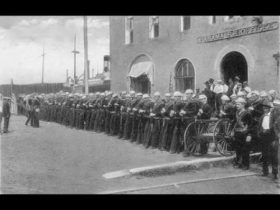
US Marines Seized Panama in 1903
or go to
Aletho News Archives – Video-Images
From the Archives
Precedents for Pizzagate
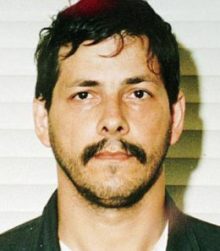
Marc Dutroux, Belgian pedophile, sadist, and serial killer with friends in high places
By Aedon Cassiel | Counter – Currents | December 23, 2016
To reiterate a point that should be clear to the more astute reader, my goal in this series (part 1, part 2) has not been to defend “Pizzagate” as such. My goal has been to defend the people who want to investigate it against specific accusations levied against them by people who think Pizzagate has revealed no intriguing information at all—for a specific reason, which I will be honing in and focusing on much more directly in this closing entry.
Whereas the mainstream critics of Pizzagate would have you believe that the dividing line is between paranoid conspiracy theorist followers of “fake news” and level-headed people who follow trustworthy news sources and rely on cold, hard reason to determine the truth, my goal has been to show that—whatever is or is not happening with Pizzagate itself—this framing of the issue is arrogant, insulting, and the product of extremely narrow tunnel vision. … continue
Blog Roll
 Aletho News
- The U.S. Sanctions Cuban Journalist For Reporting On The U.S. Blockade
- Israeli firms transform cars into intelligence devices: Reports
- Zionist-controlled companies to surveil British citizens
- THE CHILDREN GAMBIT
- A note on comment posting at Alethonews
- Trump stalls over Iran strike plan, Iran holds all the aces
- Zelensky’s Ceasefire for Elections is Strategic Gambit, Not Democratic Move
- US and Dutch pilots flying F-16s for Ukraine – Western media
- West’s Claims of Non-Involvement in Ukraine Conflict ‘Epitome of Hypocrisy’ – Expert
- Putin aide urges retaliation to ‘Western piracy’
- If Americans Knew
- Help end the injustice against Shadi
- Israel’s Favorite American President
- Israel’s “Yellow Line” Is a Death Trap for Palestinians. We Drove Into It.
- Why Israel’s expanding occupation in Syria presents a critical legal test
- Gaza is not a natural disaster. It is the victim of genocide enabled by global inaction
- Netanyahu’s plan to “end” US aid to Israel is to give even more money under a different name
- Israel ceased firing on Gaza for just 15 days of the “ceasefire” – Not a ceasefire Day 130
- In Gaza, “rats run over our faces” – Not a ceasefire Day 129
- Israel-backed border guards, GHF-linked aid – Not a ceasefire Day 128
- Israel battles Palestinian right of return, one Palestinian at a time – Not a ceasefire Day 127
- No Tricks Zone
- New Study: A 4°C Warmer Beaufort Sea Had ‘No Sea Ice’ 11,700 – 8200 Years Ago
- Unfudging The Data: Dutch Meteorological Institute Reinstates Early 20th Centruy Heat Waves It Had Erased Earlier
- German Gas Crisis…Chancellor Merz Allegedly Bans Gas Debate Ahead of Elections!
- Pollen Reconstructions Show The Last Glacial’s Warming Events Were Global, 10x Greater Than Modern
- Germany’s Natural Gas Storage Level Dwindles To Just 28%… Increasingly Critical
- New Study Rebuts The Assumption That Anthropogenic CO2 Molecules Have ‘Special’ Properties
- Climate Scientist Who Predicted End Of “Heavy Frost And Snow” Now Refuses Media Inquiries
- Polar Bear Numbers Rising And Health Improving In Areas With The Most Rapid Sea Ice Decline
- One Reason Only For Germany’s Heating Gas Crisis: Its Hardcore-Dumbass Energy Policy
- 130 Years Later: The CO2 Greenhouse Effect Is Still Only An Imaginary-World Thought Experiment
 Aletho News