Ileana Ros-Lehtinen Under Federal Probe for Campaign Fund Theft

teleSUR | September 25, 2020
According to a Miami CBS affiliate, several one-time staffers have been subpoenaed to provide records or testify before a grand jury on Ros-Lehtinen’s alleged misuse of campaign funds for personal expenses, vacations, and ornate meals—part of an investigation by the DOJ’s Public Integrity Section.
Announcing in April 2017 she would not be seeking re-election in 2018, Ros-Lehtinen transferred almost $180,000 from her re-election campaign fund to a political action committee (PAC) she ran, not an unusual move. However, personal use of these funds is illegal under federal law, even if transferred first to a PAC.
Expense reports from the PAC show Ros-Lehtinen indulged in a nearly $4,000 family trip to Walt Disney World in December 2017, a $3,100 dinner at Coral Gables restaurant Mesa Mar for New Years 2018, more than $10,000 in rooms at New York’s Lotte New York Palace and $28,000 at the W Hotel on South Beach, among many other expenditures.
Nonpartisan watchdog group Campaign Legal Center filed a complaint against Ros-Lehtinen with the FEC in October 2019, claiming her PAC violated federal law by “converting contributions for personal use…none of which have any apparent connections to Rep. Ros-Lehtinen candidacy or duties as an officeholder.” It remains unclear if the FEC referred the case to the DOJ or whether the DOJ began its own investigation independently.
In a statement to CBS Miami, Ros-Lehtinen’s attorney Jeffrey Weiner said: “She and her former staff members and volunteers are cooperating fully with the Federal Elections Commission and the Department of Justice. We are gathering the information requested by the Department of Justice and are confident that, if bookkeeping errors were committed, they were due to negligence and not willful or intentional misconduct by the former congresswoman or anyone on her staff or her accountants.”
Weiner added: “As my team and I have investigated and studied the facts in this matter, we have not found any evidence whatsoever of intentional wrongdoing by Ileana or anyone on her behalf.”
Ros-Lehtinen, who represented Miami-Dade county from 1989-2019 and was the first Latina and Cuban-American elected to Congress, served as the Chairwoman of the House Foreign Affairs Committee from 2011-2013, widely known her punitive and interventionist positions towards Cuba, Venezuela, and Nicaragua.
Coups and Neo-Coups in Latin America
By Juan Paz y Miño Cepeda |Venezuelanalysis | September 15, 2020
I recently received an article entitled “Coups and neo-coups in Latin America. Violence and political conflict in the twenty-first century” by Carlos Alberto Figueroa Ibarra, a long-time friend and academic at the University of Puebla, Mexico, and Octavio Humberto Moreno Velador, a professor at the same university.
The authors say that since the 1980s, democracy in Latin America has asserted itself across the continent, so much so that the topic has become recurrent in the political sciences. However, during the first seventeen years of the 21st century, new coups resurfaced, which they describe as “neo-coups.”
During the twentieth century, the authors identified 87 coups in South America and the Caribbean, with Bolivia and Ecuador being the most hit countries, while Mexico has only suffered once. The greatest concentration of coups occurred in four decades: 1930-1939 with 18; 1940-1949 with 12; 1960-1969 with 16 and 1970-1979 with 13. Between 1900-1909 and 1990-1999, the fewest coups occurred (3 and 1, respectively). Finally, 63 coups were deemed as military-led; 7 civilian; 8 civic-military; 6 presidential self-coups and three military self-coups. 77 percent of coups had a marked influence of right-wing ideology and party participation, and since the 1960s US intervention has been observed in several coups.
The neo-coups of the 21st century, however, are different from the coups of the twentieth century and with distinct characteristics. Of the seven studied, four have been carried out by the military/police (two which failed in Venezuela/2002 and Ecuador/2010 and two which were successful in Haiti/2004 and Honduras/2009). Likewise, two were parliamentary coups (Paraguay/2012 and Brazil/2016, both successful) and one was a civilian-state-led coup (Bolivia/2008, failed). In three of them, there is evidence of US intervention (Haiti, Bolivia and Honduras).
The intervention of the military or police took place in Venezuela, Haiti, Honduras and Ecuador. In Haiti, Bolivia and Brazil, large-scale concentrations of opposition citizen groups preceded the coups, exerting political pressure. There were also other cases of subsequent concentrations in support of Presidents Hugo Chávez and Rafael Correa, which prevented the success of the coups against them.
In three cases there was clear intervention by the judiciary (Honduras, against Manuel Zelaya; Paraguay, against Fernando Lugo; and Brazil, against Dilma Rousseff), and also of the legislative powers.
In addition, regional and supranational institutions have intervened in defence of democracy, specifically MERCOSUR, UNASUR, CELAC and even the Rio Group.
The authors conclude that “The new coups have sought to evade their cruder military expression in order to seek success. In this sense, the intervention of judicial and parliamentary institutions have represented a viable alternative to maintaining democratic continuity, despite the breakdown of constitutional and institutional pacts.”
To the analysis carried out by the two professors, and which I summarise without going into too many details, some considerations may be added.
All the coups of the 21st century have been directed against rulers of the Latin American progressive cycle: Hugo Chávez, Evo Morales, Manuel Zelaya, Rafael Correa, Fernando Lugo, Dilma Rousseff, and Haiti, where the case is particular because of the turbulence that the country has experienced where the military coup was against Jean-Bertrand Aristide, who had won the election with 91.69 percent of the vote.
Progressive governments aroused furious enemies: business elites, traditional oligarchies, military sectors of old “McCarthyism” anti-communism, the political right, “corporate” media, and, no doubt, imperialism.
There is not a single coup d’état led by “leftist” forces, which reveals an equally new phenomenon: the entire left has accepted democracy as a political system and elections as an instrument through which they may come to power. Historically speaking, this phenomenon represents a continuation of Salvador Allende’s and the Chilean Popular Unity’s thesis, which trusted in the possibility of building socialism through a peaceful path. It is the political and economic right, which have turned to neo-coup mongering, with their discourse of defending “democracy.”
Those same right-wing sectors have not only sponsored “soft coups,” but also promoted the use of two mechanisms that have been tremendously successful to them. Firstly, lawfare, or “legal war,” used to pursue, in appearance of legality, those who have served or identified with progressive governments. Secondly, the use of the most influential media (but also of social media and their “trolls”), which were put at the service of combating “populists” and “progressives,” and defend the interests of persecuting governments, business elites, rich sectors and transnational capital. These phenomena have been clearly expressed in Brazil against Inácio Lula da Silva, Dilma Roussef and the PT Workers’ Party, but also in Bolivia, against Evo Morales and the MAS Movement to Socialism and in Ecuador, where righting forces have achieved the prosecution of Rafael Correa, of figures of his government and of the “correístas.” In Argentina Alberto Fernández’s triumph stopped the legal persecution against Cristina Fernández and “Kirchnerismo”.
But there is, finally, a new element to be added to the neo-coup mongering of the 21st century, which is the anticipated coup d’état. This has been inaugurated in Bolivia and Ecuador.
In Bolivia, not only was the vote count suspended and Evo Morales forced to take refuge outside the country, but [he and his party] have been politically outlawed, and every effort has been made to marginalise them from future elections.
In Ecuador, all kinds of legal ruse have been used to prevent Rafael Correa’s vice-presidential candidacy (he was ultimately not admitted), to not recognise his party and other forces that could sponsor him, as well as to make it difficult for the [Correa-backed] Andrés Araúz team to run for the presidency.
It also has an equally unique characteristic of what happened in Chile. In Chile, despite the protests and social mobilisations, as well as domestic and international political pressure, the political plot was finally manipulated in such a way that the plebiscite convened for October/2020 will not be for a Constituent Assembly (which could dictate a new constitution), but for a Constitutional Convention, which allows traditional forces to preserve their hegemony, according to the analysis carried out by renowned researcher Manuel Cabieses Donoso.
As a result, neo-coup mongering has shown that, while institutional and representative democracy has become a commonplace value and a line of action for the social and progressive lefts, it has also become an instrument that allows access to government and, with it, the orientation of state policies for the popular benefit and not at the service of economic elites.
On the other hand, it has become an increasingly “dangerous” instrument for the same bourgeoisie and internal oligarchy, as well as imperialism, to such an extent that they no longer hold back from breaking with their own rules, legalities, institutions or constitutional principles, using new forms of carrying out coups.
It is, however, an otherwise obvious lesson in Latin American history: when popular processes advance, the forces willing to liquidate them are also prepared. And finally, for these forces, democracy doesn’t matter at all, only saving businesses, private accumulation, wealth and the social exclusiveness of the elites.
Juan J. Paz y Miño Cepeda is an Ecuadorian historian from the PUCE Catholic University of Quito. He is also the former vice-president of the Latin-American and Caribbean Historian’s Association (ADHILAC).
Translation by Paul Dobson for Venezuelanalysis.
Political pardon given by Maduro may be a checkmate against Venezuelan opposition
By Lucas Leiroz | September 7, 2020
In Venezuela, Juan Guaidó no longer appears to be the leader of the opposition. The forgiveness of 110 opponents by President Nicolás Maduro completely fragmented the political wing opposing the regime, which, in practice, removes from Guaidó the “monopoly” of militancy against the government. Maduro’s decision to forgive as many opponents as possible seems particularly strategic in an election year. For the December 2020 parliamentary elections, Maduro’s allies represent the only unified and solidly based political wing in the country, while currently his opponents are fragmented into several factions.
Another oppositionist leader, Henrique Capriles has already announced that he will dispute the elections. In recent times, after a long period of silence and inactivity, Capriles has occupied an increasingly prominent place in Venezuelan politics, diminishing Guaidó’s influence on the opposition. Capriles seems to have a more interesting political alternative for some opposition groups than the proposal by Guaidó, who is a politician absolutely aligned with external interests and who openly defends Venezuela’s total subordination to Washington.
Perhaps this was the reason for the fall of Guaidó’s political strength. 2020 was for the opposition leader the year of his abrupt fall. On February 5, Guaidó attended a conference at the Capitol in Washington DC and was applauded by Donald Trump, Nancy Pelosi and everyone in attendance. At that time, the illusion that Guaidó was in fact the president of Venezuela was fully consolidated. Guaidó himself believed to be the country’s president, which was the starting point of his downfall.
It seemed inevitable that the invention of the “Guaidó’s presidency” would result in the opposition being closed to the Venezuelan political reality. The history of the opposition leader, since his recognition in January 2019 by Trump, is a succession of errors and deficiencies that denounce his total inability to lead the country. The most notable mistakes so far have been his explicit participation in the landing of Colombian mercenaries on the Venezuelan coast and the leakage of his connections with drug trafficking in South America, which has greatly weakened his public image inside and outside Venezuela.
Guaidó’s decline, at first, had little impact on the Venezuelan opposition, as there was his “recognition” as the country’s president. But this illusion could not last long. The proximity of the parliamentary elections in December aroused in the Venezuelan opposition a strong wave of political realism and led different factions to assume the obvious truth: Guaidó is not the president of the country. This fact becomes even more evident when Maduro pardons and legalizes more than one hundred opponents, creating ties of cordiality in internal disputes – something that Guaidó still refuses to accept. Then a scenario was created in which the opposition is divided between those who recognize the legitimacy of the government and oppose it politically in the elections and, on the other hand, Guaidó, who recognizes himself as president with American support. This new scenario will completely change the way in which political disputes in Venezuela will take place and may even destabilize the opposition’s international alliances.
How long will Washington invest in Guaidó as its ally in opposing Maduro? What makes Guaidó more interesting than, for example, the political figure of Capriles or any other politician who will announce his candidacy for the December elections? Guaidó will not run in the parliamentary elections because he believes he is the president of the country, while other politicians will run and will be able to make real and effective opposition against Maduro. Will international actors interested in the fall of the government really continue to fuel the illusion that Guaidó is the president rather than supporting opponents within Parliament? It is a question that remains unanswered, but we can predict the outcome.
Indeed, there is no future for the Venezuelan opposition as it is today. The entire political wing that opposes Maduro is absolutely fragmented, with no unity of thought among its representatives, much less a solid national project. The only thing in common that opponents want is to overthrow Maduro, but that will not happen so easily. The Venezuelan government remains strong and well-structured, with an effective political apparatus at its disposal, which cannot be seen in the opposition. Opponents’ political forgiveness was a checkmate for the next elections. The weakness of the opposition became clear and all of its representatives were disadvantaged: Guaidó lost political strength and will possibly be without international alliances; the other opponents have broken ties with Guaidó and are not strong enough to face the government, even though they may run for election.
Lucas Leiroz is a research fellow in international law at the Federal University of Rio de Janeiro.
Venezuela: Operation Gedeon Organizers Arrested in Colombia
By Ricardo Vaz | Venezuelanalysis | September 5, 2020
Mérida – Colombian security forces announced the arrest of four Venezuelan citizens on Thursday.
Rayder Alexander Russo Marquez, Juvenal Sequea Torres and Juven Jose Sequea Torres were captured in Bogota, while Yacsy Alexandra Alvarez Mirabal was detained in Barranquilla. The operation was jointly carried out by the Colombian attorney general’s office, police, army and migration services, with assistance from the FBI.
Colombian President Ivan Duque held a press conference after the arrests, claiming that the four were “criminals” paid by the Venezuelan government to “destabilize” the country.
The comments drew a sharp rebuke from Caracas, with Foreign Minister Jorge Arreaza condemning the “nerve” of the Colombian president.
“What nerve from Ivan Duque. Now it turns out that Venezuelan deserting mercenaries were going to destabilize Colombia,” he wrote ironically on Twitter. “We gave the Colombian government information about these terrorists and it chose to do nothing.”
According to Venezuelan authorities, Russo, the Sequea brothers and Alvarez participated in the “Operation Gedeon” failed paramilitary incursion. On May 3 and 4, two speed boats carrying armed men were intercepted by security forces. Search operations in the following days led to over 40 arrests.
The 60-man Operation Gedeon was orchestrated by former US Green Beret Jordan Goudreau, who was hired by the Juan Guaido-led Venezuelan opposition, and intended to take over strategic locations in the capital and capture several high-ranking figures, including President Nicolas Maduro.
Two other US citizens, fellow former Green Berets Airan Berry and Luke Denman, were arrested in the operation, as was a third Sequea brother, Antonio.
The Venezuelan government sustains that Russo, Juvenal and Juven Sequea took part in the Northern Colombia-based training camps where the coup attempt was prepared. The Sequea brothers took part in the April 30, 2019 failed coup attempt before deserting from the Bolivarian National Guard. Russo, aka “Teniente Pico” is accused of involvement in the August 2018 assassination attempt against Maduro.
For her part, Alvarez is said to have been behind the logistics of the operation as well as functioning as liaison between the Americans and retired Major General Cliver Alcala, another organizer behind Operation Gedeon. Alcala, who had been responsible for previous armed incursion attempts featuring Venezuelan deserters, surrendered to US authorities after being indicted on drug charges.
Venezuelan Government Invites International Observers as Opposition Splits Over Elections
By Ricardo Vaz | Venezuelanalysis | September 4, 2020
Mérida – The Venezuelan government has invited the United Nations (UN) and the European Union (EU) to monitor the December 6 National Assembly (AN) elections.
Foreign Minister Jorge Arreaza wrote on Twitter that letters had been sent to UN Secretary General Antonio Guterres and EU Foreign Policy Chief Josep Borrell explaining electoral guarantees and inviting the bodies to send observers.
“Your participation in this process will have a positive contribution to an atmosphere of democratic understanding between Venezuelans and support political, peaceful and negotiated solutions to existing issues,” the letter read.
At the time of writing there have been no reactions from either the UN or the EU. While both have previously voiced support for dialogue processes, the European bloc recently vowed not to recognize the parliamentary election, which will elect 277 deputies for the 2021-2026 term.
The appeal to the international instances comes on the heels of President Maduro granting pardons to 110 opposition figures. This includes a number of AN deputies and other leaders charged or convicted for taking part in activities such as the violent “guarimba” street protests, the 2018 assassination attempt against Maduro, or the April 30, 2019 failed putsch.
On Thursday, the ruling United Socialist Party of Venezuela (PSUV) and its allies submitted their electoral candidates, with eight current cabinet members heading the list and subsequently replaced. Current state television VTV president Freddy Nanez replaced Jorge Rodriguez as communications minister, Noris Herrera replaced Blanca Eekhout as communes minister, Carolys Perez took over from Asia Villegas as minister for women, while there were also changes at the prisons, mining, youth, urban agriculture and indigenous peoples ministries.
The electoral scenario has also led to bitter infighting amongst the opposition ranks. On Wednesday, two-time former presidential candidate Henrique Capriles called on opposition leader Juan Guaido to stop “playing at government on the internet.”
“Either you’re the government, or you’re the opposition. You can’t be both,” he said during an online broadcast.
The comments came in response to criticism from Guaido after Capriles and fellow opposition member Stalin Gonzalez held a meeting with Turkish Foreign Minister Mevlut Cavusoglu concerning electoral participation and guarantees.
“These negotiations were held without the knowledge and permission of the ‘Interim Government’ and our international allies,” read a statement published by Guaido’s office.
The opposition lawmaker proclaimed himself “interim president” in January 2019 and was immediately backed by Washington and its allies. He went on to lead several unsuccessful efforts to overthrow the government by force, but a host of scandals saw his position increasingly questioned by other high-ranking opposition figures.
Guaido has lobbied for a boycott of the December AN elections and called on opposition figures to join a “unitary path” to oust the Maduro government which would extend his “interim presidency” into 2021.
However, other anti-government politicians have refused to rally behind him, with some urging voters to take to the polls, and hardline figures such as Maria Corina Machado calling for a foreign intervention.
For its part, Washington downplayed talk of a possible military intervention, with the Trump administration’s Special Representative for Venezuela Elliott Abrams criticizing opposition leaders “who only think that the magic moment of a military intervention will arrive” in a recent interview.
However, the veteran official, who is known for his role in the Iraq war and the Reagan administration’s Central America policy, has reiterated that the US will continue supporting Guaido while tightening sanctions against the Venezuelan economy.
The age of disputed presidencies – is democracy in crisis?
By Uriel Araujo | August 27, 2020
In 1378, it was not clear who the true Pope was. Depending on whom one asked, it was either Clement VII, nowadays listed as an Antipope in the Catholic Encyclopedia, or Urban VI. This was a time of crisis in Western Europe, often referred to as the “Western Schism”.
Likewise today, in the realm of secular politics, we currently have or recently had disputed or contested presidencies – in varying degrees – in many countries. In fact, Venezuela – where Guaidó and the country’s president Maduro are each recognized by a number of countries – is far from the being the only such case in Latin America.
For instance, in Peru, on October 2019, both Vizcarra and Araós claimed to be the legitimate president. In Honduras, Hernández election was contested, amid allegations of narco connections. Even in Colombia, Petro (2018 election runner up) and his party no longer recognize Duque’s presidency, who has also been accused of narco links and of tampering with ballots. In Brazil, Ms. Roussef’s 2016 deposition was perceived by many as an “institutional coup”. The current Brazilian president Bolsonaro, in his turn, also faces accusations of vote fraud through the use of Whatsapp “fake news”.
There are disputed presidencies or leaderships right now in Belarus, Guinea-Bissau, Malawi, Mali (which is under a military coup) and other countries. In the US, Trump’s 2016 election was also hotly contested (there were even wild accusations of “Russian interference”) and many journalists and experts are now writing that the new US election – amid the coronavirus outbreak and other crisis – may not be “swiftly accepted”. Antifa demonstrations are spreading across the country and are becoming increasingly violent.
All such legitimacy disputes are not just narrative wars amongst political rivals – it rather seems that in many parts of the world, the election process itself and democracy are losing credibility. It could turn into a war of models. If the contemporary and rather globalized democratic model is in crisis – and it would appear so – then, what are the alternatives?
The very specific notion of “Democracy” as necessarily including free speech, a multi-party system, alternance in power, a secular state and a Montesquieu’s trias politica separation of powers – with an often bicameral legislature – is of course quite Western in terms of its history and the values underlying it. In Western discourse today, the notion of democracy sometimes gets even more exclusive, sometimes including only societies which recognize gay marriage and do not criminalize abortion.
The United States is often taken as an (unexamined) “standard-bearer” for the entire world. The truth is that political forms and models are not so clearly differentiable but actually are rather intermingled. Thus, the current British monarch, for example, is officially the Defender of the Church of England and, as such, appoints Bishops and Archbishops – and no one dares to call it a “theocracy”. The US president, in his turn, in his authority to conduct war, has the power to maintain anyone under indefinite detention (without due process of law) according to attorney John Yoo (of so called Torture Memos) – and no one calls it a dictatorship. Clearly, labeling one as “non-democratic” is also a weapon of political discourse.
As for alternative models, a few years ago, notions of “Bolivarian” direct democracy were on the rise in South America. Furthermore, Bolivia’s 2010 law acknowledged the rights of Pachamama (Mother Earth) as a collective subject of public interest. The current Bolivian de facto president, Ms. Jeanine Áñez (President Morales was deposed in what many described as a coup), is currently working to undermine such notions as well as the notion of Bolivia as a Plurinational State – as defined by its 2009 Constitution.
So, right now, the left too (and its Bolivarian and indigenist alternatives) has been largely discredited amongst a large part of the population in South America. This has opened the door for the rise of a new kind of right-wing “populism” – which has little regard for current institutions. For instance, according to recent polls, 34% of the Brazilian population would support closing down (abolishing) the Parliament and 32% support doing the same to the Supreme Court. The COVID-19 pandemic could also be paving the way for “authoritarianism” in Europe and the US, according to several political scientists. The new populism is on the rise in Europe too.
In many parts of the world, a large part of society seems to care more about employment and security than abstract notions of the rule of law. If current political regimes fail to provide safety and to economically include the people they rule, dissatisfaction is sure to follow. And in the economically fragile post-COVID-19 world, this could get ugly.
Is it about time to reinvent democracy? Some new forms of it could arise, better suited for their cultural and regional contexts. In the meantime, a lot of instability may ensue (with economic and security consequences), especially in Latin America but in other parts of the world too – perhaps in Europe and the US as well.
Uriel Araujo is a researcher with a focus on international and ethnic conflicts.
COVID-19 economic decline brings IMF back to Latin America
By Paul Antonopoulos | August 26, 2020
The economic impacts of the COVID-19 pandemic brought the International Monetary Fund (IMF) back to Latin America. In December 2005, Brazilian President Luiz Inácio Lula da Silva and Argentine President Néstor Kirchner announced that they had paid the debts that South America’s two largest countries had with the IMF. At the time, Brazil paid $15.5 billion and Argentina about $9.81 billion, cancelling its debts. In addition to being historic, this transaction marked an era. The two South American powers freed themselves from the influence of the IMF and showed unprecedented political coordination, which was also complemented by political support from Venezuelan President Hugo Chávez.
The bloc also gave impetus to its neighbors: Uruguay, for example, cancelled its debt of $1.08 billion in 2006, while Bolivia freed itself from the fund that same year after an agreement allowed a $250 million debt to be forgiven.
However, everything seems to have changed 15 years later. Latin America is one of the world’s most affected regions from the COVID-19 pandemic – medically and economically. The IMF’s director, Kristalina Georgieva, predicts a 9.3% contraction for the region in 2020, compared to a 4.9% decline worldwide. Georgieva said that as a result of the new coronavirus pandemic, the organization has doubled access to emergency financing, disbursing a total of $25 billion to help 70 countries. Of those, about $5.5 billion went to 17 countries in South America, Central America and the Caribbean. The IMF director especially mentioned the cases of Chile, Peru and Colombia, which the IMF signed flexible credit line agreements totalling $107 billion.
An analysis by Teresa Morales, Nicolás Oliva and Guillermo Oglietti from the Latin American Strategic Center for Geopolitics (CELAG) shows that between April 17 and May 1, the IMF also helped Bolivia, Costa Rica, Dominica, Dominican Republic, Ecuador, El Salvador, Granada, Haiti, Panama, Paraguay and Saint Lucia with a total of $3.48 billion. CELAG researchers indicated at the end of May that “Latin American countries have started a new indebtedness process with the IMF.” In this sense, they warned that the IMF “will certainly mean short-term relief to face a very adverse external front, but that it certainly has its counterpart in the conditions of macroeconomic policies and their known consequences.”
However, we have not yet entered into a critical debt process. This is not so much because Latin American countries are not looking for it, but because of the very lukewarm response of multilateral organizations like the IMF to the pandemic. In this sense, the emergency financing lines provided by the organization have been of low magnitude and, for the time being, leave out the countries of the region with a low credit rating. Despite everything, this does not mean that the Fund has not returned to the region. The IMF has had a process of rapprochement with Latin America since the economic crisis of 2008 with loans of $57 billion to Argentina in 2018 and $4.5 billion to Ecuador.
It will depend on how much the countries in the region will need financing as a result of the pandemic to see if the IMF’s role as a financier in Latin America will be strengthened. One of the main changes is a nuance of the Washington Consensus, the traditional series of measures promoted by the IMF, the World Bank and the U.S. Treasury Department. The Washington Consensus pursues trade liberalization, fiscal adjustment, privatization policies and deregulation of the capital market, among others.
The Fund made a very strong self-criticism of the Washington Consensus. For example, now the reforms are not necessarily all implemented and, in some cases, the Fund recognized the importance of capital control by the State, the importance of counter-cyclical policies and the reduction of inequality through progressive fiscal policies. The organization is now more flexible and has started to allow government officials to participate in designing reform plans. It is likely this was allowed only after the IMF received massive criticism for choking Greece economically between 2008 and 2018 that tarnished the Fund’s image and reputation all around the world.
The Fund essentially has become more cunning and has learned that the same economic changes in all countries is counterproductive, not only in terms of economic results, but also in terms of the institution’s legitimacy. This change does not mean that it is a new institution, it still very much is the IMF with an orthodox bias, focused on liberalization policies. The IMF continues to have a preference for structural reforms, such as social security reform, tax reform, labor reform and, in some cases, trade reform.
In Georgieva’s address to the governments of Latin America and the Caribbean, the IMF will maintain its supposed solid commitment to the region in terms of capacity-building and economic policy advice. In this context, the IMF director asked Latin American countries to be able to reorient policies when the time comes to help workers get back to work and asked them to do so using fiscal stimulus with prudence. In her message, Georgieva said that as shocks dissipate, fiscal soundness and debt sustainability must become priorities for economic policy. However, it appears rather that Georgieva is attempting to prepare Latin America to once again be dominated by the IMF.
Paul Antonopoulos is an independent geopolitical analyst.
USA’s Militarization of Latin America
By Yanis Iqbal | Dissident Voice | August 24, 2020
Maj. Gen. Andrew Croft, the commander of 12th Air Force, wrote on 22 August: “I have seen an increasingly contested strategic space where Beijing and Moscow are aggressively investing time and resources in Latin America to support their authoritarian models of governance. The Air Force must reinforce the strength of our longstanding commitment to the Western Hemisphere. We lose ground when we are unable to commit to spending the time and resources to fly our aircraft south and train alongside our partners.”
Croft’s statement reflects the growing American hysteria against the presence of any extra-regional actors in the Latin American continent. For US policy-makers, Latin America is not an aggregation of sovereign nations but a large lump of subordinated states constituting “America’s backyard”. Consequently, this conceptualization of Latin America as a natural extension of the American empire has led to viewing the engagement of any South American country with China, Russia and Iran as a “threat” to peace and security.
On February 7, 2019, Admiral Craig S. Faller – the commander of the United States Southern Command – told the Congress that the Western Hemisphere is facing “a troubling array of challenges and threats”. These threats included alarmist assertions about the growing dominance of China, Russia and Iran and a general demonization of the socialist governments of Cuba, Venezuela and Nicaragua:
“China has accelerated expansion of its Belt and Road Initiative at a pace that may one day overshadow its expansion in Southeast Asia and Africa. Russia supports multiple information outlets spreading its false narrative of world events and U.S. intentions. Iran has deepened its anti-U.S. Spanish language media coverage and has exported its state support for terrorism into our hemisphere. Russia and China also support the autocratic regimes in Venezuela, Cuba, and Nicaragua, which are counter to democracy and U.S. interests. We are monitoring the latest events in Venezuela and look forward to welcoming that country back into the hemisphere’s community of democracies.”
In response to the perceived threats posed by the China-Russia-Iran nexus, the Secretary of Defense has decided to conduct an assessment of the sufficiency of resources available to the U.S. Southern Command, the U.S. Northern Command, the Department of State, and the U.S. Agency for International Development (USAID) to carry out their respective missions in the Western Hemisphere. This assessment is required to include “a list of investments, programs, or partnerships in the Western Hemisphere by China, Iran, Russia, or other adversarial groups or countries that threaten the national security of the United States.”
In addition to warlike preparations, USA has also pursued a policy of increased militarization wherein it has tried to ensure “technological superiority” with regard to “anti-US actors”. In March, 2020, USA decided to send additional ships, aircraft and forces to South America and Central America in order to combat the influence of Russia and China. According to Navy Adm. Craig Faller, commander of Southern Command, “This really was born out of a recognition of the threats in the region,”. Along with the mobilization of the Southern Command, USA has substantially enlarged its security aid to Latin America: From $527,706,000 in 2019, US security aid to Latin America has increased by 10% to $581,270,000.
Chinese Footprint
The present-day US militarization of Latin America is rhetorically driven by an imperialist discourse framing the continent as a possession of the American empire which China, Russia and Iran are trying to appropriate. To take an example, R. Evan Ellis, a Latin America Research Professor at the US Army War College, stated before the US-China Economic and Security Review Commission that China’s engagement with Latin America “threatens the position of the United States, our security and prosperity, and the democratic values, rights, institutions and laws on which we depend.” To substantiate his statements, Ellis enunciated various strategies through which China is undermining USA’s dominance:
- “Trade with, loans to, investment in, and other forms of economic and other support to anti-US regimes, indirectly enabling their criminal activities and contributions to regional instability”.
- “Through providing an alternative to commerce, loans and investment from the West, making governments of the region less inclined to support the US on political, commercial, or security issues, or to stand up for rule of law, democracy or human rights, particularly where it might offend the PRC;”
In both these points, one can observe the imperialistic high-handedness with which Ellis is declaiming his pro-US rhetoric. While Beijing’s efforts to engage with sovereign nations and construct an alternative to the global American empire are regarded as enabling “regional instability”, no questions are asked about USA’s expansionist quest to imperialize the entire world through militaristic tactics.
In order to vilify China and smear its non-aggressive foreign policy, hawkish security experts have framed the country’s diplomatic involvement with various Latin American nations as a type of authoritarian tactic. Using this line of reasoning, the National Endowment for Democracy (NED) writes: “Beijing has now officially established its own version of soft power… which emanates from its undemocratic system and rests on its ability to shape the viewpoints of others through co-optation and persuasion.” Not having any empirical evidence to prove its unconvincing statements, NED talks vaguely about the “hypnotic effects” exercised by “Chinese-style warm welcome”: “The Chinese-style warm welcome, the carefully selected tours that include visits to sites with symbolic historical and cultural significance, and ad hoc friendly discourse delivered by the Chinese hosts can have hypnotic effects on their foreign guests.” This is an indication of the extent to which America hysteria against China can reach.
In the same way as NED, the Brookings Institution has also tried to slander China’s diplomatic initiatives in Latin America to preserve the coercive dominance of USA in the continent. As per the think tank, “it would be fair to assume that China’s growing economic power and ambitions of global leadership, coupled with its inherently closed and repressive model of political control, will hurt the region’s prospects for strengthening its liberal democratic systems and respect for human rights.” While saying this, the Brooking Institution conveniently forgets that it the US, with its Western-styled liberal democracy, that has hurt the region most in the form of coups, violence and overt brutality against social movements. Most recently, a US-backed coup in Bolivia has resulted in two massacres and massive repression of social movements.
The Iranian Connection
Like China, Iran, too, experiences American hostility towards its engagement with Latin American countries. Lieutenant Andrew Kramer of the U.S. Navy terms Iranian support for the “economically backward governments” of Cuba, Nicaragua and Venezuela as efforts “to maintain pockets of instability and hostility close to U.S. borders.” Echoing this perspective, William Preston McLaughlin, a Colonel (Ret.) of U.S. Marine Corps and Magdalena Defort, an Intern Analyst at the Foundation of Defense of Democracies, argue that “Iran’s presence in Latin America is an imminent threat to peace and political stability in the Western Hemisphere because its forces interact with Latin America’s deeply rooted revolutionary ideology and various well-intentioned but flawed “liberation theology” social movements.” Here, both of the analysts are merely parroting the imperialist “Monroe Doctrine” that subverted the sovereignty of Latin American nations and tethered the people of the continent to the whims of the American empire. Through the Monroe Doctrine, USA relegated the entire Latin American continent to the status of the empire’s handmaiden and constantly used its military muscles to overpower any regional initiatives challenging the dynamics of subjugation. Now, when Iran is lending support to the anti-imperialist administrations of Venezuela, Nicaragua and Cuba, it has come under the radar of USA for ostensibly destroying peace and political stability in the Western Hemisphere. In August 2020, for instance, USA confiscated four Iranian fuel shipments that had been bound for Venezuela, making it clear that it would not tolerate anti-imperialist opposition in Latin America.
In addition to portraying Iran as a threat to global peace, both the analysts also used a shrill, scaremongering rhetoric to over-exaggerate the strength of the country. According to the analysts, “Iran has used every agency within its borders to help extend Iranian tentacles into the political, cultural, economic, and military life of Latin America.” This bears striking resemblance to the traditional war-mongering US narrative that frames Hezbollah as a menace to justify the militarizary raising funds, seeking recruits, probing for our weaknesses and challenging our defenses,”. Through these discourses, USA seeks to unleash a new war against the anti-imperialist axis of Latin America which is standing up to militaristic predatoriness of the global hegemon.
Russian Presence
Besides Iran and China, Russia is another nation perceived as a “threat” to US security. General John Kelly, commander of the U.S. Southern Command (SOUTHCOM) noted in his Congressional testimony, “it has been over three decades since we last saw this type of high-profile Russian presence” in Latin America. In his command’s 2015 Posture Statement, Kelly added:
“Periodically since 2008, Russia has pursued an increased presence in Latin America through propaganda, military arms and equipment sales, counterdrug agreements, and trade. Under President Putin, however, we have seen a clear return to Cold War tactics. As part of its global strategy, Russia is using power projection in an attempt to erode U.S. leadership and challenge U.S. influence in the Western Hemisphere.”
John Kelly’s representation of Russia as a military threat has been repeated by the Commander of US Southern Command, Admiral Kurt W. Tidd who said in his February 2018 Posture Statement to the US Senate Armed Services Committee that:
“Russia’s increased role in our hemisphere is particularly concerning, given its intelligence and cyber capabilities, intent to upend international stability and order, and discredit democratic institutions… Left unchecked, Russian access and placement could eventually transition from a regional spoiler to a critical threat to the U.S. homeland.”
With the help this narrative, USA has aggressively pushed forward the agenda of greater militarism in Latin America as it strives to maintain “technological superiority” in relation to Russia and expand its already large military expenditure.
On top of depicting Russia as a military threat, US analysts have additionally portrayed the country’s support of socialist governments in Latin America as a danger to the economically empty liberal democracies of the West. According to IBI Consultants, a National Security consulting company specializing in Latin America, Russia’s growing presence in Latin America “is now an integral part of an alliance of state and nonstate actors that have shown their hostility toward the United States in their ideology, criminalized behavior, and anti-democratic nature.” Reiterating this point, on July 9, 2019, Admiral Faller declared before the Congress that “Russia seeks to sow disunity and distrust, propping up autocratic regimes in Cuba, Bolivia, Venezuela, and Nicaragua, which are counter to democracy and U.S. interests.” For Faller, those nations which don’t doggedly toe America’s imperialist line automatically become “threats” to democracy and if Russia shows solidarity with these anti-imperialist nations, it, too, classifies as a threat to US interests.
As the USA continues to militarize Latin America, it is increasingly becoming clear that it wants to protect its old, imperial structures from being challenged by anyone. It has been explicitly acknowledged even by pro-US analysts such as Ellis that US military assistance in Latin America “potentially serves U.S. strategic interests by helping to inoculate receiving states against radical or anti-democratic [read “socialist”] solutions which find receptivity when populations lose faith in the ability of a democratic political system and a free market economy to effectively address the corruption, inequality, injustice, and other dysfunctionalities plaguing their country [Emphasis mine].” US military assistance, therefore, is not apolitical and is ideologically tarnished with the objectives of stabilizing free market economies-bourgeoisie democracies and subverting socialist countries.
The United States Intelligence Community’s assessment of threats to US national security had stated in 2019 that “anti-US autocrats [in the Western Hemisphere]will present continuing challenges to US interests, as US adversaries and strategic competitors seek greater influence in the region.” Here, “anti-US autocrats” refers to the socialist administrations of three Latin American countries: Cuba, Venezuela and Nicaragua. These three countries have been facing strong US belligerence for their anti-imperialist stance. US sanctions against Cuba have tightened during the pandemic; USA’s hybrid war against Venezuela has intensified as Trump has decided to use frozen funds to topple Nicolas Maduro and USAID (United States Agency for International Development) has strengthened its regime change operations against the Sandinista government of Daniel Ortega in Nicaragua. Due to the support lent by China, Russia and Iran to the socialist governments of Latin America, USA has decided to eradicate these extra-regional actors from its “own” backyard and re-proclaim a complete American dominance in the region. In times like these, the international community needs to oppose the militarism of USA against new regional alliances in Latin America.
Yanis Iqbal is a student and freelance writer based in Aligarh, India.
Drug trafficking militias massacre social leaders in Colombia
By Lucas Leiroz | August 22, 2020
In Colombia, a terrible wave of violence affects the people and especially traditional indigenous communities. According to United Nations data, more than 40 murders of social leaders have occurred this year alone.
Last Tuesday, August 18, three Indians of the Awá people were murdered in the municipality of Ricaurte, department of Nariño, while two young men were tortured and murdered in El Patía, department of Cauca, and a social leader, Jaime Monge, was also murdered in Villacarmelo, a rural area of Cali. These deaths made newspapers’ headlines a few days after others that shocked the country. On Saturday, 15, eight young men were shot in the municipality of Samaniego; on the 11th, five teenagers were murdered in Llano Verde and an Afro-Colombian social leader was murdered in Chocó; and on the 8th, in the municipality of Leiva, Nariño, two students who were attending school were murdered.
Contrary to what was common in other times, there is no public claim of responsibility for the murders. The main reason for this is that currently there is no longer a monopoly on the attacks by the major illegal factions, but the simultaneous action of a wide variety of militias involved in drug trafficking networks. However, the Colombian State denies the existence of widespread paramilitarism in the country. Whenever a massacre occurs in the country, the official versions generally point to drug trafficking as the culprit, without further investigation, which is why the attacks remain unpunished.
Despite the denials of the authorities, the existence of multiple groups is evident and the phenomenon of paramilitarism can no longer be associated strictly with groups such as the FARC (Revolutionary Armed Forces of Colombia) and the ELN (National Liberation Army), being, currently, an extremely multifaceted and widespread phenomenon. For example, in three recent massacres in the Santander region, a paramilitary group known as “Los Rastrojos” was denounced as the perpetrator. According to local sources, this group has between 150 and 200 members and is advancing across the country.
This same armed group – “Los Rastrojos” – has an interesting history of links with drug trafficking in the neighboring country, Venezuela. The group was expelled from Venezuela due to the constant and incisive actions of Venezuelan security forces, which forced the migration of militia members to Colombia, where they are now spreading with great speed. However, “los Rastrojos” act not only in drug trafficking, but also in politics, apparently. It was this group that, in February 2019, accompanied Juan Guaidó’s flight to Colombia. Guaidó, moreover, has several records in photos and videos with members of the militia, which raises suspicions of links between the Venezuelan opposition and Colombian drug trafficking.
In fact, the peace agreement signed between the Colombian government and the FARC in 2016 did not end civil conflicts, but it did generate a reconfiguration of the actors in the fighting. Now legalized, the FARC is no longer the main belligerent group and new, lesser-known militias are taking on a greater role in drug trafficking. In practice, the power of these militias far outweighs the ability of state security forces to control and combat them, which spurs the creation of secret networks of cooperation between the state and organized crime to keep illegal activities “restricted” and avoid the liquidation of the social order. In this way, rises what we can call a narco-state – a phenomenon in which people and criminal organizations involved in drug trafficking start to occupy positions of relevance in the government and to influence state policies.
The existence of a Colombian Narco-State is almost undeniable and explains the inertia of state forces to investigate crimes committed by criminal organizations. Massacres occur freely across the country as social movements and communities of traditional peoples become an obstacle to the advancement of trafficking. The State remains silent and even collaborates with the actions of the militias and thus the interests of crime are realized without any impediment.
The situation in Colombia, however, is old and the country has been referred to as a Narco-State on several other occasions. What is really surprising is not the Colombian government’s attitude towards organized crime, but the inertia of international organizations and foreign powers in the case. Still, the role of the US in South America is curious. A few months ago, US President Donald Trump accused Venezuelan President Nicolás Maduro of being involved in drug trafficking and offered a millionaire reward for his “capture”. However, the main center of US operations against Venezuela is precisely Colombia, from where, on more than one occasion, mercenaries left and crossed the border into Venezuela trying to overthrow Maduro. In addition, Washington-backed Venezuelan opposition leader Guaidó has already demonstrated links to at least one criminal organization active in Colombia and involved in the murders of social leaders.
Why do Washington, the United Nations and all the Western powers that condemn Maduro remain silent in the face of these cases? Why is Colombia not being punished with international sanctions for its inertia in preventing the massacre of its own people? Perhaps drug trafficking is not really an enemy for Washington.
Lucas Leiroz is a research fellow in international law at the Federal University of Rio de Janeiro.
YouTube Shuts Down New Channels from Venezuela and Cuba
teleSUR | August 21, 2020
Without prior notice, YouTube Thursday removed three Venezuelan channels and two Cuban channels from its platform.
“We were loading to the platform not only live transmissions but also our complete programs. There is no clear explanation for this action,” said Barry Cartaya, a presenter of Venezolana de Television (VTV), a state-run television station based in Caracas.
“This page isn’t available. Sorry about that. Try searching for something else,” is the message popping up when the people try to access VTV channels.YouTube eliminated over 68,000 videos that the Venezuelan media stored in this platform since2011.
The VTV channels affected by the U.S. company are Multimedio VTV (314,000 subscribers), VTV Programs (87,000 subscribers), and VTV Signal Live, which allowed journalists and correspondents to directly post their productions to inform the public.
In Cuba, outlet Cubadebate also denounced the closure of two Youtube channels, namely, Mesa Redonda (19,700 subscribers) and Cubavision Internacional (8,200 subscribers).
Local analysts consider YouTube’s decisions might be related to the sanctions President Donald Trump is applying against individuals, companies, and institutions of both countries.
According to YouTube’s own rules, a channel can be closed when it has committed three serious offenses during a certain period. In the cases of the Venezuelan and Cuban channels, however, these offenses did not exist.
The US contracts out its regime change operation in Nicaragua
By John Perry | COHA | August 4, 2020
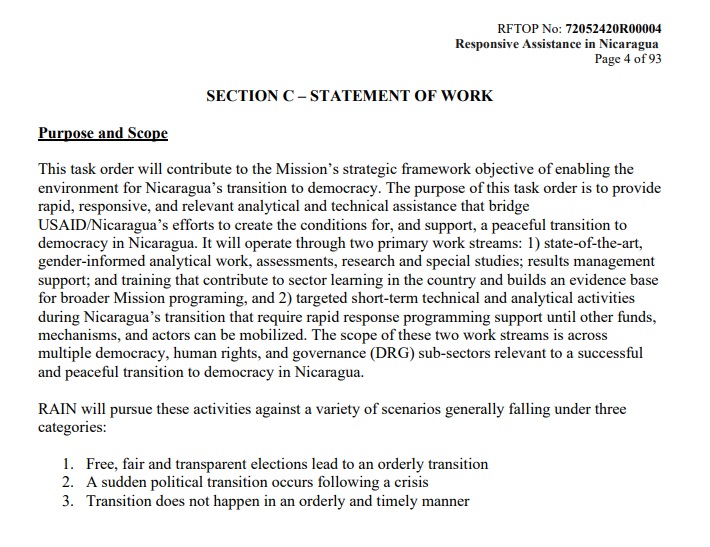
Masaya, Nicaragua – An extraordinary leaked document gives a glimpse of the breadth and complexity of the US government’s plan to interfere in Nicaragua’s internal affairs up to and after its presidential election in 2021.
The plan,[1] a 14-page extract from a much longer document, dates from March-April this year and sets the terms for a contract to be awarded by USAID (a “Request for Task Order Proposal”). It was revealed by reporter William Grigsby from Nicaragua’s independent Radio La Primerisima[2] and describes the task of creating what the document calls “the environment for Nicaragua’s transition to democracy.” The aim is to achieve “an orderly transition” from the current government of Daniel Ortega to “a government committed to the rule of law, civil liberties, and a free civil society.” The contractor will work with the “democracy, human rights, and governance (DRG) sub-sectors” which in reality is an agglomeration of NGOs, think tanks, media organizations and so-called human rights bodies that depend on US funding and which – while claiming to be independent – are in practice an integral part of the opposition to the Ortega government.
To justify such blatant interference, a considerable rewriting of history is needed. For example, the document claims that the ruling Sandinista party manipulated “successive” past elections so as to win “without a majority of the votes.” Then after “manipulating the 2016 presidential elections” to similar effect, it was warned by the Organization of American States (OAS) that there had been various “impediments to free and fair elections” as a result of which the OAS requested “technical electoral reforms.” What the document omits, however, are the overall conclusions of the OAS on the last elections. Although it identified “weaknesses typical of all electoral processes,” the OAS explicitly said that these had “not affected substantially the popular will expressed through the vote.” In other words, the nature of Daniel Ortega’s victory (he gained 72% of the popular vote) made any minor irregularities irrelevant to the result: he won by an enormous margin. The leaked document makes clear that the US is worried that the same might happen again and aims to stop it.
Not surprisingly, the document also rewrites recent history, saying that the “uprising” in 2018 (which had strong US backing) was answered by “the government’s brutal repression” of demonstrations, while it ignores the wave of violence and destruction that the opposition itself unleashed. The economic disruption it caused is still damaging the country, even though (pre-pandemic) there were strong signs of recovery. USAID, however, has to paint a picture of a country in crisis “… broadening into an economic debacle with the potential to become a humanitarian emergency, depending on the impact of the COVID-19 contagion on Nicaragua’s weak healthcare system.” Someone casually reading the document, unaware of the real situation, might get the impression that, in Nicaragua’s “crisis environment,” regime change is not only desirable but urgently required. The reality – that Nicaragua is at peace, has so far coped with the COVID-19 pandemic reasonably well, and hasn’t suffered the severe economic problems experienced by its neighbors El Salvador and Honduras – is of course incompatible with the picture the US administration needs to present, in order to give some semblance of justification for its intervention.
A long history of US intervention
Given the long history of US interference in Nicaragua, going back at least as far as William Walker’s assault on its capital and usurption of the presidency in 1856, the existence of a plan of this kind is hardly surprising. What’s unusual is that someone has made it publicly available and we can now see the plan in detail. Of course, the US has long developed a tool box of regime change methods short of direct military intervention, such as when it sent in the marines in the 1920s and 1930s or illegally funded and provided logistical support for the “Contra” forces in the 1980s. It now has more sophisticated methods, using local proxies, which are deniable in the unlikely event that they will be exposed by the international media (which normally displays little interest, being much more interested in electoral interference by Russia than it is in Washington’s disruption of the democratic processes).
The latest escalation in intervention began under the Obama presidency and continued under Trump, although the motivation probably has more to do with the US administration’s ongoing concerns about the success of the Ortega government’s development model since it returned to power in 2007 and began a decade of renewed social investment. Oxfam summarized the problem in the memorable title it gave to a 1980s report about Nicaragua: The Threat of a Good Example. Between 2005 and 2016, poverty was reduced by almost half, from 48 percent to 25 percent according to World Bank data. Nicaragua had a low crime rate, limited drug-related violence, and community-based policing. Over the 11 years to 2017, Nicaragua’s per-capita GDP increased by 38 percent—more than for any of its neighbors. Its success contrasted sharply with the experience of the three “Northern Triangle” countries closely allied to the US. While Nicaragua became one of the safest countries in Latin America, neighboring Guatemala, El Salvador and particularly Honduras saw soaring crime levels, rampant corruption and rapid growth in the drug trade that prevented social progress and produced the “migrant caravans” that began to head north towards the US in 2017.
The US administration’s efforts in 2016 and 2017, building on long experience of manipulating Nicaraguan politics, appeared to produce results in April 2018. The first catalyst for action by US-funded groups was an out-of-control forest fire in a remote reserve, inaccessible by road.[3] The tactics were clear: take an incident with potential to get young people onto the streets, blame the government for inaction (even though the fire was almost impossible to control), whip up people’s anger via social media, organize protests, generate critical stories in the local press, enlist support from neighboring allies (in this case, Costa Rica) and secure hostile coverage in the international media. All of these tactics worked, but before the next stage could be reached (protesters being repressed by the Ortega “regime”) the forest fire was extinguished by a rainstorm.
A week later, the opposition forces were unexpectedly given a second opportunity. The government announced a package of modest social security reforms, and quickly faced new protests on the streets. The same tactics were deployed, this time with much greater success. Violence by protesters on April 19 (a police officer, a Sandinista supporter and a bystander were shot) brought inevitable attempts by the police to control the protests, leading to rapid escalation. Media messages proliferated about students being killed, many of them false. Only a few days later the government cancelled the social security reforms, but by now the protests had (as planned) moved on to demanding the government’s resignation. The full story of events in April-July 2018, and how the government eventually prevailed, is told in Live from Nicaragua: Uprising or Coup?
A section of the report
Laying the groundwork for insurrection
How were the conditions for a coup created? The aims of US government funding in Nicaragua and the tactics they paid for in this period were made surprisingly clear in the online magazine Global Americans in 2018, which is partly funded by the National Endowment for Democracy (NED).[4] Arguing (in May 2018, at the height of the violence) that “Nicaragua is on the brink of a civic insurrection,” the author Ben Waddell, who was in Nicaragua at the time, pointed out that “US support has helped play a role in nurturing the current uprisings.”
His article’s title, Laying the groundwork for insurrection,[5] was starkly accurate in describing the ambitions behind the NED’s funding program, which had financed 54 projects in Nicaragua over the period 2014-17 and has continued to do so since then. What did the projects do? Like the recently leaked document, NED promotes ostensibly innocuous or even apparently beneficial activities like strengthening civil society, promoting democratic values, finding “a new generation of democratic youth leaders” and identifying “advocacy opportunities.” To get behind the jargon and clarify the NED’s role, Waddell quotes the New York Times (referring to the uprisings in Egypt, where NED had also been active):[6]
“… the United States’ democracy-building campaigns played a bigger role in fomenting protests than was previously known, with key leaders of the movements having been trained by the Americans in campaigning, organizing through new media tools and monitoring elections.”
In the case of Nicaragua, the NED’s funding of groups opposed to the Sandinista government began in 1984, giving the lie to their aim being to “promote democracy” since that was the year in which Nicaragua’s revolutionary government held the country’s first-ever democratic elections. Waddell makes it clear that the NED’s efforts continued, years later:
“… it is now quite evident that the U.S. government actively helped build the political space and capacity in Nicaraguan society for the social uprising that is currently unfolding.”
The NED is not the only non-covert source of US funding. Another is USAID, which describes its role in the 2018 uprising in similar terms to the NED. Not long before he exposed the new document, William Grigsby was able to publish lists of groups and projects in Nicaragua funded by USAID and by the National Democratic Institute (NDI).[7] He showed that upwards of $30 million was being distributed to a wide range of groups opposed to the government and involved in the violence of 2018, and that in the case of the NDI at least this funding continued into 2020.
Last year, Yorlis Gabriela Luna recounted for COHA her own experiences of how US-funded groups trained young people, in particular, and influenced their political beliefs in the build-up to 2018.[8] She explained how social networks and media outlets were “capable of fooling a significant portion of Nicaragua’s youth and general population.” She explained how the groups used scholarships to learn English, diploma programs, graduate studies, and courses with enticing names like “democratic values, social media activism, human rights and accountability” at private universities, “to attract and lure young people.” She went on to explain how exciting events were organised in expensive hotels or even involving trips abroad, so that young people who had never before been privileged in these ways developed a sense of “pride,” belonging, and “group identity,” and as a result “wound up aligning themselves with the foreign interests” of those who funded the courses and activities.
The new task during and after the pandemic
Two years after the failed coup attempt, what are the organizations that receive US funding now supposed to do? The new document is full of jargon, requiring the contractor (for example) to engage in “targeted short-term technical and analytical activities during Nicaragua’s transition that require rapid response programming support until other funds, mechanisms, and actors can be mobilized.” The work also requires “longer-term programs, which will be determined as the crisis evolves.” Preparation is required for the possibility that “transition [to a new government] does not happen in an orderly and timely manner.” The contractor will have to prepare “a roster of subject matter experts in Nicaragua” to provide short term technical assistance, “regardless of the result of the 2021 election, even in the event of the Sandinistas ‘winning fairly’.” The document is full of requirements like being able to offer “a rapid response” and “seize new opportunities,” emphasizing the urgency of the task. In other words, a fresh attempt is underway to destabilize Daniel Ortega’s government and, in the event that this doesn’t work, and even should the Sandinistas win the next election fairly, as the document admits is a possibility, US attempts at regime change are stepping up a gear.
Who will carry this out? The document places much emphasis on “maintaining” and “strengthening” civil society and improving its leadership, which appears to refer to the numerous NGOs, think tanks and “human rights” bodies which receive US funding. At one point the document asks “what should donor coordination, the opposition, civil society, and media focus on?” – clearly implying that the contractor has a role in influencing not just these civil society groups but also the media and political parties.
Not surprisingly, the document has been interpreted as a new plan to destabilize the country. Writing in La Primerísima, Wiston López argues that the plan’s purpose is “to create the conditions for a coup d’état in Nicaragua.”[9] Brian Wilson, the VietNam veteran severely injured in the 1980s when attempting to stop a freight train carrying supplies to the “Contra,” and who lives in Nicaragua, concludes that the US now realizes that Ortega will win the coming election.[10] In response, the “US has launched a brazen, criminal and arrogant plan to overthrow Nicaragua’s government.”
Supposing that there is a clear Sandinista victory in 2021, will the US nevertheless refuse to accept the result? Having implied that the OAS had serious criticisms of the last election when this was not the case, the document implies that it will be pressured to take a different attitude next time, saying that “whether the OAS decides to pick up the pressure on electoral reform again will be an important international pressure point.” No doubt the US will try to insist that the OAS must be election observers, and if this is refused it will allow the legitimacy of the election to be called into question, if the result is unfavorable to US interests. Many question whether the OAS is even qualified to have an observer role any longer, however, after the serious harm it did to Bolivian democracy in 2019 by casting doubts on what experts considered a fair election and, in effect, instigating a coup.[11] This document creates legitimate concern that the US government would like to use the OAS to prevent another government that is not to its liking from winning an election, as it did so recently in Bolivia.
Not only must conditions be created to replace the current government, but once this is achieved the changes must extend to “rebuilding” the institutions of government, including the judicial system, police and armed forces. After the widespread persecution of government officials, state and municipal workers and Sandinista supporters that occurred in 2018, it is not surprising that this is interpreted as requiring a purge of all the institutions and personnel with Sandinista sympathies. As Wilson says, “the new government must immediately submit to the policies and guidelines established by the United States, including persecution of Sandinistas, dissolving the National Police and the Army, among other institutions.”
USAID makes it clear that it is internal pressure in Nicaragua that might eventually provoke a coup d’état, so it calls on its agents to deepen the political, economic and also the health crisis, taking into account the context of COVID-19. The US State Department recently awarded an extra $750,000 to Nicaraguan non-government bodies as part of its global response to COVID-19, and this includes “support for targeted communication and community engagement activities.”[12] As López points out in Popular Resistance, “Since March the US-directed opposition has focused 95% of their actions on attempting to discredit Nicaragua’s prevention, contention, and Covid treatment. However, this only had some success in the international media and is now backfiring since Nicaragua is the country with one of the lowest mortality rates in the continent.”[13] The Johns Hopkins University’s world map of coronavirus cases currently shows Nicaragua with 3,672 cases compared with 17,448 in El Salvador, 42,685 in Honduras and 51,306 in Guatemala.[14] Even though higher figures produced by Nicaragua’s so-called Citizens’ Observatory[15] are regularly cited in the international media, they currently show just 9,044 “suspected” cases, still far below the numbers in the “Northern triangle” countries.
What will the opposition do next?
COHA has already documented the disinformation campaign taking place against Nicaragua during the pandemic and how this has been repeated in the international media. So far, however, warnings of the health system’s collapse have proved to be unfounded.[16] If, as happened with the Indio Maíz fire and the social security protests in 2018, the opposition fails in its attempt to use the pandemic to destabilize the Ortega government, what will it do next? A recent incident shows that attempts to seize on events to spur a crisis will continue. On July 31, a fire occurred in Managua’s cathedral. The fire department responded quickly and put out the blaze within ten minutes, but a crucifix and the chapel where it stood were badly damaged. Within minutes opposition newspaper La Prensa reported that “an attack” had occurred involving a “Molotov cocktail” and that the government or its supporters were implicated.[17] This was echoed by other local and international media, opposition parties, the Archbishop of Managua, and by one of the NGOs which received USAID funding.[18] Despite the lack of any evidence to back up the media stories, the United Nations High Commission for Human Rights (UNHCR) also condemned the incident, obviously implying that it was an attack on human rights.[19]
Yet a police investigation quickly established that there was no evidence at all of any foul play, or that petrol or explosive materials were involved.[20] Their investigations pointed instead to a tragic accident involving lighted candles and the alcohol spray being used as a disinfectant as part of the cathedral’s anti-COVID-19 precautions. The Catholic Church has already announced that the damaged chapel will be restored to its former state. However, the damage that has been done to the government’s national and international reputation, and to its highly politicized relationship with the Catholic Church, will be more difficult to repair.
John Perry is a writer based in Nicaragua.
End notes
[1] Downloadable in English (pdf) at https://s3.amazonaws.com/rlp680/files/uploads/2020/07/31/aid-mayo-2020-ingles.pdf
[2] “EEUU lanza descarado plan intervencionista para tumbar al FSLN”, https://www.radiolaprimerisima.com/noticias/general/287264/eeuu-lanza-descarado-plan-intervencionista-A histotrypara-tumbar-al-fsln/
[3] “International Forces ‘Distorting’ Nicaragua’s Indio Maíz Fire,” https://www.telesurenglish.net/analysis/International-Forces-Distorting-Nicaraguas-Indio-Maiz-Fire-20180414-0019.html
[4] See details at https://www.ned.org/wp-content/themes/ned/search/grant-search.php (NED is nominally independent of the US administration, but is funded by Congress.)
[5] “Laying the groundwork for insurrection: A closer look at the U.S. role in Nicaragua’s social unrest,” https://theglobalamericans.org/2018/05/laying-groundwork-insurrection-closer-look-u-s-role-nicaraguas-social-unrest/
[6] “U.S. Groups Helped Nurture Arab Uprisings,” https://www.nytimes.com/2011/04/15/world/15aid.html
[7] “Asi financia EEUU a los terroristas,” http://www.radiolaprimerisima.com/noticias/general/286068/asi-financia-eeuu-a-los-terroristas/
[8] “The Other Nicaragua, Empire and Resistance,” https://www.coha.org/the-other-nicaragua-empire-and-resistance/
[9] “EEUU lanza descarado plan intervencionista para tumbar al FSLN,” http://www.radiolaprimerisima.com/noticias/general/287264/eeuu-lanza-descarado-plan-intervencionista-para-tumbar-al-fsln/
[10] “NIcaragua targeted for US overthrow in 2020-21,” https://popularresistance.org/nicaragua-targeted-for-us-overthrow-in-2020-21/
[11] “Bolivia’s Struggle to Restore Democracy after OAS Instigated Coup,” https://www.coha.org/bolivias-struggle-to-restore-democracy-after-oas-instigated-coup/
[12] See https://www.state.gov/update-the-united-states-continues-to-lead-the-global-response-to-covid-19/
[13] “US Launches Brazen Interventionist Plan to Overthrow the FSLN,” https://popularresistance.org/us-launches-brazen-interventionist-plan-to-overthrow-the-fsln/
[14] See https://coronavirus.jhu.edu/map.html
[15] See https://observatorioni.org/
[16] “Experts Warn about Possible Health System Collapse in Nicaragua,” https://www.voanews.com/episode/experts-warn-about-possible-health-system-collapse-nicaragua-4320606
[17] See https://www.laprensa.com.ni/2020/07/31/nacionales/2702954-lanzan-bomba-molotov-adentro-de-la-capilla-de-la-catedral
[18] See for example https://confidencial.com.ni/atentado-con-bomba-molotov-en-la-catedral-de-managua/ and https://elpais.com/internacional/2020-07-31/un-atentado-con-bomba-molotov-incendia-la-capilla-de-la-catedral-metropolitana-de-managua.html
[19] See https://twitter.com/OACNUDH/status/1289574031159488514?ref_src=twsrc%5Etfw%7Ctwcamp%5Etweetembed%7Ctwterm%5E1289574031159488514%7Ctwgr%5E&ref_url=https%3A%2F%2Fwww.laprensa.com.ni%2F2020%2F08%2F01%2Fnacionales%2F2703388-organismos-de-derechos-humanos-condenan-ataque-a-la-catedral-de-managua
[20] “Esclarecimiento de incendio en Capilla de la Sangre de Cristo, Catedral de Managua”, https://www.el19digital.com/articulos/ver/titulo:105922-esclarecimiento-de-incendio-en-capilla-de-la-sangre-de-cristo-catedral-de-managua-presentacion
Featured Video
Chinese jet fuel and the myth of energy independence
or go to
Aletho News Archives – Video-Images
Book Review
Former Insiders Criticize Iran Policy as U.S. Hegemony
By GARETH PORTER | CounterPunch | February 27, 2013
“Going to Tehran” arguably represents the most important work on the subject of U.S.-Iran relations to be published thus far.
Flynt Leverett and Hillary Mann Leverett tackle not only U.S. policy toward Iran but the broader context of Middle East policy with a systematic analytical perspective informed by personal experience, as well as very extensive documentation.
More importantly, however, their exposé required a degree of courage that may be unparalleled in the writing of former U.S. national security officials about issues on which they worked. They have chosen not just to criticise U.S. policy toward Iran but to analyse that policy as a problem of U.S. hegemony. … continue
Blog Roll
 Aletho News
- What is fueling unrest across the EU?
- Why no power can undermine Iran’s eternal dominance over the Strait of Hormuz
- Is The War Against Iran Over?
- Iran war will leave long-term ‘scar’ on Wall Street, investors warn
- How Iran decimated US power projection in West Asia: Military lessons of 40-day war
- Iran’s report details US-Israeli war crimes in targeting schools, hospitals, livelihoods
- NATO’s Slow Fracture: How Trump’s Iran War Exposed the Instrument of Hegemony
- Chinese jet fuel and the myth of energy independence
- Ukraine Sea Drone Fired From Libya Hit Russian Tanker in Mediterranean
- IRGC: Iranian forces launched no attacks during ceasefire hours
- If Americans Knew
- Military aid to Israel emerges as the latest political litmus test for Democrats
- The only Palestinian children’s rights organization closes following years-long Israeli campaign against it
- ‘I Can’t Forget the Smell’: Lebanese Reel After Israel Kills Over 300 in Single Day
- DNC Shoots Down Resolutions Calling Out AIPAC and Limiting Arms to Israel
- TCN: Is Israel Blackmailing President Trump?
- Israel killed at least 303 Lebanese yesterday – who were they? Daily Update
- Amnesty: Urgent – Protect Lebanese civilians from brutal escalation in Israeli attacks
- Is The War Against Iran Over?
- Inside the Israeli army’s propaganda wing
- Hundreds of Gaza Amputees Stranded in Legal Limbo
- No Tricks Zone
- New Study: No Linear Warming Or Glacier Retreat Along Northern Antarctic Peninsula Since 1980s
- An Inconvenient Tree: Uncovered In Alps… Europe Much Warmer Than Today 6000 Years Ago
- New Study Reports A 60% Slowdown In Greenland’s Ice Loss Rate In The Last Decade
- Low Intensity Tornado Wrecks Major Solar Farm, Creating A Potential Toxic Dump
- New Study Finds Warming Saves Lives…Cold Temperatures 12 Times More Deadly Than Excess Heat
- German Science Blog Accuses PIK Climate Institute Of Hallucinating Climate Tipping Points
- Devastating Assessment Of Comirnaty Vaccine By Former Senior Pfizer Europe Toxicologist
- New Study: CO2 Is ‘Effectively Negligible’ As An Explanatory Climate Change Factor Since 2000
- Former Pfizer Toxicologist Dr. Helmut Sterz Tells Bundestag Hearing Pfizer Vaccine Should Have Never Been Approved
- Energy Expert: Germany’s Nuclear Phaseout Was A “500 Billion Euro Mistake”
 Aletho News