To Western Media, Prosecuting Bolivian Coup Leaders Is Worse Than Leading a Coup
BY JOE EMERSBERGER | FAIR | MARCH 23, 2021
One can imagine an editor of the London-based Guardian (3/17/21) shaking her head sadly as she typed the headline: “Cycle of Retribution Takes Bolivia’s Ex-President From Palace to Prison Cell.” The subhead told readers, “Jeanine Áñez’s government once sought to jail the country’s former leader Evo Morales for terrorism and sedition—now she faces the same charges.”
The Guardian article by Tom Phillips wants us to lament an alleged incapacity of Bolivian governments to stop persecuting opponents once they take office. We are told that Áñez’s government did it, and that now the government of President Luis Arce (elected in a landslide win on October 18, 2020) is also doing it.
The article’s premise is a lie, and the liberal Guardian has hardly been the only outlet spreading it, with help from Jose Miguel Vivanco, Americas director of Human Rights Watch (HRW), whom Philips quoted. A team effort between Western media and NGOs like HRW often reinforces the views of the US government (FAIR.org, 8/23/18, 8/31/18, 5/31/2o, 11/3/18).
Áñez was a US-backed dictator installed after a military coup sent democratically elected President Evo Morales fleeing Bolivia for his life on November 10, 2019. Once in power, Áñez immediately promised security forces legal immunity as they massacred dozens of protesters. She is now charged with terrorism (in addition to sedition and criminal conspiracy) over her attempt to keep power by terrorizing the public. Her arrest is good news to people who support democracy and human rights.
But now, as when the coup took place in 2019, the most obvious conclusions are evaded when they are incompatible with US foreign policy (FAIR.org, 11/11/19). It should surprise nobody that US officials have made statements depicting her arrest as political persecution.
Fighting to spring an ex-dictator
In downgrading the coup that installed Áñez to a mere allegation made against Áñez, Reuters (3/13/21), the Financial Times (3/13/21), the Washington Post (3/13/21), CNN (3/15/21) and Canada’s National Post (3/13/21) have all run articles quoting HRW’s Vivanco criticizing her arrest. CNN quoted him:
The arrest warrants against Añez and her ministers do not contain any evidence that they have committed the crime of “terrorism.” For this reason, they generate well-founded doubts that it is a process based on political motives.
The Washington Post article, whose headline alleged a “crackdown on opposition,” used a shorter version of the same quote from Vivanco.
While all the articles described the coup as an allegation, CNN stands out for getting the most ridiculous with its denialism:
Then-head of the Bolivian Armed Forces, Cmdr. Williams Kaliman, asked Morales to step down to restore stability and peace; Morales acquiesced on November 10 “for the good of Bolivia.”
But political allies maintain he was removed from power as part of a coup orchestrated by conservatives, including Áñez.
Did Kaliman need to be filmed putting a gun directly to Morales’ head for CNN to admit it was a coup?
Adding to the disinformation loop from his own platform on Twitter, Vivanco spread an Americas Quarterly op-ed by Raul Peñaranda (3/16/21) that denounced the arrest of Áñez. Peñaranda once said that Bolivia’s democracy was “saved” the day Morales was overthrown, and his recent op-ed depicts the November 2019 coup as a legal transfer of power.
In 2019, the military publicly “urged” Morales to resign, as both the military and police made clear they would not protect him from violent right-wing protesters, some of whom ransacked his house. Áñez, a right-wing senator whose party received only 4% of the national vote in the 2019 legislative elections, had the presidential sash placed on her by military men, while lawmakers from Evo Morales’ party (Movimineto al Socialismo, or MAS), the majority in the legislature, were absent: some in hiding, others refusing to attend without guarantees of their safety and their families’.
Ignoring all that, the Guardian article by Tom Philips refers to “claims the former senator [Áñez] was involved in plotting the right-wing coup that Bolivia’s current government claims brought her to power.” (My emphasis.) Editors are usually big fans of concision. The highlighted words should have been deleted. An added benefit would have been accuracy.
Of course, it’s easier to deny that Áñez was involved in plotting the coup that put her in power (hardly a stretch) if you do not even accept that a coup took place. Reuters placed scare quotes around the word “coup” in headlines about Áñez’s arrest: “Bolivian Ex-President Áñez Begins Four-Month Detention Over ‘Coup’ Allegations” (3/16/21); “ Bolivian Ex-President Áñez Begins Jail Term as Rights Groups Slam ‘Coup’ Probe” (3/14/21).
Reuters (3/14/21) and CNN (3/15/21) also uncritically reported the thoroughly debunked pretext for the coup. CNN reported, “Though an international audit would later find the results the 2019 election could not be validated because of ‘serious irregularities,’ [Morales] declared himself the winner, prompting massive protests around the country.” (The “international audit” is the OAS’s widely debunked report.) Reuters simply stated that the Organization of America States (OAS) “was an official monitor of the 2019 election and had found it fraudulent.”
Cycle of dishonesty
The coup was incited by transparently dishonest claims repeatedly made by OAS monitors about the presidential election won by Morales on October 20, 2019. Three days after the election, they claimed there was a “drastic,” “inexplicable” and “hard to explain” increase in Morales’ lead in the vote count (FAIR.org, 12/17/19).
The Washington, DC–based Center for Economic and Policy Research immediately pointed out that this was utter nonsense. But in the crucial months following Morales’ ouster, outlets like Reuters constantly shielded the OAS from devastating criticism. Eventually, expert criticism of the OAS continually mounted and disrupted the media silence. Details from the election results in 2020, in which Evo Morales’ party triumphed by an even greater margin than in 2019, further exposed OAS dishonesty.
Like Reuters, the widely quoted Jose Miguel Vivanco of HRW spread fraud claims when it mattered most in 2019. The day after the election won by Morales, Vivanco tweeted in Spanish that “everything indicates that [Evo Morales] intends to steal the election.” As late as December 2019, HRW executive director Ken Roth was also promoting OAS claims without the slightest trace of scepticism. Months into the murderous illegitimate rule of Áñez, Vivanco explicitly referred to Bolivia as a “democracy.” He did so in a Spanish-language interview with BrujulaDigital (5/15/20), an outlet edited by Raul Peñaranda, the coup supporter whose Americas Quarterly op-ed Vivanco recently promoted on Twitter. Meanwhile, on Twitter, Vivanco constantly refers to the governments of President Nicolás Maduro in Venezuela, and President Daniel Ortega in Nicaragua–two democratically elected presidents the US government wants overthrown–as “dictaduras” (dictatorships).
The New York Times editorial board openly supported the coup that ousted Morales in 2019:
The forced ouster of an elected leader is by definition a setback to democracy, and so a moment of risk. But when a leader resorts to brazenly abusing the power and institutions put in his care by the electorate, as President Evo Morales did in Bolivia, it is he who sheds his legitimacy, and forcing him out often becomes the only remaining option. That is what the Bolivians have done, and what remains is to hope that Mr. Morales goes peacefully into exile in Mexico and to help Bolivia restore its wounded democracy.
So predictably enough, a Times article (3/12/21) about the recent Áñez arrest referred vaguely to the utterly debunked OAS fraud claims (“a contested vote count”) and took the same kind of dishonest stance as HRW and other Western media by equating a US-backed dictatorship to a democratically elected government whose ouster the US supported: “Both Mr. Morales and Ms. Añez used the judiciary to go after their critics.”
The Washington Post editorial board (3/18/21) came out with a wild defense of Añez, headlined: “The Bolivian Government Is on a Lawless Course. Its Democracy Must Be Preserved.” Most ominously, the editorial said, “The Biden administration should lead a regional effort to preserve democratic stability in this long-suffering country, lest crisis turn into catastrophe.” Informed people may laugh at this for a few seconds–until they remember that Bolivia’s people could eventually face lethal US sanctions for daring to hold murderers to account. Left unchallenged, that’s the catastrophe that propaganda like this could bring about.
Brutal dictators supported by Washington have no reason to doubt that establishment journalists and big NGOs will try very hard to keep them out of jail. Removing the threat of US -backed coups from the world will involve a constant struggle against Western media and the sources they present to us as reliable.
Bolivian Court Issues Warrants for Arrest of Former Interim President Jeanine Añez, Other Ministers
By Morgan Artyukhina – Sputnik – 12.03.2021
Last week, Jeanine Añez, the former self-proclaimed interim president of Bolivia, refused a summons to meet with the state prosecutor in her home province of Beni, paving the way for her arrest for giving security forces a “license to kill” protesters who challenged her interim government’s rule in 2019 and 2020.
A Bolivian court has issued arrest warrants for Jeanine Añez, the former interim president who seized power in a coup d’etat in late 2019, alongside several of her senior ministers, warning they are a “flight risk.”
According to the court filing shared by Bolivian news outlet Kawsachun News, Añez and nine other senior officials from her administration are charged with terrorism, sedition and conspiracy.
In response to the arrest warrants being issued, Añez took to Twitter on Friday to beg for support.
”The political persecution has begun,” she wrote. “The MAS has decided to return to the styles of the dictatorship. A shame because Bolivia does not need dictators, it needs freedom and solutions.”
Rise and Fall of the House of Añez
Añez left office in early November when Luis Arce from the Movement for Socialism (MAS) took office, having won in a landslide election on October 18. The vote was repeatedly postponed, sparking protests and fueling fears of a turn even further from democracy.
A former senator from the lowland Beni region in northeastern Bolivia, Añez rose to power in the chaos of November 2019, when a coordinated campaign by domestic and international forces attempted to void the re-election of MAS leader and then-President Evo Morales the previous month. After right-wing militias and sympathetic police forces locked out MAS lawmakers and Añez found herself the head of a rump parliament, she declared herself the interim president on November 12.
US media and the US government both provided support to the anti-MAS forces in the country, with then-US President Donald Trump and allies like Brazilian President Jair Bolsonaro quickly extending recognition to Añez’s declared interim government. However, after months of claiming Morales had stolen the vote, US papers like the Washington Post were forced to admit that the Organization of American States report underpinning those claims was “deeply flawed.”
“There is not any statistical evidence of fraud that we can find – the trends in the preliminary count, the lack of any big jump in support for Morales after the halt, and the size of Morales’s margin all appear legitimate,” the Post wrote in February 2020, after months of street violence between Añez’s police and military forces and the indigenous-led protests against them had solidified her rule.
A backer of former President Evo Morales scuffles with police in La Paz, Bolivia, Wednesday, Nov. 13, 2019. The opposition senator who has claimed Bolivia’s presidency Jeanine Anez, faces the challenge of stabilizing the nation and organizing national elections within three months at a time of political disputes that pushed Morales to fly off to self-exile in Mexico after 14 years in power.
New elections were originally slated for May 2020, but after the spread of the COVID-19 pandemic earlier in the year, Añez’s government repeatedly postponed the elections until ten days of mass demonstrations forced it to commit to October 18. Ironically, the leading contender in the race was the MAS candidate Luis Arce, who swept the October elections with 55% of the vote.
In the weeks that followed, the new Plurinational Legislative Assembly, Bolivia’s parliament, issued indictments for Añez in connection with a series of massacres of protesters by police under her watch. She and 11 of her then-ministers were implicated in massacres in the indigenous-majority communities of Senkata, Sacaba and Yapacani and accused of genocide for giving police a “license to kill.”
Last week, she refused a summons to meet with the state prosecutor in Beni on pain of arrest.
Nicaragua’s ‘Foreign Agents’ Law Explained
NSCAG News | February 22, 2021
In October 2020, Nicaragua passed a ‘Foreign Agents’ law. The law requires all organisations, agencies or individuals, who work with, receive funds from or respond to organizations that are owned or controlled directly or indirectly by foreign governments or entities, to register as foreign agents with the Ministry of the Interior. The fundamental objective of the law is to establish a legal framework that will regulate natural or legal persons that respond to foreign interests and funding, and use this funding to carry out activities that lead to interference by foreign governments or organisations in the internal affairs of Nicaragua, putting at risk the sovereign security of the country.
Predictably, the law has caused an outcry from the United States, who accuse Nicaragua of sliding towards dictatorship (when in fact the new law mirrors a similar and even more stringent law in the United States) and organisations like Amnesty International who claim that President Ortega plans to ‘silence those who criticise government policies, inform the population and defend human rights.’
The truth of the matter is that the intention behind the law is very simple – to create a tool that allows Nicaragua to ensure or prevent foreign powers, countries, governments, agencies or organisations from developing acts of interference in Nicaragua’s domestic affairs or national domestic policy, something that not only Nicaragua seeks to do and condemn, but very much something that international organisations of all kinds also condemn. There are Resolutions of the United Nations; there are Resolutions of the Organization of American States; there are Rulings of the International Court of Justice in The Hague, where they condemn, in a clear and categorical way, all these acts of interference, by any foreign Government in the domestic matters of another country.
For years now, the US has poured millions of dollars into opposition NGOs and media in Nicaragua in an attempt to destabilise the country, undermine the democratically elected government and bring about ‘regime change’. Since 2017, a handful of Nicaraguan NGOs and media have received well over US$100 million from USAID alone. There are clear signs that the US intends to intensify these actions in the run up to Nicaragua’ national elections in November. In passing the Foreign Agents law, the Nicaraguan government has acted only to stem the tide of US funding which has been used until now to create chaos and instability and attack the country’s sovereignty.
There are around 5,000 NGOs in Nicaragua – the vast majority are engaged in perfectly legitimate activities around health and social issues for example and none of them will be affected by this law which is targeted solely at a minority of organisations who have been heavily funded by the US merely to act as proxies for US and right wing opposition ambitions in the country.
‘Nicaragua has the right to know about and protect itself from foreign funding of its domestic opposition – a country is not required to cooperate in its own overthrow by a foreign power.’ – Chuck Kaufman, Alliance for Global Justice
Sources:-
Council on Hemispheric Affairs, article by John Perry
The Grayzone article by Ben Norton
Interview with Deputy Walmaro Gutierrez, President of the Economic Commission of Nicaragua’s National Assembly, Tortilla con Sal
Briefs
By Nan McCurdy
UNICEF Says Not Closing Schools Was Best Decision
Jean Gough, UNICEF regional director for Latin America and the Caribbean, acknowledged the decision of the Nicaraguan government not to close schools in the face of the pandemic. The regional director of the United Nations Children’s Fund congratulated the efforts made by Nicaragua to give continuity to education, among them the “best decision was not to close the schools in time of pandemic.” During a meeting at the headquarters of the Nicaraguan Foreign Ministry with the Minister of Foreign Affairs, Denis Moncada, Gough expressed UNICEF’s decision to continue supporting the actions of the Nicaraguan government. The meeting allowed both parties to discuss the current Cooperation Program between UNICEF and Nicaragua for the period 2019-2023. Moncada thanked the representative of the United Nations agency for the support they provide to programs on education and protection of children and adolescents. (Radio La Primerisima, 7 March 2021)
Territorial dispute growing between Guyana and Venezuela
By Lucas Leiroz | March 4, 2021
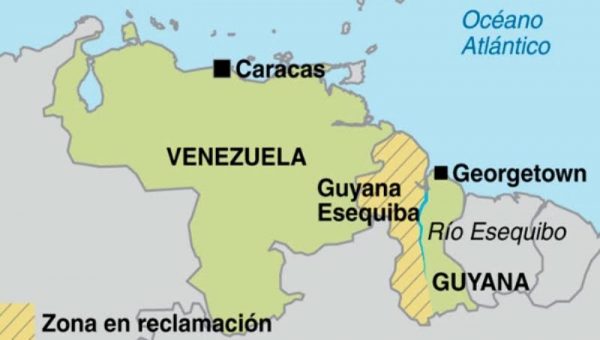
An old territorial dispute in South America is reaching its most tense point in decades. The territory known as Essequibo has been mutually claimed by Guyana and Venezuela since the 19th century when Guyana still belonged to the United Kingdom. In 1897, the Venezuelan and British authorities agreed to submit their dispute to an arbitrary international court in Paris, which ruled that the land belonged to the UK. For decades, the arbitration decision was accepted by Caracas, but in 1948 Venezuelan authorities revealed some irregularities in the trial, which were documented in old government files. As a result, the decision was considered null, and years later, in 1963, Venezuela formally submitted its territorial claim to the United Nations, and the dispute remains unresolved till today, when the interests of foreign oil companies threaten to increase the tensions.
As a region rich in oil, Essequibo has recently entered the map of the large multinationals in this sector, especially the American Exxon Mobil. More than that, the economic sanctions imposed on Venezuela and the political alignment of Guyana with Washington contribute to create an even more controversial scenario. Guyana has the support of the large private oil sector and the American government, while Venezuela remains alone. Last year, the case was filed with the International Court of Justice, but Venezuela did not accept it and remained out of the trial.
However, in a sentence on December 18, 2020, the Court proclaimed its competence to intervene in the dispute, despite Venezuela’s position. It is necessary to highlight that, regardless of any decision taken by the Court over who really has sovereignty in Essequibo, this sentence must be considered null, since the absence of Venezuelan consent prevents the execution of the sentence. The need for consent is one of the most elementary principles of international law and the very fact that the Court declares itself competent already leads us to question whether its judges are really impartial – clearly, the norms of international law are being violated in favor of Guyana.
Guyana has publicly admitted that its expenses for the court case in The Hague were paid by Exxon Mobil. Although the American oil company has been operating in Guyana for decades, its interest has been greatly increased with the recent discoveries of oil reserves and investors are willing to do anything to ensure the exploration of local natural resources. Currently, Exxon Mobil is interested in expanding its facilities over an area of more than 26,000 square kilometers, which not only crosses the disputed territory in Essequibo, but also violates Venezuelan undisputed national territory.
With this scenario of clear attack on Venezuelan national sovereignty and possible collaboration of the International Court with one of the parties, Venezuela is at a disadvantage mainly due to its diplomatic weakness. Venezuela, at this point, lacks sufficient influence to cause the Court to review its decision or judge the case in a really partial way. For that, only strong international alliances can help Caracas. The large nations that are not aligned with Washington and have so far cooperated strongly with Venezuela, Russia and China, might be provoked by the Venezuelan government to incite international pressure in this regard. Only these two countries can mediate a parallel agreement that may be established between Caracas and The Hague in order to choose between two paths: either Venezuela agrees to submit to trial on the condition that there is a partial judgment and without the influence of private companies, or the Court declines jurisdiction. As the first scenario is unlikely and difficult to monitor, the most viable route would be for The Hague to abdicate any form of judgment.
It is important to mention that, in the absence of international judgment, what is in force in Essequibo is the Geneva Agreement of 1966, which did not decide on sovereignty in the region, but, in search of a peaceful solution, defined what activities would be allowed or prohibited in Essequibo. Oil exploration by foreign companies is not allowed, so, in principle, Guyana is violating the agreement and its activities could only become lawful if there was a decision by the International Court on the matter, allowing exploration. As Venezuela does not submit to the Court, the trial is impossible and, therefore, exploration remains prohibited and Guyana is committing an international offense.
However, more worrying than that is the fact that the American military is working in Essequibo, carrying out tests with the aim of intimidating Venezuela and pressuring Caracas to renounce its demands. There are American military ships in Essequibo “protecting” Exxon Mobil facilities and provoking Caracas. In addition, considering that the American company wants to publicly explore areas within Venezuelan territory, what will become of the American presence? If Caracas does not allow the activities of Exxon Mobil, it is the Venezuelan right to control or even destroy the facilities in its territory. And what would be the American reaction to that – considering Biden’s aggressive interventionist policy?
It is for these reasons that, more than ever, countries of greater international relevance must mediate the issue in order to maintain the status of illegality to the Exxon Mobil’s activities. With international pressure, it is possible that the American company will retreat or that at least the American military in the region will leave and with that we would have a reduction in tensions.
Still, it is possible that with international mediation a mutual exploration agreement will be reached that allows both countries to enjoy the local wealth, without, however, allowing companies that violate the Geneva Agreement to operate.
Lucas Leiroz is a research fellow in international law at the Federal University of Rio de Janeiro.
Bolivia’s Central Bank Returns Añez’s Requested Loan To IMF
teleSUR | February 17, 2021
Bolivia’s Central Bank announced on Wednesday that it had returned US$346.7 million to the International Monetary Fund (IMF), a loan irregularly managed by the de facto government of Jeanine Añez.
“This loan, in addition to being irregular and onerous due to its financial conditions, generated additional and millionaire economic costs to the Bolivian State, which as of February 2021 amount to US$24.3 million of which US$19.6 million are due to exchange rate fluctuations 19.6 million for exchange variation and 4.7 million for commissions and interest,” the institution explained in a statement.
The Central Bank denounced that the IMF jeopardized the “country’s sovereignty and economic interests” through its Rapid Financing Instrument (RFI), which conditioned the funds to fiscal, financial, exchange rate monetary duties, which violate the Bolivian legal framework.
Moreover, authorities explain that they would start an investigation to prosecute all officials involved in the IMF’s illegal arrangement.
Argentina Denounces Presence of US Submarine

teleSUR | February 13, 2021
The Argentine Foreign Ministry, through an official statement published on its website expressed Friday its “serious concern” about the presence in the South Atlantic of the U.S. nuclear submarine USS Greeneville.
“The Argentine government expresses its serious concern over information that emerged from the official Twitter account of the Commander, Submarine Force Atlantic, by which it is pointed out that they would have recently operated with British support in the South Atlantic,” the Foreign Ministry expresses.
The statement also recalls that “carrying and using nuclear weapons” in the mentioned area contradicts resolutions of the United Nations Organization and urged to respect the region as a “zone of peace and cooperation.”
“The presence of ships capable of carrying and using nuclear weapons in the South Atlantic contradicts Resolution 41/11 of the United Nations General Assembly (Zone of Peace and Cooperation in the South Atlantic),” the communiqué stresses.
The official document recalls that the aforementioned resolution “calls upon States of all other regions, especially militarily important States, to scrupulously respect the South Atlantic region as a zone of peace and cooperation.”
“It is not the first time that Argentina” denounces “the presence of a British military base in the Malvinas Islands”, which is contrary to “various United Nations resolutions such as 31/49, which calls on the Governments of Argentina and the United Kingdom of Great Britain and Northern Ireland to expedite negotiations on the sovereignty dispute.”
Featured Video
“Historic Russia”: The Land Putin Will Not Give Back
or go to
Aletho News Archives – Video-Images
Book Review
Why the War on Conspiracy Theories Is Bad Public Policy
By Kevin Barrett • Unz Review • February 1, 2019
 A Review of Conspiracy Theories and Other Dangerous Ideas by Cass Sunstein (based on an earlier paper co-authored with Adrian Vermeule); In Defense of Troublemakers: The Power of Dissent in Life and Business by Charlan Nemeth; and Conspiracy Theories and the People Who Believe Them, edited by Joseph E. Uscinski
On January 25 2018 YouTube unleashed the latest salvo in the war on conspiracy theories, saying “we’ll begin reducing recommendations of borderline content and content that could misinform users in harmful ways—such as videos promoting a phony miracle cure for a serious illness, claiming the earth is flat, or making blatantly false claims about historic events like 9/11.”
At first glance that sounds reasonable. Nobody wants YouTube or anyone else to recommend bad information. And almost everyone agrees that phony miracle cures, flat earthism, and blatantly false claims about 9/11 and other historical events are undesirable.
But if we stop and seriously consider those words, we notice a couple of problems. First, the word “recommend” is not just misleading but mendacious. YouTube obviously doesn’t really recommend anything. When it says it does, it is lying. … continue
Blog Roll
 Aletho News
- BRITAIN’S WARNING: PREPARE FOR WAR
- “Historic Russia”: The Land Putin Will Not Give Back
- How the Cambridge Analytica scandal still haunts Mark Zuckerberg
- The Ongoing Cancellation Campaign Against a Dissenting Academic in Norway
- Yemen and ‘the Houthis’: Challenging Sami Hamdi’s Narrative
- No, Christians did not invent Zionism
- AIPAC-led lobbying network opens branches in Cypriot, Greek parliaments
- Araghchi blasts ‘parasitic’ alliance as US taxpayers pay for Israel’s war on Iran
- Easy fix for Europe’s chaos? Stop fueling war against Russia
- Putin’s key remarks on peace talks and Europe’s ‘schizophrenia’
- If Americans Knew
- Damning report shows the media must confront its failures on Gaza
- BBC senior broadcaster speaks out on Gaza coverage
- Netanyahu vows vast West Bank invasion in response to 20-minute skirmish that left 2 Israeli soldiers and 2 Palestinian fighters dead
- Tied up and tortured: Israel using US-made electroshock weapons on Palestinian detainees
- The outsourced risk: how newsrooms rely on Gaza’s freelancers without protecting them
- Gaza bakeries forced to shut as Israel blocks flour shipments
- Gaza’s breast cancer patients face a deadly wait for treatment amid Israel’s genocide
- DAILY UPDATE: Latest essential news on Palestine, Israel, & region
- The Israel Lobby’s Changing Fortunes
- AIPAC has become such a political liability that it’s shifting to a more “nimble” approach to buying politicians
- No Tricks Zone
- Two New Studies Find Thwaites Glacier Melt Cannot Be Driven By Human Activity Or A Warming Ocean
- E-Cars Reduce CO2 Emissions By Only 41% Compared To Internal Combustion Engine Vehicles
- Predictions Made By Renowned Climate Professor Over Past Decades Have Been Proven To Be Poor
- New Study Suggests Large Regions Of The Pacific Ocean Have Been Cooling For The Last 80 Years
- Germany’s Green Energy Debacle: High Energy Costs Force Kahla Porzellan to Close After 182 Years!
- New Study: 50 Years Of The Most Aggressive ‘Net Zero’ Policies Can Only Affect The Global Climate By 0.03°C
- US September “Heat” Was No Record…Many Records Set Decades Ago
- Latest European Green Energy Debacle; Portugal’s Largest Flagship Solar Park Insolvent!
- Green Energy Debacle: German Expert Professor Fritz Vahrenholt Warns Of Severe Economic And Social Consequences
- Two More Paleo Reconstructions Affirm Meters-Higher Sea Levels Across Ireland, Brazil 7000-6000 Years Ago

