Iran surges in Venezuela in defiance of US sanctions
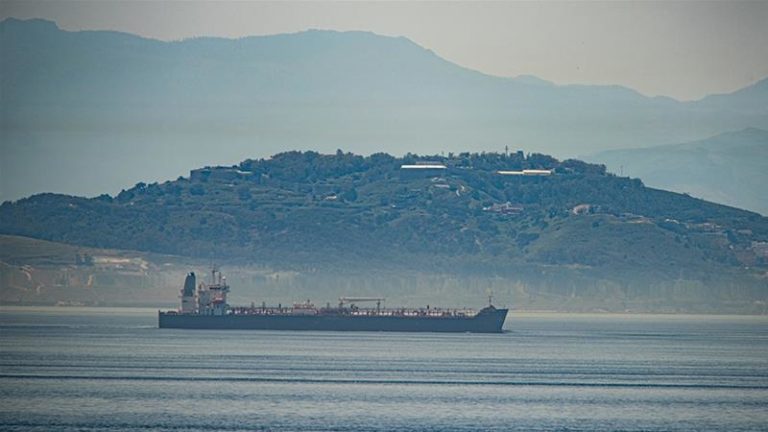
Iranian oil tanker Clavel crossing the Gibraltar stretch heading for Venezuela, May 20, 2020
By M. K. BHADRAKUMAR | Indian Punchline | May 25, 2020
Escorted by the Venezuelan navy and air force, an Iranian oil tanker named Fortune has entered that country’s waters on Sunday, amidst intense speculation whether the US would interfere with the delivery. The US has imposed oil sanctions against Venezuela and Iran and had said it is monitoring the Iranian tanker.
In fact, five Iranian tankers carrying about 1.5m barrels of fuel passed through the Suez Canal earlier this month, according to shipping data on Refinitiv Eikon, and were heading for Venezuela. The other four Iranian tankers — Forest, Petunia, Faxon and Clavel — are approaching the Caribbean en route to Venezuela.
A flotilla of US Navy and Coast Guard vessels is patrolling the Caribbean Sea on a mission to counter illicit drug trafficking. But the Pentagon has stated that there are no plans to stop the Iranian tankers.
At the same time, a Pentagon spokesman, Jonathan Hoffman, while saying on Thursday he was not aware of any operations related to the Iranian cargoes, also added, “We have continued to say that Iran and Venezuela – both two outliers in the international order – [are] clearly violating international sanctions on both nations with this transaction.”
The US sanctions on Venezuela are aimed at increasing pressure on President Maduro to step down. Thus, arguably, Iran is frontally challenging the Trump administration’s stated policy of ‘regime change’ in Venezuela. The Iranian move comes just three weeks after the abortive coup attempt masterminded by the White House on May 1 with the participation of two former US Green Berets aimed at capturing Maduro and transport him to the US in American helicopters to be put on trial on fake drug trafficking charges.
The coup attempt showed the extent of desperation in Washington to overthrow the Maduro government before the US presidential election in November, which President Trump hopes would help him garner Hispanic votes. Iran has now offered a lifeline to Venezuela.
In an historical context, this becomes a frontal assault by Iran on the Monroe Doctrine dating back to the 19th century, which in US foreign policy calculus regarded the Western Hemisphere as its sphere of influence. According to a Reuters report, the Trump administration said earlier this month it was “considering measures” it could take in response to the Iranian shipments, without providing specifics.
No doubt, this is a deliberate sanctions-busting enterprise by Iran. Venezuela desperately needs fuel for up to 1,800 gasoline stations that have been partially closed for weeks due to insufficient supply from state-run refineries.
Venezuela’s gasoline output is now limited to a single facility, the Amuay refinery, but most fuel produced is low octane as most of the country’s alkylation units are out of service. Imported alkylate could improve the quality of domestic gasoline. Venezuela’s refineries are in poor condition. Shipments of equipment in flights by Iran’s Mahan Air have arrived in Venezuela in recent weeks to start repair work.
It will be interesting to see whether the US Navy would interdict any of the other four Iranian tankers before they enter Venezuelan waters. Tehran has sternly warned the US that it would retaliate if any such attempt is made. On Saturday, Tehran raised the ante with President Hassan Rouhani explicitly warning, “If our oil tankers in the Caribbean Sea or anywhere else in the world get into trouble caused by the Americans, they (US) will run into trouble reciprocally.”
Washington is well aware of Iran’s capability to create big problems for the US Navy deployed in the Persian Gulf, especially the Strait of Hormuz. Last week, in a precautionary step, US Navy, via the Maritime Safety Office run by the National Geospatial-Intelligence Agency, alerted all international maritime traffic to maintain a safe distance of at least 100 meters from US naval vessels in international waters and straits. Pentagon officials separately confirmed that the stay-away warning to marine traffic in the Persian Gulf, the Arabian Sea and the Gulf of Oman was actually intended for Iran.
In geopolitical terms, Iran’s strategic defiance of the US in the Western Hemisphere makes an interesting case study not only of the decline in American influence in its backyard to the south but the entire efficacy of the “sphere of influence” concept in contemporary world politics. This is one thing.
More importantly, in the backdrop of the Iranian tanker reaching Venezuela, Caracas has described Iran as a “revolutionary partner” in the struggle against US imperialism. From the Iranian viewpoint, Venezuela becomes a part of the “axis of resistance” against the US. To be sure, the audacity of the two countries will irritate Washington to no end.
How far the Iran-Venezuela axis will deepen and expand will bear watch. Importantly, the UN Security Council embargo against Iran exporting arms to other countries is expiring in October. The US move to extend the timeline of the embargo is unlikely to succeed, given the strong negative reaction by Russia and China. It is entirely conceivable that a matrix of military cooperation may commence in a near future involving Iran and Venezuela.
Iran’s indigenously developed missile capability acts as a deterrent against US aggression. Iran has transferred missile technology to Hezbollah, which is estimated to have the capability today to inflict significant damage to Israel in the event of any aggression by the latter on Lebanon. Significantly, the deterrence is working and Israel no longer stages attacks on Lebanon.
A similar shift in the strategic balance with Iran’s help can create more space for Venezuela to push back at the US. All in all, Iran appears to be working on a strategy to help Venezuela to maintain its strategic autonomy. There is enormous potential for cooperation and coordination between Iran and Venezuela. If Venezuela has the largest known oil reserves in the world, Iran too has massive reserves of oil and gas.
The despatch of oil to lubricate the beleaguered Venezuelan economy may prove to be the harbinger of an assertive Iranian power projection elsewhere in Latin America too. Surely, in the near term, it is a rebuff to the Trump administration’s maximum pressure strategy against Iran. In a longer-term perspective, a concerted regional strategy in Latin America by Russia, China and Iran can seriously erode the US influence in the continent.
Will Trump Really Start Two Wars Instead of “Just” One?
The Saker | Unz Review | May 20, 2020
Amidst the worldwide pandemic induced scare most of us have probably lost track of all the other potential dangers which still threaten international peace and stability. Allow me to list just a few headlines which, I strongly believe, deserve much more attention than what they got so far. Here we go:
- Military Times : “5 Iran tankers sailing to Venezuela amid US pressure tactics“
- Time : “5 Iranian Tankers Head to Venezuela Amid Heightened Tensions Between U.S. and Tehran“
- FoxNews: “Iran tankers sailing to Venezuela in effort to undermine US sanctions“
Notice that Military Times speaks of “US pressure tactics”, Time of “tensions” and FoxNews of “efforts to undermine US sanctions”?
I don’t think that this is a coincidence. Folks in the US military are much more in touch with reality than the flag-waving prostitutes which some people call “reporters” or “journalists”.
Furthermore, the US has embarked on a new policy to justify its acts of piracy on the high seas with something called Visit, Board, Search and Seizure (VBSS) all under the pretext of the war on drugs. To get a better understanding of the context of these developments I asked a specialist of Maritime issues of our community, NatSouth, who replied the following: (stress added)
If a ship does not comply with the request to be boarded, it is usual that the pursuing authorities must gain the permission of the ‘flag’ state prior to boarding, on the high seas and the pursuit has to have started in the coastal state’s jurisdictional waters. The caveat here is that in the Caribbean – Caribbean Regional Maritime Agreement (CRA) – (long name: Agreement Concerning Co-operation in Suppressing Illicit Maritime and Air Trafficking in Narcotic Drugs and Psychotropic Substances in the Caribbean Area). So, there is an agreement with participating coastal states on boardings and pursuits in EEZs and the like. You can find more on the legal aspects of boardings at sea here: and more info on so-called “consensual boardings” here.
The anti-drug/ counterterrorism angle allows the U.S. Navy and the USCG to carry out interdictions on the high seas. Important point to note whether this approach will be taken to interdict the tankers, given that Venezuela is a declared narco-State. The absurdity is that Venezuela isn’t the primary transit point in the region, Colombia holds that honour.
If I could add at this point, the origins are that Venezuela didn’t wish to play ball with Washington anymore, specifically with the DEA back in 2005, squaring the circle of sorts, (or should that be a vicious circle cunningly used by Washington, because who is going to argue with that narrative, aka the war on terror). March: SOUTHCOM’s Adm. Faller: “There will be an increase in US military presence in the hemisphere later this year. This will include an enhanced presence of ships, aircraft, & security forces to reassure our partners… & counter a range of threats to include illicit narco-terrorism.” At the same time, the State dept released this tweet, so the US could effectively carry out boardings under the guise of counterterrorism as well.
While the Iranian tankers were in the Mediterranean, Washington released a (delayed) “Global Maritime Sanctions Advisory”, to the maritime industry, setting out guidelines to shipowners and insurers to enable them to avoid the risks of sanctions penalties related to North Korea, Syria and Iran. This also concerns oil exports from Iran, (but doesn’t apply to Iranian flagged ships). This came after the State Dept gave warning notice to oil companies to stop operations, including Rosneft (Russia), Reliance (India) and Repsol (Spain).
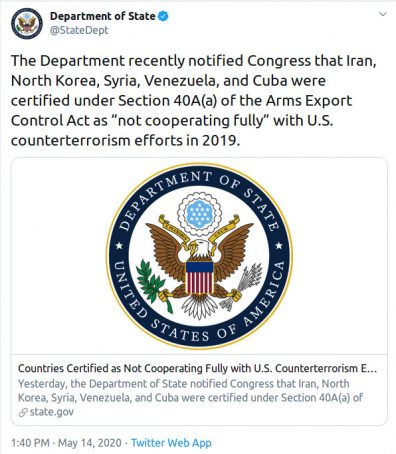
Then NatSouth concluded the following:
Under international law, every merchant ship must be registered with a flag state, which has jurisdiction over the vessel. Hence, this time, the use of Iranian-flagged tankers, as a direct response from Washington’s latest version of restating “maximum pressure” campaign on enforcement of Iran and Venezuela sanctions, (back in Feb, literally the same language as in Aug 2019). There was talk back then of a naval embargo, which would a serious notch up in tensions. There was mention of the 4 U.S. warships in the Caribbean, the U.S. Navy tweeted about, but one the Preble went through the Panama Canal into the Pacific).
Pretty clear, isn’t it?
What the US is doing is substituting itself for the United Nations and it is now openly claiming the right to board any vessel under whatever kind of pious pretext like, say, narco-trafficing, nuclear proliferation, sanctions against so-called “rogue states”, etc. Clearly, the AngloZionists expect everybody to roll over and take it.
How likely is that?
Let’s look at a few Iranian headlines, all from PressTV:
- PressTV, May 16th: “Iran’s fuel shipment to Venezuela guaranteed by its missile power“
- PressTV, May 17th: “US aware Iran will respond ‘very strongly’ if Venezuela-bound ships attacked: Analyst“
- PressTV, May 18th: “Iran: US bears responsibility for any foolish act against tankers heading to Venezuela“
Three days in a row. I think that it is fair to assume that the Iranians are trying very hard to convince Uncle Shmuel not to mess with these tankers. Does anybody seriously believe that the Iranians are bluffing?
Before we look at some of the aspects of this potential crisis, let’s just mention a few things here.
First, the US is acting in total and official illegality. Just like the bombing of Syria, the threats to Iran, or the US murderous sanctions Uncle Shmuel imposes left and right – the blockade of Venezuela is a) totally illegal and b) an act of war under international law.
Second, if USN commanders think they can operate with impunity only because the Caribbean is far away from Iran, they are kidding themselves. Yes, Iranian forces cannot defend these tankers so far away from home, nor can they take any action against the USN in the Atlantic-Caribbean theater of naval operations. But what they can and will do is retaliate against any AngloZionist target in the Middle-East, including any oil/gas tanker.
Third, while Venezuela’s military is tiny and weak compared to the immensely expensive and bloated US military, being immensely expensive and bloated is no guarantee of success. In fact, and depending on how the Venezuelan leadership perceives its options, there could be some very real risk for the USA in any attempt to interfere with the free passage of these ships.
What do I mean by that?
Did you know that Venezuela had four squadrons of Su-30MKV for a total of 22 aircraft? Did you know that Venezuela also had an unknown number of Kh-31A supersonic anti-shipping missiles? And did you know that Venezuela had a number of S-300VM and 9K317M2 Buk-M2E long range and medium range SAMs?
True, that is nowhere near the amount of weapons systems Venezuela would need to withstand a determined US attack, but it is more than enough to create some real headaches for US planners. Do you remember what the Argentinian Air Force did to the British Navy during the Malvinas war? Not only did the Argentinians sink two Type 42 guided missile destroyers (the HMS Sheffield and the HMS Coventry) which were providing long-range radar and medium-high altitude missile picket for the British carriers, they also destroyed 2 frigates, 1 landing ship, 1 landing craft, 1 container ship. Frankly, considering how poorly defended the British carriers were, it is only luck which saved them from destruction (that, and the lack of sufficient number of Super Étendard strike aircraft and Exocet missiles). I would add here that the British military, having been defeated on many occasions, has learned the painful lessons of their past defeats and does not suffer from the cocky-sure attitude of the US military. As a result, they were very careful during the war against Argentina and that caution was one of the factors which gave a Britain well-deserved the victory (I mean that in military terms only; in moral terms this was just another imperialist war with all the evil that entails). Had the Argentinians had a modern air force and enough anti-shipping missiles, the war could have taken a very different turn.
Returning to the topic of Venezuela, war is a much more complex phenomenon than just a struggle of military forces. In fact, I strongly believe that political factors will remain the single most important determinant factor of most wars, even in the 21st century. And chances are that the Venezuelans, being the militarily weaker side, will look to political factors to prevail. Here is one possible scenario among many other possible ones:
Caracas decides that the US seizing/attacking the Iranian tankers constitutes an existential threat to Venezuela because if that action goes unchallenged, then the US will totally “strangle” Venezuela. Of course, the Venezuelan military cannot take on the immense US military, but what they could do is force a US intervention, say by attacking one/several USN vessel(s). Such an attack, if even only partially successful, would force the US to retaliate, bringing US forces closer not only to Venezuelan air defenses, but also closer to the Venezuelan people which will see any US retaliation as an illegitimate counter-counter-attack following the fully legitimate Venezuelan counter-attack.
Then there is the problem of defining victory. In the US political “culture” winning is usually defined as pressing a few buttons to fire off some standoff weapons, kill lots of civilians, and then declare that the “indispensable nation” has “kicked the other guy’s ass”. The problem with that is the following one: if they other guy is very visibly weaker and has no chance for a military victory of his own, then the best option for him is to declare that “surviving is winning” – meaning that if Maduro stays in power, then Venezuela as won. How would the USA cope with that kind of narrative? Keep in mind that Caracas is a city of over two million people which even in peacetime is rather dangerous (courtesy of both regular crime and potential guerilla activities). Yet, for Maduro to “win” all he has to show is that he controls Caracas. Keep in mind that even if the US forces succeed in creating some kind of “zone of real democracy” somewhere near the Colombian border, that will mean nothing to Maduro, especially considering the terrain between the border and the capital city (please check out this very high resolution map of Venezuela or this medium resolution one). As for the notion of a USN landing on the shores of Venezuela, all we need to do is to remember how the immense Hodgepodge of units which were tasked with invading Grenada (including 2 Ranger Battalions, Navy Seals, most of an Airborne Division, etc. for a total of over 7,000 soldiers(!) against a tiny nation which never expected to be invaded (for details, and a good laugh, see here for a full list of participating US forces!) was defeated by the waves of the Caribbean and the few Cuban military engineers who resisted with small-arms fire (eventually, most of the 82AB was calling in to fix this mess).
In other words, if Maduro remains in power in Caracas then, in political terms, Venezuela wins even though it would loose in purely military terms.
This phenomenon is hardly something new, as shown by the following famous quote by Ho Chi Minh: “You can kill ten of my men for every one I kill of yours. But even at those odds, you will lose and I will win.”
By the way, this is exactly the same problem the Empire faces with Iran: as long as the Islamic Republic remains an Islamic Republic it “wins” in any exchange of strikes with the USA and/or Israel.
Still, it is pretty obvious that the US can turn much of Venezuela into a smoking heap of ruins. That is true (just like what the USA did to Korea, Vietnam, Iraq or Serbia and Israel what did to Lebanon in 2006). But that would hardly constitute a “victory” in any imaginable sense of the word. Again, in theory, the US might be able to secure a number of landing locations and then send in an intervention force which could try to take key locations in Caracas. But what would happen after that? Not only would the hardcore Chavistas trigger a guerilla insurrection which would be impossible to crush (when is the last time the USA prevailed in a counter-insurgency war?), but many Venezuelans would expect the US to pay for reconstruction (and they would be right, according to the rules of international law, “once you take it, you own it” meaning that the USA would become responsible for the socio-economic situation of the country). Finally, there is always the option of an anti-leadership “decapitating” strike of some kind. I believe that in purely military terms, the US has the know-how and resources to accomplish this. I do not believe that this option would secure anything for the USA, instead – it would further destabilize the situation and would trigger some kind of reaction by the Venezuelan military both outside and inside Venezuela. If anything, the repeated failures of the various coup attempts against Chavez and Maduro prove that the the bulk of the military remains firmly behind the Chavistas (and the failed coup only served to unmask the traitors and replace them anyway!).
The bottom line is this: if Uncle Shmuel decides to seize/attack the Iranian tankers, there is not only a quasi certitude of a war between the US and Iran (or, at the very least, an exchange of strikes), but there is also a non-trivial possibility that Maduro and his government might actually decide to provoke the USA into a war they really can’t win.
Is Trump capable of starting a process which will result in not one, but two wars?
You betcha he is! A guy who thinks in categories like “my button is bigger than yours” or “super-dooper weapons” obviously understands exactly *nothing* about warfare, while the climate of messianic narcissism prevailing among the US ruling classes gives them a sense of total impunity.
Let’s hope that cooler heads, possibly in the military, will prevail. The last thing the world needs today is another needless war of choice, never mind two more.
Ottawa’s ties with far right Colombian president undermines human rights rhetoric regarding Venezuela

By Yves Engler · May 13, 2020
A week ago a former Canadian soldier instigated a harebrained bid to kidnap or kill Venezuelan President Nicolás Maduro. Launched from Colombia, the plot failed spectacularly with most of the men captured or killed.
Still, the leader of the invasion Jordan Goudreau, a veteran of the Canadian military and US special forces, has been remarkably forthright about the involvement of opposition figure Juan Guaidó. A leaked contract between Guaidó’s representative in Florida and Goudreau’s Silvercorp USA describes plans for a multi month occupation force, which after ousting Maduro would “convert to a National Asset Unit that will act under the direction of the [Guaidó] Administration to counter threats to government stability, terror threats and work closely” with other armed forces. Apparently, Goudreau was hoping for a big payday from Venezuela’s opposition. He also had his eyes on the $15 million bounty Washington put up in March for Maduro’s capture as well as tens of millions dollars for other members of the government.
As the plot has unraveled, Ottawa has refused to directly criticize the invasion launched from Colombia. The military has also refused to release information regarding Goudreau’s time in the Canadian forces. What’s more, since the plot began Canada’s foreign affairs minister has reached out to regional opponents of Maduro and reasserted Ottawa’s backing for Guaidó. The PM also discussed Venezuela with his Colombian counterpart.
The Trudeau government’s reaction to recent events suggest the global pandemic has not deterred them from brazenly seeking to overthrow Venezuela’s government. In a bid to elicit “regime change”, over the past couple years Ottawa has worked to isolate Caracas, imposed illegal sanctions, took that government to the International Criminal Court, financed an often-unsavoury opposition and decided a marginal opposition politician was the legitimate president.
The day after the first phase of the invasion was foiled foreign minister François-Philippe Champagne spoke to his Colombian, Peruvian and Brazilian counterparts concerning the “Venezuela crisis and the humanitarian needs of Venezuelans.” Four days later Champagne tweeted, “great call with Venezuela Interim President Juan Guaidó. Canada will always stand with the people of Venezuela in their desire to restore democracy and human rights in their country.”
On Monday Prime Minister Justin Trudeau spoke with Colombian President Iván Duque Márque. According to the official release, they “discussed the crisis in Venezuela and its humanitarian impact in the region which is heightened by the pandemic. They underscored the need for continued close collaboration and a concerted international effort to address this challenging situation.” Over the past 18 months Trudeau has repeatedly discussed Venezuela with a Colombian president who has offered up his country to armed opponents of Maduro.
The Trudeau government has been chummy with Duque more generally. After he won a close election marred by fraud allegations then Foreign Minister Chrystia Freeland “congratulated” Duque and said, “Canada and Colombia share a commitment to democracy and human rights.” In August 2018 Trudeau tweeted, “today, Colombia’s new President, Ivan Duque, took office and joins Swedish PM, Norway PM, Emmanuel Macron, Pedro Sánchez, and others with a gender-equal cabinet. Iván, I look forward to working with you and your entire team.” A month later he added, “thanks to President Ivan Duque for a great first meeting at UNGA this afternoon, focused on growing our economies, addressing the crisis in Venezuela, and strengthening the friendship between Canada & Colombia.”
But, Duque is from the extreme right — “le champion du retour de la droite dure en Colombie”, according to a Le Soleil headline. The Colombian president has undercut the peace accord the previous (right, but not far right) government signed with the Revolutionary Armed Forces of Colombia (FARC) to end Colombia’s 50-year civil war, which left some 220,000 dead. Duque’s policies have increased violence towards the ex-rebels and social activists. Seventy-seven former FARC members were killed in 2019. Even more human rights defenders were murdered. The United Nations High Commissioner for Human Rights found that at least 107 Colombian, mostly Indigenous, rights defenders were killed in 2019.
Through the first part of this year the pace at which social leaders and demobilized FARC members have been killed has increased. According to the UN observer mission in Colombia, 24 demobilized guerrillas have already been assassinated and a recent Patriotic March report on the “The other pandemic lived in Colombia” details 95 social leaders, human rights defenders and former guerrillas killed in the first four months of 2020.
Trudeau’s dalliance with Duque is difficult to align with his stated concern for human rights in Venezuela.
The same can be said for Ottawa’s failure to condemn the recent invasion attempt. The Trudeau government should be questioned on whether it was involved or had foreknowledge of the recent plot to invade Venezuela.
A Cautionary Tale About the WHO

By Larry Romanoff | Moon of Shanghai | May 10, 2020
There appears to be no shortage of claims from multiple informed and independent sources that the WHO has two primary functions, the first as a tool for world population reduction on behalf of its masters, and the second as a powerful marketing agent for big pharma, specifically the vaccine manufacturers. Many critics have pointed out that the ‘vaccination experts’ at the WHO are “dominated by the vaccine makers standing to gain from the enormously lucrative vaccine and antiviral contracts awarded by governments.” And indeed, the advisory and other committees involved with the WHO’s vaccine programs seem heavily populated with those who profit directly from those same programs.
Equally, the claims and concerns about population control and reduction are far from conspiracy theories today, with far too much evidence, some of it frightening, that this is indeed a major agenda of the WHO today. We have already seen too much hard evidence of this body’s involvement in both areas to justify dismissing the concerns as implausible fears. Moreover, there is a disturbing list of individuals closely associated with the WHO, who have had either population reduction or mass vaccinations as a pet project; individuals like David Rothschild, David Rockefeller, George Soros, Donald Rumsfeld, Bill Gates, and many more, the list including national organisations like the CDC, FEMA, the US Department of Homeland Security, the Rockefeller and Carnegie Institutes, the CFR, and others.
It is not difficult, on the basis of all the evidence, to conclude the WHO is an international criminal enterprise under the control of a core group, one with European corporate dynasties at its center which, as one writer noted, “provides the strategic leadership and funds the development, manufacturing and release of synthetic, man-made viruses solely to justify immensely profitable mass vaccinations”. We have seen so many instances of an unusual and apparently laboratory-made virus appearing without warning, the onset followed immediately by urgent worried pronouncements from the WHO of yet another mandatory mass vaccination.
We have the rampant production of deadly viruses in secretive labs around the world, and the repeated “accidental” release of those into various populations (think ZIKA) – seemingly inevitably without explanation, apology or even a semblance of actual investigation, much less censure or criminal or civil charges. We also have the blanket legal immunity for all pharma companies in their creation and dissemination of deadly pathogens by vaccination. When we add into this mix the WHO’s history of criminality as with their now-famous tetanus/hCG international sterility program, the curious timing of the onset of AIDS, and the many occurrences of the WHO’s vaccination programs perfectly coinciding with a sudden outbreak of yet another unusual disease in the same areas and populations, one would have to be a hard-core ideologue to not become damned suspicious.
WHO Vaccinations and Population Control
During the early 1990s, the WHO had been overseeing massive tetanus vaccination campaigns in Nicaragua, Mexico, the Philippines, Tanzania and Nigeria. All tell a similar story, one that almost beggars belief but with the facts too clear to refute. Tetanus is a disease whose onset we often associate with stepping on a rusty nail or some such event. It should be clear that men would be at least as likely, if not more likely, to encounter this circumstance than would women, and perhaps careless children more than adults, but the WHO vaccination program was directed only to females from 15 to 45 years of age – in other words, child-bearing ages. In Nicaragua, the targets were females from 12 to 49 years of age.
Also, a single tetanus shot is universally accepted as sufficient to provide protective duration of ten years or more, but the WHO inexplicably insisted on vaccinating these women five times within several months. Shortly after the initiation of these programs, concerns began to emerge about spontaneous abortions and other complications arising exclusively within the vaccinated populations. On suspicion, a group in Mexico had the vaccination serum analysed and discovered it contained the Human chorionic gonadotrophin (hCG) hormone. This hormone is critical to the female body during pregnancy. It causes the release of other hormones that prepare the uterine lining for the implantation of the fertilised egg. Without it, a woman’s body is unable to sustain a pregnancy and the fetus will be aborted. This hormone was injected into the subjects along with the tetanus serum, causing a female body to then recognise both as foreign agents and to develop antibodies to destroy either if they were to ever appear in the body in the future.
Upon becoming pregnant, a woman’s body would fail to recognize hCG as a friend and would produce anti-hCG antibodies, the prior vaccination now inducing her body’s immune system to attack the hormone that is needed to bring an unborn child to term, preventing subsequent pregnancies by killing the hCG which is necessary to sustain them. This means each woman who received the WHO inoculation was vaccinated not only against tetanus but also against pregnancy. (1) (2)
The WHO at first denied the facts and disparaged the results of the initial tests, but following this revelation each nation conducted extensive tests and in all cases the hCG hormone was identified as existing in the tetanus vaccination serum. The WHO eventually went silent and discontinued their program but by this time many millions of women had been vaccinated – and rendered sterile. One important fact is that the three different brands of tetanus vaccine being used in this project were developed, produced, and distributed in secrecy and that none had ever been tested or licensed for sale or distribution anywhere in the world. The companies that produced them were Connaught Laboratories and Intervex from Canada, and Australia’s CSL Laboratories. Connaught is the same firm that, along with the Canadian Red Cross, knowingly distributed AIDS-contaminated blood products for several years during the 1980s, a criminal organisation that should have been executed along with its owners. (3)
Further damning evidence that the Western media censored, was the fact that the WHO had been actively involved for more than 20 years prior in the development of an anti-fertility vaccine utilizing hCG tied to tetanus toxoid as a carrier – precisely the same combination as in these vaccines. According to the WHO’s own reports, they had spent nearly $400 million on this kind of “reproductive health” research. More than 20 research articles have been written on this subject, many of these by the WHO itself, that document in detail the WHO’s attempts to create an anti-fertility vaccine utilizing tetanus toxoid. And they aren’t alone; the UNFPA, the UNDP, the World Bank and of course – whenever we encounter secret efforts at population control – the ubiquitous Rockefeller Foundation, are all allied in this cause, as was the US National Institute of Health. The Government of Norway was also a partner in this travesty, contributing more than $40 million to develop this Tetanus-abortion vaccine.
The Bill & Melinda Gates Foundation has been heavily funding the distribution of tetanus vaccine in Africa by UNICEF, which is the agency that provided Kenya with the vaccine laced with hCG. Gates said: “The world today has 6.8 billion people. That’s heading up to about nine billion. Now if we do a really great job on new vaccines, health care, reproductive health services, we could lower that by perhaps ten or fifteen percent.” (4) The Rockefeller Foundation also heavily funded this vaccine research and distribution. (5) All this amounts to genocide on a planetary scale.
I examined in detail the WHO website and discovered there were dozens of articles, many written by WHO researchers, documenting in detail the WHO’s attempts to create an anti-fertility vaccine utilizing tetanus toxoid as a carrier. (6) Some leading articles included:
- “Clinical profile and Toxicology Studies on Four Women Immunized with Pr-B-hCG-TT,” Contraception, February, 1976, pp. 253-268.
- “Observations on the antigenicity and clinical effects of a candidate antipregnancy vaccine: B-subunit of human chorionic gonadotropin linked to tetanus toxoid,” Fertility and Sterility, October 1980, pp. 328-335.
- “Phase 1 Clinical Trials of a World Health Organisation Birth Control Vaccine,” The Lancet, 11 June 1988, pp. 1295-1298. “Vaccines for Fertility Regulation,” Chapter 11, pp. 177-198, Research in Human Reproduction, Biennial Report (1986-1987), WHO Special Programme of Research, Development and Research Training in Human Reproduction (WHO, Geneva 1988).
- “Anti-hCG Vaccines are in Clinical Trials,” Scandinavian Journal of Immunology, Vol. 36, 1992, pp. 123-126.
As early as 1978, the WHO was actively exploring ways to eradicate much of the population of the Third World. A paper published by the WHO (7) was titled, “Evaluating … placental antigen vaccines for fertility regulation”; The paper acknowledged “substantial progress” in its worldwide eugenics program of culling non-whites, but yet identified “an urgent need for a greater variety of methods” of preventing fertility, and gushed over the fact that “immunisation as a prophylactic measure is now so widely accepted”, that the employment of sterilisation vaccines would be widely appealing (to those dispensing the vaccines) and would offer “great ease of delivery”.
If that isn’t clear, the WHO is saying that vaccinations for other purposes – protection against diseases – are so common and widely-accepted, inoculation is probably the easiest way to sterilise the populations of undeveloped countries. The paper then notes the accumulation of evidence that “there exist proteins specific to the reproductive system” which “could be blocked” by vaccinations and provide a new method of “fertility regulation”. Among the stated advantages of a sterilisation vaccine is that it could prevent or disrupt implantation of the fertilised egg onto the uterus wall, and thereby guarantee that every (non-white) conception would result in a miscarriage or spontaneous abortion, i.e., an anti-hCG vaccine. The paper continues:
“Testing … will reveal whether a single injection is sufficient to achieve the desired level of immunization, or whether several boosting injections will be required. The main desired effect is to achieve a degree of immunization sufficient to: (a) neutralize the hormonal activity of hCG in vivo; and (b) prevent or disrupt implantation at a very early stage of pregnancy. It is not yet established whether immunization with the β hCG peptide conjugate will cause an irreversible biological neutralization of hCG … This will probably vary from individual to individual. In the first case, the indication for immunization will be restricted to sterilization, whereas in the second eventuality … immunization may be considered as a long-lasting but reversible anti-fertility measure.”
On August 17-18, 1992, the WHO produced a report titled “Fertility Regulating Vaccines”, resulting from a large meeting in Geneva of scientists and ‘womens’ health advocates’ “to review the current status of the development of fertility regulating vaccines.” The meeting was from a joint Special Program of research in reproduction of the UNDP, UNFPA, the WHO and the World Bank. The report stated, “… applied research on FRV’s (fertility-regulating vaccines) has been going on for more than twenty years …”, and discussed not only the anti-hCG vaccines already receiving clinical trials, but the development of other vaccines such as an anti-GnRH vaccine that would extend the temporary infertility due to breast-feeding.
This vaccine was also being field-tested at the time, with the possible intention of employing both antigens in the same vaccine on the assumption that a single vaccine might not sterilise all victims. They also recognised the dangers of administering such a vaccine to women who were already pregnant, and expressed awareness the antibodies would almost certainly be present in the milk and might therefore render the infants permanently sterile as well – with the massive understatement that this “might not be acceptable to all potential users …” From the outset, WHO planners realised that during mass vaccinations, many pregnant women would also be inoculated with the anti-hCG serum, which would inevitably result not only in sterilisation, miscarriages and spontaneous abortions but also incurable autoimmune disorders and birth defects.
The same paper went on to state, “In addition to women being immunized inadvertently during an established pregnancy, fetuses could be exposed to potential teratological effects of immunization …”. In other words, WHO staff would freely inoculate pregnant women, those embryos or fetuses not spontaneously aborting would experience pathological growth from which would result various undefined birth defects. The WHO is not researching ‘reproductive health’, but reproductive impossibility, and their tetanus-hCG vaccine is not in any sense ‘regulating’ the fertility of women but rendering their fertility biologically impossible, which is not quite the same thing. Their own paper stated the vaccination likely “will cause an irreversible biological neutralization of hCG”, which means the permanent sterilisation of innocent women who agreed to receive tetanus shots.
Try to understand what this means: the WHO was for decades receiving hundreds of millions of dollars in funding for research and testing, to produce an antifertility vaccine that would make a woman’s immune system attack and destroy her own babies in the womb, a vaccine they would surreptitiously combine with a tetanus vaccination without informing the victims. To say their deceit was successful would be an understatement. The WHO inoculated more than 130 million women in 52 countries with this vaccine, permanently sterilising some very large percentage of them without their knowledge or consent. It was only when an enormous number of women in all countries experienced vaginal bleeding and miscarriages immediately after the vaccinations, that the hormone additive was discovered as the cause. Suspicions were aroused when the WHO selected only females of child-bearing age and further specified the unheard-of practice of five multiple injections over a three month period, but the health officials in these undeveloped countries still had faith in the white man’s medicine.
Upon the discovery of the hormone in the vaccine, Nigerian physicians reported WHO doctors telling them the hCG hormone “would have no effect on human reproduction”, statements they knew to be false. When this information reached the public, the WHO assumed an offensive and repugnant stand, mocking and ridiculing the nations that had performed the tests and revealed the contamination, condemning them as incompetent, having “unsuitable” testing laboratories, and using improper samples or procedures. WHO officials claimed these nations had “Not the right kind of lab to do the test. The labs know only how to test urine samples . . .” This is the standard response by Western agencies, governments, and corporations, when caught with adulterated products. When Coca-Cola’s drinks in China were found to contain frightening levels of pesticides and chlorine, the immediate accusation was that China’s biological laboratories were all incompetent. When Nestle’s noodles in India were found to contain dangerously toxic amounts of lead, India’s laboratories were all incompetent. The next step is to carefully produce a few samples known to be uncontaminated, provide them to an “independent” laboratory that inevitably pronounces them clean, then move the story off the front page.
When the discovery was made, many nations enacted immediate legal restraining orders against WHO and UNICEF vaccine programs. WHO and UNICEF officials said the “grave allegations” were “not backed up by evidence”, which was nonsense. UNICEF, USAID and the WHO refused to address the evidence like vaginal bleeding, miscarriages and spontaneous abortions. They also refused to discuss the reasons for a series of five closely-spaced vaccinations when one had always been sufficient, ignoring the content of their own published papers stating that multiple injections of a tetanus-hCG vaccine would be necessary for effective sterilisation.
When faced with documented results, WHO officials admitted the hormone did indeed exist “in small amounts” in “some” of the vaccine material, but that this was an inconsequential result of “accidental contamination”. Nobody at the WHO attempted to explain the source of the hCG hormone in sufficient volume to contaminate 130 million doses of a vaccine, nor how that “contamination” could “accidentally” have inserted itself into all those vaccines. The Lancet reported that the US National Institute of Health supplied much of the hCG hormone for WHO experiments and testing. The Western media were of course too busy at the time telling us how evil Iran was, to notice the small issue of 130 million women having been deliberately vaccinated against pregnancy, without their knowledge. As I’ve often mentioned elsewhere, the Western media are excessively fond of demonising Hitler, but Hitler didn’t sterilise 130 million women without their knowledge or consent, so where is the moral outrage against the WHO? The outrage is buried in the fact that none of those 130 million sterilised women were white.
The WHO went silent for a while, but in 2015, Vatican Radio charged that the UN organisations WHO and UNICEF were again executing vast international programs of depopulating the earth by using vaccines to surreptitiously sterilise women in Third World countries, this time in Kenya. It stated that “Catholic Bishops in Kenya have been opposed to the nationwide Tetanus Vaccination Campaign targeting 2.3 million Kenyan women and girls of reproductive age between 15-49 years, terming the campaign a secret government plan to sterilize women and control population growth”. (8) In May of 2018, it was reported that fertility-regulating vaccines were being used in India. (9)
And Polio, Too
In 2009, there was a spreading outbreak of Polio in Nigeria, a direct result of yet another WHO vaccination program, this time directly linked to the vaccine which was made from a live polio virus which always carries a risk of causing polio instead of protecting against it – as the Americans learned to their chagrin many years ago. Today in the West, polio vaccines are made from a killed virus that cannot cause polio. This latest WHO-sponsored outbreak actually began several years prior, which the WHO blamed on the live virus in their vaccines that had somehow “mutated”. So once again, the WHO is causing polio in the undeveloped world, amid evidence that for every case of identified polio there are hundreds of other children who don’t develop the disease but remain carriers and pass it on to others. It has long been recognised that the live oral vaccine used by the WHO can easily cause the very epidemics it pretends to be eliminating, and of course there is no published evidence that the polio virus had in fact “mutated”. The same occurred in Kenya, this time using the hCG hormone tied to polio vaccinations, with the same tragic results. (10)
In late 2013, Syria experienced a sudden outbreak of polio, the first in that country in about 20 years, and in an area that had been under the control of US-backed revolutionary mercenaries. The Syrian government claimed to have evidence that these foreigners brought the disease into the country from Pakistan, from Western (US) agencies. The WHO was active in Pakistan in yet another of its “humanitarian vaccination programs” that strangely coincided in geographic area with a severe outbreak of polio, and Syrian authorities were adamant that the West transmitted it to their nation when 1.7 million doses of polio vaccine were purchased by UNICEF, in spite of the fact that no cases of polio had been seen since 1999. After the mass vaccination program started, cases of polio began to reappear in Syria.
UNICEF began a similar mass vaccination program with 500,000 doses of live oral polio vaccine in the Philippines in spite of the fact there were no reported cases of polio in the Philippines since 1993. This would fit the pattern from other instances of sudden disease emergencies. I have not managed yet to reconstruct the WHO’s vaccination and other programs in all locations, but sudden outbreaks of viruses are always suspicious since they cannot be created from nothing and must be introduced into a population, and with surprising regularity appear on the heels of some WHO vaccination program. The sudden and inexplicable appearance of the Bubonic plague in Peru and Madagascar are two such events and, increasingly often, the pathogens do not appear to be natural in origin. In particular, the SARS-related camel virus in the Middle East had some obvious signs of human engineering as did the SARS coronavirus itself. There are many other such cases which are far too often linked with the presence of some program of the WHO.
The WHO is also becoming active in China with alarming potential for disaster. As one example, in late 2013, a number of newborn Chinese babies died immediately after being inoculated by the WHO against hepatitis B. The WHO China representative, Dr. Bernhard Schwartlander, called China’s program “very successful”, but I find myself with gnawing suspicions about his definition of ‘success’. The infant deaths may indeed have been an unfortunate accident, but I was not encouraged by Schwartlander’s comment that it is “difficult to establish a causal link between the vaccines and the babies’ deaths”. Knowing the past history of the WHO and their infectious inoculations, the ‘difficulty of establishing a causal link between the WHO vaccinations and civilian deaths’, may have been the part that was ‘successful’.
Pfizer Case Study – The Perfectly-Timed Epidemic
It is by now well-known that many new drugs are accompanied by serious side-effects such as irreversible liver damage, and are often fatal to children. In 1996 Pfizer developed a new antibiotic called Trovan to treat a variety of infections – meningitis being one example. Many of these new antibiotics are very powerful and with side effects that normally make them too dangerous to use for children, often causing permanent liver damage, joint disease and many other debilitating complications. Inexplicably, Pfizer decided to perform test trials on infants. However, Pfizer had the standard problem that FDA certification in the US required clinical trials on humans, and these are almost impossible to conduct in developed countries because no parents are willing to allow their children to take part in such risky clinical trials, to say nothing of the lawsuits resulting from trials gone bad. Therefore these pharma companies tend almost universally to take their trials to poor countries in Africa, Asia and South America where the laws are unprepared and the people don’t understand the risks of untested and unapproved drugs. The American (and European) pharma companies therefore transformed the developing world into an enormous test laboratory that carries no financial liability.
As luck would have it, at precisely the moment when Pfizer was ready to commence clinical trials of this new drug, Nigeria was suddenly and inexplicably hit with one of the worst meningitis epidemics in history. And of course, Pfizer was there to help the Nigerian government deal with the outbreak. But Pfizer didn’t exactly deal with the outbreak; what it did was to conduct a reprehensible clinical trial for its new medication, on a group of victims unlikely to complain. Rather than “helping” as it claimed, Pfizer gathered a trial group and a control group, giving one group Pfizer’s new medication and a competitor’s product to the other. It quickly became obvious that the Americans were not on a humanitarian mission but were saving the expense of live trials. After experimenting on about 200 victims, they gathered their test information and left – right in the middle of the meningitis epidemic, without having saved any lives. The Nigerian government tallied the deaths at about 11,000.
That would have been the end, except that a controversy erupted soon after about the relationship between Pfizer’s need for test trials and the meningitis outbreak. As it happened, the WHO was in Nigeria immediately prior to that time on another of its “life-saving” vaccination programs, this time for polio, and the timing and location of the meningitis outbreak apparently matched perfectly the WHO’s polio vaccination program. And of course it perfectly matched Pfizer’s need for large numbers of test subjects. There were lawsuits and payments, accusations and denials, but to this day Nigeria refuses WHO entry into the country and will not participate in any further “humanitarian” aid from the UN or the WHO. We cannot definitively say that the WHO deliberately created the meningitis epidemic for the benefit of Pfizer’s tests, but it’s the only theory that fits all the known facts and it’s the kind of thing the WHO appears to do on a regular basis. We should note Pfizer’s intention to market Trovan in the US and Europe after its trials on these African children, but the FDA refused to approve Trovan for American children due to the severe dangers.
Pfizer’s behavior after these “field trials” ended was, if anything, even more reprehensible. The lawsuits were based on claims that Pfizer did not have proper consent from parents to use an experimental drug on their children, the use of which not only left many children dead but others with brain damage, paralysis or slurred speech. Pfizer eventually reached a settlement with the Nigerian state government to pay $75m in damages and to create a fund of $35m to compensate the victims. This, after what the Guardian described as “a 15-year legal battle against Pfizer over a fiercely controversial drug trial”. Pfizer not only resisted to the end, forcing the poor families through 15 years of hell before finally relenting, but resorted to extortion and blackmail of Nigerian government officials in attempts to avoid making any payments to the families of the tiny victims of its illegal drug trial. The UK Guardian reported that leaked US government diplomatic cables revealed that “Pfizer hired investigators to look for evidence of corruption against the Nigerian attorney general in an effort to persuade him to drop the legal action”, with the apparent full knowledge and possibly assistance of the US State Department.
The Guardian stated the diplomatic cables recorded meetings between Pfizer’s country manager, Enrico Liggeri, and US officials at the Abuja embassy on 9 April 2009, stating, “According to Liggeri, Pfizer had hired investigators to uncover corruption links to federal attorney general Michael Aondoakaa to expose him and put pressure on him to drop the federal cases. He said Pfizer’s investigators were passing this information to local media.” The Guardian also reported there was no suggestion or evidence Nigeria’s attorney general was swayed by this pressure. Pfizer of course claimed the entire notion was “preposterous”, but we can assume the cables – which were classified as “Confidential” – didn’t lie.
It seems Pfizer was dissembling in all its statements, not only with claims of government approval and parental knowledge, but their claim a Nigerian doctor was in charge and directed the experiments. The government’s study found the local doctor was the director “in name only” and most often was not even informed of the procedures of the study and was typically “kept in the dark”. As well Pfizer used the fake letter from a non-existent department to obtain FDA approval for these clinical trials. Pfizer finally admitted the forged letter was “incorrect”, but I’m not sure that is the most appropriate adjective to use. Pfizer also made the infuriatingly dishonest claim that its antibiotic “Trovan demonstrated the highest survival rate of any treatment at the hospital. Trovan unquestionably saved lives.” Well, maybe, but the data on which Pfizer based this claim were the fact that in one location five patients died after using Pfizer’s drug while six patients died after using another medication, with no data as to infection severity or anything else. At best, an empty and fundamentally dishonest claim.
To deflect the issue of Pfizer’s Trovan being lethal to children, the company claimed that the international body Doctors Without Borders (Médecins sans Frontières) were administering Pfizer’s drug in their own large treatment program, a claim MSF vehemently denied, saying, “We have never worked with this family of antibiotic. We don’t use it for meningitis. That is the reason why we were shocked to see this trial in the hospital.” It was Pfizer’s Liggeri who claimed the lawsuits against Pfizer “were wholly political in nature”, and Liggeri as well who concocted the accusation that MSF had administered Pfizer’s Trovan to children.
In 2006 the Washington Post reported on a lengthy Nigerian government study that concluded Pfizer violated international law by testing its unapproved drug on children with brain infections. The Post apparently obtained a copy of the confidential report which had been hidden away for five years, and which stated Pfizer had never received authorisation from the government for its clinical trial, the apparent authorisation letter having been forged on the letterhead of a non-existent department and backdated to a date prior to the study. According to the Post’s article, the government claimed Pfizer’s ‘humanitarian effort’ was “an illegal trial of an unregistered drug, and a clear case of exploitation of the ignorant.” (11)
The American response was not one of shame for participating in this fraud, nor did the State Department condemn Pfizer for either conducting the drug trials or attempting the extortion and blackmail. Instead, the US ambassador condemned the leak of US embassy cables, as if publicly revealing the crime constituted a worse action than the crime itself. The State Department rushed the high moral ground to condemn “endangering innocent people” and “sabotaging peaceful relations between nations”, ignoring the facts that Pfizer’s trials did far more to ‘endanger innocent people’ and ‘sabotage relations’ than could be done by the revelation of a crime. But in the eyes of the US government, Americans do not commit crimes, and in any case the victims weren’t white. The cables further claimed Pfizer settled only because legal and ‘investigative’ fees had been costing the company more than $15 million per year, which leads one to wonder what occurs in the minds of these people who will spend $15 million a year for 15 years, to avoid paying half that sum to compensate lives they destroyed.
And there is still more. We have seen so many documented examples of the US courts assuming jurisdiction where they have none, agreeing to try cases without any US involvement that occurred wholly outside the US, in flagrant violations of international law, and indicative only of imperial arrogance. But when Nigeria attempted to file claims against Pfizer in the US, the American courts refused to hear the cases, oddly claiming they had no jurisdiction. And this isn’t the first time the US government, the State Department and the US courts have circled the wagons to protect a US multinational by closing the courts.
In 2004 and 2007, the Nigerian media carried reports which were heavily suppressed in US and Western media that the country was refusing to permit UN health authorities to carry out further administration of polio vaccines, blaming the WHO for having initiated the meningitis epidemic in 1996 that resulted in Pfizer’s highly questionable drug trial in that country. Nigerian leaders were also concerned that polio and other foreign vaccines were deliberately contaminated with sterilising and other agents, as occurred in the Philippines and other nations at around the same time. In much of Africa, there appears to be little remaining of the trust that once existed in international agencies and US and European pharma companies. Today, they are viewed primarily as imperial predators with a distinctly anti-human agenda, or at least an agenda that is anti non-white. The portions of Nigeria and other African nations that do still permit vaccinations now insist these be prepared in a trusted non-Western country with no involvement of the WHO or other Western agencies.
Many nations today insist the WHO is a tool to reduce Muslim populations, a claim that is increasingly difficult to dismiss as simple paranoia, and in fact Nigeria also discovered sterilants in WHO vaccines in that country that were clearly capable of lowering fertility in women. The Western media steadfastly ignore the body of evidence supporting these claims and suspicions, and focus instead on a moralistic concern that “the world might be slipping in its efforts to wipe out polio”, categorising the valid concerns of so many nations as ignorant and uninformed suspicion. The Western media of course are all reading from the same page as the perpetrators of this outrage.
We also have the ever-present corporate apologists, weaving their tapestries of misinformation attempting to irreversibly confuse an issue with irrelevancies and so as to place doubts in the minds of the public. One perennial favorite is a claim that “these attacks on pharmaceutical companies could encourage countries to enact legislation that would lower drug profits, which in turn could hamper the development of new medications”. This foolish statement from Roger Bate, a “fellow” at the International Policy Network, which is a lobby group for big pharma, funded by the usual Foundations and corporations, and dutifully reported by London’s Daily Telegraph in its campaign to confuse the uninformed public. The statement is actually rather clever, suggesting that our condemnation of the atrocities and illegalities of big pharma are somehow unjustified violent “attacks” on undeserving corporations. In the case of Pfizer and its Nigerian Trovan trials, The Telegraph gives us an added incentive to sympathise with big pharma by telling us – without evidence or documentation – that “the Nigerian government’s motives (in condemning Pfizer) have also been questioned”, the issue being morphed from reprehensible drug trials resulting in death of children into one of an untrustworthy government with questionable political motives. Thus will the Western media spin and weave until truth in all its forms disappears from the landscape forever.
Larry Romanoff is a retired management consultant and businessman. He has held senior executive positions in international consulting firms, and owned an international import-export business. He has been a visiting professor at Shanghai’s Fudan University, presenting case studies in international affairs to senior EMBA classes. Mr. Romanoff lives in Shanghai and is currently writing a series of ten books generally related to China and the West. He can be contacted at: 2186604556@qq.com. He is a frequent contributor to Global Research.
Notes:
(1) Tetanus vaccine laced with anti-fertility drug; https://www.ncbi.nlm.nih.gov/pubmed/12346214
(2) HCG found in WHO tetanus vaccine in Kenya; https://nexusnewsfeed.com/article/human-rights/hcg-found-in-who-tetanus-vaccine-in-kenya/
(3) Vaccines and Population Control: A Hidden Agenda; https://www.thelibertybeacon.com/are-new-vaccines-laced-with-birth-control-drugs/
(4) Bill Gates and the anti-fertility agent in African tetanus vaccine;
(5) Rockefeller-Funded Anti-Fertility Vaccine Coordinated by WHO; https://www.globalresearch.ca/rockefeller-funded-anti-fertility-vaccine-coordinated-by-who
(6) One need only search the WHO website for hCG to find the reports.
(7) Clin. exp. Immunol. (1978) 33, (360-375); February 8, 1978
(8) Vatican: UNICEF and WHO are sterilizing girls through vaccines
(9) Fertility-Regulating Vaccines are Being Tested in India; https://vactruth.com/2018/05/30/fertility-regulating-vaccines-india/
(10) Polio Vaccines Laced with Sterilizing Hormone Discovered in Kenya – WHO is Controlling Population?
(11) Panel Faults Pfizer in ’96 Clinical Trial In Nigeria; www.washingtonpost.com/wp-dyn/content/article/2006/05/06/AR2006050601338.html
(12) Drugs companies fund patient groups which attack NHS; https://www.telegraph.co.uk/news/health/3112841/Drugs-companies-fund-patient-groups-which-attack-NHS-decisions.html
Copyright © Larry Romanoff, Global Research, 2020
Bolivia’s Public Companies Are Being Dismantled, Morales Says
teleSUR | May 8, 2020
Bolivia’s former President Evo Morales denounced that the coup-born regime led by Jeanine Añez is dismantling state-owned companies such as Yacimientos Petroliferos Fiscales Bolivianos (YPFB), Bolivian Airlines (BoA), and Bolivian Telecommunications (Entel).
“Jeanine Áñez’s trusted men, Herland Soliz and Elio Montes, embezzled from the Bolivian Oil Company and the Bolivian Telecommunications enterprises… A similar fate awaits to Bolivian Aviation Company (BOA)” Morales tweeted.
In February, the Entel director Elio Montes was arrested at a U.S. airport because he was carrying a high amount of money. Under his management, the Bolivian authorities investigated unjustified expenses in the telecommunications company.
“The Bolivian people fought for their natural resources and against plundering and privatization. In 2006, we nationalized the petroleum industry… Today it is at risk because of mismanagement and corruption,” the Movement Towards Socialism (MAS) presidential candidate Luis Arce tweeted.
“We, Bolivians, along with our social organizations, have the duty to defend strategic companies,” Morales said and warned that “if we don’t protect them, it will be tough to get out of the crisis.”
In late 2019, the Santa Cruz’s Parliamentary Group president Erick Moran denounced that the Añez regime had appointed private entrepreneurs as managers of the aviation company.
Even though the self-proclaimed president said that the capital of this company would increase, its financial sustainability has worsened.
“The de facto government is destroying what Bolivians had a hard time recovering,” Morales added.
China Rejects Illegal, Violent Actions Against Venezuela, Cuba
teleSUR | May 6, 2020
China Wednesday condemned the recent rifle attack at the Cuban embassy in the United States, a mercenary forces’ invasion plan of Venezuela, and all the interventionist maneuvers against the sovereignty of any country.
China’s Foreign Ministry spokeswoman Hua Chunying said that her government firmly opposes any violent action perpetrated against official representations.
She urged Washington to take the necessary measures to protect the Cuban embassy from any damage, as provided for in the 1961 Vienna Convention.
In this way, China joined other nations in the world that repudiated the shooting launched last Thursday against the Cuban embassy in the U.S. capital. The Cuban mission officials suffered no damage, but there were material deteriorations in the building as a result of the attack.
Hua also deplored the attempted maritime invasion of Venezuela by mercenary forces seeking to carry out a coup against President Nicolas Maduro.
She stressed the Chinese government’s rejection of the violation of the sovereignty of the South American country by any means or excuse.
The diplomat called for prioritizing the well-being of the Bolivarian people and promoting the peaceful resolution of the political impasse in Venezuela.
China has been in favor of respecting the United Nations Charter and the basic norms governing international relations in the face of the U.S. policy of hostility towards the Maduro administration.
The Asian nation recently criticized Washington for applying more extraterritorial sanctions to Venezuela, Cuba, and Iran to the detriment of the public health of the people just as the COVID-19 pandemic spreads.
Venezuelan Armed Forces: Paramilitary Incursion Neutralized
By Ricardo Vaz | Venezuelanalysis | May 3, 2020
Mérida – Venezuelan authorities announced they routed an armed group attempting to land on Venezuelan shores on Sunday.
The incident reportedly took place in the early morning hours, with armed men on speed boats approaching coastal La Guaira State, just north of Caracas.
“A group of terrorist mercenaries, organized and trained in Colombia, tried to disembark with war material off the coast of La Guaira,” a statement released by the Bolivarian National Armed Forces (FANB) read.
The statement detailed that intelligence work, as well as defense exercises, allowed the FANB and police units to respond immediately. In the ensuing confrontation, eight members of the paramilitary group were killed, the FANB added, and two were arrested. There are no reports of casualties on the Venezuelan side.
The operation also resulted in the apprehension of military gear and weapons, allegedly matching equipment stolen in the failed April 30, 2019 military putsch. The armed forces likewise revealed that divers are currently being deployed to recover additional weapons and that Navy ships are patrolling the coastline in search of other vessels involved in the incursion.
“The Bolivarian National Armed Forces categorically rejects these irrational acts of violence,” the statement went on to say.
Speaking to the press on Sunday, Interior Minister Nestor Reverol and Defense Minister Vladimir Padrino Lopez said that the defensive operation was ongoing and there could be further arrests in the coming days.
Padrino also announced that a new set of “Bolivarian Shield” military exercises will begin immediately on orders of President Nicolas Maduro.
For his part, National Constituent Assembly President Diosdado Cabello divulged that weapons had been seized on land, including vehicles fitted with machine guns. The location of the equipment was not disclosed. He also claimed that the boats’ GPS trackers indicated they had departed from Colombia.
Sunday’s failed incursion came on the heels of an Associated Press report revealing that former US Special Operations soldier Jordan Goudreau had played a leading role in a plan to invade Venezuela led by retired Venezuelan Major General Cliver Alcala. Goudreau was responsible for training a contingent of 300 Venezuelan army deserters who were to enter Venezuela in a heavily armed caravan and seize the capital within 96 hours.
Both the Venezuelan opposition and the Colombian government were reportedly aware of the plot.
In a video released on social media, Goudreau confirmed that the amphibious landing attempt had been launched from Colombia as part of “Operation Gedeon” and that “other units” were active in the “south, west, and east of Venezuela.” He appeared alongside retired National Guard Captain Javier Nieto Quintero, who claimed that the operation aimed to “capture” high-ranking officials and “liberate” the Venezuelan people.
Nieto spent 18 months in prison starting in 2004 for alleged connections to Colombian paramilitary groups before leaving the country. In a press conference in Florida in October 2019 he announced the creation of a “Military Command,” made up of former officials, with the stated goal of setting up an armed force to back a “transition government.”
A video of purported participants in “Operation Gedeon” was likewise released on Sunday. A man identifying himself as Antonio Jose Sequea, whom Goudreau identifies as the commander of the operation, appears on a beach flanked by heavily armed soldiers. Sequea is additionally seen with a blue armband similar to those worn by mutinous FANB soldiers who took part in last year’s failed April 30 putsch led by opposition leader Juan Guaido.
Among the other soldiers cameoed in the video is National Guard Captain Robert Colina, aka “Panther,” who reportedly died in the operation. In March, the Venezuelan government accused Colina of planning the assassination of top Caracas officials as part of Alcala’s Colombia-based paramilitary activites. Sequea was also identified at the time as a participant in the April 30 coup attempt.
For his part, opposition leader Guaido issued a statement Sunday afternoon dismissing the operation as a “false flag” allegedly perpetrated by the Maduro government. Guaido declared himself “interim president” in January 2019 with US backing but has since faded from the spotlight following repeated failed attempts to oust Maduro.
Guaido has yet to comment on Goudreau and Nieto’s video announcing the military operation.
The former National Assembly president had previously denied any connection to Alcala and Goudreau. For his part, Alcala claimed that a contract had been signed with Guaido, opposition strategist J. J. Rendon, and “US advisors.”
However, Miami-based Venezuelan journalist Patricia Poleo published a document Sunday evening, which she purported to be a copy of the contract. Poleo interviewed Goudreau, who produced a document with Guaido’s signature, which contracts Goudreau’s company Silvercorp to provide services, including “strategic planning,” “equipment procuring” and “project execution advisement,” for a fee of US $212 million.
Poleo also released several audio recordings of an alleged conference call between Guiado, Goudreau, and senior Guaido envoy Sergio Vergara, in which they agreed to sign the contract.
During the interview, Goudreau accused the Venezuelan opposition of not fulfilling their end of the contract, but that the operation (“Gedeon”) had gone ahead.
guaido_goudreau.jpg

Alleged contract signed between Juan Guaido and Jordan Goudreau’s company Silvercorp for $212 million. (@FactoresdePoder)
Pentagon would be producing biological weapons in the Amazon Rainforest
By Lucas Leiroz | April 29, 2020
The theme of biological warfare has gained increasing prominence in recent times. The global pandemic of the new coronavirus has aroused interest in this matter in particular, and several speculations have arisen by experts from many countries about the possibility of an artificial origin of the virus that currently plagues the planet. In fact, it doesn’t matter if this particular virus was created in laboratory or not, but the use of biological manipulation for military purposes is a complex subject and worthy of careful study. The interest in the issue is absolutely legitimate and allows such a debate to go beyond the sphere of “conspiracy theories” to acquire an academic character.
Recently, some alleged cases of biological weapons operations have received due attention, thanks to the suspicions raised by the pandemic. This is the case for American military laboratories in the Amazon rainforest. Although little is said about this subject, the American armed forces maintain several laboratories for obscure research purposes within the Amazon territory. It is already known that many of these laboratories have or had an active participation in the drug production process by drug trafficking criminal organizations hidden in the Amazon. The most notorious laboratory is the so-called NAMRU-6, which belongs to the American Navy.
The “Observatory for the Closing of the School of the Americas” reported in a note that several bacteriological and tropical diseases researches are being carried out in the Peruvian Amazon by the NAMRU-6 base. “In Peru, the United States has a number of military bases, some allegedly involved in drug trafficking,” said Pablo Ruiz, spokesman for the observatory, emphasizing: “This is a military base that we are monitoring, which belongs to the US Navy. […] (NAMRU) Conducts research on pathological and infectious diseases, and we are very concerned because it is close to the Amazon, and eventually on that military base they could be preparing biological weapons.”
NAMRU-6 (Naval Medical Research Unit Six) is an American Navy biomedical research center based in Lima, Peru. Publicly, Washington states that the interest of the researches carried out by the base is the identification and control of infectious diseases and the development of medications for their control, however there are several suspicions about the real nature of its activities, with the hypothesis of clandestine operations on biological manipulation being highly considered. According to the Observatory (which is a social movement that fights for the end of foreign military bases in Latin America), NAMRU is behind the creation of several biological weapons, many of which have already been used in combat by the USA.
The Observatory spokesman reported that the investigations being carried out on NAMRU suggest that this base is behind the epidemic of hemorrhagic dengue in Cuba in 1981, which caused the death of hundreds of people. The hypothesis gains even more strength now that evidence is found of the use of the mosquito “aedes eagypt” (host of the virus that transmits dengue and other diseases) as a biological weapon by the Pentagon in several regions of the planet, as described in several official documents recently revealed.
Pablo Ruiz argued that the UN bodies responsible for the control of weapons of mass destruction should work more closely with regard to biological weapons and seek greater control over the activities carried out by military laboratories. In his words: “In the situation that humanity is currently experiencing, it would be very good if the UN body that ensures that no country produces weapons of mass destruction could visit this base and see what they are doing there with infectious diseases”.
In fact, too much attention has been paid in recent decades to the danger of nuclear weapons proliferation; however, biological weapons are almost never seriously treated, with almost all complaints on the subject being referred as “conspiratorial”. The reason for this is understandable: when used, biological weapons transmit an atmosphere of “normality”, as they deal with natural phenomena that are artificially manipulated. So, the last thing one could think about an infection is that it is a military weapon rather than a natural phenomenon. But this is exactly where the benefits of using such weapons are: they are almost never noticed and their damage can be greater than that of chemical and nuclear weapons – which clearly identify their launchers. The difficulty in understanding whether or not such weapons were used in a given event was the main reason why some countries chose to go ahead in research to develop such products.
It is increasingly difficult to deny the existence of biological weapons. It is a matter of time before publicly admitting that the biomedical field is a battlefield like any other, just as it happened recently with the cyberspace. However, until it is proved whether or not such weapons are being used, many things continue to happen, such as, for example, top-secret research by the American Navy within the Amazon Rainforest. The location is extremely strategic: far from any rich country, in remote and difficult-to-reach regions, these laboratories remain out of the international media and do not put the populations of western urban centers at risk in the event of accidents or leaks.
Indeed, Washington already has several accusations of using biological weapons. Experts from Russia, China, Iran and several other nationalities raised this hypothesis about the new coronavirus. Now, a new charge comes from South America. Above all, the US owes the world an answer. After all, what is so secret about biomedical research being carried out in military laboratories in remote areas of the globe? International society demands an explanation.
Lucas Leiroz is a research fellow in international law at the Federal University of Rio de Janeiro.
US commander claims major naval buildup in Caribbean not aimed at toppling Maduro
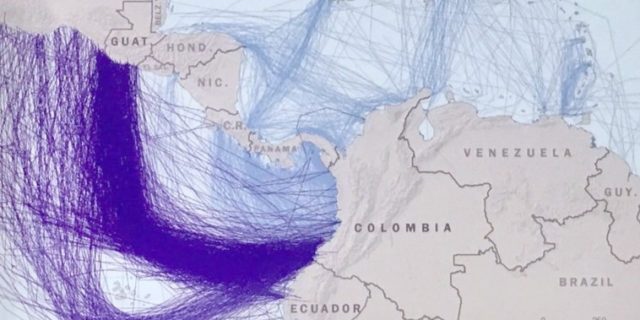
A map produced by the US Southern Command shows that most drug routes enter the US via the Pacific and then Central America (Business Insider)
Press TV – April 19, 2020
The top US military commander for Latin America has claimed that the Navy’s purported expansion of counter-narcotic operations in the Caribbean is not a military force aimed at toppling Venezuela’s President Nicolas Maduro despite Washington persisting provocations against Caracas.
Chief of US Southern Command Adm. Craig Faller asserted in an interview that Washington’s recent decision to double anti-narcotics assets in Latin America was planned months ago and not “directly” tied to Maduro’s indictment in a US court on allegations of leading a “narco-terrorist” conspiracy that supposedly sent 250 metric tons of cocaine a year to the United States.
“This is not a shift in US government policy,” Faller further claimed, despite boasting that enhanced interdiction efforts would harm Maduro’s finances and staying power. “It’s not an indication of some sort of new militarization in the Caribbean.”
The naval deployment announced this month is reportedly one of the largest US military operations in the region since its invasion of Panama in 1989 to topple its president and former CIA operative Gen. Manuel Noriega from power and take him to the US to face drug charges.
The operation involves major war-making resources such as Navy warships, AWACS surveillance aircraft and on-ground Special Forces rarely deployed before in the region.
Faller, however, further claimed that economic and diplomatic pressure — not the use of military force — continue to be Washington’s preferred instruments to oust the Venezuelan president from power.
He then went on to claim that growing instability in Venezuela is leading to an “uptick” in piracy in the Caribbean without citing any statistics or evidence to support his assertion.
Faller also said the recent sinking of a Venezuelan naval ship after it allegedly rammed an Antarctic-hardened cruise ship without passengers near Curacao reflected the readiness of the Venezuelan armed forces.
“It was a bad day for them,” he mockingly said. “Their lack of seamanship and lack of integrity is indicative of how it all played out.”
The hawkish US commander also pointed out that the coronavirus pandemic did force some in the US military to rethink the timing of the current deployment out of concern for the safety of American troops, adding that while controls to protect the workforce have been enhanced, it was determined that over the long term, the US is positioned to take advantage of the disruption in narcotics supply chains caused by the coronavirus outbreak as drug cartels scramble to source precursor chemical and other inputs.
“We thrive in uncertainty and are going to try and capitalize on that,” Faller boasted.
Corporate Media Cover for US Mob Threats Against Venezuela
By Lucas Koerner and Ricardo Vaz | FAIR | April 15, 2020
The Trump administration unveiled on March 31 a “democratic transition” plan to remove Venezuelan President Nicolás Maduro from office, in favor of a “council of state” composed of both opposition and ruling party loyalists.
The plan was, however, less an offer to negotiate than a diktat, with the US State Department (3/31/20) vowing that “sanctions will remain in effect, and increase, until the Maduro regime accepts a genuine political transition.”
Despite the obvious mafioso overtones, Washington’s stenographers in the corporate press were quick to present the initiative as “sanctions relief,” once again whitewashing murderous US economic warfare against Venezuela (FAIR.org, 2/6/19, 6/14/19, 6/26/19).
Western journalists’ callous obfuscation of sanctions’ deadly toll, especially amid a global pandemic (FAIR.org, 3/25/20), goes hand in hand with their parroting of bogus “narco-terrorism” charges leveled against Maduro and top Venezuelan officials, which butresses Washington’s ever-illicit casus belli.
An Offer They Can’t Refuse
The New York Times (3/31/20) jumped at the opportunity to furnish the Trump administration’s plan with a varnish of reasonability. “The proposal…offers to ease American sanctions intended to pressure President Nicolás Maduro and his loyalists over the past year,” Lara Jakes wrote, misconstruing the unilateral measures destroying Venezuela’s economy as well-intentioned steps to bring about “fair elections.”
At no point did the paper of record mention Washington’s threat to ramp up illegal sanctions if Maduro refuses the “offer” to replace his government with a five-person junta, in flagrant violation of Venezuela’s constitution. Other Western media likewise covered up the US blackmail, praising Donald Trump’s bayonet-hoisted ultimatum as a “roadmap to relief” (Washington Post, 3/31/20), a “more toned-down approach” (Reuters, 3/31/20) and a “conciliatory framework” (Economist, 4/2/20).
Having dutifully whitewashed US sanctions, the Times and its counterparts were free to cast war criminal Elliott Abrams, rehabilitated last year as Trump’s Venezuela envoy (CounterSpin, 3/1/19), as an honest broker committed to good-faith dialogue:
But Mr. Abrams was careful to say that the plan was an opening offer for talks between the two sides, “not a take-it-or-leave-it proposition,” and that no single issue was a deal breaker—except the demand for Mr. Maduro’s departure.
By contrast, Maduro—reelected in internationally monitored elections with a greater percentage of the electorate than Trump won in 2016, or Barack Obama in 2012—is for the Times “reminiscent of mid-20th century Latin American strongmen,” whose 2018 victory was “self-declared.”
The Times went on to accuse the Venezuelan leader of “creating one of the world’s largest refugee populations,” concealing the role of criminal sanctions in driving migration (FAIR.org, 2/18/18).
This vilification of Maduro and the Chavista poor people’s movement does not merely reflect reporters’ professional class bias, but is structurally necessary to justify US economic warfare and more overt criminality in the first place.
It is therefore no coincidence that the Trump administration’s gunpoint “proposal” to overturn Venezuela’s constitutional order came on the heels of Department of Justice “narco-terrorism” charges against the Venezuelan head of state and other top officials, which corporate journalists trumpeted enthusiastically.
Most outlets regarded the timing as a symptom of “contradictory” (Washington Post, 4/14/20) or “erratic” (New York Times, 4/10/20) US policy, which could “make it harder to remove Maduro” (Economist, 4/2/20), but the underlying regime change (ir)rationality never comes into question.
Indeed, even liberal imperialist academics like David Smilde and Abraham Lowenthal (Washington Post, 4/14/20) declined to call for scrapping the indictments, let alone easing sanctions, as a goodwill gesture aimed at securing Chavista support for the US plan, which they hailed as a “step in the right direction.” Rather, they merely recommend that the Trump administration offer “guarantees for indicted officials” against extradition, as if Maduro would be inclined to negotiate while Washington continues its collective punishment and maintains a $15 million bounty on his head.
Smilde and his Washington Office on Latin America colleague Geoff Ramsey’s (Washington Post, 3/27/20) refusal to demand the immediate annulment of the drug charges and illegal sanctions is hardly surprising, given both men’s long-running support for US coup efforts (Common Dreams, 3/5/19).

(Left) The NYT found Maduro’s white suit and being flanked by ministers as “reminiscent of dictators” (Right) The WaPo found an unconstitutional plan to remove an elected president on the basis of threats “a step in the right direction”
Calling the Kettle Black
The DoJ’s indictment of 14 current or former senior Venezuelan officials on “narco-terrorism” charges provided the Western media with fresh grist for its imperial propaganda mill.
This is hardly the first time that the corporate media have reported the Washington’s evidence-free drug allegations against official enemies, which they have frequently done without any pretense of journalistic rigor (Extra!, 1/90, 9/12; FAIR.org, 9/24/19, 5/24/19).
The New York Times (3/26/20) dedicated no less than 12 paragraphs to repeating prosecutors’ claims, which are centered on the outlandish notion that Maduro secretly heads a drug cartel that conspired with Colombia’s FARC guerrillas to “‘flood’ the United States with cocaine.”
Despite marshaling a crack team of three writers and four contributing reporters, the Times proved incapable of citing any contrarian perspectives, let alone basic facts, that cast doubt on the “narco-terrorism” narrative.
The Guardian (3/26/20) and the Washington Post (3/27/20) were virtually the only outlets to mention the US government’s own publicly available data showing that just a small fraction of drug routes pass through Venezuela, with the overwhelming majority of cocaine entering the United States via Mexico and Central America. Furthermore, Colombia remains the world’s largest cocaine producer, right under the nose of large US military and DEA contingents, which have long waged a “war for drugs and of terror” in the country.
The DoJ’s case looks like a reheated version of equally unfounded accusations against former President Hugo Chávez, which corporate journalists eagerly promoted last year (FAIR.org, 9/24/19).
A map produced by the US Southern Command shows that most drug routes enter the US via the Pacific and then Central America (Business Insider)
As with prior allegations against Socialist Party Vice President Diosdado Cabello (Wall Street Journal, 5/18/15), the indictments hinge on the testimony of defectors, whose claims are echoed in the Western press without scrutiny.
In the most recent case, retired Maj. Gen. Cliver Alcalá and former intelligence chief Hugo “El Pollo” Carvajal were also charged by the DoJ and pledged to cooperate with US authorities. Both had previously broken with the Maduro government and endorsed self-proclaimed “interim president” Juan Guaidó.
Alcalá, who swiftly surrendered to DEA agents and was flown to the US, boasted of plotting a coup in conjunction with Guaidó and “US advisers.”
In an exposé of the coup plot, the Financial Times (4/4/20) cast doubt on the general’s “rambling and contradictory” account, quoting several US officials denying the coup attempt and alleging Alcalá was “acting on the orders of Caracas.”
The outlet conveniently ignored that this would not be the first time Alcalá conspired to invade Venezuela with a paramilitary force.
According to Bloomberg (3/6/19), there was a plan for the general to lead a contingent of 200 Venezuelan exile soldiers to clear the way for the entry of “humanitarian aid” on February 23, 2019, which was vetoed at the last minute by Colombia, suggesting high-level coordination with Washington, Bogotá and Guaidó.
By repeating the US narrative of Alcalá as a Maduro “plant,” corporate journalists paradoxically legitimize the general as a reliable source of current information on Venezuelan “narco-terrorism,” while concealing his embarrassing ties to the US and its opposition proxies.
As we have exposed for FAIR.org (5/24/19), Carvajal has already proved his worth in the past by serving up to credulous reporters highly dubious allegations about Venezuelan leaders’ Hezbollah ties (New York Times, 2/21/19).
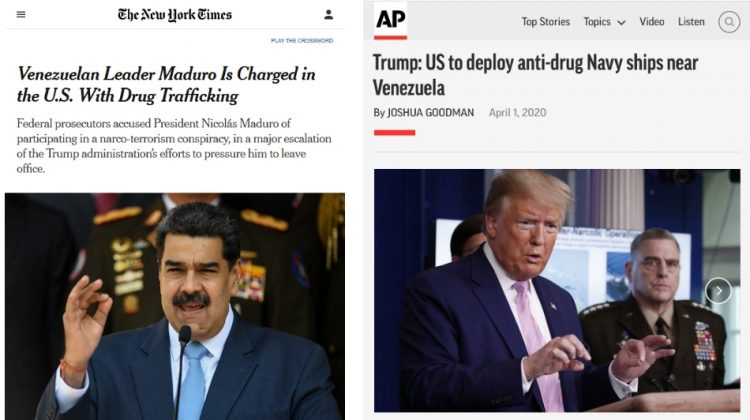
(Left) The NYT (and other outlets) accepted the DoJ’s “narco-terrorism” charges at face value (Right) An AP headline endorsed Trump’s dubious justification for an aggression
Imaginary Cartels, Real Warships
The uncritical coverage of the DoJ charges paved the way for a further US escalation shortly after the “transition” plan was unveiled.
On March 31, the Trump administration announced a military deployment to the Caribbean described by Associated Press (4/1/20) as “one of the largest in the region since the 1989 invasion of Panama.”
One might have expected such an obscenely expensive display of force amid a deadly pandemic currently killing thousands of Americans to be met with widespread rebuke across the media spectrum.
In fact, the opposition was largely muted. Newsweek (4/3/20) and Foreign Policy (4/2/20) gave voice to the Pentagon’s concern that the operation was wasteful and politically motivated, while the New York Times (4/10/20) published an op-ed raising polite proceduralist quibbles. Agreeing with the Trump administration that Maduro is a “dictator” who “must go,” Michael Shifter and Michael Camilleri nonetheless placed a vague call for Washington “to reboot sanctions policy, provide aid through accountable channels, and press the country’s leaders to work together.” Evidently, demanding the immediate lifting of (arguably genocidal) sanctions was too unreasonable to ask.
Referring to the Venezuelan military as “deeply involved in corruption and criminality,” Shifter and Camilleri exemplify the decadent imperial intelligentsia’s psychology of displacement.
From social democratic left to neoliberal right, Global North journalists and intellectuals remain invested in the self-serving illusion that besieged Southern nations such as Venezuela and Iran are more “criminal,” “corrupt” and “authoritarian” than the US empire (FAIR.org, 2/12/20).
For all their polite critiques of illegal US sanctions and military escalation–whose monstrosity has been laid bare by the current pandemic–the cult of Western exceptionalism goes unchallenged.
Ecuador’s Covid-19 catastrophe is man-made disaster
For political elites ordinary Ecuadorians are just disposables

People wait next to coffins to bury their loved ones outside a cemetery in Guayaquyil, Ecuador, on April 6, 2020 © AFP / Jose Sanchez
By Pablo Vivanco | RT | April 7, 2020
Corpses line the streets of Ecuador’s city of Guayaquil, as it’s struggling to deal with the outbreak of Covid’19. But catastrophe could’ve been avoided had the political elites not put monied interest before the lives of people.
Even by Latin American standards, the images emerging from Ecuador’s largest city, Guayaquil, have been shocking. Since the first case of Covid-19 was announced in late February, Ecuador has turned into the epicenter of the crisis in Latin America, touching many of the city’s 3 million residents.
“I know several people who have been infected and also some who have died,” Guayaquil resident Xavier Flores Aguirre tells me. “I think that by this point, everyone in Guayaquil is experiencing something similar.”
In the last weeks, videos and photos have been circulating on social media showing wrapped and covered bodies strewn on the streets in 30 degree temperatures.
Others chose to bury their dead loved ones in empty fields, some in mass graves, and in some cases even resorting to burning the corpses on the streets, all in desperate attempts to save other family members from being contaminated.
Government officials initially played down reports about the outbreak in the city, and Ecuadorian president Lenin Moreno even tweeted on April 1 that this was “fake news with clear political intent.”
Ecuadorian authorities have become accustomed to either denying inconvenient facts, or to simply blame the previous government for any of the country’s woes, but when the mainstream media outlets that have toed government lines in the past began to report on the situation, they had no choice but to acknowledge what was happening.
The city’s hospitals are now spilling over with the sick and dead, and workers from morgues have not been picking up cadavers, leaving many with few options other than the moribound ones that are all over social media.
But who is to blame for the post-apocalyptic scenes in Ecuador’s busiest port?
“I think that the fact that Guayaquil is the most affected population is related to the development model imposed by the political right in the city since the 1990s,” says Flores Aguirre.
Home to the country’s wealthiest people, Guayaquil has long been governed by the Social Christian Party, which has concentrated resources and efforts on supporting the export industries of the city. Social investments have historically been paltry, and in 2018 the city put aside more money for publicity than it did for health. Despite its ‘law and order’ mantra, Guayaquil retains the highest homicide rates, and it has also been deemed as a central gateway for cocaine to Europe.
But the lack of social infrastructure created under decades of uninterrupted rule in Guayaquil can only partly explain why the city accounts for some 90% of the confirmed Covid-19 cases in the country.
Since the beginning of the outbreak, the city’s leaders have carried on as usual, allowing large gatherings to continue and even encouraging people to flock to the Copa Libertadores match in the city. Over 20,000 people showed up to see Barcelona SC play Independiente del Valle in what is certainly a repeat of ‘biological bomb’ in the Champions League match in Northern Italy between Atalanta and Valencia.
Even as the city garners world wide attention for the disaster on the streets, Mayor Cynthia Viteri branded a ‘donation of 1000 cardboard coffins’ to the victim’s families as an act of ‘solidarity.’ The level of contempt and disregard that Guayaquil’s leaders have shown their residents is truly astounding.
But Viteri and her party share responsibility with their allies for this debacle.
“The highest authorities of the central government must be held responsible for the ineffective, late and reactive response,” says Flores Aguirre, who is a constitutional lawyer by trade.
As soon as he was elected, President Moreno back-stabbed his former left-wing allies, as well as predecessor Rafael Correa, by forming a pact with right-wing parties and groups to dismantle the institutions and policies created by the ‘Citizen’s Revolution’ that he helped usher in. He also cosied up to Washington and brokered deals with the International Monetary Fund, all the while pushing through harsh austerity measures that have gutted key social services and diminished the state’s capacity to respond to a crisis like this.
In the health sector, the Moreno government slashed spending from $306 million in 2017 to $201 million in 2018, and then $110 million in 2019, according to a March report from the Central University of Ecuador.
Just two weeks after the first confirmed Covid-19 case, Moreno announced another budget cut of $1.4 billion, including the elimination of 4 regulatory and control agencies, 3 public companies and 4 technical secretariats. Later in March, Ecuador chose to pay $324 million to creditors instead of making investments to stem the impact of the impending crisis.
This is no coincidence of course, as creditors such as the IMF make reduction of public spending a condition of their loans, and this was certainly the case for Ecuador, where the proposed cuts sparked weeks of violent protests in October of 2019.
Moreno worked to dismantle the apparatus and regulations created under Correa, in order to return the country towards the model of governance that his allies have been carrying out in Guayaquil for decades. Simply put, the tragedy unfolding in Guayaquil is the result of the political leaders being unwilling to seriously confront any sort of social crisis, let alone a health related one, and decimated institutions being unable to.
What’s more, the specter of the Guayaquil problem threatens to spread across the country, as the state struggles to ensure police are allowed to patrol the popular tourist city of Banos, or even to properly equip or pay doctors at public hospitals while they attend to the worst crisis that has hit the country since the devastating 2016 earthquake.
Comparing the response now with that of the Correa government in 2016, where the central government moved to coordinate relief and rescue efforts quickly, underscores the fact that what is playing out in Guayaquil is a man-made tragedy.

Health workers wearing protective gear are seen behind body bags outside of Teodoro Maldonado Carbo Hospital in Guayaquil, Ecuador April 3, 2020 © REUTERS / Vicente Gaibor del Pino
The government now acknowledges almost 4,000 cases and under 200 deaths, but surely this number is considerably higher. A joint military-police operation in the city has now begun picking up more than 100 bodies a day, and the country’s health minister said in an interview that as many as 1,500 had died in the city so far.
Ecuador was already turning into a powder keg, as the October protest showed. However, this callous indifference in the handling of this crisis should make it clear that, to the country’s political elites, ordinary Ecuadorians are disposable. Once the dust has settled, those who have already had to scramble to dispose of the corpse of their uncle or grandmother won’t be likely to forget that quickly…
Pablo Vivanco is a journalist and analyst specializing in politics and history in the Americas, who served as the Director of teleSUR English. Recent bylines include The Jacobin, Asia Times, The Progressive and Truthout. Follow him on Twitter@pvivancoguzman
Featured Video

Deception – Submarines against Olof Palme
or go to
Aletho News Archives – Video-Images
From the Archives
Woolsey Fire started at Santa Susana Field Lab — where “radioactive materials released were never accurately measured”
By John Laforge | CounterPunch | November 30, 2018
In my Nov. 16 column, I reported on potential radiation risks posed by California’s Woolsey wildfire having burned over parts or all of the Santa Susana Field Laboratory—south of Simi Valley, Calif., 30 miles outside Los Angeles—site of at least four partial or total nuclear reactor meltdowns.
The field laboratory operated 10 experimental reactors and conducted rocket engine tests. In his 2014 book Atomic Accidents, researcher James Mahaffey writes, “The cores in four experimental reactors on site … melted.” Reactor core melts always result in the release of large amounts of radioactive gases and particles. Clean up of the deeply contaminated site has not been conducted in spite of a 2010 agreement.
Los Angeles’s KABC-7 TV reported Nov. 13 that the Santa Susana lab site “appears to be the origin of the Woolsey Fire” which has torched over 96,000 acres. Southern Calif. Public Radio said, “According to Cal Fire, the Woolsey Fire started on the afternoon of Thursday, Nov. 8 … on the Santa Susana site.” … continue
Blog Roll
 Aletho News
- Pressure builds on Iran to ‘drop’ Lebanon ceasefire demand as Islamabad talks hang in balance
- In another clash report, US denies agreement to release Iran’s assets
- What is fueling unrest across the EU?
- Why no power can undermine Iran’s eternal dominance over the Strait of Hormuz
- Is The War Against Iran Over?
- Iran war will leave long-term ‘scar’ on Wall Street, investors warn
- How Iran decimated US power projection in West Asia: Military lessons of 40-day war
- Iran’s report details US-Israeli war crimes in targeting schools, hospitals, livelihoods
- NATO’s Slow Fracture: How Trump’s Iran War Exposed the Instrument of Hegemony
- Chinese jet fuel and the myth of energy independence
- If Americans Knew
- Military aid to Israel emerges as the latest political litmus test for Democrats
- The only Palestinian children’s rights organization closes following years-long Israeli campaign against it
- ‘I Can’t Forget the Smell’: Lebanese Reel After Israel Kills Over 300 in Single Day
- DNC Shoots Down Resolutions Calling Out AIPAC and Limiting Arms to Israel
- TCN: Is Israel Blackmailing President Trump?
- Israel killed at least 303 Lebanese yesterday – who were they? Daily Update
- Amnesty: Urgent – Protect Lebanese civilians from brutal escalation in Israeli attacks
- Is The War Against Iran Over?
- Inside the Israeli army’s propaganda wing
- Hundreds of Gaza Amputees Stranded in Legal Limbo
- No Tricks Zone
- New Study: No Linear Warming Or Glacier Retreat Along Northern Antarctic Peninsula Since 1980s
- An Inconvenient Tree: Uncovered In Alps… Europe Much Warmer Than Today 6000 Years Ago
- New Study Reports A 60% Slowdown In Greenland’s Ice Loss Rate In The Last Decade
- Low Intensity Tornado Wrecks Major Solar Farm, Creating A Potential Toxic Dump
- New Study Finds Warming Saves Lives…Cold Temperatures 12 Times More Deadly Than Excess Heat
- German Science Blog Accuses PIK Climate Institute Of Hallucinating Climate Tipping Points
- Devastating Assessment Of Comirnaty Vaccine By Former Senior Pfizer Europe Toxicologist
- New Study: CO2 Is ‘Effectively Negligible’ As An Explanatory Climate Change Factor Since 2000
- Former Pfizer Toxicologist Dr. Helmut Sterz Tells Bundestag Hearing Pfizer Vaccine Should Have Never Been Approved
- Energy Expert: Germany’s Nuclear Phaseout Was A “500 Billion Euro Mistake”
 Aletho News