The Washington Post’s “Cartel of the Suns” Theory is the Latest Desperate Excuse for Why the Coup Attempt in Venezuela has Failed
By Peter Bolton | CounterPunch | May 17, 2019
With the attempted coup in Venezuela now nearing its four-month mark, commentators in the corporate-owned Western press are scratching their heads as to why Washington’s plan for its proxy, Juan Guaido, to topple the government of Nicolas Maduro has so far failed to materialize. Of course, all of the real reasons elude them because they have never so much as crossed their minds. It is beyond their mental world to consider the lasting popularity of the late Hugo Chavez’s policies and lasting suspicion toward the right-wing opposition amongst large swathes of the population – or the deep revulsion at the thought of US (and especially US military) intervention into their country held by the vast majority of Venezuelans (and, indeed, Latin Americans generally). Rather, both the coup attempt’s puppeteers in Washington and their ventriloquist dummies in the mainstream media have been coming up with ever-more desperate excuses for why Guaido’s attempt to take power has not been a swift and decisive success. The so-called “propping up” of the Maduro “regime” by the traditional the US boogeymen of Russia, China and Cuba seems to have been the most frequently touted explanation. This has manifested itself in increasingly bizarre ways, such as the recent claim by Mike Pompeo that Maduro was at the point of fleeing the country before being convinced otherwise by Russia.
Now, the Washington Post’s notorious warhawk and deranged conspiracy peddler Jackson Diehl has come up with the latest labored rationalization for the failure of the coup attempt: the so-called “Cartel of the Suns.” According to Diehl, this shadowy organization is made up of “some of the most senior officials in the Maduro regime.” He claims that it “flies hundreds of tons of Colombian cocaine from Venezuelan airfields to Central America and the Caribbean for eventual distribution in the United States and Europe.” He furthermore claims that the Maduro government’s crimes also include skimming accounts used for importing food and medicine and “corrupt currency trading.” Describing the Maduro government as “less a government — much less a socialist one — than a criminal gang,” he claims that “the money it is reaping from criminal activity is serving as a prop that allows it to survive U.S. sanctions.” The only sources he provides to support these assertions are: an Associated Press article from September 2018 that reported on an unproven allegation made by a minor US Treasury Department figure, a January 2019 Wall Street Journal article that reports on another unproven allegation made by the US Treasury Department, and a link to one of his own Washington Post articles published in 2015. Leaving aside the self-citation, allegations made by the Treasury Department can hardly be considered credible evidence. It is, after all, a branch of the US government, which has been attempting to destabilize Chavista administrations since their earliest days in office. The Trump administration that it currently answers to, meanwhile, has been the major driving force behind the attempted coup and makes no secret of basing the effort on the advancement of US corporate economic interests.
Larissa Costas has gone so far as to posit that the very idea of such a government-operated cartel might be a whole-cloth fabrication. She stated in February 2017 article:
Although information abounds in the mediums of communication, the “Cartel of the Suns” has not been caught with a single gram of drugs, nor has there been any insignia of the organization identified in any seizure, nor has a single death been attributed to it. There are just two explanations: either it is the most inoffensive of cartels or it simply does not exist. [translated from the original in Spanish]
This latter possibility seems to be confirmed by the consistent failure of repeated Washington-led investigations into members of the Maduro government to result in actual convictions or even clear conclusions. For instance, in January 2015 the US Justice Department (DoJ) and Drug Enforcement Administration (DEA) launched a joint probe into then-President of the National Assembly Diosdado Cabello and other senior figures of the Venezuelan government. News reports soon followed repeating the allegations, including the claim that Cabello is the “capo” of the “Cartel of the Suns.” (Note here the loaded use of mafia-tinged language that’s seemingly borrowed straight from The Godfather movies.) But now, over four years since the launch of this probe, the DEA and DoJ have yet to even charge, let alone convict, any of the people implicated in it. Yet still the mainstream media reports repeat the allegations as if they were beyond question. In May 2018, for example, InSight Crime published an article titled “Drug Trafficking Within the Venezuelan Regime: The ‘Cartel of the Suns’,” in which the publication claims to have built “files on senior [Venezuelan] officials, current or past, that have been involved in the trafficking of cocaine.” But rather than providing the reader with this purported mountain of evidence that they have amassed, the authors instead cite an anonymous Justice Department official as their source. Just as with the US Treasury Department, the Justice Department can hardly be trusted when successive administrations in Washington have been consistently trying to undermine Chavista governments ever since Hugo Chavez was first elected in 1998. From CIA and Bush administration involvement in the 2002 coup attempt and also in the 2002-2003 PDVSA management lock-out through to the present coup attempt and oil sanctions, Washington has gone from covert to brazenly overt regime change methods.
But things go deeper than this. It seems that these dubious accusations of drug trafficking, in fact, form a significant part of the regime change effort itself. For one thing, they are used as justification for sanctions that Washington enacts in order to weaken the regime by sending thinly veiled signals to international capital to avoid Venezuela. Second of all, these sanctions and allegations are in turn used as a form of leverage to weaken the regime and encourage defection to the US’s and US-backed opposition’s side. There is no better case to illustrate this reality than that of the retired Venezuelan General Hugo Carvajal. In July 2014, as Carvajal was being released from custody in Aruba, Reuters reported that he categorically denied US charges of involvement in the illegal drug trade and provision of aid to Colombian leftist armed groups. But in February 2019, with the coup attempt about a month in, Carvajal did an about-face and accused Maduro and his inner circle of involvement in drug trafficking. This was right after Trump made an open threat that military officials who remain loyal to Maduro have “everything to lose” while Guaido simultaneously offered amnesty to those willing to defect to his side. It seems that Carvajal was responding to this “carrot and stick” threat/incentive combination that the US had, in his case successfully, employed as part of its regime change arsenal. The questionable validity of his claims is demonstrated by his repetition of Washington’s oft-repeated mantra that Maduro officials are courting the Lebanese “militant” group Hezbollah. These claims have been decisively debunked by Richard Vaz, who points out that mainstream media outlets such as CNN that report these allegations again use solely the Treasury Department as their source, or worse still figures such as Marco Rubio. Vaz also points to the absurdity of holding up Tarek el Aissami as the facilitator of some kind of cross-Atlantic Iranian-led Shi’ite alliance when el Aissami himself is not even Muslim, but rather the son of Lebanese Druze immigrants who was born and has spent all his life in Venezuela.
In any normal situation this is all that would have to be said to dismiss Diehl’s claims. But Latin America is no normal place and US relations with the region constitute no normal situation. In addition to the scarcity of evidence for the claims he makes, there is a question of double standards that lies beneath the surface. Diehl undoubtedly wishes to imply that the Maduro government’s alleged involvement in criminal activity justifies the interventionist actions from Washington and its proxies on the ground. But when one looks across the region and into both its past and present, one sees a whole cornucopia of flagrant narco-states that Washington has not only ignored but bank-rolled and armed to the teeth. Not coincidentally, two of them are staunch allies and the other was so until very recently. I am talking, of course, of Colombia, Honduras and Mexico.
Colombia’s status as a narco-state during the first decade of this century is hardly a secret. Even some of the US’s own declassified intelligence documents contain allegations of former president Alvaro Uribe’s close ties to narcotrafficking. A 1991 declassified Defense Intelligence Agency (DIA) report, for example, describes Uribe as a “close personal friend of Pablo Escobar” and “dedicated to collaboration with the Medellín cartel at high government levels.” Another intelligence report from 1993, and declassified in 2018, says that Colombian Senator told officials at the US Embassy in Bogota that Escobar’s cartel had financed Uribe’s election campaign for the Colombian Senate. In spite of having such information available, Washington nonetheless generously funded the Uribe government through Plan Colombia to engage in so-called “counter-narcotics” campaigns, which served as a cover for brutal offensives against labor and indigenous rights activists and displacement of rural campesinos. The extent of state capture by drug cartels in Colombia was furthermore exposed by the Parapolitics scandal, which led to the conviction of 32 members of the Colombian congress along with five state governors for collusion with right-wing paramilitaries. These groups, incidentally, have been the biggest players in the Colombian drug trade, dwarfing the involvement of leftist guerrilla groups such as the FARC and ELN.
Revelations from the recently concluded trial of Joaquín ‘El Chapo’ Guzmán have shone a light onto a similar story in Mexico. State witness Alex Cifuentes made a credible accusation during his testimony against Guzman that former Mexican president Enrique Peña Nieto received a bribe from Guzman worth $100 million dollars. Mexican investigative journalist Anabel Hernandez has long claimed that collusion between the Mexican state and narco-trafficking groups stretches all the way to the top, including the presidency, which Cifuentes’ testimony seemingly confirms. As has been the case with Colombia, the US has not only turned a blind eye to this situation, but has been generous funding the Mexican government to conduct “counter-narcotics” campaigns through the Merida Initiative. And again, these campaigns provided cover for brutal human rights violations on the part of Mexico’s state security forces.
Finally, we should turn to Honduras, the most contemporary and, in many ways, most flagrant example of a narco-state that the US cozies up to. Ever since the State Department orchestrated a coup against the democratically-elected government of Manuel Zelaya in 2009 there have been growing signs that Honduras has degenerated into a fully-fledged narco-state. In January of last year, for example, it emerged that a national police chief personally facilitated a cocaine delivery worth $20 million in 2013. In November 2018, President Juan Orlando Hernandez’s brother, Tony Hernandez, was arrested on drug trafficking charges in Miami. Just as this article went to press, testimony that he gave to US Drug Enforcement Administration (DEA) was unsealed in which he reportedly admits to interacting with several known drug traffickers as well as taking bribes. Even according to the aforementioned InSight Crime : “Tony Hernández’s detailed knowledge of the activities of some of Honduras’ most prominent drug traffickers makes it increasingly difficult for President Juan Orlando Hernández to deny being aware of these acts.” The president himself has previously faced allegations of involvement in drug trafficking via ex-army captain Santos Rodriguez Orellana. And as with Colombia and Mexico, not only has Washington never issued any punitive measure whatsoever against Honduras for any of this, it has rather been generously funding its state security forces in spite of its brutal record of human rights violations.
Note that all three of the above countries have been close US allies for the last few decades, with Colombia and Honduras remaining so while Mexico begins to break from Washington following the election of progressive president Andres Manuel Lopez Obrador. This is no coincidence. So long as a country is serving the US’s geostrategic and economic interests, it will not just overlook its status as a narco-state but will aid and abet its committing of human rights violations. You won’t hear about any of this from Jackson Diehl, however. Because as an obedient cheerleader for the Monroe Doctrine he must faithfully promulgate the selective indignation that underpins its entire edifice of justification propaganda. Given Washington’s record in the wider region, whether or not Venezuela is indeed a narco-state ceases to be the point. Rather, the question becomes one of credibility. And when it comes to evenhandedness in its treatment of Latin American states, Washington has exactly none.
Trudeau continues push to overthrow Venezuela’s government
By Yves Engler · May 10, 2019
The effort Justin Trudeau is putting into overthrowing Venezuela’s government is remarkable.
During the past 12 days the prime minister has raised the issue separately with the leaders of the EU, Spain, Japan and Cuba. On Tuesday Trudeau had a phone conversation with European Council President Donald Tusk focused almost entirely on Venezuela, according to the communiqué .“Prime Minister Trudeau reiterated his support for Interim President Juan Guaidó”, it noted.
The next day Trudeau talked to Spanish Prime Minister Pedro Sánchez about ousting president Nicolás Maduro. Venezuela is the only subject mentioned in the official release about the call.
Venezuela was also on the agenda during Japanese Prime Minister Shinzo Abe’s visit to Ottawa on April 28. The post meeting release noted, “during the visit, Prime Minister Abe announced Japan’s endorsement of the Ottawa Declaration on Venezuela.” Produced at an early February meeting of the “Lima Group” of governments opposed to Maduro, the “Ottawa Declaration” called on Venezuela’s armed forces “to demonstrate their loyalty to the interim president” and remove the elected president.
On May 3 Trudeau called Cuban president Miguel Díaz-Canel to pressure him to join Ottawa’s effort to oust Maduro. The release noted, “the Prime Minister, on behalf of the Lima Group, underscored the desire to see free and fair elections and the constitution upheld in Venezuela.”
Four days later foreign affairs minister Chrystia Freeland added to the diplomatic pressure on Havana. She told reporters, “Cuba needs to not be part of the problem in Venezuela, but become part of the solution.”
Freeland was highly active after Guaidó, Leopoldo Lopez and others sought to stoke a military uprising in Caracas on April 30. Hours into the early morning effort Freeland tweeted, “watching events today in Venezuela very closely. The safety and security of Juan Guaido and Leopoldo López must be guaranteed. Venezuelans who peacefully support Interim President Guaido must do so without fear of intimidation or violence.” She followed that up with a statement to the press noting, “Venezuelans are in the streets today demonstrating their desire for a return to democracy even in the face of a violent crackdown. Canada commends their courage and we call on the Maduro regime to step aside now.” Then Freeland put out a video calling on Venezuelans to rise up and requested an emergency video conference meeting of the Lima Group. Later that evening the coalition issued a statement labeling the attempted putsch an effort “to restore democracy” and demanded the military “cease being instruments of the illegitimate regime for the oppression of the Venezuelan people.”
Three days later Freeland attended an emergency meeting of the Lima Group in Peru. The coalition released a communique after that get together accusing Maduro’s government of protecting “terrorist groups” in Colombia.
At another Lima Group meeting in Chile on April 15 Freeland announced the fourth round of Canadian sanctions against Venezuelan officials. Forty-three individuals were added to the list of 70 leaders Canada had already sanctioned. CBC reported that the latest round of (illegal) sanctions were designed to “punish Venezuelan judges who rubber-stamped Maduro’s moves” and “lower-ranking police officials who took prominent roles in suppressing the attempt by Venezuela’s opposition to bring humanitarian aid into the country on February 23.”
The Venezuelan government responded to Canadian sanctions by denouncing Ottawa’s “alliance with war criminals that have declared their intention to destroy the Venezuelan economy to inflict suffering on the people and loot the country’s riches.” A recent Center for Economic and Policy Research report gives credence to this perspective. Written by Jeffrey Sachs and Mark Weisbrot, “Economic Sanctions as Collective Punishment: The Case of Venezuela” concluded that 40,000 Venezuelans may have died over the past two years as a result of US sanctions.
The Liberals want us to believe their campaign to oust Venezuela’s government is motivated by support for democracy and human rights. Yet in recent weeks the Trudeau government has deepened ties to repressive Middle East monarchies, gutted its promise to rein in international abuses by Canadian mining companies’ and justified Israeli violence against those living in the open-air prison known as the Gaza Strip.
Last month members of Mouvement Québécois pour la Paix interrupted a speech by Freeland at the University of Montréal to criticize Canada’s policy towards Venezuela. Activists should be disrupting Freeland and other Liberal MPs public events across the country to demand an end to their effort to overthrow the government of Venezuela.
Pandering to Israel Means War With Iran
By Philip Giraldi | Strategic Culture Foundation | May 9, 2019
The United States is moving dangerously forward in what appears to be a deliberate attempt to provoke a war with Iran, apparently based on threat intelligence provided by Israel. The claims made by National Security Advisor John Bolton and by Secretary of State Mike Pompeo that there is solid evidence of Iran’s intention to attack US forces in the Persian Gulf region is almost certainly a fabrication, possibly deliberately contrived by Bolton and company in collaboration with Prime Minister Benjamin Netanyahu. It will be used to justify sending bombers and additional naval air resources to confront any possible moves by Tehran to maintain its oil exports, which were blocked by Washington last week. If the US Navy tries to board ships carrying Iranian oil it will undoubtedly, and justifiably, provoke a violent response from Iran, which is precisely what Bolton, Pompeo and Netanyahu are seeking.
It would be difficult to find in the history books another example of a war fought for no reason whatsoever. As ignorant as President Donald Trump and his triumvirate or psychotics Bolton, Pompeo and Elliott Abrams are, even they surely know that Iran poses no threat to the United States. If they believe at all that a war is necessary, they no doubt base their judgment on the perception that the United States must maintain its number one position in the world by occasionally attacking and defeating someone to serve as an example of what might happen if one defies Washington. Understanding that, the Iranians would be wise to avoid confrontation until the sages in the White House move on to some easier target, which at the moment would appear to be Venezuela.
The influence of Israel over US foreign policy is undeniable, with Washington now declaring that it will “review ties” with other nations that are considered to be unfriendly to the Jewish state. For observers who might also believe that Israel and its allies in the US are the driving force behind America’s belligerency in the Middle East, there are possibly some other games that are in play, all involving Benjamin Netanyahu and his band of merry cutthroats. It is becoming increasingly apparent that foreign politicians have realized that the easiest way to gain Washington’s favor is to do something that will please Israel. In practical terms, the door to Capitol Hill and the White House is opened through the good offices of the American Israel Public Affairs Committee (AIPAC).
Israel is desperate to confirm its legitimacy in international fora, where it has few friends in spite of an intensive lobbying campaign. It seeks to have countries that do not have an embassy in Israel to take steps to establish one, and it also wants more nations that do already have an embassy in Tel Aviv to move to Jerusalem, building on the White House’s decision taken last year to do just that. Not surprisingly, nations and political leaders who are on the make and want American support have drawn the correct conclusions and pander to Israel as a first step.
One only has to cite the example of Venezuela. Juan Guaido, the candidate favored by Washington for regime change, has undoubtedly a lot of things on his plate but he has proven willing to make some time to say what Benjamin Netanyahu wants to hear, as reported by the Israeli media. The Times of Israel describes how “Venezuela’s self-proclaimed leader Juan Guaido is working to re-establish diplomatic relations with Israel and isn’t ruling out placing his country’s embassy in Jerusalem, according to an interview with an Israeli newspaper published Tuesday.”
One would think that Guaido would consider his interview sufficient, but he has also taken the pandering process one step farther, reportedly displaying huge video images of the flags of both Israel and the United States at his rallies.
This deference to Israel’s interests produced an almost immediate positive result with Netanyahu recognizing him as the legitimate Venezuelan head of state, followed by an echo chamber of effusive congratulations from US (sic) Ambassador to Israel David Friedman, who praised the Jewish state for “standing with the people of Venezuela and the forces of freedom and democracy.” Donald Trump’s esteemed special envoy for international negotiations, Jason Greenblatt, also joined in, praising the Israeli government for its “courageous stand in solidarity with the Venezuelan people.”
A similar bonding took place regarding Brazil, where hard right conservative leader Jair Bolsonaro was recently elected president. Netanyahu attended the Bolsonaro inauguration last December and the two men benefit from strong support from Christian Evangelicals. Bolsonaro repaid the favor by promising that Israel would be his first foreign trip. In the event he went to Washington first, but the state visit to Israel took place in April, just before that country’s elections, in a bid to demonstrate international support for Netanyahu.
Brazilian Jews constitute a wealthy and powerful community which reacted positively to Bolsonaro’s pledges to fight corruption and high crime rates while also repairing a struggling economy. They also appreciated his stance on Israel. He committed to moving the Brazilian embassy to Jerusalem from Tel Aviv, though he has backpedaled a bit on that pledge. And he also promised to shut the Palestinian embassy in the capital Brasilia. He famously asked and answered his own question, “Is Palestine a country? Palestine is not a country, so there should be no embassy here. You do not negotiate with terrorists.”
Bolsonaro’s pro-Israel anti-Venezuela credentials also endeared him to Donald Trump on a visit to Washington in mid-March which was described by the media as a “love fest.” The Brazilian leader’s visits to Israel and the US as well as Guaido’s promises to Israel reveal that the foreign policies of Tel Aviv and Washington have become inextricably intertwined, with supplicant nations and politicians wisely seeking to do homage to both regimes to gain favor. It is a development that would shock the Founding Fathers, most particularly George Washington, who warned against entangling alliances, and it means that American interests will be seen through an Israeli prism, a reality that has already produced very bad results.
US sanctions against Iran, Cuba, Venezuela breach human rights: UN expert
Press TV – May 7, 2019
A UN rights expert has slammed unilateral US sanctions against Iran, Cuba and Venezuela, saying the use of economic measures for political purposes violates human rights and international law.
In a statement released on Monday, Idriss Jazairy, UN special rapporteur on the negative impact of the unilateral coercive measures, warned that the US bans against the trio might precipitate man-made humanitarian catastrophes.
“Regime change through economic measures likely to lead to the denial of basic human rights and indeed possibly to starvation has never been an accepted practice of international relations,” he said.
“Real concerns and serious political differences between governments must never be resolved by precipitating economic and humanitarian disasters, making ordinary people pawns and hostages thereof,” he added.
Jazairy also voiced worries about Washington’s termination of sanctions waivers for major Iranian crude buyers, saying the move harms not only the Iranian nation, but also their trade partners.
“The extraterritorial application of unilateral sanctions is clearly contrary to international law,” he said.
“I am deeply concerned that one State can use its dominant position in international finance to harm not only the Iranian people, who have followed their obligations under the UN-approved nuclear deal to this day, but also everyone in the world who trades with them,” he noted, referring to the landmark 2015 agreement — officially called the Joint Comprehensive Plan of Action (JCPOA).
Recently, the US ended six months of waivers which allowed Tehran’s eight largest customers to continue importing limited volumes. It also threatened the buyers of Iranian oil with sanctions if they fail to stop their purchases.
The anti-Iran American sanctions had been lifted under the JCPOA, but they returned in place last year when the US abandoned the multilateral accord.
Elsewhere in his statement, the UN rights expert denounced the economic hardship caused by the US sanctions in Cuba and questioned Washington’s claim that its sanctions against Venezuela were aimed at “helping” its people.
He further called on the international community to “challenge” Washington’s restrictive measures against sovereign countries which amount to “a threat to world peace and security.”
“I call on the international community to engage in constructive dialogue with Venezuela, Cuba, Iran and the United States to find a peaceful resolution in compliance with the spirit and letter of the Charter of the United Nations before the arbitrary use of economic starvation becomes the new ‘normal’,” Jazairy said.
How GMO Seeds and Monsanto/Bayer’s “RoundUp” are Driving US Policy in Venezuela
By Whitney Webb | MintPress News | May 6, 2019
CARACAS, VENEZUELA — As the political crisis in Venezuela has unfolded, much has been said about the Trump administration’s clear interest in the privatization and exploitation of Venezuela’s oil reserves, the largest in the world, by American oil giants like Chevron and ExxonMobil.
Yet the influence of another notorious American company, Monsanto — now a subsidiary of Bayer — has gone largely unmentioned.
While numerous other Latin American nations have become a “free for all” for the biotech company and its affiliates, Venezuela has been one of the few countries to fight Monsanto and other international agrochemical giants and win. However, since that victory — which was won under Chavista rule — the U.S.-backed Venezuelan opposition has been working to undo it.
Now, with Juan Guaidó’s parallel government attempting to take power with the backing of the U.S., it is telling that the top political donors of those in the U.S. most fervently pushing regime change in Venezuela have close ties to Monsanto and major financial stakes in Bayer.
In recent months, Monsanto’s most controversial and notorious product — the pesticide glyphosate, branded as Roundup, and linked to cancer in recent U.S. court rulings — has threatened Bayer’s financial future as never before, with a litany of new court cases barking at Bayer’s door. It appears that many of the forces in the U.S. now seeking to overthrow the Venezuelan government are hoping that a new Guaidó-led government will provide Bayer with a fresh, much-needed market for its agrochemicals and transgenic seeds, particularly those products that now face bans in countries all over the world, including once-defoliated and still-poisoned Vietnam.
U.S.-Backed Venezuelan opposition seeks to reverse Chavista seed law and GMO ban
In 2004, then-president of Venezuela, Hugo Chávez, surprised many when he announced the cancellation of Monsanto’s plans to plant 500,000 acres of Venezuelan agricultural land in genetically modified (GM) soybeans. The cancellation of Monsanto’s Venezuela contract led to what became an ad hoc ban on all GM seeds in the entire country, a move that was praised by local farmer groups and environmental activists. In contrast to anti-GM movements that have sprung up in other countries, Venezuela’s resistance to GM crops was based more on concerns about the country’s food sovereignty and protecting the livelihoods of farmers.
Although the ban has failed to keep GM products out of Venezuela — as Venezuela has long imported a majority of its food, much of it originating in countries that are among the world’s largest producers of genetically modified foods — one clear effect has been preventing companies like Monsanto and other major agrochemical and seed companies from gaining any significant foothold in the Venezuelan market.
In 2013, a new seed law was nearly passed that would have allowed GM seeds to be sold in Venezuela through a legal loophole. That law, which was authored by a member of the Chavista United Socialist Party of Venezuela (PSUV), was widely protested by farmers, indigenous activists, environmentalists, and eco-socialist groups, which led to the law’s transformation into what has been nicknamed the “People’s Seed Law.” That law, passed in 2015, went even farther than the original 2004 ban by banning not just GM seeds but several toxic agrochemicals, while also strengthening heirloom seed varieties through the creation of the National Seed Institute.
Soon after the new seed law was passed in 2015, the U.S.-backed Venezuelan opposition led by the Roundtable of Democratic Unity (MUD) — a group comprised of numerous U.S.-funded political parties, including Guaidó’s Popular Will — took control of the country’s National Assembly. Until Venezuela’s Supreme Court dissolved the assembly in 2017, the MUD-legislature attempted to repeal the seed law on several occasions. Those in favor of the repeal called the seed bill “anti-scientific” and damaging to the economy.
Despite the 2017 Supreme Court decision, the National Assembly has continued to meet, but the body holds no real power in the current Venezuelan government. However, if the current government is overthrown and Guaidó — the “interim president” who is also president of the dissolved National Assembly — comes to power, it seems almost certain that the “People’s Seed Law” will be one of the first pieces of legislation on the chopping block.
The AEI axis
Some of the key figures and loudest voices supporting the efforts of the Trump administration to overthrow the Venezuelan government in the United States are well-connected to one particular think-tank, the American Enterprise Institute (AEI). For instance, John Bolton — now Trump’s national security advisor and a major player in the administration’s aggressive Venezuela policy — was a senior fellow at AEI until he became Trump’s top national security official. As national security adviser, Bolton advises the president on foreign policy and issues of national security while also advising both the Secretary of State and the Secretary of Defense. As of late, he has been pushing for military action in Venezuela, according to media reports.
Another key figure in Trump’s Venezuela policy — Elliott Abrams, the State Department’s Special Representative for Venezuela — has been regularly featured at AEI summits and as a guest on its panels and podcasts. According to Secretary of State Mike Pompeo, Abrams’ current role gives him the “responsibility for all things related to our efforts to restore democracy” in Venezuela. Other top figures in the administration, including Vice President Mike Pence and Secretary of State Mike Pompeo, were featured guests at the AEI’s “secretive” gathering in early March. As MintPress and other outlets have reported, Guaidó declared himself “interim president” of Venezuela at Pence’s behest. Pompeo is also intimately involved in directing Trump’s Venezuela policy as the president’s main adviser on foreign affairs.
Other connections to the Trump administration include Secretary of Education Betsy DeVos who was previously on AEI’s board of trustees.
AEI has long been a key part of the “neoconservative” establishment and employs well-known neoconservatives such as Fred Kagan — the architect of the Iraq “troop surge” — and Paul Wolfowitz, the architect of the Iraq War. Its connections to the George W. Bush administration were particularly notable and controversial, as more than 20 AEI employees were given top positions under Bush. Several of them, such as Bolton, have enjoyed new prominence in Trump’s administration.
Other key Bush officials joined the AEI soon after leaving their posts in the administration. One such was Roger Noriega, who was the U.S. representative to the Organization of American States (OAS) during the failed, U.S.-backed 2002 coup and went on to be assistant secretary of state for Western Hemisphere affairs from 2003 to 2005, where he was extremely influential in the administration’s policies towards Venezuela and Cuba.
Since leaving the Bush administration and promptly joining the AEI, Noriega has been instrumental in pushing claims that lack evidence but aim to paint Venezuela’s current President Nicolas Maduro-led government as a national security threat, such as claiming that Venezuela is helping Iran acquire nuclear weapons and hosts soldiers from Lebanon’s Hezbollah. He also lobbied Congress to support Venezuelan opposition leader Leopoldo López, Guaidó’s political mentor and leader of his political party, Popular Will.
Not only that, but Noreiga teamed up with Martin Rodil, a Venezuelan exile formerly employed by the IMF, and José Cardenas, who served in the Bush administration, to found Visión Américas, a private risk-assessment and lobbying firm that was hired to “support the efforts of the Honduran private sector to help consolidate the democratic transition in their country” after the U.S.-backed Honduran coup in 2009. In recent months, Noriega and his associates have been very focused on Venezuela, with Cardenas offering Trump public advice about how “to hasten Maduro’s exit,” while Rodil has publicly offered “to get you a deal” if you have dirt on Venezuela’s government.
While the AEI is best known for its hawkishness, it is also a promoter of big agricultural interests. Since 2000, It has hosted several conferences on the promise of “biotechnology” and genetically modified seeds and has heavily promoted the work of former Monsanto lobbyist Jon Entine, who was an AEI visiting fellow for several years. The AEI also has long-time connections to Dow Chemical.
The most likely reason for the AEI’s interest in promoting biotech, however, can be found in its links to Monsanto. In 2013, The Nation acquired a 2009 AEI document, obtained through a filing error and not intended for public disclosure, that revealed the think tank’s top donors. The form, known as the “schedule of contributors,” revealed that the AEI’s top two donors at the time were the Donors Capital Fund and billionaire Paul Singer.
The Donors Capital Fund, which remains a major contributor to the AEI, is linked to Monsanto interests through the vice chairman of its board, Kimberly O. Dennis, who is also currently a member of the AEI’s National Council. According to AEI, the National Council is composed of “business and community leaders from across the country who are committed to AEI’s success and serve as ambassadors for AEI, providing us with advice, insight, and guidance.”
Dennis is the long-time executive chairwoman of the Searle Freedom Trust, which was founded in 1988 by Daniel Searle after he oversaw the sale of his family pharmaceutical company — G.D. Searle and Company — to Monsanto in 1985 for $2.7 billion. The money Searle had made from that merger was used to fund the trust that now funds the AEI and other right-wing think tanks. Searle was also close to Donald Rumsfeld, who led G.D. Searle and Co. for years and was Secretary of Defense under Gerald Ford and George W. Bush. Searle was also a trustee of the Hudson Institute, which once employed Elliott Abrams.
After the family company — which gained notoriety for faking research about the safety of its sweetener, aspartame or NutraSweet — was sold to Monsanto, G.D. Searle executives close to Daniel Searle rose to prominence within the company. Robert Shapiro, who was G.D. Searle’s long-time attorney and head of its NutraSweet division, would go on to become Monsanto’s vice president, president and later CEO. Notably, Daniel Searle’s grandson, D. Gideon Searle, was an AEI trustee until relatively recently.
Why is a top donor to Marco Rubio increasing his stake in Bayer while others flee?
Yet, it is AEI’s top individual donor noted in the accidental “schedule of contributors” disclosure who is most telling about the private biotech interests guiding the Trump administration’s Venezuela policy. Paul Singer, the controversial billionaire hedge fund manager, has long been a major donor to neoconservative and Zionist causes — helping fund the Foreign Policy Initiative (FPI), the successor to the Project for a New American Century (PNAC); and the neoconservative and islamophobic Foundation for the Defense of Democracies (FDD), in addition to the AEI.
Singer is notably one of the top political donors to Senator Marco Rubio (R-FL) and has been intimately involved in the recent chaos in Venezuela. He has been called one of the architects of the administration’s current regime-change policy, and was the top donor to Rubio’s presidential campaign, as well as a key figure behind the controversial “dossier” on Donald Trump that was compiled by Fusion GPS. Indeed, Singer had been the first person to hire Fusion GPS to do “opposition research” on Trump. However, Singer has largely since evaded much scrutiny for his role in the dossier’s creation, likely because he became a key donor to Trump following his election win in 2016, giving $1 million to Trump’s inauguration fund.
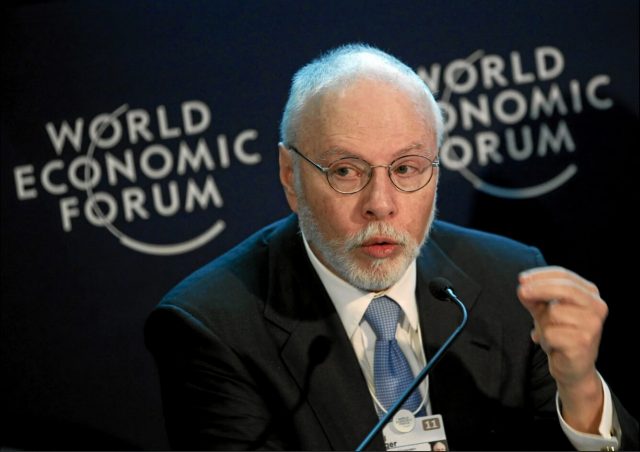
Hedge fund manager Paul Singer has raised millions for a pro-Marco Rubio super PAC. Moritz Hager | World Economic Forum
Singer has a storied history in South America, though he has been relatively quiet about Venezuela. However, a long-time manager of Singer’s hedge fund, Jay Newman, recently told Bloomberg that a Guaidó-led government would recognize that foreign creditors “aren’t the enemy,” and hinted that Newman himself was weighing whether to join a growing “list of bond veterans [that have] already begun staking out positions, anticipating a $60 billion debt restructuring once the U.S.-backed Guaidó manages to oust President Nicolas Maduro and take control.” In addition, the Washington Free Beacon, which is largely funded by Singer, has been a vocal advocate for the Trump administration’s regime-change policy in Venezuela.
Beyond that, Singer’s Elliott Management Corporation gave Roger Noriega, the former assistant secretary of state for Western Hemisphere affairs under Bush, $60,000 in 2007 to lobby on the issue of sovereign debt and for “federal advocacy on behalf of U.S. investors in Latin America.” During the time Noriega was on Singer’s payroll, he wrote articles linking Argentina and Venezuela to Iran’s nonexistent nuclear program. At the time, Singer was aggressively pursuing the government of Argentina in an effort to obtain more money from the country’s prior default on its sovereign debt.
While Singer has been mum himself on Venezuela, he has been making business decisions that have raised eyebrows, such as significantly increasing his stake in Bayer. This move seems at odds with Bayer’s financial troubles, a direct result of the slew of court cases regarding the link between Monsanto’s glyphosate and cancer. The first ruling that signaled trouble for Monsanto and its new parent company Bayer took place last August, but Singer increased his stake in the company starting last December, even though it was already clear by then that Bayer’s financial troubles in relation to the glyphosate court cases were only beginning.
Since the year began, Bayer’s problems with the Monsanto merger have only worsened, with Bayer’s CEO recently stating that the lawsuits had “massively affected” the company’s stock prices and financial performance.
Forcing open a new market for RoundUp
Part of Singer’s interest in Bayer may relate to Venezuela, given that Juan Guaido’s “Plan País” to “rescue” the Venezuelan economy includes a focus on the country’s agricultural sector. Notably, prior to and under Chavismo, agricultural productivity and investment in the agricultural sector took a backseat to oil production, resulting in under 25 percent of Venezuelan land being used for agricultural purposes despite the fact that the nation has a wealth of arable land. The result has been that Venezuela needs to import much of its food from abroad, most of which originate in Colombia or the United States.
Under Chávez and his successor, Maduro, there has been a renewed focus on small-scale farming, food sovereignty and organic agriculture. However, if Maduro is ousted and Guaidó moves to implement his “Plan País,” the opposition’s coziness with foreign corporations, the interests of U.S. coup architects in Bayer/Monsanto, and the opposition’s past efforts to overturn the GM seed ban all suggest that a new market for Bayer/Monsanto products — particularly glyphosate — will open up.
South America has long been a key market for Monsanto and — as the company’s problems began to mount prior to the merger with Bayer — it became a lifeline for the company due to less stringent environmental and consumer regulations than many Western countries. In recent years, when South American governments have opened their countries to more “market-friendly” policies in their agricultural sectors, Monsanto has made millions.
For instance, when Brazil sought to expand biotechnology (i.e. GM seed) investment in 2012, Monsanto saw a 21% increase in its sales of GM corn seed alone, generating an additional $1 billion in profits for the company. A similar comeback scenario is needed more than every by Bayer/Monsanto, as Monsanto’s legal troubles saw the company’s profits plunge late last year.
With countries around the world now weighing glyphosate bans as a result of increased litigation over the chemical’s links to cancer, Bayer needs a new market for the chemical to avoid financial ruin. As Singer now has a significant stake in the company, he — along with the politicians and think tanks he funds — may see promise in the end of the anti-GM seed ban that a Guaidó-led government would bring.
Furthermore, given that Guaidó’s top adviser wants the Trump administration to have a direct role in governing Venezuela if Maduro is ousted, it seems likely that Singer would leverage his connections to keep Bayer/Monsanto afloat amid the growing controversy surrounding glyphosate. Such behavior on the part of Singer would hardly be surprising in light of the fact that international financial media have characterized him as a “ruthless opportunist” and “overly aggressive.”
Such an outcome would be in keeping with the increased profit margins for Monsanto and related companies that have followed its expansion into countries following U.S.-backed coups. For instance, after the U.S.-backed coup in Ukraine in 2014, the loans given to Ukraine by the International Monetary Fund and the World Bank forced the country to open up and expand the use of “biotechnology” and GM crops in its agricultural sector, and Monsanto, in particular, made millions as the prior government’s ban on GM seeds and their associated agrochemicals was reversed. If Maduro is ousted, a similar scenario is likely to play out in Venezuela, given that the Guaidó-led government made known its intention to borrow heavily from these institutions just days after Guaidó declared himself “interim president.”
Feature photo | Luis Arrieta inspects a freshly planted coffee field that used to be a peach orchard in the coastal area of Carayaca on the outskirts of Caracas, Venezuela, Oct. 10, 2018 . Fernando Llano | AP
Whitney Webb is a MintPress News journalist based in Chile. She has contributed to several independent media outlets including Global Research, EcoWatch, the Ron Paul Institute and 21st Century Wire, among others. She has made several radio and television appearances and is the 2019 winner of the Serena Shim Award for Uncompromised Integrity in Journalism.
Kieran Barr contributed to the research used in this report.
The New False Positive Being Planned Against Venezuela
Orinoco Tribune | May 5, 2019
The defeat of the military political operation of April 30, 2019 against the government of President Maduro, adds to the long list of failures that led to Ivan Duque accusing the Venezuelan government of protecting the ELN, in a desperate attempt to meet one of the two tasks that have been assigned to him within the uribista government: to close the roads to the one of peace in Colombia and to attack Venezuela.
Once again defrauded by the Venezuelan opposition, the United States continues giving more and more prominence to the Colombian right. The call of Ivan Duque to the Venezuelan military during that day, shows a clumsy despair before the incapacity of the Venezuelan right, which gave one more element to President Maduro to accuse the US government and Colombia of being behind the failed coup d’etat. But the Bolivarian triumph in this battle does not end with the war.
The new false positive, to link the Venezuelan government with the ELN, is still under construction.
ELN, A GUERRILLA ORGANIZATION THAT IS APPROACHING ITS 55TH ANNIVERSARY
The National Liberation Army (ELN) and the Revolutionary Armed Forces of Colombia (FARC) were born in 1964 while Raúl Leoni occupied the presidency of Venezuela. Not even the most tendentious versions of history mention any possibility that Leoni’s government was behind its founding, nor any political group of the Venezuelan left, since all the existing ones for that moment were less strong than those that existed. They gave rise to the Colombian guerrillas during the last half of the 20th century.
Since its inception, both guerrilla groups have operated throughout the country, which obviously includes the territories of the porous border with Venezuela.
After the FARC-EP secretariat signed the peace agreements, and with it the demobilization of most of its troops, the ELN became the largest and oldest guerrilla group on the continent. The Uribista government of Duque, decided to breach and tries to modify the agreements with the FARC-EP and got up from the dialogue table with the ELN, that is, closed any near possibility of achieving a negotiated political solution to the conflict. And at the same time, it has made repression and judicialization the only government response to popular demands, while paramilitaries and the Public Force execute a new genocide against leaders and social leaders.
The reality is obvious, in Colombia there is no peace , no post-conflict and is on the verge of a humanitarian crisis. In more than five decades of confrontation, the Colombian state has not had the true political will to solve the social conflict generated by the war and its Public Force, has not managed to defeat the ELN militarily, not even with the support of paramilitary forces or the contest of the US military institutions. They have more than 16 facilities of different types in the country. On the contrary, on more than one occasion, it has been forced to negotiate. So far, the ELN has held dialogues with five presidents and seven Colombian governments.
The first dialogues had the support of Carlos Andrés Pérez, who was in his second term as president of the then Republic of Venezuela and later with the support of the governments of Hugo Chávez and Nicolás Maduro, whose interest in the peace of Colombia has been evident.
THE PSYCHOLOGICAL PROJECTION OF THE URIBE GOVERNMENT
The Colombian government refuses to assume that the entire state is in check because of the penetration of drug trafficking into its institutions. The production of cocaine and the planting of coca have a constant increase in Colombia and, according to Donald Trump himself, had never been as high as since Ivan Duque’s presidency. But the Uribe government insists on attributing to the Venezuelan government, the status of “narco-government” that actually belongs to him, and now he blames it for his own inability to win a war that has lasted more than half a century.
The caricature of President Maduro that has been built by media corporations and the voices of the Colombian government, as a fool without popular support that only remains in the presidency with the support of the FANB, is opposed to that of the man they accuse of being behind all the struggles of the Colombian people and now, even to sustain a guerrilla organization that was born when he was only one year old and since then has remained active uninterruptedly.
What looks like typical psychological projection, is actually a new attempt to generate a false positive – as denounced by the Venezuelan chancellor – but to succeed they need to erase history.
FROM IRAN TO VENEZUELA
A few days ago, Donald Trump announced that the United States would declare Iran’s Revolutionary Guard a “foreign terrorist organization,” as indeed it happened. Since this military force is the institution of an independent republic, recognized by the United Nations, this measure has no precedents and sows a very bad precedent as it is a violation of international law and the most elementary diplomatic norms.
The ELN, for its part, has been included in the list of foreign terrorist organizations designated by the US for many years , so it is not unreasonable to assume that, in addition to the argument to justify the involvement of Colombia in the first war between countries of the region of the 21st century, another dangerous objective of this attempt to link the Venezuelan government with the Colombian guerrilla organization, could be to declare the FANB as a foreign terrorist organization, given that they have not managed to co-opt, divide or defeat it.
If the internal consensus were achieved or if the pressure from the United States forced it, it would be expected that before August 2019 the Colombian state will add to its terrible history of wars, a costly and complicated military aggression against Venezuela.
Coincidentally, a few hours after the failed coup d’etat in Venezuela, Trump decided to change his ambassador in Bogotá, Kevin Whitaker, to post Philip Goldberg, whose record can give clues to the new strategies that will be directed from Colombia against Venezuela.
Goldberg was expelled from Bolivia in 2008 for allegations of conspiracy made by President Morales, he was recently in charge of business in Havana, he was also part of the diplomatic corps in Kosovo, he is an intelligence specialist and was the Coordinator in Bogotá of the terrible Plan Colombia.
Therefore, while it is important to disprove the false opinion matrices and investigate the non-governmental organizations that sustain these matrices with pseudo-investigations -even some linked to sectors that call themselves the left, Venezuela must continue preparing to respond in other areas because the lies will keep coming out of the laboratories without ceasing and will be as diverse as the tactics require; what has not changed much in the last two centuries are the strategic objectives of the United States on the region and the world.
Source: Mision Verdad
Translated by: JRE\EF
RELATED CONTENT: Venezuelan Military Deserters Removed From Hotel in Cúcuta for Late Payments
Russia FM Blasts US Illegal ‘Methods of Blackmail’ Against Cuba
teleSUR | May 4, 2019
Russia’s Foreign Ministry urged the international community to unite in condemning the United States’ new anti-Cuban blockade measure, which came about after President Donald Trump lifted the waiver on Title III of the once-dormant Helms-Burton Act.
“We emphasize again that the methods of blackmail and pressure used by Washington are absolutely illegal. We call on all responsible forces to defend the U.N. Charter and international law in order to jointly put an end to the anti-Cuba blockade,” the Russian ministry said in a statement.
The ministry also pointed out that Washington is threatening more sanctions on Cuba in the vein of the “Monroe Doctrine” in an “overt encroachment” on the sovereignty of the Latin American nation.
The new sanctions were made known when United States Secretary of State Mike Pompeo announced that the Title II would come into effect on May 2, permitting U.S. nationals to sue Cuban entities or foreign entities operating on the island prior to the Cuban Revolution for damages.
Moscow said the measures are excessive since Cuba has repeatedly expressed readiness to resolve existing contradictions with the United States regarding bilateral issues.
The Helms-Burton Act is a bill passed by former U.S. President Bill Clinton in 1996. However, this is the first time that any U.S. administration has authorized its implementation.
“Through the devaluation of democratic principles and rejection of international legal norms, the U.S. neglects the values it promotes, creating obstacles for all countries leading a separate policy and refusing to follow Washington’s directions,” the Foreign Ministry noted.
Canada, the European Union as well as other countries have rejected the activation of the Helms-Burton Act, explaining that it violates the norms of international law.
Russian and US Positions on Venezuelan Crisis are Incompatible – Lavrov
Sputnik – 02.05.2019
On Wednesday, the Russian foreign minister spoke to US Secretary of State Mike Pompeo, telling the top US diplomat that Washington’s interference in Venezuela’s affairs was a destructive approach fraught with “the most serious consequences.”
Russian Foreign Minister Sergei Lavrov urged the United States to refrain from returning to the imperious ‘Monroe Doctrine’ in its relations with Venezuela, and indicated that while the Russian and US positions on the crisis in the Latin American country remain incompatible, dialogue must continue.
“We agreed to maintain contacts, including on Venezuela, but I don’t see a way to reconcile our positions — ours, on the one hand, which is based on the UN Charter and the principles and norms of international law, and that of the United States, on the other, in which Washington assigns the acting president of another country,” Lavrov said, speaking to reporters in Tashkent, Uzbekistan on Thursday.
“Our positions are incompatible, but we are ready to talk,” Lavrov stressed.
According to the foreign minister, during their conversation Wednesday, he told Pompeo that the return of the Monroe Doctrine approach to US foreign policy was a sign of disrespect to the people of Venezuela and Latin America as a whole.
Commenting on the possibility of a US military intervention of Venezuela, Lavrov said that Russia plans to create a bloc of countries to counter such plans. This group is already being formed at the UN, he indicated. “I hope that it will receive serious support from the organisation, because we’re talking about a very simple issue — one that’s hard to distort: the defence of the fundamental norms and principles of international law as they are defined in the UN Charter.”
Maduro Never Had Plans to ‘Flee’ Venezuela
Lavrov noted that earlier claims by Secretary of State Pompeo about Maduro’s supposed plans to escape the country and Russia’s efforts to dissuade him from doing so were simply not true. “If one were to review everything that officials in the US administration say about Venezuela, an endless series of questions would arise. And all of these questions, as a rule, have one and the same answer. Putting it diplomatically: this is not true,” Lavrov said.
Asked why Secretary of State Pompeo may have called him in the first place, Lavrov said that as he understood it, “he called so that he could later say publicly that he called me and urged Russia not to interfere. Well, he did so.” At the same time, Lavrov indicated that Russia does not interfere in Venezuela’s internal affairs, calling Pompeo’s allegations to that effect “rather surreal.”
“I told him that based on our principled position, we never interfere in the affairs of others, and urge others to do the same,” Lavrov said.
Lavrov and Pompeo spoke by telephone by Wednesday, a day after Venezuelan opposition leader Juan Guaido announced the beginning of the “final phase” in the opposition’s bid to seize power in the Latin American country. Before the talks, Pompeo told US media that the US could still use military force against the country “if that’s what’s required.”
Guaido proclaimed himself Venezuela’s interim president on January 23, two weeks after Maduro’s inauguration for a second term following elections in May 2018. The opposition leader was immediately recognised by the US and its Latin American and European allies, as well as Canada, while Russia, China, Cuba, Nicaragua, Bolivia and other countries around the world voiced their support for the elected government, or urged non-interference in Venezuela’s internal affairs.
A Desperate Empire Crashes in Venezuela
By Maximilian Forte | Zero Anthropology | May 1, 2019
The April 30, 2019, coup attempt in Venezuela has come and gone. The coup has failed. “Failed state” theory just got a lot more complicated. No longer can the “failed state” designation apply only to those states targeted for recolonization after a prolonged period of destabilization and foreign intervention. Now “failed state” theory has to apply to a degenerate imperial state at its wit’s end, and to the failure of its proxies on the ground, as well as the failure of its invented political fictions to materialize. Even worse than any “failed state,” is the failure of aspirants to power who pretend to have power—namely, the incompetent Venezuelan opposition activist, Juán Guaidó. It’s time that even the few critical media outlets left stop dignifying Guaidó, opposition activist, with the title of self-declared “interim president,” because even that is too grandiose.
This so-called “interim president” is, by the tortured logic of Elliot Abrams, the president of an interim that has not yet begun. So that means he is not the interim president even. Or, he was the interim president, but his 30-day term (as specified by the Constitution), expired months ago. Or, he is still the interim president, but only if a defunct opposition body, that calls itself the National Assembly, believes it has the authority to unilaterally overwrite the Constitution—it does not, so he is still not even a self-declared interim president. This is what the US wants the world to recognize as “interim president”: a total fiction that cannot be sustained without reference to other fictions.
This bundle of fictions has not even been wielded by people who have the good sense to know when it’s time to shut up. No, instead the authors of these inventions spin even more, as if wanting to be spotted in all their foolishness. So we had the US government almost triumphantly declaring that it was withdrawing US diplomats from Venezuela—when Venezuela’s government was the one that ordered them out. Then we had US officials rejoice that Venezuela’s representatives had been expelled from the Organization of American States—when Venezuela already declared it was withdrawing from the OAS two years ago, and this month marked the final step in the process. Then we had the US State Department pretend that it could hand the Venezuelan Embassy in Washington, DC, over to representatives of an interim president of an interim that had not even started, or that already ended. One has to really have faith in the stupidity of audiences, and be unflinching about treating everyone as idiots, to mount such an absurd production in public. It also means that they literally have no shame.
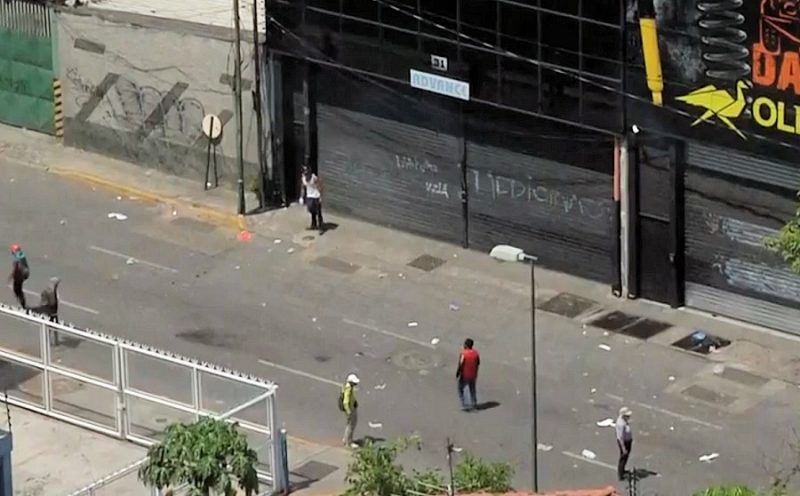
Impressive “uprising” you have there.
As a bad work of fiction, Guaidó could not mount even a lame imitation of a military-backed coup on April 30, which is just the latest in a long line of his failures this year. This character, unknown to 80% of Venezuelans a few months ago, leader of a minority party in a defunct parliament, who never campaigned for the presidency and was never elected to it—this same character posed in front of cameras and claimed military backing which he never had. So he calls on the resources of a hostile foreign power in the vain hope it make his fiction reality, clearly showing he understands nothing at all. Even worse: it shows a total lack of any care for all those who would suffer and die in war—Guaidó is ready to sacrifice them all. It’s an ill bird that fouls its own nest.
The response to Guaidó’s call? A few hundred violent protesters showed up, traded rocks with the Bolivarian National Guard, and then stood around talking to each other for hours on end. John Bolton, pushing US intervention in the name of keeping Venezuela free of external dominance (he knows no irony), even tried to nudge Venezuelans in a pitiful attempt at bribery, promising US economic relief if Guaidó took power. As far as attempted coups go, this was fortunately among the most pathetic, lame farces. There is now no resemblance between Venezuela 2019 and Libya 2011, where in the latter case opponents actually seized towns and cities and mounted protests that lasted days on end. What remains the same in the two cases is the determination of the US to implement through violent proxies a fiction of rule.
One also has to wonder how John Bolton, Mike Pompeo, and Elliot Abrams still have jobs today. Trump is not a tower of managerial business acumen after all—if one ever believed the fiction constituting his performance on The Apprentice. Bolton, who was most prominent during the April 30 coup farce, could not even keep himself from tripping over his own excremental attempt at a “narrative”. First, John Bolton called on the Venezuelan military to side with Guaidó—but then invalidated his call, turning around and asserting that, in any case, Venezuela was under (imaginary) Cuban occupation, and it was Cuban troops who were really in charge. So everything fell apart… because of Cuba, and thus Trump threatened Cuba with an embargo, which it has already been under for six decades. Cuba was the fiction used to mask another fiction—the only thing that was real here was how utterly ridiculous US empire has become.
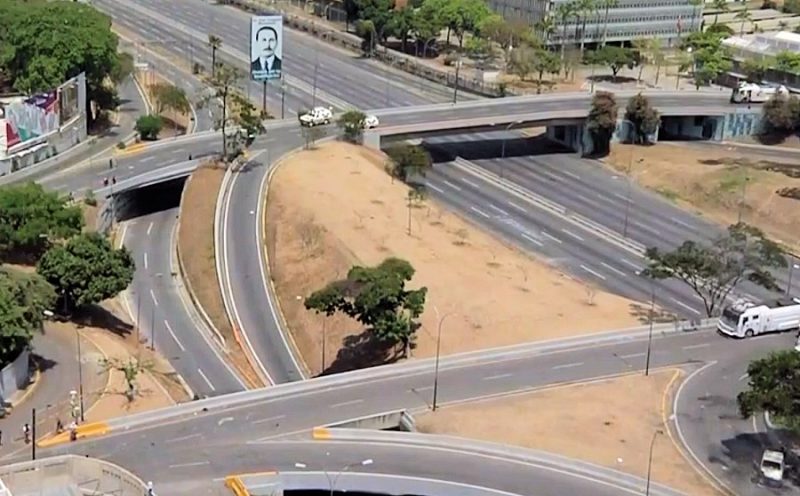
All the action, caught live on camera.
On the night of April 30, as I often do I listened to live radio from Caracas, where the assembled panellists spent a good amount of time engaged in the healthiest, most robust guffawing I have heard in ages. The subject of their laughter? Erik Prince, the war criminal who headed BlackWater and is now begging Trump for cash in return for a “plan”—a plan to send a grand total of 5,000 mercenaries to Venezuela. On RNV radio they wondered if the Americans had really become so stupid and psychotic to think that 5,000 clowns could take and hold so much as a bakery in a country which has 2,000,000 armed citizens in militias alone, not counting the hundreds of thousands in the armed forces and the paramilitary police. Apparently Prince mixed up Venezuela with Grenada—and even in Grenada it took US Marines a week to subdue armed opposition from a comparatively tiny group of diehard patriots.
Nothing is working for the US, not even what might be the most extreme sanctions ever imposed, and weeks of power outages. Certainly, none of the “humanitarian” theatre worked, whether it was the forced “aid” stunt, or the myth that Venezuelan troops set their fake aid on fire. The US was forced to imagine and fantasize about Maduro fleeing the country: witness Mike Pompeo’s bout of deranged lying about Maduro getting on a plane to Cuba, until Russia stopped him. Fictions, lies, propaganda, disinformation, fake news. To top it all off, the news came: this was not even a coup, you see. The real problem here, with such a monumental loss of face, in such a magnificent failure as April 30, is that the US will turn to even more desperate and thus more dangerous measures. However, that comes at a real cost: if the US invades, Trump has to go into an electoral contest with a new war on his back, and it’s not like such a war would come even close to a “cake walk”.
One has to wonder: will those national leaders who—without the authorization of their citizens—unilaterally “recognized” Guaidó as this so-called “interim president” thing, now take stock finally? Or will they cling to this science-fiction that there is a popular movement opposing Nicolás Maduro’s legitimate and very real government?
Clearly, very clearly as it was televised live worldwide all day on April 30 for all to see, Guaidó does not lead a popular movement. He has no authority, no legitimacy, and only a paltry amount of futile support. This so-called “uprising” was an embarrassing failure for his own image as a supposed leader. Then he takes shelter and says “tomorrow, more protests”—yes, junior, that will do the trick. Remember, sport, more always works, and besides, “there’s always tomorrow”. Keep at it, son.
This is what practice without theory looks like. This is what a “movement” without support looks like. This is what science-fiction looks like when it tries to escape the theatre and mingle with real people in the street.
Meanwhile, members of the Lima Group such as Canada, and those members of the European Union that have called for a “peaceful transition” in Venezuela, there is a lot for which they must answer. What “democracy” do they think it is where someone, not elected by the people, marshals the forces of violence in an effort to impose a government on a country? If this were to be done in their countries, would they accept it as democracy? This is the other outrageous fiction that we face: that we in North America live in democratic polities. Democracy should recognize itself in democracy—but when you instead recognize your partner in a violent clutch of putschists, then what are you?
Gitmo Destroyed Our Constitutional Order
By Jacob G. Hornberger | FFF | April 23, 2019
Sunday’s Washington Post carried an article about the suicide of former Peruvian President Alan García, who Peruvian officials had charged with official corruption while he was in office. The article posited the possibility that García committed suicide because under Peru’s judicial system, he would have faced up to three years in pretrial detention without actually being indicted, which the Post said was “a term unthinkable in many democracies, even for suspects facing overwhelming evidence of the most heinous crimes.”
What the Post did not point out is that indefinite detention without a trial is not unthinkable in the United States. Instead, thanks to the Pentagon and the CIA, indefinite detention has now become a core feature of America’s criminal-justice system. As the Post implies, it is also a hallmark of tyranny.
Among the potential acts of tyranny with which our American ancestors were most concerned was the power of the federal government to keep people in jail indefinitely without a trial. That was why the Constitution, which called into existence a government of limited powers, did not delegate such a power to federal officials. It’s also why the American people enacted the Fifth, Sixth, and Eighth Amendments, which expressly guaranty the rights of trial by jury, a speedy and public trial, bail, and protection from cruel and unusual punishments.
The Pentagon and the CIA destroyed those rights with the establishment of their prison, torture program, and “judicial” center at Guantanamo Bay, Cuba. Today, there are people at Gitmo who have been languishing for more than a decade, denied the benefits of trial by jury, a speedy and public trial, and bail.
This shouldn’t surprise us. In the long sordid history of the U.S. national-security establishment and its infamous regime-change operations in foreign countries, it has always stood for installing dictatorships into power, preferably military ones. By their very nature, military establishments almost always lean conservative, viewing procedural protections as nothing more than “technicalities” that permit guilty people to go free. Thus, the last thing that military regimes are going to do is honor and respect the principles enunciated in the U.S. Bill of Rights.
An example was the U.S.-inspired coup in Chile in 1973, where the regime of military Gen. Augusto Pinochet had his national-security state forces round up some 50,000 people, incarcerate them, rape them, torture them, and murder or disappear around 3,000 of them. No trial by jury. No bail. Fearful of the power of the Chilean national security establishment, the Chilean federal courts went silent, as did the Chilean legislature.
The same thing happened in the CIA’s coup in Guatemala some 20 years before that. The CIA succeeded in ousting the democratically elected president of the country, Jacobo Arbenz, and installed a brutal military general in his stead, who proceeded to round up, torture, and kill people without a trial.
We saw it with Iran, when a CIA coup in 1953 ousted the democratically elected prime minister, Mohammad Mossadegh, and restored the brutal tyranny of the Shah. While the Shah wasn’t a military general, his U.S.-supported rule was every bit as tyrannical as that of any military general. Indefinite detention and torture, without the benefit of a trial, were hallmarks of his brutal rule, which came to an end in 1979 when the Iranian people revolted against it.
We see it today in the military dictatorship in Egypt. Indefinite detention and torture, without trial. All fully supported by the Pentagon, the CIA, and most of the rest of the federal government.
Therefore, it shouldn’t surprise us that the Pentagon and the CIA established this same type of system in Cuba, where the ruling leftist communist regime, ironically enough, engages in indefinite detention and torture without trial as well. In fact, don’t forget that that is why our ancestors demanded that the Bill of Rights be enacted — they were certain that federal officials would do the tyrannical acts proscribed by the Amendments. What the Pentagon and the CIA have done in Cuba is a confirmation of the concerns that motivated Americans to enact the Bill of Rights.
One irony in all this, of course, is that U.S. military officials and CIA officials take an oath to support and defend the U.S. Constitution. But it’s obvious that the oath is nothing more than a lie. After all, the reason that the Pentagon and the CIA established their prison and torture center in Cuba was precisely to avoid the provisions of the Constitution. Their very aim was to establish a Constitution-free zone, one in which they could keep people jailed forever and torture them to their heart’s content and never have to bring them to trial.
It’s a sad and pathetic legacy of the decision after World War II to convert the U.S. government from a limited-government republic to a national-security state, a type of governmental structure that is inherent to totalitarian regimes, one in which government officials wield tyrannical powers. That’s why it’s not enough to close the Pentagon’s and CIA’s imperialist prison and torture center in Cuba. To restore freedom and justice to our land, it’s also necessary to restore a limited-government republic to ensure that this type of dark tyranny never afflicts our nation again.
Featured Video
US IRAN TALKS: Who Are the Crazy Ones Here? /Lt Col Daniel Davis
or go to
Aletho News Archives – Video-Images
From the Archives
Woolsey Fire started at Santa Susana Field Lab — where “radioactive materials released were never accurately measured”
By John Laforge | CounterPunch | November 30, 2018
In my Nov. 16 column, I reported on potential radiation risks posed by California’s Woolsey wildfire having burned over parts or all of the Santa Susana Field Laboratory—south of Simi Valley, Calif., 30 miles outside Los Angeles—site of at least four partial or total nuclear reactor meltdowns.
The field laboratory operated 10 experimental reactors and conducted rocket engine tests. In his 2014 book Atomic Accidents, researcher James Mahaffey writes, “The cores in four experimental reactors on site … melted.” Reactor core melts always result in the release of large amounts of radioactive gases and particles. Clean up of the deeply contaminated site has not been conducted in spite of a 2010 agreement.
Los Angeles’s KABC-7 TV reported Nov. 13 that the Santa Susana lab site “appears to be the origin of the Woolsey Fire” which has torched over 96,000 acres. Southern Calif. Public Radio said, “According to Cal Fire, the Woolsey Fire started on the afternoon of Thursday, Nov. 8 … on the Santa Susana site.” … continue
Blog Roll
 Aletho News
- US IRAN TALKS: Who Are the Crazy Ones Here? /Lt Col Daniel Davis
- Talks with the US end without a deal over excessive US demands: Iran
- Feeling Better, Getting Worse: How Psychiatric Drugs Create the Illusion They Cure
- ‘Nobody Told Me’: Former Mental Health Patient Calls Out Dangerous Side Effects of Psychiatric Drugs
- Dr. Abu-Sitta: Beirut ‘felt like a day in Shifa Hospital’
- Iran Has Won the War, It Will Be Up to the US to Secure the Peace: Mohammad Marandi
- Iran condemns assassination threats against Iranian negotiators amid US talks
- Brussels cannot say where its own pipeline inspectors are as Hungary’s oil lifeline remains shut
- Israel’s Iran War: Myth and Reality
- Between war and industrial breakdown: The US-Israeli attrition crisis
- If Americans Knew
- Pro-Israel ‘Thinktanks’ and Individuals who Influence U.S. Foreign Policy
- Mearsheimer reveals how Israel dictates US policies on Iran, Gaza – video
- After killing 350+, Israel still has a “score to settle” with Lebanon before ceasefire – Daily Update
- Military aid to Israel emerges as the latest political litmus test for Democrats
- The only Palestinian children’s rights organization closes following years-long Israeli campaign against it
- ‘I Can’t Forget the Smell’: Lebanese Reel After Israel Kills Over 300 in Single Day
- DNC Shoots Down Resolutions Calling Out AIPAC and Limiting Arms to Israel
- TCN: Is Israel Blackmailing President Trump?
- Israel killed at least 303 Lebanese yesterday – who were they? Daily Update
- Amnesty: Urgent – Protect Lebanese civilians from brutal escalation in Israeli attacks
- No Tricks Zone
- German Expert: Heat Dome Led To Record Temps In Western USA…Warmer In 1934, 1936
- New Study: No Linear Warming Or Glacier Retreat Along Northern Antarctic Peninsula Since 1980s
- An Inconvenient Tree: Uncovered In Alps… Europe Much Warmer Than Today 6000 Years Ago
- New Study Reports A 60% Slowdown In Greenland’s Ice Loss Rate In The Last Decade
- Low Intensity Tornado Wrecks Major Solar Farm, Creating A Potential Toxic Dump
- New Study Finds Warming Saves Lives…Cold Temperatures 12 Times More Deadly Than Excess Heat
- German Science Blog Accuses PIK Climate Institute Of Hallucinating Climate Tipping Points
- Devastating Assessment Of Comirnaty Vaccine By Former Senior Pfizer Europe Toxicologist
- New Study: CO2 Is ‘Effectively Negligible’ As An Explanatory Climate Change Factor Since 2000
- Former Pfizer Toxicologist Dr. Helmut Sterz Tells Bundestag Hearing Pfizer Vaccine Should Have Never Been Approved
 Aletho News