Nicaragua: Legitimacy And Human Rights
By Stephen Seftan | Tortilla con Sal | July 4, 2018
The murder of Miguel Ramos on July 3 focuses many aspects of the current crisis in Nicaragua to do with conflicting claims of legitimacy involving fundamental issues of civil and political rights and social and economic rights. In 1978 and 1979, as a teenager in the Carlos Fonseca Northern Front guerrilla column, Miguel fought for Nicaragua’s sovereign independence. On July 3 he died for that same cause, gunned down by supporters of the U.S.-backed right-wing coup in progress against the Sandinista government of President Daniel Ortega. Miguel was one of a group of civilians helping the authorities clear an opposition roadblock at La Trinidad on the Panamerican Highway about 20km south of Esteli.
On July 3, Carlos Ascencio, El Salvador’s ambassador, published an appeal on behalf of all the Central American ambassadors in Nicaragua to clear similar roadblocks in Jinotepe. His letter provides independent corroboration of the violent intimidation and extortion practised by opposition gangs who have operated these roadblocks for two months, strangling Nicaragua’s economy and abusing people’s basic rights.
Ascencio denounces the effective detention of 400 truck drivers and their vehicles near the town of Jinotepe for over a month. The drivers, from all over Central America, have been threatened and their vehicles damaged. The political opposition activists operating the roadblocks refuse to liberate the trucks and their drivers because “they are our protective shield and negotiating card to support our demands in the dialogue.”
A Focus For Murder
That is just one of the innumerable gross human rights abuses by the right-wing opposition forces promoting the attempted coup in Nicaragua. For two months the road blocks, operated by opposition paramilitaries and paid thugs, have been a focus for murder, torture, kidnapping, intimidation, extortion and criminal delinquency. Supporters of the coup turn that reality upside-down, blaming the resulting violence on the government. In their upside-down world, ordinary citizens organizing to defend their rights against armed and violent opposition gangs metamorphose into ‘Sandinista paramilitaries.’
In the case of Miguel Gomez, the opposition have already portrayed the incident in which he died as a government paramilitary attack on peaceful protesters. They will add Miguel’s death to the tally of their own casualties, even though he died at their hands. Abundant documentation and audio-visual evidence exists now disproving categorically the constant falsehoods propagated by U.S.-funded opposition human rights organizations and local Nicaraguan opposition media. The original list of 55 deaths, proclaimed with such theater on the first day of the National Dialogue, has been completely debunked. There was never any ‘student massacre.’
Sadistic Violence
Other material exposes media and NGO manipulation of opposition marches, or the deaths of women during the crisis. Numerous videos demonstrate the sadistic violence of opposition activists. Various writers like Alex Anfruns have explained the systematic pattern of media distortion and manipulation of opposition attacks and abuses reported by opposition media and NGOs as government human rights violations. No Western corporate media and only a handful of alternative media publish this material or any version challenging the demonstrable false witness of Amnesty International and the Inter-American Commission for Human Rights (IACHR).
Just as in the case of Venezuela, those organizations have failed to investigate impartially any of the incidents they report, merely recycling the version already prepared for them by U.S.-funded local NGOs and media and ignoring or rejecting documentation from the Nicaraguan authorities out of hand. IACHR Director Paulo Abrao effectively disqualified himself as an independent arbitrator during a visit to Nicaragua last May, when he was recorded publicly declaring his support for the opposition. The investigative process accompanied by a group of IACHR experts had not even begun when, on June 22, the IACHR presented their final report to the OAS Permanent Commission.
Blatant Political Bias
Perhaps as the political price of avoiding – at least for the moment – the kind of all-out economic and diplomatic assault applied to Cuba and Venezuela, the Nicaraguan government has accepted these gross methodological irregularities and the blatant political bias of the OAS and its IACHR subsidiary. For its part, the Comission for Truth, Justice and Peace appointed by the National Assembly has actively sought an exchange of information with the opposition human rights organizations. As Commission member Cairo Amador has explained, “It’s a matter of everyone providing their data and their versions so, in the end, everyone contributes to getting at the truth.”
But as Esteli Mayor Francisco Valenzuela has pointed out, the effects of the attempted coup are much broader than the civil rights violations: “The damages can definitely be classified in order of importance. First, the suffering and the victims that we all lament. Secondly, everything to do with the economy and with people’s freedoms, the roadblocks that impede freedom of movement and have affected employment. The inability to move goods and products for export has caused enormous financial losses. Tourism has suffered nationally and locally, especially small businesses. Most businesses in Nicaragua are small- or medium-sized and have been very badly affected. A lot of businesses have closed.” Economy Minister Ivan Acosta has stated: “Growth projections for the economy were 4.5 percent to 5 percent, but now we think the economy is not growing. 200,000 jobs have been lost, which affects social security, trade, domestic demand and real productive activity.”
Extensive Losses
Nicaragua’s municipal authorities report losses to vehicles, machinery and equipment of over US$10 million and to buildings and infrastructure of over US$112 million. The country’s technical training institute reports losses of US$80 million. The Ministry of Education reports over 60 schools attacked and damaged. A preliminary MINSA report in June reported 55 ambulances destroyed or damaged, as well as other damage to hospitals and health centers, all resulting from opposition attacks. The Infrastructure and Transport Ministry also reports extensive losses, for example damage valued at US$1.5 million from just one incident, when opposition activists attacked a plant in Sebaco and destroyed equipment.
None of that extraordinary level of violence and destruction figures anywhere in the reports by Amnesty International or the IACHR, nor the abuse of the basic rights of the government workers and local population involved. Similarly, neither those organizations nor the Western media have reported the role of criminals contracted to operate the opposition roadblocks and carry out attacks. On June 30, Nicaraguan police arrested Salvadoran mara leader Oscar Rivas Carrillo, who confirmed he and other criminals were being paid to operate roadblocks, carry out murders, burn public buildings and attack economic targets. Rivas and other criminals worked jointly with opposition activists supported by right-wing business interests, U.S.-funded NGOs, right-wing political parties and the Catholic Church.
Clearly, Amnesty International and the IACHR have deliberately covered up that reality and misled international opinion, faithlessly exploiting their image as defenders of human rights, just as they do on Venezuela and Cuba. Even so, despite the extreme violence and the egregious dishonesty of its apologists, the U.S.-backed right-wing opposition coup to oust President Daniel Ortega has failed. People in Nicaragua overwhelmingly support efforts to return to normality and a political solution to the crisis. The Nicaraguan authorities will tolerate the IACHR’s theatrics for another few months before the OAS circus eventually moves on. Defeated opposition leaders hoped to impose their coup, failed because they lacked popular support, and now have to accept what the Sandinista government is prepared to agree as the sovereign power in Nicaragua. Miguel Gomez did not die in vain.
Nicaragua: terrorism as an art of demonstrating
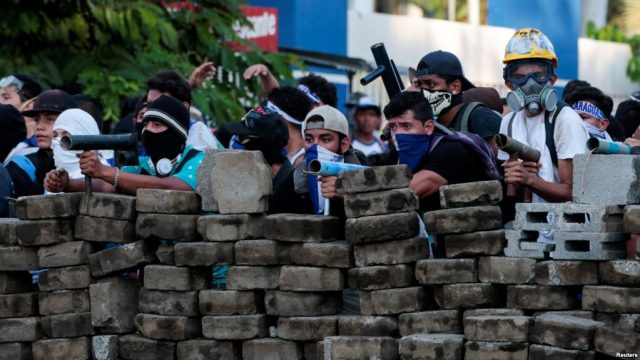
By Alex Anfruns | Investig’Action | July 1, 2018
For two months, Nicaragua has been through a major political crisis, fueled by clashes between law enforcement and an insurgency. Humanitarian organizations report a terrifying record of nearly 200 deaths. This violence, compromising the attempts of political negotiations, makes it necessary to understand who has an interest in paralyzing this Central American country. What are the motivations of protesters and opposition forces? Is the Nicaraguan government the symbol of absolute tyranny?
It was a pension reform project that started the fire. To avoid privatizing social security as recommended by the IMF, the government wanted to increase contributions for both workers and employers. Faced with a public outcry, the government backtracked and withdrew its reform plan. But the protests continued without anyone being able to understand what their objective was. In order to stop the cycle of violence, government spokesmen called on the protesters to participate in peace commissions. They insisted on their willingness to listen to the various demands and to promote the expression of political opposition. To no avail. Calls for dialogue from the government have been shunned. They were even perceived as a sign of weakness, galvanizing the young protesters of the M-19 movement.
With no program, this movement simply calls for overthrowing the “dictatorship” accused of being at the origin of the “repression”. Moreover, the international media aligned themselves without reserve with these demonstrators, regarded as the quintessence of the civil society, in spite of their nihilism and extremism. But the attitude of the M-19 raises questions. By refusing any political solution and promoting violence, the movement offers an ideal motive for the proponents of “regime change” and “constructive chaos” already applied in countries like Libya, Iraq or Ukraine
On 14 June, the M-19 operation consisting of deploying “tranques” (barricades) in certain areas of the capital Managua, as well as in nearby cities such as Masaya or Granada, was supported by a “national strike” of 24 hours. This strike was convened by COSEP, the main employers’ organization. Yes, in Nicaragua, it is the bosses who call to strike! The world upside down? The fact remains that neither the majority of workers, nor the small and medium-sized enterprises followed suit. But it allowed an evaluation of the balance of power as well as maintaining the pressure until the next phase. On June 16, the day when the peace dialogue between the opposition and the government was to be revived, a new episode of extreme violence made the front pages of the international media.
The macabre fire of the Velasquez house
First, the facts. On June 16, a group of hooded people set fire to a building in Managua using Molotov cocktails, causing seven deaths, including a two-year-old child and a five-month-old baby. A mattress store occupied the ground floor of the building while the owner and his family lived on the first floor. Neighbors said they saw hoodlums throw their cocktails at the building, and said some shooters would have prevented the family from escaping. Accident as a possible cause was therefore immediately rejected.
But private media like Televisa or BBC immediately seized on the case to blame the authorities for the crime. According to their information, paramilitaries on government payroll wanted to use the roof of the building to post snipers; the paramilitaries, having been denied access by the homeowner, would have locked him up in his residence with his family before setting it on fire. This is the same thesis defended by the Nicaraguan Center for Human Rights (CENIDH), which pointed out “their complicity with the national police”. For other governments, this argument would appear simplistic, implausible and irrational. Who would have defended the idea that the British government was behind the fire at the Grenfell tower for example? But in the case of Nicaragua, the complicity or even the responsibility of the government is put forth as a matter of fact.
To give credit to the story, the BBC used the testimony of the only survivor in the family: “Hooded people came with police officers and locked up nine people in a room on the second floor and burned us alive.” According to the same testimony, the offenders carried “mortars, weapons, and Molotov bombs”. We can only respect the bereavement of the survivor. But it cannot be dismissed that under shock, and calling for divine justice, she felt the need to find an immediate culprit. This is why it cannot be excluded that her testimony has been influenced in some way so as to channel her anger and to politically exploit it. In an effort to get closer to the truth, it is necessary to look for additional information and to cross-check it with other testimonies and documents.
The problem is that observers are facing a real war of images. Filmed from the balcony of the burned house, an amateur video was immediately relayed on social media. It aims at reinforcing the thesis of police forces and para-police organizations participation. Filmed by the eldest son of the family, Alfredo Pavon, one of the victims of the fire, this video is certainly interesting. But we see only a convoy of five police vans stopping near the house after a motorcycle chase, after which the police fires some warning shots and arrests a young biker. It’s hard to turn this into evidence. This document is nevertheless used to sow doubt, or even to point at the authorities as being responsible for the crime. Widely shared by the media in the aftermath of the crime, the video continues to be broadcast in a loop and feed hate comments…
However, these images have in fact been taken out of context: the recording was made on April 21, that is, at the very beginning of this crisis. What it reveals above all is that this precise area had been the scene of clashes between the two camps since the beginning of the crisis. This corresponds to information sent by Nicaraguan citizens, which indicates that the Carlos Marx district is controlled by the opposition. Indeed, it is hard to believe, as the opposition says, that police forces have surrounded the same neighborhood for two months, without being able to quell the protest movement until June 16, when they finally decided to use the roof of the Velasquez family to post snipers. And that’s not all. According to the same version, short of obtaining the family’s approval, the authorities acted brutally by setting the house on fire, without anticipating that it would cause a resurgence of tensions instead of calming them down.
Not really intimidated by the crime in the Velasquez house, four members of the M-19 were present on the scene the same day, to record a video where they accuse the government of “state terrorism” and call to support their movement. They take the opportunity to send a message to the negotiation table: “We are not going to remove the barricades, they are in our hands and those of the people, and we will not take them off. I want you to know: if the people do not unite, it will end up in new massacres like this one”. But have their accusations, carried by certain media and Internet users on social media, been the subject of a real inquiry gathering enough facts?
Retaliation against the right to work?
TeleSur journalist, Madelein Garcia, reports a completely different version: the people responsible for the fire are “delinquents recruited by the opposition”, “hooded men who attacked with mortars and Molotov cocktails the family home, after reading in a media that snipers of the police were hiding there.” Garcia explains that according to a friend of the family, “the hooded men asked for mattresses, the owner refused and that’s when they burned the house for revenge.”
Moreover, a disturbing screen shot of the April 19 movement was relayed via social media, including several photos of the owner of the premises, the father Velasquez Pavon, accompanied by explicit threats against him. The document dates from 2 days before the fire, that is to say at the time of the strike organized by COSEP. The commentary indicates that he did not respect the strike directive, preferring to continue working. In the eyes of his attackers, that would have been enough to make him automatically suspicious of sympathy with the government. The M-19 would have then relayed the identity and address of one of the future victims, threatening to “disappear” these “infiltrated” Sandinistas who “refuse to strike by pretending to support the people”.
Since the release of this document, it appears that the text and photos have been removed from the account, the group administrators explaining that it could be a forgery. An explanation that did not convince everyone: some remember seeing these photos before the day of the fire, and point out that the area was under the control of the opposition, including through the “tranques” (barricades).
Who to believe? We only have amateur videos published by Velasquez Pavon on his Facebook account in recent months. He proudly presents his mattress making workshop and says he works tirelessly. Would the small business owner Velasquez Pavon have been the target of opposition or paramilitary forces? Two days after the employers’ strike, would there have been any reprisals against the right to work of the Nicaraguan people? The dead do not speak; it is difficult to answer these questions. But respect for the victims requires a real independent investigation, which is incompatible with political and media manipulation.
Who wants to eliminate the Sandinistas?
Without the same outrage from the media, other killings and attacks have clearly targeted citizens and buildings associated with Sandinismo.
On the same day that the Velasquez house was burned, a funeral home located a few meters from the house was also ransacked and set on fire.
Still near the scene of the incident, two men were spotted in the street dismantling the barricades of the opposition. They were shot dead on the spot. The killers sprinkled gasoline on one of the corpses and set it on fire. Before leaving, they put objects on the burned body to create a macabre scene. It was Francisco Aráuz Pineda, from a historical family of the Sandinista Revolution.
Here is a non-exhaustive timeline sequence of violent actions that took place in just three weeks:
- On May 28, the public prosecutor’s office in Masaya was subjected to arson, while the police reported an attack on their offices.
- On May 29 protesters set fire to the offices of Tu Nueva Radio Ya, considered a pro-government media.
- On May 31, the offices of Caruna, a financial services cooperative, were set on fire.
- On June 9 it was Radio Nicaragua’s turn, destroyed by the flames. That same day, a young Sandinista activist died in a motorcycle accident while trying to dodge a trap in a barricade in San José de Jinotepe, Carazo.
- On June 12, a gang kidnapped and brutally tortured 3 workers at San José College in Jinotepe. In the context of the clashes, 2 historic Sandinista militants were murdered. Also that day, the mayor’s house was ransacked and burned.
- On June 13, another group held captive and brutally tortured Leonel Morales, a leader of the National Union of Students of Nicaragua (UNEN). The emergency doctors at Bautista Hospital treated serious wounds caused by a bullet lodged in the young man’s abdomen, which would indicate a clear intention to kill. The authors of this attack had come from the vicinity of the Polytechnic University of Managua.
- On June 15, the day after the employers strike, Sandinista lawyer and activist Marlon Medina Tobal was shot dead while walking beside a barricade in the city of Leon. On the same day, demonstrators armed with mortars were spotted in Jinotepe town.
- On June 18, criminals threw a burning tire inside the house of Rosa Argentina Solís, a 60-year-old communal leader … for “totally supporting the government of the constitutional president Daniel Ortega and reminded that he had won the elections by a majority of votes.” The same day, the house of the mother of Sandinista MP José Ramón Sarria Morales was the subject of arson. Then nine members of his family were held captive and tortured.
- On June 18, Sandinista activist Yosep Joel Mendoza Sequeira, a resident of Simón Bolivar Matagalpa neighborhood, was held captive and savagely tortured. The same day, a video was relayed via social media, where a young woman accused of sympathy with the government is humiliated and tortured during an interrogation.
- On June 21, after being held by men manning barricades in Zaragoza, Stiaba, a young Sandinista youth activist named Sander Bonilla was savagely tortured under the impassive gaze of a priest.
- On June 22, an anti-Sandinist group fired at the house of the teacher Mayra Garmendia in Jinotega and burned the building where her family was, who managed to escape.
The similarities with the crimes perpetrated in Venezuela by the anti-Chavista opposition a year ago suggest that this wave of violence is primarily motivated by a deep ideological hatred that goes beyond the framework of ordinary crime.
When the dead are brought back to life
To these brutal attacks that speak for themselves, we can add the confusion maintained by the protesters themselves with the complicity of the private media.
- Thus, on April 23, at the very beginning of the protests, motorcyclists carrying Molotov cocktails shot at point blank range Roberto Carlos Garcia Paladino, a 40-year-old man who died on the spot. His mother, Janeth Garcia, denounced the opposition for using his image by making him a student victim of repression. “They are carrying the flag with his image, as if it were a flag of struggle, but he was not a student, you can verify it without problems.”
- On May 4 a video with the testimony of José Daniel García is broadcast. He denounces the use of his own photo in a demonstration, looking as if he was killed in the clashes. Alerted by his mother, García demands that his photo be removed. According to him, this “manipulation is intended to deceive the people”. Similar cases where the dead are resurrected have been identified:
- On May 13, a Frente Sandinista activist, Heriberto Rodríguez, was shot dead in the head near a cinema in Masaya. The private media say he was murdered during a protest, portraying him as a martyr of the anti-government struggle, while Sandinismo’s Voice media claims he was killed by gangs of criminals allied with the right.
- On May 16, a group of demonstrators near the Metrocentro Mall in Managua threw down a metal art installation called “The Tree of Life”. After demolishing it, they stomped on it. The filmmaker of Guatemalan origin Eduardo Spiegler, who was there at the time of the incident, was crushed by the weight of the metal construction and died on the spot. His picture will be used to make it look as if he was a student victim of the repression, which some will denounce as manipulation.
- On May 30, the 18-year-old Mario Alberto Medina’s family, who died in September 2017, condemns the “unscrupulous actions of people who are using the young man’s photographs to add them to the list of dead”.
Other people also discovered the presence of their name or photo in a list of dead claimed by the protesters: Christomar Baltodano, Karla Sotelo, Marlon Joshua Martinez, Marlon Jose Davila, William Daniel Gonzalez … Much like in Venezuela in 2014, the public was intoxicated by a massive campaign of fake news via social media.
Observers on the “good side” of the barricade
If we want to broaden the perspective, short of exposing the long history, it is necessary to return to the chronology of the facts. On June 15, the Catholic Church’s peace dialogue had just resumed after the talks had been interrupted since May 23. The new agenda between the government and the opposition renewed the authorization granted to a list of international organizations to participate in observation missions in the country, in order to identify all murders and acts of violence as well as their leaders, with an integral plan of care for victims in order to achieve effective justice. They included observers from the Inter-American Commission on Human Rights (IACHR), as well as the EU.
An organization dependent of the Organization of American States (aligned with Washington), the IACHR had already carried out a mission between May 17 and May 21. Then it continued to issue reports, the last of which coincided with the day of the strike. Its record attributed to the government of Daniel Ortega the central responsibility in this crisis, while recognizing the presence of armed groups with “homemade mortars filled with gunpowder” in the ranks of the demonstrators. The wording is not very eloquent: the reader of the release is unlikely to imagine the scenes of horror that these groups were responsible for.
On June 14, the Nicaraguan Foreign Ministry replied in a letter that the work of the IACHR had still not taken into account “evidence of atrocious crimes, cruel and degrading treatment, kidnapping and other acts of violence committed against the population and especially against public officials and persons known to be Sandinistas “. Given the biased stance it is accused of, the authorization to visit the premises that the Ortega government granted to the IACHR on June 26, must be considered as a concession in the framework of peace negotiations between the two parties. Especially since institutions like Amnesty International have clearly shown that they are on the other side of the barricade, turning a deaf ear to the testimonies that are not aligned with the dominant narrative.
Caution is therefore required. If we assume the hypothesis of a political motive behind the frightening crime of the Velasquez house, the arrival of the investigators of the IACHR could have constituted a special motivation, in order to attract the international public opinion’s attention. Be that as it may, it did not take long to happen.
First, on June 18 the Civic Alliance, the political opposition movement engaged in dialogue with the government, announced its withdrawal from the negotiation table and demanded the presence of external observers. The reactions were immediate, notably that of the representative of the OAS Luis Almagro and the IACHR… and finally the unavoidable press release of the spokesperson of the US Department of State Heather Nauert, condemning the ‘current violence sponsored by the government, including the attack on June 16 against the residence and trade of a family…”. Nauert recommended that the government should carry on according to the points on the peace agenda, including the planned visit of observers of the IACHR. Her conclusion is quite significant: the United States “takes note of the general appeal of Nicaraguans for new presidential elections” and “considers that the elections would be a constructive way forward”!
This statement contains a thinly veiled threat: it is an interference with the sovereignty of Nicaragua. It relies on a new balance of power, starting from the mid-June sequence – the strike and the peace agreement, undermined by the new violence of the weekend, which has had as a result the opposition leaving the negotiation table. Nauert therefore puts pressure on the Ortega government, which is now confronted on the one hand with increased street violence and lack of dialogue with the political opposition, and on the other hand with the arrival of the observation missions – who have probably already decided in advance the conclusion of their report.
Is “regime change” a thing of the past?
Unless one is uncontrollably naive, everyone will have noticed that the United States continues to regard Latin America as its backyard. For we cannot dismiss the role played in Nicaragua by a certain international activism, which is centered on the United States Congress, where the Nica Act was approved last November. Under the initiative of Ileana Ros-Lehtinen, an anti-Castro Cuban-American elected member of the Republican party, this law aims to stifle the Nicaraguan economy, blocking international loans. The reason? “Human rights violations, the regression of democracy in Nicaragua, and the dismantling of the free elections system in this country”.
When the United States presents itself as the defender of human rights and the champion of democracy in the world, it should be remembered that in recent years bodies dedicated to “promoting democracy”, such as USAID or the NED, showered opposition movements with dollars (support that the protesters do not hide). Simultaneously, Senator Marco Rubio proposed to use the Magnitsky Act as a weapon of financial sanctions against the Vice-President of the mixed enterprise Albanisa. What was Rubio’s aim? “Not only to support the desire for new elections as soon as possible to change the government, but also change the constitution, because a new government on the basis of corruption and dictatorship is more or less the same thing.” Helping to overthrow the government elected by the Nicaraguan people is not enough, so you have to write directly a new constitution in its place, to prevent these Latinos from returning to bad habits!
All these mechanisms of destabilization correspond to the different phases of a real hybrid war. In the view of the neoconservative strategists, “constructive chaos” is far better than the loss of the areas of direct influence of yesteryear. If Nicaragua is again in the line of sight of US imperialism, the real reasons are mostly economic.
Nicaragua, theater of a long US strategic war
As early as 1825, the Federal Republic of Central America, a political entity stemming from the wars of independence, had commissioned a study on the creation of a canal on the Lake Nicaragua Canal route. It was a strategic project for the economic development and survival of the young republic. But following the creation of the Independent State of Nicaragua in 1838, the Central American Federation broke out, dividing it into six different political entities (Guatemala, Belize, El Salvador, Honduras, Nicaragua and Costa Rica). What about the economic integration project in the region? It fell into oblivion.

For the United States, the break-up of Central America was therefore very advantageous from a strategic point of view. In 1846, the Colombian government with the United States signed the Mallarino-Bidlak Treaty, by which Colombia was to ensure free circulation in this region, where the United States planned to create an inter-oceanic canal. Following the vision of US Marine Corps Captain Alfred Thayer, the goal was to better control maritime trade. The new agreement offered US troops the pretext to intervene militarily 14 times, relying on the legal foundations of the treaty. Thus the United States played a decisive role in the separation of Colombia and the Department of Panama on November 3, 1903.
As a reminder, as early as 1823, the United States had issued a warning to the European powers who would be tempted to regain control over the young emerging republics. It was the famous Monroe Doctrine: “America for Americans”. Translation: The United States were keeping a “right of interference” on its southern neighbors. Well, in 1850 the United States signed a similar treaty with England, which since 1661 had established a protectorate over the coastal region of Mosquitia, allying itself with the indigenous Mosquito people against the Spaniards. The agreement between the two powers provided for the shared control of the coast and the circulation of goods in the future canal. But in 1860, Nicaragua signed another agreement with England, by which it formally renounced the protectorate. In its place, the Kingdom of Mosquitia was created, with a constitution based on English laws. In 1904, Mosquitia was finally incorporated in Nicaragua.
On December 6, 1904, facing the US Congress, President Theodore Roosevelt proclaimed the “Big Stick” doctrine, also known as the “Roosevelt Corollary.” This foreign policy was practiced in the period between 1898 and 1934 where, in order to protect its commercial interests, the United States occupied several Latin American countries, in what would become known as the “banana wars”. William Howard Taft, who had been appointed Secretary of War in the Roosevelt administration, did not hesitate to use force in several countries. Significantly, the same Taft was responsible for overseeing the construction of the Panama Canal, which was finally inaugurated in 1914.
It must be remembered that the initial project for the construction of the Panama Canal was first granted by Colombia to France thanks to the signing of the Salgar-Wyse agreement. The works, led by Ferdinand de Lesseps, the engineer responsible for the Suez Canal in Egypt, began in 1878 and lasted ten years, but was abandoned in 1888. The abandonment of the project by the French led to the United States resuming the idea of the canal and commissioned a study of the American Congress at the Walker Commission. Finally, the choice was on Nicaragua and a construction treaty was signed. But this country opposed the granting of a route planned by the United States, and envisaged the possibility of granting it to Germany. In retaliation, in August 1912, the United States sent troops to Nicaragua. They would only return home after 21 years of occupation, turning the country into a sort of protectorate. The invasion served the purpose of preventing another country from building a canal in the area. In 1916, the newly elected Adolfo Diaz government, with the kind support of the US Marines, signed with the United States the Bryan-Chamorro Treaty, through which that country obtained the concession for the canal for a period of 99 years and the authorization to install a naval base.
The success of the Panama Canal and the long invasion of Nicaragua by the United States threw the other canal project into the dustbin of history. But not forever. Daniel Ortega, the historical leader of the Sandinista Revolution who was president of Nicaragua in the 1980s and re-elected in 2006, brought back the project. In 2013, the National Assembly approved a law granting the concession of the new Transoceanic Canal to the private Chinese company HKND. If it saw the light of day, it would be three times the size of the Panama Canal. In other words, there would be a serious competition issue.
Translated from French by Tamarvlad
The Immigration Con: How the Duopoly Makes the Public Forget about Roots Causes of War and Economics
By Sam Husseini | June 26, 2018
Many are focusing on the travel ban, largely targeting Muslim countries, and the separation and detention of asylum seekers separated from their children at the U.S.-Mexico border. The the U.S. media and political establishment has put the issue of immigration front and center, causing all manner of political venting and pro and anti Trump venom to spew forth.
A silver lining seems to be that it has helped raise issues that — unlike the Russiagate story much of the establishment media has obsessed over — at least have some currency with the general public.
But the manner in which immigration issues have been focused on has obscured the root causes of those issues. Desperate migration is ultimately caused by economics, like so-called trade deals, corrupt Central American governments, often U.S.-backed, U.S.-backed coups and other policies.
And refugees desperately flee countries like Syria largely because of prolonged U.S.-backed wars.
In virtually all these instances, there is left-right opposition to the establishment policy that is often at the root of the problem. The establishment of the Republican and Democratic party have rammed through trade deals like NAFTA and CAFTA and global pro-corporate policies. The U.S. government — with both Obama and Trump administrations — has backed coups like Honduras in 2009 or rigged elections like in 2017.
Corporate deals and coups and such give rise to governments unresponsive to their citizens, enacting economic policies that have impoverished most of the people of these countries. It’s a testament to the long term effects of U.S. interventions that regions like Central America, which have been the focus of so much U.S. government attention over the decades, are in such dismal condition.
Such circumstances breed gangs, which means a lack of safety, causing desperate migration. Parts of grassroots economies, like small farmers growing corn, have been decimated because deals like NAFTA allow for dumping of U.S. agribusiness corn. Drug cartels rise as a way to make money for some — and to fulfill a demand for narcotics in the U.S., an escape for USians from their own economic plights and often nihilistic lives. Meanwhile, transpartisan efforts at drug legalization are pushed to the background.
Similarly, many leftists and some rightwingers, like Ron Paul, oppose constant U.S. interventions in the Mideast as well. The invasion of Iraq lead to the rise of ISIS, the destablization of Syria, Libya and other countries. The U.S. establishment and its allies, Saudi Arabia and Israel have effectively sought to prolong the war in Syria and to destabilize other counties in the region for their geostrategic designs.
The rank and file bases of the Democratic and Republican parties are largely against NAFTA, CAFTA, etc. — while the elites in both parties are for them, so they get done. Clinton and Obama were duplicitously for them (pretending that side deals on labor and environment will do much and thus to distract from their pushing the corporate agenda). Trump rants and raves about much, but hasn’t put forward a serious critique of them.
So, the bases of the two parties end up fuming at each other over the status of migrants from Central America and travelers from largely Muslim countries. They become further entrenched into either establishment party structure while the people running those structures continue to perpetuate policies that the bases agree with each other about.
Wars cause refugees. Then, the left and right scream at each other over the refugees, forgetting how the establishment continues the wars that the left and right are significantly opposed to.
All this has the effect of further entrenching people in their partisan boxes. Progressives with problems with the Democratic Party do their duty to fight against the Trumpsters and vice versa.
So, you get more war and more pro-corporate policies.
The manner of these debates tears people apart just enough to prevent dialogue. Sarah Sanders is told to leave a restaurant, but pundits on CNN urge the public not to be out in the streets arguing. Voting is the one and only path to making your voice heard. Shut up and get in line.
The debates rarely question national myths. Quite the contrary, they are an opportunity for “both sides” to appear to more loudly vocalize how they embody the goodness inherent in the U.S. “We need to reclaim our values… We’re a good nation, we’re a good people. And we should be setting a standard on this planet of what humanity should be about,” says Sen. Cory Booker after the Supreme Court upholds President Trump’s travel ban.
What “humanity should be about”. This from a member of a Democratic Party establishment that has fueled polarization with the other nation on the planet with thousands of nuclear warheads. From a party establishment that has dismissed apparent progress toward finally ending the bloody Korean War. Just this week, Senators from both sides of the aisle voted to allocate more and more money for wars. The recent increases in the Pentagon budget are more than the entire military budget of the great threat, Russia.
But pay no attention to that. National piety is upheld. The U.S. is so wonderful, the immigrants want in. That proves it. Never mind U.S. government policies helped impoverish them. Never mind U.S. government wars destroyed the countries of millions of refugees. Never mind what you think might be wrong with the country, just be grateful you’re here.
U.S. benevolence is to be proven by taking in a nominal number of refugees to some self-proclaimed liberals. So-called conservatives preserved the dignity of the nation not by insisting that the rule of law be applied to high officials, but that we should have zero tolerance for helping some desperate souls.
The diminishing economic state of USians emanating from economic inequality is largely off the agenda of both parties. They entrench the partisan divide, but in a way that obscures deeper issues. Party on.
Sam Husseini is founder of VotePact.org, which encourages intelligent left-right cooperation.
Venezuela Criticizes ‘Politicized’ UN Human Rights Report
teleSUR | June 22, 2018
The Venezuelan government has criticized a United Nations human rights report on the Latin American nation as “lacking technical rigour and objectivity.”
“Venezuela categorically rejects the report regarding the alleged human rights situation in the country, published by the Office of United Nations High Commissioner for Human Rights, as a result of a highly questionable methodology that buries the credibility and technical rigor demanded of an office of this nature, and violates the principles of objectivity, impartiality and non-selectivity,” a statement released by the Ministry of Foreign Relations said.
UN High Commissioner for Human Rights and Jordanian prince, Zeid Ra’ad Al Hussein, said Friday that “rule of law is virtually absent in Venezuela,” after a report was published citing “shocking” accounts of alleged extrajudicial killings by state forces.
The Venezuelan government responded that “Mr Zeid Ra’ad Al Hussein confirms his complicity with the multiform aggression that is underway against Venezuela, keeping silent in the face of the negative impact on the enjoyment of economic, social, and cultural rights created by coercive, unilateral measures imposed by the United States of America and its servile allies in the region.”
The statement also pointed out that all official information provided by the Venezuelan government has been excluded from the report, “in order to build a grotesque media farce on this matter.”
The Foreign Ministry “reiterates its inescapable commitment to human rights” and its “willingness to continue cooperating with the organs of the United Nations system on issues of human rights, provided that the sovereignty of the country is respected and that it acts in accordance with rigour and truth.”
UN independent expert and Rapporteur, Alfred de Zayas, who himself was in Venezuela compiling data on human rights last year, described the report as lacking objectivity and neutrality.
“My worry is the credibility of the office when it shows no neutrality nor objectivity,” he stated following the release of the report.
Much of the report referred to the State’s reaction to the 2014 and 2017 right wing violent street protests, and the Operation of People’s Liberation (OLP) crime operatives which were temporarily held during 2017.
Venezuela’s Jose Vicente Rangel, who served as vice president under Hugo Chavez and now has a popular weekly TV show, warned of police abuses back in April, highlighting “operations that police groups are carrying out, operations that involve outrages against citizens and numerous cases of murder in the barrios.”
He alleged that the suspended OLP ops were being continued extra-officially by the FAES special police forces.
Colombian President-elect will not recognise Venezuela’s government, says to withdraw from UNASUR
Venezuelanalysis | June 21, 2018
Colombian President-elect Ivan Duque has vowed to not send an ambassador to Caracas upon assuming the presidency, claiming not to recognise the Venezuelan government in heated statements less than two weeks after his electoral victory.
“We can’t accept having links with a government which we consider to be illegitimate,” declared the winner of the June 17 election. Duque obtained 54 percent of the vote amid a 53 percent participation.
The president-elect, who will take power on August 7, also characterized Venezuelan President Nicolas Maduro as a “dictator,” alleging the existence of government-sponsored “drug trafficking structures.”
Similarly, Duque criticised Venezuela’s recent May 20 elections, which he considers to have been “openly manipulated.”
Venezuela’s May 20 presidential elections were declared free and fair by numerous international accompaniment missions who observed the process in the Caribbean nation.
By contrast, Colombia’s recent balloting has drawn significant criticism, with Colombia’s Immediate Reception for the Electoral Transparency Unit (URIEL) registering 1,239 complaints on the day of voting, 51 percent of which referred to “pressure and threats” to voters.
Duque is considered a hard-line politician of the right wing Democratic Centre center who is extremely close to party head and ex-Colombian President Alvaro Uribe, both in his rejection to the Colombian peace process and in the aggressive tone taken in relation to Caracas.
However, unlike Uribe, who stated days after his presidency was over that an invasion to Venezuela had been on the table, Duque has calmed concerns over a possible military encounter between NATO member Colombia and Venezuela, saying that he will not “assume a warlike attitude towards Venezuela.”
Nonetheless, the new Colombian president has threatened to denounce his Venezuelan counterpart at the UN Security Council. Duque has also promised to withdraw from regional body UNASUR for its “complicity” with Venezuela.
The tense relations between Colombia and Venezuela since 1999 have not stopped the abundant, migration between the two populations. It is estimated that more than five million Colombians entered Venezuela fleeing the civil war and government persecution. Likewise, recent data suggests that more than one million Venezuelans have crossed into Colombia in the past two years.
Nicaragua : Defeating the Soft Coup
By Tortilla Con Sal | teleSUR | June 12, 2018
Nicaragua has been a good example of how Western corporate and alternative news media are able to create a custom-made bizarro-world to suit the propaganda requirements of their countries’ elites. The current media onslaught against Nicaragua uses the whole toolbox of propaganda tricks portraying aggressors as victims, reporting non-existent massacres of peacefully protesting students, denying systematic destruction by opposition paramilitaries of public property and private businesses, even omitting attacks on hospitals and ambulances. The big fundamental fiction has been that a majority of people in Nicaragua reject the Sandinista government led by President Daniel Ortega. The converse of the lie is that most people support the so-called Civic Alliance composed of right-wing business leaders, right-wing political parties, reactionary Catholic bishops, US-funded NGOs and university students allied to those interests.
But events in real life contradict the minority opposition storyline. On April 22nd, the supposed dictatorship proposed a national dialogue mediated by the Catholic church. It took the opposition almost three weeks to agree. They did so on condition the government withdraw the police from the streets. In fact, police had already been ordered not to intervene against the violent opposition paramilitaries. The government agreed, but when the dialogue began the bishops refused to condemn opposition violence while still falsely accusing the government of violent repression. The opposition never tried to negotiate in good faith, simply demanding the government resign and refusing to dismantle roadblocks which the government, supposedly a dictatorship, allowed to operate so as to avoid more violent conflict.
The government strategy has been to accept extraordinary levels of opposition violence and intimidation so as to allow the opposition to discredit themselves with public opinion. The opposition violence and roadblocks have disrupted economic life, affecting thousands of small and micro businesses, throwing tens of thousands into unemployment and causing hardship for many thousands of people with serious health problems. The opposition paramilitary violence has destroyed numerous public buildings and government offices in various cities, decimated the tourist industry, cost the lives of around 150 people and left over 1100 injured. Some of the worst violence has been in the tourist cities of Granada and Masaya where hundreds of businesses have been practically destroyed. In that context, the Catholic bishops categorically betrayed their mediation role last week by presenting President Ortega with an undisclosed ultimatum very obviously in sympathy with the political opposition and demanding a response in two days.
Following that ultimatum delivered on June 7th, the opposition paramilitaries staged a wave of attacks against government offices in León, Masaya and Jinotega, also attacking police stations elsewhere to steal firearms, kidnapping and torturing police officers. In an attack on Monday, June 11th, a gang of paramilitaries killed two more police officers, wounding two in Mulukukú in the country’s northern Mining Triangle. At the same time, they intensified their roadblocks almost completely stopping traffic along the highway between Managua and the north of the country. That same day, police acted to clear some of the roadblocks in what many people view as the beginning of President Ortega’s response to the bishops’ ultimatum. The government decision to act against the roadblocks strangling the economy is clearly supported by a majority of people in the country. But it remains to be seen how the opposition will react.
One feature in particular of the crisis covered up by alternative and corporate media has been the role in the opposition violence of organized crime and delinquents. From the very start of the crisis on April 18th criminals and youth gangs have operated alongside right-wing extremists to foment civil disturbances and lethal violence. One notorious group involved in attacks portrayed as political protest and also responsible for various murders, including one of a US citizen, was broken up by police on May 31st. The group operated out of the private Polytechnic University occupied by opposition students and associated protestors, including this group of criminals The police have accused right-wing political activist Felix Maradiaga of involvement with that criminal group. Maradiaga, one of the leaders of the opposition protests against the government is currently in the United States where he went to lobby against the Nicaraguan government in the Organization of American States General Assembly on June 4th and 5th.
During that OAS General Assembly, Nicaragua’s diplomats defeated opposition efforts to secure any condemnation of President Ortega’s government. Secretary-General Luis Almagro had previously denounced deceitful and misleading statements from Nicaragua’s opposition, insisting on a constitutional resolution of the country’s crisis. That lead Felix Maradiaga to accuse Almagro of being President Ortega’s accomplice, to which Almagro retorted that he is indeed an accomplice, but an accomplice of democracy against anti-democratic moves in violation of constitutional norms. Subsequently, the United Nations Secretary-General expressed his satisfaction that the Nicaraguan government is working closely with the OAS to reach a negotiated settlement to Nicaragua’s political crisis, a position supported by the European Union and, at least nominally, even by the US State Department.
These setbacks at the international level for Nicaragua’s political opposition have been followed by the collapse of the Catholic bishops’ credibility as mediators for the dialogue and the emergence of clear majority support nationally for an end to the violence and the economic damage and distress it has caused. In this new context, Nicaragua’s Sandinista government seems to be moving cautiously to clear the roadblocks while at the same time developing local initiatives for peace and dialogue aimed at isolating the violent opposition paramilitary groups. As that process advances, Nicaragua’s political opposition are likely to act with increasing desperation to try and mitigate the likely consequences of their attempted coup. While the next couple of weeks may well see the beginnings of a political settlement of the crisis, achieving that outcome is likely to come at the price of yet more death and destruction from Nicaragua’s opposition extremists.
Colombia, the death squads & the US’ human rights double standard
Dan Kovalik | RT | June 7, 2018
Nearly every day, we are bombarded with “news” about problems in Venezuela. And certainly, there are problems, such as food and medicine shortages and skyrocketing inflation. But there is something that is downplayed.
What the press downplays, if it mentions it at all, is the very real and significant ways that US sanctions have contributed to these problems facing Venezuela and how these sanctions are making it nearly impossible for Venezuela to solve these problems.
What the press also fails to mention is the even greater humanitarian issues confronting Venezuela’s next-door neighbor, Colombia – the US’ number one ally in the region and, quite bizarrely, the newest “global partner” of NATO from Latin America. And, the US is very much responsible for these issues as well, but in quite different ways.
The fact is that, by a number of measures, Colombia has one of the worst human rights situations on earth, but you would never know this from watching the nightly news.
First of all, Colombia has the largest number of people forcibly disappeared in all of the Americas – even more than all of the Southern Cone countries combined during the infamous ‘dirty war’ years – at over 60,000.
In addition, Colombia has one of the largest internally displaced populations on earth at well over 7 million – second only to Syria. And, a disproportionate number of these internally displaced are indigenous and Afro-descendants.
Moreover, Colombia ranks 5th in the world for the number of children internally displaced by conflict, with two million boys and girls internally displaced. Quite shockingly, Colombia ranks 3rd in the world for the number of children murdered, with 715 children murdered just last year. Such statistics have led Save The Children to conclude that Colombia is “one of the worst countries to be a child and adolescent in the world.”
Colombia is also one of the worst countries in the world to be a social leader, such as a human rights defender, union leader, indigenous or Afro-Colombian leader. Thus, even after the signing of a peace deal between the Colombian government and FARC guerrillas in 2016, social leaders are being murdered at an alarming rate. Indeed, over 200 social leaders have been killed just since January of 2017. Last year was in fact the worst year on record for human rights defenders in Colombia, with 120 killed in 2017.
Of course, the US has a large responsibility to bear for this awful situation in Colombia, as it has been the intellectual author behind Colombia’s brutal, decades-long war against its own people and has provided billions of dollars of material aid to this war effort. Indeed, since 2000, the US has given Colombia $10 billion in mostly military assistance as part of its counter-insurgency program known as ‘Plan Colombia.’ During the Plan Colombia years, the Colombian military attempted to boost US military assistance by murdering civilians in cold blood and passing them off as left-wing guerillas. It is now believed that the military killed 10,000 civilians in this grisly “false positive” operation.
But the US is also behind an even darker force than the Colombian military – that is, the Colombian paramilitary death squads. While those who live in the more remote parts of Colombia are painfully aware of the paramilitaries’ presence and brutality, the paramilitaries are now a well-kept secret in the more well-to-do parts of Colombia’s big cities and even more so outside of Colombia. Indeed, the Colombian and US governments deny the very existence of these paramilitary groups, and the compliant press is happy to oblige in keeping this dirty secret.
Recently, Colombia’s most prominent human rights defender, Father Javier Giraldo, S.J., spoke about the paramilitary phenomenon of which he is an expert. As he explains, “There are clandestine or semi-clandestine arms of the State, which are the paramilitary groups. Today, it is not tolerated that you refer to them as such, but I still call them paramilitaries, because that is the appropriate term.”
Father Giraldo describes the origin of the paramilitary death squads, a force developed by the United States before the left-wing guerrillas even came into existence in 1964. As Father Giraldo explains:
“In 1962, when Guillermo León Valencia was president, a mission of the North American army, of a special school of war in North Carolina, created after the Second World War to maintain the security of the United States, arrived in Colombia… They analyzed the situation in Colombia and left secret instructions, ordering the Colombian government to begin training mixed groups of civilians and the military, and preparing them for paramilitary terrorist activities to combat the sympathizers of communism.”
“… President Valencia, on Christmas day of the year 1965, issued Decree 3398 with which he changed the name of the Ministry of War to [the Ministry of] Defense, and authorized forming groups of civilians as auxiliaries of the armed forces, the legal basis of paramilitarism.”
“… The United States began to direct the entire security apparatus in Colombia and its agencies… first with 400 officers of the US Army; today there are at least 800. The paramilitarism that was created at that time, with all the legal support, has been reaffirmed.”
Of course, as Father Giraldo has explained on numerous occasions, the ostensible “sympathizers of communism” targeted by the paramilitaries are trade union leaders, human rights defenders, peasant leaders, and Catholic priests who advocate on behalf of the poor. As for Catholic priests, over 80 have been murdered since 1984 for the crime of advocating on behalf of the poor.
It is now becoming more evident than ever from the fact that there is now a rise in the murder of such social leaders, as well as mass forced displacement, after the disarming of the FARC guerrillas, that it, is the paramilitaries which are responsible for the lion’s share of such human rights abuses in Colombia. But again, you would have no idea about this from reading the newspapers or watching the nightly news. And, Colombians who are suffering at the hands of the paramilitaries are painfully aware of the conspiracy of silence around this issue.
Indeed, when I was recently in Colombia for the first round of the presidential elections, our delegation met with a number of residents of the small town of Suarez (Cauca Department) which had just lost three members of their community to paramilitary violence. One of the members of the community desperately asked us, “what can we do to let the world know of the continued existence of the paramilitaries?” I answered that we have been trying to do just that for many years, though few will hear us out on this issue.
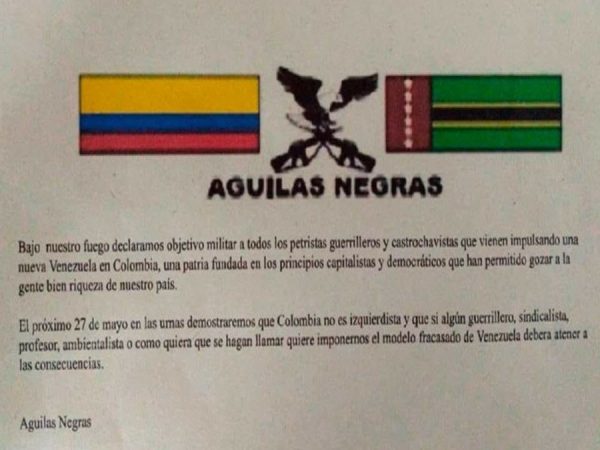
While we were in Colombia, a campaign coordinator for Gustavo Petro, a Colombian presidential candidate, was murdered by paramilitaries the day before the election, and the paramilitary group known as ‘Aguilas Negras’ (Black Eagles) issued a general threat against the supporters of Petro for president just a few days before the May 27 vote.
© Dan Kovalik
If Colombia’s very real human rights and humanitarian crises were given nearly the attention that the problems in neighboring Venezuela receives, the US and Colombian government would at least have some incentive to improve the situation in Colombia and to go after the paramilitary groups which continue to haunt that country. The near complete silence about the staggering violence in Colombia is critical in allowing that violence to continue. Indeed, the paramilitaries have always depended upon being able to operate in the shadows, and the US press is more than happy to oblige them in this effort.
Dan Kovalik teaches International Human Rights at the University of Pittsburgh School of Law. He is the author of ‘The Plot to Attack Iran.’
Rebellion or Counter-Revolution: Made In US In Nicaragua?
By Achim Rödner – teleSUR – May 30, 2018
Many wonder if the United States is involved in the student protests of the past month in Nicaragua which attempted to destabilize the country. Western media writes nothing about the issue, while at the same time similar scenarios have played out in Venezuela, Brazil, Cuba, Honduras, Bolivia and other countries in which the left has made progress. At this moment, three Nicaraguan students are touring Europe and Sweden in search of support for their campaign. At least one of the students represents an organization funded and created by the United States.
The student protests in Nicaragua are described in the Western media as legitimate protests by young Nicaraguans who have spontaneously united to fight the supposed dictatorship. Surely there are many young people who have joined the fight with these ideas. Surely many people here in Sweden have joined and support that struggle. But there is much that indicates that these are not just spontaneous protests. There are many indications that organizations led by the United States waited for the right moment to create chaos, and exacerbate the contradictions to destabilize the democratically elected government of Nicaragua.
Changing Society
One of the three students on tour in Sweden right now is Jessica Cisneros, active in issues of integration and youth participation in political processes. She is a member of the Movimiento Civico de Juventudes (MCJ). That organization is financed, created by and an integral part of the National Democratic Institute. The NDI is an organization that works to change society in other countries. The president of the NDI is Madeleine Albright, former U.S. secretary of state. The general secretary of the MCJ, Davis Jose Nicaragua Lopez, founder of the organization, is also the coordinator of the NDI in Nicaragua and active in a series of similar organizations in Nicaragua and El Salvador.
Excerpt from the NDI website: “The Civic Youth Movement (MCJ) has been part of an NDI project that began in 2015 with the aim of expanding youth leadership and political commitment by providing hands-on training in organizational techniques. Several of the group members are graduates of the Leadership and Political Conduct Certification (CLPM) program that the NDI has supported in conjunction with Nicaraguan universities and civil society organizations.”
Yerling Aguilera is from the Polytechnic University (UPOLI) of Managua and has specialized in research on the revolution and the feminist movement. She has also been an employee and consultant for IEEPP in Nicaragua, which works to strengthen the capacity of political, state and social actors for a better informed public through creative and innovative services. IEEPP has received support from the National Endowment for Democracy (NED) of US$224,162 between 2014 and 2017.
Madelaine Caracas participates in the national dialogue currently taking place in Nicaragua. She is also active in the feminist and environmental movement.
From 2015 on, the United States expanded its support to Nicaragua, especially through support for leadership courses and money for young people in universities, schools, NGOs and political parties. Organizations that work with feminist movements and women, human rights and the environment have been prioritized.
This from the NDI website: “To ensure that the next generation of leaders will be equipped to govern in a democratic and transparent manner, since 2010 the NDI has partnered with Nicaraguan universities and civic organizations to lead a youth leadership program that has helped prepare more than 2,000 youth leaders, current and future, throughout the country. The NDI has also contributed to Nicaragua’s efforts to increase women’s political participation and initiatives to reduce discrimination against LGBT people, as well as shared best practices for monitoring electoral processes.” Is foreign interference in democracy and elections good for Nicaragua, but unacceptable for the United States and Sweden?
Foreign Interference
It is also interesting to compare what happens in Nicaragua with what happens in other countries. The NDI also works in Venezuela, also with subversive tasks. The activity of the United States and the NDI in Latin America should be compared with the debate on the interference of powers in the electoral systems of the United States, Sweden or Europe. For example, would those countries accept that Russia form and support organizations that train political leaders in Sweden or the United States?
This is how the NDI describes its activities in Venezuela on its website: “The NDI began working in Venezuela in the mid-1990s in response to requests to exchange international experiences on comparative approaches to democratic governance. After closing its offices in Venezuela in 2011, the NDI has continued – based on requests – offering material resources to democratic processes, including international approaches on electoral transparency, monitoring of political processes and civic and political organization, and the Institute promotes dialogue among Venezuelans and their civic and political peers and politicians at an international level on topics of mutual interest. ”
Organizations from the United States work towards the development of democracy and foreign interference in Nicaragua. According to its website, the Instituto Democratico Nacional (NDI) has 2,000 young leaders in Nicaragua. The National Endowment for Democracy (NED) is another organization that, according to its own version of events, since the 1990s has been dedicated to doing the work that the CIA used to do in secret. It promotes the destabilization of other countries. The NED works with a number of other organizations, media, websites and NGOs in Nicaragua. Officially, its support for Nicaragua amounted to US$4.2 million between 2014 and 2017.
USAID officially works with medical and disaster relief, but the NDI and the NED support a number of organizations that work with issues concerning women, children, the environment and human rights. On their website, they write that they want to “Promote democracy by training young and emerging leaders and giving them technical help so that they strengthen civil participation and improve local leadership.” They do not say whose democracy they want to strengthen: whether it is the vision of democracy in the United States and the CIA, or the people of Nicaragua.
Previously, USAID worked in Bolivia but it was expelled in 2013 for carrying out destabilizing activities. In the same raid, a Danish organization was also expelled. That does not mean the organization necessarily engaged in illegal activities, but that it did work with an organization that received money from the United States. USAID also works in Venezuela, and also says there is work to strengthen “civil society.” Its budget in Venezuela in 2015 was US$4.25 million. Its partners in Venezuela are, among others, Freedom House and the NDI.
Creating Change
Who will create change in Nicaragua? And will it be violently or through elections? USAID, NDI and NED have extensive activities in Nicaragua, with thousands of activists trained to “change society,” and hundreds of NGOs, universities and political parties that receive money and material for these organizations. The United States participates in this process and its interests are to destabilize the democratically elected Sandinista government.
Believing that the United States is not involved in the riots in Nicaragua is naive. The situation in Nicaragua is serious and a dialogue for peace is necessary. Those responsible for the violence, the criminal fires, the riots, the destruction and the looting must answer for them, both on the side of the demonstrators, as well as on the critical elements, the political groups of young people and the responsible politicians. If, as the student leaders say, Daniel Ortega has ordered the police to shoot to kill, go ahead and have the president tried. And if there has been foreign interference in the internal affairs of Nicaragua, those responsible for it have responded, both from activists in Nicaragua and from politicians in the United States. Many things can change for the better in Nicaragua, but it must be the work of the Nicaraguans themselves and not the money and agenda of the United States determining the changes.
Venezuela: ‘Colombia Joining NATO A Threat To Regional Peace’
teleSUR – May 26, 2018
Venezuela has rejected the announcement by Colombia’s President Juan Manuel Santos that his country will be entering the North Atlantic Treaty Organization (NATO) as a “global partner.”
“Venezuela denounces once more before the international community the intention of Colombian authorities to lend themselves to introduce, in Latin America and the Caribbean, a foreign military alliance with nuclear capacity, which in every way constitutes a serious threat for peace and regional stability,” a statement by the foreign ministry said.
Likewise, Venezuela reiterated that it supports the historical position of the region to distance itself from the politics and wars of NATO, and from “any other army or military organization that desires to apply force to the suffering of the people, to impose and guarantee the hegemony of a particular political and economic model.”
The statement asks that the Colombian government fulfill its obligations toward peace and peaceful solutions to regional controversies.
Colombia will be the fist “global partner” of NATO in Latin America, beginning next week, President Santos announced Friday.
NATO was founded during the Cold War and was primarily a means for Western nations – led by the United States – to suppress the Soviet Bloc militarily and economically.
It continues to play a major role in modern conflicts, and has engaged in major military interventions in sovereign countries, most recently the removal and murder of Libyan leader Muammar Gaddafi in 2011.
Featured Video
Max Blumenthal: ‘Israel First’ in Iran War Sparks MAGA Civil War
or go to
Aletho News Archives – Video-Images
From the Archives
Wartime internment camps in Australia
National Archives of Australia
World War I
During World War I, for security reasons the Australian Government pursued a comprehensive internment policy against enemy aliens living in Australia.
Initially only those born in countries at war with Australia were classed as enemy aliens, but later this was expanded to include people of enemy nations who were naturalised British subjects, Australian-born descendants of migrants born in enemy nations and others who were thought to pose a threat to Australia’s security.
Australia interned almost 7,000 people during World War I, of whom about 4,500 were enemy aliens and British nationals of German ancestry already resident in Australia.
Records of World War I internment camps
World War II
During World War II, Australian authorities established internment camps for three reasons – to prevent residents from assisting Australia’s enemies, to appease public opinion and to house overseas internees sent to Australia for the duration of the war.
Unlike World War I, the initial aim of internment during the later conflict was to identify and intern those who posed a particular threat to the safety or defence of the country. As the war progressed, however, this policy changed and Japanese residents were interned en masse. In the later years of the war, Germans and Italians were also interned on the basis of nationality, particularly those living in the north of Australia. In all, just over 20 per cent of all Italians resident in Australia were interned. … continue
Blog Roll
 Aletho News
- ‘Israel’ attacks civilians to hide its embarrassing military failures & out of pure sadism
- Any Foreign Military Vessel Approaching Hormuz Under Any Pretext ‘Will Be Dealt With Severely’: IRGC
- Diplomats slam US negotiators’ performance in Iran talks
- Trump Refuses Exit Ramp, War with Iran will Continue
- Trump Says US Naval Blockade in Strait of Hormuz Will Begin Shortly
- US, Iran end 21-hour talks without agreement
- US IRAN TALKS: Who Are the Crazy Ones Here? /Lt Col Daniel Davis
- Talks with the US end without a deal over excessive US demands: Iran
- Feeling Better, Getting Worse: How Psychiatric Drugs Create the Illusion They Cure
- ‘Nobody Told Me’: Former Mental Health Patient Calls Out Dangerous Side Effects of Psychiatric Drugs
- If Americans Knew
- US-Iran ceasefire negotiations make zero progress – Daily Update
- Pro-Israel ‘Thinktanks’ and Individuals who Influence U.S. Foreign Policy
- Mearsheimer reveals how Israel dictates US policies on Iran, Gaza – video
- After killing 350+, Israel still has a “score to settle” with Lebanon before ceasefire – Daily Update
- Military aid to Israel emerges as the latest political litmus test for Democrats
- The only Palestinian children’s rights organization closes following years-long Israeli campaign against it
- ‘I Can’t Forget the Smell’: Lebanese Reel After Israel Kills Over 300 in Single Day
- DNC Shoots Down Resolutions Calling Out AIPAC and Limiting Arms to Israel
- TCN: Is Israel Blackmailing President Trump?
- Israel killed at least 303 Lebanese yesterday – who were they? Daily Update
- No Tricks Zone
- German Expert: Heat Dome Led To Record Temps In Western USA…Warmer In 1934, 1936
- New Study: No Linear Warming Or Glacier Retreat Along Northern Antarctic Peninsula Since 1980s
- An Inconvenient Tree: Uncovered In Alps… Europe Much Warmer Than Today 6000 Years Ago
- New Study Reports A 60% Slowdown In Greenland’s Ice Loss Rate In The Last Decade
- Low Intensity Tornado Wrecks Major Solar Farm, Creating A Potential Toxic Dump
- New Study Finds Warming Saves Lives…Cold Temperatures 12 Times More Deadly Than Excess Heat
- German Science Blog Accuses PIK Climate Institute Of Hallucinating Climate Tipping Points
- Devastating Assessment Of Comirnaty Vaccine By Former Senior Pfizer Europe Toxicologist
- New Study: CO2 Is ‘Effectively Negligible’ As An Explanatory Climate Change Factor Since 2000
- Former Pfizer Toxicologist Dr. Helmut Sterz Tells Bundestag Hearing Pfizer Vaccine Should Have Never Been Approved
 Aletho News