Chile: Activists Protest Against Dictatorship Killers’ Parole

teleSUR | August 1, 2018
Human rights activists in Chile are protesting a Supreme Court decision to release former Judge Gamaliel Soto, three former military soldiers and a police officer involved in the torture and disappearance of 31-year-old Eduardo Alberto Gonzalez Galeno in 1973.
The demonstrators gathered in front of the court in Valparaiso holding pictures of people forcibly disappeared during the military dictatorship headed by Augusto Pinochet, including Gonzalez Galeno, director of the Hospital of Cunco in Araucania, on September 14, 1973.
Soto had been sentenced to ten years for his involvement in ordering Gonzalez Galeno’s kidnapping, but Chile’s Second Chamber of the Supreme Court decided on Tuesday to grant him parole.
The three military soldiers, Jose Quintanilla Fernandez, Hernan Protillo Aranda and Felipe Gonzalez Astorga, as well as police officer Manuel Perez Santillan, all convicted of crimes against humanity, were also released as a result of an appeal to the country’s highest court, according to Nodal.
Their release was welcomed by the group’s legal defence, arguing that good behavior and the fact that they served half of their sentence were sufficient reason for their release.
Witnesses said Gonzalez Galeno was accused of being a member of the Revolutionary Left Movement (MIR) during his captivity by the military dictatorship headed by military general Augusto Pinochet and, subsequently, beaten and disappeared.
Human rights lawyer Nelson Caucoto decried the court’s decision to release the men, stating there was no justification to grant parole: “We must take into account that parole is justified only by people who have been rehabilitated.
“It does not make sense to grant people freedom to live alongside others if they have not recognized the gravity of their crimes, nor have shown repentance beyond the fulfillment of certain formalities.”
Caucoto also said granting parole to people convicted of crimes against humanity, as in this case, violates the international agreements that Chile is a signatory to.
Violent Coup Fail in Nicaragua
By Kevin Zeese | CounterPunch | July 24, 2018
On Clearing The FOG radio and podcast, Margaret Flowers and I interviewed Stephen Sefton, who lives in Nicaragua and is a founder of Tortilla con Sal. He names the names behind the violence and describes what is happening in Nicaragua.
Lessons Learned From The Failed Violent Coup In Nicaragua And Next Steps
The violent coup in Nicaragua has failed. This does not mean the United States and oligarchs are giving up, but this phase of their effort to remove the government did not succeed. The coup exposed the alliances who are working with the United States to put in place a neoliberal government that is controlled by the United States and serves the interests of the wealthy. People celebrated the failure of the coup but realize work needs to be done to protect the gains of the Sandinista revolution.
People Celebrate Revolution, Call For Peace, Show Support for Government
The people of Nicaragua showed their support for the democratically-elected government of Daniel Ortega with a massive outpouring in Managua in a celebration of the 39th anniversary of the Sandinista Revolution. In addition to the mass protest in Managua, various cities had their own, in some cases very sizeable ones.
People have wanted peace to return to Nicaragua. They have also wanted the roadblocks removed, which have resulted in closed businesses, job loss and loss of mobility. Roadblocks have been removed, even in the opposition stronghold of Masaya. There were two opposition deaths and one police officer killed in the removal. There was also an earlier death of a policeman in Masaya, captured when he was off-duty, tortured and burnt to death. This brings the total of police killed since April up to at least 21 with hundreds injured. With the opening of the main road on the east side of Masaya, all Nicaragua’s main routes are open to traffic and buses etc are operating normally.
At the rally, President Ortega called on the people of Nicaragua to defend peace and reinstate the unity that existed in the nation before the violent opposition protests. He described how the violent coup attempted to destabilize the country and ended the peace that has existed through the eleven years of his time in office. He said, “Peace must be defended every day to avoid situations like these being repeated.”
He also criticized the Catholic Bishops for their role in the failed violent coup. Ortega described the Episcopal Conference of Nicaragua as “coup leaders” for collaborating with the opposition during the protests. Not only did the Catholic leadership side with the opposition during the national dialogue, but priests were involved in kidnapping and torture. Pope Francis has a lot of work to do to rein in the Catholic Church in Nicaragua. If their role in these violent protests and opposition to an economy for the people is not stopped, this will become a scandal for the Catholic Church.
Other Latin American leaders spoke out against involvement in the coup. Bolivian President Evo Morales condemned US “interference” in Nicaragua, denouncing the “criminal strategies” used against the government of Daniel Ortega. Morales accused the United States Agency for International Development (USAID), and the National Endowment for Democracy (NED) of “openly supporting violence” in Nicaragua. Also at the celebration were the foreign ministers of Cuba and Venezuela, Bruno Rodríguez Parrilla, and Jorge Arreza, all supporting Nicaragua over the violent coup of the United States and oligarchs.
The United States is Escalating Economic War and Support for Opposition
The United States is not giving up. Also on the anniversary of the revolution, the NICA Act, designed to escalate the economic war against Nicaragua, was introduced in the Senate. It has already been passed by the US House of Representatives. The Senate bill, called the Nicaragua Human Rights and Anti-corruption Act of 2018, imposes sanctions, calls for early elections and escalates US intelligence involvement in Nicaragua. It is a law that ensures continued US efforts to remove the democratically-elected government.
At the same time, USAID announced an additional $1.5 million for Nicaragua to build opposition to the government. This will fund the NGOs that participated in the protests, human rights groups that falsely reported the situation, media to produce the regime change narrative and other support for the opposition.
The coordination between Nicaraguan opposition and the United States was shown by Max Blumenthal’s attempted visit to an organization that funnels USAID and NED money to the opposition. He visited the Managua offices of the Institute of Strategic Studies and Public Policies (IEEPP in Spanish), but it was closed because its director, Felix Maradiaga, who was at the heart of the violent unrest, was in Washington, DC seeking more funding from USAID.
On July 18, the US-dominated OAS passed a resolution concerning “The Situation in Nicaragua.” An earlier effort to endorse a report of the Inter-American Commission on Human Rights (IACHR) was so biased that it failed. The report ignored the opposition’s widespread violence or inaccurately attributed it to the government. It also failed to recognize government actions in self-defense. The resolution approving the IACHR report was supported by only ten out of 34 countries.
The resolution, which was finally passed by the OAS, condemned violence on all sides and urged Nicaragua to pursue all options including the national dialogue to seek peace begun by Ortega. On the issue of elections, the resolution urged Nicaragua “to support an electoral calendar jointly agreed to in the context of the National Dialogue process.” Only this mainly symbolic resolution could pass muster in the OAS, despite US domination.
What Happened and What Was Learned
In our article “Correcting the Record: What Is Really Happening In Nicaragua,” Nils McCune and I describe what was behind the violent coup attempt. We reported that there was a lot of misinformation on what was occurring in Nicaragua, indeed the false narrative of regime change was part of the tactics of the failed coup. Perhaps most importantly we described the alignment of forces behind the coup.
The coup was a class war turned upside down. The Ortega government includes none of the oligarchic families, a first in the history of Nicaragua. He has put in place a bottom-up economy that has lifted people out of poverty, provided access to health care and education, given micro-loans to entrepreneurs and small businesses and created an economy energized by public spending. Ortega expanded coverage of the social security system; as a result, a new formula was required to ensure fiscal stability.
Ortega made a counter-proposal to the IMF/business proposal, which would cut social security and raise the retirement age. He proposed no cuts to social security and increasing employer contributions by 3.5% to pension and health funds, while only slightly increasing worker contributions by 0.75% and shifting 5% of pensioners’ cash transfer into their healthcare fund. These reforms were the trigger as it was the business lobby who called for the protests.
The forces aligned with the violent coup included the oligarchs, big business interests, foreign investors (e.g. Colombian financiers), the US-funded NGO’s and the Catholic Church, a long-term ally of the wealthy. Also involved was the Movement for Renovation of Sandinismo (MRS), a tiny Sandinista offshoot party, of former Sandanistas who left the party when Ortega lost an election in 1990 who are aligned with the US State Department.
Regarding students, there were already student protests around university elections, and these were redirected by the violent coup effort and supported by a small minority of students from private universities, the April 19th Movement. Some of these students had been brought to the US by the Freedom House, which has long ties to the CIA and met with far-right interventionist members of the US Congress, including Rep. Ileana Ros-Lehtinen, Sen. Marco Rubio, and Sen. Ted Cruz.
These groups acted in opposition to the bulk of Nicaraguan society and showed their true colors. This includes:

No doubt more will come out about this in the future as the coup is researched and analyzed. As the facts become clear, the opposition will lose more political power and be even less likely to win elections. The blockades of roads with violence undermined the economy and had a negative impact on the poor and working class. If it becomes evident that this was a strategy of the opposition, they will lose power. NGO’s that are funded by the US and run by members of the MRS will be noted for their dishonest narrative and will be seen as an arm of the United States and not trusted by the people of Nicaragua. Media outside of Nicaragua will come to understand that human rights groups and NGOs are not reliable sources of information but need to be questioned. They need to be pushed to break their ties with the United States.
This does not mean all is well on the Sandinista side of the alliance of forces. The coup is an opportunity for self-reflection and self-criticism that is already happening, as seen in this list of 20 results from the coup, which begins with “A more consolidated and United FSLN.” In addition, the Action Group of the Solidarity with Nicaragua Campaign put forward seven propositions to unify around. The protest took advantage of challenges the Nicaraguan government faces in continuing to lift up the poor and economically insecure. It shows their need to build their capacity to quickly let the public know their side of the story. And, it shows the need for planning for a post-Ortega Sandinista government, as the president is in his third term.
The anniversary of the revolution was a good beginning at strengthening the unity of the Sandinista movement and celebration of the defeat of the coup, but there will be challenges ahead. Nicaragua is a poor country that needs foreign investment. If the United States escalates the economic war, which seems to be the intent, it will make it challenging to continue the social and economic programs that are lifting up the poor. Nicaragua had relied on investment from Venezuela, but it is also in the midst of an economic war, which along with the low oil prices has created economic challenges for them. Nicaragua has begun to build economic relationships with China, Russia, Iran and other countries; these will likely need to expand.
The misinformation was deep and widespread. Inside Nicaragua, there were stories of students being killed that never happened but that escalated the protests. The opposition claimed to be nonviolent when their strategy was to use violence to force regime change while the government quartered the National Police. False news and videos of attacks on neighborhoods and universities never stopped being manufactured. One example, students calling for help and claiming they were under attack, was later exposed in a video showing the students practicing the false social media narrative.
Peace and justice activists in the United States and western nations have learned they need to be much more careful believing reports on what is occurring in Nicaragua. The US-funding of NGOs involved in women’s issues, environmental protection and human rights in Nicaragua make them questionable sources of information for justice advocates. In addition, US-funded regime change efforts are getting more sophisticated at social media; and thus, care must be taken as social media is abused by regime change advocates. We must look to other sources that have shown the ability to report accurately e.g., Tortilla con Sal, Telesur, Redvolucion. Peace and justice advocates must be grounded in anti-imperialism and nonintervention by the United States.
In Nicaragua, is Operation “Contra bis” failing?
By Alex Anfrus | Journal of Our Americas, Investig’Action | July 21, 2018
Thrown under the spotlight since mid-April, the homeland of Sandino is still facing an intense political crisis. From now on, the crisis seems to be approaching its final resolution. On the one hand, the Nicaraguan people are mobilizing more and more alongside the authorities to help them dismantle barricades in insurgent spots. And on the other hand, in one week two big demonstrations for peace took place. Against the wishes of an opposition camp and spokespersons of the US administration, the message of Daniel Ortega during the march for peace of July 7 in Managua was crystal clear: “Here it is the people who set the rules in the Constitution of the Republic. They will not change overnight by the will of some coup leaders. If the putschists want to come to the government, let them seek the people’s vote in the next elections. With all the destruction they have provoked, we will see what support they will have.” But these facts are minimized by the private media and major news agencies, which continue to hide the evolution on the ground and blow on the embers of the dispute. Which side will tip the scales?
A dreadful propaganda scheme
In a recent article, I examined a number of contradictions in the treatment by international media of Nicaragua. Notably, one can recognize one of the principles of war propaganda which is to reverse the aggressor and the victim. The scheme works as follows: first, an opposition sector, one that refuses dialogue with the government, plans to control some parts of the capital and other cities by means of barricades. These areas are then considered “liberated from tyranny”, and thus represent the hearth of insurgency that must recur throughout the country, to defeat the operations of “repression” of police forces. This tactic of deploying barricades has been theorized as an effective means of preventing the authorities from gaining control over the national territory, because it is “impossible for the government to have enough personnel to control every inch of the country”. The first obvious thing to emphasize is that this is not a completely spontaneous crisis that emerges from a massive popular mobilization, but that there is indeed an insurrectional plan in place capable of standing up to the authorities for months. We are witnessing the first phase in the development of an unconventional war to overthrow a democratically elected government.
Then, a number of clashes take place in these areas “liberated” by the opposition. At this point, it is not trivial to note that the activists who defend these barricades are no longer peaceful protesters that the mainstream media has portrayed. Images of hooded youths handling homemade mortars and other explosive devices are impossible to conceal. In fact, they even contribute to the creation of a “romantic” dimension of popular resistance in the context of face-to-face contact with the professional police corps. This is where the second phase of the unconventional war comes in, namely the decisive role of media corporations that contribute to the production of a dominant and one-sided narrative of the crisis. It is easier to identify with a young demonstrator who is rebelling than a young police officer compelled to use force to enforce the law. Thus, when there have been deaths around the barricades, it becomes complicated for an outside observer to know the truth.
Who is not concerned with these victims?
A simple and quick tour of private media news will make anyone realize that the idealized dimension mentioned above serves only to delegitimize government action. No one is asking themselves this simple question: “Was the victim a pro-government Sandinista helping the police dismantle the barricades, or an opponent who defended them?” Many testimonies in favor of the first version have been systematically dismissed! Indeed, the role of the private media is fundamental in order to give maximum credibility to the opposition’s side of the story. Would the latter be manipulating the victims’ memory with the complicity of some private media in Nicaragua? This is quite a strong point for us: what about the many cases of victims whose membership in the pro-government camp has been proven?
In the framework of the peace talks, the Nicaraguan government first accepted that the IACHR (Note: Inter-American Commission on Human Rights, organ of the Organization of American States (OAS)) lead a human rights observation mission. But it went on to denounce that its report does not include the description of many cases of attacks against civilian victims, including public officials, as a result of the violence unleashed by the opposition. Are the dice loaded? Here are some recent examples that illustrate a much more nuanced situation than that described by some media:
– On June 19, the authorities launch an operation in Masaya to release the Deputy Director of the National Police Ramon Avellan and his agents, who were entrenched in the police station, surrounded by barricades since June 2. Every night, protesters fired mortar at the police station, accompanied by threats: “What do you think? That there were only “güevones” (rascals) in this fight? Here again, here is my little sister… ” Then, the mortar fire would start again near the police station… Under the pretext of playful action, a video shows how protesters positioned behind a barricade sing menacing songs against General Avellan, accompanied by shots. According to the Pro-Human Rights Nicaraguan Association ANPDH organization, as a result of the police rescue operation, six people – including three whose identity remains to be verified – were murdered in several surrounding neighborhoods.
– On June 30, in the context of an opposition march, a protester was shot dead. Recorded a few minutes before the tragedy by a journalist who was there, a video shows how opposition members surround a private security officer and ask him to handover his weapon, simulating a hostage situation in order to justify their action. Then, the images show a person who stands behind the agent, points a pistol at his temple and steals his rifle. Later, the protesters will attribute the death to government repression.
– On July 3, two people were kidnapped in Jinotepe by a group of armed hooded men: police major Erlin García Cortez and Enacal worker Erasmo Palacios. Three days later, Bismarck de Jesús Martínez Sánchez, a worker from the Managua City Hall, was also kidnapped. A week later, relatives had still not received any sign of life from them.
– On July 5, the lifeless body of National Police officer Yadira Ramos was found in Jinotepe. She had been kidnapped, raped and tortured. She had been forced to get off her vehicle and her husband had been killed on the spot.
– On July 6, FSLN member Roberto Castillo Cruz was killed by opposition hoodlums who held barricades in Jinotepe. His son, Christopher Castillo Rosales had been killed just a week before him. In a video published shortly before his own murder, Castillo Cruz denounced the murderers: “This criminal gang of the right has killed my son, I only ask for justice and that peace prevails so that our children do not lose their lives!”
– On July 8, during a nighttime clash in Matagalpa, a 55-year-old man named Aran Molina was killed while rescuing Lalo Soza, a Sandinista activist who was under attack. The following day, Frente Sandinista de Liberación Nacional (FSLN) paid tribute to him through a procession. The same day, two other people were killed: social worker Tirzo Ramón Mendoza, executed by hooded people after being kidnapped, and a third victim whose identity remains unknown.
– On 9 July, the authorities dismantled the barricades that prevented free movement in the towns of Diriamba and Jinotepe. Many residents then testified about the many violent actions of the opposition, including torture against the Sandinistas. At the same time, representatives of the Episcopal Conference arrived. Citizens of Jinotepe then entered the church, where they found opposition members disguised as members of the clergy. Residents accused church officials of protecting them and not saying anything or doing anything to stop the violence unleashed in the last two months. In Diriamba, the inhabitants also discovered an arsenal of mortars hidden in the church of San Sebastian.
– On July 12, a criminal gang attacked the Morrito Town Hall in Rio San Juan. A historical Sandinista fighter, Carlos Hernandez, was kidnapped there. Seriously wounded and unable to escape, a youth Sandinista activist, two police officers and their superiors are murdered. A Sandinista activist received a bullet in the abdomen. Later, schoolmaster Marvin Ugarte Campos would succumb to his injuries. The version of the opposition? It says the massacre was … a “self-attack by paramilitaries”!
It seems that some deaths and violent acts have no value, while others are erected as martyrs for a sacred cause. In the end, does everything depend on the prism through which we look at reality? Are we already placed in a camp in a conflict without knowing it or even suspecting it? In this case, would it be a waste of time to try to form one’s own opinion from fact analysis? The search for peace and truth prevents us from succumbing to such resignation.
In a remarkable 46-page work entitled “The monopoly of death – how to inflate figures to assign them to the government”, Enrique Hendrix identified the numerous inconsistencies in the various reports presented by the three main human rights organizations, the CENIDH (Nicaraguan Center for Human Rights), the IACHR and the ANPDH. Comparing the various reports from the beginning of the crisis to the date of the last reports presented (from April 18 to June 25), he concluded that the three organizations recorded a total of 293 deaths. In 26% of cases (77 citizens), information on the deaths is incomplete and remains to be verified. In 21% of cases (60 citizens), the dead are persons murdered by the opposition, either public officials or Sandinista militants who were murdered for helping the authorities dismantle the barricades. In 20% of the cases (59 citizens), the dead were protesters, opposition members or people who erected barricades. In 17% of cases (51 citizens), the dead do not have a direct relationship with the demonstrations. Finally in 16% of the cases (46 citizens), the dead were passers-by who did not take part in the clashes.
As can be seen in this study, the balance sheets of these organizations are sorely lacking in rigor and mix all sorts of victims (fights between gangs, road accidents, murders in the context of vehicle theft, conflict between land owners, police officers, a pregnant woman in an ambulance blocked by barricades …). Conclusion: if we take into account the exact circumstances of each death, it is obvious that we cannot attribute the responsibility to the government alone. In light of these elements, we have the right to challenge the international media about their lack of objectivity. Why such an alignment with a sector of the opposition who has declared itself fiercely hostile to any dialogue?
Who is not interested in dialogue?
This propaganda mechanism is completed by the “blackout” of other information that is not considered relevant. However, while the media focuses on the clashes, other sectors of the opposition continue to participate in the various sessions of the “dialogue tables for truth, peace and justice”, organized to listen to different points of view and seek to establish responsibility in the wave of violence ravaging the country. Moreover, the final conclusions of the various human rights observation missions in the country had not yet been made, they were to be discussed and include new elements. But what can we expect from the dialogue between the two parties, when a number of observers have already decided in advance that the government alone is responsible for the violence?
All over the world, the role of the police is to repress in case of “disturbance of public order”. But we struggle to understand why the authorities would order it to attack civilians wildly and arbitrarily at the same time as the peace dialogue is taking place. On the other hand, one could expect such an attitude from those who, refusing to participate in the dialogues, would seek to sabotage it, having an interest in the derailment of this process. In this case, it is not unlikely that hooded thugs have been posing as police forces on several occasions.
In any case, it is no less credible than the version of these same hooded thugs, who say that the government of Daniel Ortega would have given the green light to disguised civilians to destroy infrastructure and kill other civilians! Still, the government did not deny that at the beginning of the crisis some police officers sometimes acted using disproportionate violence, and it responded that justice will have to determine their responsibility in actions punishable by law. The National Assembly, for its part, has launched an initiative to create a “Commission for Truth, Justice and Peace” with the aim of reporting on the responsibilities of human rights violations within three months.
But in the fairy tale that the mainstream media is manufacturing from dawn to dusk, and on the internet 24 hours a day, it is not even conceivable that the government of Nicaragua is facing difficulties whose causes would be complex and numerous. The media hype and the positions of foreign political figures serve as irrefutable proof! As has been the case in Venezuela in recent years, taking the public hostage in this way is an insult to its intelligence. Of course, not everything is explained by the tentacles of the imperialist octopus. But for those who are interested in the history of inter-American relations for the last two centuries, it is not serious to forget about its weight and consider that this influence is a thing of the past.
How to export democracy in dollars
It seems that few observers are really shocked by the rapid progression of these events, which are shaped like a breadcrumb trail towards a single objective: condemning the Ortega government and demanding early elections. That’s where the hiccup is: Latin American countries where assassinations of trade unionists, peasants and social leaders have been a common thing for years, where the peace efforts of governments are considered, at best, as totally ineffective, and at worst as non-existent, such as Colombia, Honduras or Mexico, are not at all worried about the image of their “democracies”. There is something wrong, isn’t it? To shed some light on this mystery, a reminder of the history of the twentieth century is worth the detour.
The coups and destabilizations fomented from abroad, such as in the Dominican Republic or in Guatemala, show that in the second half of the 20th century the Latin-American context was still marked by the military interventionism of the Monroe Doctrine and the “manifest destiny” of the United States. It was nothing more than an imperialist policy of controlling the resources and raw materials of Latin America, now presented as an anticommunist “crusade” in the context of the Cold War. On the other hand, the dominance of the United States would not be limited to a demonstration of force based on the “regime change” and the sending of troops on the ground, but it would also take forms of cultural domination, in particular through the so-called “development aid” policies.
In his speech in January 1949, US President Harry Truman described non-industrialized countries as “underdeveloped” countries. Thus, in 1950, the American Congress passed an Act for International Development (AID). On September 4, 1961, a US Congress law replaced the AID by USAID, which was to implement a new, more comprehensive vision of “development assistance” directed anywhere in the planet. As can be seen in the coup against Jacobo Arbenz in Guatemala in 1954, the anti-communist struggle was only a pretext. The main concern of the US government was to prevent the development of national consciousness within the armies and police of “underdeveloped countries”. That is why, from 1950 to 1967, “the United States government spent more than $ 1,500 million on military aid to Latin American countries.” (1)
After the victory of the Cuban Revolution in 1959, John Kennedy announced the Alliance for Progress in 1961. It was a similar initiative to the Marshall Plan in Europe. Between 1961 and 1970, the Alliance for Progress provided $ 20 billion in economic assistance to Latin America. One of the objectives was the stabilization of the regimes that fought against communism and the influence of Cuba.
“John F. Kennedy and his advisers are developing an action plan for the region, the Alliance for Progress, consisting of a $ 20 billion investments for economic development and massive military assistance. The decade of the sixties is marked by the formation of a new generation of Latin American military and the transfer of capital and technology from the US military to Latin America. The Pentagon and the CIA draw their strategy to halt the advance of socialism: the US Army-run Panama School trains the cadres of the Latin American armed forces “. (2)
Under the fallacious concept of “development aid policies”, the “creation of strong armies and police” and “military aid to reactionary and pro-imperialist regimes” served to offer to the monopolies “the most favorable conditions of exploitation of underdeveloped countries “. (3) In other words, this “aid” represented above all a political weapon in favor of the economic interests of the countries of the Global North. These were represented in the OECD (Organization for Economic Co-operation and Development), founded in 1961 and also known as the “Rich Country Club”. It consisted of 27 countries, mostly those of North America, Western Europe and Japan.
Resistance emerges sooner or later
But the new reality resulting from decolonization in Asia and Africa also represented an awareness: the strength of the liberated countries now resided in their unity. This would enable them to exercise some orientation on the agenda of the United Nations General Assembly, and to defend the autonomous “right to development”. Thus, in the 1970s, the United Nations Conference on Trade and Development (UNCTAD) would play an important role in defending the interests of the Group 77. Created in 1964, UNCTAD was characterized by the Common Declaration of the 77 countries as a “historic turning point”.
The invasion and the military occupation of Nicaragua by the United States makes it possible to better appreciate the historical value of the Sandinista Popular Revolution and the resistance to the interferences which it showed in the 1980s. The scandal of the financing of Contras by the CIA through the drug trade in Central America was proof that these plans are not infallible. Despite the many interferences and destabilizations suffered throughout history, the peoples of the South have an advantage over the powerful: collective memory and intelligence.
After the dictatorships’ repression, the debt crisis and the rule of the IMF in the 1970s and 1980s, Latin America was to experience many social revolts in the 1990s, paving the way for the arrival of new progressive governments in Brazil, Ecuador, Venezuela or Bolivia. The next step was to launch the Bolivarian Alliance for the Peoples of Our America (ALBA), a regional cooperation body created in 2004 to defeat the proposed Free Trade Area of the Americas (ALCA in Spanish) by the United States.
What remains today of yesterday’s meddling?
Since the 1990s, at the end of the Cold War, US aid no longer had the pretext of restraining communism. It then took the form of “counter-terrorism” or “security and anti-drug policies”. Here are the main recipients of US aid in Latin America: $ 9.5 billion for Colombia; $ 2.9 billion for Mexico; and since 2016, aid to all countries in the Northern Triangle of Central America (El Salvador, Guatemala and Honduras) has exceeded that of the first two. (4) Which explains why we systematically condemn some countries and not others… regardless of reality and the degree of violence.
Yet the Cold War is not over in the minds of some. Thus, OAS Secretary General Luis Almagro believes it is necessary in 2018 to comply with White House requirements, and to harass night and day countries such as Nicaragua or Venezuela at the risk of being ridiculed. Indeed, when in a special session of the OAS the US spokesperson has just criticized the violence in Nicaragua and attributed it exclusively to the government, can we take his word for it? It would be better to remind him that his country does not have the slightest legitimacy to talk about Nicaragua, because it invaded and occupied it militarily for 21 years, then went on to support the clan of the dictator Somoza for another 43 years!
The “conservative restoration” of recent years, with the “soft coups” to overthrow Lugo in Paraguay, Zelaya in Honduras, Rousseff in Brazil; the failure of the peace process in Colombia, the judicial persecution against Jorge Glas, Lula Da Silva and now Rafael Correa, is the ideal context for the OAS, this obsolete organization, to try to put an end to the memory of the social achievements of recent years.
Since the US did not invent hot water, to reach their ends they must use the means at hand. Unsurprisingly, Freedom House, funded among others by USAID and the National Endowment for Democracy (NED), decided to create a special task force to fight the FSLN in Nicaragua in 1988. It is always opportune to hear NED Co-Founder Allen Weinstein: “A lot of what we do today was done covertly 25 years ago by the CIA. The biggest difference is that when such activities are done overtly, the flap potential is close to zero. Openness is its own protection.”. (5)
Today, the interference keeps going through the financing of opposition movements, framed by training programs for “young leaders” ready to defend tooth and nail the values of the sacrosanct “democracy” and to overthrow “dictatorships” from their countries of origin. From 2014 to 2017, the NED has dedicated up to $ 4.2 million to Nicaraguan organizations such as IEEPP (Institute for Strategic Studies and Public Policy), CPDHN (Human Rights Permanent Commission in Nicaragua), Invermedia, Hagamos Democracia and Fundacion Nicaraguense para el Desarrollo Economico y Social. When we remind this to young opponents and their sympathisers, they pretend not to understand…
While it may have been extremely effective in some countries like Ukraine in 2014, the pattern we have described must be confronted with the reality and political traditions of each country. In Nicaragua, the FSLN is the dominant political force that has won democratically in the last three elections. It is significant that opposition sectors that rely on the support of the US, the right wing, and local employers are forced to use references to Sandinismo in an attempt to gain credibility. However, this practice goes too far when it tries to compare the Sandinista government and the dictatorship of Somoza, thus demonizing Daniel Ortega.
The march for peace convened by the FSLN on July 13, in tribute to the 39th anniversary of the historic “tactical retreat” of Sandinism in Masaya, was a new show of strength of the Nicaraguan people and its willingness to defeat the violent strategy of the opposition. Will the peoples of the world live up to the solidarity that this moment demands?
Notes
1) Yves Fuchs; La coopération. Aide ou néo-colonialisme ? Editions Sociales. Paris, 1973, pp. 55 (Cooperation. Help or neo-colonialism?)
2) Claude Lacaille; En Mission dans la Tourmente des Dictatures. Haïti, Equateur, Chili : 1965-1986. Novalis, Montreal, 2014. p 23. (In Mission in the Torment of Dictators. Haiti, Ecuador, Chile: 1965-1986)
3) Gustavo Esteva, “Desarrollo” in SachsWolfgang (coord.) Diccionario del Desarrollo, Lima, PRATEC, 1996. p. 52.
4) https://www.wola.org/es/analisis/ayuda-militar-de-estados-unidos-en-latinoamerica/
5) Washington Post, 22 September 1991.
Two Politicians from President-Elect’s Party Killed in Mexico – Reports
Sputnik – 21.07.2018
MEXICO CITY – Two politicians from the young Morena party founded by Mexico’s leftist president-elect were killed on Friday, local media reported.
Eliseo Delgado Sanchez, the newly-elected mayor of Buenavista in Michoacan state, was shot dead on the steps of the town hall, the Excelsior news website reported. Earlier on Friday, gunmen reportedly opened fire on the car of Zenon Cocula Fierro, a city councillor in Tlaquepaque in Jalisco state.
Mexican authorities estimated last week that a total of 523 politicians and government officials were assassinated in the country during the recent election campaign.
According to the report of the Mexican authorities, covering the period from September 8 to July 1, as many as 152 politicians were killed, including 48 preparing to become candidates for elective posts, and 371 government officials at different levels.
On average, there were 1.7 assassinations of politicians and officials per day. The total number of attempts reached 1,200.
On the Election Day, July 1, as many as 138 attacks and seven murders of politicians in 26 states of the country were registered.
The presidential election was won by the left-wing candidate Andres Manuel Lopez Obrador. He will take office on December 1. Lopez Obrador has already promised to change the vector of the fight against crime that swept the Latin American country amid the war with drug cartels, from forceful to social.
Colombia’s New Defense Minister To Impose Permit Requirement for Protests
teleSUR | July 19, 2018
Colombia’s incoming Defense Minister Guillermo Botero is planning to “regulate” anti-government protests by only allowing demonstrations if they are previously approved by authorities. The announcement was made by Botero during a summit attended by USAID director Mark Green and former U.S. vice-president Joseph Biden.
Also attending the summit, president-elect Ivan Duque, said that “opposition is important to scrutinize, make demands and to criticize. But the invitation is that we pull together for a future for us all.”
Botero, who will be in charge of both the National Police and military, seemed to agree, saying public protests should “represent the interests of all Colombians and not just a small group.”
Restricting anti-government protests, which appears to go in contradiction to some parts of the ongoing peace process, was the first proposal made by Botero after being appointed by Duque.
Outgoing president Juan Manuel Santos vowed to release jailed participants in protests that turned violent during major social tensions between neglected or discriminated communities and the authorities, according to Colombia Reports.
Over the past decade, the overwhelming majority of protests were held by historically neglected groups, mainly Indigenous groups and African-descendant communities. They also included labor unions, campesinos, teachers, as well as political opponents to the government.
Botero’s proposal comes amid a surge of assassinations and death threats against human rights defenders and social activists.
Opposition Senator Alexander Lopez, who earlier this year survived an alleged assassination attempt, took to Twitter to voice his concern over the restrictive measure. “Botero hasn’t even taken office and he’s already persecuting social protest. He wants us to just raise our arms for him to do what he wants with us.”
Colombia’s inspector general, Fernando Carrillo, has accused elements of the country’s police and military of collaborating with criminal organizations to assassinate human rights defenders and community leaders. “State agents are co-opted by criminal organizations that are eliminating social leaders,” the official said on Wednesday.
Carrillo’s office is one of the state departments tasked with investigating the murders of at least 311 social leaders since 2016.
RELATED:
Colombia: State Agents Accused of Murdering Social Leaders
Colombian Community Mourns the Loss of Another Social Leader
teleSUR | July 17, 2018
Another Colombian social leader was reportedly murdered in the municipality of Caloto, Cauca, a national human rights network confirmed Monday.
The father of a former FARC soldier, an active participant in the Association of Pro-Constitution Workers Zones of the Caloto Campesina Reserves, Luis Eduardo Dague was a leader in his community. He assisted in founding the Carmelo of the Municipality of Caloto Cauca community and worked on the El Carmelo Action Board and various union, trade, and agricultural groups, the human rights network Francisco Isaías Cifuentes reported.
Dague’s remains were found in the El Carmelo Monday morning with marks consistent with torture across his body, face, and neck. Experts say Dague was most likely stoned or beaten to death.
According to local reports, a group of soldiers was camped on property owned by the victim near the crime scene. This is the second murder registered in Cauca this week. On Sunday, the body of Jose Bayardo Montoya was found in Miranda, also allegedly beaten to death, his skull completely crushed.
The Human Rights groups denounced the recent violence, calling on the state to act accordingly and to uphold the rights to life, liberty, personal safety, as well as physical, and psychological integrity; saying, “The necessary legal actions to determine the collective and individual responsibilities for the homicide.”
Late last week, Colombia’s inspector general, Fernando Carrillo, accused elements of the country’s police and military of collaborating with criminal organizations to assassinate human rights defenders and community leaders.
While earlier this month, demonstrations were organized in Paris, Valencia, Barcelona, Berlin, Brussels, London, New York, Rome and Buenos Aires to protests the violence targeting social rights leaders.
Jaime Gutierrez, of the National Confederation of Community Action, told El Espectador: “Why do they kill leaders? Because we’re against illegal mining, because it’s us who denounce the drug routes.”
Despite government promises from outgoing President Juan Manuel Santos to address the paramilitary violence, the number of fallen social leaders continues to climb with over 400 deaths since the signing of the Peace Treaty signing in November 2016.
RELATED:
Nicaragua Defeats The Not-So-Soft Coup
teleSUR | July 17, 2018
On July 19, hundreds of thousands of people from across Nicaragua will converge on the capital Managua to celebrate the 39th anniversary of their historic 1979 defeat of the Somoza dictatorship. The event takes place as the authorities continue to liberate communities blockaded by roadblocks operated by armed opposition activists whose not-so-soft coup attempt against the Sandinista government, begun on April 18, has failed. Ever since April 21, when President Daniel Ortega called for a process of National Dialogue to peacefully resolve opposition demands, Nicaragua’s political opposition and their allies have worked to sabotage talks for a negotiated solution. They have regularly staged extremely violent provocations falsely seeking to portray the government as being wholly responsible for the crisis and demanding President Ortega’s resignation.
Early in July, the opposition reneged on an agreement to dismantle the roadblocks their armed supporters have used since late April to try to destroy the country’s economy and intimidate the general population. On July 9, the government declared it would no longer permit the opposition to abuse the population’s basic rights to peace and security, stating: “Faced with the daily suffering imposed on Nicaragua’s families, who since April 18 have suffered violence from terrorists who have murdered, tortured and kidnapped hundreds of citizens, the same terrorists that have burned and destroyed hundreds of families’ homes, public buildings, small- and medium-sized businesses, such that the state is bound to act in accordance with the law to guarantee the right of its citizens to live in peace, with security and respect for the human rights enshrined in our political constitution, in the charters of international organizations and in human rights conventions.”
Opposition Violence
Subsequently, Nicaragua’s national police have worked with local communities around the country to clear the opposition roadblocks. In Jinotepe, they set free hundreds of trucks and their drivers held hostage by opposition gangs for over a month. In many places, it has been possible to negotiate agreements to remove the roadblocks peacefully. Elsewhere, the process has involved violence and casualties provoked by very well-armed activists and associated paid criminals resisting the authorities’ efforts to restore freedom of movement. On July 13 in Managua, two opposition activists were killed during the clearance of blockades in and around the National Autonomous University.
Elsewhere, on July 12, opposition activists from roadblocks operated by Francisca Ramirez and Medardo Mairena’s anti-Canal movement infiltrated an opposition peace march in the town of Morrito, on the eastern shore of Lake Nicaragua, on the highway to the Rio San Juan. They attacked a police post and the local municipal office, murdering four police officers and a primary school teacher, wounding four municipal workers and kidnapping nine police officers. Subsequently, that evening the police officers were set free, six of them with injuries.
Tortured & Murdered
In Masaya, opposition activists tortured, murdered and burned police officer Gabriel Vado Ruiz and would have done the same to another police officer, Rodrigo Barrios Flores, had he not escaped from his captors after enduring two days of torture and abuse. Although the extreme violence of the armed opposition activists has been responsible directly and indirectly for almost all the loss of life and injuries during the crisis, international news media and human rights organizations continue to falsely blame the government for virtually all the deaths and people injured. Amnesty International and fellow coup apologists such as Bianca Jagger and SOS Nicaragua, along with their allies in corporate media such as the Guardian, Telegraph, Washington Post, New York Times, Al Jazeera, CNN, BBC, all cover up very serious human rights violations by the opposition activists during the failed attempted coup against Nicaragua’s legitimate government.
However, abundant audiovisual and photographic material exists providing irrefutable evidence of systematic human rights violations practiced by Nicaragua’s political opposition. From the the start, on April 18, the armed opposition offensive has manipulated legitimate peaceful protest so as to give cover to a very deliberate campaign of violence and deceit, promoting a climate of fear and casting blame on the government so as to create a psychosis of hatred, polarizing Nicaraguan society. The campaign’s objective is to make impossible a negotiated solution to the crisis provoked by the political opposition. Over the weekend of July 13-15, events in Nicaragua showed how refined the techniques of psychological warfare have become.
Misrepresenting & Exaggerating
The political opposition have used social media to misrepresent and exaggerate events, create incidents that never happened and obliterate their own criminal terrorist attacks. For example, the crisis in Nicaragua began with a fake ‘student massacre’ that never took place. Now Nicaragua’s opposition have faked attacks on a church in Managua, exaggerated casualties during the clearance of opposition thugs from the national university and covered up their own deliberate murders of police in Morrito and Masaya, as well as their gratuitous attacks on peaceful Sandinista demonstrators. In the national university, the opposition gangs also set fire to a classroom module and destroyed a preschool facility on the university campus.
Right from the start of the crisis, the opposition have expertly staged phony scenes of students taking cover from gunfire and used those images to justify their own savage attacks, like those in which they burned down pro-government Nuevo Radio Ya and CARUNA, the rural cooperatives’ savings and loan institution. Photographs show opposition journalists and photographers filming opposition activists pretending to be attacked, but despite the obvious fakery, those false stories get published uncritically in international corporate and alternative media. Nicaragua provides a textbook case study bearing out the work of analysts such as Cuba’s Randy Falcon, who has emphasized how new technologies exponentially multiply the digital reproduction of longstanding conventional propaganda motifs.
Propaganda Ploys
In Nicaragua, the government has in several cases negotiated agreements to clear armed opposition roadblocks, only to find that the opposition refuse to honor the agreements. The extremist political opposition are desperate to keep up their violence so as to sabotage efforts at National Dialogue and project the false image of a repressive government without popular support. Large demonstrations across the country supporting the government’s efforts for peace show exactly the reverse is true. Majority national opinion in Nicaragua is well aware of the opposition’s propaganda ploys and false claims.
Within Nicaragua, the opposition hardly bother to conceal their invention and artifice because their false political theater is staged almost entirely to impress overseas opinion. Their sinister cynical theater aims to set the scene for the Organization of American States to change its previously moderate position on Nicaragua and give the U.S. government an institutional pretext on which to intensify sanctions against Nicaragua’s government and its people. Even so, despite probable opposition attempts to sabotage it, July 19 will be a massive celebration of the coup’s defeat and a categorical vindication of President Daniel Ortega’s Sandinista government’s efforts for peace in Nicaragua.
What’s Happening in Nicaragua?
Task Force on the Americas | July 1, 2018
For over two decades, Nicaragua was:
The safest country in Latin America.[2]Its police force was internationally recognized for its innovative community policing policies. Unlike its neighbors El Salvador, Honduras, and Guatemala, where undocumented immigrants were fleeing to the US border, Nicaragua had kept gang violence and organized drug cartels in check.
Far from a dictatorship.[3] President Daniel Ortega was democratically elected and then twice re-elected, each time with an increasing percentage and number of votes.In 2017, polls showed he had the highest approval rating of any chief of state in the entire hemisphere.[4]
Where social indices were on the rise. [5]Literacy, small businesses promotion, free public education, poverty reduction, and economic growth were among the highest in the hemisphere.[6]
Then on April 18 things suddenly changed dramatically. Triggered by a minor adjustment to the social security program, which was designed to avoid austerity measures promoted by big business and the International Monetary Fund (IMF), violence broke out across Nicaragua.[7]
Incongruously, the opposition was led by students from private universities, who had little material interest in old age pensions, and by rightwing elements that favored draconian cuts in social welfare programs.[8]Despite the government rescinding the adjustment and its attempts to meet with the opposition and negotiate a settlement,[9]the violence has escalated with a death toll of over 200.[10]
Road blocks have been set up on vital streets and highways throughout the country. They are forcefully maintained by young militants, with reports that many are paid.[11]Organized crime, aligned with the violent protests, has infiltrated Nicaragua.[12]Some believe the extreme opposition is intent on escalating the conflict to paralyze or overthrow the elected government.[13]
This is within the larger context the US government targeting[14]independent and progressive governments for regime change.[15]Nicaragua is allied with Cuba, Venezuela, and Bolivia and has not served as a client state to the dictates of Washington.
The US has poured millions into Nicaraguan private non-governmental organizations (NGOs) in what is called “democracy promotion” but may be better understood as regime change training.[16]Even sources hostile to the Ortega government admit US involvement in the current unrest.[17]Meanwhile the US Senate is considering the NICA Act designed to cripple the Nicaraguan economy.
The Task Force on the Americas:
Recognizes the Nicaraguan people may have legitimate grievances with their elected government. But the rightwing attack is on what the Sandinistas have done right, not what they’ve done wrong.
Believes there is a huge amount of distortion and misinformation in how the situation is being portrayed.
Supports an objective and independent investigation of who carried out and who provoked the violence [18] with all parties held responsible for their actions. [19]
Commends efforts to mediate a peaceful settlement in Nicaragua, including dismantling the barricades and cessation of destruction of public property. [20]
Opposes the NICA Act and US interference [21] in the internal affairs of Nicaragua including through the NED, [22] USAID, and other instruments of intervention.
NOTES and SOURCES
[1]The Task Force on the Americas is a 32-year-old anti-imperialist human rights organization. http://taskforceamericas.org/
[2]How Central America’s poorest country became one of its safest. 01/28/12. https://www.economist.com/the-americas/2012/01/28/a-surprising-safe-haven
[3]Pérez, Foundations of Democracy,06/25/18. http://www.redvolucion.net/2018/06/25/cimientos-de-la-democracia/
[4]Nicaraguan President Daniel Ortega at 80% approval rate, 10/11/17. https://www.telesurtv.net/english/news/Nicaraguan-President-Daniel-Ortega-at-80-Aproval-Rating-Poll-20171019-0008.html
[5]Di Fabio, Economic growth in Nicaragua has helped reduce poverty, 04/18. https://borgenproject.org/economic-growth-in-nicaragua-helped-reduce-poverty/
[6]The World Bank on Nicaragua, 04/16/18. http://www.worldbank.org/en/country/nicaragua/overview
[7]The reform of the social security system and the interest groups of Nicaragua,04/25/18. http://www.celag.org/la-reforma-del-sistema-seguridad-social-y-los-grupos-de-interes-en-nicaragua/
[8]Fernandez, A Nicaragua spring or an imperial spring cleaning. 05/07/18. https://www.aljazeera.com/indepth/opinion/nicaraguan-spring-imperial-spring-cleaning-180507082508249.html
[9]Tricker, Update on Nicaragua: the national dialogue is back on…for now.06/22/18. https://quixote.org/update-on-nicaragua-the-national-dialogue-is-back-on-for-now/
[10]Perry, After 2 months of unrest, Nicaragua is at a fateful crossroads, 06/22/18. https:/ /www.thenation.com/article/two-months-unrest-nicaragua-fateful-crossroad/
[11]Kovalik, The US, Nicaragua and the continuing counter-revolutionary war.06/27/18. https://ahtribune.com/world/americas/2316-us-nicaragua.html
[12]Violencia armada en Nicaragua: un product importado (investigación), 06/24/18.http://misionverdad.com/trama-global/violencia-armada-y-paracriminal-exportada-a-nicaragua-investigacion
[13]Tortilla con Sal, Nicaragua’s crisis – the latest stage in a permanent war, 06/17/18.https://www.telesurtv.net/english/opinion/Nicaraguas-Crisis—the-Latest-Stage-in-a-Permanent-War-20180617-0021.html
[14]Kovalik, The US & Nicaragua: a case study in historic amnesia and blindness. 06/15/18. https://www.counterpunch.org/2018/06/15/the-us-nicaragua-a-case-study-in-historical-amnesia-blindness/
[15]Chossudovsky, Social media and the destabilization of Cuba,04/05/14. https://www.globalresearch.ca/social-media-and-the-destabilization-of-cuba-usaids-secret-cuban-twitter-intended-to-stir-unrest/5376720
[16]Blumenthal & Norton, US gov’t regime change machine exacerbates Nicaragua’s violent protests,06/2/18. https://therealnews.com/stories/us-govt-regime-change-machine-fuels-nicaraguas-violent-right-wing-insurgency
[17]Waddell, Laying the groundwork for change: a closer look at the U.S. role in Nicaragua’s social unrest. 05/01/18. https://theglobalamericans.org/2018/05/laying-groundwork-change-closer-look-u-s-role-nicaraguas-social-unrest/
[18]Sweeney, Right-wing militias committing ‘acts of terrorism’ in an effort to destabilize Nicaragua, police say,06/111/18. https://www.morningstaronline.co.uk/article/f-lead-nicaraguan-acts-terrorism
[19]Kaufman, Let’s think about the consequences of our actions. 06/06/18. https://afgj.org/nicanotes-lets-think-about-the-consequences-of-our-actions
[20]Mejia, Open letter to Amnesty International on Nicaragua from a former Amnesty International Prisoner of Conscience. 06/15/18.https://www.counterpunch.org/2018/06/15/open-letter-to-amnesty-international-on-nicaragua-from-a-former-amnesty-international-prisoner-of-conscience/
[21]Blumenthal, U.S. gov. meddling machine boasts of ‘laying the groundwork for insurrection’ in Nicaragua.06/19/18. https://grayzoneproject.com/2018/06/19/ned-nicaragua-protests-us-government/
[22]Tricker, Manufacturing dissent: the N.E.D., oppositionmedia and the political crisis in Nicaragua, 05/11/18. https://quixote.org/manufacturing-dissent-the-n-e-d-opposition-media-and-the-political-crisis-in-nicaragua/
Mexico: Who Are the Women That Make Up Half of AMLO’s Cabinet?
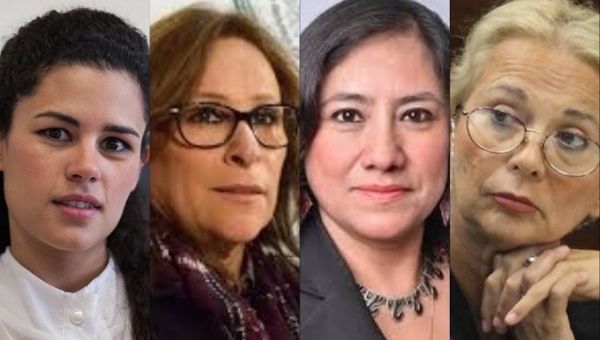
(L-R): Luisa Maria Alcalde, Rocio Nahle, Irma Sandoval and Olga Maria del Carmen Sanchez are part of AMLO’s cabinet. | Photo: Facebook / Twitter / plumas libres
teleSUR | July 11, 2018
Eight of the key figures in AMLO’s future government are women and they have interesting proposals for Mexico.
Of the 16 confirmed members of president-elect Andres Manuel Lopez Obrador’s cabinet eight are women. teleSUR English reviews their profiles and plans for their tenure.
AMLO’s cabinet will include representatives of the business sectors and members of the traditional Institutional Revolution Party, but it also has an important share of academics and progressive women.
Olga Maria del Carmen Sanchez, the first woman to head the ministry of the Interior, was a judge in Mexico’s Supreme Court between 1995 and 2005. She is in favor of legalizing marijuana and believes the country needs to rethink its policy on drugs.
During an interview with Zosimo Camacho, Sanchez criticized the lack of judicial symmetry with the United States and stressed the importance of changing the strategy in the war on drugs. “How is it possible that here in our country we are killing ourselves and the U.S. is decriminalizing drugs?,” she questioned.
AMLO’s pick for social development, Maria Luisa Albores is an agronomist and specialist on social economy, which is based on the principle of solidarity. Since 2001 she has worked with Indigenous and Campesino communities in the development of productive and economic cooperatives and projects.
During the campaign trail, Albores vowed to work for the economic and social inclusion of rural Mexico and stressed the importance of restructuring Mexico’s social development ministry. According to Albores the ministry has “served to keep people poor, and poverty has been administered electorally.”
For Minister of Labor and Social Welfare, AMLO has appointed Luisa Maria Alcalde, a lawyer and former legislator, who has done extensive work on a dignified salary in Mexico.
Alcalde has announced she will hold meeting with Mexico’s private sector and the country’s central bank to find a viable path to an increase to the country’s minimum wage.
Economy will be headed by Graciela Marquez, Ph.D. in economic history and professor in several universities in Mexico and abroad. She has written extensively on economic development, inequality and commercial policy. She would be the first woman to head the ministry of economy and will head the current negotiations on the North American Free Trade Agreement (NAFTA).
Alejandra Frausto has accepted to lead Mexico’s ministry of culture. She has worked to promote access to culture and the arts as a central element in social development, with an emphasis on popular and Indigenous cultures.
The Ministry of Environment and natural resources will be headed by Oxford graduate Josefa Gonzalez, who studied transformative art and has worked with vulnerable populations in art-related projects. For the past years she has worked in the southern state of Chiapas in conservation and reforestation projects.
Irma Sandoval has been given the Ministry of the Civil Service. She is a political scientist and researcher for Mexico’s Autonomous University (UNAM). Sandoval is also the coordinator of UNAM’s Lab on corruption documentation and analysis.
She has proposed to use technology to monitor the good use of public resources, a monitoring system open to citizens to control public works, and to encourage anonimous complaints to fight corruption in Mexico.
Finally, AMLO’s pick for the Energy Minister is Rocio Nahle who has worked in the petrochemical industry for years. Her main proposal is the construction of two refineries in Tabasco and Campeche, and the rehabilitation of six refineries to meet Mexico’s internal demand.
RELATED:
Mexico President Strikes Upbeat Tone on Trump Ahead of Talks
AMLO to Implement San Andres Agreements Signed With Zapatistas
The Persecution of Rafael Correa
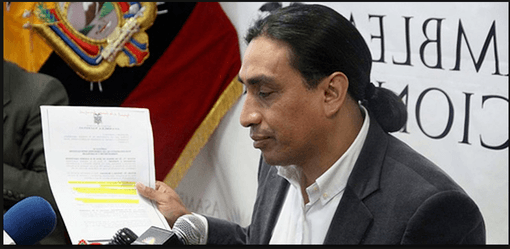
By Joe Emersberger | CounterPunch | July 9, 2018
An Ecuadorean judge has issued an arrest order for former President Rafael Correa. Correa is accused of having masterminded an attempted kidnapping of the right wing former legislator, Fernando Balda, in 2012. Balda was in Colombia at the time evading a prison sentence in Ecuador for libel. The kidnapping was foiled within a few hours by Colombian police and the perpetrators were captured. Months later, Balda was deported to Ecuador where he served two years in jail.
As explained in other pieces for CounterPunch (here, here, and here) in 2017 Lenin Moreno was elected on a platform of continuing the policies of his left wing predecessor, Correa, who was first elected in 2006. Immediately after taking office, Moreno shifted very hard to the right and has therefore made it his main priority to accuse the government he was part of for ten years of being corrupt.
A week before the arrest order for Correa, I spoke with Virgilio Hernandez who was a member of the National Assembly while Correa was in office. Part of the interview was updated after the arrest order came out. A key point Hernandez makes is that the “Transitional” Citizens Participation Council whose members were hand-picked by President Moreno (details here on the reasons the body is unconstitutional) has sweeping powers over the judiciary and other authorities.
JOE EMERSBERGER: Could you please explain the various legal and constitutional problems with the way Correa is being pursued over the Fernando Balda case?
VIRGILIO HERNANDEZ:The obvious thing about the Balda case is its political functionality, the determined effort to prosecute the former president Rafael Correa for anything at all. The case is in its early stages but the prosecution has already perpetrated a series of irregularities, a series of violations of the institutional norms and of the rule of law that makes it absolutely clear that justice is not their goal. They are not pursuing a credible investigation of the facts. They are basically pursuing political objectives through the prosecution of Rafael Correa on frivolous grounds.
The first irregularity is that, according to our constitution, authorization to prosecute the ex-president should have been received from the National Assembly. In fact, it was requested by Judge Camacho on June 11. Unfortunately, a majority that exists in the assembly is an alliance between the Alianza País party [that Correa and his allies resigned from after they broke with President Moreno] and the Social Cristiano party [right wing legislators] and what did they do? On June 15, they voted through [by simple majority] a resolution saying that the assembly is not competent to respond to the judge’s request. Regrettably, the judge then disregarded her own authority, ignored the Organic Law of the Judicial Function, and followed through with a hearing to move the case forward when what she was supposed to do was demand that the National Assembly comply with her request – to vote on whether or not they authorize the prosecution of former president Rafael Correa [a 2/3 vote in favor is required for the prosecution to proceed]. Here is the first thing that that reveals political animosity, that the rule of law is not respected, that due process and the constitution are not respected.
Second (and this explains a huge blunder that was perpetrated in contextual terms) one must understand why the prosecution of the former president had to be authorized by the National Assembly. It was because the events to which he is being linked happened while he was president. The law says that for prosecution to proceed presidential immunity must first be removed for events that took place while he was in office. That’s the second irregularity.
A third irregularity is that in general a whole slew of authorities in our country are acting illegally. The acting attorney general was appointed by the “Transitional” Citizens Participation Council that has been overhauling the justice system by appointing interim prosecutors and an interim Judicial Council. The acting prosecutor has not been sworn in before the National Assembly as mandated by the constitution. Their authority is completely illegitimate.
A fourth irregularity is that the arguments used to link Rafael Correa to the Balda’s case [the attempted kidnapping] are utterly weak and confirm that there is a political vendetta being pursued against the former president. Let’s quickly go over those arguments.
First, the simple fact that he was president is used to argue that he was criminally responsible. Criminal responsibility is something very personal. It cannot be established that he has criminal responsibility for all acts perpetrated while he was in office. That’s a legal absurdity.
Second, the former president is linked through hearsay, from what other people have claimed, or by remarks attributed to the ex-president saying he wanted to see Balda (who was a fugitive from Ecuador’s justice system at the time) captured. Balda was also engaged in electronic espionage and a permanent destabilization effort against the government. There is not even anything documented that proves what Correa is claimed to have said about the case. It is all second hand.
Third, there are letters from people who are being prosecuted who say they alerted the former president about a kidnapping attempt, but it has been shown that these letters never reached the hands of the president. It’s another argument that turns out to be completely weak. There were people in government expressing interest in bringing Balda back to Ecuador but through legal processes – by getting him deported from Colombia [which he ultimately was]. In Ecuador, Balda had a criminal sentence to serve. The prosecutor goes after Correa even though the only thing that has been demonstrated is that Balda’s legal deportation from Colombia was being pursued. Moreover, former President Correa wasn’t even pursuing it. That was up to the authorities who were in charge of the internal and external security of the state. It’s another of the prosecutor’s arguments that are easily answered. Then there are a number of details having to do with checks that were issued and testimony by one “Raúl Ch”that are dubious, contradictory and undermine the prosecutor’s case.
In short, the arguments the acting prosecutor is using to pursue former President Rafael Correa are absolutely feeble. The judge disregarded the feebleness of those arguments, but additionally the case should not have even been allowed to proceed [without National Assembly authorization] but what they did next is worse. The judge, when determining pretrial conditions for Correa, established measures beyond what the prosecutor himself requested. The prosecutor requested that as a precautionary measure – given that the former president has collaborated with the investigation – that he appear regularly before the Ecuadorean consulate in Belgium. The judge responded in a very questionable way. First, she asked the acting prosecutor to reformulate his request for precautionary measures when that is the prosecutor’s job. She was clearly looking for the prosecutor to request pre-trial detention by arguing that the consulates do not have the competence to receive a person who appears by court order. This argument the judge made is absolutely false since the Foreign Service Law establishes that the consulates can comply with this kind of order from a judge. The penal code itself states that if a judicial authority establishes provisions, authorities of the state in general have to comply. Judge Camacho’s claim that the Foreign Service Law does not give consulates that capacity is completely cynical. It reveals political animosity.
And when she asked the acting prosecutor to reformulate his request – clearly looking for harsher pre-trial conditions – the persecutor reminded her “You have the authority to set them. This is what the Comprehensive Organic Criminal Code says and therefore, if you so order that the consulates are obliged to accept this order you give them “. In the end the judge ordered that Correa must appear periodically [every 15 days] before a court here in the city of Quito even though it is common knowledge that he lives in Belgium. She made the legally inadequate claim that he has two addresses and therefore must periodically appear Quito. Everyone knows he lives in Belgium as he said repeatedly he was going to move to Belgium [where his wife is from] for several months before he finished his final term as president. The judge set an obvious trap for the former president not to appear and thus have an excuse to order pretrial detention.
JE: On social media I noticed that many of Correa’s detractors were totally enraged that judge Camacho requested National Assembly authorization and called for her to be sacked. Do you think she became more extreme in response to media and other pressures? [Moreno’s handpicked “Transitional” Citizens Participation Council appointed an interim Judicial Council which has announced that it will be evaluating all judges and dismissing those who “fail”.]
VH: All these arbitrary acts are possible because, as Noam Chomsky might say, the media has worked hard to “manufacture consent” for the idea that one way or another Correa must be indicted. It is very clear that the media play a central role. This persecution would not be possible without the big media networks and the use of media power.
Both the actions and the aversion shown by the acting prosecutor and the judge during the bond hearing clearly reveal that there will be no objective handling of the case – and also that the context that we live in Ecuador, when there are authorities that are hand-picked without any constitutional legitimacy by the “Transitional” Citizen Participation Council, sets up a scenario of political persecution. We are without a doubt living through “lawfare” here in Ecuador and it is directed towards Rafael Correa and the main leaders of the Citizens Revolution.
Now, what we feared has in fact happened. Correa appeared at the consulate in Belgium, but the judge ruled that this was a violation of his pre-trial conditions and replaced the order to appear in Quito with an order of pre-trial detention. She did all this in one hearing disregarding a requirement for 72 hours’ notice before changing the pre-trial conditions. Her stated justification for doing that was based on “procedural economy”, but in criminal matters one cannot invoke procedural economy if it violates rights as has now been done with Rafael Correa. All these arbitrary acts against the Citizen Revolution are perpetrated with the complicity of the media whose silence over unconstitutional actions are aimed at ending what they call “correísmo”
JE: There was a news article I read in El Telegrafo (a government run newspaper) that basically argued that prosecuting Correa is fine because former President Jamil Mahuad was also prosecuted (in a case that was initiated years before Correa first took office in 2007).
VH: When the judge asked for authorization to prosecute Rafael Correa, she cited the precedent that had previously been used to prosecute Jamil Mahuad. Authorization had also been requested by the national congress of that time. And although the Congress also said that it was not competent, let’s not forget that this decision was made with 2/3 of its members and not as in this case that is taken by a simple majority.
Mahuad’s defense team has argued that his case be dismissed on those grounds [of not being authorized].
JE: Looks to me like they have a valid argument, not that anyone should defend Mahuad’s disastrous policies.
VH: Yes and in fact and that was cited by the judge herself. The organic code of the judicial function is clear that authorization from the assembly is required in this case. It does not allow the judge to accept, as she did in Correa’s case, that the National Assembly returns her request saying it is inappropriate. According to what our legal regulations say, the National Assembly cannot assess whether or not a request from a competent authority (in this case a judge of the national court) is appropriate. It has to comply with what the judge requested. If that is not done, it violates the autonomy and authority of the judiciary if a judge’s order is disregarded.
JE: Do you think Mahuad’s case should have been halted on these grounds?
VH: I don’t want to go into the details of something that I do not have very clear in my memory. My concern is relating what is happening at this time with the case of former President Rafael Correa.
JE: You were heavily involved with protests by indigenous groups like CONAIE during the 1990s against neoliberal economic policies. I’ve personally noticed since the 2010 coup attempt against Correa that they’ve become quite reactionary. They recently publicly “recognized” Cesar Trujillo, one of Moreno’s key handpicked members of the “Transitional” Council of Citizens Participation.
VH: Since about the end of the 1990s and the beginning of this century I would say what is evident in CONAIE is that a current became dominant that we’d call a “conservative indigenist” current that has put everything into what they call the “ethnic cause” and left aside the causes of social movements and the left in the country. That explains not only what you describe (these tributes to people like Cesar Trujillo) but also that in the last presidential campaign they openly supported the candidate of the oligarchy and the banks, Guillermo Lasso. It is very clear for almost two decades they lost course and have been useful to the oligarchic groups that have always rabidly opposed Rafael Correa and the Citizens Revolution.
JE: How is the new party the movement is working on organizing going to correct the errors that led to people like Lenin Moreno being in positions of leadership?
VH: The first thing we have to do now is to overcome the political blockade. The political persecution we face is seeking to dismantle all the laws and norms of the Citizens Revolution. Second we have administrative persecution that goes through an “acting” comptroller who also works illegally. They persecute many of the leaders of the Citizen Revolution that way. Third, there is a judicial persecution of former President Rafael Correa. The fourth element of persecution that must be identified clearly is the political blockade. So far they are preventing us from being able to organize ourselves politically even though it is a constitutional right. Therefore, before thinking about self-criticism and the mistakes we should not commit, at this moment our main priority is to break the political blockade. We seek legal recognition to be able to participate in the democratic arena. This will allow voters to continue supporting Citizens Revocation against this ongoing persecution we face.
JE: I am going to make a comment and you can tell me if you agree. I would say to Rafael Correa that he not be a martyr, that he seek political asylum so that his voice is not silenced. I think his ability to speak out, even if from afar in a limited way through social media and other venues, is crucial to overcoming the one-sided media landscape Moreno has established inside Ecuador.
VH: Actually, today, in a meeting of the national coordinators the movement – the group of legislators [who remained loyal to Correa] Andean parliamentarians, councilors of the city of Quito and other authorities of the movement – we have asked Rafael Correa not to come to Ecuador. We said conditions for a fair trial do not exist, conditions for due process do not exist and that therefore that he should not come and that he should seek international assistance to protect his security and freedom. We agree with your position and we have publicly expressed one like it.
Featured Video
Elijah Magnier: Yemen’s strikes are shattering Saudi Arabia’s long-term strategy
or go to
Aletho News Archives – Video-Images
From the Archives
British weapons and personnel doing much of the killing in Yemen
Press TV – June 18, 2019
A detailed report published by the Guardian newspaper has shown how Britain is massively contributing to Saudi Arabia’s devastating war on Yemen as it suggests that London is not only supplying the bombs that fall on Yemenis, but it provides the personnel and expertise that keep the war going.
The comprehensive report by Arron Merat published on Tuesday showed that Britain was doing much of the killing in Yemen as the country continues to provide Saudi Arabia with everything it needs to turn its southern impoverished neighbor into a graveyard.
“Every day Yemen is hit by British bombs – dropped by British planes that are flown by British-trained pilots and maintained and prepared inside Saudi Arabia by thousands of British contractors,” said Merat in the report. … continue
Blog Roll
 Aletho News
- Racist Seinfeld Dances for Joy as Bibi Unveils His New Map
- A West Bank War for Netanyahu’s Election Campaign, Could It Backfire?
- Yemen denounces European Parliament’s ‘hypocritical’ push to blacklist Ansarullah
- Qalibaf: UAE’s UN bid aims to ‘clear the runway’ for ‘Greater Israel’, whitewash genocide
- Pakistan reopens Iran border after boosting security: Report
- Why are so many Brazilians voting for Flávio Bolsonaro?
- Democrats Put Anti-Russia Agenda Ahead of American Workers
- Elijah Magnier: Yemen’s Strikes Are Shattering Saudi Arabia’s Long-Term Strategy
- Pentagon designates Chinese cultural centers national security threat
- Israel Demolishes Home Of Lebanese Journalist Whose Viral Film Exposed Pager Attack
- If Americans Knew
- An error has occurred; the feed is probably down. Try again later.
- No Tricks Zone
- Sudden Stratospheric Warming, Powerful El Niño Combination May Lead To Extreme Europe Cold, Energy Crisis!
- Two New Studies Find Thwaites Glacier Melt Cannot Be Driven By Human Activity Or A Warming Ocean
- E-Cars Reduce CO2 Emissions By Only 41% Compared To Internal Combustion Engine Vehicles
- Predictions Made By Renowned Climate Professor Over Past Decades Have Been Proven To Be Poor
- New Study Suggests Large Regions Of The Pacific Ocean Have Been Cooling For The Last 80 Years
- Germany’s Green Energy Debacle: High Energy Costs Force Kahla Porzellan to Close After 182 Years!
- New Study: 50 Years Of The Most Aggressive ‘Net Zero’ Policies Can Only Affect The Global Climate By 0.03°C
- US September “Heat” Was No Record…Many Records Set Decades Ago
- Latest European Green Energy Debacle; Portugal’s Largest Flagship Solar Park Insolvent!
- Green Energy Debacle: German Expert Professor Fritz Vahrenholt Warns Of Severe Economic And Social Consequences

