Lula’s Legal Team Rejects Politicized Corruption Allegations
teleSUR | September 6, 2017
Faced with formal accusations of criminal conduct and corruption, former Brazilian President Luis Inacio Lula da Silva has struck back through his legal team, maintaining that the politicized allegations are an attack on Brazil’s legal order and democracy itself.
“The latest allegations are a complete fabrication, politically motivated in spite of growing international outrage of the behavior of parts of the judiciary, and timed to influence the democratic will of Brazilians,” attorneys Cristiano Zanin Martins and Valeska Teixeira Zanin Martins said in a statement released on behalf of their client, Lula.
“We will fight these ludicrous, unsubstantiated claims with rigor using all legal avenues open to us,” the lawyers maintained.
Lula’s legal team added that the accusations are tantamount to political persecution, signaling the clear danger that the popular former head of state will have his rights violated in kangaroo court-style proceedings. Such a process would be a clear breach Brazil’s constitutionally-guaranteed right to a fair trial – a right backed by international law.
“The decision by the attorney general is another attack on Brazilian democracy. The country is facing a real threat to the basic rule of law and democracy itself. This legal battle is bigger than one person, it is a fight for the very future of Brazil,” the statement concluded.
Brazilian Attorney General Rodrigo Janot accused former presidents Lula and Dilma Rousseff, along with several other leaders of the Workers’ Party, or PT, of forming a criminal organization to divert money from the state-controlled oil company, Petrobras, to the tune of $US475 million through a corruption scheme involving construction conglomerate Odebrecht.
“The indictment written by the Attorney General’s Office accusing me, along with the PT, of belonging to a criminal organization is a document that seems to have been hastily assembled and based exclusively on statements from bribed informants,” Rousseff said in a statement. She added that the groundless allegations seem to have no basis in evidence, but are based on suppositions, specious claims and spurious inferences taken as facts.
“The ‘charges’ rely on fabricated lies – some quite old – which seem to have been unearthed and reanimated in order to divert attention from the actual recordings,” she added, a reference to scandalous audio recordings of President Michael Temer urging that witnesses in the scandal be bribed. “The informants themselves say that in order to be found innocent or win a reduced sentence, they will say what the prosecutors want to hear.”
Rousseff added that a section of Brazil’s press has allowed itself to become an accomplice to the forces of corruption and to distract the public from the erosion of ethics and morality among ruling elites on the very same day that Brazilian police found US$16 million cash in an apartment allegedly used by Geddel Vieira, a former cabinet member in the Temer government.
“Justice and truth will always triumph,” she concluded, expressing her confidence in the court’s ability to see justice through and expose the lack of evidence in the indictment leveled by the attorney general.
The accusations come on the heels of Lula’s 20-day Caravan of Hope bus tour through Brazil’s northeast, a base of support for the PT, where he was enthusiastically greeted by crowds numbering in the tens of thousands who are opposed to the Temer government and its neoliberal agenda.
OHCHR’s Venezuela Report is Terrible and May Incite More Violence
By Joe Emersberger | ZNET | September 1, 2017
The OHCHR put out a press release a few weeks ago about violent protests in Venezuela in which the following words leapt off the page to anybody who has been following the situation without blinders on:
“security forces are allegedly responsible for at least 46 of those deaths, while pro-Government armed groups, referred to as ‘armed colectivos’ are reportedly responsible for 27 of the deaths. It is unclear who the perpetrators of the remaining deaths may be.” [my emphasis]
It was “unclear” to the OHCHR if protesters had killed a single person!
The OHCHR’s full report, which was just released, does not go to that extreme but is still an embarrassingly shoddy and biased report. In a section with the subheading “Violent anti-Government protesters”, the OHCHR report concedes that four murders have been perpetrated by protesters but hastens to add that protester violence has been a “reaction to the disproportionate use of force by security forces” and that the “level of violence by these groups increased as the use of force by security forces rose”.
Four is less preposterous than zero, but is still wildly off the mark. See the detailed timeline provided by VenezuelAnalysis.com.
Direct victims of opposition political violence: 23
Bryan Principal, Oliver Villa Camargo, Niumar Jose Sanclemente, Almelina Carrillo, Paola Ramirez, Jesus Leonardo Sulbaran, Luis Alberto Marquez, Efrain Sierra, Rexol Navas, Gerardo Barrera, Anderson Dugarte, Jorge David Escandon, Pedro Josue Carrillo, Danny José Subero, Orlando Figuera, Douglas Acevedo Sánchez, Ronny Alberto Parra, Alexander Rafael Sanoja Sanchez, Jose Luis Bravo, Ramses Martinez, Hector Anuel, Oneiver Quiñones Ramirez, Felix Pineda Marcano, Ronald RamirezDeaths indirectly linked to opposition barricades*: 8
Ricarda Gonzalez, Ana Colmenarez, Maria de los Angeles Guanipa, Angel Enrique Moreira Gonzalez, Carlos Enrique Hernández, José Amador Lorenzo González, Luis Alberto Machado, Miguel Angel Villalobos Urdaneta
Additionally, how were the murders of unarmed civilians like Orlando Figuera and Almelina Carrillo by protesters a “reaction” against the security forces? Similarly, how is the burning of food warehouses and ambulances, which the OHCHR also concedes took place, a reaction against the security forces?
Moreover, the first person killed by opposition protesters was the civilian bystander Brayan Principal on April 12, only eight days after the protests began. The VenezuelAnalysis timeline shows that, right from the beginning of the protests, when security forces have perpetrated crimes they have been arrested and charged. That’s quite a contrast with what frequently occurs in the United States which is not faced with violent foreign-backed protesters trying to oust the government. It was only four days after the protests began, on April 8, when protesters torched a Supreme Court building.
I would not advise Black Lives Matter protesters in the United States to torch a Supreme Court building and expect to have their actions excused by the OHCHR or any other high profile outfit as a “reaction to the disproportionate force by police”.
The extremely well documented case of Orlando Figuera also exposed some inexcusable sloppiness in the OHCHR report. It falsely stated that Figuera died the same day he was attacked. He actually died in hospital few weeks later. He claimed from his hospital bed that he had been killed for being a suspected Chavista.
Why were the protesters brazen enough to murder Figuera in broad daylight in front of numerous witnesses?
There have apparently been no arrests in the case though the government has identified one of the perpetrators (who was in hiding).
Here are a few reasons:
- 1) People in opposition strongholds – like the one where Figuera was murdered – would likely be afraid to name the perpetrators or, sadly, even supportive of the crime in some cases.
- 2) The Attorney General at the time, Luisa Ortega Diaz (who has now been fired and is who now collaborating with US prosecutors to target the Maduro government), was preoccupied with weakening the government and maneuvering to save her own skin should the opposition seize power.
- 3) Biased reporting promotes impunity. When the United States government wants to vilify a government and have it overthrown – which has been the case in Venezuela for the past fifteen years – numerous natural allies reflexively offer a helping hand: private media companies around the world, high profile NGOs and of course UN bodies like the OHCHR. The destruction of Iraq since 1990 does not happen without UN complicity even though neocons demand that the UN be even more subservient to the US.
There is a section in the OHCHR report on “Violations of the right to freedom of expression” and “Smear campaigns against journalists”. The OHCHR included a throwaway remark that “journalists were also targeted by demonstrators and supporters of both the opposition and the government.“
Prominent opposition supporters tried to get Abby Martin and Mike Prysner lynched by spreading allegations that they were working as informants for the government. Watching their report on the violent protesters the OHCHR whitewashed is something I highly recommend. The OHCHR’s bias not only makes opposition violence more likely, it makes honest journalism about it more dangerous.
The report “recommends” that opposition leaders condemn all violence by its supporters when the OHCHR itself goes out of its way to ignore that violence and deflect responsibility away from the perpetrators. The OHCHR also didn’t think to “recommend” that opposition leaders stop calling on the military to overthrow the government. An organization not at the service of the US Empire would also have “recommended” that the US government not violate international law by imposing economic sanctions or threatening the use of force against Venezuela. Have OHCHR investigators not reviewed the UN Charter recently?
Nicaragua’s Sandinista Achievements Baffle World Bank, IMF
teleSUR | August 31, 2017
No one can take at face value any report, governmental or quasi non-governmental, coming out of the imperialist bureaucracy in Washington. Ideological bias and institutional self-justification prevent these reports from giving a true account of virtually anything.
The latest World Bank report on Nicaragua is no exception.
The implicit but unstated truth in this report is that President Daniel Ortega and the Sandinista National Liberation Front have achieved an unprecedented economic turnaround in just seven years, starting in 2010.
Reading the report, it is impossible to ignore the tension between latent ideological and political imperatives and the obligation to report the facts. Put another way, mild conflict clearly prevails between the World Bank’s Washington head office and its reality based local officials. From Washington, the tendency is both to minimize Ortega’s achievement and also to cover up the World Bank’s own lamentable history in Nicaragua. On the other hand, in Nicaragua, local World Bank staff dutifully report the facts as they see them.
A total of 71 people contributed to the report. Supposing those 71 people each worked for a month to prepare the research and say their average salary was about US$80,000, then pro rata a month’s work by that team cost over US$500,000, a very conservative guess. Even so, in summary, that money bought policy recommendations for Nicaragua’s development amounting to little more than better infrastructure; better basic services; more private business investment; more efficient government; better targeted social policies. That’s it, for US$500,000 or more.
In general, the report recognizes Nicaragua’s achievements in reducing poverty and inequality, raising productivity, diversifying economic activity and promoting security and stability. The report’s 130 or so pages include, among the economic and sociological analysis, many self-confessed guesses to fill in “knowledge gaps” and much gerrymandered history to cover up what Harold Pinter in his 2005 Nobel prize winning address justly called “the tragedy of Nicaragua.”
Pinter himself might have remarked the report is almost witty in its audacious, glib omissions. It acknowledges the catastrophic destructive effects of the 1980s war in Nicaragua, but carefully omits the U.S. government’s deliberate role in that destruction, now repeated against Syria and Venezuela.
The report talks about a “democratic transition” starting in 1990. In fact, the Sandinistas organized the first free and fair democratic elections ever in Nicaragua in 1984, but the U.S. government ordered the main Nicaraguan opposition to boycott them. Despite the war, Ortega and the Sandinistas won with 67 percent of the vote, very similar to the most recent presidential elections in 2016.
The heavy ideological bias also explains the World Bank’s curious dating of when Nicaragua’s economic turnaround began, placing it firmly in the neoliberal era prior to 2007. But at just that time, the World Bank was cutting back the public sector as much as they could, pushing, for example, to privatize Nicaragua’s public water utility and its education system.
Back then, Nicaragua’s neglected electrical system collapsed through 2005 and 2006, incapable of generating even 400 megawatts a day, plunging swathes of Nicaragua back into 19th-century darkness for 10 to 12 hours at a time, day after day. That was the World Bank and IMF’s gift to Nicaragua after 17 years of so-called “democratic transition.” That period included Hurricane Mitch, devastating Nicaragua to the tune of 20 percent of its GDP, only for the corrupt neoliberal government at the time to misuse hundreds of millions of dollars in disaster relief. The only structurally significant economic achievement of the neoliberal era in Nicaragua was substantial foreign debt relief.
When Ortega took office in January 2007, he faced four years of domestic crisis with an opposition controlled legislature persistently sabotaging his government’s programs. From 2007 to 2008, Nicaragua and the whole region struggled in vain to contain a balance of payment deficits against oil prices reaching US$147 a barrel in 2008.
That disaster was compounded by the collapse of the Western financial system in late 2008 to 2009, a year when Nicaragua’s economy suffered a 3 percent contraction. Only in 2010, did the Nicaraguan government finally enjoy domestic and international conditions stable enough to be able to consolidate and improve its social programs, improve infrastructure investment, democratize and diversify the economy, extend basic services, and attract foreign investment, among other things.
If that sounds suddenly familiar, it should. It is exactly the development recipe offered up by this latest World Bank report, essentially an embellished review of policies the Nicaraguan government has already been implementing for a decade. Put positively, the government’s National Human Development Plan and other relevant documents suggest that the World Bank’s engagement with the Nicaraguan government has been one of mutual learning. So much so, that the current country program is likely to continue and may even expand.
The political opposition in Nicaragua has seized on parts of the report to try and discredit the Sandinista government’s outstanding achievements. In fact, for 17 years under neoliberal governments implementing World Bank and IMF policies, areas criticized like, for example, access to drinking water and adequate sanitation, or education, suffered chronic lack of investment, compounded by egregious waste and corruption. Now, the World Bank hypocritically criticizes Nicaragua’s government for intractable policy difficulties the IMF and the World Bank themselves originally provoked.
Similarly, when the World Bank report criticizes the targeting of social programs, they omit the unquestionable success of the government’s Zero Usury micro credit program and the Zero Hunger rural family support program, both prioritizing women. These programs have lifted tens of thousands of families out of poverty and, along with unprecedented support for Nicaragua’s cooperative sector, radically democratized Nicaragua’s economy, especially for previously excluded rural families and women. That supremely important national process is entirely absent from the World Bank report.
In its discussions of almost all these issues, the report makes more or less detailed contributions, mostly already identified by the government itself. In every case, the underlying cause of problems or lack of progress, for example, on land titling or social security, has been the legacy of neoliberal governments between 1990 and 2007, that reinstated elite privilege, rolled back the revolutionary gains of the 1980s and failed to guarantee necessary investment.
The World Bank and the IMF were enthusiastic ideological partners in that endeavor. They would have continued their ideological offensive had not Ortega and his government dug in their heels in 2007 and 2008, backed by investment support for social and productive programs from Venezuela as part of the Bolivarian Alliance of the Americas.
Since then, the World Bank, as this report suggests, seems, at least for the moment, to have learned two key lessons from the Sandinistas. In a world dominated by corporate elite globalization, their report implicitly recognizes the importance, firstly, of a mixed economy under a strong central government and, secondly, the crucial role of broad dialogue and consensus, across all sectors of society, to promote and sustain national stability. Essentially, the World Bank has acknowledged the undeniable success of the Sandinista Revolution’s socialist inspired, solidarity based policies, decisively prioritizing the needs of people over corporate profit and demonstrating the systemic inability of capitalism to meet those needs.
Venezuela Pulls 2 Channels Off Air Over “Resign or Die” Comments
By Ryan Mallett-Outtrim | Venezuelanalysis | August 25, 2017
Venezuelan regulators ordered Thursday two cable networks be taken off air, after they were accused of promoting violence.
The country’s national telecommunications regulator CONATEL said Colombian broadcasters RCN and Caracol Television would be taken off air for “openly calling for [the] assassination [of the president].”
“The measure is within the bounds of the law, given that those stations over several months attacked Venezuela and [its] institutions,” CONATEL said in a statement, quoting former head regulator Andres Mendez.
The move was in response to comments by former Mexican president Vicente Fox aired by RCN and Caracol. Addressing Maduro, Fox warned “this dictator will leave through resignation, or with his feet in front of him, in a box”.
During RCN’s broadcast, the lower third beneath Fox simply read, “Dictator Maduro, resign or die.”
Fox’s comments were quickly condemned by Maduro ally and Bolivian President Evo Morales.
“If anything happens to our brother President Maduro, it will be Mexican ex-president Vicente Fox’s responsibility,” he said.
Fox made his comment during the “Thinking the 21st Century” conference in Baranquilla, Colombia. Last month, the ex-president was declared persona non grata in Venezuela after he participated as an observer in an unofficial opposition plebiscite asking citizens if they would support a “zero hour” campaign of protests aimed at overthrowing the government.
Neither RCN or Caracol appeared available in Venezuela at the time of writing, and at least one major cable provider has confirmed cutting one of the signals.
“We inform you that the 772 Caracol International channel is no longer available for Venezuela because we are complying with an order from … CONATEL,” cable provider DirecTV tweeted.
Some viewers have reported they can still access RCN through DirecTV, but not through most other major providers.
Venezuela’s opposition had condemned CONATEL’s decision as censorship.
“One more channel off the airwaves! Has that made crime go down? Is inflation any lower? Is there more food? More medicine? Has any problem been solved?” opposition leader Henrique Capriles stated.
The shutdowns are the second major regulatory action taken against broadcasters accused of promoting unrest in Venezuela. Earlier this year, CONATEL pulled CNN’s Spanish language channel, accusing the broadcaster of seeking to “undermine the image of the national executive branch”.
The decision came in the wake of CNN’s publication of an investigation that alleged to have uncovered evidence Venezuelan diplomatic officials in Iraq had sold Venezuelan passports to non-Venezuelans, including Iraqi and Syrian nationals. Venezuela’s government largely dismissed the report as US propaganda.
In 2014, another major Colombian broadcaster, RTN24, was also wiped from Venezuelan airwaves after CONATEL alleged it had “promoted violence”. Another major case also occurred in 2007, when the Caracas-based RCTV lost its broadcast concession, after regulators determined the station had played a role in a 2002 coup that temporarily overthrew the Chavez government.
A Venezuelan Tanker Is Stranded Off The Louisiana Coast
By Tyler Durden | Zero Hedge | August 17, 2017
A tanker loaded with 1 million barrels of Venezuelan heavy crude has been stranded for over a month off the coast of Louisiana, not because it can’t sail but as a result of Venezuela’s imploding economy, and its inability to obtain a bank letter of credit to deliver its expensive cargo. It’s the latest sign of the financial troubles plaguing state-run oil company PDVSA in the aftermath of the latest US sanctions against the Maduro regime, and evidence that banks are slashing exposure to Venezuela across the board as the Latin American nation spirals into chaos.
As Reuters reports, following the recently imposed US sanctions, a large number of banks have closed accounts linked to officials of the OPEC member and have refused to provide correspondent bank services or trade in government bonds. The stranded tanker is one direct casualty of this escalation.
The tanker Karvounis, a Suezmax carrying Venezuelan diluted crude oil, has been anchored at South West Pass off the coast of Louisiana for about a month, according to Marinetraffic data.
For the past 30 days, PBF Energy, the intended recipient of the cargo, has been trying unsuccessfully to find a bank willing to provide a letter of credit to discharge the oil, according to two trading and shipping sources.
The tanker was loaded with oil in late June at the Caribbean island of St. Eustatius where PDVSA rents storage tanks, and has been waiting for authorization to discharge since early July, according to Reuters. It is here that the delivery process was halted as crude sellers request letters of credit from customers that guarantee payment within 30 days after a cargo is delivered.
While the documents must be issued by a bank and received before the parties agree to discharge, this time this is impossible as the correspondent bank has decided to avoid interacting with PDVSA and running afoul of the latest US sanctions. It was not immediately clear which banks have denied letters of credit and if other U.S. refiners are affected.
In an ironic coincidence, these days the state energy company of Venezuela, PDVSA, is almost as much Venezuelan as it is Russian and Chinese. Chinese and Russian entities currently take about 40% of all PDVSA’s exports as repayment for over $60 billion in loans to Venezuela and the company in the last decade, as we reported last year and as Reuters recently updated. This has left U.S. refiners among the few remaining cash buyers. Meanwhile, as a result of these ongoing historical barter deals exchanging oil for refined products and loans, PDVSA’s cash flow has collapsed even as the company’s creditors resort to increasingly more aggressive measures to collect: just this April, a Russian state company took a Venezuelan oil tanker hostage in hopes of recouping $30 million in unpaid debt.
The first indication that the financial noose is tightening on the Caracas regime came earlier this month when Credit Suisse barred operations involving certain Venezuelan bonds and is now requiring that business with President Nicolas Maduro’s government and related entities undergo a reputation risk review. In a while publicized move, this past May Goldman Sachs purchased $2.8 billion of Venezuelan debt bonds at steep discount, a move criticized by the Venezuelan opposition and other banks.
While PDVSA owns the cargo, the actual tanker was chartered by Trafigura:
Since last year, the trading firm has been marketing an increasing volume of Venezuelan oil received from companies such as Russia’s Rosneft, which lift and then resell PDVSA’s barrels to monetize credits extended to Venezuela, according to traders and PDVSA’s internal documents.
Some barrels are offered on the open market, others are supplied to typical PDVSA’s customers including U.S refiners.
Meanwhile, even before this latest sanctions-induced L/C crisis, Venezuela’s oil exports to the US were already in freefall: PDVSA and its JVs exported only 638,325bpd to the US in July, more than a fifth, or 22% less, than the same month of 2016, according to Reuters Trade Flows data.
As for the recipient, PBF received just three cargoes for a total of 1.58 million barrels last month, the lowest figure since February. Other U.S. refineries such as Phillips 66 did not receive any cargo. The US refiner and PDVSA have a long-term supply agreement for Venezuelan oil signed in 2015 when PBF bought the 189,000-bpd Chalmette refinery from PDVSA and ExxonMobil Corp.
Earlier in the month, PBF’s Chalmette refinery received half a million barrels of Venezuelan crude on the tanker Ridgebury Sally B. This second delivery got stuck on tanker Karvounis.
It is likely that soon virtually all Venezuelan cargos bound for the US will share a similar “stranded” fate as one bank after another cease providing L/C backstops to the Venezuelan company, ultimately suffocating Maduro’s regime which is in dire need of dollars to keep the army on its side and prevent a revolution. As for how high the price of oil rises as Venezuela’s oil production is slowly taken offline, it remains to be seen. Three weeks ago, Barclays calculated that a “sharper and longer disruption” to Venezuela oil production could raise oil prices by at least $5-7/barrell. Such a disruption appears to now be forming.
Korea and Venezuela: Flip Sides of the Same Coin
By Jacob G. Hornberger | Future of Freedom Foundation | August 14, 2017
By suggesting that he might order a U.S. regime-change invasion of Venezuela, President Trump has inadvertently shown why North Korea has been desperately trying to develop nuclear weapons — to serve as a deterrent or defense against one of the U.S. national-security state storied regime-change operations. In fact, I wouldn’t be surprised to see Venezuela and, for that matter, other Third World countries who stand up to the U.S. Empire, also seeking to put their hands on nuclear weapons. What better way to deter a U.S. regime-change operation against them?
Think back to the Cuban Missile Crisis. The U.S. national-security establishment had initiated a military invasion of the Cuba at the Bay of Pigs, had exhorted President Kennedy to bomb Cuba during that invasion, and then had recommended that the president implement a fraudulent pretext (i.e., Operation Northwoods) for a full-scale military invasion of Cuba.
That’s why Cuba, which had never initiated any acts of aggression against the United States, wanted Soviet nuclear missiles installed in Cuba. Cuba’s leader Fidel Castro knew that there was no way that Cuba could defeat the United States in a regular, conventional war. Everyone knows that the military establishment in the United States is so large and so powerful that it can easily smash any Third World nation, including Cuba, North Korea, Iraq, Afghanistan, and Venezuela.
Castro’s strategy worked. The Soviet nuclear missiles installed in Cuba drove Kennedy to reject the Pentagon’s and CIA’s vehement exhortations to bomb and invade Cuba. The way the Pentagon and the CIA saw the situation was that Kennedy now had his justification for effecting a violent regime-change operation in Cuba. The way Kennedy saw the situation was that a violent regime-change operation through bombing and invasion could easily result in all-out nuclear war between the United States and Russia.
It turned out that Kennedy was right. What the Pentagon and the CIA didn’t realize at the time is that Soviet commanders on the ground in Cuba had fully armed tactical nuclear weapons at their disposal and the battlefield authority to use them in the event of a U.S. bombing or invasion of the island. If Kennedy had complied with the dictates of the Pentagon and the CIA, it is a virtual certainty that the result would have been all-out nuclear war between the Soviet Union and the United States. To his ever-lasting credit, Kennedy struck a deal in which he vowed that the United States would cease and desist from invading Cuba in return for the Soviet Union’s withdrawal of its nuclear missiles from Cuba.
The point is this: If the Pentagon and the CIA had not been trying to get regime-change in Cuba, Cuba would never have felt the need to get those Soviet missiles. It was the Pentagon’s and CIA’s commitment to regime change in Cuba that gave us hte the Cuban Missile Crisis.
Equally important, the resolution of the crisis showed that if an independent, recalcitrant Third World regime wants to protect itself from a U.S. national-security-state regime-change operation, the best thing it can do is secure nuclear weapons. Thus, the current crisis over North Korea’s quest to get nuclear weapons to deter a U.S. regime-change operation is rooted in how Cuba deterred the U.S. national security establishment’s regime-change efforts in 1962.
Americans would be wise to regime change operations in North Korea and Venezuela in the context of the U.S. government’s overall foreign policy of military empire and interventionism.
Recall, first of all, that the U.S. government has a long history of interventionism in Latin America, where it has brought nothing but death, destruction, suffering, misery, and tyranny. Nicaragua, Guatemala, Chile, Brazil, Panama, and Grenada come to mind.
In fact, the situation in Chile that resulted in U.S. intervention was quite similar to today’s situation in Venezuela. In Chile, a socialist was democratically elected and began adopting socialist policies, which caused economic chaos and crisis. The CIA and Pentagon intentionally and secretly did everything they could to makes matters worse. U.S. officials even engaged in bribery, kidnapping, and assassination in Chile. They incited and encouraged a coup that succeeded in ousting the democratically elected socialist and replaced by a “pro-capitalist” military general, whose forces proceeded to round up, kidnap, torture, rape, or execute tens of thousands of people, including the murder of two Americans, all with the support and complicity of the Pentagon and the CIA.
Haven’t we seen the same types of results with the U.S. regime-change operations in Iraq, Afghanistan, Libya, Yemen, Syria, and elsewhere? Death, destruction, and chaos, not to mention a gigantic refugee crisis for Europe.
And look at what the pro-empire, interventionist system has done to the American people. Constant, never-ending crises and chaos, with North Korea being just the latest example. Out of control federal spending and debt that are threatening the nation with financial bankruptcy and economic and monetary crises. Totalitarian-like powers being exercised by the president and his national-security establishment, including assassination, torture, and indefinite detention. Weird, bizarre random acts of violence that reflect the same lack of regard for the sanctity of human life that U.S. officials display in faraway countries.
None of this is necessary. It’s entirely possible for Americans to live normal, healthy, free lives. All it takes is a change of direction — one away from empire and interventionism and toward a limited-government republic and non-interventionism in the affairs of other nations. That’s the way to achieve a free, prosperous, harmonious, and friendly society.
Amnesty International – weaponizing hypocrisy for the US and NATO
Tortilla con Sal | Telesur | August 12, 2017
Over the last year, in Latin America, Amnesty International have taken their collusion in support of NATO government foreign policy down to new depths of falsehood and bad faith attacking Venezuela and, most recently, Nicaragua. The multi-million dollar Western NGO claims, “We are independent of any government, political ideology, economic interest or religion”. That claim is extremely dishonest. Many of Amnesty International’s board and most of the senior staff in its Secretariat, which produces the organization’s reports, are individuals with a deeply ideologically committed background in corporate dominated NGO’s like Purpose, Open Society Institute, Human Rights Watch, and many others.
Mexico has over 36000 people disappeared and abuses by the security forces are constant. Colombia has over 4 million internally displaced people with over 53 community activists murdered just in 2017. Amnesty International generally puts that horrific reality in context by including criticism of forces challenging those countries’ authorities. By contrast, its reporting on Venezuela and Nicaragua, like those of other similar Western NGOs, reproduces the false claims of those countries’ minority political opposition forces, all supported one way or another by NATO country governments.
In Venezuela and Nicaragua, Western human rights organizations exaggerate alleged government violations while minimizing abuses and provocations by the opposition. This screenshot of Amnesty International’s three main news items on Venezuela from August 9th gives a fair idea of the organization’s heavily politicized, bad faith coverage of recent events.
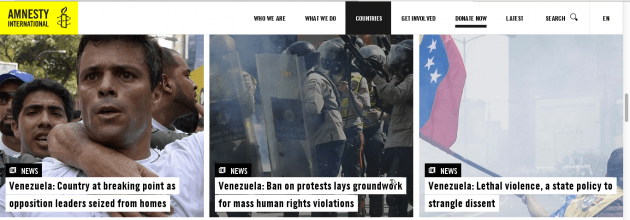
This is identical false coverage to that of Western mainstream corporate media and most Western alternative media outlets too. Amnesty International’s coverage minimizes opposition murders of ordinary Venezuelans, setting many people on fire, violent attacks on hospitals, universities and even preschools and innumerable acts of intimidation of the general population. That headline “Venezuela: Lethal violence, a state policy to strangle dissent” is a pernicious lie. President Nicolas Maduro explicitly banned the use of lethal force against opposition demonstrations from the start of the latest phase of the opposition’s long drawn out attempted coup back in early April this year.
Likewise, against Nicaragua, Amnesty’s latest report, kicking off their global campaign to stop Nicaragua’s proposed Interoceanic Canal, also begins with a demonstrable lie : “Nicaragua has pushed ahead with the approval and design of a mega-project that puts the human rights of hundreds of thousands of people at risk, without consultation and in a process shrouded in silence” That claim is completely false. Even prior to September 2015, the international consultants’ impact study found that the government and the HKND company in charge of building the Canal had organized consultations with, among others, over 5400 people from rural communities in addition to 475 people from indigenous communities along the route of the Canal and its subsidiary projects. There has been very extensive media discussion and coverage of the project ever since it was announced.
That extremely prestigious ERM consultants’ Environmental and Social Impact study, which together with associated studies cost well over US$100 million, is publicly available in Spanish and in English. Two years ago, it anticipated all the criticisms made by Amnesty International and was accepted by the Nicaraguan government, leading to a long period of analysis and revision that is still under way. Amnesty International excludes that information. Recently, government spokesperson Telemaco Talavera, said the continuing process involves a total of 26 further studies. Until the studies are complete, the government is clearly right to avoid commenting on the proposed Canal, because the new studies may radically change the overall project.
Amnesty International states, “According to independent studies of civil society organizations, along the announced route of the canal, approximately 24,100 households (some 119,200 people) in the area will be directly impacted.” But, the ERM study notes, “HKND conducted a census of the population living in the Project Affected Areas. The census determined that approximately 30,000 people (or 7,210 families) would need to be physically or economically displaced.” But Amnesty International’s report omits that contradictory detail, demonstrating how irrationally committed they are to the false propaganda of Nicaragua’s political opposition.
Amnesty International claim their research team interviewed “at least 190 people” concerned about the effects of the Canal. By contrast, the Nicaraguan government and the HKND company have discussed the project with around six thousand people in the areas along the route of the Canal. In that regard, even the local church hierarchy has criticized the way the Nicaraguan opposition have manipulated rural families on the issue of the Canal. But that fact too, Amnesty International omits. Their whole report is tailor made to supplement the political opposition’s campaign for US intervention via the notorious NICA Act.
The Nicaraguan government has made an express commitment to a fair and just resolution of the issue of expropriations. Its 2015 report on the Canal in the context of its National Development Plan, states : “The Nicaraguan government and HKND will guarantee that persons and families on the route of the Canal’s construction will have living conditions superior to those they currently have (without the Canal). To that end, the Government of Reconciliation and National Unity, via the Project’s Commission, will guarantee not just a fair and transparent indemnification of their properties, via negotiations and direct agreements with each family affected, but furthermore will promote actions to improve their economic conditions, health care, education, housing and employment.
But the Amnesty International report systematically excludes that and any other sources giving the government’s point of view, claiming it was unable to access primary sources either from the government itself or from among the Canal’s numerous advocates. However, secondary sources abound that categorically contradict Amnesty’s advocacy against the Canal. Their report specifically and extensively attacks the Law 840, facilitating the construction of the Canal and its sub-projects, but cynically omits a fundamental, crucial detail, while also failing completely to give relevant social and economic context.
The crucial detail is that Law 840’s Article 18 specifically states the Canal project “cannot require any Government Entity to take any action that violates the political Constitution of the Republic of Nicaragua or the terms of any international treaty of which the State of the Republic of Nicaragua is a party.” Amnesty International completely omit that absolutely crucial part of the Law 840 from their report because it makes redundant their advocacy of opposition claims attacking the equity and legality of the Canal’s legal framework. The same is true of the relevant political, social and economic context.
Nicaragua’s political culture is based on dialog, consensus and respect for international law. All the main business organizations and labor unions in Nicaragua and all the main international financial and humanitarian institutions acknowledge that. President Daniel Ortega and Vice President Rosario Murillo enjoy levels of approval of over 70%. There is good reason for that massive majority approval. Among many other factors, the precedents of how the Nicaraguan authorities have resolved relocating populations affected by large projects, for example the Tumarín hydroelectric project, completely contradict the scaremongering of the Nicaraguan opposition propaganda, so glibly recycled by Amnesty International.
Nicaragua’s current Sandinista government has been the most successful ever in reducing poverty and defending the right of all Nicaraguans to a dignified life. To do so, among many other initiatives, it has mobilized record levels of foreign direct investment. In that context, Law 840 explicitly protects the huge potential investments in the proposed Canal, while at the same time implicitly guaranteeing constitutional protections. Similarly, ever since the announcement of the Canal, President Ortega has repeatedly, publicly reassured people in Nicaragua that any families who may eventually be relocated should the Canal go ahead will get every necessary help and assistance from the government.
Just as it has done in the case of Venezuela, on Nicaragua, Amnesty International misrepresents the facts, cynically promoting the positions of the country’s right wing political opposition. In Latin America, under cover of phony concern for peoples’ basic rights, in practice Amnesty International, like almost all the big multi-millionaire Western NGOs, gives spurious humanitarian cover to the political agenda of the US and allied country corporate elites and their governments. The destructive, catastrophic effects of Amnesty International’s recent role in the crises affecting Syria, Ukraine and now Venezuela, are living proof of that.
Three Social Leaders Murdered in Colombia in Only 72 Hours
teleSUR | August 12, 2017
The Colombian activist and social leader Fernando Asprilla was murdered on Friday in the Cauca department, and was the third death of a social leader recorded in a 72 hour period.
The Ombudsman of Colombia, Carlos Alfonso Negret Mosquera, showed in a recent report that during the period between the first of January, 2016, and March 1st of 2017, at least 156 homicides, five disappearances, and 33 violent attacks against community and social leaders occurred.
According to the report given by Negret, one of the primary causes of the deadly trend is the continued operations of illegal armed right-wing paramilitary organizations that have occupied territory left behind by the disarming Revolutionary Armed Forces of Colombia – People’s Army (FARC – EP).
Human rights defenders and activists in the districts of Antioquia, Arauca, Atlantico, Bolivar, Caldas, Caqueta, Casanare, Cauca, Cesar, Cordoba, Cundinamarca, Choco, Huila, La Guajira, Magdalena, Meta, Nariño, Norte de Santander, Putumayo, Risaralda, Santander, Tolima and Cauca Valley have been assassinated since the FARC’s demobilization process began.
As they have handed over their weapons and negotiated terms of peace with the Colombian government, FARC-EP has consistently demanded that the state works to dismantle paramilitarism in the country, saying its ongoing violence represents the greatest threat to the peace process.
The government however, has largely ignored the existence of paramilitaries, claiming that they were demobilized during Alvaro Uribe’s presidential term between 2006 and 2008. FARC-EP leaders have pointed out that many of the groups have been reclassified as criminal gangs, but continue to represent the same threat as always by assassinating leaders who fight for human and land rights.
Venezuela Brings Regional Elections Forward to October
teleSUR | August 12, 2017
Venezuela’s newly-elected National Constituent Assembly, ANC, has brought forward the regional elections by two months.
The polls, which had been scheduled to take place on December 10, will now be held in October following unanimous approval by the ANC.
The second vice president of the body, Isaias Rodriguez, said the process for the election of governors and state governors, will take place “within the framework of the electoral program already announced by the electoral power.”
ANC Constituent Tania Diaz explained that bringing the regional elections forward is a mandate of the people and added, “The recent elections to choose the members of the ANC represents a popular victory and a defeat of the violent actions promoted in the last four months by the right, which has triggered more than 100 fatalities.”
Another member of the ANC, Melvin Maldonado recalled that in 18 years of the Bolivarian Revolution, there have been 21 elections, which “shows the strength of our National Electoral Council, and it also shows the democratic nature and electoral power in our country.”
The president of the National Electoral Council of Venezuela, Tibisay Lucena, said the submission of nominations for the regional elections will start on Sunday August 13 and close the following day.
OAS Chief Almagro Praises Israel, Condemns Venezuela
teleSur | August 10, 2017
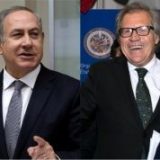 Secretary-General of the Organization of American States Luis Almagro used his one-day visit to Israel to condemn Venezuela’s leftist government while expressing “pride that Israel is a friend of the Americas,” praising what he called Tel Aviv’s record of respecting human rights and democracy.
The tour seemed less like the diplomacy of a “supra-president” representing the Western Hemisphere, and more like a roadshow for the OAS chief to reiterate Trump administration talking points.
“As friends, Israel and the Americas share key values such as democracy and human rights. We have opportunities to learn from each other,” he told a gathering of World Jewish Congress members in Jerusalem. Despite Tel Aviv’s globally unrecognized claims that the ancient city is its “national capital,” Jerusalem remains under illegal occupation.
The themes of democracy and human rights were repeated multiple times by the secretary-general during his time with Israeli officials, usually in such contexts as “Israeli … our essential partner in the Middle East — due to its commitment to democracy and to human rights.”
Israeli authorities face routine criticism from world legal bodies like the U.N. for their disregard of human rights standards, especially in their discriminatory treatment of the Palestinian population.
“Israel is a democratic state in which the institutions function,” Almagro told Haaretz. “The functionality of institutions and the balance of powers are fundamental for us and are the paradigm of the health of a democracy.”
Israeli institutions systematically deny the people of Palestine their right to self-determination, imposing stringent restrictions on their movement, travel, and trade. Israeli security forces have been criticized by rights organizations for resorting to excessive force, including extrajudicial killings, on a regular basis, while unarmed Palestinian demonstrators — adults and children — face imprisonment, torture, and abuse for taking part in protests against occupation activities. The construction of massive settlements deep in the occupied West Bank likewise is illegal under international law.
Almagro’s tone jars dramatically with his opinion five years ago as foreign minister of Uruguay, admitting in an interview that he voted on U.N. resolutions condemning Israeli settlements and human rights violations “with both hands” while arguing that the Israeli occupation’s crimes were irrefutable from a legal standpoint.
On the subject of Venezuela, Almagro struck an emphatic tone consistent with his prior calls to remove the country’s government through “regime change” efforts.
“It is a dictatorship, there’s no other definition for Venezuela today,” Almagro told Israeli daily Haaretz.
Seemingly oblivious to the irony in his words, he then condemned the left for having “flinched on democracy and human rights” in the South American nation.
Opining about U.S. unilateral sanctions on Venezuela, Almagro said, “no country feels comfortable in this situation … but that does not mean the sanctions don’t hit hard and hit those specific places that most affect the regime.”
Since becoming secretary-general of the OAS, Almagro has become a partisan of Venezuela’s right-wing opposition, railing against alleged abuses by the “ruling regime” and issuing thousands of tweets against the Bolivarian government, accompanied by calls for foreign intervention in the country.
In contrast, Almagro has been relatively silent in respect to the Western Hemisphere’s most pressing human rights crises — such as the Mexican government’s crackdowns on social movements resisting neoliberal structural reforms, assassinations of social movement leaders and paramilitary attacks on rural and Indigenous communities throughout Latin America, and the parliamentary coup against Brazilian President Dilma Rousseff.
The OAS chief’s contradictory messages underscore Bolivian President Evo Morales’ description of Almagro’s “submission to the North American empire.”
Featured Video
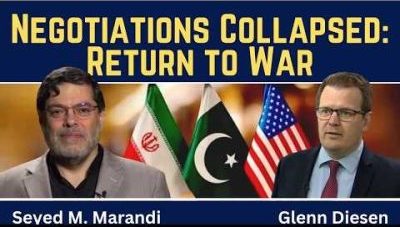
Seyed M. Marandi: Negotiations Collapsed – Return to War
or go to
Aletho News Archives – Video-Images
From the Archives
The US-Iran Scenario That Most Scares Israel
By Ali Haydar | Al-Akhbar | October 9, 2013
Israeli Prime Minister Benjamin Netanyahu issued a series of threats toward Iran and its interlocutors in the West, including the US, as serious negotiations on Iran’s nuclear program seem more plausible.
As a possible rapprochement looms between the US and Iran, Netanyahu has attempted to impose impossible Israeli conditions on the negotiators, such as the full dismantling of Iran’s nuclear program, not to mention threatening military force.
Whatever the deal that could materialize between Iran and the West, Israel is going to find itself before an open-ended path. One can foresee three possible scenarios… continue
Blog Roll
 Aletho News
- Seyed M. Marandi: Negotiations Collapsed – Return to War
- Tomorrow’s naval blockade showdown
- ‘Israel’ attacks civilians to hide its embarrassing military failures & out of pure sadism
- Any Foreign Military Vessel Approaching Hormuz Under Any Pretext ‘Will Be Dealt With Severely’: IRGC
- Diplomats slam US negotiators’ performance in Iran talks
- Trump Refuses Exit Ramp, War with Iran will Continue
- Trump Says US Naval Blockade in Strait of Hormuz Will Begin Shortly
- US, Iran end 21-hour talks without agreement
- US IRAN TALKS: Who Are the Crazy Ones Here? /Lt Col Daniel Davis
- Talks with the US end without a deal over excessive US demands: Iran
- If Americans Knew
- US-Iran ceasefire negotiations make zero progress – Daily Update
- Pro-Israel ‘Thinktanks’ and Individuals who Influence U.S. Foreign Policy
- Mearsheimer reveals how Israel dictates US policies on Iran, Gaza – video
- After killing 350+, Israel still has a “score to settle” with Lebanon before ceasefire – Daily Update
- Military aid to Israel emerges as the latest political litmus test for Democrats
- The only Palestinian children’s rights organization closes following years-long Israeli campaign against it
- ‘I Can’t Forget the Smell’: Lebanese Reel After Israel Kills Over 300 in Single Day
- DNC Shoots Down Resolutions Calling Out AIPAC and Limiting Arms to Israel
- TCN: Is Israel Blackmailing President Trump?
- Israel killed at least 303 Lebanese yesterday – who were they? Daily Update
- No Tricks Zone
- Cave Discovery Reveals Today’s Desert Climates Were Recently Far Warmer, Wetter, Teeming With Life
- German Expert: Heat Dome Led To Record Temps In Western USA…Warmer In 1934, 1936
- New Study: No Linear Warming Or Glacier Retreat Along Northern Antarctic Peninsula Since 1980s
- An Inconvenient Tree: Uncovered In Alps… Europe Much Warmer Than Today 6000 Years Ago
- New Study Reports A 60% Slowdown In Greenland’s Ice Loss Rate In The Last Decade
- Low Intensity Tornado Wrecks Major Solar Farm, Creating A Potential Toxic Dump
- New Study Finds Warming Saves Lives…Cold Temperatures 12 Times More Deadly Than Excess Heat
- German Science Blog Accuses PIK Climate Institute Of Hallucinating Climate Tipping Points
- Devastating Assessment Of Comirnaty Vaccine By Former Senior Pfizer Europe Toxicologist
- New Study: CO2 Is ‘Effectively Negligible’ As An Explanatory Climate Change Factor Since 2000
 Aletho News