Global ‘False’ Witness Targets Nicaragua
By Tortilla con Sal | teleSUR | August 4, 2017
Global Witness is a well-established environmental and human rights non-governmental organization based in Britain.
As with many other similar organizations, its reports often figure in news media as authoritative sources on international issues. Ever since the 1980s and, increasingly so, after the turn of the century, the status of NGOs as trustworthy information sources on foreign affairs has become increasingly untenable as they have been more and more co-opted by corporate interests and governments to promote the Western elites’ neocolonial global policy agenda.
In the case of Nicaragua, in 2016 Global Witness produced a brief, flawed and unreliable account of land conflicts in Nicaragua’s Northern Caribbean Autonomous Region in a report called “On Dangerous Ground”. In June 2017, they produced a report called “Defenders of the Earth”, with a section on Nicaragua even more poorly researched and false than the previous one. Three main reasons stand out to dismiss the latest Global Witness report on Nicaragua as unreliable and in bad faith.
Firstly, the report itself is clearly biased and flawed, from even a cursory analysis of its references and their sources by anyone familiar with Nicaragua. Secondly, the organization’s human and material resources all come from a very narrow managerial class and corporate funding base, overwhelmingly advocating the foreign policy positions of the United States government and its allies. Thirdly, the history of Global Witness clearly indicates its categorical bias in favor of NATO country governments’ policy positions in the countries that figure in its reports and too its systemic defense of the very corporate capitalism whose destructive effects Global Witness superficially and selectively criticizes.
Global Witness sources on Nicaragua
Before looking at the text of the false Global Witness attack on Nicaragua, it is worth looking at the sources they identify in their footnotes, of which there are 23, composed of a total of 44 references. For anyone familiar with Nicaraguan politics and society since the war of the 1980s many of the sources are wearily familiar and readily identifiable as anti-Sandinista, for example, the virulently anti-Sandinista La Prensa newspaper. Some of the references are duplicates and some disguise the fact that while apparently distinct, ultimately the information they provide comes from one single source. (Here’s a link to the relevant spreadsheet for anyone interested in a more detailed analysis.)
Of the 44 references, some of which are duplicates, not one represents the view of the Nicaraguan authorities or others criticized in the report or any source sympathetic to them. 16 references are to sources inside Nicaragua politically opposed to the Nicaragua’s Sandinista government. 25 of the sources are external to Nicaragua but with a long record identifying them as ideologically opposed to the Sandinista government. Of those 25 sources, one might argue that the Washington-based Interamerican Commission for Human Rights or the EFE Spanish language news agency are impartial, but their record is indisputably biased against Nicaragua’s Sandinista authorities.
For all but imperialist ideologues, the Paris based International Federation for Human Rights (FIDH) has been discredited in particular, most recently, by its flagrant partisan bias in favor of NATO country government policies attacking the populations of Libya and Syria. One source, a reference to the law authorizing Nicaragua’s Canal, is completely neutral. Only one media source, El Nuevo Diario, is generally independent. Two references are to sources within the Western environmental scientific lobby, which has its own set of highly questionable biases, prejudices and neocolonial hypocrisy.
“Methodology”
As if by way of justifying this desperately unfair selection of sources, Global Witness also offer an account of what they call their “methodology”. They aver, “We have recorded data about the cases using the HURIDOCS Event Standard Formats and Micro-Thesauri, an approach which is widely used to manage and analyse material of this nature.”
That Global Witness claim is demonstrably untrue. Whatever their aspirations they certainly did not use the HURIDOCS approach.
HURIDOCS (Human Rights Information and Documentation Systems, International) is a European NGO established in 1982 to facilitate networking between human rights organizations around the world. HURIDOCS says its ‟specific role in this capacity-building process lies in improving access to and the dissemination of human rights information through more effective, appropriate and compatible methods and techniques of information handling. HURIDOCS recognises that we live in an age of tremendous advances in information and communication technologies. There is the need to master these technologies to aid us in our human rights work. At the same time, we must be conscious of the fact that the technologies to be applied should be appropriate and responsive to the main focus of the mandates of human rights organisation.”
HURIDOCS exposition of their approach includes the following definitions:
Fact-finding is the process of identifying the violations in one event, and establishing the facts relevant to these violations. Fact-finding and investigation are terms that are used interchangeably.
Documentation is the process of systematically recording the results of an investigation or fact-finding in relation to an event or number of events. Fact-finding and documentation are organically related and should not be viewed as separate processes.
Monitoring is closely observing a given situation in society over a long period of time to see whether human rights standards are met. To carry out monitoring, investigation and documentation of a large and/or representative number of events are conducted.”
Global Witness are not in compliance with the HURIDOCS approach because their practice in their reporting on Nicaragua demonstrably violates all of these definitions.
Their fact-finding or investigation is so heavily biased as to make it impossible for them to establish the facts. Consequently, thanks to this gross fact finding bias, their documentation is partial, often inaccurate and categorically incomplete. Nor do they show any sign of having done due diligence in monitoring consistently over time via ” investigation and documentation of a large and/or representative number of events” or the context of those events in Nicaragua.
Other theoretical considerations
Apart from these chronic procedural failures, other theoretical considerations cry out for clarification.
Global Witness say, “This report is based on research on killings and enforced disappearances of land and environmental defenders, who we define as people who take peaceful action to protect land or environmental rights”.
But in a bitter property dispute between competing communities, clarifying who is defending whose rights becomes a fundamentally important question. Certainly in Nicaragua’s northern Caribbean Coast, unscrupulous Miskito community leaders are themselves involved in provoking these property disputes by illegally selling land to rural families migrating in search of a better life. Miskito gangs have attacked and murdered many such people, a factor not even mentioned by Global Witness. They completely evade the issue of identifying in a responsible, proportionate way whose rights are being violated.
Similarly, Global Witness state, “cases were identified by searching and reviewing reliable sources of publicly online information”. But Global Witness obviously used heavily politicized criteria for deciding what is a reliable source, because not one single reference in their report on Nicaragua gives the Nicaraguan authorities’ side of the story and only one reference can fairly be described as ideologically independent. That renders completely incredible the phony Global Witness claim to systematic research.
They claim their investigation is systematic because “We set up search engine alerts using keywords and conducted other searches online to identify relevant cases across the world.” However, in the case of a small country like Nicaragua, a genuinely systematic search can readily be done covering a much wider range of sources than those accessed by Global Witness without recourse to modish, geeky “search engine alerts”. The poverty of sources evident in the report’s footnotes make Global Witness’s procedure look ridiculous.
Global Witness claim they “verify” the results of their investigation because “Where possible, we checked with in-country or regional partners to gather further information”. But they only cross-checked with ideologically and politically biased organizations, apparently using the same highly questionable, politically compromised sources they cite in their report.
Karl Popper, philosophical darling of the Open Society ideology embraced by Global Witness, explained over 50 years ago in “Conjectures and Refutations” that verification is essentially authoritarian. He argued that a truly scientific investigation requires conjecture and falsification, a search for errors rather than for justification.
If one goes along with Popper, it should surprise no one that Global Witness uses an essentially authoritarian methodology. Self-evidently, their job is not to discover the facts or to impartially establish the truth via a hypothetic-deductive Popper-style process , but to project a manipulative version of events justifying ideologically loaded interpretations favored by their corporate funders, an inherent bias understandably unacknowledged by Global Witness.
Nor is it surprising to learn from their account of their methodology, “While we have made every effort to identify and investigate cases in line with the methodology and criteria, it is important to add that our research mostly relies on public information and that we have not been able to conduct detailed national-level searches in all countries.”
That is not true either. Gobal Witness did not make “every effort” to investigate cases in line with their alleged methodology and criteria because they are flagrantly out of compliance with the definitions advanced by HURIDOCS.
A broader range of sources
Nor is is true that they were unable to conduct a detailed national-level search in the case of Nicaragua, because they could easily have included references from sources that contradict much of the information in the Global Witness report. The following is a brief sample of many other relevant sources, gleaned in a few hours searching on the Internet :
– Indigenous group splits from Miskito party in support of Sandinista government
– Attacks by indigenous gangs on settlers, killing nine
– Miskitos claim their own leaders illegally sold over 3000 acres of communal lands to outsiders
– Historic lease agreement between Canal Authority and indigenous people along the canal route
– Interview with HKND’s Bill Wild about the benefits of the Interoceanic Canal
– HKND’s Bill Wild on the Environmental and Social Impact Study
– Environmentalist Kamilo Lara explains why he believes in Nicaragua’s Interoceanic Canal
– Nicaragua’s Canal – the environmental and economic arguments
– Public Consultation on Lake Nicaragua for the Interoceanic Canal project
– Environmental and Social Impact Assessment of Nicaragua’s Interoceanic Canal – Conclusions and Recommendations
– Bishop accuses political opposition of manipulating canal protests
– Canal protestors attack and injure six police officers
Even this very limited sample of sources, put together from just a few hours searching on the Internet, gives a very different picture to the one presented by Global Witness. So it is false of Global Witness to suggest they lack the resources to be able to stress test and falsify the version of events they have published in their report. Given the tremendous resources and the numerous skilled, experienced, talented people working at Global Witness, only abject intellectual dishonesty explains their failure to report faithfully on Nicaragua
Incoherent claims
Be that as it may, based on their cynically biased sources and their absurdly deficient methodology, Global Witness proceed in their report to make the following claims:
11 defenders killed in 2016 – making Nicaragua the most dangerous country in the world per capita
But, as independent journalist John Perry and others have pointed out, none of those people killed can fairly be described as having being killed for defending the environment. They were in property disputes and all of them were killed either directly or indirectly in the course of those property conflicts. This is true in particular of the case cited by the Inter-American Commission for Human Rights (CIDH) , that of Bernicia Dixon Peralta, her husband Feliciano Benlis Flores and their 11 year old son Feliciano Benlis Dixon. Perry mentions some of the context. More context of the property disputes in the RAAN can be found here, here and here. Not a single person mentioned by Global Witness died in Nicaragua for defending the environment in the way that someone like Berta Cáceres did. Even so Global Witness have tended disingenuously to implicitly compare the situation in Nicaragua with that in Honduras, in particular with Berta’s murder.
The bad faith with which they do so is clear from the second claim in their report on Nicaragua:
10 of those murdered were indigenous people, with most killed in conflicts with settler communities over land. Meanwhile rural ‘campesino’ defenders faced threats, harassment and attacks, including for opposing the construction of an inter-oceanic canal.
Global Witness fails to make clear that groups from the indigenous Miskito people, whom Global Witness inaccurately portray as defenseless environmental defenders, are themselves guilty of murderous attacks against migrants settling land which in many cases the migrants apparently believed they had bought legitimately. Furthermore, the Global Witness report deliberately and falsely confuses the very specific situation of these property conflicts in Nicaragua’s northern Caribbean Coast with protests over the possible displacement of communities along the still to be exactly defined route of the proposed Inter-oceanic Canal 300 kilometers to the south. Global Witness unscrupulously frame their distorted version of events in the two regions to give the impression that in both cases the Nicaraguan authorities may in some way be directly or indirectly responsible for the violence.
In fact, even the New York Times has acknowledged in their otherwise generally hostile anti-Sandinista reporting that the Nicaraguan authorities do what they can with limited resources to protect the rights of indigenous peoples in the Northern Carribean Autonomous Region.
The situation along the route of the Canal is very different from that in the RAAN. Protests against the Canal are exploited by Nicaragua’s political opposition and groups participating in the protest demonstrations have damaged property and attacked police officers. In relation to this situation, completely separate from the property disputes more than 300km to the north, Global Witness claims:
Activists were increasingly criminalized: foreign environmentalists were expelled, community leaders arrested and legislation passed restricting freedoms of speech and association.
However in the very next paragraph, the report quotes anti-Canal activist Francisca Ramirez saying, ““We have carried out 87 marches, demanding that they respect our rights and we have had no response. The only response we have had is the bullet.”
Thus, the Global Witness allegation that rights to freedom of association are restricted is immediately contradicted by Francisca Ramirez declaring her group has organized over 80 public demonstrations to express their views.
Similarly, Ramirez claims “The only response we have had is the bullet.” But, in the next paragraph, we learn “a member of her community lost an eye and another was shot in the stomach”.
Thus, after 87 demonstrations, some of which supposedly involved many thousands of participants and in which “The only response we have had is the bullet”, Ramirez cites precisely two people suffering serious injury and only one of them with a gunshot wound. Ramirez omits that the protesters on the marches she organizes go armed with machetes and home-made mortars. They block highways, intimidate ordinary people going about their business, damage property and attack police officers.
In no Western country would that be tolerated without, to put it mildly, a robust response from the police and security forces. Even so, Global Witness promote Francisca Ramirez’s account as if she and her movement were non-political and non-violent, which they are not. But Global Witness excludes those facts.
Likewise, as John Perry has pointed out, the foreign environmentalists expelled from Nicaragua were involved in a suspicious incident involving a small explosion. Again, a reasonable question to Global Witness is why they excluded this highly relevant information given that in Britain or the United States any foreigner, especially any non-white foreigner, involved in such a suspicious incident would face prosecution and a potential jail term under those countries wide-ranging anti-terrorist laws.
Inaccuracies and falsehoods
Mixed in with these disingenuous, incoherent claims, Global Witness also allege, presumably as supporting context, that the proposed Canal “would force up to 120,000 indigenous people from their land”. This outrageous falsehood is sourced from the pro-NATO, right-wing dominated European Parliament, but is categorically contradicted by the relevant multi-million dollar Environmental and Social Impact report by the extremely prestigious ERM company based in the UK. The falsity of that claim is further confirmed by the Canal concessionary HKND company’s representative Bill Wild who argues that the route of the Canal has been altered to take local concerns into account in such a way that fewer than thirty indigenous families will be directly affected.
Overall, ERM reckons that up to 7210 families or around 30,000 people are likely to be displaced along the whole route of the Canal, over 270 kilometres. The scandalously untrue figure quoted by Global Witness is propaganda from Nicaragua’s political opposition who are exploiting Ramirez’s quasi-celebrity status among Western environmentalists to amplify overseas the marginal support for their unpopular position against the Canal in Nicaragua. That fact is reflected in the incoherence of the arguments set out by Ramirez and her backers in Nicaragua’s political opposition.
If 120,000 people were really going to be displaced by the proposed Canal then the figure of 30,000 protestors from around the country the same political opposition regularly quote to describe national opposition to the Canal just does not add up. Quoting that same opposition figure, Global Witness state, “Francisca has rallied campesino groups from around the country who will be adversely affected by the canal to call for a meaningful say in its development. In June 2015, 30,000 people gathered for an anti-canal protest – Francisca organized 40 trucks so her community could attend.”
In Nicaragua, the cost of hiring a truck or a bus to carry 60 people or a similar amount of material goods on a round trip of 100km is around US$120, while a round trip of 300km costs about US$175. So hiring 40 diesel-guzzling trucks and buses with their drivers will have cost a minimum of US$4000. But Ramirez is an impoverished mother of five from a similarly impoverished community.
Even if only one quarter of the more than 80 protests Ramirez says she has helped organized involved similar costs, the total amount involved runs into tens of thousands of dollars just for Ramirez’s community. Whatever the exact financial accounting, Ramirez is clearly supported by a great deal more than her own resources and those of her community.
Even so, Global Witness completely evade the obvious conclusion to be drawn from that incoherence implicit in their report. Namely, that Francisca Ramirez, far from being a simple altruistic community organizer defending her home is in fact a savvy political opposition activist promoting an inaccurate image of herself as well as concealing her real political agenda. Ramirez alleges that she and her family have been attacked and harassed. Supposing those accusations are true, no convincing evidence points to involvement of the government or the security forces and certainly not the HKND company in charge of planning and building the Canal. That contrasts with the situation of activists in Honduras or Guatemala who can in most cases offer reliable details with corroboration from witnesses to identify their assailants.
The press report cited by Gobal Witness contains no credible evidence from Ramirez except her say so, no corroborating evidence, no witnesses. Likwise the report’s reference to Frontline Defenders’ advocacy for Ramirez links to a summary profile including the false opposition propaganda, repeated by Global Witness, that the proposed inter-oceanic Canal has been imposed without consultation. But in fact preliminary consultations took place in July 2014 and subsequently a continuing consultative process has developed both before and after the publication of ERM’s Environmental and Social Impact Study, which recommended improvements to the consultation process which both HKND and the government accepted.
The Study did also criticize the handling of the expropriation issue and recommended that international standards be applied to any expropriation of land (reckoned to total 1359km2 of dry land out of Nicaragua’s total area of 139,375km2) that may eventully be decided. Those ERM recommendations were accepted by the government and HKND, and the subsequent consultative process has led to several important changes in the precise route of the Canal and to more detailed environmental studies which have been one reason for the delay in the Canal’s construction.
Frontline Defenders’ advocacy of Ramirez, cited by Global Witness, is based on her own account of events with no apparent attempt at corroboration despite the role of Ramirez as a front person for an anti-government campaign openly supported and facilitated by Nicaragua’s political opposition. In the course of framing their benign, heroic account of Francisca Ramirez, Global Witness present an account of the Canal’s origins and procedural progress which repeats virtually word for word the extremely hostile and systematically disingenuous interpretation of Nicaragua’s political opposition.
Garbage in – Garbage out
Winding up their version of the falsehoods, disinformation and propaganda copied from Nicaragua’s political opposition, Global Witness assert, “Resistance to the canal takes place against a terrifying backdrop of multiple murders in indigenous communities elsewhere in the country which have stood up against the arrival of agricultural settlers and demanded the government guarantee their land rights. Even requests by the Inter-American human rights system haven’t spurred the government into protecting community activists from being disappeared, mutilated and murdered.”
But, as is clear from reviewing a wider selection of sources of information in relation to the complicated land situation in Nicaragua’s northern Caribbean Coast, indigenous people themselves are responsible for murderous violence and their own leaders are implicated in corrupt land dealings. It is simply untrue to label the murders as being generically the result of attacks on community activists in the sense in which that term is commonly understood. The general consensus is that the Nicaraguan government has done more than any government in the region, with the possible exception of Venezuela, to protect indigenous people’s land rights with almost a third of the national territory designated as indigenous peoples’ communal land. Global Witness’s allegations on that score are demonstrably inaccurate and grossly unfair.
Similarly, the suggestion that the Canal protest movement is vulnerable to the kind of murderous violence prevalent in Nicaragua’s Northern Caribbean Autonomous Region is egregiously false. The protesters themselves have used violence and intimidation against the general population to carry out their protest actions, so far, thankfully, with no fatalities.
In summary, the Global Witness report in its section on Nicaragua uses politically and ideologically prejudiced sources which could readily have been supplemented with sources offering a contradictory account. The sources used themselves do not always corroborate the claims made in the report. Apart from the ideological bias, various substantive inaccuracies render the report extremey unreliable. The report’s conclusions are flawed because its initial premises are false – Garbage In, Garbage Out.
It remains true that there are serious property conflicts in Nicaragua’s Northern Caribbean Autonomous Region which the government is attempting to address despite a lack of administrative, judicial and security resources, against an intricate social, economic and political context and also the constantly changing opportunistic interaction of corrupt business interests with local indigenous peoples’ leaders, and unscrupulous local officials.
In the case of Nicaragua’s proposed Interoceanic Canal, it is true various issues, including the issue of expropriation, have to be clarified. Protestors claim they want dialog, but Francisca Ramirez sets the precondition that the Canal be scrapped.
The Canal’s critics never acknowledge that Nicaragua is already suffering chronic environmental degradation. The government and many environmentalists argue that the Canal will provide Nicaragua with the resources it needs to reforest deforested areas, better manage its water resources and reverse the current deterioration in Lake Nicaragua, while at the same time helping to reduce poverty.
Foreign and national environmentalists offer no viable proposals to enable Nicaragua to reverse the socio-economic and climate processes already driving accelerating environmental degradation in the country.
Protestors against the Canal exaggerate the number of people likely to be displaced by its construction and often dishonestly claim people affected by displacement will not be compensated. Meanwhile, they themselves are among those responsible for the environmental degradation that will definitely get progressively worse without the resources the Canal is projected to provide.
Corporate funders and the elite NGO revolving door
Few plausible explanations except intellectual dishonesty offer themselves for the desperate failure of Global Witness, firstly to adequately research the issues involved or, secondly, supposing they in fact did so, to acknowledge the complexity of the issues they examine. Global Witness frankly explain in their financial statement for 2016, they had income of over US$13 million. So they do not lack resources. Similarly, their Board, their Advisory Board and their CEO are all very experienced, smart, talented people. So even if they depend on younger inexperienced staff to do the research, their senior staff presumably review the product before publication. Lack of experience is not a reasonable explanation for the report’s glib dishonesty and inaccuracy.
A review of Global Witness funders reveals that for 2016 the two biggest funders were the Open Society Foundation of George Soros associated with the numerous so-called color revolutions in support of NATO country government foreign policy objectives and the Omidyar Network of Pierre Omidyar whose links with US intelligence contractor Booz Allen Hamilton are well known. Less well known is Omidyar’s support for NGOs that fomented the successful right wing coup in Ukraine. The complete list of Global Witness funders is available in the financial statement for 2016 on their web site. That document reports that in 2016 Global Witness received US$3.4 million from the George Soros Open Society Foundation, US$1.5 million from Pierre Omidyar’s Omidyar Network, US$840,000 from the Ford Foundation and over US$3 million from various European NATO governments plus Sweden.
All of these funding sources are unrelenting ideological opponents of Nicaragua’s Sandinista government. A broad pro-NATO bias is very clear in the composition of the Global Witness Board and Advisory Board and CEO. Their profiles make clear they are almost all luminaries from the Western elite neocolonial non governmental sector, while many have a strong corporate business background as well. Just as there is a revolving door between government and corporate business and finance in North America and Europe, so too there is also a revolving door within that region’s elite NGO sector, a sector very clearly serving NATO country foreign policy goals.
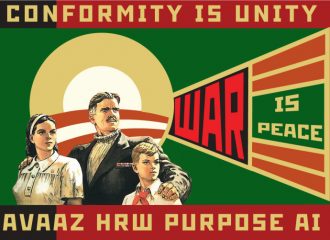 Cory Morningstar has exposed the pro-NATO global political agenda of organizations like US based organizations like Avaaz and Purpose. In the case of Global Witness, their Board member Jessie Tolka is also a board member of Purpose and too of 350.org: Current Global Witness CEO Gillian Caldwell was also a very successful Campaigns Director of Sky1, now merged into 350.0rg. Cory Morningstar argues, “the most vital purpose of the non-profit industrial complex (NPIC) has not been to destroy the ecocidal economic system that enslaves us while perpetuating and ensuring infinite wars. Rather, the key purpose of the NPIC is and has always been to protect this very system it purports to oppose from being dismantled. Hence the trillions of dollars pumped into the NPIC by the establishment.”
Confirmation of Cory Morningstar’s argument can be found in the history of Global Witness itself. For example on Libya, despite their superficial anti-corporate gloss, Global Witness relentlessly apply NATO country government criteria here and here. Also on Ukraine, Global Witness project the same anti-corporate message while simultaneously reinforcing NATO country government propaganda. Global Witness has also received US National Endowment for Democracy grants in Cambodia and in Liberia.
Also, a decade ago, writers Keith Harmon Snow and Rick Hines questioned Global Witness’ corporate links in relation to the “Blood Diamonds” controversy and the organization’s role in relation to De Beers and also Maurice Templesman’s diamond companies. No doubt more thorough research would reveal information casting similar doubt on Global Witness’s integrity and independence.
Conclusion
This latest Global Witness report in relation to Nicaragua is important because it is so readily falsifiable. It thus presents a clear litmus test: no news and information media can use the Global Witness report’s material in relation to Nicaragua without compromising their credibility.
The bias and inaccuracies in the section on Nicaragua in the Global Witness 2017 report call into doubt the integrity of the whole report. No news or information media interested in accuracy or honest reporting can conscientiously rely on Global Witness as a source without thorough cross checking and systematically comparing, contrasting and evaluating information from sources giving a different account of the events and issues in question.
Global Witness is neither independent nor trustworthy. It clearly has a strong but unacknowledged neocolonial political agenda promoting the regional policy goals of NATO country governments, while, conversely, attacking governments and other regional actors opposed to those goals.
NGOs like Global Witness, International Crisis Group, Human Rights Watch, Transparency International and so many others, self-evidently fabricate psychological warfare inputs serving NATO country government policy, itself shaped by the same corporate elites that fund the class of NGOS of which Global Witness is a part.
They operate as the soft, extramural arm of NATO country governments’ foreign policy psychological warfare offensives, targeting liberal and progressive audiences to ensure their acquiescence in overseas aggression and intimidation against governments and movements targeted by NATO. To that end, they deceitfully exploit liberal and progressive susceptibilities in relation to environmental, humanitarian and human rights issues.
Their psychological warfare role supporting the NATO government’s aggressive destabilization of Ivory Coast, Libya and Syria in 2011, of Ukraine in 2014, and the NATO country government’s low intensity war against Venezuela ever since 2013, as well as the campaign against Cuba over five decades, has been unmistakable.
More broadly their systemic ideological role is very obviously to protect and defend global corporate capitalism while superficially and selectively questioning and criticizing some of its worst abuses. Cory Morningstar’s insight bears repeating “the key purpose of the non-profit industrial complex is and has always been to protect this very system it purports to oppose”.
The coverage of Nicaragua in the latest 2017 Global Witness report is a text book example of that sinister fact.
Voting Machine Maker Says Venezuela Polls Rigged, Offers No Evidence
By Tony Cartalucci | Land Destroyer | August 3, 2017
London-based voting machine maker Smartmatic claims the recent polls carried out in Venezuela this week were rigged. In their 5 minute video statement, however, they failed to provide any evidence.
An AP article titled, “Election report: Venezuela vote ‘probably rigged’,” claims:
The number of Venezuelans who participated in the election for an all-powerful constituent assembly was tampered with – off by at least 1 million votes – in an official count, the head of a voting technology company asserted Wednesday, a finding certain to sow further discord over the super-body that has generated months of nationwide protests.
Smartmatic CEO Antonio Mugica said results recorded by his systems and those reported by Venezuela’s National Electoral Council indicate “without any doubt” that official turnout figure of more than 8 million participants was manipulated.
Mugica, however, claims in his full statement (video here) that (emphasis added):
Our automated election system is designed to make it evident when results are manipulated, however, there must be people auditing the system and watching for that evidence. During the National Constituent Assembly elections there were no auditors from the opposition parties as they did not want to participate.
Thus, at best Mugica and Smartmatic can warn that irregularities might have occurred, since no one from the opposition was there to audit the final tallies and report any potential inconsistencies.
Since no opposition auditors were there, no evidence has been provided that such irregularities occurred. Neither AP’s article nor Mugica’s full statement provide any evidence or explanation as to how Smartmatic “estimated” the final count regarding participation was off by “one million votes.” Mugica doesn’t even explain whether it was one million more than reported, or one million less.
Smartmatic either failed to reveal information it has regarding the final count, or has simply lied on behalf of the Venezuelan opposition and the powerful foreign interests sponsoring it from Washington, London, and Brussels.
This latest announcement, absent of any evidence to substantiate these accusations, calls into question Smartmatic’s professionalism, ethics, and impartiality. Other nations considering Smartmatic machines must consider the possibility that the company’s CEO may attempt to use his machines and their role in tallying votes to manipulate their internal politics as well.
This announcement also once again calls the Western media into question for failing to note the very obvious inconsistencies between Mugica’s conclusions and the lack of evidence provided to substantiate them.
US Regime Change in Venezuela: The Truth is Easy if You Follow the Money
By Tony Cartalucci | Land Destroyer | July 31, 2017
Venezuela’s ongoing crisis is not driven by political ideology – it is not a battle of socialism versus capitalism or dictatorship versus democracy – it is the result of two centers of political power possessing opposing interests and colliding geopolitically.
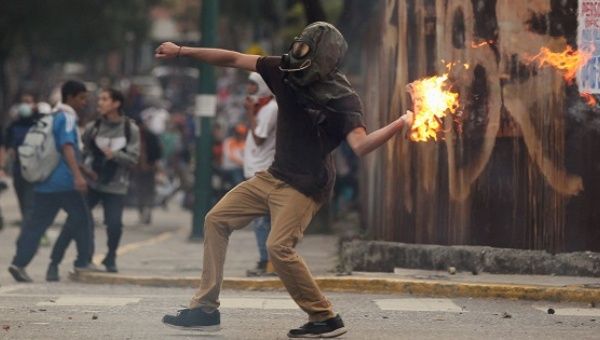
The nation of Venezuela is currently under the control of Venezuelans who derive their support, wealth, and power from Venezuela itself – its people and its natural resource. This political order also receives aid and support from Venezuela’s economic and military partners both in the region and around the globe.
The opposition opposed to the current political order and seeking to supplant it represents foreign interests and more specifically, the United States and its European allies.
The Opposition is Pro-Washington, Not “Pro-Democracy”
As early as 2002, US-backed regime change targeting then Venezuelan president Hugo Chavez, sought to violently overthrow Venezuela’s political order and replace it with one obedient to Washington. Current leaders of the opposition were not only involved in the 2002 failed coup, many are documented to have received political and financial support from the United States government ever since.

Maria Corina Machado, founder of Sumate, an alleged Venezuelan election monitoring group, funded by the US National Endowment for Democracy (NED), meeting with US President George Bush who presided over the failed coup attempt against President Hugo Chavez.
This includes several founders of the opposition party, Primero Justicia (Justice First), including Leopoldo Lopez, Julio Borges, and Henrique Capriles Radonski. The latter of the three has been prominently featured in Western media coverage lately.
US State Department documents reveal that the department itself along with US-funded fronts posing as nongovernmental organizations (NGOs) have been providing Venezuela’s opposition with support.
This includes a report titled, “Status of Capriles and Sumate Cases,” referring to the above mentioned Henrique Capriles Radonski and Sumate, a US National Endowment for Democracy (NED) funded front posing as an election monitor.

Currently, NED’s own website features an extensive list of activities it is engaged in within Venezuela’s borders. It includes leveraging human rights for political gain, electoral manipulation, building opposition fronts, and expanding pro-opposition media. While each activity is labelled with benign titles, it is clear that none of these activities are done impartially, and as State Department documents reveal, these activities are done specifically for the benefit of the US-backed opposition.
Wall Street and Washington’s Open Conspiracy
After the death of Chavez in 2013, US-based special interests openly conspired to finally overturn the political order he built. Corporate-financier policy think tank, the American Enterprise Institute (AEI) created a checklist of US foreign policy goals it sought to achieve in Venezuela. They included:
- The ouster of narco-kingpins who now hold senior posts in government
- The respect for a constitutional succession
- The adoption of meaningful electoral reforms to ensure a fair campaign environment and a transparent vote count in expected presidential elections; and
- The dismantling of Iranian and Hezbollah networks in Venezuela
In reality, AEI is talking about dismantling entirely the obstacles that have prevented the US and the corporate-financier interests that direct it, from installing a client regime and extracting entirely Venezuela’s wealth while obstructing, even dismantling the geopolitical independence and influence achieved by Chavez in Venezuela, throughout South America, and beyond.
The think tank would continue by stating:
Now is the time for US diplomats to begin a quiet dialogue with key regional powers to explain the high cost of Chávez’s criminal regime, including the impact of chavista complicity with narcotraffickers who sow mayhem in Colombia, Central America, and Mexico. Perhaps then we can convince regional leaders to show solidarity with Venezuelan democrats who want to restore a commitment to the rule of law and to rebuild an economy that can be an engine for growth in South America.
By “Venezuelan democrats,” AEI means proxies created, funded, and directed by Washington, including Primero Justicia and the street mobs and paramilitary units it commands.
More recently, another Wall Street-Washington policy think tank, the Brookings Institution, would publish in a paper titled, “Venezuela: A path out of crisis,” a 5-point plan toward escalating the crisis in Venezuela (emphasis added):
1. The United States could expand its assistance to countries that until now have been dependent on Venezuelan oil, as a means to decrease regional support for and dependence on the Maduro government.
2. The United States could increase monetary assistance to credible civil society organizations and nongovernmental organizations able to deliver food and medicines to Venezuelans. By doing so, the United States should make clear that international pressure aims to support democracy, not punish the Venezuelan people.
3. The United States could support efforts by the opposition in Venezuela to build an “off-ramp” that would split moderate elements of the government away from hardliners, encouraging the former to acquiesce to a transition to democracy by lowering their costs of exiting government.
4. The United States could coordinate with international institutions such as the International Monetary Fund (IMF) to offer financial incentives for holding free and fair elections in 2018, and for the opposition to unify and compete in those elections. Such coordination would also involve developing and publicizing a credible plan to restart Venezuela’s economy.
5. As a last resort, the United States could consider raising economic costs to the government through an expanded sanctions regime that aims to limit Venezuelan earnings from oil exports and block further financing. This policy is risky, given that the Maduro government would be able to more credibly shift blame for the economic crisis onto the United States, and should be accompanied by well-publicized efforts to deliver humanitarian aid through credible civil society and nongovernmental organizations.
While the Western media attempts to frame Venezuela’s crisis as a result of “socialism” and “dictatorship,” it is clear by reading the West’s own policy papers that it is owed instead to a systematic assault on Venezuela’s sociopolitical stability and economic viability, spanning decades.
Venezuela is not the first nation in South America that the United States has sought to overturn by undermining its economy.
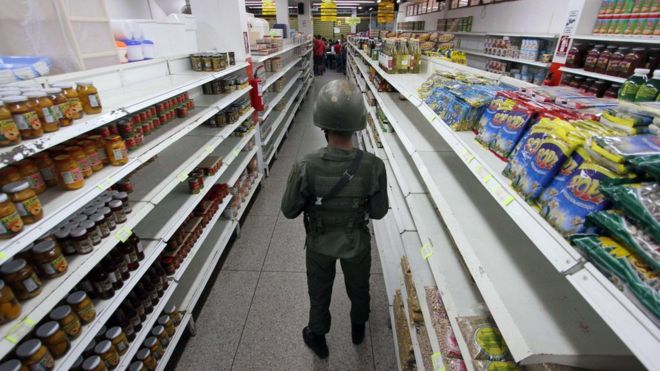
Within the CIA’s own online archives under a section titled, “CIA Activities in Chile,” it is admitted that in the 1970s, similar tactics were used to undermine and overturn the government of Chile. It states specifically: (emphasis added):
According to the Church Committee report, in their meeting with CIA Director Richard Helms and Attorney General John Mitchell on 15 September 1970 President Nixon and his National Security Advisor, Henry Kissinger, directed the CIA to prevent Allende from taking power. They were “not concerned [about the] risks involved,” according to Helms’ notes. In addition to political action, Nixon and Kissinger, according to Helms’s notes, ordered steps to “make the economy scream.”
These Cold War attitudes persisted into the Pinochet era. After Pinochet came to power, senior policymakers appeared reluctant to criticize human rights violations, taking to task US diplomats urging greater attention to the problem. US military assistance and sales grew significantly during the years of greatest human rights abuses. According to a previously released Memorandum of Conversation, Kissinger in June 1976 indicated to Pinochet that the US Government was sympathetic to his regime, although Kissinger advised some progress on human rights in order to improve Chile’s image in the US Congress.
Considering America’s extensive list of interventions, wars, and occupations it is currently involved in worldwide and the manner in which each was presented to the public – with ideology and humanitarian concerns used to manipulate public perception, and considering Venezuela’s opposition is a documented recipient of US support, it is clear that yet another intervention is under way, this time in South America.
Unipolar vs Multipolar
In a world moving toward multipolarism and greater decentralization on all levels, Venezuela’s collapse and a victory for Washington would undo an increasingly balanced distribution of geopolitical power – both in South and Central America, as well as across the world.
As a major oil producing nation, US control over its people and natural resources would further allow the US and its allies to manipulate energy prices toward achieving future goals – particularly in terms of encircling, isolating, and dismantling other centers of political power dependent on oil production for economic prosperity.

One needs not be a fan of “socialism” to understand that the ultimate outcome of Venezuela’s collapse will be a further concentration of power in Washington and Wall Street’s hands. Such power, regardless of whatever ideology it is superficially wielded behind, will always be abused. Regardless of the alleged form of government a nation may take, as long as it is a step away from unipolar globalization, it is a step in the right direction.
The crisis in Venezuela is not one of socialism versus capitalism or dictatorship versus democracy – it is one of hegemony versus national sovereignty, of centralized unipolar power versus an increasingly multipolar world.
A sovereign and independent Venezuela allowed to pursue its own destiny is one in which its own people will naturally seek to decentralize and distribute power. While the current government may not provide the ideal conditions to accomplish this, conditions under a US client regime – as US-wrecked Libya, Afghanistan, or Iraq prove – would be significantly less ideal.
For geopolitical analysts, moving away from ideological talking points and examining the actual government and opposition, their interests, associations, and funding, as well as their base motives reveals a much simpler and consistent narrative, one that any analyst could discern, and a discernment that will stand the test of scrutiny and time. Those entrenched in left/right ideology risk being betrayed by the government’s floundering desperation and the true nature of an opposition that most certainly is not “capitalist” or “pro-democracy.”
8 million Venezuelans vote for Constituent Assembly amid violence
Press TV – July 31, 2017
Over eight million Venezuelans have participated in the Sunday vote to elect a powerful new congress, which will be allowed to rewrite the constitution, with President Nicolas Maduro hailing the results as a victory for the country’s Bolivarian Revolution.
Venezuela’s National Electoral Council said Monday that the turnout was 41.5 percent– more than double the estimates of both the government’s political opponents and independent experts.
“Peace has won. If peace has won, Venezuela has won,” said Tibisay Lucena, the council’s president, at a televised press conference, the pan–Latin American Telesur television network reported. “Despite the violence and threats, Venezuelans were able to express themselves.”
Speaking at a large gathering of government supporters, Maduro thanked the nation for supporting the vote and said it was one of the highest voter turnouts in the history of the Bolivarian Revolution, with 8,089, 320 casting ballots to select their representatives.
“It is the biggest vote the revolution has ever scored in its 18-year history,” he said, referring to the year his late predecessor and mentor, Hugo Chavez, came to power.
“Eight million in the middle of threats, there were states where they crossed rivers and mountains, and they voted,” Maduro said.
He also hailed the Latin American and Caribbean countries for standing by Venezuela against “interventionist” moves by the United States.
“We don’t care what [US President Donald] Trump says, we care about what our people say,” said Maduro, referring to Trump’s promise that he would not accept the vote results.
The Venezuelan president said before the new legislative body begins the process to re-write the constitution, the government will in the first step call on the opposition to engage in dialog.
However, members of the opposition, which has boycotted the vote, reacted with mockery and anger to the count, which they say appears to be only two to three million.
The Sunday vote took place amid a wave of clashes and violence, which led to the deaths of ten people.
Anti-government protesters and security forces engaged in street battles across the country as voting got underway early Sunday morning. Those killed include a soldier and a regional opposition leader, according to prosecutors.
They also say one of the candidates running in the assembly election was also fatally shot by yet unknown gunmen.
Defense Minister General Vladimir Padrino Lopez said none of the deaths that occurred in the setting of Sunday’s vote were “attributable to the Bolivarian National Armed Forces.”
The anti-government protesters took to the streets despite a ban on such gatherings, which took effect on Friday and will continue through Tuesday.
The government had deployed more than 200,000 military officers to maintain order in more than 1,000 voting stations across the country.
The roads to polling stations had been sealed off and only those with registration cards were allowed to pass.
Several attacks happened in the capital city of Caracas, where one remote explosion occurred around noon and injured at least six police officers.
The opposition has urged further protests on Monday.
“We do not recognize this fraudulent process,” said opposition leader Henrique Capriles.
Maduro wants to replace the current legislative body— the National Assembly— with a new institution called the Constituent Assembly. The new assembly will have the power to override an opposition-led congress and re-write the constitution.
The opposition says the new assembly is a power grab by Maduro.
The president, however, argues that it is the only way to restore peace after months of opposition-backed political unrest, which has fueled the country’s economic woes.
The latest casualties brought the death toll from the unrest ongoing since early April to 123, authorities said.
US urges ‘swift actions’
Meanwhile, the US State Department officially condemned the Venezuelan government for holding the vote, and once again promised to “continue to take strong and swift actions against the architects of authoritarianism in Venezuela.”
The department called Maduro’s measure as a move to “undermine the Venezuelan people’s right to self-determination.”
US Ambassador to the United Nations Nikki Haley also took to Twitter on Sunday to offer Washington’s official response to the vote.
“Maduro’s sham election is another step toward dictatorship,” Haley tweeted. “We won’t accept an illegitimate govt. The Venezuelan ppl. [people] & democracy will prevail.”
The US and its allies, including the UK, Canada, Argentina, Peru, Colombia, Mexico, Spain, Panama and Paraguay, have said they would not recognize the vote results.
Washington also blamed Maduro for violence and urged regional and international governments to take strong action against his government.
Online Petition Forces Review of Dilma Rouseff’s Impeachment
teleSUR | July 29, 2017
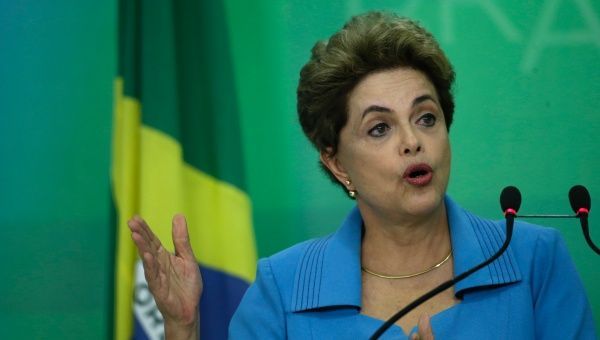
Brazilian senators will have to review the controversial procedure that led to the former president Dilma Rousseff’s impeachment last year, after an online citizens’ petition gathered more than 46,000 signatures in less than 24 hours.
The survey is being carried out on the Senate’s online platform E-Cidadania, and required a minimum of 20,000 signatures by November before it could be formally converted into a “legislative suggestion” to be considered in the higher house.
It poses two questions: firstly, that the loss of her mandate as the constitutional president was the consequence of a coup d’état.
And secondly, that the ‘failure’ of her successor Michel Terner’s government means that the only solution is to reinstate Rouseff into her elected post which should never have been taken away from her.
Last August, Brazil’s Senate voted to remove her from office for manipulating the budget.
Rouseff protested her innocence and promised not to give up the political struggle against poverty and inequality.
The petition is similar to another one which has been drawn up by the National Movement for the Anullment of the Impeachment, MNAI.
It’s supporters include the former president Luiz Inacio Lula da Silva, the national president of the Workers’ Party, Gleisi Hoffmann and the singer and composer Chico Buarque.
The MNAI hopes to gather 1.3 million signatures in order to pressure the Federal Supreme Court to revoke the result of the trial against Rousseff.
The Brazilian President Michel Temer’s approval ratings have plummeted to less than five percent as the corruption allegations against him and other politicians refuse to go away.
While opponents of his government’s controversial labor and pension reforms are still demanding his resignation.
ELN Seeks ‘Temporary and Renewable’ Ceasefire in Colombia
teleSUR | July 26, 2017
The chief negotiator of the National Liberation Army (ELN) in Colombia’s peace talks, Pablo Beltran, said on Tuesday that the objective of the third round of negotiations is to reach a “temporary and renewable” bilateral ceasefire, a process which he said takes time because it requires “very precise procedures.”
During an interview with TeleSUR on the Enclave Politica program, Beltran said that the ELN is committed to peace talks and the peace process, and that a consensus has emerged among its members that there “must be a bilateral ceasefire.”
The task of the third round of dialogue is “to make the agreement, design the protocols, sign them, and then apply them. This round must be about the bilateral ceasefire that we want to last beyond the visit of Pope Francis,” according to Beltran.
Beltran emphasized that the group’s motto has always been to “be with the people, and that there is a large sector of Colombian society that wants peace.” The ELN has been accused by some of those opposed to peace talks for allegedly only being interested in peace because their political project has “failed.”
The reason for being in the ELN, he said, is to always be with the people and acting where there is social change and struggle. Beltran said that at the heart of the peace talks is “that there is participation so that the people say how Colombian democracy should be… that is why there are sectors of the right that oppose peace.”
“Some sectors in the government want an expedited negotiation, but we want things to be done well so that it is durable,” he said regarding delays in the process.
“We have lost 26 months in the negotiations because of the government tactic to place the ELN negotiations behind those with the Revolutionary Armed Forces of Colombia – People’s Army (FARC),” he said. “There is a sector of the hard right that is going to oppose anything that signals peace.”
While dialogue progresses, the ELN still is active and present in several regions of Colombia, where the chief negotiater said they have programs and popular support. “The ELN is alive, it is acting,” he said.
OAS Appoints Former ICC Prosecutor Ocampo to Look Into Venezuela ‘Crimes Against Humanity’

Luis Moreno Ocampo (L) discusses human rights with NYT columnist Nicholas Kristof (R) at the CFR Symposium on International Law and Justice sponsored by the Pitt-Jolie Foundation*
teleSUR | July 25, 2017
Luis Almagro, the secretary-general of the Organization of American States, has appointed former International Criminal Court Prosecutor Luis Moreno Ocampo as OAS special adviser on crimes against humanity.
Ocampo, who also served as a World Bank consultant, is a controversial figure who has been described as erratic and prone to grandstanding performances that undercut his own legal efforts.
According to a statement published by the OAS, Ocampo’s tasks will include analyzing, studying and discussing the situation in Venezuela with all interested parties and, consequently, making suggestions on possible courses of action by the OAS.
Almagro said the decision was made in light of an “escalation of human rights violations in Venezuela and the systematic attack on the civilian population includes murder, imprisonment and torture … it is evident in the eyes of the international community that we are witnessing crimes against humanity. ”
Caracas has repeatedly accused Almagro and the OAS of promoting intervention and destabilization in Venezuela, which ultimately led to the Bolivarian nation leaving the regional body on the grounds that its continued presence there posed a threat to the country’s sovereignty.
“The OAS can prevent impunity in Venezuela,” Ocampo said. “The secretary-general is creating a new space within the OAS, focusing on crime prevention and control, as well as gathering information that may be useful to the OAS in conducting an independent judicial investigation”
Luis Moreno Ocampo earned much of his recognition during his time as deputy prosecutor during the case of nine members of the military junta that ruled Argentina from 1976 to 1983. However, his time as ICC prosecutor is largely seen as a failure in which the global court lost a great deal of its credibility as some impartial body, largely thanks to Ocampo’s wild moves and desire to seek the media spotlight.
Ocampo drew criticism for his role in Colombia, where in 2008 he suggested that the ICC should begin investigating the Revolutionary Armed Forces of Colombia or FARC for crimes against humanity. At the time, then-President Alvaro Uribe was busy pursuing a bloody counterinsurgency campaign against the group, utilizing paramilitary death squads and security forces whose operations led to the execution of 2,364 civilians, a figure that dwarfed the death toll resulting from FARC actions during Uribe’s reign.
In recent years, Ocampo also drew negative attention for his proceedings against sitting heads of state, a pattern that also began in 2008 when he sought a warrant for the arrest of Sudanese President Omar Bashir amid the raging conflict in Darfur. Critics claim that the evidence cited by Ocampo was a spurious mix of fact and fiction, and such an intervention while the civil war raged would only stymie the possibility of an internationally-mediated peace process.
“My time in the ICC was a mixture of a fascinating time and a terrible time,” a former staffer for the Office of the Prosecutor said at the time, according to World Affairs Journal. “The prosecutor was erratic, so irrational sometimes that you felt despair. He uses his charisma in a negative way.
Since then, Ocampo has pursued the prosecution of Syrian President Bashar al-Assad on charges of genocide while likewise charging deceased former Libyan leader Muammar Gaddafi with crimes against humanity for alleged massacres committed against anti-government protests that became increasingly violent before culminating in an open “regime change” campaign spearheaded by the U.S. with European and Gulf Arab allies.
The court has largely been discredited among non-Group of 7 nations as a neocolonial tool of Western capitals seeking to control the Global south. Last October, Gambia’s Information Minister Sheriff Bojang noted that the ICC is, “in fact, an International Caucasian Court for the persecution and humiliation of people of color.”
Most recently, the former ICC prosecutor advised the Israelis on how to evade criminal charges for their perpetual expansion of illegal settlements. Ocampo noted that the settler-colonial state could successfully defend itself by manipulating international legal perceptions through arguments that the ongoing settlement construction is legal “once ratified by the country’s top court,” the Israeli High Court, which Ocampo argued “is highly respected internationally.”
* Photo: YouTube-Council on Foreign Relations
The Guardian’s Propaganda on Venezuela
By Ricardo Vaz | Investig’Action | July 25, 2017

With the Constituent Assembly elections due to take place on July 30th, the Guardian published a piece titled “Venezuela elections: all you need to know”. But instead of breaking through the fog of falsehood and misinformation that is typical of the mainstream media’s coverage of Venezuela, the Guardian comes up with another propaganda piece laden with lies, distortions and omissions. In this article we go through the Guardian’s piece, clarifying the falsehoods, adding the conveniently omitted information and questioning the whole narrative that is presented.
*****
What is happening on 30 July?
To be fair to the Guardian, there is one almost-informative paragraph, where the electoral procedure is explained. In a previous article the Guardian stated that
“[…] election rules appear designed to guarantee a majority for the government even though it has minority popular support”,
instead of presenting said electoral rules and letting the reader decide if they are so designed. This time they do present the rules, only omitting to say that everyone not currently holding public office can run for a seat. But then the Guardian brings in the propaganda artillery to ensure the reader’s conclusions do not stray too far off from those of the State Department.
“[…] voter turnout will be exclusively pro-government – and likely very low, given that Maduro’s approval rating hovers around 20%” 1
One assumes the Guardian is citing Datanalisis, their favourite Venezuelan anti-government pollster. Putting aside the fact that other, more reliable polls, demonstrate larger levels of government support, and the massive turnout for last Sunday’s dry-run, there are two obvious questions here. If turnout will be so low, why is the opposition hell-bent on stopping the vote from taking place, barricading streets and killing candidates? And if the opposition has such an overwhelming majority, why did they decide not to participate? This might have been their chance to introduce a Platt Amendment into the Constitution.
“The current constitution was written by an assembly called in 1999 by Maduro’s predecessor and political father, Hugo Chávez. But Chavez made sure he had popular support for the rewrite, by calling a referendum first. This time around, Maduro ordered the constituent assembly by decree.”
Chávez needed to call a referendum because he was working within the legal framework of the 1961 Constitution which did not have anything about such a mechanism. In the 1999 Constitution, article 348 states who can convene a Constituent Assembly.

Venezuelan president Nicolás Maduro has repeatedly urged opposition leaders to engage in dialogue and has backed the Constituent Assembly to guarantee peace.
“On 16 July, a symbolic plebiscite against Maduro’s initiative held by the opposition drew more than seven million people – more than those who voted for Maduro in the 2014 election.”
When it comes to the Venezuelan opposition, the Guardian checks all the journalism tools at the door. In a recent Investig’Action article we examined the opposition’s highly doubtful numbers, Venezuelanalysis did the same. At least the Guardian refrained from explicitly saying this vote could have recalled Maduro, something the opposition could not manage even with a lot of number-cooking (see footnote 2).
“Amid mounting pressure, Maduro vowed last month to hold a popular vote at the end of the process to approve or reject the new constitution.”
This was announced almost two months ago, and if it had been due to “mounting pressure” the mainstream media would have done a victory lap. Here another question springs up: why are the Venezuelan opposition and the Guardian so scared of this process? If they represent this huge majority, can they not just vote down the Constituent Assembly proposal?
Why did Maduro call this vote?
The final paragraph of this section contains the mandatory red-baiting and waving of the Cuban bogeyman.
“Venezuela has been rocked by nonstop street protests since the government’s attempt in late March to strip Congress of its right to legislate. Although the move was partially reversed, demonstrations have continued against an increasingly authoritarian government widely blamed for the country’s tanking economy and soaring crime rate.”
Again, there is very little journalism here to be found. It was not the government that overrode the National Assembly, but the Supreme Court. And they did it because the National Assembly is currently in contempt of court. Three legislators from Amazonas state are being investigated for electoral fraud, and despite repeated warnings from judicial authorities, the opposition went ahead and swore in these legislators. One can agree or disagree with the Supreme Court’s initiative, but omitting this fact is pure dishonesty.
This is also a good point to notice how only the “authoritarian” government and the “beleaguered” president have earned adjectives. “Protests” are referred to five times without a single reference to their violent nature, and a few adjectives (“divided”, “US-backed”, “coup-plotting”) also come to mind when describing the opposition.
“[…] violence and state repression have escalated since, with more than 100 people killed and hundreds arrested.”
Sophisticated newspapers like the Guardian are careful not to state directly that everyone was killed by state repression, only heavily implying it. A breakdown of the cases shows that it is the opposition’s political violence that has been responsible for the large majority of casualties.
What does the opposition say?
“The coalition of opposition forces known as the Democratic Unity Roundtable (known by its Spanish initials, MUD) rejected the move from the start. But criticism extends far beyond the political opposition. According to one pollster, eight out of 10 Venezuelans oppose a new constitution and would prefer general elections.”
One would think this would be an opportune moment to remind readers of the opposition’s constant, repeated calls for a Constituent Assembly in the recent past. And according to a different pollster, 79% of Venezuelans agree that the process should take place, 54% think the process will defend social gains of recent years, and 65% agrees with holding elections in 2018.

Opposition leaders Freddy Guevara and Maria Corina Machado had called for a Constituent Assembly in the past. (Tweets by Misión Verdad)
What happens next?
“Pressure is set to rise after the MUD called a two-day national strike for Wednesday and Thursday, and then mass protests dubbed the “taking of Caracas” on Friday.”
To anyone familiar with the recent history of Venezuela these announcements sound eerily like the events leading up to the failed 2002 coup. In fact, this would be the time to mention that many of the opposition leaders, including Henrique Capriles, Julio Borges, Leopoldo López and Maria Corina Machado, were directly involved in the 2002 coup attempt. Why is there never a mention that the opposition leadership is full of protagonists from that US-backed military coup that ultimately failed? Quite simply because it would undermine the entire “democracy vs. dictatorship” propaganda narrative.
“Maduro has been very vague about the scope of the new constitution – prompting fears that this is simply a move to tighten the government’s hold on power rather than to solve the country’s many problems.”
This is again a distortion. Maduro proposed nine issues to be tackled by the ANC, including the economy, national sovereignty, social missions, communes, and more. Granted, there is some ambiguity on what a “post-oil economy” stands for, with radical sectors looking for a deepening of the Revolution and business leaders looking for more incentives to private investment. But is down to the individual candidates to bring forward their proposals during the campaign. If Maduro specifically said what changes he wanted made to the Constitution, would he not fit into the “authoritarian” label that the Guardian loves to use?
“Maduro threatened to jail two high profile opposition leaders for “treason to the motherland”…”
Once more, it would be useful to put the actions of the Venezuelan opposition in context. There is hardly any other place in the world where opposition leaders openly call for a US military invasion or urge foreign agents to create a financial blockade against their own country!
“According to human rights groups…”
Which rights groups? Why not link to the reports and disclose who funds these groups? Because groups like Human Rights Watch have been beyond partisan when it comes to Venezuela, not to mention the revolving door that puts former US officials as human rights “guardians”. UNICEF, for example, has criticised the use of children in the opposition’s violent protests and the opposition’s attack against a maternity hospital.
“The next presidential elections – which Maduro seems likely to lose – are currently scheduled to be held in 2018, but it is unclear whether this would remain the case under a new constitution.”
Maduro has said that, rain or shine, there will be a presidential election in 2018. And he said it after convening the Constituent Assembly. The omission of this statement is again plain dishonest journalism.

Chavistas march on May 1st. The Venezuelan opposition is fearful of a large turnout for the Constituent Assembly elections on July 30th.
What is the international community doing?
“The Organization of American States has tried repeatedly to chastise Venezuela diplomatically, but Caracas has used oil diplomacy to ensure that small Caribbean states reliant on subsidised oil voted against critical resolutions or abstained.”
It is amazing that countries that are part of PetroCaribe are bullied by oil diplomacy, and yet countries that receive billions in US (military) aid and host US military bases are moved by a genuine love for democracy and human rights. Does it not occur to a journalist that, for a small Caribbean country, if a US-dominated organisation such as the OAS is dictating to Venezuela which elections can take place and when, then soon enough the same will happen to them? By rejecting this interference they are actually asserting their own independence.
It is precisely because this kind of bullying that Venezuela left the OAS. On the other hand, regional organisations that have been formed in the last decade precisely to counter US hegemony, like ALBA or CELAC, have come out in support of Venezuela and its sovereignty. International meetings like the People’s Summit or the Foro de São Paulo have also rejected the imperialist aggression against Venezuela.
“Previous US sanctions have targeted Venezuelan officials accused of drug trafficking or involvement in human rights abuses.”
These accusations have always been very big in terms of publicity and very thin in terms of evidence. They are always based on dubious sources mentioning all-powerful, yet unheard-of, drug cartels, Hezbollah training camps in Latin America and the like.
In summary, the Guardian is passing a pure propaganda piece under the guise of clarifying the upcoming Constituent Assembly elections in Venezuela. Quite clearly the next few days will be crucial, as the opposition ramps up its violent regime change efforts and the US blares out its threats, while on the other side chavismo is mobilising for this important step and (true) solidarity movements are standing with the Venezuelan poor and working-class.
As for the Guardian, whenever they ask you to support “quality, independent journalism”, you should look for it someplace else…)
- Even if this number were true, that would still make Maduro more popular than the presidents of Colombia, Mexico and Brazil, staunch US allies in the region.
Q & A: The National Constituent Assembly in Venezuela
Venezuela Solidarity Campaign | Venezuelanalysis | July 24, 2017
Elections for a National Constituent Assembly are being held in Venezuela on July 30th. Here are some common questions – with the answers – that are being asked about the Assembly. (21/07/17)
What is a National Constituent Assembly (ANC), under Venezuelan law?
A National Constituent Assembly is essentially a constitutional convention, a gathering for the purpose of writing a new constitution or revising an existing constitution. Apart from the famous examples from the 18th century America and France, a range of other countries have employed this mechanism. In Venezuela, Article 347 of its constitution says:
“The original constituent power rests with the people of Venezuela. This power may be exercised by calling a National Constituent Assembly for the purpose of transforming the State, creating a new juridical order and drawing up a new Constitution.”
Venezuela’s constitution is itself the product of a constitutional convention held in 1999, convened at the initiative of President Chávez to draft a new constitution. The constitution was later endorsed by referendum in December 1999. New general elections were held under the new constitution in July 2000. This marked the transition from the Fourth Republic of Venezuela to the present-day Bolivarian Republic of Venezuela
Is President Maduro allowed to call for the setting up of a Constituent Assembly?
Article 348 of the constitution provides for how a National Constituent Assembly is to be instigated:
“The initiative for calling a National Constituent Assembly may emanate from the President of the Republic sitting with the Cabinet of Ministers; from the National Assembly by a two-thirds vote of its members; from the Municipal Councils in open session, by a two-thirds vote of their members; and from 15% of the voters registered with the Civil and Electoral Registry.”
It is also important to note what Article 349 of the constitution says, bearing in mind (as explained later) that the right-wing opposition coalition, which has a majority in the National Assembly, is opposed to the calling of a National Constituent Assembly:
Article 349: “The President of the Republic shall not have the power to object to the new Constitution. The existing constituted authorities shall not be permitted to obstruct the Constituent Assembly in any way. For purposes of the promulgation of the new Constitution, the same shall be published in the Official Gazette of the Republic of Venezuela or in the Gazette of the Constituent Assembly.”
Why has President Maduro called for a National Constituent Assembly?
In a formal document which he signed in front of the National Electoral Council (CNE), President Maduro stated that the call for the Constituent Assembly was made in the context of the current social, political and economic circumstances in which there are severe internal and external threats against democracy and the constitutional order.
This refers to the right-wing opposition-led violence aimed at bringing down the elected Venezuelan President Nicolas Maduro. The violence began in early April, resulting so far in scores of deaths and over 1,200 people injured. A key tactic in the violent protests is the use of ‘guarimbas’ or street blockades created by masked protesters.
The current violence has involved attacks on state facilities and services such as maternity hospitals, electricity supplies, food depots and public transport, and also targeted assassinations of government supporters. A ramping up of the aggression occurred in late June when a police officer flying a stolen helicopter attacked the Ministry of Interior building and the Supreme Court, firing shots and dropping four grenades.
The purpose of the Constituent Assembly has been expounded on by former Education Minister Elias Jaua, who explained in an interview with Televen, a private Venezuela TV channel, that its aims were “to maintain political stability, to solve the economic issues, to broaden and to strengthen the system of social welfare [and] to heal the social wounds that have come up during the conflict”.
When and how will the Constituent Assembly be made up?
Elections for Constituent Assembly are scheduled to take place on 30 July 2017.
Anybody, regardless of political persuasion, can be nominated or nominate themselves to be a candidate for election to the Constituent Assembly.
Candidates may be nominated in one of the following ways:
• by their own initiative.
• by the initiative of groups of voters and voters.
• by the initiative of the sectoral groups comprising173 seats of the 545 seat Constituent Assembly (see infogram)

In order to run for office on their own initiative, 3% of voters and voters registered in the electoral registry of the municipalities are required to nominate the constituents. In the sector category, the candidates will be nominated by the corresponding sector, and should receive the backing of 3% of the sector to which they belong.
From these various ways of being nominated, there are over 6,000 candidates competing for Constituent Assembly seats.
In keeping with how previous elections have been organised, the National Electoral Council (CNE) organised a ‘trial run’ of voting arrangements for the Constituent Assembly, setting up nearly 2,000 voting booths in voting centres across the country, in order to be assured that on election day everything would run smoothly and efficiently..
How will a new constitution emerge?
Once elected, the National Constituent Assembly will be convened within 72 hours and will get to work.
The Assembly will set its agenda for discussion on the basis of what it sees as national priorities. As convenor of the Assembly, however, the President has proposed nine topics for the Assembly to consider:
• the nation’s right and need for peace
• improvements to the country’s economy
• constitutional recognition of the various ‘Missions’ (government social programmes)
• an extension of the justice system’s scope, to end impunity for crimes
• constitutional recognition of new forms of popular and participatory democracy in Venezuela, such as communal councils and communes
• the defence of Venezuela’s sovereignty and protection against foreign intervention
• reinvigorating the plural, multicultural character of Venezuela
• a guarantee for the future of Venezuela’s youth through enshrining in the constitution their rights and the need to preserve life on the planet
Symbol of the National Constituent Assembly from government media campaign. Text: “The constituent [assembly] is going ahead!”
What is the right-wing opposition’s response to the National Constituent Assembly initiative?
Venezuela’s right-wing opposition, the so-called ‘Roundtable of Democratic Unity’ (MUD) coalition, originally announced in May that it would boycott the National Constituent Assembly and denounced it as an illegitimate effort to rewrite the nation’s constitution.
This is seemingly in contrast to the position it held in 2013, when 55 opposition leaders signed a joint statement in support of setting up a constituent assembly.
Considering the opposition’s claim about the depth of the government’s unpopularity, echoed by most of the media, it is puzzling that opposition candidates will not be contesting all Constituent Assembly seats.
Instead of taking part in this legitimate constitutional process, the opposition held on July 16 their own unofficial plebiscite, asking whether voters recognised or rejected the Constituent Assembly process. Turnout levels for this exercise have been hotly disputed, since the process was not conducted under the auspices of the National Electoral Council and the voting was not independently audited.
How does this Constituent Assembly initiative fit with current peace and dialogue initiatives?
The convening of a Constituent Assembly is a key part of ongoing efforts by President Maduro to engage in constructive dialogue with the opposition.
The dialogue process was launched last year between the government and opposition sectors, but the right-wing MUD coalition has refused to participate.
Some opposition parties have accepted the offer of dialogue. Seventeen Venezuelan opposition parties met with the government to discuss the Constituent Assembly in May 2017. The parties who accepted the invitation included Citizenship Movement, Mopivene Movement, Republican Democracy, Republican Movement, Labour Power, Red Flag, Civilian Resistance, Renewable Democracy, Ecological Movement, Young Party and the Stone Party.
In an attempt to pursue dialogue, in early June Maduro sent a letter to Pope Francis asking him to mediate the political conflict with opposition sectors that have encouraged violence in the streets. Pope Francis has repeatedly urged dialogue between sectors in Venezuela, criticising part of the opposition for not being willing to sit down for talks, but without success. He has also called on Venezuelan bishops to denounce “any form of violence.”
President Maduro has followed this by again renewing his call for the opposition to agree to dialogue and peace, in order that solutions can be arrived at to meet the needs and well-being of the Venezuelan people. He has emphasised that these solutions can only be arrived at through cooperation and peace.
US Agrees to Clean Up World War II Mustard Gas Stockpile in Panama
Sputnik – 18.07.2017
The US has come to an agreement with Panama to destroy a stockpile of mustard gas left over from secret human tests conducted by the Americans during and shortly after World War II.
Tiny San Jose Island, with an area of 17 square miles and a permanent population of 10, once hosted a contingent of 200 US soldiers who began conducting chemical warfare testing from 1945 to 1947. Seventy years later, eight mustard gas bombs still remain undetonated on the island, and one Panamanian report claimed that there could be as many as 3,000 other bombs that still haven’t been found.
Panama has repeatedly pushed the United States to destroy the bombs since they were discovered in 2002, and the US only agreed to do so in 2017. Previously, Washington offered to pay for the training of Panamanians to dispose of the bombs, so long as the small Central American republic released the US from liability.
Panama refused and demanded that Washington clean the mess up themselves. As the American government took a hardline stance against the use of chemical weapons during the Syrian Civil War, it became increasingly amenable to the disposal of such weapons it created in decades past.
The disposal will begin in September 2017 and will take six to eight weeks, according to Panamanian officials. It will be overseen by the Organization for the Prohibition of Chemical Weapons.
In a new wrinkle, the Canadian Department of National Defense (DND) has revealed that they may also have mustard gas and other chemical weapons on the island. Ottawa is not going to participate in the disposal of the bombs, according to a statement from Global Affairs Canada, but in the past Canada has denied involvement in the San Jose weapons tests.
In fact, the new DND file notes that most of the mustard gas, as well as roughly 1,000 of the bombs used in the San Jose tests, were Canada-made. Canadian scientists helped design some of the tests, and Canadian pilots flew the planes that dropped chemical bombs during the experiments.
Furthermore, Canada used heavy duty metal shipping containers to transport mustard gas to the island — containers durable enough to have survived 70 years of weathering and decay. Mustard gas decomposes very slowly, especially outside of water, meaning much of the soil in San Jose may be contaminated.
Susan Smith, a professor of history at the University of Alberta and an expert on the use of mustard gas during World War II, said that Canada was a significant participant in the chemical weapons tests on San Jose Island. “This was an area where Canada indeed punched above its own weight,” Smith told the Ottawa Citizen. “Canada has a moral commitment to help clean up the mess it created.”
She added that the San Jose experiments tested how soldiers of different races reacted to mustard gas exposure, with white, Puerto Rican, black, and Japanese soldiers all being exposed.
“It felt like you were on fire,” then-93-year-old Rollins Edwards told NPR in 2015. Edwards served in the US Army during the war and was party to the mustard gas tests. “Guys started screaming and hollering and trying to break out. And then some of the guys fainted. And finally they opened the door and let us out, and the guys were just, they were in bad shape.”
Edwards says he still gets rashes and flaky skin from the chemical burns he suffered 70 years ago.
In 1974, a construction worker on San Jose Island suffered mysterious chemical burns. In 2001, Panama discovered the existence of the chemical weapons and asked Canada to assist in a comprehensive search for bombs in the island’s jungles, but Canada said no.
Most countries who fought in World War II did not use chemical weapons against enemy combatants. The Imperial Japanese did, but only against other Asian nations such as China. The Americans did at one point consider the use of mustard gas against the Japanese in the last days of the war, but opted for atomic weapons instead.
Canada, Panama and the United States are all signatories to the 1992 United Nations Chemical Weapons Convention, which stipulates that all chemical weapons worldwide are to be destroyed. The US government has disposed of 90 percent of its 37,000-ton stockpile of chemical weapons since then.
Israeli firms promote military tourism at fantasy terror camps
Press TV – July 15, 2017
A growing number of Israeli firms promote the regime’s military tourism in the occupied territories by offering tourists from across the world courses that include simulated situations of killing assailants who suspiciously look like Palestinian Arabs.
Half a dozen Israeli firms run several fantasy terror camps across the occupied territories, which allow foreign tourists to receive training like Israeli forces for $115 per person in a variety of situations such as explosions, stabbing attacks, sniper tournaments and live demonstrations with attack dogs.
The two-hour camps also allow the tourists to use actual guns and have former soldiers and retired officials guide them as to how to shoot the targets, which are usually photos of Palestinian Arabs.
Apart from the training programs, the Israeli companies are also earning revenues from merchandise they sell, including T-shirts and hard-core military equipment.
Caliber 3 in the West Bank settlement of Gush Etzion, the first and reportedly “the most popular” facility of its kind in Israel, attracts approximately 15,000 to 25,000 tourists each year.
The facility also runs a three-month summer camp for teenage boys, which includes training and lessons on Zionism.
In a Tuesday report, Israeli daily Haaretz described the camps as “part-propaganda and part-morbid amusement.”
Observers warn that the facilities, which are constantly profiting from the idea of threat of war in Israel, are mainly aimed at promoting anti-Palestinian sentiments and forging a moral image for the Israel army.
The file photo by Israeli daily Haaretz shows a poster for the Caliber 3 military training camp in July 2017.
While most of the visitors comprise American Jews, the facilities have also attracted a considerable number of tourists from Brazil, Argentina, France, Italy, Russia and China.
The Israelis are also promoting the idea of fantasy terror camps abroad, with Cherev Gidon, a US-based Israeli military training school, providing specialized courses on Israeli tactical shooting techniques at its branches across America.
Ecuador’s Public Healthcare System Named Most Innovative by UN
teleSUR | July 3, 2017
Public health care in Ecuador was internationally recognized as the most innovative and progressive in the world when they were awarded the United Nations Public Service Award.
The prestigious award, presented on June 23, praised the South American country’s delivery of health services which Ecuadoreans have access to through the Public Health Network (RPIS), from which stem other branches of state medical aid such as the Ministry of Public Health (MSP), Ecuadorean Institute of Social Security (ISSFA), and the National Police Social Security Institute (ISSPOL).
Ecuadoreans will receive medical attention from any one of these institutions at any location, irrespective of their member status or their economic situation per the country’s constitution which guarantees free health care.
Additionally, Ecuador’s public health takes a step further, breaking convention and putting the welfare of its citizens first. In the case that a medical procedure is not available in the country, the patient in sent outside the country to undergo medical aid, free of charge.
One such case was that of Sofia Echeverria, a young woman who had suffered from biliary atresia, a sickness of the liver, since birth. As liver transplant is impossible in Ecuador, she was sent to the Austral Hospital in Argentina to undergo surgery.
Since its initiation, RPIS has treated more than 8 million patients and members the state medical institutions as well as transferred 40,000 to outside private services.
“This has implied great changes in our institutions and state officials attitude since the system was divided and full of barriers that did not allow citizens to benefit from hospital services due to the lack of funds,” Minister of Health, Veronica Espinosa stated.
Espinosa said that despite the progress made, there is still much left to do.
The minister explained the need for a legislative framework which will guarantee universal medical care for future generations – a proposal that will be discussed at the National Assembly.
Featured Video
Patrik Baab: Europe’s New Iron Curtain – Freedom of Speech Dies
or go to
Aletho News Archives – Video-Images
Book Review
Jeffrey Epstein: A Jewish Individual?
The Occidental Observer | February 5, 2023
One Nation Under Blackmail: The Sordid Union between Intelligence and Organized Crime that Gave Rise to Jeffrey Epstein (Volume 1 & 2) by Whitney Webb
“Far from being an anomaly, Epstein was one of several men who, over the past century, have engaged in sexual blackmail activities designed to obtain damaging information (i.e., “intelligence”) on powerful individuals with the goal of controlling their activities and securing their compliance.”[1]
Jeffrey Epstein is dead and Ghislaine Maxwell is locked away in prison, and the thought-makers of our world seem keen to let the more explosive parts of the scandal dissipate from the public consciousness. As far as the mainstream media is concerned, Epstein and Maxwell were little more than well-connected socialites who ran a sex-trafficking ring for the rich and the powerful, and the focus has shifted instead to the criminal and civil cases seeking to achieve redress for the victims of sexual abuse.
On occasion some newspaper articles will mention the hidden cameras littered across Epstein’s properties, others the reams of CDs and hard drives found within them during the FBI raids. Altogether missing from the Netflix documentaries (Jeffrey Epstein: Filthy Rich [2020] and Ghislaine Maxwell: Filthy Rich [2022]) or the articles that spend their time narrowly focusing on the links between Epstein and Bill Gates, is the acknowledgement of the true nature of Epstein himself and the ultimate purpose of this sex-trafficking of minors — a sexual blackmail operation.
Not everyone is cowardly enough to let these controversial aspects lie untouched, as the newly released two-volume book One Nation Under Blackmail by independent reporter Whitney Webb seeks to blow wide open this media-enforced blackout. Utilizing primarily open-source information (that is, publicly accessible information such as books, newspapers articles and government reports),[2] Webb’s book delves into the life and times of Jeffrey Epstein and his deep ties to Jewish billionaires and Israeli intelligence. … continue
Blog Roll
Recent Comments


 Aletho News
- Germany’s CDU Pushes Real-Name Social Media Mandate and ID Checks
- Patrik Baab: Europe’s New Iron Curtain – Freedom of Speech Dies
- Trump’s ‘Board of Peace’ exports Israeli ‘ceasefire’ diplomacy to the world
- Israeli army closes dozens of cases involving killing of Palestinians inside torture camps
- Europe creates a ‘Russian government-in-exile’, consisting of a bunch of losers
- Munich, 2007: The Day the West Was Told No
- At The Munich Security Conference, AOC Gets It Wrong On Foreign Policy
- Europe Decided to Go to War With Russia by 2030, Already Preparing – Orban
- Russia and China Are Expanding Their Cooperation to Counter US Efforts to Bully Iran and Cuba
- NATO plotting maritime blockade of Russia – Moscow
- If Americans Knew
- Israel battles Palestinian right of return, one Palestinian at a time – Not a ceasefire Day 127
- Noor’s short life of unimaginable suffering
- Israel Destroyed Gaza’s Hospitals. Now It’s Banning Doctors Without Borders.
- Is Spite of What Zionists Say, It’s a Good Thing to Criticize Governments
- Palestinian mother, daughter recount strip searches, harsh conditions in Israeli detention
- Israel used weapons in Gaza that made thousands of Palestinians evaporate
- ADL’s Stats Twist Israel’s Critics Into Antisemites
- Why Is the World Silent When the Gaza Genocide Is Not Over?
- In Gaza: 8,000 bodies under rubble, 3,000 missing – Not a ceasefire Day 126
- AZAPAC, the new PAC opposing Israeli domination of U.S policies
- No Tricks Zone
- Unfudging The Data: Dutch Meteorological Institute Reinstates Early 20th Centruy Heat Waves It Had Erased Earlier
- German Gas Crisis…Chancellor Merz Allegedly Bans Gas Debate Ahead of Elections!
- Pollen Reconstructions Show The Last Glacial’s Warming Events Were Global, 10x Greater Than Modern
- Germany’s Natural Gas Storage Level Dwindles To Just 28%… Increasingly Critical
- New Study Rebuts The Assumption That Anthropogenic CO2 Molecules Have ‘Special’ Properties
- Climate Scientist Who Predicted End Of “Heavy Frost And Snow” Now Refuses Media Inquiries
- Polar Bear Numbers Rising And Health Improving In Areas With The Most Rapid Sea Ice Decline
- One Reason Only For Germany’s Heating Gas Crisis: Its Hardcore-Dumbass Energy Policy
- 130 Years Later: The CO2 Greenhouse Effect Is Still Only An Imaginary-World Thought Experiment
- New Study Affirms Rising CO2’s Greening Impact Across India – A Region With No Net Warming In 75 Years
 Aletho News