It should come as no surprise, but it does for many, that money merchants founded and continue to govern America. See Debt Serfdom in America. The dominant narrative that America was established by “puritans” and “pilgrims” escaping religious atrocities sweeping across Europe is incompletely correct, used mostly for myth-making and finding a respectable origin for a powerful nation, the United States of America . But the dominant narrative conveniently if not deliberately whitewashes the plight of wretched debt servants brought from Europe to make profits for entrepreneurs. Just as vulnerable migrant workers are now imported from across the Mexican border to slog in the fields, poverty-stricken Europeans were transported from across the Atlantic to toil in the “New World” for the benefit of venture capitalists.
An indentured servant –also known as debt servant or peon–is given money upfront and placed under debt. The person receiving money (or some other benefit such as free voyage to a distant land) contracts a legal obligation fortified with criminal penalties to work off the debt by providing labor to the original money master or his assignees. As debt servants have recurrent need to borrow money to meet monthly expenses, they remain trapped in cyclical debt. Runaways, like fugitive slaves, are apprehended and imprisoned or returned to the master. Venture capitalists used debt servants (known as peons in Spanish colonies) for economic exploitation of new lands. Debt servitude has been a potent legal alternative to slavery.
In common law, venture capitalists and their political allies in the British parliament introduced the idea of stock company, a forebear of modern day corporation. The East India Company was launched in 1600 to make profits from ventures undertaken in the “spicy” East Indies. The Virginia Company of London (VCL) was chartered in 1606 to make profits from ventures commenced in “savage” America. Other stock companies were initiated to establish and operate settlements. Stockholders in these companies were no philanthropists, moralists, or humanitarians; they were speculators eager to make money by investing money into exotic ventures. These companies were open to operate by any means necessary, resorting to all forms of human trafficking, to make profits for stockholders.
From establishment of the first colony until well into the eighteenth century, the principal source of labor (from 50% to 75%) in mainland colonies was indentured servants shipped from England, Scotland, Germany, and other parts of Europe. Religious strife tearing apart Europe was God’s gift for money merchants as the strife made debt servants cheap and readily available. Money merchants and venture capitalists offered entire families “free voyage” to debt servitude in America. Even Africans were first brought as indentured servants. In1641, the Massachusetts slave traders passed the first slavery law setting the trend in American colonies. It was color-blind slave legislation.
Colonial money merchants and their scions, much like money merchants today, cared little about racial characteristics or national origin since working hands were desperately needed to exploit the land and natural resources forcibly taken from Native Americans. As money merchants and venture capitalists relished their wealth, they found it commercially logical to cast a wider net of debt servitude to ensnare Native Americans, Mexicans, and free and freed Africans. Debt servitude turned into “an equal opportunity employer” for the poor and the wretched without distinction of race, religion, color, national origin, or gender.
Millions of white Americans living today are the descendants of indigent Europeans brought as indentured servants. Historically, white Americans have more in common with African Americans, Mexicans, and Native Americans than they do with money merchants and venture capitalists -old money or new money– who take delight in turning social and racial divisions into cheap labor.
In 1785, almost three hundred years after Christopher Columbus’ “discovery” voyage, the British Parliament passed a law to prohibit transporting debt servants on English vessels. Conveniently though, other vessels were still available. Furthermore, the European royalty and money merchants remained open, as before, to ship convicts to American colonies. These convicts, much like indentured servants, were used as cheap labor. These convicts married and procreated. Their progeny faced difficulty in melting with the offspring of affluent families. In the process, the derogatory term “white trash” was invented to describe poor white families, mostly living in the South. White servitude, much like slavery, was stereotyped as morally deficient and criminal. Other derogatory terms, such as Okies, Hillbillies, and rednecks, are also employed to degrade poor white families first trapped in cyclical debt and later in recurring poverty.
White servitude continued to persist even after the post-Civil War enactment of the Thirteenth Amendment, which abolished slavery and involuntary servitude except for crimes. Note that money merchants and their cohorts in legislatures found no moral imperative to close all doors to involuntary servitude. Convicts as social outcasts have always been the most vulnerable targets for involuntary servitude. Note also that involuntary servitude is a much broader term than debt servitude. In 1867, Congress passed the Anti-peonage Act to specifically suppress peonage, a model similar to debt servitude, borrowed from the Spaniards, which was rampant in New Mexico and other places.
Sometimes laws are merely good wishes, sometimes smoke and mirrors, sometimes blatant lies, and sometimes bad-faith attempts at correcting mighty market forces. The servitude market was building venture capitalists and money merchants and its bounties were lucrative for entrepreneurs, tobacco and cotton growers, railroads, and other industries. They all needed low-cost and reliable labor. In 1906, Federal investigations exposed the vibrant presence of European immigrants “who were lured to the South by promises of high wages but found themselves in debt working as peons in railroad and turpentine camps.”
Racial and ethnic rivalries in America hide the hideous role of money merchants that create debt and debt products to lock in labor and services. Millions of Americans, the progeny of slaves and debt servants, reject all forms of racism as a cruel ploy that money merchants, venture capitalists, entrepreneurs, and morality-free politicians (including Donald Trump) freely exploit to divide and rule vulnerable people unmindful of historical mistreatment of their forefathers and foremothers. Most Americans, regardless of race, religion, national origin, and gender, have much in common than idiotic racial distinctions invented to separate them. Shared servitude is the foundation of America and there is no shame for any family in rising from the bottom of the pyramid built by Pharos. If rich and influential families trace their roots to some sort of European aristocracy, their ties to the people matter little because, in light of history, their ways are in opposition to the ways of the majority.
L. Ali Khan is the founder of Legal Scholar Academy and a professor of law at Washburn University, Kansas.
December 3, 2015
Posted by aletho |
Civil Liberties, Economics, Timeless or most popular | Human rights, Latin America, United States |
Leave a comment
Caracas – US Democrat presidential frontrunner and former Secretary of State Hillary Clinton has accused Venezuela’s leftist president Nicolas Maduro of attempting to “rig” the upcoming National Assembly elections.
Speaking at the Atlanta Council conference “Politics, Government and Women in Latin America: Better than you think?” this past Monday, Clinton beseeched hemispheric leaders to “raise their voices” on behalf of the Venezuelan people this Sunday, when they will elect their representatives to the country’s National Assembly.
“To date, (the Maduro administration) has been doing all it can to rig the elections: jailing political opponents, blocking with trumped up charges, stoking political tensions.”
“The people of Venezuela need to know that their friends and neighbours in the Americas are rallying to their cause and defence. They are not alone,” she stated.
Clinton’s comments come less than two weeks after it was revealed that the State Department’s embassy in Caracas had collaborated with the National Security Agency (NSA) to spy on executives at Venezuelan state oil company PDVSA.
Presidential elections are not due in Venezuela until 2019, but the upcoming elections to choose the country’s representatives to parliament could potentially increase the influence of the Venezuelan opposition coalition, the Roundtable of Democratic Unity (MUD), on national policy– especially if it garners two-thirds of parliamentary seats.
While the ruling socialist party has consistently won the majority of national elections over the past fifteen years, 2015’s parliamentary elections are taking place in the midst of a spiralling economic crisis. Some observers predict that general discontent amongst the population could translate to political gains for the opposition.
In her speech, Clinton appeared to strongly back an opposition win this Sunday, and rejected the possibility that the government could win the majority of the National Assembly fairly.
Nonetheless, the presidential hopeful did not take advantage of her time on the podium to elaborate on the basis for her accusations. She also made no reference to the country’s National Electoral Council (CNE), which is responsible for monitoring electoral contests in the country, nor the international electoral observation mission headed by UNASUR (Union of South American Nations) that will also accompany Sunday’s vote.
Opposition Murder
In other comments, Clinton waded into the contentious murder of opposition parliamentary candidate Luis Manuel Diaz who was shot at a political event last week.
Opposition spokespeople immediately moved to blame the death on Chavista groups, but information since released by authorities suggests that the murder was related to turf wars and unsettled scores between rival organised criminal groups.
Diaz himself had spent three years in prison awaiting trial for his connection to a double homicide and had received a series of death threats since he was temporarily released.
“I am outraged by the cold-blooded assassination of Luis Manuel Diaz on stage at a rally last week,” stated Clinton.
Voices in the Region
In what seemed to be a thinly veiled vote of confidence in the newly elected Argentine president, millionaire former businessman Mauricio Macri, Clinton added that she welcomed “voices across the region that have started to speak up for democratic values, but we need much more”.
Since his election last Sunday, Macri has pledged to have Venezuela suspended from the regional organisation MERCOSUR (the Common Market of the South), but has failed to gain the backing of other leaders on the continent.
As former Secretary of State for the Obama administration between 2009-2013, Clinton’s tenure coincided with an increase in funding for political opposition groups in Venezuela from institutions such as the National Endowment for Democracy– which in return receives an annual appropriation from US Congress through the State Department.
On Monday she vowed that the US would “show leadership and lead in the region more broadly” if she were to become president in 2016.
December 2, 2015
Posted by aletho |
Deception, Economics | Hillary Clinton, Latin America, National Endowment for Democracy, United States, Venezuela |
Leave a comment
In a dramatic segment on CBS News’ 60 Minutes titled “The Last Prisoner of the Cold War,” former United States Agency for International Development (USAID) subcontractor Alan Gross tells of horrifying experiences in captivity: “They threatened to hang me, they threatened to pull out my fingernails, they said I’d never see the light of day.”
Gross portrays a harrowing ordeal. He purports to have feared for his safety and his life, as if he was chained in a medieval dungeon at the whims of an arbitrary monarch. This description likely sounds credible to many Americans who view the Cuban government as their own government and media have portrayed it for the last 55 years: a totalitarian dictatorship with no respect for human rights or the rule of law.
The opportunistic Gross, who earned more than $500,000 from his work for USAID, undoubtedly understands that he could cash in on the American public’s preconceptions of Cuba by dramatizing his experience there. Perhaps this occurred to Gross during his imprisonment, when he told a second cousin that “when he comes back he’s going to have a big book deal.” One might even venture to guess his 60 Minutes interview might be an audition for such a pay day.
Such nightmarish conditions have certainly been documented in Cuba. Whistleblowers have described “sexual abuse by medical personnel, torture by other medical personnel, brutal beatings out of frustration, fear, and retribution … torturous shackling, positional torture” and other practices – in Guantanamo Bay, by U.S. military personnel on detainees kidnapped and held indefinitely without charges or due process.
In the rest of Cuba, which is governed by the Revolutionary regime, such stories are virtually unheard of. Professor and author Salim Lamrani compared human rights reports among Latin American countries and found many credible accusations of torture, but for Cuba he observed: “Not a single case of torture against prisoners is noted by Amnesty International. It has to be emphasised that of all the reports by Amnesty about the countries of Latin America, the report on Cuba is by far the least condemnatory.”
“Since the year 1959, there has not been one single case of extra-judicial execution, enforced disappearance or torture,” stated Maria Esther Reus, Minister of Justice of the Republic of Cuba, in the Cuban government’s presentation to the Working Group on the Universal Periodic Review of the U.N. Human Rights Council. “The prison system constitutes an example of Cuba’s humanism. Cuba has developed programmes that are directed towards transforming prisons into schools. The goal is to ensure that human beings who have served their sentences are fully reintegrated into society.”
While the latest Amnesty report on Cuba notes that the government has not granted permission for a visit by the U.N. Special Rapporteur on torture and other cruel, inhuman and degrading treatment or punishment, Cuba is far from alone.
The U.N. Special Rapporteur himself noted in his latest report that the U.S. government had not allowed him access to the Guantanamo Bay detention center. Additionally, he has not been granted access to visit U.S. federal and state prisons. He did not mention the Cuban government at all in the report.
Gross’s Covert Mission
Narrating the 60 Minutes segment, Scott Pelley says, “Gross was hired by the U.S. Agency for International Development. USAID is America’s charity, delivering aid all around the world. But in Cuba its mission was different. USAID asked Gross to set up independent internet connections for the Jewish community. Only five percent of Cubans were online. But bypassing government censorship was illegal.”
Actually, according to the World Bank, 14.3 percent of Cubans had internet access in 2009 when Gross was imprisoned. This number has more than doubled over the last six years as the Cuban government has expanded internet access through programs such as public WiFi zones. Of course, this was done independently without any help from the U.S. government or subcontractors like Gross working on their behalf.
Pelley’s claim that Gross’s mission was merely to help the Jewish community in Cuba obtain internet access is easily debunked. During each of his five trips to Cuba, Gross traveled under a tourist visa and represented himself as a member of a Jewish humanitarian group, rather than an agent of the U.S. government. Jewish leaders in Cuba said they already had access to the internet, and were not aware of Gross’s connections to the U.S. government.
An Associated Press investigation discovered that Gross was well aware the misrepresentation of his activities in the country put him at serious risk. The AP quotes Gross saying that “(t)his is very risky business in no uncertain terms,” and “(d)etection of satellite signals will be catastrophic.”
Gross’s employer, Development Alternative, Inc. (DAI), had received a $28 million contract from USAID to carry out a democracy project in 2008. Tracey Eaton writes in his Along the Malecón blog that “Gross said in court documents he was coordinating some of his activities with the Pan American Development Foundation, or PADF, another organization that had received U.S. government funds to try to hasten Cuba’s transition to democracy.”
In a memo to DAI, Gross wrote that the “ICTs Para la Isla pilot project” was designed to “lay a practical groundwork (emphasis in original) that will facilitate and enable the better management of larger-scale and more comprehensive transition-to-democracy initiatives.” Therefore, Gross’s mission was clearly political, rather than humanitarian. His professed mission to help Jewish groups was merely a cover for his clandestine activities on behalf of a government whose official policy for more than half a century has been the replacement of the Revolutionary government in Cuba.
Gross was bringing into the country highly sophisticated computer equipment including satellite phones and a mobile phone chip to disguise satellite signals. Cuban law prohibits importing such equipment without legal authorization.
60 Minutes’ claim that “Cuban authorities locked (Gross) up for helping its citizens get unrestricted Internet access” is at best a vast oversimplification, if not an outright fabrication. In reality, Gross was convicted under Cuba’s Article 11 of Law 88, “Protection of National and Economic Independence.”
The law stipulates imprisonment of 3 to 8 years for anyone who “directly or through a third party, receives, distributes or participates in the distribution by financial means, materials or of another nature, proceeds of the Government of the United States, its agencies, dependencies, representatives, functionaries or other private entities.”
As Lamrani points out, “(t)his severity is not unique to Cuban legislation. US law prescribes similar penalties for this type of crime. The Foreign Agents Registration Act prescribes that any un-registered agent ‘who requests, collects, supplies or spends contributions, loans, money or any valuable object in his own interest’ may be liable to a sentence of five years in prison.”
Gross’s Detainment and Treatment By Cuban Authorities
Gross was held not in a regular prison but in a military hospital for the duration of his detainment. Cuban authorities not only took pains to ensure Gross was granted appropriate medical care, but were extremely accommodating to allow him time with his wife Judy.
It seems unlikely that Gross was abused or mistreated while serving his sentence. According to the Associated Press, Gross’s lawyer Jared Genser said Judy “arrived in Cuba on Sept. 5 (2012) and was allowed to visit her husband on four days, three at the military hospital and once at a guarded home near the capital. He said there is no sign that Gross is being ill-treated.” He also told the AP “(Gross) is being treated fine.”
Gross, who suffered from arthritis, lost significant weight while held in confinement and developed a mass in his shoulder. He was treated by Cuban medical staff, and there is no evidence poor conditions contributed to his medical issues.
New York rabbi and gastroenterologist Elie Abadie was allowed to visit Gross in the military hospital, where he determined “through the exam he personally performed and also through the extensive information supplied by the team of Cuban doctors who have attended (Gross)” that Gross was in a good state of health.
Gross petitioned to see his mother before she passed away from cancer, but as Cuban Ministry of Foreign Affairs official Josefina Vidal noted: “neither the Cuban penitentiary system nor the U.S. penitentiary system provide the possibility for inmates to travel abroad, no matter the reason.” The week after his mother died, Gross’s wife was allowed to visit him again in Cuba.
The Obama Administration’s Rejection of Cuba’s Humanitarian Proposal
In early 2014, Gross began a hunger strike because of what he called “mistruths, deceptions, and inaction by both governments … because of the lack of any reasonable or valid effort to resolve this shameful ordeal.” He ended his hunger strike a week later, stating he would not resume his protest “when both governments show more concern for human beings and less malice toward each other.”
Despite Gross assigning blame to both governments, there is ample evidence that the Cuban government made much more than a reasonable effort to resolve his case, while it was the U.S. government – alone – that refused do so.
Two years earlier in 2012, the highest ranking Cuban diplomat in Washington, Jorge Bolaños, had proposed a prisoner swap of Gross for the Cuban Five (more on them shortly). Bolaños expressed his government’s desire to “find a humanitarian solution to the case on a reciprocal basis.” But the Obama administration flatly said no, and continued to unilaterally demand Gross’s release without engaging the Cuban government on their offer.
On Dec. 17, 2014, the negotiated solution that freed Gross was the exact same deal the Cuban government had proposed three years earlier. It bears repeating that this offer was on the table all along and could have been agreed to by the Obama administration at any time.
If the agreement was fair last December, why was it not fair when it was first offered three years before? The U.S. government alone holds the blame – with Obama, as the head of his administration, owning the lion’s share – for rejecting a clearly reasonable offer that resulted in Gross remaining detained unnecessarily for two and a half extra years.
Without any controversy, the U.S. government could have secured his release before he developed health complications, before his mother died, and before he began his hunger strike. The U.S. government obstinately refused, continuously, for three years to even consider a deal that later appeared to be a no-brainer for both sides.
Faulting both governments for the delay in obtaining Gross’s release is asinine historical revisionism. It is merely an unmerited attempt to create a fictional balance based on the assumption that the U.S. government in its righteousness must be justified in its quarrels with other governments.
The Cuban Five
One cannot discuss the case of Alan Gross without at the same time discussing the aforementioned Cuban Five, who Gross was eventually swapped for. Unlike Gross, who was acting as a mercenary assisting the U.S. government carry out covert political operations, the members of the Cuban Five were fighting a very real threat of terrorism against the Cuban people emanating from the United States. Their operation was not in any way politically subversive, and did not interfere with the U.S. government’s sovereignty.
They were in Florida to infiltrate terrorist organizations and disrupt plots these groups were planning on Cuban territory. Thousands of Cubans have been killed by contra-revolutionary terrorism since 1959 by groups who enjoy safe haven inside the United States, including 73 people whose plane was blown up over the Caribbean in 1978 and an Italian man killed in a restaurant bombing in Havana in 1997. As author Stephen Kimber writes, if the roles were reversed and the Cuban Five were working for the U.S. government, they “would be American heroes.”
The Five – as they are known in their home country – were convicted on trumped up conspiracy charges. The group’s leader Gerardo Hernández was convicted on the most outrageous, unfounded charge of conspiracy to commit murder. He received two life sentences plus fifteen years.
By any objective comparison, the conditions the Cuban Five faced in confinement were far worse than those of Gross. Each member of the Five was held in solitary confinement for 17 months prior to trial. They spent nearly three years without being able to communicate with each other or their families. The U.N. Working Group on Arbitrary Detention concluded in 2005 that “the depravation of liberty of these five persons” was “arbitrary.”
Olga, the wife of René González, and Adriana, the wife of Hernández, were denied visas to visit their husbands for 10 years, until after the Cuban government allowed Judy Gross to visit her husband. The U.S. government had previously deemed the Cuban wives “a threat to the stability and national security of the United States.”
Amnesty International stated its concern “that such a blanket or permanent bar on visits with their wives constitutes additional punishment and is contrary to international standards for the humane treatment of prisoners and states’ obligation to protect family life.”
González, the first member of the group to be paroled, was freed after 13 years.
The three members of the Five who were released in December 2014 had spent more than 16 years each in prison. That is, more than three times longer than Gross.
Needless to say, 60 Minutes does not make this comparison between Gross and the Cuban Five. But 60 Minutes – a standard bearer of American journalism – does achieve an important function of the American Free Press: demonizing official enemies while keeping the microscope away from one’s own government, lest any inconvenient analysis might raise doubts about their inherent superiority and benevolence.
November 30, 2015
Posted by aletho |
Deception, Mainstream Media, Warmongering, Subjugation - Torture, Timeless or most popular | Alan Gross, CBS, Foreign Agents Registration Act, Latin America, United States, United States Agency for International Development, USAID |
Leave a comment
 As the world commemorates the United Nations’ International Day for Solidarity with Palestinians, it is important to remember that many countries in Latin America have been some of the most vocal supporters of Palestine and its people.
On several occasions Palestinian officials have expressed their gratitude to Latin American countries for their support, which at times is larger than support from neighboring Arab nations.
This support is translated through opening borders for Palestinian refugees and students, hosting high-level officials from Palestine as well as continually condemning the harsh treatment of Israel towards the Palestinian people through occupation, human rights violations, settlement construction and open discrimination against Palestinian citizens of Israel.
Last year, Palestinian Ambassador to Caracas Linda Sobeh Ali speaking to Venezuela’s President Nicolas Maduro said: “You and the people of Latin America have shown us more support than some of our Arab brothers. Thank you.”
1 – Syrian and Palestinian refugees welcomed by Argentina
In September 2015, Argentina government announced that Syrian and Palestinian refugees were welcome into the country at a time when European nations were militarizing its borders to deter entry to thousands of people fleeing the war-torn country. Refugees would receive a two-year residence permit as soon as they arrive into the country.
2 – Latin America united in support for Palestinians during Israel’s war on Gaza
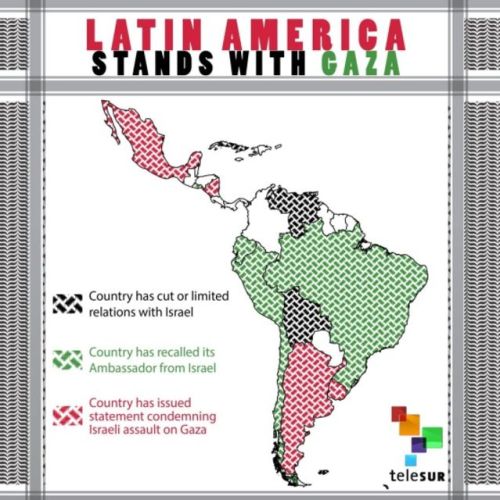
In August, Latin American leaders harshly condemned the Israeli government over its 50-day war against Gaza in summer 2014, including Rafael Correa of Ecuador, Nicolas Maduro of Venezuela, and Evo Morales of Bolivia. Several countries in the region downgraded relations with Israel, while others recalled ambassadors.
3 – Venezuela hosts congress on Palestinian Right of Return April 2015
In April 2015 Venezuela hosted the first Latin American Congress of the Global Campaign to Return to Palestine, being held until Friday in the capital of Caracas. The campaign was founded two years ago as an effort to coordinate the work of Palestinian solidarity activists at a global level. It gives particular attention to demand for the right-of-return of Palestinians who were forcibly displaced by militant Zionists during the foundation of the state of Israel.
4 – Chile hosts PLO official in a 5-day visit to strengthen ties with Palestine
In August 2015, Palestinian Liberation Organization official Saeb Erekat took a five-day visit to Chile where he visited the Arab School in Santiago, met with Chilean President Michelle Bachelet, the foreign minister, as well as representatives of the Jewish community in Chile. Chile is home to more than 400,000 Palestinians and Palestinian descendants.
5 – A ‘Song for Palestine’ solidarity event in Ecuador
In July 2014, social organizations of Ecuador convened on to present “A song for Palestine”, an expression of solidarity with the Palestinian people in the face of attacks by the Israeli Defense Force against the Palestinian people in Gaza.

November 27, 2015
Posted by aletho |
Ethnic Cleansing, Racism, Zionism, Illegal Occupation, Solidarity and Activism, War Crimes | Argentina, Human rights, Latin America, Palestine, Venezuela, Zionism |
Leave a comment
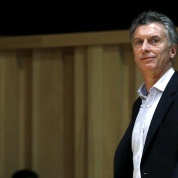 The election of Mauricio Macri in Argentina’s presidential race comes as a welcome victory to the country’s business elite and right-wing parties across Latin America, but the president-elect has some dubious ties that could signal a lasting legacy in the new head of state of darker times in Argentina.
Macri has been particularly criticized for his indirect ties to the last military dictatorship in Argentina in the late 1970s and early 1980s that cracked down on left-wing activists and political opposition.
While many of Macri’s powerful economic backers and corporate allies propped up the dictatorship that benefited them economically, Macri’s closest ties to the dictatorship are through his own family business Macri Society, known as Socma.
Macri, a long-time business magnate and former mayor of Buenos Aires, has been a director of his father’s Socma corporate conglomerate since a young age. The Macris are one of Argentina’s wealthiest families, and Socma was among the companies that directly benefited from the dictatorship.
In 1973, prior to the 1976 military coup that ousted the civilian Peronist government of President Maria Estela de Peron and installed a dictatorship, Socma owned seven companies. When the dictatorship ended 10 years later, in 1983, the Socma corporate empire had expanded to 46 companies.
Among Socma’s dozens of companies were various businesses that benefited the Macri family economically by providing services to the dictatorship regime, such as the solid waste management company Manliba, privatized under the dictatorship in 1979, and the postal company Correo Argentino, later nationalized in 2003 under former President Nestor Kirchner.
Macri also showed his sympathies for corporate complicity in dictatorship-era abuses earlier this year when he and his party opposed a government move to end impunity for dictatorship supporters.
Argentina’s Parliament decided in September to launch an investigation into how people and businesses participated in crimes committed by the 1976-1983 dictatorship. While the vote passed by a wide margin of 170-14, Macri and his Republican Proposal Party made up the minority of lawmakers opposing the bill.
The U.S.-backed Dirty War disappeared between 7,000 and 30,000 people in Argentina under the dictatorship regime.
Argentina’s right-wing newspaper La Nacion, which supported the dictatorship, hailed Macri’s election as signalling an end to “revenge” for the dictatorship years.
“The desire for revenge should be buried once and for all,” a La Nacion editorial said on Monday following Macri’s victory. The editorial referred the end to a “culture of revenge” under the governments of Nestor Kirchner and Cristina Fernandez in reference to their efforts to seek truth and justice for dictatorship-era crimes, including Kirchner’s 2003 repeal of amnesty laws for crimes against humanity.
Macri’s election marks the first victory for the country’s right-wing business elite through electoral means rather than military coup. He will be the third non-Peronist head of state in the more than three decades since the end of the dictatorship.
Right-Wing Alliances in Latin America
While corporate elites and dictatorship-supporters celebrate Macri’s election in Argentina, right-wing organizations across Latin America also welcome his victory as a win for their neoliberal political project in the region.
Macri has already made his foreign policy plans clear, vowing to reshape international ties to strengthen relations with the United States and European Union while requesting that Venezuela be suspended from the South American regional bloc Mercosur.
Macri’s relationship with the United States has been demonstrated in leaked diplomatic cables, published by WikiLeaks, in which he accused the U.S. of being “too soft” on the Kirchner governments and called on the U.S. to crack down on Cristina Fernandez de Kirchner.
Macri’s stance against the Venezuelan government was also clearly solidified when Lilian Tintori, wife of Venezuelan opposition leader Leopoldo Lopez, took to the stage with Macri during his victory celebration on Sunday night. Tintori hailed Macri’s win as the start of “political change in Latin America and Venezuela’s opposition was “delighted” by Macri’s win, Reuters reported.
Many of Macri’s supporters are those who hope to reinvigorate neoliberal free trade politics in Latin America and roll back the regional integration projects launched by former Venezuelan President Hugo Chavez.
For example, the Argentine think tank Thinking Foundation, focused on developing projects and strategies to get Macri’s party elected, has collaborated with the Spanish FAES Foundation, which promotes neoliberal politics and has strong ties to Spain’s conservative People’s Party.
The Thinking Foundation is also part of the Atlas Foundation, which in turn is part of the global Atlas Network, a think tank that promotes neoliberal free trade and market-based public policy through over 400 member think tanks worldwide.
Macri’s Majority Pro-Kirchner Opposition Government
Macri’s plans to shift Argentina to the right may still face resistance. The president-elect will be forced to govern without majority support from Congress.
In the Argentine Senate and House of Representatives, the majority of lawmakers are not representatives of Macri’s Let’s Change coalition, but of the pro-Kirchner alliance Front for Victory that backed Daniel Scioli’s bid for president. Of 257 seats in the Lower House, 114 are held by the Front for Victory. In the Senate, 42 of 72 senators are Front for Victory officials.
The era of “Kirchnerismo” under Cristina Fernandez and Nestor Kirchner may have come to an end with Macri’s election, but the Peronist movement that has long fought for social justice in Argentina now forms the official opposition.
While change under Macri is certain, the question that remains is what the long-term legacy of the Peronist movement and Kirchner governments will be in Argentina and Latin America.
November 25, 2015
Posted by aletho |
Corruption, Economics, Subjugation - Torture, Timeless or most popular | Argentina, Atlas Network, Human rights, Latin America, Mauricio Macri |
Leave a comment
 Georgia’s infamous ‘School of Assassins’ was besieged by hundreds of activists from across the country, calling for the closure of the military training center and a halt to the militarization of Latin America by the US.
The 25th anniversary protest march was held over the weekend in the town of Lumpkin in northern Georgia, and at the gates of Fort Benning army base, where the former US Army School of the Americas (SOA), hidden now under the name of the Western Hemisphere Institute for Security Cooperation (WHINSEC), is located, along with the nearby Stewart Immigrant Detention Center, the country’s largest for-profit immigration prison.
Dozens of nonprofit organizations and some 1,400 activists joined the rally, which aimed to protest against the notorious “School of Assassins,” as SOA is referred to, for its production of “death squads” that commit mass murders, torture and other human rights’ violations and military crimes across the globe, activists claim. Watchdogs maintain several Latin Americans dictators and many more security officials, who have perpetrated such crimes, graduated from SOA.
“Despite a shocking human rights abuse record, the School of the Americas continues to operate with US taxpayer money. Closing the SOA would send a strong human rights message to Latin America and the world,” SOA Watch founder and organizer of the event, Father Roy Bourgeois, said in a statement.
Hundreds held vigil in front of Fort Benning, while others marched to protest to the immigrant prison, where some 1,800 migrants await repatriation. Eleven people were arrested after crossing onto the grounds of the prison, according to the Ledger-Enquirer.
The event was attended, among others, by members of Veterans for Peace.
“From Ferguson to Ayotzinapa, we must continue to denounce the militarization of police across the Americas and call for an end of state-sponsored terrorism and violence against our communities. Our clamor for justice must be heard!” the pacifist NGO’s online statement reads.
Newly released documents, obtained by the Partnership for Civil Justice Fund, suggest the FBI has been monitoring the activities of SOA Watch and infiltrating the NGO, using confidential informants and counterterrorism units.
November 24, 2015
Posted by aletho |
Solidarity and Activism, Subjugation - Torture, Timeless or most popular, War Crimes | Latin America, School of the Americas, SOA, United States |
Leave a comment
On Sunday, Argentina held a runoff vote to pick its next president, resulting in a narrow victory for conservative Let’s Change coalition candidate Mauricio Macri over his center-left Front for Victory coalition opponent, Daniel Scioli. The question on everybody’s mind now is: what should Argentinians, and the world, expect from the new government?
An estimated 80% of Argentina’s 32 million eligible voters went to the polls on Sunday to elect their next president, in a runoff vote between the two leading candidates from the first round of voting, held in late October. With 51.5% of the votes cast in favor of conservative candidate Mauricio Macri, the favorite of the country’s big business and private media, the country is set for a hard right turn.In the run up to the election, analysts in both Latin America and across the loose global coalition of countries opposed to a unipolar world order had worryingly suggested that a Macri victory would result in a rollback to the policies pursued by Buenos Aires over the past decade aimed at challenging US hegemony, both in the region and around the world.
Daniel Scioli, the candidate of the Peronist, center-left Front for Victory electoral alliance, had promised to continue outgoing President Cristina Fernandez’ center-left-oriented politics domestically, and to pursue an independent foreign policy course abroad.
Throughout Fernandez’ tenure (she was elected in 2007) and that of her late husband, Nestor Kirchner (elected in 2003), Argentina had aligned itself with the string of left-wing Latin American governments emerging in the region in the early 2000s, while pushing for new economic and political ties with the BRICS countries, including Russia and China. Now, with Macri’s victory, the country’s multipolar outlook is under threat.
At the moment, Russian-Argentinian political and economic ties are believed to be at historic highs, characterized by the Russian ambassador to Buenos Aires as “excellent” and “extremely constructive and trusting.” Earlier this year, ahead of Fernandez’ official state visit to Moscow in April, Argentina’s Ambassador to Russia, Pablo Anselmo Tettamanti, went so far as to describe relations to be at the highest levels they have ever been in the countries’ 130-year-long history of bilateral relations.
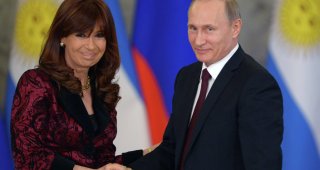 During her visit to Russia, President Fernandez met with President Vladimir Putin, signing over 20 memorandums on economic cooperation, said to amount to an “all-encompassing strategic partnership.”
The agreements included joint projects on the development of hydroelectric, nuclear and fossil-based energy in Argentina, including the construction of the sixth bloc at the Atucha nuclear power plant, along with a $2 billion memorandum on the construction of a new hydroelectric dam. Meanwhile, Russian energy giant Gazprom signed a memorandum on the exploration and development of gas fields with Argentine state gas company YPF, a deal amounting to $1 billion in investments. Russian company Uralmash was also tapped to build a plant manufacturing oil extraction equipment, amounting to an additional $1.9 billion in investments.
In the course of the visit, the two sides promised to conduct consultations on the use of each other’s national currencies for trade, pledging to increase cooperation in the military-technical sphere, accelerating construction of the GLONASS satellite navigation systems, and negotiating on the prospects of increasing bilateral food trade (presently amounting to about $1.3 billion).In the sphere of political cooperation, President Fernandez voiced her support for Moscow’s position that the situation in Ukraine could only be resolved by peaceful means, with the Russian president, for his part, pledging support for “Argentina’s striving for direct talks with Britain to achieve prompt resolution to the Mavinas [Falklands] Islands dispute.”
Visiting Moscow in July, Argentinian Vice President Amado Boudou emphasized that Argentina’s diplomatic moves toward improving relations with Russia were based on the fact that the two countries “share a very strong position with a common vision of the need for a multipolar world to ensure the existence of an inclusive and autonomous policy.”
Now, following Macri’s election victory, Argentina’s strategy of promoting regional integration in Latin America, and a multipolar world order, may be coming to an end. With Mexican economist Ariel Noyola Rodriguez suggesting only months ago that the Russian-Argentinian partnership signaled “Washington’s incapacity to sabotage the construction of a multipolar world,” it seems that the analyst may have spoken too soon.
With Fernandez (and her husband before her) becoming a major thorn in Washington’s side, the latter unhappy over the Peronists’ efforts to extract the country and the region from its subservient position in the US’s so-called ‘backyard’, the election of Macri, who promised to immediately improve relations with Washington, must come as a welcome change.
The conservative politican has already hinted that he would give less weight to Mercosur –the South American trade bloc aimed at ensuring regional economic integration and development, and shift the country’s diplomacy away from close cooperation with the leftist governments of Venezuela, Bolivia, Ecuador and Brazil.
And while his victory may not nullify the economic and other cooperation agreements reached with Russia, China, and other BRICS countries over the past decade, it does threaten Buenos Aires’ general trajectory of development –the country’s moves toward regional integration and a multipolar world independent of Washington’s influence.
For the Argentinian People: A Return to Neoliberalism?
As far as the Argentinian people are concerned, Macri’s victory is feared by his critics to mark a throwback to neoliberal dogmas which plagued the country prior to Kirchner’s 2003 election victory.
For their part, the British and American business press couldn’t help but gloat in the moment, with Financial Times suggesting it was “the beginning of a new political era for South America’s second-largest economy,” and The Wall Street Journal trash-talking Fernandez and her party, and suggesting that her economic policies, “uncivil rants against her political opponents, and a substantial loss of judicial independence and press freedom during kirchnerismo” contributed to Scioli’s defeat. Bloomberg Business, naturally, focused on the election’s effects on the markets, finding it crucial to point out that “in anticipation of a Macri victory, bond yields fell to an eight-year low and the local stock market rallied to a record high.”
But not everyone is convinced that this ‘new political era’ will bring positive changes, at least for ordinary Argentinians. In the run up to the voite, Scioli and his supporters warned that Macri’s proposals, which promised a return to neoliberal economic policies, would amount to “savage capitalism,” eroding social welfare and creating an economy which catered to a wealthy minority.
It’s worth recalling that before the Kirchners, Argentina was viewed as a textbook example of a developing country enveloped by the so-called Washington Consensus, a set of neoliberal economic dogmas which resulted in extremely high unemployment (over 25% in 2003), high poverty rates (nearly 55%), and a high Gini index.Under Kirchner and Fernandez, the country pursued social and economic policies that amounted to the creation of a mixed Keynesian economy, promoting government intervention where necessary, support for medium and small businesses, and a push for export growth via regional economic integration.
According to pan-Latin American news channel Telesur, these efforts resulted in the reduction of unemployment to 6.6% in 2015 (with 5 million jobs created over the past ten years), the reduction of poverty from over 50% to 6.5%, the creation of 50,000 small and medium-sized businesses, a major industrialization drive via the Industrial Parks National Program, increases in the share of GDP spent on education and pensions (from 3.6% and 4.1% in 2003 to 6.5% and 7.7% of GDP in 2013, respectively), and the near doubling of public investment, all the while reducing the national debt from 166% of GDP in 2003 to 41%.
In the areas of social policies, Kirchner and Fernandez began a comprehensive reform of the country’s justice system (making the Supreme Court independent), while annulling the ‘laws of pardon’ which gave immunity to the leaders of the country’s military dictatorship of 1976-1983 accused of crimes against humanity. The country also became the first in Latin America, and the tenth in the world, to pass equal marriage laws, in 2010.
Now, these gains, which came at a cost of high inflation (offset to an extent by annual negotiations between unions, employers and employees on adjusting wages) are under threat, with Macri’s critics saying his policies (including tax cuts, social spending cuts, and privatization schemes) will favor big business and the country’s oligarchs, sidelining the problems of social inequality, and reverting the country to its 90s’ era social and economic malaise.
Critics have also pointed to Macri’s promises of beginning negotiations with the predatory ‘vulture fund‘ creditors that rejected the debt restructuring which took place following the country’s default in 2002, giving an indication not only of his upcoming domestic economic policy, but also his possible subservience to the Western-dominated economic institutions which Argentina rejected under the Kirchners.Ultimately, only time will tell whether Argentina’s new government will continue to pursue policies based on economic and political pragmatism which have brought Buenos Aires closer to those countries looking to challenge global unipolarity (with some analysts already suggesting that they will).
As far as Argentina itself is concerned, it remains unclear how a return to the neoliberalism which devastated the country’s economy in the early 2000s will do it any good. As Russian social media users commenting on the election results lamented, it seems that too many Argentinians have forgotten the neoliberal catastrophe and ‘de-sovereignization’ of the 90s, processes which Russians themselves know all too well.
November 23, 2015
Posted by aletho |
Aletho News | Argentina, BRICS, Latin America, Russia |
Leave a comment

Campesino leaders say the government is criminalizing their movements and does not protect their rights. | Photo: @marchapatriota
At least 300 campesino leaders have been killed in Colombia in 2015, according to Andres Gil, human rights leader and spokesperson of the Marcha Patriotica.
Many of these deaths have come as campesino leaders are attempting to defend their land and their natural resources. Another 7,000 campesino leaders have been jailed.
Land distribution in Colombia is extremely unequal. Less than 1 percent of the population owns roughly half of the land, and 70 percent of the population owns only 5 percent of the land. Campesinos who fight for their land are often risking their lives.
At least three campesinos leaders where killed just in the last two weeks, including the young Afro-descendent leader Jhon Jairo Ramirez Olaya in the Valle region; the environmental and campesino leader Daniel Abril, in the Orinoquia region; and the representative of Afro-descendent victims from Cordoba, Luis Francisco Hernandez Gonzales.
Another young campesino leader allegedly killed by the armed forces last Friday, according to Marcha Patriota.
According to Verdad Abierta — an investigative project on the armed conflict of Colombia’s Semana magazine — Abril accused various state officials of corruption, and was fighting against multiple oil corporations with extensive land interests.
Feliciano Valencia, another indigenous leader from the region of Cauca who was controversially sentenced to 18 years in jail, was also victim of a homicide attempt on Tuesday, as four men opened fire on his home, according to local social organizations.
Still in Cauca, in the end October, the armed forces were recently involved in the murder of indigenous leader Alfredo Bolaño, the 58th victim from security forces in the region, one of the most affected by violence because of its highly fertile lands.
On Friday, the Colombian army killed one campesino and wounded five others after it raided a rural area in what military officials said was an effort to “manually eradicate” illegal coca crops.
According to the local community, the armed forces opened fire on a peaceful march last Thursday in Argelia, Cauca.
The country’s ombudsman Fabian Laverde told teleSUR that this issue was rooted in several causes.
“First, the national government refuses to recognize the existence of paramilitarism. Second, the complaints from the social movements made about situations of threats or concrete actions against residents of these territories have been completely ignored,” he said.
November 22, 2015
Posted by aletho |
Civil Liberties, Corruption, Economics, Environmentalism, Ethnic Cleansing, Racism, Zionism, Subjugation - Torture | Colombia, Human rights, Latin America |
Leave a comment
In its effort to vet one of the leading GOP presidential candidates, Dr. Ben Carson, the New York Times didn’t properly vet its primary source in this vetting, former CIA officer Duane Clarridge—an indicted liar and overseer of Contra death squads in Central America.
While the Times’ Trip Gabriel briefly notes the former, he completely omits the latter, instead offering this starry-eyed description:
Mr. Clarridge, described by Mr. Carson’s top adviser, Armstrong Williams, as “a mentor for Dr. Carson,” is a colorful, even legendary figure in intelligence circles, someone who could have stepped out of a Hollywood thriller. He was a longtime CIA officer, serving undercover in India, Turkey, Italy and other countries, and sprinkles his remarks with salty language.
As head of Reagan’s CIA division in Latin America in the 1980s, Clarridge took part in the effort to overthrow Nicaragua’s Sandinista government by illegally supplying funds and arms to the Contras—a right-wing terrorist movement that committed brutal war crimes. This was not an unforeseen consequence, but the point of the operation; asked by CIA Director William Casey to come up with a strategy for dealing with the Sandinista revolution, Clarridge writes in his memoir A Spy for All Seasons :
My plan was simple:
- Take the war to Nicaragua.
- Start killing Cubans.
Clarridge acknowledges that his plan, “stated so bluntly, undoubtedly sounds harsh.”
He also boasts of having come up with the idea of mining Nicaragua’s harbors to interfere with shipping:
I remember sitting with a glass of gin on the rocks, smoking a cigar (of course), and pondering my dilemma, when it hit me. Sea mines were the solution…. To this day I wonder why I didn’t think of it sooner.
The mines were, as conservative icon Sen. Barry Goldwater pointed out, an “act of war”—and predictably resulted in the deaths of civilians, something that doesn’t trouble Clarridge overly much. Or, apparently, the New York Times.
The Times vaguely alludes to the Iran/Contra scandal but without mentioning what it entailed, namely that Clarridge had an operational involvement with terrorist death squads.
In addition to this bloodsoaked past, Clarridge has more recently been a freelance hit-list generator for the Defense Department in Afghanistan ( New York Times, 3/14/10)–part of what the Times referred to as “an off-the-books spy operation.”
The kid-glove treatment would even extend to ethnic slurs, which the Times glosses over without citing specifically. Gabriel quotes Clarridge dismissing the notion—spread by right-wing media—that there are Chinese troops in Syria, “using an ethnic slur for the Chinese.” If a top adviser to a leading presidential candidate is referring to Chinese people as “Chinks”—or the equivalent—isn’t that a newsworthy fact that the New York Times ought to report?
It’s not a surprise a New York Times Beltway insider like Trip Gabriel would whitewash Clarridge’s brutal resume to the point of unrecognizability, but it doesn’t make using a grotesque violator of human rights and a known liar to kneecap Carson any less sleazy. On the issue of policy knowledge, it is more than fair to point out Carson’s shortcomings. But the bigger story here—that a leading candidate’s primary international adviser is a CIA goon with a bloody (or as the Times would put it “colorful”) past—is buried in a story about a routine DC pissing match.
This is how America’s war crimes are laundered, by absorbing the most complicit and criminal into respectable circles by passing them off as “experts” with “legendary” pasts. The Times would have better served its readers by pointing out, in clear and honest terms, what this “colorful, even legendary” past amounted to. It would help put Clarridge’s testimony—and Carson’s potential nomination—into historical and moral context.
November 20, 2015
Posted by aletho |
Deception, Mainstream Media, Warmongering, War Crimes | Ben Carson, Central Intelligence Agency, CIA, Duane Clarridge, Human rights, Latin America, New York Times, Trip Gabriel, United States |
Leave a comment
Over the past 15 years the US has been engaged in a series of wars, which has led many writers to refer to the ‘rise of militarism’ – the growth of an empire, built primarily by and for the projection of military power – and only secondarily to advance economic imperialism.
The rise of a military-based empire, however, does not preclude the emergence of competing, conflicting, and convergent power configurations within the imperial state. These factions of the Washington elite define the objectives and targets of imperialist warfare, often on their own terms.
Having stated the obvious general fact of the power of militarism within the imperialist state, it is necessary to recognize that the key policy-makers, who direct the wars and military policy, will vary according to the country targeted, type of warfare engaged in and their conception of the war. In other words, while US policy is imperialist and highly militaristic, the key policymakers, their approach and the outcomes of their policies will differ. There is no fixed strategy devised by a cohesive Washington policy elite guided by a unified strategic vision of the US Empire.
In order to understand the current, seemingly endless wars, we have to examine the shifting coalitions of elites, who make decisions in Washington but not always primarily for Washington. Some factions of the policy elite have clear conceptions of the American empire, but others improvise and rely on superior ‘political’ or ‘lobbying’ power to successfully push their agenda in the face of repeated failures and suffer no consequences or costs.
We will start by listing US imperialist wars during the last decade and a half. We will then identify the main policy-making faction which has been the driving force in each war. We will discuss their successes and failures as imperial policy makers and conclude with an evaluation of “the state of the empire” and its future.
Imperial Wars: From 2001-2015
The current war cycle started in late 2001 with the US invasion and occupation of Afghanistan. This was followed by the invasion and occupation of Iraq in March 2003, the US arms support for Israel’s invasion of Lebanon in 2006, the proxy invasion of Somalia in 2006/7; the massive re-escalation of war in Iraq and Afghanistan in 2007-2009; the bombing, invasion ‘regime change’ in Libya in 2011; the ongoing proxy-mercenary war against Syria (since 2012), and the ongoing 2015 Saudi-US invasion and destruction of Yemen. In Europe, the US was behind the 2014 proxy putsch and violent ‘regime change’ in Ukraine which has led to an ongoing war against ethnic Russian speakers in south-east Ukraine, especially the populous industrial heartland of the Donbas region.
Over the past 15 years, there have been overt and covert military interventions, accompanied by an intense, provocative military build-up along Russia’s borders in the Baltic States, Eastern Europe (especially Poland), the Balkans (Bulgaria and Romania) and the mammoth US base in Kosovo; in Central Europe with nuclear missiles in Germany and, of course, the annexation of Ukraine and Georgia as US-NATO clients.
Parallel to the military provocations encircling Russia, Washington has launched a major military, political, economic and diplomatic offensive aimed at isolating China and affirming US supremacy in the Pacific.
In South America, US military intervention found expression via Washington-orchestrated business-military coup attempts in Venezuela in 2002 and Bolivia in 2008, and a successful ‘regime change’ in Honduras in 2009, overthrowing its elected president and installing a US puppet.
In summary, the US has been engaged in two, three or more wars since 2001, defining an almost exclusively militarist empire, run by an imperial state directed by civilian and military officials seeking unchallenged global dominance through violence.
Washington: Military Workshop of the World
War and violent regime change are the exclusive means through which the US now advances its foreign policy. However, the various Washington war-makers among the power elite do not form a unified bloc with common priorities. Washington provides the weapons, soldiers and financing for whichever power configuration or faction among the elite is in a position, by design or default, to seize the initiative and push their own war agenda.
The invasion of Afghanistan was significant in so far as it was seen by all sectors of the militarist elite, as the first in a series of wars. Afghanistan was to set the stage for the launching of higher priority wars elsewhere.
Afghanistan was followed by the infamous ‘Axis of Evil’ speech, dictated by Tel Aviv, penned by presidential speech-writer, David Frum and mouthed by the brainless President Bush, II. The ‘Global War on Terror’ was the thinly veiled slogan for serial wars around the world. Washington measured the loyalty of its vassals among the nations of Europe, Asia, Africa and Latin America by their support for the invasion and occupation of Afghanistan. The Afghan invasion provided the template for future wars. It led to an unprecedented increase in the military budget and ushered in Caesar-like dictatorial presidential powers to order and execute wars, silencing domestic critics and sending scores of thousands of US and NATO troops to the Hindu Kush.
In itself, Afghanistan was never any threat and certainly no economic prize for plunder and profit. The Taliban had not attacked the US. Osama Bin Laden could have been turned over to a judicial tribunal – as the governing Taliban had insisted.
The US military (with its Coalition of the Willing or COW) successfully invaded and occupied Afghanistan and set up a vassal regime in Kabul. It built scores of military bases and attempted to form an obedient colonial army. In the meantime, the Washington militarist elite had moved on to bigger and, for the Israel-centric Zionist elite, higher priority wars, namely Iraq.
The decision to invade Afghanistan was not opposed by any of Washington’s militarist elite factions. They all shared the idea of using a successful military blitz or ‘cake-walk’ against the abysmally impoverished Afghanistan as a way to rabble rouse the American masses into accepting a long period of intense and costly global warfare throughout the world.
Washington’s militarist elites fabricated the link between the attacks on 9/11/2001 and Afghanistan’s governing Taliban and the presence of the Saudi warlord Osama Bin Laden. Despite the ‘fact’ that most of the ‘hijackers’ were from the kingdom of Saudi Arabia and none were Afghans, invading and destroying Afghanistan was to be the initial test to gauge the highly manipulated and frightened American public’s willingness to shoulder the burden of a huge new cycle of imperial wars. This has been the only aspect of the invasion of Afghanistan that could be viewed as a policy success – it made the costs of endless wars ‘acceptable’ to a relentlessly propagandized public.
Flush with their military victories in the Hindu Kush, the Washington militarists turned to Iraq and fabricated a series of increasingly preposterous pretexts for war: Linking the 9/11 ‘jihadi’ hijackers with the secular regime of Saddam Hussein, whose intolerance for violent Islamists (especially the Saudi variety) was well documented, and concocting a whole fabric of lies about Iraqi ‘weapons of mass destruction’ which provided the propaganda basis for invading an already disarmed, blockaded and starved Iraq in March 2003.
Leading the Washington militarists in designing the war to destroy Iraq were the Zionists, including Paul Wolfowitz, Elliot Abrams, Richard Perle, and a few Israel-centric Gentile militarists, such as Vice President Cheney, Secretary of State Colin Powell and Defense Secretary Rumsfeld. The Zionists had a powerful entourage in key positions in the State Department, Treasury and the Pentagon.
There were ‘outsiders’ – non-Zionists and militarists within these institutions, especially the Pentagon, who voiced reservations – but they were brushed aside, not consulted and ‘encouraged’ to retire.
None of the ‘old hands’ in the State Department or Pentagon bought into the hysteria about Saddam Hussein’s weapons of mass destruction, but to voice reservations was to risk one’s career. The manufacture and dissemination of the pretext for invading Iraq was orchestrated by a small team of operatives linking Tel Aviv and Deputy Secretary of Defense Paul Wolfowitz’s Office of Special Plans, a tight group of Zionists and some Israelis headed by Abram Shulsky (Sept. 2002-June 2003).
The US war on Iraq was an important part of Israel’s agenda to ‘re-make the Middle East’ to establish its unchallenged regional hegemony and execute a ‘final solution’ for its own vexing ‘Arab (native Palestinian) problem’: It was made operational by the powerful Zionist faction within the Executive (White House), which had assumed almost dictatorial powers after the attack on 9/11/2001. Zionists planned the war, designed the ‘occupation policy’ and ‘succeeded wildly’ with the eventual dismemberment of a once modern secular nationalist Arab state.
In order to smash the Iraqi state – the US occupation policy was to eliminate (through mass firings, jailing and assassination) all high level, experienced Iraqi civil, military and scientific personnel – down to high school principals. They dismantled any vital infrastructure (which had not been already destroyed by the decades of US sanctions and bombing under President Clinton) and reduced an agriculturally advanced Iraq to a barren wasteland which would take centuries to recover and could never challenge Israel’s colonization of Palestine, let alone its military supremacy in the Middle East. Naturally, the large Palestinian Diaspora refugee population in Iraq was targeted for ‘special treatment’.
But Zionist policymakers had a much larger agenda than erasing Iraq as a viable country: They had a longer list of targets: Syria, Iran, Lebanon and Libya, whose destruction was to be carried out with US and NATO blood and treasure (and not a single Israeli soldier).
Despite the fact that Iraq did not even possess a functioning air force or navy in March 2003 and Afghanistan in late 2001 was rather primitive, the invasions of both countries turned out to be very costly to the US. The US completely failed to benefit from its ‘victory and occupation’, despite Paul Wolfowitz’ boasts that the pillage of Iraq’s oil fields would pay for the entire project in a ‘few months’. This was because the real Zionist plan was to destroy these nations – beyond any possibility for a quick or cheap imperialist economic gain. Scorching the earth and salting the fields is not a very profitable policy for empire builders.
Israel has been the biggest winner with no cost for the ‘Jewish State’. The American Zionist policy elite literally handed them the services of the largest and richest armed forces in history: the US. Israel-Firsters played a decisive role among Washington policy-makers and Tel Aviv celebrated in the streets! They came, they dominated policy and they accomplished their mission: Iraq (and millions of its people)was destroyed.
The US gained an unreliable, broken colony, with a devastated economy and systematically destroyed infrastructure and without the functioning civil service needed for a modern state. To pay for the mess, the American people faced a spiraling budget deficit, tens of thousands of American war casualties and massive cuts in their own social programs. Crowning the Washington war-makers’ victory was the disarticulation of American civil and constitutional rights and liberties and the construction of a enormous domestic police state.
After the Iraq disaster, the same influential Zionist faction in Washington lost no time in demanding a new war against Israel’s bigger enemy – namely Iran. In the ensuing years, they failed to push the US to attack Tehran but they succeeded in imposing crippling sanctions on Iran. The Zionist faction secured massive US military support for Israel’s abortive invasion of Lebanon and its devastating series of blitzkriegs against the impoverished and trapped people of Gaza.
The Zionist faction successfully shaped US military interventions to meet Israel’s regional ambitions against three Arab countries: Yemen, Syria, and Libya. The Zionists were not able to manipulate the US into attacking Iran because the traditional militarist faction in Washington balked: With instability in Afghanistan and Iraq, the US was not well positioned to face a major conflagration throughout the Middle East, South Asia and beyond – which a ground and air war with Iran would involve. However, the Zionist factions did secure brutal economic sanctions and the appointment of key Israel-Centric officials within the US Treasury. Secretary Stuart Levey, at the start of the Obama regime, and David Cohen afterwards, were positioned to enforce the sanctions.
Even before the ascendancy of Israeli Prime Minister Binyamin Netanyahu, Tel Aviv’s military objectives after Iraq, including Iran, Syria, Lebanon, Libya, and Yemen had to be spaced over time, because the non-Zionist factions among Washington’s elite had been unable to integrate occupied Afghanistan and Iraq into the empire.
Resistance, armed conflict and military advances in both Afghanistan and Iraq never ceased and are continuing into their 2nd decade. As soon as the US would withdraw from a region, declaring it ‘pacified’, the armed resistance would move back in and the local sepoys would defect to the rebels or take off for London or Washington with millions in pillaged loot.
‘Unfinished wars’, mounting casualties and spiraling costs, with no end in sight, undermined the agreement between the militarist and the Zionist factions in the Executive branch. However, the massively powerful Zionist presence in the US Congress provided a platform to bray for new and even bigger wars.
Israel’s vicious invasion of Lebanon in 2006 was defeated despite receiving massive US arms supplies, a US funded ‘Iron Dome’ missile defense system and intelligence assistance. Tel Aviv could not defeat the highly disciplined and motivated Hezbollah fighters in South Lebanon despite resorting to carpet bombing of civilian neighborhoods with millions of banned cluster munitions and picking off ambulances and churches sheltering refugees. Israelis have been much more triumphal murdering lightly armed Palestinian resistance fighters and stone-throwing children.
Libya: A Multi-faction War for the Militarists (without Big Oil)
The war against Libya was a result of multiple factions among the Washington militarist elite, including the Zionists, coming together with French, English and German militarists to smash the most modern, secular, independent state in Africa under President Muammar Gaddafi.
The aerial campaign against the Gaddafi regime had virtually no organized support within Libya with which to reconstruct a viable neo-colonial state ripe for pillage. This was another ‘planned dismemberment’ of a complex, modern republic which had been independent of the US Empire.
The war succeeded wildly in shredding Libya’s economy, state, and society. It unleashed scores of armed terrorist groups, (who appropriated the modern weapons of Gaddafi’s army and police) and uprooted two million black contract workers and Libyan citizens of South Saharan origin forcing them to flee the rampaging racist militias to the refugee camps of Europe. Untold thousands died in rickety boats in the Mediterranean Sea.
The entire war was carried out to the publicly giddy delight of Secretary of State Hillary Clinton and her ‘humanitarian interventionist’ lieutenants (Susan Rice and Samantha Power), who were utterly ignorant as to who and what the Libyan “opposition” represented. Eventually, even Hillary’s own Ambassador to Libya would be slaughtered by … the same victorious US-backed ‘rebels’ (sic) in the newly liberated Bengazi!
The Zionist faction destroyed Gaddafi (whose capture, grotesque torture and murder was filmed and widely disseminated), eliminating another real adversary of Israel and supporter of Palestinian rights. The US militarist faction, which led the war, got nothing positive – not even a secure naval, air, or training base – only a dead Ambassador, millions of desperate refugees flooding Europe, and thousands of trained and armed jihadists for the next target: Syria.
For a while Libya became the main supply-line for Islamist mercenaries and arms to invade Syria and fight the secular nationalist government in Damascus.
Once again the least influential faction in Washington turned out to be the oil and gas industry, which lost lucrative contracts it had already signed with the Gaddafi regime. Thousands of highly trained foreign oil workers were withdrawn. After Iraq, it should have been obvious that these wars were not ‘for oil’!
Ukraine: Coups, Wars, and Russia’s ‘Underbelly’
With the US-orchestrated coup and intervention in Ukraine, the militarist factions once again seized the initiative, establishing a puppet regime in Kiev and targeting Russia’s strategic ‘soft underbelly’. The plan had been to take over Russia’s strategic military bases in Crimea and cut Russia from the vital military-industrial complexes in the Donbas region with its vast iron and coal reserves.
The mechanics of the power grab were relatively well planned, the political clients were put in power, but the US militarists had made no contingencies for propping up the Ukrainian economy, cut loose from its main trading partner and oil and gas supplier, Russia.
The coup led to a ‘proxy war’ in the ethnic-Russian majority regions in the south east (the Donbas) with four ‘unanticipated consequences’. 1) a country divided east and west along ethno-linguistic lines, (2) a bankrupt economy made even worse by the imposition of an IMF austerity program, (3) a corrupt crony capitalist elite, which was ‘pro-West by bank account’, (4) and, after two years, mass disaffection among voters toward the US puppet regime.
The militarists in Washington and Brussels succeeded in engineering the coup in Ukraine but lacked the domestic allies, plans and preparations to run the country and successfully annex it to the EU and NATO as a viable country.
Apparently the militarist factions in the State Department and Pentagon are much more proficient in stage managing coups and invasions than in establishing a stable regime as part of a New World Order. They succeed in the former and fail repeatedly in the latter.
The Pivot to Asia and the Pirouette to Syria
During most of the previous decade, traditional global strategists in Washington increasingly objected to the Zionist faction’s domination and direction of US war policies focused on the Middle East for the benefit of Israel, instead of meeting the growing challenge of the new world economic superpower in Asia, China.
US economic supremacy in Asia had been deeply eroded as China’s economy grew at double digits. Beijing was displacing the US as the major trade partner in the Latin American and African markets. Meanwhile, the top 500 US MNCs were heavily invested in China. Three years into President Obama’s first term the ‘China militarist faction’ announced a shift from the Middle East and the Israel-centric agenda to a ‘pivot to Asia’, the source of 40% of the world’s industrial output.
But it was not profits and markets that motivated Washington’s Asia faction among the militarist elites – it was military power. Even trade agreements, like the TransPacific Partnership (TPP), were viewed as tools to encircle and weaken China militarily and undermine its regional influence.
Led by the hysterical Pentagon boss Ashton Carter, Washington prepared a series of major military confrontations with Beijing off the coast of China.
The US signed expanded military base agreements with the Philippines, Japan, and Australia; it participated in military exercises with Vietnam, South Korea, and Malaysia; it dispatched battleships and aircraft carriers into Chinese territorial waters.
The US confrontational trade policy was formulated by the Zionist trio: Secretary of Commerce, Penny Pritzker, Trade Negotiator Michael Froman (who works for both the Asia militarist and Zionist factions), and Treasury Secretary Jake Lew. The result was the Trans-Pacific Partnership (TPP), involving 12 Pacific countries while deliberating excluding China. Washington’s Asian militarist faction planned to militarize the entire Pacific Basin, in order to dominate the maritime trade routes and, at a moment’s notice, choke off all of China’s overseas markets and suppliers – shades of the series of US provocations against Japan leading up to the US entering WW2.
The ‘Asia-militarist faction’ successfully demanded a bigger military budget to accommodate its vastly more aggressive posture toward China.
Predictably, China has insisted on defending its maritime routes and has increased its naval and air base building and sea and air patrols. Also, predictably, China has countered the US-dominated TPP by setting-up a one hundred billion dollar Asia Infrastructure Investment Bank (AIIB), while contributing to the multi-billion dollar BRICS Bank. Meanwhile, China even signed a separate $30 billion dollar trade agreement with Washington’s strategic ‘partner’, Britain. In fact, Britain followed the rest of the EU and joined the Asia Infrastructure Investment Bank – despite objections from Washington’s “Asia faction”.
While the US depends heavily on its military pacts with South Korea and Japan, the latter nations have been meeting with China – their most significant trading partner – to work on expanding and deepening economic ties.
Up until 2014, the “business-with-China faction” of the Washington elite played a key role in the making of US-Asia policy. However, they have been eclipsed by the Asia militarist-faction, which is taking US policy in a totally different direction: Pushing China out as Asia’s economic superpower and escalating military confrontation with Beijing now heads Washington’s agenda.
Ashton Carter, the US Defense Secretary, has China, the second most important economy in the world in the Pentagon’s ‘cross-hairs’. When the TPP failed to curtail China’s expansion, the militarist faction shifted Washington toward a high risk military course, which could destabilize the region and risk a nuclear confrontation.
The Pirouette: China and Syria
Meanwhile in the Levant, Washington’s Zionist faction has been busy running a proxy war in Syria. The pivot to Asia has had to compete with the pirouette to Syria and Yemen.
The US joined Saudi Arabia, Turkey, the Gulf Emirates, and the EU in sponsoring a replay of the Libyan ‘regime change’ — sponsoring proxy terrorists from around the globe into invading and devastating Syria. Damascus has been attacked from all sides for the ‘crime’ of being secular and multi-ethnic; for being pro-Palestinian; for being allied with Iran and Lebanon; for having an independent foreign policy; and for maintaining a limited representative (but not necessarily democratic) government. For these crimes, the West, Israel and the Saudis would have Syria fractured into an ethnically cleansed ‘tribal state’ – something they had accomplished in Iraq and Libya.
The US militarist faction (personified by Secretary of Defense Carter and Senators McCain and Graham) have funded, trained and equipped the terrorists, whom they call ‘moderates’ and had clearly expected their progeny to follow Washington’s directions. The emergence of ISIS showed just how close these ‘moderates’ stuck to Washington’s script.
Initially, the traditional militarist wing of Washington’s elite resisted the Zionist faction’s demand for direct US military intervention (American ‘boots on the ground’). That is changing with recent (very convenient) events in Paris.
Warfare: From Piecemeal Interventions to Nuclear Confrontation
The Washington militarists have again committed more US soldiers to Iraq and Afghanistan; American fighter planes and Special Forces are in Syria and Yemen. Meanwhile, US naval armadas aggressively patrol the coasts of China and Iran. The militarist-Zionist ‘compromise’ over Syria was comprised of an initial contingent of 50 US Special Forces to join in ‘limited’ combat roles with (“loyal” sic) Islamist mercenaries – the so-called moderates. There are commitments for greater and heavier weaponry to come, including ground to air missiles capable of shooting down Russian and Syrian military jets.
Elite Factional Politics: An Overview
How does the record of these competing factions, formulating US imperial war policies in the Middle East over the past 15 years stack up? Clearly there has been no coherent imperial economic strategy.
The policy toward Afghanistan is remarkable for its failure to end the longest war in US history – over 14 years of occupation! The recent attempts by US-led client NATO forces to withdraw have been immediately followed by military advances by the nationalist-Islamist resistance militia – the Taliban, which controls much of the countryside. The possibility of a collapse of the current puppet in Kabul has forced the militarists in Washington to retain US bases – surrounded by completely hostile rural populations.
The Afghan war’s initial appearance of success triggered new wars – inter alia Iraq. But taking the long view, the Afghan war, has been a miserable failure in terms of the stated strategic goal of establishing a stable client government. The Afghan economy collapsed: opium production (which had been significantly suppressed by the Taliban’s poppy eradication campaign in 2000-2001) is the now predominant crop – with cheap heroin flooding Europe and beyond. Under the weight of massive and all pervasive corruption by ‘loyal’ client officials – the Afghan treasury is empty. The puppet rulers are totally disconnected from the most important regional, ethnic, religious and family clans and associations.
Washington could not ‘find’ any viable economic classes in Afghanistan with which to anchor a development strategy. They did not come to terms with the deep ethno-religious consciousness rooted in rural communities and fought the most popular political force among the majority Pashtu, the Taliban, which had no role in the attack on ‘9/11’.
They artificially slapped together a massive army of surly illiterates under Western imperial command and watched it fall apart at the seams, defect to the Taliban or turn their own guns on the foreign occupation troops. These “mistakes”, which accounted for the failure of the militarist faction in the Afghanistan war were due, in no small part, to the pressure and influence of the Zionist faction who wanted to quickly move on to their highest priority, a US war against Israel’s first priority enemy – Iraq – without consolidating the US control in Afghanistan. For the Zionists, Afghanistan (envisioned as a ‘cake-walk’ or quick victory) was just a tool to set the stage for a much larger sequence of US wars against Israel’s regional Arab and Persian adversaries.
Before the militarists could establish any viable order and an enduring governmental structure in Afghanistan, attention shifted to a Zionist-centered war against Iraq.
The build-up for the US war against Iraq has to be understood as a project wholly engineered by and for the state of Israel, mostly through its agents within the US government and Washington policy elite. The goal was to establish Israel as the unchallenged political-military power in the region using American troops and money and preparing the ground for Tel Aviv’s “final solution” for the Palestinian ‘problem’; total expulsion…
The US military and occupation campaign included the wholesale and systematic destruction of Iraq: Its law and order, culture, economy and society – so there would be no possibility of recovery. Such a vicious campaign did not resonate with any productive sector of the US economy (or for that matter with any Israeli economic interest).
Washington’s Zionist faction set about in a parody of Pol Pot’s Khmer Rouge to identify and destroy any competent, experienced Iraqi professional, civil servant, scientist, intellectual, or military official capable of re-organizing and re-building the county and war-battered society. They were assassinated, arrested, tortured, or driven into exile. The occupation deliberately encouraged religious parties and traditional tribes to engage in inter-communal massacres and ethnic cleansing. In other words, the Zionist faction did not pursue the traditionally understood policy of empire building which would incorporate the second tier functionaries of a conquered state to form a competent client regime and use Iraq’s great oil and gas wealth to build its economy. Instead they chose to impose a scorched earth policy; setting loose organized sectarian armies, imposing the rule of grotesquely corrupt ex-pats and placing the most venal, sectarian clients in positions of power. The effect has been to transform the most advanced, secular Arab country into an ‘Afghanistan’ and in less than 15 years destroying centuries of culture and community.
The goal of the ‘Zionist strategy’ was to destroy Iraq as Israel’s regional rival. The cost of over a million Iraqi dead and many millions of refugees did not prick any conscience in Washington or Tel Aviv.
After all, Washington’s traditional ‘militarist faction’ picked up the bill (costing hundreds of billions) which they passed on to the American taxpayers (well over one trillion dollars) and used the deaths and suffering of tens of thousands of American troops to provide a pretext for spreading more chaos. The result of their mayhem includes the specter of the Islamic State in Iraq and Syria (ISIS), which they may consider to be a success – since hysteria over ISIS pushes the West ‘closer to Israel’.
The sheer scale of death and destruction inflicted on the Iraqi population by the Zionist faction led to thousands of highly competent Ba’athist officers, who had survived ‘Shock and Awe’ and the sectarian massacres, to join armed Islamist Sunnis and eventually form the ISIS. This group of experienced Iraqi military officers formed the strategic technical core of ISIS which launched a devastating offensive in Iraq in 2014 – taking major cities in the north and completely routing the US-trained puppet armies of the ‘government’ in Baghdad. From there they moved into Syria and beyond. It is fundamental to understanding the roots of ISIS: The Zionist faction among US militarist policymakers imposed a deliberate ‘scorched earth’ occupation policy, which united highly trained nationalist Ba’athist military officers with young Sunni fighters ,both locals and increasingly foreign jihadist mercenaries. These deracinated members of the traditional Iraqi nationalist military elite had lost their families to the sectarian massacres; they were persecuted, tortured, driven underground, and highly motivated. They literally had nothing left to lose!
This core of ISIS leadership stands in stark contrast to the colonial, corrupt, and demoralized army slapped together by the US military with more cash than morale. ISIS quickly swept through half of Iraq and came within 40 miles of Baghdad.
The US militarist faction faced military defeat after eight years of war. They mobilized, financed, and armed their client Kurdish mercenaries in northern Iraq and recruited the Shia Ayatollah Ali al-Sistani to appeal to the Shia militia.
ISIS exploited the Western-backed Islamist uprising in Syria and extended their sweep well across the border. Syria had accepted a million Iraqi refugees from the US invasion, including many of Iraq’s surviving experienced nationalist administrative elite. The US militarists are in a dilemma – another full-scale war would not be politically feasible, and its military outcome uncertain… Moreover the US was aligned with dubious allies – especially the Saudis – who had their own regional ambitions. Turkey and Saudi Arabia, Israel and the Kurds were each eager to expand their power territorially and politically.
In the midst of this, the traditional Washington militarists are left with no overall viable imperialist strategy. Instead they improvise with faux ‘rebels’, who claim to be moderates and democrats, while taking US guns and dollars and ultimately joining the most powerful Islamist groups – like ISIS.
Throwing a wrench into the machinery of Israeli-Saudi hegemonic ambitions, Russia, Iran and Hezbollah have sided with the secular Syrian government. Russia finally moved to bomb ISIS strongholds – after identifying a significant ISIS contingent of militant Chechens whose ultimate aims are to bring war and terror back to Russia.
The US-EU war against Libya unleashed all the retrograde mercenary forces from three continents (Africa, Asia and Europe) and Washington finds itself with no means to control them. Washington could not even protect its own consulate in their ‘liberated’ regional capital of Benghazi – the US ambassador and two intelligence aides were killed by Washington’s own ‘rebels’. The competing and cooperating factions of the Washington militarist elite placed Libya on a steaming platter: Serving up invasion, regicide and hundreds of thousands of refugees, which they did not bother to even ‘season’ with any plan or strategy – just unadulterated scorched earth against another opponent of Zionism. And a potentially lucrative strategic neo-colony in North Africa has been lost with no accountability for the Washington architects of such barbarism.
Latin America: The Last Outpost of the Multi-Nationals
As we have seen, the major theaters of imperial policy (the Middle East and Asia) have been dominated by militarists, not professional diplomats-linked to the multi-national corporations. Latin America stands as something of an exception. In Latin America, US policymakers have been guided by big business interests. Their main focus has been on pushing the neo-liberal agenda. Eventually this has meant promoting the US-centered ‘free trade’ agreements, joint military exercises, shared military bases, and political backing for the US global military agenda.
The ‘militarist faction’ in Washington worked with the traditional business faction in support of the unsuccessful military coups in Venezuela (2002 and 2014), the attempted coup in Bolivia 2008, and a successful regime change in Honduras (2010).
To harass the independent Argentine government which was developing closer diplomatic and trade ties with Iran, a sector of the US Zionist financial elite (the ‘vulture fund’ magnate Paul Singer) joined forces with the Zionist militarist faction to raise hysterical accusations against President Cristina Kirchner over the ‘mysterious’ suicide of a Israel-linked Argentine prosecutor. The prosecutor, Alberto Nisman, had devoted his career to ‘cooking up a case’ against Iran with the aid of the Mossad and CIA for the unsolved, bombing the Buenos Aires Jewish community center in 1994. Various investigations had exonerated Iran and the Nisman Affair was an intense effort to keep Argentina from trading with Iran.
The Washington business faction operated in a mildly hostile Latin America for most of the past decade. However, it was able to recover influence, via a series of bilateral free trade agreements and took advantage of the end of the commodity cycle. The latter weakened the center-left regimes and moved them closer to Washington.
The ‘excesses’ committed by the US backed military dictatorships during the nineteen sixties through eighties, and the crisis of the neo-liberal nineties, set the stage for the rise of a relatively moderate business-diplomatic faction to come to the fore in Washington. It is also the case that the various militarist and Zionist factions in Washington were focused elsewhere (Europe, Middle East and Asia). In any case the US political elite operates in Latin America mostly via political and business proxies, for the time being.
Conclusion
From our brief survey, it is clear that wars play a key role in US foreign policy in most regions of the world. However, war policies in different regions respond to different factions in the governing elite.
The traditional militarist faction predominates creating confrontations in Ukraine, Asia and along the Russian border. Within that framework the US Army, Air Force, and Special Forces play a leading, and fairly conventional, role. In the Far East, the Navy and Air Force predominate.
In the Middle East and South Asia, the military (Army and Air Force) factions share power with the Zionist faction. Fundamentally the Zionists dictate policy on Iraq, Lebanon, and Palestine and the militarists follow.
Both factions overlapped in creating the debacle in Libya.
The factions form shifting coalitions, supporting wars of interest to their respective power centers. The militarists and Zionists worked together in launching the Afghan war; but once launched, the Zionists abandoned Kabul and concentrated on preparing for the invasion and occupation of Iraq, which was of far greater interest to Israel.
It should be noted that at no point did the oil and business elite play any significant role in war policy. The Zionist faction pushed hard to secure direct US ground intervention in Libya and Syria, but was not able to force the US to send large contingents of ground troops due to opposition from the Russians as well as a growing sector of the US electorate. Likewise, the Zionists played a leading role in successfully imposing sanctions against Iran and a major role in prosecuting banks around the world accused of violating the sanctions. However, they were not able to block the military faction from securing a diplomatic agreement with Iran over its uranium enrichment program – without going to war.
Clearly, the business faction plays a major role in promoting US trade agreements and tries to lift or avoid sanctions against important real and potential trade partners like China, Iran and Cuba.
The Zionist faction among Washington elite policymakers takes positions which consistently push for wars and aggressive policies against any regime targeted by Israel. The differences between the traditional militarist and Zionist factions are blurred by most writers who scrupulously avoid identifying Zionist decision-makers, but there is no question of who benefits and who loses.
The kind of war which the Zionists promote and implement – the utter destruction of enemy countries – undermines any plans by the traditional militarist faction and the military to consolidate power in an occupied country and incorporate it into a stable empire.
It is a serious error to lump these factions together: the business, Zionist, and various militarist factions of the Washington policy making elite are not one homogeneous group. They may overlap at times, but they also differ as to interests, liabilities, ideology, and loyalties. They also differ in their institutional allegiances.
The overarching militarist ideology which permeates US imperialist foreign policy obscures a deep and recurrent weakness – US policymakers master the mechanics of war but have no strategy for ruling after intervening. This has been glaringly evident in all recent wars: Iraq, Syria, Libya, Ukraine, etc. Improvisation has repeatedly led to monumental failures: from financing phantom armies to bleeding billions to prop-up incompetent, kleptocratic puppet regimes. Despite the hundreds of billions of public money wasted in these serial disasters, no policymaker has been held to account.
Long wars and short memories are the norm for Washington’s militarist rulers who do not lose sleep over their blunders. The Zionists, for their part, do not even need a strategy for rule. They push the US into wars for Israel, and once having destroyed ‘the enemy country’ they leave a vacuum to be filled by chaos. The American public provides the gold and blood for these misadventures and reaps nothing but domestic deterioration and greater international strife.
November 20, 2015
Posted by aletho |
Corruption, Deception, Ethnic Cleansing, Racism, Zionism, Militarism, Timeless or most popular, Wars for Israel | 9/11, Afghanistan, Benjamin Netanyahu, David Frum, Elliot Abrams, Hezbollah, Hillary Clinton, Iran, Iraq, Israel, Latin America, Lebanon, Libya, Middle East, NATO, Palestine, Paul Wolfowitz, Richard Perle, Stuart Levey, Syria, United States, Yemen, Zionism |
Leave a comment
The U.S. National Security Agency accessed the internal communications of Venezuela’s state-owned oil company, Petroleos de Venezuela and acquired sensitive data it planned to exploit in order to spy on the company’s top officials, according to a highly classified NSA document that reveals the operation was carried out in concert with the U.S. embassy in Caracas.
The March 2011 document, labeled, “top secret,” and provided by former NSA contractor-turned-whistleblower Edward Snowden, is being reported on in an exclusive partnership between teleSUR and The Intercept.
Drafted by an NSA signals development analyst, the document explains that PDVSA’s network, already compromised by U.S. intelligence, was further infiltrated after an NSA review in late 2010 – during President Barack Obama’s first term, which would suggest he ordered or at least authorized the operation – “showed telltale signs that things were getting stagnant on the Venezuelan Energy target set.” Most intelligence “was coming from warranted collection,” which likely refers to communications that were intercepted as they passed across U.S. soil. According to the analyst, “what little was coming from other collectors,” or warrantless surveillance, “was pretty sparse.”
Beyond efforts to infiltrate Venezuela’s most important company, the leaked NSA document highlights the existence of a secretive joint operation between the NSA and the Central Intelligence Agency operating out of the U.S. embassy in Caracas. A fortress-like building just a few kilometers from PDVSA headquarters, the embassy sits on the top of a hill that gives those inside a commanding view of the Venezuelan capital.
Last year, Der Spiegel published top-secret documents detailing the state-of-the-art surveillance equipment that the NSA and CIA deploy to embassies around the world. That intelligence on PDVSA had grown “stagnant” was concerning to the U.S. intelligence community for a number of reasons, which its powerful surveillance capabilities could help address.
“Venezuela has some of the largest oil and natural gas reserves in the world,” the NSA document states, with revenue from oil and gas accounting “for roughly one third of GDP” and “more than half of all government revenues.”
“To understand PDVSA,” the NSA analyst explains, “is to understand the economic heart of Venezuela.”
Increasing surveillance on the leadership of PDVSA, the most important company in a South American nation seen as hostile to U.S. corporate interests, was a priority for the undisclosed NSA division to which the analyst reported. “Plainly speaking,” the analyst writes, they “wanted PDVSA information at the highest possible levels of the corporation – namely, the president and members of the Board of Directors.”
Given a task, the analyst got to work and, with the help of “sheer luck,” found his task easier than expected.
It began simply enough: with a visit to PDVSA’s website, “where I clicked on ‘Leadership’ and wrote down the names of the principals who would become my target list.” From there, the analyst “dumped the names” into PINWALE, the NSA’s primary database of previously intercepted digital communications, automatically culled using a dictionary of search terms called “selectors.” It was an almost immediate success.
In addition to email traffic, the analyst came across over 10,000 employee contact profiles full of email addresses, phone numbers, and other useful targeting information, including the usernames and passwords for over 900 PDVSA employees. One profile the analyst found was for Rafael Ramirez, PDVSA’s president from 2004 to 2014 and Venezuela’s current envoy to the United Nations. A similar entry turned up for Luis Vierma, the company’s former vice president of exploration and production.
“Now, even my old eyes could see that these things were a goldmine,” the analyst wrote. The entries were full of “work, home, and cell phones, email addresses, LOTS!” This type of information, referred to internally as “selectors,” can then be “tasked” across the NSA’s wide array of surveillance tools so that any relevant communications will be saved.
According to the analyst, the man to whom he reported “was thrilled!” But “it is what happened next that really made our day.”
“As I was analyzing the metadata,” the analyst explains, “I clicked on the ‘From IP’ and noticed something peculiar,” all of the employee profile, “over 10,000 of them, came from the same IP!!!” That, the analyst determined, meant “I had been looking at internal PDVSA comms all this time!!! I fired off a few emails to F6 here and in Caracas, and they confirmed it!”
“Metadata” is a broad term that can include the phone numbers a target has dialed, the duration of the call and from where it was placed, as well as the Wi-Fi networks used to access the Internet, the websites visited and the times accessed. That information can then be used to identify the user.
F6 is the NSA code name for a joint operation with the CIA known as the Special Collection Service, based in Beltsville, Maryland – and with agents posing as diplomats in dozens of U.S. embassies around the world, including Caracas, Bogota and Brasilia.
In 2013, Der Spiegel reported that it was this unit of the U.S. intelligence bureaucracy that had installed, within the U.S. embassy in Berlin, “sophisticated listening devices with which they can intercept virtually every popular method of communication: cellular signals, wireless networks and satellite communication.” The article suggested this is likely how the U.S. tapped into German Chancellor Angela Merkel’s cellphone.
SCS at the U.S. embassy in Caracas played an active role throughout the espionage activities described in the NSA document. “I have been coordinating with Caracas,” the NSA analyst states, “who have been surveying their environment and sticking the results into XKEYSCORE.”
XKEYSCORE, as reported by The Intercept, processes a continuous “flow of Internet traffic from fiber optic cables that make up the backbone of the world’s communication network,” storing the data for 72 hours on a “rolling buffer” and “sweep[ing] up countless people’s Internet searches, emails, documents, usernames and passwords.”
The NSA’s combined databases are, essentially, “a very ugly version of Google with half the world’s information in it,” explained Matthew Green, a professor at the Johns Hopkins Information Security Institute, in an email. “They’re capturing so much information from their cable taps, that even the NSA analysts don’t know what they’ve got,” he added, “an analyst has to occasionally step in and manually dig through the data” to see if the information they want has already been collected.
That is exactly what the NSA analyst did in the case of PDVSA, which turned up even more leads to expand their collection efforts.
“I have been lucky enough to find several juicy pdf documents in there,” the NSA analyst wrote, “one of which has just been made a report.”
That report, dated January 2011, suggests a familiarity with the finances of PDVSA beyond that which was public knowledge, noting a decline in the theft and loss of oil.
“In addition, I have discovered a string that carries user ID’s and their passwords, and have recovered over 900 unique user/password combinations” the analyst wrote, which he forwarded to the NSA’s elite hacking team, Targeted Access Operations, along with other useful information and a “targeting request to see if we can pwn this network and especially, the boxes of PDVSA’s leadership.”
“Pwn,” in this context, means to successfully hack and gain full access to a computer or network. “Pwning” a computer, or “box,” would allow the hacker to monitor a user’s every keystroke.
A History of US Interest in Venezuelan Affairs
PDVSA has long been a target of U.S. intelligence agencies and the subject of intense scrutiny from U.S. diplomats. A February 17, 2009, cable, sent from the U.S. ambassador in Caracas to Washington and obtained by WikiLeaks, shows that PDVSA employees, were probed during visa interviews about their company’s internal operations. The embassy was particularly interested in the PDVSA’s strategy concerning litigation over Venezuela’s 2007 nationalization of the Cerro Negro oil project – and billions of dollars in assets owned by U.S. oil giant ExxonMobil.
“According to a PDVSA employee interviewed following his visa renewal, PDVSA is aggressively preparing its international arbitration case against ExxonMobil,” the cable notes.
A year before, U.S. State Department spokesman Sean McCormack told reporters that the U.S. government “fully support the efforts of ExxonMobil to get a just and fair compensation package for their assets.” But, he added, “We are not involved in that dispute.”
ExxonMobil is also at the center of a border dispute between Guyana and Venezuela. In May 2015, the company announced it had made a “significant oil discovery” in an offshore location claimed by both countries. The U.S. ambassador to Guyana has offered support for that country’s claim.
More recently, the U.S. government has begun leaking information to media about allegations against top Venezuelan officials.
In October, The Wall Street Journal reported in a piece, “U.S. Investigates Venezuelan Oil Giant,” that “agents from the Department of Homeland Security, the Drug Enforcement Administration, the Federal Bureau of Investigation and other agencies” had recently met to discuss “various PDVSA-related probes.” The “wide-ranging investigations” reportedly have to do with whether former PDVSA President Rafael Ramirez and other executives accepted bribes.
Leaked news of the investigations came less than two months before Dec. 6 parliamentary elections in Venezuela. Ramirez, for his part, has rejected the accusations, which he claims are part of a “new campaign that wants to claim from us the recovery and revolutionary transformation of PDVSA.” Thanks to Chavez, he added, Venezuela’s oil belongs to “the people.”
In its piece on the accusations against him, The Wall Street Journal notes that during Ramirez’s time in office PDVSA became “an arm of the late President Hugo Chavez’s socialist revolution,” with money made from the sale of petroleum used “to pay for housing, appliances and food for the poor.”
The former PDVSA president is not the only Venezuelan official to be accused of corruption by the U.S. government. In May 2015, the U.S. Department of Justice accused Diosdado Cabello, president of the Venezuelan National Assembly, of being involved in cocaine trafficking and money laundering. Former Interior Minister Tarek El Aissami, the former director of military intelligence, Hugo Carvajal, and Nestor Reverol, head of the National Guard, have also faced similar accusations from the U.S. government.
None of these accusations against high-ranking Venezuelan officials has led to any indictments.
The timing of the charges, made in the court of public opinion rather than a courthouse, has led some to believe there’s another motive.
“These people despise us,” Venezuelan President Nicolas Maduro said in October. He and his supporters argue the goal of the U.S. government’s selective leaks is to undermine his party ahead of the upcoming elections, helping install a right-wing opposition seen as friendlier to U.S. interests. “They believe that we belong to them.”
Loose Standards for NSA Intelligence Sharing
Ulterior motives or not, by the NSA’s own admission the intelligence it gathers on foreign targets may be disseminated widely among U.S. officials who may have more than justice on their minds.
According to a guide issued by the NSA on January 12, 2015, the communications of non-U.S. persons may be captured in bulk and retained if they are said to contain information concerning a plot against the United States or evidence of, “Transnational criminal threats, including illicit finance and sanctions evasion.” Any intelligence that is gathered may then be passed on to other agencies, such as the DEA, if it “is related to a crime that has been, is being, or is about to be committed.”
Spying for the sole purpose of protecting the interests of a corporation is ostensibly not allowed, though there are exceptions that do allow for what might be termed economic espionage.
“The collection of foreign private commercial information or trade secrets is authorized only to protect nation the national security of the United States or its partners and allies,” the agency states. It is not supposed to collect such information “to afford a competitive advantage to U.S. companies and U.S. business sectors commercially.” However, “Certain economic purposes, such as identifying trade or sanctions violations or government influence or direction, shall not constitute competitive advantage.”
In May 2011, two months after the leaked document was published in NSA’s internal newsletter, the U.S. State Department announced it was imposing sanctions on PDVSA – a state-owned enterprise, or one that could be said to be subject to “government influence or direction” – for business it conducted with the Islamic Republic of Iran between December 2010 and March 2011. The department did not say how it obtained information about the transactions, allegedly worth US$50 million.
Intelligence gathered with one stated purpose can also serve another, and the NSA’s already liberal rules on the sharing of what it gathers can also be bent in times of perceived emergency.
“If, due to unanticipated or extraordinary circumstances, NSA determines that it must take action in apparent departure from these procedures to protect the national security of the United States, such action may be taken” – after either consulting other branches of the intelligence bureaucracy. “If there is insufficient time for approval,” however, it may unilaterally take action.
Beyond the obvious importance of oil, leaked diplomatic cables show PDVSA was also on the U.S. radar because of its importance to Venezuela’s left-wing government. In 2009, another diplomatic cable obtained by WikiLeaks shows the U.S. embassy in Caracas viewed PDVSA as crucial to the political operations of long-time foe and former President Hugo Chavez. In April 2002, Chavez was briefly overthrown in a coup that, according to The New York Times, as many as 200 officials in the George W. Bush administration – briefed by the CIA – knew about days before it was carried out.
The Venezuelan government was not informed of the plot.
“Since the December 2002-February 2003 oil sector strike, PDVSA has put itself at the service of President Chavez’s Bolivarian revolution, funding everything from domestic programs to Chavez’s geopolitical endeavors,” the 2009 cable states.
Why might that be a problem, from the U.S. government’s perspective? Another missive from the U.S. embassy in Caracas, this one sent in 2010, sheds some light: Chavez “appears determined to shape the hemisphere according to his vision of ‘socialism in the 21st century,’” it states, “a vision that is almost the mirror image of what the United States seeks.”
There was a time when not so long ago when the U.S. had an ally in Venezuela, one that shared its vision for the hemisphere – and invited a U.S. firm run by former U.S. intelligence officials to directly administer its information technology operations.
Amid a push for privatization under former Venezuelan President Rafael Caldera, in January 1997 PDVSA decided to outsource its IT system to a joint a company called Information, Business and Technology, or INTESA – the product of a joint venture between the oil company, which owned a 40 percent share of the new corporation, and the major U.S.-based defense contractor Science Applications International Corporation, or SAIC, which controlled 60 percent.
SAIC has close, long-standing ties to the U.S. intelligence community. At the time of its dealings with Venezuela, the company’s director was retired Admiral Bobby Inman. Before coming to SAIC, Inman served as the U.S. Director of Naval Intelligence and Vice Director of the U.S. Defense Intelligence Agency. Inman also served as deputy director of the CIA and, from 1977 to 1981, as director of the NSA.
In his book, “Changing Venezuela by Taking Power: The History and Policies of the Chavez Government,” author Gregory Wilpert notes that Inman was far from the only former intelligence official working for SAIC in a leadership role. Joining him were two former U.S. Secretaries of Defense, William Perry and Melvin Laird, a former director of the CIA, John Deutsch, and a former head of both the CIA and the Defense Department, Robert Gates. The company that those men controlled, INTESA, was given the job of managing “all of PDVSA’s data processing needs.”
In 2002, Venezuela, now led by a government seeking to roll back the privatizations of its predecessor, chose not to renew SAIC’s contract for another five years, a decision the company protested to the U.S. Overseas Private Investment Corporation, which insures the overseas investments of U.S. corporations. In 2004, the U.S. agency ruled that by canceling its contract with SAIC the Venezuelan government had “expropriated” the company’s investment.
However, before that ruling, and before its operations were reincorporated by PDVSA, the company that SAIC controlled, INTESA, played a key role in an opposition-led strike aimed at shutting down the Venezuelan oil industry. In December 2002, eight months after the failed coup attempt and the same month its contract was set to expire, INTESA, the Venezuelan Ministry of Communication and Information alleges, “exercised its ability to control our computers by paralyzing the charge, discharge, and storage of crude at different terminals within the national grid.” The government alleges INTESA, which possessed the codes needed to access those terminals, refused to allow non-striking PDVSA employees access to the company’s control systems.
“The result,” Wilpert noted, “was that PDVSA could not transfer its data processing to new systems, nor could it process its orders for invoices for oil shipments. PDVSA ended up having to process such things manually because passwords and the general computing infrastructure were unavailable, causing the strike to be much more damaging to the company than it would have been if the data processing had been in PDVSA’s hands.”
PDVSA’s IT operations would become a strictly internal affair soon thereafter, though one never truly free from the prying eyes of hostile outsiders.
November 19, 2015
Posted by aletho |
Corruption, Deception, Economics, Full Spectrum Dominance, Timeless or most popular | Canada, Central Intelligence Agency, CIA, Department of Homeland Security, Drug Enforcement Administration, Federal Bureau of Investigation, Hugo Chávez, Latin America, National Security Agency, South America, Surveillance, United States, Venezuela |
Leave a comment
A right-wing rally on Sept. 5 in San Salvador (Contrapunto/ Jessica Orellana)
Over the summer, news out of Central America seemed to take a positive turn. According to reports worldwide, the streets and plazas in several countries had filled with empowered citizens, united under the banner of “anti-corruption.” In Guatemala, a president notorious for the genocidal atrocities he helped wage against indigenous communities during the U.S.-backed civil war was toppled and disgraced. In Honduras, thousands marched against a repressive regime with a dubious mandate, stained by a 2009 coup d’état against democratically elected president Manuel Zelaya. In neighboring El Salvador, strategists of the political opposition looked on longingly as pundits enthusiastically heralded a “Central American Spring.”
Unlike in Honduras and Guatemala, in El Salvador, the political Left has governed the country since 2009, placing the Salvadoran Right in the unfamiliar role of the opposition. Hoping to capitalize on the trending currents next door, El Salvador’s elites are now hastily hoisting the banner of anti-corruption politics. Theirs is a cynical, if clumsy, effort to foment a tide of popular opposition against the current FMLN administration of President Salvador Sánchez Cerén. The conservative Nationalist Republican Alliance (ARENA) party is leading this charge, desperate to recover executive power and, with it, unbridled access to the state coffers it once ransacked. This movement is acting through a handful of small but well-funded right-wing civil society organizations, such as the Movimiento de 5 en 5, Grupo 300, and Democracia Limpia, as well as powerful economic groups like the National Association of Private Enterprise (ANEP) and the right-wing think tank FUSADES, ARENA, and its private sector allies. They are convening marches, filling headlines with empty accusations against the FMLN, and flooding social media with snappy civic hashtags like #YoTambiénEstoyIndignado (“I’m Outraged, Too”) and #NoALaCorrupción (#NoToCorruption).
The hypocrisy of this tactic is hard to overstate. From 1989 to 2009, the ARENA party oversaw the disappearance of more than $3.9 billion in public funds. The extent of such corruption only came to light after ARENA lost the presidency. Former president Francisco Flores (1999-2004), the poster boy for the ARENA party’s legacy of corruption, is now on trial for misappropriating at least $15 million in Taiwanese aid for earthquake victims. Even the U.S. State Department, historically a loyal supporter of ARENA politicians, admitted in a cable released by Wikileaks that the Salvadoran party’s finances were dependent on its ability to “hand out” government “patronage.”
Since unseating ARENA in 2009, the FMLN administrations of Mauricio Funes and Salvador Sánchez Cerén have made unprecedented efforts to investigate and prosecute many high-ranking former officials, like Flores, for acts of corruption. At the same time, the Salvadoran government, under the FMLN’s leadership, has completed several important public works projects, such as major highway constructions and hospital repairs, that languished unfinished, in part due to the rampant theft and embezzlement that occurred under ARENA. In addition, the FMLN has enacted new policies aimed at improving government transparency, such as the Access to Public Information Law; the establishment of a Secretary for Citizen Participation, Transparency and Anti-Corruption; the creation of a digital open government platform; and the establishment of a new policy forcing government institutions to present and publish annual reports of their activities. The Foundation for the Study of the Application of the Law (FESPAD) has observed that since the election of a leftist government in El Salvador there have been “important advances oriented towards honest and transparent public administration based on accountability, access to public information as well as the prevention and investigation of State corruption.”
For months now, the Salvadoran opposition has recklessly thrown corruption allegations at the FMLN administration. Thus far, however, they have been unsuccessful in making such allegations stick. As a result, conservative efforts to rally the public against the government have floundered. In a country accustomed to large protests, the Salvadoran Right has failed to bring more than a few hundred people into the streets – despite significant efforts on social media. The demonstrations have consistently featured an elite “who’s who” of ARENA party leaders and allies. Even government detractors have dismissed these events as partisan political theater.
This is not to say ARENA’s efforts have been wholly unsuccessful. While street mobilizations have faltered, ARENA’s diplomatic maneuvering has gotten significantly more traction. Its latest instrument of choice is the so-called CICIES, or International Commission against Impunity in El Salvador. And it’s here that ARENA has encountered its old ally: the United States.
The CICIES proposal is modeled on the International Commission against Impunity in Guatemala (CICIG), the United Nations-run body whose investigations recently toppled President Otto Pérez Molina and his vice president, Roxanna Baldetti. The CICIG was founded at the behest of human rights organizations to address the activities of paramilitary security groups that undermined the fragile achievements of Guatemala’s peace accords. Today, these groups defend the CICIG as the only feasible means of imposing justice in an utterly compromised judicial system.
At the same time, significant U.S. financial backing for the CICIG has also served to justify ongoing U.S. assistance to abusive Guatemalan security forces and neoliberal economic agreements with corrupt Guatemalan administrations. As the U.S. promotes the Alliance for Prosperity in the Central American Northern Triangle, a controversial economic and security strategy modeled on Plan Colombia, the CICIG has emerged as a key player. During a March visit to Guatemala, Vice President Joe Biden himself stressed that “the International Commission against Impunity in Guatemala should be extended” as a condition of the Alliance.
In 2011, then Salvadoran president Mauricio Funes considered the implementation of a commission similar to the CICIG. The ARENA party, however, strongly opposed the proposal. At that time, former ARENA presidential candidate Rodrigo Ávila declared that in El Salvador there were sufficiently capable police, jurists, and lawyers. “To come and say that we need foreign attorneys […] who do not know the reality of the country” was, Ávila argued, “a blow to the capabilities of Salvadorans.”
The idea of creating an anti-corruption commission in El Salvador did not resurface again until this year – this time as a suggestion from the U.S. State Department. During a visit to the country in July, State Department Counselor Thomas Shannon hailed the CICIG, and recommended the implementation of a similar model throughout the region. “It would be intelligent for El Salvador and Honduras to seek the support of the international community” in combating impunity and corruption, Shannon told a group of Salvadoran reporters.
ARENA, in a sudden change of heart, quickly echoed Shannon’s call. “The scourge of corruption and high levels of impunity are affecting our country and democracy,” ARENA legislator David Reyes told the media in late August. “With this type of independent international body, many of the problems can be solved, and [it will] help recoup trust in our institutions.” On October 12, ARENA party representatives held a press conference announcing the delivery of a letter to the president calling for the establishment of CICIES. The conservative organization Allies for Democracy, a USAID-supported group whose membership includes the powerful National Association of Private Enterprise, has also since come out in favor of CICIES.
The fact that the U.S.’s statements regarding the CICIES come at the same moment that the U.S. is pushing the Alliance for Prosperity suggests that State Department concerns about corruption in the region are less than altruistic. While recognizing the gains of Guatemala’s U.N.-backed anti-impunity commission, historian Greg Grandin noted in The Nation that under other circumstances, CICIG might “easily be dismissed as a neocolonial imposition meant to press order on a country so that it could continue to participate in the ‘international community’ as a ‘responsible’ free-trade partner.” The fact that the U.S.’s statements regarding the CICIES come at the same moment that the U.S. is pushing the Alliance for Prosperity suggests that State Department concerns about corruption in the region are less than altruistic. As Thomas Shannon told Salvadoran media, “It is strategically important for us to have a successful Northern Triangle in terms of our regional policy.” If the State Department has its own interests in mind as it pushes for an International Commission against Impunity in El Salvador, its recommendations have played nicely into the hands of El Salvador’s right-wing opposition.
To be sure, the Salvadoran Left is not blind to ARENA’s opportunism. Despite the rampant corruption during two decades of ARENA governance, the U.S. never pushed for an International Commission against Impunity in El Salvador until the election of a left-leaning administration. Most former ARENA officials have little to fear today; the ten-year statute of limitations for crimes of corruption in El Salvador now protects most ARENA officials from prosecution, leaving only former President Tony Saca (2004-2009), who since defected from the party and is therefore of small concern to his former colleagues, and, of course, the FMLN.
The Salvadoran government and other transparency advocates contend that unlike in Guatemala, the very institutions created by the 1992 Peace Accords would fight corruption and impunity. “After the armed conflict, the intervention of international institutions like ONUSAL [the United Nations Observer Mission in El Salvador] was justified because there wasn’t institutionality in the country […] The Truth Commission report even said that the judicial system was complicit in systematic human rights violations,” explained Abram Abrego, director of the respected legal aid non-profit FESPAD. “The judicial branch was questioned, and an international organization was necessary to verify its conduct […] But after more than 20 years, institutionality has developed in other ways. There’s more to do,” Abrego says, “but the country now has better laws than after the Peace Accords; it has better guarantees.”
Because of this history, Salvadoran progressives have thus far dismissed the need for an international commission to investigate corruption and impunity, calling instead for judicial reform to ensure justice within the country’s existing institutions. “The bourgeoisie is asking for it, not the people,” says Margarita Posada of the National Healthcare Forum, in reference to the proposed Commission. “What our people want is justice, and for the judicial system to work.”
In a recent editorial, Luis Cruz of the youth organization Progre expressed similar sentiments. “Salvadoran institutionality is still weak,” Cruz notes, “and the response should be to solve our problems by strengthening ourselves without appealing to foreign institutions.” In a rally outside the Supreme Court, Francisco Garcia of the Popular Coalition for a Peaceful Country without Hunger (CONPHAS) declared that, “The issue of purging the judicial system is an urgent necessity in order to guarantee the democratic transformations in this country.” Groups like CONPHAS, the National Healthcare Forum, and Progre have rejected the proposed Commission as a political smokescreen. Instead, they are focusing on critical measures like the election of a new Attorney General, the creation of an internal body to investigate corruption within the judicial system, and the dismissal of compromised judges from the bench.
The fact that ARENA’s calls for an international anti-corruption commission have no resonance with the country’s popular movement organizations has not deterred El Salvador’s elites in their crusade. Indeed, the U.S. State Department has bolstered their message. In this respect, their charade reveals the disturbing underside of the anti-impunity movements that have taken hold in other parts of Central America, often unseen to the international community.
There is much work to be done in El Salvador, and all of Central America for that matter, to claim victory in the battle against corruption and impunity. That is precisely why it is imperative to see this right-wing anti-corruption discourse in El Salvador for what it is: a cynical strategy to return to the status quo at a time when the powerful interests who have historically run the country are being challenged.
Hilary Goodfriend is a researcher in El Salvador. A graduate of New York University in Latin American Studies, she is currently completing a master’s thesis at the Central American University (UCA) in San Salvador.
November 18, 2015
Posted by aletho |
Corruption, Deception | ARENA, El Salvador, FMLN, Latin America |
Leave a comment



 Aletho News
 Aletho News