Lebanon and Israel finalize historic maritime border deal
The Cradle | October 11, 2022
Lebanon and Israel have agreed to a US-mediated maritime deal to demarcate the gas-rich blocks in the Mediterranean sea, seemingly putting an end to the prospect of an armed conflict.
In two separate statements by Lebanese and Israeli authorities, Beirut and Tel Aviv announced they have concluded all negotiations and will meet soon in Naqoura to sign the agreement.
“This is a historic achievement that will strengthen Israel’s security, inject billions into Israel’s economy, and ensure the stability of our northern border,” Israeli interim Prime Minister Yair Lapid said in a statement on Twitter.
A statement released by the office of outgoing Lebanese President Michel Aoun claims the deal “is satisfactory to Lebanon and meets its demands,” adding that it “preserves [the nation’s] rights to its natural wealth.”
In details revealed by Lebanese daily newspaper Al-Akhbar, all obstacles that led to a recent spike in tensions have been resolved, as both countries compromised with regards to the legal language used in the final draft.
The newspaper reveals that both sides agreed that Israel will be paid royalties from the Qana prospect field. However, the money will be paid from the revenue generated from the French oil company Total, not Lebanon’s share of the revenue.
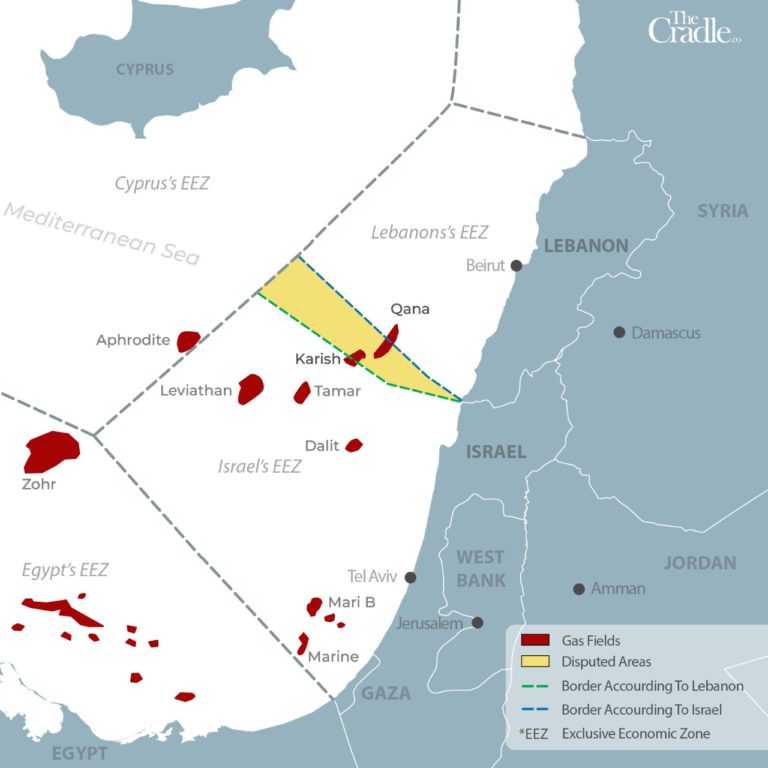
Map of the disputed maritime border between Lebanon and Israel. (Photo Credit: The Cradle)
As for the most pressing concern for both sides, Lebanon and Israel compromised in the legal language regarding the buoys deployed at sea to demarcate the various economic blocks.
According to the leaks, Lebanon insisted on adopting Line 20 while refusing to acknowledge that the line demarcates the maritime borders, but simply the blocks at sea.
Whereas Israel insisted on Line 31 which is going to be on the final draft between both countries.
Nonetheless, Lebanon will not acknowledge its effects on the land border demarcation, leaving the issue for indirect land-border negotiations.
In light of these developments, Lebanese caretaker Prime Minister Najib Mikati met on 11 October with the Lebanese Minister of Energy, Walid Fayyad, and a delegation from Total.
The delegation included the Director of Oil Exploration and Production Laurent Vivier, who was informed about the results of the negotiations and received a request to start operations.
Total informed the Lebanese side that the logistics of exploration need time, promising to start “as soon as possible.”
Similarly, Israeli National Security Council Chairman Eyal Hulta announced that all of Israel’s demands have been met.
“Israel’s security interests have been preserved. We are on our way to signing a historic agreement,” Hulta said.
According to Israeli Minister of Defense Benny Gantz, the current state of alert at the norther border with Lebanon came as a result of credible intelligence information about Hezbollah’s plans to launch an attack had Israel started to extract gas from the Karish gas field before a deal was concluded with Lebanon.
Similar assessments were made by the foreign intelligence services of several western countries.
This attack would have fulfilled the promise made by the Secretary General of Hezbollah, Hassan Nasrallah, who reiterated on several occasion that only mutual access to the gas reserves will be permitted.
“Israel, the US, and EU all know we are not bluffing. They have enough proof of that,” the resistance leader said during a televised speech in September.
Will Lebanon and Israel go to war over the maritime border dispute?
By Robert Inlakesh | Samizdat | October 8, 2022
Israel has announced its readiness for war with Lebanon, as the ongoing US-mediated maritime border demarcation talks head towards a dead end. The issue, however, is not just causing dispute between Beirut and Tel Aviv, but also becoming more prevalent within Israeli politics as it heads into another round of general elections.
On Thursday, Israeli Prime Minister Yair Lapid rejected Lebanese amendments to a US-proposed maritime border demarcation agreement. The previous day, Israeli officials had reportedly been briefed on the deal, which was the cause of much optimism, with an unnamed source telling Axios news that Lapid “made it clear that Israel will not compromise on its security and economic interests, even if that means that there will be no agreement soon.”
Later on Wednesday, Israeli Defense Minister Benny Gantz ordered the military establishment to prepare for an armed confrontation with Lebanon. A four-hour cabinet meeting, which was said to have been attended by major Israeli security establishment figures, was then concluded with a public announcement that the prime minister and defense minister had been granted permission to strike Lebanon without further cabinet approval.
Why are Lebanon and Israel on the verge of war?
In early June, a ship owned by the gas company Energean arrived at the resource-rich Karish field in the Eastern Mediterranean to begin preparations for natural gas production for Israel. Lebanese President Michel Aoun condemned the arrival, warning Tel Aviv against taking any further “aggressive action.” The Karish field, as well as the nearby Qana field, have for years been central to on-off US-mediated negotiations between Lebanon and Israel. The two nations have still not come to any agreement on the demarcation of their maritime borders, with Beirut seeing Karish and Qana as vital to reviving its collapsing economy.
While Lebanon maintains, due to legal arguments put forth in previous negotiations, that the entire area is to be considered ‘disputed waters,’ Israel has maintained that all of the Karish field and the majority of the Qana field are within its own ‘Exclusive Economic Zone’. The Lebanese political and military party Hezbollah, which claims to have 100,000 battle-ready troops at its disposal, then weighed in on the debate, vowing to protect Lebanon’s rights to its oil and gas.
Secretary General of Lebanese Hezbollah Seyyed Hassan Nasrallah declared that if no maritime border deal were reached and Lebanon is not able to secure its rights, then military action will be taken. Nasrallah vowed that the new reality would be “If we can’t have our resources, nobody can.” Hezbollah’s red line is Israeli extraction from the Karish field before any agreement is signed – if this happens, the group has threatened to strike not only Tel Aviv’s infrastructure at site, but every other Israeli oil and gas facility in the Mediterranean.
Israel has since responded with threats of its own, which have ranged from a vow to eliminate the entire densely populated Beirut suburb that serves as Hezbollah’s stronghold, to Benny Gantz’s recent warning that the whole of Lebanon would “pay a heavy price” for any military action by Hezbollah. Now that the negotiations have reached a “make or break” point, there are significant fears that military action will be taken, either by Israel or Hezbollah.
Empty threats?
The most recent threats issued by the military and political leadership in Tel Aviv have caused panic among Israelis living near the Lebanese border. However, there is a significant possibility that the rhetoric is aimed at a domestic audience. Israel will enter into a new round of national elections in November and the demarcation of maritime borders has recently been weaponized against the current Israeli leadership, causing ministers to act in order to save face.
Israeli opposition leader and former long-time prime minister Benjamin Netanyahu began to lash out at interim-PM Yair Lapid back in September, releasing a video in which he claimed that Lapid had “totally folded in the face of Nasrallah’s threats” and that Hezbollah had forced him to delay extraction from the Karish field. Netanyahu has continued to heavily criticize his political opponents’ handling of the demarcation-line issue, with similar claims that Israel is backing down over the threats issued by Lebanese Hezbollah.
Netanyahu’s words ring true in that Lapid has clearly been forced to take the issue of demarcation of maritime borders very seriously and has conceded on positions held by Tel Aviv in the past. In addition to this, the extraction of gas from the Karish field has also been delayed, as Energean, which owns the rights to extract from the site, was initially prepared to begin operations in late September and has so far refrained from doing so. However, had Netanyahu remained as PM, he would hardly have had any other choice but to do the same.
The threats made by Hezbollah are very serious, and the group apparently has the capacity to follow through with them and destroy all of Israel’s oil and gas facilities. At this time, however, the Israeli far-right camp headed by Netanyahu is blaming the situation on Lapid’s weak governance, saying he is prepared to give away territory that belongs to Israel. For this reason, it is likely that Yair Lapid will attempt to delay extraction of gas from the Karish field in order to sideline the issue until after the elections.
The necessity of a deal for Lebanon
Lebanon sees the Karish and Qana issue as integral to its survival. Some UN experts put the percentage of Lebanese living in poverty at around 80%, while the country endures round-the-clock blackouts, a rising crime rate, and civil instability. Some people have even been spotted searching for food in garbage bins, as well as fighting over loaves of bread at bakeries. Getting its hands on a possible multi-billion-dollar oil and gas field is a matter of life or death for Beirut – but not for Tel Aviv, which enjoys far more economic stability.
The US mediator in the Lebanon-Israel talks, Amos Hochstein, gave an interview to the American owned al-Hurra TV in June, laughing when asked about the prospect of trading the Karish field for Qana. Months later, after Hezbollah upped its threats and the group’s leader, Nasrallah, stated that the Lebanese people would not be laughed at, this issue has become a rather grave one. The US, which has a clear pro-Israeli bias, is now being forced to take the talks much more seriously.
Earlier this year, as the European Union looked for alternative gas suppliers, a deal was inked between Tel Aviv and Brussels, under which Israel would send gas through pipelines to Europe via Egypt. This has encouraged Tel Aviv to announce its plans to double its gas output, and the Karish field is key to achieving this.
The Qana field, however, has not yet been explored and will take time to develop. Despite this, one of the key reasons for Israel’s rejection of the Lebanese proposal is that Beirut refuses to pay Tel Aviv royalties for the gas it would extract from the Qana field should it be handed to Lebanon. Beirut cannot commit itself to such an agreement, because this would mean normalizing ties with the Tel Aviv regime, which still occupies Shebaa farms – an area that Lebanon claims as its rightful territory.
Whether war happens will now boil down to whether bickering between Israeli political parties and individual officials will cause Tel Aviv to adopt a belligerent approach and push forward with gas production in the disputed fields before an agreement is reached. If it does, there can be little doubt that Hezbollah will open fire if its red line is crossed. Israel’s stake in the matter is additional energy revenues, while for Lebanon it is potentially a matter of life or death. Neither side wants war, but one has much to gain and the other has everything to lose.
Robert Inlakesh is a political analyst, journalist and documentary filmmaker currently based in London, UK. He has reported from and lived in the Palestinian territories and currently works with Quds News.
Europe’s Biggest Enemy Isn’t Russia Nor Islamic Terrorism, but Israel
By Martin Jay | Strategic Culture Foundation | September 25, 2022
When Joe Biden took office, many pundits said that at least relations between the U.S. and EU would be restored. But the Iran deal is the ultimate test of just how much he loves the old continent.
Just how far will Israel go to scupper the so-called Iran deal from being signed by both Iran and the West? And will it play a fair game or use underhand and covert tactics to achieve its goal of the deal never being signed? Recently, we have seen the talks in Vienna progress as even the Americans say that certain key negotiating points have been taken out of the deal from the Iranians which has made the negotiations move closer to an agreement; we have also seen though Israel pulling out all the stops, from a PR and lobbying perspective at least.
And then there is the murky subject of skullduggery to destroy the talks. If you’re one of these people who believes in fairies at the bottom of the garden or that certain toothpastes can make your teeth whiter, then you might not buy into Israel using Mossad to derail the deal. Attacks on U.S. forces for example in Iraq, supposedly carried out by Iran-backed militias would normally have most people pointing the finger at Iran, proclaiming that Tehran is not at all serious about the deal but just playing along for time so that it can roll out a nuclear bomb. Then there is the curious case of the Salman Rushdie attack, which, again, many would point out could be attributed to the Iranians who still have a very much ‘alive’ fatwa against the British writer. Indeed, even the Supreme Leader is reported to have made a comment against Rushdie when he heard of the knife attack.
Given even the Israeli media have speculated that Mossad did it, it would be easy to conclude an open and shut case right?
Yet the author believes, like the 9/11 attacks in New York, which was the dirty work of Mossad, that these previous attacks can also be attributed to the Israelis who may well be plotting a bigger attack in the U.S. which Iran can be framed for; in fact, Americans are so ignorant of Islam or anything to do with the Arab world, that such an attack doesn’t even need to be linked to Iran but simply “Islamic terrorists” which might have tenuous links with Tehran.
There is no limit for Israel in terms of how far it can go to block the deal as the elite there believes that the Iran deal would exponentially boost Tehran’s power given the impact of sanctions relief on the economy. But the emergence of Iran as a regional player, economically, will always be a threat to Israel especially as it throws the spotlight on the once pariah state and many will see the fraud of hatred between Israel and Iran for what it is. Just as for decades the West goaded the Gulf States about Iran, installing fear to such a point that it was America and the UK who cleaned up on weapons sales, Israel needs to keep this yarn alive that Iran is the threat both for internal politics with their own people and also to justify the obscene amount of military aid which is sent to Israel each year. But any hack in Lebanon who has connections with Hezbollah will tell you that this threat is phoney and that both sides have enormous respect for one another; in reality both sides are fooling their own people into buying into the threat of an attack as it’s good for political support. The recent claims by Matthew Levitt in the Israeli media for example that Hezbollah wants to start some skirmishes with Israel can’t be taken seriously from those who are close to the Shiite group in Lebanon who say simply that Hezbollah is too scared to do such a thing off its own bat; being directed by the Supreme Leader in Iran though is another matter.
Hezbollah and Indeed Israel’s game of smoke and mirrors in Lebanon makes some pundits question whether Iran is really serious about reaching out for a deal with the west to lift its sanctions, or just playing us all along to win time? Surely Israel can’t have it both ways as its desperate antics of late tend to contradict themselves.
Hezbollah serves Israel well as the latter can focus more of defence spending and other such border initiatives in preference for being held more accountable for its governance. For Hezbollah it’s exactly the same. The threat of Israel launching an attack, once again, is the very bedrock of Hezbollah support in Lebanon. Without that threat, the Shia group may well lose half of its support overnight. This is one of the reasons why Israel continues to bomb Syria, targeting Iranian and Hezbollah activities: to keep the dream alive. It’s another reason why Hezbollah has a despondent enthusiasm towards Lebanon securing gas drilling rights close to Israel’s maritime border.
Yet in this time of Europe’s economies diving into recessions, we should ask ourselves what is the bigger picture? If Israel fails to derail the Iran talks and once again the Iranians get a deal which appeases the Americans, then certainly their economy in Iran will return to the billion dollars a month trade with the EU. One minor detail though which is overlooked and carefully airbrushed out of mainstream media’s narrative is the impact on Europe if the deal goes ahead. Cheap Iranian oil being sent to most EU countries which are really suffering from the shortages of oil and gas and its present market price could be a godsend and would enrage the Israelis even further. Europeans and even the British would look at Iran through a more favourable prism. Many would argue that Iran should be brought back in from the cold, in preference to the loathing of Putin and the hatred generally towards Russia. At least we can talk to the Iranians, many will argue. This notion cannot have escaped the attention of the EU dogs of war in Brussels who seem to be detached from all realities about the Ukrainian war and their sanctions towards Russia. Is it that they are banking on cheap oil from Iran saving EU economies? Biden too must have been advised of how things will pan out. But cheap oil for EU countries doesn’t favour the U.S. directly whereas letting the Europeans sink in their own demise will actually boost the U.S. economy according to the Washington Post, So much for the special relationship with Europe. For both Israel and Washington.
How the US controls Lebanon’s energy supply
The US is leveraging Egypt’s gas supply to pressure Beirut over US-brokered maritime border talks with Israel
By Yeghia Tashjian | The Cradle | August 19 2022
Consider the chaos in Europe today caused by a sudden reduction in Russian gas supplies.
Now imagine the catastrophic state of Lebanon’s energy sector after two years of fuel shortages, limited foreign currency with which to purchase new, urgent supplies, and US-sanctions on Syria impeding Lebanon’s only land route for imports.
After decades of stalled reforms, Lebanon is running out of time and money.
In June 2021, a lifeline was handed to the country in a deal struck with Baghdad to supply two Lebanese power stations with Iraqi fuel. The agreement, which was due to expire in September 2022, has recently been extended for one year.
But while there are short and long term solutions available to remedy Lebanon’s energy crisis, the two main options are both monopolized by US policymakers with stakes in regional geopolitics.
The first option involves transporting fuel to Lebanon via the Arab Gas Pipeline (AGP), whereby Egypt will supply gas through Syria. Although the proposal was originally an American suggestion, this fuel route requires US sanctions waivers that have not yet been approved by Washington.
The second option is for Lebanon to extract its own gas supply from newly discovered fields off its coastline. This too depends entirely on US-mediated, indirect negotiations with Israel to resolve a maritime dispute over the Karish gas field in the eastern Mediterranean Sea.
Accessing its own gas supplies will go a long way to guarantee Lebanon’s own energy security, while providing the state with much needed revenues from exports.
However, the success of either project depends largely on the status of US-Lebanese relations at any given moment. The two options are also inextricably linked to each other: Washington is pressuring Beirut to compromise with Tel Aviv on the maritime border dispute before agreeing to “green light” Cairo’s gas exports via Syria, which is in turn heavily sanctioned by the US’s “Caesar Act.”
While Washington is playing a leverage game, Lebanon is slowly collapsing.
Gas from Egypt
Under the agreement signed with Cairo, 650 million cubic meters of natural gas will be exported annually via the AGP. As it turns out, the actual supply of gas, as per the World Bank’s conditions, awaits US approval to exclude Egypt from sanctions imposed on the passage of goods through Syria.
The AGP is already a functioning pipeline that has supplied Lebanon with Egyptian gas in the past, but operations were halted in 2011 when Syrian pipelines were damaged during the country’s armed conflict.
Under the deal, Egypt will pump gas through the pipeline to supply Lebanon’s northern Deir Ammar power plant, which can then produce 450 megawatts of electricity – adding four hours of additional electricity supply per day. It is a modest but necessary improvement over the barely two hours of electricity currently provided by the state.
The World Bank has pledged to finance the deal on the condition that the Lebanese government implements much needed reforms in the electricity sector, which has created tens of billions of dollars in public debt.
The Syrian equation
For the Syrian government, the arrangement is perceived as a diplomatic victory as it confers ‘legitimacy’ to the state and represents a step toward its international rehabilitation. The AGP deal was also hailed by Syrian Minister of Oil and Mineral Resources Bassam Tohmy as one of the most important joint Arab cooperation projects.
According to Will Todman, a research fellow in the Middle East Program at the Center for Strategic and International Studies, the agreement is “a win for the [Bashar al-]Assad government. The deal represents the first major move toward Syria’s economic integration with the region since Arab Spring protests shook Syria in March 2011, halting previous integration efforts.”
However, due to US Caesar Law restrictions, no concrete progress has been made over the past months. Amman and Cairo have both requested guarantees from Washington that they will not be subject to sanctions – to no avail. US President Joe Biden has yet to make a final decision on whether the plan will be considered a violation of sanctions on Syria.
Linking the Egypt deal with Israel talks
In order to create a certain interdependency in the region to minimize the possibility of new conflicts with Israel, the US is attempting to link the Egyptian gas deal with the ongoing, indirect, maritime negotiations between Tel Aviv and Beirut.
Amos Hochstein, the State Department senior adviser on energy security, who acts as chief mediator on the disputed maritime border between Lebanon and Israel, said after arriving in Beirut on 14 June that the US side will look at the final agreement between Egypt and Lebanon to evaluate the sanctions compliance of the natural gas project.
This means that Washington is linking the fate of the gas deal to the maritime dispute with Israel to exert additional pressure on Lebanon.
On 14 October, 2020 – just two months after the Beirut port blast which severed the primary transportation route for seaborne Lebanese imports – Lebanon and Israel began the long-awaited US-mediated talks to demarcate their maritime borders, under the supervision of the UN.
The framework agreement announced by both countries at the time was the most serious attempt to resolve the maritime dispute and secure gas drilling operations through diplomatic means.
However, there are many challenges that can slow or even derail these negotiations.
According to Lebanese estimates, the country has 96 trillion cubic feet of natural gas reserves and 865 million barrels of oil offshore, and is in urgent need to begin drilling to save its ailing economy.
Israel is also in hurry to resolve this dispute as it wants to finalize the negotiations before September 2022, when the Karish gas rig is expected to begin production. The concern is that if a deal is not signed by then, Hezbollah may take action to halt Israel’s extraction altogether – until Lebanon is able to extract its own fuel from those waters.
Resolution or conflict
Last month, Hezbollah Secretary General Hassan Nasrallah reiterated warnings against Tel Aviv in the event that Lebanon is prevented from extracting its own resources in the Med. “When things reach a dead-end, we will not only stand in the face of Karish… Mark these words: we will reach Karish, beyond Karish, and beyond, beyond Karish,” he cautioned.
Initially, Lebanon took a maximalist position on its maritime borders with Israel: the main dispute was around the percentage both countries should share in the disputed 860 square kilometers, which covers Lebanon’s offshore gas Blocks 8, 9 and 10.
It is worth mentioning that Lebanon does not enter these negotiations from a position of strength and is in dire economic need to unlock foreign aid and begin the flow of potential gas revenues.
Meanwhile, the arrival this summer of the British-based Energean, an oil and gas exploration company, which will begin a drilling operation close to the Karish gas field, has sparked tensions between both countries, prompting US envoy Hochstein to race back to the region on 13 June.
In order to provide Lebanon with some much-needed leverage and accelerate negotiations, Hezbollah dispatched three drones towards the Karish gas field on 2 July. The operation sought several results: to test Israeli military responses to the drones, to scare off the private company contractors working on the rig, and to motivate both Tel Aviv and Washington to step up and strike a deal.
The operation achieved its goals. Israel’s military now can’t rule out the possibility that the Lebanese resistance movement will launch additional attacks on the gas field in the near future, or provoke Israel in a different manner – if the maritime dispute is not ironed out, and soon.
Beyond the Mediterranean Sea
The negotiations have also been impacted by international developments, chiefly, the war in Ukraine and the growing energy crisis in Europe. Sweeping western economic sanctions on Moscow’s economic interests have dried up Russian exports to the continent, driving Europe to seek alternative sources of energy, few of which are readily available.
In May 2022, the US and EU unveiled a plan to reduce Europe’s dependence on Russian fossil fuels and in June, the EU and Israel signed an agreement to export Israeli gas to Europe. These external factors have further motivated the US and Israel to hasten the negotiation process with Lebanon, all of which are overshadowed by the aforementioned US pressure on the Lebanese government.
Energy expert Laury Haytayan believes that linking Lebanon to regional energy projects makes it harder for Lebanon to go to war with Israel. Haytayan told The Cradle: “Lebanon needs gas, Israel needs stability, and the US wants to give both what they want.”
It is important to recognize that a final maritime demarcation agreement also means defusing the tensions on the Lebanese-Israeli border, which may require a broader US-Iranian agreement, something that is unlikely in the short term.
If the gas deal is successful and the US approves the Egyptian energy exports, the move will only increase US leverage over Lebanon when it comes to future negotiations on energy security.
It is in Lebanon’s interest to ensure that one party, the US, does not continue to hold all the cards related to its vital fuel needs. A recent offer from Iran to supply the country with monthly free fuel was tacitly accepted by Lebanon’s prime minister and energy minister, but needs work. Other states have offered to build power generation plants to enhance the nation’s infrastructure and efficiency.
But with Lebanon so deeply affected by Washington’s whims – and punishments – it isn’t at all certain that the country can steer itself to these more independent options.
The US and Israel have never been this highly incentivized to solve the maritime dispute. If the deal fails, Hezbollah may proceed with military action, especially before the conclusion of political ally President Michel Aoun’s term this Fall.
Furthermore, the gas issue may turn into a contentious domestic political issue ahead of Israel’s November parliamentary elections. In that instance too, a military conflict between Israel and Hezbollah may be triggered.
The only solution is to strike a deal, get gas flowing, and avert war. Will saner minds prevail, or will the region’s high-stakes geopolitical competition continue to escalate blindly? More importantly, can Washington bear to allow Lebanon the breathing space after three years of severe economic pressure to control Beirut’s political decisions?
Israel ‘yields to Lebanon’s maritime demands’ as Hezbollah-set deadline approaches
Press TV – August 19, 2022
Israel has reportedly yielded to Lebanon’s full maritime demands over the disputed waters and gas fields, asking the Arab country for extra time to finalize a deal.
According to a report by Lebanese newspaper Al-Akhbar on August 19, the regime sent a message to Hezbollah through diplomatic channels, saying it accepts Lebanon’s full demands.
Israel has pledged to acknowledge that Line 23 and the Qana prospect field are in Lebanese territory while also pleading with Hezbollah to set aside potential plans to attack Israeli gas fields in case of a delayed deal, the report added.
Secretary General of Hezbollah Sayyed Hassan Nasrallah has already rejected any delays in the case as Lebanon is going through dire economic conditions. “Time is short, and depending on the [Israeli] response, we will surely act,” he said in a speech during Ashura mourning procession.
Hezbollah had set a deadline for Lebanon to secure its rights over the disputed areas, which will expire on September 15.
Meanwhile, Israeli media reported an Israeli official is set to make a trip to the United States to discuss the dispute in the hopes of achieving an agreement.
According to Al-Akhbar, some firms have warned Israel they would withdraw their employees and facilities in case the regime fails to guarantee their safety.
Nasrallah had earlier said the Israeli regime would not be allowed to conduct drilling operations for oil and natural gas in the disputed area in the Mediterranean Sea until Lebanon gets what it deserves.
“Lebanon is facing a historic and golden opportunity to get out of its financial crisis. If we fail to take advantage of it, we would not be able to extract oil within the next 100 years. We are not looking for moral gains out of extraction in the Karish natural gas field. We rather want to tap into our oil reserves. There would, therefore, be no room for oil or gas extraction in the entire region if Lebanon does not get its right,” Nasrallah said at a local event in Beirut on July 19.
Lebanese politicians hope commercially viable hydrocarbon resources off Lebanon’s coast could help the debt-ridden country out of its worst economic crisis in decades.
In February 2018, Lebanon signed its first contract for drilling in two blocks in the Mediterranean with a consortium comprising energy giants Total, Eni, and Novatek.
Lebanon and Israel took part in indirect talks to discuss demarcation in 2020. But the talks stalled after Lebanon demanded a larger area, including part of the Karish gas field, where Israel has given exploration rights to a Greek firm.
The talks were supposed to discuss a Lebanese demand for 860 square kilometers (330 square miles) of territory in the disputed maritime area, according to a map sent to the United Nations in 2011. However, Lebanon then said the map was based on erroneous calculations and demanded 1,430 square kilometers (552 square miles) more further south, including part of Karish.
Hezbollah warns Israel against targeting Palestinians in Lebanon
MEMO | August 9, 2022
The head of Lebanon’s powerful Hezbollah movement, Sayyed Hassan Nasrallah, today warned against any Israeli attempts to expand their targeting of Palestinian resistance members to Lebanon, Reuters reported.
“Any attack on any human being will not go unpunished or unanswered,” Nasrallah said in a televised address marking Ashura, a commemoration for Shia Muslims of the killing of the Prophet Muhammad (peace be upon him)’s grandson Hussein.
The comments came after Israel launched a war against Gaza on Friday, killing 44 Palestinians including 15 children. It also killed senior Islamic Jihad leaders. The bombing was halted late on Sunday under the terms of an Egypt-brokered ceasefire.
On Saturday, Israeli defence minister Benny Gantz hinted at the possible targeting of Islamic Jihad officials abroad, who he said could be seen in “restaurants and hotels in Tehran, Syria and Lebanon”.
“They too will have to pay the price,” Gantz said. Yesterday he said Israel could carry out “pre-emptive strikes” abroad.
“In the future too, if necessary, we will deliver a pre-emptive strike in order to defend Israel’s citizens, sovereignty and infrastructure and this is true for all fronts, from Tehran to Khan Yunis,” he said.
Tensions between Hezbollah and Israel have been escalating in recent months over a disputed maritime border between Lebanon and Israel.
Russia offers monthly donation of 40,000 tons of wheat for Lebanon
Lebanon has been dealing with bread shortages over recent months, in the latest dilemma to hit the crisis-hit nation
The Cradle | August 6, 2022
The Russian Ambassador to Lebanon, Alexander Rudakov, has reportedly obtained initial approval from Moscow to provide Lebanon with a donation of 40,000 tons of wheat per month until the end of the year.
This deal could be extended past December to help the Levantine nation overcome a worsening food crisis, according to information obtained by Al-Akhbar.
Russia’s offer comes just days after Beirut cleared the Syrian-owned Laodicea vessel to depart the port of Tripoli, despite protests from the Ukrainian embassy, which claimed the ship was carrying “stolen grain.”
However, customs officials revealed to The Cradle that the ship’s grain cargo originated in Russia.
Lebanon’s top prosecutor allowed the ship to leave after revealing Kiev failed to present evidence to back their claim of theft against Russia and Syria.
Before the ship’s release, the Ukrainian embassy offered to retract their claim if Beirut paid them for the Russian grain.
Since 2019, Lebanon has been faced with the dire consequences of a severe economic meltdown.
The situation has pushed over 80 percent of the population below the poverty line and all but wiped out the value of the local currency.
Lebanon used to import as much as 80 percent of its wheat from Ukraine, but since the start of the Russian war, it now faces a major food crisis.
Another factor that limits Lebanon’s wheat supply is the destruction of the country’s grain silos during the Beirut Port blast of 2020 — considered to be the largest non-nuclear explosion in history.
As all of this unfolds inside the country, Lebanon is facing a serious threat of war from Israel; the two nations are mired in a dispute for control of an offshore gas field that could provide billions in revenue.
The hidden goal behind Gaza’s assault
By Batool Subeiti | Press TV | August 7, 2022
The Zionist regime’s unprovoked blitz on Gaza since Friday afternoon was, firstly, a direct message to Lebanon, that it is not interested in going into war over the maritime boarders, thereby conceding to line 23 and the Qana fields that Lebanon has demanded full sovereignty over. Secondly, the regime seeks to test the waters through this limited confrontation.
The limited scope of the confrontation between Palestinian Islamic Jihad (PIJ) and the Zionist regime implies the objective is not aimed at weakening the resistance, rather it is to measure the reactions of this confrontation on many levels and to send underlying messages in the process.
The Zionist regime considers the Palestinian resistance to be the easiest target within the resistance axis and has therefore sought calculated confrontation with this entity. Through its assaults on Gaza, the regime is interested in testing the extent of unification of the regional resistance factions in decision making, logistical support, the readiness of factions to get involved if the battle escalates, how willing they are to expand the war in addition to their stock of weapons, their capabilities, and capacities.
This is also happening at a time when the Zionist regime will hold its fifth election in four years this November, thereby seeking to rally the settler population over a point of unity – that is usually attacks on Gaza. The regime seeks to paint the image that it is unafraid to attack in any circumstance to ensure their ‘security’, with Israeli Prime Minister Yair Lapid stating on Friday that, “the country has ‘zero tolerance’ for attacks from Gaza”. However, he also made it clear in the same press conference that there is no interest in a ‘broader battle’.
More importantly, the Zionist regime is approaching a due position and that is drawing the maritime boarders with Lebanon, which if it does not end up playing in the interests of Lebanon, poses an imminent danger, and calls for an imminent war, as made clear by the Secretary General of the Islamic resistance party in Lebanon. The Zionist regime wishes to prevent a war at all costs and that means it has no choice but to compromise, which appears as a point of weakness for the settler population in the context of the elections, as they wish for a candidate that takes a strong stance on such issues. This smaller scale attack was therefore launched in order to avoid a larger war, and for the regime to grant itself some credit as well.
It is also important for the Zionist regime to reinforce the phobia of war within the minds of the settler population, such that the mass general opinion formed is one that aligns with the Zionist government’s decision to compromise on the maritime boarders, in order to prevent a wider scale war where the battle front is opened beyond one Palestinian resistance faction, the PIJ, and in the worst case extends to the Lebanese resistance that has over 100,000 rockets.
The reason that the Zionist regime seeks to compromise on the boarders are because it knows the resistance capabilities are very strong, such as when they sent three unmanned aircraft (UAV) targeting the gas rigs in July. The regime however also seeks to paint the image that they are strong through launching an offensive attack on the resistance, however the reality is that they don’t wish for a war and in fact know that other Palestinian resistance organizations such as Hamas, the Popular Front do not intend to get involved and the operation is of a limited nature. The head of Shin Bet reportedly told cabinet ministers overnight on Saturday that Tel Aviv, “met most of the objectives it set at the outset of the operation in Gaza.”
In this process, the Zionist regime has sought to send a message to the internal resistance in Palestine that the head of PIJ, Ziad Nakhala is in Tehran whilst key commanders of the group are being assassinated, thereby seeking a show of display for their supposed lack of fear and strength. However, the unmasked reality is that since the regime are seeking compromise, they want to grant themselves false credit regarding their strategic strength and seek to gain publicity without it affecting their elections. The reality is that the regime is deceiving its own population through putting forth titles that sound big but are empty, as they know the resistance won’t be dragged into the square they want, and their aim is to appeal to the public opinion of the Zionist settlers through deception.
Batool Subeiti is an Energy Engineer and political analyst based in London, UK.
As Lebanon suffers food crisis, Ukraine uses Western support to block flour and wheat from its markets
By Robert Inlakesh | Samizdat | August 3, 2022
A Syrian-flagged ship named the Laodicea that docked in the Lebanese port of Tripoli was detained last Saturday, preventing desperately needed flour and barley from reaching people in the Middle East. The move came after Western threats against Beirut and unsubstantiated claims from Kiev that the cargo was stolen from Ukraine. The ship, which has been on a US blacklist since 2015 for allegedly carrying shipments from sanctioned Crimea, is now under investigation.
On Friday, allegations emerged in Western media, citing the Ukrainian embassy in Beirut, that “stolen” flour and barley had been transferred to the Lebanese port of Tripoli and that Kiev had warned the Lebanese government against buying the grain. The news was said to have sparked protests from Western governments “warning” Lebanon’s Foreign Minister, Abdallah Bou Habib, over the allegedly stolen cargo. It later turned out that Kiev possessed no evidence that the flour and barley aboard the ship was from Ukraine. Despite this, Lebanon has now seized the ship and will act according to legal proceedings on the issue, after reported Western pressure.
The Ukrainian embassy in Beirut told Reuters that “the ship has traveled from a Crimean port that is closed to international shipping, carrying 5,000 tonnes of barley and 5,000 tonnes of flour that we suspect was taken from Ukrainian stores,” without presenting evidence to support the claim. An official from a private firm responsible for the import of the grain, Loyal Agro Co LTD, based in Turkey, not only denied that the goods were Ukrainian, but also clarified that the ship was carrying 8,000 tonnes of flour and 1,700 tonnes of barley in total. The vessel was also said to have been seeking private buyers in Lebanon, not a sale to the Lebanese government, and was destined to travel on to Syria after its stop in Tripoli.
Additionally, the Russian embassy in Beirut said that it had “no information regarding the Syrian vessel or a cargo brought to Lebanon by a private company.” An official at the Lebanese port authority also stated that there was “nothing wrong” with the cargo aboard the ship. None of this however, was enough to prevent the issue being pursued and for Lebanon to be threatened.
What makes this issue troubling, is that – without evidence – Western nations and Kiev can openly pressure Lebanon to keep much needed supplies away from its people, in this case potentially forever and for at least 72 hours under detention. The country is currently suffering its worst ever economic collapse, enduring shortages in food, medicine, electricity and essential goods. According to some UN estimates, some 78% of the Lebanese population now live in poverty. The food shortage has led to long queues at bakeries, sometimes resulting in gunfire and brawls between people fighting over the limited supply of bread. The Ukraine crisis has made Lebanon’s predicament even tougher, with a lack of flow of supplies from Ukraine and difficulties bringing in Russian goods due to sanctions. The Western “Caesar Act” sanctions against Syria have also made the situation even worse, as Lebanon has historically benefited greatly from its bigger neighbor.
What Kiev is doing, by threatening the future of bilateral relations between Lebanon and Ukraine over this issue, could be interpreted as blackmail. Ukraine has 20 million tonnes of wheat that it still hasn’t exported and a severing of relations with Beirut would mean that Lebanon could potentially miss out on acquiring it during a food shortage. The Lebanese government is clearly in a weak position and Kiev, backed by the power of NATO, is now attempting to bully Beirut over unsubstantiated claims that are denied by all sides, notwithstanding that officials won’t even state the allegation with certainty.
Another issue here is the double-standard at play, whilst Western nations suffer economically themselves, there is no hesitation at sending billions of dollars in aid to Ukraine every other week. Yet when it comes to simply amending sanctions, after pledging to do so, in order to allow Egypt to send gas to ease the energy crisis in Lebanon, Washington still refuses to allow it, a year later.
Instead, based upon unsubstantiated claims, Lebanon is forced to suffer even more by having basic food supplies dangled over its head. Whilst the West acts holier-than-thou on the issue of unsubstantiated claims of Ukraine’s grain being sold by private firms in Lebanon, it seemingly forgets that the US illegally occupies neighboring Syria’s most fertile agricultural lands, in addition to the majority of its oil and gas fields.
America has repeatedly been accused of smuggling Syrian grain and oil into Iraq, resources which should belong to the Syrian government and could be part of the answer to Lebanon’s current shortage.
Robert Inlakesh is a political analyst, journalist and documentary filmmaker currently based in London, UK. He has reported from and lived in the occupied Palestinian territories and currently works with Quds News. Director of ‘Steal of the Century: Trump’s Palestine-Israel Catastrophe’.
Hezbollah Releases Coordinates of Israeli Platforms in Mediterranean: “Within Our Reach”
Al-Manar | July 31, 2022
Hezbollah’s Military Media Department released on Sunday video showing the Israeli platforms operating in the Mediterranean, warning the Zionist enemy of its attempts to plunder Lebanon’s gas and oil fields.
The video shows surveillance scenes taken from land and air, some form yesterday, for Israeli vessels at the Karish field near the Lebanese maritime borders.
Starting with Hezbollah Secretary General Sayyed Hasan Nasrallah’s warning that “procrastination is useless”, the video shows Hezbollah’s anti-ship missile readying to be launched.
The footage included detailed coordinates of Israeli platforms, showing their names and locations.
The one-minute-video, which includes subtitles in Hebrew, concluded by “within our reach”, referring to previous threats by Sayyed Nasrallah that all Israeli platforms and targets are within the reach of the Lebanese Resistance missiles.
The video was released just hours before the US’ so-called ‘mediator’ Amos Hochstein arrives in Lebanon, probably holding a message from the Zionist entity concerning the maritime border talks and gas extraction.
Sayyed Nasrallah earlier this month, warned the Israeli enemy that if Lebanon is prevented to extract oil and gas off its shore then the Zionist regime won’t be able to do so.
Time for Palestine to claim its stolen gas
Hezbollah threatened Israel with war if Lebanon is not allowed to exploit its share in the Karish gas field. Palestinian resistance may do the same over the “stolen gas” off Gaza.
By Yousef Fares | The Cradle | July 22 2022
The maritime border dispute between Lebanon and Israel over the Karish gas field is reminiscent of the stolen gas fields in Palestine’s Gaza Strip. With the naked eye, Gazans can only stand by and watch the Occupation’s gas drilling platforms a few kilometers off their own coast.
This situation could change though, and may depend on the way in which the resistance in Lebanon handles the conflict over Karish.
That scenario may encourage the Palestinian resistance to follow their northern neighbor’s example in threatening to target Israeli platforms if Palestinians are denied their rights to the “Gaza Marine” field.
So long as Palestinians are deprived of basic living condition rights (electricity, fuel, food and medicine shortages) by their Israeli occupiers, they would be foolhardy to ignore the game-changing potential of gas extraction off their own coastline.
However, Lebanon’s current dispute is not the only issue that has led to the Palestinian claim resurfacing. Indeed, there are other factors related to the energy crisis, and it involves the Europeans.
Not Israel’s gas to export
On 15 June, it was announced in Cairo that a memorandum of understanding (MoU) had been signed to export Israeli (stolen Palestinian) gas to the European Union (EU) through Egypt.
The MoU, which Israel and the EU described as a “historic agreement,” extends over three years and is automatically renewable for two further years. It includes transporting gas from Israel to liquefaction stations in Egypt (Idku and Damietta in the north), then shipping it to Europe, which imported 155 billion cubic meters (bcm) of gas from Russia last year.
In light of the EU’s faltering standoff with Moscow over Ukraine, Europe is seeking – among other sources – “Israeli gas” to compensate for about 10 percent of this amount, while Israel for its part is eager to increase its production of natural gas to 40 bcm (billion cubic meters) annually.
Experts estimate that most of this quantity will come from Palestinian gas extracted from “Gaza Marine 1” which is adjacent to the Strip, and “Marine 2” which is located within the maritime border area between Gaza and Israel.

Not the PA’s right
Understandably, news of the MoU angered the Palestinian resistance, especially since the Palestinian Authority (PA) in Ramallah did not take any practical steps to demand Palestinian rights in this matter.
Informed, anonymous sources have told The Cradle that the EU has bought the silence of the PA by giving it a 4 percent share of the value of the extracted gas, while most of the agreements signed between Ramallah and the extraction companies, in the past two decades, stipulated a ratio ranging from 10 percent to 27.5 percent.
There are also accusations that the PA will only collect some taxes on monthly production, in addition to accelerating EU aid to the Palestinians.
On 12 June, the European Commission approved a new aid package for the Palestinians worth 224.8 million euros, as a ‘bribe’ for the PA, with a verbal pledge to support Palestinian rights and confront Israeli policies that undermine the two-state solution, particularly in Jerusalem.
The EU also pledged to press for the allocation of part of the extracted gas for Palestinians at preferential prices in order to operate the power plants in Gaza and Jenin.
In return for these gestures, the PA committed to the charter of the “Eastern Mediterranean Gas Countries,” and will not object to any steps in the region’s energy file, specifically with regard to the start of exploration and extraction of natural gas from the Gaza Marine field and the Rantis field west of Ramallah. The PA further agreed not to raise the issue of Palestinian rights to energy in the areas under its “control.”
In this context, Israel tried to indirectly buy the restraint of the resistance in the Gaza Strip by increasing work permits for Palestinians in the occupied territories to 20,000.
Gaza’s gas
Located in Palestinian territorial waters 36 km west of the Strip in the eastern Mediterranean Sea, the Gaza Marine gas field was first discovered around 1999 by British Gas who were contracted to develop it.
Despite its discovery, gas has not been extracted from the area despite the PA’s conclusion of several agreements with foreign companies, which were aborted because Israel refused to allow the operations to proceed.
Significantly, the Gaza Marine includes approximately 8 adjacent fields and is estimated to contain 12 trillion cubic meters of gas, at an attractive depth that makes the cost of extraction low.
Pirates of the Mediterranean
Israel controls the gas fields in Palestinian waters in the north of the Gaza Strip and in the eastern Mediterranean, including the so-called Yam Tethys fields, which were proven to be Palestinian property according to maps submitted by the state of Palestine to the United Nations.
In 2019, an investigation conducted by Al-Jazeera showed that Israel drained the “Mari B” gas field in the Gaza Sea (it contained enough gas for the Strip for 15 years). An investigation by Middle East Eye concluded that the Palestinians could claim 6,600 square kilometers of marine area, five times the area they now own.
Lebanon and the Gaza Strip face similar economic difficulties brought about through different foreign tools of economic besiegement. In the case of Gaza, the blockade is direct, as Israel controls the factors impacting their standard of living and welfare. As for Lebanon, it faces US sanctions and diktats that have contributed to the country’s economic meltdown.
The way in which Lebanon’s resistance movement Hezbollah manages the Karish field file will be interesting as it is likely to influence how the Palestinian resistance choose to go about protecting and reclaiming their rights.
With gas revenues estimated at $4.5 billion annually, Ramallah’s budget – which in 2021 was set at $5.6 billion, of which $3.9 billion was provided by internal revenues – could achieve self-sufficiency. Additionally, these resources could provide a radical solution to the fuel and electricity crises in the Strip.
A meeting of minds in Beirut
Informed sources have told The Cradle they have credible reason to believe the Palestinian resistance factions will take advantage of the battle that Hezbollah Secretary General Hassan Nasrallah has threatened to ignite if Israel continues to ignore Lebanon’s right to its gas fields. Nasrallah has set a deadline – the start of September – for this access to be provided.
The sources also say that Hamas’ Political Bureau Chief Ismail Haniyeh discussed the gas file with Nasrallah during their meeting in Beirut on 23 June, and suggested that the resistance in Gaza would likely participate in any future war, especially in the face of Israel’s continued theft and deprivation of natural resources.
Haniyeh spoke of “Lebanon’s right to extract gas from its maritime borders, and to stop Israeli piracy.”
However, there are calculations which must be taken into account before the Palestinian resistance gets involved in any war. This is related to the scale of the hypothetical war and the Israeli reaction to it, as well as to the logistical capabilities of the resistance at the naval level.
Yet it is the Palestinian silence on both the official and resistance level which has angered Lebanese authorities. The Director General of Lebanon’s General Security, Major General Abbas Ibrahim, demanded that Palestinians take a coherent political stance towards what “Lebanon is negotiating regarding the gas that is in the Palestinian waters occupied by Israel.”
A military response
However, well-informed sources in the Palestinian resistance tell The Cradle that their factions have now placed the military option relating to Gaza Marine on the table, triggered by the signing of the tripartite gas agreement (between Egypt, Israel and the EU) in June.
Political analyst Ismail Muhammad believes that the Haniyeh-Nasrallah meeting resulted in a preliminary agreement, which could be implemented at the military level if necessary.
Speaking to The Cradle, Muhammad explained that “the resistance cannot miss such regional circumstances to remind of its right to Palestinian gas which has been stolen before its eyes. Just as Lebanon’s economic future depends on the extraction and sale of gas, Palestine in general, and Gaza in particular, needs such income to end the economic dependence on occupation and to liberate its political decision-making.”
Muhammad refers to the expected strategic results of any victory in the battle over the Karish and Gaza Marine fields, not just the potential economic outcomes. Extracting the right to one’s energy resources, whether by military force or by an agreement, effectively ends the Israeli-US economic blockade in both Gaza and Lebanon.
This presents “a victory for the resistance, which increases its political influence and reduces the influence of external dictates,” he added.
“This is a major battle. Winning it against the Israeli-American-Arab alliance will change the future of the region.”
Expected scenarios
There is near unanimity that there is as much a chance of a gradual military escalation as there is of reaching a fair solution to the Karish field dilemma. There are three scenarios for the role of the Palestinian resistance in the event that Hezbollah is forced to resort to force:
First, that Hezbollah initiate a gradual escalation using a qualitative weapon to strike the British/Greek drilling ship in Karish. This will deprive all parties of benefiting from the field, and return the gas file to square one.
On the other hand, Israel absorbs the blow and responds in a limited manner that does not lead to an all-out war. In this case, it is expected that the resistance in Gaza will maintain its readiness without providing guarantees of non-interference, which means that Israel will have to occupy thousands of its soldiers, along with a few squadrons of its aircraft and at least a tank battalion, to contain any reaction in Gaza.
Second, that Israel ignore Nasrallah’s threats to strike the gas platforms in “Karish and beyond Karish,” which effectively means to paralyze the entire Israeli energy sector by expanding the range of targets to include the fields of Athens, Tanin, Dolphin, Leviathan, Dalit and Aphrodite.
These fields represent the cornerstone of the energy sector, on which Israel relies to secure its gas and oil needs and provide it with financial revenues. The fields located off the shores of occupied Ashkelon and Gaza, such as Kirin, Nawa and Marin Bay – about 190 km from Gaza – also fall within the scope of Nasrallah’s “beyond Karish” equation.
Sources in the Palestinian resistance who spoke to The Cradle suggest that this scenario means a comprehensive regional war. In this case, their decision would be to “directly participate” in such a war. Although their logistical capabilities do not allow for “accurate point” hits to the gas rigs, the fire intensity provided by the suicide drones and missiles will put these fields out of action.
One source points to the Palestinian resistance’s success in targeting the Tamar natural gas field off the shores of Ashkelon and the Eilat-Ashkelon gas pipeline, which was hit by about twenty missiles, during Operation Sayf Al-Quds (Sword of Jerusalem) in May 2021.
“Israel will not be able to launch a large-scale operation against the Strip. It will not venture into an irregular war on two fronts at the same time, especially since the priority is for the Lebanese front, where there is a huge stockpile of weapons and advanced capabilities. Most probably, it will be satisfied with conventional air strikes against civilian and military targets in Gaza,” he says.
Third, the resistance also takes into account the scenario of a comprehensive war in which all the components of the Resistance Axis can participate; in Lebanon, Syria, Iraq and Yemen.
In such a conflict, the Palestinian resistance will spare no effort in igniting all the fronts, in Gaza, the West Bank and Jerusalem, and even in the 1948 occupied territories, as it will be an opportunity to change the “map of the region” and hit a “historic blow to the entire Zionist project,” even though the current international circumstances make such scenario unlikely to happen.
Palestinian pragmatism
It is evident that the resistance in Gaza views the gas crisis between Lebanon and Israel as an opportunity that must be exploited to demand legitimate Palestinian rights. The continuation of difficult living conditions in the Gaza Strip in particular, hostage to conditional Israeli facilities, is something worth sacrificing to change.
Therefore, Gaza’s participation in a war between Lebanon’s Hezbollah and Israel stems from the existence of a common interest, and not just a mutual foe.
Featured Video
Seyed M. Marandi: Negotiations Collapsed – Return to War
or go to
Aletho News Archives – Video-Images
From the Archives
Wartime internment camps in Australia
National Archives of Australia
World War I
During World War I, for security reasons the Australian Government pursued a comprehensive internment policy against enemy aliens living in Australia.
Initially only those born in countries at war with Australia were classed as enemy aliens, but later this was expanded to include people of enemy nations who were naturalised British subjects, Australian-born descendants of migrants born in enemy nations and others who were thought to pose a threat to Australia’s security.
Australia interned almost 7,000 people during World War I, of whom about 4,500 were enemy aliens and British nationals of German ancestry already resident in Australia.
Records of World War I internment camps
World War II
During World War II, Australian authorities established internment camps for three reasons – to prevent residents from assisting Australia’s enemies, to appease public opinion and to house overseas internees sent to Australia for the duration of the war.
Unlike World War I, the initial aim of internment during the later conflict was to identify and intern those who posed a particular threat to the safety or defence of the country. As the war progressed, however, this policy changed and Japanese residents were interned en masse. In the later years of the war, Germans and Italians were also interned on the basis of nationality, particularly those living in the north of Australia. In all, just over 20 per cent of all Italians resident in Australia were interned. … continue
Blog Roll
 Aletho News
- Seyed M. Marandi: Negotiations Collapsed – Return to War
- Tomorrow’s naval blockade showdown
- ‘Israel’ attacks civilians to hide its embarrassing military failures & out of pure sadism
- Any Foreign Military Vessel Approaching Hormuz Under Any Pretext ‘Will Be Dealt With Severely’: IRGC
- Diplomats slam US negotiators’ performance in Iran talks
- Trump Refuses Exit Ramp, War with Iran will Continue
- Trump Says US Naval Blockade in Strait of Hormuz Will Begin Shortly
- US, Iran end 21-hour talks without agreement
- US IRAN TALKS: Who Are the Crazy Ones Here? /Lt Col Daniel Davis
- Talks with the US end without a deal over excessive US demands: Iran
- If Americans Knew
- US-Iran ceasefire negotiations make zero progress – Daily Update
- Pro-Israel ‘Thinktanks’ and Individuals who Influence U.S. Foreign Policy
- Mearsheimer reveals how Israel dictates US policies on Iran, Gaza – video
- After killing 350+, Israel still has a “score to settle” with Lebanon before ceasefire – Daily Update
- Military aid to Israel emerges as the latest political litmus test for Democrats
- The only Palestinian children’s rights organization closes following years-long Israeli campaign against it
- ‘I Can’t Forget the Smell’: Lebanese Reel After Israel Kills Over 300 in Single Day
- DNC Shoots Down Resolutions Calling Out AIPAC and Limiting Arms to Israel
- TCN: Is Israel Blackmailing President Trump?
- Israel killed at least 303 Lebanese yesterday – who were they? Daily Update
- No Tricks Zone
- Cave Discovery Reveals Today’s Desert Climates Were Recently Far Warmer, Wetter, Teeming With Life
- German Expert: Heat Dome Led To Record Temps In Western USA…Warmer In 1934, 1936
- New Study: No Linear Warming Or Glacier Retreat Along Northern Antarctic Peninsula Since 1980s
- An Inconvenient Tree: Uncovered In Alps… Europe Much Warmer Than Today 6000 Years Ago
- New Study Reports A 60% Slowdown In Greenland’s Ice Loss Rate In The Last Decade
- Low Intensity Tornado Wrecks Major Solar Farm, Creating A Potential Toxic Dump
- New Study Finds Warming Saves Lives…Cold Temperatures 12 Times More Deadly Than Excess Heat
- German Science Blog Accuses PIK Climate Institute Of Hallucinating Climate Tipping Points
- Devastating Assessment Of Comirnaty Vaccine By Former Senior Pfizer Europe Toxicologist
- New Study: CO2 Is ‘Effectively Negligible’ As An Explanatory Climate Change Factor Since 2000
 Aletho News