US Threatens Lebanon: Accept Israel’s Conditions or You Won’t Be Able to Extract Maritime Gas for Decades
Al-Manar | July 20, 2022
Caretaker Minister of Foreign Affairs Abdallah Bou Habib met on Wednesday with head of the American Task Force For Lebanon Edward Gabriel heading a delegation.
After the meeting, Gabriel addressed the reporters, conveying an American threat to Lebanon.
Gabriel considered that Lebanon has a small chance to extract its maritime gas resources by concluding a settlement after engaging in negotiations.
Otherwise, Lebanon would not be able to extract its maritime gas for decades, Gabriel added.
It is worth noting that Lebanon has insisted on obtaining its entire maritime rights preserved by a fair and legal border demarcation. However, the Zionist enemy has stubbornly rejected Lebanon’s demands.
Hezbollah Secretary General Sayyed Hasan Nasrallah warned the Israeli enemy and the United States that if Lebanon is prevented from extracting its maritime resources, none will be able to extract or sell gas and oil.
In a televised speech, Sayyed Nasrallah indicated that Hezbollah military forces are monitoring all the Zionist platforms across the occupied Palestinian coast, adding that the Resistance may resort to ground, maritime or air capabilities in order to attack the enemy and secure Lebanon’s rights.
According to Sayyed Nasrallah, the new equation is Karish, what’s beyond Karish and what’s far beyond Karish.
Thus, Hezbollah military power has been writing the long story of Lebanon’s pride of victory that protects the nations and secures its all-leveled prosperity.
Nasrallah: If Lebanon is denied its oil and gas resources, we will shut down all Israeli platforms
Speech by Hezbollah Secretary General Sayed Hassan Nasrallah on July 13, 2022, on Biden’s visit to the Middle East and the border dispute between Lebanon and Israel over the Karish maritime gas field.
Source: almanar.com.lb Translation: resistancenews.org
Transcript:
[…] Now I come to the main point of my speech tonight. One of the results of the July (2006) war is the establishment of a balance of deterrence in the struggle against the Israeli enemy, between Lebanon and the enemy entity. These equations, this balance… Of course, I am not talking about a balance of forces in terms of the number of our respective soldiers, our respective naval power or our respective air forces. That’s not what I’m talking about. I’m talking about a balance of deterrence, a balance of fear, a balance of terror. It’s a different kind of equation (than a strict balance of power).
For the past 16 years, that is, from 2006 to the present, Lebanon has enjoyed an excellent security situation with regard to the fight against the Israeli enemy, if we compare it to what used to happen before. The enemy has been unable to include Lebanon in its strategy of “the battle between wars” (conducting episodic strikes without starting a war, as it does in Syria), and Israel thinks a thousand times before taking any military action against Lebanon, knowing that there would be retaliation (from Hezbollah). That is why when Israel tries to do something (in Lebanon), it tries to carry out security operations (against Hezbollah) trying as much as possible not to leave any footprints, any traces (of its involvement). This achievement (of the Resistance) is still valid.
In this regard, before the episode of the drones (sent by Hezbollah over the Israeli gas platform in Karish), after my (last) speech about Israel’s exploitation of the Karish field (claimed by Lebanon; Hezbollah promised to prevent Israel from extracting gas from it, even if it means war), the enemy War Minister… Of course, all Israeli officials spoke out to threaten, promise (retaliation), etc, but in these days of commemoration of the 2006 war, I only want to comment on one sentence of the Minister of War [Benny] Gantz. He said, and I quote you his words, “We are ready for war, and if necessary, we will march again on Beirut, Sidon and Tyre.” I’ll just comment on that sentence before I continue. In short, Gantz knows very well that such words are pure mockery, and that he is lying to himself, to his people and to his peers. All Israelis know that this is just empty rhetoric that carries absolutely no weight. Yes, anyone in Israel can say that they are going to bomb, destroy Lebanon, etc. I am not saying that they are incapable of doing this: on the contrary, it is ALL they are capable of. In all the wars against Gaza, all they have done is air strikes, missile strikes, artillery strikes, nothing else. The only time they made a ground incursion into Gaza, they suffered a disaster, and even had prisoners taken (by Hamas)! And even in the recent military maneuvers they dubbed “Chariots of Fire”, the entire operation towards Gaza was based on firepower, not on a ground incursion.
So you (Israelis), who, faced with a Gaza under siege for 15 years, whose geography is flat, whose conditions are (so) difficult, and whose weapons are largely produced locally, do not even dare to take a few steps forward, you claim to invade Lebanon and reach Tyre, Saida and Beirut? You are completely mistaken if you make the same calculations as 20, 30 or 40 years ago, as if the situation (today) was the same (as when Israel invaded Lebanon in 1982). In any case, I advise Gantz to review his case, and in particular to review the last days of the 2006 war, when the Israelis took the decision to enter the town of Bint Jbeil, which is very close to the international border (between Lebanon and Israel). Let him review in particular the number of elite troops that participated, the generals that participated, the tank battalions that participated, the size of the forces that participated, the artillery and aerial firepower, the missile strikes, the planes, the helicopters, etc. They destroyed most of the city, besieged it, and left only one exit route for the fighters to flee. But the fighters did not flee, and the opposite happened: more (Hezbollah) fighters entered Bint Jbeil. The situation was quite different (from what Israel imagined). And Israel’s goal may not even have been to occupy the whole city of Bint Jbeil, but only to reach the stadium where I gave the spider’s web speech (on May 25, 2000) and plant the Israeli flag there. And even that you were unable to do! And this during the last days of the war, when, in your eyes, the (Hezbollah) fighters would be exhausted and weakened by the bombing, with low morale, etc. But such is the experience of Bint Jbeil, the closest city to occupied Palestine (it was a resounding failure for Israel).
Therefore, to claim that Israel will reach Saida, Tyre and Beirut is a preposterous statement, and I believe that all Lebanese have laughed at this statement and these threats. Those days (when Israel could occupy our capital) are well and truly over. And that is why we need not fear anything on this side in the ongoing border dispute between Lebanon and Israel: Israel is threatening us with invasion, but what could it possibly invade? During the 33 days of the 2006 war, it remained at the gates of Ayt al-Chab and our other villages at the border, without being able to enter them. Israel tried to enter Maroun al-Ras for 3 days, despite the fact that there were only a small number of fighters there, (but failed).
I only want to confirm, regarding the lessons and teachings of the 2006 war for the future, especially regarding South Lebanon and the Israeli claim to carry out a ground incursion there, that today, the popular support (for the Resistance) is different from that of 1982: the masses overwhelmingly support the Resistance and embrace it (totally). The organization of the Resistance is very large, and has no comparable precedent, both in terms of its numbers and its military capabilities and power. Likewise, the will to fight, the spirit of resistance, and this is what counts most, is stronger and higher than ever before. Not to mention the (mountainous) geography of Lebanon (conducive to guerrilla warfare). The geography is with the Resistance, the people are with the Resistance, the capabilities are with the Resistance, the Resistance is with the Resistance, and first and last, God the Most High and Exalted is with the Resistance. It is He who has given it victory in the past, and it is He who will give it victory at any time in the future. God never fails in His promise, and He gives victory to those who fight in His way [Quran, XXII, 40].
The third point is the issue of oil and gas. One of the consequences of the 2006 war is that it demonstrated the power of the Resistance to protect Lebanon. A new equation (of deterrence) was imposed, I just mentioned it. The protection of Lebanon, its territory, its population, its national security —I’m not talking about the security of the Lebanese society, currently in crisis— in the fight against the Israeli enemy, its natural resources, etc. All this —and I am beginning to be very precise in my remarks— constitutes the only strength that Lebanon has in order to obtain its rights to the oil and gas deposits, to extract them and to sell them. There are several key points in this matter.
First, no Lebanese questions the fact that the golden opportunity to save Lebanon is to extract its oil and gas. When I talk about saving Lebanon, I am talking about saving the State, the majority of whose public services are suspended. Salaries and services are insufficient, but the State is unable to remedy this. Tomorrow, if the Central Bank’s reserves run out, even the salaries of civil servants may not be paid. There will be no more subsidies for medicines, flour, etc. The State is on the verge of collapse, and the country is heading towards an extremely difficult and even critical situation. What else? Even if reforms are carried out, I have already mentioned it but I want to repeat it, the conditions imposed by the IMF for the granting of a 3 billion dollar loan (are draconian), and such a sum cannot meet Lebanon’s (enormous) needs. Someone told me that it doesn’t matter if the IMF gives only $3 billion, what matters is that if this loan is granted, it will give more confidence in Lebanon, and then an international conference can be organized to help Lebanon. Very well, but what can we expect from it? $10, $11, $12 billion, like the CEDRE Conference, the majority of which will be loans, and therefore new debts for Lebanon, with very strict conditions. Will this solve Lebanon’s problems? Lebanon’s problems are much more important than that.
There is a second option, which does not bring $3 billion in debts, nor $11 billion in debts, but hundreds of billions of dollars that will be our property, with which we will be able to pay our debts, pay [and increase] the salaries of civil servants, subsidize medicines, flour, find financing to revive the economy, etc. Because in fact, the lifting of subsidies on gasoline and fuel has not revived anything. The only existing and dignified way of salvation for the Lebanese is the exploitation of our oil and gas: no other way has appeared until now.
The second point is that the golden opportunity is now. It is now, during these two months. And now there are less than two months left, what’s left of July and August, into September, early September, the first week of September —I’ll spell it out in detail. We have a golden opportunity now. Why do I say golden opportunity? If there was no war between Russia and Ukraine, there would not be this (urgent) need of Europe and the United States for gas and oil. I don’t mean that they will import gas and oil from Lebanon, because to install sea platforms, extract hydrocarbons and sell them, it takes years. But Lebanon’s strength is that it can be a problem, an obstacle to the Israeli enemy, to the Israeli entity, and create a problem in the whole region that will prevent the extraction of gas and oil (in the Mediterranean), and will prevent the sale of gas and oil to Europe. Because these people are in a panic situation, they have no choice and they have no time. And I explained that Biden came to the Middle East in the first place for that (to convince the Gulf countries to increase their oil and gas production). They absolutely need oil and gas now.
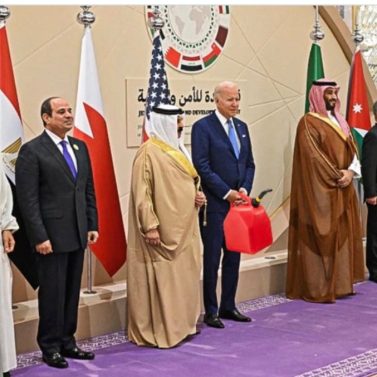
And that’s why Israel rushed to exploit the Karish field. Why do I say that everything is being played out in these two months? Because now is the time to find alternative oil and gas for Europe [before winter], and this is the time required by the company [Energean] to start extracting oil and gas from Karish. This is our window of opportunity. If this two-month period passes and Lebanon has not obtained its rights, the situation will be very difficult, and it will be infinitely harder to obtain our rights. If we have to get our rights after the extraction of oil and gas has started in Karish, it will cost us much more. It is up to you to understand what I mean. The price we have to pay will be much higher. That is why I said in my last speech that time is running out, that it is crucial to act as soon as possible (before it is too late), without specifying exactly how long. But now the Israelis themselves, and the world with them, say that the extraction of oil and gas in Karish will begin in September. This is the critical period we are facing. The Lebanese officials, the Lebanese State and all the Lebanese people must do everything to take advantage of this golden time, this golden opportunity.
Do not allow the Americans to fool you, to procrastinate and to play the game of temporization. I was very affected to hear (Lebanese) officials say that with the grace of God, the (maritime border agreement between Israel and Lebanon) will be concluded in September. It will be too late! In September, it will be too late. If you don’t get your rights before September, and if you don’t agree on the maritime border before September, and the US and the UN have not recognized Lebanon’s rights, after this two-month period, things will be much harder and the price will be much higher. Of course, we would not give up on the issue, but it will be very hard and very costly. That’s how you have to make your calculations. Maybe if you let these two months pass, you (Lebanese officials) will not get anything, except by paying a very high price (war). Don’t let the US fool you. Don’t give any credence to the honeyed words of the Americans. The proof is that it will soon be a year since I announced, on the tenth day of Muharram, the arrival of a cargo of fuel from Iran, and the American ambassador promised the Lebanese people gas from Egypt and electricity from Jordan, as well as a waiver on the (American) Caesar sanctions, as well as a loan from the World Bank to Lebanon. It will be a year next month. What have we seen of all this? Nothing. Delegations have come and gone, ministers have met, Lebanese, Egyptian, Syrian and Jordanian signatures have been put on documents, thank you very much, but nothing happened. A few days ago, the Lebanese Minister of Energy came back from Egypt and said that the Egyptians are finally ready (to export their gas to Lebanon), thank God all this is over, but we are still waiting for the American waiver on Caesar sanctions and the World Bank loan. Nothing has progressed at this level, after a whole year! Egypt had no problem (selling us its gas), and never had any issue since the beginning, for years, just as Jordan has no problem selling us its electricity: the problem is the American veto. The problem is the American veto. It is clear what value the Lebanese people, drowned in crisis and shortage, have in the eyes of the Americans: they refuse to waive the Caesar sanctions and allow Egyptian gas to be exported to Lebanon via Syria, as well as Jordanian electricity. They have, however, made a waiver for Iraq, which imports gas from Iran while Iranian oil and gas are subject to US sanctions. Iraq is allowed to import Iranian gas for its electricity. When the US occupied Afghanistan, it granted a waiver to the Afghan government under its control, allowing it to buy oil, gas and oil derivatives from Iran. But nothing like that for Lebanon, after a whole year, when Lebanon needs more than ever even one (extra) hour of electricity, during this summer, this very summer. And winter is coming.
Those United States who are unable to waive their Caesar sanctions for Lebanon, why would they grant you your maritime rights, your borders, the Qana field, and allow Total and other (Western) companies to start extracting oil and gas from Lebanon? For whose sake would they do so? Should we rely on their ethics and good manners? This individual whom you call an American intermediary [Amos Hochstein], but whom we call judge and jury, because he works in Israel’s interest and puts pressure on Lebanon. The Americans came a long time ago, and even when [Hochstein] came recently, in my opinion, his attitude was inappropriate, both in terms of form and substance: in terms of form, during his meeting [with Lebanese officials], he was laughing, joking, and mocking, and in terms of substance, he did not recognize any rights for Lebanon. He considered that it was not a matter of rights, because (in his opinion) there is no way to enforce this right, but that it is only a matter of negotiations, of an agreement that must be reached according to what both parties will accept. He did not behave in a serious and promising manner either in substance or in form.
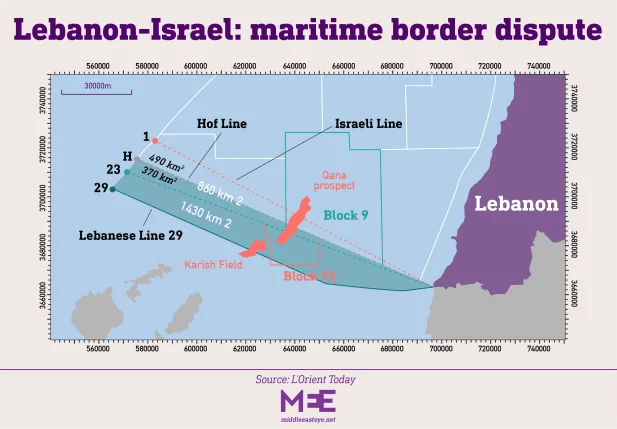
And basically, why did Hochstein come? When, a few years ago, the Americans came and established the Hof line, and then turned their backs on us for years, Lebanon stood by and waited (for an agreement on the maritime borders), while Israel explored (the maritime deposits), etc. Some (Lebanese) still tell us that Israel is exploring Karish: but my dear, the exploration in Karish is long over! They are now getting ready to extract gas from Karish. They are digging and getting ready (for extraction), while we sit around waiting for negotiations. Then Hochstein came along, and he proposed a line of demarcation. I don’t know what he called it, let’s call it the Hochstein line. He imposed it as something non-negotiable, and then turned around and ran off, telling the Lebanese officials that as soon as they had an answer, they should send it to him in writing. What brought Hochstein back for his recent visit? Two things. Let’s be specific. He did not come back for the sake of anyone in Lebanon, nor for the sake of the Lebanese State, nor for the sake of anyone else. He came for two reasons. First, the US need for oil and gas for Europe, as I just explained. Because the situation is very difficult and even critical due to the war between Russia and Ukraine, which has been pressing on their throats for several months. This is the first new point: the urgent need to get a replacement (for Russian oil and gas), and this is the point on which we can put pressure on the United States. I don’t want to describe it as a weak point, but as an urgent American-Israeli-Western need. And the second reason is the real point of strength in Lebanon: Hochstein came back because he saw the threats from Hezbollah. Listen to me: without the Resistance’s threats (to strike Karish), if there was no Resistance, if he did not know that the Resistance has drones, precision missiles, and air, sea and land (military) capabilities, if he did not know that the Resistance had the courage and audacity to threaten, act and do (what it promises), Hochstein would not have come: he would have said that he had already given us a line of demarcation, and that he was waiting for an answer (from Lebanon) that never came. This is the reason why Hochstein came because the oil and gas of Karish was threatened, and much more than that, as I will explain.
In sum, Lebanon is now facing an adversary, or rather an enemy that has a weak point, namely the pressing and urgent need for gas and oil that it wants to import from the (enemy) entity. For he cannot import oil and gas from Lebanon at the moment, but we can prevent Israel from extracting and exporting oil and gas, which is our point of strength. Lebanon’s strong point is that it has a Resistance, capable of preventing and prohibiting any extraction of gas and oil (in the Mediterranean). We are able to do this. When it goes to negotiations, like any country that goes to negotiations, Lebanon must have points of strength (to assert its rights). What are the main cards that Lebanon can play? What strengths can it bring to the table? Can it take advantage of the presence of the Arab League or the Organization of Islamic Cooperation at its side [laughs]? The UN? The Security Council? From Europe? Whose support can Lebanon claim? Lebanon, like the Syrian, Palestinian and Yemeni peoples, is left to its own devices. This is the fate of all oppressed peoples. Lebanon must therefore seek its inside strength (and not an illusory external support). The only strength of Lebanon, with which I began my remarks, is Hezbollah. It is the only one. If someone claims that there is another one, let him present it to us: we are not stubborn and are willing to learn. The only strong point in Lebanon is the Resistance and the actions of the Resistance. Even the United States is not a neutral intermediary, it is judge and jury: all it wants is an agreement that will give maximum gains to Israel at the expense of Lebanon. This is their real goal. The personality of the intermediary is not important, it is the fundamental policy of the United States that Biden has come to pursue, as he announced as soon as he arrived at the airport (in Tel Aviv). This is our only point of strength, and it is on this basis that we must move forward.
I want to address the Lebanese leaders without commenting on everything that has been said so far. I want to be constructive. Some Lebanese officials are convinced —whether they have said so publicly or not, they say it during internal meetings— they are convinced that the strength of Lebanon is the Resistance and the threats of the Resistance. Some officials may not be convinced of this, or at least they are afraid to state it clearly. I do not want to go into these details. I only want to say to the Lebanese leaders: this single strong point in your hands, use it! I say to you myself, in the name of the Resistance, use us! Instrumentalize us! Take advantage of us! As you like! When you sit down with the Americans and the Europeans, with the UN and with the whole world, tell them what you want! Insult us if you want, but don’t totally dissociate yourself from us of course. Insult us, no problem! Tell them that this group (Hezbollah) doesn’t listen to anyone, is out of control, and can lead the whole region to the abyss! Say what you want [to get Lebanon’s rights, even if you denigrate us when you recall our threats]! I invite you publicly to do so! Say it! And this is not psychological warfare. The Americans and the Israelis know that we are not waging psychological warfare on this issue, but are deadly serious. Let me give you some details about this. We are very serious. The Lebanese negotiators have one trump card to play, and that is Hezbollah. When we sent the drones over Karish, you should have said, “You see? These people are out of control and capable of anything! They don’t listen to anyone and can lead the whole region to the abyss [if they don’t get what they want]! So please, solve this problem and give Lebanon its legitimate rights!” This is what I wanted to confirm tonight.
After the episode of the drones (sent by Hezbollah over the Karish field), which I will talk about a bit, I heard some officials say that this action violates the agreement (allegedly made between Hezbollah and the government). What agreement are you talking about? Who made an agreement with whom? If someone makes agreements without our knowledge, that’s his problem. But we, Hezbollah, have not made any agreement with anyone, nor have we promised anyone that we would not do anything and that we would wait for the outcome of negotiations. Not at all. And whoever tells the Americans or anyone else that Hezbollah will do nothing, that it will not take any action, neither in the past, nor in the present, nor in the future, whoever makes such promises is deceiving his interlocutors and lying to himself, while squandering Lebanon’s interests. Instead of giving them guarantees and trying to reassure them, you have to scare them! Because this is your only strong point! It is your only card to play! If you reassure them, they will turn their heels, waste our time, and stall for these two months, just as they have been laughing at you for a year with their promises of Egyptian gas and Jordanian electricity. On the contrary, we must not only scare them, but even make them shake with terror!
Secondly, some have asked how Hezbollah can take the initiative to send drones when it claims to stand behind the State? You have misunderstood us, my dear! We are behind the State in the demarcation of the maritime borders! This is a matter in which we do not want to interfere. This does not mean that if the State accepts such and such a demarcation line, we will also sign, no! We do not interfere in any way. We are neither with nor against. We do not want to participate in the demarcation of maritime borders, as I have already explained in the past, and I do not want to explain it again. We do not participate in it for reasons of principle, ideology, culture, morality and tactics. When we say that we are behind the State on the issue of the maritime borders, it means that we do not want to interfere in this issue. When we say we are behind the State, it means that it is the Lebanese State that is negotiating the borders, not us. Many have claimed that Hezbollah has intervened in the negotiations, and opened channels for negotiations, but these are baseless lies. We are not involved in any way. But we have never said that we [fail to] stand behind the State in terms of putting pressure on the enemy, in terms of initiatives that can serve the negotiations, etc. We have never said anything of the sort, on the contrary: we have said the opposite! I made it clear that we would not stand idly by! That is what I said. Don’t misunderstand: we have not made any commitments to anyone and will not make any commitments to anyone. We are following what is going on, and we have the right to carry out any action at any time that we deem appropriate, of the appropriate scale and in the appropriate manner to put pressure on the enemy in the interest of the negotiations and the Lebanese negotiators. Let this be clear, both for the past and for the future.
It is on this basis that we took the initiative to send the drones (over the Israeli gas platform of Karish). The goal was to gain time! There has been an (American-Israeli) response, which Lebanese officials are evaluating in different ways. There is no doubt that there is a positive step forward, I say this to be honest and factual, but it is not enough, because even what the Lebanese State asks for is not granted. We in Hezbollah are not asking for anything, because I have said that we do not interfere in this issue. They told Lebanon to wait until September. But it will be too late. And therein lies the American duplicity. That is the American duplicity. And that’s when the drones came in, the day after the response in which the duplicity and the delaying tactics were obvious: it was clear that they were fooling us. And we don’t want to be fooled. So we launched the drones, and I’m going to expand a little bit on the military aspect of this. As the Resistance statement said, we sent out 3 drones of different sizes, and unarmed. Of course, we purposely did not arm them. Even when we were discussing this decision with the brothers, we agreed that our goal was for Israel to shoot down these drones. And despite that, Israel had a hard time shooting them down, first sending in planes and then bringing in the navy, Barak (sea-to-air) missiles, etc. These are details, but I explain to you what our intention was, and this will also benefit Israel in the future. Our brothers told us that they were perfectly able to send a drone (over Karish) that would collect intelligence and return (unharmed). But we unanimously said that we wanted the drone to go over there, collect intelligence and then be shot down by Israel. Why did we want this? Because we wanted the warplanes to fire missiles. Quite frankly. We wanted warships to fire sea-to-air missiles. We wanted fire and explosions in that area, on their side, so that the ship, the engineers, the (Israeli and foreign) employees (on the Greek gas platform Energean) and everyone else knows that they are in a dangerous area, facing a real and serious threat (to their lives).
If we had sent only one drone that would have collected intelligence there and returned, we would have issued a statement to that effect, saying that a drone flew over Karish and returned unharmed with the sought-after information, but maybe some would have believed us, and others would not. But the important and undeniable event is that the drones went there and were shot down, and that Israel was forced to hit them with missiles and speak out about it. That’s why Israel spoke before us, we were waiting to see what they would say. And we sent 3 drones on purpose to make the incident more prominent, because one drone would not have made so much noise. By the way, this was the first time in the history of the Israeli entity that 3 drones were sent simultaneously. As for sending a single drone, Hezbollah has been doing this for a long time (the first known drone, named “Ayoub,” was launched over Israel in 2012) and continues to do so to this day, with Israel sometimes intercepting them. Gaza has also sent drones over occupied Palestine. Iran has also sent them once or twice, and so has Syria. But each time, the drones were sent one by one. This is the first time that 3 drones were sent simultaneously to the same target. So that’s the whole story. I should point out that we are able to send a very large number of drones simultaneously. We can send them armed or unarmed, with different types of weapons, different sizes, etc. We are capable of all of that, with God’s help. We don’t have any problem with that. We sent 3 not because we were unable to send 5 (or more), but because 3 were enough for the message we wanted to send. And we were ready for anything, depending on the reaction of Israel, we were ready to face any retaliation.
In sending these drones, our goal… There were military, security, tactical objectives, which I don’t want to talk about, but we wanted to send a message to the enemy and to the whole world. If anyone thinks (that we are bluffing)… And I say this to the Americans, because in Lebanon (and especially in the American Embassy), some stupid advisors may claim that (we are bluffing). Some may (reassure Israel and the United States) that there is nothing to fear because the situation in Lebanon is very difficult, people are choking (because of the crisis, hyperinflation and shortages), and that Hezbollah can talk and threaten, but it is only empty words, and Hezbollah will not do anything. We have read many statements, communiqués, discussions and interventions in this vein. It’s said on TV, then it’s repeated at the U.S. Embassy, and maybe the (US) officials will be fooled. But with the 3 drones, the message was clear, and it was received loud and clear. The message was clearly that we are serious, that we see this as a crucial issue, that we are not waging psychological warfare, and that we are taking actions in a progressive way (more and more serious), and we will do whatever is necessary without any hesitation. This message was well understood by Israel and the United States. Whether some Lebanese commentators have understood it or not is the least of our worries. What matters is that the enemy gets this message, because it is addressed to him in the first place. Secondly, this message is addressed to our friends, so that they know that they are in a strong position, that they do not have to be afraid or tremble. This message has been well received, and the proof is that there has been no reaction from Israel on the ground, despite the (blatant) violation of the entity’s airspace. For the issue of oil and gas is very sensitive and pressing for the Israelis, the Americans and the Europeans. And the second proof is the internal contacts that were established, and the messages that were transmitted to the Lebanese State and also to us (Hezbollah) after the drone operation. All this confirms that the message was well received and well understood.
What will happen now? I must also say two words clearly for the future. In terms of our (military) capability, the enemy must know, and they know it well, but I say this to reassure and help our friends, that our capability is multiple. By the Israelis’ own admission, they were taken aback by the drones, and had difficulty shooting them down. But we have a variety of options (to strike Karish): we have air options, sea options, and land options. All of these capabilities are effective and on the table. Playing the delaying game will not help (with us). We are capable of doing anything that will serve our cause, and we will do it every time with the right scale, at the right time and in the right way. And I repeat, Lebanon can boast of a real deterrent power (Hezbollah) capable of preventing (the extraction of Karish gas), whose existence and threats (it poses to the enemy) it must take advantage of, as well as its actions if necessary.
In this power, in these negotiations, in this issue, there are two issues (which I will clarify) so that people do not misunderstand what position to take towards them. The first issue is Lebanon’s maritime borders, on which the State is negotiating. It is expected that they will reach a result, which will be recognized by the United States and the UN. This is a first issue. But it is not enough on its own. I want to remind you that for the Israeli invasions of 1978 and 1982, the borders of Lebanon were not disputed: they were internationally recognized, by the UN and whatever you want (but it didn’t prevent Israel from invading). It is not enough to have international recognition for our maritime border and our exclusive economic zone. That is not enough. The second issue is the (American) permission that must be given to foreign companies like TOTAL, which have committed themselves to come and explore and extract Lebanese hydrocarbons. Without this, what will we have gained? If we are told that these are our maritime borders, but the American veto continues to prohibit us from exploring and extracting our resources for 10 or 20 years, we will only have a right on paper, and the maritime oil and gas will be plundered (by Israel). So the two issues must be linked and resolved together. It is not enough to be told “Here are your borders” and to forbid TOTAL and any other company in the world to come and prospect or extract Lebanese hydrocarbons. We would have gained nothing, and it would be a mockery of the world and of ourselves to claim the contrary. The (Lebanese) State would have achieved success only on paper, without it being translated into facts. Therefore, the choice that Lebanon has is to apply pressure. We must apply pressure. We must apply pressure. It is our fate that is at stake. I will now express the core of my statement and our position. This is a vital issue for us.
I want to tell our enemies and friends that we are not waging psychological warfare on this issue. We will not just talk, express our opinion and bade farewell, certainly not. We are very serious. In our eyes, this is the only way to save Lebanon as a nation, as a State with its institutions that is threatened with collapse, as a people, its present and its future. We are talking about an operation of salvation. Perhaps tomorrow someone will react to my words by saying that I am ruining the whole process of border demarcation. Someone will ask me if I want to lead the country to war. But if we continue like this, Lebanon is heading for a situation worse than war! A situation much worse than war! Just for once, let us Lebanese try to be brave, to stand up as one man and have one strong and courageous stand against the Americans and the Israelis, without evasion, without pretence and without misreading. Someone will claim that all this is aimed at influencing the negotiations on the Iranian nuclear issue. Since 1982, we have been hearing about Iran, Syria, etc. (to present Hezbollah as a mere satellite of Tehran or Damascus), but this is just empty talk. This has nothing to do with the Iranian nuclear issue, as the US itself has acknowledged. So let’s aim at achieving our goal (getting Lebanon’s maritime rights and saving the country), why would the Iranian nuclear issue matter to us? If we stand up as one to the Americans, both at the level of the (Lebanese) State, the people and the Resistance, and say to them, “If you do not give us the rights claimed by the State, and not by Hezbollah, and if you do not allow the companies to come and extract (our hydrocarbons), we will all cause (a terrible war) in the region. We may turn the tables on the whole world.”
There are people who want the Lebanese people to starve and kill each other in front of bakeries, gas stations, and kill each other for a bite to eat, because the Lebanese pound is worthless, as are salaries. There are people who want to destroy this country. But no (we won’t let them)! I say tonight in all frankness, if the choice is that Lebanon should not be helped —and the natural way to help it is its wealth in hydrocarbons—, and that Lebanon should be pushed towards collapse, starvation, the people killing each other, no, no, no, no (we will never allow it). War is more dignified, much more dignified. Whether it is the threat of war, or even the actual war! It is much more dignified and much more noble! The first way, which is to let things continue towards collapse, anarchy and people killing each other because of hunger, has no horizon. It has no way out. But war has a horizon. If we decide to go to war, there is a way out. It can make the enemy submit (to our demands). Maybe he will submit before the war, maybe he will submit at the beginning of the war, maybe in the middle, maybe at the end! He will submit and we will impose our conditions, and we will earn hundreds of billions of dollars (by selling our hydrocarbons), which will save the country! And whoever dies in such a war will die a martyr. It is better than dying because of a fight at the bakery, at the gas station, in a robbery or whatever. Let’s talk about it seriously. I know that tonight many voices will be raised (to denounce my speech), but I am speaking frankly.
And we have learned from experience… We hope that the national position of Lebanon will be strong and unanimous. But it is obvious that we do not expect unanimity. From 1982 to 2000, the experience of the Resistance, the parties of the Resistance and the factions of the Lebanese Resistance all declare that if we had waited for national unanimity (to fight the invader), Lebanon would still be occupied by Israel, and there would be settlements in the South, in the Western Bekaa, in Rachayya and in many other places. Lebanon would have been swallowed by Israel. We will not wait for unanimity, and we will not abandon the State. We cannot leave the State alone in such a difficult and sensitive matter.
That is why I say to the enemy tonight: let him not make a mistake in his calculations. Let the Americans and Hochstein not trick the Lebanese and try to deceive them. The Lebanese will not be fooled. The drone message is only a beginning, a modest beginning (which gives only a small glimpse) of all that we can do. If things go wrong, we will not just target Karish. We are on the anniversary of the 2006 war, so record the new equation: Karish, beyond Karish and far beyond Karish [referring to the 2006 equation promising to strike “Haifa, beyond Haifa and far beyond Haifa”]. Today, I asked the brothers concerned in Hezbollah to present me with a list of everything that is facing the Palestinian coast. We count and follow closely (the activity of) all the (oil and gas) fields, all the oil wells, all the maritime platforms, whose names we know, as well as their activity, those with operational status or not, those who are still in the exploration phase, etc. All these details are in our possession. All these details are in our possession. If you want to continue to choke Lebanon, I am not just talking about the Karish equation: the issue is much broader for us. If you want to continue to impose the equation that Lebanon is forbidden to save itself by exploiting its natural gas and oil resources, no one will be able to extract gas or oil, and no one will be able to sell gas or oil. Do you understand? Do you understand or shall I repeat myself, as they say? And this regardless of the consequences.
O Lebanese people, we have reached the end of the road. We have reached the end of the road. Whoever promises you something else, let him explain what he is promising (to save Lebanon). What is he promising? Who is going to save Lebanon? They don’t even want to give you an (extra) hour of electricity! When a simple signature of the Americans would be enough, they have nothing else to do and would not lose a penny. But they want this country to collapse, to starve, to give in and give up its rights, to be their slave. But this is impossible. Whoever wants to be a slave, good for him. But it is not for him who wants to be free to give in. In any people, in any country, in any nation, in any State, people must fundamentally have sovereignty, freedom, independence, they must enjoy their natural resources that will save their people from ignorance, illiteracy, disease, hunger… This is the situation we are in today.
In the days to come, and while Biden is present in the region —it is said that Hochstein is also present with him—, and (Israeli War Minister) Gantz said “We don’t want war, and we are ready to go very far in the way of peace and to reach an agreement about the maritime border between us and Lebanon which must be agreed upon quickly.” I exhort you (O Lebanese leaders), talk to them, let them not stall and laugh at you and fool the Lebanese. No one will laugh at us, and we will not allow anyone to fool us.
I wanted to talk about other points, such as the economic and social situation, the bread, the government, but I have already gone on too long, and I will do so in a future speech.
May God’s peace be upon you, as well as His mercy and blessings.
Israeli Generals Urge Political Command to Make Concessions to Lebanon in Maritime Conflict to Avoid Hezbollah War
Al-Manar – July 15, 2022
In light of the threats made by Hezbollah Secretary General Sayyed Hasan Nasrallah over the Zionist infringement on the Lebanese maritime borders, the Israeli media reflected calls on the government to eliminate Hezbollah pretexts to escalate the confrontation.
The US officials accompanying President Joe Biden during his visit to the occupied Palestinian territories stressed that they support the efforts exerted to reach a solution.
In this regard, the US National Security Council spokesman John Kirby said, “We listened to the ‘threats’, and we support reaching a solution.”
The US mediator, Amos Hochestein, told the Israeli media that he was still optimistic about achieving a solution, adding that his target concentrates on facilitating the negotiations.
Hochestein also revealed that he would visit Lebanon to meet the senior officials in the context of resuming the negotiations soon.
Meanwhile, the Zionist media reflected the Israeli circles frustration with Biden’s remarks which did not voice a clear support to ‘Israel’ pertaining the maritime border demarcation.
The Israeli army generals urged the Zionist government to avoid any escalation with Hezbollah by making concessions to Lebanon in the negotiations in order to avoid any military escalation with Hezbollah.
Sayyed Nasrallah warned on Wednesday the Israeli enemy and the United States that if Lebanon is prevented from extracting its maritime resources, none will be able to extract or sell gas and oil.
In a televised speech, Sayyed Nasrallah indicated that Hezbollah military forces are monitoring all the Zionist platforms across the occupied Palestinian coast, adding that the Resistance may resort to ground, maritime or air capabilities in order to attack the enemy and secure Lebanon’s rights.
According to Sayyed Nasrallah, the new equation is Karish, what’s beyond Karish and what’s far beyond Karish.
‘Israel’ Continues Exploring Disputed Maritime Zones, US Mediator Insolently Says Lebanon Cannot Restore Rights
Al-Manar – June 14, 2022
In light of the ongoing dispute between Lebanon and the Zionist entity over the maritime border demarcation, the US mediator, Amos Hochstein, visited Lebanon and met with the senior officials.
The Lebanese officials voiced a united stance on the demarcation issue, underlining the Lebanese rights in this regard.
However, the insolent mediator said, during an interview with Al-Hurra News Channel, that Lebanon will not be able to obtain its rights, adding that the issue would be complicated.
Hochstein expressed satisfaction with what he heard from Lebanese officials in his meetings with them on Tuesday, adding that this will enable the sea border negotiations with Israel to “go forward.”
“The good news is that I heard a lot more unanimity, a lot more unity of message (and) serious preparation for the visit,” Hochstein said.
“They shared some ideas of how to continue the negotiations, the basis for which to continue the negotiations and to take it a step forward,” he added.
In an article published last October, Al-Akhbar Lebanese daily described the US envoy as “an Israeli-born who served with the Israeli occupation army, killed the people of this land (Lebanon) and now acts in Beirut as a man on a spy mission in favor of his “homeland” (the Zionist entity).”
The Greek firm Energean’s FPSO arrived on June 6 near the disputed maritime zone, knowing that Energean signed in 2018 an agreement with the Zionist entity to drill and extract gas and oil in occupied Palestine’s offshore, and the disputed field of Karish.
Hezbollah: US First Side to Blame for Preventing Lebanon from Gas Drilling
Al-Manar – June 6, 2022
Head of Hezbollah’s Executive Council Sayyed Hashem Safieddine stressed on Sunday that the United States is the first side to blame for preventing Lebanon from gas drilling.
In a local ceremony in south Lebanon, Sayyed Safieddine said “Lebanon has potentials to extract gas and oil off its shores,” calling on the Lebanese state not to subdue to all forms of pressures exerted by foreign sides in this regards.
The Hezbollah official called on the Lebanese state to officially announce the Lebanese maritime borders and the disputed areas, “in order for the Resistance, Army and People to throng together and retrieve Lebanon’s rights regardless of the US stance.”
Sayyed Safieddine in this regard, stressed the importance of Lebanese unity in order to cope with the country’s political and economic crises.
“Resistance is the only choice to defend Lebanon’s wealth and preserve our victories,” he said in remarks carried by Al-Manar.
Lebanon warns Israel
Samizdat | June 5, 2022
A battle over Mediterranean waters rich in natural gas deposits bubbled up on Sunday when Lebanese President Michel Aoun warned Israel that trying to tap the offshore riches without first resolving a territorial dispute would be seen as a “provocation.”
“Any action or activity in the disputed area represents a provocation and an aggressive action,” Aoun said on Sunday in a statement. He made his comments after a floating production storage and offloading (FPSO) vessel arrived in the disputed area, where London-based upstream firm Energean plans to start pumping gas from the Karish field under contract with the Israeli government later this year.
Aoun said he discussed the FPSO’s arrival with Prime Minister Najib Mikati and asked Lebanon’s Army Command to provide him “accurate and official data to build upon the matter.” Mikati called the situation “extremely dangerous,” saying Israel was trying to “create a new crisis, encroaching on Lebanon’s maritime wealth and imposing a fait accompli in a disputed area.”
Karish is located about 90km west of Haifa, close to the much larger gas fields of Leviathan and Tamar, and it holds reserves estimated at more than 300 million barrels of oil equivalent. Energean signed a contract in March to sell output from Karish to Israel Electric Co., the largest Israeli gas buyer.
Jerusalem has claimed that Karish is located in Israel’s exclusive economic zone, as recognized by the United Nations, and isn’t subject to the country’s territorial dispute with Lebanon. Aoun said negotiations to resolve the issue are continuing, and both countries have filed disputes with the UN regarding their overlapping maritime claims.
Lebanon’s Hezbollah militant group has threatened to take action if Israel extracts fossil fuels in the disputed area without resolving the territorial impasse.
Nasrallah: Those pushing for disarmament of Hezbollah want to sell Lebanon to US

Press TV – May 9, 2022
The secretary general of the Lebanese Hezbollah resistance movement, Sayyed Hassan Nasrallah, speaks in a televised speech broadcast live from the Lebanese capital city of Beirut on May 9, 2022.
The secretary-general of the Lebanese Hezbollah resistance movement has denounced calls by some political parties for the disarmament of the movement in the run-up to next week’s parliamentary elections, saying the demand comes amid those parties’ utter disregard for the worsening economic crisis in the country.
“I want the entire Lebanese nation to know that those who are calling for the disarmament of the resistance are unaware of what the southerners went through since 1948,” Sayyed Hassan Nasrallah said in a televised speech broadcast live from the Lebanese capital city of Beirut on Monday evening.
“Some political forces have unfortunately turned Hezbollah’s disarmament into the main topic of their electoral campaigns,” Nasrallah said, stressing that the parties that are “pushing for the handover of Hezbollah’s weapons want to sell Lebanon to US and make it susceptible in face of Israel.”
“Those who are calling for Hezbollah’s disarmament disregard its achievements as to liberation of the occupied Lebanese territories and freedom of prisoners” from Israeli detention centers, Nasrallah said.
“Does Israel dare bomb any area in Lebanon today?” Nasrallah asked, attributing the deterrence to the presence of Hezbollah forces.
“We respect the army. It has a national creed as well as competent officers and soldiers. The Lebanese army, however, cannot shoulder the responsibility on its own at the moment, and cannot confront the Israeli enemy alone,” the Hezbollah leader said.
Nasrallah went on to emphasize that his movement is ready to discuss a national defense strategy, because it has “reason and evidence.”
He added that those making demands for Hezbollah’s disarmament have not yet offered “an alternative” in the face of Israeli acts of aggression.
“Who will protect southern Lebanon if the resistance abandons its duties? Hezbollah is the strong force protecting Lebanon today,” Nasrallah said.
He went on to lament that some Lebanese politicians “do not view Israel as an enemy” and do not believe that “the regime has ambitious plans for Lebanon’s territorial waters and gas reserves.”
Nasrallah highlighted that the May 15 parliamentary elections will be a “political war” and that Hezbollah “will practice political resistance in the polls.”
“Those who want to defend Lebanon, extract its oil resources and protect its waters must vote for the resistance and its allies,” he pointed out.
“Some people are saying that they won’t vote for the resistance due to the economic crisis. We tell that the resistance will guarantee extraction of natural gas and crude oil from Lebanon’s territorial waters in order to resolve the crisis,” Nasrallah added.
“Hundreds of billions of dollars are present in our waters,” Nasrallah said of Lebanon’s potential oil and gas reserves.
The Ansarullah chief went on to call on the Lebanese government to start investment in the country’s offshore oil reserves.
Nasrallah said the United States wants Lebanon to recognize Israel, and naturalize the Palestinian and Syrian refugees.
He finally made a reference to the Israeli military’s drills near the border with Lebanon, emphasizing that Hezbollah resistance fighters will not hesitate to respond to any aggression against their homeland.
“We are not afraid of your drills and your deployment. We are the ones who coined the expression ‘Israel is weaker than a spider web’ more than 20 years ago,” Nasrallah concluded.
Leaked files expose Britain’s covert infiltration of Palestinian refugee camps
By Kit Klarenberg | The Cradle | April 13 2022
In February, Lebanese journalist Mohammed Shoaib was arrested on suspicion of collusion with Israel’s Mossad spy agency. The writer who worked for Al-Jaras, confessed that the notorious spy agency secretly paid him to author “dozens” of anti-Hezbollah articles, receiving a paltry $30 to $70 per article.
In particular, Shoaib was tasked with writing hit jobs on the “Iranian occupation” of Lebanon, and falsely linking Hezbollah with the August 2020 Beirut port blast, drug trafficking, and murder of political activists.
It is also alleged that Mossad specifically requested his work incite hostility towards Palestinian refugees in the country who number almost 300,000. In all, Lebanon hosts more than 1.7 million refugees and has the largest per capita population of refugees in the world.
Roughly half inhabit camps administered by the United Nations Relief and Works Agency (UNRWA), where they endure abysmal living conditions, overcrowding, poverty, unemployment, lack of access to justice, and other unspeakable hardships. The 11-year, foreign-backed crisis in neighboring Syria has also prompted Palestinian refugees there – and Syrian citizens – to seek sanctuary in Lebanon.
Given Israel’s track record of multifaceted crimes against the Palestinian people, that they are targeting an already vulnerable refugee population for propaganda purposes is hardly surprising. Nonetheless, Israel is not the only hostile foreign country resorting to these tactics.
Leaked files reviewed by The Cradle reveal the British Foreign Office has for many years secretly meddled in Lebanon’s refugee camps, courtesy of ARK, a shadowy intelligence cutout run by probable MI6 operative Alistair Harris. London’s agenda is rather different than Tel Aviv’s, however – it seeks to subtly stir up revolutionary fervor, and exploit them as unwitting foot soldiers in its ongoing clandestine war against Lebanon’s ruling elite.
‘Community Engagement’
The documents indicate ARK has been operating in all 12 camps since 2009, implementing British-funded “programming” of various kinds. This experience has granted the company “granular understanding” of their internal political, economic, ideological, religious and practical dynamics, and led to the establishment of a “diverse delivery team” and array of “local contacts” with “access throughout all camps and gatherings,” meaning community-level discussions and activities of residents can be spied upon and influenced.
This intimate, insidious insight is reinforced by “daily monitoring of neighborhood-level WhatsApp groups,” with “any new information, such as affiliation between a local group and a faction, or conflict between factions” documented by ARK’s in-house “stakeholder tracker.”
Typically, ARK has engaged in small-scale initiatives in the camps, including the restoration of streets and cemeteries, recycling initiatives, assisting in the launch of small businesses, providing income to disadvantaged and disabled residents, creating nurseries and daycare centers, and even launching a community hub, Sawa Coffeeshop. It serves to this day as “a popular place for youth to gather and promote civic engagement in their community and a shared Palestinian identity that bridges factional differences.”
In submissions to the Foreign Office dating to May 2019, ARK proposed ramping up these activities significantly. It pledged to create “Community Leadership Committees” in each camp, composed of hand-picked “stakeholders” – including NGOs, youth activists, women’s organizations, and representatives of neighborhood armed groups – to identify “quick impact projects” that could be implemented therein. These projects aim to “counter threats to social stability in the camps, create or improve livelihood opportunities, and provide better access to services.”
A social media platform created by ARK, Nastopia – which boasted 20,000 “highly invested” followers on Facebook at the time, a figure that has almost doubled since – was forecast to be fundamental to these efforts.
The page, run by a 24-strong team of ARK-trained “youth reporters”, would be used to recruit local participants, increase awareness and demand for “community engagement and improved conditions” among camp residents. Other activities include the promotion of Foreign Office-financed projects and to publicize “success stories” generated by them, while “promoting Palestinian culture and a sense of belonging, and tackling social injustice.”
Nastopia was “already [an] effective voice for connecting Palestinian communities, particularly youth” by that point. ARK cited a recent “Camps Films Festival” organized by the platform, covered by Al-Jazeera, which showcased “films portraying life in the camps and what it means to be Palestinian,” and in the process provided “positive examples of a shared identity.”
All along, the Nastopia page was to be monitored with “community feedback” on the assorted initiatives gauged to identify areas in which these activities “could be adapted to maximize impact.” Specialist training provided to its staff meant the platform could also serve “as a forum for online and offline discussion about social injustices [and] virtual space to talk about topics considered taboo in the camps,” allowing ARK to burrow even deeper inside the heads of refugees.
‘Active Citizenship’
If the obvious surveillance and manipulation dimensions of ARK’s project weren’t troubling enough, it takes on an acutely sinister character when one considers a key objective of “highlighting successful initiatives” in the camps was to “[enhance] the audience’s confidence in their own ability to contribute to social change.”
A Foreign Office-commissioned Target Audience Analysis conducted by ARK in March 2019 sought to pinpoint a segment of Lebanon’s population that could be mobilized to “affect positive social change,” and methods by which tensions between sectarian communities could be reduced, in order to unify them in opposition to the country’s ruling elite. Reading between the lines, it gives every appearance of a blueprint for the overthrow of the Lebanese government.
An ideal audience was duly identified, representing 12 percent of the population, who disavowed violence but did not reject “other forms of contentious politics,” and could be “influenced” to engage in “behaviors leading to positive social change,” such as protests and community initiatives.
The only questions for ARK were: “What might be done to enable other Lebanese to have similar confidence in their potential to contribute to positive social change?” and “how might this segment of the population … be grown to include a larger fraction of the public?”
The answer, ARK proposed, was to both covertly and overtly promote the message that “change is possible and ordinary citizens have a role to play in achieving change,” by way of propaganda campaigns and civil society initiatives “[highlighting] where change has been achieved or where threats to Lebanon’s stability have been countered.” This would demonstrate to the country’s diverse population that “barriers” to reform can be overcome, by taking matters into their own hands.
Providing evidence of “responsive government at local levels” was crucial for reinforcing “principles of active citizenship” among Lebanon’s population – and the analysis specifically cited Syrians and Palestinians, who are mostly Sunni Muslims, as representing an “important part” of the country’s demography, to be motivated in this manner.
In other words, Foreign Office activities in the refugee camps form just one fragment of a wider, clandestine, multi-channel assault on public perceptions in Lebanon that Britain has been waging against its democratically-elected government.
A mobilized force
One can judge these efforts by their fruits. In October 2019, seven months after ARK’s Target Audience Analysis was supplied to the Foreign Office, large-scale protests engulfed the streets of Beirut, which have ebbed and flowed ever since, and generated enormous amounts of western media coverage along the way.
The extent to which ARK’s Foreign Office-funded meddling in Lebanon influenced this incendiary unrest may never be fully quantifiable, but it may be significant that in July that year, thousands of refugees across several camps began demonstrating in unison, demanding the government immediately reform employment laws barring them as “foreign workers” from numerous professions.
This turmoil was arguably the spark that ignited the entire “October Revolution” – and in one of its Foreign Office submissions, ARK refers to how it “takes pride” in ensuring refugees recruited to its illicit schemes receive “annual leave, sick leave, and health insurance,” despite this not being “legally necessary” due to local legislation “discriminating against Palestinians.”
Who benefits?
The influence of ARK on Lebanon’s impending general election in May, the country’s first since the riots began, is even more unambiguous. Several news outlets have hailed the unprecedentedly high profusion of young candidates vying for office – 80 in total, many of them women.
A clandestine Foreign Office project influenced by the aforementioned Target Audience Analysis sought to enlist Lebanese youth as “agents of change”, fostering among them a culture of active political participation, in order that they could better “hold political institutions and individuals accountable,” and increase “electoral participation” in favor of opposition parties.
Under its auspices, ARK convened “boot camps” in “priority areas” of Lebanon, cultivated “a national group capable of pushing for greater change” composed of young women, and created social media assets and youth-focused websites featuring political interviews, question-and-answer sessions, coverage of boot camp meetings, “calls to action,” and “humorous messaging campaigns.” Activity on these assets was scheduled to ramp up ahead of the 2022 elections.
Clearly, irrespective of the outcome of the Lebanon May elections, the ultimate victors won’t be the parties and candidates that secure office, or the average Lebanese citizens who elected them, but Britain – for whatever form the next government takes, one way or another, it will serve London’s financial, ideological, military, and political interests.
Israel offers Arab state the opportunity to tackle Iran together
RT | February 15, 2022
Since Israel and Bahrain both view Iran as a threat, they could team up and counter Tehran together, Israeli prime minister Naftali Bennett said on his landmark visit to the Gulf monarchy.
“We will fight Iran and its followers in the region night and day. We will aid our friends in strengthening peace, security, and stability, whenever we are asked to do so,” Bennett pledged in an interview with the Bahraini state-linked Al-Ayyam outlet on Tuesday.
The PM blamed Tehran of striving to “destroy moderate states” in the Gulf region in order to replace them with “bloodthirsty terrorist groups.”
When asked about the possibility of creating an alliance to resist Iranian influence, which could include Israel, Bahrain, and some other Arab nations, he gave a positive response: “We all understand that we face the same challenges, so why not work together to tackle them?”
Bennet, who became the first Israeli prime minister ever to visit Bahrain, assured the journalists that “Israel is a strong and reliable country.”
The idea of such a block was first floated by Israeli general Tal Kelman last year. According to Kelman, who heads the IDF’s Strategy and Third Circle Directorate, “the moderate axis” of Israel, Bahrain, the UAE, Jordan, Egypt and others should resist “the radical axis” of Iran and what he called its “proxies” in Lebanon, Syria, Yemen, and Iraq.
Israel and Bahrain normalized relations in late 2020 as part of the so-called Abraham Accords, a US-backed drive to improve ties between the Jewish state and some Arab countries after decades of strife.
Bahrain is a small island nation of around 1.5 million. The majority of its population is Shia Muslims, but the country is being run by a Sunni monarchy. The rulers in Manama have been concerned by Tehran’s activities as Iran, which is located less than 800 kilometers (497 miles) away, often faces accusations from its rivals of supporting Shia groups in other countries.
Threat of War between Syria and Israel is getting More Real
By Vladimir Platov – New Eastern Outlook – 14.02.2022
On February 9, Israel launched yet another series of strikes on targets near Damascus, which resulted in one Syrian killed and five injured, which has aggravated the threat of war between Syria and Israel.
According to the Syrian Arab News Agency (SANA), on February 9, four Israeli F-16s, without crossing the state border of Syria, launched another guided missile attack on facilities near Al-Kiswah, a village south of Damascus. One of the anti-aircraft missiles of the Syrian army exploded over the occupied Golan Heights, after which the IDF fired from the area occupied by Israeli troops in the Syrian Golan Heights ten surface-to-surface missiles at the positions of the Syrian air defense forces. Some missiles were brought down by Syrian air defenses. Nevertheless, the attack still caused significant damage to some buildings in the city of Qudsaya, destroying dozens of houses and cars. To repel the attack, Syrian troops utilized Russian-made air defense systems, which shot down eight missiles.
According to an IDF statement, in response to an intercepted missile fired from Syria into northern Israel, Israel attacked targets in Syria, including the “Syrian radar and anti-aircraft batteries that launched missiles at Israeli Air Force aircraft.” However, it is obvious that the missile chosen by the IDF as the reason for retaliation was the anti-aircraft missile that exploded in the air and was launched by Syrian air defenses as a measure of protection against earlier Israeli missile attacks launched from Lebanon.
In the message the Syrian Foreign Ministry sent to the UN Security Council regarding the aforementioned act of aggression by Tel Aviv, the Syrian government denounces the dangerous consequences the Israeli attacks on the SAR territory may have for stability in the Middle East and the entire world. “Syria reserves the right to use all legal means to respond to the treacherous strikes carried out by Israel on the outskirts of Damascus from Lebanese airspace and from the occupied Golan Heights,” the document says. The Syrian Foreign Ministry drew attention to the fact that “the United States, which patronizes Israel, encourages it to continue attacks and paralyzes possible measures by the UN Security Council to deter the aggressor, which undermines the prestige of the international community.”
Initially, Israel planned to launch two strikes simultaneously on February 9 – one on the outskirts of Damascus, and the other on Latakia. However, after encountering two Su-35s scrambled in response, the IAF fighters flew back without attacking the Syrian port. At the same time, almost all of the missiles allegedly aimed at Iranian facilities in the Rif Dimashq Governorate were shot down by Russian-made Syrian air defense systems. The attack was carried out from Lebanese airspace, which is another gross violation of international law.
Israeli Air Force regularly strikes targets in Syria without entering the airspace of the Arab Republic, and mainly operates from the airspace of Lebanon – in violation of international norms, or from the Mediterranean Sea. Since 2013, the IDF has been carrying out hundreds of airstrikes on the territory of a neighboring country primarily targeting pro-Iranian forces in the SAR. This year, there have already been two such attacks by Israel. The first one was took place on January 31 at targets near Damascus, namely Hezbollah facilities and warehouses in the vicinity of Al-Qutayfah. In 2021, there were 55 attacks:
– 3 missile strikes in December (on December 7, 16 and 28, mainly in the area of the port of Latakia, one Syrian soldier was killed, and significant damage was caused). It is noteworthy that on December 28, not for the first time, two F-16s of the Israeli Air Force launched four guided missiles at facilities on the territory of the port of Latakia without crossing the Syrian border (from the Mediterranean Sea). The Syrian air defense forces did not engage in a battle to repel the IAF raid on the port of Latakia, since a landing Russian Air Force transport plane could be in the affected area;
– 4 missile strikes in November (on November 3, 8, 17 and 28, mainly on targets near the city of Homs, which resulted in four people killed, including two civilians, several people wounded and significant material damage);
– 4 missile strikes in October (on October 8, 13, 25 and 30, strikes were carried out on the outskirts of Damascus, the outskirts of al-Ba’ath and the village of Al-Krum in the Quneitra Governorate in southern Syria, and the city of Abu Kamal, as a result of which more than ten Hezbollah militants and a Syrian soldier were killed, and significant damage was caused);
– 3 missile strikes in September (on September 3, 14 and 27, South from the village of Mayadin in the Deir ez-Zor Governorate in Eastern Syria, near the Iraqi border, with many people being wounded);
– 2 missile strikes in August (on August 17 and 19); 3 missile attacks from May to July (on May 5, June 8 and July 19); 9 missile strikes from January to April, with dozens of people dead and wounded;
– 39 missile attacks and air raids were carried out in 2020.
Israel explains its attacks with the desire to prevent modern weapons from falling into the hands of it enemies. Enemy No. 1 in this regard is the Lebanese Hezbollah movement, which is fighting on the side of Syrian President Bashar al-Assad and is controlled by Tehran. After the first Israeli airstrikes, Moscow invited all interested parties to meet and talk about disentangling their interests in order to avoid armed conflicts and civilian casualties. However, these calls of Russia have not been heeded.
Israel, despite repeated statements by official Syrian authorities to the UN, continues regular airstrikes on Syrian civilian targets, using, among other things, provocative air attacks by its fighters “under the cover” of civilian aircraft. Thus, in addition to the attack of December 28, on the night of October 13, 2021, four IAF F-16s once again entered the Syrian airspace in the area of the US-occupied Al-Tanf zone in the Homs Governorate and, under the cover of civilian aircraft flying at the same time, carried out an airstrike on a phosphate ore processing plant in the Palmyra area. It is noteworthy that this is not the first time such air attacks have been carried out from the area of the US-occupied zone in the Homs Governorate, which clearly indicates the coordinated actions of the IAF with the US military.
Such provocative tactics of the Israeli Air Force can lead to a serious aggravation of the situation, and it will by the IAF’s fault if the Syrian air defenses in their anti-missile actions shoot down a civilian aircraft of any country, under whose cover Tel Aviv carries out its airstrikes. And such an incident has already occurred in 2018 when Israeli planes bombed Syria from the air zone where the Russian reconnaissance plane was located, and the Syrian air defense shot down this plane by mistake. Russian service members were killed and a big scandal broke out, which was extinguished, and an armed conflict with Israel prevented, only thanks to complex diplomatic efforts.
The Syrian leadership has repeatedly demanded that the UN Security Council put pressure on Israel to stop attacks on the territory of the republic, since such actions violate its sovereignty and lead to increasing tensions in the region. The Syrian Foreign Ministry has previously repeatedly stated that the republic can use “all legal means” to respond to Israeli airstrikes on the Syrian territory. Therefore, by continuing such provocative attacks, Israel is openly tempting its fate, which could turn into a serious armed conflict at any time.
Featured Video
Seyed M. Marandi: Negotiations Collapsed – Return to War
or go to
Aletho News Archives – Video-Images
From the Archives
The US-Iran Scenario That Most Scares Israel
By Ali Haydar | Al-Akhbar | October 9, 2013
Israeli Prime Minister Benjamin Netanyahu issued a series of threats toward Iran and its interlocutors in the West, including the US, as serious negotiations on Iran’s nuclear program seem more plausible.
As a possible rapprochement looms between the US and Iran, Netanyahu has attempted to impose impossible Israeli conditions on the negotiators, such as the full dismantling of Iran’s nuclear program, not to mention threatening military force.
Whatever the deal that could materialize between Iran and the West, Israel is going to find itself before an open-ended path. One can foresee three possible scenarios… continue
Blog Roll
 Aletho News
- Seyed M. Marandi: Negotiations Collapsed – Return to War
- Tomorrow’s naval blockade showdown
- ‘Israel’ attacks civilians to hide its embarrassing military failures & out of pure sadism
- Any Foreign Military Vessel Approaching Hormuz Under Any Pretext ‘Will Be Dealt With Severely’: IRGC
- Diplomats slam US negotiators’ performance in Iran talks
- Trump Refuses Exit Ramp, War with Iran will Continue
- Trump Says US Naval Blockade in Strait of Hormuz Will Begin Shortly
- US, Iran end 21-hour talks without agreement
- US IRAN TALKS: Who Are the Crazy Ones Here? /Lt Col Daniel Davis
- Talks with the US end without a deal over excessive US demands: Iran
- If Americans Knew
- Critical shortages in Gaza, Lebanon in ruins, “piracy” in Iran – Daily Update
- US-Iran ceasefire negotiations make zero progress – Daily Update
- Pro-Israel ‘Thinktanks’ and Individuals who Influence U.S. Foreign Policy
- Mearsheimer reveals how Israel dictates US policies on Iran, Gaza – video
- After killing 350+, Israel still has a “score to settle” with Lebanon before ceasefire – Daily Update
- Military aid to Israel emerges as the latest political litmus test for Democrats
- The only Palestinian children’s rights organization closes following years-long Israeli campaign against it
- ‘I Can’t Forget the Smell’: Lebanese Reel After Israel Kills Over 300 in Single Day
- DNC Shoots Down Resolutions Calling Out AIPAC and Limiting Arms to Israel
- TCN: Is Israel Blackmailing President Trump?
- No Tricks Zone
- Cave Discovery Reveals Today’s Desert Climates Were Recently Far Warmer, Wetter, Teeming With Life
- German Expert: Heat Dome Led To Record Temps In Western USA…Warmer In 1934, 1936
- New Study: No Linear Warming Or Glacier Retreat Along Northern Antarctic Peninsula Since 1980s
- An Inconvenient Tree: Uncovered In Alps… Europe Much Warmer Than Today 6000 Years Ago
- New Study Reports A 60% Slowdown In Greenland’s Ice Loss Rate In The Last Decade
- Low Intensity Tornado Wrecks Major Solar Farm, Creating A Potential Toxic Dump
- New Study Finds Warming Saves Lives…Cold Temperatures 12 Times More Deadly Than Excess Heat
- German Science Blog Accuses PIK Climate Institute Of Hallucinating Climate Tipping Points
- Devastating Assessment Of Comirnaty Vaccine By Former Senior Pfizer Europe Toxicologist
- New Study: CO2 Is ‘Effectively Negligible’ As An Explanatory Climate Change Factor Since 2000
 Aletho News