Hezbollah death traps, attacks on supply lines deal heavy blows to Israeli army
The Cradle | October 4, 2024
Heavy fighting continued in southern Lebanon on 3 October, as Hezbollah fighters fiercely confronted the Israeli army’s incursions into the country’s territory and inflicted casualties among its ranks.
Israeli forces were struck with rockets on the outskirts of the Lebanese town of Odaisseh on Thursday afternoon, one of the towns where troops fell into a bloody ambush just a day earlier.
A Hezbollah guided-missile attack also hit a Merkava tank in the Natoa settlement not long before.
“When an Israeli enemy infantry force attempted to infiltrate towards the cemetery of the town of Yaroun, the Mujahideen of the Islamic Resistance detonated a Sejil explosive device at the advancing force at 12:00 noon on Thursday 10-3-2024, killing and wounding them,” Hezbollah said earlier, marking its 21st statement on 3 October.
Hezbollah announced shortly before that its fighters “detonated an explosive device at 12:00 noon on Thursday 10-3-2024 with a force from the Golani Brigade in the Tartira area in the town of Maroun al-Ras, which was trying to bypass the western side of the town.”
The members of the Golani Brigade force were killed or wounded, the Hezbollah statement added.
“Since dawn on Thursday, the Islamic Resistance fighters have been confronting all attempts by the elite forces of the Israeli enemy army to advance on more than one axis in southern Lebanon with various types of weapons and explosive devices, inflicting heavy losses on them in terms of equipment and personnel,” Hezbollah field sources told Al Manar on 3 October.
The sources added that the fighters continue to prevent any Israeli advance in southern Lebanon with pre-prepared ambushes. They also explained that Hezbollah also continued targeting supply lines and troop gatherings in several Israeli bases and sites along the border.
“The Islamic Resistance fighters targeted on Thursday 10-3-2024 a gathering of Israeli enemy forces in the Avivim settlement with a rocket salvo,” the Lebanese resistance announced.
It also fired rockets at troops in the Al-Bassa settlement and launched a Falaq rocket at Israeli positions in the Shomera settlement, as well as at the Sasa settlement.
Earlier on Thursday, Hezbollah detonated two explosive devices near an infantry force trying to enter the town of Maroun al-Ras.
Tel Aviv has so far admitted to the deaths of eight of its soldiers in southern Lebanon. It claims to have killed dozens of Hezbollah operatives.
A Hezbollah field source told Al Mayadeen on 2 October that more than 80 Israeli soldiers and officers are between dead and wounded, adding that the Lebanese resistance has destroyed five Merkava tanks.
“What is coming is more painful for the enemy,” the field source said.
An Israeli M113 remote control army vehicle was abandoned inside the border village Kfar Kila on Thursday. Hezbollah has forced troops to retreat several times during the incursions that the Israeli army has been attempting to carry out since Wednesday morning.
Israel has meanwhile continued to bombard south Lebanon heavily and issued evacuation orders to residents in over two dozen villages.
Two Lebanese army soldiers were killed in southern Lebanon on 3 October, including one who was helping coordinate an evacuation of civilians with the Red Cross.
Russia sends 33 tons of humanitarian aid to Lebanon amid exodus from south
MEMO | October 3, 2024
Russia has delivered dozens of tons of humanitarian aid to Lebanon, amid the growing series of crises afflicting the country and its population amid Israel’s bombardment of some areas in recent weeks.
According to a statement by Russia’s Emergency Situations Ministry, Moscow this week sent a special Il-76 aircraft to Beirut under the direction of President Vladimir Putin and Emergency Situations Minister, Alexander Kurenkov.
The plane reportedly carried 33 tons of humanitarian aid, which included food, essential goods, medicines and portable power stations, all of which are intended to assist the Lebanese population, especially those who have been fleeing the destruction in the south of the country over the past few weeks and who have been heading further north.
That destruction is the direct result of Israel’s ongoing air strikes on areas throughout Lebanon, particularly in the south where the Hezbollah group is largely based.
Lebanese soldier killed after Israel bombs Red Cross convoy

Israeli attack on Sohor, Lebanon – September 24, 2024
The Cradle | October 3, 2024
At least one member of the Lebanese Armed Forces (LAF) was killed and four paramedics were injured on 3 October when the Israeli air force bombed a Red Cross convoy traveling near the village of Taybeh in south Lebanon as they were evacuating wounded people from the region.
The Lebanese Red Cross announced that the humanitarian convoy was targeted despite coordinating its movements with the UN Interim Force in Lebanon (UNIFIL).
The LAF said a second soldier was injured in the attack.
“One soldier was killed and another injured in an attack by Israeli forces while conducting an evacuation and rescue mission in collaboration with the Lebanese Red Cross in the town of Taybeh, Marjaayoun,” the LAf said in their statement.
The indiscriminate Israeli attack came just hours after an Islamic Health Authority team was hit by an airstrike in central Beirut, killing seven paramedics, rescue workers, and volunteers.
Israel reportedly used internationally-banned white phosphorus munitions in the attack, leaving behind a foul, acidic smell across Beirut.
Nearly 2,000 have been killed by Israel in Lebanon since the start of cross-border clashes last year. About half of the toll has been recorded over recent weeks after Tel Aviv significantly expanded its war against the Levantine nation.
About one million people have been displaced inside the small country, with hundreds of thousands fleeing to neighboring Syria.
Last month, reports in western media showed that Israeli airstrikes have become the leading cause of death for humanitarian workers across the world since 7 October, as the Israeli army is responsible for more than 75 percent of the deaths of aid workers over the past year.
In Gaza, Israeli strikes on humanitarian convoys have become commonplace over the past year, as the army has intentionally targeted aid groups that share their coordinates with authorities regularly.
Later on Thursday, the LAF confirmed another soldier was killed in an Israeli attack on a military post in the Bint Jbeil area of southern Lebanon.
Iran launches unprovoked attack on country that committed year-long genocide and threatened to destroy it
Laura and Normal Island News | October 1, 2024
In harrowing scenes, Iran has launched a salvo of hypersonic missiles at Israel that have rendered the iron dome useless and caused explosions across the country. This unprovoked attack came after Israel peacefully committed a year-long genocide, bombed an embassy, destroyed schools, universities and hospitals, starved 2.1 million civilians, carried out multiple assassinations, murdered 162 journalists and 222 UN workers, built a centre dedicated to the rape and torture of prisoners, launched large-scale terror attacks in Beirut, and invaded Lebanon. Why is Iran like this?
Among Iran’s targets were military installations located in densely-populated areas of Tel Aviv. Outrageously, Israel has been accused by the worst people of using civilians as human shields. What kind of monster would use such insensitive language when people are dying? Please show some compassion.
In a horrific attack, a large number of Israeli civilians were gunned down in Tel Aviv earlier today. Every decent person should condemn this violence towards civilians, and every decent person has. Even the people who laughed when Lebanese children lost their eyeballs in the pager attack have condemned this violence.
Israelis are understandably terrified, having endured for one day what Palestinians have endured for one year. Everyone knows only Palestinians, and maybe Lebanese, should endure this level of suffering. We couldn’t just have… peace.
As all the sensible people keep telling us, a peace deal wouldn’t achieve peace, only this would: World War III. If you don’t understand this, it’s because you’re an idiot and a terrorist lover.
Thankfully, the newspapers have found their ability to name the attacker, now that someone who is not Israel is firing rockets. For a moment, I was worried they were going to describe this terrorism as “mysterious explosions in militant strongholds” and urge restraint from Israel.
Netanyahu was understood to be in good spirits in his luxury bunker as World War III got underway because sure, millions of innocent people around the world are going to die, but this is his best chance of avoiding those corruption charges. And that’s what matters, isn’t it?
Reassuringly, I’m told the prime minister has now been airlifted out of Israel and returned to the safety of his home country, Poland. This is how much Mileikowsky loves his people.
Israel’s de-escalation through escalation strategy is going well, isn’t it? So well, in fact, that I’m having an end of world party tonight. I mean why not? Personally, I think this is much better than the alternative which was not selling arms to Israel. If we’d done that, we wouldn’t have had the pleasure of 12 months of genocide, would we? Thank god the moderates made the right decision!
Anyway, who else can’t wait to be conscripted and used as a meat shield for Israel? If you’re worried you’re too old for conscription, at least your children can be called up. I hope you’re not too attached to them! At least they’ll be sacrificed for the best possible reason: the political career of someone everyone hates.
Netanyahu has reassured us that when Israel loses the war he didn’t start, he is going to push that nuclear button because the tens of thousands he’s killed so far, and the millions he’s about to kill, just aren’t enough. Might as well eradicate every multicellular lifeform on the planet. It’s either that or international arrest warrants and the Hague. I know what I’d choose in his position.
Hezbollah kills over a dozen Israeli soldiers attempting to invade south Lebanon
The Cradle | October 2, 2024
Israeli forces continued to take heavy losses during their attempts at infiltrating southern Lebanon on 2 October, forcing them to retreat a number of times.
Lebanon’s Armed Forces (LAF) confirmed on Wednesday afternoon that an Israeli force withdrew from the Blue Line back to the Israeli side of the border after penetrating 400 meters into Lebanon’s territory.
“While an Israeli enemy force was trying to encircle the town of Yaroun from the forest side, the Islamic Resistance fighters surprised them at 2:00 pm on Wednesday 10/2/2024 by detonating a special explosive device, killing and wounding all members of the force,” Hezbollah said on Wednesday afternoon.
“In defense of Lebanon and its people, the Islamic Resistance is engaging in clashes with the Israeli enemy soldiers who have infiltrated the town of Maroun al-Ras from the eastern side, inflicting several casualties among them, and the clashes are still ongoing,” it said earlier.
Video footage showed Israeli forces carrying several dead or wounded soldiers in order to evacuate them via helicopter.
According to Israeli sources cited by Sky News Arabia, 14 soldiers have been killed so far by Hezbollah fighters since Wednesday morning. Al-Arabiya and Al-Hadath previously reported that four have been killed and around 20 others injured.
Among those killed by Hezbollah fighters is Lieutenant Eitan Oster from Israel’s elite Egoz unit. Israel admitted his death as the “first” killed in clashes with Hezbollah.
Early on Wednesday morning, Hezbollah thwarted an attempt by Israeli soldiers to penetrate Lebanese territory via the town of Odaisseh, targeting them and forcing them to retreat after inflicting casualties.
“The number of enemy casualties in today’s battles is very large, and there is a media blackout imposed by the enemy,” the head of Hezbollah’s media relations office, Mohammad Afif, said on 2 October.
The Israeli army claims its ground operation aims to push Hezbollah away from the border and return tens of thousands of Israeli settlers evacuated from the northern settlements as a result of the Lebanese resistance’s operations, which began on 8 October last year.
In his last speech prior to his sudden assassination last week, Secretary-General Hassan Nasrallah promised that any ground invasion of Lebanon would be “hell” for Israel and that the settlers “will not return” to the north.
Words kill: Why Israel gets away with murder in Gaza and Lebanon

By Ramzy Baroud | MEMO | October 1, 2024
The official Israeli army version of why it targeted civilian areas during the intense and deadly bombardment of southern Lebanon on 20 September is that the Lebanese are hiding long-range missile launchers in their homes. This official explanation was meant to justify the killing of 492 people and the wounding of 1,645 in a single day of Israeli air strikes.
This off-the-shelf explanation will be repeated throughout the Israeli war in Lebanon, however long it takes. Israeli media is now citing these claims and, as usual, US and western media are parroting the same narrative. Keep this in mind as you reflect on earlier statements made by Israeli President Isaac Herzog on 13 October last year when he argued that there are no civilians in Gaza, and that, “There is an entire nation out there that is responsible [for 7 October ].”
Israel does this in every war it launches against the Palestinians or any Arab nation.
Instead of removing civilians and civilian infrastructures from its target bank, it immediately turns the civilian population into the main targets for its bombs.
A quick glance at the number of civilians killed in the ongoing war and genocide in Gaza should be enough to demonstrate that Israel targets ordinary people as a matter of course. According to the Palestinian Health Ministry in Gaza, children and women constitute the largest percentage of the war’s victims at 69 per cent . If we factor in the number of adult males who have been killed — including doctors and other medical staff, civil defense workers and numerous other categories — it will be obvious that the vast majority of all of Gaza’s victims of Israeli brutality were civilians.
Only Israeli media, and their allies in the west, continue to find justifications for killing Palestinian and now Lebanese civilians in large numbers.
Compare the following two statements, which received much attention in the media, by Israeli military spokesperson Daniel Hagari regarding both Gaza and Lebanon: “Hamas systematically uses hospitals to wage war and consistently uses the people of Gaza as human shields,” said Hagari on 25 March. Then he claimed on September 27, “Hezbollah’s terror headquarters was intentionally built under residential buildings in the heart of Beirut, as part of Hezbollah’s strategy of using human shields.”
For those who routinely give Hagari and other Israeli spokespeople the benefit of the doubt, just review what has taken place in Gaza in the past year. For example, Israel claimed that the massacre at Al-Ahli Baptist Hospital was not of its doing, and that it was a Palestinian rocket that killed the nearly 500 displaced refugees and wounded hundreds more on 17 October 2023. All evidence, including investigations by well -respected rights groups, concluded the opposite. However, the false Israeli claims still dominated the media headlines.
The Baptist Hospital episode was repeated with other lies on numerous occasions. In fact, the lies started on 7 October, not 17 October, when Israel made claims about decapitated babies and mass rape. Even though much of that has been proven conclusively to be wrong, some in the media, and pro-Israel officials, continue to speak of it as if it is a proven fact.
Moreover, although no Hamas headquarters were ever found under Al-Shifa Hospital, the unsubstantiated Israeli claims continued to be repeated as if they were the full truth of the matter, and thus justified the death and destruction at Gaza’s main medical facility.
The same logic is now being applied to Lebanon, where Israel claims that it does not target civilians and, when civilians are killed, that it is the Lebanese themselves who should be blamed for supposedly using civilians as human shields.
The Gaza playbook is now the Lebanon playbook.
Of course, many are playing along, not because they are irrational or unable to reach proper conclusions based on the obvious evidence. They do so because they are happy to be part of the Israeli narrative, not neutral storytellers or honest journalists.
Even the BBC plays its part within that narrative, as it uses Israeli claims as the starting point of any conversation on Palestine or Lebanon. “Israel has said it carried out a wave of pre-emptive strikes across southern Lebanon to thwart a large-scale rocket and drone attack by Hezbollah,” reported the corporation on 26 August. That’s just one example of many.
Israel gets away with its lies pertaining to the mass killings in Gaza, and now in Lebanon, because Israeli propaganda is welcomed, in fact, embraced by western officials and journalists. Thus, when US National Security Advisor Jake Sullivan described the 20 September air strikes on Lebanon as “justice served”, he was telling mainstream media that its coverage should remain committed to that official assessment.
Imagine the outrage if the tables were turned, and Israeli civilians were slaughtered in their own homes by Lebanese bombs. There would be no need to have to explain the reactions of the US or western media, as they would be obvious to anyone who is paying attention.
Lebanon is a sovereign Arab state. Gaza is an occupied territory, and its people are protected under the Fourth Geneva Conventions. Neither Lebanese nor Palestinian lives are without worth, and their mass murder should not be allowed to take place for any reason, especially based on lies communicated by an Israeli military spokesperson and repeated by complicit media.
Perpetuating Israeli lies is dangerous, not only because truth-telling is a virtue, but also because words kill. Dishonest reporting can, in fact, succeed in justifying genocide, which is why Israel gets away with murder in Gaza and Lebanon.
Jerusalem Post deletes article claiming Lebanon is part of Israel’s ‘promised land’
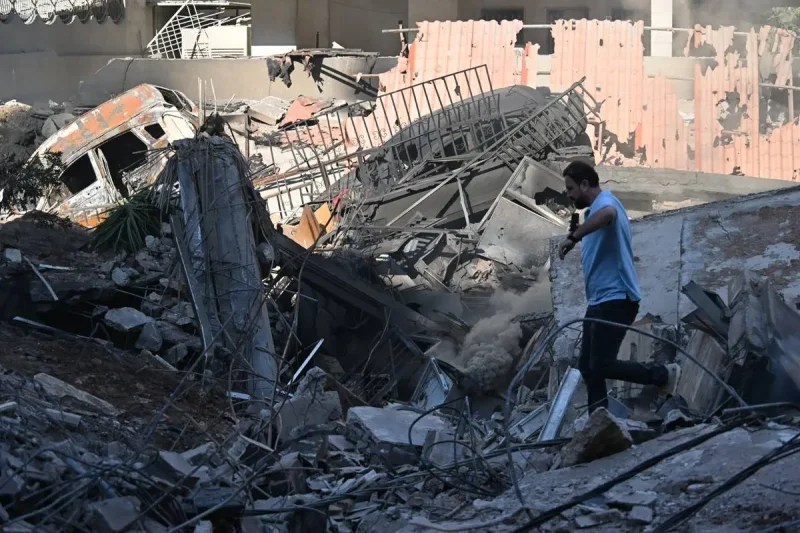
A man walks over debris of the building, where Hezbollah’s Secretary-General Hassan Nasrallah lost his life, after Israeli army’s airstrike, carried out by F-35 fighter jets, in Dahieh, Beirut, Lebanon on September 29, 2024 [Houssam Shbaro – Anadolu Agency]
MEMO | October 1, 2024
The Jerusalem Post has prompted a controversy after publishing then swiftly deleting an article suggesting that Lebanon and several other Middle Eastern countries are part of Israel’s “promised land”.
“Is Lebanon part of Israel’s promised territory?” was published on 25 September, coinciding with Israel’s assault on Lebanon and subsequent ground invasion. The timing and content of the piece have been viewed by critics as evidence of Israel’s expansionist ambitions in the region.
In the now-deleted article, Mark Fish claimed that the land “promised by God” to the “children of Israel” includes parts of modern-day Israel, the West Bank, Gaza, Lebanon, Syria, Jordan, Iraq and even Turkey. Fish cited religious texts to support its claims.
“The Torah provides clear guidelines regarding the areas we were commanded to conquer when taking possession of the land,” he wrote. He elaborated further on the concept of “Greater Israel”, suggesting that the Biblical boundaries stretch “from the ‘River of Egypt’ [interpreted by some as the Nile or a smaller river in Sinai] to the Perat River [Euphrates].”
The Jerusalem Post removed the article following a backlash on social media, with many accusing the newspaper of promoting expansionist ideology under the guise of religious justification. However, the article has been archived and continues to circulate online.
Notably, the author provides Torah-based justifications for holding onto occupied land. He said that “Hashem [God] tells us that we are granted every land we will conquer within the borders mentioned,” suggesting that God has sanctioned territorial expansion and occupation. This is an argument that aligns with a core tenet of Zionist ideology, which often cites Biblical prophecy about God’s promise to the Jews as justification for claiming Palestine and surrounding areas.
“Every place where the sole of your foot will tread shall be yours — from the wilderness and the Lebanon, from the river — the Euphrates River — until the western sea shall be your boundary,” wrote Fish. “This promise from the Creator clearly places the land of Lebanon within the Promised Land of Israel, or what some refer to as ‘the Complete Land of Israel’, or ‘The greater Israel’.”
Critics argue that the publication of such content, especially during another Israeli invasion of Lebanon, serves to legitimise Israel’s ongoing colonisation efforts in the Middle East. They contend that it reflects a broader ideology within certain Israeli circles that seeks to justify territorial expansion based on religious beliefs.
The controversy has reignited debates about the role of Israel’s religious claims to Palestine and the potential consequences of such rhetoric in an already volatile region. Like the early Zionists who concealed their true intention about ethnic cleansing and the complete colonisation of all of Palestine, Israeli leaders tend to avoid commenting on the concept of Greater Israel.
As of the time of writing, the Jerusalem Post had not issued an official statement regarding the publication and subsequent removal of the article.
US deploys thousands of troops to Middle East as tensions rise
Al Mayadeen | October 1, 2024
Deputy Pentagon Press Secretary Sabrina Singh told reporters on Monday said the US is increasing its military presence in the Middle East by deploying a “few thousand” additional troops.
According to a statement, this includes bringing in new units and extending the stay of those already stationed there.
“A certain number of units already deployed to the Middle East region… will be extended and the forces due to rotate into theater to replace them will now instead augment” those that are already there, Singh said.
“These augmented forces include F-16, F-15E, A-10, F-22 fighter aircraft and associated personnel,” Singh added, noting that there will be “an additional few thousand” personnel in the region as a result.
This comes in light of heightened escalations amid the start of “Israel’s” “localized and targeted” aggression of Lebanon.
The latest attacks on US positions in the region include a strike on the US military’s Victoria base near Baghdad Airport, occurring late Monday into Tuesday.
The Yemeni Armed Forces have also struck Israeli military targets earlier today using long-range multi-purpose one-way assault Samad 4 drone.
Meanwhile, Hezbollah continues its operations targeting Israeli movements within the occupied Palestinian territories.
Iran also launched a response to the Israeli assassinations of martyrs Haniyeh, Sayyed Nasrallah, and General Nilforooshian earlier, launching hundreds of rockets toward occupied Palestine.
Heightened escalations
On Monday, US Defense Secretary Lloyd Austin expressed support to Israeli Security Minister Yoav Gallant for “dismantling attack infrastructure” belonging to Hezbollah.
Austin also warned Iran of “serious consequences” should it directly strike “Israel” in retaliation for attacks on the Lebanese Resistance group.
On Tuesday, Hezbollah Political Council member Mahmoud Qomati said in an interview with Al Mayadeen that Hezbollah’s allies “will intervene if the battle expands.”
Qomati warned that southern Lebanon “will become a graveyard for the occupation forces” should they enter, highlighting the Resistance’s vast arsenal of unused weapons and the fighters’ readiness to engage with Israeli forces.
Addressing observers, Qomati said the Resistance was rebuilt immediately following the assassination of Hezbollah Secretary-General Sayyed Hassan Nasrallah.
The legacy of Sayyed Nasrallah is well-maintained, he said, adding, “his trust is in our hands and will remain so with every leader and fighter.”
Qomati also reiterated Hezbollah’s stance, which had been affirmed by the late Secretary-General since the beginning of the Israeli occupation’s war on Gaza, stressing that the party “will not halt its support unless a comprehensive proposal is put forward, including a ceasefire in Gaza.”
Operation True Promise II: Iran launches barrage of missiles against Zionist entity
Press TV – October 1, 2024
Sirens sounded all over the occupied territories as Iran launched hundreds of missiles towards the Zionist entity, in a retaliatory attack dubbed Operation True Promise II.
Flares and missiles were seen in the Tel Aviv sky and explosions could be heard in the occupied al-Quds, sending Zionist settlers fleeing into shelters.
The Israel Airports Authority said that no aircraft will be allowed to take off or arrive at all Israeli airports.
Israeli newspaper Haaretz reported “direct hits” in Negev, Sharon and other locations from Iran’s attack.
The Islamic Revolution Guards Corps (IRGC) issued a statement shortly after the missile attack began.
It said in response to the martyrdom of Hamas chief Ismail Haniyah, Hezbollah leader Sayyed Hassan Nasrallah, and IRGC commander Abbas Nilforoushan, the IRGC Aerospace Force launched dozens of ballistic missiles targeting key military and intelligence bases in the heart of the occupied territories.
The IRGC further said that the attack was in line with the country’s right to legitimate self-defense as per the United Nations Charter, and in response to the regime’s escalating crimes—backed by the United States—against the people of Lebanon and Gaza.
The Zionist regime will face more crushing attacks in case it reacts to Iran’s operation, the IRGC added.
In a follow-up statement, the IRGC said three Israeli military bases in Tel Aviv were hit during the operation.
In this operation, a number of air and radar bases, as well as centers for conspiracy and assassination planning against resistance leaders and IRGC commanders were targeted, the statement said.
The IRGC noted that even though the designated areas were shielded by advanced defense systems, 90% of the missiles shot successfully hit their targets.
“The Zionist regime has been terrified by the intelligence and operational dominance of the Islamic Republic,” it added.
The Iranian mission to the United Nations said in a statement that the missile attack was a “legal, rational, and legitimate” response to the terrorist acts of the Zionist regime.
It also warned the Israeli regime that a more “crushing” response would ensue should it dare to respond or commit further acts of malevolence.
Celebratory gunfire erupted in southern Beirut, where Hezbollah chief Nasrallah was killed in a massive Israeli airstrike last week, following Iran’s retaliatory attack.
“Heavy gunfire heard from automatic weapons from areas of the southern suburbs, rejoicing in the missile launch from Iran towards Israel,” Lebanon’s National News Agency said.
The weakness of Zionist air power
By Robert Daly | Al Mayadeen | October 1, 2024
What we have seen in the Zionist conduct of war since October 7, 2023, is a flashy, noisy exhibition but no seizure and holding of territory.
The murder of Sayyed Hassan Nasrallah and the destruction of six high-rise apartment buildings with multiple airstrikes make Zionist air power appear triumphant over Hezbollah. But nothing could be further from the truth. It is not air power that defeats enemies in war. Rather, it is infantry—conquering, seizing, and holding territory that defeats an enemy. The Soviet Union defeated Nazi Germany not through air power but through the ground battles of Stalingrad and Kursk and then by pushing the Nazi troops back into Germany as the Soviets liberated one occupied state after another from Ukraine and Belarus to Hungary and Czechoslovakia. The West at the time bombed Dresden and other cities, but that effort had little effect in defeating the Nazis. So, Zionist bombings of Lebanon’s cities kill citizens and wreck their homes but do not occupy territory or defeat Hezbollah.
It is beyond the capability of air power to seize enemy territory and hold it. Air power is only a form of contemporary artillery. In the past 100 years, humankind has ‘progressed’ from mere cannons and tanks delivering artillery shells onto an enemy’s positions to warplanes dropping them from above. What we have seen in the Zionist conduct of war since October 7, 2023, is a flashy, noisy exhibition but no seizure and holding of territory. Today, Hamas has retaken all of Gaza and continues to manage the territory as the Zionists have admitted in press briefings though they attacked Gaza by air. The Zionists responded to Hamas’ Oct. 7 attack by bombing and destroying civilian residential buildings, but that did not destroy Hamas, which took advantage of the situation and the changed terrain to prepare positions from behind wrecked buildings to attack Zionist tanks and armored personnel carriers, which they have destroyed by the dozen. In this way, we have seen the contrast between ground fighters and air power in Gaza, where the Zionists are effective at killing women and children from the sky above with bombs, but cannot occupy and hold the territory that that population lived in.
If air power is an effective way to defeat one’s enemy and win a war, why is Hamas still ruling Gaza? Yedioth Ahronoth, a leading ‘Israeli’ newspaper, citing Israeli security sources wrote this past week that:
○ Hamas is working to consolidate its authority again in the areas of Gaza that the IOF left.
○ No one in Gaza stands against Hamas, and no one challenges its rule.
This is not new. In June, after eight months of Zionist bombing, the Guardian wrote “Hamas still strong in areas ‘cleared’ by Israel in northern Gaza.” How is that possible? Zionist warplanes far above do not provide much competition with Palestinian freedom fighters on the ground. Zionist armored vehicles full of scared reservists are easy targets for Gazan patriots who destroy those vehicles one after another. The Guardian concludes, “Hamas’s ability to return to areas from which it was earlier forced to retreat threatens ‘forever war’.” The paper explains, “There may be more Hamas militants in the north of Gaza, supposedly cleared by Israeli forces months ago, than in Rafah, the southern city in the territory described by Israeli officials as the extremist Islamist organization’s “last stronghold”. “We do have to remember there are more Hamas armed people in the north of Gaza in the places that the IDF has already moved out of than … in Rafah … Those are the IDF’s numbers. This is why the IDF had to go back into Jabaliya and … Zeitoun. Hamas is controlling all those areas,” Eyal Hulata, the head of “Israel’s” “national security council” from 2021 to last year, told reporters last May. Zionist air power and fragile armor have failed to conquer Gaza. They only wrecked it.
One can expect an even better outcome for the domestic national liberation army in Lebanon, where Hezbollah has the advantage of better and more artillery and soldiers experienced in fighting ISIS and Al-Qaeda on the ground in Syria.
One of the most disgusting Zionist air war practices is their cowardly war by assassination. Zionists will swoop down in aircraft of various sorts to kill someone on a motorcycle, a family in a car, or a leader of the national liberation movement in a building. To do that, they do not hesitate to murder hundreds of others in the area, as when the fascists murdered Sayyed Hassan. For if the Nazi abandoned his air vehicle and fought a fair fight on the ground, he would surely lose.
Moreover, it is an embarrassment to an American with a memory to hear Hezbollah or Hamas referred to as “terrorists” for defending their own land from Zionist invaders. Does not anyone remember Washington’s crossing of the Delaware on Christmas 1776, when they and their makeshift army slaughtered British-hired Hessian mercenaries drunk from celebrating the holiday? If Hamas is “terrorist”, then why isn’t George Washington?
So, we have it: “Israel” has not won in Lebanon. Rather, “the enemy must wait for us by air, land, and sea. We repeat: If war is imposed on Lebanon, the Resistance will fight without rules, controls, or ceilings,” Sayyed Hassan Nasrallah once said. “Storming the Galilee is a possibility that remains present within the framework of any war that the occupation may launch against Lebanon,” he added, referencing his 12-year-old promise that Hezbollah will invade “Israel’s” north if Tel Aviv chooses to attack.
Iran won’t deploy forces to Lebanon to help Hezbollah – foreign ministry
RT | September 30, 2024
Iran will not send troops to Lebanon or Gaza to confront Israel, the Foreign Ministry in Tehran announced on Monday. The statement comes amid Israel’s intensified attacks against the Lebanon-based militant group Hezbollah and the Houthis in Yemen.
Tehran does not seek war but is not afraid of it and stands for a safe and stable Middle East, the ministry stressed.
“There is no need to send extra or volunteer forces of the Islamic Republic of Iran,” Foreign Ministry spokesperson Nasser Kanaani told a weekly news conference. Lebanon and fighters in the Palestinian territories “have the capability and strength to defend themselves against the aggression,” he added.
In the past several weeks, Israel has been conducting heavy airstrikes targeting Hezbollah in Lebanon and other militant groups in the region, including in Syria, Yemen, and Iraq, raising fears the conflict could engulf the entire Middle East and draw in Iran and the US, Israel’s main ally.
“We have not received any request in this regard from any side, on the contrary, we are informed and are sure that they do not need the help of our forces,” Kanaani told reporters.
He nonetheless pledged that Israel “will not remain without reprimand and punishment for the crimes it has committed against the Iranian people, military personnel and the resistance forces.”
During the past week alone, the Israel Defense Forces (IDF) significantly ramped up airstrikes on Lebanon, killing more than 1,000 people and wounding over 6,000 according to local health officials. The escalation also triggered a mass exodus from the areas most affected by the Israeli bombing.
The Israeli military also conducted a series of strikes against senior Hezbollah commanders, killing most of them, including the group’s leader Hassan Nasrallah.
Iranian President Masoud Pezeshkian visited Hezbollah’s office in Tehran on Monday to pay tribute to Nasrallah, according to the government’s website.
Featured Video

Trita Parsi: Israel Set a Trap for Total War in the Region
or go to
Aletho News Archives – Video-Images
From the Archive
Zionism’s Violent Legacy
By Donald Neff | Washington Report On Middle East Affairs | January 1996
On January 4, 1948, Jewish terrorists drove a truck loaded with explosives into the center of the all Arab city of Jaffa and detonated it, killing 26 and wounding around 100 Palestinian men, women and children.[1] The attack was the work of the Irgun Zvai Leumi – the “National Military Organization,” also known by the Hebrew letters Etzel – the largest Jewish terrorist group in Palestine. The Irgun was headed by Revisionist Zionist Menachem Begin and had been killing and maiming Arabs, Britons and even Jews for the previous ten years in its efforts to establish a Jewish state.
This terror campaign meant that at the core of Revisionist Zionism there existed a philosophical embrace of violence. … continue
Blog Roll
 Aletho News
- Trita Parsi: Israel Set a Trap for Total War in the Region
- Trump’s Iran war is on an Israeli leash
- Saudi oil boss issues global supply warning
- Riyadh Says Its Oil System Is Intact. The Numbers Say Otherwise.
- Trump and Netanyahu Want to “Finish the Job” on Iran
- US ‘one-sided dictation’ not Iran’s beliefs makes rational talks impossible: Baghaei
- Iran’s Next Strike May Not Explode. It Could Shut You Down /Col Doug Macgregor
- Iran: US political targets legitimate if assassinations return
- Iraq shuts key border crossing with Iran under US pressure: Report
- Undersea Internet cables could be targeted in retaliation for attacks on Iran: IRGC deputy chief
- If Americans Knew
- The Israel Lobby’s Changing Fortunes
- AIPAC has become such a political liability that it’s shifting to a more “nimble” approach to buying politicians
- At least 160 Israeli settler attacks in 2 weeks
- Will Gaza’s Ancient Christian Community Disappear Forever?
- Israel’s vision of regional security rests on keeping Arab states weak
- Heidi Levine recounts how Palestinian youths helped save her in settler attack
- DAILY UPDATE: Latest essential news on Palestine, Israel, & region
- Trump’s Intensifying Sabotage of the ICC, for Israel’s Sake
- Israeli military detain US and UK volunteers in West Bank including Democratic NY politician Brad Lander
- Americans at National Conservatism Conference held in Israel this year criticize Israel
- No Tricks Zone
- E-Cars Reduce CO2 Emissions By Only 41% Compared To Internal Combustion Engine Vehicles
- Predictions Made By Renowned Climate Professor Over Past Decades Have Been Proven To Be Poor
- New Study Suggests Large Regions Of The Pacific Ocean Have Been Cooling For The Last 80 Years
- Germany’s Green Energy Debacle: High Energy Costs Force Kahla Porzellan to Close After 182 Years!
- New Study: 50 Years Of The Most Aggressive ‘Net Zero’ Policies Can Only Affect The Global Climate By 0.03°C
- US September “Heat” Was No Record…Many Records Set Decades Ago
- Latest European Green Energy Debacle; Portugal’s Largest Flagship Solar Park Insolvent!
- Green Energy Debacle: German Expert Professor Fritz Vahrenholt Warns Of Severe Economic And Social Consequences
- Two More Paleo Reconstructions Affirm Meters-Higher Sea Levels Across Ireland, Brazil 7000-6000 Years Ago
- New Study: Earth And Venus Surface Warmth Largely Explained By Convection And Lapse Rate, Not CO2 Or Radiation

