Erdoğan Opened a Pandora’s Box in Libya That Will Be Difficult to Close
By Paul Antonopoulos | December 4, 2019
Tensions in the Eastern Mediterranean are rapidly rising after Turkish President Recep Tayyip Erdoğan met with a Libyan official of the internationally recognized Government of National Accord (GNA), based in the Libyan capital of Tripoli, in Ankara last week. They agreed on their own Economic Exclusive Zone that penetrates into Greek and Cypriot waters, in violation of the United Nations Convention Law of the Sea (UNCLOS) that favors Cypriot and Greek claims, a major reason why Turkey is only one of 15 UN members, out of 193, that has not signed it. Although Turkey claims it is acting within international law to enter the oil and gas-rich Greek and Cypriot waters, it never references which international law. This leads to the simple question of why Turkey has not signed UNCLOS if international law supposedly favors their claim?
The Turkish-GNA provocation against Greece comes as only last month Pakistan and Turkey conducted naval exercises where Pakistan violated Greek and Cypriot air and maritime space several times and harassed Cypriot merchant ships. This demonstrates that Turkey is bolstering its alliances to force its complete hegemony over the Eastern Mediterranean. This is to expand their maritime space in violation of international law to exploit the rich deposits of gas and oil in the region.
However, Turkey has once again defied international law, remembering the illegal invasion of northern Cyprus and Syria among many. This has now opened up a new quagmire that Erdoğan has probably not expected. With the NATO destruction of Libya in 2011, in which both Greece and Turkey took a minor part, the country has been plagued by tribalism, feudalism and Islamic radicalism, with two major forces emerging from the mess – the GNA in coalition with the Muslim Brotherhood, and the Libyan National Army (LNA) led by General Khalifa Haftar and based in eastern Libya. This is unsurprising since Turkey has a long history of supporting the Muslim Brotherhood.
Erdoğan has opened up a pandora’s box in Libya that will now surely backfire on him and see the dismantlement of the GNA. The GNA is now becoming increasingly isolated since Saudi Arabia, the United Arab Emirates and Egypt have sworn to back General Haftar with weapons and money. It is expected that with the arrival of new funds and weapons, Haftar will continue his assault to take Tripoli which he began in March. One major reason for this new support for the LNA is that Greece, Cyprus and Egypt are in a strategic regional alliance to protect their respective EEZ against Turkish aggression.
Haftar has also controversially announced that he wants relations with Israel. His desires for relations with Israel, a rarity among Muslim-majority countries, will surely bring Haftar more international recognition and legitimacy as a “reward,” especially crucial as the majority of the world recognizes the Tripoli government.
A delegation of U.S. diplomats recently asked Haftar to halt military operations, citing that it will supposedly allow Russia’s military invasion of Libya. Haftar refused. Haftar’s Secretary of State said that the United States is completely wrong, as Libya has become a huge arena for settling accounts among regional powers – and this is true if we consider that the Saudis, Emirates and Egyptians are backing the LNA, while the Turks and Qataris backs the GNA.
Rather than being in compliance with international law, Erdoğan signed with the GNA an illegal agreement to carve out the Eastern Mediterranean for its own plans. Greece has given the GNA time until today to retract their deal with Turkey. Although Greece on the international scene is a minor player, it does wield significant influence in the Eastern Mediterranean and will use NATO and EU mechanisms to convince member states to retract their recognition of the GNA, which will only further isolate Turkey as it has attempted to build an alliance to counter the Greek-Cypriot-Egyptian military partnership.
In a rare occurrence, both the U.S. and Russia have criticized Turkey’s aggression and escalation in the Eastern Mediterranean, with the US State Department describing the Turkish and GNA move as “unhelpful” and “provocative.”
It is unlikely this will make a difference as it is expected that the GNA will adamantly refuse to renounce its agreement with Turkey, which will push Greece to back the LNA and encourage NATO and EU members to do the same. At the very minimum, the Saudi-Emirati-Egyptian tripartite has used Turkey’s aggression in the Eastern Mediterranean as an excuse to back the LNA, providing him with the money, weapons, intelligence and other resources to overcome the Turkish-backed GNA.
With Saif Gaddafi, the second son of Muammar Gaddafi, also announcing his support for Haftar, there is every potential that the internationally recognized GNA will have a multitude of pressure from NATO, the EU, the Saudi-Emirati-Egyptian alliance, and from Haftar and Gaddafi supporters. Erdoğan’s desperate pursuit for regional hegemony was first received with applause domestically, but it appears he has now opened a pandora’s box in Libya that is now likely to backfire on him.
Paul Antonopoulos is a Research Fellow at the Center for Syncretic Studies.
US gatecrashes into Libyan endgame. But Russia stands in the way
By M. K. BHADRAKUMAR | Indian Punchline | November 29, 2019
The United States has alleged that Russia’s presence in Libya is having an “incredibly destabilising” impact. Washington is stepping out of the shade and making way to the centre stage of the Libyan conflict.
David Schenker, the State Department’s assistant secretary for near eastern affairs said Tuesday in Washington, “The United States is committed to a secure and prosperous future for the people of Libya. For this to become a reality, we need real commitments from external actors… In particular, Russia’s military interference threatens Libya’s peace, security, and stability.”
Schenker explained, “Russian regulars and the Wagner forces are being deployed in significant numbers on the ground and support of the LNA [Libyan National Army]. We think this is incredibly destabilising. And the way this organisation, the Russians in particular, have operated before raises the spectre of large-scale casualties in civilian populations.”
Schenker spoke only days after a delegation of US civilian and military officials led by the high-flying US Deputy National Security Advisor Victoria Coates met with Khalifa Haftar, the supremo of the LNA. A state department readout said Coates expressed serious concern to Haftar over Russia’s “exploitation of the conflict” at the expense of the Libyan people.
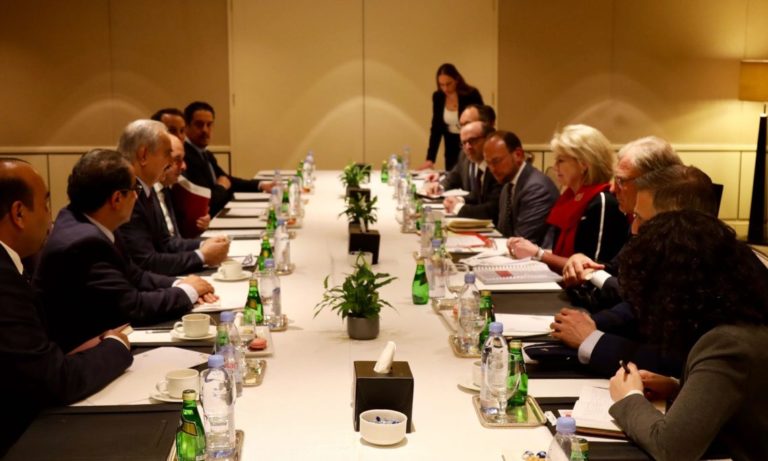
US Delegation meeting with General Khalifa Haftar, Nov 24, 2019
Libya becomes the third theatre after Ukraine and Syria where Washington has locked horns with Moscow in a Cold War-style proxy war. Up until last weekend, two EU members were supposedly conducting a proxy war in Libya over control of Africa’s largest oil and gas resources — France and Italy.
Actually, the alignments in Libya do not warrant a US-Russia standoff, as disparate external powers largely pursue self-interests. Italy, Turkey and Qatar have backed the Government of National Accord (GNA) in Tripoli (also supported by Germany and the UN), while France, Egypt, UAE, Saudi Arabia and Russia backed LNA.
The fight against terrorist groups is a stated common objective of all protagonists, but there are sub-plots too — Libya’s oil and gas (France, Italy, Turkey and Russia); political Islam (Turkey, Qatar, Egypt, UAE); France’s military operations in the five Sahel countries (Mauritania, Mali, Niger, Burkina Faso and Chad), which can end only with the stabilisation of Libya; the migration issue; and geopolitical interests (France, Italy, Russia and Turkey).
Although Haftar was a CIA “asset” for over three decades, Washington largely kept contacts with him under the radar and seemingly watched the struggle between GNA and LNA from the sidelines even after Haftar launched a determined push in April to capture Tripoli. The US policies were incoherent. President Trump apparently viewed Haftar as a factor of stability, while Washington officially pitched for a UN-mediated political settlement in Libya, although that is easier said than done, given the fragmentation in the country.
Washington was marking time, unsure whether Haftar’s military campaign would succeed. Moscow too took a back seat, but in recent months the Kremlin began weighing Haftar’s prospects positively. Moscow (like Cairo) counts on Haftar’s impeccable credentials in the fight against terrorist groups.
Russian military support has decisively helped Haftar’s campaign, which took big leaps lately. Haftar controls something like 80 percent of Libya, whereas, GNA is reduced to a mere rump confined to Tripoli.
Enter Washington. Washington feels alarmed that in the Libyan endgame, with Haftar inexorably gaining the upper hand, thanks to Moscow’s help, the vista opens for cascading Russian influence over the new regime.
Nonetheless, it isn’t easy to find fault with Russia’s military role to stabilise Libya, since NATO intervention in 2011 that wrought havoc and such colossal destruction had enjoyed the backing of Obama Administration. Washington is on weak moral grounds. Geopolitics is dictating its policy trajectory.
Washington’s policy is driven by the project to make Libya the headquarters of the United States Africa Command, one of the eleven unified combatant commands of the United States Armed Forces (which is presently based in Stuttgart, Germany.) Clearly, the rollback of Russian presence and influence in Libya becomes a prerequisite of the US project.
The backdrop, of course, is the big-power struggle erupting over Africa and its vast untapped resources. China has been rapidly expanding its presence in Africa and Russia too is stepping up. Importantly, as the recent Russia-Africa summit in Sochi (October 23-24) signalled, military cooperation is Moscow’s priority.
Russia and China’s growing presence creates space for African leaderships to negotiate with the Western powers. It is a sign of the times that the South African Navy’s first-ever multinational maritime exercise (November 25-30) is exclusively with Russia and China.
Fan Guanqing, the captain of the PLA Navy frigate Wei Fang, said in Cape Town last weekend, “We hope that the exercises will allow China, Russia and South Africa to work together and make an improvement through co-operation and exchanges. This exercise is historical and the first of its kind for these three countries.” Captain Fan said the maritime exercise should help maintain world peace and stability and would also be the starting point of a relationship between the three countries.”
Libya is the perfect gateway for NATO to penetrate the African continent. But a willing government in Tripoli could give the Russian Navy access to the eastern Libyan ports of Sirte and Benghazi on the Mediterranean. If Russia gets ensconced in Libya (in addition to Syria), NATO presence in the Mediterranean is affected. Russia and Libya also have a history of close political, military and economic ties dating back to the Soviet era.
Russia had a traditional presence in Libya’s armaments market and Soviet troops were deployed in Libya. Today, Libya’s reconstruction is the real prize for Moscow in terms of infrastructure (roads, railways, cities). Russia lost heavily due to the NATO-led regime change in Libya in 2011. Moscow had billions of dollars in investments in Libya during Moammar Gadhafi’s rule.
It remains to be seen how far the US pressure tactic on Haftar to sever his links with Russia will work. Russia, France and Egypt are on the same page in helping Haftar militarily. All three countries also bond together. While Moscow’s politico-military relations with Cairo are deepening, France is decoupling from the US’ Russia policies. Washington will be hard-pressed to isolate Russia in Libya. The big question is where indeed Haftar himself stands.
Brexit isn’t David Cameron’s Legacy – Libya is
The MSM’s total disregard for the apocalyptic destruction of the most developed nation in Africa is a crime
By Kit Knightly | OffGuardian | October 1, 2019
“The strong man with the dagger is followed by the weak man with the sponge.”
Lord Acton
David Cameron has a book out. You’ve probably heard. There’s a lot of press coverage. The BBC did a retrospective documentary about him to coincide with it, The Guardian had a review of the book, a review of the documentary, and an interview with the man himself.
Oh, and then another article about how it’s selling less well than Blair’s biography.
This is obviously just about journalists reporting the news, you understand.
It is absolutely not at all a mass marketing strategy camouflaged as “current events”.
Shame on you for thinking otherwise.
Naturally, as is always the case when ex-Prime Ministers make appearances or churn out autobiographies, there is plenty of talk about “legacy”.
Well… what is David Cameron’s legacy?
The media are pretty clear: Brexit.
The BBC documentary is entitled The Cameron Years. It’s in two parts, somehow bloated out to two whole hours in runtime, and is only concerned with the Brexit vote. The first part is entirely dedicated to it, that’s literally all it’s about, with the second half being more general, but still very Brexit-centric.
The reviews of the book are no better. In fact they are worse.
The Telegraph liked it, as did the Times. The Guardian and Independent didn’t, as much, but still praised its “honesty”. They all talk almost entirely about Brexit. Bloomberg headline “David Cameron Wants You to Remember Him for More Than Just Brexit”, pointing out: “The former prime minister’s new memoir, For the Record, spends just 50 of 700 pages on the disastrous referendum”… before going on to review just those fifty pages.
In fact, I’ve read over half-a-dozen reviews of this book, and none of them talks about anything but Brexit.
There is not a single use of the word “Libya” in any of them. Not anywhere. Not in even in passing.
Not. One. Single. Use.
For those of you foggy on the details, Libya was a place that used to look like this:
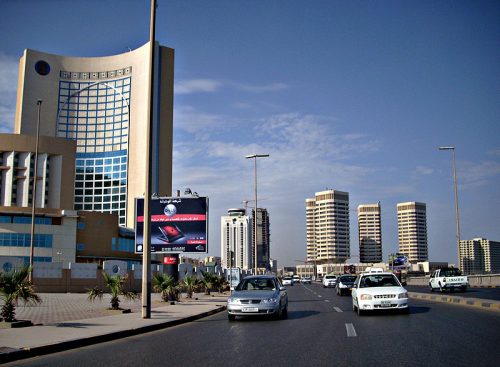
… and now looks like this:
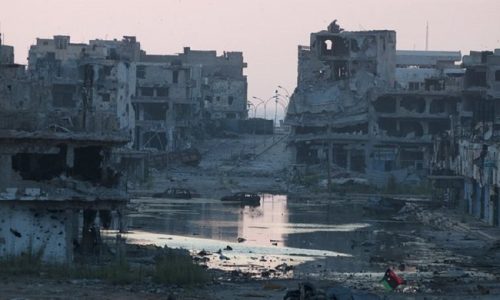
You would think that the total and complete destruction of the most developed nation on the African continent would warrant at least brief discussion in the “legacy” of the Prime Minister responsible but, apparently, you would be wrong.
(I know we’re only Britain, and we only do what America tells us, but “Only following orders” didn’t work for Goering and probably shouldn’t work for anybody else. Cameron included).
The press silence on Libya is on another level.
They grudgingly discuss Iraq as a “mistake” or “blunder”, they carry on their insane propaganda-war on Syria with fresh gusto every few months (or whenever they need a distraction), but Libya… Libya is the country that must not be named.
Take Jonathan Freedland. He was ALL OVER Libya back in 2011. He campaigned for NATO to do something, preaching about the West’s “responsibility to protect”. Does he mention Libya once in his review of this book? Nope.
He even has the gall to open the piece with this:
“Just as the 700 pages of Tony Blair’s autobiography could not escape the shadow of Iraq, so the 700 pages of David Cameron’s memoir are destined to be read through a single lens: Brexit.”
As if his decision to totally disregard a war crime he not only apologised for, but cheerfully encouraged, was somehow just fate and totally beyond his control.
That’s probably got something to do with the organ trafficking and open-air slave markets.
This was no accident, you understand, Libya is exactly what NATO set-out to make it – a failed state where absolutely everything is for sale. A true capitalist paradise. But discussing that would make it harder to sell “R2P” in the future.
Better to just endlessly rant on about Brexit instead.
Now, obviously, Brexit is (potentially) an important decision for the fate of the country. You can’t deny that.
BUT – let’s be real here – Even IF we leave the EU (and right now that is far from guaranteed), and even IF our leaving is as bad as the worst doom-sayers are predicting, London isn’t going to end up like this…
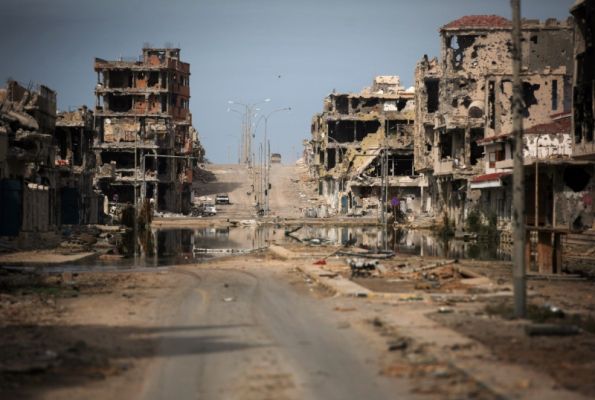
…. or this:
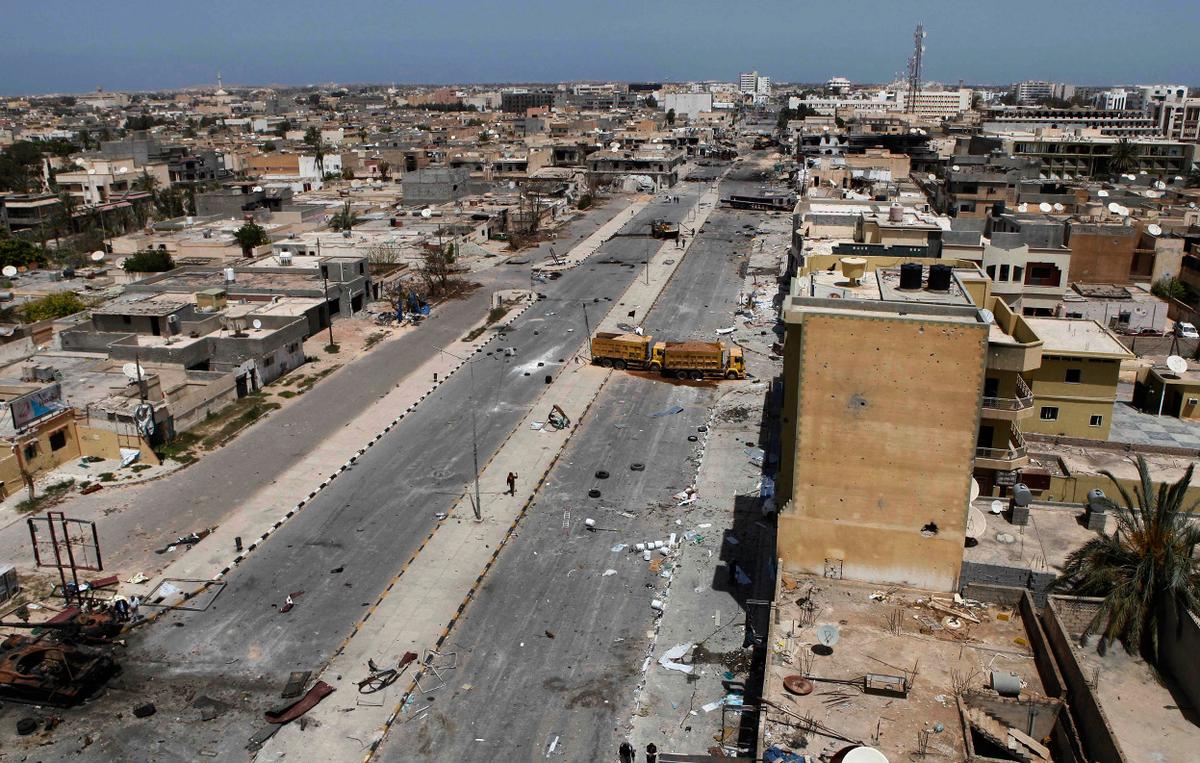
…. or this:
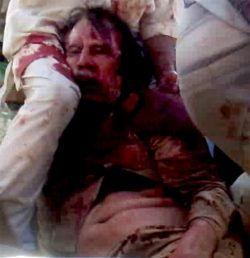
And at the end of the day, THAT is Cameron’s legacy.
Just as it’s the legacy of the all slimy apologists who cheered him on, and the narrow-minded, self-centred xenophobes who clean up after him.
Kit Knightly is co-editor of OffGuardian. The Guardian banned him from commenting. Twice. He used to write for fun, but now he’s forced to out of a near-permanent sense of outrage.
“US Causes Instability Anywhere It Sets Foot”
Al-Manar | July 20, 2019
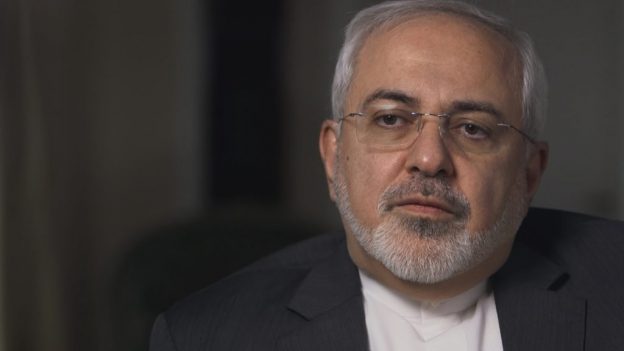
Iranian Foreign Minister Mohammad Javad Zarif said Saturday that the United States causes instability and insecurity everywhere in the world it sets foot, including the Persian Gulf and South America.
Iranian Foreign Minister Mohammad Javad Zarif arrived in the Venezuelan capital early Saturday after a six-day stay in New York.
Speaking to reporters upon arriving in Caracas, Zarif said that “anywhere the United States sets foot in, it causes instability there.”
“At the moment, the US is causing insecurity with its presence in the Persian Gulf, the Middle East, and also the South American region,” said Zarif.
He went on to add that, “I don’t know any place in the world where the US’s presence has brought stability.”
“Anywhere the US has set foot on, it led to pressure on the people and caused extremism and terrorism,” stressed the Iranian top diplomat.
While in Caracas, Zarif is slated to take part in the Ministerial Meeting of the Non-Aligned Movement (NAM) Coordinating Bureau (CoB) on 20-21 July under the theme: “Promotion and Consolidation of Peace through Respect for International Law.” He will also meet with a host of Venezuelan officials before making a visit to Nicaragua and Bolivia.
Libya’s GNA forces seize US missiles at captured Haftar base
Press TV – June 30, 2019
Military officials with Libya’s internationally-recognized government say they have seized sophisticated US missiles and weaponry at a base they captured from forces allied to renegade General Khalifa Haftar in the south of the capital, Tripoli.
The Tripoli-based Government of National Accord (GNA) retook the southern strategic town of Gharyan, home to the main supply base of eastern forces attacking the capital, from Haftar’s self-styled Libyan National Army (LNA) on Wednesday.
The GNA announced on Saturday that among the weaponry its forces had seized were four US-made Javelin anti-tank missiles packed in wooden crates marked “armed forces of the United Arab Emirates”.
The GNA officials said the markings indicated that the missiles – jointly manufactured by the arms giants Raytheon and Lockheed Martin – had originally been sold to the United Arab Emirates (UAE), a major buyer of US arms and one of Haftar’s main supporters.
“The seized weapons and ammunition have been sent to the specialized experts and have been documented,” Mohammed Qununu, spokesman of the GNA’s military operation, told reporters in Gharyan.
“The military commanders and the political leaders are now fully aware of these weapons and ammunition to make the right decisions that will be announced.”
United Nations reports have previously said that the UAE, Saudi Arabia and Egypt have been arming Haftar’s forces since 2014.
UN arms embargo violation
The New York Times, confirming the discovery of American missiles by the GNA in a report on Saturday, said the UAE’s Ambassador to the US Yousef al-Otaiba had declined to answer questions about the provenance of the missiles.
The American daily, however, said it would be in breach of both the terms of the sale and a UN arms embargo on the conflict-ridden Libya if the missiles were found to have been sold or transferred to forces under Haftar’s command.
The GNA has reportedly launched a fact-finding mission with the goal of producing a report that would be submitted to the United Nations as well as other international organizations.
Officials at the US State Department and the Pentagon also said they had opened investigations into how the weapons had ended up on the Libyan battlefield.
“We take all allegations of misuse of US origin defense articles very seriously. We are aware of these reports and are seeking additional information,” a State Department spokesperson said on condition of anonymity. “We expect all recipients of US origin defense equipment to abide by their end-use obligations.”
The US government’s support for Haftar, however, is beyond doubt.
Libya’s GNA headed by Prime Minister Fayez al-Sarraj has already called on US President Donald Trump to stop support for “aspiring military dictator”.
The US president, in a phone call with the military strongman in April, “recognized Field Marshal Haftar’s significant role in fighting terrorism and securing Libya’s oil resources.”
Forces loyal to Haftar launched an offensive on April 4 to capture Tripoli. Since then, fighting has killed 653 people, wounded more than 2,000 and displaced over 93,000, according to the UN.
Libya has been the scene of increasing violence since 2011, when former dictator Muammar Gaddafi was toppled from power after an uprising and a NATO military intervention.
His ouster created a huge power vacuum, leading to chaos and the emergence of numerous militant outfits, including the Daesh terrorist group.
The country has been divided between two rival governments, the House of Representatives based in the eastern city of Tobruk and the GNA in Tripoli.
Despair or distraction? Pompeo’s ‘push for peace’ in Libya does not pass smell test
By Alex Benley – RT- April 12, 2019
The US Secretary of State Mike Pompeo may have called for peace in Libya but his lack of credibility makes one suspect something else is going on.
“There is no military solution,” warns West Point graduate, former CIA chief and waterboarding defender, Mike Pompeo.
“We have made clear that we oppose the military offensive by Khalifa Haftar’s forces and urge the immediate halt to these military operations against the Libyan capital,” Pompeo’s statement read.
There is something not right about Pompeo’s call. Otherwise, it would seem to mark a major U-turn in US foreign policy. But the record of this and previous administrations does not corroborate such an assumption.
Libya is a great case study when it comes to the gap between US leaders’ public statements and their underlying intent.
In his address to the nation on March 28, 2011, Nobel peace prize laureate Barack Obama framed the mission as one “to protect the Libyan people from immediate danger and to establish a no-fly zone… Broadening our military mission to include regime change would be a mistake.” Roger that.
During a Senate hearing, Hillary Clinton’s deputy, James Steinberg said, “President Obama has been equally firm that our military operation has a narrowly defined mission that does not include regime change.”
During the months that followed, however, the US provided rebels with $25 million in assistance and reportedly allowed advanced weapons to be delivered by Egypt and Qatar.
NATO ships stationed in the Mediterranean to enforce an arms embargo under Section 9 of Resolution 1970 let go a rebel tugboat with small arms, 105mm howitzer rounds, and “lots of explosives.”
On the day Vice Adm. William Gortney, director of the Joint Staff, “guaranteed” the press that Muammar Gaddafi is “not on a targeting list,” bombs hit the presidential compound.
Clinton’s eventual “we came, we saw, he died” is the most striking giveaway that regime change was the White House’s goal right from the start.
The US action under the guise of a peace and humanitarian narrative resulted in the collapse of a once rich and stable country that has since turned it into a playground for extremist forces, with spillover effects for the entire region. It has been a de-facto failed state for eight years now.
Need more examples of Washington’s hypocrisy? Promoting peace in Yemen and Syria on paper did not preclude the US from launching airstrikes against Damascus and exporting weapons that kill civilians in the protracted Saudi-led war on Yemen’s Houthis.
The US is clearer on Venezuela but again not everything is said in public. Remember National Security Advisor John Bolton’s hand-written reminder to send 5,000 troops to Colombia captured on camera?
Going back to Libya, there is another detail that is adding flavor to the story.
It is common knowledge that Haftar’s military experience helped topple the Gaddafi regime in 2011 following his return to Libya from the US where he gained American citizenship. Other than being a skilled commanding officer, he is said to have become a CIA asset and was trained in guerilla warfare by the agency’s paramilitary arm. This was after Washington saved him from a prison in Chad following a botched Libyan campaign and abandonment by Gaddafi in 1987. In March 1996, Haftar took part in the uprising against the Libyan leader.
However, Haftar has also been building ties with Russia. He’s flown to Moscow and has met several times with Defense Minister Sergey Shoigu.
If the general has made up his mind, he could run his homeland on his own terms. The US is just trying to buy time to figure out his and its own next move.
Also on rt.com Libya’s military strongman Haftar to meet Russian FM Lavrov in Moscow
But the timing of the general’s offensive – just days ahead of a major UN conference – might indicate he may have been directed by the US to thwart European and broader international efforts. The goal would be to show who the real powerbroker is, to scare the Europeans with potentially more refugees, and punish the EU for seeking greater autonomy from the US.
So, what’s truly behind Pompeo’s statement – a distraction to prove their alibi while a special CIA op is underway or a signal to a former asset gone rogue in a geopolitical tug of war over who defines Libya’s future?
Whatever the case, make no mistake: Pompeo is no peace dove and the US will have no qualms about issuing secret orders to advance their strategic interests that run counter to their publicly stated objectives.
Libya jails 4 Palestinians over alleged Hamas links
MEMO | February 22, 2019
A court in Tripoli on Wednesday sentenced four Palestinians to prison terms ranging from 17 to 22 years over their alleged links to Hamas.
The four defendants were accused of “setting up a secret foreign organisation on Libyan territory, arms possession and conspiring against state security.”
The Palestinians were arrested on 6 October 2016 from their homes in the capital, Tripoli, and were taken to an unknown destination.
Family sources told Arabi21 news site that they had been denied family visits for two months before their prison sentences were announced.
According to the sources, the detainees suffered daily abuses resulted in one of them losing one of his eyes. One detainee named Marwan who suffers from hypertension and diabetes has been denied his medication.
The four Palestinians used to work for a technology company in the capital, Tripoli.
The detainees’ families expressed their “fear that they would be handed over to Israel via a third party” appealing to all concerned bodies to help release them.
Mainstream media boosts Trudeau’s popularity over Venezuela
By Yves Engler · February 13, 2019
US presidents have bombed or invaded places like Grenada, Panama, Iraq and Sudan to distract from domestic scandals or to gain a quick boost in popularity. But, do Canadian politicians also pursue regime change abroad to be cheered on by the dominant media as decisive leaders?
In a discussion on regime change in Venezuela after last Monday’s “Lima Group” meeting in Ottawa, Conservative foreign affairs critic Erin O’Toole praised Canadian policy but added that the Liberals used the meeting of countries opposed to Nicolas Maduro’s government to drown out criticism of their foreign policy. O’Toole claimed the “Lima Group” meeting was “put together quite quickly and I think there are some politics behind that with some of the foreign affairs challenges the Trudeau government has been having in recent months.” In other words, O’Toole believes the Liberals organized a gathering that concluded with a call for the military to oust Venezuela’s elected president to appear like effective international players.
Understood within the broader corporate and geopolitical context, O’Toole’s assessment appears reasonable. After being criticized for its China policy, the Liberals have been widely praised for their regime change efforts in Venezuela. In a sign of media cheerleading, CTV News host Don Martin began his post “Lima Group” interview with foreign minister Chrystia Freeland by stating “the Lima summit has wrapped and the object of regime change is staying put for the time being” and then he asked her “is [Venezuelan President Nicolas] Maduro any step closer to being kicked out of office as a result of this meeting today?” Later in the interview Martin applauded the “Lima Group’s” bid “to put the economic pincers around it [Venezuela’s economy] and choking it off from international transactions.”
In recent days Ben Rowswell, a former Canadian ambassador in Caracas, has been widely quoted praising the Liberals’ leadership on Venezuela. “It’s clear that the international community is paying attention to what Canada has to say about human rights and democracy,” Rowswell was quoted as saying in an article titled “Trudeau’s Venezuela diplomacy is a bright spot amid China furor”.
Rowswell heads the Canadian International Council, which seeks to “integrate business leaders with the best researchers and public policy leaders”, according to its billionaire financier Jim Balsillie. Long an influential voice on foreign policy, CIC hosted the above-mentioned forum with O’Toole that also included the Liberal’s junior foreign minister Andrew Leslie and NDP foreign affairs critic Hélène Laverdière. CIC’s post “Lima Group” meeting forum was co-sponsored with the Canadian Council of the Americas, which is led by Kinross, Kinross, ScotiaBank, KPMG and SNC Lavalin. On the day of the “Lima Group” meeting CCA head Ken Frankel published an op-ed in the Globe and Mail headlined “Venezuela crisis will be a true test of Canada’s leadership in the hemisphere.” Frankel told CPAC he was “always supportive of Canadian leadership in the Hemisphere” and “the Venezuela situation has presented … a perfect opportunity for the Trudeau government to showcase the principles of its foreign policy.”
At the CCA/CIC forum Laverdière made it clear there’s little official political opposition to Ottawa’s regime change efforts. The NDP’s foreign critic agreed with Canada’s recognition of Juan Guaidó as president of Venezuela, as she did on Twitter, at a press scrum and on CPAC during the day of the “Lima Group” meeting in Ottawa. (Amidst criticism from NDP activists, party leader Jagmeet Singh later equivocated on explicitly recognizing Guaidó.)
With the NDP, Conservatives, CIC, CCA, most media, etc. supporting regime change in Venezuela, there is little downside for the Liberals to push an issue they believe boosts their international brand. To get a sense of their brashness, the day of the “Lima Group” meeting the iconic CN Tower in Toronto was lit up with the colours of the Venezuelan flag. A tweet from Global Affairs Canada explained, “As the sun sets on today’s historic Lima Group meeting, Venezuela’s colours shine bright on Canada’s CN Tower to show our support for the people of Venezuela and their fight for democracy.”
The Liberals drive for regime change in Venezuela to mask other foreign-policy problem is reminiscent of Stephen Harper’s push to bomb Libya. Facing criticism for weakening Canada’s moral reputation and failing to win a seat on the UN Security Council, a Canadian general oversaw NATO’s war, seven CF-18s participated in bombing runs and two Royal Canadian Navy vessels patrolled Libya’s coast.
The mission, which began six weeks before the 2011 federal election, may have helped the Conservatives win a majority government. At the time Postmedia published a story titled “Libya ‘photo op’ gives Harper advantage: experts” and Toronto Star columnist Thomas Walkom published a commentary titled “Libyan war could be a winner for Harper”. He wrote: “War fits with the Conservative storyline of Harper as a strong, decisive leader. War against a notorious villain contradicts opposition charges of Conservative moral bankruptcy. The inevitable media stories of brave Canadian pilots and grateful Libyan rebels can only distract attention from the Conservative government’s real failings.”
Similar to Venezuela today, the regime change effort in Libya was unanimously endorsed in Parliament (three months into the bombing campaign Green Party MP Elizabeth May voted against a second resolution endorsing a continuation of the war). “It’s appropriate for Canada to be a part of this effort to try to stop Gadhafi from attacking his citizens as he has been threatening to do,’’ said NDP leader Jack Layton. After Moammar Gaddafi was savagely killed six months later, NDP interim leader Nycole Turmel released a statement noting, “the future of Libya now belongs to all Libyans. Our troops have done a wonderful job in Libya over the past few months.”
Emboldened by the opposition parties, the Conservatives organized a nationally televised post-war celebration for Canada’s “military heroes”, which included flyovers from a dozen military aircraft. Calling it “a day of honour”, Prime Minister Stephen Harper told the 300 military personnel brought in from four bases: “We are celebrating a great military success.”
Today Libya is, of course, a disaster. It is still divided into various warring factions and hundreds of militias operate in the country of six million.
But who in Canada ever paid a political price for the destruction of that country and resulting destabilization of much of the Sahel region of Africa?
A similar scenario could develop in Venezuela. Canadian politicians’ push for the military to remove the president could easily slide into civil war and pave the way to a foreign invasion that leads to a humanitarian calamity. If that happened, Canadian politicians, as in Libya, would simply wash their hands of the intervention.
Canadians need to reflect on a political culture in which governing parties encourage regime change abroad with an eye to their domestic standing.
Venezuela’s Gold: 3 Times State Wealth in Western Banks “Mysteriously” Vanished
Sputnik | January 28, 2019
Self-proclaimed Venezuelan interim president Juan Guaido has praised the Bank of England’s reported refusal to allow Caracas to repatriate $1.2 billion worth of gold bullion, branding the move a “protection of assets.” Sputnik looks at a few other times Western governments and banks froze, or outright stole, the sovereign wealth of other countries.
Caracas has been waging a losing battle to get its gold back from the UK since late last year, with the Bank of England repeatedly refusing its repatriation requests, according to media reports. Last week, British Foreign Secretary Jeremy Hunt joined Britain’s US allies in backing Juan Guaido, calling him “the right person to take Venezuela forward” and making the return of Venezuela’s gold all the more unlikely. Over the weekend, as if on cue, Guaido praised London’s decision not to return the gold.
All Part of the Job
The practice of freezing or seizing the assets of countries which somehow find themselves on the wrong side of US and European policymakers and financial interests is anything but new. A 1992 review of US extraterritorial asset freeze orders by legal scholar Rachel Gerstenhaber recounted well over a dozen cases of the US freezing or confiscating assets of countries including the likes of Iraq, Panama, Libya, Iran, South Vietnam, Cuba, Nicaragua and a bevy of former Eastern Bloc states. The list doesn’t include similar moves by US allies in Western Europe, which similarly deprived countries of tens of billions of dollars in sovereign assets. For the sake of brevity, Sputnik focuses on three such cases.
Iran
The 40-year-old saga of Iran’s frozen assets goes back to the 1979 Iranian Revolution, which saw revolutionaries overthrow US-backed dictator Mohammad Reza Shah Pahlavi and the establishment of an Islamic republic. The upheaval, which included the taking of hostages at the US Embassy in Tehran, prompted Washington to cut off diplomatic relations, ban Iranian oil imports and freeze some $11 billion in assets ($35.35 billion today, accounting for inflation).On the eve of the signing of the landmark Joint Comprehensive Plan of Action (JCPOA), widely known as the Iran nuclear deal, in 2015, Tehran’s frozen assets, including those stemming from the 1979 Revolution, as well as international nuclear-related restrictions, were estimated to amount to at least $100 billion. The chief of Iran’s central bank said that only about $32 billion, a third of the total, could be released in connection with the nuclear deal.
Over three years after the JCPOA’s signature, the fate of much of the wealth remains unclear. What is known is that US courts have heard multiple cases demanding the outright seizure of the Islamic Republic’s wealth. This includes a 2016 ruling ordering Iranian cash to be paid to the families of US servicemen killed in the 23 October, 1983 truck bombings in Beirut, Lebanon. Tehran maintains that it had nothing to do with the act of terrorism, and has challenged the ruling with the International Court of Justice, so far unsuccessfully.
In a separate, even more outrageous ruling from 2018, a New York court ordered frozen Iranian assets to be used to compensate the victims of 9/11, despite the fact that Iran had nothing to do with the terrorist attacks and that 15 of the 19 hijackers were Saudi nationals.
Iraq
In the run-up to the US invasion of Iraq in 2003, the military planning to seize the country’s strategic assets was accompanied by economic calculations to seize some $1.75 billion in Iraqi assets already frozen in US accounts.
The seizure was just the tip of the iceberg in what would become what seems like a bottomless pit of asset pilfering in the chaos which followed the invasion. In 2010, a Pentagon audit concluded that it couldn’t account for some $8.7 billion in missing Iraqi oil and gas money meant for reconstruction.
Earlier, US media sporadically reported on the enthralling case of some $10-$20 billion in cash, most of it consisting of Iraqi state assets, which was shipped into Iraq in 2004 for reconstruction efforts before seemingly vanishing into thin air.In a 2005 audit, US inspector general for Iraq reconstruction Stuart W. Bowen Jr. reported that over $8.8 billion in the funds could not be accounted for. Six years later, Bowen told Congress that US officials still hadn’t accounted for some $6.6 billion in funds, and said the case could very well be “the largest theft of funds in national history.”
Libya
The details of the suspected plundering of a major chunk of Libya’s vast sovereign wealth fund in the aftermath of the NATO intervention to overthrow Libyan leader Muammar Gaddafi remain shrouded in mystery, close to eight years after the attack. In late 2018, officials from one of Libya’s warring factions called on the UN Security Council to safeguard what’s left of the Libyan assets still frozen in foreign accounts.
The concerns came following reports last March that some 10 billion euros (approximately $11.4 billion US) in Libyan sovereign wealth had disappeared from a Belgian bank, with just 5 billion euros of the original 16 billion euro fund remaining. Last September, a UN panel found Belgium to be in breach of asset freeze restrictions, with interest payments on some of the Libyan funds feared to have been transferred to accounts belonging to warring militias, including Islamists. Authorities from the Tripoli-based government later alleged that the United Arab Emirates were “almost certainly” behind the pilfering, saying the funds were used to support the Tobruk-based government in eastern Libya.
The scandal is just one of numerous major asset freezes and seizures by Western powers in the aftermath of Gaddafi’s demise. In 2012, over a billion euros in assets belonging to Gaddafi’s family and senior members of his government were seized in Italy at the request of the International Criminal Court, including stakes in major Italian companies, as well as property.
A year before that, the Obama administration froze $29.8 billion in Libyan wealth held in US banks including Goldman Sachs, Citigroup, JPMorgan Chase and the Carlyle Group.
The assets, along with $40 billion more in funds held elsewhere, were reported to have been unfrozen in December of 2011. However, UN officials later said that only about $3 billion of that had actually reached the country “due to concerns over who the money should be released to and other diplomatic problems.” In late 2018, the head of Libya’s sovereign wealth fund told Reuters that the fund was planning to appoint auditors to carry out a system-wide audit of its assets in 2019 to try to unfreeze some of the billions in assets still frozen. As of late last year, an estimated 70 percent of the Libyan Investment Authority’s $67 billion in assets abroad remain frozen by the UN.
Also in 2018, British lawmakers mulled pulling a US courts-style seizure of part of Libya’s sovereign wealth fund to compensate victims of the Irish Republican Army, which Gaddafi is thought to have sponsored in the 1980s.
An estimated 9.5 billion pounds ($12.5 billion US) of Libya’s wealth is still believed to be held in British banks. Tripoli has urged London not to go ahead with the seizure. “There is no lawful basis for the United Kingdom to seize or change ownership of the frozen LIA assets. These belong to the Libyan people,” Libyan Investment Authority chief Ali Mahmoud Hassan Mohamed said in a letter addressed to the UK’s Junior Foreign Minister Alistair Burt last October.
The unscrupulous use of Libyan national wealth hasn’t been limited to post-Gaddafi Libya, either. Last year, former French President Nicolas Sarkozy was charged with bribery and accepting some 50 million euros in illegal campaign contributions from Libya ahead of the 2007 presidential election in France. Sarkozy repaid this generosity by being one of the key advocates of the 2011 NATO attack on Libya.
Caracas’s Bullion
On Sunday, Argentinian newspaper Ambito Financiero reported that Venezuelan national assembly head Juan Guaido had asked Prime Minister May and Bank of England governor Mark Carney not to return the estimated $1.2 billion in gold bullion to Caracas, despite President Maduro’s requests. Earlier, in a Saturday tweet, Guaido praised the Bank’s alleged refusal to allow the gold to be repatriated, writing that “the process of protecting the assets of Venezuela has begun,” and saying that the opposition would “not allow more abuse and theft of money intended for food, medicine and the future of our children.”
If the stories of asset freezes and seizures outlined above are anything to go by, it doesn’t seem like it’s going to be up to the Venezuelans to decide what Western governments and central banks do with their country’s wealth.
See also:
Libya Investigates Who Benefited From Gaddafi’s Billions Frozen in Belgium
Israeli PM visits Chad ‘to restore relations’
MEMO | January 20, 2019
Israel’s Prime Minister Benjamin Netanyahu headed to Chad on Sunday for talks aimed at restoring diplomatic relations between Tel Aviv and N’Djamena.
“I am now leaving on another historic and important breakthrough, to Chad, a huge Muslim country bordering Libya and Sudan,” The Times of Israel newspaper quoted Netanyahu as saying in statements ahead of travelling to Chad.
“There will be big news,” Netanyahu said, hinting at the formal resumption of diplomatic relations between the two countries.
Chad severed diplomatic relations with Israel in 1972.
Netanyahu described his visit to Chad as “part of the revolution we are doing in the Arab and Muslim world”.
The Israeli premier claimed that Iran and the Palestinians have attempted to “prevent Israel’s diplomatic push”.
“It greatly worries, even greatly angers [them],” he said.
The resumption of bilateral ties between Chad and Israel is expected to be announced in a joint press conference between Netanyahu and Chadian President Idriss Deby.
Israeli Channel 10 reported Saturday night that Netanyahu is expected to offer his government’s support for Deby to prevent militants’ infiltration to Chad coming from Libya.
Netanyahu’s delegation to Chad includes senior officials from the defense and finance ministries, in an indication of his target to boost military and trade ties with Chad.
The Chadian President had made a rare visit to Israel in November.
Featured Video
or go to
Aletho News Archives – Video-Images
From the Archives
Israel Would Have No Qualms About USS Liberty-Style FALSE FLAG If Iran Campaign Falters – Analysts
By Ilya Tsukanov – Sputnik – 18.06.2025
Donald Trump is mulling whether or not to join Israel’s aggression against Iran as Tel Aviv faces problems sustaining its defenses against growing counterstrikes, and apparently lacks a realistic game plan for an end to hostilities after failing to achieve its goals. Analysts told Sputnik how the US could be ‘nudged’ into the conflict.
“The US is already assisting Israel with supplies, intel, refueling support, etc. One of the many US posts in the region could be attacked for a casus belli,” former Pentagon analyst Karen Kwiatkowski explained.
“If Trump doesn’t comply with Israel’s demand” and join its aggression voluntarily, “a false flag may be needed” to drag the US in, Kwiatkowski, retired US Air Force Lt. Col.-turned Iraq War whistleblower, fears.
Netanyahu has a diverse array of options at his disposal, according to the observer, including:
- a false flag against US assets abroad blamed on Iran or one of its Axis of Resistance allies, like the Houthis
- a US domestic attack or assassination blamed on Iran
- Iranian air defenses ‘accidentally’ hitting a civilian jetliner carrying Americans
- use of a dirty bomb or nuclear contamination somewhere in the region blamed on Iran
- even blackmailing by threatening to use nukes against Iran if the US doesn’t join the fight
Kwiatkowski estimates that Israel probably has “enough blackmail power” against President Trump and Congress to avoid the necessity of a false flag operation, but a “USS Liberty-style” attack, targeting the soon-to-be-retired USS Nimitz supercarrier that’s heading to the Middle East, for example, nevertheless cannot be ruled out entirely, she says. … continue
Blog Roll
 Aletho News
- Top PMU commander, over a dozen fighters killed in new US strikes on Iraq
- Is Netanyahu’s war gamble threatening the future of ‘Israel’?: FT
- Smotrich calls for annexation of South Lebanon to Litani River
- Echos of Gallipoli? Hormuz and the Geography of Hubris
- Pakistan PM backs Iran’s right to self-defense amid tensions
- Hungary blasts ‘fake’ EU accusation
- SAFE Debt Trap: Poland’s €43.7 Billion Bet on Unipolar Illusion
- War on Iran threatens global Gulf capital flows: FT analysis
- Mossad De Facto Admits To Inciting Riots In Iran
- Tehran: World grown thoroughly exhausted with US-Israeli ‘false flag storylines’
- If Americans Knew
- Instead of taking Joe Kent’s claims seriously, the media is disregarding him as an antisemite
- Joe Kent’s Explosive Interviews about his Resignation over the Iran War
- Israel poised to take over southern Lebanon; settlers wreak havoc in West Bank – Not a ceasefire Day 165
- From Sde Teiman, the truth about Israel’s military justice system has been set free
- Child denied life-saving bone marrow transplant by Israel ‘because he is from Gaza’
- Raffi Berg: BBC Middle East Editor Exposed as CIA, Mossad Collaborator
- Jerusalem Archbishop Rebukes Netanyahu’s Statements on Christianity
- US to embed Palantir AI across entire military: Report
- Israeli-US war on Iran to drag on “a few more weeks” – Not a ceasefire Day 164
- Lebanon deaths top 1,200; Palantir AI to be embedded across US military – Not a ceasefire Day 163
- No Tricks Zone
- Devastating Assessment Of Comirnaty Vaccine By Former Senior Pfizer Europe Toxicologist
- New Study: CO2 Is ‘Effectively Negligible’ As An Explanatory Climate Change Factor Since 2000
- Former Pfizer Toxicologist Dr. Helmut Sterz Tells Bundestag Hearing Pfizer Vaccine Should Have Never Been Approved
- Energy Expert: Germany’s Nuclear Phaseout Was A “500 Billion Euro Mistake”
- New Research: South Australia’s Mid-Holocene Sea Surface Temperatures Were 4°C Warmer Than Today
- Storing Green Energy To Last Germany 10 Days Would Require A 60-Million Tonne Battery
- New Studies: UK Sea Levels Were 4 Meters Higher Than Today During The Mid-Holocene
- Destructive Green New Deal: German Energy And Metal Group Warns Of Drastic Crisis
- New Study Documents A 20-Year Pause In Arctic Sea Ice Decline – Driven By Internal Variability
- Wake-up Call: Survey Shows Majority Of Germans Now Favor Postponing Climate Targets!
 Aletho News