NATO’s Dead?
If so, who killed it: Obama, Putin, Or Trump?
By Andrew Korbyko – InfoRoss – 06.07.2018
NATO, as the world knew it, is dead, and the organization’s demise is attributable to the combination of President Putin’s deft diplomacy in advancing the Russian-Turkish rapprochement and his American counterpart’s revolutionary reconceptualization of the very essence of the alliance, both of which wouldn’t have been possible had it not been for Obama.
NATO, as it was previously conceived of for decades, is dead, and while it might be reborn in a different format sometime in the future, its previous model has exhausted its purpose and is entering into the dustbin of history. The organization still officially exists, but everything about it is changing to the point where it might soon become unrecognizable. The consistently anti-Russian driving force behind the bloc has been decisively neutralized by President Putin’s deft diplomacy in winning over its second-largest military member, Turkey, as Russia’s newest strategic partner, while Trump’s revolutionary reconceptualization of the alliance as an equal collection of states combating the asymmetrical security challenges of terrorism and illegal migration will fundamentally transform what it means to be a NATO member.
The Shadow Of Obama
Before going through the post-mortem in detail, it’s worthwhile to describe how Obama’s shadow hangs heavy in the sense that he orchestrated the three greatest mistakes that inadvertently led to NATO’s demise. The 2011 NATO War on Libya has the chance of being seen in hindsight as the final flash of a fast- fading star, with its “shock-and-awe” destruction of the former Jamahiriya going down in history as perhaps the last real instance of the bloc’s members working in coordination with one another to conventionally wage war against a targeted state. The self-congratulatory pomp that followed this brief military campaign has since been proven to have been premature because of the country’s ongoing civil war and role as a transit state for facilitating the flood of hundreds of thousands of migrants into Europe, which sparked its own crisis that has since led to the rise of EuroRealist populists in the continent.
In addition, the Libyan model of Hybrid War destabilization was also applied to Syria, albeit minus the final conventional warfare form, and this exacerbated the Migrant Crisis to the point of no return in guaranteeing the inevitable rise of right-wing politicians in Europe. Taken together, the Wars on Libya and Syria, waged in different manners but nevertheless following the same neo-imperialist regime change form, generated unprecedented humanitarian blowback to the point of triggering far-reaching political changes in NATO’s EU members, making many of them reconsider the official anti-Russian purpose of the bloc when it could be better put to use in defending the organization’s southern shores from swarms of migrants. For as “constructive” of an idea as this may have been, it led to deep divisions within the EU itself between the pro-migrant Western countries, the anti-migrant Central & Eastern European ones, and the anti-Russian Baltic States, Poland, and Romania.
While these intra-NATO disagreements were percolating, Obama made another massive mistake in giving the greenlight for the failed pro-American coup attempt against Turkish President Erdogan in the summer of 2016, and the blowback from this sloppy operation was almost instantaneous in making the bloc’s second-largest military deeply suspicious of US intentions from then on out. Although Turkey had hitherto been mostly focused on facilitating American strategic objectives in the Mideast (which for the most part were disadvantageous to Russia’s long-term regional vision), its unchanging geopolitical position as an irreplaceable part of NATO’s anti-Russian “containment” policy was thought to have retained a consistent function that had been taken completely for granted up until that point. That was a huge error, as will be seen, because President Putin’s deft diplomacy succeeded in its judo-like maneuver to flip Turkey from an enemy into a partner.
Putin’s Judo
Taking advantage of President Erdogan’s understandable distrust of what he had presumed was his country’s closest ally, President Putin reached out to extend his support for the embattled Turkish leader in demonstrating which of the two Great Powers really had Ankara’s best interests in mind. It shouldn’t be forgotten that unconfirmed reports also alleged that Russian intelligence might have tipped President Erdogan off right before a fighter jet flown by one of the coup conspirators was set to bomb his residence, therefore saving his life and sealing a new bond of friendship between both countries. It might never be known whether that actually happened or not, but in any case, the Russian-Turkish rapprochement that followed soon thereafter was swift and even saw Moscow passively accepting Ankara’s limited “Euphrates Shield” incursion into northern Syria later that summer, something that would have been utterly unthinkable just a few months prior.
The revival of the Turkish Stream pipeline project and a related agreement on nuclear energy cooperation served as physical testimonies to the strength of the Russian-Turkish Strategic Partnership, which went one dramatic step much further in officially including a military dimension per Ankara’s desire to buy Moscow’s state-of-the-art S-400 air & missile defense system despite Washington’s threats to sanction it if the deal goes through. In the course of less than two years, President Putin’s deft diplomacy flipped the tables on the previous US-Turkish Strategic Partnership by replacing America with Russia and totally changing the overall dynamics of Mideast geopolitics. The de-facto removal of NATO’s second-largest military force from the organization, which is essentially the true state of affairs at the moment given Ankara’s planned S-400 military cooperation with Moscow and Washington’s CAATSA sanction threats, dealt a heavy blow to the bloc from which it has yet to recover.
Decades’ worth of strategic planning that went into using Turkey as a bulwark against the spread of Russian influence towards the Mediterranean are now worthless after Ankara has for all intents and purposes turned its back on the bloc out of protest of the US’ role in the failed summer 2016 coup attempt. The organization can no longer count on the cornerstone of its Mideast, Black Sea, and Eastern Mediterranean policies, and this has inevitably led to the alliance having to reinvent itself. As it happened, this took place concurrent with the rapid politicization of the Migrant Crisis and its resultant intra-NATO/-EU disputes about how best to respond to this civilizational challenge, further exacerbating divisions within the West and making Turkey’s “defection” (brought about through President Putin’s masterful diplomacy) all the more impactful of a destabilizing move for the already confused alliance.
Trump’s Turnaround
The last and most powerful factor that contributed to the death of NATO was Trump himself, who decided to turn everything around and reorient the bloc from its official anti-Russian purpose by transforming it into something entirely different. It’s true that some of the anti-Russian functions will still remain because of the Baltic States, Poland, and Romania’s membership as “frontline states”, but Trump’s vision is to use NATO as a platform for responding more to asymmetrical security threats such as terrorism and illegal immigration instead of conventional ones like Russia was portrayed as being since the organization’s inception. Words are one thing, but transforming them through action is another, and it’s here where Trump is “walking the walk” much more than “talking the talk” like his predecessors did in visibly pressuring his “allies” to contribute their required 2% of GDP towards defense like they were always supposed to do to begin with.
Trump, being the successful businessman that he is, can’t fathom why the US should subsidize the EU’s “socialist welfare states” especially given that the “foreboding challenge” of a “Soviet invasion” no longer makes that necessary like it may have once. Seeing world affairs from an economic perspective and therefore perceiving the EU to be America’s rival in this respect, Trump knows that the best way to “level the playing field” and “get a better deal” is to put pressure on America’s military underlings by compelling them to pay more for defense in order to advance their interests in a reconceptualized NATO, with this being coordinated alongside the US’ campaign to get the EU to lift its anti-American tariffs. The knock-on effect of this “double whammy” could hit the Europeans’ economic growth and possibly compel them into “cutting a deal’ of some sort for relief, one which can only be speculated upon at this time but which would undoubtedly strengthen American influence.
Far from representing the “united” West that NATO did during the Old Cold War and the brief period of unipolarity that followed, the New Cold War has seen the bloc weakened from within because of the blowback caused by Obama’s disastrous Wars on Libya & Syria as well as the failed pro-American coup attempt against President Erdogan in summer 2016.
President Putin skillfully exploited the latter in rapidly turning Turkey into a close partner and convincing it that its future interests are best served by keeping the bloc at arm’s length, while Trump dealt the deathblow against the alliance for his own reasons mainly having to do with a different view on contemporary security challenges and his economically driven vision of foreign affairs. While the shell of NATO still exists, its functional capacities are now divided into different regional blocs mostly constituting the new anti-migrant European Intervention Force in Western Europe and the remaining anti-Russian forces in the East, though Turkey’s de-facto “defection” means that the organization will never be the same as before.
No Trump, No Clinton, No NATO
By Craig Murray | July 7, 2018
Marina Hyde’s vicious and spiteful attack on Susan Sarandon and the Green Party points to the real danger of anti-Trump protest next week being hijacked by the neo-con warmonger franchise. The idea that those of us who do not want arch warmonger Clinton in power are therefore supporters of Trump is intellectually risible and politically dishonest.
Yesterday the OPCW reported that, contrary to US and UK assertions in the UN security council, there was no nerve agent attack on jihadist-held Douma by the Syrian government, precisely as Robert Fisk was execrated by the entire media establishment for pointing out. The OPCW did find some traces of chlorine compounds, but chlorine is a very commonly used element and you have traces of it all over your house. The US wants your chicken chlorinated. The OPCW said it was “Not clear” if the chlorine was weaponised, and it is plain to me from a career in diplomacy that the almost incidental mention is a diplomatic sop to the UK, US and France, which are important members of the OPCW.
Trump’s reaction to yet more lying claims by the UK government funded White Helmets and Syrian Observatory, a reaction of missile strikes on alleged Syrian facilities producing the non-existent nerve agent, was foolish. May’s leap for British participation was unwise, and the usual queue of Blairites who stood up as always in Parliament to support any bombing action, stand yet again exposed as evil tools of the military industrial complex.
Hillary Clinton, true to form, wanted more aggressive military action than was undertaken by Trump. Hillary has been itching to destroy Syria as she destroyed Libya. Libya was very much Hillary’s war and – almost unreported by the mainstream media – NATO bombers carried out almost 14,000 bombing sorties on Libya and devastated entire cities.
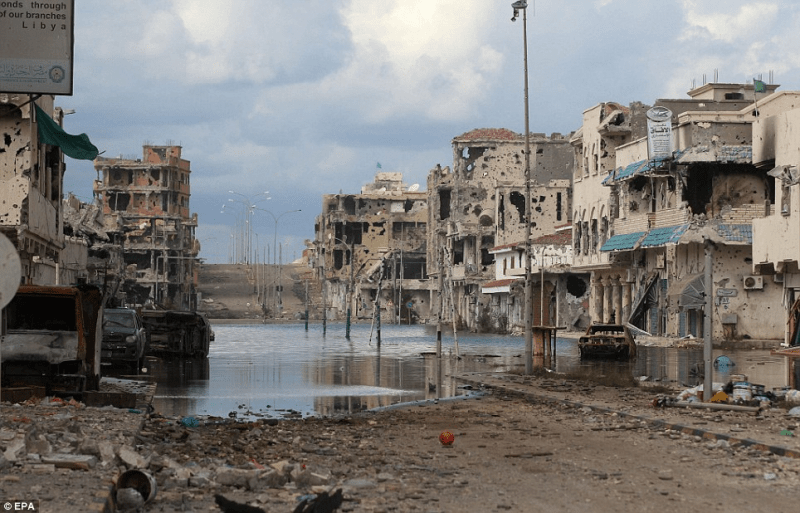
Sirte, Libya, after NATO bombing
The destruction of Libya’s government and infrastructure directly caused the Mediterranean boat migrant crisis, which has poisoned the politics of much of the European Union.
Donald Trump has not started any major war. He has been more restrained in military action than any US President since Jimmy Carter. My own view is (and of course it is impossible to know for sure) that, had Hillary been in power, Syria would already have been totally destroyed, the Cold War with Russia would be at mankind threatening levels, and nuclear tension with North Korea would be escalating.
“He hasn’t destroyed mankind yet” is faint praise for anyone. Being less of an existential danger to mankind than Hillary Clinton is a level achieved by virtually the entire population of the planet. I am not supporting Trump. I am condemning Clinton. I too, like Susan Sarandon, would have voted for Jill Stein were I an American.
So do protest against Trump. But do so under the banner No Trump! No Clinton! No NATO! And if any Clintonite or Blairite gets up to address you, tell them very loudly where to get off. I remember the hijacking of the Make Poverty History campaign by Brown, Darling and Campbell on behalf of their banker friends. Don’t let that happen again.
Or here is an even better idea.
Escape the Trump visit completely. Rather than stand penned in and shouting slogans at a police van parked right in front of you, turn your back on all of that and come join me at the Doune the Rabbit Hole Festival from 13 to 15 July. As our regulars know, this blog has been intimately connected with running the Festival from the start. This year is much bigger, with the Levellers, Akala, Atari Teenage Riot, Peatbog Faeries, and literally scores of other bands, and a great array of other festival activities too, including for kids, who come free and get free drinks.
DTRH has no sponsorship, no advertising, no government money and no rip-offs – beer and cider from £3.50 a pint at the bars. It is very much an alternative lifestyle gathering, and I find spiritual renewal there in the glorious Stirlingshire countryside. (I know that sounds corny, but I do). Tickets are £90 for full weekend including camping, which I think makes it the cheapest festival on this level around. Or you can buy a cheaper day ticket and drop in just for the day. If tickets are too expensive or you fancy a different kind of fun, you can volunteer, including to come and work with me in the bar, though there are a whole range of other tasks to be done if you don’t fancy that. Volunteers get in free and get fed in return for one six hour shift a day.
I really do hope I will see some of you there – it looks set to be a glorious weekend. Forget stress, forget Trump and hang out with nice people!
NATO’s Fraudulent War on Behalf of Women
By George Szamuely | CounterPunch | January 9, 2018
In a recent Guardian article titled “Why NATO Must Defend Women’s Rights,” NATO Secretary-General Jens Soltenberg and Hollywood movie star Angelina Jolie assert that “NATO has the responsibility and opportunity to be a leading protector of women’s rights.” NATO, moreover, “can become the global military leader in how to prevent and respond to sexual violence in conflict.” The two vowed to identify “ways in which NATO can strengthen its contribution to women’s protection and participation in all aspects of conflict-prevention and resolution.”
The pairing of a NATO bureaucrat and a famous movie actress may at first glance appear odd. However, this partnership has been long in the making. Some years ago, NATO, always on the lookout for a reason to justify its continued existence, not to mention its perpetual expansion, came up with a new raison d’être: It would be the global champion of women. “Achieving gender equality is our collective task. And NATO is doing its part,” said Mari Skåre, the NATO Secretary General’s Special Representative for Women, Peace and Security, in 2013. In March 2016, on International Women’s Day, NATO held a so-called “Barbershop Conference” on gender equality. Stoltenberg took the opportunity to declare that gender equality was a frightfully important issue for NATO because “NATO is a values-based organization and none of the Alliance’s fundamental values—individual liberties, democracy, human rights and the rule of law—work without equality.” Diversity was a source of strength. “We learned in Afghanistan and in the Balkans that by integrating gender within our operations, we make a tangible difference to the lives of women and children,” Stoltenberg explained. He stressed that NATO is proud of its record in embedding gender perspectives within its work. Last November, Stoltenberg was at it again: “Empowering women is not just the right thing to do, it’s the smart thing to do: it makes countries safer and more stable. NATO is determined to make a difference.”
NATO has indeed made a difference but not through empowering women. When it isn’t bombing, killing, blowing up bridges and buildings, destroying wedding receptions, empowering jihadis, triggering refugee flows and ruining the lives of countless women, NATO holds unctuous press briefings, organizes self-congratulatory conferences and publishes articles such as the one by Stoltenberg/Jolie seeking to present a gargantuan 29-state military coalition as a do-gooder charity helping out the needy.
This is where Angelina Jolie comes in. Jolie is a goodwill ambassador of the United Nations High Commissioner for Refugees (UNHCR) and, in that capacity, wanders around the world berating the “international community” for not doing enough to address humanitarian crises. Her take on these crises is invariably the same as that of NATO. “It is important that we intervene in a timely fashion,” she once explained, “diplomatically if we can, with force if we must.” In October 2011, following seven months of relentless NATO bombing, Jolie rushed to Libya and excitedly hailed the Libyan “revolution”:
I’m… here on behalf of the Libyan people to show them solidarity. I think this revolution on behalf of human rights, which is what I feel these people really have been doing and what they have pushed for, and to help them to implement these new laws and help them with the future of their country.
Sometimes it’s breathless enthusiasm for “revolution,” sometimes it’s tearful pleading for plain, old-fashioned “humanitarian intervention”—Angelina Jolie is nothing if not consistent in her advocacy for Western use of force. When it comes to Syria, Jolie has declared that “some form of intervention is absolutely necessary.” She sneered at the U.N. Security Council permanent members that stood in the way of intervention. “I feel very strongly that the use of a veto when you have financial interests in the country should be questioned and the use of a veto against humanitarian intervention should be questioned,” she said in an interview. Jolie was of course simply echoing the blustery words of the Obama administration. Recall Susan Rice’s tirade following Russia’s and China’s veto of a February 2012 Security Council resolution calling for Bashar al Assad to step aside and for the Syrian army to return to its barracks. Rice, then U.S. permanent representative at the U.N., called the vetoes “disgusting and shameful.” The countries “that have blocked potentially the last effort to resolve this peacefully…will have any future blood spill on their hands.”
This kind of attack on the veto-wielding Security Council members has become a staple of the humanitarian intervention crowd. For example, former French President François Hollande told the U.N. General Assembly in September 2013 that when mass atrocities were taking place, U.N. Security Council permanent members must give up their veto powers:
The U.N. has a responsibility to take action. And whenever our organization proves to be powerless, it’s peace that pays the price. That’s why I am proposing that a code of good conduct be defined by the permanent members of the Security Council, and that in the event of a mass crime they can decide to collectively renounce their veto powers.
Taking action, of course, means taking military action. It never means, say, the lifting of sanctions so that food, oil, medical supplies could get through. To the contrary, if military action is ruled out, the humanitarians immediately resort to demanding the tightening of sanctions. Interventionists such as Hollande, Rice, et al., never explain why it is necessary for U.N. permanent members to give up their veto if the right course of action is so self-evident. The unstated assumption obviously is that any reluctance to sanction the use of force must be motivated by moral failings such as greed, selfishness, political ambition or lack of compassion.
The heartlessness of the so-called international community was the message of the 2011 film she wrote and directed about the 1992-95 war in Bosnia, In the Land of Blood and Honey. The film, she said, points a “finger at the international community, which should have intervened in the Bosnian war was much sooner.” She proudly boasted that among the experts she consulted in making the film were Richard Holbrooke and Wesley Clark, two figures who played prominent roles in the devastation of Bosnia and Kosovo. The film, predictably, features villainous Serbs persecuting innocent Muslims. Asked whether her film should have been a little more balanced, Jolie replied “The fact is that the war was not balanced. I could not make a film where it’s 50-50. It’s inaccurate to what happened.” This is standard NATO stuff, particularly the part about NATO’s military intervention as having finally brought peace to Bosnia.
Jolie is useful to NATO not only because she can be relied on to echo the military alliance’s self-justifying rationales for its favored solution to any problem, namely, the threat to use force. Jolie’s is the glamorous face of NATO’s revamped PR campaign. NATO would have us believe that it’s not only bringing enlightenment to backward societies but also to us, NATO member-state citizens, by informing us about something of which we had hitherto been apparently unaware: sexual violence occurs during wartime. The obvious remedy—doing everything possible to avoid war—is not one that either NATO or Jolie favors. NATO can’t very well be expected to advocate itself out of existence. In NATOspeak you threaten and defend military action even as you bemoan in lachrymose terms its predictable consequences, namely, war crimes, including sexual crimes.
In April 2014, Jolie traipsed around the Balkans with British Foreign Secretary William Hague, visiting the Srebrenica memorial center in Potocari, Bosnia. During the visit, Jolie stated, “The use of rape as a weapon of war is one of the most harrowing and savage of these crimes against civilians. This is rape so brutal, with such extreme violence, that it is even hard to talk about it.” Hague and Jolie jointly launched a campaign called Preventing Sexual Violence in Conflict Initiative, the goal of which was “to address the culture of impunity, ensure more perpetrators are brought to justice and ensure better support for survivors. We’re campaigning to raise awareness, rally global action, promote international coherence and increase the political will and capacity of states to do more.”
Hague earnestly explained, “I started this campaign with Angelina Jolie because foreign policy has got to be about more than just dealing with urgent crises—it has to be about improving the condition of humanity.” Then Hague warmed to his theme: “Tens of thousands of women, girls and men were raped during the war in Bosnia. We are visiting to draw the world’s attention to their search for justice, and to call for global action to end the use of rape as a weapon of war once and for all.” In a BBC interview Hague claimed that sexual violence in conflict was “one of the great mass crimes of the 20th century and the 21st century…. If anything, this is getting worse—war zone rape as a weapon of war, used systematically and deliberately against civilian populations.”
Hague was of course British foreign secretary during NATO’s 2011 Libyan bombing campaign. It hardly needs to be said that NATO did nothing to help Libya’s women. To the contrary: Thousands of women lost their lives as a direct result of NATO and Hague’s humanitarian bombs. NATO destroyed government, law and public order, institutions that before its intervention had protected the women of Libya from sexual crimes. Most striking of all, NATO helped deliver perhaps millions of women into the hands of ISIS. Here is an account of the record of ISIS rule in Libya from Human Rights Watch (a reliably pro-interventionist outfit) in its 2017 country report on Libya: “In the first half of 2016, fighters loyal to ISIS controlled the central coastal town of Sirte and subjected residents to a rigid interpretation of Sharia law that included public floggings, amputation of limbs, and public lynchings, often leaving the victims’ corpses on display.”
Not to worry: In June 2014, Hague and Jolie co-hosted in London a grand three-day Global Summit to End Sexual Violence. Participants included Secretary of State John Kerry and U.N. Secretary-General Ban Ki-moon. According to one report, the summit cost £5.2 million to host. The food bill alone was more than £299,000, while total expenditure on taxis, hotels and transport reached £576,000. Jolie declared:
We need to shatter that culture of impunity and make justice the norm, not the exception, for these crimes. We need political will, replicated across the world, and we need to treat this subject as a priority. We need to see real commitment and go after the worst perpetrators, to fund proper protection for vulnerable people, and to step in to help the worst-affected countries. We need all armies, peacekeeping troops and police forces to have prevention of sexual violence in conflict as part of their training.
Punishing the perpetrators of sexual violence sounds laudable enough. The trouble is that NATO’s record of making incendiary charges and then failing to back them up with serious evidence is not one that inspires confidence. During the Bosnian war, for example, the media reported obsessively on the use of rape as an instrument of war. In 1992, Dame Ann Warburton’s European parliamentary delegation estimated that 20,000 rapes had already taken place in Bosnia. In January 1993, Newsweek carried a lengthy cover-story charging Serbs with the rape of as many as 50,000 women, mostly Muslim, as part of “deliberate programs to impregnate Muslim women with unwanted Serb babies.”
Systematic research on the subject however resulted in findings that were insufficiently dramatic to make it into the papers. On Jan. 29, 1994, the U.N. secretary-general issued a report on rapes in the former Yugoslavia, including Bosnia and Croatia, based on a study by the U.N. Commission of Experts. The report found “126 victims, 113 incidents, 252 alleged perpetrators, 73 witnesses.” The report also stated “some of the rape cases” were “clearly the result of individual or small-group conduct without evidence of command responsibility. Others may be part of an overall pattern. Because of a variety of factors, such a pattern may lead to a conclusion that a systematic rape policy existed, but this remains to be proved.”
Allegations of mass rape were a key component of NATO’s propaganda campaign during the 1999 bombing of Yugoslavia. British Foreign Secretary Robin Cook regaled the public with lurid tales of Serbs forcing women “to endure ‘systematic rape’ at an army camp at Djakovica.” Clare Short, Britain’s international development secretary, added that the rapes were “deliberately performed in front of children, fathers and brothers.” The British Foreign Office followed up with claims of having discovered three more rape camps: “Refugees reported orchestrated rapes at Globocica, Urosevac and an unidentified point on the Kosovo-Albania border.” Subsequently, when it was too late to matter, the media sheepishly admitted that the rape-camp stories, like most of NATO’s allegations, were a fabrication. The Washington Post reported that “Western accusations that there were Serb-run rape camps in the cities of Djakovica and Pec, and poorly sourced allegations in some publications that the Serbs were engaging in the mutilation of the living and the dead—including castration and decapitation—all proved to be false.” Even Human Rights Watch’s Fred Abrahams, who had worked as an investigator for the International Criminal Tribunal for the Former Yugoslavia, admitted in testimony that he had found no evidence to support the incendiary rape-camp allegations.
Still, NATO remained undeterred. During NATO’s next campaign, the one directed against Libya, rape stories made their appearance within days of the launch of the first bombs. Susan Rice, the U.S. Permanent Representative at the U.N., informed the Security Council that Libya’s leader, Muammar Qaddafi, was supplying his troops with Viagra in order to help them commit mass rape. Though Rice offered no evidence to support her claims, her charge was sufficient for the International Criminal Court prosecutor, Luis Moreno-Ocampo, to announce that he had “information to confirm that it was a policy in Libya to rape those who were against the Government. Rape is a new aspect of the repression.” Moreno-Ocampo even accepted as confirmed Rice’s Viagra story: “We are finding some elements confirming this issue of acquisition of Viagra-type of medicaments to show a policy. They were buying containers with products to enhance the possibility to rape, and we are getting the information in detail confirming the policy.”
In the end, predictably enough, NATO’s rape allegations turned out to have been made up out of whole cloth. Donatella Rovera, a senior crisis response adviser for Amnesty International, reported that the organization had “not found any evidence or a single victim of rape or a doctor who knew about somebody being raped.” Rovera also dismissed the Viagra story. She said that “rebels dealing with the foreign media in Benghazi started showing journalists packets of Viagra, claiming they came from burned-out tanks, though it is unclear why the packets were not charred.”
Though one allegation after another has proved to be false, NATO will continue to make them, seizing on whatever is the hot-button issue of the moment. NATO does nothing for women and does nothing to stop sexual crimes, whether in NATO member-states or anywhere else in the world. What NATO does do well, thanks to its multimillion dollar sophisticated PR machinery, is seizing on highly emotional issues such as rape and turning them into justifications for bigger budgets, more weaponry, more expansion, more deployments in more countries and, in the end, military action.
 George Szamuely, PhD, author of Bombs for Peace: NATO’s Humanitarian War on Yugoslavia, is Senior Research Fellow at the Global Policy Institute of London Metropolitan University.
Yemen, Afghanistan in focus as landmine casualties spike
Press TV – December 14, 2017
Landmines killed 8,605 people in several countries in 2016, despite an international ban on the deadly device, a monitoring group says.
According to the annual report released Thursday by Landmine Monitor, about three-quarters of the known casualties were civilians, including more than 1,000 children who were injured and nearly 500 who were killed.
The number of the casualties — which were mostly recorded in Afghanistan, Libya, Ukraine and Yemen — showed a 30% surge compared to 2015.
“A few intense conflicts, where utter disregard for civilian safety persists, have resulted in very high numbers of mine casualties for the second year in a row,” Loren Persi, an editor of the Landmine Monitor said.
Persi described the spike as “alarming”, adding that the true number of the victims would be significantly higher if the data gathering were complete.
The surge comes after a 18-year decline in landmine casualties since the Mine Ban Treaty first came into force in 1999.
The treaty bans the use of landmines and other explosive devices placed on or under the ground, designed to blow up when somebody unintentionally steps on them.
These weapons can be continuously deadly weapons for many years, long after the war has ended. About 80% of landmine victims are civilians.
The Mine Ban Treaty, which has been signed by 163 countries, also bans production, stockpiling and transfer of the deadly landmines.
Featured Video

or go to
Aletho News Archives – Video-Images
From the Archives
Israel Would Have No Qualms About USS Liberty-Style FALSE FLAG If Iran Campaign Falters – Analysts
By Ilya Tsukanov – Sputnik – 18.06.2025
Donald Trump is mulling whether or not to join Israel’s aggression against Iran as Tel Aviv faces problems sustaining its defenses against growing counterstrikes, and apparently lacks a realistic game plan for an end to hostilities after failing to achieve its goals. Analysts told Sputnik how the US could be ‘nudged’ into the conflict.
“The US is already assisting Israel with supplies, intel, refueling support, etc. One of the many US posts in the region could be attacked for a casus belli,” former Pentagon analyst Karen Kwiatkowski explained.
“If Trump doesn’t comply with Israel’s demand” and join its aggression voluntarily, “a false flag may be needed” to drag the US in, Kwiatkowski, retired US Air Force Lt. Col.-turned Iraq War whistleblower, fears.
Netanyahu has a diverse array of options at his disposal, according to the observer, including:
- a false flag against US assets abroad blamed on Iran or one of its Axis of Resistance allies, like the Houthis
- a US domestic attack or assassination blamed on Iran
- Iranian air defenses ‘accidentally’ hitting a civilian jetliner carrying Americans
- use of a dirty bomb or nuclear contamination somewhere in the region blamed on Iran
- even blackmailing by threatening to use nukes against Iran if the US doesn’t join the fight
Kwiatkowski estimates that Israel probably has “enough blackmail power” against President Trump and Congress to avoid the necessity of a false flag operation, but a “USS Liberty-style” attack, targeting the soon-to-be-retired USS Nimitz supercarrier that’s heading to the Middle East, for example, nevertheless cannot be ruled out entirely, she says. … continue
Blog Roll
 Aletho News
- Embarrassing Pivot: U.S. considers dropping Iran oil sanctions amid war
- US has 2 months of rare earths left to replenish weapons amid Iran war: Report
- Strait Of Hormuz closure brings Empire to brink
- Iran controls Strait of Hormuz, dictates terms of war and peace as US excursion backfires
- Outlasting the Superpower: The Reasons Why Iran is Beating uhe US and Israel
- Top PMU commander, over a dozen fighters killed in new US strikes on Iraq
- Is Netanyahu’s war gamble threatening the future of ‘Israel’?: FT
- Smotrich calls for annexation of South Lebanon to Litani River
- Echos of Gallipoli? Hormuz and the Geography of Hubris
- Pakistan PM backs Iran’s right to self-defense amid tensions
- If Americans Knew
- UN’s special rapporteur on human rights says Israel is systematically torturing Palestinians
- Trump White House plagiarized Iran war manifesto from Israel-aligned think tank
- Gaza says 6–10 patients die daily waiting for treatment abroad as Israel blocks medical evacuations
- ‘Substantial evidence’ of double-tap strike in killing of Gaza’s Hind Rajab
- ‘Do Not Want To Die For Israel’: Doubts About Trump’s Iran Strategy Spread Among Troops
- Instead of taking Joe Kent’s claims seriously, the media is disregarding him as an antisemite
- Joe Kent’s Explosive Interviews about his Resignation over the Iran War
- Israel poised to take over southern Lebanon; settlers wreak havoc in West Bank – Not a ceasefire Day 165
- From Sde Teiman, the truth about Israel’s military justice system has been set free
- Child denied life-saving bone marrow transplant by Israel ‘because he is from Gaza’
- No Tricks Zone
- Devastating Assessment Of Comirnaty Vaccine By Former Senior Pfizer Europe Toxicologist
- New Study: CO2 Is ‘Effectively Negligible’ As An Explanatory Climate Change Factor Since 2000
- Former Pfizer Toxicologist Dr. Helmut Sterz Tells Bundestag Hearing Pfizer Vaccine Should Have Never Been Approved
- Energy Expert: Germany’s Nuclear Phaseout Was A “500 Billion Euro Mistake”
- New Research: South Australia’s Mid-Holocene Sea Surface Temperatures Were 4°C Warmer Than Today
- Storing Green Energy To Last Germany 10 Days Would Require A 60-Million Tonne Battery
- New Studies: UK Sea Levels Were 4 Meters Higher Than Today During The Mid-Holocene
- Destructive Green New Deal: German Energy And Metal Group Warns Of Drastic Crisis
- New Study Documents A 20-Year Pause In Arctic Sea Ice Decline – Driven By Internal Variability
- Wake-up Call: Survey Shows Majority Of Germans Now Favor Postponing Climate Targets!
 Aletho News