How the war will end…
By Gilbert Doctorow | June 3, 2022
It has been my rule not to join the vast majority of my fellow political commentators at the scrimmage line in sterile debates of the one subject of the day, week, month that has attracted their full attention. Their debates are sterile because they ignore all but a few parameters of reality in Russia, in Ukraine. For them, ignorance is bliss. They do not stir from their armchairs nor do they switch channels to get information from the other side of the barricades, meaning from Russia.
I will violate this overriding rule and just this once join the debate over how Russia’s ‘special military operation’ will end. Nearly all of my peers in Western media and academia give you read-outs based on their shared certainty over Russia’s military and political ambition from the start of the ‘operation,’ how Russia failed by underestimating Ukrainian resilience and professionalism, how Putin must now save face by capturing and holding some part of Ukraine. The subject of disagreement is whether at the end of the campaign the borders will revert to the status quo before 24 February in exchange for Ukrainian neutrality or whether the Russians will have to entirely give up claims on Donbas and possibly even on Crimea.
As for commentators in the European Union, there is exaggerated outrage over alleged Russian aggression, over any possible revision of European borders as enshrined in the Helsinki Act of 1975 and subsequent recommitments by all parties to territorial inviolability of the signatory States. There is the stench of hypocrisy from this crowd as they overlook what they wrought in the deconstruction of Yugoslavia and, in particular, the hiving off of Kosovo from the state of Serbia.
I mention all of the foregoing as background to what I see now going on in Russian political life, namely open and lively discussion of whether the country should annex the territories of Ukraine newly ‘liberated’ by forces of the Donetsk and Lugansk People’s Republics with decisive assistance of the Russian military. By admission of President Zelensky yesterday, these territories now amount to 20% of the Ukrainian state as it was configured in 2014.
In the past several weeks, when Russia concentrated its men and materiel on the Donbas and began to score decisive victories, most notably following the taking of Mariupol and capitulation of the nationalist fighters in the Azovstal complex, leading public officials in the DPR, the LPR and the Kherson oblast have called for quick accession of their lands to the Russian Federation with or without referendums. In Moscow, politicians, including Duma members, have called for the same, claiming that a fait accompli could be achieved already in July.
However, as I see and hear on political talk shows and even in simple political reportage on mainstream Russian radio like Business FM, a counter argument has raised its head. Those on this side ask whether the populations of the potential new constituent parts of the RF are likely to be loyal to Russia. They ask if there is truly a pro-Russian majority in the population should a referendum be organized.
This is all very interesting. It surely is a continuation of the internal debate in Moscow back in 2014 when the decision was taken to grant Crimea immediate entry into the RF while denying the requests for similar treatment from the political leaders of the Donbas oblasts.
However, there surely are other considerations weighing in on the Kremlin that I have not seen aired so far. They may be likened to the considerations of France following the fall of the Berlin Wall in 1989, when the possible reunification of Germany was the talk of the day. Sharp witted observers said at the time that President Mitterand liked Germany so much that he wanted to continue to see two of them. Today Vladimir Putin may like Ukraine and its brethren Slavs so much that he wants to see three or four of them.
To be specific, from the very beginning the number one issue for Moscow as it entered upon its military adventure in Ukraine was geopolitical: to ensure that Ukraine will never again be used as a platform to threaten Russian state security, that Ukraine will never become a NATO member. We may safely assume that internationally guaranteed and supervised neutrality of Ukraine will be part of any peace settlement. It would be nicely supported by a new reality on the ground: namely by carving out several Russia-friendly and Russia-dependent mini-states on the former territory of East and South Ukraine. At the same time this solution removes from the international political agenda many of the accusations that have been made against Russia which support the vicious sanctions now being applied to the RF at great cost to Europe and to the world at large: there will be no territorial acquisitions.
If Kiev is compelled to acknowledge the independence of these two, three or more former oblasts as demanded by their populations, that is a situation fully compatible with the United Nations Charter. In a word, a decision by the Kremlin not to annex parts of Ukraine beyond the Crimea, which has long been quietly accepted by many in Europe, would prepare the way for a gradual return of civilized relations within Europe and even, eventually, with the United States
©Gilbert Doctorow, 2022
Another confusing and misleading human rights report by United Nations observers in Ukraine
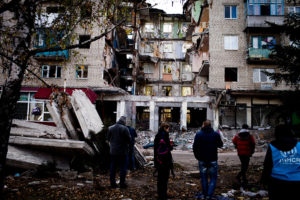
Eastern Ukraine neighbourhood shelled by Ukraine armed forces (UNHCR photo)
By Roger Annis | New Cold War | July 19, 2016
Five days ago, the United Nations Office of the United Nations High Commissioner for Human Rights (OHCHR) released another in a long line of reports purporting to provide an overview of the human rights situation in Ukraine. This latest report is titled “Accountability for killings in Ukraine from January 2014 to May 2016”.
The report is 20 pages long with 31 additional pages of appendix examining “Cases of violations or abuses of the right to life in Ukraine from January 2014 to May 2016”. A press release by the UN body summarizes the content of the report.
The OHCHR report is another outlandish collection of selected facts making a strong inference that a large part of the “abuses to the right to life” it examines are the fault of the Donetsk and Lugansk people’s republics and their self-defense forces.
As with past reports, the OHCHR makes an equivalency between, on the one hand, the governing regime in Kyiv which is bound by all of the international conventions on human rights which previous Ukrainian governments signed onto and, on the other hand, the people’s republics and armed forces of Donetsk and Lugansk which are not so bound. The Donetsk and Lugansk republics cannot sign on to international human rights conventions because they are shunned and unrecognized by most international bodies… including the OHCHR!
At last check, it is not the republics of the former eastern Ukraine which have invaded Ukraine, but Ukraine that has invaded and imposed an ‘Anti-Terrorist Operation’ against the people there. Yet the UN report describes Kyiv’s civil war as a “separatist conflict”.
Adding insult to injury, the UN press release says, “According to the report, the killings are being “fueled by the inflow of foreign fighters and weapons from the Russian Federation”.
The UN report fails to mention that even if such a patently false description of the conflict as being a “separatist conflict” were true, Ukraine is nonetheless duty bound by international convention to protect its nominal citizens and not wage war against them.
The UN report speaks of shadowy “armed groups” in Donetsk and Lugansk who it says are responsible for extra-judicial killings as well as prisoner abuse, torture and killings. Yet when it comes to the extremist and neo-Nazi paramilitaries who are joined with Ukraine’s armed forces in waging civil war, they are given the polite description of “volunteer battalions”. Sounds downright patriotic and heroic!
When it comes to the Kyiv regime itself, the UN report language is all kid glove. For example, in professing concern about the Odessa Massacre of 48 people on May 2, 2014, UN press release writes:
The report also highlighted the violence that took place on 2 May 2014, in Odesa, during which 48 people died as a result of clashes between “pro-unity” and “pro-federalism” groups. OHCHR “remains concerned that the authorities have still not taken appropriate measures to ensure effective investigations into the 2 May 2014 events, nor to protect the independence of the judiciary,” the report said.
On that day in Odessa, nearly all of the victims were peacefully protesting against the coup in Ukraine in February 2014 which deposed the country’s elected president. They were targeted for killing when the trade union building in the center of the city where they had taken refuge from a right-wing mob was set on fire.
Further in the press release we read:
Furthermore, the report found that the lack of accountability remains widespread in Ukraine, despite efforts by the Government [sic] to bring perpetrators from its own ranks to justice and the pre-trial investigations by the Office of the Chief Military Prosecutor into cases of killing, torture and ill-treatment by members of the armed groups of the self-proclaimed [sic] “Donetsk people’s republic” and self-proclaimed “Luhansk people’s republic.”
While acknowledging the challenges faced by the authorities in ensuring justice, including the lack of access to the territories where many of the alleged acts took place, the report noted “an apparent lack of motivation to investigate some cases … especially when it concerns acts allegedly committed by Ukrainian forces.”
What about the Minsk-2 ceasefire agreement, signed by Ukraine on February 12, 2015 and endorsed by no less that the UN Security Council several days later? Not a word of it in the OHCHR press release. In the 20 pages of the report, one finds several references to the need to implement what is called the “Minsk Agreements”, but no detailed description of the content and import of the agreement is provided.
How bad is the official state of human rights in Ukraine? Two months ago, the UN’s Subcommittee on Prevention of Torture took the unprecedented step of cancelling in mid-visit an official visit looking into reported cases of torture by Ukrainian government forces and by rebel authorities in the east. The reason for the cancellation was that Kyiv refused to live up to its obligations under Optional Protocol to the Convention against Torture, an international convention to which a previous Ukrainian government signed on. It requires signators to provide unfettered access to prisons and other places of detention. The subcommittee was intending to investigate reports of secret prisons operated by Ukraine’s police and military services.
Oh, don’t look for information in this latest UN report on the telling experience of the UN’s Subcommittee on Prevention of Torture two months ago. Blank. Apparently, that would be unrelated to “Cases of violations or abuses of the right to life in Ukraine from January 2014 to May 2016”.
Constitutional maneuvering in Ukraine to deny recognition of Donetsk and Lugansk republics and sabotage Minsk-2
New Cold War | July 6, 2015
The Donetsk and Lugansk People’s Republics have announced they will hold local elections on October 18 and November 1, respectively. The two dates surround announced local elections to take place in Ukraine on October 25.
Prime Minister of the Donetsk People’s Republic Aleksandr Zakharchenko made his announcement on July 2. According to UNIAN News, heads of cities and districts will be elected. No decision on the election of members of local councils has been made yet.
Lugansk People’s Republic Prime Minister Igor Plotnitsky announced on July 6 that similar local elections will take place there on November 1.
Interfax reports Zakharchenko as explaining, “In today’s situation, which emerged through Kyiv’s fault, the Donetsk People’s Republic has to independently start to implement the Minsk agreements in order to rescue them.
“We will begin acting immediately, without waiting for Kyiv to come to its senses and return to real, not fake, talks, because any further procrastination and delays will benefit only the Ukrainian party of war.”
Plotnitsky’s statement said, “Recently, we concluded that Ukraine doesn’t intend to abide by its commitments. Kiev either breaks or pretends to execute the provisions of the Minsk Agreement. The Verkhovna Rada issues bills not consistent with our draft documents on matters affecting the Donbass. To date, they’ve refused to define the special status of the LPR, nor have they even begun to write the laws embodying that special status. Besides that, with each passing day, Kiev intensifies its blockade of the LPR.”
“From such a perspective, we decided to begin a unilateral implementation of the Minsk Agreement regarding local elections in the LPR.”
The two prime ministers are referring to the failure of the Kyiv government to respect clauses of the Minsk-2 ceasefire agreement of Feb. 12, 2015 requiring dialogue with the rebel regions of Donetsk and Lugansk as well as a decentralization of powers to them.
The announcements by the two people’s republics administrations are in response to an elaborate scheme by the government of Ukrainian President Petro Poroshenko to dodge the key provisions of Minsk-2 requiring talks and constitutional change.
Back in May, at the eighth Kiev Security Forum, Poroshenko and Ukraine’s prime minister made it clear they will not engage in talks. “We will hold a dialogue with Donbass, but with the other Donbass, a Ukrainian one,” Poroshenko said. He went on, “We must ensure fair elections.”
Prime Minister Arseniy Yatsenyuk said his government would never talk to the current representatives in Donbas. “We will communicate only with the legitimate representatives of this region, we want to hold legitimate elections there.”
Yatsenyuk provocatively said his government would talk to leaders of the Donetsk and Lugansk republics “only when they are behind bars”. He added, “By the way, we have got enough empty prison cells.”
Instead of talks, the Ukraine government convened a Constitutional Commission in April. That body is set to deliver its draft report to the Verkhovna Rada this week. It will propose some cosmetic decentralization changes, but crucially, the changes will deny any present or future recognition of the Donetsk and Lugansk republics. The constitutional changes will be sold to international public opinion as proof of compliance with Minsk-2.
Poroshenko earlier announced local elections for October 25 as part of the scheme. Donetsk and Lugansk republics will, of course, refuse to allow a government in Kyiv waging war on them to conduct elections on their territories. This will be sold as proof of their intransigence and impossibility of dialogue with them.
TASS reports Zakharchenko saying in his July 2 announcement that Kiev’s unilateral actions on adopting amendments to Ukraine’s constitution serve as evidence that “the Kiev regime has de facto exited the Minsk peace process”.
“Under the circumstances,” he said, “the Donetsk People’s Republic has to start implementing the Minsk agreements itself in order to save them.”
The following day, the DPR head responded to an orchestrated statement by U.S. Vice-President Joseph Biden criticizing the Oct. 18 election decision. Zakharchenko said, reports TASS, “The U.S. Vice President has most likely not studied the issue thoroughly. I doubt that he has even read the Minsk package of measures. And Poroshenko is distorting facts as usual.”
He continued, “If Biden is really concerned about the future of the Minsk accords, than he should make Poroshenko and Groysman [Speaker of the Verkhovna Rada] implement them.”
Russian Foreign Minister Sergei Lavrov issued a statement on July 3 saying his government is deeply disappointed with what it calls the failure of the Ukrainian government to respect provisions of Minsk-2. He said, “Russia is deeply concerned about Kiev’s inability and unwillingness to fulfill its commitments to coordinate with Donetsk and Lugansk modalities of conducting local elections and its inability to attract representatives of the self-proclaimed republics to drawing up a new constitution.”
Lavrov said that Poroshenko’s and Yatsenyuk’s government has written a new, draft constitution without participation of Donetsk and Lugansk representatives. This “does not fulfill any of the requirements of the Minsk agreements with regard to this document.”
The draft “does not reflect the tasks of ensuring a special status for these territories on a permanent basis and does not reflect the tasks of decentralization of power,” as envisaged in the peace deal reached in the Belorussian capital in February.
All-Out War in Ukraine: NATO’s ‘Final Offensive’
By James Petras :: 11.20.2014
Introduction
There are clear signs that a major war is about to break out in Ukraine: A war actively promoted by the NATO regimes and supported by their allies and clients in Asia (Japan) and the Middle East (Saudi Arabia).
The war over Ukraine will essentially run along the lines of a full-scale military offensive against the southeast Donbas region, targeting the breakaway ethnic Ukraine- Russian Peoples Republic of Donetsk and Lugansk, with the intention of deposing the democratically elected government, disarming the popular militias, killing the guerrilla resistance partisans and their mass base, dismantling the popular representative organizations and engaging in ethnic cleansing of millions of bilingual Ukraino-Russian citizens. NATO’s forthcoming military seizure of the Donbas region is a continuation and extension of its original violent putsch in Kiev, which overthrew an elected Ukrainian government in February 2014.
The Kiev junta and its newly ‘elected’ client rulers, and its NATO sponsors are intent on a major purge to consolidate the puppet Poroshenko’s dictatorial rule. The recent NATO-sponsored elections excluded several major political parties that had traditionally supported the country’s large ethnic minority populations, and was boycotted in the Donbas region. This sham election in Kiev set the tone for NATO’s next move toward converting Ukraine into one gigantic US multi-purpose military base aimed at the Russian heartland and into a neo-colony for German capital, supplying Berlin with grain and raw materials while serving as a captive market for German manufactured goods.
An intensifying war fever is sweeping the West; the consequences of this madness appear graver by the hour.
War Signs: The Propaganda and Sanctions Campaign, the G20 Summit and the Military Build Up
The official drum- beat for a widening conflict in Ukraine, spearheaded by the Kiev junta and its fascist militias, echoes in every Western mass media outlet, every day. Major mass media propaganda mills and government ‘spokesmen and women’ publish or announce new trumped-up accounts of growing Russian military threats to its neighbors and cross-border invasions into Ukraine. New Russian incursions are ‘reported’ from the Nordic borders and Baltic states to the Caucusus. The Swedish regime creates a new level of hysteria over a mysterious “Russian” submarine off the coast of Stockholm, which it never identifies or locates – let alone confirms the ‘sighting’ of. Estonia and Latvia claim Russian warplanes violated their air space without confirmation. Poland expels Russian “spies” without proof or witnesses. Provocative full-scale joint NATO-client state military exercises are taking place along Russia’s frontiers in the Baltic States, Poland, Romania and Ukraine.
NATO is sending vast arms shipments to the Kiev junta, along with “Special Forces” advisers and counter-insurgency experts in anticipation of a full-scale attack against the rebels in the Donbas.
The Kiev regime has never abided by the Minsk cease fire. According to the UN Human Rights office 13 people on average –mostly civilians –have been killed each day since the September cease fire. In eight weeks, the UN reports that 957 people have been killed –overwhelmingly by Kiev’s armed forces.
The Kiev regime, in turn, has cut all basic social and public services to the Peoples’ Republics’, including electricity, fuel, civil service salaries, pensions, medical supplies, salaries for teachers and medical workers, municipal workers wages; banking and transport have been blockaded.
The strategy is to further strangle the economy, destroy the infrastructure, force an even greater mass exodus of destitute refugees from the densely populated cities across the border into Russia and then to launch massive air, missile, artillery and ground assaults on urban centers as well as rebel bases.
The Kiev junta has launched an all-out military mobilization in the Western regions, accompanied by rabid anti-Russian, anti-Eastern Orthodox indoctrination campaigns designed to attract the most violent far right chauvinist thugs and to incorporate the Nazi-style military brigades into the frontline shock troops. The cynical use of irregular fascist militias will ‘free’ NATO and Germany from any responsibility for the inevitable terror and atrocities in their campaign. This system of ‘plausible deniability’ mirrors the tactics of the German Nazis whose hordes of fascist Ukrainians and Ustashi Croats were notorious in their epoch of ethnic cleansing.
G20-plus-NATO: Support of the Kiev Blitz
To isolate and weaken resistance in the Donbas and guarantee the victory of the impending Kiev blitz, the EU and the US are intensifying their economic, military and diplomatic pressure on Russia to abandon the nascent peoples’ democracy in the south-east region of Ukraine, their principle ally.
Each and every escalation of economic sanctions against Russia is designed to weaken the capacity of the Donbas resistance fighters to defend their homes, towns and cities. Each and every Russian shipment of essential medical supplies and food to the besieged population evokes a new and more hysterical outburst – because it counters the Kiev-NATO strategy of starving the partisans and their mass base into submission or provoking their flight to safety across the Russian border.
After suffering a series of defeats, the Kiev regime and its NATO strategists decided to sign a ‘peace protocol’, the so-called Minsk agreement, to halt the advance of the Donbas resistance into the southern regions and to protect Kiev’s soldiers and militias holed-up in isolated pockets in the East. The Minsk agreement was designed to allow the Kiev junta to build up its military, re-organize its command and incorporate the disparate Nazi militias into its overall military forces in preparation for a ‘final offensive’. Kiev’s military build-up on the inside and NATO’s escalation of sanctions against Russia on the outside would be two sides of the same strategy: the success of a frontal attack on the democratic resistance of the Donbas basin depends on minimizing Russian military support through international sanctions.
NATO’s virulent hostility to Russian President Putin was on full display at the G20 meeting in Australia: NATO-linked presidents and prime ministers, especially Merkel, Obama, Cameron, Abbott, and Harper’s political threats and overt personal insults paralleled Kiev’s growing starvation blockade of the besieged rebels and population centers in the south-east. Both the G20’s economic threats against Russia and the diplomatic isolation of Putin and Kiev’s economic blockade are preludes to NATO’s Final Solution – the physical annihilation of all vestiges of Donbas resistance, popular democracy and cultural-economic ties with Russia.
Kiev depends on its NATO mentors to impose a new round of severe sanctions against Russia, especially if its planned invasion encounters a well armed and robust mass resistance bolstered by Russian support. NATO is counting on Kiev’s restored and newly supplied military capacity to effectively destroy the southeast centers of resistance.
NATO has decided on an ‘all-or-nothing campaign’: to seize all of Ukraine or, failing that, destroy the restive southeast, obliterate its population and productive capacity and engage in an all-out economic (and possibly shooting) war with Russia. Chancellor Angela Merkel is on board with this plan despite the complaints of German industrialists over their huge loss of export sales to Russia. President Hollande of France has signed on dismissing the complaints of trade unionists over the loss of thousands French jobs in the shipyards. Prime Minister David Cameron is eager for an economic war against Moscow, suggesting the bankers of the City of London find new channels to launder the illicit earnings of Russian oligarchs.
The Russian Response
Russian diplomats are desperate to find a compromise, which allows Ukraine’s ethnic Ukraine- Russian population in the southeast to retain some autonomy under a federation plan and regain influence within the ‘new’ post-putsch Ukraine. Russian military strategists have provided logistical and military aid to the resistance in order to avoid a repeat of the Odessa massacre of ethnic Russians by Ukrainian fascists on a massive scale. Above all, Russia cannot afford to have NATO-Nazi-Kiev military bases along its southern ‘underbelly’, imposing a blockade of the Crimea and forcing a mass exodus of ethnic Russians from the Donbas. Under Putin, the Russian government has tried to propose compromises allowing Western economic supremacy over Ukraine but without NATO military expansion and absorption by Kiev.
That policy of conciliation has repeatedly failed.
The democratically elected ‘compromise regime’ in Kiev was overthrown in February 2014 in a violent putsch, which installed a pro-NATO junta.
Kiev violated the Minsk agreement with impunity and encouragement from the NATO powers and Germany.
The recent G20 meeting in Australia featured a rabble-rousing chorus against President Putin. The crucial four-hour private meeting between Putin and Merkel turned into a fiasco when Germany parroted the NATO chorus.
Putin finally responded by expanding Russia’s air and ground troop preparedness along its borders while accelerating Moscow’s economic pivot to Asia.
Most important, President Putin has announced that Russia cannot stand by and allow the massacre of a whole people in the Donbas region.
Is Poroshenko’s forthcoming blitz against the people of southeast Ukraine designed to provoke a Russian response – to the humanitarian crisis? Will Russia confront the NATO-directed Kiev offensive and risk a total break with the West?
James Petras latest book is THE POLITICS OF IMPERIALISM:THE US,ISRAEL AND THE MIDDLE EAST (CLARITY PRESS:ATLANTA)
Self-proclaimed Donetsk and Lugansk republics form ‘Novorossiya’ union
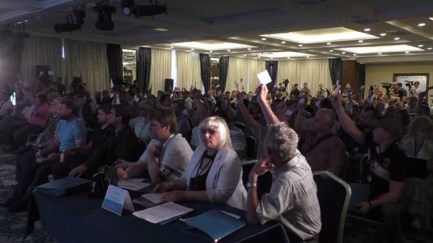
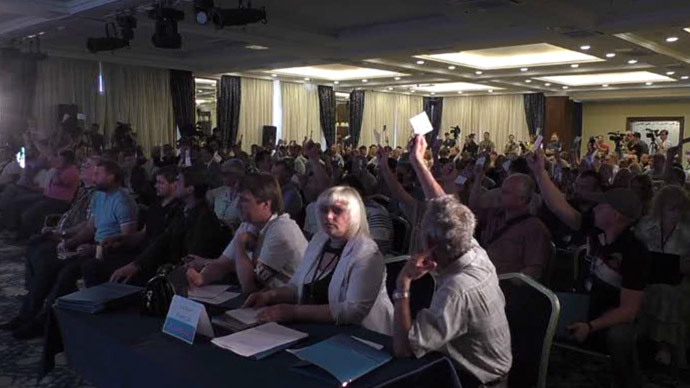
Representatives from eight south-eastern regions voting at the people’s congress in Donetsk
RT | May 24, 2014
Self-proclaimed Donetsk and Lugansk People’s Republics which recently held referenda on independence from Ukraine have declared the creation of Novorossiya union.
“We have signed a memorandum on the union,” Denis Pushilin, co-chairman of the Donetsk People’s Republic, told the media.
The new union will be called Novorossiya, said the people’s governor of the Donetsk Region, Pavel Gubarev.
He added that the document was signed in the city of Donetsk by Donetsk People’s Republic Prime Minister Aleksandr Borodai and the head of Lugansk People’s Republic Aleksey Karyakin.
People’s representatives from eight Ukrainian regions gathered for a congress in Donetsk on Saturday, a day ahead of scheduled countrywide presidential elections.
As a result of the congress, the south-eastern regions of Ukraine, where anti-government protests gained momentum, have announced the creation of a pro-federalization Popular Front socio-political coalition. The movement accepted a manifesto vowing self-determination and protection of people from “Nazi gangs’ terror.”
The coalition involves Odessa, Nikolaev, Dnepropetrovsk, Zaporozhye, Kharkov, Kherson, Donetsk and Lugansk Regions.
At the congress, all 145 delegates accepted the manifesto, which stresses that the Popular Front will consist of “everybody, who is ready to resist self-appointed Kiev authority, which started war against the people.”
The coalition vowed to protect innocent civilians from the “terror of Nazi gangs, financed by oligarchs and foreign security services.” It also pledges “a joint fight for people’s rights to a decent life.”
It says it has launched an investigative commission that will probe “crimes of Nazi-terrorists and their Kiev patrons”.
The coalition is calling for a boycott of the presidential election, which is scheduled to take place on Sunday, because “all major candidates” are “oligarchs, whom we have already seen in top positions, hence, robbery and terror would continue,” the manifesto said.
When it comes to a new Ukrainian constitution, the Popular Front demands that it guarantees “neutrality” and non-participation in military blocks as well as “political independence”, “mechanisms to stop corruption and massive poverty.”
The coalition also demands that the parliament consists of two chambers. At the same time, regions must be given “a right to autonomy” and “independent foreign-economic activity”.
In addition to that, regional governments must be given a right to “announce its territory de-militarized zones and also “ban political, social and religious organizations on its territory” in case they are considered a “threat” to the people.
The Popular Front wants two official languages in Ukraine – Ukrainian and Russian.
Lugansk and Donetsk People’s Republics earlier announced they will not participate in Ukraine’s presidential elections scheduled for May 25.
Ukrainian ultranationalist leader calls for guerilla war against pro-federalists
RT | May 18, 2014
Television debates with three nationalist presidential candidates ended up in calls to pursue a guerilla war against federalist Ukrainian citizens and conduct targeted assassinations of their leaders.
The leader of the radical Right Sector movement, Dmitry Yarosh, and his no less nationalist opponents, former chief of foreign intelligence service, Nikolay Malomuzh, and chairman of People’s Rukh nationalist party, Vasily Skubiyda, presented their vision of Ukraine on Saturday after the presidential election set for May 25.
Because their positions are really close, they represent the far-right body of electors. The extremist views of Dmitry Yarosh stood out against a background of total antagonism towards everything non-Ukrainian, in the first place the Russian-speaking citizens of the country’s southeast who are demanding federalization.
The leader of the militants, who now make up the backbone of the newly created National Guards, currently conducting military operations against federalization activists in eastern Ukraine, has called for “extensive guerilla war” against the protesting federalist forces in Donetsk and Lugansk.
The Right Sector, which last month formed a special detachment, Donbass-1, for waging war against the federalists in eastern Ukraine, is now busy forming the Donbass-2 unit and plans to recruit militants for a third one, said Yarosh.
The ultranationalist leader categorically denied that the autonomous republic of Crimea had the right to disengage with Ukraine through a popular referendum and reunite with Russia. Crimea “has always been, and remains” a Ukrainian territory, stated Yarosh and called to start a guerilla war in the peninsula get the region back.
The Right Sector leader also shared new tactics to be used against federalists in the East, saying that there should be no more attempts to storm the rebel cities, but rather “knock out” the activist leaders. It means that they should be physically eliminated, he specified.
The federalization of Ukraine should never be allowed as it would destroy the Ukrainian state, stressed Yarosh, and promised in case of victory in the presidential race to form future authorities out of Maidan activists who have proven their loyalty.
There is no secret that several Ukrainian oligarchs, who were appointed governors of several eastern regions of the country by the new Kiev authorities, are financing paramilitary units that actually make up private armies of their own.
As for and the Right Sector, its leader Dmitry Yarosh stated that he is “against oligarchs.” The new politician claimed that once he becomes president, he would “redirect Ukrainian economy and tax system from supporting monopolies owned by oligarchs to support small and medium business.”
However, the Right Sector leader never explained what happened to the valuables that were reported missing after Right Sector members occupied certain premises, such as the recreational center ‘Bear oak grove’, or the lavish residence of the former Ukrainian President Viktor Yanukovich soon after the ousted president fled the country.
During the debates, all three candidates agreed that there should be only one official language in Ukraine to maintain the integrity of the country. The presidential candidates expressed a readiness to ensure the rights of the ‘national minorities,’ but offered no solution to the historically Russian-speaking majority of the 20 million-strong population of the South and East of Ukraine, who do not speak Ukrainian.
Towards the end of the debates, Dmitry Yarosh made a controversial statement, addressing the electorate.
“I would like to assure all citizens in the East and South of Ukraine that neither me as a person, nor the Right Sector, bear any ill will to peaceful Ukrainian citizens. Yes, we’re ready to carry out our constitutional duty to protect territorial integrity and the sovereignty of Ukraine, and we’re already doing so. We will protect our country with arms if necessary,” said Yarosh.
In fact, Ukrainian citizens of the protesting regions have every right to fear Yarosh and his Right Sector union as they are acting as the spearhead of punitive actions against the protesters in the Donetsk, Lugansk, Kharkov and Odessa regions.
So far there have been 23 registered presidential candidates in Ukraine, but five of them have called off their candidacies for various reasons.
Developments over the last several months have revealed that the coup-imposed government in Kiev has little, if any authority over the Right Sector’s actions.
After a notorious Right Sector radical militant, Aleksandr Muzychko, was shot dead in a police raid in late March, Dmitry Yarosh demanded the immediate resignation of the Interior Minister Arsen Avakov and punishment for those law enforcement officers who took part in the operation. Right Sector militants besieged the Ukrainian parliament headquarters, forcing the coup-imposed government to consider banning the radical organization, but it never dared to do so.
In Russia Dmitry Yarosh has been put on the wanted list for taking part in killing Russian soldiers in Chechnya in 1994-1995. Moscow also requested Interpol to put the ultranationalist on the international wanted list.
Lugansk and Donetsk regions vote for self-determination
RT | May 11, 2014
The referendum is in full swing in Ukraine’s Donetsk and Lugansk regions, seeking independence from the central government. Local self-defense forces boosted security, fearing that Kiev could stage provocations to disrupt the self-determination vote.
Turnout at the referendum is exceptionally high, the head of the Central Election Commission of the self-proclaimed “Donetsk People’s Republic,” Roman Lyagin, told Interfax.
“The turnout is not just high, it’s off the charts,” Lyagin said. “People are queuing up at polling stations, and election commissions are working at full capacity.”
In Lugansk, 22 percent of eligible voters cast their ballots two hours after the polls opened, a leader of the city’s self-defense forces, Vasily Nikitin, told RIA Novosti.
In Mariupol, recovering from Friday’s deadly clashes, only eight polling stations have been opened, according to the coordinator of the central election commission of the “Donetsk People’s Republic”, Boris Litvinov. Those willing to vote have to wait for their turn in huge queues.
Almost simultaneously with the opening of polling stations, sounds of shooting and artillery fire were heard on the outskirts of Slavyansk, in southeast Ukraine’s Donetsk region, RIA Novosti reported, citing its correspondent in the area.
Slavyansk already witnessed mortar shelling of its outskirts by Ukrainian forces on the eve of the referendum. In the embattled city the stations will close at 15:00 GMT for security reasons.
Some 1,471 polling stations in Lugansk region and around 1,500 in Donetsk region opened their doors for voters at 8:00 local time (5:00 GMT) and will close at 22:00 (19:00 GMT). Security has been tightened around them.
“We sent additional self-defense units to polling stations and also to the most important social institutions,” a Lugansk self-defense leader, Aleksey Chmilenko, told Interfax. “So far everything is normal, there are no incidents.”
RT’s Paula Slier, currently in Donetsk, reports that Roman Lyagin, chair of the central election commission in the region, believes that a provocation has been planned and says that anti-government activists are ready for it.
An attempt at provocation was registered in Lugansk, where a group of people tried to take away ballot papers from voters, a representative of the city’s self-defense forces, Vasily Nikitin, told RIA Novosti. He said the attempt to disrupt voting was foiled and the incident is being investigated.
Citizens of the two southeastern regions of Ukraine are being asked if they “support the Act of state self-rule” of Donetsk People’s Republic or Lugansk People’s Republic. The election commission officials explained that the people are not choosing between staying within Ukraine and joining Russia, as widely reported, but instead are asked to support regions’ right for political self-determination.
Over 3 million ballot papers were printed for Donetsk region. All in all, the organizers spent about 20,000 hryvnas preparing for the vote in Ukraine’s industrial region, the heart of the country’s coal-mining. “The referendum will be considered valid whatever voter turnout will be,” Roman Lyagin, the head Donetsk election commission told reporters on Saturday.
In Donetsk, western observers are not present at the polling stations, commission officials said, as nobody expressed willingness to oversee the vote in the turbulent region. “We did not refuse anyone, there were no applications,” Lyagin said, adding though that over 470 international journalists are accredited in Donetsk.
Some 30 international observers are monitoring the voting in Lugansk region, where some 1.8 million are expected to take part in the referendum. “According to a survey, 83% of Lugansk residents are ready to support the Act of state self-rule of the People’s Republic of Lugansk,” said Igor Shakhov, the head of the local election commission.
Security measures have been increased on the day of the historic vote with self-defense units in both regions preparing to thwart any attempt by Kiev’s military and paramilitary forces to disrupt the vote and prevent provocations by radicals at the polling stations.
The referendums, announced back in March, are going ahead as planned despite Russian President Putin’s call on pro-federalization activists to postpone them due to the deteriorating and unpredictable security situation in Ukraine.
The Kiev government as well as many western countries, including the US, France and Germany are calling the referendums “illegal” and urge dialogue between all conflicting parties in Ukraine, at the same time showing no readiness to stop the punitive military operation in the east of the country.
If a majority of voters answer “yes” on Sunday the regions will gain full moral right to officially state they do not accept what is happening in the country, anti-coup protesters say. The combined population of Donetsk and Lugansk industrial regions, rejecting the legitimacy of the coup-installed Kiev authorities, stands at about 6.7 million in a country of 45 million.

Featured Video
Laith Marouf: Hezbollah’s position on US-Iran ceasefire
or go to
Aletho News Archives – Video-Images
From the Archives
The Dirty Little Secret behind the “Global Terrorism Index”
The Omission of Israeli Terrorism in the Occupied Palestinian Territories
By Karin Brothers | Global Research | December 6, 2014
… The Israeli settlements — all of which are illegal – have been identified as a major impediment to peace. The refusal of a major “global” terrorism report to name the Israeli settlers as one of the groups most responsible for terrorism not only misrepresents a major source of regional violence but exposes the Global Terrorism Index as a propaganda tool that supports a U.S. agenda.
In recent years, governments have been attempting to thwart terrorism by blocking supportive fund-raising. When it comes to Israeli settlements, however, the US and Canada actually encourage fund-raising by giving organizations (such as Christian Friends of Israeli Communities (CFOIC) and the Jewish National Fund) financial support in the form of donor tax-deductions.
Charities which provide funds for the Israeli settlements should be regarded as terror-financing organizations. They should not only lose their tax-deductible status, but they should be banned because they support the violation of international humanitarian law. The terror-financing laws that are being strictly enforced for Muslim charities should be applied to Christian and Jewish charities as well. … Read full article
Blog Roll
 Aletho News
- The ‘Opposition Party’ Has Done Nothing to Stop the Iran War and Much to Goad Trump Into Continuing It
- Moscow backs Tehran on status of Lebanon in US-Iran deal
- How UK Regulator Ofcom Quietly Bypassed International Law to Police American Speech
- The Black Cube Files: How Former Mossad Operatives Flipped a Nation
- Laith Marouf: Hezbollah’s position on US-Iran ceasefire: What you’re not being told
- Israel’s priority lies in destroying chances of peace between Iran, US: Ex-UN nuclear chief
- Ceasefire for all or for none: Iran shuts Hormuz over Lebanon attacks
- Strait of Hormuz is Iran’s ‘nuclear weapon’ that forced US retreat: Medvedev
- Energy crisis will last for months – Kremlin envoy
- Europe’s quiet role in the war on Iran
- If Americans Knew
- This is ceasefire? Israel’s biggest massacre yet in Lebanon, another journalist killed in Gaza – Daily Update
- Tucker Carlson on Israel: This Is the Behavior of an Ally? Really?
- Gazans face a triple crisis: severe shortages of water and bread, healthcare in tatters
- NY Times reports how Netanyahu took the US into Iran War
- A sigh of relief over Iran, but Gaza and Lebanon in dire straits – Daily Update
- Thousands dead and neighborhoods razed to the ground: Aid agencies fear southern Lebanon is becoming the new Gaza
- The war the US is fighting for Israel could cost trillions
- ‘Cigarette Burns, Nail Wounds’: Toddler Tortured in Gaza to Coerce Father
- Trump Says US Sent ‘a Lot of Guns’ to Protesters in Iran
- Israeli forces destroy 17 UN peacekeeper cameras in south Lebanon
- No Tricks Zone
- An Inconvenient Tree: Uncovered In Alps… Europe Much Warmer Than Today 6000 Years Ago
- New Study Reports A 60% Slowdown In Greenland’s Ice Loss Rate In The Last Decade
- Low Intensity Tornado Wrecks Major Solar Farm, Creating A Potential Toxic Dump
- New Study Finds Warming Saves Lives…Cold Temperatures 12 Times More Deadly Than Excess Heat
- German Science Blog Accuses PIK Climate Institute Of Hallucinating Climate Tipping Points
- Devastating Assessment Of Comirnaty Vaccine By Former Senior Pfizer Europe Toxicologist
- New Study: CO2 Is ‘Effectively Negligible’ As An Explanatory Climate Change Factor Since 2000
- Former Pfizer Toxicologist Dr. Helmut Sterz Tells Bundestag Hearing Pfizer Vaccine Should Have Never Been Approved
- Energy Expert: Germany’s Nuclear Phaseout Was A “500 Billion Euro Mistake”
- New Research: South Australia’s Mid-Holocene Sea Surface Temperatures Were 4°C Warmer Than Today
 Aletho News