Who Are the Leading State Sponsors of Terrorism?
By Philip M. GIRALDI | Strategic Culture Foundation | 28.12.2017
As 2017 draws to a close, it is difficult to be optimistic about what will be coming in the new year. The American President, whose margin of victory was certainly based on his pledge to avoid unnecessary wars, has doubled down on Afghanistan, refuses to leave Syria even though ISIS has been defeated, and is playing serious brinksmanship with a psychopathic and unpredictable regime in Pyongyang. The White House has also bought into the prevailing largely fabricated narrative about a Russia and has decided to arm Ukraine with offensive weapons, which has already resulted in a sharp response from Moscow and will make détente of any kind between the two leading powers all but impossible in the upcoming year.
But, as I have observed before, the red hazard light that continues to be blinking most brightly relates to Washington’s relationship with Iran, which has unnecessarily deteriorated dramatically over the past year and which brings with it collateral problems with Russia and Turkey that could trigger a much wider conflict. I say unnecessarily because all the steps taken to poison the relationship have come out of Washington, not Tehran. The Trump administration refused to certify that the Iranians had been in compliance with the nuclear agreement negotiated in 2015 and has since escalated its verbal attacks, mostly at the United Nations, claiming that the regime in Tehran is the major source of terrorism in the world and that it is seeking hegemony over a broad arc of countries running westward from its borders to the Mediterranean Sea.
The only problem with the allegations being made is that none of them is true and, furthermore, Iran, with limited military resources, poses no serious threat to gain control over its neighbors, nor to attack the United States or Europe. The invective about Iran largely derives from Israel and Saudi Arabia, which themselves have hegemonic ambitions relating to their region. Israel’s friends in the US Congress, media and White House have not surprisingly picked up on the refrain and are pushing for military action. Israel has even threatened to bomb any Iranian permanent presence inside neighboring Syria.
A recent detailed analysis by former US intelligence officers has demonstrated just how the claim that Iran is the world’s leading sponsor of terrorism is almost completely fabricated. The analysis explains how these false narratives are contrived and how they become part of the Washington background noise. The White House’s recent National Security Strategy Report for 2018 stated that “Iran, the world’s leading state sponsor of terrorism, has taken advantage of instability to expand its influence through partners and proxies, weapon proliferation, and funding.” But another US government report, the annual Country Reports on Terrorism 2016 cites no actual terrorist incidents initiated by Iran in that year. In fact, the most recent terrorist incident attributed to Tehran was in 2012, and that was retaliatory against Israel, which was at the time assassinating Iran’s scientists and technicians and attacking its computer systems.
America’s UN Ambassador Nikki Haley’s has recently claimed that it is hard to find a “terrorist group in the Middle East that does not have Iran’s fingerprints all over it.” But in reality, the overwhelming majority of terrorist groups in the region, to include ISIS, Al-Qaeda and al-Nusra, are Sunni Muslims, who believe Iran’s Shi’ism is heretical, and are both tied to and funded by Qatar, Saudi Arabia and the United States. The Mujahedin-e-Khalq (MEK) is indeed an ethnic Iranian terrorist group, but it has been funded and supported by Washington and Tel Aviv to carry out attacks inside Iran.
The reality is that terrorism, defined by the United Nations as “criminal acts intended or calculated to provoke a state of terror in the general public,” is most employed at the state level by the United States and its allies Israel and Saudi Arabia, not by Iran. All have used violence directed against civilians in places like Afghanistan, Iraq, Syria, Yemen and Lebanon, and all three have supported organizations that fit the definition of terrorists. Iran may indeed be guilty of actions that much of the world disapproves of, but it is not the world’s leading state sponsor of terrorism as has been alleged.
The Rise of MEK/NCRI in Washington: Pay Off The Right People and You Are No Longer A Terrorist

Maryam Rajavi- Rudy Giuliani and Senator Joe Lieberman at the free Iran Gathering – 1 July 2017. Image credit: Maryam Rajavi/ flickr)
By Philip Giraldi | American Herald Tribune | October 30, 2017
If you want to change a group of terrorists who have killed Americans overseas into something that appears to be much more benign, all you have to do is pay off the right people in Washington. With enough money, you can even open a nice plush lobbying office on Pennsylvania Avenue in the District of Columbia, not too far from the White House and Capitol Hill.
One-time Secretary of State Hillary Clinton has been rightly blamed for the ill-conceived and badly bungled “regime change” in Libya in 2011 that eventually led to her mishandling of the resulting blowback in Benghazi, but one of her greatest failings just might have involved the piece of paper she signed when she removed the Mujaheddin e Khalq (MEK) group from the State Department list of “designated terrorist organizations” in September 2012.
How is it possible that the bad judgment demonstrated in the Libyan fiasco that created a failed state, a humanitarian disaster, a migrant crisis, armed terrorists and ultimately produced the murder of the U.S. ambassador and three other Americans compares with a signature on a piece of paper? It is because that signature put in place one of the elements that will most likely in the near future lead to a far more disastrous war for the United States than was Libya. MEK, now labeled the National Council of Resistance of Iran (NCRI), has become a principal voice of the war party that is now seeking to attack Iran, a role similar to that played by Ahmad Chalabi and his Iraqi National Congress in his disseminating of lies in the lead up to the catastrophic invasion of Iraq in 2003.
The tale of the rehabilitation and rise of MEK/NCRI is a subset of the ongoing corruption of America’s political culture, best illustrated by the fact that even national security is now up for sale, enabling a terrorist group to transform itself into a “resistance movement” and eventually be labeled “freedom fighters.”
How did this happen as MEK was on the State Department roster of foreign terrorist organizations since the list was established in 1997? Its inclusion derived from its having killed six Americans in the 1970s, its participation in the U.S. Embassy hostage-taking and from its record of extreme violence both inside and outside Iran since that time. When I was a CIA trainee our course included a simulation of the horrific attack on U.S. Air Force Officers in Tehran in 1973 that killed two colonels.
MEK is widely regarded as a terrorist cult headed by a bizarre husband and wife team Massoud and Maryam Rajavi. Its members are required to be celibate and are subjected to extensive brainwashing, physical torture, severe beatings even unto death, and prolonged solitary confinement if they question the leadership. One scholar who has studied them describes their beliefs as a “weird combination of Marxism and Islamic fundamentalism.”
With the sharp turn of the Trump Administration against Iran, NCRI is now finding an audience, telling the American public that Iran is “cheating” on the nuclear deal. It also tells us that “Iran’s nuclear weapons program has far from halted” and has claimed to identify four major sites that “with a high degree of certainty” have been involved in various aspects of the allegedly ongoing nuclear weapons project. This has led Jillian Mele of Fox News to declare, falsely, that “It appears [Iran’s nuclear] weapons program is fully operational.”
The CIA has in the past recruited MEK/NCRI agents to enter into Iran and report on nuclear facilities, but Israel’s Mossad is the group’s principal employer. Agents, recruited and trained by Israel, have killed a number of Iranian nuclear scientists and officials. The group appears to have ample financial resources, places full page ads in major US newspapers, and is also known to pay hefty fees to major political figures who are willing to speak publicly on its behalf. The group claims to want regime change in Iran to restore democracy to the country, an odd assertion as it itself has no internal democracy and is loathed by nearly all Iranians.
Because MEK/NCRI is a resource being used by Tel Aviv in its clandestine war against Iran, it is perhaps inevitable that many friends of Israel in the United States actively campaigned to have the group removed from the terrorism list so that it could, ironically, have a free hand to continue to terrorize Iran. Indeed, neocons at their various think tanks and publications as well as the American Israel Public Affairs Committee all recommended delisting the group and continue to support it. Prominent American Jews to include Elie Wiesel and Alan Dershowitz have been advocates for the group in spite of its record of terrorism.
Multi-million dollar contracts with Washington lobbying firms experienced at “working” congress backed up by handsome speaking fees have induced many prominent Americans to join the chorus supporting NCRI. Prior to 2012, speaking fees for the group started at $15,000 and went up from there. Former Pennsylvania governor Ed Rendell reported more than $150,000 in honoraria. Rudy Giuliani has been paid generously for years at $20,000 per appearance for brief, twenty-minute speeches. Bear in mind that MEK was a listed terrorist group at the time and accepting money from it to promote its interests should have constituted material support of terrorism.
The group’s well-connected friends have included prominent neocons like John Bolton and ex-CIA Directors James Woolsey, Michael Hayden and Porter Goss as well as former Generals Anthony Zinni, Peter Pace, Wesley Clark, and Hugh Shelton. Traditional conservatives close to the Trump Administration like Newt Gingrich, Fran Townsend and Elaine Chao are also fans of NCRI. Townsend in particular, as a national security specialist, has appeared on television to denounce Iran, calling its actions “acts of war” without indicating that she has received money from an opposition group.
The emergence of NCRI at this time is just another fool’s game with the usual Washington crowd queuing up for a bad cause because they are both lining their pockets and thinking they are helping Israel by punishing Iran. In any event it is a poor bargain for the rest of us, but that hardly seems to matter anymore.
Tehran Was Always America’s and Thus the Islamic State’s Final Destination
By Tony Cartalucci – New Eastern Outlook – 10.06.2017
Several were left dead and many more injured after coordinated terror attacks on Iran’s capital of Tehran. Shootings and bombings targeted Iran’s parliament and the tomb of Ayatollah Khomeini.
According to Reuters, the so-called “Islamic State” claimed responsibility for the attack, which unfolded just days after another terror attack unfolded in London. The Islamic State also reportedly took responsibility for the violence in London, despite evidence emerging that the three suspects involved were long-known to British security and intelligence agencies and were simply allowed to plot and carry out their attacks.
It is much less likely that Tehran’s government coddled terrorists -as it has been engaged for years in fighting terrorism both on its borders and in Syria amid a vicious six-year war fueled by US, European, and Persian Gulf weapons, cash, and fighters.
Armed Violence Targeting Tehran Was the Stated Goal of US Policymakers
The recent terrorist attacks in Tehran are the literal manifestation of US foreign policy. The creation of a proxy force with which to fight Iran and establishing a safe haven for it beyond Iran’s borders have been long-stated US policy. The current chaos consuming Syria and Iraq – and to a lesser extent in southeast Turkey – is a direct result of the US attempting to secure a base of operations to launch a proxy war directly against Iran.
In the 2009 Brookings Institution document titled, “Which Path to Persia? Options for a New American Strategy toward Iran,” the use of then US State Department-listed foreign terrorist organization Mujahedin-e Khalq Organization (MEK) as a proxy for instigating a full-fledged armed insurgency not unlike that which is currently unfolding in Syria was discussed in detail.
The report explicitly stated:
The United states could also attempt to promote external Iranian opposition groups, providing them with the support to turn themselves into full-fledged insurgencies and even helping them militarily defeat the forces of the clerical regime. The United states could work with groups like the Iraq-based National council of resistance of Iran (NCRI) and its military wing, the Mujahedin-e Khalq (MeK), helping the thousands of its members who, under Saddam Husayn’s regime, were armed and had conducted guerrilla and terrorist operations against the clerical regime. although the NCRI is supposedly disarmed today, that could quickly be changed.
Brookings policymakers admitted throughout the report that MEK was responsible for killing both American and Iranian military personnel, politicians, and civilians in what was clear-cut terrorism. Despite this, and admissions that MEK remained indisputably a terrorist organization, recommendations were made to de-list it from the US State Department’s Foreign Terrorist Organization registry so that more overt support could be provided to the group for armed regime change.
Based on such recommendations and intensive lobbying, the US State Department would eventually de-list MEK in 2012 and the group would receive significant backing from the US openly. This included support from many members of current US President Donald Trump’s campaign team – including Rudy Giuliani, Newt Gingrich, and John Bolton.
However, despite these efforts, MEK was not capable then or now of accomplishing the lofty goal of instigating full-fledged insurrection against Tehran, necessitating the use of other armed groups. The 2009 Brookings paper made mention of other candidates under a section titled, “Potential Ethnic Proxies,” identifying Arab and Kurdish groups as well as possible candidates for a US proxy war against Tehran.
Under a section titled, “Finding a Conduit and Safe Haven,” Brookings notes:
Of equal importance (and potential difficulty) will be finding a neighboring country willing to serve as the conduit for U.S. aid to the insurgent group, as well as to provide a safe haven where the group can train, plan, organize, heal, and resupply.
For the US proxy war on Syria, Turkey and Jordan fulfill this role. For Iran, it is clear that US efforts would have to focus on establishing conduits and safe havens from Pakistan’s southwest Balochistan province and from Kurdish-dominated regions in northern Iraq, eastern Syria, and southeastern Turkey – precisely where current upheaval is being fueled by US intervention both overtly and covertly.
Brookings noted in 2009 that:
It would be difficult to find or build an insurgency with a high likelihood of success. The existing candidates are weak and divided, and the Iranian regime is very strong relative to the potential internal and external challengers.
A group not mentioned by Brookings in 2009, but that exists in the very region the US seeks to create a conduit and safe haven for a proxy war with Iran, is the Islamic State. Despite claims that it is an independent terrorist organization propelled by black market oil sales, ransoms, and local taxes, its fighting capacity, logistical networks, and operational reach demonstrates vast state sponsorship.
The Ultimate Proxy, the Perfect Conduit and Safe Haven
The Islamic State reaching into Iran, southern Russia, and even as far as western China was not only possible, it was inevitable and the logical progression of US policy as stated by Brookings in 2009 and verifiably executed since then.
The Islamic State represents the perfect “proxy,” occupying the ideal conduit and safe haven for executing America’s proxy war against Iran and beyond. Surrounding the Islamic State’s holdings are US military bases, including those illegally constructed in eastern Syria. Were the US to wage war against Iran in the near future, it is likely these assets would all “coincidentally” coordinate against Tehran just as they are now being “coincidentally” coordinated against Damascus.
The use of terrorism, extremists, and proxies in executing US foreign policy, and the use of extremists observing the Islamic State and Al Qaeda’s brand of indoctrination was demonstrated definitively during the 1980’s when the US with the assistance of Saudi Arabia and Pakistan – used Al Qaeda to expel Soviet forces from Afghanistan. This example is in fact mentioned explicitly by Brookings policymakers as a template for creating a new proxy war – this time against Iran.
For the US, there is no better stand-in for Al Qaeda than its successor the Islamic State. US policymakers have demonstrated a desire to use known terrorist organizations to wage proxy war against targeted nation-states, has previously done so in Afghanistan, and has clearly organized the geopolitical game board on all sides of Iran to facilitate its agenda laid out in 2009. With terrorists now killing people in Tehran, it is simply verification that this agenda is advancing onward.
Iran’s involvement in the Syrian conflict illustrates that Tehran is well aware of this conspiracy and is actively defending against it both within and beyond its borders. Russia is likewise an ultimate target of the proxy war in Syria and is likewise involved in resolving it in favor of stopping it there before it goes further.
China’s small but expanding role in the conflict is linked directly to the inevitability of this instability spreading to its western Xianjiang province.
While terrorism in Europe, including the recent London attack, is held up as proof that the West is “also” being targeted by the Islamic State, evidence suggests otherwise. The attacks are more likely an exercise in producing plausible deniability.
In reality, the Islamic State – like Al Qaeda before it – depends on vast, multinational state sponsorship – state sponsorship the US, Europe, and its regional allies in the Persian Gulf are providing. It is also sponsorship they can – at anytime of their choosing – expose and end. They simply choose not to in pursuit of regional and global hegemony.
The 2009 Brookings paper is a signed and dated confession of the West’s proclivity toward using terrorism as a geopolitical tool. While Western headlines insist that nations like Iran, Russia, and China jeopardize global stability, it is clear that they themselves do so in pursuit of global hegemony.
Iranophobes on Parade
Will Iran be the target of the Trump regime?
By Philip Giraldi • Unz Review • November 29, 2016
One of the most discouraging aspects of the filling out of the Donald Trump cabinet is the array of Iran haters that seem to be lining up in the foreign policy and national security areas. Trump has been personally advocating sensible policies relating to Russia and Syria but he appears to have gone off the rails regarding Iran, which just might be attributed to those who are giving him advice. A reversion to the relationship that prevailed prior to last year’s signing of the Joint Comprehensive Plan of Action (JCPA) between Iran and the so-called P5+1 consisting of the United States, Russia, China, France, Britain, and the European Union would be undesirable, to say the least, but that appears to be what is likely to develop. Or it could be even worse, finding bilateral support for “action” as a number of policy advisors in the presidential campaign from both parties were endorsing something like war against the Persians.
The irony is that the arguments made then and now for attacking Iran were based on the threat of Tehran deciding to build its own atomic bomb. With the JCPA agreement, however, most would agree that any remaining concerns that Tehran might even be considering the development of a nuclear weapons program were greatly diminished. Iran has since that time been in compliance with the agreement, possible nuclear proliferation has been avoided, and, apart from the fulminations of the inevitable anti-Iranian politicians in the United States, the signatories to the agreement have expressed their satisfaction with the outcome. It has been Washington that has failed to live up to its part of the agreement by easing remaining restrictions that are being imposed against Iranian financial institutions and regarding the purchase of some commercially available dual use technologies.
Candidate Donald Trump did not need much prompting to pick up on the prevailing anti-Iran sentiment. In a number of campaign speeches he denounced the JCPA as a bad deal and vowed to tear it up upon taking office. Some of that sentiment might well have been derived from his desire to distance himself from foreign policy positions promoted by President Barack Obama that were subsequently endorsed by Hillary Clinton so it is no surprise that since being elected he has somewhat modified his stance. He is now veering towards trying to renegotiate the agreement, which would likely be impossible given that it has multiple signatories. He could nevertheless disrupt it by continuing or increasing sanctions on Iran.
The thought of reverting to a state of unrelenting hostility towards Iran is disconcerting. One recalls joint CIA-Mossad operations between 2010 and 2012 that assassinated four civilian scientists connected to the country’s nuclear program as well as the creation of the Stuxnet virus that threatened to spread to other computers worldwide. It is generally accepted that Israel’s Mossad planned and prepared the killing of the scientists with a little help from the U.S., attacks which were almost certainly carried out by associates of the radical Marxist group Mujaheddin e Khalq (MEK), which is now being seen favorably by several Trump advisors even though the group is Marxist, cult-like and has killed Americans.
The assassinations were based on the false premise that Iran had a nuclear weapons program that could be disrupted by killing the scientists and technicians involved. Two comprehensive studies by the American government’s Central Intelligence Agency (CIA) conducted in 2007 and 2011 determined that no such program existed and that Iran had never taken any serious steps to initiate such research. Israel was also aware that there was no program. Nevertheless, the Israeli and American governments took steps to interfere with Iran’s existing and completely legal and open to inspection atomic energy program by identifying then killing its scientists and also introducing viruses into its computer systems. This was in spite of the fact that Iran was fully compliant with international norms on nuclear research and it was a signatory to the Nuclear Non-Proliferation Treaty (NPT), which Israel, possessing its own nuclear arsenal, had refused to sign.
The history of the Iran-U.S. relationship is significant because several Trump advisors appear to be locked into a time warp regarding the Mullahs and the threat to Americans that they allegedly constitute. Former Defense Intelligence Agency (DIA) head Michael Flynn, who will be the Trump National Security Advisor, is the most prominent Iran hater and also the most outspoken.
Flynn, also an unapologetic Islamophobe, has said that Iran represents a danger to U.S. national security and that our friend and ally Israel “lives under the threat of total annihilation from Iran… something the United States must never allow.” He believes that Iran intends to build nuclear weapons as well as the ballistic missiles needed to deliver them on target and thinks that “regime change” is the only solution to the threat posed by the current government. And for Flynn, Iran is not alone, it is part of a “global alliance” that includes China and Russia which seeks to threaten the U.S. and its allies.
Flynn concludes that Iran is unmitigated evil and that Washington should have nothing to do with it, apart from recognizing the reality that it and its government must be destroyed. I personally attended a conference in Moscow last December at which Flynn asserted that Iran is solely responsible for nearly all the instability in the Middle East and is behind at least five wars in the region, an assertion that is just as ridiculous as it sounds.
One might suggest that Flynn is terribly uninformed about a subject regarding which he claims expertise. His comments would suggest that the capabilities of the DIA that he once headed were dangerously overrated, but reports from his former colleagues indicate that he was always guilty of serious overreach in his pronouncements, something they referred to as “Flynn facts”.
If Flynn were just one loud voice braying in the wilderness he would be bad enough since his job is important, particularly with a president who has no foreign policy experience, but the sad fact is that he is not alone. Congressman, West Point grad and former Army officer Mike Pompeo, who will head the CIA, is more-or-less on the same page when it comes to Iran. He supports new sanctions on the country and, regarding his appointment as Director, he had only one comment to make and it related to the JCPA, “I look forward to rolling back this disastrous deal with the world’s largest state sponsor of terrorism.” As in the case with Flynn and DIA one has to wonder what kind of “objective” intelligence CIA will be producing under Pompeo.
Finally, there is retired Marine General James Mattis, who is being considered for a senior position in national security, possibly as Secretary of Defense. He is yet another Iranophobe who opposed the JCPA and calls Iran a rogue state that constitutes the “greatest threat” in the Middle East. As part of the evidence for that assessment he cites Iran’s alliance with Syria, which is at least in part directed against America’s enemy number one ISIS, demonstrating once again how Establishment Washington has difficulty in understanding what constitutes actual national interests. Mattis, in fact, denies that Iran is actually fighting ISIS.
The neoconservative kingpin Bill Kristol is gloating, headlining in his Weekly Standard publication that the “Iran Deal Is Doomed!” He should be pleased. Team Trump’s attitude towards an alleged Iranian threat is delusional, more in sync with Kristol and some Israeli thinking than with any actual American interests. Just as neoconservatives always believe that it is 1938 and we are in Munich, Flynn, Pompeo and Mattis likewise seem to think that it is 1979 and the United States Embassy in Tehran is still occupied.
The three Trumpsmen are not stupid, far from it, but the problem appears to be that they cannot comfortably assess two or more conflicting concepts at the same time, which might be due to the linear thinking derived from their military backgrounds. The Middle East is awash with players, all of whom have separate agendas, few of which coincide with actual American interests. If one is fixated on or obsessed with Iran as the sole disruptive force in the region it becomes difficult to see how Saudi Arabia, Turkey and Israel are also problems. It is decidedly neoconnish to look at a complex foreign policy issue and only see black and white, but that is what the Trump national security team seems to be prone to do.
Hopefully someone will convince Donald Trump that the real answer to eliminating the “Iranian threat” is not war. It requires building on the relationship established by JCPA to bind Iran more closely to the international community, both economically and culturally. By all accounts, young Iranians, a majority of the population, are dismissive of the rigidity of their own government and are very open to Western ideas and lifestyle. Change will come to Iran if the United States and its European allies encourage more rather than less non-threatening contact. It will not come at the point of a bayonet as Flynn, Pompeo and Mattis appear to be promoting.
Scottish Nationalism & the Yinon Plan
By Barbara McKenzie | July 13, 2016
The Scottish National Party, under Alex Salmond, has long been associated with opposition to illegal and immoral wars. Salmond was one of the few MPs who opposed the bombing of Serbia, and campaigned actively against the invasion of Iraq, subsequently supporting Plaid Cymru’s Adam Price in his attempt to impeach Tony Blair. Like Jeremy Corbyn he has been responding to the publication of the Chilcot report; like Jeremy Corbyn he is calling for Blair to be charged with war crimes.
What exactly is the position of the Scottish National Party with regard to global peace and justice?
The foremost objective of the Scottish National Party is Scottish independence. Beyond that, it has been obliged to position itself as the centre-left party of Scotland, there being scarcely room on the right along with Labour and the Tories, and espouses certain left-wing causes such as the question of upgrading Britain’s nuclear missile system, Trident. However a commitment to Scottish independence and opposition to nuclear weapons do not in themselves add up to an ethical view on global affairs.
Despite Salmond’s stance on Iraq, the SNP, with Salmond as party leader, voted with the Government and Labour Opposition to bomb Libya in 2011. It should be noted that both Jeremy Corbyn and John McDonnell voted against the motion, along with 11 other MPs. The reasons given for their No vote are varied and convincing. That of Caroline Lucas, Green MP for Brighton Pavilion, went : ’Given the West’s colonial past, its history of adventurism and support for dictatorship in the region, its failure to enforce UN resolutions in Palestine and the legacy of the invasion of Iraq in 2003, I think its motives in Libya will always be in doubt.’ Quite so.
The SNP clearly did not see it that way. As Steve James puts it:
Since coming to power in Edinburgh in 2007, the [SNP] has repeatedly made clear it is willing to support British military actions, particularly if a UN flag is flying over the slaughter of the day—including in Libya. […] The SNP has repeatedly made clear that they support NATO, the European Union, a struggle against Russia, and increased spending on frigates, fast jets and long-range reconnaissance aircraft.
The SNP’s line on Syria could be seen as being consistent with its position on Iraq, in that it opposed the overt bombing of the country (ostensibly ISIS in Syria) in December, 2015. When talking to the press after the vote was passed Salmond made a lot of sense (as he usually does), pointing out the lack of a proper strategy to deal with Islamic State.
However the elephant present in the chamber when the bombing of Syria was debated was the UK government’s known support for the extremist militants fighting the legitimate government in Syria, see here and here. Neither Salmond’s statement on the ‘bomb Syria’ vote nor Nicola Sturgeon’s contain any proposal for the obvious moral alternative, to stop supporting armed extremists, mostly imported, and instead help the Syrian people fight these terrorists. There is nothing said by either politician to suggest that the SNP does not support in principle the proxy war on Syria and enforced regime change.
It is obvious to all and sundry that there is a gross contradiction between the West’s claims to see terrorism and the growth of ISIS as a major threat, while in real terms prioritising the overthrow of the Syrian government who is actually fighting them on the ground. By not pressing the UK government and the EU to actually help the Syrian people fight jihadi extremists, instead of providing those same extremists with moral and material support, the SNP has shown itself to be just as compromised as the Labor and Conservative parties.
The Yinon Plan
Many active users of social media who follow global events will be familiar with General Wesley Clark’s revelation in 2007 about the US plan, after having already invaded Afghanistan, to take out 7 further countries in 5 years. It was made known to Wesley Clark a couple of weeks after 9/11 that the US planned to invade Iraq, Syria, Lebanon, Libya, Somalia, Sudan and finally Iran.
Likewise, many people will be familiar with Oded Yinon’s ‘Strategy for Israel in the Nineteen Eighties’, a proposal to further Israel’s interests by destabilising the whole of the Middle East. The plan operates on two essential premises. To survive, Israel must 1) become an imperial regional power, and 2) must effect the division of the whole area into small states by the dissolution of all existing Arab states.
The objectives of the proposal articulated by Wesley Clark clearly further those of the second premise of the Yinon Plan. Furthermore, leaked documents (such as Clinton’s emails) confirm that Israel’s interests are paramount for US foreign policy. The same documents show that the decision to take out Syria had been made at least by 2006, but probably much earlier.
Given the catastrophic progression of wars from Afghanistan, Iraq, Libya to Syria, all strongly promoted and either actively waged or heavily sponsored by the West, Israel and their ally Saudi Arabia, there is no moral or intellectual justification for seeing these wars as anything but a cold-blooded plan to destabilise the greater Middle East and fulfill the Yinon plan.
There is little in the actions of the SNP (and many of their supporters) to suggest that they do not support in principle this path of destruction. Nicola Sturgeon declared her unequivocal support for the Israel lobby by putting on a blue nose to celebrate Yom Ha’atzmaut, which translates as something like ‘Destroy Palestine Day’.

Support for Israel, and for the Israel-backed programme of regime change in the Middle East, is a thread that runs through the Scottish independence movement.
The main Scottish ‘leftist’ pro-independence blogs, while they probably opposed the Iraq war, have abandoned any pretense at a moral perspective when it comes to global affairs. Rev. Stuart Campbell, the editor of Wings over Scotland and a strong supporter of the SNP, has wisely avoided commenting on issues such as the Syria conflict, focusing on what he knows best, i.e. Scottish affairs. However Campbell forms a mutual admiration society with one Stephen Daisley, a journalist with STV News who has been termed a ‘hate-filled and crazed right-winger’ by ex-UK ambassador Craig Murray. Daisley authored a quite extraordinary article attacking those who criticise Israel, which fully justifies Murray’s categorisation, offering such objective analysis as, ‘Why deny the Holocaust when you can throw it back in the Jews’ faces by fictionalising Gaza as a concentration camp? Why hurl rocks at a Jew in the street when you can hurl endless vexatious UN resolutions at Israel?’
Daisley’s article was published 24 August 2015. On the same day Wings over Scotland tweeted (not, I hasten to add, in reference to Daisley’s article, but also not for the first time)

Daisley promoted Wings over Scotland’s crowd fundraiser in February 2015, while until late last year his blog was listed among the suggested links on Wings over Scotland’s Home Page.
The other major pro-indy blog, Bella Caledonia, which has been praised by such notable Scots as Irvine Welsh, has come out strongly in support for enforced regime change in Syria, posting, for example, an article What is to be Done about Syria by determined propagandist for the ‘revolution’, Mohammed Idrees Ahmed. To be fair to Scotland, the article attracted a number of negative (or appalled) comments, but editor Mike Small responded to criticism by digging himself into an ever deeper hole, and disappointed readers were left in no doubt of his support for illicit regime change in Syria.
Who’s next?
It is widely assumed that the next country in the sights of the NATO/Israel alliance will be Iran (although with all the recent sabre-rattling about Russia, one could be forgiven for thinking that country may be next in the firing line). It has also been widely assumed that the progression to war on Iran, either through direct military intervention or via a bogus revolution on the Syria model, is impeded by the failure so far to achieve a resolution in Syria that satisfies the NATO/Israel alliance, and that the ‘West’ will not move its attentions to Syria until the Syrian situation is resolved.
Quite how long Iran is safe from the predatory NATO/Israel alliance is hard to say. But those wanting to move against Iran sooner rather than later met in Paris on 9-10 July 2016, at a rally called Free Iran: Our Pledge Regime Change. This is an annual event convened by the People’s Mujahedeen of Iran (PMOI), more commonly known as the Mujahedeen-e-Khalq or MEK, which was until 2012 on the US prescribed terrorist list. Daniel Larison in the hardly left-wing American Conservative described MEK in less than glowing terms.
… the MEK is probably best-known for its role fighting on the side of Saddam Hussein in the Iran-Iraq war against their own country. That is one of the chief reasons why the group is still loathed by almost all Iranians in Iran and around the world. The idea that this group speaks for dissident Iranians is nonsensical and insulting to the latter, and the fantasy that such an abusive, totalitarian cult has any interest in the freedom of Iranians is laughable even by Washington’s low standards.
The touted 100,000 participants included a number of politicians and other dignitaries such Prince Turki al-Faisal, ex-intelligence chief from Saudi Arabia, who talked of the importance of overthrowing an oppressive regime, but obviously could not go too deeply into the question of human rights, and Newt Gingrich, a potential running mate for Donald Trump.
It is well known that the MEK has close ties with pro-Israel lobby groups, so perhaps it should not surprise that convenor Maryam Rajavi paid a special tribute to Elie Wiesel, who won a Nobel Prize for his book on his holocaust experience. Now Elie Wiesel is considered by all except the most hardened Zionists as a fraud and a hypocrite, and certainly nothing like the great messenger for humanity described by Rajavi. Again, it is difficult to see such concern for the priorities of the Israel lobby resonating with the people of Iran.
The sentiments of the conference are also supported by a number of Anglican bishops. This episcopal empathy with Iranian Christians might inspire more conviction if the same had been shown for Syrian Christians. However a Google search for such an outpouring of compassion found only an article in the very unlikely Spectator, asking that Cameron Should Listen to Syrian Bishops Not the Anglican Ones. My search for “UK Bishops grateful to Hezbollah for protecting Syrian Christians” was no more successful.
Very proud to be sharing a platform with such august company as Prince Turki al-Faisal and Newt Gingrich were three MPs from the Scottish National Party:

Despite all these years of bloody war in the greater Middle East, the implications of attending a conference dedicated to regime change were clearly lost on the SNP representatives.

The PMOI/MEK have an unsavoury reputation as terrorists and manipulators. The rally itself was a blatant display of hypocrisy of the highest order, with participants giving standing ovations to Turki al-Faisal of the Kingdom of Saudi Arabia, as he lectured on oppressive regimes. His hostess Maryam Rajavi, who aspired to ‘win the hearts and minds of the Iranian diaspora’, stood on the same platform as al-Faisal and spoke of Iran as the source of terrorism and extremism, completely disregarding the fact that Iran (unlike Saudi Arabia) support no terrorist groups, but the legitimate government of Syria. Participation in such an event does the organisations that the delegates represent no favours.
Anyone who puts too much trust in the integrity and consistency of politicians is headed for disappointment. But for the Scottish National Party to allow three of its MPS to be associated with an organisation and event of such ill repute is an exceptional display of poor judgement, quite apart from what this says about the party’s values.
It is likely that when the decision is made to go for Iran, the NATO/Israel alliance will go for the more deniable ‘revolution’ option, though they will be hoping for more credible partners than the MEK. The chances of such an organisation ever managing to acquire credibility as an Iranian opposition within Iran are minimal. However the case of Syria has shown that as long as their governments are not actually invading or bombing, the British and American publics are quite happy to put up with blatant hypocrisy and hardly less blatant support for murderous extremists.
Whatever method is chosen to wipe out Iran, we needn’t look to the Scottish National Party to stand in the way.
Following the Money: The New Anti-Semitism?

By Jim Lobe and Charles Davis | LobeLog | May 1, 2015
In the 1976 docudrama about the Watergate affair and the fall of Richard Nixon, All the President’s Men, Bob Woodward’s source at the FBI, Deep Throat, tells him to “follow the money.” To the Washington Post editorial board in 2015, doing just that is problematic—and probably anti-Semitic. Or at least that’s their charge in a piece published last Friday entitled, “Argentina’s President Resorts to Anti-Semitic Conspiracy Theories,” the Post opens by asking:
What do lobbyists at the American Israel Public Affairs Committee and the director of a Washington think tank have to do with hedge-fund manager Paul Singer and the Argentine prosecutor, Alberto Nisman, who died mysteriously in January? Well, according to Argentine President Cristina Fernandez de Kirchner, they are all part of a “global modus operandi” that “generates international political operations of any type, shape and color.”[Links added]
The Post’s problem is that Kirchner posted a “rant” on her website highlighting the fact that Paul Singer—whose hedge fund, Elliott Management, is seeking to force Argentina to repay the full amount of its defaulted debt—has contributed a whole lot of cash to the same neoconservative organizations in Washington that have been tarring the South American nation as a deadbeat ally of Iranian-backed terrorism. These same groups have also uncritically promoted the work of prosecutor Alberto Nisman, who in 2006 issued a highly controversial 900-page indictment charging seven senior Iranian officials with ordering the 1994 bombing of the Jewish community center in Buenos Aires, the Argentine Israelite Mutual Association (AMIA), that killed 85 people. Nisman died in his apartment from a bullet to the head January 18, the night before he was set to testify before the Argentine congress in support of new charges that Kirchner and her foreign minister, Hector Timerman, had conspired with Tehran to quash international arrest warrants against those same Iranians, including Supreme Leader Ayatollah Ali Khamenei and then President Ali Hashemi Rafsanjani, in exchange for a favorable trade agreement.
Making the Links
In 2013, Inter Press Service (IPS) ran a two-part feature by Charles (here and here) on the links between Singer and Nisman’s neoconservative fan club in the United States. The Argentine press and the president herself recently cited this work. The Post, however, plays dumb: “How do Singer, AIPAC and Mark Dubowitz of the Foundation for Defense of Democracies [FDD] come into this?” it asks.
Mr. Singer—or “the Vulture Lord,” as Ms. Kirchner called him—won a court battle on behalf of holders of Argentine debt last year; Ms. Kirchner chose to default rather than pay. Mr. Dubowitz’s think tank has published papers on Argentine-Iranian relations, while AIPAC has criticized the Obama administration’s preliminary nuclear deal with Iran. Confused?
Conspicuously and no doubt consciously missing from the Post’s retelling is the fourth sentence of Kirchner’s “rant”: “[Singer] contributed to the NGO Foundation for the Defense of Democracies (FDD), $3.6 million from 2008 to 2014.” By leaving this out, the Post is better able to pretend the only link between Singer and Dubowitz and Nisman is their Judaism.
Argentina, whose politics are reputedly as byzantine and Machiavellian as any country’s, does indeed have a history of anti-Semitism. Not only did it offer a refuge to fleeing Nazis after World War II, but the military junta that took power in 1976 included elements that extolled the Third Reich, as eloquently retold by perhaps the most famous survivor of the junta’s torture chambers, Jacobo Timerman (the foreign minister’s late father) in his 1981 book, Prisoner Without a Name, Cell Without a Number.
Kirchner may indeed have a political interest in claiming that an international conspiracy is defaming her government, but the evidence for such a conspiracy in this case is much stronger than the Post suggests. As noted above, millions of dollars have flowed from Singer’s pockets to the various neoconservative groups whose advocacy of confrontation with Iran has extended to attacking Argentina, in particular over its ties to the Islamic Republic.
Singer, who sits on the board of the hawkish Republican Jewish Coalition, turns out to be a generous funder of not only FDD, but AIPAC and the American Enterprise Institute (AEI), as well as a number of other right-wing groups and politicians that have stoked hostility toward Iran. In 2010, for example, his personal and family foundations contributed a combined $1 million to the American Israel Education Foundation, the fundraising wing of AIPAC and the sponsor of its congressional junkets to Israel. The $3.6 million he gave to FDD between 2008 and 2011, meanwhile, makes him the group’s second largest donor during those three years. So, it’s pretty clear that what ties AIPAC and FDD together is not only their anti-Iran efforts, but also Paul Singer’s largesse. And that’s the link Kirchner highlights but the Post leaves out.
Make no mistake: Singer and Elliott Management stand to make as much as $2 billion if they can collect full value on the debt they bought for pennies on the dollar after the country’s 2001 default. About 93 percent of Argentina’s bondholders agreed to accept a fraction of what they were originally owed (a fact the Post also conveniently omitted). But Singer—who has done this sort of thing before with other nations that have defaulted on their debt—sued in U.S. court to recover the full amount, a move the Kirchner government has fought every step of the way. The Obama administration and the International Monetary Fund, as well as most of Latin America and Washington’s closest European allies, have also sided with Argentina, viewing Singer’s actions as a threat to the international financial system.
The Iranian “Connection”
What has this got to do with Nisman, though? His allegations of Iranian direction in the 1994 bombing in Buenos Aires—and subsequent charges that the Kirchner government was trying to cover up that involvement so as to not undermine its growing economic relations with the Tehran—proved quite useful in another arena: the court of public and congressional opinion. According to IPS’s Gareth Porter, Nisman’s 2006 indictments were based virtually entirely on the testimony of a long-discredited former Iranian intelligence officer and several members of the cult-like Mujahedin-e Khalq (MEK), an Iranian opposition group that fought alongside Saddam Hussein’s forces in the Iran-Iraq war.
But the claims have undoubtedly been useful to Singer’s cause. “We do whatever we can to get our government and media’s attention focused on what a bad actor Argentina is,” Robert Raben, executive director of the American Task Force Argentina (ATFA) explained to The Huffington Post. ATFA, a group Singer helped create with other hold-out creditors in 2007, spent at least $3.8 million dollars over 5 years doing whatever it could to paint Argentina as a pariah, according to IPS. Connecting the Kirchner government to Iran has clearly furthered that purpose.
“Argentina and Iran: Shameful Allies” was the headline of one ATFA ad that ran in Washington newspapers back in June 2013 as the Obama administration was considering whether to file an amicus brief with the U.S. Supreme Court in Argentina’s favour. The ad featured adjoining photos of Kirchner and outgoing President Mahmoud Ahmadinejad connected by the question, “A Pact With the Devil?”
“What’s the TRUTH About Argentina’s Deal with Iran?” asked another very flashy full-page ad featuring unflattering photos of Kirchner and Hassan Rouhani published in the Post’s front section shortly thereafter. The ad included excerpts of letters denouncing the joint investigation from members of Congress, including Mark Kirk (R-IL) who received more than $95,000 from employees of Singer’s firm, Elliott Management, in the 2010 election. The signer of one letter urging the administration against siding with Argentina, former Rep. Michael Grimm (R-NY)—who after his re-election in 2014 pleaded guilty to federal tax evasion and resigned shortly thereafter—received $38,000 in campaign contributions from Elliott in 2012, nearly twice as much as his next largest donor.
Singer’s generosity also appears to have produced results in the think tank world, with Dubowitz’s FDD leading the way. In May 2013, as ATFA was running the Kirchner-Ahmadinejad ad, FDD release an English-language summary of a new “ground-breaking” report by Nisman detailing “Iran’s extensive terrorist network in Latin America.” (In an extended exchange with ProPublica here and here, Jim pointed out the summary’s many serious holes, leaps of logic, and other weaknesses.) The report triggered a flood of op-eds by FDD fellows and fellow-travellers at other neo-conservative organizations, as well as a series of hearings held by the House Homeland Security Subcommittee. According to FDD’s vice president, Toby Dershowitz, the report provided:
a virtual road map for how Iran’s long arm of terrorism can reach unsuspecting communities and that the AMIA attack was merely the canary in the coal mine. …The no-holds-barred, courageous report is a ‘must read’ for policy makers and law enforcement around the world and Nisman himself should be tapped for his guidance and profound understanding of Iran’s terrorism strategy.
Nisman’s death, on the eve of his testimony before the Argentine Congress about his charges against Kirchner and Timerman (since dismissed by two courts), produced another outpouring of articles by FDD fellows recalling the prosecutor’s tireless efforts to document Iran’s alleged involvement in the AMIA bombings and Kirchner’s purported courtship of Iran. Within a month, FDD announced the establishment of an “Alberto Nisman Award for Courage.” “We must pay careful attention to the detailed Iranian playbook he left behind and from it, heed important lessons in counter-terrorism and law enforcement,” Dershowitz said in the announcement. (For an interesting take on Nisman’s work, see “Why Nisman is No Hero in Argentine Bombing Case” by Argentine journalist Graciela Mochkofsky published last month in The Forward.)
Although FDD clearly lent itself with gusto to Singer’s efforts to tar Argentina and Kirchner with the Iranian brush, AIPAC has been more reserved. It has focused on the issue of Iranian terrorism in its own tireless drive to promote sanctions legislation and a policy of confrontation against the Islamic Republic. In 2010, however, the same year in which Singer and his foundation contributed $1 million to the premier pro-Israel lobby, Nisman was featured on a panel entitled, “Dangerous Liaisons: Iran’s Alliances With Rogue Regimes” at the group’s annual policy conference.
AEI Joins In
As for AEI, Singer would find it attractive not only for its pro-Israel hawkishness and long-standing hostility toward Iran and leftist governments everywhere, but also to its domestic agenda: a hands-off policy toward Wall Street. In other words, he may have had several reasons to give the group $1.1 million in 2009—its second-biggest donor that year—and another $1.2 million over the next two. Whatever his reasons, those who received those millions surely (and demonstrably) knew well enough not to upset their benefactor. And AEI fellow Roger Noriega, a former senior Bush administration official, has certainly pushed the Argentina-Iran/Nisman connection.
As Charles reported in 2013, Noriega has himself been paid at least $60,000 by Elliott Management since 2007—the same year AFTA was founded—to lobby on the issue of “Sovereign Debt Owed to a U.S. Company.” In 2011, he published an article on AEI’s website citing Nisman’s AMIA indictment and denouncing Iran’s offer to cooperate with Argentina in investigating the AMIA bombing as “shocking, in light of Tehran’s apparent complicity in that attack.” The article—“Argentina’s Secret Deal With Iran?”—cited secret documents suggesting that Tehran and Buenos Aires had recently renewed their cooperation on nuclear development as part of a deal “brokered and paid for” by Venezuela’s Hugo Chavez.
Two years later, Noriega and Jose Cardenas, a contributor to AEI’s “Venezuela-Iran Project,” co-authored a seven-page policy brief on AEI’s website entitled “Argentina’s Race to the Bottom,” which, among other things, charged that Kirchner’s government was “casting its lot with rogue governments like those in Venezuela and Iran.” Noting that two-way trade with Iran had grown from $339 million in 2002 to $18.1 billion in 2011, the article asserted:
…[T]he Kirchner government has been turning its back on its historical alliances and increasingly tilting its economic relationships toward countries of dubious international standing where rule of law is less of a concern.
And a week after FDD announced its Nisman Award for Courage, Noriega was back at it with an article headlined “Argentina’s Kirchner Reeling from Scandal.” The piece called for a “credible international investigation into Nisman’s case… to ensure that his 10-year search for the truth was not in vain and that justice is attained not only for his family but also for the victims of the 1994 AMIA bombing.” In a veiled reference to Singer’s quest, he wrote:
From ongoing battles with bondholders playing out in a New York courtroom to pressuring critical news outlets through threats and intimidation to failed attempts to jumpstart a flagging economy, the Kirchner administration cannot end soon enough for many Argentines. Candidates lining up to replace Kirchner in the October elections will likely position themselves as far away from the kirchnerista record as possible. A new administration will have ample opportunity – and likely significant public support – to chart a new economic course. That means reconciling with international financial institutions and markets, restoring trust among foreign investors, and rooting out corruption.
Perhaps Noriega is simply interested in tarring Argentina with the Iranian brush in keeping with his long-standing crusade against any Latin American government that defies Washington’s writ. But like others engaged in this campaign, he and his organization have been paid generously by a very wealthy individual with a clear financial stake in seeing that Argentina’s current government is excised from the community of respectable nations, at least until it pays what he thinks he is owed.
If the Post had “followed the money,” it perhaps would not have been so “confused” by the connections Kirchner highlighted between Singer and those who have attacked her government over its allegedly nefarious relations with Iran. Ignoring Deep Throat’s advice and acting as if that trail of money doesn’t exist allowed the paper to better roll out the powerful charge of anti-Semitism. In truth, it’s not the president of Argentina’s supposed bigotry that offends, though, but the powerful enemies she’s made (and how much they’re worth).
MEK Hoax Exposed
CASMII – February 25, 2015

GMP product photo
The latest NCRI revelations of a new “Lavizan 3” facility has been sent to the right wing and pro-war media and has been playing in the US non-stop. The group claims it has photo of a “steel door” designed to prevent radiation leaks. (Washington Post).
Here’s a typical article. It links to the original report.
The report feature only one singular picture as proof, they say was taken from an underground bunker that is “anti nuclear radiation”. But the picture is from an Iranian safe company GMP It’s a product shot for their “explosive resistant” door.

Page 10 of NCRI Report, Feb 24, 2015
The NCRI is a front organization controlled by the People’s Mujahedin of Iran (MEK), a violent terrorist organization at war with Iran. It has targeted and killed many civilians including American citizens since the 1960’s. The group was listed as a terrorist organization until 2012 in the United States.
The cult-like group has also perpetrated human rights abuses against its own members. But in the post-Iraq invasion era, it has become a vocal supporter of military action by US and Israel. MEK participated in assassination of Iranian scientists and has an established relationship with Israel. Read this National Interest article for some of the details.
MEK Re-Ups 3 Year Old Nuclear Propaganda
Terror Group is Sounding Board for Dubious US Intel
By Nima Shirazi | Wide Asleep in America | July 13, 2013
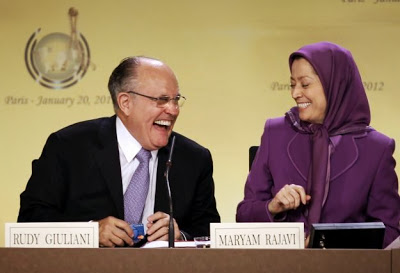
Rudy Giuliani with MEK leader Maryam Rajavi
(Photo Credit: Jacques Demarthon / AFP)
Embracing its recent removal from the U.S. State Department’s list of designated foreign terrorist organizations, the Mujahedeen-e Khalq (MEK), an exiled Iranian terror cult with deep pockets and close ties to the Washington establishment, is attempting to ramp up the fear-mongering and propaganda over Iran’s nuclear program following last month’s election of moderate cleric Hassan Rouhani as the Islamic Republic’s next president.
In April 2013, the group opened an office in Washington DC and officially registered as a lobbying organization the following month.
Now, a Reuters article from July 11, 2013 reported the MEK and its affiliate organizations such as the National Council of Resistance of Iran (NCRI) claim to have “obtained reliable information on a new and completely secret site designated for [Iran’s] nuclear project,” despite providing no credible evidence to back up the allegation.
The supposed site is said to be “located in a complex of tunnels beneath mountains 10 km (6 miles) east of the town of Damavand, itself about 50 km northeast of Tehran.” The MEK claimed that construction of the site began in 2006 and it was recently completed. “The site consists of four tunnels and has been constructed by a group of engineering and construction companies associated with the engineering arms of the Ministry of Defence and the IRGC (Iran’s elite Revolutionary Guards force),” a statement from the terror group said.
Unsurprisingly, the Iranian government immediately denied the allegations.
As in nearly all media reports on the MEK, Reuters credits the group with having “exposed Iran’s uranium enrichment facility at Natanz and a heavy water facility at Arak” in 2002. But beyond the fact that Iran’s nuclear program was never a secret, this specific claim is untrue, as nuclear experts Jeffrey Lewis and Mark Hibbs pointed out back in 2006.
In fact, the U.S. intelligence community had been tracking Iran’s nuclear facility development for quite some time, notably its construction at both Natanz and Arak. Lewis notes that, in 2002, “someone leaked that information to an Iranian dissident group, the National Council of Resistance of Iran (NCRI), which then released the second-hand dope in a press conference where they got the details wrong.” The information the MEK supposedly gleans from sources inside Iran are actually just leaks received from intelligence agencies in the United States and Israel.
Since then, the MEK has not itself provided a single shred of credible information regarding Iran’s nuclear program. Furthermore, in early 2007, an unnamed senior official at the International Atomic Energy Agency (IAEA) revealed to the Los Angeles Times, “Since 2002, pretty much all the intelligence that’s come to us [from the United States about the Iranian nuclear program] has proved to be wrong” and has never led to significant discoveries inside Iran.
“They gave us a paper with a list of sites. [The inspectors] did some follow-up, they went to some military sites, but there was no sign of [banned nuclear] activities,” the official told The Guardian at the time. Additionally, the LA Times reported that “U.S. officials privately acknowledge that much of their evidence on Iran’s nuclear plans and programs remains ambiguous, fragmented and difficult to prove.”
Additionally, the Associated Press reported this past May that, when it comes to accusations about the Iranian nuclear program and despite their terrible track record, “about 80 percent of the intelligence comes from the United States and its allies.”
Reuters, writing about the MEK’s most recent revelation, noted, “The group released satellite photographs of what it said was the site. But the images did not appear to constitute hard evidence to support the assertion that it was a planned nuclear facility.” Clearly, a non-state actor like the MEK doesn’t have satellites of its own floating around in space taking pictures of Iranian mountains; it’s obviously getting the information from government organizations with advanced spying resources.
Though these latest claims by the MEK have garnered quite a bit of attention this week, they are, in fact, nothing new. Allegations about tunnel systems have long been a go-to source of alarmism over Iran’s nuclear program. Back in January 2010, on the heels of promoting an opinion piece that explicitly advocated an unprovoked military attack on Iran, The New York Times‘ William Broad published a hysterical report, which claimed, “Over the past decade, Iran has quietly hidden an increasingly large part of its atomic complex in networks of tunnels and bunkers across the country.”
The report goes on to lament that Iranian efforts to protect their own nuclear infrastructure from military attack is viewed by the U.S. administration as “a stealth weapon, complicating the West’s military and geopolitical calculus.” Translation: it’s harder to spy on things and then blow them up when they’re not out in the open and that’s annoying.
Broad doesn’t even try to mask the frustration:
“It complicates your targeting,” said Richard L. Russell, a former Central Intelligence Agency analyst now at the National Defense University. “We’re used to facilities being above ground. Underground, it becomes literally a black hole. You can’t be sure what’s taking place.”
Even the Israelis concede that solid rock can render bombs useless. Late last month, the Israeli defense minister, Ehud Barak, told Parliament that the Qum plant was “located in bunkers that cannot be destroyed through a conventional attack.”
Despite the decades of threats from the United States and Israel, then-U.S. Defense Secretary Robert Gates didn’t realize the blistering irony when, discussing the heavily-fortified uranium enrichment site at Fordow, he said, “If they wanted it for peaceful purposes, there’s no reason to put it so deep underground, no reason to be deceptive about it, keep it a secret for a protracted period of time.”
Later in his report, Broad describes Iranian President Mahmoud Ahmadinejad as a tunnel aficionado and quotes Greg Duckworth, a “civilian scientist” described as having “recently led a Pentagon research effort to pinpoint enemy tunnels,” as saying, “Deeply buried targets have been a problem forever. And it’s getting worse.”
As the January 2010 report continues, a familiar name emerges under the heading “An Opposition Watchdog.” Who could that be? Broad writes, “In 2002, the National Council of Resistance of Iran, an opposition group, revealed that Iran was building a secret underground nuclear plant at Natanz that turned out to be for enriching uranium. Enrichment plants can make fuel for reactors or, with a little more effort, atom bombs.”
He goes on to sing the praises of NCRI for having announced “that Iran was digging tunnels for missile and atomic work at 14 sites” in 2005 and announcing “that Iran was tunneling in the mountains near Natanz, the sprawling enrichment site” in 2007, which he says was confirmed by satellite images.
In December 2009, Broad writes that NCRI issued yet another report on “Iranian military tunneling,” which claimed “Iran had dug tunnels and bunkers for research facilities, ammunition storage, military headquarters and command and control centers.”
“A group of factories” in the mountains east of Tehran, it insisted without providing proof, specialize in “the manufacturing of nuclear warheads.”
Broad even quotes the Los Alamos National Laboratory’s Frank Pabian saying of the MEK, “They’re right 90 percent of the time. That doesn’t mean they’re perfect, but 90 percent is a pretty good record.” Mohamed ElBaradei, former IAEA Director-General, had a different take on the group. “We followed whatever they came up with. And a lot of it was bogus.”
In his reporting, William Broad never once identifies the MEK or NCRI as an officially designated terrorist group, which at the time they both were and had been for over a decade.
To hammer home how deliberately alarmist the claims actually were, the Times even published the article with a photograph of a smiling Mahmoud Ahmadinejad and his entourage in red hardhats emerging from what is apparently supposed to resemble a steel-reinforced underground lair. Yet the photo is wholly unrelated to any of the allegations made within the report.
The caption beneath of the picture reads, “President Mahmoud Ahmadinejad of Iran, center, at a highway tunnel near Tehran. Much of Iran’s atomic work is also in tunnels.”
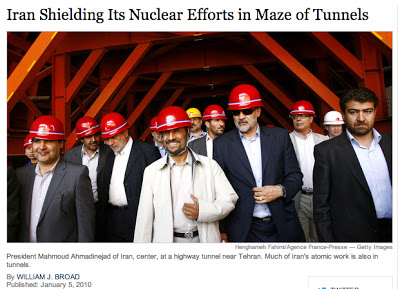
Yes, that really happened. Fit to print, indeed.
The focus on Iranian tunnels leads inevitably to discussion of American military capabilities and the challenges faced by less vulnerable facilities. Broad, in his 2010 report, noted that the “Pentagon is racing to develop a deadly tunnel weapon” for such circumstances. That weapon has since been completed and tested, but has not been sold to Israel for fear it might be used without American authorization.
Clearly, the MEK’s latest revelations are recycled claims and, like before, are essentially allegations based on vague intelligence leaked to the group by American officials. The MEK merely acts as a laundering service for the unproven accusations of its handlers in the United States and Israel.
Unfortunately, the mainstream press – even when skeptical about the information – continues to dutifully provide a platform for such propaganda and fear-mongering by publishing such accusations.
Columnist Clarence Page Spoke at Rally for Iranian Militant Group
By Justin Elliott | ProPublica | July 2, 2012
Late last month, syndicated columnist Clarence Page appeared at a rally in Paris in support of the Mujahadin-e Khalq (MEK), an Iranian group that has been lobbying Washington to be removed from the U.S. government’s list of designated foreign terrorist organizations.
Before a huge crowd waving portraits of MEK leaders Maryam and Massoud Rajavi as well as Iranian flags, Page called for the MEK to be removed from the official terrorist organization list.
Contacted about the appearance by ProPublica, Page said he has decided to give back his speaking fee for the event, as well as reimburse the cost of travel to and from France, which was paid for by a group called the Organizing Committee for Convention for Democracy in Iran.
“I thought they were simply a group of Iranian exiles who were opposed to the regime in Tehran,” Page said. “I later found out they can be construed as a MEK front group, and I don’t think it’s worth it to my reputation to be perceived as a paid spokesman for any political cause.”
Page said he was paid a fee of $20,000 and travel expenses and that he attended the June 23 event during vacation time. He said he just arrived back at work from vacation and has not yet given back the money. He did not have the text of the speech he delivered, but he told ProPublica he spoke in favor of the MEK being removed from the list of terrorist organizations, a move he expects to occur shortly.
The MEK, which fiercely opposes the current regime in Iran, has mounted a high-priced lobbying and legal battle to get off the terrorist list in recent years. The group was placed on the list in 1997 by the Clinton Administration, which cited its record of attacks against Iranian targets. The group also “assassinated several U.S. military personnel and U.S. civilians working on defense projects in Tehran” in the 1970s when the U.S. was allied with the Shah, according to the State Department. The MEK says it has renounced violence. A federal appeals court last month ordered the State Department to decide within four months whether the MEK should remain on the list.
Groups supporting the MEK have paid millions of dollars to attract former officials and retired military officers to appear at events supporting the group in recent years. But because the MEK is an officially designated terrorist organization, it is illegal for Americans to accept money from the MEK itself. NBC reported in March that former officials had received subpoenas as part of a federal probe “focused on whether the former officials may have received funding, directly or indirectly, from the [MEK].”
Besides Page’s role as a columnist whose work is distributed by Tribune Media Services, he is also a member of the Chicago Tribune’s editorial board. Page has not written about Iran in his column recently, but the Tribune editorial board regularly weighs in on foreign policy. Last month, the paper called on the Obama administration to “ratchet up the economic pressure” on Iran in the dispute over the country’s nuclear program. A spokeswoman for the Tribune did not immediately respond to a message seeking comment.
Organizers assert that 100,000 people attended the Paris event last month, but that figure has not been independently verified. In a speech, Maryam Rajavi hailed the “unparalleled bipartisan coalition which has challenged the official policy” that labels the MEK a terrorist group.
Others attending the event last month include Newt Gingrich, former Pennsylvania Gov. Ed Rendell, former New York City Mayor Rudy Giuliani, former State Department spokesman P.J. Crowley, former Bush administration official John Bolton, and several former high-ranking military officers.
“When I got involved with it, I saw the stellar list of VIPs who were also on the program, and I saw this to be another conference with another speech,” Page said.
Page said the invitation to the event last month came through his agent Janet LeBrun Cosby and Bethesda-based Speakers Worldwide.
~
Video of Newt Gingrich speech at the event:
Related articles
- Gingrich Speaks At Rally In France For Iranian ‘Terror’ Group (theuglytruth.wordpress.com)
- Romney Adviser John Bolton Campaigns For Alleged Terror Group (thinkprogress.org)
Featured Video
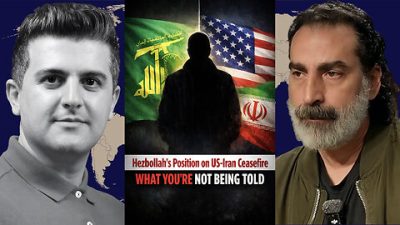
Laith Marouf: Hezbollah’s position on US-Iran ceasefire
or go to
Aletho News Archives – Video-Images
From the Archives
The Dirty Little Secret behind the “Global Terrorism Index”
The Omission of Israeli Terrorism in the Occupied Palestinian Territories
By Karin Brothers | Global Research | December 6, 2014
… The Israeli settlements — all of which are illegal – have been identified as a major impediment to peace. The refusal of a major “global” terrorism report to name the Israeli settlers as one of the groups most responsible for terrorism not only misrepresents a major source of regional violence but exposes the Global Terrorism Index as a propaganda tool that supports a U.S. agenda.
In recent years, governments have been attempting to thwart terrorism by blocking supportive fund-raising. When it comes to Israeli settlements, however, the US and Canada actually encourage fund-raising by giving organizations (such as Christian Friends of Israeli Communities (CFOIC) and the Jewish National Fund) financial support in the form of donor tax-deductions.
Charities which provide funds for the Israeli settlements should be regarded as terror-financing organizations. They should not only lose their tax-deductible status, but they should be banned because they support the violation of international humanitarian law. The terror-financing laws that are being strictly enforced for Muslim charities should be applied to Christian and Jewish charities as well. … Read full article
Blog Roll
 Aletho News
- The ‘Opposition Party’ Has Done Nothing to Stop the Iran War and Much to Goad Trump Into Continuing It
- Moscow backs Tehran on status of Lebanon in US-Iran deal
- How UK Regulator Ofcom Quietly Bypassed International Law to Police American Speech
- The Black Cube Files: How Former Mossad Operatives Flipped a Nation
- Laith Marouf: Hezbollah’s position on US-Iran ceasefire: What you’re not being told
- Israel’s priority lies in destroying chances of peace between Iran, US: Ex-UN nuclear chief
- Ceasefire for all or for none: Iran shuts Hormuz over Lebanon attacks
- Strait of Hormuz is Iran’s ‘nuclear weapon’ that forced US retreat: Medvedev
- Energy crisis will last for months – Kremlin envoy
- Europe’s quiet role in the war on Iran
- If Americans Knew
- This is ceasefire? Israel’s biggest massacre yet in Lebanon, another journalist killed in Gaza – Daily Update
- Tucker Carlson on Israel: This Is the Behavior of an Ally? Really?
- Gazans face a triple crisis: severe shortages of water and bread, healthcare in tatters
- NY Times reports how Netanyahu took the US into Iran War
- A sigh of relief over Iran, but Gaza and Lebanon in dire straits – Daily Update
- Thousands dead and neighborhoods razed to the ground: Aid agencies fear southern Lebanon is becoming the new Gaza
- The war the US is fighting for Israel could cost trillions
- ‘Cigarette Burns, Nail Wounds’: Toddler Tortured in Gaza to Coerce Father
- Trump Says US Sent ‘a Lot of Guns’ to Protesters in Iran
- Israeli forces destroy 17 UN peacekeeper cameras in south Lebanon
- No Tricks Zone
- An Inconvenient Tree: Uncovered In Alps… Europe Much Warmer Than Today 6000 Years Ago
- New Study Reports A 60% Slowdown In Greenland’s Ice Loss Rate In The Last Decade
- Low Intensity Tornado Wrecks Major Solar Farm, Creating A Potential Toxic Dump
- New Study Finds Warming Saves Lives…Cold Temperatures 12 Times More Deadly Than Excess Heat
- German Science Blog Accuses PIK Climate Institute Of Hallucinating Climate Tipping Points
- Devastating Assessment Of Comirnaty Vaccine By Former Senior Pfizer Europe Toxicologist
- New Study: CO2 Is ‘Effectively Negligible’ As An Explanatory Climate Change Factor Since 2000
- Former Pfizer Toxicologist Dr. Helmut Sterz Tells Bundestag Hearing Pfizer Vaccine Should Have Never Been Approved
- Energy Expert: Germany’s Nuclear Phaseout Was A “500 Billion Euro Mistake”
- New Research: South Australia’s Mid-Holocene Sea Surface Temperatures Were 4°C Warmer Than Today
 Aletho News