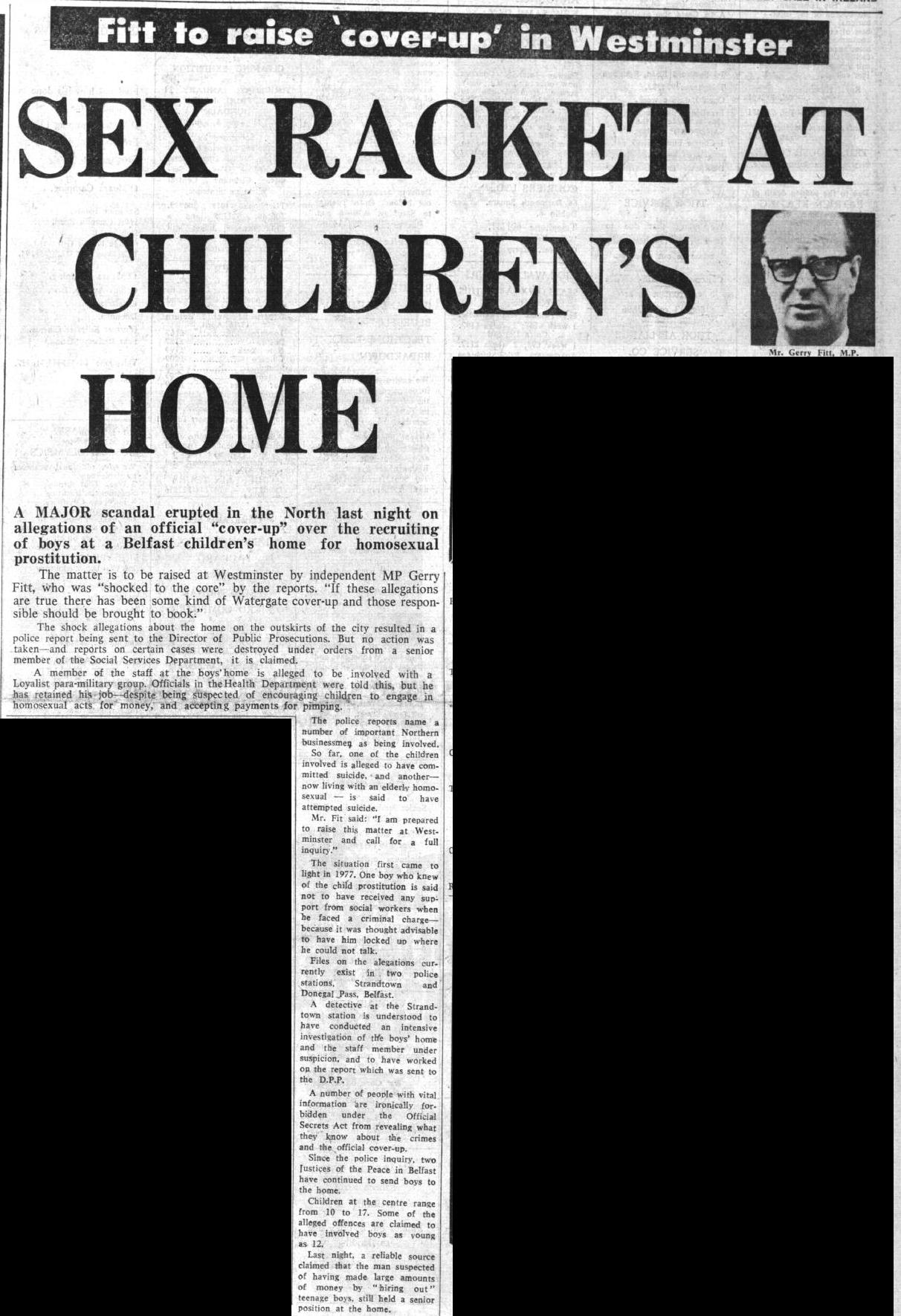
Half a century after the public learned that boys at a Belfast group home were sexually assaulted by senior staff, a key question remains unanswered: was British intelligence implicated in the abuse conspiracy, and did Kincora serve as a ‘honeypot’ to entrap and blackmail powerful figures?
A vast trove of declassified files on Jeffrey Epstein’s sexual, political, and intelligence escapades released by the US Department of Justice has once again thrust disgraced former Prince Andrew Mountbatten-Windsor into the spotlight. With British police reportedly reviewing Andrew’s past sexual activities and links to Epstein, questions are growing about whether Britain’s spy agencies were aware of Andrew’s alleged escapades with minors.
If the darkest rumors turn out to be true, it will not be the first time a British royal had been embroiled in a child rape conspiracy with spy agency involvement. Back in 1980, a scandal erupted when the Kincora Boys’ Home in occupied Ireland was exposed as a secret brothel run by powerful pedophiles. Chief among the alleged perpetrators was Lord Mountbatten — Andrew’s great-uncle.
From the very beginning, hints began to appear that MI5/MI6 knew of the child abuse taking place Kincora, and could have even been running the group home as part of a dastardly intelligence plot. With Britain’s domestic and foreign spies engaged in a savage dirty war in Ireland, and both services running operatives in Republican and Unionist paramilitaries, Kincora would have provided an ideal means of recruiting and compromising potential assets. Official investigations have strongly insinuated British intelligence chiefs had a close bond with many individuals who ran the Boys’ Home.
In May 2025, veteran BBC journalist Chris Moore published a forensic account of the case titled Kincora: Britain’s Shame. Featuring four and a half decades of firsthand research by the author, its groundbreaking contents have been met with general silence by British mainstream media.
In the book, Moore argues persuasively that the Boys’ Home was just one component of a more extensive child abuse network extending across British-occupied Ireland and beyond — in which London’s spying apparatus was not only aware, but likely complicit.
In 2023, Moore met personally with Kincora victim Arthur Smyth in Australia. Smyth’s stay at the Home was brief, but the horrors he endured there left him scarred forever.
“Having interviewed a number of Kincora survivors, I found Arthur’s story familiar. Sent to the Boys’ Home by a Belfast divorce court judge aged 11, he was continually preyed upon by the pedophiles who ran it, and intimidated into silence,” Moore told The Grayzone. “Arthur was also brutally abused repeatedly by a man he knew only as ‘Dickie’, who raped him while bending him over a desk.”
In August 1979, two years after Smyth escaped Kincora, he learned the true identity of ‘Dickie’ was none other than Louis Francis Albert Victor Nicholas Mountbatten, a member of the royal family and Queen Elizabeth II’s cousin. Mountbatten had just been murdered in an apparent IRA bombing attack on his fishing boat off the coast of Ireland. Though the British government appears to remain committed to concealing his crimes from the public, Mountbatten’s pedophilia was common knowledge among both British and US intelligence for decades.
As early as World War II, the FBI had identified Mountbatten as “a homosexual with a perversion for young boys.” A Bureau file detailing this was later identified by historian Andrew Lownie. After requesting other files the Bureau maintained on the royal, Lownie was informed by US authorities they had been destroyed.
Lownie says he was told by an FBI official that the files were only disposed of “after [he] asked for them” — indicating they were “clearly” shredded at the request of the British government.
Kincora conspiracy begins to unravel
Within months of Kincora’s opening in 1958, boys at the facility began coming forward to inform the adults around them that they were being routinely sexually abused. The Boys’ Home was repeatedly visited by police throughout the decades that followed in response to reports of rape and other mistreatment. Despite repeated investigations, time and time again, complaints were ultimately dismissed by the police.
Reports of sexual abuse spiked dramatically in 1971, when a prominent loyalist named William McGrath became the group home’s housefather, and was placed directly in charge of the boys’ day-to-to lives. Moore documented numerous harrowing accounts in which victims described being sadistically raped by McGrath to the point of internal bleeding, with the boys’ silence ensured by threats of violence.
Moore attributes police inaction to the “skillful manipulation” of Kincora’s director, Joe Mains, who successfully convinced officers that accusers were simply lying as revenge for perceived slights by the staff.
As an extremely well-networked figure in British-occupied Ireland, with deep links to prominent Unionist politicians and Protestant paramilitary groups, McGrath enjoyed virtual impunity. He also headed Tara, an armed Masonic loyalist faction covertly run by the British Army, which effectively functioned as an intelligence operation.
In conversations with colleagues, McGrath was known to boast about his work with British intelligence, and the regular trips to London which it entailed. A police source confirmed to Moore that MI6 had an interest in McGrath since the late 1950s, and that “everything McGrath did from this point on was known” to British intelligence. Small wonder campaigners firmly believe Kincora was exploited to compromise and control Unionists, who committed pedophilic offenses at the Home.
The horrifying abuse at Kincora finally surfaced in January 1980 when the Irish Times published an explosive report that triggered a police investigation, which was led by a veteran detective named George Caskey. According to Moore, it took Caskey just three days to decide that Kincora’s leadership were likely guilty.
Within weeks, Caskey’s team had identified dozens of victims of McGrath and others at Kincora, who each gave detailed statements about the abuse they suffered there. Based on their testimony, Mains, McGrath and fellow high-ranking staffer Raymond Semple were suspended from the group home, and arrested a month later. Curiously, Mains and Semple readily admitted their offenses to police, but McGrath aggressively protested his innocence. Resisting interrogation with such skill that investigating officers believed he had rehearsed for their questioning in advance, he made a number of bizarre, cryptic comments.
For one, McGrath declared he was the victim of political intrigue and the accusations against him were bogusly cooked up by the pro-British Ulster Volunteer Force paramilitary faction, among other people “out to destroy me.” He refused to elaborate on who they were, or why he believed he was being maliciously targeted in this manner. McGrath furthermore promised “other stories” and a “rebuttal to these allegations” would “come out in court,” but again declined to expand any further.
In December 1981, Mains, McGrath, Semple and three other individuals found to have abused young boys at two other state-run group homes in occupied Ireland finally stood trial. McGrath was the only defendant to plead not guilty. Present in court at the time, Moore recalls widespread anticipation McGrath’s testimony would “open a Pandora’s Box, laying bare the truth about Kincora and exposing an uncomfortable – some might say unholy – alliance between the British government and unionism, and perhaps even details of a secret MI5 operation.”
However, at the last minute, McGrath’s lawyer made a shock announcement – his client had changed his plea to guilty. McGrath’s volte face elicited a ripple of exasperated sighs across the courtroom, where over 30 Kincora victims had gathered, preparing to testify. Though all six men were convicted of sexual abuse of boys across three Belfast children’s homes, their relatively light sentences drew outrage. In the end, Mains was jailed for six years, while Semple received five years and McGrath, just four.
MI5 proposes creating ‘false files’ to sabotage investigations
For Moore, McGrath’s change of heart raises obvious suspicions that someone persuaded him to keep his mouth shut about “what had been said to him and by whom.” The police investigation established the six men knew each other and shared information about abused children in state-run boys’ homes, but did not explore the possibility they were part of a wider pedophile ring. The most significant official probe into Kincora since, the Northern Ireland Historical Institutional Abuse Inquiry (HIA), initially raised hopes such information might emerge when it was launched in 2013.
That probe, which centered around allegations by British intelligence whistleblowers Colin Wallace and Fred Holroyd that the UK security state was complicit in systematic child rape at Kincora, appeared to leave MI5 extremely uneasy about the potential for British spies’ darkest secrets coming to light in occupied Ireland.
The HIA, however, appears to have been set up to fail. With no ability to compel MI5 or MI6 to produce records, the commission was forced to accept only whatever heavily redacted files the agencies voluntarily provided.
The decision to limit the scope of the HIA’s oversight came despite appeals by prominent figures including victims of sex abuse at Kincora, parliament’s home affairs committee, and former military officials, who claimed British intelligence was complicit in abuses at Kincora, and demanded the Inquiry be granted the ability to subpoena sensitive documents and witnesses.
As anonymous security and intelligence operatives spoke via videolink in the HIA hearings, Inquiry chair Judge Anthony Hart appeared to take their testimony at face value.
The Inquiry’s handling is all the more shocking given the contents of a June 1982 document provided by MI5 to the HIA showing how the agency’s higherups planned to counteract the inquiry itself.
Anxious to distance themselves from the horrors of Kincora, the British spy agency discussed creating “false files” to counteract “lines of enquiry which it was anticipated” that Caskey might pursue. In other words, MI5 was actively seeking to deceive police investigators through forgery.
But the HIA later declared it was “satisfied” that “the suggestion was not pursued,” concluding that the “false files” were not produced for the purposes of misdirecting the inquiry.
Kincora coverup continues
In 2020, it was revealed that extensive police records on investigations into Kincora from 1980 to 1983 had conveniently been destroyed roughly around the time the Inquiry was established.
The files which survived show the HIA received a number of tips suggesting MI5/6 were indeed entangled in pedophilic abuse at Kincora, only to consistently understate their significance.
For example, MI5 told HIA it had no records of William McGrath working for the agency. Conversely, documents produced by the intelligence service indicate how in April 1972, McGrath, who was “commanding officer of the Tara Brigade,” had not only been plausibly “accused of assaulting small boys,” but “could not account for any cash that had been handed to him over a period of a year.”
The HIA accepted MI5’s risible explanation that this information was not passed on to local police because it was unclear McGrath’s attacks on the boys were pedophilic in nature, rather than simply physical. “We ought not to assume that ‘assault’ would have been interpreted at the time by… [MI5] as being of a sexual type,” an internal document presented to the Inquiry declared.
Responding to a separate MI5 document from November 1973 noting McGrath was implicated in “assaulting small boys,” the HIA noted British intelligence was legally obligated to report such an “arrestable offence” to the police, and that by not doing so, it could be argued “the MI5 officers who had this information were in breach of that duty.” But the Inquiry concluded that “to take that view would be unjustified for several reasons,” primarily that “an unidentified member of Tara” was the source of this “unsubstantiated allegation.”
Similar mental gymnastics were employed to downplay the contents of an October 1989 MI6 file detailing “various allegations surrounding the Kincora Boys’ Home,” which revealed the spy agency “certainly ran at least one agent who was aware of sexual malpractice at the home and who may have mentioned this” to his handler. Judge Hart stultifyingly concluded, “it is quite possible the [MI6] officer misinterpreted what was discussed at the meeting.”
The HIA also insisted MI5 was unaware McGrath worked at Kincora until 1977. But that claim was effectively contradicted by the Inquiry itself, which unveiled MI5 documents from January 1976 clearly stating, “McGrath was reported in March 1975 to be warden of Kincora Boys’ Hostel.” A police memo from November 1973 dispatched to MI5’s director similarly noted McGrath was a “social worker” at Kincora.
Whitewash inquiry implicates MI6 chief in Kincora
As part of its probe, the HIA ordered “searches of documents and records” held by MI5, MI6, GCHQ, and the Metropolitan Police on allegations of child sex abuse by public figures and servants. In response, MI5 released files listing 10 powerful individuals, including diplomats, government ministers, and lawmakers, who Britain’s domestic spying agency had evidence to suggest may have been involved in pedophilic abuse.
Chief among them was veteran spy and dark arts specialist Maurice Oldfield, who oversaw MI6 operations in occupied Ireland throughout the 1970s, first as its deputy then chief. Shortly before his April 1981 death, Oldfield was outed as gay, which precluded him from serving with the agency under contemporary recruitment rules. Resultantly, “MI5 conducted a lengthy investigation to determine whether” Oldfield’s sexual proclivities “posed a risk to national security by making him vulnerable to blackmail or other pressure.”
Over the course of “many interviews,” he “provided information about homosexual encounters with male domestic staff, referred to as ‘houseboys’, whilst serving in the Middle East in the 1940s and hotel stewards in Asia in the 1950s.” Media reporting prior to Oldfield’s death suggested he was “a compulsive” user of “rent boys and young down-and-outs,” which was well-known to his security detail. However, the HIA repeatedly exonerated Oldfield of any wrongdoing, despite receiving bombshell evidence implicating him in the horrendous pedophilic acts perpetrated at Kincora.
Unbelievably, its report concluded “there is insufficient information in the records to deduce whether the term ‘houseboys’” was “used simply to describe domestic staff or to denote youth, leaving ambiguity over the ages of the other parties.” This is despite an anonymous MI6 officer telling the Inquiry the agency possessed four separate “ring binders” documenting Oldfield’s “relationship” with Kincora, his “friendship” with its chief Joe Mains, and potential personal connection to “alleged crimes at the boys’ home.”
Heavily redacted files published by the HIA also indicate MI5 was “aware of allegations” that occupied Ireland’s police knew Oldfield was intimately embroiled in the scandal. An internal agency telegram noted well-grounded suspicions the MI6 chief “was involved in the Kincora boys home affair in the course of occasional visits to Northern Ireland (associated with his job) between 1974 and 1979.” Still, the Inquiry dismissed this as proof of MI5/6 involvement in the child abuse conspiracy, on the grounds these excerpts referred purely to “allegations.”
The Kincora coverup continues today. In April 2021, the BBC announced “a new season of landmark documentaries… set to shine a new light on remarkable stories from Northern Ireland’s recent history.” Among the scheduled films was Lost Boys, which told the hideous tale of how numerous children inexplicably vanished in Belfast during the Troubles. It concluded the cases were all linked to pedophilic abuses at Kincora. Interviewees included several former police officers, who believed their inquiries into the disappearances had been systematically sabotaged by British intelligence.
On the eve of transmission, Lost Boys was pulled from broadcast. BBC managers were reportedly “shocked by its content, particularly evidence of MI5’s involvement in covering up the Kincora saga.” Moore, who consulted on the film, told The Grayzone there are strong insinuations British intelligence took a keen interest in the documentary’s producers, AlleyCats. “The home of one staffer involved in editing Lost Boys was burgled,” he says. “Another Alleycats member suspected a break-in, but could not be entirely certain.”
Having investigated Kincora since it first came to public attention, Moore concludes “MI5 and its cohorts in the police believe they can do what they want with little or no regard for the truth, the law or democracy,” noting British intelligence “somehow persuaded the government to bury Kincora files until 2065 and 2085.” The veteran muckraker also recently learned his private communications with journalists investigating other cases of criminal activity by MI5/6-sponsored loyalist paramilitaries – including murder – have been heavily surveilled.
“The British state has illegally spied on people trying to expose the truth in Northern Ireland for many years, in what they call a ‘defensive operation’. Senior local police chiefs have admitted surveillance tactics were deployed against 320 journalists and 500 lawyers over a decade, including me,” Moore concluded. “My telephone was monitored due to probing government-funded loyalist killers. Like many police officers who’ve looked into these matters, I’m all too aware of how authorities frustrate criminal investigations.”
February 10, 2026
Posted by aletho |
Book Review, Corruption, Deception, Full Spectrum Dominance, Timeless or most popular | GCHQ, Human rights, Ireland, MI5, MI6, UK |
Leave a comment
Iran’s embassy in London has strongly rejected allegations by the head of Britain’s MI5 that Tehran seeks to threaten the United Kingdom’s security, calling the claims “baseless and irresponsible.”
The diplomatic mission, in a statement released late on Friday, repudiated the assertions made by Sir Ken McCallum on October 16, which accused Iran of involvement in so-called “deadly plots” and “cross-border hostile actions.”
“The Embassy of the Islamic Republic of Iran expresses its strong protest to and outright rejection of these unfounded and irresponsible statements,” the statement read.
“Such baseless accusations are part of a continued effort to distort Iran’s policies and undermine bilateral diplomatic relations.”
The embassy emphasized that Iran firmly denies any involvement in violent acts, abductions, or harassment of individuals in the UK or elsewhere.
It further stated that the claims were made “without credible evidence,” and contradict Iran’s ongoing commitment to international law, the principle of sovereign equality, as well as promotion of peaceful coexistence and international cooperation.
The statement came after the MI5 chief alleged that UK security forces had thwarted 20 operations linked to Iran on British soil over the past year — a claim Tehran has dismissed as part of an ongoing campaign of misinformation.
The Iranian embassy urged the British government to “refrain from making or escalating baseless accusations” and instead pursue a “responsible and constructive approach based on dialogue and mutual respect” to address shared security concerns through legal and diplomatic channels.
The mission finally reaffirmed Iran’s preparedness for dialogue, and its commitment to international norms and peaceful international relations.
October 18, 2025
Posted by aletho |
Deception, Mainstream Media, Warmongering | MI5, Sanctions against Iran, UK |
Leave a comment
The UK government’s extremism is a global threat to privacy, a new report shows
Imagine waking up one morning to find out your government has demanded the master key to every digital iPhone lock on Earth — without telling anyone. That’s exactly what British security officials have tried to pull off, secretly ordering Apple to build a backdoor into iCloud that would allow them to decrypt any user’s data, anywhere in the world. Yes, not just suspected criminals, not just UK citizens — everyone. And they don’t even want Apple to talk about it.
This breathtakingly authoritarian stunt, first reported by The Washington Post, is one of the most aggressive attempts to dismantle digital privacy ever attempted by a so-called Western democracy. It’s the kind of thing you’d expect from regimes that plaster their leader’s face on every street corner, not from a country that still pretends to believe in civil liberties.
The Order: Total Access, Zero Oversight
This isn’t about catching a single terrorist or cracking a single case. No, this order — issued in secret last month by Keir Starmer’s Labour government — demands universal decryption capabilities, effectively turning Apple into a surveillance arm of the UK government. Forget warrants, forget oversight, forget even the pretense of targeted investigations. If this order were obeyed, British authorities would have the power to rifle through anyone’s iCloud account at will, no justification required.
The officials pushing for this monstrosity are hiding behind the UK’s Investigatory Powers Act of 2016, a law so Orwellian it’s lovingly referred to as the “Snoopers’ Charter.” This piece of legislative overreach forces tech companies to comply with government spying requests while making it illegal to even disclose that such demands have been made. It’s the surveillance state’s dream—limitless power, zero accountability.
Apple’s Answer: Thanks, But No Thanks
Apple, to its credit, has not rolled over — yet. Instead of turning itself into an informant for MI5, the company is reportedly considering pulling encrypted iCloud storage from the UK entirely. In other words, British users could lose a major security feature because their government is hell-bent on playing digital dictator.
But even that isn’t enough for UK authorities, who aren’t just demanding access to British accounts. They want a skeleton key to iCloud data worldwide, including in the US That’s right—British intelligence, in a stunning display of overreach, is trying to force an American company to compromise American users on American soil.
The “Appeal” Process: A Kafkaesque Farce
Technically, Apple has the right to challenge this order. But in true dystopian fashion, its only option is to plead its case before a secret technical panel, which will then determine if the request is too expensive. If that doesn’t work, Apple can go before a judge, who will decide whether the demand is “proportionate” to the government’s needs. Because if there’s one thing we know about government surveillance, it’s that it’s always reasonable and restrained.
Meanwhile, Apple has refused to comment, likely because doing so would be a criminal offense under UK law. That’s right — even talking about the demand could land Apple executives in legal trouble. Nothing screams “free society” like threatening jail time for discussing government overreach.
Here’s the wider issue: even if Apple were to challenge this draconian demand, it wouldn’t matter. The law requires immediate compliance — meaning that even as Apple fights the order, it would still be forced to hand over the keys in the meantime. It’s the legal equivalent of being forced to serve a prison sentence while appealing your conviction. By the time the courts make a decision, the damage is already done.
Apple, to its credit, saw this Orwellian nightmare coming from a mile away. Last year, it explicitly warned British lawmakers that such a demand would be nothing less than an assault on global privacy. The company made its stance clear:
“There is no reason why the U.K. [government] should have the authority to decide for citizens of the world whether they can avail themselves of the proven security benefits that flow from end-to-end encryption.”
In other words: Who the hell does Britain think it is? The UK government, in its wisdom, apparently believes it should have the power to determine how encryption works for everyone, everywhere, not just in its own backyard. Because why stop at surveillance when you can have global surveillance?
The Official Non-Denial Denial
Of course, when asked about this breathtakingly bold power grab, the UK Home Office fell back on the bureaucrat’s favorite escape hatch: refusing to confirm or deny reality itself.
“We do not comment on operational matters, including for example confirming or denying the existence of any such notices.”
In other words, “We won’t admit we’re demanding this, but we won’t deny it either.” Because why be transparent when you can keep the public guessing?
How the UK Plans to Kill Encryption by Exploiting the Cloud
For those still clinging to the idea that end-to-end encryption will protect their messages from prying eyes, here’s the bad news: the UK government already has a backdoor, and most people don’t even realize it.
Yes, apps like iMessage, WhatsApp, and Signal use end-to-end encryption, meaning only the sender and recipient can read the messages. But the moment you back up those encrypted chats to the cloud? They become fair game. Law enforcement can demand access through legal orders, bypassing encryption entirely.
Apple’s Advanced Data Protection was designed to close this loophole, giving users a way to keep their cloud backups as secure as their messages. And that, of course, is precisely why the UK wants to kill it.
Because for governments that dream of unlimited surveillance, letting people secure their own data is simply unacceptable.
The UK Is Now Outpacing the US in Anti-Privacy Extremism
For years, the US has led the charge in trying to undermine encryption, with the FBI repeatedly demanding backdoors and government officials throwing tantrums whenever a tech company refuses to play ball. But even America has never gone this far.
Now, Britain is attempting to leap ahead, pushing for surveillance powers that would force not just UK companies, but global tech giants to comply — regardless of where their users live. And Apple? It’s just the first target.
Google, which has offered default encrypted backups for Android since 2018, could easily be next. When asked whether the UK or any other government had made similar demands, Google spokesperson Ed Fernandez gave a carefully worded response:
“Google can’t access Android end-to-end encrypted backup data, even with a legal order.”
That’s a fancy way of saying “We don’t have the keys, and we’re not planning to give them up.” But how long until the UK demands that Google build a key, just like it’s demanding from Apple?
And then there’s Meta. WhatsApp’s encrypted backups are another thorn in the side of surveillance-hungry governments. When pressed on whether they had received any secret orders for access, Meta, predictably, refused to comment.
February 7, 2025
Posted by aletho |
Civil Liberties, Deception, Full Spectrum Dominance | FBI, Human rights, MI5, UK, United States |
Leave a comment
Since the launch of Israel’s genocidal war on Gaza in early October, the United Kingdom has dramatically increased its military and intelligence support for the Israeli regime.
It has done so either by recruiting spies in the occupied Palestinian territories, engaging private military companies, deploying surveillance aircraft and vessels, or conducting spy missions over Gaza.
Notable components of the British deployment include Royal Air Force P-8 maritime patrol aircraft, unspecified surveillance assets, two Royal Fleet Auxiliary support ships, three Merlin helicopters, and a contingent of Royal Marines, which were meant to aid the Israeli aggression against Palestinians.
According to the Campaign Against Arms Trade (CAAT), a UK-based civil society organization, the United Kingdom and Germany are among the biggest arms suppliers to Tel Aviv.
The CAAT report said British companies supplied approximately 15 percent of components used in F-35s that were employed in the Israeli bombardment of the besieged Gaza Strip.
Some companies, such as Elbit, the Israeli regime’s international military contractor, hold licenses for trading military equipment in Britain, the report stated.
MI5 recruits spies in Gaza
Beyond military assistance, the UK has consistently sought to provide intelligence support to the Israeli regime by utilizing existing intelligence operatives and recruiting new agents within occupied territories.
In a recently revealed case, the British spy agency MI5 tried to recruit a British man in Gaza by offering to help his family escape the city, which is currently under heavy bombardment by the Israeli regime.
The man, who reportedly declined the offer, revealed that his family had registered with the Foreign, Commonwealth and Development Office (FCDO) for evacuation but experienced prolonged delays, enduring dire conditions in a tent among other displaced individuals in Gaza.
“I have been waiting for more than two months for them to get me and my family out of this crazy, dangerous war,” he was quoted as saying, expressing frustration.
The MI5 contact with the man in Gaza indicated that the agency’s ability to facilitate the family’s evacuation through FCDO was contingent upon the man agreeing to work for the intelligence agency.
Despite the urgency of their situation, the man said he did not agree to this condition.
MI5, the contact said, had influence over the FCDO but only if he could show “there is willingness from your side about working together”.
“After I received their offer, I said to myself: the UK is a country of institutions and law, and they will not obstruct the evacuation of me and my family because I did not respond to MI5’s proposal. But unfortunately, I was wrong,” the unidentified man stated.
Moazzam Begg, a senior director at advocacy organization Cage International, and a former Guantanamo Bay detainee assisting the family, noted that the recruitment methods employed by MI5 seem consistent with the agency’s tactics to exploit individuals facing desperate circumstances.
Begg emphasized the coercive nature of such recruitment, sharing his own experience.
“I know from personal experience from MI5 agents telling me directly that the only way you can get out of a place where you are being tortured or abused or detained without trial is by cooperating.”
UK spy mission over Gaza
The British intelligence support for the Israeli regime and its spy missions in the occupied territories is not limited to the recruitment of potential spies.
A recent investigation revealed that the British military conducted approximately 50 spy missions over the Gaza Strip for the Israeli regime since December.
In its latest report, Declassified UK, a news website focused on British foreign policy, said the flights have taken off from the UK’s Akrotiri air base on the Mediterranean island of Cyprus. Flights originating from the controversial air base utilized Shadow R1 surveillance aircraft to gather intelligence.
The UK Ministry of Defense initially claimed these flights aimed to collect information on British captives held by the Hamas resistance movement, but the frequency and timing raised suspicions of broader intelligence gathering.
“The extraordinary number of flights, and the fact that they started nearly two months after the hostages were taken, raises suspicions that the UK is not collecting intelligence solely for this purpose,” Declassified UK said.
Head of the Cyprus Peace Council Charis Pashias said last week that locals have seen a “daily” increase in the number of flights from Akrotiri since Israel launched its bombardment of Gaza on Oct 7, 2023.
He said people have also “become aware of the illegal presence of thousands of American soldiers now stationed in Akrotiri.”
UK’s plan for surveillance flights
In another noteworthy development, the UK government openly announced its plan for surveillance flights over Israel and Gaza, citing it as part of hostage rescue efforts.
Hamas condemned this decision, labeling it as military involvement in the “genocidal” war on Gaza. The group urged the UK to reconsider, citing historical grievances such as the 1917 Balfour Declaration, describing it as “the sin of the century” and condemning the UK for perpetuating a shameful colonial past.
The UK’s “intention to carry out intelligence flights over the Gaza Strip makes it an accomplice to the Zionist occupation in its crimes, and responsible for the massacres to which our Palestinian people are subjected,” the Palestinian resistance group said in a statement.
The UK should have “corrected its historical position that was offensive to the Palestinian people,” and “atone for” the 1917 Balfour Declaration, a letter from then-British Foreign Secretary Arthur Balfour to Lionel Walter Rothschild, a leading figure of the British Jewish community, pledging support for “a national home for the Jewish people” in Palestine.
British Cyprus intelligence base
The recent surge in UK surveillance activities is closely tied to its significant presence in the Eastern Mediterranean, specifically the British Sovereign Base Areas (SBA) on Cyprus.
These bases, constituting 3 percent of the island’s landmass, house the largest Royal Air Force base outside the UK and contain substantial signals- and intelligence-gathering assets. Most UK surveillance flights are launched from these bases, strategically located just 200 miles from Gaza.
Although officially unacknowledged, leaked top-secret documents from GCHQ, the UK’s largest spy agency, confirm that Cyprus “hosts a wide range of UK and US intelligence facilities.”
The main US spy agency of National Security Agency (NSA) particularly operates on British territory, maintaining a “far-reaching technical and analytic relationship” with the Israeli SIGINT National Unit (ISNU), sharing information on access, intercept, targeting, language, analysis, and reporting, according to Declassified.
A top-secret document from GCHQ adds that “Cyprus collection facilities are acknowledged by NSA as important assets”.
These revelations, leaked by NSA whistleblower Edward Snowden, gained significance in light of the US-UK activities on Cyprus, suggesting that intelligence obtained from Gaza by American spy agencies operating on British Cyprus might be shared with the Israeli regime.
The US and British militaries are key partners of Israel and have supported its bombing of Gaza. The documents show intelligence gathered on Cyprus is likely to be part of this support.
The leaked GCHQ document acknowledges that intelligence gathered from Cyprus is integrated “with military planning and operations,” emphasizing the close interaction between GCHQ and the Ministry of Defence (MoD) on Cyprus.
Moreover, RAF Troodos, a British “retained site” near the northern Cyprus border, operates as a listening post for the US, providing unique access to critical points in the Middle East. The intelligence collected from Troodos supports technical analysts in both the US and the UK and is used for weapons-related collection, according to a GCHQ document.
The Troodos site, GCHQ noted, “has long been regarded as a ‘Jewel in the Crown’ by NSA as it offers unique access to the Levant, North Africa, and Turkey”.
Furthermore, it is believed that the CIA is operating from Britain’s bases on Cyprus. A leaked US cable, reported by Declassified, mentioned a UK official stating that American aircraft flying from RAF Akrotiri are operated by the State Department and US military, with the “possibility of other agencies”, presumably the CIA, conducting operations from the base.
British soldiers take part in Israeli war
In a recent revelation, the death of Nathanel Young, a 20-year-old British man serving as a corporal in the Israeli Occupation Forces (IOF), shed light on the fact that hundreds of Britons are serving in the IOF, which is illegally occupying Palestinian land and has killed thousands of children in Gaza.
In an interview with the Times, Sam Sank, a British paratrooper in the Israeli army, who has been participating in the Israeli war against Palestinians since early October, revealed that hundreds of fellow Brits are currently serving in the IOF.
Former Home Secretary Suella Braverman, whose husband has lived in the Israeli-occupied territories, previously told the Jewish Chronicle that they have “close family members who serve in the IDF”.
It is unclear if those relatives are British citizens.
This prompted the International Centre of Justice for Palestinians to seek urgent clarification from the UK Foreign Office on the legality of British nationals enlisting in the Israeli army.
They made the request “In light of the catastrophic situation currently unfolding in Gaza, with clear evidence that war crimes and crimes against humanity may already have been committed in Israel and the Occupied Palestinian Territory, and the real risk that further mass atrocity crimes may be imminent”.
People who fight for a foreign army are often viewed as mercenaries and would meet the dictionary definition. However, the UK lacks effective anti-mercenary laws and tends to prosecute foreign fighters on an ad hoc basis, depending on whatever geo-political interests are being pursued by the government of the day.
The UK even tried to thwart attempts by the United Nations to craft a ban on mercenaries. The only international law concerning mercenaries that Britain has signed is Article 47 of Additional Protocol I to the Geneva Convention.
It was adopted in 1977 as “countries attempted to create a fine distinction between those classified as mercenaries and other actors, essentially to retain the right to recruit, train, finance, and use mercenaries with impunity,” according to a report presented last month to the UN General Assembly by its working group on mercenaries.
Britons joining the IOF may only meet certain aspects of the Geneva Convention’s criteria for mercenaries, especially concerning material compensation exceeding that of their Israeli counterparts.
The country’s historical resistance to international efforts to ban mercenaries complicates the legal landscape around this issue.
UK arms exports to Israel
According to research by the Campaign Against the Arms Trade (CAAT), the UK has licensed approximately £472 million in arms exports to Israel since 2015. These exports include various components, equipment, and technology for fighter aircraft and drones.
It’s worth noting that, as James Butler observes, “the headline figure is taken from the value of standard licenses, but the UK also operates a system of open licenses that permit transfers of unlimited – and unspecified – quantities of particular military goods.”
Scrutiny of the Israeli regime’s genocide in Gaza has increased in the UK due to concerns that weapons supplied by the UK might be used in violation of international humanitarian law (IHL).
Despite these concerns and calls from human rights campaigners to suspend arms sales to Israel, the UK government has shown no intention of halting such exports. The UK government’s rhetorical emphasis on IHL compliance contrasts with its uninterrupted supply of arms to the apartheid regime.
In the first weeks of the war, a report by openDemocracy said “The UK government has no plans to suspend arms sales to Israel, despite human rights campaigners warning its exports have been used to kill civilians.”
In late November, when pressed in the House of Commons, the incumbent Defence Secretary Grant Shapps rebuffed the idea of the UK suspending its arms sales to the regime in Tel Aviv.
This stance persisted even after the regime’s attacks on October 7, with London and other Western nations expressing “unequivocal support” for Israel, which made them directly complicit.
February 18, 2024
Posted by aletho |
Ethnic Cleansing, Racism, Zionism, Timeless or most popular, War Crimes | Gaza, Israel, MI5, Palestine, UK, United States, Zionism |
Leave a comment
“Beatles” ISIS member was tried in the US was to conceal his previous links to British intelligence and his role in their regime-change efforts in Syria
In January 2023, reports emerged that Alexanda Kotey, known as “Jihadi George” and one of the four British ISIS members collectively known as the “Beatles,” had disappeared from the custody of the US Bureau of Prisons (BOP).
In 2022, Kotey was convicted in a US court and sentenced to life in prison for the abduction and detention of multiple western hostages in Syria between 2012 and 2015, including journalists James Foley, John Cantlie, and Steven Sotloff, and aid workers Kayla Jean Mueller, Peter Kassig, David Haines, and Alan Henning, most of whom were later executed by ISIS.
A BOP spokesperson refused to provide details of Kotey’s whereabouts or why he had been moved, stating only that there are “several reasons” why an inmate may be referred to as “not in BOP custody,” including for “court hearings, medical treatment or for other reasons. We do not provide specific information on the status of inmates who are not in the custody of the BOP for safety, security, or privacy reasons.”
Kotey’s links with British intelligence
The refusal of BOP officials to provide details of Kotey’s whereabouts raises fears that Kotey may be able to escape facing justice for his crimes. This is due to Kotey’s previous links to British intelligence, which sought to use UK-based Islamist extremists such as Kotey as proxies in the 2011 US-led regime-change war against the Syrian government.
Kotey’s links to British intelligence are evidenced by the convoluted effort to prosecute him after his 2018 detention by the US-backed and Kurdish-led Syrian Democratic Forces (SDF).
Although Kotey held UK citizenship like three of his alleged victims, Haines, Henning, and Cantlie, British officials insisted that Kotey and fellow Beatle Elshafee Elsheikh be tried in US rather than UK courts.
A review of events surrounding Kotey’s case reveals that prosecuting the West Londoner in the US was necessary to avoid revealing his and fellow Beatles’ links to British intelligence.
Laying the foundations for ISIS
Kotey traveled to Syria in August 2012 with fellow Beatle Muhammad Emzawi, known as “Jihadi John,” as part of a “terror-funnel” established by British intelligence. Upon arrival in Syria, Kotey and Emzawi immediately joined an armed group fighting against the Syrian government known as Katibat al-Muhajireen.
In November 2012, Emzawi participated in the abduction of American journalist James Foley and British journalist John Cantlie near the town of Binnish in northwestern Syria.
Kotey, Emzawi, and Elsheikh then served as prison guards for Foley, Cantlie, and other western hostages. Many members of Katibat al-Muhajireen – including the trio – then helped lay the foundation for the rise of ISIS by joining the terror group when it was established in April 2013.
Foley was brutally murdered by Emzawi in August 2014. In a video recording of the murder, a black-clad and masked Emzawi beheaded Foley, who was kneeling in the desert sand in an orange Guantanamo-style prisoner’s jumpsuit. Sotloff, Haines, Hennig, and Kassig were murdered subsequently, while Cantlie’s whereabouts are still unknown.
Terrorism researcher Raffaello Pantucci reports that Kotey and Elsheikh, “were longstanding figures of concern to the security services. Involved in a West London network that has long fed young British men to jihadi battlefields and created terrorist cells back in the UK.”
The Times reports that according to court papers filed in Kotey’s case, he first tried to travel to Syria with three other Britons via the Channel tunnel in February 2012 but was denied entry at the Turkish border and deported.
A month later, Kotey tried again but failed to reach Syria by flying from Barcelona. He returned to London through St Pancras station, where police arrested him for carrying a “lock-blade knife.”
The Times reported further that, “In August 2012 Kotey tried for a third time to make it to Syria by travelling overland across Europe with Emwazi. He has disclosed that the pair were detained at least twice during the two-month journey, although it is unclear in which countries. Each time, it seems, they were allowed to continue on their way.”
A spokesman for the SDF claimed that Kotey entered Turkey in 2012 “even though the Turkish intelligence had his jihadi record. He gained two months’ residence in Turkey and then he was allowed to go to Syria and he entered Syrian soil through the border crossing at Bab al Hawa.”
After years of fighting for Katibat al-Muhajireen and then ISIS, Kotey and Elsheikh were detained by the SDF in 2018 as the Caliphate faced defeat by the Syrian Arab Army (SAA) and its allies on the one hand, and US and SDF forces on the other, during the race to control Syria’s northeastern oil and grain producing regions. Emzawi had already been killed in a US airstrike in 2015.
Trial in the US instead of UK
By the time of Kotey’s detention in 2018, British police had long been collecting evidence of Kotey’s terrorist activities. As a result, the Guardian reported that the Crown Prosecution Service (CPS) had charged Kotey with five counts of murder and eight counts of hostage-taking in February 2016, and issued warrants for his arrest.
However, once Kotey was in SDF custody, British officials took extraordinary legal measures to ensure he would not be brought back to the UK for trial, insisting instead that Kotey be tried in a US court.
The British Home Office then revoked Kotey’s British citizenship, making it more difficult to prosecute him in the UK. According to Ken Macdonald, a former UK director of public prosecutions, stripping Kotey of his citizenship appeared to be an attempt by the government “to duck responsibility for bringing this Briton to justice.”
The Guardian reports that UK Security Minister Ben Wallace claimed to parliament in July 2018 that the UK did not have enough evidence to try Kotey and a US trial was the only option. However, a legal source with knowledge of the case claimed that the “British families of those murdered by ‘the Beatles’ were misled by UK government officials” and told that “if these men are not sent to the US, we won’t be able to prosecute them.”
The Telegraph reported in 2018 that according to a leaked letter from British Home Secretary Sajid Javid, the Metropolitan Police and FBI had been investigating Kotey’s activities in Syria for the past four years, “collecting more than 600 witness statements in a criminal inquiry involving 14 other countries,” and that there was “intelligence” implicating Kotey in the “kidnap and murder” of two Britons and three Americans.
Britain’s support of terrorists in Syria
UK officials were correct, however, in saying to the victims’ families that if Kotey and Elsheikh were not sent to the US, they could not be prosecuted. This was because British intelligence had been directly supporting Katibat al-Muhajireen, the armed group Kotey, Elsheikh, and Emzawi initially fought for during the time they participated in the abduction and captivity of numerous western hostages.
Two previous efforts to convict British citizens on terrorism charges for their involvement with Katibat al-Muhajireen had fallen apart for this specific reason, illustrating British intelligence support for the armed group.
The first was the 2015 terror trial of Swedish citizen Bherlin Gildo, who according to the Daily Mail fought for Katibat al-Muhajireen and later for the official al-Qaeda affiliate in Syria, the Nusra Front.
The Guardian reports that after Gildo abandoned the conflict, he was detained while transiting through Heathrow Airport. He was accused by British authorities of attending a terrorist training camp and receiving weapons training between 31 August, 2012, and 1 March, 2013, as well as possessing information likely to be useful to a terrorist.
However, the terror trial collapsed “after fears of deep embarrassment” to the British security services. This was because, as Gildo’s lawyer explained, “British intelligence agencies were supporting the same Syrian opposition groups as he [Gildo] was.”
Another example is former Guantanamo detainee Moazzam Begg, who was also tried on terror charges for assisting Katibat al-Muhajireen. Begg traveled to Syria several times in 2012 and provided physical training to foreign fighters from the group in Aleppo, as reported by Foreign Policy. Begg made his latest trip to Syria in December 2012.
As a result, Begg was detained by UK authorities in 2014 and accused of attending a terrorist training camp. The Guardian reported, however, that Begg was freed after British intelligence officials from MI5, “belatedly gave police and prosecutors a series of documents that detailed the agency’s extensive contacts with him before and after his trips to Syria,” and which showed that MI5 told Begg he could continue his work for the so-called opposition in Syria “unhindered.”
It was therefore clear that any terror trial of Kotey and Elsheikh in the UK would collapse for the same reasons as the previous cases, leaving UK officials no choice but to have them tried in the US instead.
In the letter leaked to the Telegraph, former Home Secretary Sajid Javid explained that “the UK does not currently intend to request, nor actively encourage, the transfer of Kotey and El-sheikh to the UK to support future UK-based prosecution.” Showing that he was under pressure as a result of this decision, Javid wrote further to the letter’s addressee, “I do understand your frustration on this subject.”
The Telegraph notes further that, “despite repeated ministerial assurances that British jihadists traveling to Syria would be held to account in British courts, the Home Secretary’s letter discloses concerns that laws in this country may not be robust enough to ensure successful prosecution. He believes American terrorism laws are more effective.”
In other words, British law was not robust enough to convict someone on terrorism charges for fighting with a terrorist group the UK intelligence services themselves supported.
The capital punishment loophole
Despite claims that there was insufficient evidence to prosecute Kotey in the UK, any successful conviction in the US would have relied on evidence collected by UK prosecutors, which would have to be shared with their US counterparts.
This was problematic, however, because US officials had not provided assurances that Kotey would not face the death penalty if convicted. Because the death penalty is banned in the UK, it was contrary to long standing UK policy to provide evidence that could contribute to a death sentence.
Home Secretary Javid nevertheless approved providing evidence against Kotey and Elsheikh to US prosecutors after the pair were transferred from SDF to US custody.
House of Lords member Alex Carlile, a former reviewer of terrorism legislation, described Javid’s willingness to approve this as “a dramatic change of policy by a minister, secretly, without any discussion in parliament,” and that “Britain has always said that it will pass information and intelligence, in appropriate cases, provided there is no death penalty. That is a decades-old policy and it is not for the home secretary to change that policy.”
This led Elsheikh’s mother to sue the British government, fearing that if her son and Kotey were convicted in a US court, they would be executed. The case eventually went to the British Supreme Court, which according to the New York Times, “unanimously ruled that the British home secretary’s decision to transfer personal data to law enforcement authorities abroad for use in capital criminal proceedings without any safeguards violated a data protection law passed in 2018.”
As a result, US Attorney General William Barr belatedly gave the assurance in August 2020 that Kotey and Elsheikh would not face the death penalty, allowing the sharing of evidence and the prosecution to move forward.
A testimony of the west’s support of ISIS
In 2022, Kotey and Elsheikh were finally convicted and sentenced to life in prison. At the time, the Washington Post explained that the successful prosecution of Elsheikh and Kotey had been unlikely, given that at time of their capture, it was “unclear whether an American trial would happen at all. A federal prosecution was met with opposition at the highest levels of government on two continents.”
While the reason for Kotey’s recent disappearance from US Bureau of Prisons custody is unclear, the insistence of UK officials to have him and fellow Beatle Elsheikh prosecuted in a US rather than UK court, and the reluctance of both governments to try the two ISIS militants at all, indicates that British planners wished to hide their previous support for extremists who helped lay the foundation for ISIS.
While ISIS is widely understood to have emerged in Iraq, evidence continues to emerge showing that officials in London and Washington played the crucial role in the rise of the notorious terror group as part of a broader effort to topple the Syrian government of Bashar al-Assad.
February 3, 2023
Posted by aletho |
False Flag Terrorism, Timeless or most popular, War Crimes | ISIS, MI5, Syria, UK, United States |
Leave a comment
Samizdat | May 6, 2022
The growing political feud between Russia and the West has spurred the activation of specialized propaganda and intelligence units. With regards to the Ukraine crisis, experts say one of the most active parties has been the United Kingdom, which in recent years has stepped up its efforts to demonise Russia by waging a full-scale propaganda war.
As an RT analysis has shown, Britain’s “HMG Russia Unit,” an interdepartmental government organization created several years ago, has acted as a front for soft influence operations against Moscow with the assistance of international consulting organizations.
Up until now, the activities of the operation had not been publicly visible. However, last month publications containing its employees’ personal information appeared in a number of Russian Telegram channels. It is alleged that the email addresses included in these posts belong to employees of the HMG Russia Unit who are also connected to various other UK government departments, including the Cabinet Office, the Foreign and Commonwealth Office, military intelligence, MI5, and the Ministry of Defence, as well as American curators attached to the group.
Prioritized Propaganda
To begin with, let’s explain how a group specifically targeting Russia appeared within the British government, what its purpose is, and what it does.
“The government has long recognized the presence of a sustained and significant threat from Russia to the UK and its allies, including both conventional military capabilities and disinformation, illegal financial transactions, influence operations, and cyber-attacks,” said a report submitted to parliament by the Office of the British Prime Minister in 2020.
For the British government, Russia has become “one of the main priorities from the point of view of national security,” it adds.
“This is why in 2017 the Government implemented the NSC-endorsed (National Security Council — editor) Russia Strategy, and in 2017 established the cross-Government Russia Unit which brings together the UK’s diplomatic, intelligence and military capabilities to maximum effect,” the report goes on to say.
According to the British government’s own reports, the HMG Russia Unit, which was formally attached to the UK Foreign Office, was primarily tasked with coordinating information and propaganda campaigns aimed against Russia. This can be traced from data released by the British government and, in particular, from a large-scale program financed by the UK Conflict, Stability and Security Fund (CSSF) that was carried out by the Foreign Office up until 2021 to develop media resources, including in Russian, and so-called “counter disinformation.”
The program notes that the United Kingdom is working with a number of partners to improve the quality of public and independent media resources, including Russian-speaking ones, so they can “support social cohesion, uphold universal values and provide communities in countries across Eastern Europe with access to reliable information.”
The forms of support vary. They include, for example, mentoring by British media staff, consultations on creating broadcast networks, financing of joint productions, and support for regional media projects in Russian.
“In the coming year we will be investing over £8m in supporting public service and independent media. This will include projects in the Baltic States and Ukraine, as well as regional initiatives,” according to a document published by the UK government.
Contract for Demonization
However, the HMG Russia Unit’s efforts are not limited to coordinating propaganda efforts. From data on the UK government’s public procurement portal, it can be seen that it has served as a customer for the Green Finance initiative – a British-Russian project aimed at promoting sustainable financing for developing institutional ties between Moscow and London in the environmental and economic spheres. The final date for fulfilling the contract is March 31, 2022.
“Funds in the amount of £987,600 were received by the well-known consulting company PricewaterhouseCoopers LLP (PwC).”
If we analyze the UK government’s funding allocations targeting Russia, it turns out that in addition to PwC, Moody’s Analytics (a Moody’s subsidiary) received funds through a specialized non-profit entity named UK Research and Innovation as part of a contract to track companies and individuals that have been sanctioned over the Ukraine conflict. The relevant restrictions are noted on a portal for the placement of UK government contracts.
The involvement of private international consulting companies in promoting the UK agenda with respect to Russia, as well as the post-Soviet space, logically correlates with the HMG Russia Unit’s involvement in large-scale projects to demonize Russia’s image.
In this regard, there is a noteworthy letter dated February 7, 2019, addressed to the British investigative journalist Till Bruckner, who had requested data on the activities of the Integrity Initiative from the British Foreign Office. It states that in 2017-2018, £296,500 was earmarked to finance the project, and an additional £1.961 million in 2019.
A response to the journalist’s request was received from the HMG Russia Unit. The Integrity Initiative has been flagged as one of Britain’s main programs responsible for spreading anti-Russia fakes and waging a propaganda war against Moscow. At the same time, as RT noted back in 2018, the Anonymous hackers’ collective published internal documents from the Integrity Initiative that revealed the mechanisms British media networks employ in their subversive work aimed at Russia.
‘Fake’ Trendsetters
British influence networks initially set a certain standard for the West’s anti-Russian template, Alexey Martynov, a political scientist who heads the Institute of Newly Established States, said in an interview with RT.
“The British are trendsetters, in a sense. The now popular buzzword ‘fake news’, the formation of false narratives, the management of media streams – all this was born in their heads,” says the political scientist. “Goebbels studied with British military propagandists. What they are doing is military propaganda.”
The academic noted that using private consulting companies and rating agencies as tools to influence Russia was a ‘soft power’ tactic traditionally employed by specialized British agencies.
“Any rating agency is created as a tool for manipulating media flows, and other business dimensions grow out of this. They also have access to domestic statistics that are not available to the public,” the political scientist said. “These mechanisms have been tested since the 1990s, when all data was opened to foreign ‘partners’. Then these mechanisms were created – it is important to have a high ranking with rating agencies, otherwise you won’t receive loans.”
The UK continues to ramp up its sanctions against Russia. In May it announced another package of restrictive measures, adding more individuals and legal entities from Russia to the list and planning to ban imports of russian oil. In April, London also banned the import of Russian silver, caviar, and wood products.
May 6, 2022
Posted by aletho |
Deception, Fake News, Mainstream Media, Warmongering, Russophobia, Timeless or most popular | MI5, NSC, Russia, UK |
Leave a comment
The sensational headlines screaming on the front pages of British newspapers this week showed that the parliamentary Russia Report was a triumph of bombast.
The Daily Mail led with “Damning Russia Dossier” while The Times heralded “MI5 to get more powers” and “Tough new laws will combat threat of Russian spies”. The Times also splashed its front page with a large photograph of Russian President Vladimir Putin seemingly lurking behind a curtain, which just goes to show how much British journalism has descended into cartoonish trivia.
There is sound reason why the British government delayed until this week publication of the so-called Russia Report by a cross-party parliamentary committee. That’s plainly because there is nothing in it that could in any way substantiate lurid claims of alleged Russian interference in British politics.
The 55-page document was neither “damning” nor “devastating” as The Daily Mail asserted. The groundless hype suggests that the headline writers simply were looking for something to sell to readers regardless of facts.
Boris Johnson, the prime minister, received a copy of the report 10 months ago, but decided to postpone its publication until after the general election that was held in December. That delay led to claims that his Conservative government was hiding something sinister. There were procedural hiccups from the Intelligence and Security Committee (ISC) being replaced with new members. However, now that the report is published any rational reader can see that the real cause of the delay is down to the report being a dud, despite all the breathless speculation. It is an empty vessel, with no evidence or substantive detail. It consists of entirely prejudiced assertions that Russia is “a hostile state” and the UK “is clearly a target for Russia disinformation campaigns and political influence”.
The nine lawmakers on the committee and their nine predecessors acknowledge among their sources for the report the following individuals: Anne Applebaum, William Browder and Christopher Steele. All of them are zealously anti-Russia and are prodigious purveyors of “Russian interference” narratives to anyone who will listen to them. Steele is the notorious former MI6 spy who cooked up the ludicrous “Russia Dossier” for the Democrats to smear Trump with in the 2016 elections. That dossier fueled the bogus “Russiagate” scandal.
Of course, the main sources for the parliamentary committee are British intelligence agencies, MI6, MI5 and GCHQ. Candid admission of all those sources should underscore with redlines that the so-called report is nothing but a propaganda screed. Yet the British media treat it with deference and respect as if it is a credible, objective assessment.
What is rather laughable is the unrestrained prejudice of the authors who are, in reality, propagandists more suited to being frozen in Cold War mentality than offering any kind of “expertise”. They claim Russian politics is “paranoid” and “nihilistic” driven by “zero-sum calculation”. All those attributed defects are merely self-projection by the authors of this report and their sources.
It is rather telling that in place of anything resembling substance of alleged Russian interference, the parliamentarians refer to “open sources” of media influence by Russian state-owned RT and Sputnik. They accuse these media of “direct support of a pro-Russian narrative in relation to particular events”. Oh, how shocking! And the British state-owned BBC does not also do the same?
Again referring to “open sources” – meaning public media reports – the parliamentarians claim that the Kremlin interfered in the Scottish referendum on independence back in 2014. So just because Russian news media featured that subject in its coverage is supposed to be “evidence” of Kremlin interference. The absurd accusation is also a convenient way to smear Scottish pro-independence.
Oddly enough, the report says there was no manifest Russian interference in the 2016 Brexit referendum. Well that’s handy. The Tory government wouldn’t want to smear its ambitions of reviving the British empire, that’s for sure.
The ISC publication is a self-serving dud that is “not worth a penny”, as Russian lawmaker Aleksy Chepa put it.
It is loaded with complacent British self-regard and knee-jerk Russophobia.
The parliamentarians repeatedly rebuke the British government and state intelligence for not taking the “threat” of alleged Russian meddling seriously enough.
A more plausible explanation is because there is negligible Russian meddling in British politics, as Moscow has consistently stated. If the British government and its spooks fail to get excited – in private – about allegations of Russian malfeasance it’s because there is actually nothing to the allegations. Still, the parliamentarian anti-Russia ideologues assume to know better. They are convinced that Britain is a target for Kremlin hostility and they lambast the government and intelligence services for “not making it a priority issue”.
The Orwellian plot thickens when the authors of the boilerplate Russian Report then conclude by urging MI5 to be given more secretive powers to collaborate with social media networks in order to control information in the name of combating a “hostile state threat”. This is a sinister, anti-democratic call worthy of a dictatorship for censoring and blackballing any dissenting views under the guise of “defending democracy”.
One area where the ISC document begins to deal with reality – but only superficially and misleadingly – is on the subject of super-rich Russian expatriates living in London, which is dubbed “Londongrad”. Many of these oligarchs are beneficiaries of looting Russian state assets during the privatization-robbery frenzy under former President Boris Yeltsin. They are not “friends of Putin” as the British lawmakers make out. These shady oligarchs are often big donors to the Conservative party, not because they want to inject pro-Russian influence, but rather because they are typically opposed to the current Russian government and are seeking to destabilize it. If there is any Russian “influence” in British politics it is that which promotes illegal regime-change policies in opposition to the Russian state.
In every aspect the much-vaunted Russia Report is a worthless pile of propaganda. Even a glimmer resembling something real – the Russian oligarchs in Londongrad – turns out to be an inversion of reality. And yet, pathetically, the British media amplify the nonsense with reverence and gravitas.
July 24, 2020
Posted by aletho |
Deception, Fake News, Mainstream Media, Warmongering, Russophobia | GCHQ, MI5, MI6, UK |
Leave a comment
Britain’s national press is acting largely as a platform for the views of the UK military and intelligence establishment, new statistical research by Declassified UK shows.
The UK press, from The Times to The Guardian, is also routinely helping to demonise states identified by the British government as enemies, while tending to whitewash those seen as allies.
The research, which analyses the UK national print media, suggests that the public is being bombarded by views and selective information supporting the priorities of policy-makers. The media is found to be routinely misinforming the public and acting far from independently.
This is the second part of a two-part analysis of UK national press coverage of British foreign policy.
Elite platform
Numerous stories or points of information on Britain’s intelligence agencies, such as MI6 and GCHQ, are being fed to journalists by anonymous “security sources” – often military or intelligence officials who do not want to be named.
The term “security sources” has been mentioned in 1,020 press articles in the past three years alone, close to one a day. While not all of these relate to UK sources, it indicates the common use of this method by British journalists.
Declassified’s recent research found that officials in the UK military and intelligence establishment had been sources for at least 34 major national media stories that cast Labour leader Jeremy Corbyn as a danger to British security. The research also found 440 articles in the UK press from September 2015 until December 2019 specifically mentioning Corbyn as a “threat to national security”.
Anonymous sources easily push out messages supportive of government policy and often include misleading or unverifiable information with no come-back from journalists. The Ministry of Defence (MOD) says it has 89 “media relations and communications” officers.
Many journalists regularly present the views of the MOD or security services to the public with few or no filters or challenges, merely amplifying what their sources tell them. In “exclusive” interviews with MI6 or MI5, for example, journalists invariably allow the security services to promote their views without serious, or any, scepticism for their claims or relevant context.
That the UK intelligence services are regularly presented as politically neutral actors and the bearers of objective information is exemplified in headlines such as “MI6 lays bare the growing Russian threat” (in the Times) and “Russia and Assad regime ‘creating a new generation of terrorists who will be threat to us all’, MI6 warns” (in the Independent).
Press coverage of the RAF’s 100th “birthday” in 2018 produced no critical articles that could be found, with most being stories from the MOD presented as news. This is despite episodes in the RAF’s history such as the bombing of civilians in colonial campaigns in the Middle East in the 1920s, 1930s and 1950s and its prominent current role in supporting Saudi airstrikes in Yemen, which has helped create the world’s biggest humanitarian disaster.
Similarly, for GCHQ’s 100th anniversary in 2019, the press appeared to simply write up information provided by the organisation. Only the occasional article mentioned GCHQ’s role in operating programmes of mass surveillance while its covert online action programmes and secret spy bases in at least one repressive Middle East regime were ignored by every paper at the time, as far as could be found.
The national press are generally strong supporters of the security services and the military. A number of outlets, from the Times and Telegraph to the Mirror, are strongly opposed to government cuts in parts of the military budget, for example.
The British army’s main special forces unit, the SAS, which is currently involved in seven covert wars, is invariably seen positively in the national press. A search reveals 384 mentions of the term “SAS hero” in the UK national press in the past five years – mainly in the Sun, but also in the Times, Express, Mail, Telegraph and others.
Critical articles on the special forces are rare, and the journalists writing them can face a backlash from other reporters.
In some press articles, MOD media releases are largely copied and pasted. For example, recent MOD material on RAF Typhoons in Eastern Europe scrambling to intercept Russian aircraft has often been repeated word for word across the media.
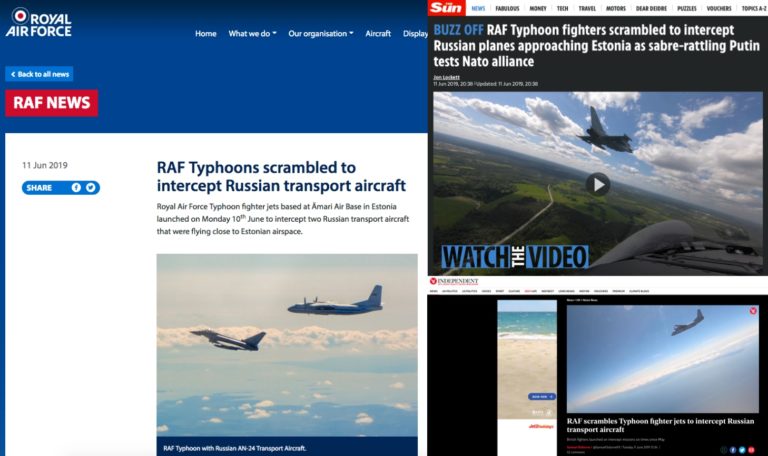
A press release from the UK’s Royal Air Force, and how it was covered by two British newspapers, The Sun and The Independent.
Such “embedded journalism” poses a significant threat to the public interest. Richard Norton-Taylor, formerly the Guardian’s security correspondent for over 40 years, told Declassified : “Embedded journalists — those invited to join British military units in conflict zones — are at the mercy of their MOD handlers at the best of times. Journalists covering defence, security and intelligence are far too deferential and indulge far too much in self-censorship”.
Some papers are more extreme than others in their willingness to act as platforms for the military and intelligence establishment. The Express may well be the most supportive: its coverage of MOD stories and vilification of official enemies, notably Russia, is remarkable and consistent.
The Guardian, however, has also been shown to play a similar role. Declassified’s recent analysis, drawing on newly released documents and evidence from former and current Guardian journalists, found that the paper has been successfully targeted by security agencies to neutralise its adversarial reporting of the “security state”.
Censorship by omission
Articles critical of the Ministry of Defence or security services are occasionally published in the press. However, these tend to be either on relatively minor issues or are reported on briefly and then forgotten. Rarely do seriously critical stories receive sustained coverage or are widely picked up across the rest of the media.
Often, reporters will cover a topic and elide the most important information for no clear reason. For example, there is considerable coverage of possible MI5 failures to prevent the May 2017 Manchester terrorist bombing — failings which may be understandable given the large number of terrorist suspects being monitored at any one time.
However, the government admitted in parliament in March 2018 that it “likely” had contacts with two militant groups in the 2011 war in Libya for which the Manchester bomber and his father reportedly fought at the time, one of which groups the UK had covertly supported in the past. This significant admission in parliament has not been reported in any press article, as far as can be found.
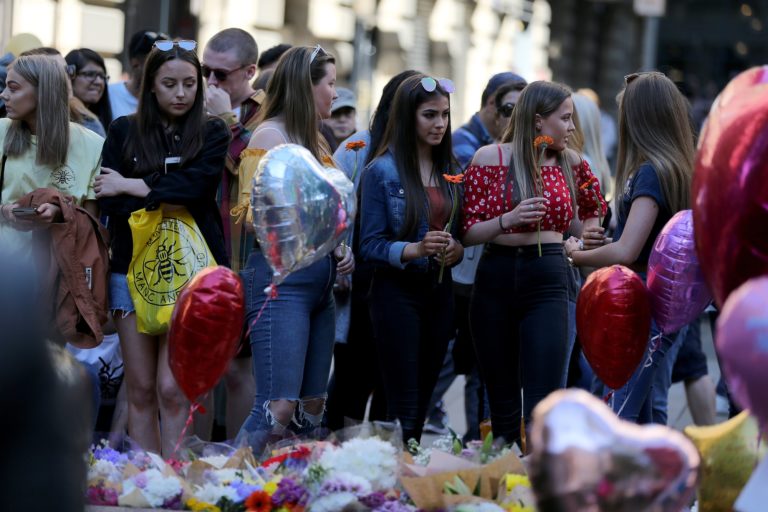
People lay flowers in St Annes Square on the first anniversary of the Manchester Arena bombing in Manchester, Britain, 22 May 2018. (Photo: EPA-EFE / Nigel Roddis)
Last September, veteran investigative journalist Ian Cobain broke a story on the alternative news site Middle East Eye revealing that the senior Twitter executive with editorial responsibility for the Middle East is also a part-time officer in the British army’s psychological warfare unit, the so-called 77th Brigade.
This story was picked up by a few media outlets at the time (including the Financial Times, the Times and the Independent ) but our research finds that it then went unmentioned in the hundreds of press articles subsequently covering Twitter.
Similarly, in November 2018, a story broke on a secretive UK government-financed programme called the Integrity Initiative, which is ostensibly a “counter disinformation” programme to challenge Russian information operations but was also revealed to be tweeting messages attacking Labour leader Jeremy Corbyn.
Our research finds that in the 14 months until December 2019, the Integrity Initiative was mentioned less than 20 times in the UK-wide national press, mainly in the Times (it was also mentioned 15 times in the Scottish paper, the Sunday Mail ).
By contrast, when stories break that are useful to the British establishment, they tend to receive sustained media coverage.
Establishment think tanks
The British press routinely chooses to rely on sources in think tanks that largely share the same pro-military and pro-intervention agenda as the state.
The two most widely-cited military-related think tanks in the UK are the London-based Royal United Services Institute (RUSI) and the International Institute for Strategic Studies (IISS) which are usually quoted as independent voices or experts. In the last five years, RUSI has appeared in 534 press articles and IISS in 120.
However, both are funded by governments and corporations. RUSI, which is located next door to the Ministry of Defence in Whitehall, has funders such as BAE Systems, the Qatar government, the Foreign Office and the US State Department. IISS’s chief financial backers include BAE Systems, Raytheon, Lockheed Martin and Airbus.
This funding is mentioned in only two press reports that could be found – the Guardian reported that IISS received money from the regime in Bahrain while the Times once noted, “RUSI, while funded in part by the MoD, is an independent think tank”.
One Telegraph article refers to a “research fellow at RUSI who specialises in combat airpower”, without mentioning that its funder BAE Systems is a major producer of warplanes.
Although many senior figures in these organisations previously worked in government, press readers are rarely informed of this. RUSI’s chair is former foreign secretary William Hague, its vice-chair is former MI6 director Sir John Scarlett and its senior vice-president is David Petraeus, former CIA director.
The IISS’s deputy secretary-general is a former senior official at the US State Department while its Middle East director is a former Lieutenant-General in the British army who served as defence senior adviser to the Middle East. One of IISS’ senior advisers is Nigel Inkster, a former senior MI6 officer.
Media and intelligence
Richard Keeble, professor of journalism at the University of Lincoln, has noted that the influence of the intelligence services on the media may be “enormous” and the British secret service may even control large parts of the press. “Most tabloid newspapers – or even newspapers in general – are playthings of MI5”, says Roy Greenslade, a former editor of the Daily Mirror who has also worked as media specialist for both the Telegraph and the Guardian.
David Leigh, former investigations editor of the Guardian, has written that reporters are routinely approached and manipulated by intelligence agents, who operate in three ways: they attempt to recruit journalists to spy on other people or go themselves under journalistic “cover”, they pose as journalists in order to write tendentious articles under false names, and they plant stories on willing journalists, who disguise their origin from their readers — known as black propaganda.
MI6 managed a psychological warfare operation in the run-up to the Iraq war of 2003 that was revealed by former UN arms inspector Scott Ritter. Known as Operation Mass Appeal, this operation “served as a focal point for passing MI6 intelligence on Iraq to the media, both in the UK and around the world. The goal was to help shape public opinion about Iraq and the threat posed by WMD [weapons of mass destruction]”.
Various fabricated reports were written up in the media in the run-up to the Iraq war, based on intelligence sources. These included cargo ships said to be carrying Iraqi weapons of mass destruction (covered in the Independent and Guardian ) and claims that Saddam Hussein killed his missile chief to thwart a UN team (Sunday Telegraph ).
More recent examples of apparently fabricated stories in the establishment media include Guardian articles on the subject of Julian Assange. The paper claimed in a front page splash written by Luke Harding and Dan Collyns in November 2018 that former Trump campaign manager Paul Manafort secretly met Assange in the Ecuadorian embassy three times.
The Guardian also falsely reported on a “Russia escape plot” to enable Assange to leave the embassy for which the paper later gave a partial apology. Both stories appeared to be part of a months-long campaign by the Guardian against Assange.
The exterior view of Thames House, MI5 Headquarters, in Millbank, on the bank of the River Thames, London, Britain. (Photo: EPA-EFE/ Horacio Villalobos)
Demonising enemies
The media plays a consistent role in following the state’s demonisation of official enemies. The term “Russian threat” is mentioned in 401 articles in the past five years, across the national press. The Express may be the largest press amplifier of the government’s demonisation of Russia — the paper carries a steady stream of stories critical of Russia and Putin.
The British establishment has invoked Russia as an enemy in recent years due mainly to the poisonings in the town of Salisbury and policy in eastern Europe. Whatever malign policies Russia is promoting, which can be real, false or exaggerated, it is noteworthy that this has been elevated by the press to a general “threat” to the UK. As during the cold war, this is useful to the British military and security services arguing for larger budgets and for offensive military postures in Eastern Europe and the Middle East.
Russia’s alleged interference in British politics has received huge coverage compared to alleged Israeli influence. A simple comparison of search terms using “Russia/Israel and UK and interference” in press articles in the past five years yields seven times more mentions of Russia than Israel, despite considerable evidence of Israeli interference.
UK press reporting on Iran is also noticeably supportive of government policy. A search for “Iran and nuclear weapons programme” reveals 325 articles in the past five years. While this large coverage is driven by president Trump’s withdrawal from the Iran nuclear deal, it is also driven by Iran being a designated enemy of the US and UK, which have deemed it unacceptable that Tehran should ever acquire nuclear weapons.
By contrast, “Israel’s nuclear weapons” (and variants of this search term) are mentioned in under 30 press articles in the past five years. Natanz, Iran’s main nuclear arms facility, has been mentioned in around four times more press articles than Dimona, the Israeli nuclear site, in the past five years.
The contrast in reporting on Iran and Israel is striking since Iran does not possess nuclear weapons, and it is not certain that it seeks to, whereas Western ally Israel already has such weapons, estimated at around 80 warheads.
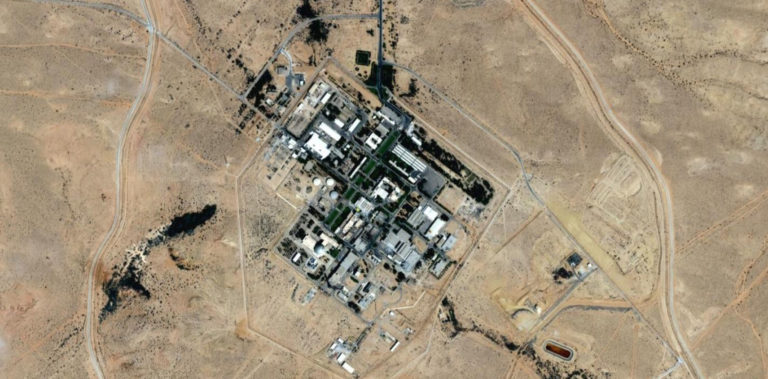
An aerial view of Israel’s nuclear site at Dimona. (Google Maps)
Labelling goodies and baddies
The national press strongly follows the government in labelling states as enemies or allies.
States favoured by the UK are mainly described in the press using the neutral term “government” rather the more critical term “regime”. In the past three years, for example, the term “Saudi government” has been used in 790 articles while “Saudi regime” is mentioned in 388. However, with Iran the number of instances is reversed: “Iranian government” is used in 419 articles whereas “Iranian regime” is mentioned in 456.
The same holds for other allies. The “Egyptian regime” receives 24 mentions while “Egyptian government” has 222, in the past three years. The “Bahraini regime” is mentioned in 10 articles while “Bahraini government” is mentioned in 60.
The precise term “Iranian-backed Houthi rebels”, referring to the war in Yemen, is mentioned in 198 articles in the last five years. However, the equivalent term for the UK backing the Saudis in Yemen (using search terms such as “UK-backed Saudis” or “British-backed Saudis”) appears in just three articles.
The pattern is also that the crimes of official enemies are covered extensively in the national press but those of the UK and its allies much less so, if at all.
Articles mentioning “war crimes and Syria” number 1,527 in the past five years compared to 495 covering “war crimes and Yemen”. While the press often reports that the Syrian government has carried out war crimes, most articles simply suggest or allege war crimes by the Saudis in Yemen.
Indeed, the UK press has been much more interested in covering the Syrian war—chiefly prosecuted by the UK’s opponents—than the Yemen war, where Britain has played a sustained widespread role. As a basic indicator, the specific term “war in Syria” is mentioned in well over double the number of articles as “war in Yemen” in the past five years.
Furthermore, government enemies are regularly described in the press as supporters of terrorism, which rarely applies to allies.
In the past three years 185 articles mention the term “sponsor of terrorism”, most referring to Iran, followed by Sudan and North Korea with the occasional mention of Libya and Pakistan. None specifically label UK allies Turkey or Saudi “sponsors of terrorism”, despite evidence of this in Syria and elsewhere, and none describe Britain or the US as such.
Some 102 articles in the past five years specifically mention Russia’s “occupation of Crimea”. However, despite some critical articles on UK policy towards the Chagos Islands in the Indian ocean—which were depopulated by the UK in the 1970s and which the US now uses as a military base—only two articles specifically mention the UK’s “occupation of Chagos” (or variants of this term).
Similar labelling prevails on opposition forces in foreign countries. Protesters in Hong Kong are routinely called “pro-democracy” by the press – the term has been mentioned in hundreds of articles in the past two years. However, protesters in UK allies Bahrain and Egypt have been referred to as “pro-democracy” in only a handful of cases, the research finds.
The special relationship
While demonising enemies, UK allies are regularly presented favourably in the press. This is especially true of the US, the UK’s key special relationship on which much of its global power rests. US foreign policy is routinely presented as promoting the same noble objectives as the UK and the press follows the US government line on many foreign policy issues.
The term “leader of the free world” to refer to the US has been used in over 1,500 articles in the past five years, invariably taken seriously across the media, without challenge or ridicule.
The view that the US promotes democracy is widely repeated across the press. A 2018 editorial in the Financial Times, written by its chief foreign affairs commentator Gideon Rachman, notes that, “Leading figures in both [US political] parties — from John Kennedy to Ronald Reagan through to the Bushes and Clintons — agreed that it was in US interests to promote free-trade and democracy around the world”. In 2017 Daniel McCarthy wrote in the Telegraph of “two decades of idealism in US foreign policy, of attempts to spread liberalism and democracy”.
It is equally common for the UK press to quote US figures on their supposed noble aims, without challenge. For example, the Sunday Times recently cited without comment the US state department saying “Promoting freedom, democracy and transparency and the protection of human rights are central to US foreign policy”.
The press often strongly criticises President Donald Trump, but often for betraying otherwise benign US values and policies that it assumes previous presidents have promoted. For example, Tom Leonard in the Daily Mail writes of “Mr Trump’s belief that US foreign policy should be guided by cold self-interest rather than protecting democracy and human rights”.
The Guardian is especially supportive of US foreign policy. A sub-heading to a recent article notes: “The US once led Western states’ support of democracy around the world, but under this president [Trump] that feels like a long time ago”. One of its main foreign affairs columnists, Simon Tisdall, recently wrote that the US fundamental “mission” was an “exemplary global vision of democracy, prosperity and freedom”, albeit one which has been distorted by the war on terror.
The Guardian regularly heaped praise on president Obama. An editorial in January 2017 commented that Obama was a “successful US leader” and that “internationally” his vision “could hardly be faulted for lack of ambition”. It also noted Obama’s “liberalism and ethics” and that: “Mr Obama has governed impeccably for eight years without any ethical scandal”.
Although the article noted US wars and civilian casualties in Yemen and Libya, the paper brushed these off, stating “But to ascribe the world’s tragedies to a single leader’s choices can be simplistic. The global superpower cannot control local dynamics”.
Research covered the period to the end of 2019 using the media search tool, Factiva. It analysed the “mainstream” UK-wide print media (dailies and Sundays) over different time scales, usually two or five years, as specified in the article. Media search engines cannot be guaranteed to work perfectly so additional research was sometimes undertaken.
Mark Curtis is the co-founder and editor of Declassified UK, an historian and author of five books on UK foreign policy. He tweets at: @markcurtis30.
March 11, 2020
Posted by aletho |
Deception, Fake News, Mainstream Media, Warmongering, Russophobia | GCHQ, MI5, MI6, The Guardian, UK |
Leave a comment
The ongoing legal challenge of UK human rights group Liberty over data privacy breaches committed by MI5 has revealed new details about the violations, showing that the security service has been failing to remove collected bulk surveillance data on time and received surveillance warrants based on knowingly false information.
Under the Investigatory Powers Act (IPA), MI5 has the authority to collect, upon authorization, personal data of a large number of innocent people and store it for potential future investigations. Security services, however, cannot store such data indefinitely: they are obliged to delete it within certain time limits.
Documents released during a court hearing on Tuesday showed that the MI5 legal team said, as quoted by the Liberty, that there is “a high likelihood [of material] being discovered when it should have been deleted, in a disclosure exercise leading to substantial legal or oversight failure.”
Moreover, a senior official from the intelligence service said that people’s personal data was being kept in “ungoverned spaces,” the rights group said in a statement, published on its official website.
“These shocking revelations expose how MI5 has been illegally mishandling our data for years, storing it when they have no legal basis to do so. This could include our most deeply sensitive information – our calls and messages, our location data, our web browsing history,” Liberty lawyer Megan Goulding said, as quoted by the rights group.
Investigatory Powers Commissioner and Lord Justice Adrian Fulford, who is responsible for verifying that the security services respect data privacy provisions laid out in the IPA, described MI5’s actions as “undoubtedly unlawful.”
“Without seeking to be emotive, I consider that MI5’s use of warranted data … is currently, in effect, in ‘special measures’ and the historical lack of compliance … is of such gravity that IPCO [Investigatory Powers Commissioner’s Office] will need to be satisfied to a greater degree than usual that it is ‘fit for purpose'” Fulford said as quoted by the Liberty website.
According to the rights group, the commissioner said that the intelligence would have never obtained permissions for their surveillance activities if the watchdog had known that MI5 was violating the IPA.
“Warrants for bulk surveillance were issued by senior judges (known as Judicial Commissioners) on the understanding that MI5’s data handling obligations under the IPA were being met – when they were not,” Liberty said.
The rights group raised the alarm about MI5’s violations in May, prompting the investigatory powers commissioner to start an investigation into the matter.
June 12, 2019
Posted by aletho |
Civil Liberties, Deception | Human rights, MI5, UK |
Leave a comment
The alt media-verse is currently on fire with the news that the US State Dept’s answer to Al Capone, Mike Pompeo, has been caught promising “Jewish leaders” to send the boys round to Jeremy Corbyn if he should get elected and subsequently prove to be uppity and out of line. According to the WaPo, who broke the story:
The remarks, which are contained in audio of a private meeting leaked to The Washington Post, make Pompeo the second senior U.S. official to comment on Britain’s turbulent leadership succession in the past week.
During his meeting with Jewish leaders in New York, Pompeo was asked if Corbyn “is elected, would you be willing to work with us to take on actions if life becomes very difficult for Jews in the U.K.?”
In response, Pompeo said, “It could be that Mr. Corbyn manages to run the gantlet and get elected. It’s possible. You should know, we won’t wait for him to do those things to begin to push back. We will do our level best,” he said to fervent applause from attendees.
“It’s too risky and too important and too hard once it’s already happened,” he said.
Of course the idea the “Jewish leaders” harbor any real fear that Jeremy Corbyn (Jeremy Corbyn!) is going to make life “difficult” for British Jews if elected is simply risible. They know, just as every moderately informed person knows, that that’s absurd. They know Corbyn has no wish to make life difficult for anybody – except possibly the uber wealthy and the profiteer class.
They know the “antisemitism” fear is just a cover for the very very real fear that a Corbyn government will break the unwritten rules of modern western governance and reject the agenda of austerity, exploitation and perpetual war that has been creating huge profits and ideological thrills for the blessed few over the last twenty years.
They know that what Pompeo is promising is action to prevent this possibility coming about.
People are up in arms about this, and some seem quite shocked. Apparently the idea the neoliberal elites would try regime change or regime-control on a relatively prosperous western country was something they didn’t previously think possible.
Unfortunately it’s more than possible. The state apparatus of the different western nations are a tight bond of mutual regard and interest, just as likely to foment regime change on their own or their allies’ elected representatives as on those of impoverished or “developing” countries, if they believe those representatives threaten the perceived interests of the state. Of course it isn’t too often necessary, since the same western state apparatus also works to ensure that only governments that don’t threaten perceived state interests manage to get elected. But, when the unthinkable happens, MI5 and the CIA are quite happy to step up to the plate and throw their own or their allies’ democratic governments out the window. It’s happened – or nearly happened – at least twice in the last fifty years.
In the 1960s the UK security agencies, senior military and members of the royal family were apparently contemplating a full blown coup against Labour prime minister Harold Wilson.
In 1975 it was Australia’s turn, when democratically elected reforming prime minister Gough Whitlam was overthrown in a bloodless constitutional coup organised jointly by the US and UK.
The old empire and the new have form in this regard, and this means no one should take Pompeo’s words (spoken in private let’s not forget) lightly.
It’s also interesting to look at how the WaPo frames the revelation. There’s no sense of outrage or surprise there. In fact it’s an almost matter-of-fact piece, written with no awareness of its potential impact. Even those in the comments who object in some form are mostly doing it within the permissible current language of dissent – blaming Trump, because in these identity politics-saturated times, your morality resides in who or what you are NOT in what you do.
To the WaPo – and many of its readers – there’s nothing intrinsically either wrong or surprising in the idea a US secretary of state should be overtly promising to interfere in the democratic governance of another country.
It’s just what they do when they need to.
Catte Black is an OffGuardian co-founding editor. Writer. Opinionated polemicist.
June 10, 2019
Posted by aletho |
Timeless or most popular | CIA, MI5, UK, United States, Washington Post, Zionism |
Leave a comment
Israel’s ambassador to Britain, Shlomo Argov, was shot and mortally wounded in 1982, giving Menachem Begin’s government the excuse needed to invade Lebanon and drive the Palestine Liberation Organisation (PLO) out of Beirut.
The UK National Archives has refused a request by a Sputnik reporter — made under the Freedom of Information Act — to reveal what happened to the terrorists who attacked Mr. Argov.
Mr. Argov, 52, was leaving a diplomatic function at the Dorchester Hotel in Park Lane, central London, when a gunmen approached him and fired two shots.
He was hit in the head, went into a coma for three months and later lost his sight.
Mr. Argov was transferred to Hadassah University Hospital in Jerusalem. His death in 2003 was blamed on the injuries he received that fateful night in London.
The gunman — Hussein Ahmad Ghassan Said — was shot and injured by a police officer who was acting as Mr. Argov’s bodyguard and he was arrested, along with two other men who fled the scene in a car, which was chased through the streets of London.
Said and the two other men, who had links to the Palestinian extremist Abu Nidal Organisation, were convicted of attempted murder and jailed for life in March 1983.
The file on Hussein Ahmad Ghassan Said, Marwan Al-Banna and Nauoff Nagib Meflehel al-Rosan at the National Archives is marked as “closed until 2077”.
The file covers the events of January 1982-December 1984.
Although the terrorists were from Abu Nidal Organisation and not Yasser Arafat’s PLO, the Israeli government retaliated by launching Operation Peace for Galilee, a full-scale invasion of Lebanon.
The Israelis occupied parts of Beirut and in September 1982 their Falangist allies massacred hundreds of Palestinian civilians in the Sabra and Shatila refugee camps while Israeli troops led by future prime minister Ariel Sharon turned a blind eye.
Israeli forces only left in 1985.
But what of the three men whose actions triggered these horrific events?
Said was a Jordanian national while al-Banna was Abu Nidal’s cousin and al-Rosan was a colonel in Saddam Hussain’s Iraqi intelligence agency.
The Abu Nidal Organization the PLO were enemies and ironically al-Banna and al-Rosan were also under orders to kill the PLO’s London representative, Nabil Ramlawi, but were arrested before they could get to him.
Said, al-Banna and al-Rosan were jailed for life at the Central Criminal Court in London and given minimum terms of between 30 and 35 years.
Two of them were reportedly later transferred to high security hospitals in the UK after becoming mentally ill.
In 1999 the respected Israeli newspaper Ha’aretz published an article claiming MI5 had knew about the plot.
Lord Alton, a former Liberal MP, tried to raise the issue in the House of Lords but was rebuffed when Lord Williams of Mostyn, a Home Office minister, refused to comment “on the operations of the security and intelligence agencies.”
The Independent newspaper also claimed a convicted murderer, and Liverpool police informer, Ronald Waldron, said he had given a “hot” warning of the plot to kill Argov.
“I gave them everything, the group’s whole list of targets. I told them that they were planning to kill Argov. They knew that Argov was on the list, but they still left him with one bodyguard, completely exposed to the assassins’ bullets. That was really a crime,” Waldron told The Independent.
Abu Nidal died mysteriously in Baghdad in 2002.
In the intervening years Said, al-Banna and al-Rosan have vanished.
Are they still in jail? Are they in psychiatric hospitals? Have they been deported to Jordan or Iraq?
Or were they released and given political asylum in Britain?
A Sputnik reporter submitted a request under the Freedom of Information Act in September.
But earlier this month this request was refused by the National Archives, after “consultation with the Ministry of Justice”.
They said they were unable to open the file because it was exempt from the Freedom of Information Act under various grounds.
“When these exemptions apply, we are required to consider whether it is in the public interest to release this information and we regret to say, after very careful consideration, we do not think there is a public interest in doing so. These exemptions apply because we considered that the factors in favour of release are outweighed by the factors against releasing this information into the public domain at this time,” said the National Archives in a statement to Sputnik.
So what were the exemptions?
Sections 23 and 24 both cover “national security”.
“It is in the public interest that our security bodies can operate effectively in the interests of the United Kingdom, without disclosing information that may assist those determined to undermine the security of the United Kingdom and its citizens,” said the National Archives statement.
So perhaps the Israeli press were right and MI5 were privy to the plot and failed to stop it, or even allowed it to happen?
Another exemption was “law enforcement”.
“The Metropolitan Police Service has a duty to protect life and property, which would not include the release of information that would prejudice law enforcement,” said the National Archives statement.
But Mr. Argov is dead and his three attackers were jailed after a trial at the Old Bailey so what information could possibly be released that would “prejudice law enforcement”?
Unless one or all of the three attackers had been a police informant and was perhaps released early in a secret deal?
Another exemption was “physical and mental health”.
The Ministry of Justice’s “duty to openness and transparency under the FOI Act must not be fulfilled in such a way as to undermine public confidence that the right to privacy of victim’s families will be upheld, and must be balanced against its parallel duties to protect them from further harm, shock and distress.”
Sputnik has tried to contact Mr. Argov’s son, Gideon, a venture capitalist who lives in Boston, but without success.
The final exemption is “third party personal data”.
“The exemption applies because the document contains the personal information of one or more identifiable individuals reasonably assumed still to be living. These individuals have a reasonable expectation of privacy, which would not include the release of this information into the public domain during their lifetime,” says the National Archives statement.
But numerous files have been released by the National Archives containing personal information about individuals who are still alive.
December 31, 2018
Posted by aletho |
Deception, Ethnic Cleansing, Racism, Zionism, Timeless or most popular | Abu Nidal, Israel, Lebanon, MI5, UK, Zionism |
Leave a comment
UK ministers relied on questions from a tortured terror suspect to make their case for the Iraq War, the Middle East Eye (MEE) has claimed. British spies fed questions to the suspect even though they knew of his mistreatment.
According to redacted documents, seen by the MEE, an MI6 officer knew that Ibn al-Sheikh al-Libi was placed inside a sealed coffin by the CIA at a US-run Afghanistan based prison. Al-Libi – alive inside the coffin – was then taken, aboard a truck, to an aircraft that was to fly to Egypt.
The MI6 officer and his colleagues reported the incident to their department’s London HQ, stating that they “were tempted to speak out” on behalf of al-Libi, but failed to do so, adding: “The event reinforced the uneasy feeling of operating in a legal wilderness.”
Once al-Libi was in Egypt, a country with a well-documented history of human rights abuses, both MI6 and MI5 fed questions to the detainee, receiving reports from his Egyptian interrogators.
Al-Libi, under torture, told his jailers that Osama Bin Laden’s Al-Qaeda had links to Iraqi President Saddam Hussein’s nuclear weapons program. The claim was cited as fact by US President George W. Bush as he made the case for war.
Upon being returned to the CIA, al-Libi stated that he had lied to avoid further torture. By that point the US, along with the UK, had already invaded Iraq.
As well as Bush, al-Libi’s false information was cited by then-US Secretary of State Colin Powell in his infamous speech advocating for war at the UN Security Council on February 5 2003. On the same day, then-UK Prime Minister Tony Blair told parliament there were “unquestionably” links between Al-Qaeda and Iraq.
“There is evidence of such links. Exactly how far they go is uncertain. However… there is intelligence coming through to us the entire time about this,” Blair said.
The US had been keen to link Iraq to Al-Qaeda in the immediate aftermath of 9/11. In evidence disclosed to the Chilcot Inquiry, Bush had raised the issue in a phone call with Blair, who is said to have replied that he couldn’t accept it without seeing compelling evidence.
READ MORE:
British govt urged to come clean on ‘links to torture’ after Iraq invasion
November 7, 2018
Posted by aletho |
Deception, Fake News, Mainstream Media, Warmongering, Subjugation - Torture, Timeless or most popular, War Crimes | CIA, Egypt, MI5, MI6, UK, United States |
Leave a comment

 Aletho News
 Aletho News