IRA terrorist behind 1993 Belfast bombing was ‘MI5 informant’ – leaked documents
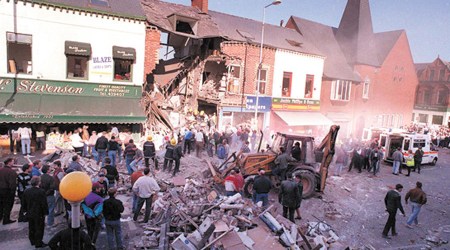
Aftermath of the Shankill Road Bombing © Wikipedia
RT | January 26, 2016
Northern Ireland’s police watchdog is investigating allegations that the IRA operative who planned the 1993 Shankhill Road bombing was an MI5 informant who gave intelligence that could have helped security forces stop the atrocity.
Nine civilians, including two children, were killed in the attack on a fish shop in Belfast’s loyalist heartland in 1993. The bombing became one of the most notorious atrocities of The Troubles, prompting a wave of sectarian revenge murders in its wake.
Inside job?
Some 23 years after the attack, allegations have surfaced that sensitive documents stolen by the Irish Republican Army in a 2002 raid on the Royal Ulster Constabulary (RUC) headquarters in Castlereagh show that the terrorist who planned the bombing was a British intelligence agent codenamed “AA.”
Excerpts of the stolen files indicate that AA had extensively briefed his Special Branch or MI5 handlers on the objective and timing of the bombing, which had been designed to stoke sectarian anger by murdering the leader of loyalist terror group the Ulster Defense Association (UDA).
UDA chiefs had planned to meet above the fish shop on the day of the attack, but postponed at short notice. Although they escaped the blast unharmed, it killed Protestant shoppers and one of the bombers, IRA member Thomas Begley.
The initial plan had been to light a fuse just long enough for civilians to be evacuated from the site and for the bombers, who were disguised as delivery men, to flee. But the bomb exploded as Begley approached the shop’s counter amid a group of customers.
Establishing a motive
The allegations concerning AA, which were first reported by the Belfast-based newspaper Irish News, raise the question of precisely what British intelligence officers knew in the run-up to the atrocity.
Observers suggest UK intelligence officers either allowed a botched bombing of civilians to play out or failed to intervene quickly enough to stop the atrocity.
The police ombudsman for Northern Ireland, Dr Michael Maguire, has confirmed he is examining the allegation.
“We have received a complaint. It centers on two concerns: Did the RUC have information which would have allowed them to prevent the bombing and was the subsequent investigation compromised; [and] did the police ‘fail to deliver justice to the families of those who lost their lives in the bombing?’” he said.
“We will seek to establish if this is something we should investigate, and if so, when we could begin this work.”
History of collusion
The police ombudsman’s inquiry began after relative of one of the Shankill Road bombing’s victims approached the watchdog, asking about AA.
The Castlereagh documents are believed to reveal that AA was passing information back to his handlers on details of the IRA plot to target senior UDA members, including the location and date of the bombing.
The documents stolen by the IRA in its raid on the RUC Castlereagh offices gave the codenames of British agents inside Republican terrorist groups, and a year later the IRA “stood down” one of its operatives, which it identified as AA after comparing the RUC documents with its own intelligence.
Investigators examining the case will look to ascertain whether information from the British agent could have been given to the UDA leadership to make sure their meeting was rescheduled and whether there is evidence to show British intelligence operatives allowed the attack to go ahead to protect AA as their source.
Relatives of the bombing’s victims have called for a full investigation.
Charlie Butler, who lost three relatives in the Shankill Road bombing, said he and other families would be “devastated” if the allegations are accurate.
“Collusion is not a nice word for anyone but when it is collusion with innocent people losing their lives to protect someone else there has to be a line drawn to say that is wrong,” he told BBC News.
“[The security forces] were there to do a job, to protect people. If they knew about [the bombing] then they should pay.”
The claims are the latest in a long line of allegations of collusion between terror groups and security forces on both sides of The Troubles.
In addition to the case involving AA, Northern Ireland’s police watchdog is investigating murders in the 1980s and 1990s of at least 20 alleged IRA informers whose family members believe they were used as scapegoats to cover the tracks of the security forces’ prominent IRA agents.
Britain’s Secret Widespread Use Of Torture
By Graham Vanbergen | TruePublica | October 6, 2015
The last British prisoner in Guantanamo Bay has claimed that Britain knew flawed evidence, used to justify the Iraq War, had been obtained under torture – and said his lengthy detention was a result of fears that he would go on the record if released.
Shaker Aamer, who is due to be freed from the US military prison after 13 years without charge, said he witnessed British agents at Bagram Air Base when a prisoner wrongly told interrogators that Iraqi forces had trained al-Qaeda in the use of weapons of mass destruction.
The evidence of Ibn al-Shaykh al-Libi, which was later disproven, was used by George W Bush in 2002 during a hawkish speech calling for the removal of Saddam Hussein, in which he said: “We’ve learned that Iraq has trained al-Qaeda members in bomb-making and poisons and deadly gases.”
Mr Aamer said that despite guarantees he would be released within days, he feared he would still die in the prison, adding: “I know there are people who, even now, are working hard to keep me here.”
A Foreign Office spokesman said: “The UK does not participate in, solicit, encourage or condone the use of torture or cruel, inhuman or degrading treatment or punishment for any purpose.
Aamer gave statements to the Metropolitan police two years ago in which he detailed the alleged brutality he has faced, that included torture. He said he was interrogated by British agents at Bagram airbase, who knew he and others were being tortured there.
Britain has a long, dark history of torture and it has gone to extraordinary lengths to hide it. A normal functioning democracy would stand resolute that torture of any kind is not just illegal and immoral, it simply doesn’t work.
David Whyte’s recent book “How Corrupt is Britain” covers some pivotal moments in the UK’s history of torture.
In June 1975 an eminent Harley Street doctor flew to Dublin. The patient was suffering from severe angina, a condition which is ‘always associated with the risk of sudden death according to the doctor. The doctor was Dr Denis Leigh, a leading consultant psychiatrist at the Bethlem Royal and the Maudsley Hospitals in London, and more importantly, medical consultant to the British Army.
The patient, Sean McKenna, was a former member of the IRA who had been subjected to so-called ‘in-depth interrogation’ following the introduction of internment without trial in August 1971, He was one of the 14 ‘hooded men’ whose infamous treatment forced the lrish state to launch a case alleging torture against the UK government at the European Court of Human Rights in Strasbourg.
Leigh’s medical examination was being carried out on behalf of the Crown to bolster the UK defence that the men had not suffered long-term physical or psychiatric damage as a result of their interrogation.
The ‘in-depth interrogation’ that McKenna and the others were subjected to consisted of five techniques that had been widely used by the British army in counter-insurgency campaigns in Aden, Cyprus, Malaya, Palestine and elsewhere – hooding, white noise, wall standing in a stress position and of course regular beatings.
Dr Leigh found that McKenna’s condition was known to British army doctors before the interrogation went ahead, and ‘it would be hard to show that it was wise to proceed with the interrogation, and that the interrogation did not have the effect of worsening his angina’.
In fact McKenna’s psychiatric condition was such that he had been released from Long Kesh internment camp in May 1972 directly into the care of a psychiatric unit. His daughter described ‘a very broken man, sitting crying, very shaky’. Four days after the June 1975 medical examination Sean McKenna died. He had suffered a massive heart attack.
In 1976 the European Human Rights Commission (EHRC) upheld a complaint by Ireland that the treatment of the ‘hooded men’ constituted torture, and referred the case to the European Court of Human Rights for judgement. The Commission had condemned the five techniques as a ‘modern system of torture’.
Britain was one of the original signatories to the European Convention on Human Rights, had been found to have sanctioned torture.
Successive UK governments, rather than comply with their legal obligation to ‘search and try’ allegations of torture, adopted a policy more akin to ‘hide and lie’. This was to have consequences many years later. The inquiry into the 2003 murder of an Iraqi civilian, Baha Mousa, by British soldiers was told that the five techniques had again been used in Iraq by every single battle group in the field.
ln ‘Cruel Britannia: A Secret History of Torture,’ Guardian journalist Ian Cobain provides damning evidence that the UK government did in fact ‘do’ torture, and had been doing so for decades in counter-insurgency wars from Brunei to Aden, and from Ireland to lraq. In June 2013 UK foreign secretary William Hague apologised in Parliament for the torture of Mau Mau suspects in Kenya during the 1950s. Over £50 million was paid out in compensation to some 5,000 Kenyan victims. ln 1972 prime minister Edward Heath had promised Parliament that the ‘five techniques’ torture techniques would never be used again.
As declassified documents now show, prime ministers and cabinet colleagues over the decades actually went to great lengths to ensure that those responsible for torture would not face sanction or prosecution and actively covered up these crimes.
In another case in Afghanistan, among the Britons who were picked up was a man called Jamal al-Harith. Born Ronald Fiddler in Manchester in 1966, Harith had converted to Islam in his 20s and travelled widely in the Muslim world before arriving in Afghanistan. After 9/11, he had been imprisoned by the Taliban, who suspected him of being a British spy. A British journalist found Harith languishing in the prison in January 2002 and alerted British diplomats in Kabul, believing they would arrange his repatriation. Instead, they arranged for him to be detained by US forces, who took him straight to an interrogation centre at Kandahar.
Harith then spent two years at Guantánamo, being kicked, punched, slapped, shackled in painful positions, subjected to extreme temperatures and deprived of sleep. He was refused adequate water supplies and fed on food with date markings 10 or 12 years old. On one occasion, he says, he was chained and severely beaten for refusing an injection. He estimates he was interrogated about 80 times, usually by Americans but sometimes by British intelligence officers.
In all, nine British nationals were sent to the maximum-security prison at Guantánamo, along with at least nine former British residents. All were incarcerated for years, and from the moment they arrived they suffered torture including regular beatings, threats and sleep deprivation. All were interrogated by MI5 officers and some also by MI6.
In December 2005, the full truth about British complicity in rendition and torture was still such a deeply buried official secret that Jack Straw felt able to reassure MPs on the Commons foreign affairs committee about the allegations starting to surface in the media. “Unless we all start to believe in conspiracy theories,” he said, “there simply is no truth in the claims that the United Kingdom has been involved in rendition or that behind this there is some kind of secret state which is in league with some dark forces in the United States”. Straw was lying.
Over the next few years, men were rendered not only from the war zones of Afghanistan and Iraq, but from Kenya, Pakistan, Indonesia, Somalia, Bosnia, Croatia, Albania, Gambia, Zambia, Thailand and the US itself. The US was running a global kidnapping programme on the basis of agreements reached at a Nato meeting.
Quietly, Britain pledged logistics support for the rendition programme, which resulted in the CIA’s jets becoming frequent visitors to British airports en route to the agency’s secret prisons on at least 210 times.
It has since been discovered that throughout the postwar period, it seemed, there had been a network of secret British prisons, hidden from the Red Cross, where men thought to pose a threat to the state could be kept for years and systematically tormented, tortured and sometimes murdered.
It is now known that MI5 have a department called the “international terrorism-related agent running section”: the section routinely responsible for interviewing suspected terrorists. The MI5 officers who were interrogating al-Qaida suspects – men who were being tortured in Afghanistan, Pakistan, Guantánamo and elsewhere around the world – were agent handlers. It appeared that MI5 was seeking to recruit torture victims as double agents.
Within two months of the May 2010 general election, under pressure from his Liberal Democrat coalition partners, as well as some of his own backbenchers, the new prime minister, David Cameron, announced the establishment of a judge-led inquiry into the UK’s involvement in torture and rendition. The man appointed to head the inquiry was named as Sir Peter Gibson, a retired judge. It is possible that MI5 and MI6 had a hand in his selection; for the previous four years Gibson had served as the intelligence services commissioner. Rights groups suggested that Gibson should be appearing before the inquiry as a witness rather than presiding over it.
In July 2011, most major international and British human rights groups, including Amnesty International, said they would be boycotting the inquiry. The following month, lawyers representing victims of Britain’s torture operations announced that they, too, would have nothing to do with it. Six months later, the government announced that the Gibson inquiry was scrapped.
Cameron’s government then brought forward a green paper that suggested a need for greater courtroom secrecy. Britain’s complicity in torture was to continue to be a dirty dark state secret.
None of this squares with Britain’s reputation as a nation that prides itself on its love of fair play and respect for the rule of law. Successive British government’s continues to preach to other nations around the world of the importance of justice, transparency and democracy whilst disregarding essentials such as these back at home.
The War on Conspiracy Realists Continues
By Brandon Martinez | Non-Aligned Media | July 24, 2015
Do you believe that governments occasionally conspire to undermine the public good? Do you believe that governments manipulate people through fear to achieve nefarious ends such as war and intervention abroad? Do you believe that ‘elected’ officials serve rich and powerful special interests rather than the majority population?
If you answered yes to any of the above, and you are a British citizen, then you could be the target of a new ‘counter-extremism’ initiative spearheaded by that country’s perverse Prime Minister David Cameron. As part of his Orwellian ‘counter-extremism’ effort, Cameron has instituted a number of truly despotic measures intent on stifling free speech and extirpating ‘heretical’ viewpoints about false flag terrorism and the undue influence of Zionists on Western foreign policy.
While self-evident to most clear thinking people, the notion that the West is deliberately targeting Muslims and their countries in accordance with an intricately fashioned master plan of divide and conquer will now be a prohibited opinion that could put the British police state on your trail.
“Muslim conspiracy theorists,” Cameron proclaimed in a recent speech outlining his ‘five year strategy’ to combat extremism, who believe that “Jews exercise a ‘malevolent’ power, that [the] Israeli intelligence agency Mossad inspired 9/11 and that the UK allowed 7/7 because it wanted an anti-Muslim backlash” are to be singled out for suppression.[1]
Cameron’s 1984-style designs will give parents the ability to revoke their children’s passports if suspected of holding ‘extremist’ beliefs. Police will be given new surveillance powers as well as the authority to vet what certain ‘extremists’ and ‘conspiracy theorists’ post on social media. Additionally, Ofcom – Britain’s communications regulatory body – will also be empowered to “crack down on television channels broadcasting extremist messages.” ‘Extremist messages’ appears to be a thinly disguised euphemism for anything not consonant with Western and Zionist propaganda.
Cameron’s aggressive moves against free expression were not unforeseen. During a speech at the United Nations last September, the British leader decried “conspiracy theorists” as “non-violent extremists” who should be confronted with the “full force” of the British state.[2] The theory that Israel and Western intelligence agencies were involved in the fabrication of 9/11 and other false flag attacks was specifically mentioned by Cameron as one of those “dangerous ideas” that needs to be eliminated from public discourse. Inferences about Jewish-Zionist manipulation of Western foreign policy towards the Islamic world should also be combatted, said Cameron in the speech.
Distracting the Public from Western Sponsorship of ISIS
All of this disingenuous bluster rings hollow when one considers the fact that Western governments and their allies have supported, and many would argue created, ISIS to serve their duplicitous agenda in the Middle East.
The CIA, MI6 and Mossad, in conjunction with the oppressive autocrats of Saudi Arabia, have long worked with Wahhabi-Salafist extremist elements in the Middle East and North Africa to counter other more formidable, non-sectarian adversaries in the region such as Libya’s Gaddafi, Syria’s Assad, Lebanon’s Hezbollah and the Islamic Republic of Iran. A re-run of the CIA’s “Operation Cyclone” which empowered Mujahideen forces in Afghanistan against the Soviets in the 1980s is currently unfolding in the Middle East under the auspices of many of the same players.
Award winning reporter Seymour Hersh revealed in a 2007 report titled “The Redirection” that the Bush administration launched a joint covert operation with Israel and Saudi Arabia to augment “Sunni extremist groups” and other fanatics to weaken the influence of Syria, Iran and Hezbollah.[3] Obama picked up where Bush left off, flooding Syrian and Libyan insurgent groups with untold largesse and arms, using the corrupted Arab Gulf kingdoms as conduits for weapons transfers for the sake of plausible deniability.
Hersh’s sources close to the US government told him that the Saudis assured Washington that they exercised control over the extremist Wahhabi and Salafist groups, and would steer their fanaticism towards the Shiites. “It’s not that we don’t want the Salafis to throw bombs; it’s who they throw them at—Hezbollah, Moqtada al-Sadr, Iran, and at the Syrians, if they continue to work with Hezbollah and Iran,” Prince Bandar bin Sultan, Saudi Arabia’s then-National Security Advisor, purportedly told his American counterparts in the Bush administration. “We’ve created this movement, and we can control it.”[4]
Part of the arrangement, Hersh explained, was a guarantee from the Saudis that Israel’s security interests would be safeguarded, which clarifies why ISIS and its affiliates have not attacked Israel despite the country’s close proximity to the terrorists’ strongholds in Syria and Iraq. “Israel would be assured that its security was paramount and that Washington and Saudi Arabia and other Sunni states shared its concern about Iran,” Hersh noted was the first point in a series of “informal understandings about their new strategic direction” to combat Shiite influence led by Iran.[5]
ISIS themselves have mostly eschewed hostility towards Israel, posting an official statement on social media in July 2014 saying that they’re more interested in fighting “Muslim infidels” than the Zionist state.[6] Israeli officials have expressed similar sentiments, with Israel’s former envoy to the US, Michael Oren, stating in a September 2013 interview that Tel Aviv “prefers” ISIS and al-Qaeda over the “bad guys backed by Iran,” namely Syria’s Assad and Hezbollah. Oren forthrightly conceded that Israel is committed to defeating through terrorist violence “the strategic arc that extends from Tehran, to Damascus to Beirut” with Assad in Syria functioning as the “keystone in that arc.” “That is a position we had well before the outbreak of hostilities in Syria,” Oren told the Jerusalem Post. “With the outbreak of hostilities we continued to want Assad to go.”[7]
The unholy alliance between Israel and the Salafist jihadists came right out in the open in June 2015 when ISIS released a video threatening to topple Hamas in Gaza[8], promising to bring bloodshed and ruin to the Strip. Salafist elements tied to ISIS have in fact attacked Hamas havens in Gaza on multiple occasions over the past few months, showcasing their utility as pawns of Israel.[9][10][11] There are also well-documented direct connections between ISIS-linked militants and Israel. A 2014 report compiled by United Nations observers stationed in the area revealed that the Israeli military has provided anti-Assad militants with sanctuary on the Israeli side of the Golan region, ostensibly treating wounded fighters in Israeli field hospitals and even giving them caches of weapons and other supplies.[12] On top of material support for the terrorists that have besieged Syria, Israel has aided their onslaught through numerous air strikes against Syrian military targets since the turmoil began in earnest in 2012, effectively attempting to tip the tide of the war in the Takfiris’ favour.[13] In January 2015 Israel conducted an airstrike that wiped out a brigade of Hezbollah fighters on the Syrian side of the Golan Heights, once again highlighting the Takfiri-Tel Aviv nexus.[14]
In light of such treachery against Arabs and Muslims trying to liberate themselves from oppression and domination, ISIS’s primary function as an acquiescent tool of US-Israeli imperialism cannot be overstated.
Perfidious Albion
As Prime Minister Cameron feigns outrage and opposition to Islamic extremism, the British government under his watch has been an active and willing partner in the Machiavellian strategy of divide and rule in the Middle East spearheaded by the US and Israel.
The 2015 trial of Swedish national Bherlin Gildo – who fought for a militant group in Syria – confirmed London’s role in backing Takfiri insurgents battling Damascus. In his defense, Gildo’s lawyers introduced evidence that British intelligence agencies “were supporting the same Syrian opposition groups as he was, and were party to a secret operation providing weapons and non-lethal help to the groups, including the Free Syrian Army.” Confronted with this contradiction, the British court dropped all charges against Gildo, fearing more embarrassing evidence showcasing British complicity with Syrian rebels could surface during proceedings.[15]
In 2013, Roland Dumas, France’s former foreign minister, told a French television station that during a visit to Britain two years before the Syrian crisis began in 2011, British officials informed him of a secret plan to spark a rebel invasion of Syria.[16] “Britain was preparing gunmen to invade Syria,” Dumas said, pinpointing the origins of the scheme to Israel which, according to Dumas, sought to oust a neighbouring regime hostile to its imperial ambitions in the Levant. Dumas then recounted a conversation he had with an unnamed Israeli prime minister who allegedly told him that the countries in the Middle East that get in the way of Zionist objectives for the region would be swiftly eliminated.
In an April 2014 report entitled “The Red Line and the Rat Line,”[17] journalist Seymour Hersh uncovered British involvement with a CIA-led covert operation in Benghazi, Libya, wherein the Agency was secretly channeling the looted weapons stockpiles of the fallen Gaddafi regime to Western-backed Syrian rebels through a “rat line.” Commenting on Hersh’s report, The Independent’s Patrick Cockburn described the CIA/MI6 “rat line” project in Benghazi as a “supply chain for the Syrian rebels overseen by the US in covert cooperation with Turkey, Saudi Arabia and Qatar.”[18] He summarized Hersh’s findings in more detail as follows:
“The information about this comes from a highly classified and hitherto secret annex to the report by the US Senate Intelligence Committee on the attack by Libyan militiamen on the US consulate in Benghazi on 11 September 2012 in which US ambassador Christopher Stevens was killed. The annex deals with an operation in which the CIA, in cooperation with MI6, arranged the dispatch of arms from Mu’ammer Gaddafi’s arsenals to Turkey and then across the 500-mile long Turkish southern frontier with Syria. The annex refers to an agreement reached in early 2012 between Obama and Erdogan with Turkey, Saudi Arabia and Qatar supplying funding. Front companies, purporting to be Australian, were set up, employing former US soldiers who were in charge of obtaining and transporting the weapons. According to Hersh, the MI6 presence enabled the CIA to avoid reporting the operation to Congress, as required by law, since it could be presented as a liaison mission.”
In addition to conniving with the US and Israel to arm Takfiri rebel gangs that eventually overran Gaddafi and continue to menace Syria, the British government has also covertly collaborated with Wahhabi extremists in its own country who serve as cartoonish fodder for anti-Muslim war on terror propaganda. In a May 2013 report for the Asia Times, security scholar Nafeez Ahmed disclosed that the British-based Salafist group Al Muhajiroun has been secretly supported by the British intelligence services since its inception in 1996.[19] That group has spawned nearly all of the supposed Islamic extremists implicated in (and perhaps framed for) various attacks in Britain, including the alleged ‘shoe bomber’ Richard Reid, the alleged Woolwich killers of British soldier Lee Rigby, the alleged 7/7 bombers and many others accused or convicted of terrorism-related offenses. Ahmed contends that various dubious personalities acting as leaders of Al Muhajiroun over the years – including Abu Hamza, Omar Bakri, Haroon Rashid Aswat and Anjem Choudary – have been clandestine agents of British intelligence fronting as ‘Islamic radicals.’
Despite his vocal support for al-Qaeda and ISIS, outwardly championing their grotesque bloodletting in Syria and Iraq today, Anjem Choudary (the current leader of Al Muhajiroun which has re-branded and re-named itself several times) is left untouched by British authorities and appears frequently on mainstream media. How can this impunity be explained if Choudary and his organization are operating independently without state protection? “Almost every major terrorist attack and plot in the UK has in some way been linked to Choudary’s extremist network,” noted Ahmed in the aforesaid piece, yet the radical preacher and his organization “[continues] to function with impunity in new incarnations.”
“[T]hrough Al Muhajiroun,” Ahmed explained, “MI5 is spawning many of the plots it lays claim to successfully foiling – as the FBI is also doing.” The MI5-controlled front group essentially serves a dual purpose: 1) it functions as a repository for Muslim patsies used in US-Israeli-British false flag operations, and 2) it acts as a recruiting hub for Wahhabi-Salafist mercenaries wielded as cannon fodder in various battle zones where Western/Zionist geopolitical and economic interests are at stake.
Unraveling the Web of Intrigue
Those not learned in the dark arts of black operations will likely be confused by all of this. “The West is fighting a war on Islamic extremism,” the indoctrinated lemmings will proclaim with confidence, completely unaware that they are being played for fools by professional spooks trained to employ artifices against the masses.
The surface rhetoric that politicians employ is merely a pack of daft lies intended to divert attention from the real agendas that drive policy. The public is fed a steady diet of cover stories and feel-good rationales – fanciful tales of good vs. evil – to pacify adverse reactions to and deflect unwanted attention from nefarious plots designed to benefit rich people and their interests.
David Cameron himself inadvertently identified whom some of these wealthy string-pullers are: Jewish Zionists committed to overturning every regime in the Middle East that is not yet subordinated to Tel Aviv. The other half of that equation includes an assortment of profiteering Anglos, Americans, Europeans, Arabs, Russians, Chinese and other money-mad opportunists. The Cameron’s, Obama’s, Harper’s, Hollande’s and Merkel’s of the world are mere screens or dummies for the real power behind the throne: the unscrupulous financiers, oligarchs and speculators who dominate Wall Street and the City of London, and to a lesser extent Shanghai and Moscow.
The Zionists, however, seem to be the most organized, the most aggressive and the most committed to living out their grandiose messianic dreams. Whether that vision entails a “New Middle East” in which “Greater Israel” rules the roost or a global government headquartered in Jerusalem remains to be seen. Either way it spells disaster for most of the world’s peoples.
Sources
[1] “Parents may cancel children’s passports in war on IS,” The Week, July 20, 2015. https://web.archive.org/web/20150724070333/http://www.theweek.co.uk/64449/cameron-attacks-ludicrous-extremist-conspiracy-theories
[2] http://www.youtube.com/watch?v=0g-HqRP-ANk
[3] Seymour Hersh, “The Redirection,” The New Yorker, March 5, 2007. https://web.archive.org/web/20150318015442/http://www.newyorker.com/magazine/2007/03/05/the-redirection
[4] Ibid.
[5] Ibid.
[6] Elad Benari, “ISIS: Fighting ‘Infidels’ Takes Precedence Over Fighting Israel,” Israel National News, July 8, 2014. https://web.archive.org/web/20140831070443/http://www.israelnationalnews.com/News/News.aspx/182632
[7] Herb Keinon, “’Israel wanted Assad gone since start of Syria civil war’,” Jerusalem Post, Sept. 17, 2013. https://web.archive.org/web/20150112102133/http://www.jpost.com/Syria-Crisis/Oren-Jerusalem-has-wanted-Assad-ousted-since-the-outbreak-of-the-Syrian-civil-war-326328
[8] “ISIS Threatens To Topple Hamas In Gaza,” Reuters, July 1, 2015. http://www.huffingtonpost.com/2015/07/01/isis-hamas-gaza_n_7704360.html
[9] “Isis blamed for Gaza City bomb attacks,” The Independent, July 20, 2015. http://www.independent.co.uk/news/world/middle-east/isis-blamed-for-gaza-city-bomb-attacks-10400747.html
[10] “ISIS Allies Target Hamas and Energize Gaza Extremists,” New York Times, June 30, 2015. https://web.archive.org/web/20150713130805/http://www.nytimes.com/2015/07/01/world/isis-allies-target-hamas-and-energize-gaza-extremists.html?_r=0
[11] “ISIS supporters claim attack on Hamas base in Gaza Strip,” Russia Today, May 8, 2015. https://web.archive.org/web/20150713195921/http://rt.com/news/256941-isis-attack-gaza-hamas/
[12] “UN details Israel helping Syrian rebels at Golan Heights,” Russia Today, Dec. 8, 2014. https://web.archive.org/web/20150316140841/http://rt.com/news/212319-israel-helps-syrian-militants/
[13] “Head of Syrian army after alleged airstrikes: Israel working with ISIS and al-Qaida,” Jerusalem Post, Dec. 7, 2014. https://web.archive.org/web/20150316154301/http://www.jpost.com/Arab-Israeli-Conflict/Head-of-Syrian-army-after-alleged-airstrikes-Israel-working-with-ISIS-and-al-Qaida-383907
[14] “’Israel strike’ kills Hezbollah men in Syria’s Golan Heights,” BBC News, Jan. 18, 2015. https://web.archive.org/web/20150316090443/http://www.bbc.com/news/world-middle-east-30873402
[15] “Terror trial collapses after fears of deep embarrassment to security services,” The Guardian, June 1, 2015. https://web.archive.org/web/20150610080819/http://www.theguardian.com/uk-news/2015/jun/01/trial-swedish-man-accused-terrorism-offences-collapse-bherlin-gildo
[16] https://www.youtube.com/watch?v=jeyRwFHR8WY
[17] Seymour Hersh, “The Red Line and the Rat Line,” London Review of Books, April 17, 2014. https://web.archive.org/web/20150315050157/http://www.lrb.co.uk/v36/n08/seymour-m-hersh/the-red-line-and-the-rat-line
[18] Patrick Cockburn, “MI6, the CIA and Turkey’s rogue game in Syria,” The Independent, April 13, 2014. https://web.archive.org/web/20150110040831/http://www.independent.co.uk/voices/comment/mi6-the-cia-and-turkeys-rogue-game-in-syria-9256551.html
[19] Nafeez Ahmed, “UK pays price for MI5 courting terror,” Asia Times, May 30, 2013. https://web.archive.org/web/20130801060233/http://atimes.com/atimes/World/WOR-01-300513.html
Copyright 2015 Brandon Martinez
7/7 attacks: What is MI5 hiding?
By Jane Calvari | Press TV | July 7, 2014
Lower Manhattan, New York City, September 11, 2001; a shocking event leads to the declaration of the so-called global “War on Terror” lead by the United States Government.
The world changed after 9/11. Since then Governments across the world and the British Government in particular have introduced anti-terror laws that have compromised essential liberties in the society.
But that was not enough for the British officials. There was a need for another shock to the society to introduce laws to discipline those who were outspoken about the Government’s behaviors.
On the morning of July 7, 2005, Londoners started their day with panicking news. On that day, several explosions occurred on the public transport system in the city of London.
Fifty-six people, including four alleged suicide bombers, died in three explosions on the London underground and one explosion on a London bus.
Within hours, the British Government, the Metropolitan Police, Intelligence agencies and many others started to propagate stories that do not simply add up to common sense.
Nine years on and there is still no clear picture of what happened that day. British officials hoped that time will erode the ambiguities, but they are now turned to snowballs attracting more attention among the public.
Preliminary Events: Coincidence or Planned?
In May 2004, the BBC’s investigative current affairs program “Panorama” had a panel of experts discussing how Britain would react to a terrorist attack just like the future 7/7 bombings. The scenario included three explosions on the London Underground and one of a vehicle.
The program entitled “London Under Attack” depicted a fictional terrorist attack. It was presented in a documentary style as if it were really happening. Surprisingly the simulation was as similar as possible to the real event that happened months later.
On the morning of 7 July 2005, there was one more territory that has caused controversy ever since. Senior Metropolitan police officer Peter Power was conducting a tabletop exercise that morning, that not only envisaged the attacks on the Underground involving three simultaneous explosions at 3 tube stations but a bombing on a bus. Power’s scenario involved the very same underground locations that were attacked in real life that morning.
Israel is Here Again
On the morning of 7/7 In London, Israeli Finance Minister of the time, Benjamin Netanyahu was scheduled for an economic conference in London but he never left his hotel room adjacent to the site of the first explosion. In the confusion after the attacks, Associated Press reported that Scotland Yard had tipped off the Israeli delegation. A senior Israeli official admitted that, minutes before the explosions it had informed the Israeli delegations that it had received warnings of possible terror attacks.
Netanyahu and Scotland Yard have since denied the reports. The story itself was being reported by other sources and traveled right around the world’s media.
The former mayor of New York and staunch Zionist, Rudi Giuliani was also in Britain. On July 6th, he appeared up in Yorkshire, where he gave a rousing pro-war on terror speech. He admired Tony Blair, while deploring the way the world had allowed terrorists to get out of control through failing to take the problem seriously enough.
What was Giuliani doing in London that morning or indeed the UK? No one has ever answered that. Was it a coincidence that Giuliani who was the mayor of New York on 9/11 was in London on just the day the London bombs went off?
The Secret Services Knew about the Threat and Colluded with the Terrorists
Although there have been suspicions and anecdotal evidence of a fifth or more bombers, the official 7/7 story claims that only four home-grown extremists were responsible for the attacks. They were Mohammed Siddique Khan age 30 from Beeston Leeds, accused of the Edgware Road blast. Shehzad Tanweer aged 22 also from Beeston, accused of the Liverpool Aldgate blast. Jamaican-born Germaine Lindsay age 19 from Aylesbury, allegedly set off the bomb at the carriage heading from Russell Square station and Hasib Hussain the youngest at just 18 said to have blown himself up on the number 30 bus outside of Tavistock Square.
One may ask why were all these radicals and potential terrorists with links to networks overseas, residing in Britain in the years leading up to 7/7? That question is a long and complex one that includes elements of collusion by the state and security services with the extremists.
In his book “7/7: What Went Wrong” former British army officer and intelligence expert Crispin Black, wrote of a secret Government policy known as the covenant of security.
He says this refers to the long-standing British habit of providing refuge and welfare to extremists on the unspoken assumption that “if we give them a safe haven they will not attack us.”
Under the covenant Britain spent years harboring preachers like Abu Hamza former Imam of the Finsbury Park mosque and Omar Bakri former leader of “Almuhajeruns” now “Muslims Against Crusades.”
In fact at various stages, both men were assets of the MI5 and the MI6.
Abu Hamza became an informant for special Branch and the MI5 in 1997 and despite his inflammatory sermons and role in recruiting for terrorism he was told that what he was doing fell under freedom of speech.
“You don’t have to worry unless we see blood on the street” the authorities told him.
While they were turning a blind eye, Hamza was training young men how to use AK-47, handguns and mock rocket launchers during country retreats. He was preparing them for the tougher times they could face overseas that the authorities also knew he was funding.
Hamza was so protected on British soil that the French even considered kidnapping him to stop him. Egypt was so concerned that they offered to swap him for a British prisoner, but they were turned down.
Richard Reid the “Shoe Bomber” was a regular attendee of Hamza’s Finsbury Park Mosque before he attempted to down American Airline’s flight 63.
Hamza’s influence also did not escape those surrounding the future 7/7 bombings. Alleged bombers Mohammed Siddique Khan, Shehzad Tanweer and Jermaine Lindsay had all attended his sermons at various stages.
It is hard to understand why there was such a careless policy of appeasement.
Was Britain really in such a position that it was safer to harbour extremists than it was to challenge them? One possibility is that the covenant was really to benefit Britain’s foreign policy goals. It’s easy for the Government to say four Muslims attacked Britain, but things get a lot more complicated when those four Muslims grew up in an extremist environment which the Government themselves permitted.
On the one hand, British citizens were told we’re fighting a war on terror but, on the other hand, their Government helped and supported the terrorists. What’s more worrying is that they may not have learned the lesson about this appeasement and collusion.
Since at least the 90s, the Government and its intelligence agencies put Britain at risk by harboring Wahhabi extremists and allowing them to groom young British men for terror overseas when it suited their foreign policy.
Paving the Way for Attacks
Despite all of the data, on June 2, 2005, just over a month before the attacks, the terror threat level was lowered, and police were moved out of the city. The official announcement stated “at present there is not a group with both the intent and the capability to attack the UK.”
So on the one hand, officials were warning about attacks on the underground and were conducting drills and exercises in preparation, yet on the other hand they lowered the threat level stating nobody was planning to attack, and had since claimed they had no inkling that anything like this was going to take place. Subsequent Government investigations have never adequately addressed this massive contradiction.
Resisting against Transparency
On May 1, 2007, survivors and relatives of those killed on July 7 2005, delivered a letter to the Home Office calling for an independent and impartial public inquiry into the attacks. That was brusquely rejected by the Government.
Perhaps what’s nonsensical and offensive is that survivors and family members of the victims had to wait five years for any judicial hearing.
What did take place was an inquest although it was long overdue. Its scope was limited, and the coroner’s main goal without certain guilt was to determine how the deaths occurred.
This proved extremely difficult because there were no internal post-mortems carried out on the bodies. There was no forensic evidence from the scenes as to what explosives were used. There was no CCTV on the trains or buses to verify the conflicting eyewitness’ reports and even the locations of the blasts in relation to the passengers have not been adequately determined.
The Home Office narrative gives locations for 3 of the alleged bombers on the tube and says that all of them took off their rucksacks containing the bombs, putting them on the floor and blew themselves up and killed those people. But the problem is that the Metropolitan police entered into evidence at the inquest a series of diagrams that do not for the most part, correspond with where the Home Office narrative says the explosions took place. So to talk about the official story of what exactly happened is a falsehood. There isn’t any accurate and clear official story.
The British establishment theory is that there was a conspiracy of four home-grown suicide bombers who were not known to the intelligence agencies, who attacked in London using home-made bombs with no outside help.
The MI5 were not challenged, or cross-examined at the inquest. It rejected recommendations put forward by the families to help prevent this happening in the future.
James Eadie QC arrogantly stated : “The evidence simply does not give rise to any concern about other deaths in the future or continuing risk.”
This echoed the King’s Cross Underground fire of 1987 when the authorities failed to implement recommendations even by 2005.
Consecutive Governments Tried to Hide Something?
Nick Clegg and David Cameron picked up on the events when they were in opposition and scolded Blair for rejecting the public’s wishes.
But now the coalition is in full swing. They too have shown no interest in getting to the truth behind Britain’s most devastating terrorist atrocity. Rather than becoming more transparent about their actions and protocols and more importantly their collusion with the very terrorists that citizens are supposed to be protected from, in November 2011 foreign secretary William Hague revealed plans to restrict further the ability of courts to discuss in public the work of the MI5 and the MI6, who suggested intelligence data should only be discussed in secret court hearing.
If that was the case following 7/7, we may not have been privy to most of the information covered in this report. What exactly are they trying to hide?
Britain’s MI5 accused of complicity in torture
Press TV – May 20, 2014
Britain’s domestic spying apparatus MI5 has been accused of complicity in torture.
A Dutch man of Somali origin, Ahmed Diini, accused the British spy agency of questioning him while he was being tortured in an Egyptian prison earlier this year.
Diini said during his eight-month imprisonment in Cairo that he was shackled, hooded, repeatedly beaten, and threatened that his wife would be raped.
The former British resident, who is also a grandson of the deposed Somali dictator Mohamed Siad Barre, claimed that the alleged MI5 agents worked closely with Egyptian security forces, promising him his freedom if he agreed to work for the British intelligence service.
The Dutch man was imprisoned for unknown reasons following the ouster of Egyptian president Mohamed Morsi.
The claim comes as the head of MI5 told lawmakers in November that his officers would never participate in or condone torture, or take part in operations where a suspect is being illegally detained by a foreign state.
This is while the Constitution Project report last year slammed Britain for violating human rights through colluding with the US in the torture and rendition of terror suspects.
The dossier also claims MI5 agents under the last Labour government knew that prisoners were ill-treated at the hands of their captors
For years, Labour ministers denied involvement in rendition. But the report pointed out that the UK had paid out around £10 million to more than a dozen detainees after they were illegally rendered and tortured.
Featured Video
No Threat Can Force Iran’s Surrender /Trita Parsi & Lt Cl Daniel Davis
or go to
Aletho News Archives – Video-Images
From the Archives
What is the Israeli Lobby in Australia Doing in Interfaith Dialogue?
By Ali Kazak | Dissident Voice | October 11, 2015
For years Israel and its lobby around the world have been trying to normalise their relations with Arabs and Muslims without solving the Palestine Question.
One of the methods they resorted to in the last few years is using human rights and community organizations such as interfaith dialogue and Multiculturalism to achieve this objective and to: isolate the Palestinians, marginalise the Palestine question, end Israel’s isolation, and prevent criticism of Israel, knowing that these organisations will be the first to stand against Israel’s violations, racial and religious discrimination.
The group responsible for this task in Australia is The Australia/Israel & Jewish Affairs Council (AIJAC); its Director of International & Community Affairs, Jeremy Jones is in charge of lobbying religious community organizations, specifically Muslims and Christians. Consequently he convened the Faith Communities for Reconciliation, founding participant in the Australian Partnership of Religious Organisations and the Australian National Dialogue of Christians, Muslims & Jews.
AIJAC is a private political propaganda group. It is recognised as the main Israeli lobby in Australia. It coordinates its activities and works intimately with the Israeli embassy in Canberra and different institutions in Israel. It is privately funded by some Jewish businessmen. It monitors closely Australian politicians, the media, ethnic and religious groups, (especially Arabs and Muslims), unions and academics on their stands towards Israel and the Palestine question. … continue
Blog Roll
 Aletho News
- The war of liberation of the Arab and Islamic peoples expands across the Gulf
- Envoy warns UN on Trump’s threat to ‘obliterate’ Iran’s civilian infrastructure
- The Larak Corridor: Iran’s Rial Gate With No US, No Israel, and No Way Around
- ‘Economic terrorism’: Steel facilities hit again in US-Israeli strike
- ‘War Crime’: Iran condemns attacks on Arak, Ardakan nuclear sites
- Two-thirds of Americans want quick end to Iran war even if goals unmet
- Trump to Give “Important Update on Iran” Wednesday in Prime-Time Speech
- Theodore Postol: Iran’s Missiles & Drones Were Underestimated
- Iran To Target Military Industrial-Tech Complex That Facilitated Gaza Genocide
- Collapsing Empire: The Resistance Disarms ‘Israel’
- If Americans Knew
- Israel wants US to bomb more of Iran’s civilian structures (113,000 is not enough) – Not a ceasefire Day 173
- Ann Coulter Rips Into Fox News for Iran War Coverage
- Joe Kent Urges Americans To Call White House and Congress To Object To Sending Troops Into Iran
- DNC Resolution to Reject AIPAC Funding Puts Democratic Leaders in the Hot Seat
- Swedish foundation to build 400 schools as over 650,000 Gaza children remain without education for 2 years
- Israeli army admits photshopping image of slain Lebanese journalist
- This is how Israel is systematically killing health workers under the cover of war in Lebanon
- Carrying life under fire: Israeli invasion of Lebanon leaves pregnant women facing deadly risks
- Champagne all around for the new death penalty (for Palestinians) law – Not a ceasefire Day 172
- Why are Palestinian books struggling to be seen on Amazon?
- No Tricks Zone
- New Study Finds Warming Saves Lives…Cold Temperatures 12 Times More Deadly Than Excess Heat
- German Science Blog Accuses PIK Climate Institute Of Hallucinating Climate Tipping Points
- Devastating Assessment Of Comirnaty Vaccine By Former Senior Pfizer Europe Toxicologist
- New Study: CO2 Is ‘Effectively Negligible’ As An Explanatory Climate Change Factor Since 2000
- Former Pfizer Toxicologist Dr. Helmut Sterz Tells Bundestag Hearing Pfizer Vaccine Should Have Never Been Approved
- Energy Expert: Germany’s Nuclear Phaseout Was A “500 Billion Euro Mistake”
- New Research: South Australia’s Mid-Holocene Sea Surface Temperatures Were 4°C Warmer Than Today
- Storing Green Energy To Last Germany 10 Days Would Require A 60-Million Tonne Battery
- New Studies: UK Sea Levels Were 4 Meters Higher Than Today During The Mid-Holocene
- Destructive Green New Deal: German Energy And Metal Group Warns Of Drastic Crisis
 Aletho News