With Azov Sea Events Stealing Spotlight, US Gathers Huge Military Force in and Around Syria
By Arkady SAVITSKY | Strategic Culture Foundation | 29.11.2018
While the world attention is riveted to the situation in the Azov Sea and the relationship between Russia and Ukraine, US forces are getting prepared for a large-scale military operation in Syria.
US President Donald Trump announced this past March that the military personnel would be leaving Syria “very soon.” Looks like he has changed his mind since then. The five-ship strong Harry S. Truman Carrier Strike Group has recently entered the Mediterranean Sea. American, British, French and Israeli aircraft are conducting round the clock flights across Syria’s airspace under the pretext of holding an exercise. The US-led anti-ISIS coalition aircraft are constantly on patrol. French Dupuy de Lome intelligence gathering vessel is also there, coordinating its activities with the American ships.
The US Army has rushed another 500 Marines to the Al Tanf base straddling the borders of Syria, Jordan and Iraq. 1,700 members of the Syrian Democratic Forces (SDF), which operates under US command, have also moved to reinforce the garrison. There are over a dozen US military locations in northeastern Syria, including at least four air strips stretched from Manbij in the vicinity of the Turkish border to Al-Hasakeh, the hub of the pro-American Kurds-dominated SDF forces located in northern Syria.
US soldiers started to patrol the Syrian-Turkish border earlier this month. The move is seen as offering a kind of protection to Kurdish forces from Turkey, probably because their support would be crucial if shooting starts. Russia warned the US twice in September about possible consequences in case Syria starts an operation to free its territory from foreign troops but the warning fell on deaf ears.
According to the Washington Post, the US is preparing to strike Iran in Syria under the pretext of being a target of unprovoked attack.
There are other signs an operation is a possibility. “Russia has been permissive, in consultation with the Israelis, about Israeli strikes against Iranian targets inside Syria. We certainly hope that that permissive approach will continue,” James Jeffrey, Washington’s special representative to Syria said in early November. Back then, the ambassador noted that forcing Iran to leave Syria was an objective of Trump’s economic pressure campaign against the Islamic Republic. With the Islamic State reduced to insignificance and holding no territory to control, it would be a large order to find a legal pretext for a military action but the administration appears to be unfazed. With no threat to national security or strategic interests to justify getting embroiled in a conflict, it is adamant to stay.
The Arab nations, which are candidates for the “Arab NATO” membership, held a joint large-scale military exercise dubbed Arab Shield 1. It ended on Nov.16. The training event was seen as a preparation for a joint military operation. Tamer al-Shahawi, a member of the parliamentary National Defense and Security Committee and a former Egyptian military intelligence officer, said “There is close cooperation between the Gulf states, Egypt and Israel against Tehran. Arab countries are trying to benefit from any possible support against the Iranian influence.”
To increase the effect of sanctions, Iran should be separated from the Mediterranean Sea. The route across Iraq, Syria and Iran-friendly Lebanon should be made inaccessible. If Israel decides to strike what it calls Iranian targets, it would badly need US backing. Another reason to stay in Syria is making sure the nation would be divided in case the reconciliation and restoration process starts to gain momentum. Separating the SDF-controlled areas from the rest of the country is the only way to achieve it. Rebuilding rebel forces and controlling a vast chunk of land is the way to deny Syrian President Assad the international legitimacy he so desperately strives for. The ongoing American presence at Tanf and elsewhere demonstrates Washington has no intention to leave the Middle East as President Trump promised it would do. Neither would it pull out from Syria until a security situation in the region meets its goals.
The concentration of US military in the region is a worrisome sign. This huge force has gathered for something much more serious than just training. With the events in Europe grabbing public attention, the situation creep in Syria is staying under the radar. It shouldn’t be. Something is definitely being cooked up.
Lebanese President Warns International Community of Continuing Wars in Region
Al-Manar | November 29, 2018
President of the Republic, General Michel Aoun, on Thursday condemned the fact that UN resolution #194, which affirmed the right of return of Palestinian refugees to their homeland, remained mere ink on paper.
“This has deepened the feelings of oppression amongst the Palestinian people, all amid daily attempts to hide their identity and to destroy their legitimate rights,” Aoun said marking the International Day of Solidarity with the Palestinian People.
“The declaration of Al-Quds as the capital of ‘Israel’, and the transfer of some embassies to it against the will of the international community, the passing of the ‘Jewish nation-state law’, and the blocking of UNRWA aid signify a collective effort to defeat resolution #194 and point to attempts to rid it of its content,” Aoun said.
The President also warned the international community of its failure to carry out its duties towards the Palestinian cause, and its adoption of a double standard policy.
“This would lead to the continuation of wars in the Middle East due to lack of justice,” Aoun said.
The President’s words came in a letter addressed to Cheikh Niang, the Permanent Representative of Senegal to the United Nations Chair of the Committee on the Exercise of the Inalienable Rights of the Palestinian People, marking the International Day of Solidarity with the Palestinian People.
Israel and the Jihadi Connection
Israel’s complex game with Jihadi terror groups pays off as more and more African states look to Israel for protection

By Richard Galustian | The Duran | November 28, 2018
Earlier this year, with little publicity, the official position of Israel on terrorism was explained by Israeli Defense Minister Moshe Yaalon:
“I would like to see ISIS rule all of Syria (by inference, the whole region – RG); ISIS and its offshoots do not pose a threat to the Israeli State. Iran remains the main enemy!”
Ya’alon was being disingenuous, but the thinking behind his words is actually clear enough from the words themselves. Put simply, Israel’s relentless emphasis on the supposed threat from Iran is simply a diversionary tactic intended to conceal the continuing realisation of the ‘Greater Israel’ Project.
Ya’alon added:
“Iran is a rogue regime with designs on a regional hegemony. Hezbollah is Iran’s proxy, with the ability to declare war. Iran currently has terror infrastructure in place in five continents: Asia, Africa, Europe and both in South and North America.”
Ya’alon’s last comment refers to Iran as a rogue regime. However experienced Middle East observers will no doubt hesitate after reading the totality of his comments, and will wonder whether in light of them it is actually Israel and the US which should be considered the rogue regimes rather than Iran or indeed anyone else, other than obviously Israel’s and the US’s staunch ally, the odious Saudi regime.
Many similar comments of this nature have been made by senior Israeli officials, but one in particular stands out. This is a speech made at the Herzliya Conference by Israel’s military intelligence chief, Major General Herzi Halevy. He took Israel’s long-standing position that it “prefers ISIS” over the Syrian government to a whole new level, declaring openly that Israel does not want to see ISIS defeated in any war. As quoted in the Hebrew language NRG site, owned by the Maariv Newspaper conglomerate, Major Gen. Halevy actually expressed worry about the recent offensives against ISIS, expressing concern that military offensives in the last three months had placed ISIS in the “most difficult” situation it has known since its inception or at least since its declaration of a caliphate.
Needless to say most people are not aware that Major Gen. Halevy has in effect become a spokesperson for ISIS.
So what is going on?
The short answer is that the real ‘game’ in the region is being played out by and on behalf of Israeli interests. An indirect but nonetheless highly revealing clue has just been provided by the recently developing relationship between Israel and Chad. Chad, located south of Libya in the Sahara, faces a mountain of difficulties which Israel can help it deal with. These range from extreme water scarcity to Chad finding itself on the front line in Africa’s fight against Islamist terrorism, be it in the form ISIS, al-Qaeda or Boko Haram. This supplies the reason for Chadian President Idriss Déby recent visit to Israel, which has taken place 46 years after Libya’s former leader Muammar Gaddafi pressured Chad into breaking off diplomatic relations with Israel in 1972, a step which Chad took even before the big wave of African countries severing diplomatic ties with Israel took place, which happened after the 1973 Arab-Israeli Yom Kippur War.
Chad broke off diplomatic relations with Israel in 1972 because it believed that it would gain more by forging close ties with Gaddafi’s Libya than by retaining ties with Israel. Obviously since the fall of Gaddafi that calculation has changed.
However another – obviously unacknowledged – reason is almost certainly Chad’s worry that it might find itself facing the same sort of Islamist terrorism in Chad that Syria has recently experienced. After all if Israeli officials can publicly admit to Israel’s de facto support for Islamist terrorism in Syria why should it be any different in Chad?
So the bottom line is that Chad – and no doubt plenty of other countries in the region – find themselves needing Israel’s help to protect themselves from the Frankenstein’s monster of worldwide Islamist terrorism which Israeli and US policies have conjured up. It amounts to the classic protection racket, with countries like Chad looking to Israel to ‘protect’ them from the very Islamist threat Israeli and US policies are themselves creating.
Given that this is so, and given the extent to which the spread of Islamist terrorist groups across the Middle East and North Africa actually serves Israeli and US interests, there is simply no point looking to Israel and the US for a ‘solution’ to the problem caused by them. Certainly no such solution is going to be found in Palermo, site of the latest Libya peace talks. No such solution is going to be found whilst the ‘protection racket’ serves Israel’s regional interests so well. Indeed Déby’s visit to Jerusalem, as does the rush of other African countries restoring relations with Israel, shows the spectacular success of the ’protection racket’.
In view of this it should come as no surprise that all attempts to change it are furiously resisted. Thus in the US “The Stop Arming Terrorists Act” proposed in early 2017 by Representative Tulsi Gabbard and Senator Rand Paul, which sought to prohibit use of US government funds from providing assistance to terrorist groups like Al Qaeda, Jabhat Fateh al-Sham, ISIS, and the rest, and to those countries which support these organizations, predictably ran into a wall of opposition. As of November 2017 only 14 out of 435 members of the US House of Representatives were prepared to co-sponsor the bill with Gabbard, whilst in the Senate Rand Paul could find no co-sponsors at all.
Given the extremely close ties between the US and Israel, there is in fact no possibility of the bill – at least in the form proposed by Gabbard and Rand Paul – being passed.
Given the strong feelings many in the US have about Islamist terrorism – with memories of 9/11 still fresh – one might suppose that this would be an enormous scandal. However – predictably enough – neither the US media nor the global media seem at all interested in it.
U.S. Foreign Policy Has No Policy
Why can’t we just leave everyone alone?
By Philip Giraldi • Unz Review • November 27, 2018
President Donald Trump’s recent statement on the Jamal Khashoggi killing by Saudi Arabia’s Crown Prince might well be considered a metaphor for his foreign policy. Several commentators have suggested that the text appears to be something that Trump wrote himself without any adult supervision, similar to the poorly expressed random arguments presented in his tweeting only longer. That might be the case, but it would not be wise to dismiss the document as merely frivolous or misguided as it does in reality express the kind of thinking that has produced a foreign policy that seems to drift randomly to no real end, a kind of leaderless creative destruction of the United States as a world power.
Lord Palmerston, Prime Minister of Britain in the mid nineteenth century, famously said that “Nations have no permanent friends or allies, they only have permanent interests.” The United States currently has neither real friends nor any clearly defined interests. It is, however, infested with parasites that have convinced an at-drift America that their causes are identical to the interests of the United States. Leading the charge to reduce the U.S. to “bitch” status, as Congresswoman Tulsi Gabbard has artfully put it, are Israel and Saudi Arabia, but there are many other countries, alliances and advocacy groups that have learned how to subvert and direct the “leader of the free world.”
Trump’s memo on the Saudis begins with the headline “The world is a very dangerous place!” Indeed, it is and behavior by the three occupants of the White House since 2000 is largely to blame. It is difficult to find a part of the world where an actual American interest is being served by Washington’s foreign and global security policies. Indeed, a national security policy that sees competitors and adversaries as enemies in a military sense has made nuclear war, unthinkable since the demise of the Soviet Union in 1991, thinkable once again. The fact that no one in the media or in political circles is even talking about that terrible danger suggests that war has again become mainstreamed, tacitly benefiting from bipartisan acceptance of it as a viable foreign policy tool by the media, in the U.S. Congress and also in the White House.
The part of the world where American meddling coupled with ignorance has produced the worst result is inevitably the Middle East. Washington has been led by the nose by Israel and Saudi Arabia, currently working in sync, to have the United States destroy Iran even though the Iranians represent no threat whatsoever to Americans or any serious U.S. interests. The wildly skewed view of what is taking place in that region is reflected in Trump’s memo in the first paragraph, which reads:
“The country of Iran, as an example, is responsible for a bloody proxy war against Saudi Arabia in Yemen, trying to destabilize Iraq’s fragile attempt at democracy, supporting the terror group Hezbollah in Lebanon, propping up dictator Bashar Assad in Syria (who has killed millions of his own citizens), and much more. Likewise, the Iranians have killed many Americans and other innocent people throughout the Middle East. Iran states openly, and with great force, ‘Death to America!’ and ‘Death to Israel!’ Iran is considered ‘the world’s leading sponsor of terror.’”
Almost all of that is either patently untrue or grossly exaggerated, meaning that Trump’s profoundly ignorant statement is remarkable for the number of lies that it incorporates into 631 words which are wrapped around a central premise that the United States will always do whatever it wants wherever it wants just because it can. The war being waged by the Saudis against Yemen, which reportedly has killed as many as 80,000 children, is not a proxy struggle against Iran as Trump prefers to think. It is naked aggression bordering on genocide that is enabled by the United States under completely false pretenses. Iran did not start the war and plays almost no role in it apart from serving as a Saudi and Emirati excuse to justify the fighting. Other lies include that Bashar al-Assad of Syria has killed millions of his own citizens and that Saudi Arabia is fighting terrorism. Quite the contrary is true as the Saudis have been a major source of Islamic terrorism. And as for Iran being the “world’s leading sponsor of terrorism,” that honor currently belongs to the U.S., Israel and the Saudis.
The core of Trump’s thinking about Khashoggi and the Saudis comes down to Riyadh’s willingness to buy weapons to benefit America’s defense contractors and this one sentence: “The United States intends to remain a steadfast partner of Saudi Arabia to ensure the interests of our country, Israel and all other partners in the region.” Yes, once again it is Israel pulling Trump’s strings, with Prime Minister Benjamin Netanyahu leading the charge to give Crown Prince Mohammad bin Salman a pass on the gruesome murder of a legal resident of the United States who, once upon a time, might have actually had the U.S. government on his side.
The reckless calibrations employed to set American policies in other parts of the world are also playing out badly. Russia has been hounded relentlessly since the 2016 election, wasting the opportunity to establish a modus vivendi that Trump appeared to be offering in his campaign. Russian and American soldiers confront each other in Syria, where the U.S. has absolutely no real interests beyond supporting feckless Israel and Saudi Arabia in an unnecessary armed conflict that has already been lost. There is now talk of war coming from both Moscow and Washington while NATO in the middle has turned aggressive in an attempt to justify its existence. The bilateral relationship between the U.S. and Russia is now worse than it was towards the end of the Cold War while the expansion of NATO up to Russia’s doorstep has threatened the Kremlin’s vital interests without advancing any interest of the United States.
Afghanistan has become the longest war in U.S. history with no end in sight and China too has seen what began as a dispute over trade turned into something more vitriolic, a military rivalry over the South China Sea that could explode. And North Korea? A love fest between two leaders that is devoid of content.
One might also add Venezuela to the list, with the U.S. initiating sanctions over the state of the country’s internal politics and even considering, according to some in the media, a military intervention.
All of the White House’s actions have one thing in common and that is that they do not benefit Americans in any way unless one works for a weapons manufacturer, and that is not even taking into consideration the dead soldiers and civilians and the massive debt that has been incurred to intervene all over the world. One might also add that most of America’s interventions are built on deliberate lies by the government and its associated media, intended to increase tension and create a casus belli where none exists.
So what is to be done as it often seems that the best thing Trump has going for him is that he is not Hillary Clinton? First of all, a comprehensive rethink of what the real interests of the United States are in the world arena is past due. America is less safe now than it was in 2001 as it continues to make enemies with its blundering everywhere it goes. There are now four times as many designated terrorists as there were in 2001, active in 70 countries. One would quite plausibly soon arrive at George Washington’s dictum in his Farewell Address, counseling his countrymen to “observe good faith and justice towards all nations; cultivate peace and harmony with all.” And Washington might have somehow foreseen the poisonous relationships with Israel and the Saudis when he warned that “… a passionate attachment of one nation for another produces a variety of evils. Sympathy for the favorite nation, facilitating the illusion of an imaginary common interest in cases where no real common interest exists, and infusing into one the enmities of the other, betrays the former into a participation in the quarrels and wars of the latter without adequate inducement or justification.”
George Washington or any of the other Founders would be appalled to see an America with 800 military bases overseas, allegedly for self-defense. The transfer of wealth from taxpayers to the military industrial complex and related entities like Wall Street has been catastrophic. The United States does not need to protect Israel and Saudi Arabia, two countries that are armed to the teeth and well able to defend themselves. Nor does it have to be in Syria and Afghanistan. And, by the way, Russia is no longer the Soviet Union and NATO should be abolished.
If the United States were to withdraw its military from the Middle East and the rest of Asia tomorrow, it would be to nearly everyone’s benefit. If the armed forces were to be subsequently reduced to a level sufficient to defend the United States it would put money back in the pockets of Americans and end the continuous fearmongering through surfacing of “threats” by career militarists justifying the bloated budgets.
Will that produce the peaceable kingdom? Probably not, but there are signs that some in powerful positions are beginning to see the light. Senator Rand Paul’s courageous decision to place a “hold” on aid to Israel is long overdue as Israel is a liability to the United States and is also legally ineligible for aid due to its undeclared nuclear arsenal and its unwillingness to sign the Nuclear Non-Proliferation Treaty (NPT). The hysterical reactions of American Jews and Israel suggest that any redirection of U.S. Middle East policy will produce a hostile reaction from the Establishment, but even small steps in the right direction could initiate a gradual process of turning the United States into a more normal country in its relationships with the rest of the world rather than a universal predator and bully.
Philip M. Giraldi, Ph.D., is Executive Director of the Council for the National Interest, a 501(c)3 tax deductible educational foundation that seeks a more interests-based U.S. foreign policy in the Middle East. Website is www.councilforthenationalinterest.org, address is P.O. Box 2157, Purcellville VA 20134 and its email is inform@cnionline.org.
Manama Invites Israeli Economy Minister to Visit Bahrain
Al-Manar | November 26, 2018
The Israeli Minister of Economy, Eli Cohen received an official invitation to visit Bahrain in mid-April next year, the Israeli Broadcasting Corporation (Makan) reported Sunday evening.
Cohen will participate in the Startup Nations Ministerial conference, an international high-tech conference organized by the World Bank.
Makan said the 3-day conference will discuss ways to promote economic growth with the participation of decision makers, entrepreneurs and investors from 170 countries.
Last week, the office of Israeli Prime Minister Benjamin Netanyahu revealed that Netanyahu will visit the Kingdom of Bahrain after having recently visited Oman.
Netanyahu and his wife Sarah visited in late October Oman and met Sultan Qaboos bin Said. Netanyahu said at the time that relations between Tel Aviv and a number of Arab countries are growing.
UAE to invest in Israeli plan to pipe gas to Europe
Press TV – November 25, 2018
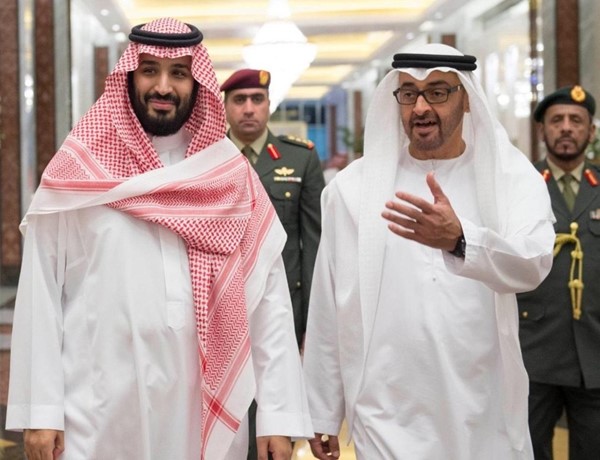
The media in Tel Aviv have reported that the UAE has invested as much as $100 million in an ambitious Israeli project to pipe natural gas to Europe.
The investment would be made by a company based in Abu Dhabi for a pipeline project which is internationally known to be unique given its record length as well as the extreme depths it would be laid toward Europe, Lebanon’s al-Mayadeen quoted Israeli media as reporting.
The agreement has been described as “historic” by Israeli media, al-Mayadeen added.
Israel has signed a multilateral deal over the scheme – called the East Med Pipeline Project – with Greece, Italy and Cyprus. The European Union also supports the project.
The East Med Pipeline Project is to start about 170 kilometers (105 miles) off Cyprus’s southern coast and stretch for 2,200 kilometers (1,350 miles) to reach Otranto, Italy, via Crete and the Greek mainland, according to a report by The Times of Israel news website.
The pipeline will have the capacity to carry up to 20 billion cubic meters (706 billion cubic feet) of gas from Israeli fields each year. Europe’s gas import needs are projected to increase by 100 billion cubic meters (3.5 billion cubic feet) annually by 2030.
Work on the project is expected to begin within a few months, and to conclude within five years.
UAE’s investment in the project could trigger protests in the Muslim world. The Emirates has already taken moves to approach Tel Aviv with speculations recently emerging that it has even involved itself in certain military operations by Israel on Gaza.
Last December, Israel’s Energy Minister Yuval Steinitz said a study on the project showed that the project is feasible, even though it presents technical challenges due to the depths involved and has an estimated cost of 6.2 billion euro ($7.36 billion).
Israel has already engaged in disputes with Lebanon over tapping into Mediterranean energy resources.
Last February, Israel described as “very provocative” a Lebanese tender for projects in two of its 10 offshore blocks in the Mediterranean Sea.
Israel itself has long been developing a number of offshore gas deposits in the Mediterranean Sea, with the Tamar gas field, with proven reserves of 200 billion cubic meters, already producing gas, while the larger Leviathan field is expected to go online in the coming months.
A source close to Israeli Prime Minister Benjamin Netanyahu said in 2012 that Israel’s natural gas reserves were worth around $130 billion. A Business Week estimate later that year put the reserves’ value at $240 billion.
US creates new facts on the ground in Syria
By M. K. BHADRAKUMAR | Indian Punchline | November 24, 2018
The Trump administration is making a determined effort to engage with Turkey, which used to be the anchor sheet of American regional strategies in the Middle East for several decades. Without a robust partnership with Turkey, US policies remain ineffectual on several regional fronts – ranging from the Black Sea and Eastern Mediterranean to post-conflict Syria, Iran oil sanctions and Gulf security — and even Khashoggi affair.
Turkey has a long list of grievances – real, feigned or imaginary. But President Trump senses that Turkish president Erdogan prioritizes two core issues – demand that a) Washington should extradite his arch political rival Islamist preacher Fetullah Gulen (who he alleges plotted the failed coup against him in 2016); and, b) that the so-called Halkbank case in a Manhattan court should be wound up.
Trump has lately signaled that he is acting on both issues. Gulen is a tough call for Trump insofar as he has been an “asset” of the CIA. The Halkbank file may be relatively easy to handle.

(Fetullah Gulen’s ‘retreat center’ in Pennsylvania)
In turn, Erdogan is holding the trump card in the Khashoggi affair, which has potential to undermine the US’ grand Middle East strategies. A top Saudi establishment commentator Abdulrahman Al-Rashed wrote in the Saudi daily Asharq Al-Awsat, “Turkey has been using the (Khashoggi) crime to push Trump to make concessions to release a convicted Turkish banker or hand over an opposition figure in exchange of stopping its campaign against Saudi Arabia.” Clearly, Trump expects Erdogan to stop fueling the Khashoggi affair.
Erdogan has now let it be known that he is open to meeting with the Saudi Crown Prince Mohammed bin Salman on the sidelines of the G20 summit in Argentina on November 30.
However, the Turkish-American engagement has a much bigger backdrop — Syrian conflict. How far the tango over Khashoggi helped US to address the Syrian situation is hard to tell, but American diplomacy has a way of juggling several balls. In particular, the Pentagon’s alliance with Syrian Kurdish groups worries Turkey and Erdogan has been threatening to move against them.
Now, the US has come up with an innovative idea to work with Turkish military apropos any terrorist threats from Syria. Two days ago, US defence Secretary James Mattis unveiled the idea with disarming simplicity during an interaction with the media:
“Turkey is a NATO ally and they have legitimate concerns about terror threats… from Assad’s Syria… And Turkey has a lot of reasons for concerns, being the NATO country with a border right along Syria. And we don’t dismiss any of their concerns. We are putting in OPs up in northern Syria, this is the change now, okay? We are putting in observation posts in several locations up along the Syria border — northern Syria border because we want to be the people who call the Turks and warn them if we see something coming out of an area that we’re operating in. This is closely collaborated – we are consulting closely with Turkey, military and State Department. Both were consulting with them.”
“We are going to track any threat that we can spot going up into Turkey. That means we will be talking to Turkish military across the border. They will be very clearly marked locations day and night so that the Turks know where they’re at.”
Meanwhile, Voice of America also reported on November 22 that “a large military convoy from an Arab country was deployed last week to the eastern Syrian province of Deir el-Zour” in the region under US control.
Prima facie, the US is pre-empting any excuse by Turkey to attack the Kurdish groups by offering a CBM. But the bottom line is that the US is marking as its exclusive preserve a vast swathe of territory in Syria’s northeastern region — roughly one-third of entire Syria — which is rich in hydrocarbon reserves and water resources, and it expects Turkey to respect the ground reality.
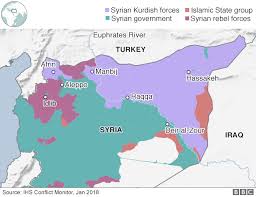
(Who controls what in Syria.)
Without doubt, an entity is being carved out of Syria that is beyond the reach of Damascus, with the Arab Forces providing the “steel frame” for internal security and acting as deterrent against any Turkish attacks against the Kurdish militia, while the US monitors the border region with Turkey.
Mattis claimed that Turkey is on board. But Turkey strongly supports Syria’s unity. Turkish Defence Minister Hulusi Akar has openly voiced disquiet over the US move to set up observation posts on Turkish-Syrian border. Akar disclosed that Turkey conveyed its “discomfort” to the Pentagon:
“We have stated that the observation points to be established by the US troops on the Syrian border will have a very negative impact… and in the course of our discussions we expressed that it could lead to a perception that US soldiers are somehow protecting terrorist YPG (Syrian Kurdish) members and shield them.”
Equally, could an Arab force’s – most likely Saudi and Emirati troops – deployment (just when the war is ending) have been without prior consultation between Washington and Ankara? The point is, Turkey has troubled relations with both Saudi Arabia and the UAE and will resent their deployment of troops to its border regions with Syria.
In sum, the US’ newfound role as the gatekeeper of the Turkish-Syrian border means the Pentagon is creating new facts on the ground, which signals a long-term US occupation of northern Syria. There are serious implications for Syria’s unity and territorial integrity. Indeed, the last thing that Turkey wants is an independent entity along its border with Syria where the Kurds enjoy autonomy. Turkey has a congruence of interests with Russia and Iran in this regard.
What you won’t hear from US govt: Iran is open to working with Saudi Arabia
By Darius Shahtahmasebi | RT | November 22, 2018
Washington’s rhetoric regarding Iran paints the picture of an evil nation hellbent on destroying the world. In reality, it appears that Tehran would prefer dialogue with its rivals, which is unacceptable to the US.
Tuesday’s White House Statement from President Trump on “Standing with Saudi Arabia” was an outright condemnation of Iran and a total free pass for Saudi Arabia.
Iran is to blame for almost every issue in the Middle East, including the war in Yemen, according to the statement. The US-made and supplied bombs raining down on Yemeni school buses, with some 85,000 children dying in the process, is simply because of Iran. Not only is Iran responsible for the bloodshed in Yemen, Tehran has further helped “dictator Bashar Assad” in Syria kill “millions of his own citizens.” The official death toll of the Syrian war is under one million, and certainly the various jihadist groups, including Islamic State (IS), share responsibility for that figure.
“The Iranians” have also killed many Americans and other innocent people throughout the Middle East. Iran not only shouts “Death to America” and “Death to Israel” but it is also considered “the world’s leading sponsor of terror.”
It is curious enough that firstly, in a statement about Saudi Arabia, the term “world’s leading sponsor of terror” is not gifted to the prime sponsors of Al-Qaeda and IS. Secondly, the fact that Trump himself put that term in inverted commas seems to suggest that even he doesn’t quite believe that one to be true.
Remember, Saudi Arabia is the country that Trump, before becoming president, once accused of masterminding the 9/11 attacks. I wasn’t aware of this until reading the statement, but according to the White House, Saudi Arabia would gladly withdraw from Yemen if the Iranians would agree to leave. That’s right, Iran’s non-presence in Yemen must be removed in order for Saudi Arabia to cease blowing up children, hospitals, factories, food trucks, schools, agricultural land, strategic ports, and relinquish its complete stranglehold over the country.
If you were naive enough to take the White House statement at face value, you would surely think that Iran has much to answer for. Iran is, after all, public enemy number one and has been for some time. Conversely, Saudi Arabia has been a longstanding ally of the United States, a faithfully serving client state, and it should be protected at all costs especially if there is to be any hope at pushing back against Iran as it yells “Death to America” and “Death to Israel.”
But what if Iran was, despite all of its flaws, not interested in fighting a war with Saudi Arabia? What if we dug a little bit deeper and asked ourselves: is there another way of dealing with the “threat” that Iran poses?
In January this year, Iran’s Foreign Minister Mohammad Javad Zarif wrote an article that was published in the Financial Times which laid out the country’s proposed framework for bringing stability to the Middle East. The article was widely ignored by the rest of the world, even though its implications were potentially life-saving.
“The objective of a strong region — as opposed to a quest for hegemony and the exclusion of other actors — is rooted in recognising the need to respect the interest of all stakeholders,” Zarif wrote. “Any domineering effort by one country is not only inappropriate but essentially impossible: those who insist on following that path create instability. The arms race in our region is an instance of this kind of destructive rivalry: siphoning vital resources into the coffers of arms manufacturers has contributed nothing to achieving peace and security. Militarism has only served to fuel disastrous adventurism.”
Zarif states that the usual modes of forming alliances have become “obsolete” and suggests that security networking to address issues is a much better practice. He proposes that instead of ignoring conflicts of interests, the countries in the region should accept their differences.
“The rules of this new order are straightforward: common standards, most significantly the purposes and principles of the UN Charter, such as sovereign equality of states; refraining from the threat or use of force; peaceful resolution of conflicts; respect for the territorial integrity of states; non-intervention in the domestic affairs of states; and respect for self-determination within states,” Zarif adds.
Zarif recommends opening up dialogue and blames a “dialogue deficit” for instability throughout the region. Such a dialogue, he argues, could help other nations understand that all parties have “similar concerns, fears, aspirations and hopes.” His eventual vision is that these countries will eventually adopt a “non-aggression pact.”
Now, Zarif did not explicitly state who he was talking about in this proposed path to peace and stability. But what if his intention was to work with Saudi Arabia, is this not something that should be talked about, particularly by the US commander-in-chief when releasing statements stoking the fire of an already volatile region while pitting two major regional players against each other?
In October last year, Zarif was quoted as saying that Tehran is willing and ready for rapprochement with the Kingdom of Saudi Arabia, adding that he does not believe the two countries should have the type of relationship they have right now.
In December last year, Iran’s president Hassan Rouhani further intimated that Tehran is willing to resume ties with Saudi Arabia if it halted its military campaign in Yemen and severed its ties with Israel.
“We don’t have any problem with the country that is our neighbor and unfortunately speaks a lot and speaks irrationally. Saudi Arabia, as our neighbor, should stop bombing Yemen from tomorrow, stop bowing to Israel, stand straight and rely on its nation,” Rouhani said.
In March this year, Zarif then took his ambiguous article one step further and openly said that Iran is willing to resolve its differences with Saudi Arabia’s as part of Tehran’s desire for stability in the region. As Zarif notes, this is not the first time Iran has reached out to the kingdom, yet the Saudis continue to reject Iran’s proposed dialogue.
In August of this year, Zarif further stated that Iran wants to restore relations with Saudi Arabia as well as the United Arab Emirates (UAE) and Bahrain. Surprisingly, Saudi Arabia had just allowed the entry of an Iranian diplomat to head Iran’s interests in the Kingdom, a rare move since diplomatic ties had been cut almost two years prior.
Just last month, Zarif again called for Saudi Arabia’s cooperation to push back against the “repeated insults” made by the US president at the time.
“This is the reward of the illusion that security could be achieved through external support,” Zarif said. “We extend our hands to our neighbours, saying: let’s build a strong region to stop this arrogant pride.”
I could be wrong, but in its totality, it does appear that Iran is proposing a framework where Middle Eastern countries settle their disputes between themselves without outside interference, whereby the US would be left out completely. Such a suggestion is in itself a form of hubris so unacceptable to Washington that the proposal itself makes the country ripe for a targeted regime change operation. Despite this, Iran has been quite open about its blueprint for a new outlook to the Middle East.
“We don’t need foreigners to guarantee the security of our region,” Iran’s president said earlier this year.
“When it comes to regional security arrangements, we are ready to talk to our neighbours and friends, without the presence of foreigners,” he added. “We are, have been and always will be good neighbours.” Yes – even Saudi Arabia.
In August, UN experts went even further and said that Iran might be willing to play a “constructive role” in ending the war in Yemen, something Iran has said it has been wanting to do for years by working with Saudi Arabia.
Conversely, the Saudis and their US counterparts are not so willing to take the Iranians up on their offer.The Saudis always want to “fight the Iranians to the last American,” according to former Secretary of Defence Robert Gates. The Saudis have even openly abandoned the Palestinian cause in an attempt to cosy up to Israel and create a US-backed alliance that can confront Iran in the region. The Saudi Crown Prince also compared Iran’s supreme leader to Adolf Hitler, a brazen statement for a man who executes journalists and unarmed children with complete impunity. The kingdom continues to openly work with Al-Qaeda linked groups to prolong the fighting in Yemen, all because its anti-Iran hysteria cannot falter from its position.
A détente between Riyadh and Tehran appears to be a far cry away from happening any time soon, but we cannot continue to pretend we haven’t noticed the opportunity that continues to present itself, particularly from the Iranian side. Whether an Iran-Saudi relationship is a positive step or a disastrous one is an important question to ask; but we should at least consider it as an option if it can avoid a potential and unnecessary war between two regional powers, as well as its potential to diffuse an already devastating war which continues to kill thousands of people completely needlessly.
US will remain steadfast partner of Saudi Arabia to ensure Israel’s interests: Trump
Press TV – November 20, 2018
President Donald Trump has said Washington intends to remain a steadfast partner of Saudi Arabia to ensure interests of the United States, Israel and regional partners.
Trump said that it is possible that Saudi Crown Prince Mohammad bin Salman had knowledge of the assassination of Saudi dissident journalist Jamal Khashoggi, according to a statement issued by the White House on Tuesday.
Trump said that “King Salman and Crown Prince Mohammad bin Salman vigorously deny any knowledge of the planning or execution of the murder of Mr. Khashoggi. Our intelligence agencies continue to assess all information, but it could very well be that the Crown Prince had knowledge of this tragic event – maybe he did and maybe he didn’t!”
“That being said, we may never know all of the facts surrounding the murder of Mr. Jamal Khashoggi. In any case, our relationship is with the Kingdom of Saudi Arabia,” the US president insisted. “They have been a great ally in our very important fight against Iran.”
“The United States intends to remain a steadfast partner of Saudi Arabia to ensure the interests of our country, Israel and all other partners in the region. It is our paramount goal to fully eliminate the threat of terrorism throughout the world!” he added.
He mentioned that Saudi Arabia had “agreed to spend and invest $450 billion in the United States. This is a record amount of money. It will create hundreds of thousands of jobs, tremendous economic development, and much additional wealth for the United States.”
“Of the $450 billion, $110 billion will be spent on the purchase of military equipment from Boeing, Lockheed Martin, Raytheon and many other great U.S. defense contractors. If we foolishly cancel these contracts, Russia and China would be the enormous beneficiaries – and very happy to acquire all of this newfound business. It would be a wonderful gift to them directly from the United States!” he pointed out.
He acknowledged that the “crime against Jamal Khashoggi was a terrible one, and one that our country does not condone,” but implied that due to the murder of a journalist Washington cannot cancel such lucrative business deals with the kingdom.
Some US senators have called on Trump to cancel arms deals with Saudi Arabia as a punishment over the murder of Khashoggi — a US resident who was killed in the Saudi consulate in Istanbul on October 2 after being lured into the mission for some standard paperwork.
While mounting evidence released by Turkey and even the CIA point to bin Salman’s role in the murder, Trump had resisted calls inside Washington to hold him responsible.
In an attempt to ease the criticism, the US Treasury Department imposed economic sanctions on 17 Saudis involved in the murder on Thursday.
The sanctions came after the Saudi public prosecutor announced that five officials faced a possible death sentence in the case but exonerated bin Salman, also known as MBS.
Prospects for Syrian peace are looking up
By M. K. BHADRAKUMAR | Indian Punchline | November 20, 2018
After prolonged hibernation, the Astana Process on Syrian peace is kinetic, with the troika of ‘guarantor’ states – Russia, Turkey and Iran – set to hold a round of talks in the Kazakh capital on November 28-29. Delegations of the Syrian government and the opposition are also expected to attend. A renewed effort is commencing to create traction for the UN-sponsored negotiations in Geneva.
Much water has flown down the Euphrates since the 9th round of the Astana Process took place in May. Six months is a long time in politics – especially in Middle East politics. But, paradoxically, while Middle Eastern politics is in turmoil, the prospects for peace in Syria may have improved. The setting for tomorrow’s meet – it’s unclear at what level the event will take place – has become largely favorable. At least 10 major reasons can be attributed.
One, Syria is witnessing a period of relative calm. There has been no major fighting for months. Two, Syrian-Jordanian border had reopened and nothing of a feared flare-up happened in the Golan Heights. Three, the Russian-Turkish understanding on Idlib is holding. Four, Israel has been effectively ‘defanged’ (thanks to deployment of Russian S-300 ABM system to Syria). Five, Russia and Iran intend to retain their military footprints in Syria for a foreseeable future, while on the contrary, the US lacks the political will or the military capability to impact the strategic calculations of Moscow, Tehran, Damascus or Ankara.
Six, importantly, Turkey has become an implicit ally of Russia and Iran and is inching closer and closer to a political deal that leaves President Bashar Al-Assad in power. Seven, Russia, Turkey, and Iran are in the lead in shaping the Syria policy, with clear strategic goals and, even more so, the means to achieve them.
Eight, on the other hand, a growing determination on the part of Russia, Iran, and Turkey is discernible to freeze out the United States from any role in shaping Syria’s geo-strategic future. Although the three countries would have tactical differences between them, broadly, Turkey will accommodate Russia and Iran so long as it has a free hand to check the Kurdish forces threatening its security. Significantly, the announcement on the rebooting of the Astana Process comes after the visit by Russian President Vladimir Putin to Turkey on November 19.
Nine, the crisis in Turkish-American relations not only persists but may even deepen in the period ahead. Finally, the Trump administration’s calculations that its re-imposition of sanctions against Iran will either force Iran out of Syria or, better yet, produce a veritable collapse of the Iranian government are turning out to be a mere pipe dream. In fact, the opposite has happened.
Iran is intensifying its coordination with Russia and Turkey, and is creating firewalls to protect its strategic gains in Syria. Again, it is clear by now that the US cannot count on the new government in Baghdad to act against Iranian interests.
On the other hand, the dangerous situation that has arisen on Israel’s border with Gaza (which was precipitated entirely by Israeli hardliners) and the ensuing mayhem in Israel’s domestic politics will seriously delimit Benjamin Netanyahu’s energy and resources to act as ‘spoiler’ in Syria. Moscow has openly snubbed Netanyahu lately by refusing him to schedule his visit.
Similarly, the widening cracks in the US-Saudi alliance in the downstream of the Khashoggi murder all but means an overall Saudi disengagement from the Syrian conflict. The UAE has already begun mending fences with the Syrian government, which would only have been possible with Saudi approval. (See my blog UAE, Saudi sense convergence with Syria.)
Suffice to say, the so-called Syrian opposition is finding itself rudderless. Their erstwhile mentors – US, Turkey, Saudi Arabia, UAE – have either reached a dead end or have turned to new priorities in their self-interests accepting the defeat in the Syrian conflict.
Meanwhile, the appointment of Norwegian diplomat Geir Pederson as the UN Secretary-General’s new special envoy for Syria becomes a positive factor. Russia has warmly noted that “we know him as an experienced and unbiased diplomat.” Pederson’s predecessor Staffan de Mistura was widely perceived as a sidekick of the US. Clearly, the Astana Process is not wasting time by kickstarting the work on a Syrian settlement even as Perdersen moves in.
Iran, Iraq Can Ramp up Trade to $20bn: Rouhani
Al-Manar | November 17, 2018
Iranian President Rouhani said Saturday that the current economic transactions between Iran and Iraq stands at about $12 billion, which can be boosted to $20 billion with further cooperation.
President Rouhani made the remarks in a press conference with his Iraqi counterpart Barham Salih on Saturday in Tehran, which was held after their bilateral meeting earlier that day.
The Iranian president maintained that the two sides held talks on electricity and gas swap, as well as cooperation on petroleum products and oilfield exploration and extraction.
The Shalamcheh-Basra railway is ready to come on stream, and the Iranian side is ready to carry out its side of the project together with the help of measures taken by Iraq’s Ministry of Finance, said Rouhani, adding that the 35km-railway will facilitate transport for the people of both countries.
Rouhani said the two sides also talked about environmental issues, noting the dust storms in western and eastern borders that need joint cooperation to be resolved. He added that Iraqi President Barham Salih has vowed to follow up on those environmental issues.
We reached an agreement to establish a free trade zone between the two countries, Rouhani added.
He further maintained that the two sides conferred on regional issues, saying the two believed that stability and security in the region will benefit all people, and there is no need for foreign interference in regional affairs.
The Iraqi president, for his part, highlighted that Iraq would never forget Iran’s support in defeating terrorism in the country.
After the military defeat of ISIL, Iraq has ahead of itself the two important objectives of ‘reconstruction’ and ‘strengthening of political stability’, he added.
President Salih maintained that the realization of these two goals requires political and economic measures and reforms, as well as stable conditions in the region.
It is time for the formation of a new regional order which can be in the interest of all regional states, President Salih stressed, adding that Iraq attaches high significance to Iran’s role and place in this new regional order.
He further voiced hope that the implementation of joint projects such as railway connections between Iran and Iraq could provide the necessary condition for Iraq to play a more active role in the region, and allow other countries in the region to form relations based on mutual interests.
Featured Video
Seyed M. Marandi: U.S. Military DIVIDED? Iran’s Secret Defense EXPOSED
or go to
Aletho News Archives – Video-Images
From the Archives
‘Israel sees Iran as obstacle to its policies’
Press TV – August 25, 2017
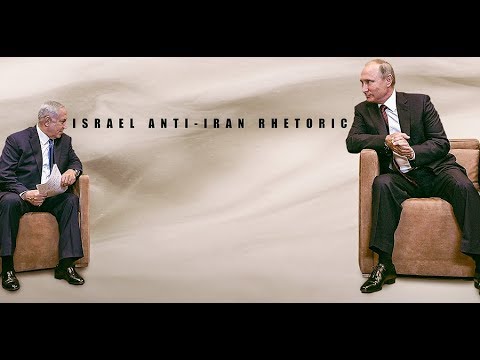
Prime Minister Benjamin Netanyahu has said that Israel felt threatened by Iran’s growing influence in the Middle East. Netanyahu expressed his Iranophobic view in a meeting with Russian President Vladimir Putin in Russia’s Black Sea resort of Sochi on Wednesday. Press TV has asked Scott Rickard, former American intelligence linguist from Tampa, Florida, and Brent Budowsky, a columnist at The Hill from Washington, to give their thoughts on the issue.
Rickard said Tel Aviv is concerned about the fact that the regime could not carry out its old project to spread sectarian divisions and pave the way for dismemberment of the countries in the Middle East region because of the Iranian-led resistance against Israeli policies, not only in the occupied territories of Palestine but also in the whole region.
“Iran is not a threat to Israel whatsoever. The threat that Israel sees is the fact that their Oded Yinon Plan is being put to a hold by Iran,” the intelligence linguist said on Thursday night.
“They (the Israelis) look at Iran as a threat only because they have no influence on their governments and Iran is autonomous and is not under the Zionist influence,” he added.
Since the victory of the Islamic Republic of Iran in 1979, Tehran has been critical of Israel’s policies in the region, whereas “no leaders [of other states] even dared to speak out against Zionism,” Rickard argued. … continue
Blog Roll
 Aletho News
- Israeli tank fire killed UN peacekeeper in Lebanon, UNIFIL investigation finds
- Russia, China block Bahrain-sponsored UN resolution on Strait of Hormuz
- The US-Israeli War on Science is an Assault on our Future
- Trump’s Promise to Bomb Iran ‘Like Never Before’ Faces Brutal Logistics — Expert
- Germany seeks to restrict stays abroad for men of fighting age – Berliner Zeitung
- Evidence points to Ukraine being behind TurkStream attempted sabotage, but that should come as no surprise
- Sri Lanka secures supplies of Russia oil – minister
- Nations across Asia strike direct deals with Iran for Hormuz passage
- IRGC commander declares ‘new phase’ of reprisal attacks against aggressors
- Israel’s air defenses overwhelmed by cluster-warhead Iranian missiles: Reports
- If Americans Knew
- The war the US is fighting for Israel could cost trillions
- ‘Cigarette Burns, Nail Wounds’: Toddler Tortured in Gaza to Coerce Father
- Trump Says US Sent ‘a Lot of Guns’ to Protesters in Iran
- Israeli forces destroy 17 UN peacekeeper cameras in south Lebanon
- US-Israeli strikes ‘completely destroy’ synagogue in Tehran
- Archbishop for US Military Says Iran War Is Unjust Under Catholic Teaching
- Iranian leaders’ Open Letters to the American People
- Trump says Iranians appreciate bombs, WHO warns of nuclear risks – Daily Update
- U.N. experts demand Israel release prominent Gaza doctor after reports of ‘severe torture’
- Israel’s Latest Genocide Is Against the Shias of Lebanon. Why Is the World Silent?
- No Tricks Zone
- An Inconvenient Tree: Uncovered In Alps… Europe Much Warmer Than Today 6000 Years Ago
- New Study Reports A 60% Slowdown In Greenland’s Ice Loss Rate In The Last Decade
- Low Intensity Tornado Wrecks Major Solar Farm, Creating A Potential Toxic Dump
- New Study Finds Warming Saves Lives…Cold Temperatures 12 Times More Deadly Than Excess Heat
- German Science Blog Accuses PIK Climate Institute Of Hallucinating Climate Tipping Points
- Devastating Assessment Of Comirnaty Vaccine By Former Senior Pfizer Europe Toxicologist
- New Study: CO2 Is ‘Effectively Negligible’ As An Explanatory Climate Change Factor Since 2000
- Former Pfizer Toxicologist Dr. Helmut Sterz Tells Bundestag Hearing Pfizer Vaccine Should Have Never Been Approved
- Energy Expert: Germany’s Nuclear Phaseout Was A “500 Billion Euro Mistake”
- New Research: South Australia’s Mid-Holocene Sea Surface Temperatures Were 4°C Warmer Than Today
 Aletho News