Painting an Israeli Attack on Syria as Israeli ‘Retaliation’
By Gregory Shupak | FAIR | February 21, 2018
Israel claimed that it intercepted an Iranian drone in Israeli airspace on Saturday, February 10; Iran denied that it had a drone there. Israel then bombed a Syrian airbase, saying it was the command-and-control center from which Iran had launched the drone. The Syrian government shot down an Israeli jet that had bombed the base, and Israel subsequently launched more airstrikes against Syria.
Reuters (2/13/18) described the latter airstrikes as Israel having “retaliated” for the downing of its aircraft. Vice (2/13/18) too characterized them as “retaliatory”; the Los Angeles Times (2/11/18) did the same three times. These word choices wrongly imply that Israel was acting defensively, when it was Israel who fired the first shots in the weekend’s exchanges: These outlets were saying that Israel was “retaliating” against Syria for defending itself against an ongoing Israeli attack.
“Retaliation” is an exculpatory term. To say that a party is “retaliating” is to say that their actions are an understandable response to another party’s provocation. As FAIR’s Rachel Coen and Peter Hart (Extra!, 5–6/02) wrote more than a decade and a half ago, the term “lays responsibility for the cycle of violence at the doorstep of the party being ‘retaliated’ against, since they presumably initiated the conflict.” In this case, casting Syria and Iran as the aggressors rests on the dubious assumption that flying a drone over Israel—if Israel’s charge is accurate—is more aggressive than Israel dropping bombs on Syria.

Painting warplanes carrying out an aggressive bombing raid as victims
It also rests on the flawed assumption that the timeline of hostilities between Israel and the Syrian government began on Friday, February 9. However, despite the Associated Press’s untenable claim (2/10/18) that “Israel has mostly stayed out of the prolonged fighting in Syria,” Israel admits to having bombed the Syrian government and its ally Hezbollah nearly 100 times since the war in Syria began in 2011 (Reuters, 2/6/18). If Brigadier General Amnon Ein Dar, the head of the Israeli Air Force’s Air Division, is to be believed (Ynet, 2/11/18), the Israeli military has “carried out thousands of missions in Syria in the last year alone.”
A Washington Post article (2/10/18) made the similarly dubious assertion that “Israel has largely stood on the sidelines of the Syrian conflict over the past seven years.” In the next paragraph, though, the author acknowledges that “Israel has conducted dozens of covert airstrikes against [the Syrian government-aligned] Hezbollah weapons convoys in Syria,” and the piece goes on, in a spectacular display of self-contradiction, to note that “Israel has carried out a number of significant attacks in Syria in recent months.”
Israel has also supported the Syrian armed opposition for years, the Wall Street Journal (6/18/17) reported, supplying fighters with food, fuel, medical supplies “and money payments to commanders that help pay salaries of fighters and buy ammunition and weapons.” According to the Journal, the Israeli army “is in regular communication with rebel groups,” and Israel “has established a military unit that oversees the support in Syria—a country that it has been in a state of war with for decades—and set aside a specific budget for the aid, said one person familiar with Israeli operation.” There is even reason to believe that Israel has had an alliance with the Al Qaeda affiliate in Syria (Middle East Monitor, 5/26/15; Electronic Intifada, 6/16/15). None of the articles cited here on the February 10 clashes mentioned this important backdrop.
Turning an Occupation Into a ‘Border’
Coverage of these events also failed to correctly describe the status of the Golan Heights, a piece of land that is central to the Israeli/Syrian conflict. Israel occupied the territory in the 1967 war, fought off a Syrian effort to reclaim it in 1973, and illegally annexed it in 1981. Israel has sought to take advantage of the war that has devastated Syria for nearly seven years by, as Matt Broomfield writes in the Electronic Intifada (11/11/16), planning a fivefold increase in the number of Israeli settlers in the Golan, allocating $108 million for 750 new Israeli agricultural projects in the territory, and significantly expanding military forces along the boundary between Syria and the area under Israeli control.
The New York Times (2/10/18) made two references to “the Israeli-held portion of the Golan Heights,” a rather anodyne depiction of territory that is internationally recognized as Syrian, but which Israel seized by force of arms and claimed for itself.
The Washington Post (2/10/18) said that “Israel shares a contentious border with Syria—the Golan Heights.” But the Golan isn’t “a contentious border”; it’s a territory that, despite Israeli claims to the contrary, unambiguously belongs to Syria under international law.
A CNN report (2/11/18) closed by saying that “authorities also accused Syria in November of violating the 1974 ceasefire agreement [with Israel] by “conducting construction work” in the northern part of the Golan Demilitarized Zone.” While it’s unclear which authorities are being referenced, this passage neglects to mention that by late 2015, Israel had built 30 settlements, housing 20,000 settlers, in the Golan, or that a year later it announced plans for 1,600 new homes in the territory, “construction work” that has been roundly condemned by “authorities” like the United Nations.
Moreover, 20,000 Syrians live in the Golan, and many are directly harmed by Israeli policies. According to the United Nations Human Rights Council (UNHRC), Israel’s discriminatory land, housing and development policies in the territory have made it hard for Syrians to get building permits, leading to increasingly overcrowded Syrian towns and villages. The UNHRC also points out that Israel has demolished a Syrian home, and that a number of Syrian homeowners have reportedly received demolition notices.
This larger context of Israel’s Syria policies would have helped news readers make sense of what occurred on February 10, but it was absent. Given that Israel had just launched an airstrike on a Syrian base, has apparently bombed Syria close to 100 times in the past six years, has carried out perhaps 1,000 attacks against it in the last year, has backed an armed insurgency against the Syrian government, and has stolen and illegally colonized Syrian land while oppressing and dispossessing Syrian civilians, it is far more accurate to say that Syria retaliated against Israel on February 10.
US Violates Iranian Nuclear Deal Almost Every Day – Tehran
Sputnik – February 22, 2018
Iranian Deputy Foreign Minister Abbas Araghchi said Thursday that the US violated the Joint Comprehensive Plan of Action (JCPOA) almost every day, while Trump’s public statements contribute to this.
“It is a fact that the United States is not implementing the JCPOA [the Joint Comprehensive Plan of Action], it is a fact that it violates it almost daily,” he told the BBC.
According to him, Trump’s statements regarding the deal being “bad,” or seeking to change it are a violation of the agreement.
“This violates the letter, not the spirit of the agreement,” the deputy minister added.
Speaking further, the senior Iranian official said that Iran would withdraw from the agreement if there would be no economic benefits for the country and major banks wouldn’t work with Iran.
“The deal would not survive this way even if the ultimatum is passed and waivers are extended,” Araqchi said.
The statement comes almost two weeks after US President Donald Trump delivered an ultimatum to the heads of European countries, saying that he wouldn’t extend the US sanctions relief on Iran if the sides refused to “fix the terrible flaws of the Iran nuclear deal.
“The day before, Iranian Foreign Minister Mohammad Javad Zarif said in an exclusive interview with Sputnik that “the US has never adhered to its liabilities within the JCPOA.”
Fears of Syrian War Tearing Middle East Apart
Araghchi also commented on the on-going conflict in Syria, which has recently escalated after an Israeli F-16 jet was shot down by the Syrian Army as it was about to attack Iranian positions for allegedly flying a drone into Israel’s airspace.
The Deputy FM denied the accusations, claiming that the drone in fact belonged to the Syrian government.
At the same time, he underlined the policy of double standards on the part of Israeli Prime Minister Benjamin Netanyahu, who had earlier branded Iran as the “greatest threat to our world,” while the Israeli military itself is frequently flying drones over Syria and neighboring countries.
“They shouldn’t be angry when they are faced with something that they are doing against others on a daily basis,” Araghchi said.
The deputy minister noted that the incident has had a significant destabilizing impact on the de-escalation process in Syria and on the maintenance of peace in the Middle East.
“Fear of war is everywhere in our region,” Araghchi stated.
Nevertheless, Araghchi stressed that the presence of Iranian forces in Syria should not be misinterpreted as a threat to Israel, since their sole objective is to assist the government of Bashar al-Assad in combating terrorists.
“Just imagine if we were not there. Now you would have Daesh [the Islamic State group] in Damascus, and maybe in Beirut and other places,” he said.
The Deputy FM affirmed that the “de-escalation of tensions” is “very important” to the Iranian strategy in Syria, and the country has “worked hard to achieve that.”
US-Russia rivalry surges in Syria
By M K Bhadrakumar | Indian Punchline | February 20, 2018
A major speech by Russian Foreign Minister Sergey Lavrov on Monday at an international conference on the Middle East turned into the strongest Russian denunciation to date of the shift in the US policies under the Trump administration towards Syria, where the Pentagon now intends to keep a military presence indefinitely. (here and here)
The overall impression Lavrov conveyed is three-fold. One, in immediate terms, a spurt in fighting in Syria can be expected, as the US attempts to create new facts on the ground by using local proxies — Kurdish militia plus al-Qaeda affiliates and ISIS fighters — as well as to push back at Russia, Iran and the Syrian government.
Two, Russia concludes that the shift in the overall US strategy aims at balkanizing Syria. (Later on Monday, while speaking to the media in Moscow, Lavrov also drew attention to the presence of mercenaries and the Special Forces of France and Britain in northeastern Syria working in league with the US forces in implementing the American agenda to create zones of influence.)
Three, the conversation between Moscow and Washington regarding Syria is at a dead end. Lavrov specifically warned Washington that it is “playing with fire” in Syria, implying that the US strategy will run into resistance.
Two other features of the Moscow conference in Moscow are that, first, Iran’s Foreign Minister Mohamad Javad Zarif took part in it, and, second, the event also talked up a Russian mediatory role to calm down the tensions between Iran and Saudi Arabia.
Zarif told Lavrov at a meeting in Moscow on Monday that Tehran seeks Russia’s help in resolving the intra-regional rifts in the Muslim Middle East. Later, Zarif posted on his official Tweeter account: “With Russia’s sober strategic perspective and its growing influence in West Asia, it can play an instrumental role to help a paradigm shift in the Persian Gulf to one based on dialogue and inclusion.”
The conference was attended by non-official delegates from several Middle East countries, including Saudi Arabia. Meanwhile, King Abdullah of Jordan had paid a ‘working visit’ to Moscow on February 15 and met Putin. On the previous day, Lavrov had spoken to his Egyptian counterpart Sameh Hassan Shoukry on phone. Yesterday, Putin also telephoned Turkish President Recep Erdogan. The focus was on Syria in all these exchanges.
The Russian strategy will be to persuade important regional states who have been the US’ key regional allies – Saudi Arabia and Jordan, in particular – not to rejoin the conflict in Syria by fueling a new round of fighting. If the approach succeeds, the US may find itself at a disadvantage in lacking regional support for pressing ahead with the military track.
However, although Russia’s ties with Saudi Arabia have appreciably strengthened in the recent years, Moscow’s capacity to mediate a Saudi-Iranian rapprochement remains to be seen. Syria continues to be a major source of rivalry between Saudi Arabia and Iran. And, the irony is that, finally, the Trump administration is doing what Saudi Arabia had wanted the previous Obama administration to do by pushing upfront the ‘regime change’ agenda in Syria through coercive methods.
In the Saudi perception, Russia suffered a series of setbacks in Syria recently. Summing up the Syrian situation, Ghassan Charbel, editor-in-chief of the influential Saudi establishment daily Asharq Al-Awsat wrote on Monday, “ Never before have all these flags, interests, dangers, armies, militias, internal divisions and regional and international clashes come together on its (Syria’s) territories. From the South to Idlib to Hmeimem to Afrin, Syria is like a powder keg. It is at the heart of a complex and vast geo-strategic conflict that is impossible to resolve with force and where losses and rewards will be difficult to predict… The regional and international circumstances do not appear ripe for… talks to happen. The Syrian tragedy is open to the most dangerous possibilities.”
The Saudi inclination will be to wait and watch which way the winds are blowing. On the other hand, the war in Yemen remains Saudi Arabia’s number one priority today and Riyadh seeks a Russian role in ending the war in Yemen by leveraging its influence with Iran.
Rouhani Phones Erdogan, Highlights Necessity of Respecting Syria’s Sovereignty and Territorial Integrity
Al-Manar | February 20, 2018
Iran’s President Sheikh Hassan Rouhani reiterated the necessity of respecting Syria’s sovereignty and territorial integrity, underlining the need to restore security and stability to it as soon as possible and provide appropriate conditions that will enable all Syrian displaced people to return home.
Rouhani’s remark came during a phone call with his Turkish counterpart Recep Tayyip Erdogan on Monday.
The Iranian President added that talks between the leaders and officials of Iran, Russia and Turkey in Astana and Sochi have been promising in terms of enhancing security and stability in Syria.
He stressed that this constructive track should be further reinforced through the continuous consultations among the heads of the three states.
Rouhani said that fighting terrorism, cleansing Syria of terrorist organizations and countering separatist attempts in the region are among the common objectives of Iran and Turkey, adding that “We should not allow terrorist groups to regain strength and return again to the region.”
He pointed out to the US-Zionist conspiracies against the countries of the region, noting that Iran and Turkey have common objectives regarding the regional and international issues.
The Iranian President called for consolidating cooperation in line with implementing the decisions reached in Astana.
US baits Turkey in hopes of ending Ankara’s Russian dalliance
Leaving aside the issue of the Kurds in Syria, Washington is experienced in leveraging Turkish predicaments – and appears optimistic about doing so again
By MK Bhadrakumar | Asia Times | February 20, 2018
When the host country openly patronizes a Track 2 – or ‘backchannel’ – event, it becomes Track 1.5. The conference in Moscow on Monday under the rubric ‘Russia in the Middle East: Playing on Every Field,’ seemed firmly in this category.
However, just as the event was about to begin, Iran’s Foreign Minister, Mohammad Javad Zarif, joined Russia’s, Sergey Lavrov, on the podium, raising matters to the level Track 1.
Nonetheless, Turkey’s absence must be noted. The backdrop is the US-Turkish “thaw” following a two-day visit to Ankara last weekend by the US Secretary of State Rex Tillerson. The first authoritative comments by the Trump administration regarding Tillerson’s talks came from US Defence Secretary James Mattis, who said on Saturday:
“We concur with Turkey on the need for locals taking control of the liberated areas [in Syria], and we’re going to work with Turkey on the locals taking control, and with Turkey on every other irritant, or diversion or distraction, or every area. We have many areas of absolute concurrence, too. Remember that, they are an ally. We work with them… So this is not an all-one-way issue, but there are significant issues that the Secretary of State and his foreign minister counterpart agreed that we would work through… I can’t tell you that we’ve resolved them all. That means we’re going to work through them. We’re committed to them. That’s where we’re going.”
Mattis was donning a diplomatic hat in projecting such an optimistic assessment. Tillerson’s talks in Ankara were wide-ranging and there were exchanges on creating and jointly managing a zone of influence in northern Syria. But for Turkey, the vacation of the region to the west of the Euphrates by US-backed Kurdish militias is a non-negotiable demand. The Pentagon will be hard-pressed to jettison its alliance with those militias.
The US-Turkey reconciliation process will not be easy. But then again, it does not suit either side to allow the discussions to reach a dead end anytime soon. Turkey’s operation in Afrin is not going well and that puts future operations in doubt – which, in turn, gives time and space for both Ankara and Washington to negotiate. And for the US, while the Kurds may be regarded as useful (perhaps irreplaceable) footsoldiers, the resuscitation of an alliance with Turkey could be a game changer.
Washington senses that Turkish President Recep Erdogan is groping for a way forward. He has made an extra effort in recent weeks to mend ties with Germany, signaling that Turkey does not want isolation from the West. Make no mistake that Washington is greatly experienced in leveraging Turkish predicaments. Washington has shown time and again that it has a way of getting things done with Ankara, its time-tested cold war ally. Mattis’ optimism reflects that.
The big question is how the Russian-Iranian alliance will respond to a potential US-Turkey entente in northern Syria. Indeed, it will be a major setback for Moscow and Tehran if Ankara reverts to coordinating with the US. Events on the ground in recent weeks should leave Moscow in no doubt that eliminating the Russian presence in Eastern Mediterranean is as much a priority for the Pentagon as rolling back Iranian influence in Syria. Russian President Vladimir Putin telephoned Erdogan on Monday to discuss Syria.
Afrin may seem the immediate focal point, but the various protagonists are attempting to create new facts on the ground. Russia and Iran have a congruence of interests in opposing the expansion of the US presence in northern Syria. (Afrin is the gateway to Idlib, which is adjacent to the coastal province of Latakia, where the Russian bases are located.)
Lavrov on Monday warned today that the US should not play with fire. In a hard-hitting speech at the Moscow conference, he alleged that the US is using the Kurds as a proxy and also covertly encouraging extremist groups to “disintegrate Syria”. Meanwhile, the Tass news agency quoted Zarif as stressing to Lavrov that the flow of events “demonstrates the depth of strategic relations between Iran and Russia, which have been playing a very important role in maintaining security and stability in our region.”
However, neither Moscow nor Tehran has voiced any criticism of Turkey. They seem reasonably confident that Turkish-American reconciliation is improbable, since Syria is only the tip of the iceberg against which mutual trust between the two NATO allies crashed in the aftermath of a failed coup attempt against Erdogan in July 2016.
The Russian-Iranian strategy will be to keep Turkey constructively engaged even as Ankara is involved in back-to-back negotiations with Washington beginning in the first half of March. Zarif disclosed in Moscow that he and his Russian and Turkish counterparts propose to meet in Astana in a fortnight to prepare the ground for a trilateral summit meeting of the three presidents in Istanbul regarding Syria.
CrossTalk: Syria on Fire
RT | February 16, 2018
The stakes couldn’t be higher. And it is happening in Syria. The goal of destroying the Islamic State is largely complete. Now the Syrian proxy war is entering a new stage. Who are the players and what are their aims? And what does winning mean?
CrossTalking with Abdel Bari Atwan, Marwa Osman, and Mohammad Marandi.
Bahrain Government Committed Nearly 1,000 Abuses in January: Report
teleSUR | February 10, 2018
The monarchy of Hamad bin Isa Al Khalifa, in Bahrain, committed 995 cases of abuse in January, a new report by the Bahrain Forum for Human Rights (BFHR) has revealed.
The report, published Saturday, states that 121 people, including six minors, were arbitrarily arrested in house raids. Torture and other violent tactics were used against 18 detainees, including eight minors and four women, in police stations and prisons.
A total of 17 Bahrainis were disappeared last month, many having participated in anti-government protests, and 77 opposition protesters were given a total of 679 years in prison for taking part in protests or supporting notable dissidents.
The BFHR also cited the continued ban on Friday prayers in the village of Diraz as a human rights violation. Diraz harbors many people who favor a reform of the Bahraini monarchy.
Since February 2011, Bahrain has been the scene of near-daily protests against the Al Khalifah monarchy, with dozens killed. Many notable opposition figures remain imprisoned.
Despite government bans, people are preparing for protests and demonstrations to commemorate the anniversary of the uprising that began seven years ago.
Featured Video
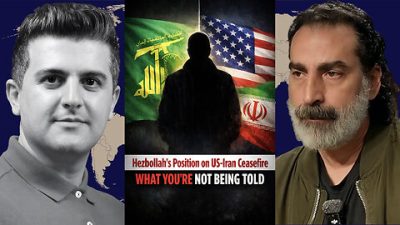
Laith Marouf: Hezbollah’s position on US-Iran ceasefire
or go to
Aletho News Archives – Video-Images
From the Archives
Is Israel to blame for the Iraq War?
American Goy | March 10, 2008
I am so tired of this old canard that “Israel had nothing to do with USA’s war with Iraq – in fact, it officially advised America against it”.
Bullshit. … continue
Blog Roll
 Aletho News
- Laith Marouf: Hezbollah’s position on US-Iran ceasefire: What you’re not being told
- Israel’s priority lies in destroying chances of peace between Iran, US: Ex-UN nuclear chief
- Ceasefire for all or for none: Iran shuts Hormuz over Lebanon attacks
- Strait of Hormuz is Iran’s ‘nuclear weapon’ that forced US retreat: Medvedev
- Energy crisis will last for months – Kremlin envoy
- Europe’s quiet role in the war on Iran
- Forty days that shook the Empire: How Iran turned the tables on US and prevailed
- Netanyahu unilaterally declares Lebanon outside of ceasefire deal
- Israeli leaders: ‘Not a single goal’ achieved in war with Iran
- What on earth just happened? Trump, Iran, and the unlikely ceasefire
- If Americans Knew
- Gazans face a triple crisis: severe shortages of water and bread, healthcare in tatters
- NY Times reports how Netanyahu took the US into Iran War
- A sigh of relief over Iran, but Gaza and Lebanon in dire straits – Daily Update
- Thousands dead and neighborhoods razed to the ground: Aid agencies fear southern Lebanon is becoming the new Gaza
- The war the US is fighting for Israel could cost trillions
- ‘Cigarette Burns, Nail Wounds’: Toddler Tortured in Gaza to Coerce Father
- Trump Says US Sent ‘a Lot of Guns’ to Protesters in Iran
- Israeli forces destroy 17 UN peacekeeper cameras in south Lebanon
- US-Israeli strikes ‘completely destroy’ synagogue in Tehran
- Archbishop for US Military Says Iran War Is Unjust Under Catholic Teaching
- No Tricks Zone
- An Inconvenient Tree: Uncovered In Alps… Europe Much Warmer Than Today 6000 Years Ago
- New Study Reports A 60% Slowdown In Greenland’s Ice Loss Rate In The Last Decade
- Low Intensity Tornado Wrecks Major Solar Farm, Creating A Potential Toxic Dump
- New Study Finds Warming Saves Lives…Cold Temperatures 12 Times More Deadly Than Excess Heat
- German Science Blog Accuses PIK Climate Institute Of Hallucinating Climate Tipping Points
- Devastating Assessment Of Comirnaty Vaccine By Former Senior Pfizer Europe Toxicologist
- New Study: CO2 Is ‘Effectively Negligible’ As An Explanatory Climate Change Factor Since 2000
- Former Pfizer Toxicologist Dr. Helmut Sterz Tells Bundestag Hearing Pfizer Vaccine Should Have Never Been Approved
- Energy Expert: Germany’s Nuclear Phaseout Was A “500 Billion Euro Mistake”
- New Research: South Australia’s Mid-Holocene Sea Surface Temperatures Were 4°C Warmer Than Today
 Aletho News