Canada Gets Cozy with Repressive Middle East Monarchies
By Yves Engler | Dissident Voice | April 26, 2019
While Justin Trudeau’s government embraces repressive Middle East monarchies, they want us to believe their campaign to oust Venezuela’s government is motivated by support for democracy and human rights.
On a tour of the Middle East last week Defence Minister Harjit Singh Sajjan met his United Arab Emirates counterpart Mohammed bin Ahmed Al Bowardi in Abu Dhabi. According to Emirates News Agency, Canadian and UAE officials discussed “cooperation in the military and defence sectors” at a time when the oil rich nation plays a key role in the horrendous violence in Yemen.
The Trudeau government is promoting arm sales to the UAE and other regional monarchies. With support from “15 trade commissioners and representatives from the Government of Ontario, National Defence, Global Affairs Canada, and the Canadian Commercial Corporation”, 50 Canadian arms companies flogged their wares at the Abu Dhabi-based International Defence Exhibition and Conference (IDEX) in February. To help the arms companies move their wares, Commander of the Bahrain-based Combined Task Force 150, Commodore Darren Garnier, led a Canadian military delegation to IDEX.
During his recent tour Sajjan met King Abdullah II bin Al-Hussein in Jordan. He discussed military cooperation with a monarch known for prosecuting individuals for “extending one’s tongue” (having a big mouth) against the King. At the end of March, Trudeau phoned King Abdullah II.
On April 9 the Canadian and Jordanian armed forces broke ground on a road project along the Jordanian-Syrian border. During a ceremony for the Canadian-funded initiative Commander of the Canadian Joint Operations Command, Lieutenant General Michael Rouleau, said: “this important road rehabilitation project is a tangible example of the close relationship between Jordan and Canada. It will help keep the people of Jordan safe by allowing the Jordanian armed forces to deter, monitor and interdict incursions along the northern border with Syria, which will help to enhance security in Jordan and in the region.”
On his Middle East tour Sajjan also met Kuwait’s Prime Minister and Defence Minister Sheikh Nasser Sabah Al-Ahmad Al-Sabah who is part of a family that has ruled for 250 years. According to the Kuwait News Agency, Canada’s defence minister “stressed deep relations between Kuwait and Canada and pointed out mutual willingness to bolster and consolidate bilateral ties.”
Earlier in the month finance minister Bill Morneau and Parliamentary Secretary Omar Alghabra participated in the inaugural Kuwait and Canada Investment Forum. At the time Alghabra wrote, “let’s celebrate and continue our efforts to grow the relationship between Canada and Kuwait in investments, trade and defence.”
Military ties with Kuwait are important because the Canadian forces have a small base there. In December the Canadian Navy took command of Combined Task Force 150 from their Saudi counterparts. Canada also has a small number of troops in the monarchies of Bahrain, the UAE and Qatar.
Last month Canada’s Ambassador to Qatar Stefanie McCollum boasted of growing relations between the countries, claiming “our values structures are very similar.” In an interview with Al Bawaba the Canadian diplomat also said Ottawa is seeking to deepen business ties with the natural gas rich monarchy and that the two countries are in the final stage of signing a defence cooperation agreement.
Notwithstanding the diplomatic spat last summer, the Trudeau government has mostly continued business as usual with the most powerful and repressive monarchy in the region. Recently foreign minister Chrystia Freeland looked the other way when Saudi student Mohammed Zuraibi Alzoabi fled Canada — presumably with help from the embassy — to avoid sexual assault charges in Cape Breton. While Freeland told reporters that Global Affairs was investigating the matter, Halifax Chronicle Herald journalist Aaron Beswick’s Access to Information request suggests they didn’t even bother contacting the Saudi embassy concerning the matter.
According to an access request by PhD researcher Anthony Fenton, Freeland phoned new Saudi foreign minister Ibrahim Abdulaziz Al-Assaf in January. In briefing notes for the (unannounced) discussion Freeland was encouraged to tell her counterpart (under the headline “points to register” regarding Yemen): “Appreciate the hard work and heavy lifting by the Saudis and encourage ongoing efforts in this regard.”
Despite their devastating war in Yemen and dismembering of journalist Jamal Khashoggi at the consulate in Istanbul, Saudi Arabia continues to receive large shipments of Canadian weaponry. 2018 was a record year for Canadian rifle and armoured vehicle sales to the Saudis. $17.64 million in rifles were exported to the kingdom last year and another $1.896 million worth of guns were delivered in February. In the first month of this year Canada exported $367 million worth of “tanks and other armoured fighting vehicles” to the Saudis.
As Fenton has documented in detail on his highly informative Twitter handle, armoured vehicles made by Canadian company Streit Group in the UAE have been repeatedly videoed in Yemen. Equipment from three other Canadian armoured vehicle makers – Terradyne, IAG Guardian and General Dynamics – was found with Saudi-backed forces in Yemen. The Saudi-led coalition used Canadian-made rifles as well.
On Tuesday the Saudis beheaded 37 mostly minority Shiites. Ottawa waited 48 hours — after many other countries criticized the mass execution — to release a “muted” statement. The Trudeau government has stayed mum on the Saudi’s recent effort to derail pro-democracy demonstrations in Sudan and Algeria as well as Riyadh’s funding for Libyan warlord Khalifa Haftar’s bid to seize Tripoli by force.
The close and friendly relationships between the Trudeau government and repressive Middle East monarchies demonstrates how little the Liberals care about democracy abroad and illustrates the hypocrisy of Canada’s claims that its efforts to oust Venezuela’s government is all about supporting democracy.
Yves Engler is the author of 10 books, including A Propaganda System: How Canada’s Government, Corporations, Media and Academia Sell War and Exploitation.
Mideast States Join Iraq Summit in Blow to US-Led ‘Arab NATO’ Initiative
Sputnik – April 20, 2019
The summit marks a shift in Iraq’s foreign policy, with the country assuming the role of a mediator in the region as US President Donald Trump has revived the Obama-era concept of an anti-Iranian alliance of Gulf nations.
Iraq is hosting a one-day summit, which brings together the country’s neighbours: Syria, Turkey, Jordan, and Kuwait, as well as two long-time rivals – Saudi Arabia and Iran – in a blow to the US-led “Arab NATO” initiative, Press TV reported.
“This is a positive message to all neighbouring countries and the world that Iraq is determined to regain its health and return to its Arab, regional environment and assume its rightful place in the map of the balance of power”, Bashir Haddad, deputy parliamentary speaker said.
The development comes as US President Donald Trump breathed new life into the Obama-era initiative, “Middle East Strategic Alliance”, commonly referred to as “Arab NATO”, to forge an anti-Iran alliance of Gulf nations.
In 2017, the Trump administration suggested creating an alliance to stop what the US called Tehran’s “malign activities” in the Middle East.
The plan, first proposed by Saudi Arabia in 2017, was promoted by US Secretary of State Mike Pompeo, who even met with Qatari officials last year in a bid to deescalate tensions between Doha and Riyadh to push the idea forward.
Aside from the US and Saudi Arabia, the so-called Middle East Strategic Alliance would hypothetically include the UAE, Oman, Bahrain, Kuwait, Qatar, Jordan and Egypt to counter Iran, deepen defence relations, energy cooperation and deal with regional threats. However, Egypt reportedly dealt the first blow to the proposal last week, having withdrawn from the initiative over concerns of damaging relations with Iran.
Sitting on Syria’s Oil, US Cuts Lifeline From Iran, Plunges Syria Into Fuel Crisis
By Marko Marjanović | Checkpoint Asia | April 17, 2019
Syria produced 325,000-385,000 barrels of oil per day before the war. Now it produces 25,000. Partly because of war damage, and partly because the majority of its oil fields are to the east of the Euphrates and occupied by the US and its Syrian Kurdish proxies. (The Kurds are happy to sell but the US won’t let them.)
It used to consume over 200,000 barrels of oil domestically, but that has gone down to 100,000 or less, with majority of that being shipments from Iran on a credit line that both nations understood was unlikely to ever be paid back in full.
Now the US has succeeded in cutting off that lifeline as well. It is blacklisting tankers which deliver the Iranian fuel and having Egypt block them from ever crossing the Suez.
This has caused a huge fuel crisis in government-controlled Syria with extreme rationing and cars lining up for miles in order to pump their allowed maximum of 20 liters every five days.
In Syria’s case the US really did “steal its oil”. It has forced an oil-producing nation into a fuel crisis. It has seperated Damascus from its oil fields (which BTW are in the ethnically Arab part of the country) and then cut its oil from abroad as well.
Israeli businessmen, officials cancel Bahrain visit amid national outcry
Press TV – April 15, 2019
An Israeli delegation of merchants and officials has canceled its planned participation in a business conference in Bahrain amid growing national outcry over the Persian Gulf kingdom’s warming ties with the Tel Aviv regime following years of clandestine contacts.
A spokeswoman for Israel’s Economy Ministry said a planned visit to Bahrain this week by Israel’s Economy Minister Eli Cohen had been “delayed because of political issues.”
A group of around 30 Israeli business executives and regime officials was scheduled to participate in the event, which is organized by the US- based Global Entrepreneurship Network and will run in Manama from April 15 to 18.
At least three Israeli speakers, including the Israel Innovation Authority’s deputy chief, Anya Eldan, were scheduled to speak at the event.
“While we advised the Israeli delegation they would be welcome, they decided this morning not to come due to security concerns and a wish not to cause disruption for the other 180 nations participating,” the organization’s president Jonathan Ortmans told Reuters.
Earlier this month, Bahrain’s most prominent Shia cleric Ayatollah Sheikh Isa Qassim strongly denounced the Manama regime’s decision to host an Israeli delegation in the business conference.
“Hosting and greeting the Zionists at the Global Entrepreneurship Congress, is a bold step on a dishonorable path; that of humiliation, capitulation and shamelessness,” he said in a statement carried by the Arabic-language Lua Lua television network.
Sheikh Qassim further underlined that the Israeli regime tops the list of Muslim world’s enemies, and that Manama’s plan to host Israeli delegates was in line with its attempts to compromise and normalize ties with the enemy.
This is a clear sign of the Manama regime’s disregard for Islam and the will of the nation, the top cleric pointed out.
Last month, members of the Bahrain parliament issued a statement, rejecting the visit.
“Parliament stresses its support for the just cause of the brotherly Palestinian people, and it will remain a priority for the Bahraini and Arab people,” the statement read.
It added, “The end of the Israeli occupation and the withdrawal from all Arab land is an absolute necessity for the stability and security of the region and for a fair and comprehensive peace.”
Some street protests were also held in Manama in condemnation of the planned visit.
Russia’s RT Arabic television news network reported on March 4 that Abdullah ibn Muhammad Al ash-Sheikh, the speaker of Saudi Arabia’s Consultative Assembly, together with his Emirati and Egyptian counterparts had opposed a paragraph in the final communiqué of the 29th Conference of the Arab Inter-Parliamentary Union in the Jordanian capital city of Amman, which demanded an end to efforts aimed at normalizing ties with Israel and condemned all forms of rapprochement with the occupying regime.
The paragraph stated that “one of the most important steps to support Palestinian brethren requires the cessation of all forms of rapprochement and normalization with the Israeli occupiers. Therefore, we call for resilience and steadfastness by blocking all the doors of normalization with Israel.”
On February 17, a report published by Israeli Channel 13 television network said Israeli Prime Minister Benjamin Netanyahu had held a “secret meeting” with Moroccan Foreign Minister Nasser Bourita last September.
Additionally, the Warsaw conference, a US-sponsored gathering that was held in the Polish capital on February 13-14, brought together Netanyahu and representatives from a number of Arab states, including Oman, Morocco, Saudi Arabic, the UAE, Bahrain, Jordan and Egypt.
The Israeli regime also recently re-launched a “virtual embassy” in a bid to “promote dialogue” with the Persian Gulf Arab states.
Russia expands ties in Lebanon’s oil and gas sector
Michal Kranz – Al Monitor – April 10, 2019
During a Middle East tour last month, US Secretary of State Mike Pompeo focused primarily on Iran’s influence in the region, but on Mar. 20 in Jerusalem he also labeled Russia an adversary of US regional allies in addition to Iran and China when speaking about energy and security in the eastern Mediterranean. “Revisionist powers like Iran and Russia and China are all trying to take major footholds in the East and in the West,” Pompeo said, alongside Israeli Prime Minister Benjamin Netanyahu and the leaders of Greece and Cyprus.
Pompeo had also reportedly planned to set “red lines” on Russian projects in Lebanon while in Beirut March 22-23. Yet, whatever plans Pompeo may have had to counter Russia in Lebanon, they seem to have had little effect. Lebanese leaders have doubled down on working with Russian companies in their country’s expanding oil and gas sector in the weeks since Pompeo’s visit.
Although the United States maintains an important degree of diplomatic clout in Lebanese energy matters, Russian economic investments in the sector have far outpaced those of the Americans, and Russian officials and business leaders have expressed their desire to take further steps to cement roles as key players like the United States continue to lag behind.
“The Russians have an advantage over the Americans not only in Lebanon, but in the region as well,” Amal Abou Zeid, adviser for Lebanese-Russian affairs at Lebanon’s Foreign Ministry, told Al-Monitor.
Lebanon and Russia signed a memorandum of understanding to cooperate on oil and gas in October 2013, and since then cooperation between them has deepened. In December 2017, the Lebanese government awarded its first contracts for offshore oil and gas exploration to a consortium of three firms that included Novatek, Russia’s second-largest gas company.
This past January, Russia’s majority state-owned oil giant Rosneft signed a deal to manage, operate and potentially rehabilitate and expand part of the oil storage terminal in Tripoli, Lebanon’s second largest city, as part of a 20-year lease. Rosneft is also competing in a bidding process along with other consortiums, including an American company, for an offshore gas terminal off the Lebanese coast.
Days after Pompeo’s visit, Lebanese President Michel Aoun traveled to Moscow, where he met with Russian President Vladimir Putin and Rosneft CEO Igor Sechin, who said the company is interested in “elevating the oil facilities in north Lebanon.” According to Abou Zeid, Sechin is interested in building up to three additional oil storage facilities in Tripoli and potentially investing in a future refinery in the north.
Cesar Abi Khalil, a parliamentarian who served as energy minister when Lebanon signed the Tripoli deal with Rosneft, told Al-Monitor that there is “high interest” in Lebanon to work with companies, including American ones, on refinery construction and rehabilitation. He added that ultimately, contracts will be awarded to companies that present the best proposals, as Rosneft did for the Tripoli terminal.
Russia’s interest in Lebanon is tied to its regional strategy. Since 2016, Rosneft has steadily expanded its operations into Iraq, Egypt and Libya, and Gazprom, Russia’s state-owned gas company, has been making inroads in Syria’s gas market during the civil war there. While Syria’s oil and gas reserves are dwarfed by those in neighboring Iraq, its location is highly strategic for Russia, which has been supporting Syrian President Bashar al-Assad in the civil conflict since 2015. Hundreds of Russian mercenaries have reportedly been killed securing oil fields in the country [actually that is a myth], and Russia has begun exploring for oil and gas off the Syrian coast.
Abou Zeid confirmed that the rehabilitation of a long-disused oil pipeline connecting Tripoli with oilfields in Iraqi Kurdistan, where Rosneft is active, was one of the topics discussed by Aoun and Sechin in Moscow. It is likely that gaining access to oil infrastructure in Lebanon in addition to offshore reserves in the country will enhance Russia’s strategic position in Syria and across the eastern Mediterranean, but it remains possible that it could also use the Tripoli facilities to try to bypass US sanctions on fuel shipments to Syria.
Meanwhile, American companies have been unable or unwilling to secure stakes in Lebanon’s new offshore prospects, which the US Department of Energy estimates will produce almost $254 billion between 2020 and 2039. Abou Zeid said that he had heard that ExxonMobil had entered into a consortium before the first bidding process for the offshore exploration contract began, but ultimately they and many other American companies failed to submit bids once they were eligible.
“I am certain that the Americans are interested, and they were not very happy with the Russian presence in this sector,” Abou Zeid said, speculating that political issues, like Hezbollah’s role in Lebanese politics, may have scared off potential American investors.
Mona Sukkarieh, a political risk consultant and co-founder of Middle East Strategic Perspectives, told Al-Monitor that other factors were more likely to be involved.
“Repeated delays resulting from frequent vacuums within the executive branch, an incomplete legal framework, changes in blocks offered and a change in market conditions all affected companies’ enthusiasm for the first licensing round,” she said.
Abi Khalil agreed that market forces were partially to blame for the lack of interest from the United States during the first round of bidding, but he also said that he had found ongoing interest by American firms in Lebanese oil and gas during his three official visits to the States, including in potential refinery projects across the country.
Despite these difficulties, the Novatek consortium followed through on its interest and secured rights to two blocks in Lebanon’s Exclusive Economic Zone (EEZ), one of which is in a disputed zone that Israel has claimed as part of its own EEZ since 2010. On April 4, Lebanese Energy Minister Nada Boustani announced the opening of a second round of bidding for contracts to five additional offshore blocks, two of which lie along the disputed border area. Lebanese leaders have long maintained that Israel is encroaching on Lebanon’s maritime boundary.
On April 1, parliament Speaker Nabih Berri said that Lebanon won’t give Israel “one cup” of its water. According Berri’s office, on March 22 the speaker and Pompeo discussed the issue of Lebanon’s southern maritime border and efforts to settle the dispute with Israel.
Abou Zeid claims that all the involved parties are interested in seeing the United States play a mediating role in the boundary issue. Regardless, US influence over matters related to energy in Lebanon are quickly diminishing given American companies’ absence in the country’s oil and gas sector and the lack of trust among Lebanese leaders, who believe Washington is biased toward Israel’s geopolitical positions.
“The US is really, one, not that interested, and two, the space that the US used to have in Lebanon in terms of influence and shaping decisions, it’s been lost,” Hanin Ghaddar, a researcher specializing in Lebanon and Iran at the Washington Institute for Near East Policy, told Al-Monitor. She added that in her view, it is unlikely that American firms will gain any offshore contracts.
So far, US efforts to counter Russian expansion in the eastern Mediterranean through diplomacy have proven inadequate. Unless American companies get serious about acquiring stakes in Lebanon’s offshore reserves, it will likely be almost impossible for the United States to overcome the head start Russia has gotten in Lebanon’s oil and gas sector, allowing Moscow to continue to strengthen its economic position across the Middle East.
Iran, Iraq and Syria considering transnational railway project: Report
Press TV – April 13, 2019
Iraq says negotiations are underway with Iran and Syria to develop a transnational railway line linking the three countries.
Iraqi Republic Railways Company chief Salib al-Hussaini said a summit will be held between the countries to further discuss the matter, the Arabic-language al-Sumeria news website reported on Friday.
The comments made on the sidelines of the joint Syrian-Iraqi committee held in Damascus came a week after Iranian First Vice-President Eshaq Jahangiri spoke of an initiative to link the Persian Gulf to the Mediterranean.
“We will connect the Persian Gulf from Iraq to Syria and the Mediterranean via railway and road,” said Jahangiri, making reference to the construction of a railway linking the Iranian Shalamcheh border region to the Iraqi city of Basra.
The Shalamcheh-Basra railway project is estimated to cost 2.22 billion rials and can link Iran to Syria via Iraq.
Speaking last December, Director General of the Railway and Technical Structures Department at the Islamic Republic of Iran Railways (RAI) Mohammad Mousavi said Iran was planning to build a movable railway bridge over the Arvand river as part of the Shalamcheh-Basra project.
Mousavi said the project would effectively link the Iranian cities of Khorramshahr and Abadan along with the Imam Khomeini Port to the Iraqi city.
The railway project was agreed to last month when Iran and Iraq signed five memorandums of understanding for the expansion of bilateral cooperation in various economic and healthcare sectors.
Observers have described the new agreements as a sign of Baghdad’s serious intention of not being “party to the system of sanctions against Iran” as Prime Minister Abdul-Mahdi said earlier in February.
Iraq heavily depends on Iran for everything from food to machinery, electricity, natural gas, fruits and vegetables.
Last year, Iran exported $8.7 billion worth of commodities to Iraq, overtaking Turkey with $7.3 billion of exports.
President Hassan Rouhani said last week that Iran and Iraq had plans to expand bilateral trade volume to $20 billion in the future.
Iran and Syria also signed a series of “historic” agreements earlier this year, including a “long-term strategic economic cooperation” deal described as a sign of changing realities in the Middle East.
Syrian Prime Minister Imad Khamis said the “historic” agreements covered cooperation in fields of industry, trade and agriculture. He called the agreement “a message to the world on the reality of Syrian-Iranian cooperation.”
Iraq and Syria have been expanding political and economic ties with Iran as they seek assistance in the post-war reconstruction of their countries which had large swathes of their territories overrun by foreign-backed terrorist outfits in the past years.
Iran has been offering military advisory support to Iraq and Syria at the request of their governments, enabling their forces to speed up gains on various fronts against the terrorist groups.
Despair or distraction? Pompeo’s ‘push for peace’ in Libya does not pass smell test
By Alex Benley – RT- April 12, 2019
The US Secretary of State Mike Pompeo may have called for peace in Libya but his lack of credibility makes one suspect something else is going on.
“There is no military solution,” warns West Point graduate, former CIA chief and waterboarding defender, Mike Pompeo.
“We have made clear that we oppose the military offensive by Khalifa Haftar’s forces and urge the immediate halt to these military operations against the Libyan capital,” Pompeo’s statement read.
There is something not right about Pompeo’s call. Otherwise, it would seem to mark a major U-turn in US foreign policy. But the record of this and previous administrations does not corroborate such an assumption.
Libya is a great case study when it comes to the gap between US leaders’ public statements and their underlying intent.
In his address to the nation on March 28, 2011, Nobel peace prize laureate Barack Obama framed the mission as one “to protect the Libyan people from immediate danger and to establish a no-fly zone… Broadening our military mission to include regime change would be a mistake.” Roger that.
During a Senate hearing, Hillary Clinton’s deputy, James Steinberg said, “President Obama has been equally firm that our military operation has a narrowly defined mission that does not include regime change.”
During the months that followed, however, the US provided rebels with $25 million in assistance and reportedly allowed advanced weapons to be delivered by Egypt and Qatar.
NATO ships stationed in the Mediterranean to enforce an arms embargo under Section 9 of Resolution 1970 let go a rebel tugboat with small arms, 105mm howitzer rounds, and “lots of explosives.”
On the day Vice Adm. William Gortney, director of the Joint Staff, “guaranteed” the press that Muammar Gaddafi is “not on a targeting list,” bombs hit the presidential compound.
Clinton’s eventual “we came, we saw, he died” is the most striking giveaway that regime change was the White House’s goal right from the start.
The US action under the guise of a peace and humanitarian narrative resulted in the collapse of a once rich and stable country that has since turned it into a playground for extremist forces, with spillover effects for the entire region. It has been a de-facto failed state for eight years now.
Need more examples of Washington’s hypocrisy? Promoting peace in Yemen and Syria on paper did not preclude the US from launching airstrikes against Damascus and exporting weapons that kill civilians in the protracted Saudi-led war on Yemen’s Houthis.
The US is clearer on Venezuela but again not everything is said in public. Remember National Security Advisor John Bolton’s hand-written reminder to send 5,000 troops to Colombia captured on camera?
Going back to Libya, there is another detail that is adding flavor to the story.
It is common knowledge that Haftar’s military experience helped topple the Gaddafi regime in 2011 following his return to Libya from the US where he gained American citizenship. Other than being a skilled commanding officer, he is said to have become a CIA asset and was trained in guerilla warfare by the agency’s paramilitary arm. This was after Washington saved him from a prison in Chad following a botched Libyan campaign and abandonment by Gaddafi in 1987. In March 1996, Haftar took part in the uprising against the Libyan leader.
However, Haftar has also been building ties with Russia. He’s flown to Moscow and has met several times with Defense Minister Sergey Shoigu.
If the general has made up his mind, he could run his homeland on his own terms. The US is just trying to buy time to figure out his and its own next move.
Also on rt.com Libya’s military strongman Haftar to meet Russian FM Lavrov in Moscow
But the timing of the general’s offensive – just days ahead of a major UN conference – might indicate he may have been directed by the US to thwart European and broader international efforts. The goal would be to show who the real powerbroker is, to scare the Europeans with potentially more refugees, and punish the EU for seeking greater autonomy from the US.
So, what’s truly behind Pompeo’s statement – a distraction to prove their alibi while a special CIA op is underway or a signal to a former asset gone rogue in a geopolitical tug of war over who defines Libya’s future?
Whatever the case, make no mistake: Pompeo is no peace dove and the US will have no qualms about issuing secret orders to advance their strategic interests that run counter to their publicly stated objectives.
Where Trump’s and Bibi’s Interests Clash
By Pat Buchanan • Unz Review • April 12, 2019
On Monday, President Donald Trump designated the Islamic Revolutionary Guard Corps a terrorist organization, the first time the United States has designated part of another nation’s government as such a threat.
Iran’s Supreme National Security Council responded by declaring U.S. Central Command a terrorist group.
With 5,000 U.S. troops in Iraq and 2,000 in Syria, often in proximity to Iranian units, this inches America closer to war.
Why did we do it? What benefit did the U.S. derive?
How do we now negotiate with the IRGC on missile tests?
Israel’s Bibi Netanyahu took credit for Trump’s decision, tweeting, “Once again you are keeping the world safe from Iran aggression and terrorism. … Thank you for accepting another important request of mine.”
Previous “requests” to which Trump acceded include moving the U.S. embassy to Jerusalem, declaring Jerusalem Israel’s eternal capital, closing the Palestinian consulate and cutting off aid, and U.S. recognition of the Golan Heights, captured from Syria in 1967, as sovereign Israeli territory.
What Bibi wants, Bibi gets.
One hopes his future requests will not include a demand that we cease dithering and deliver the same “shock and awe” to Iran that George W. Bush delivered to Saddam Hussein’s Iraq.
With Bibi’s election win Tuesday, his fifth, the secret Mideast peace plan Trump’s son-in-law Jared Kushner has been laboring on these last two years is likely to be unveiled.
Yet it is hard to see how Jared’s baby is not stillborn.
Bibi is not going to accept a Palestinian right of return to Israel, or a sharing of the Holy City with a Palestinian state ruled by a successor of Yasser Arafat. And as Bibi fought Ariel Sharon’s withdrawal of the 8,000 Jewish settlers from Gaza, he is not going to order the removal of tens of thousands of Jewish settlers from homes on the West Bank.
Indeed, on the eve of his reelection Tuesday, Bibi promised Israelis he would begin the annexation of Jewish settlements on the West Bank.
As for Trump, he is the most popular man in Israel. And he is not going to force Bibi to do what Bibi does not want to do and thereby imperil his major political gains in the U.S. Jewish community.
Given the indulgence of the progressive wing of the Democratic Party for BDS, the anti-Israel Boycott, Divestment and Sanction movement, and the divisions among Democrats over Netanyahu’s expansionism, the president’s pro-Israel stance has proven a political winner for the GOP.
But while a U.S. war with Iran may be what Bibi wants, it is not what America wants or needs.
Consider what 20 years of U.S. wars in the Mideast have cost this country, as China has stayed out of the region and pushed its power and influence into Asia, Africa and Europe.
In Afghanistan, the Taliban have regained control of more territory than they have held since 2001, and they are negotiating with the Americans for a withdrawal of our remaining 14,000 troops.
Cost of the Afghan war: 2,400 U.S. dead, 32,000 wounded, $1 trillion sunk, and the U.S. on the precipice of a potential strategic defeat.
So dreadful has become the five-year Yemeni civil war between Iran-backed Houthi rebels and the Saudi-backed regime they ousted that the U.S. House and Senate have invoked the War Powers Act and directed Trump to terminate U.S. assistance for the Saudi intervention.
In Libya, where a U.S.-led NATO intervention overthrew Colonel Gadhafi in 2011, a renegade general now controls two-thirds of the country and is mounting an assault on Tripoli. U.S. soldiers and diplomats fled the capital last week.
In Syria, President Bashar Assad, with the support of Russia, Iran and Hezbollah, defeated the U.S. backed-rebels years ago.
The Syrian Kurdish militia we partnered with to crush ISIS have been designated as terrorists by the Turks, who promise to annihilate the Kurds if they try to return to homes along the Turkish border.
As for Turkey itself, President Erdogan says he will take delivery this summer of a Russian-made S-400 air and missile defense system.
Go through with that, says the U.S., and we cancel your order for 100 F-35s. The justified U.S. fear: Russia’s S-400 system will be tested against America’s most advanced fifth-generation fighter, the F-35.
If Turkey does not cancel the S-400, a NATO crisis appears imminent.
In Iraq, where 5,000 U.S. troops remain, the government has both pro-U.S. and pro-Iran elements in Baghdad, and mutual designation of the IRGC and CENT-COM as terrorist organizations can only present hellish problems for America’s soldiers and diplomats still in that country.
Bottom line: Though Bibi and John Bolton may want war with Iran, U.S. national interests, based on the awful experience of two decades, and Trump’s political interests, dictate that he not start any more wars.
Not a single Middle East war this century has gone as we planned or hoped.
Copyright 2019 Creators.com.
Turkey Confirms Interest in Russian Su-35, Su-57 If US Denies It the F-35
By Andrei Martyanov | Reminiscence of the Future | April 10, 2019
It is really fascinating to observe the whole process but Turks seem to be in full reactive armor mode and refuse to yield to US pressure on the issue of F-35, which is, by default, the issue of S-400.
Turkey warned on Wednesday that it could buy jets and additional air defense systems from Russia if it cannot get Patriot missile shields and F-35 jets from Washington, raising the prospect of ever deeper defense ties between Moscow and a NATO member.
President Tayyip Erdogan’s existing plans to buy Russian S-400 missile defenses have already alarmed the United States, which says they are not compatible with NATO systems and would compromise the security of F-35 jets Turkey is due to receive.
Washington has offered Ankara both carrot and stick in response, proposing to sell it the Raytheon Co. Patriot systems instead of the S-400s, while at the same time warning of sanctions and a halt in the F-35 fighter jet sales if the Russian deal goes ahead.
Turkey has shown no sign of giving ground and Erdogan, who held talks with President Vladimir Putin in Moscow this week, was quoted on Wednesday as saying the July date for delivery of the first S-400s could even be brought forward.
Foreign Minister Mevlut Cavusoglu also reiterated Turkey’s stance that the S-400 purchase was a done deal and that it would meet its defense needs from elsewhere if necessary.
“If the United States is willing to sell, then we’ll buy Patriots. However, if the United States doesn’t want to sell, we may buy more S-400s or other systems,” Cavusoglu told Turkish broadcaster NTV.
“If the F-35s don’t work out, I will again have to procure the jets I need from elsewhere … There are (Russian) SU-34, SU-57 and others. I will absolutely meet my needs from somewhere until I can produce it myself,” he said.
My main question here is if Turkey knows that F-35 is a…. turkey? I am pretty sure Turks do. Of course, behind all this back-and-forth on S-400 are things much more substantial than even top-notch air defense for Turkey—namely massive economic developments in Eurasia.
It is also obvious that Turks are now in the bargain mode with Russia across the whole spectrum of issues — gas, nuclear power, military, tourism, agriculture, to name a few — and that could be indicative of a tectonic shift in Turkey’s geopolitical orientation but we cannot be sure 100% yet.
On F-35 issue, however, one should not discount the possibility of Turks getting off at the last opportunity from this program in order for a bigger, better thing. This thing are Su-35 of latest modifications and Su-57 which is hitting serial production in 2020 and China expressing interest in this aircraft while already operating full Russian versions of Su-35.
And so the drama is being played out in a front of our very own eyes (and ears). Turkey is getting S-400 (for warm-up), now what will Greece do? Who knows, but implications are enormous for Turkey, NATO and, of course, the United States.
The US knows that this could be bad, very bad but with Trump being surrounded with neocons and Israel having very serious issues with Turkey, who said that the White House will not continue with self-defeating policies in general, and towards Turkey in particular because of Israel— you may see it for yourself.
Most likely Trump and his “court” of Israeli-firsters, aided by US Congress fully corrupted and bought by Israeli lobby, will continue to self-destruct to make Israeli masters feel better, and situation with Turkey is one such example.
So, here is the news of today and for now, at least, it seems the contract will go ahead but, again, knowing that in this region words mean very little we just have to wait to see how it will play out to the very end. Fascinating!
Who Is Killing Whom in the Middle East? Blaming Iran Might be an Excuse for War
By Philip M. GIRALDI | Strategic Culture Foundation | 11.04.2019
Newsweek is reporting a story regarding how Iran “was responsible for the deaths of at least 608 American troops in Iraq between 2003 and 2011.” The account is sourced to a newly revised estimate prepared by analysts at the Pentagon that was discussed by Special Representative for Iran Brian Hook at a State Department press briefing on April 2nd. According to Hook, Tehran is now being blamed for 17 per cent of all US military deaths because it supplied weapons to the several Shiite militias that were opposing the US invasion, occupation and subsequent presence in the country.
Hook also stated that the American casualties are in addition to the “thousands” of Iraqi troops and civilians that were killed in attacks initiated by what he referred to as the Iranian proxy forces. Hook noted that the new number is higher than the 2015 confirmed death total of 500 that was reported by then Chairman of the Joint Chiefs of Staff General Joseph Dunford, who qualified his estimate by saying “We were not always able to attribute the casualties that we had to Iranian activity, although many times we suspected it was Iranian activity, even though we did not necessarily have the forensics to support that.”
There is little doubt that Tehran provided weapons to Shiite militias in Iraq after the invasion of the country by American forces in April 2003 and the defeat and replacement of the Saddam Hussein regime. The US was occupying the country at the time and Shiites were a repressed majority of the population given the fact that Saddam ruled through his Sunni minority.
The most controversial and lethal weapons used by the Shiite and Sunni resistance to the United States were the Improvised Explosive Devices or IEDs, subsequently also referred to as Explosively Formed Penetrators or EFPs which were capable of penetrating the armor on US military vehicles. They first appeared in Iraq in the summer of 2004, but they were initially mostly used by Sunni insurgents, not by the Shiites.
Now that the US occupation has ended, Iran and Iraq enjoy a close relationship that is based on their common Shiite religion. The former militiamen are now referred to as Popular Mobilization Forces, which were key to the eventual defeat of ISIS. The United States, which retains a major military base inside Iraq, continues to rail against Iran. During the briefing, Hook said “We are imposing costs on the [Iranian] regime for behaving as an outlaw expansionist regime. The regime is weaker today than when we took office two years ago. Its proxies are also weaker. Unless the regime demonstrates a change in policy and behavior, the financial challenges facing Tehran will mount.”
There are several problems with the Hook analysis, if that is actually what it was. The United States government has been arguing since 2005 that Iran is “interfering” in neighboring Iraq, combined with allegations about “they are killing our soldiers” to make sure that Tehran continues to be everyone’s recognizable regional enemy. Specific claims by generals and US politicians were made between 2005 and 2007 regarding Iranian involvement in the production of the shaped charges, which were increasingly exacting a bloody toll of US and allied military personnel.
But the claims being made by the Bush Administration, by Congress, and by the media regarding Iranian support of militants in Iraq had a number of things in common: they were generic and lacking in specificity, they were based on possibly unwarranted assumptions about Iranian interactions with other players in the region, they played fast and loose with statistics, and they seldom provided actual verifiable evidence to back up the assertions being made. One might also point out that nearly all the reports were derivative in that they build on each other to develop credibility, much like the reports about Iraq in 2002.
It has also been noted that the arguments about Iranian involvement are logically inconsistent. The Iraqi insurgency in the period 2004-2006 was largely Sunni. That the Iranians would be supplying the Sunnis or that the Sunnis would even seek such assistance does not appear probable. In an April 2007 briefing Major General William Caldwell explained, “We have, in fact, found some cases recently where Iranian intelligence services have provided to some Sunni insurgent groups some support.” Three uses of “some” in one sentence suggest a degree of uncertainty. Even the relatively tame media at the briefing were skeptical, asking “Do the Iranians support all the militias in Iraq?”
The fact that the EFP is very simple to make also argues against a largely Iranian provenance. The EFP or variations thereof has been around for a long time. It was reportedly used under its old name “shaped charge” by the French resistance against the Germans and by the Irish Republican Army against British armored vehicles and it has been used extensively by both Hezbollah and Hamas against the Israelis.
The case against Iran basically relies on a basic argument that the EFP is actually a sophisticated weapon that has to have its copper disk machined in a weapons shop that is accustomed to milling metal to the finest tolerances. According to those who believe in an Iranian hand in EFP attacks, it is not possible that the weapons are being produced by Iraqis without Iranian assistance but the fact is that the Iraqis are more than capable of making the weapon. Iraq had a large and relatively sophisticated military prior to 2003. It had its own weapons shops and ordnance experts, many of whom were Sunnis and many of whom became unemployed in the spring of 2003 when the army was disbanded.
So Iran’s EFP weapon of choice that, according to the Pentagon, has killed 608 Americans turns out to be not that hard to make and not uniquely Iranian. But the real argument against Brian Hook’s numbers is the assumption made by the government analysts that supplying weapons, even if and when the end user can be demonstrated, makes one responsible for who gets killed as a result. Since the US is the world’s leading arms manufacturer, that argument leads down a slippery slope as “Made in USA.” weapons are likely featured in every conflict.
Also bear in mind that the United States in Iraq was an invading army in what became a guerrilla war in which that country’s civilians ultimately constituted most of the victims. By one estimate, 460,000 Iraqis died, many by US-made ordnance. To cite one other more recent example of what that measure of accountability might mean, the United States could be considered responsible for the deaths of tens of thousands civilians in Yemen, 5,000 in 2018 alone, as the Saudis are using US supplied weapons. And there are a lot of other instances of American made weapons winding up in all kinds of places, including the arsenals of ISIS and al-Qaeda. Al-Qaeda in its war against the Russians in Afghanistan relied largely on American weaponry. Some of those weapons are still being used to kill American rather than Russian soldiers.
Since the United States government is selectively charging Iran with offenses that might well be exploited by neoconservatives named Bolton and Pompeo to initiate a war it should be more careful in how it attempts to frame its arguments. Iran did not kill those 4,424 American soldiers who died in Iraq. President George W. Bush, Vice President Dick Cheney and the band of psychopaths at the Pentagon and National Security Council did that when they initiated a chain of events that began with attacking a country that they knew posed no threat against the United States. The bloody consequences of that action continue to this day.
Egypt pulls out of anti-Iran alliance envisioned by US, allies: Report
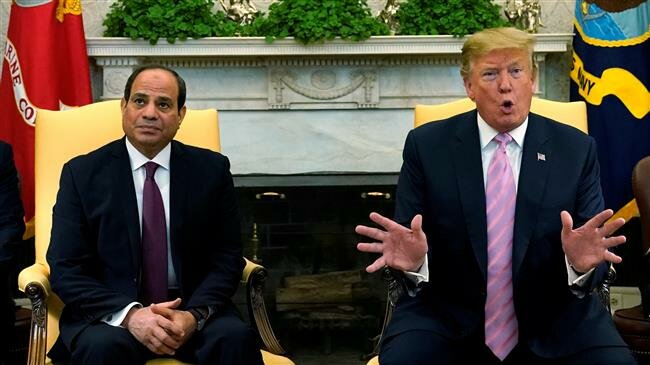
US President Donald Trump meets with his Egyptian counterpart, Abdel Fattah el-Sisi, at the White House in Washington on April 9, 2019. (Photo by Reuters)
Press TV | April 11, 2019
Egypt has reportedly turned its back on a US-led initiative to establish a NATO-style alliance of Arab countries primarily aimed at countering Iran out of concerns that such a coalition could increase tensions with the Islamic Republic, among other reasons.
Four sources familiar with the matter told Reuters on Thursday that Cairo had informed the US and the members of what is to be called the Middle East Strategic Alliance (MESA) of the withdrawal plan ahead of their Sunday’s meeting in the Saudi capital, Riyadh.
One of the sources, speaking on condition of anonymity, said that Egypt had not sent a delegation to the Riyadh event.
An Arab source stressed that Egypt had pulled out of the so-called “Arab NATO” because of its doubts about the seriousness of the proposal as well as the danger that such an Arab front would increase tensions with Tehran.
Other reasons were uncertainty about whether US President Donald Trump will win a second term in 2020 and whether his successor may scrap the initiative to form an anti-Iran alliance, the Arab source added.
Reuters described Cairo’s move as a blow to the Trump administration’s anti-Iran strategy.
A Saudi source also confirmed problems with the plan, saying, “It’s not moving well.”
Meanwhile, two other sources emphasized that the remaining MESA members were moving ahead with the initiative and would press Egypt diplomatically to revoke its withdrawal from the anti-Iran group.
“We all want them back,” said one of the sources.
The Arab source, however, noted that Egypt could not be convinced to return to the so-called “Arab NATO,” which is comprised of Jordan and six Persian Gulf Arab countries, including Saudi Arabia, the United Arab Emirates, Bahrain, Kuwait, Oman and Qatar.
Egyptian officials have not yet commented on the report.
The alliance was first proposed by Saudi Arabia back in 2017 in a bid to counter Iran as well as Russia and China, according to a classified White House document reviewed by Reuters last year.
It has, however, faced several obstacles such as a diplomatic standoff between Qatar and a Saudi-led quartet of countries and the fallout of the state-sponsored killing of dissident Saudi journalist Jamal Khashoggi.
The problems have delayed a summit in the United States, which would feature the signing of a preliminary accord on the anti-Iran alliance.
The report about Cairo’s withdrawal plan came following a meeting between Egyptian President Abdel Fattah el-Sisi and Trump in Washington.
Before the meeting, Trump had said he would exchange views with Sisi on security issues, but it was not clear whether they discussed the MESA issue.
The US and its allies in the Persian Gulf view regional powerhouse Iran as a common “threat.” They constantly accuse the Islamic Republic of “regional interference,” a claim Tehran vehemently rejects.
Trump – who came to office in early 2017 with a highly belligerent anti-Iran agenda – has been pressing its Arab allies to act on the Saudi initiative and move to form the NATO-like military alliance.
In parallel, the US president has also been encouraging the Arabs to step up their attempts towards normalization with the regime in Israel in favor of a coalition against Iran.
In February, a controversial US-organized summit in Warsaw, Poland, brought together Israeli Prime Minister Benjamin Netanyahu and representatives from a number of Arab states, including Oman, Morocco, Saudi Arabia, the United Arab Emirates, Bahrain, Qatar, Jordan, Egypt, Tunisia and Kuwait, among other participants.
On the sidelines of that event, Netanyahu said the Arab countries participating in the Warsaw forum were “sitting down together with Israel in order to advance the common interest of war with Iran.”
Tehran has also repeatedly warned the Persian Gulf littoral states against the US’s divisive policies in the Middle East, saying the planned Arab alliance would merely be a tool for the US to fuel tensions in the region and advance its own agenda there.
Featured Video
Integrity Initiative: UK-funded network framed dissent as Russian disinformation for years
or go to
Aletho News Archives – Video-Images
From the Archives
Why Saudi Ties to 9/11 Mean U.S. Ties to 9/11
By Kevin Ryan | Dig Within | September 27, 2015
Media interest in Saudi Arabian connections to the crimes of 9/11 has centered on calls for the release of the 28 missing pages from the Joint Congressional Inquiry’s report. However, those calls focus on the question of hijacker financing and omit the most interesting links between the 9/11 attacks and Saudi Arabia—links that implicate powerful people in the United States. Here are twenty examples. … continue
Blog Roll
 Aletho News
- IAEA inspectors cannot return to Iran amid US threats: Russia
- Senate Rejects Iran War Powers Resolution Passed By House
- ‘We did not attack Pakistan with drones’: Afghan sources
- Iraqi Resistance faction links arms to sovereignty, questions US exit
- Cannon fodder no more… South Korea rejects Trump’s pressure to join his criminal war on Iran
- Neria Leiter Was A Legitimate Military Target
- Integrity Initiative: UK-funded network framed dissent as Russian disinformation for years
- ‘We don’t seek permission to defend our country’: Snippets from President Pezeshkian’s UNGA address
- NATO chief wants Europeans to fight American wars [for Israel]
- German chemicals giant reveals details of downsizing
- If Americans Knew
- Israel displaces hundreds of Palestinians amid wave of demolitions in West Bank
- Aid, reconstruction, and Israel’s history of obstruction in Gaza
- Trump administration digs an ever-deeper hole of complicity in genocide – Daily Update
- US-Israel $2.8 Billion Arms Deal, 40,000-Bomb Supply Faces New Gaza Complicity Accusations
- Caught on Tape: AIPAC CEO Boasted of Controlling Trump’s National Security Officials
- Why Hamas Attacked Israel in October 2023 – Israeli professor Ilan Pappé
- They see them, then kill them: Israeli quadcopters track, deliberately target civilians in Gaza
- Winter could turn Gaza’s treacherous, war-damaged buildings into deathtraps
- Majority of Democratic Voters Want to Prosecute Both Biden and Trump Administration Officials Over Gaza
- As Gaza languishes, world leaders gather at the UN – Daily Update
- No Tricks Zone
- New Study: Earth And Venus Surface Warmth Largely Explained By Convection And Lapse Rate, Not CO2 Or Radiation
- 2025 Nature Paper Claiming Worsening Global Drought Gets RETRACTED …Heavily Flawed
- New Study: ‘Global Drought Shows No Detectable Recent Acceleration Under Climate Warming’
- Economic Masterminds: German Socialists Suggest Taxing Productivity Gains Stemming From Using AI
- The South China Sea Has Not Been Cooperating With The Climate Change Narrative
- Energy Crisis: Germany Enters Heating Season With Historically Low Gas Reserve Fill Levels
- New Study: The Antarctic Ice Sheet Gained Mass From 2020-2024 Due To Staggering Snow And Ice Accumulation
- Study: Ocean Heating Rates From Thousands Of Years Ago ‘Dwarf’ Modern Ocean Heating Rates
- Climate Extremists Target, Attack Large-Scale Power Grid Infrastructure In Germany!
- New Study: Antarctic Ice Melt Has Contributed Less Than 1 Centimeter To Sea Level Rise In The Last 30 Years

