British Lies Are a Secret No More
By Jean Perier – New Eastern Outlook – 02.01.2017
The sitting British officials remain ignorant of the fact what kind of disservice the Obama administration has made them by demanding London to repeat the twisted lies the former has been spreading. Both David Cameron and Theresa May have always been obedient disciples of the White House, therefore they chose to spread tedious lies and disinformation in a bid to justify the failure of their social and economic policies, while hiding from the public the fact that Britain is responsible for a number of armed conflicts in the Middle East and Africa.
As a result, a considerable number of media sources and non-governmental organizations have been tasked with creating the image of a dangerous enemy looming somewhere on the borders, to cover corruption and looting of the UK treasury, that are now being labeled as “necessary measures taken for the protection from external threats.”
The British Independent would become pretty apologetic by claiming:
The foreign media has allowed – through naivety or self-interest – people who could only operate with the permission of al-Qaeda-type groups such as Jabhat al-Nusra and Ahrar al-Sham to dominate the news agenda.
So it’s now the fault of pro-Western radical militants that the corporate media were publishing one lie after another about the situation in Aleppo, and Western governments had nothing to do with the fact that those who reported facts about the situation on the ground would soon be kidnapped and executed. Thus, the Independent openly admits, that radical jihadists were allowed to shape the media coverage of Western media sources completely. But then the Independent takes a step further in admitting what has been happening all along in Syria:
It would be simple-minded to believe that this very appealing and professional PR for the Syrian armed opposition is all their own work. Foreign governments play a fairly open role in funding and training opposition media specialists. One journalist of partly Syrian extraction in Beirut told me how he had been offered $17,000 a month to work for just such an opposition media PR project backed by the British government.
So, both the UK and US media sources are accomplices of the war crimes that the West has been carrying out in Syria, or maybe the editors of those corporate media sources were held hostage of radical militants too, while being unable to tell the truth?
The more time passes since the liberation of Aleppo, the more facts we learn about the attempts that the West made to prevent citizens of this city from getting rid from the barbaric oppression of radical militants. There’s been reports that the fake stories about “Russia’s war crimes in Syria” were fabricated by British intelligence services. There’s every reason to believe that even though the notorious “White Helmets” organization is being sponsored by George Soros, it’s directly controlled by Western intelligence services. In total, London has allocated 32 million pounds to sponsor this organization, with 12,5 sent last year alone. According to the reports released by Syrian journalists, the White Helmets are getting 50 million dollars a year from various sources, while George Soros remains one of their main sponsors.
The founder of the White Helmets is James Le Mesurier, a British “security” specialist and ‘ex’ British military intelligence officer with an impressive track record in some of the most dubious NATO interventions. Additionally, one of the leaders of the White Helmets, Mosab Obeidat, has already been identified to have contributed a major role in the financing of the terrorist groups. According to some reports, Obeidat has played the role of a mediator in providing the Syrian militants with around 2.2 million dollars to pay for weapons and ammunition supplies.
The White Helmets have been actively cooperating with the Jabhat al-Nusra movement, the local branch of Al-Qaeda. In fact, it was with the support of these terrorist organizations that allowed the White Helmets to operate in the areas controlled by terrorists, where other non-governmental organizations are virtually banned. It’s curious that last year this organization was even nominated for the Nobel Peace Prize, which, according to its backers in London, would make its activities more visible.
In this regard, it’s curious that in the official report UK NON-HUMANITARIAN AID IN RESPONSE TO THE SYRIA CONFLICT, it’s been explicitly stated that the White Helmets received 15 million pounds from the British government, while another 5.3 million pounds were allocated to “certain media sources”.
It should also be added that just recently at the UN conference entitled “Against propaganda and regime change, for peace and national sovereignty” Eva Bartlett, a prominent journalist from Canada, stressed the fact that there are no offices of international human rights organizations in Syria. Therefore, the West is free to draw any conclusions about the humanitarian situation on the basis of the observations of “Syrian Observatory For Human Rights”, that has a single employee that is living in the UK. Bartlett has also complained that reports are often drafted on the basis of the information provided by dubious groups, such as the White Helmets.
It’s imperative for everyone to understand that when policymakers act according to false narratives, especially ones they create themselves, the result is grave dangers, as we are now experiencing with the new Cold War. To escape these dangers, London must first get the history right, particularly its own role in spreading conflicts in the Middle East.
Jean Périer is an independent researcher and analyst and a renowned expert on the Near and Middle East.
Buoyant Putin and Sinking Western Mis-Leaders
By Finian CUNNINGHAM | Strategic Culture Foundation | 30.12.2016
Future historians may well record 2016 a vintage year for Russian President Vladimir Putin. At any rate, at this point we can say it has been a good year for the Russian leader and his country’s international standing. Even Western media, which did its best to discredit, even demonize, Putin have had to admit so, albeit begrudgingly.
This week, the London Financial Times described the Russian leader as «Buoyant Putin». While last week, the Washington Post headlined: «Moscow has the world’s attention. For Putin, that’s a win».
The Washington Post surveyed some of the key developments over the past year as being in Putin’s favor, including a shaky European Union and the British Brexit vote to quit the bloc, an unwieldy NATO military alliance unsure of its purpose, the election of Donald Trump to the US presidency, and the retaking of the strategic Syrian city of Aleppo.
The victory by the Syrian army in Aleppo, crucially aided by Russian military power, was surely a crowning achievement for Putin. When Putin ordered intervention in Syria at the end of 2015, it was predicted by US President Barack Obama that the move would result in a quagmire for Russia. A year later, Putin’s decisive intervention has been vindicated as rolling back a jihadist campaign to destroy Syria.
Syrians celebrating the defeat of extremists in Aleppo have not only confounded earlier predictions; the «liberation», as it is being feted by Syrians, serves to expose Western governments and their media as having grossly distorted the war as some kind of popular uprising against a «tyrannical regime», rather than being what it is: a foreign-backed criminal conspiracy for regime change deploying jihadi terror proxies.
So the Russian-backed military campaign in Syria is a clear winning event for Vladimir Putin.
However, on the range of other world events outlined above, while they may be said to be in Putin’s favor, it is more a case of denial by Western leaders about their own failures, instead of attributing these setbacks to the alleged machinations of the Russian leader.
Putin may indeed be «buoyant». But it is also true that the mixed political fortunes are due to the sinking of Western mis-leaders through their own incompetence and baleful policies.
The Washington Post article cited above had this to say: «The Russian leader is winning because the post-Cold War order he has railed against has been thrown into chaos, and the Kremlin’s fingerprints are widely seen to be all over it».
Just who is «widely seeing» the Kremlin’s alleged depredations is not specified by the Washington Post. But a safe assumption is that the newspaper is being led by US intelligence and the CIA in particular, whose multi-million-dollar links to the outlet’s owner Jeff Bezoz have been documented elsewhere by Wayne Madsen.
It is true that Putin has often deplored the post-Cold War order of American unipolar ambitions, its disregard for international law and its conceited «exceptionalism» for unleashing military violence to enforce foreign interests. Putin has said that such policy is the fount of chaos in international relations. If anything, he has been proven right when we survey the conflict-ridden mess of the Middle East from US wars, supposed «nation-building» and regime-change operations. But to then attribute this chaos of the post-Cold War as having the «Kremlin’s fingerprints all over it» is an absurdity.
The same goes for other aspects of post-Cold War «chaos». The election of Donald Trump to the White House is alleged by the Washington Post, New York Times, NBC and other US media giants as being the result of Putin overseeing Russian computer hackers interfering in American democracy. Russia has rejected those claims as «ridiculous» – as has Trump.
Rather than dealing with political and social reality of internal decay, the American establishment has tried to divert the cause to alleged Russian malfeasance. The reality is, however, that popular American sentiment is one of disgust with the Washington establishment and its mis-leaders in both main parties, Democrats and Republicans. That disgust embroils the mainstream media which is seen to be an integral part of a corrupt, venal establishment.
To try to lay the «blame» for Trump’s election on Russian cyber-attacks is an insult to a large section of the American citizenry. It is also a sign of chronic denial by the Washington establishment that decades of economic and foreign policy are in shambles – a shambles of its own making.
The same too for the Brexit referendum held in June which saw the stunning result of Britons wanting to quit the European Union. On the back of CIA-inspired claims about Russian interference, British politicians who are miffed over the Brexit result have parlayed similar claims that the Kremlin’s meddling was behind that outcome. Russia has also hit back to rubbish the British claims.
But rather than getting a grip on reality, the official Western paranoia about alleged Russian subversiveness is becoming even more fevered.
With hotly contested national elections coming up next year across Europe, incumbent governments are decrying what they «discern» as Russian interference to push populist, anti-EU, anti-immigrant parties. Voice of America reported this week: «Europe braces for Russian cyber assault before 2017 elections» in Netherlands, France and Germany.
VOA added: «As the chief European architect of sanctions against Russia, analysts say German Chancellor Angela Merkel is the European leader Moscow would most like to see voted out of power».
As with the Brexit and Trump, it is an elitist insult to citizens’ intelligence and their democratic rights, by imposing what is a scare-campaign to discredit widespread popular discontent with establishment governments and the status quo.
People across the West, the US and Europe, are simply infuriated by elitist governments that pursue failed policies of economic austerity and a pro-Atlanticist Cold War geopolitical agenda of hostility towards Russia, inflating a NATO monstrosity based on Russophobia, and slavishly following American imperialism around the world.
Syria may have proven to be a triumph for Putin and his principled stand to defend Syrian sovereignty from a US-led covert war for regime change. But Syria also represents an unmitigated disaster for Washington and its Atlanticist European acolytes.
The massive influx of refugees from Syria and other Middle East war zones is the direct result of the US and its NATO allies waging illegal wars and sponsoring terrorist proxies – the latter in the mendacious notion of being «moderate rebels».
The terror attacks that have shocked France and Germany over the past year – the latest one in Berlin when 12 people at a Christmas market were killed by an alleged jihadist asylum-seeker plowing a 25-ton lorry into them – are the corollary of Hollande and Merkel being complicit in US imperialist wars across the Middle East.
Merkel’s «open door» policy to a million refugees is a failed policy. That judgment is not based on racism or xenophobia. Merkel’s failure is due to her allowing Germany to become an escape valve for US, British and French criminal machinations of regime change in the Middle East.
So it has been a good year for Putin and Russia’s international standing generally – the recent appalling assassination of ambassador Andrey Karlov in Ankara notwithstanding.
It’s also been an atrocious year for Western politicians of the Atlanticist mold. But their downfall is due to their own corruption and incompetence. To seek to scapegoat Vladimir Putin and Russia as «interfering» or «sowing chaos» is a contemptible denial of Western official culpability.
Such is the collapse in official Western politics and institutions, including the establishment media, that the more they spin the anti-Russian narrative, the more popular revolt will grow against their «mis-leaders».
If 2016 becomes a vintage year for Russia, for the West it is proving to be year when the official political vessels cracked open with bitter contents.
There will be no partition of Syria
By Sharmine Narwani | RT | December 29, 2016
East Aleppo is liberated, and regime-change has lost its luster. It’s no surprise Syria’s foes are ready to promote the next big goal: partition. Like most Syrian conflict predictions, of which few have materialized, the ‘partition’ of Syria is not going to happen.
In February, when East Aleppo was still bulging with Western-trained, Al Qaeda-allied militants, Syrian President Bashar Assad was asked the question: “Do you think that you can regain control over all Syrian territory?”
Well, yes, said Assad: “This is a goal we are seeking to achieve without any hesitation. It makes no sense for us to say that we will give up any part.”
Western politicians were having none of that.
First up was US Secretary of State John Kerry who coyly informed the Senate Foreign Relations Committee that the Obama administration may have a Plan B up its sleeve for Syria: “it may be too late to keep it as a whole Syria if we wait much longer.”
Next, James Stavridis, former NATO Supreme Commander and head of the US European Command penned an article for Foreign Policy entitled It’s time to seriously consider partitioning Syria where he claimed: “Syria as a nation is increasingly a fiction.”
Then, CIA Director John Brennan joined the chorus: “There’s been so much blood spilled, I don’t know if we’re going to be able to get back to [a unified Syria] in my lifetime.”
But now the stinging defeat of Western-backed militants in East Aleppo has turned up the dial on the idea of breaking up Syria. Frantic neocons and liberal interventionists are piling in on the ‘partition’ punditry – with nary a backward glance to their five failed years of “Assad will fall” prognostications.
But Assad understands something that Western analysts, journalists and politicians cannot seem to grasp. Syria’s allies in this war – Iran, Hezbollah, Iraq, Russia, China – have maintained only two hard red lines throughout the conflict:
The first is that Assad can only be removed from office in a national election, by a Syrian majority.
The second is that Syria must stay whole.
Their logic was simple. Regime-change, remapping of borders, mercenary proxy armies, divide-and-rule… the old tricks of Western hegemons needed to stop in Syria. Otherwise, they would aggressively find their way to Moscow, Beijing and Tehran.
In short, a new world order would need to emerge from the ashes of the Syrian conflict, and for that to happen, allies would need to thoroughly defeat NATO-GCC objectives and maintain the territorial integrity and sovereignty of the Syrian state at all costs.

A calculated shift in the balance of power
By 2013, one could already predict the formation of a new security-focused Mideast alliance to combat the jihadi threat raging in Syria and its neighborhood. (see map above)
It was clear by then that the irregular wars waged by jihadists and their powerful foreign backers were going to force four states – Lebanon, Syria, Iraq and Iran – to cooperate militarily and politically to defeat Wahhabi-influenced terror groups in their midst. A ‘Security Arc’ would thus form to protect the territorial integrity of these four countries, and with it, a converging worldview that would set the stage for a new Mideast security structure.
Today, Lebanon and Iran have secure borders flanking either side of Syria and Iraq. Fighters and military advisers, intelligence, weapons transfers from all four states are in play, with increased, successful coordination on the ground and in the skies.
Russia and China have provided ‘great power’ cover for this new development – whether at the UN Security Council or via military, financial or diplomatic initiatives. Furthermore, galvanized by the ferocity of the fight over Syria, Tehran, Moscow and Beijing have advanced the new multilateral order they seek – bolstering their own regional security, deepening global alliances, forging new ones, and crafting political, security and financial institutions to compete with Western-dominated ones.
As the Security Arc succeeded in beating back extremist groups, it would be necessary for three critical neighboring states to gravitate toward participation in this new regional security architecture – Egypt, Turkey and Jordan – each for different reasons.
But the new adherents would be drawn to the security zone primarily because of the realization that a weakened central government and the fragmentation of Syria would blow back into their states and create the same conditions there: chaos, instability, terrorism.
Egypt: Under the rule of President Abdel Fattah el-Sisi, Egypt has drawn away from its Saudi patrons who have, alongside Qatar and Turkey, been major sponsors of extremism in both Syria and Iraq. Earlier this year, Sisi began to pivot away from Egypt’s traditional Western and regional allies and opened the door to further political, military and economic engagement with Syria, Iran, Russia and China.
SAIS-Johns Hopkins University Fellow Dr. Christina Lin explains: “Unlike Washington, Sisi sees Assad as a secular bulwark against Islamic extremism in the Levant. If Assad falls, Lebanon and Jordan would be next, and Egypt does not want to end up like Libya with the Brotherhood and other Islamists carving up the country.”
In the past few months, Egypt has pursued a diplomatic thaw with Iran, military cooperation with Syria, and publicly squabbled with Saudi Arabia. Furthermore, Sisi has been invited to sit at the Syrian peacemaking table by Iran and Russia, while in the background, China launches plans for a $60 billion infrastructure investment in cash-strapped Egypt.
Turkey: No state has been a bigger thorn in Damascus’ side than Turkey – financier, enabler, and mastermind of the militancy flowing across its southern border into war-torn Syria. But the Syrian conflict has crippled and exhausted Turkey, in turn, unleashing terror attacks in its cities, reviving its ‘Kurdish’ conflict, isolating its unpredictable President Recep Tayyip Erdogan, squeezing its economy, and triggering widespread domestic political strife.
So when the Russians reportedly tipped off Erdogan to an ill-fated coup attempt this summer – which Turks believe to be US-inspired – the Turkish president’s political orientation began to waver, and he began to inch toward a series of compromises with Iran and Russia on the Syrian conflict.
Erdogan’s first grand gesture to Tehran and Moscow was to peel away a layer of militants from embattled Aleppo, allowing the Syrian-allied forces to focus their military might on the Al-Qaeda-affiliated groups remaining in the eastern enclave. In the aftermath of Aleppo’s liberation, the Turks, Iranians and Russians met again to hammer out their next set of objectives, including a nationwide ceasefire – a move that sidelined Erdogan’s Western allies and highlighted the fact that nobody actually needs the US, UK or France at the Syrian negotiating table.
Jordan: For much of the Syrian conflict, Jordan’s interests were subverted by powerful patrons who turned the Hashemite Kingdom into a covert operations hub for Western special forces, GCC intel operatives and ‘rebel’ training centers. But in recent years, Jordan’s King Abdullah has been forced to disentangle his financially-strapped country from the consequences created by a huge influx of Syrian refugees and a terrifying surge in domestic radicalism. Consequently, Jordan has been quietly sharing intelligence with Syrian authorities to weaken the militancy in southern Syria and has effectively shut down their shared border.
The king himself has been engaging in some frenzied shuttle diplomacy with Russia and China to gain investment and political relevance, so Jordan is well-positioned to follow the lead of its larger neighbors when the regional balance of power shifts decisively in Syria’s favor.
Victors map the future, not the vanquished
The liberation of East Aleppo from Al-Qaeda-allied militants is a significant turning point in the war against Syria. All the major population/infrastructure areas that define the north-to-south western side of the country are now primarily in government hands.
Moreover, East Aleppo’s liberation serves as an important launching pad to cut off the vital Turkey-to-Mosul corridor that has funneled fighters, supplies and weapons to ISIS for years. Syrian troops and their allies will now be able to move east of the city to the Euphrates to sever this Turkish-ISIS lifeline.
With western Syrian hubs secured and militants severely crippled in the south, only the north-eastern areas present a challenge – but those are areas largely occupied by ISIS, where the final battles will be waged to rout the terror group.
So, what exactly do Americans want to partition – and why?
Recent wars in Afghanistan, Iraq, Yemen and Libya demonstrate clearly that a weak central authority only creates a political and security vacuum that extremists rush in to occupy. US President-Elect Donald Trump has himself said he prefers the rule of strongmen, rather than the instability that prevails with regime-change conflicts.
Any partition of Syria would, therefore, benefit ISIS and Al-Qaeda primarily – and all the parties know this.
The Security Arc states and their allies can ably eradicate the terrorism in their midst. Turkey and the United States still remain key irritants, each still vying, against their own security interests, to lay claim to north-eastern swathes of territory that hold some strategic interest.
Funnily enough, these interests pit the two NATO allies against each other. The US’ ‘Kurdish project’ has sent Erdogan fleeing toward the Iranians and Russians for help. It is ironic indeed that the West’s longtime efforts to sow discord between regional actors, sects, and ethnicities could now be reversed in one fell swoop by the US’ support for Kurdish nationalism. There is nothing more guaranteed to create common cause between Arabs, Iranians, and Turks than the unifying prospect of Kurdish statehood. Not even ISIS does that.
In the aftermath of the Aleppo victory, Assad once more addressed talk of partition: “This is the Western – with some regional countries – hope… If you look at the society today, the Syrian society is more unified than before the war… There’s no way that Syrians would accept that – I’m talking now about the vast majority of the Syrians… After nearly six years I can tell you the majority of the Syrians wouldn’t accept anything related to disintegration – on the contrary, as one Syria.”
He is right. For the more than 70 percent of Syrians living in government-controlled areas, the appetite for further conflict is nonexistent – and that’s what partition would mean: conflict. Furthermore, not just Syrians, but the whole of the Security Arc and their global allies are now hell bent on protecting themselves by destroying the terrorism that dwells in the remaining pockets of occupied territory. Like Assad – and much of Europe today – they know that you will never remove the security threat if you don’t rout them all and preserve the state.
In this security context, partition is out of the question. In the military context, a forced partition would require the commitment of troops stronger than the armies of Syria, Iran, Russia, Iraq, Egypt and Hezbollah combined – and that doesn’t exist. In the political context, the international appetite for an ‘imposed’ partition is nil.
So no, there will be no partition of Syria.
Sharmine Narwani is a commentator and analyst of Middle East geopolitics. She is a former senior associate at St. Antony’s College, Oxford University and has a master’s degree in International Relations from Columbia University. You can follow her on Twitter at @snarwani
Obama Defeatedly Uses the ‘Sanctions Muscle’ Against Russia
By Salman Rafi Sheikh – New Eastern Outlook – 28.12.2016
It seems hardly a coincidence that the US out-going president announced fresh sanctions on Russia just when the later was busy discussing a deal on Syria with Turkey and Iran in Moscow. Far from being just a sort of coincidence, the act is an apt reflection of the increasing American anger over its failure in Syria against Russia. According to Wall Street Journal, the Obama administration added on Tuesday, December 20, 2016, to its sanctions list Yevgeny Prigozhin, a Russian restaurateur who, according to Washington, has links to Russia’s Vladimir Putin and is the financial backer of ‘pro-Russian propaganda’ machinery. Obama’s sanctions prohibit Prigozhin from entering the US and conducting business with any American individuals or organizations. This act has come alongside new US Treasury sanctions imposed upon a number of other Russian individuals with connections to a bank US officials have said has ‘ties’ to Mr. Putin’s inner circle. Clearly, the Obama administration is busy casting Mr. Putin as a die-hard villain in its version of political and military history.
Besides the fact that it is an expression of frustration, it is also a fact that Washington has run out of ways to hit at Putin and time is running out for the lame duck president – almost three weeks left before Obama retires.
Without doubt, the Obama administration feels humiliated that Russia, Turkey and Iran have formed a platform to discuss a Syrian settlement, which excludes the US. Even if it is not a defeating humiliation, the situation developing within and outside Syria regarding a US-exclusive peace settlement is politically deeply damaging for the US both domestically and internationally.
Nothing perhaps could explain the damage the Obama administration has done to the US due to its dual policies with regard to Syria and the larger issue of terrorism than Senator John McCain’s recent statement in which he said that what is unfolding is “the predictable consequence of President Obama’s reckless policy of disengagement from the Middle East. And it is ironic that after touting the power of diplomacy for years, President Obama’s refusal to back diplomacy with strength has left the United States without even a seat at the diplomatic table.”
While McCain’s view represents the view of a hawkish club that exists within the US, it is far from true that the Obama administration did not support diplomacy with strength. Neither was the US disengaged from the Middle East during all these years nor was the Obama administration oblivious to the importance of bringing havoc to Syria, in the name of democracy, through proxy groups, some of which continue to receive support.
Yet, the situation now emerging out of the trilateral settlement among Russia, Iran and Turkey marks a direct opposite of what the US and its allies have been seeking in Syria for last five years or so. While the joint statement of the trilateral meeting has formalized a growing convergence between Moscow, Ankara and Tehran, the bottom line and what angers the US the most is their unequivocal support for a Syria that is not only sovereign, independent and united with its territorial integrity intact, but also is “multi-ethnic, multi-religious, non-sectarian, democratic and secular.”
At the core is all parties’ willingness to facilitate an intra-Syria dialogue and to be the guarantors of a prospective agreement between the Syrian government and the opposition. Following the Moscow meeting, at a joint press conference with his Turkish and Iranian colleagues, Russian Foreign Minister Sergey Lavrov made it clear that the new trilateral format will be the “most effective” charioteer henceforth in the intra-Syrian peace talks.
He said Russia, Turkey and Iran are “probably better prepared than others to contribute to the settlement of the Syrian crisis with real actions, not just words”.
The three countries have as such tactfully got rid of the US mentorship in Geneva by agreeing to hold the talks in Astana, Kazakhstan. Hence, the brewing domestic anger over the Obama administration and the consequent sanctions.
While Obama may just be able to pacify its supporters through these sanctions, he cannot certainly turn blind to the danger Europe is facing. This widening of American sanctions against Russia at a time when the bloody attacks in Ankara and Berlin should bring reasonable people together to fight the terrorist threat shows that Washington has completely lost its grip on reality and deliberately decided to turn blind to it. Yet the threat exists and continues to pose a major challenge to Europe’s security situation. The Obama administration’s stubbornness with regard to indiscriminately fighting terrorism and its undue insistence on Assad’s exit are directly contributing to the persistence of this threat and even its territorial expansion into other continents. To an extent, the US’ dualism has even cost it its erstwhile allies.
The US is losing its traditional grip over the Middle East and the Arab world. This is evident from the way Turkey, despite being a NATO member, has weaned itself away from the US-led block and adopted an alternative course of action. The Moscow meeting has clearly shown that Turkey has decided to bury its past Syria policies and expressed its willingness to chalk out a scheme that caters to the interests of all the actors involved. In the joint statement with Russia and Iran, Turkey implicitly accepts, notwithstanding the bargain that might have taken place among all the parties involved, that the toppling of the Assad regime is no longer the agenda in Syria.
While such an outcome and changed position of Turkey vis-à-vis Syria and Assad can be attributed to what it is likely to gain in terms of an assurance from Russia, Iran and Syria against the creation of an independent Kurdistan, it can equally be attributed to the failure of efforts, spanning over 5 years, to topple Assad.
While Turkey has finally come to terms, the US and its European and Arab allies continue to cling to the old agenda. In their calculations, they seem to continue to ignore the fact that Assad does enjoy significant local support. Had it not been for this support, he might have been toppled long before Russia entered the scene.
The Syrian minorities have backed him and fought for him out of sheer self-preservation. Having seen what happened to the Yazidis in Iraq when they were captured by brutal IS fighters, they know they are fighting for their lives, their homes and their wives and daughters. This is an element in Assad’s support that, thus far, has gone unrecognised in the West.
With Assad strong enough to claim its office, with Russia and Iran standing in Syria and with Turkey sliding over to Russia and Iran, the US’ credibility as a reliable security partner has been damaged to a great extent. Fresh sanctions on Russia are just yet another indication of the fact that the US is too weak to achieve its objectives through other means—something that is causing Arab states to re-think their traditional reliance on the US for their national security.
As against the Arab states’ current standing, Russian influence in the region is increasing and a number of other countries, such as Egypt and Israel, have shown their willingness to extend co-operation with Russia against terrorism. Importantly, this co-operation against terrorism is not mere co-operation’; it also signifies a potential rejection of the US version of terrorism according to which a terror group becomes ‘terrorist’ only when it starts hurting interests of the US and those of its allies.
Welcome to Greater Israel!
The tail will be wagging the dog under Donald Trump
By Philip Giraldi • Unz Review • December 27, 2016
While the presidential campaign was still in progress it was possible to think that there might be some positive change in America’s broken foreign policy. Hillary Clinton was clearly the candidate of Washington Establishment hawkishness, while Donald Trump was declaring his disinclination for democracy and nation building overseas as well as promoting détente with Russia. Those of us who considered the foreign policy debacle to be the most dangerous issue confronting the country, particularly as it was also fueling domestic tyranny, tended to vote on the basis of that one issue in favor of Trump.
On December 1st in Cincinnati, president-elect Donald Trump made some interesting comments about his post-electoral foreign policy plans. There were a lot of good things in it, including his citing of $6 trillion “wasted” in Mideast fights when “our goal is stability not chaos.” And as for dealing with real enemies, he promised to “partner with any national that is willing to join us in the effort to defeat ISIS and radical Islamic terrorism…” He called it a “new foreign policy that finally learns from the mistakes of the past” adding that “We will stop looking to topple regimes and overthrow governments, folks.”
Regarding the apparent inability of governments to thoroughly check out new immigrants prior to letting them inside the country, demonstrated most recently in Nice, Ohio and Berlin, Trump described how “People are pouring in from regions of the Middle East — we have no idea who they are, where they come from what they are thinking and we are going to stop that dead cold. … These are stupid refugee programs created by stupid politicians.” Exaggerated? For sure, but he has a point, and it all is part and parcel of a foreign policy that serves no actual interest for people who already live in the United States.
But, as so often with Trump, there was also the flip side. On the looney fringe of the foreign and national security policy agenda, the president-elect oddly believes that “The United States must greatly strengthen and expand its nuclear capability until such time as the world comes to its senses regarding nukes.” So to reduce the number of nukes we have to create more of them and put them in more places. Pouring gasoline on a raging fire would be an appropriate analogy and it certainly leads to questions regarding who is advising The Donald with this kind of nonsense.
Trump has promised to “put America first,” but there is inevitably a spanner in the works. Now, with the New Year only six days away and the presidential inauguration coming less than three weeks after that, it is possible to discern that the new foreign policy will, more than under Barack Obama and George W. Bush, be driven in significant part by Israeli interests.
At least Obama had the good sense to despise Israeli Prime Minister Benjamin Netanyahu, but that will not be true of the White House after January 20th. Trump’s very first telephone conversation with a foreign head of government after being elected was with Netanyahu and during the campaign, he promised to invite Bibi to the White House immediately after the inauguration. The new president’s first naming of an Ambassador-designate to a foreign nation was of his good friend and bankruptcy lawyer David Friedman to Israel. Friedman had headed Trump’s Israel Advisory Committee and is a notable hard liner who supports the Israeli settler movement, an extreme right-wing political entity that is nominally opposed by existing U.S. government policy as both illegal and damaging to Washington’s interests. Beyond that, Friedman rejects creation of a Palestinian state and supports Israel’s actual annexation of the West Bank.
U.S. Ambassadors are supposed to support American interests but Friedman would actually be representing and endorsing a particularly noxious version of Israeli fascism as the new normal in the relationship with Washington. Friedman describes Jerusalem as “the holy capital of the Jewish people and only the Jewish people.” Trump is already taking steps to move the U.S. Embassy there, making the American government unique in having its chief diplomatic mission in the legally disputed city. The move will also serve as a recruiting poster for groups like ISIS and will inflame opinion against the U.S. among friendly Arab states in the region. There is no possible gain and much to lose for the United States and for American citizens in making the move, but it satisfies Israeli hardliners and zealots like Friedman.
The Trump team’s animosity towards Iran is also part of the broader Israeli agenda. Iran does not threaten the United States and is a military midget compared either to nuclear armed Israel or the U.S. Yet is has been singled out as the enemy du jour in the Middle East even though it has invaded no one since the seventeenth century. Israel would like to have the United States do the heavy lifting to destroy Iran as a regional power. If Washington were to attempt to do so it would be a catastrophe for all parties involved but that has not stopped hardliners from demanding unrelenting military pressure on Tehran.
Donald Trump is not even president yet but he advised Barack Obama to exercise the U.S. veto for the resolution condemning Israeli settlements that was voted on at the United Nations Security Council on Friday, explaining that “As the United States has long maintained, peace between the Israelis and the Palestinians will only come through direct negotiations between the parties, and not through the imposition of terms by the United Nations. This puts Israel in a very poor negotiating position and is extremely unfair to all Israelis.”
This is a straight Israeli line that might even have been written by Netanyahu himself. Or by the American Israel Public Affairs Committee (AIPAC), which fumed “AIPAC is deeply disturbed by the failure of the Obama Administration to exercise its veto to prevent a destructive, one-sided, anti-Israel resolution from being enacted by the United Nations Security Council (UNSC). In the past, this administration and past administrations have rejected this type of biased resolution since it undermines prospects for peace. It is particularly regrettable, in his last month in office, that the president has taken an action at odds with the bipartisan consensus in Congress and America’s long history of standing with Israel at the United Nations.”
Ah yes, the fabled negotiations for a two state solution, regularly employed to enable Israelis to do nothing while expanding their theft of Arab land and one wonders how Trump would define what is “fair to the Palestinians?” So we are already well into Trump’s adoption of the “always the victim argument” that the Israelis have so cleverly exploited with U.S. politicians and the media.
Not content with advising Obama, Trump also reportedly took the Palestinian issue one step further by directly pressuring the sponsoring Egyptians to postpone any submission of the resolution. Expecting to have a friendly president in the White House after January 20th, Egypt’s president Abdel Fattah al-Sisi complied on Thursday but the motion was reintroduced by New Zealand, Venezuela, Senegal and Malaysia on the following day. The resolution passed with 14 yes votes and a courageous U.S. abstention after Obama finally, after eight long years, developed a backbone. But unfortunately, Trump’s interventions suggest that nothing critical of Israel will be allowed to emerge from the U.N. during his term of office. Referring to the U.N. vote, he said that “things will be different after January 20th.”
The United Nations resolution produced an immediate reaction from Israeli Firsters in Congress and the media, led by Senator Chuck Schumer and the Washington Post. The Post featured a lead editorial entitled The Obama Administration fires a dangerous parting shot and an op-ed The United States just made Middle East peace harder by no less a redoubtable American hero than Eliot Abrams. Look in vain for any suggestion of what might be construed as an actual U.S. interest in either piece. It is all about Israel, as it always is.
The problem with Israel and its friends is that they are never satisfied and never leave the rest of us Americans alone, pushing constantly at what is essentially an open door. They have treated the United States like a doormat, spying on us more than any ostensibly friendly nation while pocketing our $38 billion donation to their expanding state without so much as a thank you. They are shameless. Israel’s ambassador to the U.S. Ron Dermer has been all over American television sputtering his rage over the United Nations settlements vote. On CNN he revealed that Israel has “clear evidence” that President Obama was “behind” the resolution and he announced his intention to share the information with Donald Trump. Every American should be outraged by Israel’s contempt for us and our institutions. One has to wonder if the mainstream media will take a rest from their pillorying of Russia to cover the story.
For many years now, Israel has sought to make the American people complicit in its own crimes while also encouraging our country’s feckless and corrupt leadership to provide their government with political cover and even go to war on its behalf. This has got to stop and, for a moment, it looked like Trump might be the man to end it when he promised to be even-handed in negotiating between the Arabs and Israelis. That was before he promised to be the best friend Israel would ever have.
Israel’s quarrels don’t stay in Israel and they are not limited to the foreign policy realm. I have already discussed the pending Anti-Semitism Awareness Act, a bipartisan effort by Congress to penalize and even potentially criminalize any criticism of Israel by equating it to anti-Semitism. Whether Israel itself wants to consider itself a democracy is up to Netanyahu and Israeli voters but the denial of basic free speech rights to Americans in deference to Israeli perceptions should be considered to be completely outrageous.
And there’s more. Israel’s government funded lawfare organization Shurat HaDin has long been using American courts to punish Palestinians and Iranians, obtaining punitive damages linked to allegations regarding terrorist incidents that have taken place in Israel. Now Shurat HaDin is using our courts to go after American companies that do business with countries like Iran.
Last year’s nuclear agreement with Iran included an end to restraints on the Islamic Republic’s ability to engage in normal banking and commercial activity. As a high priority, Iran has sought to replace some of its aging infrastructure, to include its passenger aircraft fleet. Seattle based Boeing has sought to sell to Iran Air 80 airplanes at a cost of more than $16 billion and has worked with the U.S. government to meet all licensing and technology transfer requirements. The civilian-use planes are not in any way configurable for military purposes, but Shurat HaDin on December 16th sought to block the sale at a federal court in Illinois, demanding a lien against Boeing for the monies alleged to be due to the claimed victims of Iranian sponsored terrorism. Boeing, meanwhile, has stated that the Iran Air order “support(s) tens of thousands of U.S. jobs.”
So an agency of the Israeli government is taking steps to stop an American company from doing something that is perfectly legal under U.S. law even though it will cost thousands of jobs here at home. It is a prime example of how much Israel truly cares about the United States and its people. And even more pathetic, the Israel Lobby owned U.S. Congress has predictably bowed down and kissed Netanyahu’s ring on the issue, passing a bill in November that seeks to block Treasury Department licenses to permit the financing of the airplane deal.
The New Year and the arrival of an administration with fresh ideas would provide a great opportunity for the United States to finally distance itself from a toxic Israel, but, unfortunately, it seems that everything is actually moving in the opposite direction. Don’t be too surprised if we see a shooting war with Iran before the year is out as well as a shiny new U.S. Embassy in Jerusalem (to be built on land stolen from Palestinians, incidentally). Trump might think he is ushering in a new era of American policy based on American interests but it is beginning to look a lot like same-old same-old but even worse, and Benjamin Netanyahu will be very much in the driver’s seat.
US bid to ease arms flow to Syria militants endangers Russian forces: Moscow
Press TV – December 27, 2016
Russia has warned that a US decision to ease restrictions on the provision of arms to militants in Syria compromises the safety of Russian aircraft and servicemen operating in the Arab country.
On December 8, the White House said US President Barack Obama had relaxed the so-called Arms Export Control Act for the militants “supporting US Special Forces” in Syria, saying such leniency would contribute to “the national security interests” of the US.
Russia’s Foreign Ministry said on Tuesday that it viewed the decision as a “hostile act,” and cautioned that the Obama administration was attempting to complicate the situation in the world before President-elect Donald Trump took over the White House in January.
Russia has been lending air support to Syria’s counterterrorism operations since last September. It operates two airbases in the Arab country.
Moscow had earlier warned that the US decision to ease the arms flow to the militants in Syria would pose a threat to the entire Middle East. US weapons could end up in the wrong hands, Kremlin spokesman Dmitry Peskov said at the time.
“Certainly, the worst result of this decision would be those weapons, including MANPADs [man-portable anti-air missiles], ending up in the hands of terrorists, which of course poses a serious threat not only for the region, but for the entire world,” he said.
The decision came after the liberation last week of Syria’s second city of Aleppo from militants by the Syrian and Russian militaries.
As the liberation was underway, a ceasefire deal was worked out during negotiations between Russia and Turkey, which were respectively representing the Syrian government and militants. The accord enabled evacuations out of the city.
Russia later proposed comprehensive talks aimed at the establishment of a countrywide ceasefire across the Arab country. On Tuesday, representatives from Moscow and Ankara were reported to hold follow-up talks in the Turkish capital with that end in sight.
Separately, the Russian Foreign Ministry said on Tuesday that the foreign ministers of Russia and Turkey had agreed in a telephone conversation on the same day to push for a nationwide ceasefire in Syria.
During the phone conversation, “the importance was stressed of a rapid completion of agreements on practical parameters to end military actions (in Syria), the separation of the moderate opposition from terrorist groups, and preparations for the meeting in Astana,” the statement read, referring the planned talks in the Kazakh capital to discuss a nationwide ceasefire.
Iran, Russia, and Turkey have previously discussed prospects for resolving the Syrian conflict in the Russian capital.
Middle Eastern Media Sources Discuss Aleppo’s Fall
By Yuriy Zinin – New Eastern Outlook – 22.12.2016
The liberation of Aleppo and the withdrawal of radical militants from this Syrian city provoked a storm of responses and comments across various Middle Eastern media sources.
While trying to downplay this major Damascus’ success, media sources from the anti-Syrian camp have been trying to raise arguments. They perceive the fall of Aleppo as the direct result of various intrigues and conspiracies, while admitting that there were serious miscalculations made by the so-called “opposition”. At the same time those media sources curse the West for it allegedly turning its back on the Syrian “revolutionary fighters” and Turkey for the “betrayal of their cause”, etc.
The Pro-Saudi newspaper Al-Sharq al-Awsat, however, was forced to recognize the liberation of Aleppo as a major victory of Damascus that was achieved with an extensive amount of support provided by Russia.
At the same time it’s getting clear that the sponsors of the so-called opposition, especially those of the Persian Gulf, are determined to deny any responsibility for the failure of their militants. One of the most influential Saudi newspaper Okaz is critisizing the anti-Assad camp for living in luxury hotels outside Syria. It is outraged that, in the light of the recent events in Aleppo these “ungrateful salon revolutionaries” have started criticizing Persian Gulf monarchies for not providing enough support for them. They look at the kingdom as a “cash machine”, the newspaper argues, the only purpose of which is to refill their pockets with golden coins by taking advantage of the bloodshed and suffering of their fellow citizens.
Other media sources from the anti-Assad camp are cheerfully noting that they’ve lost a battle, but they didn’t lose a war.
The Lebanese newspaper As-Safir believes that the fall of Aleppo is the direct result of the failure of the pro-Western forces in Syria. Even though the so-called opposition had the control of large Syrian cities for years, they have already shown that they are unable to govern effectively even in those territories that they were occupying. In fact, what they’ve done resulted in a complete paralysis of all government structures, that may soon result in the complete Somaliazation of the whole country. The opposition could only achieve success in a certain area, but haven’t had any comprehensive strategy worth mentioning. In contrast, government forces are aiming at liberating the territories of their country and at rebuilding them.
Against this background, we’ve witnessed an intensified media war, with at least 60 different major TV stations purposefully trying to distort the events in Syria. This propaganda machine is being fueled by the petrodollars provided by the Persian Gulf monarchies, and the latter aren’t going to stop.
It seems that we’ve heard it all already, Damascus being accused of the use of chemical weapons against the population, Syrian and Russian troops being involved in the nonexistent “atrocities” against the civilian population, the alleged destruction of schools and hospitals; the assertion that Russia’s policy in Syria and throughout the region is one-sided.
Today in the ranks of the anti-Assad propagandists one can spot signs of massive confusion. According to the newspaper Al-Quds Al-Arabi, four “media activists” of a number of jihadist groups in Aleppo surrendered to authorities long before the fall of the city. This got the opposition puzzled since those who escaped were involved in covert operations and fund raising.
The liberation of Aleppo, says the Iraqi Sawt al-Iraq news site, means that millions of dollars have been thrown to the wind, wasted on the financing of anti-government groups and supplying them with information from different sources. It’s clear at this point that back in 2011 when President Obama announced that Assad’s days were numbered he made a serious mistake. It’s the days of Barack Obama that are numbered now, argues the newspaper, since the former doesn’t have much time in power left.
The Western world is engulfed in hysteria over Aleppo. But they remained silent all the time that the city was occupied by ISIS, al-Nusra and other terrorist organizations, so why start bothering now?
Yury Zinin is a Leading Research Fellow at the Moscow State Institute of International Relations.
Making Russia ‘The Enemy’
By Robert Parry | Consortium News | December 15, 2016
The rising hysteria about Russia is best understood as fulfilling two needs for Official Washington: the Military Industrial Complex’s transitioning from the “war on terror” to a more lucrative “new cold war” – and blunting the threat that a President Trump poses to the neoconservative/liberal-interventionist foreign-policy establishment.
By hyping the Russian “threat,” the neocons and their liberal-hawk sidekicks, who include much of the mainstream U.S. news media, can guarantee bigger military budgets from Congress. The hype also sets in motion a blocking maneuver to impinge on any significant change in direction for U.S. foreign policy under Trump.
Some Democrats even hope to stop Trump from ascending to the White House by having the Central Intelligence Agency, in effect, lobby the electors in the Electoral College with scary tales about Russia trying to fix the election for Trump.
The electors meet on Dec. 19 when they will formally cast their votes, supposedly reflecting the judgments of each state’s voters, but conceivably individual electors could switch their ballots from Trump to Hillary Clinton or someone else.
On Thursday, liberal columnist E.J. Dionne Jr. joined the call for electors to flip, writing: “The question is whether Trump, Vladimir Putin and, perhaps, Clinton’s popular-vote advantage give you sufficient reason to blow up the system.”
That Democrats would want the CIA, which is forbidden to operate domestically in part because of its historic role in influencing elections in other countries, to play a similar role in the United States shows how desperate the Democratic Party has become.
And, even though The New York Times and other big news outlets are reporting as flat fact that Russia hacked the Democratic email accounts and gave the information to WikiLeaks, former British Ambassador Craig Murray, a close associate of WikiLeaks founder Julian Assange, told the London Daily Mail that he personally received the email data from a “disgusted” Democrat.
Murray said he flew from London to Washington for a clandestine handoff from one of the email sources in September, receiving the package in a wooded area near American University.
“Neither of [the leaks, from the Democratic National Committee or Clinton campaign chairman John Podesta] came from the Russians,” Murray said, adding: “the source had legal access to the information. The documents came from inside leaks, not hacks.”
Murray said the insider felt “disgust at the corruption of the Clinton Foundation and the tilting of the primary election playing field against Bernie Sanders.” Murray added that his meeting was with an intermediary for the Democratic leaker, not the leaker directly.
If Murray’s story is true, it raises several alternative scenarios: that the U.S. intelligence community’s claims about a Russian hack are false; that Russians hacked the Democrats’ emails for their own intelligence gathering without giving the material to WikiLeaks; or that Murray was deceived about the identity of the original leaker.
But the uncertainty creates the possibility that the Democrats are using a dubious CIA assessment to reverse the outcome of an American presidential election, in effect, making the CIA party to a preemptive domestic “regime change.”
Delayed Autopsy
All of this maneuvering also is delaying the Democratic Party’s self-examination into why it lost so many white working-class voters in normally Democratic strongholds, such as Pennsylvania, Michigan and Wisconsin.
Rather than national party leaders taking the blame for pre-selecting a very flawed candidate and ignoring all the warning signs about the public’s resistance to this establishment choice, Democrats have pointed fingers at almost everyone else – from FBI Director James Comey for briefly reviving Clinton’s email investigation, to third-party candidates who siphoned off votes, to the archaic Electoral College which negates the fact that Clinton did win the national popular vote – and now to the Russians.
While there may be some validity to these various complaints, the excessive frenzy that has surrounded the still-unproven claims that the Russian government surreptitiously tilted the election in Trump’s favor creates an especially dangerous dynamic.
On one level, it has led Democrats to support Orwellian/ McCarthyistic concepts, such as establishing “black lists” for Internet sites that question Official Washington’s “conventional wisdom” and thus are deemed purveyors of “Russian propaganda” or “fake news.”
On another level, it cements the Democratic Party as America’s preeminent “war party,” favoring an escalating New Cold War with Russia by ratcheting up economic sanctions against Moscow, and even seeking military challenges to Russia in conflict zones such as Syria and Ukraine.
One of the most dangerous aspects of a prospective Hillary Clinton presidency was that she would have appointed neocons, such as Assistant Secretary of State for European Affairs Victoria Nuland and her husband, Project for the New American Century co-founder Robert Kagan, to high-level foreign policy positions.
Though that risk may have passed assuming Clinton’s Electoral College defeat on Monday, Democrats now are excitedly joining the bash-Russia movement, making it harder to envision how the party can transition back into its more recent role as the “peace party” (at least relative to the extremely hawkish Republicans).
Trading Places
The potential trading places of the two parties in that regard – with Trump favoring geopolitical détente and the Democrats beating the drums for more military confrontations – augurs poorly for the Democrats regaining their political footing anytime soon.
If Democratic leaders press ahead, in alliance with neoconservative Republicans, on demands for escalating the New Cold War with Russia, they could precipitate a party split between Democratic hawks and doves, a schism that likely would have occurred if Clinton had been elected but now may happen anyway, albeit without the benefit of the party holding the White House.
The first test of this emerging Democratic-neocon alliance may come over Trump’s choice for Secretary of State, Exxon-Mobil’s chief executive Rex Tillerson, who doesn’t exhibit the visceral hatred of Russian President Vladimir Putin that Democrats are encouraging.
As an international business executive, Tillerson appears to share Trump’s real-politik take on the world, the idea that doing business with rivals makes more sense than conspiring to force “regime change” after “regime change.”
Over the past several decades, the “regime change” approach has been embraced by both neocons and liberal interventionists and has been implemented by both Republican and Democratic administrations. Sometimes, it’s done through war and other times through “color revolutions” – always under the idealistic guise of “democracy promotion” or “protecting human rights.”
But the problem with this neo-imperialist strategy has been that it has failed miserably to improve the lives of the people living in the “regime-changed” countries. Instead, it has spread chaos across wide swaths of the globe and has now even destabilized Europe.
Yet, the solution, as envisioned by the neocons and their liberal-hawk understudies, is simply to force more “regime change” medicine down the throats of the world’s population. The new “great” idea is to destabilize nuclear-armed Russia by making its economy scream and by funding as many anti-Putin elements as possible to create the nucleus for a “color revolution” in Moscow.
To justify that risky scheme, there has been a broad expansion of anti-Russian propaganda now being funded with tens of millions of dollars in taxpayer money as well as being pushed by government officials giving off-the-record briefings to mainstream media outlets.
However, as with earlier “regime change” plans, the neocons and liberal hawks never think through the scenario to the end. They always assume that everything is going to work out fine and some well-dressed “opposition leader” who has been to their think-tank conferences will simply ascend to the top job.
Remember, in Iraq, it was going to be Ahmed Chalabi who was beloved in Official Washington but broadly rejected by the Iraqi people. In Libya, there has been a parade of U.S.-approved “unity” leaders who have failed to pull that country together.
In Ukraine, Nuland’s choice – Arseniy “Yats is the guy” Yatsenyuk – resigned amid broad public disapproval earlier this year after pushing through harsh cuts in social programs, even as the U.S.-backed regime officials in Kiev continued to plunder Ukraine’s treasury and misappropriate Western economic aid.
Nuclear-Armed Destabilization
But the notion of destabilizing nuclear-armed Russia is even more hare-brained than those other fiascos. The neocon/liberal-hawk assumption is that Russians – pushed to the brink of starvation by crippling Western sanctions – will overthrow Putin and install a new version of Boris Yeltsin who would then let U.S. financial advisers return with their neoliberal “shock therapy” of the 1990s and again exploit Russia’s vast resources.
Indeed, it was the Yeltsin era and its Western-beloved “shock therapy” that created the desperate conditions before the rise of Putin with his autocratic nationalism, which, for all its faults, has dramatically improved the lives of most Russians.
So, the more likely result from the neocon/liberal-hawk “regime change” plans for Moscow would be the emergence of someone even more nationalistic – and likely far less stable – than Putin, who is regarded even by his critics as cold and calculating.
The prospect of an extreme Russian nationalist getting his or her hands on the Kremlin’s nuclear codes should send chills up and down the spines of every American, indeed every human being on the planet. But it is the course that key national Democrats appear to be on with their increasingly hysterical comments about Russia.
The Democratic National Committee issued a statement on Wednesday accusing Trump of giving Russia “an early holiday gift that smells like a payoff. … It’s rather easy to connect the dots. Russia meddled in the U.S. election in order to benefit Trump and now he’s repaying Vladimir Putin by nominating Exxon Mobil CEO Rex Tillerson as secretary of state.”
Besides delaying a desperately needed autopsy on why Democrats did so badly in an election against the also-widely-disliked Donald Trump, the new blame-Russia gambit threatens to hurt the Democrats and their preferred policies in another way.
If Democrats vote in bloc against Tillerson or other Trump foreign-policy nominees – demanding that he appoint people acceptable to the neocons and the liberal hawks – Trump might well be pushed deeper into the arms of right-wing Republicans, giving them more on domestic issues to solidify their support on his foreign-policy goals.
That could end up redounding against the Democrats as they watch important social programs gutted in exchange for their own dubious Democratic alliance with the neocons.
Since the presidency of Bill Clinton, the Democrats have courted factions of the neocons, apparently thinking they are influential because they dominate many mainstream op-ed pages and Washington think tanks. In 1993, as a thank-you gift to the neocon editors of The New Republic for endorsing him, Clinton appointed neocon ideologue James Woolsey as head of the CIA, one of Clinton’s more disastrous personnel decisions.
But the truth appears to be that the neocons have much less influence across the U.S. electoral map than the Clintons think. Arguably, their pandering to a clique of Washington insiders who are viewed as warmongers by many peace-oriented Democrats may even represent a net negative when it comes to winning votes.
I’ve communicated with a number of traditional Democrats who didn’t vote for Hillary Clinton because they feared she would pursue a dangerous neocon foreign policy. Obviously, that’s not a scientific survey, but the anecdotal evidence suggests that Clinton’s neocon connections could have been another drag on her campaign.
Assessing Russia
I also undertook a limited personal test regarding whether Russia is the police state that U.S. propaganda depicts, a country yearning to break free from the harsh grip of Vladimir Putin (although he registers 80 or so percent approval in polls).

Red Square in Moscow, Dec. 6, 2016. (Photo by R. Parry)
During my trip last week to Europe, which included stops in Brussels and Copenhagen, I decided to take a side trip to Moscow, which I had never visited before. What I encountered was an impressive, surprisingly (to me at least) Westernized city with plenty of American and European franchises, including the ubiquitous McDonald’s and Starbucks. (Russians serve the Starbucks gingerbread latte with a small ginger cookie.)
Though senior Russian officials proved unwilling to meet with me, an American reporter, at this time of tensions, Russia had little appearance of a harshly repressive society. In my years covering U.S. policies in El Salvador in the 1980s and Haiti in the 1990s, I have experienced what police states look and feel like, where death squads dump bodies in the streets. That was not what I sensed in Moscow, just a modern city with people bustling about their business under early December snowfalls.
The police presence in Red Square near the Kremlin was not even as heavy-handed as it is near the government buildings of Washington. Instead, there was a pre-Christmas festive air to the brightly lit Red Square, featuring a large skating rink surrounded by small stands selling hot chocolate, toys, warm clothing and other goods.
Granted, my time and contact with Russians were limited – since I don’t speak Russian and most of them don’t speak English – but I was struck by the contrast between the grim images created by Western media and the Russia that I saw.
It reminded me of how President Ronald Reagan depicted Sandinista-ruled Nicaragua as a “totalitarian dungeon” with a militarized state ready to march on Texas, but what I found when I traveled to Managua was a third-world country still recovering from an earthquake and with a weak security structure despite the Contra war that Reagan had unleashed against Nicaragua.
In other words, “perception management” remains the guiding principle of how the U.S. government deals with the American people, scaring us with exaggerated tales of foreign threats and then manipulating our fears and our misperceptions.
As dangerous as that can be when we’re talking about Nicaragua or Iraq or Libya, the risks are exponentially higher regarding Russia. If the American people are stampeded into a New Cold War based more on myths than reality, the minimal cost could be the trillions of dollars diverted from domestic needs into the Military Industrial Complex. The far-greater cost could be some miscalculation by either side that could end life on the planet.
So, as the Democrats chart their future, they need to decide if they want to leapfrog the Republicans as America’s “war party” or whether they want to pull back from the escalation of tensions with Russia and start addressing the pressing needs of the American people.
Investigative reporter Robert Parry broke many of the Iran-Contra stories for The Associated Press and Newsweek in the 1980s.
Featured Video
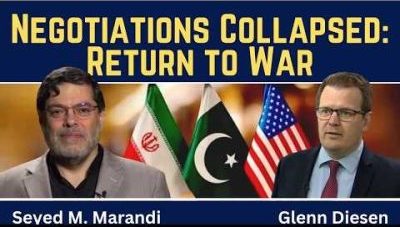
Seyed M. Marandi: Negotiations Collapsed – Return to War
or go to
Aletho News Archives – Video-Images
From the Archives
The US-Iran Scenario That Most Scares Israel
By Ali Haydar | Al-Akhbar | October 9, 2013
Israeli Prime Minister Benjamin Netanyahu issued a series of threats toward Iran and its interlocutors in the West, including the US, as serious negotiations on Iran’s nuclear program seem more plausible.
As a possible rapprochement looms between the US and Iran, Netanyahu has attempted to impose impossible Israeli conditions on the negotiators, such as the full dismantling of Iran’s nuclear program, not to mention threatening military force.
Whatever the deal that could materialize between Iran and the West, Israel is going to find itself before an open-ended path. One can foresee three possible scenarios… continue
Blog Roll
 Aletho News
- UK, Spain reject Trump’s new scheme to blockade Hormuz Strait
- Russian frigate ‘resurfaces’, chases off NATO pirates days after Kiev ‘sank’ it
- Ukraine Targets Russian Merchant Fleet With NATO Intel Support – Presidential Aide
- Russia’s ‘shadow fleet’ makes mockery of UK naval power
- Ukraine plans to attack Russian ships with Norwegian support
- US’s ‘Very Foolish’ Double Blockade of Hormuz Strait Makes Absolutely No Sense: Here’s Why
- China issues rules on countermeasures against foreign states’ unlawful extraterritorial jurisdiction
- Seyed M. Marandi: Negotiations Collapsed – Return to War
- Tomorrow’s naval blockade showdown
- ‘Israel’ attacks civilians to hide its embarrassing military failures & out of pure sadism
- If Americans Knew
- Critical shortages in Gaza, Lebanon in ruins, “piracy” in Iran – Daily Update
- US-Iran ceasefire negotiations make zero progress – Daily Update
- Pro-Israel ‘Thinktanks’ and Individuals who Influence U.S. Foreign Policy
- Mearsheimer reveals how Israel dictates US policies on Iran, Gaza – video
- After killing 350+, Israel still has a “score to settle” with Lebanon before ceasefire – Daily Update
- Military aid to Israel emerges as the latest political litmus test for Democrats
- The only Palestinian children’s rights organization closes following years-long Israeli campaign against it
- ‘I Can’t Forget the Smell’: Lebanese Reel After Israel Kills Over 300 in Single Day
- DNC Shoots Down Resolutions Calling Out AIPAC and Limiting Arms to Israel
- TCN: Is Israel Blackmailing President Trump?
- No Tricks Zone
- Cave Discovery Reveals Today’s Desert Climates Were Recently Far Warmer, Wetter, Teeming With Life
- German Expert: Heat Dome Led To Record Temps In Western USA…Warmer In 1934, 1936
- New Study: No Linear Warming Or Glacier Retreat Along Northern Antarctic Peninsula Since 1980s
- An Inconvenient Tree: Uncovered In Alps… Europe Much Warmer Than Today 6000 Years Ago
- New Study Reports A 60% Slowdown In Greenland’s Ice Loss Rate In The Last Decade
- Low Intensity Tornado Wrecks Major Solar Farm, Creating A Potential Toxic Dump
- New Study Finds Warming Saves Lives…Cold Temperatures 12 Times More Deadly Than Excess Heat
- German Science Blog Accuses PIK Climate Institute Of Hallucinating Climate Tipping Points
- Devastating Assessment Of Comirnaty Vaccine By Former Senior Pfizer Europe Toxicologist
- New Study: CO2 Is ‘Effectively Negligible’ As An Explanatory Climate Change Factor Since 2000
 Aletho News