Tehran will loan $3 billion to help Baghdad with the restoration of its infrastructure after the defeat of the Daesh terrorist group in the country, Iranian First Vice-President Eshaq Jahangiri said on Sunday.
“Iran is ready to provide Iraq with a credit line of $3 billion in order to increase the presence of Iran’s private sector in the restoration of Iraq,” Jahangiri said, as quoted by the Tasnim news agency.
Both Iran and Iraq aim to further strengthen their bilateral political and economic ties, according to the official.
Jahangiri also said that it is necessary to connect the railway systems of both countries and the sides are planning to construct a bridge and a 30-kilometer section of the railway.
“By doing this, Iraq will be able to get access to Central Asia and China, and the Iranian railways will reach the Mediterranean [region],” the first vice-president added, as quoted by the agency.
Jahangiri is currently on a visit to Baghdad to hold talks with the country’s officials.
In December, Iraqi Prime Minister Haider Abadi declared an end of the country’s fight against Daesh as Iraqi troops re-established complete control over the country’s Syrian border. This came after years of violent fighting, that brought significant damage to the country’s infrastructure.
The Kuwait International Conference of Iraq Reconstruction and Development, which was held in February, managed to raise $30 billion in direct aid, loans and investments for the post-war reconstruction of Iraq’s economy, according to Kuwaiti Foreign Minister Sabah Al Salim Sabah.
March 11, 2018
Posted by aletho |
Economics | Iran, Iraq, Middle East |
Leave a comment
London was not a coincidental choice of Saudi Arabia’s new Crown Prince for his first official visit to the Western world. The UK has been deeply involved in the brutal war the Saudis are waging on Yemen.
When it began three years ago this month, the then-foreign minister Philip Hammond explained that Britain’s policy was to support the war “in every practical way short of engaging in combat.”
He has been true to his word. Since then, not only has Britain licenced over £6 billion ($8.3 billion) worth of military equipment, but has supplied no less than 166 personnel to assist the Saudi arms forces, including several officers deployed in the air-force control room, advising on targeting. Britain provides training to Saudi air-force pilots and battlefield skills to Saudi infantry – including, it was recently revealed, training specifically tailored to Yemeni terrain. On the diplomatic front, the UK has repeatedly used its position on the UN Security Council to block UN investigations into war crimes committed by the Saudi-led coalition, much to the disgust of many of its European partners. In sum, Yemen is being destroyed by British-made missiles, dropped from British planes, by British-trained pilots.
As the eminent international lawyer Philippe Sands QC told a UK parliament select committee, – as the UK government continues to do – “that the United Kingdom is not involved” in the Yemen war. This involvement is not limited to mere support, however, what is becoming increasingly clear is that Britain is playing a leading role in the war’s strategic direction.
In late 2016, the “Yemen Quartet” was set up – a ministerial-level grouping of the four main powers responsible for the war – the UK, the US, the KSA, and the UAE. Their meetings have been sporadic, but over the past four months, they have become much more frequent, usually at Britain’s behest. But what is particularly noteworthy is that every single major strategic shift in the war’s execution in recent months has coincided with a meeting of the Quartet called by Boris Johnson. Clearly, the Foreign Office mandarins responsible for planning the Yemen war have been working overtime.
On November 29, Theresa May was in Riyadh, meeting with King Salman. At the same time, Johnson was hosting a meeting of the Quartet, attended by the foreign ministers of the UAE and Saudi Arabia, along with the US under-secretary of state. That very day, the forces of former president Ali Abdullah Saleh turned on their erstwhile allies in the Houthi-led Ansar Allah movement in what was heralded as the most significant shift in the war to date.
A few days later, on December 2, Saleh announced his formal defection to the Saudis, a move immediately followed by the launching of a new offensive aimed at the Houthi-held port city of Hodeidah under the auspices of a newly created military alliance between the UAE and the Saudis. Saleh’s defection was supposed to tip the balance against the Houthis, but his assassination two days later left his forces in disarray, allowing the Houthis to more firmly secure the areas under their control.
Nevertheless, the move had clearly been well coordinated with the powers waging war on Yemen, with intense Saudi airstrikes immediately launched in support of Saleh’s move against the Houthis. Meanwhile, the Saudis wanted to know that the offensive on Hodeidah – which had been vigorously opposed by aid agencies as likely to create a famine, and had even been blocked by President Obama when suggested the previous year – had the blessing of their Anglo-American sponsors.
The simultaneous meetings in London and Riyadh were precisely such a demonstration of that support. Less than two weeks after this meeting, and just four days into the new Red Sea offensive, Boris Johnson was in Abu Dhabi, discussing the Yemen war with the most powerful figures in Saudi Arabia and the UAE, their Crown Princes Mohammad bin Salman and Mohammad bin Zayed, followed by another meeting of the Quartet.
On January 23, the Quartet met again, this time in Paris, and again at the instigation of Boris Johnson. This came hot on the heels of the UN’s humanitarian response plan published three days earlier, which explained that the war had driven a further one million people to brink of famine since last year (leaving a total of eight million facing extreme malnutrition), and pushed another 3.5 million to dependence on aid, reaching a total of over 22 million – three-quarters of the population.
Clearly a PR offensive was going to be necessary. The groundwork had already been laid by the Saudi’s “Yemen Comprehensive Humanitarian Operations” plan, announced to the media the day before the Quartet meeting by a British PR company made up of former employees of the disgraced Bell Pottinger. The plan, which proposes to tighten up the blockade of Houthi-controlled ports – a blockade which is already helping to starve 130 children to death every day – essentially dresses up new war crimes as nothing more than heartfelt philanthropy.
Just three weeks later, on February 15, Johnson called another meeting of the Quartet – attended for the first time by US Secretary of State Rex Tillerson. This meeting occurred as coalition forces had been making slow but steady progress through Hodeidah province and were poised to take their battle to Hodeidah city itself. Once again, such a devastating move for the Yemeni population meant all four powers sought reassurance that the planned slaughter had the blessing of all the others at the highest governmental level.
The following day, the UK put forward a motion to the Security Council praising Saudi Arabia and the UAE for their humanitarian efforts in Yemen, and on February 20, the Emirati press announced that the push on Hodeidah city would begin within days, to be led by Saleh’s nephew. The four protagonists were united in their plans to intensify the strangulation of the Yemeni people.
The reasons for this deep British determination to wage war on Yemen go back over a century, when Britain decided to help the Saudi family secure their rule of the peninsula in the knowledge that their sectarianism and lack of popular legitimacy would make them forever dependent on outside colonial support. The one potential thorn in the side to this plan has always been Yemen, whose population outnumber those of every other country on the peninsula put together, and whose historic civilization appears to give the Sauds an inferiority complex.
The British have always understood that an independent Yemen is the greatest threat to Western domination of the Arab peninsula, and have consistently sought to smash the possibility every time it rears its head. This week’s meeting shows that even the obliteration of the entire country is deemed acceptable in pursuit of this goal.
Dan Glazebrook is a freelance political writer who has written for RT, Counterpunch, Z magazine, the Morning Star, the Guardian, the New Statesman, the Independent and Middle East Eye, amongst others. His first book “Divide and Ruin: The West’s Imperial Strategy in an Age of Crisis” was published by Liberation Media in October 2013. It featured a collection of articles written from 2009 onwards examining the links between economic collapse, the rise of the BRICS, war on Libya and Syria and ‘austerity’. He is currently researching a book on US-British use of sectarian death squads against independent states and movements from Northern Ireland and Central America in the 1970s and 80s to the Middle East and Africa today.
Read more:
March 11, 2018
Posted by aletho |
Timeless or most popular, War Crimes | Middle East, Saudi Arabia, UK, Yemen |
Leave a comment
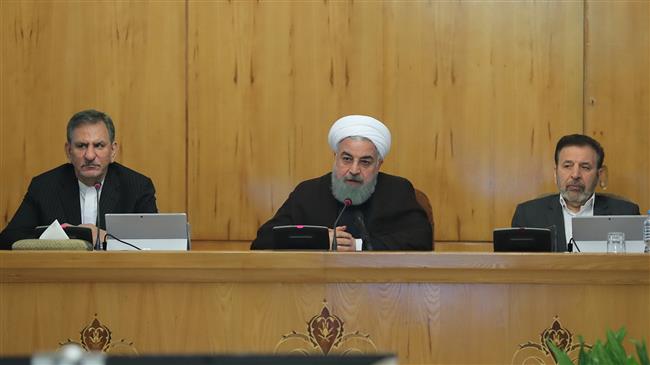
Iranian President Hassan Rouhani (C) talks during a cabinet session in Tehran on March 7, 2017. (Photo by president.ir)
Iranian President Hassan Rouhani says the Israeli regime is in no position to call Iran a threat to the Middle East, stressing the development of the country’s missile program is aimed at safeguarding peace and security.
“Those who have over the past 70 years created tension, launched wars and caused destruction in the region and have committed genocide and caused [the] Sabra and Shatila [massacre] are in no position to portray Iran as a threat,” Rouhani said during a cabinet session on Wednesday.
“Iran is no threat to anyone. Iran is [the pillar] of stability and security for the entire region. But of course it will strongly defend its rights,” he added.
The Iranian president made the remarks a day after Israeli Prime Minister Benjamin Netanyahu claimed that Iran was responsible for “darkness descending” on the Middle East and said Israel faced threats from the Islamic Republic.
In a hawkish address to the American Israel Public Affairs Committee (AIPAC) in Washington on Tuesday, Netanyahu also alleged that Iran was increasing its influence in the Middle East and sought to dominate regional countries.
Rouhani criticized attempts by certain nations of the region to promote Iranophobia, saying Iran had never invaded and would not invade any country.
“History shows that the Iranian nation has never… occupied any country. We have never bombarded our neighbors or piled up pressure on regional nations. Not only haven’t we driven people out of their countries, but we have welcomed refugees,” he noted.
Iran seeks the progress and prosperity of all regional countries, Rouhani said, stressing Iran’s economic, political and military power was for deterrence not attacking other countries.
“Our weapons are meant to promote peace, strengthen stability and security, and to prevent others from thinking about invading our country. Therefore, no one should be concerned about Iran’s weapons, missiles or strengthening of its defense might,” Rouhani stressed.
March 7, 2018
Posted by aletho |
Illegal Occupation, Militarism | Iran, Israel, Middle East, Zionism |
Leave a comment
Who is interfering with American democracy?
The American Israel Public Affairs Committee (AIPAC) is back in Washington for its annual summit. Or at least it used to be called a summit but now it is referred to as a policy conference, which is perhaps a bit of very welcome transparency as if there is one thing that AIPAC is good at it is using its $100 million budget and 300 employees to harass lawmakers on Capitol Hill and generate policy for the United States to adhere to. Eighteen thousand supporters have gathered at the city’s Convention Center to hear speeches by U.N. Ambassador Nikki Haley, Ambassador to Israel David Friedman, Vice President Mike Pence, plus Senators Marco Rubio, Robert Menendez, Tom Cotton and Ben Cardin. My personal favorite is Maryland Congressman and House Minority Whip Steny Hoyer who has visited Israel so many times he might as well move there and who can be relied on to deliver a loud sucking noise as he enthuses over the many wonders of the Jewish state. And for a little foreign flair there is the disheveled French “philosopher” Bernard-Henri Levy, who has described the brutal Israeli Army of occupation as the “most moral in the world.”
If you want to get some idea of the money and political power represented at AIPAC this year I would recommend going through the speakers’ list, a dazzling display of precisely why the United States is in bondage to Israel and its interests. The heavyweight speakers and other attendees will be joined by hundreds more Congressmen, Supreme Court Justices, and senior government officials as well as a heavy dose of “experts” from the usual Jewish-dominated pro-Israel think tanks that have sprouted up like mushrooms along K Street, including luminaries like John Bolton, Victoria Nuland, Bill Kristol, Elliot Abrams and Eric Cantor. Those participants coming from the government will, of course, be ignoring their oaths of office in which they swore to uphold the Constitution of the United States against “all enemies domestic and foreign,” but it doesn’t matter as everyone performs proskynesis for Israel.
The slogan of this year’s gather is “Choose to Lead,” an interesting objective for an organization that has led successive presidents since Bill Clinton by their respective noses. Prime Minister Benjamin Netanyahu, facing indictment back home, will also be in town and will meet with President Donald Trump. He might just decide to stay awhile as one thing that Israel is particularly good at is trying, convicting and imprisoning its corrupt leaders.
There has been some informed speculation that Trump will unveil during their meeting a “two state solution” peace plan for Israel-Palestine, but as it will possibly require Israel to withdraw from much of the large chunks of the West Bank that it has “settled,” it will not be received favorably by Netanyahu. Israel is certainly vulnerable to possible pressure coming from the White House to impose a solution, but as Trump has proven unable or unwilling to punish an out-of-control Netanyahu in any way up until this point, it has to be considered unlikely that he will change course this time around.
AIPAC must be particularly pleased since Israel has had a sweet ride with the Trump Administration in place in Washington. The greatest gift to Netanyahu has been the Administration’s recognition of all of Jerusalem as Israel’s capital together with a commitment to move the U.S. Embassy to that city. No other country currently has its embassy in an internationally disputed Jerusalem though Guatemala has followed Washington’s lead and has stated that it also intends to physically move its diplomatic facility.
The original State Department relocation plan was to phase the embassy move while a new building is being constructed, but the White House recently accelerated the process, reportedly under pressure from Jewish billionaire GOP donor Sheldon Adelson, and will open a temporary facility in May to coincide with the 70th anniversary of Israel’s founding. Netanyahu has asked Trump to appear at the embassy opening ceremony and also to assist in the celebration of the founding.
Israel has also benefited from a Trump Middle East team that is all Jewish and committed to Israel. It is headed by his son-in-law Jared Kushner and includes former bankruptcy attorney Ambassador David Friedman, who has financially supported Israel’s illegal settlements, and Jason Greenblatt, the Trump Organization corporate lawyer, as Special Representative for International Negotiations. In addition, Kushner is reportedly personally advised by a group of Orthodox Jews that he knows from his Synagogue and through his business interests.
The outcome deriving from the all-Jewish team determining Middle Eastern policy combined with a benign White House is predictable, and it just as clearly does not include any benefits for the United States. Israel has been able to dramatically expand its settlements on stolen Palestinian land and is instigating several new wars in its region without any pushback coming from Washington. Quite the contrary as the United States has proven to be an enabler for new conflicts with Syria, Lebanon and Iran. Several Senators who have recently returned from Israel claim that an invasion of Lebanon is coming because of allegations that Hezbollah is constructing an Iranian-supplied factory to build sophisticated missiles, yet another phony narrative depicting Israel as the perpetual victim of its brutal and threatening neighbors when in reality the reverse is true. This animosity towards Iran and its allies is particularly dangerous as it could produce a new war that might spin dangerously out of control as third countries like Russia and China get involved to protect their own interests.
The reality is that it is a militarily dominant Israel that has been regularly bombing targets alleged to be Iranian or Hezbollah in Syria as well as Syrian military installations. It has threatened to bomb Lebanon back into the “stone age,” which leads one to ask what have those nations done to provoke the wrath of Zion? Close to nothing. An alleged Iranian drone reportedly launched from Syria wandered into the airspace over the Israeli-occupied Golan Heights before being shot down. How many Israeli drones have flown over Lebanon and Syria? Hundreds if not thousands.
And when Israeli planes flew deep into Syria to bomb what was claimed to be the base that the drone flew from, one was shot down by a Syrian air defense missile. Israel then launched a major bombing campaign against Syrian military targets and was only dissuaded from doing far, far worse by Vladimir Putin, who warned Netanyahu against broadening the conflict. Note that it was Russia that made Bibi back down, not Washington. The United States was meanwhile busy in trying to justify its continued presence in Syria, also at the urging of Israel and AIPAC.
Every American president has to bow before Jewish power in the United State and you better believe that both AIPAC and the hundreds of other Jewish and Christian-Zionist organizations that exist at least in part to nurture and protect Israel know it. Even Barack Obama, who had an openly frosty relationship with Netanyahu knew the score and gave the Jewish state $38 billion. He opposed Israel’s expansion into the formerly Palestinian West Bank but never did one thing to stop it until the end of his final term in office when he had the U.S. abstain on a U.N. vote condemning the illegal settlements, a pointless gesture.
Demands that AIPAC, an echo chamber for Israeli interests, should be required to register under the Foreign Agents Registration Act of 1938 have been ignored by various Attorneys General since the time of John F. Kennedy, who tried to get AIPAC’s predecessor organization the American Zionist Council to comply. He was killed soon after, though I am not necessarily trying to imply anything even though Jack Ruby does come to mind.
Here at home “The Lobby” has also been successful in 2017, with 23 states having now passed laws making it illegal to boycott Israel if one wishes to have dealings with the local or state government. Three months ago, the Anti-Semitism Awareness Act was approved by the House of Representatives with 402 affirmative votes and only two libertarian-leaning congressmen voting “no.” The Israel Anti-Boycott Act that is also currently making its way through a Senate committee would set a new standard for deference to Israeli interests on the part of the national government. It would criminalize any U.S. citizen “engaged in interstate or foreign commerce” who supports a boycott of Israel or who even goes about “requesting the furnishing of information” regarding it, with penalties enforced through amendments of two existing laws, the Export Administration Act of 1979 and the Export-Import Act of 1945, that include potential fines of between $250,000 and $1 million and up to 20 years in prison. According to the Jewish Telegraph Agency, the Senate bill was drafted with the assistance of AIPAC.
And there’s lots more to come in 2018. Lindsey Graham and Chris Coons were two of the senators who have just returned from the taxpayer funded “fact finding” trip to Israel and warned about a new war breaking out. And beyond that, what other “fact” did they find? Apparently that Israel needs more money from the U.S. taxpayer. Here is what was reported:
“… they considered the provision of $38 billion over 10 years, ‘a floor.’ Graham [also] said during a meeting with reporters that he thought provisions in the agreement phasing out an arrangement in which Israel could spend U.S. funds on its own defense industry and the provision of just $500 million in missile defense funding were ‘short-sighted.’ Coons said tensions in the broader region supported the idea of more funding for Israel, citing the ongoing war in Syria and Iran’s recent use of a stealth drone.”
So, we can look forward to Congress voting another half billion or so for Israel and the money can be spent on building up Israel’s own defense industry, which competes with that of the U.S. Currently most of the largess has to be spent on U.S.-made weapons, but clearly that will be changed to benefit Israel. You can always count on Congress pretending to do the right thing by the American people and it is good to know that the folks at AIPAC, gathered in their thousands this week and including both Senators Graham and Coons, are smiling.
March 6, 2018
Posted by aletho |
Corruption, Ethnic Cleansing, Racism, Zionism, Timeless or most popular, Wars for Israel | AIPAC, Israel, Lebanon, Middle East, Palestine, United States |
Leave a comment
The perfidious role of ‘human rights’ organizations in the war on Syria has been exposed again with the Amnesty International report on Syria for 2017/18, followed by an equally tendentious article in the Melbourne Age newspaper by Claire Mallinson, Amnesty’s national director for Australia.
In the name of human rights these organizations have actually worsened the crisis in Syria. They have never dealt honestly with its primary cause, the determination of the US and its allies seven years ago to destroy the government in Damascus, as part of a bigger plan to destroy the Iran-Syria-Hezbollah strategic axis across the Middle East. Democracy, human rights and the best interests of the Syrian people were never on the agenda of these governments. They were cold-blooded and remorseless in what they wanted and the means by which they sought to get it.
By calling violent armed groups ‘rebels’ and ‘the opposition’, these ‘human rights’ organizations conceal their true nature. By calling the Syrian government a ‘regime’, instead of the legitimate government of Syria, representing Syria at the UN and representing the interests of the Syrian people, they seek to demean it. By accusing it of carrying out indiscriminate attacks on its own civilian population, on the basis of what they are being told by their tainted sources, they seek to demonize it. By accusing it of carrying out chemical weapons attacks, without having any proof, they perpetuate the lies and fabrications of the armed groups and the governments that support them.
Behind the mask of ‘human rights’ these organizations are promoting the war agenda of western and regional governments. Some are worse than others. Human Rights Watch might as well be a formal annex of the US State Department, but they all play the same duplicitous game.
East Aleppo is the template for what we are seeing now in the outrage over East Ghouta, the district on the outskirts of Damascus in which hundreds of thousands of people are being held hostage by takfiri armed groups. Aleppo was infiltrated by these groups in 2012 and the eastern sector of the city gradually taken over, as the army was already too hard-pressed on other fronts to stop this happening. Until then Aleppo, a commercial, multi-religious and multi-ethnic city, had managed to stay out of the war but now it was sucked right in. There was nil support in Aleppo for the takfiris but they had the guns and they were ready to kill to get their way. Advancing on government held positions, they devastated the old centre of the city with their attacks. Digging tunnels, they blew up some of its most famous buildings. Art, architecture, history, meant nothing to them. They destroyed the square minaret of the Umayyad mosque and their attacks led to the destruction of the ancient library in the mosque and the massive destruction of the Aleppo souk, one of the oldest and most colourful markets in the world.
In the districts they controlled they ruled by terror, massacre and murder and the institution of the most repressive sharia laws. Under the secular Syrian government, women and men have the same rights before the law, under the takfiris women have no rights that are not granted to them by men. They sought the extirpation of all those they did not regard as true Muslims (Shia and Alawi amongst others): one of their earliest acts was the kidnapping of two orthodox Christian prelates, never seen alive again. It was these armed groups and the foreign governments behind them that were responsible for the dire situation in #East Aleppo, yet it was the Syrian government, the ‘regime’ as they chose to call it, that was blamed by the media and ‘human rights’ organizations. The White Helmets, embedded with these groups, and funded by the same governments which had armed and financed them, were used as the main propaganda prop. Their staged rescues filled the pages of the corporate media. They were effectively canonised by George Clooney, the documentary on their bogus bravery and sham rescues winning an Oscar award, unfortunately not for bad acting, which should have been the prize.
As the Syrian military, with Russian air support, began to squeeze these groups in East Aleppo, the propaganda was turned up accordingly. The ‘siege’ of East Aleppo was no more a siege than the ‘siege’ of East Ghouta. The people trapped in East Aleppo were being held hostage, as are the people in East Ghouta, by some of the most violent groups on the face of the earth. These trapped civilians were their trump card. Those who tried to leave, they killed, just as the takfiris are killing civilians trying to get out of East Ghouta. Having negotiated the peaceful removal of the takfiris from East Aleppo, along with their families and camp followers, the fall-back position of the media and the ‘human rights’ organizations was to accuse the Syrian government of their forcible displacement. They made no mention of the captive Syrian soldiers whom the takfiris paused to massacre before they left. They made no mention of the civilians killed by the takfiris as they were trying to escape and no mention of the dancing in the streets, literally, by the people of Aleppo, and the honking of car horns in jubilation, as these killers were sent on their way. This just didn’t fit in with the narrative the media and these organizations had been spinning.
The takfiris fight among themselves over territory, power and money but their ideology is the same, based on the destruction of the secular state and society and the imposition of a harsh pseudo-Islamic regime in which women would be reduced to the status of cattle and all Shia and Alawi extirpated. It is they who target civilians deliberately. In Adra, at the Northern end of Ghouta, they slaughtered dozens of men, women and children in 2013, beheading some and pushing others into a bread oven. In 2015, in Douma, they put men and women into cages as hostages, to deter possible advances by the Syrian army. They are shelling the centre of Damascus every day, killing civilians, including many children, including some recently mortared in their classroom.
In its report on Syria for 2017/18 Amnesty International (AI) continues its misleading narrative on the fate of East Aleppo and east Ghouta. Those who support it financially should perhaps be considering where they could put their money and their good intentions to better use. AI refers to districts in east Ghouta controlled or ‘contested’ by unspecified ‘armed opposition groups’ and repeats the canard that the Syrian government carried out the chemical weapons attack on Khan Shaikhun in April last year. (Bear in mind the recent statement of US Defence Secretary Jim Mattis that the US had no evidence of the Syrian government using sarin, the agent allegedly fired into Khan Shaikhun.) AI has no proof of this, so why would it state this as fact, except to do more propaganda damage to the Syrian government?
AI refers to 400,000 people ‘besieged’ in East Ghouta by the Syrian military, when the true state of affairs is that their districts have been infiltrated and that they are being held hostage by extremely violent armed groups. They are besieged from within by these groups, penned in and unable to leave except at the risk of being killed by their captors. The Syrian army is not imposing a siege, it is trying to break it. The Syrian government is accused of depriving these people of access to medical care and basic necessities, when it is one or another of these armed groups, over the years, that has caused the breakdown of efforts to set up humanitarian corridors. Even now the Syrian government is waiting with medical care, buses and accommodation but those civilians who try to leave are being shot at and killed, as they were in East Aleppo.
AI’s references to ‘forced displacement’ from East Aleppo, and the way the ‘armed groups’ there were ‘compelled’ to surrender and negotiate a deal that ended the ‘unlawful siege’ are a grotesque distortion of reality. What was unlawful about the situation in East Aleppo was the presence of the armed groups, what was unlawful was the money and weapons being provided to them by outside governments, in breach of international law, what was unlawful was their killing of civilians and the restriction of their free movement (out of East Aleppo), what was lawful was the finally successful attempt of the government of Syria to break the hold of these groups.
Following the release of the AI report on Syria, Claire Mallinson, the national director of AI for Australia, charged into print under the heading of ‘Australians Need to Act on Syrian Monstrosities’ (the Melbourne Age, March 1, 2018). Her reading audience would already have been won over as the Australian media has not reported the war in Syria at all but simply pumped out the same propaganda appearing in the US or British press. Others watching Syria closely over the years know what these ‘monstrosities’ are, and they are not the same as Ms Mallinson’s.
These monstrosities begin with the conspiracy, of the US, Britain, France and their regional Middle Eastern allies, to destroy the Syrian government, and thus strike a deadly blow at the Iran-Syria-Hezbollah strategic alliance, whatever the cost to the Syrian people and whatever their aspirations. They move on to the use by these governments of takfiri proxies to do their dirty work in Syria, following the refusal of Russia and China to allow the UN Security Council to be used as the fig leaf for an air war. These governments armed and financed these groups. They did not care who they were, where they came from and what they believed as long as they were prepared to pick up a gun and bring Syria to its knees. These are the master criminals in Syria.
The monstrosities include a media picking up where it had left off in Iraq. It had peddled the lies there, it had peddled them in Libya, it peddled them again in Syria and it is still peddling them. They include the illegal presence of the US in Syria, its killing of Syrian civilians and its attacks on the legitimate armed forces of the Syrian government and people, attacks in which Australian aircraft have shamefully taken part and which have taken scores of lives of Syrian soldiers.
All of this has led to the grand monstrosity, the large-scale destruction of Syria, involving the loss of life of perhaps 400,000 people and the flight of millions of others beyond Syria’s borders. But now the same governments and the same media that brought you this war, and the same ‘human rights’ organizations that have supported it with their one-sided moralising and unbalanced reports, are expressing their outrage at the suffering in East Ghouta, as if this had nothing to do with them.
The monstrosities in the eyes of the Syrian people, if not in the eyes of Ms Mallinson, are on a par with, if not worse than, the genocidal decade of sanctions which preceded the attack on Iraq in 2003 and the crimes which followed this attack, committed by the same governments that are responsible for the onslaught on Syria. The suffering in East Ghouta is terrible and outrage is justified, but it is the causes that need to be identified and they do not include the efforts of the Syrian government and army to defend the country against attack fomented from without.
Ms Mallinson’s monstrosities are of a different order. They include the chemical weapons ‘reportedly’ being used ‘again’ by the Syrian government against its own people. This smear has been played out time and time again by ‘activists’ knowing that the media and ‘human rights’ organizations will snap it up. There is no proof of any chemical weapon attack ever being carried out by the Syrian military, as against abundant evidence of such attacks planned and carried out by the takfiris over the years, including the attack around Damascus in August, 2013.
Ms Mallinson refers to a UN report that Syria is developing chemical weapons ‘with the help of North Korea’, neatly tying in the two demonized targets of the US government. This is another canard, originating in Washington and designed again to smear the Syrian government and to set it up for whatever might come next.
What she does not say is that this ‘report’ remains unpublished, that the authors are unknown, that what we know of it comes from an account in the New York Times, which sold the lies on Iraq and has promoted the war on Syria from the beginning. The detail it gives of the material allegedly coming from North Korea indicates that it could have no possible connection with chemical weapons, which Syria does not have anyway, having given them all up under international supervision. Given the completely tendentious nature of this account, why would Ms Mallinson want to raise it except to further blacken the name of the Syrian government?
She refers to the ‘warring sides’ in East Ghouta as if both are legitimate when only one is, the government of Syria. The other is a collective of extremely violent armed groups sponsored by outside governments, in breach of international law. The presence of US and ‘coalition’ forces in Syria is a standing violation of international law and their killing of Syrian soldiers and civilians a gross aggravated violation of that law. The only legitimate armed forces in Syria are the Syrian army, which has lost tens of thousands of young men defending the country, and those forces the government has invited in, from Russian air power to Iranian and Hezbollah ground forces.
Ms Mallinson’s monstrosities include the hundreds of thousands of ‘ordinary men, women and children’ she says are at risk of annihilation by the Syrian army’s ‘siege’ of East Ghouta. In fact, the central source of the risk to the people of East Ghouta is not the Syrian government but the armed groups holding them hostage. The ‘siege’ is not of the people but of these groups. The Syrian military is trying to break their grip, as any army would in any comparable situation. Ms Mallinson accuses ‘the Russian-backed Syrian regime’ of breaking the ceasefire, ignoring the evidence that the takfiris are breaking it and killing civilians attempting to escape their grip. Only in the past few days they shot at a family trying to leave, killing the parents and shooting at the children even after they reached a Syrian army checkpoint. They are pouring shells into the centre of Damascus every day. There are no references in her account to the ‘American-backed’ or ‘Saudi-backed’ armed groups that have created this hell on earth, as she refers to it.
Finally, she appeals to the Australian government, as it assumes its seat on the UN Human Rights Council, to ‘show leadership’ in bringing these ‘abominations’ to an end. The problem here is that the Australian government is part of the problem. It fully supports US policy in Syria and has taken part in armed action in Syria, in violation of international law. In September, 2016, its aircraft joined a US-led air attack near Deir al Zor which killed perhaps 100 Syrian soldiers and allowed the Islamic State to regain lost positions. Australia did not apologise for its participation in this outrage, only repeating the US line that the attack was a mistake, which clearly it was not. When the Australian delegate did take his seat on the UN Human Rights Council, he merely echoed US policy, by attacking the Syrian ‘regime’ and its Russian backer.
If Australia does have a role in Syria, a moral role, a legal role, an independent role, it should not be as a sounding chamber for the US. It should distance itself from the illegal actions of the US and the violence of the takfiris against the Syrian people, their government and their army. It should be supporting the attempts of the government in Damascus to restore its authority over the whole of Syria and not supporting the attempts of the US and behind it, Israel, to break it up. It should support the Syrian people, not the actions of governments which have devastated their country.
It should define policy on the basis of the causes of the situation in Syria, not how they are being misrepresented in the media, by ‘activists’ embedded with the takfiri groups, by the Syrian Observatory of Human Rights, by the White Helmets and by deluded or willfully dishonest ‘human rights’ organizations playing politics, not serving truth, justice and the interests of humanity. This would be a credible role for Australia, an independent role, but it is not one the government is going to adopt.
Everyone should be concerned at the loss of life in East Ghouta. Ms Mallinson does not have a mortgage on morality and empathy with human suffering. How does anyone think Syrians feel about this, Syrians shelled in the heart of Damascus every day, Syrians who have lost fathers, brothers and sons in this conflict, Syrians whose relatives are trapped in East Ghouta or have been killed by the armed gangs holding the whole region with a knife to its throat? Does anyone outside seriously think Syrians want to live under their rule? Syrians know what they want, without equivocation, the purging of these gangs from their midst, whatever it takes. They fully support their army and their government. It is their interests Australians, or anyone else of good faith, should be supporting, not the highly politicized interests of Amnesty International.
Outrage is going to solve nothing: it only serves as the pretext for taking the war to a new level of destruction. The roots of this violence are clear: the decision of outside powers to destroy the Syrian government, their support for violent armed groups committed to an ideology destructive of every value these governments are supposed to represent and their refusal to allow the war to end. For the violence to end these are the roots that need to be acknowledged and torn out.
Jeremy Salt has taught at the University of Melbourne, Bosporus University (Istanbul) and Bilkent University (Ankara), specialising in the modern history of the Middle East. His most recent book is “The Unmaking of the Middle East. A History of Western Disorder in Arab Lands” (Berkeley: University of California Press, 2008.)
March 4, 2018
Posted by aletho |
Deception, Fake News, Mainstream Media, Warmongering, Timeless or most popular, War Crimes | Amnesty International, Australia, Claire Mallinson, George Clooney, HRW, Middle East, Syria, United States |
Leave a comment
The United States invaded and destroyed Iraq in 2003 on the false ground that Saddam Hussein secretly nurtured a nuclear program, but fifteen years later, Washington is actively discussing how to cater to Saudi Arabia’s nuclear ambitions. It is a sign of our times that the nuclear genie is out of the Saudi bottle and the US may have to get used to the idea.
Saudi Arabia has opened bids from foreign companies to build two nuclear reactors. Riyadh wants eventually to install up to 17.6 gigawatts of atomic capacity by 2032 – or up to 17 reactors. Tens of billions of dollars worth business is involved. Companies from the US, France, Russia, China and South Korea have shown interest – including Westinghouse. There is pressure on the Trump administration to restart talks with Riyadh on a civil nuclear cooperation pact so that Westinghouse can pick up the lucrative business. The nuclear commerce with Saudi Arabia fits in with President Trump’s America First, as it could create thousands of jobs in the US economy.
But there is a serious catch. The Saudis will not accept any restrictions on uranium enrichment technology. Washington’s policy, on the other hand, is to sign a peaceful nuclear cooperation pact – known as a 123 agreement – that blocks steps in fuel production with potential bomb-making uses. Now, Riyadh maintains that it is not interested in diverting nuclear technology to military use, but it wants nonetheless to tap its own uranium resources for “self-sufficiency in producing nuclear fuel”. Indeed, Saudis have a point here. It is Saudi Arabia’s prerogative to have access to nuclear enrichment technology – like any NPT member country.
But then, Saudi Arabia happens to be a Muslim country in the Middle East and the West so far ensured that there is nothing like an “islamic bomb”. What happens if some day, a gust of Arab Spring blows through the Arabian Peninsula and an authentic Islamic regime takes shape there? Again, the Saudis already have a past history of funding Pakistan’s clandestine nuclear weapon program. The two countries are close allies. General Raheel Sharif, former Pakistani army chief, heads the Saudi-led Islamic Military Alliance, which was formed last year. Pakistan’s present army chief Gen. Qamar Javed Bajwa is frequently in and out of Saudi Arabia. In February, following Bajwa’s last hushed visit, Pakistan announced the deployment of a few thousand troops to Saudi Arabia under a bilateral security cooperation agreement for unspecified purposes.
Conceivably, Saudis intend to develop nuclear weapons some day. The Saudi compulsions are similar to Pakistan’s – nuclear weapons provide deterrent capability. Lest it be forgotten, Saudi Arabia already has a “delivery system” – missiles capable of delivering nuclear weapons. Its armed forces even have a designated Saudi Strategic Missile Force, which handles long-range missiles. Actually, these missiles don’t make sense unless they’re armed with nuclear weapons. What makes all this a combustible mix is that the present Crown Prince Mohammed bin Salman is a hot head, as the bloody war in Yemen testifies. The rift with Qatar underscores that MbS is bent on establishing Saudi hegemony in the region.
Logically speaking, the US could offer to Saudi Arabia something like the Joint Comprehensive Plan of Action (JCPOA), the multilateral agreement of July 2015 that restricts Iran’s nuclear program. The Saudis cannot complain because they had previously complained that the JCPOA was a generous deal for Iran – except that it means:
- No indigenous reprocessing, with all spent reactor fuel to be shipped out of the country;
- Severe restrictions on any uranium enrichment, in terms of both the level of enrichment and the amount of material enriched;
- A highly intrusive IAEA inspection regime, in which international inspectors have continual and full access to nuclear facilities, including the right to inspect military bases or other places if they had any reason to suspect nuclear-related activities.
Of course, it entails the Trump administration admitting that JCPOA was a brilliant achievement in nuclear non-proliferation. That will be not only a bitter pill to swallow for President Trump but his (and Israel’s) entire strategy to reimpose sanctions against Iran would unravel.
The alternative will be to give Saudi Arabia a free hand to acquire mastery over the nuclear fuel cycle but the US Congress is almost certain to shoot it down. On the other hand, if the US and Saudi Arabia cannot agree on a 123 agreement, Westinghouse loses the multi-billion dollar business. Russia’s Rosatem has already sought a contract to construct 2 nuclear power plants in Saudi Arabia. In the prevailing new Cold War climate with the Trump administration castigating Russia as a “revisionist power” and an “existentialist threat”, a coordinated effort by the international community to circumscribe Saudi Arabia’s nuclear ambitions (on the lines that the Obama administration could mobilise) is too much to expect today. Which, in turn, creates space for Saudi Arabia to outmaneuver the Trump administration. Riyadh is aware of it. (Asharq Al-Awsat )
This is going to be one hell of a trapeze act for the Trump administration. If Trump destroys the JCPOA in these circumstances, and Iran retaliates by resuming uranium reprocessing, this becomes an entirely new ball game. Other Middle Eastern countries are watching – Turkey and Egypt, in particular. And they would be wondering, ‘If Saudi Arabia can have reprocessing technology, why not us?’ Israel’s “nuclear superiority” is steadily getting eroded, too. Read a fascinating piece Coming soon – a Nuclear Middle East.
March 4, 2018
Posted by aletho |
Aletho News | Israel, JCPOA, Middle East, Saudi Arabia, United States |
Leave a comment
The Houthis and the former President of South Yemen introduced somewhat similar peace proposals for ending the War on Yemen.
The first move in this direction was made during last week’s Valdai Conference on Russia’s role in the Mideast, when Ali Naser Mohamad, who presided over the People’s Democratic Republic of Yemen from 1980-1986, issued an 8-point plan for resolving the conflict in which his most unique suggestion was to “initiate a dialogue between all the political forces on the establishment of a two-region federal state.” This was clearly in reference to the Southern Transitional Council’s (STC) seizure of Aden, their former capital, from Hadi’s government at the end of January after the internationally recognized leader refused to reform his Cabinet and reportedly ordered that force be used against the protesting Southerners.
Federalization has long been thought of as a “compromise” between wartime allies Saudi Arabia and the UAE, the first of which began the war in order to reinstall Hadi as Yemen’s President while the latter is thought of having a favorable approach towards the Southern separatists.
As for the Houthis’ proposal, it interestingly mirrored most of what the former South Yemeni leader proposed, albeit with its own nuances. Both sides want an end to the war, new elections, and UNSC support, though they seem to differ over some technicalities. Whereas the South wants a federal solution, the Houthis importantly suggest that all contested issues be decided by a referendum, with the implication being that it would be a nationwide one where the more populous North would have the electoral power to reject any regional-centric proposal put forth by the South. The issues of South Yemen’s autonomy and the country’s corresponding constitutional reform to legalize this desired status seem to be the primary difference between each party’s peace proposals.
In the stalemated military situation that defines the present day, neither side is able to enforce their will on the other, but the most important observation is that the political will for peace invariably exists in the territories that used to comprise the independent countries of North and South Yemen.
Extrapolating from this, it can be deduced that each of their populations are completely exasperated by this war, especially the majority of the country that resides in the North and has been forced to endure the insufferable humanitarian consequences of the coalition’s war against the Houthis for over three years now. Likewise, presuming that the former South Yemeni President was speaking in a semi-official capacity and “testing the waters” at Valdai, the conclusion can be reached that the STC is “moderating” its independence aspirations and willing to settle for federalization, at least at this stage, which of course appeals to the Saudis and the Houthis for different reasons and makes it easier to begin a dialogue on ending the war.
In the coming future, all sides will likely readjust their positions somewhat as they politically jockey with one another in preparing for inevitable peace talks, and it’s here where Russia could play a strategic role in facilitating this by mediating or possibly even hosting this dialogue whenever it ultimately happens.
March 3, 2018
Posted by aletho |
Aletho News | Middle East, Saudi Arabia, UAE, Yemen |
Leave a comment

In more than seven years of war in Syria, we have seen many times how Western governments and news media shamelessly invert reality.
The same was seen this week over the grim fighting around Eastern Ghouta, the suburb near the capital, Damascus, where 400,000 people are said to be trapped.
But who is trapping who?
US and European media breathlessly claim that Eastern Ghouta is under siege from Syrian “regime forces” allied with Russia. This description is posing things upside down.
The district was taken over nearly six years ago by foreign-backed extremists, like Jaysh al Islam, Ahrar al Sham, and Al Nusra Front. The latter is an internationally outlawed terror group, but they all share the same murderous ideology, as well as the same Western covert sponsors in the American CIA, British MI6, French DGSE, and lavish Gulf Arab funding. It is these illegally armed insurgents who are holding the civilian population under siege in a reign of terror.
The same situation, and Western inversion of reality, has been seen before, most notably regarding Syria’s second city of Aleppo. The Syrian and Russian forces liberated that city at the end of 2016, and since then life for the residents there has fortunately returned to the normal peaceful, pluralist coexistence which prevailed before the foreign-backed terror goons took over.
Yet, Western media and officials continually confabulate about “rebels” and civilians being besieged by Syrian state forces. This inversion of reality is of course necessary in order to push the Western false narrative that has underpinned the covert Western war for regime change in Syria, including the clandestine support for terror groups as proxies.
Further twisting the situation in Eastern Ghouta this week, the Western media blamed the Syrian “regime” and Russia for not implementing a ceasefire plan to enable evacuation of civilians.
Russia proposed a daily five-hour truce, and the Syrian government established humanitarian corridors exiting from the conflict zone. The proposal from Moscow was a reasonable counter to what the US, Britain and France had wanted, which involved a 30-day cessation of all military operations.
The Western powers had tried the same proposal during the liberation of Aleppo. Syria and its legally mandated Russian ally are within their sovereign right to take back remaining territory that has been illegally occupied by foreign-backed militants.
What the Western powers would like to impose is a No-Fly Zone over parts of Syria to enable their residual proxies time and space to regroup. Why should the Syrian government forfeit its sovereign rights by accommodating foreign enemies?
The reason why the Russian humanitarian relief plan proposed this week for Eastern Ghouta did not gain traction was simply because the militants continually shelled the designated corridors for escaping civilians. Video footage clearly showed buses and aid workers organized by the Syrian government waiting to receive the civilians. But none were permitted from the area because of sniper and mortar fire from the militants.
Evidently, the militants are holding the civilian population as hostages and human shields. The same criminal tactics were deployed in Aleppo and other towns and cities where the terrorist gangs ruled with their death-cult barbarity.
Russian Foreign Minister Sergei Lavrov, addressing the UN Human Rights Council in Geneva this week, rightly pointed out that the humanitarian relief plan for Eastern Ghouta can only be made to work if the militants commit to upholding a ceasefire. But these foreign-backed mercenaries have done nothing of the sort. They have not only cut off evacuation corridors under fire; they continue to launch rockets and mortars at nearby government-controlled Damascus inflicting dozens of civilian deaths in recent weeks.
Reliable figures cited by the Syrian Free Press network, indicate that some 85 per cent of the Syrian population live in areas under the control of President Bashar Assad’s state forces. Only a small minority – 15 per cent – live in areas controlled by insurgents. And many of those people are being held in these dwindling areas against their will in a state of fear imposed by the so-called jihadists.
The brazen Western media propaganda war – misnamed as “news” – reports totally from the minority areas, which are exalted as “rebel bastions”.
In all the so-called “reporting” by France 24, BBC, CNN, and others, the information is either sourced from the CIA-sponsored and terrorist-affiliated White Helmets media operation; or anonymous “residents” and “activists”; or it is sourced from “a UK-based monitor” who is an exiled Syrian furniture salesman who has not been in Syria for 15 years.
This pathetic Western mainstream media “journalism” has been going on for the past seven years in relation to Syria.
Significantly, when do you ever hear a Syrian government official or diplomat being aired directly and at length in these media? Or Russian officials? Never. It’s all a one-way street of lies and fabrication.
The preposterous inversion of reality that the Western governments and media have perpetrated over Syria can only be sustained through systematic distortion.
Russia’s humanitarian relief plan for Eastern Ghouta has so far been sabotaged by terror groups firing on civilians. But Western officials and media have the brass neck to claim that the long-suffering population is under siege from the very forces who are trying to liberate them from terror.
When Eastern Ghouta is eventually liberated one thing is sure. The Western media will never follow-up to ask residents what their lives were really like. Just as these same vile propaganda outlets did not follow-up on liberated Aleppo.
As if the distortion couldn’t get any worse, this week the New York Times and other Western media reported claims that North Korea had secretly supplied materials for chemical weapons to Syria. The reported claims seemed unconvincing, as usual, and the Syrian government denied the latest allegations.
Alongside that, the British government asserted this week that it would order air strikes on the Syrian “regime” if it found proof that chemical weapons were used.
Adding up the Western distortion it is obvious what the objective is: to find a pretext for overt military aggression on Syria. The covert proxy war using terrorist mercenaries has failed. Now the Western terror sponsors need to take the distortion to an even more demonic level.
In truth, there is indeed a siege in Syria. The entire Syrian nation is under siege – by criminal Western regimes and their equally criminal propaganda media, justifying war and aggression.
March 2, 2018
Posted by aletho |
Deception, Fake News, False Flag Terrorism, Mainstream Media, Warmongering, Timeless or most popular, War Crimes | Middle East, New York Times, Syria, United States |
Leave a comment
The British government has spent over $2.44 billion (£1.7bn) to carry out airstrikes in Iraq and Syria since 2014, the year the US and its allies formed a so-called coalition to allegedly counter terrorist groups wreaking havoc in the two Arab countries, according to official data.
The larger chunk of the money, around $2 billion (£1.5bn), has gone into flying the Royal Air Force (RAF)’s Tornado and Eurofighter Typhoon fighter jets as well as Reaper attack and surveillance drones for more than 42,000 hours.
The figures, revealed on Monday in response to a Freedom of Information requests by anti-war group Drone Wars UK, seemed to be a fraction of what London has spent over the course of its unauthorized intervention dubbed Operation Shader.
The British air force has also dropped over 3,500 units of various munitions in over 1,700 airstrikes on Syrian and Iraqi targets at a cost of around $375 million (£267mn) over the past three and a half years.
That includes Paveway IV laser-guided bombs that cost an estimated $98,000 (£70,000) apiece for the older version and $140,000 (£100,000) for the enhanced ones.
RAF pilots have also fired no less than 8 Storm Shadow cruise missiles that are said to cost around $1,100,000 (£800,000) per unit, the activist group said.
The costs would grow if besides fuel, which is included in official figures, undisclosed data such as crew payments, aircraft maintenance and capital data are also included.
Drone Wars UK estimates that it costs the RAF $112,000 (£80,000) to keep the multi-role Typhoons airborne for an hour, while the figure drops to $49,000 (£35,000) and ($4,900) £3,500 for Tornado and Reaper aircraft respectively.
However large, the numbers are still a fraction of what the US-led coalition has collectively spent during the campaign, which has seen 105,000 bombs and missiles used in some 29,000 airstrikes. Drone Wars said the military campaign has cost around $10.5 billion (£8 bn).
The sheer number of US-led airstrikes since 2014 has alarmed rights activists about the possible civilian casualties.
While the US has only admitted to killing 841 civilians in the strikes, Drone Wars UK said it had recorded over 6,000 civilian deaths as a result of the military campaign. Neither Syria nor the United Nations have authorized the attacks.
The coalition forces have on many occasions air-dropped weapons and equipment for terrorists while targeting Syrian and Iraqi government forces who fight them.
February 27, 2018
Posted by aletho |
Economics, Militarism | Middle East, UK |
Leave a comment
It was refreshing to hear then aspirant to the GOP nomination for president Donald Trump tell a gathering of Republican Jews in New York City that he didn’t need their money. It was, of course, a lie, like so many other lies that came out of the electoral campaign, but it seemed to open the door on a new era for American foreign policy. Combined with Trump’s pledge that he would not rush headlong into any new wars in the Middle East, linked to a robust condemnation of what had gone wrong in Iraq, it seemed to indicate that the Israel Lobby would no longer be defining the playing field for U.S. engagement in the region and that a Trump presidency just might take office with considerable wariness about Jewish power in the United States. Or so it seemed.
Two years later, how things have changed. The real Donald Trump has emerged as a dedicated supporter of the most hardline elements in Israel, whose aspirations are fueled by the money flowing from American Jewish billionaires. And nowhere in sight is any actual American national interest.
Trump’s A-team in the Middle East is headed by his son-in-law Jared Kushner who is being advised by a group of Orthodox Jews. The Ambassador to Israel is David Friedman, a former bankruptcy lawyer, who is a passionate supporter of the illegal Israeli settlements and his chief “international negotiator” for the Middle East is Jason Greenblatt, the former Trump Organization lawyer. Both are Orthodox Jews with strong ties to Israel and Friedman has already distinguished himself by condemning the Palestinians at every opportunity.
Israeli Prime Minister Benjamin Netanyahu, who is facing criminal charges for corruption, is reportedly delighted with Trump and his “team.” To be sure, Israel has benefited from the White House’s reconstruction of what might be referred to as U.S. Middle East policy to favor Israel even more strongly than did George W. Bush and Barack Obama. The decision to move the U.S. Embassy from Tel Aviv to Jerusalem is a de facto affirmation of Israel’s “right” to annex and control of all of the city and its surroundings, a violation of the United Nations resolutions that established Israel in 1948. Having received what is perceived to be a green light from the White House, the expansion of Israel’s equally illegal settlements in the West Bank has been accelerating in expectation that Netanyahu will eventually move to incorporate nearly all of what might have become a Palestinian state.
Trump is also making Israel happy in other ways, to include Ambassador Nikki Haley’s Jeremiads at the United Nations and the withholding of U.S. funding to assist Palestinian refugees. Beyond that, the pressure on what Netanyahu perceives as his arch-enemy, the state of Iran, has been unrelenting both from Washington and Jerusalem, with Donald Trump repeatedly asserting that he will tear up the “terrible” nuclear agreement. Some pretext for war will surely follow with the United States having to bear much of the burden as well as most of the consequences, including what is likely to be a large casualty list as the Iranians will surely fight back.
And then there is Syria, where the U.S. looks the other way as Israel bombs targets that it claims to be Iranian or Hezbollah based on alleged intelligence that only it seems to have obtained, while Washington maintains an active presence on the ground to further destabilize the country, a major Israeli objective.
But all of the above pales beside the recent news coming from the bought-and-paid-for politician front, a congenital feature of American democracy capitalist style that Donald Trump promised to end. Jewish- Israeli mega billionaire and casino magnate Sheldon Adelson, who contributed $25 million to the Trump campaign and $5 million to his inauguration ceremony, is calling in his markers. It is widely believed that Adelson is the man who pressured the White House into making the embassy shift in the first place, and now he is offering to help pay for the new building, which will take several years to construct, to accelerate and institutionalize the process. The White House has folded, declaring that a temporary embassy will now be opening in May, to celebrate the 70th anniversary of the founding of the State of Israel and the dispossession and scattering of the Palestinians. Trump had previously declared that the opening of the embassy would take some time, but money talks, apparently.
Even the New York Times, citing some “Adelson allies,” expressed concern that the gesture “could be seen as a well-heeled financial contributor effectively privatizing – and politicizing – American foreign policy.” Bingo.
For those who are unfamiliar with Adelson and his obsession with Israel, it is possible to gain some insights from the following reports concerning his views and behavior. Adelson served in the U.S. Army in World War 2 but has since declared that he is ashamed of that service and would much prefer having served in the Israel Defense Forces. He and his wife Miriam, an IDF veteran, have stated that they would like to raise a son who would become an Israeli sniper. Adelson has declared that his primary goal in life is to obtain 100% U.S. support for Israel, to include annexation of all of historic Palestine and expulsion of its Arab inhabitants. He has referred to Palestinians as “fake people.” Regarding Iran, Adelson has recommended that Washington drop a nuclear bomb on it in a desert area with a warning that the next one would be in the middle of Tehran.
So, it turns out that Donald Trump was not so rich that he could not be bought by Adelson, worth an estimated $40 billion, who had to spend less than one-thousandth of that to ensnare an American president. It was a bargain for Israel but a very bad deal for those of us who wish to see a United States government promoting policies that benefit the American people rather than a badly-behaved tiny client-state five thousand miles away.
February 26, 2018
Posted by aletho |
Ethnic Cleansing, Racism, Zionism, Timeless or most popular, Wars for Israel | Iran, Israel, Middle East, Palestine, United States, Zionism |
Leave a comment
As President Donald Trump prepares to host Israeli Prime Minister Benjamin Netanyahu next week, a group of U.S. intelligence veterans offers corrections to a number of false accusations that have been levelled against Iran.
MEMORANDUM FOR: The President
FROM: Veteran Intelligence Professionals for Sanity (VIPS)
SUBJECT: War With Iran
INTRODUCTION
In our December 21st Memorandum to you, we cautioned that the claim that Iran is currently the world’s top sponsor of terrorism is unsupported by hard evidence. Meanwhile, other false accusations against Iran have intensified. Thus, we feel obliged to alert you to the virtually inevitable consequences of war with Iran, just as we warned President George W. Bush six weeks before the U.S. attack on Iraq 15 years ago.
In our first Memorandum in this genre we told then-President Bush that we saw “no compelling reason” to attack Iraq, and warned “the unintended consequences are likely to be catastrophic.” The consequences will be far worse, should the U.S. become drawn into war with Iran. We fear that you are not getting the straight story on this from your intelligence and national security officials.
After choosing “War With Iran” for the subject-line of this Memo, we were reminded that we had used it before, namely, for a Memorandum to President Obama on August 3, 2010 in similar circumstances. You may wish to ask your staff to give you that one to read and ponder. It included a startling quote from then-Chairman of President Bush Jr.’s Intelligence Advisory Board (and former national security adviser to Bush Sr.) Gen. Brent Scowcroft, who told the Financial Times on October 14, 2004 that Israeli Prime Minister Ariel Sharon had George W. Bush “mesmerized;” that “Sharon just has him wrapped around his little finger.” We wanted to remind you of that history, as you prepare to host Israeli Prime Minister Benjamin Netanyahu next week.
* * *
Rhetoric vs. Reality
We believe that the recent reporting regarding possible conflict with nuclear-armed North Korea has somewhat obscured consideration of the significantly higher probability that Israel or even Saudi Arabia will take steps that will lead to a war with Iran that will inevitably draw the United States in. Israel is particularly inclined to move aggressively, with potentially serious consequences for the U.S., in the wake of the recent incident involving an alleged Iranian drone and the shooting down of an Israeli aircraft.
There is also considerable anti-Iran rhetoric in U.S. media, which might well facilitate a transition from a cold war-type situation to a hot war involving U.S. forces. We have for some time been observing with some concern the growing hostility towards Iran coming out of Washington and from the governments of Israel and Saudi Arabia. National Security Adviser H.R. McMaster is warning that the “time to act is now” to thwart Iran’s aggressive regional ambitions while U.S. United Nations Ambassador Nikki Haley sees a “wake-up” call in the recent shooting incident involving Syria and Israel. Particular concern has been expressed by the White House that Iran is exploiting Shi’a minorities in neighboring Sunni dominated states to create unrest and is also expanding its role in neighboring Iraq and Syria.
While we share concerns over the Iranian government’s intentions vis-à-vis its neighbors, we do not believe that the developments in the region, many of which came about through American missteps, have a major impact on vital U.S. national interests. Nor is Iran, which often sees itself as acting defensively against surrounding Sunni states, anything like an existential threat to the United States that would mandate the sustained military action that would inevitably result if Iran is attacked.
Iran’s alleged desire to stitch together a sphere of influence consisting of an arc of allied nations and proxy forces running from its western borders to the Mediterranean Sea has been frequently cited as justification for a more assertive policy against Tehran, but we believe this concern to be greatly exaggerated. Iran, with a population of more than 80 million, is, to be sure, a major regional power but militarily, economically and politically it is highly vulnerable.
Limited Military Capability
Tehran’s Revolutionary Guard is well armed and trained, but much of its “boots on the ground” army consists of militiamen of variable quality. Its Air Force is a “shadow” of what existed under the Shah and is significantly outgunned by its rivals in the Persian Gulf, not to mention Israel. Its navy is only “green water” capable in that it consists largely of smaller vessels responsible for coastal defense supplemented by the swarming of Revolutionary Guard small speedboats.
When Napoleon had conquered much of continental Europe and was contemplating invading Britain it was widely believed that England was helpless before him. British Admiral Earl St Vincent was unperturbed: “I do not say the French can’t come, I only say they can’t come by sea.” We likewise believe that Iran’s apparent threat is in reality decisively limited by its inability to project power across the water or through the air against neighboring states that have marked superiority in both respects.
The concern over a possibly developing “Shi’ite land bridge,” also referred to as an “arc” or “crescent,” is likewise overstated. It ignores the reality that Iraq, Syria, and Lebanon all have strong national identities and religiously mixed populations. They are influenced — some of them strongly — by Iran but they are not puppet states. And there is also an ethnic division that the neighboring states’ populations are very conscious of– they are Arabs and Iran is Persian, which is also true of the Shi’a populations in Saudi Arabia and the Emirates.
Majority Shi’a Iraq, for example, is now very friendly to Iran but it has to deal with considerable Kurdish and Sunni minorities in its governance and in the direction of its foreign policy. It will not do Iran’s bidding on a number of key issues, including Baghdad’s relationship with Washington, and would be unwilling to become a proxy in Tehran’s conflicts with Israel and Saudi Arabia. Iraqi Vice President Osama al-Nujaifi, the highest-ranking Sunni in the Prime Minister Haider al-Abadi government, has, for example, recently called for the demobilization of the Shi’ite Popular Mobilization Forces or militias that have been fighting ISIS because they “have their own political aspirations, their own [political] agendas. … They are very dangerous to the future of Iraq.”
Nuclear Weapons Thwarted
A major concern that has undergirded much of the perception of an Iranian threat is the possibility that Tehran will develop a nuclear weapon somewhere down the road. We believe that the current Joint Comprehensive Plan of Action, even if imperfect, provides the best response to that Iranian proliferation problem. The U.N. inspections regime is strict and, if the agreement stands, there is every reason to believe that Iran will be unable to take the necessary precursor steps leading to a nuclear weapons program. Iran will be further limited in its options after the agreement expires in nine years. Experts believe that, at that point, Iran its not likely to choose to accumulate the necessary highly enriched uranium stocks to proceed.
The recent incident involving the shoot-down of a drone alleged to be Iranian, followed by the downing of an Israeli fighter by a Syrian air defense missile, resulted in a sharp response from Tel Aviv, though reportedly mitigated by a warning from Russian President Vladimir Putin that anything more provocative might inadvertently involve Russia in the conflict. Israeli Prime Minister Benjamin Netanyahu is said to have moderated his response but his government is clearly contemplating a more robust intervention to counter what he describes as a developing Iranian presence in Syria.
In addition, Netanyahu may be indicted on corruption charges, and it is conceivable that he might welcome a “small war” to deflect attention from mounting political problems at home.
Getting Snookered Into War
We believe that the mounting Iran hysteria evident in the U.S. media and reflected in Beltway groupthink has largely been generated by Saudi Arabia and Israel, who nurture their own aspirations for regional political and military supremacy. There are no actual American vital interests at stake and it is past time to pause and take a step backwards to consider what those interests actually are in a region that has seen nothing but disaster since 2003. Countering an assumed Iranian threat that is minimal and triggering a war would be catastrophic and would exacerbate instability, likely leading to a breakdown in the current political alignment of the entire Middle East. It would be costly for the United States.
Iran is not militarily formidable, but its ability to fight on the defensive against U.S. naval and air forces is considerable and can cause high casualties. There appears to be a perception in the Defense Department that Iran could be defeated in a matter of days, but we would warn that such predictions tend to be based on overly optimistic projections, witness the outcomes in Afghanistan and Iraq. In addition, Tehran would be able again to unleash terrorist resources throughout the region, endangering U.S. military and diplomats based there as well as American travelers and businesses. The terrorist threat might easily extend beyond the Middle East into Europe and also the United States, while the dollar costs of a major new conflict and its aftermath could break the bank, literally.
Another major consideration before ratcheting up hostilities should be that a war with Iran might not be containable. As the warning from President Vladimir Putin to Netanyahu made clear, other major powers have interests in what goes on in the Persian Gulf, and there is a real danger that a regional war could have global consequences.
In sum, we see a growing risk that the U.S. will become drawn into hostilities on pretexts fabricated by Israel and Saudi Arabia for their actual common objective (“regime change” in Iran). A confluence of factors and misconceptions about what is at stake and how such a conflict is likely to develop, coming from both inside and outside the Administration have, unfortunately, made such an outcome increasingly likely.
We have seen this picture before, just 15 years ago in Iraq, which should serve as a warning. The prevailing perception of threat that the Mullahs of Iran allegedly pose directly against the security of the U.S. is largely contrived. Even if all the allegations were true, they would not justify an Iraq-style “preventive war” violating national as well as international law. An ill-considered U.S. intervention in Iran is surely not worth the horrific humanitarian, military, economic, and political cost to be paid if Washington allows itself to become part of an armed attack.
FOR THE STEERING GROUP, VETERAN INTELLIGENCE PROFESSIONALS FOR SANITY
William Binney, former NSA Technical Director for World Geopolitical & Military Analysis; Co-founder of NSA’s Signals Intelligence Automation Research Center (ret.)
Kathleen Christison, CIA, Senior Analyst on Middle East (ret.)
Graham E. Fuller, Vice-Chair, National Intelligence Council (ret.)
Philip Giraldi, CIA, Operations Officer (ret.)
Matthew Hoh, former Capt., USMC Iraq; Foreign Service Officer, Afghanistan (associate VIPS)
Larry C. Johnson, former CIA and State Department Counter Terrorism officer
Michael S. Kearns, Captain, USAF; ex-Master SERE Instructor for Strategic Reconnaissance Operations (NSA/DIA) and Special Mission Units (JSOC) (ret.)
John Brady Kiesling, Foreign Service Officer; resigned Feb. 27, 2003 as Political Counselor, U.S. Embassy, Athens, in protest against the U.S. attack on Iraq (ret.)
John Kiriakou, Former CIA Counterterrorism Officer and former senior investigator, Senate Foreign Relations Committee
Edward Loomis, Jr., former NSA Technical Director for the Office of Signals Processing (ret.)
David MacMichael, National Intelligence Council, National Intelligence Estimates Officer (ret.)
Ray McGovern, former US Army infantry/intelligence officer & CIA analyst; CIA Presidential briefer (ret.)
Elizabeth Murray, Deputy National Intelligence Officer for Near East (ret.)
Todd E. Pierce, MAJ, US Army Judge Advocate (ret.)
Coleen Rowley, FBI Special Agent and former Minneapolis Division Legal Counsel (ret.)
Greg Thielmann, former Director of the Strategic, Proliferation, and Military Affairs Office, State Department Bureau of Intelligence & Research (INR), and former senior staffer on Senate Intelligence Committee (ret.)
Kirk Wiebe, former Senior Analyst, SIGINT Automation Research Center, NSA ret.)
Lawrence Wilkerson, Colonel (USA, ret.), former Chief of Staff for Secretary of State; Distinguished Visiting Professor, College of William and Mary (associate VIPS)
Sarah G. Wilton, CDR, USNR, (ret.); Defense Intelligence Agency (ret.)
Robert Wing, former Foreign Service Officer (associate VIPS)
Ann Wright, Colonel, US Army (ret.); also Foreign Service Officer who, like Political Counselor John Brady Kiesling, resigned in opposition to the war on Iraq
February 26, 2018
Posted by aletho |
Militarism, Timeless or most popular, Wars for Israel | Iran, Israel, Middle East, Saudi Arabia, United States |
Leave a comment
A suspected new chemical attack has reportedly hit the Damascus suburb of Eastern Ghouta just after Russia warned that militants were planning a gas attack there to pin it on the Syrian government.
Militant sources were quoted as saying that several people suffered symptoms consistent with exposure to chlorine gas in the al-Shayfouniya area on Sunday, and one child was killed.
The so-called Syrian Observatory for Human Rights, which is sympathetic to militants, said 14 civilians had suffered breathing difficulties after a Syrian warplane struck the village in the Eastern Ghouta region.
The London-based center quoted victims, ambulance drivers and others as saying that they had smelt chlorine after “an enormous explosion” in the area.
“At least 18 victims were treated with oxygen nebulizing sessions,” Reuters news agency quoted an unidentified militant source as saying.
The Syrian government has consistently denied using chemical weapons in the war that will soon enter its eighth year.
For years, foreign-backed militants have appeared to release chemical substances in the areas close to the site of government airstrikes and capture the aftermath on videos.
On Sunday, videos released by militants depicted a child’s corpse wrapped in a blue shroud, and several bare chested men and young boys appearing to struggle for breath, with some holding nebulizers to their mouths and noses.
The suspected gas attack came just after the Russian Defense Ministry warned Sunday that militants were preparing to use toxic agents in Eastern Ghouta so they could later accuse Damascus of employing chemical weapons.
Last April, the United States fired 59 Tomahawk cruise missiles at Syria in response to what it claimed was a chemical weapons attack that killed more than 100 people.
The Syrian army is currently in the midst of an operation to drive violent Takfiri militants out of Eastern Ghouta from where they launch mortar attacks on Damascus.
A ceasefire announced by the UN Security Council on Saturday does not apply to the areas held by Daesh, al-Qaeda and al-Nusra Front along with “individuals, groups, undertakings and entities” associated with the terrorist groups.
On Sunday, Iran’s Chief of Staff Major General Mohammad Baqeri said that the architects of the ceasefire had it passed at the UN in order to forestall the Syrian army’s eradication of terrorists in the Damascus suburbs.
“The West and supporters of the terrorists insisted that this ceasefire be put in place,” he said of the resolution which demands a 30-day ceasefire across Syria to allow for humanitarian aid deliveries and medical evacuations.
“We will adhere to the ceasefire resolution; Syria will also adhere,” Baqeri said, while noting that parts of the suburbs of Damascus, which are held by the terrorists, are not covered by the ceasefire and clean-up operations will continue there.
The Syrian government surrendered its stockpiles of chemical weapons in 2014 to a joint mission led by the UN and the Organization for the Prohibition of Chemical Weapons (OPCW), which oversaw the destruction of the weaponry.
Western governments and their allies however have never stopped pointing the finger at Damascus whenever an apparent chemical attack has taken place.
In April, a suspected sarin gas attack hit the town of Khan Shaykhun in the northwestern Syrian province of Idlib, taking at least 80 lives. Accusing Damascus, the US then launched several dozen Tomahawk cruise missiles at a Syrian air base.
Earlier in February, French President Emmanuel Macron said if the use of chemical weapons against civilians were proven in Syria, “France will strike.”
February 26, 2018
Posted by aletho |
Deception, Fake News, False Flag Terrorism, Mainstream Media, Warmongering | al-Qaeda, Da’esh, Middle East, Syria, United States |
Leave a comment

 Aletho News
