Iran’s intel breach involves Israeli nuke plans, surveillance, organ trafficking: Report
The Cradle | June 11, 2025
An Iranian journalist with links to the country’s security establishment has released what he says are the first details from the thousands of sensitive documents on Israel, which Tehran announced it obtained days ago.
The documents include “Tel Aviv’s dangerous four-year roadmap in the nuclear field” and information on Israel’s “nuclear military industry facilities, bases, infrastructure and processes,” journalist Mohammad Ghaderi reported on 10 June.
The documents, which, according to Tehran, revolve mainly around Israel’s nuclear secrets, contain other information, such as documentation of bribes to well-known Arab figures aimed at advancing the Abraham Accords, as well as the “complete profiles” of 23 senior Israeli spies.
They also include “Information on about six million Facebook, Twitter, Instagram, and Telegram users,” Ghaderi says.
Additionally, there is personal information on Israeli Prime Minister Benjamin Netanyahu and his wife, including medical documents.
The journalist notes that Iran’s “treasure trove” includes “Information on corruption networks, including organ trafficking networks, drug distribution, sexual exploitation of women and children, information finance, money, banking, and insurance.”
There are also hard drives and nearly 2,000 documents from the Israeli premier’s office, as well as information from “Mossad’s secret archive,” Ghaderi added.
Ghaderi claims Iran has also obtained access to private information on Israeli officials and leaders opposing Netanyahu, “including from hidden cameras in their bathrooms, bedrooms and inside their homes, and information obtained from hacking their mobile phones and personal computers, which were used in Bibi’s office to blackmail his opponents.”
The documents also contain thousands of high-quality aerial images of Israeli cities, ports, and important infrastructure, as well as “40,000 hours of CCTV footage.”
A banned recording of a heated Knesset debate involving Netanyahu, reportedly erased from official Israeli archives, is part of the cache of documents allegedly seized by Iranian intelligence.
According to DropSite News, Ghaderi is “a known media proxy” who “is often used by Iranian authorities to release sensitive information before official acknowledgment.”
DropSite News reporter Ryan Grim said, “either Iran is bluffing for leverage ahead of the next round of nuclear talks, or they pulled off an espionage coup of historic proportions.”
Iran’s Intelligence Minister Esmail Khatib announced on 8 June that Tehran has obtained thousands of sensitive documents on Israel’s nuclear program.
“The transfer of this treasure trove was time-consuming and required security measures. Naturally, the transfer methods will remain confidential, but the documents should be unveiled soon,” Intelligence Minister Esmail Khatib told Iranian television on Sunday.
“Talking of thousands of documents would be an understatement,” Khatib went on to say. The “vast collection of strategic and sensitive [Israeli] documents” includes “plans and data on [Israel’s] nuclear facilities,” according to the intelligence minister.
“They also include other documents about the relationship with the US, Europe, and other countries, as well as intelligence documents that would boost Iran’s offense power,” Khatib said.
On 10 June, the Intelligence Ministry confirmed the operation in an official statement, saying the documents were seized by operatives who managed to break through multiple layers of Israeli security and avoid detection.
A significant portion will be used by Iran’s military, some will be shared with allied countries and anti-Zionist groups, and selected parts will be made public, the ministry added.
The chief of the Islamic Revolutionary Guard Corps (IRGC), Hossein Salami, said the intel will provide Iran with an advantage if it is forced to respond to an Israeli attack on its nuclear facilities.
More signs of Britain grooming Syria’s Al-Qaeda-rooted government
The Cradle | June 4, 2025
When Syrian President Ahmad al-Sharaa (previously known as Abu Mohammad al-Julani), the former Al-Qaeda emir who led the Nusra Front, was affiliated with ISIS, and later headed Hayat Tahrir al-Sham (HTS), visited Saudi Arabia to meet Crown Prince Mohammed bin Salman (MbS) in February, he was accompanied by a surprising figure: Razan Saffour, a 32-year-old British-Syrian activist who had never set foot in Syria before the fall of former president Bashar al-Assad’s government in December.
Saffour also joined Syrian Foreign Minister Asaad al-Shaibani on his trip to the Munich Security Conference that same month. Her presence in Syria’s new ruling circle highlights Britain’s outsized role in shaping the conflict – bringing Al-Qaeda to power, whitewashing its leadership, and embedding UK operatives within its political infrastructure.
Her presence alongside Julani on official state visits signals not just personal ascension, but the triumph of Britain’s long war to launder extremist power through western-groomed proxies.
Razan Saffour was born and raised in London, studied at SOAS, and emerged as a high-profile Syrian opposition voice during the early years of the war, when she was only in her early 20s. Platformed by major western and Arab media outlets from the Persian Gulf, she was a familiar figure on the regime-change circuit. Her father, Walid Saffour, a leading Muslim Brotherhood (MB) dissident, had fled Syria in 1981 during the MB’s armed uprising against the state.
Walid Saffour would later become the Syrian opposition’s ambassador to the UK, representing the Syrian National Council. Academic Dr Dara Conduit notes that this gave “the Brotherhood an important formal diplomatic link to the UK through an undeclared member.”
Engineering regime change
By the mid-2000s, the British government had aligned with US neoconservatives and MB-linked activists to prepare a full-blown insurgency in Syria.
In October 2006, several members of an MB front group, the National Salvation Front (NSF), traveled to Washington to meet with Michael Doran, a member of the US National Security Council, to discuss plans for regime change in Syria. Doran was a close associate of prominent Jewish neoconservative and former US president George W. Bush’s administration official Elliott Abrams.
In 2009, former French foreign minister Roland Dumas was told by top British officials that “they were preparing something in Syria … Britain was organizing an invasion of rebels into Syria.” When asked why, Dumas responded, “Very simple!” because “the Syrian regime makes anti-Israeli talk.”
The covert US-UK effort to topple Assad involved training young, media-savvy Syrian activists to organize anti-government protests, as well as flooding Syria with Al-Qaeda militants from Iraq, Libya, Lebanon, and dozens of other countries to carry out false flag attacks against Syrian police and security forces.
Many were UK nationals and members of the Al-Qaeda-linked Libyan Islamic Fighting Group (LIFG). They had been allowed by British authorities to travel to Libya to topple late Libyan president Muammar al-Gaddafi, before being funneled into Syria via Turkiye.
US Ambassador to Syria Robert Ford served as the operation’s field coordinator. As former US Naval officer Wayne Madsen reported in 2011, Ford was recruiting death squads from Afghanistan, Iraq, Yemen, and Chechnya. His previous role as political officer in Iraq involved implementing the El Salvador Option: organizing Shia death squads to crush Sunni insurgents under Ambassador John Negroponte.
Among those released from the US-run Bucca prison in Iraq and dispatched to Syria was none other than Abu Mohammad al-Julani. He would go on to found the Nusra Front, the Syrian branch of Al-Qaeda, after orchestrating a series of suicide bombings in Damascus.
The Powell connection
While Al-Qaeda’s Syrian franchise grew, British intelligence cultivated parallel assets to manage the political front. In 2011, former UK Prime Minister Tony Blair’s chief of staff, Jonathan Powell, founded the NGO Inter Mediate, a Foreign Office-funded project designed to open secret channels with insurgent groups.
In March 2012, Powell wrote to Hillary Clinton’s advisor Sidney Blumenthal seeking US support: “We are setting up secret channels between insurgents and governments.” He boasted that his group worked “closely with the FCO (the Foreign and Commonwealth Office), NSC (National Security Council) and SIS (Special Intelligence Service, or MI-6) in London.”
“We are starting work in Syria,” Powell added, suggesting that he was communicating with the Nusra Front and other Al-Qaeda linked groups.
By this time, Walid Saffour had assumed his UK ambassadorial post for the Syrian opposition. He lobbied hard for the arming of the Free Syrian Army (FSA) – a cover or “weapons farm” for transferring NATO-grade weapons to Nusra.
His appointment gave “the Brotherhood an important formal diplomatic link to the UK through an undeclared member,” academic Dara Conduit wrote in her book detailing the history of the MB in Syria.
Armed with CIA-supplied TOW missiles and led by Julani’s suicide battalions, Nusra captured Idlib in 2015. A year later, it declared an Islamic emirate in the province, modeled on ISIS’s Raqqa. Brett McGurk, the US envoy to the anti-ISIS coalition, would later call Idlib “the largest Al-Qaeda safe haven since 9/11.”
While McGurk claimed “Idlib now is a huge problem,” the US and UK were quietly working with the Nusra, which was soon rebranded as HTS.
Arab media outlet Jusoor wrote that the “attempts of [Hayat] Tahrir Al-Sham for polishing itself began in the summer of 2017, with a campaign of contacts with the west.”
Jusoor added that HTS media official Zeid Attar had a meeting with the former UK diplomat Powell, “who manages many back channels for negotiating with designated terrorist groups either internationally or nationally.”
From terrorist to statesman
In 2019, US envoy James Jeffrey openly described HTS as an “asset” to Washington’s Syria strategy. The goal: preserve an Al-Qaeda-controlled buffer in Idlib to pressure Damascus.
Russian media later revealed that Powell had met Julani near the Bab al-Hawa crossing with Turkiye, coaching him on how to rehabilitate his image. Julani was advised to grant a western media interview to soften his profile.
PBS journalist Martin Smith soon arrived in Idlib. His April 2021 interview with Julani aired in the US, casting the Salafist extremist leader as a reformed figure who posed no threat to western interests.
In May 2024, Robert Ford revealed at a conference that he, too, had met Julani in Idlib. “In 2023, a British non-governmental organization specializing in conflict resolution invited me to help with their efforts to get this man out of the terrorist world and into regular politics,” Ford told attendees.
That NGO, according to Independent Arabia, was Powell’s Inter Mediate. In a revealing twist, Powell was appointed UK National Security Advisor on 8 November 2024 – just weeks before Julani’s HTS launched its final offensive on Damascus. By 8 December, Julani, who now goes by his government name Ahmad al-Sharaa, had assumed power.
London’s ‘post-Assad’ playbook
As Sharaa settled into the presidential palace, western and Arab media launched a PR blitz to sell him as a modern, diversity-friendly ruler. This was difficult given his previous pledges to carry out a genocide against any of Syria’s minority Alawites who refused to convert to Sunni Islam, and his role in dispatching car and suicide bombers, killing tens of thousands in Syria and Iraq over more than a decade.
An image facelift ensued nonetheless: Military fatigues gave way to tailored suits; his nom de guerre was dropped in favor of his alleged birth name. Time magazine listed Sharaa as one of the year’s 100 most influential people – at Ford’s behest, no less. And the US lifted its $10 million bounty on his head for terrorism.
Sharaa pledged to protect minorities, including the Alawites – even as Syria’s new HTS-led security forces began targeting them under the guise of counterinsurgency. HTS-led Syrian government forces were carrying out brutal massacres against Alawite civilians on the Syrian coast, during an operation to quell an armed uprising against the authorities. During a four-day period of massacres, at least 1,700 Alawite civilians, including scores of women and children, were killed.
The following February, after Razan Saffour accompanied Julani to meet MbS, The National reported that Powell had recently held a “low-key meeting” with Syria’s new government in his new role as National Security Advisor, “boosting suggestions he will play a leading role in relations.”
Syrian analyst Malek Hafez told the Syrian Observer that Powell’s team even runs a media office inside the presidential palace, “reportedly run by two women – one British, the other of Lebanese-British heritage.”
As Hafez concludes, “The rise of Ahmad al-Sharaa was not spontaneous – it was carefully engineered through a long-term, western-backed strategy, in which Britain played a disproportionately influential role among western powers.”
While London has not yet officially expressed its support for Sharaa and Syria’s new government, the UK’s “fingerprints” are increasingly visible, the Observer added.
When weighed against the hundreds of thousands of Syrians killed, the millions displaced, and the wreckage of a nation, the UK’s central role in bringing Julani to power should not be forgotten.
US reshuffle of pro-‘Israel’ officials alarms occupation
Al Mayadeen | June 3, 2025
Israeli officials are expressing growing concern over a series of unexpected personnel changes within the US administration, which have targeted figures long regarded as staunch supporters of “Israel”, Israeli news outlet Ynet reported.
The shake-up comes amid escalating tensions between US President Donald Trump and Prime Minister Benjamin Netanyahu over both the war on Gaza and a possible strike on Iran.
Among the most notable dismissals are Merav Ceren, a dual US-Israeli citizen who oversaw the Iran and “Israel” portfolio at the National Security Council, and Eric Trager, who led Middle East and North Africa policy. Both were appointed by former National Security Advisor Mike Waltz, a strong supporter of “Israel”, who was removed by Trump.
Their removal was reportedly executed by Secretary of State Marco Rubio, Waltz’s successor.
Another high-profile figure expected to be removed is Morgan Ortagus, deputy to special envoy Steve Witkoff and in charge of the Lebanon file.
Ortagus’s leaving her post, although unfavorable for “Israel” due to her critical role in efforts to disarm Hezbollah, marks the departure of a controversial figure in Lebanon, with her statements, such as thanking “Israel” for what she claimed was defeating Hezbollah in the Presidential Palace in Baabda, inflaming tensions in the country, flouting proper protocol, and meddling in Lebanon’s internal affairs.
Her dismissal, which sources say was not voluntary, has shocked officials in “Israel”, where she was seen as a key ally. Ortagus is reportedly being reassigned to internal duties within the State Department and will have no further role in Middle East diplomacy.
According to Lebanese outlet al-Akhbar, Ortagus had sought a more senior regional role, aiming to take over the Syria portfolio. However, her responsibilities are now expected to be reassigned, possibly to Joel Rayburn or Thomas Barrack. The Lebanese file, sources noted, has been downgraded in US priorities, with attention shifting to Syria.
American sources confirmed to Lebanon’s MTV network that Ortagus had been dismissed due to internal professional issues unrelated to Lebanon. Her upcoming trip to Beirut has been canceled, and Rayburn is expected to assume oversight of the Lebanon file as assistant secretary of state for Near Eastern affairs.
US deputy envoy behind Hezbollah disarmament campaign to be replaced: Report
The Cradle | June 1, 2025
US Deputy Special Envoy to the region Morgan Ortagus, who has been in charge of Washington’s Lebanon policy, is soon to be removed from her position and reassigned to another role, according to US and Israeli reports.
Ortagus “will be leaving her position as Deputy Envoy in the Trump administration,” right-wing US journalist Laura Loomer reported on X on 1 June, citing White House sources.
“I’m told she will be cordially reassigned to another role in the Trump administration. She wanted to be the Special Envoy to Syria, but the position was instead given to Tom Barrack. Morgan’s replacement will be announced this week by Steve Witkoff,” she added.
Ortagus has been at the head of the US government’s campaign to pressure the Lebanese government into disarming Hezbollah and Palestinian resistance groups. In an interview with Al-Arabiya in April, Ortagus referred to the Lebanese resistance as a “cancer” that needs to be “cut out.”
During her first visit to Lebanon, she publicly thanked Israel for “defeating” Hezbollah at the presidential palace in Baabda.
Ortagus was scheduled to visit Beirut in the coming days to advance proposals regarding reforms, border demarcation, reconstruction, disarmament of Hezbollah, and normalization with Israel, according to Lebanese news outlet Al-Jadeed. “The US proposals will be presented with a firm tone, with a specific deadline for Lebanon to implement what gets agreed on or be held responsible” for the consequences, the report said.
Hezbollah has outright rejected disarmament, but says it is eventually willing to hold dialogue with the Lebanese government on a national defensive strategy that sees its weapons incorporated into the state for use in protecting the country from Israel.
According to a report by Israel’s Channel 14, National Security Council (NSC) officials Merav Ceren and Eric Trager have also been recently removed from their positions. Trager was overseeing Middle East and North Africa affairs at the NSC, while Ceren was the director for Iran.
Ceren previously worked at the Israeli Ministry of Defense and is affiliated with the Foundation for Defense of Democracies (FDD), a pro-Israel think tank based in Washington DC which has been described as “hawkish” and has been heavily pushing for the dismantlement of Iran’s uranium enrichment capabilities as US President Donald Trump’s government holds nuclear talks with Tehran.
Channel 14 notes that the decision is part of an effort to restructure the NSC, reduce its influence, and transfer foreign policy to a limited group of “trusted officials.”
The outcome of these changes, including Ortagus’s departure from her current position, was described in the report as “not good for Israel.”
Another Neoconservative Bites the Dust: The Life and Legacy of Michael Ledeen
By Jose Alberto Nino – The Occidental Observer – June 1, 2025
Michael Ledeen, the man who urged America to “to pick up some small crappy little country and throw it against the wall” every decade, met an end that many of his critics would call overdue. On May 17, 2025, Ledeen died at the age of 83. marking the passing of one of the last influential Jewish neoconservatives of his generation.
Ledeen obtained a Ph.D. in History and Philosophy from the University of Wisconsin-Madison, where he studied under the Jewish German-born historian George Mosse. He took a particular interest in Italian fascism and wrote a doctoral dissertation that eventually became “Universal Fascism: The Theory and Practice of the Fascist International, 1928–1936,” published in 1972, which explored Benito Mussolini’s efforts to create a Fascist international in the late 1920s and early 1930s.
His academic career began at Washington University in St. Louis, where he was an assistant professor of history from 1967–1973, before becoming a visiting professor at the University of Rome from 1973–1977. Ledeen authored over 35 books throughout his career, including works on fascism, European history, and Middle Eastern politics.
His influence was most felt in the realm of national security though. Throughout his career, Ledeen held multiple advisory roles within the U.S. government, including as a consultant to the National Security Council, a special advisor to the Secretary of State, a consultant to the Department of Defense, and a consultant to the under-secretary of political affairs. Ledeen was an active member of numerous think tanks and regime-change advocacy organizations such as the U.S. Committee for a Free Lebanon, Coalition for Democracy in Iran (CDI), American Enterprise Institute (AEI) and Foundation for Defense of Democracies (FDD). Additionally, he has been published in numerous philosemitic conservative outlets such as the National Review, Wall Street Journal, and the Weekly Standard. His influence extended beyond formal roles. According to the Washington Post, he was the only “full-time” international affairs analyst frequently consulted by Karl Rove, the chief strategist of then-President George W. Bush.
Ledeen’s career was not free of controversy, however. In 1980, Ledeen co-authored articles with Belgian-American journalist Arnaud de Borchgrave in The New Republic alleging Jimmy Carter’s brother, Billy Carter, accepted payments from Libyan strongman Muammar Gaddafi and met with PLO leader Yasser Arafat. He made those same assertions before a Senate subcommittee as the 1980 presidential election quickly approached. These claims, published weeks before the presidential election, reignited the “Billygate” scandal.
A 1985 Wall Street Journal investigation later confirmed that the stories were part of a disinformation campaign executed by Italy’s military intelligence agency (SISMI) to hurt Carter’s presidential re-election campaign. Italian intelligence officer Francesco Pazienza testified that Ledeen received $120,000 for his role and operated under the codename “Z-3.” Pazienza, who was convicted for extortion in connection to the operation, described Ledeen as a key figure behind the dissemination of false narratives.
Additionally, Ledeen was heavily involved in the Iran-Contra affair during the Reagan administration. As a consultant to National Security Advisor Robert McFarlane, Ledeen facilitated back-channel communications between U.S. officials, Israeli Prime Minister Shimon Peres, and Iranian arms dealer Manucher Ghorbanifar. In this case, the Reagan administration was clandestinely negotiating hostage releases in Lebanon via arms sales to Iran, a scheme that bypassed Congressional oversight and later became a major scandal. Ledeen defended Ghorbanifar despite widespread skepticism about his reliability, subsequently detailing his perspective in the book “Perilous Statecraft.” While he never faced criminal charges, Ledeen’s role in Iran-Contra showcased his willingness to operate in the shadows, ethics be damned.
Like many Jews in the neoconservative movement, Ledeen has a long career of advocating for regime change in the Middle East.
Ledeen was one of the most vocal Jewish neoconservatives lobbying for the removal of Iraqi strongman Saddam Hussein. Along with other neoconservative luminaries such as Richard Perle and Paul Wolfowitz, Ledeen signed “An Open Letter to the President” in 1998, urging Bill Clinton to topple Iraq’s Baathist regime.
Similar to other Jewish officials in the national security establishment, Ledeen was an unapologetic champion of using hard military power. Jewish neoconservative journalist Jonah Goldberg coined the “Leeden Doctrine” after reflecting on a speech he attended in the 1990s at the American Enterprise Institute. In that speech, Ledeen was alleged to have said:
Every ten years or so, the United States needs to pick up some small crappy little country and throw it against the wall, just to show the world we mean business.
In the lead-up to the 2003 invasion of Iraq, Ledeen was one of the most energetic proponents of using military force against the country. Ledeen wrote a piece at the National Review critical of former national security adviser Brent Scowcroft, who advised against invading Iraq. Instead of exercising restraint, Ledeen called for turning the entire Middle East “into a cauldron”, as he explained in more detail:
Scowcroft has managed to get one thing half right, even though he misdescribes it. He fears that if we attack Iraq “I think we could have an explosion in the Middle East. It could turn the whole region into a caldron and destroy the War on Terror.”
One can only hope that we turn the region into a cauldron, and faster, please. If ever there were a region that richly deserved being cauldronized, it is the Middle East today. If we wage the war effectively, we will bring down the terror regimes in Iraq, Iran, and Syria, and either bring down the Saudi monarchy or force it to abandon its global assembly line to indoctrinate young terrorists.
Ledeen’s hawkish stance on Iran was also a lifelong constant. He labeled the late Ayatollah Ruhollah Khomeini a “theocratic fascist”, and as Jewish political commentator Peter Beinart observed about Ledeen’s Middle Eastern political analysis, every problem in the region “traces back to Tehran.” Despite opposing a direct invasion of Iran in his later years, Ledeen championed aggressive support for Iranian dissidents and preemptive strikes against nuclear facilities if diplomacy failed to get Iran to kowtow to the United States.
Michael Ledeen’s death marks the end of a career that Jewish journalist Eli Lake described as one of “America’s most courageous historians and journalists.” His friend David Goldman, a Jewish international relations commentator associated with the Claremont Institute, wrote that Ledeen’s “personal contribution to America’s victory in the Cold War is far greater than the public record shows.”
Ledeen’s legacy is undeniably one of steadfast advocacy for Jewish interests within the American conservative movement. For those who saw his influence as a barrier to a more authentically gentile Right, his passing, like David Horowitz’s, may indeed be viewed as an opportunity for change as more of the Jewish founders of neoconservatism and their progeny exit the plane of the living.
For this author, Ledeen will certainly not be missed.
Russian Cybersecurity Gains Traction in Global South and East – Deputy Foreign Minister
Sputnik – 01.06.2025
Russian cybersecurity solutions have become increasingly sought after by countries in the Global South and East amid the growing discreditation of most leading Western IT firms, Russian Deputy Foreign Minister Sergey Vershinin told Sputnik.
“In the field of information and communication technologies, we possess significant capabilities — from legislation and law enforcement practices to extensive experience and developments in ensuring ‘digital sovereignty,’” he said.
According to the senior diplomat, Russian companies are offering cybersecurity solutions that are in high demand among nations in the Global South and East.
“This is largely due to the fact that many leading Western IT corporations have discredited themselves,” Vershinin noted.
He pointed out that there have been recurring revelations about Western companies ignoring the laws of the countries in which they operate, embedding hidden “backdoors” in their products — often for the benefit of intelligence agencies — and carrying out politically motivated directives from Western governments.
“All of this is, of course, being noticed by our partners in developing countries, who are increasingly leaning toward supporting our depoliticized and impartial approaches and initiatives in the ICT sphere on multilateral platforms,” he emphasized.
“Senators from Israel” Sabotaging Trump’s Iran Deal
By Kevin Barrett | American Free Press | May 27, 2025
Last month I warned in these pages that Donald Trump faces a stark choice regarding Iran: “Nuclear Deal II or World War III.” I pointed out that Iran is open to a deal, but that it won’t be much different from the JCPOA that Trump unilaterally canceled during his first term.
Failure to reach a nuclear agreement would make a catastrophic US war on Iran almost inevitable—not because Iran would quickly build nuclear weapons or threaten anyone, but because failed negotiations would embolden Israel to attack Iran, knowing that it would almost certainly be able to draw the US into the war. And if that happened, Iran could climb the escalation ladder by killing thousands of US soldiers, sinking US ships, and most importantly, destroying enough of the region’s oil production to completely collapse the global economy.
Iran doesn’t want nuclear weapons, which are banned by a decades-old religious edict renewed by the current Supreme Leader. But a growing minority of Iranians want to rethink that edict. They believe that Iran’s lack of nuclear weapons has allowed nuclear-armed Israel to repeatedly attack it, murder its scientists, perhaps even (deniably) assassinate its president, and commit genocide and other crimes with impunity. So even though nukes are ungodly, the minority claims, there is a “necessity doctrine” that allows people to do things that are ordinarily forbidden if survival requires it.
Israel, for its part, wants to completely dominate the region. Zionist extremists, who now represent about half the Israeli public, are committed to building “Greater Israel.” That would require genocide at industrial scale to eliminate regional populations so Yahweh’s supposedly chosen people can steal all the land and resources between the Nile and Euphrates rivers.
An ever-expanding Israel that continues invading and occupying its neighbors, stealing their land and resources, and murdering and expelling their populations cannot dream of doing such things unless it is the only nuclear weapons state in the region. So the possibility that one day Iran might “go nuclear” worries Israeli hardliners. If Iran continues developing its civilian nuclear program, Israelis believe, someday its leaders might change their minds and decide to build nuclear weapons. The Israelis apparently don’t understand that it is their own reckless criminality that is driving more and more Iranians toward considering the necessity of developing nukes for self-defense.
A Trump nuclear agreement would, like its predecessor, keep Iran in a position of needing about a year of “breakout time” to build nuclear weapons—as opposed to months or even weeks without a deal. But that’s not good enough for Netanyahu and other Israeli hardliners. They want to lay waste to Iran, even if it requires blowing up the global economy and with it Trump’s presidency.
A group of “Senators from Israel” led by Tom Cotton (R-IS) and Lindsey Graham (R-IS) is trying to torpedo Trump’s nuclear negotiations with Iran. The treasonous Israeli-owned senators are pushing a resolution demanding that Iran completely dismantle its civilian nuclear program. That’s a non-starter. International law, beginning with the Nuclear Non-Proliferation Treaty (NPT) specifically allows Iran (like other non-nuclear-weapons states including Japan, Brazil, and the Netherlands) to enrich up to 5%. Under the 2015 JCPOA Iran agreed to limit enrichment to 3.67%, a significant concession representing roughly the minimum enrichment required for nuclear power and research.
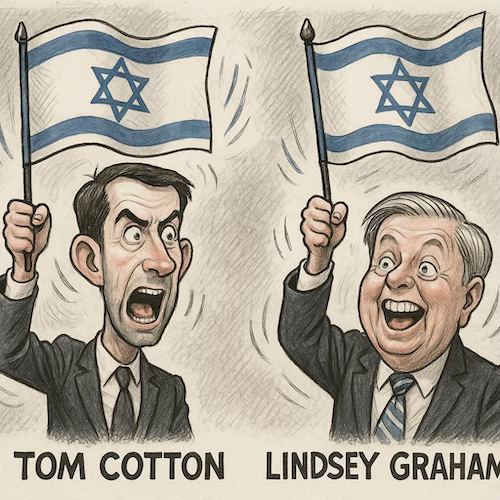
The “Senators from Israel” also want Iran to abandon its ballistic missiles—the core of its defense strategy—and stop cooperating with regional allies in Iraq, Lebanon, Yemen, and above all, Palestine. Those demands, too, are non-starters. Their only purpose is to destroy the possibility of any agreement, thereby opening the door for Israel to drag the US into a disastrous war on Iran.
Will the Trump Administration break free from the malign influence of the Israel lobby and its extremist leader, Benzion Mileikowsky, that Polish-born internationally-wanted criminal who operates under the alias “Benjamin Netanyahu”? Will Trump take the advice I offered last month and “terminate Bibi’s command…with extreme prejudice if necessary?”
There are encouraging signs that Trump may jettison Netanyahu in order to avoid the war-on-Iran-for-Israel trap that Bibi has set for him. By striking a separate peace with Yemen’s Houthis that allows them to continue targeting Israel, then triumphally visiting the region’s Arab capitals (including Hamas-funding Qatar) Trump has done everything but order Israel to stop its genocide in Gaza.
Trump needs to give that order ASAP—not only for humanitarian reasons, but also to create a fait accompli that will help bring down Netanyahu and forestall the Israeli hardliners’ efforts to trick the US into yet another disastrous war for Israel. If the Trump Administration does not act decisively, Netanyahu’s bought-and-paid-for “US” senators will keep pushing Bibi’s war plans, with potentially catastrophic results.
The Right Approach to the US-Iran Nuclear Negotiations
By Glenn Diesen | May 27, 2025
I recently attended a media festival in Tehran and also had the opportunity to explore Iran’s weapon systems and one of its nuclear facilities. Iran’s nuclear program is cited as the main reason for Israel and the US to threaten war with Iran. Such a war would likely escalate into a disastrous regional conflict, and perhaps even pull in the other great powers in a world war. Israel obviously needs to bring America on board to attack Iran, so the discussions between the US and Iran are of great importance. What do the Americans and Iranians want, and is there common ground that can be reached?
If the only demand by the US was for Iran to abstain from developing nuclear weapons, then an agreement could be reached, as Iran claims it does not intend to develop nuclear weapons and has accepted that inspectors are there to ensure compliance. Indeed, Iran agreed to the Joint Comprehensive Plan of Action (JCPOA) and honoured its obligations before the US unilaterally withdrew from the agreement. The US now demands a renegotiation and demands the complete dismantlement of Iran’s civilian nuclear energy program, which it is entitled to have as a signatory to the Non-Proliferation Treaty.
Furthermore, the US has linked its hegemonic policies in the region to the nuclear issue. The US demands that Iran limit the range of its ballistic missile program and also suspend its support for allies in the region – primarily Yemen, Lebanon and Hamas. From Tehran’s perspective, this represents a complete capitulation that would make its security dependent on the benign intentions of Israel and the US. This neglects that the US has had Iran in its crosshairs for the past 45 years, and Iran does have legitimate security concerns.
What can be considered a legitimate security concern by the US is that Iran has become a nuclear threshold state, with the knowledge and material to develop a nuclear weapon. Restricting the extent to which uranium is enriched and imposing strict inspections could possibly be negotiated.
However, threatening to bomb Iran would not eliminate its know-how or all of its material, and such an attack would only incentivise Iran to develop a nuclear deterrent. Even US threats to attack Iran unless it complies with US demands must be making the political leadership in Iran consider acquiring a nuclear weapon. So far, Iran is not developing nuclear weapons, because doing so would encourage other states, such as Saudi Arabia, to also pursue nuclear weapons. Recognising the security competition, the result would not be greater security for Iran.
In my opinion, another approach to negotiations would be to do what is rarely done anymore in Western diplomacy: to recognise and mitigate the security concerns of the other side for the purpose of reducing the security competition. Threatening and bullying Iran into making unilateral concessions has become the new normal in the unipolar era. The US offer to remove sanctions on Iran is merely an offer to stop punishing Iran. The point of departure in any diplomatic approach should be to address mutual security concerns and explore where an agreement that enhances security for both sides can be found. Threatening Iran with capitulation and linking nuclear issues to unrelated matters will only ensure the failure to reach an agreement.
Crazy shopping in Tel Aviv
By Lorenzo Maria Pacini | Strategic Culture Foundation | May 23, 2025
If you are still wondering what Italy’s position is in the Israeli-Palestinian conflict, don’t worry: for the umpteenth time, Prime Minister Giorgia Meloni has reiterated that Italy stands with Israel, always, at any cost.
In front of an international court, such a statement would automatically be condemned as ‘complicity in genocide’, on a par with what was decreed in Nuremberg after the Second World War. However, since mere statements by politicians are not enough, evidence of this ‘participation’ in a crime against humanity must be provided. There are several pieces of evidence, including the recent shopping spree that the Italian government went on in Tel Aviv and the surrounding area.
While Israeli bombing continues in the Gaza Strip, Italy is preparing to purchase military technology to equip itself with a new fleet of reconnaissance aircraft. It should be noted that military cooperation between the two countries is not a new development, far from it. On 15 April, Defence Minister Guido Crosetto sent Parliament a draft ministerial decree (SMD 19/2024) aimed at the ‘gradual implementation of multi-mission multi-sensor (MMMS) operational suites on a shared Gulfstream G550 platform’. By 26 May, the Senate Defence Committee will have to give its opinion: it may approve, reject or request amendments to the measure. Meanwhile, on 6 May, the Chamber of Deputies’ Budget Committee gave the green light to the decree in just five minutes and without discussion. According to the Military Code, if the parliamentary committees express a negative opinion, the executive is obliged to refer the decree back to the Chambers accompanied by counter-arguments. If the negative opinion is confirmed by an absolute majority and justified by non-alignment with the Multi-Year Defence Programme, the programme cannot be implemented.
The measure represents the third phase of a long-term project to convert Gulfstream G550 civil jets (known as ‘green’ in military circles) into surveillance and intelligence aircraft, thanks to technology provided by Elta Systems Ltd, an Israeli company part of the Israel Aerospace Industries (IAI) group. The total value of the entire programme exceeds three billion euros. The first two phases have already been approved and implemented.
Elta Systems’ technologies, specialising in surveillance, electronic warfare and target identification, are used worldwide and supplied to regular armies and paramilitary forces. These same technologies are also widely used by the Israeli armed forces against the Palestinian people and other entities considered “enemies”. The link between Elta and the Israeli army is very close: many employees come from special units of the Israeli Defence Forces (IDF) or are still serving there.
In 2016, Italy received its first two G550 CAEW (Conformal Airborne Early Warning) aircraft from Israel, equipped by the company with advanced surveillance and command capabilities, currently operational at the 14th Wing in Pratica di Mare.
As part of a bilateral agreement, in addition to the spy planes, Italy also purchased the OPTSAT 3000 optical military satellite from Israel, while in exchange Tel Aviv bought thirty Alenia Aermacchi M-346 training jets from Italy, supplied by Leonardo Spa.
Decree SMD 3/2020 marked the start of the next phase of the programme: the purchase and conversion of eight more aircraft to Full Mission Capable (FMC) configuration, integrating CAEW capabilities with electronic warfare, interception and intelligence systems. Six civilian Gulfstream aircraft were purchased for conversion and two were already equipped for military use. Cost: €1.223 billion. The courier has already delivered the package to Pratica di Mare.
The 2020 decree explicitly refers to intergovernmental agreements (Gov to Gov) between Italy and Israel, the Memorandum of Understanding and agreements between Italian companies (primarily Leonardo), Israeli companies (Elta System) and US companies (L3 Harris), with the possibility of involving additional Israeli companies. If the deal is good, shopping works.
The next phase, SMD 37/2021, provided for the conversion of four of the six civilian aircraft already purchased into military aircraft. This part of the programme was also carried out using Elta technology, at an additional cost of €925 million.
The third and current phase of the project, defined in decree SMD 19/2024, has gone from an initial estimate of €994 million to an updated cost of €1.632 billion. It includes the military conversion of the last two civilian Gulfstreams, the purchase of an eleventh aircraft for testing and experimentation, and the construction of the ISTAR citadel in Pratica di Mare, equipped with hangars, operational facilities and satellite connection to support the fleet. As in previous decrees, this one also provides for intergovernmental cooperation based on existing schemes.
Business is business
Let’s face it: wars have always existed and the world cannot stop in the face of conflict. Nor can the commercial business that follows. This is the logic of the double game that Italy continues to play with Israel: arms sales behind the scenes, controversy over respect for international law in front of the cameras.
According to Italian law, the sale of arms to states involved in armed conflicts is prohibited. Israel falls into this category, which is why exports should be suspended. The law in question is No. 185 of 1990. Italy ranks third among the main suppliers of arms to Israel, with a share of 4.7%, behind the United States (65.6%) and Germany (29.7%). However, data from the Customs Agency (Agenzia delle Entrate, in italian) show that between December 2023 and January 2024, Italy exported arms and ammunition worth more than €2 million to Israel. The government justified this in 2024, specifying that the business of blood and destruction continues under old licences that were signed before 7 October 2023.
Nevertheless, considering the preliminary decision of the International Court of Justice on alleged violations of the Convention on the Prevention of Genocide and the request for an arrest warrant for Prime Minister Netanyahu, arms exports to Israel after 7 October could expose Italy to the risk of being held jointly responsible for violations of international law attributed to Israel.
This is the political rhetoric of Italy, which leads the way in relations with Israel for the whole of Europe, as the main commercial hub for the IMEC, the Cotton Road, which is multilateral in nature and represents, from the US point of view, an alternative to the Chinese ‘New Silk Road’. It should be remembered that the initiative was presented during the G20 summit held in New Delhi, India, on 10 September 2023. On that occasion, India, the United States (Biden administration), the European Union, France, Germany, Italy, Saudi Arabia and the United Arab Emirates signed a memorandum of understanding for the creation of an economic corridor linking India, the Middle East and Europe (IMEC).
The ambitious plan focuses on infrastructure development and has two main components: a railway line connecting Europe with the Gulf (involving the United Arab Emirates, Saudi Arabia, Israel and Jordan), and a maritime route connecting India with the Gulf region. The initiative is supported by the Partnership for Global Infrastructure and Investment (PGII), created by the G7 in 2022, and by the European Global Gateway program, which has earmarked up to €300 billion for investment in international infrastructure between 2021 and 2027.
For Italy, the initiative is also of strategic importance due to its geographical position between the Mediterranean and the Indo-Pacific, and it is from Israel and its ports that it will receive the goods that Israel will always need to build its business. It does not matter if this means perpetrating genocide, the important thing is that the economic interests of the two countries are protected. Capital wins over Man, the logic of interest prevails over that of humanity.
Netanyahu’s endgame: Isolation and the shattered illusion of power
By Ramzy Baroud | MEMO | May 20, 2025
There was a time when Benjamin Netanyahu appeared to have all the cards. The Palestinian Authority was largely passive, the occupied West Bank was relatively calm, Israel’s diplomatic reach was expanding, and the United States seemed ready to bend international law to accommodate Israel’s desire for complete control over Palestine.
The Israeli prime minister had also, at least in his own estimation, succeeded in subduing Gaza, the persistently defiant enclave that had for years struggled unsuccessfully to break the suffocating Israeli blockade.
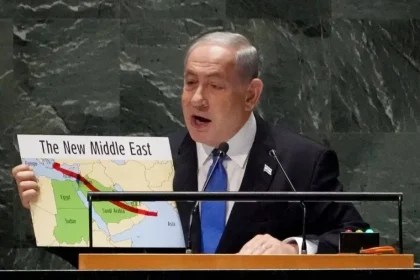
Within Israel, Netanyahu had been celebrated as the nation’s longest-serving prime minister, a figure who promised not only longevity but also unprecedented prosperity. To mark this milestone, Netanyahu employed a visual prop: a map of the Middle East, or, in his own words, “the New Middle East.”
This envisioned new Middle East, according to Netanyahu, was a unified green bloc, representing a future of ‘great blessings’ under Israeli leadership.
Conspicuously absent from this map was Palestine in its entirety—both historic Palestine, now Israel, and the occupied Palestinian territories.
Netanyahu’s latest unveiling occurred at the United Nations General Assembly on 22 September, 2023. His supposedly triumphant address was sparsely attended, and among those present, enthusiasm was notably absent. This, however, seemed of little consequence to Netanyahu, his coalition of extremists, or the broader Israeli public.
Historically, Israel has placed its reliance on the support of a select few nations considered, in their own calculus, to be of primary importance: Washington and a handful of European capitals.
Then came the October 7 assault. Initially, Israel leveraged the Palestinian attack to garner Western and international support, both validating its existing policies and justifying its intended response. However, this sympathy rapidly dissipated as it became apparent that Israel’s response entailed a campaign of genocide, the extermination of the Palestinian people in Gaza, and the ethnic cleansing of Gaza’s population and West Bank communities.
As images and footage of the devastating carnage in Gaza surfaced, anti-Israeli sentiment surged. Even Israel’s allies struggled to justify the deliberate killing of tens of thousands of innocent civilians, predominantly women and children.
Nations like Britain imposed partial arms embargoes on Israel, while France attempted a balancing act, calling for a ceasefire while suppressing domestic activists advocating for the same. The pro-Israel Western narrative has become increasingly incoherent, yet remains deeply problematic.
Washington, under President Biden, initially maintained unwavering support, implicitly endorsing Israel’s objective – genocide and ethnic cleansing.
However, as Israel failed to achieve its perceived objectives, Biden’s public stance began to shift. He called for a ceasefire, though without demonstrating any tangible willingness to pressure Israel. Biden’s staunch support for Israel has been cited by many as a contributing factor to the Democratic Party’s losses in the 2024 elections.
Then, Trump arrived. Netanyahu and his supporters, both in Israel and Washington, anticipated that Israel’s actions in Palestine and the wider region — Lebanon, Syria, etc — would align with a broader strategic plan.
They believed Trump’s administration would be willing to escalate further. This escalation, they envisioned, would include military action against Iran, the displacement of Palestinians from Gaza, the fragmentation of Syria, the weakening of Yemen’s Ansarallah, and more, without significant concessions.
Initially, Trump signalled a willingness to pursue this agenda: deploying heavier bombs, issuing direct threats against Iran, intensifying operations against Ansarallah, and expressing interest in controlling Gaza and displacing its population.
However, Netanyahu’s expectations yielded only unfulfilled promises. This raises the question: was Trump deliberately misleading Netanyahu, or did evolving circumstances necessitate a reassessment of his initial plans?
The latter explanation appears more plausible. Efforts to intimidate Iran proved ineffective, leading to a series of diplomatic engagements between Tehran and Washington, first in Oman, then in Rome.
Ansarallah demonstrated resilience, prompting the US on 6 May to curtail its military campaigns in Yemen, specifically the Operation ‘Rough Rider’. On 16 May, a US official announced that the USS Harry S. Truman would withdraw from the region.
Notably, on 12 May, Hamas and Washington announced a separate agreement, independent of Israel, for the release of US-Israeli captive Edan Alexander.
The culmination occurred on 14 May, when Trump delivered a speech at a US-Saudi investment forum in Riyadh, advocating for regional peace and prosperity, lifting sanctions on Syria, and emphasising a diplomatic resolution with Iran.
Conspicuously absent from these regional shifts was Benjamin Netanyahu and his strategic ‘vision’.
Netanyahu responded to these developments by intensifying military operations against Palestinian hospitals in Gaza, targeting patients within the Nasser and European Hospitals. This action, targeting the most vulnerable, was interpreted as a message to Washington and Arab states that his objectives remained unchanged, regardless of the consequences.
The intensified Israeli military operations in Gaza are an attempt by Netanyahu to project strength amidst perceived political vulnerability. This escalation has resulted in a sharp increase in Palestinian casualties and exacerbated food shortages, if not outright famine, for over two million people.
It remains uncertain how long Netanyahu will remain in power, but his political standing has significantly deteriorated. He faces widespread domestic opposition and international condemnation. Even his primary ally, the United States, has signalled a shift in its approach. This period may mark the beginning of the end for Benjamin Netanyahu’s political career and, potentially, for the policies associated with his horrifically violent government.
Iran Nuclear Negotiations Bring New, Suprising Developments
By Ted Snider | The Libertarian Institute | May 20, 2025
In the past several days, there have been surprising developments in the negotiations between Washington and Tehran over Iran’s civilian nuclear program.
U.S. President Donald Trump has frequently, but not always, defined the goal of the negotiations as being limited to preventing Iran from getting a nuclear weapon. He repeated that definition as recently as May 25, saying Iran must “permanently and verifiably cease pursuit of nuclear weapons…They cannot have a nuclear weapon.”
But the message from his team has been contradictory. Then-National Security Advisor Mike Waltz said that the United States is demanding “full dismantlement,” and Trump’s special envoy Steve Witkoff said that “a Trump deal” means “Iran must stop and eliminate its nuclear enrichment and weaponization program.” Rubio said that Iran can have a civilian nuclear program, but by importing uranium enriched up to 3.67%, and no longer by enriching their own. On May 9, Witkoff told Breitbart News that “An enrichment program can never exist in the state of Iran ever again. That’s our red line. No enrichment.”
But Iran has drawn the mirror image red line. Iran’s Supreme Leader, Ayatollah Ali Khamenei, has placed a firm limit that Iran will not negotiate “the full dismantling of Iran’s nuclear infrastructure.” Iranian President Masoud Pezeshkian repeated that red line ahead of the talks, insisting that “Iran has never sought, is not seeking, and will never seek nuclear weapons” but that “Iran will not give up its peaceful nuclear rights.”
American insistence on ending Iran’s civilian enrichment program could put a quick end to the talks. Widening the negotiations to Iran’s missile program or to Iran’s relationship with its regional proxy groups could also jeopardize the talks.
But Trump raised that possibility on May 14 when he suggested that breaking off relations with proxy groups in the region must be part of any deal. Iran “must stop sponsoring terror,” he said, and “halt its bloody proxy wars.”
The contradictory statements emanating from the Trump administration appear to have been “because of a lack of decision on key strategic points,” Trita Parsi, Executive Vice President of Quincy Institute for Responsible Statecraft and an expert on Iran, told me. And, indeed, on May 7, Trump said, “We haven’t made that decision yet.”
“As a result,” Parsi said, “the debate on these points is now, rather unhelpfully, taking place out in public.”
That the talks have progressed to a fourth meeting suggests, at this point, that the public crossing of these Iranian red lines may not be being repeated in the private meetings. Iran’s Foreign Minister hinted at that possibility when he identified one of the difficulties in the negotiations as being “contradictions both inside and outside the negotiating room.” Supporting this possibility, when Trump introduced Iran’s support of regional proxies into the discussion, Araghchi called the remark, not unproductive or unhelpful, but “deceitful.”
And Araghchi may know. Barak Ravid of Axios has now reported that, during the fourth round of talks, the United States presented Iran with a written proposal. The report says that, during the third round, Araghchi gave Trump’s special envoy Steve Witkoff a document with Iran’s proposals for a deal. The U.S. studied it and returned it to Iran with “questions and requests for clarifications.” Iran replied, the U.S. prepared a new proposal, and then presented it to Araghchi who has now brought it back to Tehran for consultations with Supreme Leader Ali Khamenei and President Masoud Pezeshkian.
How far down the path to a settlement the proposal is is unknown. Araghchi said future negotiations now become more difficult. But he said that “despite the difficulty and frankness of the talks, very useful discussions were held.” He then said, “We can now say that both sides have a better understanding of each other’s positions.”
This major breakthrough may have been facilitated by another recent development: a subtle change in tone by Trump. Following a flurry of American threats, the fourth round of talks was postponed. Iranian officials said that [d]epending on the U.S. approach, the date of the next round of talks will be announced.”
Recently, that approach subtly changed. Previously, Donald Trump had formulated Iran’s choice as “If they don’t make a deal, there will be bombing. It will be bombing the likes of which they have never seen before.” But in his most recent remarks, which went largely unnoticed, Trump softened the consequence, saying only “If Iran’s leadership rejects this olive branch…we will have no choice but to inflict massive maximum pressure, drive Iranian oil exports to zero.” Notably, bombing was replaced with sanctions.
On May 15, Trump again seemed to reject the risk of war:
“Because things like that get started and they get out of control. I’ve seen it over and over again. They go to war and things get out of control, and we’re not going to let that happen.”
In another surprise development, Iran may have facilitated negotiations with a creative and unexpected proposal.
There are now reports that Iran has suggested for consideration that they could join with Saudi Arabia and the United Arab Emirates in a nuclear enrichment consortium. Iran would continue to enrich uranium but accept a cap at the 3.67% enrichment required by a nuclear energy program. Saudi Arabia and UAE, who would gain access to Iran’s nuclear technology, would be shareholders and funders.
If true, the proposal would be based on a consortium idea first proposed by Princeton physicist Frank von Hippel and former Iranian nuclear negotiator Seyed Hossein Mousavian.
Von Hippel told me that the idea was inspired by the URENCO enrichment consortium of Germany, the Netherlands and Britain and by the ABAAAC consortium of Brazil and Argentina.
The consortiums, he said, allow nuclear experts from each country to “visit each other’s facilities to assure themselves that the activities are peaceful.” He added that “decisions that might have proliferation implications are made by the [partner] governments.” Saudi Arabia’s, the Emirates’ and Iran’s watchful eyes would all help the International Atomic Energy Agency ensure that the program is peaceful.
Aside from the implications for the nuclear negotiations, this level of trust between Iran, Saudi Arabia, and the UAE was unthinkable only a very short time ago and testifies to the changes going on in the region and in the evolving Iran-Saudi Arabia relationship. That Iran would trust Saudi Arabia with access to its nuclear technology indicates that a region changing shift in the relationship is underway.
As Annelle Sheline, research fellow in the Middle East program at the Quincy Institute, told me:
“The Iranians’ willingness to join a consortium with Saudi Arabia and the UAE to develop civilian nuclear energy demonstrates significantly improved relations between these countries. This sends a strong signal that Tehran as well as Riyadh and Abu Dhabi would prefer to prioritize cooperation over conflict.”
She said that all three countries have growing motivation for peace in the region. Crown Prince Mohammed bin Salman needs to avoid violent conflict to encourage the foreign investment and tourism needed to fuel his planned economic diversification. Mohammed bin Zayed needs economic security in the face of competition from Saudi Arabia to be a regional hub. Iran needs to encourage peace in the region because of the recent weakening of its own strategic position in the region. Saudi Arabia and Iran have recently been moving towards enhanced friendship both bilaterally and through multinational organizations.
Sheline expressed the hope to me that “Trump should take advantage of these circumstances to sign a nuclear deal with Iran and avoid unnecessary war.”
All of these developments, from the contradictory American messaging, to the until now unreported existence of a written proposal, to the subtle and little noticed change in Trump’s tone to the Iranian idea of a nuclear consortium with Saudi Arabia and UAE are shocking and new. They may present an opportunity to return to a nuclear agreement with Iran and to usher in a new hope for peace and friendly relations both between the U.S. and Iran and in the region. Hopefully, the two sides will seize this opportunity.
Are US-Israel ‘special relations’ about to end?
By Murad Sadygzade | RT | May 19, 2025
Last week, US President Donald Trump embarked on his first official overseas tour since taking office, choosing to visit three key Gulf nations – Saudi Arabia, Qatar, and the United Arab Emirates.
This itinerary was both unexpected and, in many ways, unprecedented. Unlike his predecessors, who traditionally began their foreign policy engagements with visits to long-standing Western allies, Trump opted to prioritize America’s Arab partners, deliberately bypassing Israel – Washington’s principal strategic ally in the region. This marked the first time in decades that a sitting US president visiting the Middle East consciously excluded it from the agenda.
This decision signaled a potential recalibration of Washington’s priorities in the region. Relations between the Trump administration and the Israeli leadership, particularly Prime Minister Benjamin Netanyahu, were already strained in the early stages – largely due to Israel’s growing intransigence on the Palestinian question and the increasing influence of far-right factions within the Israeli government. Faced with mounting frustration over Israel’s hardline policies, the White House appeared to pivot toward a more pragmatic, less confrontational, and economically advantageous partnership with the Gulf monarchies.
However, the rationale behind this shift extended beyond political calculation. Saudi Arabia, the UAE, and Qatar have long played a pivotal role in sustaining American influence in the Middle East – not only because of their strategic geography but also due to their substantial investments in the US economy and multi-billion-dollar arms contracts. For a business-minded president eager to showcase the profitability of foreign policy through economic deals, these nations represented ideal counterparts.
The lavish receptions afforded to Trump during his Gulf tour might have been dismissed as mere pageantry were it not for their deeper symbolic resonance. The true significance of the visit lay in what it revealed about broader geopolitical currents: namely, the transformation of the Gulf monarchies from regional players into increasingly assertive global actors.
Saudi Arabia, the UAE, and Qatar are no longer content with being perceived as passive participants in American-led regional frameworks. Instead, they are positioning themselves as independent centers of power in an emerging multipolar world order. Their growing international stature stems from several interrelated factors.
First, these countries have embraced ambitious and forward-looking development strategies, investing heavily in infrastructure, clean energy transitions, technological innovation, and global finance. No longer simply hydrocarbon exporters, they are becoming hubs of digital transformation, international logistics, Islamic finance, and global policy discourse on issues ranging from security to sustainable development.
Second, the Gulf states have pioneered a distinctive model of governance that blends traditionalism with modernization. While maintaining deep-rooted commitments to Islamic and tribal values, they have achieved remarkable progress in building diversified and globally competitive economies. This synthesis has not only enabled them to thrive amid intensifying global competition but, in some respects, to outpace certain Western nations grappling with internal divisions and economic stagnation.
Equally noteworthy is the political resilience of these monarchies. Western narratives often portray them simplistically as ‘absolute monarchies,’ failing to appreciate the internal mechanisms of governance that underpin their stability. In reality, the political architecture of the Gulf is more accurately described as ‘sheikhism’ – a system rooted in consensus among tribal and familial elites, structured around a balance of obligations, reciprocal loyalties, and ongoing consultation. This model, which integrates Islamic principles such as shura (consultation) with practical statecraft, has proven remarkably adaptive and resilient.
In this context, Saudi Arabia, the UAE, and Qatar can no longer be viewed merely as privileged US allies or energy suppliers. They are emerging as autonomous actors in global politics – capable of forging regional alliances, shaping international agendas across energy, media, and technology, and mediating in global conflicts. Their evolving role reflects not dependence on external security guarantees, but the outcome of deliberate, long-term strategies to consolidate sovereignty, enhance prestige, and assert influence in the 21st century.
Money above all: Trump’s deal-based diplomacy
President Donald Trump’s visit to the Gulf states was far more than his first foreign trip as head of state. It was a bold, highly symbolic debut of a new US foreign economic doctrine rooted in pragmatism, transactionalism, and strategic capitalism. Unlike previous administrations, which typically foregrounded diplomacy, security alliances, and value-based partnerships, Trump approached this tour as a high-stakes business deal. His mindset was that of a dealmaker, not a traditional statesman. The objective was clear: to restore America’s economic dominance by leveraging the vast wealth and strategic ambitions of the Middle East’s richest monarchies.
Trump’s campaign slogan, “Make America Great Again,” found tangible expression in this tour. His mission was to bring back jobs, reindustrialize key sectors, boost the US high-tech ecosystem, and enhance national competitiveness – all fueled by a surge in foreign direct investment. In this pursuit, the oil-rich, capital-heavy Gulf monarchies – endowed with massive sovereign wealth funds and seeking greater global visibility – emerged as ideal partners.
In Saudi Arabia, Trump signed an unprecedented economic package worth over $600 billion, including the largest arms deal in US history – $142 billion covering missile defense systems, advanced aviation platforms, cybersecurity capabilities, and military-grade AI technologies. Equally significant was the launch of a new tech alliance: Saudi-based DataVolt committed $20 billion to build data centers and energy facilities in the US, while a consortium led by Nvidia, AMD, and Amazon Web Services will co-develop an AI innovation hub within the Kingdom. A $50 billion venture fund was also established to support US-based startups in renewable energy and cybersecurity.
In Qatar, the results were even more staggering: agreements totaling $1.2 trillion, the largest single-country deal package in US diplomatic history. Central to this was Qatar Airways’ order for 210 Boeing aircraft valued at $96 billion, making it the most lucrative deal ever for the American aerospace giant. Qatar also pledged tens of billions of dollars for joint ventures in quantum computing, smart energy networks, and STEM education programs for engineers and IT specialists in the US. In a provocative symbolic gesture, Qatar proposed gifting President Trump a custom-built Air Force One, sparking intense debate in the American media landscape.
In the United Arab Emirates, new agreements totaling $200 billion were signed – in addition to a previously negotiated $1.4 trillion package. Key components included the construction of an aluminum plant in Oklahoma, expansion of oil and gas infrastructure with US firms, and a landmark $100 billion commitment to American companies specializing in artificial intelligence over the next three years.
In total, Trump’s Gulf tour yielded over $2 trillion in contracts and investment pledges – an economic windfall of historic proportions. But beyond the numbers, the trip marked a fundamental redefinition of American foreign policy: from projecting power through military force and ideological alignment, to securing influence through economic penetration and transactional partnerships. Trump unveiled a new image of the US – not as a global policeman, but as a global entrepreneur. A nation that negotiates not with declarations, but with data, contracts, and employment metrics.
This new model resonated deeply with the Gulf monarchies themselves, which are undergoing profound transformations. Once reliant solely on oil exports, these states are rapidly evolving into tech-driven economies with ambitions to become global hubs of innovation, finance, and logistics. In Trump’s America, they found not just a security guarantor, but a strategic co-architect of a post-oil economic order – one where capital, innovation, and mutual profit outweigh traditional diplomatic protocol and ideological rhetoric.
Trump’s message was unambiguous: the era of foreign policy as charity is over. What now matters are mutual returns, strategic alignments, and economic gains. The Gulf states, driven by their own visions of modernization and diversification, eagerly embraced this shift. Together, they reimagined international relations not as a sphere of obligations, but as a marketplace of opportunities.
What about Israel?
One of the most significant – albeit unofficial – outcomes of Donald Trump’s Middle East tour could be discerned even before the journey began: the US President conspicuously bypassed Israel. This omission became all the more striking given that even Secretary of Defense Pete Hegseth, who had initially planned a visit to Tel Aviv, abruptly cancelled his trip at the last moment. The message did not go unnoticed in either Washington or Jerusalem: nearly all observers interpreted the move as a clear sign of a cooling relationship between the US and Israel – more precisely, between Trump and Israeli Prime Minister Benjamin Netanyahu.
The rift between the two leaders appears less personal than strategic, rooted in diverging visions of the region’s future. Tensions had been mounting for months. The first major flashpoint came when Trump unilaterally announced the withdrawal of American forces from operations against Yemen’s Houthi rebels, citing the group’s supposed commitment to halt attacks on Red Sea shipping lanes. The decision, made without prior consultation with Israel – which continues to endure daily rocket fire from the Houthis – dealt a blow not only to diplomatic norms but also to the foundational trust between Israel and its closest ally.
An even more sensitive issue has been the quiet resumption of US contacts with Iran. With Oman acting as mediator, Washington has been exploring the outlines of a possible new nuclear agreement. Meanwhile, Israel remains steadfast in its conviction that no negotiations with Tehran should occur until decisive military action is taken against its nuclear and military facilities – a show of force intended to compel concessions. Netanyahu failed to persuade Trump of this hardline approach, and the US president has increasingly charted his own, more flexible course.
Tensions have also sharpened over the future of Syria. Israel refuses to recognize the country’s new leader, Ahmad al-Sharaa, branding him a former al-Qaeda affiliate and a dangerous actor. Israeli airstrikes on Syrian territory continue, the buffer zone in the Golan Heights remains under Israeli control, and the Druze population has formally been placed under Israeli protection. While Israel promotes the vision of a weak, decentralized Syria, Washington is embracing the opposite: al-Sharaa was invited to meet with Trump in Saudi Arabia, and following those talks, the US signaled its intent to lift sanctions on Damascus. Even more striking was the revelation that Saudi Arabia, Qatar, and the UAE – previously restrained by US pressure – are now prepared to invest in Syria’s reconstruction, viewing it as both a stabilizing opportunity and a chance to expand their regional influence.
Israeli frustration has been further stoked by Washington’s evolving stance on the Palestinian issue. Despite Israel’s ongoing military operation in Gaza, Trump has increasingly expressed a desire – even a demand – for a resolution to the conflict. His Gaza reconstruction plan, unveiled in February, sent shockwaves through Washington: it proposed the complete depopulation of Palestinians from the enclave and the transformation of the territory into a luxury international resort zone under US control. Not only was this radical proposal never coordinated with Israel, but it also raised fundamental questions about the future of the US-Israel alliance.
To make matters more complex, credible reports have emerged that the US has been engaged in direct negotiations with Hamas, without informing Israel. The recent release of an American citizen, IDF soldier Idan Alexander, who was captured in October 2023, was reportedly achieved through these covert channels – of which the Israeli government only became aware through its own intelligence services.
Against this backdrop, speculation is growing that the White House is seriously considering formally recognizing an independent Palestinian state. Such a move would not be a mere diplomatic gesture – it would reshape the strategic architecture of the Middle East. Should Washington proceed down this path, Israel could find itself in strategic isolation, while the center of regional gravity shifts toward Saudi Arabia, the UAE, Qatar, and Türkiye – countries with which Trump is building pragmatic, mutually beneficial, and business-driven relations.
None of these states demand unconditional support from Washington, meddle in its internal politics, or leverage domestic crises for influence. More importantly, they offer Trump what he values most: investment, trade, strategic partnership based on reciprocal interest, and freedom from ideological constraints.
Thus, a new geopolitical reality is taking shape before our eyes. In this emerging landscape, Donald Trump appears less inclined to view Israel as an indispensable ally and more drawn to politically agile, economically potent, and regionally assertive actors across the Arab world – and Türkiye. If rumors of Palestinian state recognition prove true, it will mark the end of the long-standing era of “special relations” between the US and Israel and signal the dawn of a new chapter in American Middle East policy – one governed not by ideological loyalty, but by unambiguous political and economic rationality.
Murad Sadygzade is President of the Middle East Studies Center, Visiting Lecturer, HSE University (Moscow).
Featured Video
More Iran War fallout: Maritime insurance industry shifts from London to China
or go to
Aletho News Archives – Video-Images
From the Archives
The Biggest Threat to Peace in Middle East
By Dr. Elias Akleh* | Sabbah Report | May 24, 2010
A build up of heightened tension in the Middle East is escalating in the last few weeks. American and Israeli postures towards Lebanon, Syria, and Iran have become more threatening. Listening to speeches of political leaders one hears talks only about war not peace. Iranians and Israelis are continuously training hard for a possible showdown. Both sides are conducting extensive war games every month. This led Syrians to claim that Israel is preparing for a soon-to-come another war. The Jordanians also are warning that current stalemate of the peace process is an indication of a war breaking out this summer. The Russian President and his army chief hinted, a few months ago, that the US and Israel were planning for an attack on Iran.
Indeed Iran is, as it has been for last few years, the target of most of the threats and accusations of supporting terrorism. Escalating incitement against Iran the American Defense Department sent last month (April) to Congress a report on Iran’s military claiming Iran could develop intercontinental ballistic missiles capable of reaching the US by 2015.
Ignoring the fact that N. Korea, India, Pakistan, and Israel are proven to have nuclear weapons while Iran does not, the US Secretary of State Hillary Clinton chose in her speech, to the nuclear Non-Proliferation Treaty review conference at the UN, to focus on Iran’s alleged nuclear ambitions putting the whole world at risk as she put it. According to Clinton Iran’s acquisition of nuclear weapons, rather than Israel’s more than 200 nuclear bombs, is destabilizing the Middle East. She called on the world’s nations to rally around US efforts to hold Iran, not other nuclear countries, to account.
The accusation that Usama Bin Laden is living comfortably in Iran had received a boost after the broadcast of a documentary called “Feathered Cocaine”. This echoed the June 2003 claims of the Italian newspaper Corre de la Sierra that Bin Laden was in Iran according to some intelligence report, and according to Richard Miniter’s book “Shadow War”. … continue
Blog Roll
 Aletho News
- Japan Clings to US Vassalage Despite Energy Crunch Caused By Iran War
- US Seeks Control Over Global Energy Infrastructure – Kremlin
- US senators target Orban government for standing up to Zelensky
- The deep-rooted culture of corruption in Ukraine
- Iran mobilizing one million soldiers to ‘create hell’ for any US ground assault: Report
- The coming military and psychological unravelling?
- Iran has the last laugh
- More Iran War fallout: Maritime insurance industry shifts from London to China
- US-Israeli aggression on Iran triggers review of GCC countries’ investment pledges to Washington
- Russia slams UK plan to seize tankers suspected of carrying its oil
- If Americans Knew
- Reports: Iran mobilizing 1M fighters, Israel-US run low on ammo, Israeli army faces shortage – Not a ceasefire Day 168
- ‘No Innocent Children’: Far-right Israeli Lawmaker Defends Killing of Palestinian Family
- Mossad’s promises helped Netanyahu convince Trump that Iran could be toppled
- US Arms Control Official Refuses To Comment When Asked If Israel Has Nuclear Weapons
- Veterans warn US landing could be ‘more Gallipoli than Vietnam’
- Israel may be committing war crimes in Lebanon – Not a ceasefire Day 167
- In the West Bank, life is a constant battle – 3 articles
- Jacob Reses, one of the most powerful pro-Israel operatives in Trump’s Washington
- Israeli-US assaults kill or injure 87 children a day – Not a ceasefire Day 166
- ‘Forever live by the sword’: Understanding Israelis’ massive support for Iran war
- No Tricks Zone
- Devastating Assessment Of Comirnaty Vaccine By Former Senior Pfizer Europe Toxicologist
- New Study: CO2 Is ‘Effectively Negligible’ As An Explanatory Climate Change Factor Since 2000
- Former Pfizer Toxicologist Dr. Helmut Sterz Tells Bundestag Hearing Pfizer Vaccine Should Have Never Been Approved
- Energy Expert: Germany’s Nuclear Phaseout Was A “500 Billion Euro Mistake”
- New Research: South Australia’s Mid-Holocene Sea Surface Temperatures Were 4°C Warmer Than Today
- Storing Green Energy To Last Germany 10 Days Would Require A 60-Million Tonne Battery
- New Studies: UK Sea Levels Were 4 Meters Higher Than Today During The Mid-Holocene
- Destructive Green New Deal: German Energy And Metal Group Warns Of Drastic Crisis
- New Study Documents A 20-Year Pause In Arctic Sea Ice Decline – Driven By Internal Variability
- Wake-up Call: Survey Shows Majority Of Germans Now Favor Postponing Climate Targets!
 Aletho News