West Asia reacts to Trump’s dalliance with Zionism
By M. K. BHADRAKUMAR | Indian Punchline | November 14, 2024
The election victory of Donald Trump in the November 5 election is being perceived in the West Asian region with growing anxiety as presaging the US aligning one hundred percent with the Zionist project for Greater Israel.
Although Trump has kept out vociferous neocons from his government positions, the same cannot be said for pro-Zionist figures. Prime Minister Benjamin Netanyahu claims he has spoken three times with Trump already since the election and they “see eye-to-eye regarding the Iranian threat and all of its components.”
The “components” implies that Netanyahu hopes to get a blank cheque from Trump to accelerate the ethnic cleansing in Gaza, for annexation of West Bank, violent reprisals against Palestinians and, most important, to carry the war right into Iranian territory.
Three events in as many days this week show the first signs of a backlash building up. On Monday, Iran’s foreign ministry spokesman Esmaeil Baqaei gave Tehran’s first official reaction to Trump’s election victory. Baqaei took a nuanced line saying, “What matters to us in this region is the United States’ actual behaviour and policies regarding Iran and the broader West Asia.”
Notably, Baqaei expressed “cautious optimism that the new [Trump] administration might adopt a more peace-oriented approach, reduce regional hostilities, and uphold its commitments.” (Tehran Times) Baqaei also refuted the recent allegation by Washington that Iran was involved in plots to assassinate Trump. He called the Biden Administration’s allegation as “nothing more than an attempt to sabotage relations” between Tehran and Washington by “laying traps to complicate the path for the next administration.”
Baqaei also held out an assurance to the incoming US administration that Tehran firmly adheres to a nuclear programme for peaceful purposes. He announced that Rafael Grossi, head of International Atomic Energy (IAEA) was due to arrive in Tehran on Wednesday night.
Taken together, Baqaei’s remarks suggest that Iran hopes there’s still daylight possible between Trump and Netanyahu. The clincher here would have been the remark that Trump slipped into his victory speech with great deliberation on November 6 that “I’m not going to start a war. I’m going to stop wars.”
Trump was on record during his election campaign that “I don’t want to do damage to Iran but they cannot have nuclear weapons.” Tehran’s consultations with Grossi responds to Trump’s concern. This is smart thinking. Iran’s non-provocative stance would mean there is no alibi for attacking Iran.
That said, however, the “known unknown” still remains — namely, Iran’s retaliation to the Israeli attack on October 26. On November 2, Supreme Leader Ayatollah Ali Khamenei, in a video released by Iranian state media, promised “a crushing response” to Israeli attack. Conceivably, the period till January 20 when Trump is sworn in, is going to be critical.
Meanwhile, this week witnessed that Iran and Saudi Arabia have given verve to their detente, which is now manifesting as Riyadh’s solidarity and open support for Iran in its growing confrontation with Israel.
Amidst the growing tensions in the region, the chief of staff of Saudi Arabia’s armed forces, Fayyad al-Ruwaili, visited Tehran on November 10 and met with his Iranian counterpart General Mohammad Bagheri. Iranian President Masoud Pezeshkian spoke on the phone with Saudi Crown Prince Mohammed bin Salman on the phone in the context of a summit of the Organization of Islamic Cooperation (OIC) – Arab League in Riyadh on November 11-12. Iran has extended an invitation to MbS to visit Tehran!
Two hugely significant highlights of the Riyadh summit have been, first, the Saudi prince’s inaugural address where he warned Israel against hitting Iran. This marked a historic turn by Riyadh toward Tehran-Israeli conflict, and away from US-supported normalisation with Jerusalem.
MbS told the summit that the international community should oblige Israel “to respect the sovereignty of the sisterly Islamic Republic of Iran and not to violate its lands.”
Again, Saudi Arabia accused Israel for the first time of committing “genocide” in Gaza. MbS told the leaders who gathered in Riyadh, that the kingdom renewed “its condemnation and categorical rejection of the genocide committed by Israel against the brotherly Palestinian people…”
Trump has been put on notice that he’s meeting a radically different geopolitical landscape in West Asia compared to his first term as president. The Trump transition team is keeping its cards close, offering NatSec Daily a boilerplate statement that Trump will take “necessary action” to “lead our country” and “restore peace through strength.” But warning bells are ringing.
The key pillars of Trump’s “maximum pressure” strategy against Tehran — isolating Iran and ramping up economic pressure while maintaining a credible threat of military force as deterrent — have become wobbly.
On the other hand, the massive Iranian ballistic missile attack on Israel on October 1 and the colossal failure of the Israeli air strike on Iran twenty-six days later convey a loud message all across West Asia that Israel is no longer the dominant military power it used to be — and there is a new sheriff in town. Trump will have to navigate the fallout of both sides of this issue with diminished US diplomatic and geopolitical capital at his disposal.
Meanwhile, Tehran is also deepening its cooperation with Russia, which adds a giant new Ukraine-sized complexity to Trump’s Iran policy. While in Eurasia, the US has allies, Trump is navigating in West Asia pretty much alone.
The US’ stark isolation comes home dramatically by President Recep Tayyip Erdogan’s announcement on Wednesday that Turkey, a NATO member country, has severed all ties with Israel. Erdogan disclosed this to journalists aboard his plane after visiting Saudi Arabia. A regional trend to ostracise Israel is visible now and it is destined to expand and deepen.
The summit in Riyadh witnessed the African Union joining hands with the Arab League and OIC to sign a tripartite agreement on Tuesday to establish a mechanism to support the Palestinian cause, which will be coordinated through the three organisations’ secretariats as a game changer to strengthen their influence in international forums. Saudi Foreign Minister Prince Faisal bin Farhan noted that the three organisations will now onward speak with one voice internationally.
Even as the summit concluded in Riyadh, Crown Prince Salman had a call on Wednesday with Russian President Vladimir Putin. The Kremlin readout stated that the two leaders “reaffirmed their commitment to continue the consistent expansion” of Russian-Saudi ties and specifically “stressed the importance of continuing close coordination within OPEC Plus and stated the effectiveness and timeliness of the steps being taken in this format to ensure balance on the global energy market.”
On the Palestinian-Israeli conflict, the Kremlin readout noted with satisfaction that “the principled approaches of Russia and Saudi Arabia with regard to the Middle East settlement are essentially identical.”
MbS’ initiative to re-invigorate his conversation with Putin can only be seen against the backdrop of the profound misgivings in Riyadh regarding the Trump-Netanyahu bromance and the spectre of a possible regional war haunting the region stemming out of Israel drawing encouragement from the seamless US support expected through the coming 4-year period for the Zionist cause.
How will ‘Israel’ finance its F-15IA fighter jets deal with Boeing?
Al Mayadeen | November 13, 2024
The Israeli Security Ministry’s recent announcement of an agreement with Boeing to purchase 25 F-15IA fighter jets for $5.2 billion, with funding to be drawn from US military aid, raised several questions, primarily about whether US military aid to “Israel” would cover the latest procurement, the Israeli news website Globes reported Wednesday.
According to the Watson Institute at Brown University, the US provided “Israel” with $17.9 billion in military aid during the first year of the war, significantly exceeding the formal annual aid package of $3.8 billion that Washington has committed to Tel Aviv, the news website highlighted.
It noted that among the $3.8 billion annually in military aid—$3.3 billion allocated for procurement and $500 million for joint air defense projects—along with other grants provided each year.
Globes added that the Israeli Security Ministry has stated that delivery of the F-15IA fighter jets is expected to begin in 2031, with 4-6 aircraft delivered per year through 2035 under the most favorable scenario.
It pointed out that this raises further questions about the financial structure of the deal, particularly as the total investment exceeds the annual US aid to “Israel” by $1.4 billion.
So how will “Israel” finance the F-15IA deal?
The report suggested that payments to Boeing may be structured in installments.
In this regard, Globes cited Moti Besser, who served as a financial advisor to the Israeli occupation forces Chief of Staff and headed the Ministry of Security’s budget division from 1997 to 2000, as saying that “Israel” is unique in that US security aid enables it to commit to long-term contracts based on project milestones.
Besser highlighted that while other parties must pay for defense products upfront before delivery, “Israel has a different model that has been built over the years and allows for funding to be deployed over a long period of time and to take into account existing and future sources.”
He explained that when a $5.2 billion contract is spread out, it doesn’t deplete accumulated aid, but rather aligns with a multi-year funding flow that supports additional procurements.
It is noteworthy that since October last year, the Israeli Air Force has conducted relentless airstrikes in the region, killing more than 43,000 people in the Gaza Strip and more than 3,000 others in Lebanon, in addition to leveling civilian infrastructure.
Israeli aircraft have also been used in repeated assaults on Syria and Yemen, as well as Iran.
In late September, “Israel” received a new US military aid package totaling $8.7 billion.
Ido Nehushtan, president of Boeing Israel, pointed to the long-standing relationship with the Israeli occupation entity and confirmed the company’s commitment to “working with the US and Israeli governments to deliver the advanced F-15IA aircraft through standard military procurement channels.”
Trump’s foreign policy team signals further drift from ‘America First’ to ‘Israel First’
MEMO | November 12, 2024
https://twitter.com/DonaldJTrumpJr/status/1855593982958379321
Iran, Russia, Turkey condemn Israeli atrocities in West Asia
Press TV – November 12, 2024
Iran, Russia, and Turkey have condemned the Israeli regime’s continuous atrocities in the West Asia region, calling for increased international efforts to secure an “immediate and permanent” ceasefire in Gaza.
A closing statement from the three countries following the 22nd international meeting on Syria in the Astana format, held in Kazakhstan’s capital, expressed their “strong condemnation and deep concern over the ongoing mass killings and criminal attacks by Israel in Gaza, as well as Israeli aggression in Lebanon and the West Bank.”
They called on the international community, in particular the UN Security Council, “to secure an immediate and permanent ceasefire and unhindered humanitarian access in Gaza.”
The trio also condemned Israeli military attacks on Syria, deeming such actions as violations of international law.
“[The sides] condemned all Israeli military strikes in Syria. [They] considered these actions as a violation of international law, international humanitarian law, the sovereignty and territorial integrity of Syria, and recognized them as destabilizing and exacerbating tensions in the region and called for the ceasing of these attacks,” the statement said.
The sides acknowledged the negative impact of the escalation of tensions in the region on Syria, underscoring the urgency for the United Nations High Commissioner for Refugees (UNHCR), UN agencies, and all humanitarian actors to develop an emergency response for those who were forced to cross from Lebanon into Syria following the escalation of hostilities in Lebanon.
The Israeli regime has been conducting a genocide in Gaza for over a year, resulting in significant casualties. The regime has recently expanded its military aggression to Lebanon, causing numerous fatalities in the Arab country.
Israel has also conducted repeated attacks on Syria and others in the region as part of its escalated campaign of violence.
Call for Turkey-Syria normalization
The joint statement also stressed the importance of resumed contacts and continuing efforts to normalize relations between Ankara and Damascus.
They stressed the need to combat terrorism, facilitate the safe and voluntary return of Syrians with support from the UNHCR, advance the political process, and ensure that unrestricted humanitarian aid reaches all Syrians, as stated in the joint declaration.
The statement said that the sides “reaffirmed the importance of resuming contacts between Turkey and Syria on the basis of strict adherence to the principles of respect for the unity, territorial integrity and sovereignty of both countries.”
They “emphasized the importance of resuming contacts in this format,” it said.
The three parties agreed to hold the next round of the Astana talks on Syria in the first half of 2025.
Initiated in 2017, the Astana format is a series of negotiations aimed at resolving the conflict in Syria.
It involves Russia, Iran, and Turkey as guarantor countries, alongside representatives from the Syrian government and opposition, the United Nations, and observer nations such as Jordan, Lebanon, and Iraq.
The Astana process has been instrumental in facilitating dialogue among key stakeholders in the war on Syria, focusing on de-escalation zones, humanitarian aid, and political solutions.
Trump must end wars – Dennis Kucinich
RT | November 9, 2024
US president-elect Donald Trump will have his hands full fixing the mess in foreign and domestic policy left by incumbent leader Joe Biden’s administration, according to Dennis Kucinich, two-time Democratic presidential candidate and retired eight-term US congressman.
In an interview with Going Underground host Afshin Rattansi broadcast on RT on Saturday, Kucinich said that the success of Trump’s presidency will depend on his ability to shift the focus of US politics from the “globalist aspirations of the State Department” to problems at home.
The veteran politician welcomed Trump’s victory over Democrat Kamala Harris in this week’s election, saying that it represents a “historic shift” in US politics towards “populism.”
“[The US] has come through a very dark period where the government put this country to the edge of World War III, and people don’t want that,” Kucinich stated, noting that ordinary Americans worry about simple things like paying bills and generally “making ends meet,” which he called “very practical aspirations they have in common with people around the world.” He said Trump’s presidency “will depend on not getting further involved in foreign entanglements.”
“This economy is shaking, the dollar is not in the same position it was in four years ago… the previous administration has not been successful in reviving the economy with all this money for Wall Street but not enough for main street,” he stated. Kucinich added that this happened “precisely” because the Biden administration poured billions into wars “that are not necessary.”
There’s a lot of work Trump will need to do, he is going to be faced with some serious decisions about scaling back the US position in Europe and the Middle East and to try to find a way that we can move past the events that the Biden administration embroiled America in.
Kucinich noted that he expects Trump to be able to extricate the US from global conflicts through his “deal-making finesse.”
“Trump is a deal-maker… a family man concerned about children and grandchildren. He’s not personally interested in seeing the US expand into war, he’s not a globalist in that way,” he stated.
Kucinich also suggested that Trump would be wise to lead the US towards cooperation with the “new world” that is “taking shape in response to disastrous sanctions and wars,” citing BRICS as one of the alignments that the US should consider working with.
You can watch the full interview here.
What Comes Next for the Palestinians?
Trump unlikely to oppose Netanyahu’s genocide
By Philip Giraldi • Unz Review • November 6, 2024
Well, it’s over… or is it? Donald Trump will be the next president of the United States backed by a GOP controlled Senate and possibly even a majority in the House of Representatives. And one should not discount the advantage derived from having a largely conservative Supreme Court, but much depends on who Trump appoints to key cabinet positions, a weakness in the first Trump presidency as he tended to select ideologues rather than candidates with relevant knowledge or experience. One hopes, for example, that neither the usual claque of neocons nor establishment characters like Mike Pompeo or Tom Cotton, who have been mentioned as possible candidates for Secretary of Defense, will appear on anyone’s list for high office.
During the lead-up to the presidential campaign, Trump sometimes referred to himself as the most popular politician in Israel, including a conceit that if he were able to run for office in that country he would be able to get elected to the highest offices without any problem. That was, at least in Donald’s mind, an expression of gratitude for how he had done so much for Israel in 2016-2020, including moving the US Embassy to Jerusalem, accepting the annexation of the Syrian Golan Heights, providing political cover for Israeli actions, and a declaration that the US would not do anything to interfere with military and police actions connected to Israeli settlement expansion on the nominally Palestinian West Bank. Israel also appreciated Trump’s appointment of his lawyer David Friedman as US Ambassador. Friedman proved to be a full time apologist for Israel, not representing or defending American interests. In the recent presidential campaign, Trump spoke frequently to Jewish Republican groups and declared himself to be Israel’s best friend and supporter among US politicians.
The Israeli media has also reported that the present Israeli Prime Minister Benjamin Netanyahu much preferred Trump over Kamala Harris, possibly because the PM has developed what is reported to be a close personal relationship with the Trump son-in-law Jared Kushner, who has apparently served often as a conduit to Donald. Netanyahu in fact was the first foreign head of state to telephone personally to congratulate Trump on his repeat victory at 2 a.m. on Wednesday. Netanyahu declared that Trump’s win was “historic” and said it “offers a new beginning for America and a powerful recommitment to the great alliance between Israel and America. This is a huge victory!”
It is generally believed that Netanyahu also apparently harbors some deep suspicion of the Democratic Party in spite of the Biden Administration’s generosity in arms and cash transfers, presumably in part because the Democrats harbor a small but active progressive wing which has been vocal about blocking arms sales to Israel due to its genocide of the Palestinians. The Republicans have no such tendencies apart from a persistent Tom Massie in the House and Rand Paul occasionally saying the right thing from the Senate. And key Republicans like current House speaker Mike Johnson are so in bed with Israel and all its works that he should perhaps consider moving there permanently as the average American gets nothing from the expensive and exceedingly bloody relationship apart from opprobrium from nearly the entire world for complicity in the extermination of the Palestinians. In other words, if one is expecting a return to sanity over what is going on in the Middle East, don’t expect it to come from Donald Trump.
And Netanyahu should be very pleased with the Trump victory for one other important reason, which is how he will be able to deal with an American president. The Wall Street Journal is already reporting from Israeli sources that Netanyahu is definitely expecting a “freer hand” from the new administration to do whatever he wants politically and militarily. Trump’s ego and his personal and spontaneous manner of governing is exactly the kind of relationship Bibi feels most comfortable dealing with. Netanyahu believes he can manipulate Trump and cultivate his personal relationship with the president to include dealing with him directly without worrying about any other players. Netanyahu will be in position to personally flatter, mollify, or confuse Trump even if the president were to surprisingly decide that it would be better if Israel backed off on its aggression. Netanyahu and his allies in the US Congress will be united in convincing Trump that this would be a bad idea.
Bearing in mind that Joe Biden will continue to be president for the next two months and he has demonstrated an infinite capacity to screw things up through his clueless proxies Antony Blinken and Lloyd Austin plus the comic interlude provided by State Department spokesman Matt Miller, who cracked a joke and laughed about the clearly demonstrated Israeli attempt to starve the Gazans to death. But possible Biden missteps notwithstanding, Israel should be on balance very pleased with the election result. Trump is, of course, fully supportive of the slaughter of the Palestinians and is quite willing to deal similarly with the Iranians if they should “spill one drop of American blood” by “spilling gallons of theirs.” His advice to the Israeli government has been that they should “finish the job” on dealing with the Pals not for either humane or political reasons but rather because Israel is getting a bad reputation for its openly espoused massacring of civilians, including in excess of 13,000 children. In a phone call with Netanyahu in October, Trump praised escalation of Israeli military actions in Lebanon. Senator Lindsay Graham, who was on the call, described how “He didn’t tell him what to do militarily, but he expressed that he was impressed by the pagers [and] he expressed his awe for their military operations and what they have done. He told them, do what you have to do to defend yourself.”
Trump is also appreciative of the millions of dollars that went his way during the presidential campaign from Israel’s best friends in the US. The reported $100 million that came from a single donor, casino billionaire Israeli Miriam Adelson, was allegedly in exchange for a Trump agreement to permit Israel’s annexation of what remains of the Palestinian West Bank. The multi-ethnic Arab country called Palestine in 1948 would thereby become the Jewish state of Israel de jure as well as de facto. And the expansion and warmaking with Israel’s neighbors as Netanyahu seeks to establish his country’s military dominance over the entire region will go on, with US garrisons illegally based in Syria and Iraq playing supporting roles. Trump could have removed them as well as carrying out a withdrawal from Afghanistan when he was last in office, but for reasons unknown chose not to, possibly due to pressure from the Israelis.
In short, based on the record in 2016-2020 and recent campaign rhetoric, there is no possibility that President Trump will put any pressure on Israel to cease and desist from what it has been doing in Lebanon, the West Bank and Gaza. This is potentially bad news for the Palestinians and Lebanese but it also is not welcomed by the likely majority of Americans who now oppose arming and funding Israeli genocide. It comes on top of Trump’s frequent denunciation of “useless wars” though he most often cites Ukraine in that context, promising to end that conflict “in one day” by virtue of his sheer star power, personal intervention and diplomacy. One hopes that is true, and, of course, Kiev has no powerful domestic lobby apart from the arms industry to object and continue to want to feed the fighting, so it is possible that Russia-Ukraine is actually moving towards some kind of end. Maybe if that fighting ends and sets a good example, someone in Washington will wake up and seek the same type of agreement to calm the Middle East.
Philip M. Giraldi, Ph.D., is Executive Director of the Council for the National Interest, a 501(c)3 tax deductible educational foundation (Federal ID Number #52-1739023) that seeks a more interests-based U.S. foreign policy in the Middle East. Website is councilforthenationalinterest.org, address is P.O. Box 2157, Purcellville VA 20134 and its email is inform@cnionline.org.
Iran-Arab Rapprochement Gains Ground
By Salman Rafi Sheikh – New Eastern Outlook – November 6 2024
Israel’s escalation in Gaza and Lebanon has severely hindered U.S. efforts to expand the Abraham Accords by bringing Saudi Arabia into the fold.
When Israel began its brutal war on Gaza following Hamas attacks on Israel on October 7, 2023, the Arab-Israel peace deal became nearly impossible. Washington, however, did not abandon its efforts to pursue expanding the Abraham Accords by getting Saudi Arabia to sign them. However, Washington’s inability to control Netanyahu’s war has undermined its efforts to convince Saudi Arabia.
Simultaneously, this overall failure has also negatively affected Washington’s ability to drive a wedge between Iran and Saudi Arabia to undo the Beijing-mediated normalisation between the two erstwhile rivals in the Middle East. Instead, this normalisation seems to have found new grounds in the wake of Israeli expansion of the war into Lebanon against Hezbollah. Riyadh, as reports show, categorically denied Israel the leeway it needed to execute its plans to attack Iran’s oil and nuclear facilities. How Saudi Arabia reached this conclusion is an outcome of, among other things, Iran’s active diplomacy.
Iran-Arab Normalisation
According to a recent report in Reuters, Saudi Arabia, Qatar, and the UAE explicitly gave Washington an ‘enough is enough’ call when they asked it to stop Israel from attacking Iran’s oil and nuclear facilities. Simultaneously, all three of these states have also closed their space for Israeli jets and missiles to cross to attack Iran. As the report mentions, “the moves by the Gulf states come after a diplomatic push by non-Arab Shi’ite Iran to persuade its Sunni Gulf neighbours to use their influence with Washington amid rising concerns Israel could target Iran’s oil production facilities”.
The fact that Arab states conveyed Iran’s message – and explicitly took Tehran’s side – reveals many things. But, most importantly, it shows their ability to transcend the US-imposed narrow confines of ‘sectarian rivalry’ to follow a radically alternative line of foreign policy – one that prioritises long-term regional goals. In other words, while Arab states may have failed to bring Israel’s war on Gaza to an end, they have certainly succeeded in denying Israel an easy way to impose another war in the region – a war, if it breaks out, will affect Arab states more than the Gaza war.
It has turned out to be a source of confidence for Iran to confront Israel. The Foreign Minister of Iran recently noted Iran’s readiness to respond to any hostile actions by the Zionist regime, stating, “We are not seeking to escalate tensions or war.”
No Anti-Iran Alliance
In terms of regional politics, the Arab states’ refusal to become a party to tensions between Iran and Israel means that Washington – and Israel – will not be able to establish an anti-Iran regional alliance, which was one of the goals of The Abraham Accords. Thanks to the proactive diplomacy of China and Russia, Arab states no longer share with Washington and Israel the anti-Iran enthusiasm that, until recently, defined the very core of Arab geopolitics in the region. This is one of the reasons why the US and Saudi Arabia have not been able to finalize their otherwise ‘history making agreement’.
For one thing, if Saudi Arabia has openly declared its intentions to not engage Iran in a military fight, Washington sees no potential benefit arising out of this pact vis-à-vis the security of Israel and its ability to manipulate regional politics to its advantage and at the expense of its global rivals.
This failure, in many ways, has to do with how Washington behaved in 2019 when Saudi oil facilities came under Houthi attacks. The US failed to ‘protect’ Saudia Arabia – something that created an opening for China to push for an alternative to war.
For the Saudis as well, signing this treaty in the present context has become a lot more complicated than it would have been in a context with no Israeli war on Gaza and no prior Saudi-Iran rapprochement. Riyadh understands that tying its defence deeply with Washington via a treaty means it will have to, for instance, offer its space for the US/Israel to launch strikes on Iran. It would also mean Saudi Arabia exposing itself – once again – to Iran and Iran-backed Houthis. It also means Saudi Arabia going back to the past insofar as its ties with Iran are concerned and insofar as its plans to push for a multipolar order, both in the region and worldwide, are concerned. From the Saudi perspective, this treaty not only offers (an illusion of) protection but also comes with (the very real possibility of) a new phase of military conflict.
Alternatives to Washington
Middle Eastern states having become assertive vis-à-vis Washington’s dictates has also to do with the fact that the US is no longer the only global player in the region. Russia and China are already two major players that these states have deep ties with. Beijing, for instance, reportedly invested US$152 billion in the Middle East and North African (MENA) region between 2013 and 2021.
Russia’s sale of advanced missile and air defence systems to countries like Turkey and Iran showcases its willingness to deepen its defence with the region, presenting itself as an alternative to Washington. The availability of alternatives allows Arab states to better position themselves vis-à-vis Washington.
Will this pattern be permanent in the region? This is a key question. The Middle East, as it stands, is unlikely to see any major internal shift in terms of one state singularly dominating the region. Still, the region itself is surely moving towards a system that has multi-alignment as its central feature. It means Arab states are not necessarily becoming anti-US; it means they are diversifying in ways that give them a lot more leverage to manoeuvre and protect their interests. It means they are becoming stronger both regionally and globally.
Salman Rafi Sheikh is a research analyst of International Relations and Pakistan’s foreign and domestic affairs.
What Does Trump’s Win Mean For the Middle East?
By Ekaterina Blinova – Sputnik – 06.11.2024
Donald Trump has won the 2024 presidential election, but what impact will that have on Middle Eastern nations?
“Donald Trump, of course, makes his own policies, but it is also important to see who he surrounds himself with,” Mehran Kamrava, professor of government at Georgetown University Qatar, told Sputnik.
Kamrava defines Trump as “transactional” in contrast to Joe Biden, who is “ideological” and believes in a “particular world order”.
By “transactional”, Kamrava means Trump is first and foremost a pragmatic deal-maker.
“During Donald Trump’s first term, we saw extremely close relations with Saudi Arabia and Israel,” the pundit noted. “Those were the two pillars of America’s policy in the region, and I think we will continue to see that.”
“I think we’re going to see deeper transactional relationships between the Middle East and the United States, deeper economic relationships, particularly in the Persian Gulf,” he added.
Kamrava said Trump had two solutions to Israel’s war in the Gaza Strip. He could either give Israeli Prime Minister Benjamin Netanyahu full support, or call upon Tel Aviv to wind down the conflict in Gaza and in Lebanon “because it’s not good for business.” He believes the newly-elected president will pick the second option.
The professor also expects Trump to take a more cautious approach to Iran compared to his predecessor. During his first term Trump showed “an aversion to war” in the Middle East, he stressed.
“The Biden administration, in fact, did sleepwalk into a war, into escalatory conflict not just in Gaza and a genocide in Gaza, but then in the West Bank, in Lebanon, and of course, in relation to Iran,” Kamrava said.
Betting the Farm on the Imaginary War
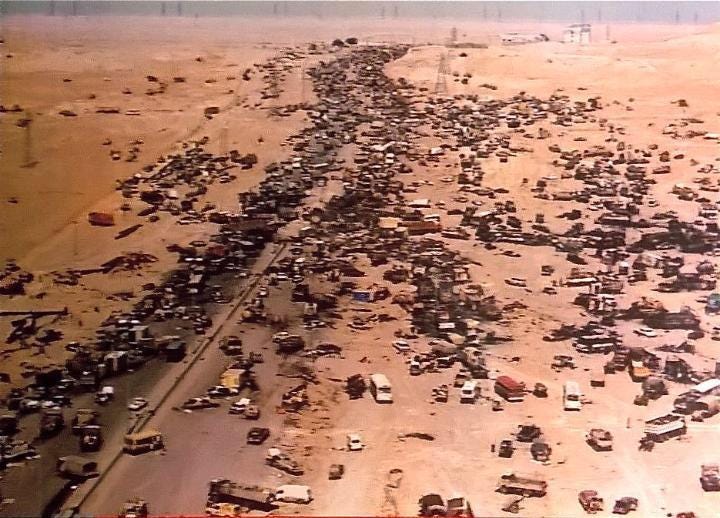
The Highway of Death, Iraq War, 1991
By William Schryver – imetatronink – November 4, 2024
It has now been ten years since I first turned my attention to the necessity of prudent financial investments in order to both preserve and hopefully enlarge the modest amount of wealth I had accumulated up to that time. I began by attempting to identify the wisest and most discerning “experts” in the field. This was no easy trick.
Fortunately, in the ten years preceding my late-2014 awakening to the importance of financial and macroeconomic matters, I had spent several years discovering that most of western academia is a sham dominated by highly credentialled ignoramuses. Therefore I was alerted to the likelihood that the so-called “experts” in other fields of study were similarly intellectually impaired, regardless of their seemingly impressive curricula vitae, how many framed certificates hung on their wall, and the size of their “assets under management”.
That said, it became apparent over time that even those I initially identified as reliable “experts” could be well-informed most of the time, and yet still be subject to blind spots that rendered them susceptible to fatal errors which could often nullify their seemingly correct judgment of everything else.
In the context of financial matters, it must be understood that the “Quantitative Easing” and near-zero interest rates that followed on the heels of the so-called “Great Financial Crisis” of 2007-2009 was a tide that floated a great many boats captained by fools whose folly would not be recognized until the consequences of central bank profligacy were revealed several years further down the road.
Even so, most of the investment “gurus” whose analysis I had come to respect managed to successfully navigate the hurricane of price inflation that roared ashore in the wake of the Covid hysteria – a storm that was then followed by the Federal Reserve’s subsequent raising of interest rates in a frantic attempt to stem the inflationary tide.
Then World War Three began.
Of course, even at this point, almost three years into that war, few people recognize it for what it is. Even fewer recognize the degree to which the geopolitical and military parameters of war itself have been radically altered in comparison to what they were during the “American Unipolar Interregnum” that commenced with the dissolution of the Soviet Union.
Indeed, the overwhelming majority of Americans believe the “unipolar moment” continues essentially intact and unthreatened. In the highly insulated environs of Wall Street and Silicon Valley, faith in the overwhelming supremacy of American high-tech and military prowess remains almost entirely unshaken, notwithstanding the ever-increasing indications to the contrary – things about which I have been writing for several years now.
Most of the gods of American high-tech and finance, and those who worship them, simply cannot discern the degree to which American power in all its forms has steadily eroded over the course of the 21st century, and that this erosion has accelerated dramatically in recent years.
For most of the western elite and their acolytes, it is still early 1991, and Norman Schwarzkopf is leading a million-man army against the hapless Iraqis in a demonstration of military might that would finally expunge the bitter humiliation of Vietnam from the American psyche.
Such people have religiously embraced the Hollywood fantasies of unassailable American superpower dominance. And given the reality that Ukraine and Israel are considered merely appendages of this assumed American military supremacy, the eastern European and Levantine theaters of World War Three have given rise to extreme examples of an unprecedented tsunami of propaganda I have been wont to call “The Imaginary War”.
This phrase I coined in the early stages of the war in Ukraine has its origins in something allegedly said by an unnamed Israeli general in the aftermath of the 2006 war in southern Lebanon – a war whose ultimate outcome was a decisive strategic defeat for Israel, but which the Israelis subsequently attempted to spin into a great victory. It was in this context that the Israeli general reportedly said, “If you can’t win a real war, win an imaginary one.”
This is precisely the narrative-building approach we have seen in Ukraine over the past two-plus years.
Most Americans, and most people around the world who believe in mainstream western narratives, are convinced that the Russians have been dealt an overwhelming strategic defeat in Ukraine; that the Russian military has been exposed as a poorly trained drunken mob; that Russian military doctrine is imbecilic; that Russian equipment is junk; that Russian military technology is decades behind its western counterparts; that American and other NATO war toys sent to Ukraine have dominated the battlefield, etc., etc.
The same types of things are believed about China, its culture, and its military capabilities.
And, of course, even greater derision is directed towards the Iranians and the North Koreans.
Just today I read a short article from a fairly prominent Wall Street hedge fund CIO, in which he wrote the following paragraph of utterly fictitious (and yet widely believed) nonsense:
Israel sent 100 aircraft for a 2000km flight to attack Tehran. Zero were shot down. First, the IDF took out Iran’s air defenses. Those Russian S-300 anti-aircraft systems can now be found disassembled in large craters through the region (Russia’s newer S-400 system underperformed expectations in Ukraine and the S-500 is in test phase). With Iran’s air defenses offline, Israeli aircraft had their way with whatever targets they chose in Tehran. They skipped over the mullahs this time. Next time who knows. Such is the nature of warfare for those with superior tech.
Never mind that literally ALL of his assertions are demonstrably false – this would-be titan of American finance intends to bet the farm on the fallacious assumptions of the imaginary wars he has convinced himself are actually taking place.
Of course, both the major party candidates for President, almost the entirety of the United States Congress, and much of the sprawling swamp of American government bureaucracy in Washington are similarly convinced of the indomitability of American imperial military might, and they are anxious to teach the current “axis of evil” in Moscow, Beijing, and Tehran a lesson they will not soon forget.
In the end – and it will come sooner than later – the only thing that will not be soon forgotten is how briefly the American unipolar moment endured, and how shockingly and suddenly it all came crashing down.
Iran slams US deployment of B-52 bombers as ‘destabilizing’
Al Mayadeen | November 4, 2024
Iranian Foreign Ministry spokesperson Esmail Baghaei criticized the United States on Monday, describing its presence in the region as “destabilizing” following its deployment of B-52 bombers in the Middle East.
At a news conference, Baghaei responded to questions about the military buildup, stating, “We have always believed that the presence of America in the region is a destabilizing presence,” adding, however, that this “will not deter (Iran’s) resolve to defend itself.”
The US military announced on Saturday the deployment of B-52 bombers to the Middle East as a warning to Iran, which has pledged to respond to the Israeli aggression that targeted several of its military sites on October 26.
The Pentagon stated that these deployments would occur in the coming months and highlighted the “flexibility of the US military movements around the world.”
“Should Iran, its partners, or its proxies choose to target American personnel or interests in the region during this time, the United States will take every measure necessary to defend our people,” Pentagon spokesperson Air Force Major General Patrick Ryder said in a statement.
Four Iranian soldiers were martyred during the latest assault on Iran, and officials reported limited damage to several radar systems.
Baghaei said that Iran’s retaliation would be “definite and decisive.” He also reaffirmed that Iran supports “all initiatives and efforts” to promote a ceasefire in Gaza and Lebanon, where “Israel” persists with its aggression.
During the news conference, Baghaei reaffirmed that Iran’s official stance against altering its nuclear doctrine and pursuing atomic weapons remains unchanged.
Quoting a recent speech by the Leader of the Islamic Revolution Sayyed Ali Khamenei, the Iranian diplomat emphasized that the Islamic Republic would be “equipped with everything necessary to defend” itself.
US, ‘Israel’ will bear the consequences
On Saturday, Sayyed Khamenei warned that the United States and the Israeli occupation will bear the consequences of their atrocities.
Speaking on National Day of the Fight against Global Arrogance, which commemorates the anniversary of the US embassy takeover by Iranian students on November 4, 1979, Sayyed Khamenei warned of the crushing response Iran would deliver in retaliation to the crimes carried out against the Islamic Republic and the Resistance.
Sayyed Khamenei stressed that Iran’s operations were not “revenge”, but rather “a logical action, an approach aligned with religion, ethics, and Islamic Law, in accordance with international regulations,” confirming that Iranian officials are constantly developing their political and military readiness to confront any hostility.
Elsewhere, he made it clear that Iran will not leave any aggression unanswered.
Iran’s missiles aimed at deterring attackers, not waging aggression: President Pezeshkian
Press TV – November 4, 2024
President Masoud Pezeshkian asserts that Iran’s missiles are aimed at deterring those seeking to potentially target the country, and are not meant to be used towards waging acts of aggression against other nations.
“We have [our] missiles [at our disposal] so they would not dare attack us. Our missiles are not meant [to be used] for carrying out attacks against anyone or [contributing to] expansionism,” the chief executive said during a ceremony on Monday.
He said the country has developed the defensive projectiles so parties such as the Israeli regime would not be able to target the Islamic Republic as they have been targeting the Gaza Strip or bomb any place or any person that they would desire.
Pezeshkian, meanwhile, hailed Gaza-based Palestinians for their “esteem and greatness” that has forbidden the Israeli regime from forcing them into surrender, despite targeting the coastal sliver with all that is at its disposal for more than a year now.
In the same context, the president slammed the regime for laying claim to respecting human rights and the international law, while its authorities perpetrate “violence, genocide, crime, and murder behind their neat and tie-wearing appearances.”
The remarks came amid the regime’s October 2023-present war of genocide against Gaza that has so far claimed the lives of more than 43,300 Palestinians, mostly women and children.
The contradiction between the regime’s claims and actions points to the regime’s “indecency and lack of identity,” he noted.
Pezeshkian berated those accusing Iran of failure to observe human rights, saying the parties that have leveled the accusations against the country were the same ones that have staged deadly attacks against the Iranian nation, including women and children, with chemical weapons and targeted the people’s sources of sustenance with sanctions.
Neutral for now: Persian Gulf states’ gamble in the Iran-Israel showdown
With Iran’s vow to retaliate against Israel, Persian Gulf states face a delicate balancing act – caught between asserting autonomy and increasing dependence on US security, all while the Resistance Axis enjoys unprecedented popularity in the region.
By Mawadda Iskandar | The Cradle | November 4, 2024
The signs of an impending Iranian response to Israel’s airstrike on Iranian military interests last month are becoming clearer. Official statements from Tehran suggest a military retaliation is inevitable and could occur before the US elections on 5 November – with some reports indicating it may be launched from Iraqi territory to curb the cycle of back-and-forth escalations that began on 1 April following Tel Aviv’s targeting of the Iranian consulate in Damascus.
Both sides are seeking to establish a new deterrence balance, albeit with very different aims. Iran, whose sovereignty has been repeatedly violated, warns of the danger posed by Israel’s expansionist ambitions in the region, while Israel, as the aggressor, seems intent on dragging the entire region into chaos, banking on unwavering US support.
Two distinct camps have emerged: on one side, the Israeli-US alliance and its supporters, and on the other, the countries of the Resistance Axis, which have launched the “battle of unity” in support of Gaza. Caught between these factions is a third group, one that seeks neutrality, unwilling to pick a side for fear of compromising its own interests.
The US is struggling to maintain influence, while Israel is playing what may be its final card. The question remains: where do the Persian Gulf states stand?
Airspace restrictions and Gulf diplomacy
The Persian Gulf states have unanimously condemned Israel’s 26 October strikes on Iranian sites, which came in response to Tehran’s own retaliatory missile attacks earlier last month following high-profile assassinations of resistance leaders carried out by the occupation state.
Statements from the Gulf Cooperation Council (GCC), Saudi Arabia, Qatar, Bahrain, the UAE, Kuwait, and Oman condemned these strikes as violations of Iranian sovereignty, escalating tensions in an already volatile West Asia.
Saudi Arabia, the UAE, and Qatar have taken a firm stance, refusing to allow Israel to use their airspace to launch further strikes against Iran, a position echoed by Jordan, which was prompted to officially deny it had allowed Israel to use its airspace to attack the Islamic Republic.
This reassured Tehran, which had threatened a forceful response against any country that facilitated Israeli attacks. These diplomatic messages coincided with Iran opening new channels of dialogue, including President Masoud Pezeshkian’s meeting with GCC officials, followed by Foreign Minister Abbas Araqchi’s diplomatic tour that included Lebanon, Syria, Saudi Arabia, Qatar, Bahrain, Kuwait, Iraq, Oman, Jordan, Egypt, and Turkiye.
Despite Amman’s claim that its airspace was not used in the recent attack, videos have emerged documenting Israeli fighter jets over Jordanian skies. Similarly, Saudi Arabia claimed its airspace was not used during the strikes, raising questions about how Israeli planes refueled over such long distances. Israel subsequently admitted to using refueling aircraft to bypass Persian Gulf airspace restrictions.
Speaking to The Cradle, Lebanese military analyst Omar Maarabouni contends that “In principle, and based on and in connection with the recent Israeli attack, a group of Gulf countries, led by Saudi Arabia, stated that they prevented the Israelis from passing through their airspace, and this is something that Iranian radar can confirm or deny, and indeed the official Iranian statement confirms that these aircraft did not pass through Gulf airspace.”
Maarabouni adds that agreements between the US and Persian Gulf states are defensive in nature, allowing these states to prevent US bases from being used offensively against Iran, especially since improved relations with Iran are now in their interest. Regarding alternative Israeli plans, Maarabouni says:
“It is quite clear that Israeli planes took the path associated with Syria and then Iraq towards Iran, and therefore we are talking about a distance of 2,000 km back and forth, and this is what Israel was keen to avoid over the issue of refueling, as F-35 and F-15 aircraft can travel distances exceeding 2,200 km without the need to refuel.”
Jordan, he says, meanwhile, finds itself in an awkward position, having claimed that Iranian missiles breached its sovereignty, despite such missiles traveling at altitudes beyond the limits recognized under international airspace law. As Maarabouni points out:
“The one who violated Jordanian sovereignty is Israel, which fired air defense missiles into Jordanian airspace to intercept Iranian missiles, but it is unclear why Jordan has adopted the responsibility of blaming the violation of its sovereignty on both Iran and Israel.”
Oil on the frontline
Persian Gulf states are wary of being dragged into the escalating conflict, especially as they attempt to close the chapter on their failing Yemen war, which backfired horribly following devastating attacks on Saudi Arabia’s prized Aramco facilities in 2019.
These strikes exposed the vulnerability of the “oil for protection” security framework under US patronage. In their recent overtures to Iran, GCC states also urged Washington to pressure Israel against targeting Iranian oil infrastructure, warning of disastrous consequences for global energy markets.
Sources in the Persian Gulf, speaking on condition of anonymity, inform The Cradle that while the Gulf states were aware of the timing of Israel’s attack, they were ready to mediate with the US if the situation escalated.
Following the attack’s failure, these states rushed to issue condemnatory statements, emphasizing their unwillingness to be drawn into direct hostilities against Tehran, despite their quiet acceptance – and even encouragement – of actions that might undermine Iranian influence or its nuclear ambitions. The Persian Gulf monarchies are eager to shield themselves from any backlash amid rising global anger over the atrocities in Gaza and Lebanon, which have put normalization efforts with Israel on hold.
US intervention: A double-edged sword
The White House has warned Iran against retaliating to Israeli strikes, stating that the US would support Israel if attacked and floating the notion that Washington “can’t restrain” Tel Aviv in the event of further attacks from Iran.
Former hawkish US national security advisor John Bolton boasted that Israel would use Persian Gulf airspace if needed, and that “these governments may complain about this, but frankly, they see Iran as a strategic threat because of its nuclear program, as well as Iran’s old support for terrorists, not only Hezbollah and Hamas, but the Houthis and Shia militias in Iraq.”
The Persian Gulf states now find themselves caught between their desire for autonomy and their dependency on US security guarantees – particularly in light of the numerous US bases spread across their territories, which primarily serve to protect Washington’s [or rather Israel’s] regional interests.
Agreements between the US and Persian Gulf states grant American forces access to airspace, ports, and military bases in these countries, providing logistical support for regional operations. While Gulf states have formally rejected offensive US operations from their territories, they still allow defensive activities.
Qatar, the only official non-NATO ally of the US, hosts the largest concentration of US forces at Al-Udeid and Al-Sailiya bases. Kuwait ranks second in terms of the quantity and quality of US assets located at four bases: Camp Doha, Arifjan, Ali al-Salem, and Buehring.
The UAE has three US bases, Al-Dhafra, Fujairah, and Jebel Ali Port, all of which provide logistical support services. As for the US facilities in Saudi Arabia, they are Eskan Village and Prince Sultan Air Base, which offer the provision of air and missile defense systems and the use of military aircraft. Bahrain hosts three bases: Juffair, Sheikh Isa, and Muharraq, and Oman hosts a similar number: Al-Masna, Thumrait, and Masira.
All of these countries fall under the domain of US Central Command (CENTCOM), which works to “counter the Iranian threat.”
Last year’s Operation Al-Aqsa Flood has reignited the debate over Persian Gulf security dependence on Washington. Experts argue that the current escalation between Iran and Israel will force Gulf states to find a balance between their diplomatic rapprochement with Tehran on the one hand, and their commitment to a US-led regional security alliance on the other.
The US has sought to reassure Persian Gulf leaders, offering assistance in defending against any potential Iranian aggression. To back up its words, the US approved a $440 million sale of TOW missiles to Riyadh and authorized the sale of over $2.2 billion in weapons and ammunition to Saudi Arabia and the UAE.
Balancing public condemnation with covert cooperation
Investigative journalist Bob Woodward’s new book War, which sheds light on recent GCC–Israeli dynamics, reveals that regional rulers, including those of the UAE, Bahrain, Saudi Arabia, and Qatar, unanimously agree – in private – on the need to eliminate Hamas, while working quietly to minimize public backlash over their covert cooperation with Israel.
After last October’s Operation Al-Aqsa Flood, Persian Gulf states condemned the attack but later launched diplomatic efforts to prevent regional tensions from escalating further. Notably, these developments have disrupted key projects, including normalization with Israel and economic diversification plans, particularly in Saudi Arabia.
Iranian journalist Mohammad Gharavi tells The Cradle that the events of 7 October, 2023 strained what had been positive Saudi-Iranian relations:
“The Iranians believed that a positive relationship would have a positive impact in terms of supporting the Palestinian cause, but the Saudi position was neutral despite the historical opportunity that could have been invested at home and in the Islamic environment. Unfortunately, the Palestinian issue is the prominent point of contention with the GCC, which is why we are sending messages that the opportunity is ripe to change this course.”
He describes Saudi–Iranian relations as having made significant advancements in terms of coordination and cooperation since the two neighboring states struck a rapprochement deal in Beijing last year:
“Iran’s reassuring messages, as well as warnings not to go too far in cooperating with the Americans and Israelis to antagonize Iran or using air, land and sea spaces to direct hostile action against it, were influential and positive and can be built upon in the coming stage, as it reflects the determination of the two countries to put aside differences in the interest of the security of the two countries and protect the strategic alliance with China and others for what it holds of economic dimensions.”
Ultimately, the Persian Gulf states remain neutral – for now. Their future course, however, will depend on visible and tangible US assurances. If such guarantees are secured, the Gulf may be willing to align more openly against Iran, given that their interests clash with those of the Resistance Axis, which promotes regional independence and self-determination – ideas that resonate with the Arab masses throughout West Asia.
Featured Video

Bombing Hitler’s Hometown
or go to
Aletho News Archives – Video-Images
From the Archives
The Biggest Threat to Peace in Middle East
By Dr. Elias Akleh* | Sabbah Report | May 24, 2010
A build up of heightened tension in the Middle East is escalating in the last few weeks. American and Israeli postures towards Lebanon, Syria, and Iran have become more threatening. Listening to speeches of political leaders one hears talks only about war not peace. Iranians and Israelis are continuously training hard for a possible showdown. Both sides are conducting extensive war games every month. This led Syrians to claim that Israel is preparing for a soon-to-come another war. The Jordanians also are warning that current stalemate of the peace process is an indication of a war breaking out this summer. The Russian President and his army chief hinted, a few months ago, that the US and Israel were planning for an attack on Iran.
Indeed Iran is, as it has been for last few years, the target of most of the threats and accusations of supporting terrorism. Escalating incitement against Iran the American Defense Department sent last month (April) to Congress a report on Iran’s military claiming Iran could develop intercontinental ballistic missiles capable of reaching the US by 2015.
Ignoring the fact that N. Korea, India, Pakistan, and Israel are proven to have nuclear weapons while Iran does not, the US Secretary of State Hillary Clinton chose in her speech, to the nuclear Non-Proliferation Treaty review conference at the UN, to focus on Iran’s alleged nuclear ambitions putting the whole world at risk as she put it. According to Clinton Iran’s acquisition of nuclear weapons, rather than Israel’s more than 200 nuclear bombs, is destabilizing the Middle East. She called on the world’s nations to rally around US efforts to hold Iran, not other nuclear countries, to account.
The accusation that Usama Bin Laden is living comfortably in Iran had received a boost after the broadcast of a documentary called “Feathered Cocaine”. This echoed the June 2003 claims of the Italian newspaper Corre de la Sierra that Bin Laden was in Iran according to some intelligence report, and according to Richard Miniter’s book “Shadow War”. … continue
Blog Roll
 Aletho News
- Bombing Hitler’s Hometown
- German journalist threatened with homelessness as German court upholds EU sanctions in landmark free speech case
- US Tells Allies That Ukraine-Bound Arms Could be Sent to Middle East
- Organized terrorism: Iran condemns killing of its diplomats in Lebanon
- Why could Gaza enter the regional war?
- Hamas official rejects Mladenov Plan linking disarmament to Gaza reconstruction
- Two Primary Elections for the Soul of ‘America First’
- Japan Clings to US Vassalage Despite Energy Crunch Caused By Iran War
- US Seeks Control Over Global Energy Infrastructure – Kremlin
- US senators target Orban government for standing up to Zelensky
- If Americans Knew
- Researchers at Human Rights Watch Resign Over Blocked Report on Palestinian Refugee Return
- Jewish Groups Are Backing a War Americans Don’t Want
- Eric Fingerhut Thinks He’s the President of the Jews
- Top Jewish Philanthropists, Rabbis Urge Israeli President to Take Action Against ‘Jewish Extremists’
- Don’t Be Fooled. Zionist Leaders Have Always Wanted to Control Southern Lebanon
- Israel’s widespread use of torture is a core element of its genocide against the Palestinian people
- In Israel’s War on Iran, Many Middle East US Bases Rendered “All But Uninhabitable”
- ‘Burn the lawn’: Israel pursues ‘Rafah model’ in southern Lebanon
- A genocide here, an amputation there
- Reports: Iran mobilizing 1M fighters, Israel-US run low on ammo, Israeli army faces shortage – Not a ceasefire Day 168
- No Tricks Zone
- Devastating Assessment Of Comirnaty Vaccine By Former Senior Pfizer Europe Toxicologist
- New Study: CO2 Is ‘Effectively Negligible’ As An Explanatory Climate Change Factor Since 2000
- Former Pfizer Toxicologist Dr. Helmut Sterz Tells Bundestag Hearing Pfizer Vaccine Should Have Never Been Approved
- Energy Expert: Germany’s Nuclear Phaseout Was A “500 Billion Euro Mistake”
- New Research: South Australia’s Mid-Holocene Sea Surface Temperatures Were 4°C Warmer Than Today
- Storing Green Energy To Last Germany 10 Days Would Require A 60-Million Tonne Battery
- New Studies: UK Sea Levels Were 4 Meters Higher Than Today During The Mid-Holocene
- Destructive Green New Deal: German Energy And Metal Group Warns Of Drastic Crisis
- New Study Documents A 20-Year Pause In Arctic Sea Ice Decline – Driven By Internal Variability
- Wake-up Call: Survey Shows Majority Of Germans Now Favor Postponing Climate Targets!
 Aletho News