CIA Assessment: The Resistance Cannot Be Crushed
By Kit Klarenberg | Global Delinquents | March 15, 2026
The Judaeo-American war on Iran was intended to be a lightning strike routing, fought exclusively from the air, lasting only a few days. Instead, Washington and its Zionist proxy have blundered into a major multi-front conflict, which could well threaten the Empire’s very existence. The initial US aerial bombardment’s centrepiece was Supreme Leader Ali Khamenei’s February 28th murder. Initially hailed by Western media as “the assassination of the century,” the vile act has resulted in catastrophe for the perpetrators.
The Islamic Republic’s relentless battering of Zionist entity civilian centres and military and intelligence infrastructure, and US bases throughout West Asia, hasn’t been deterred one iota. Vast crowds took to the streets of Tehran in vengeful mourning. Their righteous anger has pullulated throughout the Arab and Muslim world. Ever since, incensed Shiites have violently clashed with security forces in multiple major Pakistani cities. Meanwhile, Bahrain teeters on the brink of all-out revolution. Now, Mojtaba Khamenei, the slain Supreme Leader’s son, has taken his place.
Iranian citizens of every ethnic and religious extraction braved US-Israeli airstrikes to celebrate his ascension. Commonly perceived as a hardliner with strong ties to the Iranian Revolutionary Guards Corps, the expectation that the new Supreme Leader will adopt a considerably less conciliatory, patient approach than his father is widespread. Western sources forecast Mojtaba may decide the Islamic Republic “must move quickly to obtain nuclear weapons in order to forestall future US and Israeli attacks,” overturning Ali Khamenei’s longstanding fatwa against their development by Tehran.
US President Donald Trump has declared he is “not happy” with Mojtaba taking power, and Israeli apparatchiks are likewise perturbed by the development. Nonetheless, this was an inevitable upshot of assassinating the former Supreme Leader. There was also no reason to believe doing so would precipitate the Islamic Republic’s collapse, or lead to Tehran’s military submission. It begs the obvious question of why Washington and Tel Aviv electively helped install a ruler more committed than ever to expelling the Empire from West Asia.
Similarly, Hezbollah’s extraordinary broadsides of the Zionist entity since Khameinei’s assassination should dispel any notion – as perpetuated by Israeli political and military chiefs – the group was obliterated by Tel Aviv’s criminal October 2024 invasion of Lebanon. That incursion was prefaced by an operation in which thousands of pagers used by senior Hezbollah operatives were detonated simultaneously, having been wired with explosives by Mossad pre-purchase, killing and injuring many. A week-and-a-half later, the group’s Secretary General Hassan Nasrallah was lethally targeted in a Zionist entity airstrike.
Evidently, the Resistance cannot be crushed via high-level assassinations. In fact, such actions actively strengthen its members. This inconvenient reality has been well-known to the CIA since at least 2009. In July that year, the Agency produced a top secret assessment laying out the pros and cons of liquidating “high value targets” (HVTs). It was prepared in advance of Barack Obama’s CIA chief Leon Panetta shifting US “counter-terror” operations from capturing and torturing high-level suspects, to outright executing them.
The assessment concluded HVT operations “can play a useful role when they are part of a broader counterinsurgency strategy,” and sought to “assist policymakers and military officers involved in authorizing or planning” such strikes. However, it listed many “potential negative effects” of “high value” assassinations. Israel’s past killing of Hamas and Hezbollah leaders were specifically cited as examples of how the strategy can spectacularly backfire. We have witnessed the CIA’s unheeded cautions play out in real-time since February 28th.
Foremost among prospective blowback from HVT operations is that the risk high-level assassinations can increase an “insurgent” group’s support. This occurs when killing a target “[strengthens] an armed group’s bond with the population, radicalizing an insurgent group’s remaining leaders, creating a vacuum into which more radical groups can enter, and escalating or deescalating a conflict in ways that favor the insurgents.” Such actions can also “[erode] the ‘rules of the game’ between the government and insurgents,” thus exacerbating “the level of violence in a conflict”:
“HVT strikes, however, may increase support for the insurgents, particularly if these strikes enhance insurgent leaders’ lore, if noncombatants are killed in the attacks, if legitimate or semi-legitimate politicians aligned with the insurgents are targeted… An insurgent group’s unifying cause, deep ties to its constituency, or a broad support base can lessen the impact of leadership losses by ensuring a steady flow of replacement recruits.”
The CIA assessment noted several historical instances of supposed HVT successes. When high-level targets have “prominent public profiles”, assassinations can in specific instances shatter a target group. However, this was not the case with Hamas or Hezbollah. The pair “carry out state-like functions, such as providing healthcare services,” so group leaders are well-known to citizens of Gaza and Lebanon. Yet, their “highly disciplined nature, social service network, and reserve of respected leaders” mean they can easily “reorganize” in the wake of assassinations.
The Zionist entity had by this point been engaged in “targeted-killings” against Hamas, Hezbollah, and other Resistance groups since the mid-1990s. However, their “decentralized command structures, compartmented leadership, strong succession planning, and deep ties to their communities” made them “highly resilient to leadership losses.” Undeterred, Tel Aviv’s high-level assassinations continued apace. In the early 2000s, Hamas founder Sheikh Yassin and the group’s leader in Gaza Abdel Aziz al-Rantisi were murdered. However, the killings “strengthened solidarity” between Resistance factions, while “[bolstering] support for hardline militant leaders.”
The obvious lessons of this wanton bloodletting remained unlearned by the Zionist entity, once the Gaza Holocaust erupted. In June 2024, elite imperial journal Foreign Affairs published a report unequivocally headlined Hamas Is Winning. It boldly concluded “Israel’s failing strategy makes its enemy stronger.” The outlet also recorded how “according to the measures that matter,” Hamas was considerably bigger and more powerful than on October 7th 2023. Israel had thus stumbled into a deeply ruinous attritional war, with a “tenacious and deadly guerrilla force.”
Hamas’ surging popularity with Palestinians throughout the Gaza genocide was found to have significantly enhanced the group’s “ability to recruit… [and] attract new generations of fighters and operatives.” This granted Hamas the ability to launch “lethal operations” in areas previously “cleared” by the IOF “easily”. Foreign Affairs charged the Zionist entity, to its “great detriment”, failed to comprehend how “the carnage and devastation it has unleashed in Gaza has only made its enemy stronger.”
It is not merely Hamas that has been galvanised by the Gaza genocide. Israel’s “carnage and devastation” has greatly expanded the ranks and resolve of the entire Resistance, while its constituent members have won hearts and minds globally in ever-mounting numbers. Tel Aviv and its Anglo-American puppet[master]s have no good choices left to make, in a criminal war of choice waged against an indefatigable adversary committed to total victory, the likes of which they have never faced off against before.
The calamitous outcomes of Judaeo-American conflict with Iran were amply spelled out in a June 2025 report by the Israel-based Institute for National Security Studies. Among other things, it cautioned against assassinating Ali Khamenei, as the Islamic Republic “would likely have little difficulty selecting a successor, who could prove to be more extreme or more capable,” while uniting the Iranian public and government more than ever behind all-out victory. The consequences of disregarding this prophetic curse will reverberate throughout West Asia for centuries.
How Zionist Control Is Hurting US Interests

By Abbas Hashemite – New Eastern Outlook – March 14, 2026
The recent US attack on Iran has raised criticism both internationally and at home due to President Trump’s shift from America First to Israel First and over the Zionist control over the US establishment.
US-Israel Strategic Alignment: Historical Patterns
Escalating tensions between the US, Israel, and Iran have raised a critical concern in global geopolitics: has the US attacked Iran to protect its regional interests, or has it jumped into this fray to defend Netanyahu’s Zionist regime in Israel and its strategic interests? The history of American foreign policy decisions since the establishment of the illegitimate Israeli state suggests that protecting Israel’s national and strategic interests in the Middle East and beyond has become a key aspect of the United States’ strategic priorities.
Throughout history, whenever Israel felt threatened or insecure by a regional power, Washington has always supported it directly or indirectly. The historic rivalry between Israel and Iran and its escalation after the recent genocidal operation by the Israeli Defence Forces (IDF) has rendered the situation more intense. Israel considers Iran’s missile capabilities and nuclear program as a threat to its sovereignty and security. Moreover, Iran’s regional proxies also pose a significant threat to Israel’s expansionist agenda.
Recently, the United States and Iran were engaged in negotiations over the latter’s nuclear program. Reports propose that the two sides have made significant progress in resolving the issue peacefully. However, the United States and Israel launched a combined attack on Iran, targeting its key military and political leadership. Iranian Supreme Leader Ayatollah Ali Khamenei and several other high-level military and political leaders of the country were killed in the US-Israel joint strikes. These strikes, despite positive progress in the US-Iran peace negotiations, created an international perception that the United States is fighting Israel’s war in the Middle East.
Domestic and International Backlash Against US Involvement
Dissenting voices regarding the US involvement in a foreign war are rising even within the United States. People from within the US Army are raising questions over the country’s involvement in a foreign war. Even former soldiers are asking whether the US military personnel should sacrifice their lives to secure the strategic interests of Israel. Reportedly, many US soldiers have expressed their concerns over their participation in this war against Iran. They seek to know the moral and legal status of a war waged merely to protect the interests of a specific allied country. The United States faced a similar issue during the Cold War, especially in the Vietnam and Iraq wars, when numerous military personnel criticized and questioned policies that led the country into those wars. Within both U.S. military and civilian policy circles, there is mounting pressure to more clearly distinguish between America’s core national interests and the interests of its allies.
Economic and Global Implications of the Conflict
The Middle East is the center of global energy politics, and the Persian Gulf is one of the key maritime routes for global oil supply. Iran has already blocked the Strait of Hormuz, leading to disruption in global oil and energy supply, causing inflation around the world. Oil and energy prices have surged across Europe, Asia, and other regions, impacting everyday consumers and households—including those in the United States. Due to the aggressive policies of former US governments, the country has lost trillions of dollars in Vietnam, Iraq, and Afghanistan. The recent US war against Iran would prove far more expensive because of the latter’s geostrategic location and greater regional influence.
On the diplomatic front, this war will further tarnish Washington’s international image. Most of the Global South is already hostile to the United States’ interventionist policies. A prolonged war with Iran would not only widen the gulf between the US and its European allies, but it would also increase Russia and China’s global support. This war has already shifted global public opinion against the United States, weakening the country’s international credibility. Many developing nations are increasingly aligning themselves with Russia and China, signaling their interest in joining the BRICS coalition.
Washington’s involvement in this war, at the behest of Israel, has created significant intricacies for its regional allies. It has exposed the Gulf Cooperation Council (GCC), a key US ally in the Middle East, to significant Iranian attacks. Iran is repeatedly targeting US interests across the region. The GCC countries are also facing disruption in the supply chain, leading to significant economic losses, due to the blockade of the Strait of Hormuz by Iran. Moreover, it has undermined the security and safety of the UAE for global investors. This suggests that this war would create visible fractures in the US-GCC relations.
However, the United States’ involvement in this conflict, despite knowing that it will lead to severe public backlash and impinge on the country’s interests in the Middle East and beyond, demonstrates that in Washington, it’s not the US leadership but the Zionist lobby that actually calls the shots. The release of the Epstein files further strengthens the notion that the Zionists use such tools to blackmail and influence the US leaders, including President Trump, to mold the US policies to protect Israel’s interests in the Middle East and around the world.
Аbbas Hashemite is a political observer and research analyst for regional and global geopolitical issues. He is currently working as an independent researcher and journalist
Follow new articles on our Telegram channel
Iran warns it may target US missile launch sites in UAE cities
By Al Mayadeen | March 14, 2026
The spokesperson for Iran’s central Khatam al-Anbiya Headquarters warned that Iranian forces may target US missile launch sites operating from locations inside cities in the United Arab Emirates, following attacks launched against Iranian territory.
Lieutenant Colonel Ebrahim Zolfaghari said the US military had resorted to operating from ports, docks, and concealed facilities within UAE cities after its military bases in the region were destroyed.
According to the Iranian official, US forces launched missiles from these locations targeting the Iranian islands of Abu Musa and Kharg. The US CENTCOM had published footage of earlier attacks from desert settings where High Mobility Artillery Rocket System (HIMARS) fired precision munitions at Iranian territory.
Although several Gulf states have publicly claimed that their territories would not be used for attacks against Iran, open-source information suggests otherwise. Flight-tracking data indicate that Saudi Arabian airspace is being used by aerial refueling tankers supporting fighter aircraft involved in strikes against Iran. The Prince Sultan Air Base in Saudi Arabia has reportedly hosted multiple Stratotanker refueling aircraft participating in these operations.
Kuwait also plays a key logistical and operational role. The country hosts US Marine contingents, communications infrastructure, command-and-control facilities, and other assets used by US forces participating in operations targeting Iran.
In Qatar, the Al Udeid Air Base serves as a central node for regional operations, hosting critical radar systems for missile early warning and satellite communications infrastructure and serving as the forward headquarters for United States Central Command air operations.
Meanwhile, the United Arab Emirates hosts anti-missile radar systems and interceptor batteries, along with logistical infrastructure supporting both US and Israeli personnel, including facilities used for resupply and operational coordination.
Iran asserts right to strike launch sites
Zolfaghari addressed the UAE leadership directly, stating that Iran considers it a legitimate right to strike hostile US missile launch sites located in ports, shipping terminals, and military hideouts used by US forces in certain UAE cities.
He stressed that such actions would fall within Iran’s right to defend its national sovereignty and territorial integrity. The spokesperson reiterated that Tehran views the targeting of US launch sites used in attacks against Iranian territory as a lawful defensive measure.
Zolfaghari also called on residents in the UAE to stay away from ports, docks, and locations hosting US military forces inside urban areas to avoid potential harm. He emphasized that Iran’s position stems from what it describes as its legitimate right to defend its sovereignty and national territory in the face of US attacks.
Additional CENTCOM-supporting infrastructure in the UAE
Beyond missile defense assets, the UAE hosts several facilities and capabilities that support CENTCOM activities:
Al Dhafra Air Base
One of the most important US-operated installations in the Gulf. It hosts:
- US Air Force fighter aircraft
- ISR platforms (intelligence, surveillance, reconnaissance)
- MQ-9 Reaper drones
- Aerial refueling aircraft
- Surveillance aircraft such as AWACS
Port logistics hubs
Jebel Ali Port in Dubai is the largest US Navy port of call in West Asia, regularly hosting carrier strike group vessels, destroyers, and logistics ships. It alsos serves as a major resupply and maintenance hub for the United States Navy.
Pre-positioned military stockpiles
The UAE hosts US pre-positioned equipment, including:
- Ammunition
- Armored vehicles
- Spare aircraft parts
- Logistics supplies for rapid force deployment.
Intelligence and surveillance infrastructure
Facilities linked to:
- Regional signals intelligence collection
- Satellite communication nodes
- Integrated air defense networks.
With US threats against Kharg Island escalating, and the possibility of a limited US operation to seize the strategically critical island increasingly discussed, the United States Central Command would likely view the United Arab Emirates as the primary hub for logistics and land-based strike operations against Iranian positions along the mountainous coastline opposite the country.
Given its proximity to southern Iran and its extensive military infrastructure, the UAE could serve as a key staging area for missile launchers, aircraft, reconnaissance platforms, refueling operations, and maritime logistics supporting operations around Kharg and the Gulf.
The UAE would also likely play a central role in any US attempt to control the Strait of Hormuz, particularly after Tehran restricted the passage of US- and Israeli-linked vessels through the critical waterway. The strait is one of the world’s most important maritime choke points, handling roughly 20% of global seaborne oil trade, making control of the passage a major strategic objective in any escalation.
Iran says drone strikes targeted Israeli intelligence, cyber units
Meanwhile, amid operations directed away from the Gulf and toward the Israeli-occupied territories, the Islamic Republic of Iran’s Army announced carrying out drone strikes targeting key Israeli military infrastructure, including intelligence and cyber operations facilities.
In a statement, the army said the strikes targeted the Israeli military’s intelligence apparatus, specifically “Aman”, Unit 8200, which is specialized in cyber operations and data processing, and sites housing Israeli fighter jets were among the targets struck during the operation.
According to the Iranian army, the attacks were carried out in honor of “the brave fallen Iranian leaders,” naming Chief of the General Staff of the Iranian Armed Forces Abdolrahim Mousavi, IRGC Commander Mohammad Pakpour, and Defense Minister Aziz Nasirzadeh.
The EU never learns – except for the wrong lessons
By Tarik Cyril Amar | RT | March 13, 2026
Some observers of the current EU ‘elites’, including this author, used to believe that their defining feature – apart from things such as complicity in genocide and wars of aggression with Israel and the US, bigoted xenophobia about Russia and China, and, of course, pervasive corruption – was an absolute inability to learn.
We must admit, we stand corrected: Those running the EU are able to learn. The real problem is their relentless compulsion to learn the wrong thing. We are not dealing with non-learners but anti-learners: where others progress from experience, they regress.
Case in point, their response to the fact that their US-Israeli masters have started a war to end if not strictly all then at least all (barely) affordable energy supplies to the EU’s economies, while its major players are already limping along on a spectrum between walking-wounded (for instance, France, maybe) to comatose (Germany, definitely).
In Germany, still the largest single economy inside the EU, providing almost a fourth of the bloc’s total GDP, industrial demand – orders from factories – fell by over 11% in January. Such a decrease – really, collapse – in orders is “drastic,” as German Manager Magazine notes. According to the Financial Times, this “very weak” start into the new year, puts preceding – and very modest – signs of a recovery from years of stagnation in doubt. Indeed. And all of that disappointing data was gathered before the fallout of the Iran war had even started.
Regarding the latter, it will be severe. Even Berlin’s Ministry of Economics admits that the risks stemming from the war’s consequences, most of them still incoming, is substantial.
In general, the Eurozone – different from but covering most of the EU – is not in good shape either. According to Bloomberg, a very low and yet still over-optimistic Eurostat estimate of expansion by 0.3% for the last quarter of 2025 has just been revised downward to 0.2%. But frankly, who cares at that level of misery?
And for the Eurozone as well, America and Israel’s unprovoked war against Iran is likely to make things much worse. Philip Lane, chief economist of the European Central Bank (ECB), has confirmed that much to the Financial Times : An enduring decrease in oil and gas supplies from the Middle East can (read: will), he warns, bring about a “substantial spike” in inflation and a “sharp drop in output.”
And what is the EU leadership’s response to this deeply depressing outlook for its economy and the European citizens depending on it? Let’s not dream. It is true, if the EU’s ‘elites’ were in the business of protecting European interests and prosperity, they would, obviously, take a sharp turn against both the US and Israel (as well as London in case it were to stick to its special-poodle relationship with Washington).
Yet if the EU leadership had such priorities, it would long have turned against the US, for its blatant exploitation of its vassal regimes via, first, NATO over-expansion and, now, crippling overspending, for Ukraine proxy war outsourcing, and for devastating tariff warfare. It would also long have broken with Israel, for, to name only two compelling reasons, its genocide and serial wars of aggression that are both horrifically criminal and extremely destabilizing and damaging not “only” to the Middle East but the world as a whole and Europe in particular.
In short, the EU would not even be in the mess it is now if it actually took care of Europe. And, by the way, if it were not so craven but had opposed the US and Israel instead of pandering to them, perhaps it could even have contributed to preventing the current criminal war against Iran.
That, however, would not be the EU as it really is. In sordid reality, it is a second iteration of NATO, that is, an instrument of the US empire (notwithstanding showy and silly Greenland hysterics) and of international oligarchic structures. Ordinary Europeans matter only in so far as they are expected to vote – and think and speak – in line with EU ‘elite’ priorities, and when they do not, they are made to.
No wonder then that the utterly unelected and legally extremely challenged EU Commission head Ursula von der Leyen – really, the EU’s despot and US viceroy rolled into one – demonstratively does not give a damn about the massive energy price shock that has already started hitting the fragile economies of EU-Europe.
With tanker ships on fire off the Strait of Hormuz, oil surging over $100 per barrel, national reserves being dipped into, gas prices up by 50% in the EU, and, according to the International Energy Agency (IEA), oil markets suffering “the largest supply disruption in history,” von der Leyen has had nothing to offer but reverting to the tired – and less than successful – playbook of 2022, originally put together when the Western-Russian proxy war via Ukraine escalated. Tinkering, again, with ineffective price caps, taxes and fees, electricity market structures and price distortions, renewables, and wasting money on subsidies (out of budgets that are already vastly overstretched) – that was about it. No wonder, several national governments have already signaled their impatience with what, in essence, is inactivity and non-strategy.
At least as important, though, was what von der Leyen took pains to rule out: Returning to Russian supplies would be a “strategic blunder,” the EU’s one-woman decider-in-chief declared. Instead, she insists, the EU must stay the course and continue ridding itself of the last remnants of Russian gas and oil. Clearly, von der Leyen is anxious that not everyone in the EU’s ‘elites’ is up to her level of ideological obstinacy and economic as well as geopolitical irrationality. “Some,” she chided, “argue that we should abandon our long-term strategy and even go back to Russian fossil fuels.” Perish the thought! As long as von der Leyen and her type run the EU, it will ruin itself before doing the obvious – making peace with Russia and rebuilding economic ties, including in the energy sector.
And there you have it: This is a leadership style not simply refusing to learn from experience but repeating the worst blunders of the past. The von der Leyen way of policy making – from sanctions (now on round 20, I believe) to pipelines – is akin to negative natural selection: Whatever does not work will be done again, and again, and again. The real question, it seems, is not if the EU “elites” will ever stop being perverse anti-learners, but whether – or when – they will lose control. Mismanaging the massive shock that the US and Israel have sent their way now may finally provoke enough backlash from below to send the von der Leyens packing. For Europe’s sake, let’s hope for the best, even if it’s delivered by the worst.
Tarik Cyril Amar is a historian from Germany working at Koç University, Istanbul, on Russia, Ukraine, and Eastern Europe, the history of World War II, the cultural Cold War, and the politics of memory.
Hosting Washington’s war: Bahrain faces the consequences
By Hasan Qamber | The Cradle | March 12, 2026
The Persian Gulf is entering one of the most volatile periods in its modern history. Military confrontation between Iran, the US, and Israel has, from the outset, unfolded across the Gulf geography itself. States hosting western military infrastructure – particularly Bahrain – have not merely been exposed to the conflict’s expansion, but structurally integrated into its battlefield logic.
For Bahrain, the current escalation raises urgent questions about the kingdom’s internal stability, the resilience of Gulf political systems, and the capacity of neighboring countries to absorb the security, economic, and social shocks generated by an expanding war.
Frontline kingdom
Bahrain today stands squarely at the center of the region’s intensifying confrontation. Despite its small size, the island holds outsized political and military importance. Its strategic location, heavy reliance on the energy sector, and fragile domestic balances make it one of the Gulf states most exposed to the consequences of prolonged escalation.
The kingdom’s hosting of the US Fifth Fleet headquarters cements its position as a key node in Washington’s military architecture in the Persian Gulf. This presence transforms Bahrain into a potential target in any direct clash between Tehran and Washington. As the war goes on, US installations on Bahraini soil are increasingly viewed as forward operational platforms – and therefore legitimate strategic objectives in a widening regional war.
The implications extend beyond the military domain. Bahrain’s domestic political arena remains shaped by unresolved tensions dating back to the 2011 uprising. Renewed confrontation risks aggravating these internal fault lines by tying national stability more closely to the trajectory of external conflict.
Recent developments have effectively placed Bahrain on the front line. Its role as both a logistical hub for western military operations and a regional energy services center means that any escalation in the Persian Gulf immediately reverberates across the island’s security environment.
According to reports, Iranian strikes against Bahraini-based targets began on 28 February. By early March, roughly 70 to 75 ballistic missiles and more than 120 drones had reportedly been launched. Bahraini authorities stated that most incoming projectiles were intercepted.
Targets included facilities linked to the US Fifth Fleet, Bahraini and US military infrastructure, the BAPCO refinery complex in Ma’amir, and sites in Manama associated with US personnel. Installations near Bahrain International Airport and a major desalination plant – the Abu Jarjour facility – were also reportedly struck.
While the full extent of the damage remains unclear, some accounts suggest partial destruction of base infrastructure and temporary disruption of logistical systems. Heightened alert levels were subsequently reported across US installations throughout the Persian Gulf following injuries among American personnel.
Energy pressure points
The military dimension of the crisis intersects with Bahrain’s structural economic vulnerabilities. The kingdom’s economy remains heavily dependent on the energy sector, with BAPCO Energies forming its backbone. Following recent upgrades, refining capacity has reached approximately 405,000 barrels per day – positioning Bahrain as an important, if relatively modest, contributor to regional oil supply dynamics.
Reports indicate that the refinery complex has been hit at least once during the escalation, triggering fires and forcing the company to invoke force majeure clauses on certain export commitments. Temporary disruptions to refining operations reportedly led to shipment delays and a partial pause in exports, although authorities insist domestic fuel supplies remain secure.
The situation is further complicated by the growing role of international investors in Bahrain’s energy sector. The sale of selected BAPCO assets to major global investment firms – including the US-based BlackRock – has generated political controversy.
Civil society groups have criticized such moves as part of a broader normalization trajectory aligned with Washington’s regional agenda, particularly amid mounting public debt estimated to exceed 130 percent of GDP.
Any sustained targeting of energy infrastructure would therefore carry consequences far beyond immediate production losses. It would threaten investor confidence, fiscal stability, and Bahrain’s long-term economic positioning within the Gulf.
Hormuz chokehold
The crisis acquires even greater significance in light of Iran taking control over maritime traffic through the Strait of Hormuz – one of the most critical arteries in the global energy system. At least 20 percent of the world’s seaborne oil trade passes through this narrow waterway. Any disruption to navigation would send shockwaves through international markets and place immense pressure on Gulf economies.
For Bahrain, whose oil export routes are heavily tied to the strait, strategic alternatives remain limited. While pipeline connections to Saudi Arabia offer partial mitigation, rerouting exports through Red Sea terminals or relying on floating storage solutions would impose logistical and financial constraints.
The implications extend to food security. Gulf states import the vast majority of their food supplies via maritime routes traversing Hormuz, with some importing as much as 85–90 percent overall. Bahrain, constrained by limited agricultural capacity, is particularly vulnerable.
Early indicators of wartime strain have already surfaced, including higher transport costs, shipment delays, and rising prices for essential imported goods. Authorities maintain that strategic reserves are sufficient for now, but prolonged disruption could test these assurances.
Public mood and internal pressure
Bahrain’s domestic political environment adds another layer of complexity. The kingdom is often described as the only Gulf state where a Shia demographic majority lives under Sunni political rule, though the absence of official statistics makes precise figures contested. Estimates have fluctuated significantly since the introduction of political naturalization policies in the early 2000s.
The 2006 “Bandar Report” controversy – which alleged systematic demographic engineering – remains a reference point in debates about representation and legitimacy. Today, observers suggest Shia citizens may constitute between 55 and 65 percent of the population, with Sunnis forming a substantial minority. Expatriates account for more than half of Bahrain’s total population, further complicating social dynamics.
Against this backdrop, public reactions to regional escalation diverge sharply from official state positions. While Gulf governments continue to emphasize strategic partnership with Washington, segments of Bahraini society openly express support for strikes targeting US military facilities in the region. Social media circulation of footage from recent attacks reflects this polarization.
Authorities have responded with sweeping security measures aimed at preventing internal destabilization. Arrests have been reported against individuals accused of documenting strikes or organizing demonstrations. Restrictions on public gatherings and curfews in sensitive areas underline official concerns that regional war could reignite domestic protest movements.
According to human rights and field sources speaking exclusively to The Cradle, at least 114 people have been arrested since the beginning of the events. The Public Prosecution has sought the death penalty for a group of citizens and residents accused of “communicating with the enemy” for documenting missile and drone strikes on military targets.
This reflects the scale of the political challenge Bahrain faces as it attempts to balance internal stability with its security and external commitments amid a divided public mood regarding the regional war.
Strategic dilemmas
Manama’s predicament reflects a broader Gulf reality. The kingdom faces simultaneous pressures stemming from its geographic exposure, reliance on external military guarantees, and unresolved internal political tensions. Crisis management under such conditions becomes increasingly complex as regional confrontation deepens.
There is also uncertainty surrounding the stance of neighboring Gulf states. Should escalation expand to include widespread targeting of energy infrastructure or maritime trade routes, regional economic interdependence could magnify the impact on domestic stability across the peninsula.
A sustained Iran–US–Israeli confrontation threatens to reshape the political calculus of Gulf states. For decades, security architectures across the region have been anchored in strategic partnerships with Washington. Direct confrontation between Iran and the US, therefore, places these states in a structurally vulnerable position.
Three major risks loom. First, the physical targeting of military bases and oil facilities could undermine deterrence frameworks. Second, prolonged disruption to trade and energy flows may generate severe economic stress. Third, divergent popular attitudes toward the conflict risk fueling internal political tensions.
In Bahrain, these dynamics intersect with an already active opposition and a politically engaged society. Continued escalation could heighten domestic sensitivity to government policies and widen the gap between official narratives and public sentiment.
Paths ahead
Several trajectories remain possible. Rapid containment of escalation would restore the familiar pattern of managed tension in the Persian Gulf. A prolonged exchange of strikes, however, could intensify economic pressure and gradually erode political stability across Gulf states.
The most dangerous scenario would see the region transformed into an open theater of great-power confrontation – fundamentally altering the balance of power and exposing smaller states like Bahrain to sustained instability.
The kingdom now finds itself navigating an exceptional moment in regional history. Escalation is now shaping the island’s economic stability, political tensions, and security calculations in real time. Efforts by authorities to enforce internal control underline the depth of official concern that external conflict could reopen unresolved domestic fault lines.
The kingdom’s experience points to a wider shift across the Persian Gulf: strategic alignment with Washington’s military order is increasingly transforming allied states into operational terrain. In Bahrain’s case, the distance between the forward base and the front line has effectively collapsed.
The US fell for its own Iran propaganda
By Robert Inlakesh | Al Mayadeen | March 13, 2026
The US government’s mistake with Iran has been that it clearly fell into believing its own lies. Think tanks, donors, paid advisors, lobby groups, and establishment analysts are all responsible for the catastrophic mistakes that have been made in attacking the Islamic Republic.
What was supposed to be a war, destined to be all over in four days, quickly turned into weeks, months, and now, in US President Donald Trump’s own words, a “forever” war. In order to understand why, we have to assess the way the political system in Washington works.
As we now know, US politicians are oftentimes chosen by the donor class. Most of the US Congress and Senate take considerable sums from AIPAC and affiliated pro-Israeli, pro-war donors. The Israeli Lobby not only pays its chosen politicians, but also hands them materials to run through, so that they skip to the Zionist script and position themselves as attack dogs against anyone who stands up to the lobby.
Hiding underneath this, we have think tanks, which are the policy expert wing of the lobbyists. These think tank “experts” are brought in as the brains behind the operation. They shift around between holding positions within different administrations, sitting on boards, and writing briefs or analyses for think tanks.
Then you have the mainstream media, which is owned by many of the same people funding the think tanks and lobby groups, employing articulate individuals to parrot their propaganda. The media itself is a bubble, where the so-called “reputable” outlets rely on each other for validity and help to police the boundaries of the “acceptable” discourse, meaning the likes of the New York Times, BBC, and others.
When it comes to broadcast media in specific, the top suppliers of stories, soundbites, on-the-ground footage, and leads are Reuters, AFP, and the Associated Press. Oftentimes, broadcast media channels will simply copy and paste the leads or descriptions from what these suppliers provide, altering them ever so slightly to suit their channel’s bias. That is why they often use very similar language and report the same stories for their news bulletins. Anyone who has worked in a newsroom knows this to be the case.
This trio of information control, which often intersects and enjoys some crossover, is what pollutes the minds of the masses on a daily basis. This is important to understand in order for the rest of this article to make sense.
Falling for their own lies
In the lead-up to the illegal attack on the Islamic Republic of Iran, the Western ruling class constantly repeated the idea that Iran and its allies were severely weakened. Revelling in what will likely prove to be a pyrrhic victory in Syria, with the installation of a pro-US Zionist collaborator regime in Damascus, the annihilation of Gaza’s infrastructure, along with the severe blows to Hezbollah’s leadership, all three elements of the Zionist information control system began to grow arrogant.
Think Tanks like the Zionist Washington Institute for Near East Policy (WINEP) held a series of conferences about the disarmament of Hezbollah and discussed how the so-called Gaza ceasefire was supposed to be weaponized in “Israel’s” favour, while discussing war on Iran as if it was like putting down a once dominant racehorse with a broken leg.
Still, today, if you look at WINEP’s homepage, there are analysis pieces, written by Zionists salivating over a victory over Iran and envisaging how the future will pan out in a West Asia dominated by the Israelis. “The Middle East’s 1919 Moment” and “A Levant Without Militias” discuss the downfall of Iran and Hezbollah, respectively. Even at a time of great crisis for the Zionist entity, they cannot help but fantasize about how they will dominate in the future.
The trio of information control has created a parallel universe for themselves, one which they continue to cling to, for fear of shattering their entire view of reality.
When Donald Trump and Israeli PM Benjamin Netanyahu claimed to have greatly degraded Iran, it wasn’t just them speaking; they were in lockstep with the think tanks, lobbyists, and donors. Just as was the case when former US envoy to Lebanon, Morgan Ortagus, confidently asserted that Hezbollah was defeated.
For them, assessing the realities on the ground was no longer a priority; what was important was bolstering a narrative that would lead to the war that the Zionist entity desired. In essence, what they had done was fall for their own nonsense.
All of this stems from the psychological blow the Zionist regime and its loyal supremacist backers suffered on October 7, 2023. When a few thousand Palestinian Resistance fighters, armed with light weapons, tore down the illusion of the Israeli surveillance regime and collapsed its southern command within hours, the Zionists went into a kind of mental hysteria.
Suddenly, on that day, it was proven that the theory of Hezbollah’s late Secretary General, Sayyed Hassan Nasrallah, was correct: “Israel” is indeed weaker than a spider’s web. This meant for them that two things had to be achieved: the first was that their so-called “deterrence capacity” had to be re-established, which they believed would be achieved through committing the world’s first live-streamed genocide.
The second imperative was that the Zionist project had to be rapidly accelerated. At first, this appeared unlikely, yet their perceived successes in Lebanon and Syria appeared to give them the impression that it was possible.
Along comes the second Trump Presidency, which was bought and paid for by the Zionist billionaire class.
Donald Trump, a man with a vocabulary no greater than that of a 10-year-old, is their perfect puppet. Not only this, his entire administration is staffed with ultra-Zionists or paid shills who lack basic intelligence. Therefore, the Zionists saw that this was the perfect time for them to hatch the last phase of their so-called master plan to expand their regime and rule the entire region.
In the process of doing this, the Zionists dismantled the United Nations and the notion of International Law, instead ushering in “the law of the jungle.” There are no longer international norms or red lines, just total chaos.
Meanwhile, as this was going on, the Zionists adopted the attitude toward the global population that they should be scared into submission; should they dare stand up to oppose the tyranny everyone has watched unfold before their very eyes. When they are surprised because things aren’t going their way, they cry victim and, in a fit of rage, attempt to punish you. This is a reflection of their unstable mental state.
All of this is relevant because it explains how we have gotten to this point and why this trio of information control has bought into their own nonsense. The war on Iran was evidently going to be a catastrophe, but they did it anyway. Those of us who have been monitoring the situation could also tell that Lebanese Hezbollah was far from militarily finished, which the Israeli media are now beginning to come to terms with.
What do they do now that the situation is getting out of hand? They censor and desperately lie to cover their tracks. They censor their deaths, lie about the destruction and missile hits, fake air defense victories, and claim tactical and operational military victories that don’t exist. One example of this is the US Trump administration, which claimed to have destroyed Iran’s navy during the first days of the war and still brags about sinking new ships.
The Israelis take things even further: with dozens of military vehicles hit and their soldiers falling into ambush after ambush in Lebanon, only two soldiers have died, according to them. They have even banned the filming of Iranian and Hezbollah missile strikes, threatening their own population with fines and jail time for doing so. Sometimes, they will claim to have intercepted all incoming projectiles or say they fell in open spaces, yet not too long after, published videos show direct hits. It’s getting so bad there, in terms of censorship, that their own people are getting agitated.
These people lived in a “reality” where Hezbollah was weak and Iran was weak, claiming that it had only a few thousand missiles and a handful of launchers; a “reality” in which killing Iran’s leader, Sayyed Ali Khamenei, would instantly lead to regime change, where the Iranian people would suddenly fight against their government because Netanyahu told them so. Perhaps the only thing they don’t believe is their laughable lies about Iranian protester deaths; that nonsense is reserved for the Pahlavist cult.
As the entire planet is witnessing, Iran and the Axis of Resistance that it backs are far from weak. Their determination is strong, and their capabilities are clearly greater than the Zionists expected. The longer this insane arrogance continues, the worse things are going to get, because just as we saw in the Gaza Strip, nobody is about to back down and become the slaves of the terrorist entity occupying Palestine.
Seyed M. Marandi: Threat of Seizing Kharg Island & the Use of Nuclear Weapons
Glenn Diesen | March 12, 2026
Seyed Mohammad Marandi is a professor at Tehran University and a former advisor to Iran’s Nuclear Negotiation Team. Prof. Marandi argues that it will be extremely difficult for the US to seize Kharg Island, and Iran would then destroy all energy facilities in the region.
Follow Prof. Glenn Diesen:
- Substack: https://glenndiesen.substack.com/
- X/Twitter: https://x.com/Glenn_Diesen
- Patreon: https://www.patreon.com/glenndiesen
Support the research by Prof. Glenn Diesen:
- PayPal: https://www.paypal.com/paypalme/glenndiesen
- Buy me a Coffee: buymeacoffee.com/gdieseng
- Go Fund Me: https://gofund.me/09ea012f
Michael von der Schulenburg: Europe’s Self-Defeating Iran War Policy
Glenn Diesen | March 12, 2026
Michael von der Schulenburg is a German member of the EU Parliament who was previously a UN diplomat for 34 years in positions that included Assistant Secretary General of the UN Department of Political and Peacebuilding Affairs. Schulenburg also lived and worked for 9 years in Iran for the UN, and explains why this war is yet another disaster for Europe.
Follow Prof. Glenn Diesen:
- Substack: https://glenndiesen.substack.com/
- X/Twitter: https://x.com/Glenn_Diesen
- Patreon: https://www.patreon.com/glenndiesen
Support the research by Prof. Glenn Diesen:
- PayPal: https://www.paypal.com/paypalme/glenndiesen
- Buy me a Coffee: buymeacoffee.com/gdieseng
- Go Fund Me: https://gofund.me/09ea012f
- Books by Prof. Glenn Diesen
The Strategic Folly of a (Serious) US Ground Invasion of Iran
It simply can’t be done
Ashes of Pompeii | March 12, 2026
Tucker Carlson recently spoke of a potential false flag operation designed to manufacture consent for a US ground invasion of Iran. Tucker is no longer an “insider” in Washington but he still likely has his sources. Therefore this talk deserves serious examination, not because an invasion is feasible, but because the gap between political rhetoric and military reality has never been wider. Twelve days into the current conflict, with US bases being degraded under sustained attack and Iranian missile barrages continuing unabated, the notion of a ground invasion collapses under the weight of logistical, technological, and geographical constraints that no amount of political will can overcome.
The war in Ukraine has fundamentally altered the calculus of conventional warfare, demonstrating that drones have radically changed the battlefield. Mechanized armor columns, the backbone of American land warfare doctrine since World War II, have proven devastatingly vulnerable to cheap, ubiquitous unmanned systems. What took billions in sophisticated weaponry to accomplish in previous eras can now be achieved with commercially available drones costing mere thousands of dollars. The US military is only now scrambling to adapt to this reality, while Iran are already drone masters, having made drone warfare one of the foundations of its defensive doctrine. Iranian forces have not merely acquired drones; they have built an entire asymmetric warfare architecture designed to exploit the vulnerabilities of conventional mechanized forces. And make no mistake, the Chinese would be thrilled to supply Iran with all the drones and components necessary.
This technological shift is particularly catastrophic for invasion planners when combined with Iranian geography. Unlike Iraq’s vast desert expanses, Iran is characterized by narrow mountain passes, constricted valleys, and limited corridors of approach through the Zagros and Alborz ranges. These geographic chokepoints are perfect killing zones for drone swarms and precision missile strikes. Any US mechanized column attempting to advance would be funneled through predictable routes, stripped of air support by Iranian air defenses, and systematically destroyed by loitering munitions and anti-tank drones. The Ukraine war has shown that even forces with extensive drone warfare experience suffer devastating losses in such conditions; the United States, still adapting its doctrine and procurement, would face an even steeper learning curve under combat conditions.
The logistical foundation required for invasion simply does not exist. Operation Desert Storm required six months of uncontested buildup in 1991. Today, US forward bases across the region are under active bombardment, with mounting casualties and degraded operational capacity. The notion that America could amass the hundreds of thousands of troops, thousands of armored vehicles, and millions of tons of supplies needed for an Iranian invasion while its regional infrastructure is being systematically struck is fantasy. Compounding this is the seriously degraded state of US strategic sealift capacity, which has suffered decades of underinvestment. The ships needed to transport heavy armor and sustainment cargo simply do not exist in sufficient numbers, and those that do are vulnerable to Iranian anti-ship missiles in the confined waters of the Persian Gulf.
Air power cannot compensate for these limitations. The current aerial campaign, despite causing significant destruction, has not broken Iranian morale or degraded its capacity to launch heavy ballistic missile retaliations. If anything, the surprise attack has unified the Iranian population behind the regime, demonstrating the counterproductive nature of aerial coercion against a nationalist population with deep historical memories of foreign intervention. Meanwhile, Israel is absorbing punishing strikes, undermining narratives of effortless dominance. Nor is air transport any sort of logistical substitute for sealift for an operation of this nature. The quantities required are far, far beyond what the USAF can sustain.
And this is to say nothing of manpower restraints. About 700,000 US troops particpated in Desert Storm. Presumably an even larger invasion force would be required for Iran, given its size, geography and demographics. Does anyone in their right mind imagine anywhere up to a million US soldiers being available for this sort of endevour?
This does not mean the conflict will not escalate. The danger Tucker Carlson identified, a false flag or manufactured incident, remains real precisely because it could justify limited actions short of invasion. What is most likely is some form of limited incursion: a raid on a coastal facility, a seizure of an island in the Gulf, or a special forces operation designed to create the appearance of decisive action. Such an operation would allow President Trump to project strength domestically, to pound his chest before an American audience hungry for demonstrations of power. It would generate headlines and temporary political capital.
But such theatrical gestures would not alter the strategic equation. They would not degrade Iran’s missile capacity, break its will to resist, or secure US interests in the region. They would likely provoke further retaliation, deepen Iranian resolve, and expose the limits of American power rather than its strength. A limited incursion is not an invasion; it is a political performance that leaves the fundamental constraints of geography, technology, and logistics untouched.
The hard reality is that a US ground invasion of Iran is not merely inadvisable, it is militarily impossible under current conditions. The logistics are impossible, drones have changed warfare where Iran has adapted and America has not, and geography ensures that any mechanized advance would be suicidal. Trump and Hegseth can plot all the invasions they want, but even the current obsequious Pentagon, would push back very hard against the suicidal folly of a ground invasion.
The conflict will continue, but its resolution will not come through fantasies of conquest that belong to a bygone era of total American hegemony.
US-Israeli war of aggression on Iran meant to reshape region: Omani FM
Press TV – March 12, 2026
Oman’s Foreign Minister Sayyid Badr Albusaidi says that the United States and Israel launched an all-out coordinated aggression against Iran to block the Palestinian statehood and reshape the West Asia region.
Albusaidi said on Thursday that the “real objective of the war” is to “weaken Iran, reshape the region, and push the normalization agenda,” including efforts “to prevent the establishment of a Palestinian state.”
The top Omani diplomat warned that the ongoing US and Israeli attacks on Iran are part of a “dangerous chain of violations.”
The war on Iran has undermined the legal framework that has provided regional stability for decades, he added.
Albusaidi also pointed out that Iran is not the only target of the ongoing aggression.
“There is a broader plan targeting the region, and Iran is not the only target. Many regional actors are aware of this, but they are betting that aligning with the United States may push it to revise its decisions and policies,” he said.
In recent months, the Tel Aviv regime has displayed its ill intention by releasing maps which show several areas of Jordan, Egypt, Saudi Arabia and Iraq as part of “Greater Israel,” a vicious Zionist project, widely supported by the administration of US President Donald Trump.
The Israeli regime’s prime minister, Benjamin Netanyahu and members of his extremist cabinet have already announced a plan to annex the occupied West Bank in order to steal more Palestinian land and block the possibility of a Palestinian statehood.
Albusaidi also warned the war could drive higher oil prices and major supply chain disruptions globally.
The US-Israeli aggression has already driven the oil and gas prices much higher and caused food inflation.
Oman is seeking to stop the war and return to diplomacy, he stressed.
Albusaidi said the war may end soon, but called for reconsidering Persian Gulf security strategies and preparing for worst-case scenarios.
The US and Israel attacked Iran on February 28 in an unprovoked act of aggression, targeting sites across Iran, including schools, hospitals, and sports halls.
Iran responded by launching missiles and drones at targets inside Israel as well as at American bases across the region.
Senior Iranian officials have asserted that any deliberate assault by the United States and Israeli regime on Iran’s civilian and cultural heritage sites constitutes a “flagrant breach of international humanitarian law and an undisputed war crime.”
Elsewhere in his remarks on Thursday, the Omani foreign minister said Oman will not join Trump’s so-called “Board of Peace” and will not normalize relations with Israel.
The remarks come as Trump keeps pushing more Arab states of the Persian Gulf region to join the Abraham Accords and normalize their ties with Israel despite the regime’s brutal more than to-year long Israeli assault against Palestinians in Gaza.
Macron’s aircraft carrier and warplanes to the Persian Gulf is a dangerous vanity project
By Finian Cunningham | Strategic Culture Foundation | March 12, 2026
Like a knight in shining armour, French President Emmanuel Macron is vowing to defend Europe’s interests as the U.S.-Israeli war on Iran escalates.
Macron is not defending Europe or French honor. His theatrical swashbuckling is going to get more people killed and very possibly make the economic impact on Europe even more disastrous.
On a visit to Cyprus this week, Macron declared that a strike on Cyprus was a strike on Europe. He was referring to drone attacks on a British air base on the Mediterranean island last week that were blamed on Iran. It’s not clear who fired the drones at a time when false-flag operations are suspected in Turkey and Azerbaijan, carried out by Israeli forces seeking to embroil the region.
The French president was also filmed inspecting troops on board the Charles de Gaulle, France’s sole aircraft carrier, which he said is being sent along with 12 other warships to the Strait of Hormuz. The aircraft carrier was abruptly redirected from NATO exercises in the Atlantic to the Mediterranean.
The Strait of Hormuz has been closed to oil tankers since the U.S. and Israel launched their aggression on Iran two weeks ago. Europe is particularly vulnerable to oil price shocks and diminishing supply since the EU cut itself off from Russian energy markets over the proxy war in Ukraine.
In addition to the French armada being dispatched to the Persian Gulf, Macron has also ordered Rafale fighter jets to “defend the skies” over the United Arab Emirates, where the French have a base.
However, Macron’s latest show of bravado has telltale question marks. He emphasized that the French naval mission and its air assets were “purely defensive.” This indicates a lack of resolve, and that Paris is worried about the political backlash among French voters if it is seen to be wading into a reckless war started by the unhinged Americans and Israelis.
Also, Macron will be concerned that Iran views any involvement by European states as a party to the aggression and will likewise be targeted. That’s why Macron was trying to make out that French warships would be only “escorting tankers” to ensure passage through the Strait of Hormuz. The subtext to Iran is, please don’t hit us.
But Iran has categorically stated that as long as the U.S. and Israel’s aggression continues, then not one drop of oil will pass out of the Persian Gulf. If French warships try to enter the Gulf even as escort vessels, they will be seen as trying to break Iran’s tactical blockade. That will make them legitimate targets for Iran.
Macron qualified his armada plan as happening when the conflict subsides. That hardly sounds like a forthright act of bravery, more like hedging your bets.
What the French leader is doing is engaging in a vanity contest. Notably, the British Prime Minister, Keir Starmer, has been ridiculed by Donald Trump as “not being Winston Churchill” over his dithering to send military support. The British press has noted that Macron was trolling British weakness and “rubbing our noses in it”. The visit to Cyprus – which still has colonial links with London – was aimed at showing up the British as ineffective, unlike the chivalrous French coming to the rescue.
Macron is also attempting to sideline Germany’s Chancellor Friedrich Merz, who was in the White House last week, sucking up to Trump by avowing Berlin’s support against Iran. There has been a long-running ill feeling in Paris that Germany is becoming too big for its boots militarily. Macron is endeavoring to don the mantle of European leadership by declaring the defense of interests in the Persian Gulf.
The blunt truth is that Europe and France in particular are a non-entity. The EU is a mess because it has been a pathetic vassal to the United States, cutting itself off from Russian energy and damaging its economies. Now that oil is being cut off from the Persian Gulf and oil prices are heading above $100 per barrel, the Europeans are hit with a double whammy – all because of their subservience to Washington.
Macron’s strutting around the Charles de Gaulle to the strains of the Marseillaise is just theatrics to contrive looking as if he is doing something.
Another vanity factor is the major loss of the French warplane deal with Colombia last week.
For years, the French have been bidding for the sale of their Rafale fighter jets to the South American country. At the last minute, Colombia canceled the purchase and opted instead for Swedish Gripen jets. The loss is huge, amounting to €3 billion for French revenue and thousands of manufacturing jobs. But even more than that, the knock-on effect is a serious setback to French ambitions to crack the strategic Latin American market.
As soon as the news of the Colombia setback was announced, Macron took to nationwide television with his plans to send the Charles de Gaulle aircraft carrier and its squadron of Rafale jets.
This is Macron compensating for being jilted by Colombia and the potential damage to France’s military reputation and future sales of its Rafale. He is using the Persian Gulf as an advertising platform for the French military.
The mobilizing of French sea and air assets is less about “defending” Europe and more about boosting national ego and Macron’s self-image as a reincarnation of Napoleon or De Gaulle.
Macron’s folly could see him getting France and Europe dragged into a disastrous war instigated by Trump and the genocidal Israeli regime.
Iran has warned that France or any other European involvement in the war will not be viewed as neutral. France, Britain, and Germany have fanned this war by their duplicity and pandering to the United States and Israel. Macron’s vanity is an added dangerous factor for escalating the conflict and the catastrophic impact on the global economy.
If Macron and the Europeans had any moral fibre, they should be condemning the U.S. and Israeli aggression against Iran, not exploiting it for self-aggrandizement.
‘All ports in Persian Gulf will be legitimate targets if Iranian ports are attacked’
Press TV – March 11, 2026
The senior spokesman of Iran’s armed forces has warned that all ports and economic centers in Persian Gulf littoral states will be considered legitimate targets for Iran if the United States attacks Iranian ports as part of the ongoing joint aggression with Israel against the country.
“If the US follows through with its threat against Iran’s ports, there will definitely be no port, economic center, or location in the Persian Gulf that could remain beyond our reach, and they will be struck as legitimate targets,” Brigadier General Abolfazl Shekarchi said on Wednesday.
Shekarchi said that Iran has exercised restraint since the start of the US-Israeli aggression in late February by limiting its attacks to US military bases and assets in the region.
However, the general warned that attacks will expand to cover all locations in Persian Gulf countries if the US attacks key infrastructure in southern Iran.
The warning comes in response to US threats of attacking Iranian oil production facilities, as Washington faces growing pressure over rising international energy and commodity prices caused by the escalating conflict in the Persian Gulf.
Prices have increased steadily since earlier this week when Iran intensified its restrictions on the passage of ships through the Strait of Hormuz, a key waterway in the Persian Gulf responsible for a fifth of global oil demand.
Shekarchi rejected claims by the US military that its operations had caused Iranian naval vessels to be trapped in docks and economic ports in southern Iran.
“We consider this news one hundred percent wrong, and it is a lie… The (Iranian) armed forces are standing powerfully, and if necessary, we will carry out operations heavier than those we have carried out so far,” he told state TV.
Featured Video
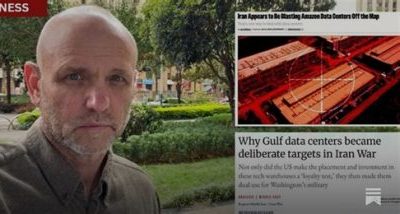
Iran spent $1 million to wipe out $30 billion in data center plans, and take down Amazon in the ME
or go to
Aletho News Archives – Video-Images
From the Archives
Clash of Civilization, Iran Part II
By Jamal Kanj – Intifada-Palestine.com – January 14, 2011
Israel’s survival kit is: perpetuate conflict, insecurity to rationalize collective hate and finally playing victim.
Devoid of conflict, Israel implodes internally; without hate, Zionism loses its justification; and playing eternal victim to continue blackmailing the West. Absence of this holy trinity, Israel ceases to exist. … continue
Blog Roll
 Aletho News
- China Rejects Outside Pressure on Trade Ties After New US Russia Sanctions Bill
- Houthis Keep Advancing as the Red Sea Crisis Deepens
- Iran spent $1 million to wipe out $30 billion in data center plans, and take down Amazon in the ME
- Zionist billionaire pressure to silence Macklemore sparks exodus from Ed Sheeran tour
- House Votes to End Iran War for Third Time
- North Korea Slams US Plan for ‘AUKUS 2.0’ with South Korea and Japan
- Prolonging US-Iran Conflict Not Meeting Interests of Int’l Community – China’s Wang Yi
- EU bans former Zelensky aide from parliament
- NATO-backed Kosovo separatist ‘responsible for war crimes’
- US destroying international space law
- If Americans Knew
- Palestinian-American Journalist Naqaa Hamed Detained by Israeli Forces After Settlers Targeted Her
- U.S. Makes, Israel Takes: The Real Story of U.S.-Israeli Military Cooperation
- Night raids rise in Palestine
- Tucker Carlson interviews Norman Finkelstein about Gaza
- Groups urge Americans to support Van Hollen legislation on Israel’s killing of Americans & Palestinians
- Trump administration plans to send 40,000 tons of bombs to Israel: report
- Sanctions Target Iran’s Government, But Kill Hospitalized 23-Year-Old Woman
- An alternative view on the book “Israel’s Lobby: America in the Grip of a Foreign Power”
- Ed Sheeran’s band Beoga, other opening acts quit tour after Macklemore was dropped over his pro-Palestinian comments
- The assassination attempt on President Trump in Butler and the various Israeli connections to it
- No Tricks Zone
- New Study: ‘Global Drought Shows No Detectable Recent Acceleration Under Climate Warming’
- Economic Masterminds: German Socialists Suggest Taxing Productivity Gains Stemming From Using AI
- The South China Sea Has Not Been Cooperating With The Climate Change Narrative
- Energy Crisis: Germany Enters Heating Season With Historically Low Gas Reserve Fill Levels
- New Study: The Antarctic Ice Sheet Gained Mass From 2020-2024 Due To Staggering Snow And Ice Accumulation
- Study: Ocean Heating Rates From Thousands Of Years Ago ‘Dwarf’ Modern Ocean Heating Rates
- Climate Extremists Target, Attack Large-Scale Power Grid Infrastructure In Germany!
- New Study: Antarctic Ice Melt Has Contributed Less Than 1 Centimeter To Sea Level Rise In The Last 30 Years
- Fear Of Debate: Alarmist German Climate Scientist Calls On Mainstream Media To Discredit Skeptic Voices
- End-Of-August Arctic Sea Ice Extent Hasn’t Fallen In 20 Years, Official Data Show!
 Aletho News