America’s Syrian Gulag
By Brad Pearce | The Libertarian Institute | August 1, 2024
At the beginning of last month the U.S. Deputy Assistant Secretary of State for Near Eastern Affairs, Ethan Goldrich, granted an interview to Rudaw, which is something like PBS for Iraqi Kurdistan. He emphasized that the United States has no plan to end its occupation of northeast Syria, where the U.S. continues to maintain some nine hundred troops under the guise of preventing the resurgence of the Islamic State. The U.S. claims it is in Syria under the authorization of United Nations Security Council Resolution 2254 to bring an end to the “Syrian Crisis,” however much of the crisis has ended, and where it has not it is primarily due to foreign occupation. Overall, the interview shows that the U.S. is continuing its dead-end policy, but Goldrich does say something interesting: the United States has concerns about providing “humanitarian” assistance for a network of prisons for IS fighters.
To those who know about the United States’ continued presence in Syria supporting the Kurdish separatists and their military known as the Syrian Democratic Force [SDF], it is commonly said that the American motive is to steal Syrian oil and grain. One would also wonder how much nine hundred soldiers could accomplish, but of course as usual they are actually there as hostages, to ensure that in Syria cannot try to retake this area without killing Americans and thus unleashing the wrath of the U.S. government. This prison network provides another important angle to the occupation. While the prisons in Syrian Kurdistan are not secret, they are also not well known. However, CNN (of all places) recently featured an excellent investigation exposing that more than 50,000 humans are kept in a network of twenty-seven facilities in Syria. CNN’s chief international correspondent Clarissa Ward was given rare access to the prisons and her reporting is illuminating. All of the inmates are denied access to any form of legal process and have no chance of release besides a vague hope that their home countries may repatriate them. Everything the United States has done in Syria, of course, it has been done in the name of human rights; but it seems to be the case that all of these individuals would have had a better chance of receiving some form of trial and definite sentencing under the government of the Syrian Arab Republic. At the very least, they could not be denied a legal process to a greater extent than they currently are.
There are two primary categories of prisoners the U.S.-funded facilities are holding in Syria. The first are accused Islamic State terrorists—most of them probably are fighters captured by the SDF, but in the absence of a legal process it is impossible to know—and families of Islamic State militants. The largest prison is known as “Panorama” and holds 4,000 inmates. According to CNN, legal experts have called it, “A U.S.-funded legal black hole, worse than Guantanamo Bay.” Clarissa Ward was allowed to see two cells and speak to a handful of prisoners. The first thing one notices is that this is a “nice” facility. One would imagine the SDF would hold prisoners in some ancient Ottoman fortress, but this is clearly a modern and newly built prison for which the U.S. taxpayer has paid a fortune. It is overcrowded, but nothing like the images one commonly sees of third world prisons. Of course it was a managed tour, as Ward acknowledged in her report. The problem is that the inmates have been there for years and have no legal rights, though an SDF official claimed that they intend to reintegrate these people into society; it has just not been possible to make progress in that regard as no country will take them.
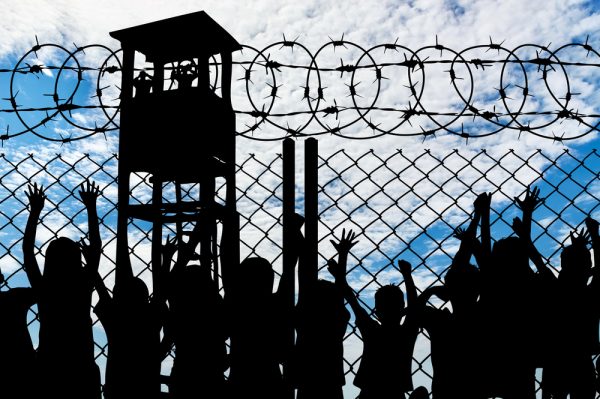
While the men are mostly kept in conventional prisons, the women and children, who are not accused of any crime, are kept in what must be the world’s largest literal concentration camp, Al Hol. The camp holds 40,000 people. Five years after the fall of the caliphate there is no plan for what to do with the individuals stored at this desert camp. Many of the women remain ideologically committed, though Ward also spoke to one former American citizen who has fully turned against IS and even stopped covering in the camp, but she has had her U.S. citizenship stripped on grounds that there was an error in her naturalization process. At a certain age—supposedly eighteen, but according to inmates as early as fourteen—the boys are removed from the camp and sent to the prisons to stop the teens from marrying and producing a “new generation of Islamic extremists.” While the conditions appear to to be broadly humane, if bleak, it is indeed hard to imagine a better breeding ground for radical Islam than this desert city of IS wives denied human rights by a United States proxy. It is of course the case that IS arose from American managed prisons in Iraq in the first place.
The biggest question is why CNN was given this access, with the SDF volunteering information about a prison system which has been criticized by basically every major human rights organization. Based on the interviews it seems to me that the SDF wants out of this obligation. The United States is functionally making them run a Gulag Archipelago and even if they are paid for it, running the prisons consumes an enormous amount of man hours by personnel who could be put to other uses. Further, there is the constant risk of breakouts (as happened in 2022) and of terrorist groups trying to liberate the camp. However, the United States clearly has no other plan for the ultimate fate of these humans, unless they intend to use them to unleash a new wave of terrorism. This is simply yet another policy where our ruling class has no exit strategy. It seems that the U.S. will occupy northeast Syria forever, if only to imprison some 50,000 people without trial. The irony, of course, is that they will continue to justify their presence by saying they need to bring human rights to Syria, just not for those trapped in this desert Guantanamo.
Slanders against China over Ukraine crisis fall apart on their own
Global Times | July 26, 2024
Chinese Foreign Minister Wang Yi held talks with Ukrainian Foreign Minister Dmytro Kuleba in the southern Chinese city of Guangzhou on Wednesday. The Ukraine crisis has entered its third year, with the conflict ongoing and risks of escalation and spillover still present. As the highest-ranking Ukrainian official to visit China since the outbreak of the conflict, the discussions and the signals sent during the talks, as well as whether there are signs of peace in the Russia-Ukraine conflict, have garnered international attention. Particularly in light of China’s successful mediation efforts in re-establishing diplomatic relations between Saudi Arabia and Iran, and promoting internal reconciliation of Palestine, there are heightened expectations for China’s constructive role in promoting peace talks in the Russia-Ukraine issue.
As part of China’s recent diplomatic efforts to mediate international and regional hotspots, China’s proactive invitation to Kuleba to visit has garnered international attention. According to Reuters, citing Ukrainian accompanying officials, the talk lasted over three hours, longer than planned, and was “very deep and concentrated.” The word “deep” is rarely used in diplomatic settings. In a statement after the meeting, the Ukrainian side stated, “China’s role as a global force for peace is important.” This reaffirms China’s role as a peacemaker and highlights the effectiveness of the meeting.
As a direct party to the Russia-Ukraine conflict, Ukraine has shown greater interest in China’s positions than before. This has led international public opinion to cautious optimism about the direction of the Russia-Ukraine issue and to pay more attention to China’s role in major regional conflicts. Even Western media, which often distorted and smeared China’s stance on the Russia-Ukraine issue, is now speculating whether China intends to preempt the US in playing the role of peacemaker. These discussions in various directions all confirm that China’s efforts to promote peace are increasingly prominent and have become an acknowledged reality in the international community.
The distortions and slanders against China by the West have largely fallen apart on their own. The fairness of China’s position has been once again validated, and China’s proposals have withstood the test of time. Western efforts to stoke the fire have only prolonged the conflict. Ukrainian President Volodymyr Zelensky stated in a recent interview, “We have to finish the war as soon as possible.” More and more signs point to the fact that the resolution of all conflicts will ultimately return to the negotiating table; all disputes will eventually be resolved through political means. This is precisely what China has consistently advocated.
From the handshake between Saudi Arabia and Iran, to the historic reconciliation within Palestine, to the complex and challenging Ukraine crisis, why does China’s position repeatedly manage to gather the broadest consensus in the international community? First, it is because China maintains an objective and fair stance and is committed to mediation and promoting dialogue. Second, China adheres to the concept of common, comprehensive, cooperative, and sustainable security, working tirelessly to maintain world peace, stability, and development. In the face of crises, China does not stoke the flames or take advantage of the situation for its own gain. This stance is visible to the international community and the parties involved in the conflict.
There is an Arabic proverb: “Seek knowledge, even if you have to go as far as China.” Now, the saying “Seek peace in China” is also becoming popular. On the complex international stage, China’s role as a responsible major power maintaining world peace is increasingly recognized. As China called for in the Global Security Initiative Concept Paper in 2023, “countries need to work in solidarity to foster a community of shared security for mankind and build a world that is free from fear and enjoys universal security.” China’s stance is clear and consistent: between peace and war, it chooses peace; between dialogue and sanctions, it chooses dialogue; between cooling down and fueling the fire, it chooses cooling down. On the Ukraine crisis, China remains straightforward and sincere, without political self-interest or geopolitical manipulation. China is truly dedicated to mediation and promoting dialogue to achieve a cease-fire and an end to the conflict.
Of course, the Ukraine crisis did not form overnight, and resolving the issue will not be accomplished in a single step. It requires the joint efforts of the international community. Recently, US Secretary of State Antony Blinken once again claimed at the Aspen Security Forum that “China can’t have it both ways.” Many in the West remain stuck in the mindset of “supporting one side,” which only complicates and intensifies the conflict. Influential major countries, in particular, should align with China to create conditions and provide support for direct dialogue and negotiations between Russia and Ukraine. Only when major powers contribute positive energy rather than negative energy can there be an early glimpse of a cease-fire in this conflict.
Russia Ready for Ukraine Peace Talks With Focus on Clear Security Agreements
Sputnik – 17.07.2024
Russia is ready for negotiations on Ukraine and European security issues and will incorporate safeguards against dual interpretations in any future European security treaty said Russian Foreign Minister Sergey Lavrov.
“We are ready for negotiations, but considering the sad experience of talks and consultations with the West and Ukrainians… I hope a treaty will be reached at some stage on European security, and in this context the Ukraine crisis will be resolved,” Lavrov stated during a press conference following a UN Security Council meeting.
“We will, of course, be very careful with the wording and will incorporate safeguards into this document against repeated unscrupulous, unreliable interpretations,” the foreign minister added.
Lavrov emphasized that, unlike China, the West does not address the root causes of the conflict in its initiatives on Ukraine.
“This already concerns the content of the dialogue; China has very clearly indicated in its first initiative the need to start with addressing the root causes of the current crisis in Europe and to work on agreements to eliminate these causes,” he said.
He noted that “no one at the Copenhagen or Burgenstock meetings even mentioned the root causes.”
Thus, the West is trying to push through Volodymyr Zelensky’s plan by all possible means.
“A course has been set to push through at any cost the so-called Zelensky plan, which has a clearly defined form of an ultimatum,” Lavrov emphasized.
Lavrov’s comments were in response to a question about Russia’s possible participation in the second summit on the Ukraine conflict and the outcomes of the recent conference in Switzerland.
On Russia-US Unofficial Contacts Regarding Ukraine
Russia and the United States have held unofficial and so-called “second level” expert level contacts to discuss issues related to the conflict in Ukraine, Minister Lavrov added.
“I will tell you in confidence — we have had unofficial contacts with the Americans involving political experts, political experts who know each other and understand the policies of their governments,” Lavrov told the press conference, adding that Ukraine was on the agenda of such contacts.
Despite the fact that the two countries are holding phone conversations from time to time, there is nothing significant in these talks, he noted.
On Russia’s Readiness to Work With a New US President
Russia will be ready to work with any elected president of the United States, the foreign minister claimed.
“Once again I want to say: we will work, we will be ready to work with any American leader that the American people elect and who … will be ready for an equal, mutually respectful dialogue,” Lavrov said at the press event.
On Israel Seeking to Involve the US in Regional Escalation
It appears that Israel’s goal is to involve the United States in the escalation of tensions with Iran, the minister observed.
“The sense is that they want to provoke them into full-scale involvement with Hezbollah. The purpose of such a provocation, analysts suggest, is to draw the United States directly into the involvement of its armed forces in this [regional] conflict,” Lavrov emphasized.
Russia hopes the West will do everything to ensure that such ideas, “if they exist in the Israeli leadership,” will remain only ideas.
Moscow is doing everything to “calm down the situation,” Lavrov added.
On the Nord Stream Explosions
Russia will continue seeking the truth regarding the explosions of the Nord Stream gas pipelines, Lavrov said.
“We will pursue the truth – since I’ve mentioned the Nord Streams, we’re going to seek the truth,” he highlighted.
JFK Jr. and the Jewish Curse on the Kennedys

BY LAURENT GUYÉNOT • UNZ REVIEW • JULY 12, 2024
John Fitzgerald Kennedy, Jr. died 25 years ago, with his wife and his sister-in-law.
He was assassinated. I’ll summarize the evidence below.
He was assassinated because he was JFK’s son, and had political ambitions driven by a strong filial piety. He had to die for the same reason his uncle RFK had to die in 1968: no Kennedy should ever approach the White House again — unless, Rabbi Jeffrey Salkin suggests, he is also a Schlossberg. And JFK Jr. could have reached the White House in eight years (he would have been 48 in November 2008; his father became president at 43).
“The Kennedy family is a clan, a tribe, a sovereignty, and a dynasty,” once wrote Arthur Krock, who knew them well.[1] None of the Kennedys can be understood as mere individuals. And so, in a deeper sense, the reason JFK Jr. had to die is that he was the grandson of the founding patriarch, Joe Kennedy. The point was candidly made by John Podhoretz in an op-ed piece for the New York Post, published on the very day when JFK Jr.’s body was recovered from the ocean floor, together with the bodies of his wife and sister-in-law. In that most disgusting piece of fiction, Podhoretz imagines that the Devil is telling Joe in Hell: “every time you think your family is on its way back to glory, I just have to do something. Like I did this weekend, with your grandson John.” According to Podhoretz, speaking in the name of the Devil to Joe, JFK Jr. died in retribution for what his grandfather did to the Jews, “when you were America’s ambassador to England, saying all those nice things about Hitler, doing everything you could to prevent Jewish emigration from Nazi Germany. Thousands of Jews died because of you.”
Note that, logically, the Jewish god Yahweh, not the Devil, should want to punish Joe by killing his grandson. Unless, of course, Yahweh is the Devil. Podhoretz took no time to ponder this question; he could not wait one day to voice his delight, while all Americans were mourning the prince of Camelot.
John Podhoretz is the son of Norman Podhoretz (his colleagues at the Washington Times used to call him “John P. Normanson” because he had been introduced to them as “John Podhoretz, Norman’s son”). Norman will be remembered as the man who wanted so much to launch World War IV. The Podhoretz love world wars because world wars are always good for Israel. Which is also why they have an eternal hatred for Joe Kennedy, the man who almost succeeded in averting World War II. As I explained in “Joseph P. Kennedy, the Cursed Peacemaker,” Joe Kennedy was not a friend of Hitler, but a friend of peace, just like Neville Chamberlain. “I am pro-peace, I pray, hope, and work for peace,” he declared on his first return from London in December 1938.[2]
For trying to prevent the Jews from drawing America into the war, Joe Kennedy was deemed a holocaustic arch-anti-Semite. It is quite astonishing, actually, that his sons could do so well in American politics, despite their father’s reputation as a Hitler-appeaser. It is, in part, a tribute to Joe’s political shrewdness. Here is a funny story told by John Hughes-Wilson:
Joseph Kennedy solved the problem in 1956 by secretly asking a prominent media and entertainment business mogul called Joe Hooker to orchestrate a right-wing press campaign against his son, by accusing the then Senator Jack Kennedy of being a “Jewish puppet”, secretly in hock to Jewish interests and influences. Hooker and his neo-Fascist contacts duly smeared JFK in the Press. “Kikes for Kennedy” ran one headline. The American Nazi party denounced him as a “Jew lover”. The Jewish lobby was impressed and so, when the request for campaign funds duly appeared, Jewish political financiers decided to back Kennedy.[3]
I doubt if the trick impressed the group of financiers gathered by Abraham Feinberg after the 1960s primaries. “Jack,” they said to JFK, “everybody knows the reputation of your father concerning Jews and Hitler. And everybody knows that the apple doesn’t fall far from the tree.” They gave him $500,000 as campaign fund nonetheless, according to Seymour Hersh[4].
They thought they had bought Kennedy’s foreign policy, but they would soon feel cheated: as promised, Kennedy did name Mike Feldman as his advisor on the Middle East, but he treated him as the Israeli agent that he was, and went on befriending Nasser.
The Zionists thought Joe Kennedy’s background could provide them with some leverage on his son. Their preferred Democratic candidate had been Lyndon Johnson, who during the primaries had attacked John as being the son of a “Chamberlain umbrella man” who “thought Hitler was right” (the black umbrella had become a symbol of Chamberlain and the 1938 Munich Conference).[5] When LBJ lost to JFK, JFK was blackmailed, through Philip Graham and Joseph Alsop of the Washington Post, into picking Johnson as vice-president. No one knows for sure what the blackmail was about. Kennedy’s long-time secretary Evelyn Lincoln thought it was “about womanizing, and things in Joe Kennedy’s background.”[6] Since the sex life of politicians was not the type of things that the press reported back then — and the Washington Post was no exception — my guess is that it was more about “Joe Kennedy’s background”. Like Feinberg’s Jewish friends, Graham and Alsop must have reminded JFK of “the reputation of your father concerning Jews and Hitler.”
President Kennedy became a huge problem for Israel, not only for wanting to deprive Israel of the holy nuke, but also for trying to end the Cold War: a rapprochement between Kennedy and Khrushchev, both supporting Nasser’s secular nationalism and pan-Arabism, was Ben-Gurion’s worst nightmare. The Soviet minister of Foreign Affairs Andrei Gromyko recalled in his memoirs a revealing conversation he had with President Kennedy in the White House, October 3, 1963 — a conversation which, he writes, “left a deep impression in my mind.”
As I entered his study, I found him smiling and as usual in a good mood. He said, ‘Why don’t we go out on to the terrace and talk one to one without interpreters?’
Naturally I agreed, and we left the room.
He immediately began to talk about the internal situation in the USA: ‘The fact is, there are two groups of the American population which are not always pleased when relations between our two countries are eased. One group consists of people who are always opposed to improvement for ideological reasons. They are quite a stable contingent. The other group are people “of a particular nationality’” — he meant the Jewish lobby — who think that always and under all circumstances, the Kremlin will support the Arabs and be an enemy of Israel. This group has effective means for making improvement between our countries very difficult.’ He ended briefly: ‘That is the reality. But I think it is still possible to improve relations, and I want Moscow to know that.’
… At the end of our conversation, Kennedy said, ‘I just wanted you to know some of the difficulties the President of the United States has to face when dealing with questions of Soviet-US relations.’
… I don’t know why, but when I first heard the Tass report of Kennedy’s murder it was that talk on the White House terrace that came into my mind — what he had said about there being opponents to his policy.[7]
From Israel’s point of view, JFK was definitely an appeaser like his father. Israel had needed WWII, and Israel now needed WWIII (as neocon Norman Podhoretz insists on calling the Cold War). “What’s wrong with the Kennedys? Why do they always want to prevent or end the wars that Israel needs? A curse on their house!”
The Kennedy curse is a kabbalistic concept that has been thrown to the public in such books as The Sins of the Father (Ronald Kessler) and The Kennedy Curse (Edward Klein). The title of the first book, written in 1997, is a reference to Exodus 20:5: “I, Yahweh, am a jealous God, punishing the children for the sin of the fathers to the third and fourth generation of those who hate me.” The second book, published in 2004, includes in its introduction a story “told in mystical Jewish circles”, of a rabbi who was “fleeing the Nazis” “shortly before the outbreak of World War II, and “put a curse on Kennedy, damning him and all his male offspring to tragic fates.”[8] It easy to see what the “Kennedy curse” has in common with John Podhoretz’s op-ed: blame it on Satan, but know it’s about messing with the Jews.
Implicit in Klein’s story is that the curse entered into action with the death of Joe Kennedy Jr., the eldest of the brothers, who was killed in action on August 12, 1944, as a patrol bomber pilot. He would have been President Kennedy. The destiny passed to the second son.
The Kennedy Curse fell again on November 22, 1963. In my article “The Umbrella Man, the Sins of the Father, and the Kennedy Curse,” I highlighted the significance of the 39-year-old man named Louie Steven Witt who had decided to open a black umbrella at the precise spot and time of President Kennedy’s execution. In 1978, he explained to the House Select Committee on Assassinations that he intended to “kind of do a little heckling” to JFK about his father’s support for Chamberlain’s appeasement policy. But the coincidence between the heckling and the killing was … well, pure coincidence, he said, and the HSCA asked him no more questions.
I had failed to pay attention to the fact that Witt was not alone in doing his “little heckling”. On the Zapruder film and on several photos, we can see, on his front right, a man saluting JFK. This “dark complected man,” as he is sometimes referred to by JFK researchers, has never been identified. This is odd, because he was obviously with Witt. Minutes after the shots that killed Kennedy, they were sitting beside each other. This suggests that their actions were a coordinated symbolic act. And this in turn suggests that the salute of Witt’s fellow was meant as a Nazi salute. The black umbrella by itself might not have been a clear enough message, so the nazi salute made the message much clearer.
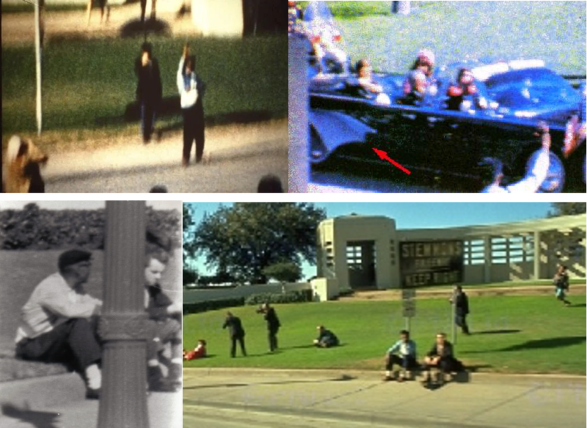
Were they cognizant Zionist agents? I don’t think so. Their sitting together after seeing JFK’s head blown before their eyes suggests that they were stunned and wondering what the hell they had been doing. I suppose they had been sent to do their “little heckling” without being told that it would spice up the killing. Who would be so crazy as to put himself in that position knowingly, standing almost in the line of the Grassy Knoll sniper? Perhaps they had been convinced to do it for money, or as a wager, or as a service to Witt’s Jewish boss at the Rio Grande National Life insurance Co where he worked.
Whatever the case may be, if there was still any doubt that Israel was the prime mover in the assassination of John Kennedy (the evidence is in my book The Unspoken Kennedy Truth), Umbrella Man and Nazi-Salute Man are the ultimate signature. But to see this, you need some spiritual insight into Jewishness and Kennedyness.
Jewishness is the evil soul of the U.S., best embodied today by the neocons (of whom Norman Podhoretz, editor-in-chief of Commentary for 35 years, is the founding father). Kennedyness was the good soul of America. Above anything else, the Kennedys stood for strong family values and service to country to the point of sacrifice. “Joseph P. Kennedy,” writes Laurence Leamer, “created one great thing in his life, and that was his family. . . . Joe taught that blood ruled and that they must trust each other and venture out into a dangerous world full of betrayals and uncertainty, always returning to the sanctuary of family.”[9] Joe also taught his children that they had to pay back to America what America had given them. The Kennedy family symbolized the America that Americans and the world loved.
This is why John F. Kennedy, Jr. was the “charismatic crown prince of America’s royal family,” as the New York Daily News wrote the day after his death.[10] He was Prince Hamlet haunted by the ghost of his murdered father, destined to avenge him and save the kingdom from the usurpers. The Kennedy tragedy is the most Shakespearian, the most paradigmatic, the most archetypal story in all American history. And America has not a worthy monument in their honor. So many Holocaust museums to honor the Jews’ dead, and not one chapel to pray for the Kennedys!
As a matter of fact, only Israel has a Kennedy memorial of any significance. It was explicitly designed to look like “the stump of a felled tree,” and it does. Do you get the idea? It symbolizes Israel’s plan for the Kennedy dynasty. You can trust Jews to choose their symbols carefully. And don’t imagine people can see any statue or even a single photo of Kennedy inside; it is as hollow as a dead stump. It is a memorial to erase the memory of Kennedy. It reminds me of the paradoxical command: “remember to erase Amalek’s memory” (Deuteronomy 25:19 and Exodus 17:14).

The Zionists’ hatred for the Kennedys runs deep, despite their histrionic “crocodile tears” after JFK’s death. When meeting the new president on May 30, 1961 in New York, Ben-Gurion could not help but see in him the son of a Hitler-appeaser. Abraham Feinberg (who arranged the meeting) recalls that “Ben-Gurion could be vicious, and he had such a hatred of the old man [Joe Kennedy].”[11] Ben-Gurion had no illusion about the fact that John was very much his father’s son. Had he not, in his 1956 Pulitzer-Prize-winning book Profiles in Courage, vindicated Senator Robert Taft for denouncing the Nuremberg Trials as a parody of justice, and the hanging of German officials as “a blot on the American record which we shall long regret”?[12] It certainly didn’t escape the Zionists that, on May 11, 1962, President Kennedy invited Charles Lindbergh and his wife at a grand reception at the White House, sitting them at the presidential table and hosting them overnight. Lindbergh had been the most prominent voice for the America First Committee in 1940, publicly accusing the Jews of pushing America into the war. Since then, he had been living in reclusion.
Moreover, Ben-Gurion believed that JFK was paving the way for a new Holocaust by preventing Israel from acquiring the indispensable nuclear deterrence against the Arabs. This is what Ben-Gurion meant when describing Nasser as a new Hitler and the Arabs as the new Nazis, in one of his last letters to Kennedy, May 12, 1963, in response to Kennedy’s demand for immediate inspections of Dimona: “Knowing them I am convinced that they are capable of following the Nazi example. … Mr. President, my people have a right to exist … and this existence is in danger.” Monika Wiesak has noted that, in that very letter, the father of the Jewish State made a cryptic digression about Jordanian King Hussein, writing: “there is always a danger that one single bullet might put an end to his life and regime.”[13]
Salvator Astucia has, I think, well captured the essence of the Kennedy problem for Israel:
The Israelis distrusted President Kennedy because of his father. It is widely known that Joseph Kennedy Sr. developed a strong loathing of Jews from his business dealings with them in finance, Hollywood, and politics. And the elder Kennedy had groomed four sons for the White House, but his oldest — Joe, Jr — had been killed in World War II. President Kennedy’s inauguration in January 1961 marked the beginning of a dynasty that would likely continue until 1985 (after the three surviving sons had each completed two terms). With this background information, it becomes clear that there was one primary motive for the assassination: to destroy the Kennedy Dynasty.[14]
Under a Kennedy presidency, there would be no Six-Day War, the Palestinian refugees would recover their land, AIPAC would be registered as a foreign agent, and the Holocaust would certainly not become a State cult enforced by ADL inquisition. And of course, Israel would never have become a nuclear State.
Destroying the Kennedy dynasty was probably a sacred oath taken by all B’nai B’rith top officials (Dallas was full of them). JFK Jr. was a marked man, if not from the moment he saluted his father’s coffin on his third birthday, at least from the moment it became clear that he had the ambition and the potential to reach the White House. Killing his political future was not enough, and probably not possible.
I wrote a long article in January 2019, titled “The Broken Presidential Destiny of JFK, Jr.”, reviewing the evidence that JFK Jr. was assassinated. I will now summarize it.
Evidence of assassination
It was Friday July 16, 1999, at 9:39 pm, when JFK Jr.’s voice was last heard by Martha’s Vineyard air traffic controller Buddy Wyatt, asking, in a calm voice, instruction for landing. (This was reported the next day by U.S. Coast Guard Petty Officer Todd Burgun in a live phone interview with anchor Susan Wornick of Boston WCVB-TV.)
About two minutes later, John’s plane suddenly plummeted into the ocean at the radar-recorded speed of 4,700 feet per minute. Victor Pribanic, an attorney from Pennsylvania who was fishing for striped bass that night and had noticed the aircraft flying toward the island, reported to the The Martha’s Vineyard Times (cited in the New York Daily News, July 21, 1999): “I heard an explosion over my right shoulder. It sounded like an explosion. There was no shock wave, but it was a large bang.”
Based on these facts, the only rational explanation is that the plane suffered a sudden structural damage by explosive, making it impossible to maintain in the air; blowing off a part of a wing or the tail would have been enough, and would have required only a very small device magnetically affixed to the plane.
These facts, however, were quickly removed from public awareness. Pribanic’s testimony never made it to the national news. And Kennedy’s 9:39 call to Martha’s Vineyard airport was quickly denied and erased from the narrative. Instead, on July 18, the Federal Aviation Administration (FAA) produced some “newly found” radar “evidence” which supposedly showed Kennedy’s flight exhibiting signs of difficulties and irregularities long before it disappeared from the radar.
The official narrative was a mix of two ingredients, bad weather and pilot recklessness, coated by a heavy layer of “the Kennedy curse”. Not a word of the possibility of foul play.
When the National Transportation Safety Board (NTSB) concluded its investigation eleven months later, it issued a news release that attributed the plane crash to “the pilot’s failure to maintain control of the airplane during a descent over water at night, which was a result of spatial disorientation. Factors in the accident were haze and the dark night.” That is all the corporate news retained. However, a close reading of the full report reveals many unanswered questions and even contradictions with its conclusion. For example, the NTSB final report quotes Martha’s Vineyard air traffic controller Buddy Wyatt as stating that the visibility was good: “I remember aircraft on visual approaches saying they had the airport in sight between 10 and 12 miles out. I do recall being able to see those aircraft and I do remember seeing the stars out that night.”
Also, the sudden drop of altitude from 2,200 feet to 1,100 feet in 14 seconds, stated in the full report, is hard to reconcile with the news release statement. Disorientation implies that the pilot was not aware that he was flying straight into the ocean. But that is impossible, as the NTSB Investigator-in-Charge, Robert Pearce, had admitted as early as July 20, 1999: “They were aware they were going down. With that kind of descent rate, it is going to be noisier than hell in the cockpit.”
In contrast to what the news media kept hammering, the NTSB report reckoned that JFK Jr. had a flight experience of “about 310 hours, of which 55 hours were at night.” During the last fifteen months, he had made 35 flights between Fairfield airport, N.J., and Martha’s Vineyard, including five at night. Three certified flight instructors (CFI) quoted in the report describe John as an “excellent”, “methodical” and “very cautious” pilot.
No matter how we twist or downplay all other data, the very conditions of the plane’s sudden dive, which is an undisputed fact, should raise a strong suspicion of a major and sudden mechanical failure. As Anthony Hilder put it:
A finely-tuned, well-kept first-class airplane doesn’t just drop out of the sky and head straight down into the ocean unless it’s blown out of the sky or the pilot deliberately sends it into a dive to kill himself and his passengers.
Evidence of cover-up
Some testimonies used in support of the theory of JFK Jr.’s incompetence and recklessness are highly suspicious. A case in point is Kyle Bailey, “the last man to see Kennedy alive at the Fairfield airport,” who claimed to have had bad a premonition on seeing him take off: “I told my family, ‘I can’t believe he’s going up in this weather’,” he said on July 18. Bailey went on becoming an aviation analyst specialized in plane crashes, and regularly working for major network such as Fox News, CBS, ABC, NBC, and BBC. Bailey appeared in the documentary Curse on the Kennedys? and then in the ABC documentary The Last Days of JFK Jr., aired in January 2019, in which he repeated his story. Kyle Bailey is to JFK Jr.’s death what Mark Walsh is to 9/11.
The search for the plane and the bodies was entirely controlled by the military, although JFK Jr. had never been in the army. A 17-nautical mile no-fly zone and no-entry zone was established around the crash site. No civilians or media crew were allowed in this area. On July 20, 1999, as we read in the NTSB report, “the airplane wreckage was located by U.S. Navy divers from the recovery ship, USS Grasp.” Why was the Navy, rather than civilian rescue craft, tasked with the retrieval of JFK Jr.’s crashed airplane? More disturbing still, why did the Pentagon take exclusive control of news reporting from July 18?
There are issues also with the botched autopsies, as Joanna Weiss and Matthew Brelis of the Boston Globe wrote on July 23, 1999 in an article titled “JFK Autopsy Rushed.”
But the most suspicious thing of all is the way the bodies were disposed of: they were cremated, then their ashes were taken aboard a Navy destroyer, and scattered into the sea, near the place where they had met their death. “The burial for the 35th president’s son was reportedly carried out in keeping with his expressed wishes,” noted journalist Paula Maxwell. What? At age 39, JFK Jr. had expressed his will not to be buried with his father and mother at Arlington cemetery and instead to be cremated and his ashes spread above the ocean? Who can believe such a thing? The Boston Globe reported on July 22 , “Kennedy’s family requested a burial at sea, and the Pentagon granted that request.” But, the next day, the same newspaper expressed surprise:
The cremated remains of John F. Kennedy Jr., his wife, and her sister were cast from a warship to the ocean currents in a manner not favored by the Catholic Church and in a ceremony that occurred only after the intercession of Pentagon brass. The Roman Catholic Church prefers the presence of a body at its funeral rites. And the Defense Department rarely accords the honor of burial at sea to civilians.
No other Kennedy had ever been cremated. The reasons given for cremating JFK Jr. body do not make any sense and are contradictory. The New York Times wrote:
“Kennedy family members, citing his wishes and hoping to avoid having a spectacle made of Mr. Kennedy’s final resting place, have decided to have his body cremated and his ashes scattered at sea in a Navy ceremony, a family adviser said.”
That is utterly unbelievable. The bodies must have been cremated and scattered for another reason: to prevent any possibility of ever finding traces of explosives in the bodies.
But the idea of wanting to deprive JFK Jr. of a final resting place that could possibly encourage a popular Kennedy cult has also a strong biblical and B’nai B’rith smell. Who, among “Kennedy family members”, could possibly have wanted this? It happens that, according to information found in RFK Jr.’s diary, published by the New York Post, Ann Freeman, Carolyn and Lauren Bessette’s mother, “began asking that her two daughters be buried near her home in Greenwich, Connecticut.” It was Edwin Schlossberg, Caroline Kennedy’s Jewish husband, who convinced her to have her two daughters cremated and their ashes spread in the ocean. “He bullied, bullied, bullied the shattered grieving mother,” writes RFK Jr.
The heir and the Avenger
JFK Jr. had grown up with a sense of destiny. According to biographer Christopher Andersen (The Good Son): “Jackie made sure that John was constantly exposed to the people who knew John [President Kennedy] best.” In her last letter to her son before dying to lymphoma in 1994, she wrote: “You, especially, have a place in history.” John told Lloyd Howard in 1997: “She expected me to follow in my father’s footsteps, and of course I will. But I don’t think the time is right just yet.” Just like his father before him, John Jr. first pursued a career in journalism: in 1995, he founded the magazine George, which engaged in controversial issues of deep politics. His longtime friend Robert Littell wrote, in The Men We Became: My Friendship with John F. Kennedy Jr. (St. Martin’s Press, 2004): “George was also an opportunity for John to build a platform from which he might possibly move into political life.” George was also a means for John to interact with political actors and thinkers.
Brought up in the worship of his father, John had taken a keen interest in “conspiracy theories” about his death at least since his late teens. His knowledge deepened in his thirties, and motivated him to publish in a special “conspiracy issue” of his magazine George, eight months before his death, a cover article by Oliver Stone, director of the groundbreaking film JFK, titled “Our Counterfeit History”.
At age 39, John had made up his mind to launch his political career by seeking an electoral mandate in New York State, and he was about to announce it publicly. According to his friend Billy Noonan (Forever Young: My Friendship with John F. Kennedy, Jr., Viking Press, 2006), he was about to enter the race for the New York Senate seat left vacant by Daniel Patrick Moynihan, which Hillary Clinton also coveted (and ultimately got). John was a New Yorker, and Clinton would have stood no chance against him.
JFK Jr. had also voiced privately his ambition to ultimately reach for the presidency. Given his personality and his popularity, he had high chances to make it in less than 20 years. Pierre Salinger, one of the men Jackie had asked to educate John about his father, had become very close to him, and declared on French radio Europe 1, on July 19, 1999: “I felt that in the coming year John Junior would also become a politician. It’s my point of view. And with other people, we thought he was going to be a Democratic candidate for the next presidential election.” Others, such as John’s assistant at George, RoseMarie Terenzio, thought “he would’ve run for president … in 2008.”
In 1968, John Kennedy’s brother ran for President with the intention, not just to save the Kennedy legacy, but to reopen the investigation on his brother’s death (as David Talbot has demonstrated in his book Brothers). He was assassinated. In 1999, Robert Kennedy’s nephew was about to announce his entry into politics, with the clear intention to go all the way to the White House. There is no question that one of his goals in life was to expose the murderers of his father. His old high school girlfriend Meg Azzoni, in her self-published book, 11 Letters and a Poem (2007), writes that as a teenager, “his heartfelt quest was to expose and bring to trial who killed his father, and covered it up.”
I rephrase my conclusion from my longer 2019 article:
So, was JFK Jr. himself assassinated? Here is man whose road to the presidency seemed traced. No other man of his age had better chances to reach the White House one day. And no other man in the world had more reasons to want the 1963 Kennedy assassination reinvestigated. He was already trying to educate the public through his magazine, at the risk of exposing his own beliefs, something no other Kennedy had ever done (even RFK had kept his doubt on the Warren report private, and his plan to reopen the case secret). And this man, his friend Billy Noonan believes, was just about to announce his candidacy for a New York Senate seat, which everyone would have understood as the first step toward the White House. Pierre Salinger and others even believe he would have run for president in 2000. What are the odds that he would die at this precise moment by accident? … If it was an accident, then the Devil caused it. Or was it Yahweh?
One more thing: JFK Jr. died two years before 9/11. Who knows what influence he would have had on the American public, either as a senator or as the editor of a magazine with a strong interest in conspiracies? He may very well have stood in the way of the War on Terror, the WWIV that Norman Podhoretz was calling for. You never know, with those Kennedy peacemakers!
Israel believes in preemptive assassinations, as demonstrated by Ronen Bergman in Rise and Kill First: The Secret History of Israel’s Targeted Assassinations.
Israel killed JFK Jr.
A curse on Israel!

Notes

[1] Arthur Krock, Memoirs: Sixty Years on the Firing Line, Funk & Wagnalls, 1968, p. 328.
[2] Michael R. Beschloss, Kennedy and Roosevelt: The Uneasy Alliance, Open Road, 1979, p.187.
[3] John Hughes-Wilson, JFK: an American coup d’état, John Blake, 2013, pp. 88-89.
[4] Seymour Hersh, The Samson Option: Israel’s Nuclear Arsenal and American Foreign Policy, Random House, 1991 , p. 96.
[5] Robert Caro, The Years of Lyndon Johnson, vol. IV: The Passage of Power, Alfred Knopf, 2012, p. 104. Also in Krock, Memoirs, op. cit., p. 362.
[6] Seymour Hersh, The Dark Side of Camelot, Little, Brown & CO, 1997, p. 129.
[7] Andrei Gromyko, Memoirs, Doubleday, 1989, pp. 181-182.
[8] Edward Klein, The Kennedy Curse: Why Tragedy Has Haunted America’s First Family for 150 Years, Saint Martin’s Press, 2004.
[9] Laurence Leamer, Sons of Camelot: The Fate of an American Dynasty, HarperCollins, 2005, kindle l. 262-267.
[10] Dave Saltonstall, Austin Fenner, Helen Kennedy and Greg B. Smith, “John F. Kennedy Jr. went missing after taking a flight with his wife and her sister in 1999,” New York Daily News, July 18, 1999, on nydailynews.com
[11] Hersh, The Samson Option, op. cit., p. 103.
[12] Robert Taft, October 6, 1946, quoted in John F. Kennedy, Profiles in Courage, 1956, Harper Perennial, 2003 , p. 199.
[13] Monika Wiesak, America’s Last President, 2022, p. 214.
[14] Salvador Astucia, Opium Lords: Israel, the Golden Triangle, and the Kennedy Assassination, 2002, p. 5, on www.whale.to/b/astucia.pdf.
Iran’s Pezeshkian discusses foreign policy, principles in first op-ed
Al Mayadeen | July 13, 2024
Iran’s newly-elected president stated that his administration is dedicated to maintaining Iran’s national dignity and global standing “under all circumstances.” Additionally, it will advocate for creating a “strong region” instead of one dominated by a single country’s pursuit of hegemony and dominance.
In an op-ed published by the Tehran Times, President Masoud Pezeshkian outlined his government’s outlook and policy, emphasizing it will focus on opportunities to maintain balanced relations with all nations in line with Iran’s economic and national interests, in addition to the needs of regional and global peace and security, saying he “will welcome sincere efforts to alleviate tensions and will reciprocate good-faith with good-faith.”
Moreover, he emphasized his opposition to neighboring countries depleting their resources through engaging in unnecessary competition, arms races, or “containment” efforts against each other. “Instead, we will aim to create an environment where our resources can be devoted to the progress and development of the region for the benefit of all.”
Pezeshkian mentioned that, following the victory of the Islamic Revolution in 1979, Iran “severed ties with two apartheid regimes, Israel and South Africa,” a decision “motivated by respect for international law and fundamental human rights.”
While “Israel” remains an “apartheid” regime to this day, Pezeshkian said it added genocide to “a record already marred by occupation, war crimes, ethnic cleansing, settlement-building, nuclear weapons possession, illegal annexation, and aggression against its neighbors.”
Don’t reward ‘Israel’ through normalization
The Iranian president-elect further said that “as a first measure” in strengthening ties with neighboring states, his government will “urge” Arab countries to collaborate diplomatically for a permanent ceasefire in Gaza to halt the ongoing massacre and prevent an expanded escalation.
“By leveraging our normative influence, we can play a crucial role in the emerging post-polar global order by promoting peace, creating a calm environment conducive to sustainable development, fostering dialogue, and dispelling Islamophobia. Iran is prepared to play its fair share in this regard.”
He underlined that all members of the 1948 Genocide Convention are obligated to take action to prevent genocide, “not to reward it through normalization of relations with the perpetrators.”
“We must then diligently work to end the prolonged occupation that has devastated the lives of four generations of Palestinians,” he continued.
Pezeshkian continued that he “looks forward” to collaborating with “Turkey, Saudi Arabia, Oman, Iraq, Bahrain, Qatar, Kuwait, the United Arab Emirates,” in addition to regional organizations, to deepen economic and trade relations. He added that coordination would also be focused on “tackling common challenges” and working on creating “a regional framework for dialogue, confidence building and development.”
Allegations of antisemitism an insult to Iran’s culture
“Cooperation for regional development and prosperity will be the guiding principle of our foreign policy,” he said, adding that, “as nations endowed with abundant resources and shared traditions rooted in peaceful Islamic teachings, we must unite and rely on the power of logic rather than the logic of power.”
Elsewhere in his piece, he pointed out the increased awareness among Western youth of “the validity” of Iran’s “decades-long” position on the Israeli occupation entity.
Addressing this “brave generation,” Pezeshkian said that the Islamic Republic considers allegations against it of “antisemitism” due to its “principled stance” on the Palestinian case are “false” and an “insult to our culture, beliefs and core values.”
“Our” Man in Israel

By Ted O’Keefe | The Occidental Observer | July 7, 2024
The issue of dual loyalty is an ancient one. As noted in a previous TOO article,
[Stephen] Walt points out that [Dennis] Ross has a long involvement with pro-Israel activist organizations, such as being director of WINEP [Washington Institute for Near East Policy, a pro-Israel think tank headquartered in Washington, DC].
But Ross’s ties to Israel are even deeper than that. Until his appointment as Middle East envoy in the Obama Administration, from 2002–2009 Ross was Chairman of the Board of Directors of the Jewish People Policy Planning Institute. This organization has assumed the role of long term planning for the Jewish people, not only in Israel but also the Diaspora. The JPPPI is an independent think tank that reports to the Israeli government and has close ties with other Jewish organizations. Its mission is “to promote the thriving of the Jewish people via professional strategic thinking and planning on issues of primary concern to world Jewry. JPPPI’s work is based on deep commitment to the future of the Jewish people with Israel as its core state.”
The JPPPI’s report Facing Tomorrow 2008 is interesting because it focuses on the threat of Iran and but also because it sees people like Stephen Walt as a threat to Israel:
The Jewish people must, as the highest priority, develop an appropriate response to the Iranian nuclear threat to Israel and to global stability as a whole. While there is no ambiguity about the need to do so in Israel, it is necessary to mobilize Jewish opinion around the world as well. The American Jewish community cannot be intimidated either by a post Iraq syndrome in the United States, or by the false and pernicious allegations of Professors Walt and Mearsheimer, or former President Carter.
In other words, Jews around the world are encouraged to mobilize to combat the threat to Israel represented by Iran. The assumption is that Jews have common interests as Jews no matter what country they happen to live in. Dennis Ross is doing his best to promote exactly this view within the Obama administration.
One might think that such a view would leave Jews in the Diaspora open to the charge of disloyalty, but the problem is easily finessed: Jews in the Diaspora are told to frame Israel’s concerns about Iran as a global threat, not simply as a threat to Israel.
Of course, that’s what we are seeing now. But we needn’t be naïve. Jews like Dennis Ross are clearly far more loyal to Israel than to the US. Speaking as a psychologist, they wouldn’t be able to see a conflict of interest between the US and Israel if it was staring them in the face. Indeed, as Gore Vidal said of Norman Podhoretz, they are unregistered agents of a foreign government.
In a sane society, there would be a huge groundswell of public opposition to Ross’s appointment–as there has been for a number of Obama’s appointments. But that won’t happen.
Since there has been no groundswell of media or public opposition to pro-Israel operatives like Ross at the highest levels of the U.S. government, it’s not surprising that the practice continues. Amos Hochstein is a good contemporary example. Israel and the powerful Lebanon-based Shiite Hezbollah militia are on the brink of open warfare, conflict that could trigger U.S. intervention and escalate to a regional or even a world war. To date these dangers have attracted little notice from the American mass media, ever eager to divert and dissemble from the direr consequences of the Washington regime’s one-sided support for Israel. Small wonder, then, that the media should evince the same reluctance in investigating the shadowy past and dubious allegiance of Hochstein, the emissary the U.S. recently dispatched to “mediate” between Hezbollah and Israel. The following is a brief foray into the workings of the Israel Lobby in the Biden Administration, as well as a primer on the perks of being Jewish in America.
Hochstein’s importance
To be sure, media reports have not slighted Hochstein’s great influence in the Biden White House or his meteoric career. He has been described as “one of President Biden’s closest confidantes [who] has worked with him for many years,” while another Washington insider calls Hochstein “the person who bridges State, Treasury, the White House and Energy”
Fittingly, one of Hochstein’s titles is “Special Presidential Coordinator.”
Yet the media have underplayed, and often ignored, a key fact about Hochstein in his role as an impartial arbiter between Hezbollah and Israel: his birth, youth, and military service in Israel.
Beyond those bare facts about his origins, Hochstein has been remarkably unforthcoming about his life before he arrived in the United States in 1974. While nearly every successful denizen of the D.C. is eager to brandish Ivy League/Seven Sisters (or the equivalent) educational credentials, one may scour the internet (including his page on the usually resume-rich LinkedIn job-hunting site) without finding anything about Hochstein’s education, college or secondary.
Just as murky are the circumstances by which Adam Hochstein, a 21-year-old immigrant with unknown credentials, became a congressional staffer within a year of his arrival in this country, working for Rep. Sam Gejdenson (D-CT) who, like Hochstein, is a Jew.
Despite his youth and inexperience, Hochstein carried out important assignments for Gejdenson. Not yet 25, he traveled to North Korea in 1997 to report on its economic and military situation; still in his twenties, he undertook negotiations with the Iraqi government (against the advice of the U.S. State Department) aimed at “resettling” thousands of Palestinians there in exchange for loosening some of the crippling sanctions then in force there.
Well before 9/11, Hochstein advocated acting against Iraq for harboring “weapons of mass destruction” in a press release issued by Congressman Gejdenson, and soon afterward he was serving as senior advisor to a senator and a governor. Like many members of the permanent government, Hochstein has used hiatuses between his party’s dominance to work in lobbying and industries close to government, in his case capitalizing on energy policy expertise that he seems to have acquired with no expertise in the field. He’s evidently done well, at some point becoming a partner in two D.C. restaurants and a movie theater.
Under Obama, Hochstein (without known diplomatic training or experience) rapidly climbed the ladder at the State Department to become America’s chief energy negotiator, deeply involved in efforts to block Russian natural gas from Europe and to facilitate Israeli access to energy.
During the Trump presidency, Hochstein served on the board of Ukraine’s natural gas company, Naftogaz.
Hochstein’s knowledge of the ins and outs of Ukraine’s shady corrupt energy industry is evidently considerable. In his testimony to the U.S. House of Representatives, Hunter Biden stated that Hochstein had advised him merely to be “very careful” in serving on the board of the notoriously corrupt Burisma corporation.
Hochstein also seems to have had a role in the “whistle blowing” that led to Trump’s first impeachment resulting from a phone call interpreted by Democrats as pressuring Zelensky to investigate Biden family corruption in Ukraine, and to have been advising Zelensky before his election.
It’s also interesting that there is a lack of definitive information on Hochstein’s current citizenship:
According to one report, a State Department source has claimed that he is “not a dual national,” but refused to state if he has renounced his Israeli citizenship, and in fact gave no [details as to Hochstein’s American citizenship.] So the question raised, unanswered— Hochstein’s citizenship is evidently a “carefully guarded secret.” Not acknowledging Hochstein’s Israeli citizenship would be useful because, for example, in Lebanon, where Hochstein has been involved as an American negotiator on the Israeli conflict with Hezbollah, “it is normally illegal for an Israeli” to visit Lebanon.
Even Hezbollah at the time did not comment on the mediator’s nationality or military past, with leader Hassan Nasrallah saying they will “not express an opinion or position related to the demarcation of borders”.
Given all this, it’s hard to disagree with this quote originally from Ha’aretz:
… the American brokerage farce, whose players are almost all American Jews, some of them former or future Israelis. If the United States is a side in the conflict, then it should say so and conduct the negotiation as though Israel is its protégé. And if it really wants to be an honest broker, then come on – Amos Hochstein?…
Houthi: US surprised by Yemen’s naval tactics, failed to stop retaliatory operations in Red Sea
Press TV – July 7, 2024
The leader of Yemen’s Ansarullah resistance movement says the Yemeni armed forces’ naval tactics in the Red Sea have taken the United States off guard, adding that Washington’s advanced military technology has failed to stop the Arab country’s retaliatory operations.
Abdul-Malik al-Houthi made the remarks during televised a speech on Sunday, where he praised Yemen’s advanced military and missile capabilities in confronting the coalition of the US, Britain, and Israel which he referred to as the “triangle of evil”.
Houthi went on to say that Yemen’s naval operations have frightened the enemies, noting that US aircraft carriers in the Red Sea are escaping rather than attacking and its MQ-9 Reaper drones are continuously shot down.
He also pointed out that many countries were not caught in the trap laid by the US-led coalition against Yemen and even had direct coordination with the Arab country instead.
“The biggest failure of the United States was that it could not include the countries neighboring the Red Sea in operations to support Israel. Washington also failed to force the Arab and neighboring countries to attack us from their soil,” he said.
The Ansarullah leader further said that the US is trying to use Saudi Arabia to exert pressure on Yemen, warning that any Saudi “hostile action” against Yemen will benefit Israel and the US.
“America intends to bring Saudi Arabia into an all-out war with us and return the situation to the peak of tension,” he said, while urging for Muslim unity and cooperation.
He also emphasized that Yemen will not remain idle in the face of aggression and will not watch the nation’s economy collapse.
Yemeni forces have repeatedly launched drones and missiles against Israeli and Israel-bound ships since mid-November last year, saying they are acting in solidarity with Palestinians against Israel’s war on the Gaza Strip.
Back in January, the United States and Britain began striking Yemen in order to dissuade the country from targeting Israeli ships which carry arms and logistics for the onslaught on the besieged enclave.
Despite months of US-led airstrikes, Yemeni forces have continued their operations, drawing from an arsenal of increasingly advanced weapons to attack Israeli, US and UK vessels in and around the Red Sea.
Israel vs Hezbollah: Strategic stakes and regional implications
By Shivan Mahendrarajah | The Cradle | July 5, 2024
There are known knowns; there are things we know we know. We also know there are known unknowns; that is to say we know there are some things we do not know. But there are also unknown unknowns—the ones we don’t know we don’t know. — Former US secretary of defense, Donald Rumsfeld
As tensions escalate between Hezbollah and Israel, analysts are meticulously wargaming potential conflict scenarios. For Prime Minister Benjamin Netanyahu and his religious-nationalist coalition, a confrontation with the Lebanese resistance movement is more than speculation – it is a strategic consideration. This coalition views a potential war as a means to address longstanding security concerns and strengthen its political position.
A key part of Tel Aviv’s strategic thinking is the hope that the US might be forced into taking a more active role in confronting Israel’s adversaries – Hezbollah, Syria, and Iran – thereby neutralizing threats that have persisted for decades. This concept of “clearing the decks” of regional enemies remains a central theme in Israeli strategic discussions.
Historical roots of Israel’s strategic confidence
For the occupation state, this potential conflict is a “war of choice” driven by historical and ethnonationalist motivations. But it is also premised on past Israeli military advantages that are long gone in today’s missile-laden West Asia.
The Six-Day War of 1967 fostered a belief in the invincibility of the Israeli military, the superiority of Zionism, and the manifest destiny of its ‘chosen people.’ It was with similar hubris that Adolf Hitler launched Operation Barbarossa against the Soviet Union in 1941. Fast forward eight decades, and today, Israelis are informing US officials “that it can pull off a ‘blitzkrieg’” in Lebanon.
In 1967, the psychological impact on neighboring Arab states was profound due to the decisive defeat of their armies. This sentiment persisted until 2006, when Lebanon’s Hezbollah emerged politically victorious, shattering the perception of Israeli invulnerability and altering regional power dynamics.
Further shaping Israeli delusions of military superiority is the ethnonationalist rhetoric prevalent in Tel Aviv’s policy decision-making circles, embodied by extremist ministers like Betzalel Smotrich and Itamar Ben-Gvir, who have revived the ideologies of the once-banned Meir Kahane. While a few sober military voices in Israel advocate for a diplomatic solution to the northern border crisis, hubris and ethnonationalism currently dominate the discourse.
Strategic imperatives for Hezbollah and Iran
Conversely, for Hezbollah and Iran, this conflict is a “war of necessity,” something neither can publicly admit nor provoke directly. Both have been marginalized and sanctioned by the US on Israel’s behalf, causing untold domestic pressures and economic hardships – an untenable situation that demands a direct challenge of Israeli policies.
But reversing sanctions cannot happen at the negotiating table. Israelis are arrogant and obstinate; they will not negotiate in good faith. Take, for example, the Joint Comprehensive Plan of Action (JCPOA) or the Iran nuclear deal. When former US president Barack Obama finalized the agreement, Netanyahu whined that Israel needed “compensation.” Obama offered Israel a military package, but as soon as he left office, Netanyahu, Jared Kushner, and AIPAC manipulated the “very stable genius,” former president Donald Trump. JCPOA was annulled. The compensation package, by the by, was not returned to US taxpayers.
Iran–Hezbollah must drag Israel to the edge of the precipice. Tel Aviv must stare into the abyss and realize that with a gentle push by the region’s Resistance Axis, it will lie mangled at the bottom of the chasm. Iran–Hezbollah, however, cannot push it over the edge, as this could lead to a nuclear nightmare. Today, in its “war of choice,” Israel has already hinted at using “unprecedented” and “unspecified” weapons against Hezbollah, implying a possible nuclear threat.
The Axis must instead show Israel a path back from the edge: a treaty that settles outstanding concerns. Tehran offered Tel Aviv and Washington a “Grand Bargain” in 2003 but was rejected. A new grand bargain is indispensable for Israel and the Axis of Resistance, yet the conditio sine qua non for a lasting treaty is Israel’s military defeat by the Axis.
The threats and counter-threats are flying, each aiming to gain “leverage” and deterrence.
Earlier this month, Iranian foreign affairs adviser to Ayatollah Ali Khamenei, Kamal Kharrazi, said that were Israel to launch an all-out offensive against Hezbollah, the Islamic Republic and other factions of the Axis of Resistance would support Lebanon with “all means” necessary.
Iran has previously warned that it may be compelled to revise its nuclear doctrine in response to Israeli aggression. It is suspected that Iran may have already crossed the nuclear threshold. Even without nuclear capabilities, Iran has the ballistic missile and warhead capabilities to destroy Tel Aviv, Haifa, and other major cities. Israel is a “one-bomb country”: it is minuscule, and its population is concentrated in a few central hubs. Iran and the Axis do not have any need for multiple nuclear warheads.
As General Hajizadah explained in a speech, the Khorramshahr missile can deliver 80 warheads. If the IRGC launched 100 missiles, that’s 8,000 warheads on major Israeli cities. Israel would be foolish to trust in its integrated air defense system after the IRGC’s successful strikes on 13 April.
2024 is not 2006
Comparing the potential 2024 conflict with the 2006 Israel–Hezbollah war is a popular frame of reference, but both sides have learned lessons since then. In particular, there have been significant advancements in military technology and tactics over the past 18 years.
Hezbollah has developed new tactics and weapons, such as the Almas Anti-Tank Guided Missile (ATGM), which has proven effective against Israeli military assets. Additionally, Hezbollah’s air defense capabilities have posed new challenges for Israeli drone offensives.
The Israeli air force ruled the skies in 2006, but whether it can do so in 2024 is unclear. Hezbollah has air defense capacity (such as the Sayyad-2 medium-range surface-to-air missile). It is not known if it has newer models, like Iran’s Khordad-3. This could be a surprise.
Israeli intelligence assessments of Hezbollah’s capabilities are likely to be imprecise. Past successes against groups like the PLO and Black September are no longer relevant. Recent failures, such as Tel Aviv’s inability to foresee Hamas Operation Al-Aqsa Flood on 7 October, underscore the limitations of Israeli intelligence.
US involvement
This has been Israel’s objective since 9/11: have Americans fight Israel’s wars. Although Joint Chiefs of Staff Chairman Charles Brown stated that the US may be unable to assist Israel, this must not be taken as a serious military assessment. It is a political statement on behalf of the Biden Administration, which does not want to join a major war until after the 5 November election. Netanyahu, however, knows that Israel controls Congress and American media. Congressman Thomas Massie is the exception, among 435 Representatives and 100 Senators, who AIPAC has not bought. Once war begins, Israel’s minions in the White House, media, and Congress will campaign for US military participation. As Netanyahu said, “I know what America is. America is a thing you can move very easily; move it in the right direction.” He is correct.
If the US intervenes – a high-probability event – Hezbollah and Iran will (reluctantly) welcome it. For the Axis to secure a “Grand Bargain,” it must inflict catastrophic damage on US land-based and sea-based assets in West Asia. Washington will only abandon Israel if ships, bases, and hundreds (or thousands) of American lives are destroyed because of Israel.
Russia
Russia is a wildcard, a “known unknown.” The US security apparatus warring against Russia and supporting Israel is top-heavy with Zionists/neo-cons. Iran’s enemies and Russia’s enemies are nearly congruent: Victoria Kagan née Nuland; Kagan family (Robert, Fred, Kim, their ISW); Antony Blinken (grandson of a founder of Israel); Avril Haines (Director of National Intelligence); deputy director CIA David Cohen, Alejandro Mayorkas (Secretary of DHS), and more. It behooves Russia to punish its tormentors by damaging the only country to which they are loyal: Israel.
Moscow has been chafing at US support for Ukraine. Elena Panina, Director of the Institute of International Political and Economic Strategies, wrote on her Telegram channel in December 2023, “The best option for Russia is to respond to America in a similar way: with a hybrid war far from its own borders. The most obvious at the moment is a proxy attack on American forces in the Middle East.” In May 2024, Putin said the same thing. Terror attacks in Belgorod and in Sevastopol on a religious holiday may tip the scales in favor of Iran, especially if the US jumps into the fray. Defeating the US will increase popular support for Russia among global Muslims and help eject the US from West Asia – a goal supported by Russia and China. Iran is “too big to fail”: Moscow has made military and economic investments and alliances with Tehran, particularly after the Ukraine War began, and is on the cusp of signing a new comprehensive cooperation agreement with Tehran. The Kremlin cannot allow Iran to be defeated and the republic to collapse. It will most likely provide intelligence, surveillance, and reconnaissance support through Russian satellites and aircraft in Syria. Russia allows IRGC to use its Humaymim/Khmeimim air base in Syria because IDF tries to prevent supplies from Iran from arriving at airports in Aleppo and Damascus. Russia could (if not already, given recent air traffic between Russia and the air base) deliver air defense batteries, missiles, and more for the Syrian Army and Hezbollah.
Unknown unknowns
The factors outlined above, along with China and North Korea’s investments in and relationships with Iran, complicate any predictions about the looming war between Israel and the Lebanese resistance. While their direct military participation is unlikely, these nuclear powers could supply Iran with essential weapons and ammunition. The “known unknowns,” a few of which are noted, are enough to complicate wargaming, but the “unknown unknowns” may render such scenarios moot.
The Debate Should Be a Wake-Up Call For Americans
By Ron Paul | July 1, 2024
There were plenty of surprises in last week’s presidential debate. For one, Americans who rely on the mainstream media for their news learned that they had been lied to for the past three years about President Biden’s capability to do the job he was elected to do.
The realization that the media has been lying for years about Biden is a positive development, as, hopefully, thoughtful Americans might begin wondering what else the media has been lying about. For example, they will find out that the media has been lying to them for years about Russia and Ukraine and about the Middle East and elsewhere. They will find out that our hyper-interventionist foreign policy does not make us safer and more free, but the opposite.
Unfortunately for most Americans, foreign policy is something that happens “over there,” with few direct effects back home. Dumping nearly $200 billion into the lost cause called “Ukraine” may at most seem like an annoyance to many Americans, but it’s not like they are being snatched up by gangs of military recruiters and sent to the front line as is happening to Ukrainian men.
However, $200 billion is real money and the effect on our economy is also real. The bill will be paid by each American family indirectly through the inflation “tax.” Each dollar created out of thin air and spent on the Ukraine debacle devalues the rest of the dollars in circulation.
The danger posed by our foreign policy seemed to escape both candidates, who each tried to convince us they were “tougher” than the other. Despite Donald Trump’s sober and accurate warning that Joe Biden has taken us to the brink of World War III, his solution to the problem is doing more of the same. His stated foreign policy seems to be that were he in office the rest of the world would not dare do anything against his will.
He would have been so tough that Russian president Vladimir Putin would never have dared to invade Ukraine, he claimed. He would have been so tough that Hamas would never have dared attack Israel on October 7th. It’s only Joe Biden’s “weakness” that leads to these disastrous foreign policy outcomes.
But the world does not work that way. Decades of US sanctions placed on any country that fails to do what Washington demands have backfired and led to the emergence of a block of countries united in their resistance to American dictates. Being “tough” on less-powerful countries may work… until it doesn’t. That’s where we are today.
Neither candidate seems to realize that the world has changed.
I have always said that real strength in foreign policy comes from restraint. To prevent these bad outcomes everywhere, stop intervening everywhere. It is not “toughness” that would have prevented Russia from taking action against Ukraine. It is restraint. Not launching a coup in Ukraine in 2014 would have prevented the disastrous war in Ukraine. Just like not stirring up trouble in the South China Sea would prevent a war with China. Not continuing to occupy and intervene in the Middle East would prevent a major regional war which might include Iran and other big players in the region.
Restraint is the real toughness. Non-intervention is the only foreign policy that will keep us safe and free. We’ve tried it the other way and it does not work. Let’s try something different.
Turkish, Syrian officials to meet in Baghdad for rapprochement: Report
Press TV – June 30, 2024
Turkish and Syrian officials are expected to meet in the Iraqi capital Baghdad for potential rapprochement between their respective countries, and restoration of diplomatic relations which were severed more than 12 years ago.
Syria’s al-Watan daily newspaper, citing informed sources who asked not to be named, reported that the upcoming meeting will be the first step on the path of a long process of negotiations that would result in political understandings.
The sources added that Ankara has called on Moscow and Baghdad to prepare the ground for Turkish diplomats to sit at the negotiating table with the Syrian side without any third party or members of the press present.
Al-Watan noted that the initiative for Turkey-Syria rapprochement, and restoration of their diplomatic ties has received broad support from Arab states, especially from Saudi Arabia and the United Arab Emirates, as well as from Russia, China and Iran.
On Friday, Turkish President Recep Tayyip Erdogan said there is no reason for his country not to forge renewed ties with neighboring Syria.
“There is no reason not to establish (relations with Syria),” Erdogan told reporters after Friday prayers in Istanbul.
He emphasized that Ankara has no plans or goals to interfere in Syria’s internal affairs.
“Just as we once developed relations between Turkey and Syria, we will act together in the same way again,” he added.
Turkey severed its relations with Syria in March 2012, a year after the Arab country found itself in the grip of rampant and deadly violence waged by foreign-backed militants, including those allegedly supported by Ankara.
The process of normalizing ties between Ankara and Damascus kicked off on December 28, 2022, when the Russian, Syrian and Turkish defense ministers met in Moscow, in what was the highest-level meeting between the two sides since the outbreak of the Syria conflict.
Since 2016, Turkey has conducted three major ground operations against US-backed militants based in northern Syria.
The Turkish government accuses the US-backed Kurdish People’s Protection Units (YPG) militants of bearing ties with the Kurdistan Workers’ Party (PKK) militant group.
Syria considers the Turkish presence on its soil to be illegal, saying it reserves the right to defend its sovereignty against the occupying forces.
Syrian President Bashar al-Assad has tied rapprochement with Turkey to Ankara’s ending its occupation of the northern parts of the Arab country and its support for militant groups wreaking havoc and fighting against the Damascus government.
Israel Lobby Cash Dominates and Perverts American Elections
Where is the Foreign Agents Registration Act of 1938 when you really need it?

BY PHILIP GIRALDI • UNZ REVIEW • JUNE 28, 2024
Once upon a time the United States of America was a constitutional republic that was by design constructed with checks and balances to limit corruption and constrain the ability of any branch of government to initiate certain potentially harmful actions, like going to war, which required approval by both Congress and the Executive Branch. Of course, that was 261 years ago and things change over time. Today’s America, what claims to be both a democracy and the issuer plus enforcer of international rules and norms, is arguably one of the most corrupt as well as most disliked countries on earth, with a political system that is exceptionally vulnerable to those who have deep pockets and a willingness to spend freely to obtain favors from the professional politicians and bureaucrats who now proliferate throughout the system.
If one measures the consequences arising from all the corruption, there is no better example than the heavily lopsided relationship with Israel, which has been produced through the infusion of hundreds of billions of dollars coming primarily from Jewish billionaire and corporate sources. Casino magnate Sheldon Adelson famously gifted Donald Trump with $100 million and in return received what he demanded, i.e. a United States decision to move the US Embassy from Tel Aviv to Jerusalem and a recognition that Jerusalem would be recognized as the country’s capital, which was illegal under international law. Additionally, Trump’s team headed by Israeli apologist Ambassador David Friedman, brought about the recognition of the Jewish state’s annexation of the occupied formerly Syrian Golan Heights, also an illegal concession, and the de facto granting of a free hand to Israel for dealing with the Palestinians as it sees fit, which is playing out currently. Trump also was in the business of canceling a nuclear monitoring agreement with Iran, which was very much in the US interest, and the assassination senior Iranian Revolutionary Guard commander Qassim Soleimani, a war crime.
The heavily pro-Israel policies have not developed in the US because of some actual affinity between the two nations but rather because of great dollops of Jewish money liberally applied to politicians and journalists to create a myth of an actual beneficial alliance between the two to produce a narrative that the US public would be inclined to accept. In this massive coordinated effort by what is euphemistically referred to as the Israel Lobby there is no more active entity than the basically illegal American Israel Public Affairs Committee (AIPAC) and its conjoined AIPAC-Political Action Committee, which delivers the cash and also the intimidation of political candidates who do not embrace the Jewish state with enthusiasm. Such dissidents are marked for removal through the surfacing of opposing prospective candidates who are particularly well-funded and sure to receive exceptionally favorable press. In the current round of primaries just concluded, AIPAC-Pac has boasted that it has achieved 100% success as “an AIPAC-endorsed candidate has won in every district (224 races) where an endorsee was on the ballot. All 90 AIPAC-backed Democrats who have had their primary races in 2024 have won. These Democrats are strong pro-Israel voices. 134 AIPAC-backed Republicans have [also]won their elections. Being pro-Israel is good policy and good politics.”
How does it work? As international lawyer John Whitbeck has described the process “the primary reasons why virtually all members of the US Congress prioritize the desires of the Israeli government over the interests of the American people are money and fear — and particularly the fear of all the money that Israel-Firsters will devote to ending your political career, most notably through primary elections, if you manifest anything less than unconditional support and/or abject subservience to Israel.” In the most recent primary in New York state, AIPAC boasts over having devoted a record $15 million, a record amount spent on a primary election, to delivering exemplary punishment to end the political career of Representative Jamaal Bowman, a rare progressive in Congress who has been an outspoken critic of Israeli apartheid and genocide. Among other damnation of Bowman’s record, he was inevitably accused of “antisemitism.” Only a single such example every few years has proven to be enough to keep virtually all members of Congress in line. One might ask former Congressmen like Cynthia McKinney and others in a long line who felt the wrath of AIPAC and its sister organizations. That would include now deceased Senators William Fulbright, Charles Percy and James Abourezk and Congressmen Paul Findley, Pete McCloskey and Jim Traficant.
It has recently been revealed that nearly all congressional candidates are routinely and openly approached by AIPAC representatives who ask in advance their views on Israel. If they are cooperative, sometimes requiring a written statement of intent, they are given a pass and can count on financial support and favorable media. If they are not, they are marked for removal. And one can even sympathize with members of Congress who are self-defined careerists in politics, as, again per Whitbeck, “what is the point, when all around you are groveling flat-out- prone in subservience to Israel, in raising your head on a matter of principle? Your head will simply be cut off, and nothing will change for the better as a result of your sacrifice. There is really no rational choice but to faithfully follow the orders of your ‘AIPAC babysitter.’” The “babysitter” is an AIPAC endorsed staffer placed in nearly every congressional office to monitor and report on Israel issues, a development which has recently been revealed by Congressman Tom Massie while being interviewed by Tucker Carlson.
So how do we limit the ability of Israel to corrupt America’s political system to such an extent that many now believe that Prime Minister Benjamin Netanyahu controls US foreign policy while his domestic lobby creatures at the same time influence as well many other aspects of how the government operates at state and national levels? And why do I refer to the actions of AIPAC and other groups as illegal? Israel is able to act with impunity because of the undeniable powerful influence of its domestic US lobby coupled with its skill at being able to hide what it is up to. The Lobby also has a free hand because the federal government does not enforce its own laws when it comes to the illegally nuclear armed Jewish state. AIPAC, not to mention groups like the Anti-Defamation League (ADL), the American Jewish Committee (AJC), are actually acting as directed agents of the Israeli government and therefore subject to the terms of the Foreign Agents Registration Act (FARA) of 1938 which requires organizations that take foreign direction regarding their activities to open up their books and records to scrutiny. It also requires some transparency vis-à-vis their contacts and relationships with the Israeli Embassy and the country’s Foreign Ministry and intelligence and security agencies.
The Act is usually referred to as FARA and was originally intended to monitor groups acting on behalf of the German and Italian governments prior to World War 2. It has since been used to limit the activity of Russian and other entities that have operated in the US but has never been applied against Israel, in itself yet another indication of the power of the Israel Lobby and its ability to suppress any exposure of its activities. Journalist and lawyer Isaiah Kenen had founded the American Zionist Committee for Public Affairs (AZCPA) as a lobbying division of the American Zionist Council in 1953 but it soon separated from AZC and became AIPAC in 1954. Kenen, an actual lobbyist for the Israeli government, had earlier worked for the Israeli Ministry of Foreign Affairs. AIPAC is today generally considered the most powerful and wealthiest Israeli lobby in the United States. President John F. Kennedy and his brother Attorney General Robert F. Kennedy understood the threat that it represented and sought to compel both AZC and AIPAC to register under FARA but JFK was assassinated shortly thereafter, which have led many to believe that the killing was a Mossad job. Registration under FARA would have inter alia blocked any funding of US political parties and politicians by those groups acting in support of Israeli interests. It would with one stroke take away much of Israel’s ability to corrupt America’s political system in its favor.
In comments to my articles I am often asked what can we ordinary Americans do to bring the Israeli influencers in this country under control. Well, after recognizing that there is a problem, a partial answer is there by enforcing FARA. One needs to put pressure on individual congressmen and the White House through the media to register AIPAC and other pro-Israel groups. Corrupting money is the key to their power and if the spigot of cash is shut off to the politicians and parties their influence will be greatly diminished. And don’t be surprised if there will be many politicians who are privately ashamed at what has been going on who will suddenly become supporters of control over the Jewish groups. The Lobby has been bad for America and not even particularly good for Israel as “sacrosanct” US support for Israel, as Joe Biden puts it, has freed folks like Netanyahu to engage in very dangerous enterprises for his own country as in Gaza and also against its neighbors and for so-called allies like the US. Time to put an end to the status quo.
Philip M. Giraldi, Ph.D., is Executive Director of the Council for the National Interest, a 501(c)3 tax deductible educational foundation (Federal ID Number #52-1739023) that seeks a more interests-based U.S. foreign policy in the Middle East. Website is councilforthenationalinterest.org, address is P.O. Box 2157, Purcellville VA 20134 and its email is inform@cnionline.org.
Yemen shows off hypersonic missile in Arab Sea op
The Cradle | June 27, 2024
Yemen’s Armed Forces released footage on 26 June of the new hypersonic ballistic missile that was used to target an Israeli ship in the Arab Sea a day earlier.
The Hatem-2 hypersonic ballistic missile is equipped with an intelligent control system and has significant maneuverability, according to the Yemeni army’s military media page. The locally-made Yemeni missile runs on solid fuel and boasts several different types with differing ranges.
The video and pictures released by Sanaa’s forces on Wednesday show the missile in use against the Israeli ship, the MSC Sarah.
The Yemeni army announced its attack on the MSC Sarah on 25 June.
“The naval forces of the Yemeni Armed Forces carried out an effective military operation targeting the Israeli ship (MSC SARAH V) in the Arabian Sea. The hit was accurate and direct … We announce that this operation was carried out with a new ballistic missile that entered service after the successful completion of trial operations,” Yemeni army spokesman Yahya Saree said in a statement.
“The missile is distinguished by its ability to hit targets accurately and over long distances, as this operation demonstrated.”
The armed forces of Yemen’s Sanaa government – which is militarily aligned with the Ansarallah resistance movement – are known to locally produce weapons. Sanaa’s Armed Forces are also still in possession of weapons stockpiles from the Soviet era.
Washington and other western nations accuse Iran of smuggling weapons to Ansarallah in Yemen. Yemen has been under a tight Saudi-led blockade for nearly 10 years, making the import of arms into the country extremely difficult.
However, Iranian expertise has played a significant role in the production of Yemen’s anti-ship ballistic missiles, according to a 29 May report from Tasnim news agency.
Tasnim says that the Yemeni Muhit missile – revealed in a military parade in the capital, Sanaa, in September last year – is directly modeled after the Iranian Qadr missile, Tehran’s first locally manufactured anti-ship ballistic missile, which was developed over 10 years ago by late Islamic Revolutionary Guard Corps (IRGC) commander Brigadier General Hassan Tehrani-Moqaddam.
Featured Video
Bombing Hitler’s Hometown
or go to
Aletho News Archives – Video-Images
From the Archives
‘Conspiracy Theory’ Now Fact: Greater Israel Has Arrived
By Kit Klarenberg | Mint Press News | January 28, 2025
Ever since Tel Aviv’s 1948 creation, much has been said and written about ‘Greater Israel’ – the notion Zionism’s ultimate end goal is the forcible annexation and ethnic cleansing of vast swaths of Arab and Muslim lands for Jewish settlement, based on Biblical claims this territory was promised to Jews by God. The mainstream media typically dismisses this concept as antisemitic conspiracy theory, or at most the fringe fantasy of a minuscule handful of extremist Israelis.
In reality … continue
Blog Roll
 Aletho News
- Failing to Defeat Hezbollah, Israel & US Pressure Syria’s Ahmed al-Sharaa to Join War
- US-Israeli war on Iran drives global fertilizer prices up 40%
- Hezbollah’s Surprise Weapons Redefine Ground Battle with Israel
- Yemen joins fight against US, Israel by firing missiles at occupied territories
- Seizing the Kharg: Washington’s path to defeat in the Persian Gulf
- Iran reports 500 US casualties in strikes on covert US military sites
- Pro-Israel terrorist arrested before assassination of pro-Palestinian activist
- Bombing Hitler’s Hometown
- German journalist threatened with homelessness as German court upholds EU sanctions in landmark free speech case
- US Tells Allies That Ukraine-Bound Arms Could be Sent to Middle East
- If Americans Knew
- Researchers at Human Rights Watch Resign Over Blocked Report on Palestinian Refugee Return
- Jewish Groups Are Backing a War Americans Don’t Want
- Eric Fingerhut Thinks He’s the President of the Jews
- Top Jewish Philanthropists, Rabbis Urge Israeli President to Take Action Against ‘Jewish Extremists’
- Don’t Be Fooled. Zionist Leaders Have Always Wanted to Control Southern Lebanon
- Israel’s widespread use of torture is a core element of its genocide against the Palestinian people
- In Israel’s War on Iran, Many Middle East US Bases Rendered “All But Uninhabitable”
- ‘Burn the lawn’: Israel pursues ‘Rafah model’ in southern Lebanon
- A genocide here, an amputation there
- Reports: Iran mobilizing 1M fighters, Israel-US run low on ammo, Israeli army faces shortage – Not a ceasefire Day 168
- No Tricks Zone
- Devastating Assessment Of Comirnaty Vaccine By Former Senior Pfizer Europe Toxicologist
- New Study: CO2 Is ‘Effectively Negligible’ As An Explanatory Climate Change Factor Since 2000
- Former Pfizer Toxicologist Dr. Helmut Sterz Tells Bundestag Hearing Pfizer Vaccine Should Have Never Been Approved
- Energy Expert: Germany’s Nuclear Phaseout Was A “500 Billion Euro Mistake”
- New Research: South Australia’s Mid-Holocene Sea Surface Temperatures Were 4°C Warmer Than Today
- Storing Green Energy To Last Germany 10 Days Would Require A 60-Million Tonne Battery
- New Studies: UK Sea Levels Were 4 Meters Higher Than Today During The Mid-Holocene
- Destructive Green New Deal: German Energy And Metal Group Warns Of Drastic Crisis
- New Study Documents A 20-Year Pause In Arctic Sea Ice Decline – Driven By Internal Variability
- Wake-up Call: Survey Shows Majority Of Germans Now Favor Postponing Climate Targets!
 Aletho News