Russia Will Not Renew International Grain Deal; Some Context
By Ted Snider | The Libertarian Institute | July 27, 2023
Like the war that necessitated it, Russia’s decision not to renew the United Nations and Turkish-brokered grain deal is bad for the world but not wholly unprovoked.
The deal allowed Ukraine safe passage for its grain laden ships through the mined and blockaded Black Sea ports so it could continue to export its agriculture to the world.
On July 17, Russia announced its decision not to renew the deal.
It has repeatedly been reported that Russia’s decision is retaliation for Ukraine’s recent sabotage of the Kerch Strait bridge that links Crimea to the Russian mainland. But President Vladimir Putin had announced the distinct possibility of suspending the agreement prior to the attack on the bridge.
During a July 13 question period, in a response to a journalist, Putin said, prior to the attack on the bridge, “We can suspend our participation in this deal.”
Putin gave two reasons for suspending the deal after having “extended this so-called deal many times.” The first is that, though it was Russia that suspended the deal, it was the West that broke it. “As for the conditions under which we agreed to ensure the safe export of Ukrainian grain, yes, there were clauses in this agreement with the United Nations, according to which Russian interests had to be taken into account as well,” Putin said. “Not a single clause related to what is in the interests of the Russian Federation has been fulfilled.”
Announcing the decision not to renew the deal four days later, Russian presidential spokesman Dmitry Peskov repeated that charge; “Unfortunately, the part of the Black Sea agreement that concerns Russia has not yet been fulfilled. As a result, it has been terminated.” However, he added that “As soon as the Russian part [of the deal] is fulfilled, the Russian side will immediately return to the implementation of this deal.” Putin made a similar pledge in his answer to the journalist. One option, he said, is “not first the extension and then the honouring of promises, but first the honouring of promises and then our participation. What do I mean? We can suspend our participation in this deal, and if everybody once again says that all the promises made to us will be fulfilled, let them fulfil them—and we will immediately join this deal. Again.”
George Beebe of the Quincy Institute has written that “Russia’s withdrawal from the deal is part of classic negotiating behavior, after its repeated demands went unaddressed by partners to the deal.”
While Russia kept its promise to allow Ukraine to export its grain, Moscow argues that the West failed to implement their commitments on facilitating Russian exports of grains and fertilizer due to an impossible to navigate web of sanctions and the failure to reconnect the Russian Agricultural Bank to the SWIFT financial system to enable payments.
Though better known as the ‘grain deal,’ the deal was meant to facilitate the export of fertilizer as well. As early as the end of April, Russian Foreign Minister Sergey Lavrov had complained that Russian cargo vessels carrying fertilizer were paralyzed in European ports. Russia has been unable to export its fertilizer. The world also watched silently with no condemnation when Russia’s Togliatti-Odessa pipeline that carries ammonia necessary for fertilizer was sabotaged.
The second reason is not about the failure to meet the conditions of the deal, but about the failure to meet the purpose of the deal. Putin has frequently pointed out that “this whole deal was presented under the pretext of ensuring the interests of African countries” whose food security was threatened. Instead, from Russia’s perspective, the deal has boosted the economy of Russia’s enemy by allowing Ukraine to export grain and boosted the economy of those supporting Russia’s enemy by allowing western Europe to import that grain while helping African countries barely at all.
Putin has repeatedly claimed that Ukrainian grain exported under the deal is not reaching Africa but is headed, instead, for Europe. He has claimed at various times that “about 45 percent of the total volume of grain exported from Ukraine went to European countries, and only three percent went to Africa.” In his response to the journalist, Putin again said that “only a little more than 3% went to the poorest countries—a bit over 3%. Everything else went to a well-fed and prosperous Europe.”
And he’s not wrong. Though Africa has benefitted from the deal indirectly by stabilizing global supply and prices, they have not been the direct beneficiaries. While only 12% of the grain has reached Africa, 40% went to Western Europe, according to the World Food Program. The biggest recipients of Ukraine’s grain have been China, Spain, Turkey, Italy, and the Netherlands. 80% of the grain has gone to upper-middle and high income countries, and 44% going to high income countries, but only 2.5% has made its way to low-income countries, according to the most recent UN data.
Russia, though, has sent many tonnes of grain to Africa; 11.5 million tonnes in 2022 and 10 million in the first half of 2023, according to Putin. And, in November 2022, Russia agreed to send grain to some African countries for free. Putin has repeatedly promised that, were the deal not to be extended, “Russia will be ready to supply the same amount that was delivered under the deal, from Russia to the African countries in great need, at no expense.” After the decision not to extend the deal, Putin wrote an article for African media repeating that promise directly to the people of Africa: “I want to give assurances that our country is capable of replacing the Ukrainian grain both on a commercial and free-of-charge basis… Notwithstanding the sanctions, Russia will continue its energetic efforts to provide supplies of grain, food products, fertilisers and other goods to Africa.” Deputy Foreign Minister Sergey Ryabkov said that, despite Western obstacles in the form of logistics, ship insurance and payments, “We will help those in need, we will find a way to do it, both with grain and fertilizers.” The Kremlin says that the offer of free grain is on the agenda of the second Russia-Africa summit being held in St. Petersburg this week.
Though Russia’s decision not to extend the grain deal is harmful to the world, like the war itself, it has been presented as emerging without antecedents. The narrative has frequently been distorted by discussing the decision not to extend the deal in isolation from its important context. The decision was not spontaneous retribution for the attack on the Kerch Strait bridge; it was a long, thought out negotiation strategy in response to promises made to Russia not being fulfilled. The announcement of the decision was also accompanied by the assurance that Russia would immediately return to the deal when those promises were fulfilled. The decision was also the product of Russia’s frustration that the deal was not only failing to benefit Russia as promised, but that it was failing to benefit Africa as promised while supporting the economies of Ukraine and the wealthy Western European countries who are helping it in its fight against Russia.
Iran Warns of Missile Power as US Parks Amphibious Strike Group Near Its Shores
By Ilya Tsukanov – Sputnik – 25.07.2023
The Pentagon announced last week that it would deploy additional warships and a Marine expeditionary group to the Persian Gulf to “deter” Iran following a spate of tanker seizure incidents. Tehran has warned that the presence of non-Persian Gulf adjacent states’ militaries in the strategic body of water would not facilitate regional security.
Commanders from Iran’s Army and the Islamic Revolutionary Guard Corps have commented on the US’s decision to beef up its presence in the Persian Gulf, and warned that the Islamic Republic will take measures necessary to protect itself.
“Considering the control and capabilities of its Armed Forces in regard to navigation and aviation security in the Persian Gulf region, Iran reserves the right to make the necessary deterrent arrangements in compliance with the rules and regulations of international law, and will exercise its inalienable rights accordingly,” Army Commander-in-Chief Abdolrahim Mousavi said Monday, speaking on the sidelines of a major aerial drill, commenting on the Pentagon’s plans to deploy warships to the Gulf.
“The Americans have come and gone from the region for many years with their bogus illusions, but the security of the region will become sustainable only with cooperation among regional countries,” Mousavi stressed.
Separately, at a ceremony on Tuesday related to the delivery of a new advanced naval cruise missile to the IRGC Navy, Commander Alireza Tangsiri said that enemy vessels will be forced to stay thousands of kilometers away to avoid finding themselves in the missile’s crosshairs.
“We can fire the Abu Mahdi missile from deep inside the country. The missile has a dual seeker and performs successfully against the enemy’s electronic warfare,” Tangsiri said.
Iran characterizes the Abu Mahdi as “among the best missiles of its class in the world in terms of targeting, high destructive power, and passage through geographical obstacles and enemy defense systems,” and says the missile, which has a range of over 1,000 km, will dramatically increase the country’s maritime reach.
“Since the missile has a very low flight ceiling and a very long range, it can hardly be tracked,” Commander Tangsiri said.
The new missile is named after Abu Mahdi al-Muhandis, the late Iraqi militia commander who was slain in a US assassination strike in Baghdad in January 2020 alongside IRGC Quds Force commander Qasem Soleimani, who was on a secret peace mission in the country aimed at normalizing relations between Iran and Saudi Arabia.
Gulf Tensions
Tensions in the Persian Gulf surged earlier this month after the US announced the deployment of F-16 fighter jets and A-10 ground attack aircraft to patrol the strategic body of water after a string of ship seizures by Iran for maritime traffic violations and attempted oil smuggling.
Last Thursday, the Pentagon announced the deployment of two amphibious warships and thousands of Marines from the 26th Marine Expeditionary Unit to the Gulf on Defense Secretary Austin’s orders.
“Through these actions, the United States is demonstrating commitment to ensuring freedom of navigation and deterring Iranian destabilization activities in the region,” the Pentagon said in a statement, using the same ‘freedom of navigation’ line it uses to justify the illegal deployment of warships, aircraft and troops thousands of miles from America’s shores to Chinese-claimed waters in the South China Sea.
Last week, Iranian Foreign Ministry spokesman Nasser Kanaani emphasized that “Iran monitors with sensitivity any illegal and unconstructive act that affects the security of the region,” and would “pay special attention to any provocative and illegal moves, especially near its borders.”
Iran has one of the largest and most technologically advanced militaries in the Middle East, and is equipped with an assortment of domestically-designed and manufactured missiles, warships, and air defense systems designed specifically for asymmetric warfare against a much larger and more powerful foe. The country has demonstrated repeatedly in recent years that it will not tolerate violations of its air and sea space, knocking a $220 million US spy drone out of the sky over the Strait of Hormuz in June 2019.
The Persian Gulf is one of the most strategically important bodies of water in the world, with ship-based oil cargoes accounting for approximately 20-30 percent of consumption passing through its waters daily.
US pledges nearly $120 million to Arab normalization initiatives for Israel
The Cradle – July 22, 2023
The US Senate Foreign Relations Committee proposed new legislation on 21 July to bolster normalization efforts between Israel and Arab countries, pledging nearly $120 million in funding and naming Saudi Arabia as a key candidate.
The Regional Integration and Normalization Act seeks to encourage the Arab world to solidify diplomatic ties with Israel.
US Senator Bob Menendez remarked that “this bill capitalizes on the dynamics that are profoundly reshaping the Middle East and North Africa,” adding, “Further integration in this region, one marked by conflict and disunity, must be a pillar of US foreign policy moving forward. It will remain a region that is critical to US strategic interests, and we should support efforts that increase stability and prosperity for our partners and the region’s citizens.”
This bill will create an ambassador-level official for the Abraham Accords, expand normalization and “integration, ”support the development of an Abraham Accords and Negev Forum Economic Partnership, and support joint cybersecurity training.
This development comes a few days after US President Joe Biden hosted Israeli President Isaac Herzog at the White House.
Since Israeli Prime Minister Benjamin Netanyahu took power last year, Biden has avoided meeting with the Israeli Prime Minister due to a controversial judicial overhaul.
US-led coalition’s jets violated Syrian airspace several times in past day: Russia
Press TV – July 17, 2023
Russia says the US-led military coalition’s fighter jets violated Syria’s airspace in the strategic al-Tanf region several times during the past day, amid repeated calls by Damascus for the expulsion of Washington’s occupation forces from the country.
Rear Admiral Oleg Gurinov, deputy chief of the Russian Center for Reconciliation of the Opposing Parties in Syria, said at a press briefing on Sunday that the al-Tanf airspace is where international air routes pass.
“A pair of the coalition’s F-16 fighter jets, and one MC-12W spy plane violated Syria’s airspace in the al-Tanf area, across which international air routes run, five times during the day,” he said.
Gurinov added that during the past 24 hours, twelve cases of violations of the de-confliction protocols of December 9, 2019 by the US-led coalition drones were recorded, warning that such actions create risks of air accidents with civilian planes.
He further said a shelling attack on the positions of government troops in Syria’s Idlib and Latakia de-escalation zone has injured a Syrian soldier.
The latest development comes as an unnamed Pentagon official declared earlier in the day that the US announced considering military options to address “Russian aggression in the skies over Syria.”
The unknown official further voiced the US’s rising concerns about “growing ties between Iran, Russia, and Syria across the Middle East.”
The official also claimed that “Russia is beholden to Iran for its support in the war in Ukraine, and Tehran wants the US out of Syria” to extend aid to Lebanon’s Hezbollah resistance movement “and threaten Israel.”
Such claims by Washington officials come as the US military is illegally occupying Syria with nearly 1,000 troops and has seized the country’s oil fields in cooperation with local anti-Damascus militants and terrorist groups while stealing its crude supplies and transferring them across the border to its bases in Iraq.
In 2014, the US and its allies invaded Syria under the pretext of fighting Daesh. The Takfiri terrorist group had emerged as Washington was running out of excuses to extend its regional meddling or enlarge it in scale.
Russia, alongside Iran, has been helping Syrian forces in battles across the conflict-plagued country, mainly providing aerial support to ground operations against foreign-backed terrorists.
Damascus maintains that the unauthorized US deployment aims to plunder the country’s natural resources.
Russia – which together with Turkey is carrying out joint patrols in northern Syria – has established special “de-confliction” zones where the US-led coalition can operate.
What is behind the current tension in Turkish-Iranian relations?
By Alexandr Svaranc – New Eastern Outlook – 16.07.2023
Turkey and Iran continue to be important Middle Eastern nations. Due to their geographical proximity, imperial past, violent rivalry, theological tensions (between Sunnism and Shiism), and, of course, the continuous divergence of geopolitical interests, both nations have a rich history of relations.
There were multiple Turkish-Persian clashes and wars, with various interruptions and varying degrees of success, during the Ottoman and Persian empires. Regarding the significance of the harem in the Ottoman Empire, historians have observed that, unlike the Turkish-Persian conflicts, which occasionally came to an end during periods of truce, the harem wars continued unabatedly. The reasons for these wars were varied, with religion often becoming a justification for the ambitions of Istanbul or Tehran. As a rule, it was a struggle for the right to own border territories from the Caucasus to Asia Minor, for the right to control strategic trade and military communications (for example, the area between Tigris and Euphrates, Eastern or Western Armenia and Syria).
In fact, such a confrontation lasted from the Middle Ages until World War I. The long military and political conflict between the Persians and Turks in such important regions, where the interests of the leading powers of Europe and Russia were represented, led to the establishment of a special international border commission with the participation of Britain and Russia at the turn of the twentieth century to facilitate the delimitation of Persia and the Ottoman Empire. But because London and St. Petersburg had their own distinct interests in the Near and Middle East, this commission never accomplished its mission.
There were also more stable times between Iran and Turkey in the new era. After World War II, from 1955 to 1979, Tehran and Ankara became even politico-military allies in the CENTO (Central Treaty Organization or Baghdad Pact) regional bloc, which emerged thanks to the Middle East diplomacy of Britain and the United States. While the Shah’s regime in Iran remained an ally of the West and Iranian oil and gas were exploited in the interests of London and Washington, Tehran was a regional partner of NATO member Turkey.
The situation changed after the February 1979 revolution in Iran, as the overthrow of the pro-American Shah’s regime and the ascension to power of the Shiite mullocracy brought about a major change in the disposition of forces in the Middle East. Since then, there have been renewed notes of mistrust and tension in Iranian-Turkish relations across the Middle East and global agenda, some of which remain relevant to this day.
It cannot be said that pragmatism in the approaches of Turkey and Iran has lost importance after the overthrow of Shah Reza Pahlavi. Despite harsh anti-Iranian sanctions, Ankara was forced to retain trading with Iran and keeps shipping gas in varying volumes due to its limited own energy supplies.
With the change of political regime in Iran after the 1979 revolution in Kemalist Turkey, where the secular regime suppressed the sprouts of Islamic revival, the politicization of Islam (albeit of Shiite origin) in the 1980s and 1990s still influenced the public consciousness of the Turkish masses in favor of the growing role of religion in the state.
The Kurdish issue remains a common concern between Turkey and Iran. Ankara and Tehran oppose all forms of Kurdish statehood and threats of ethnic separatism. However, in the situation of the Kurds after the 1979 Islamic Revolution in Iran there have been some changes. Some experts believe, not unreasonably, that the phenomenon of the Shiite revolution in February 1979 has both external and internal justifications.
The external reason was to prevent the leading Anglo-Saxon countries (the US and Britain) from monopolizing and plundering Iran’s strategic resources (oil and gas), as well as to prevent the corrosive influence of Western pop culture on the minds of Iranian youth and the general population. The internal reason, however, was related to the idea of preventing the weakening and collapse of Persian statehood under the threat of ethnic separatism with different colors (Kurds, Azeris, Baluchis). At the same time, Islam, namely political Shiism, assumed the religious consolidation of Iranian society regardless of ethnic origin.
Following the revolution’s victory, Iranian leader Ayatollah Khomeini summoned Mustafa Barzani, the leader of Iraq’s Kurdistan Region, then in exile, to Tehran for a final settlement of the Kurdish crisis on an Islamic basis. According to some reports, such an agreement was accepted by a Kurdish politician, but he never made it to Tehran. CIA handlers then announced an emergency surgery on Mustafa Barzani, but the surgery ended in his death.
The main contradictions between Tehran and Ankara include Turkey’s continued membership in NATO and Shiite-Sunni religious differences between different madhhabs. At the same time, as key countries in the Middle East region, it is natural that Turkey and Iran have different approaches on a number of regional topics (including the Syrian crisis, the situation in Libya and Iraq, and the relationship with Pakistan). The adjacent territories of the South Caucasus and Central Asia occupy a distinctive place in this package of contradictions following the breakup of the Soviet Union and the parade of sovereignties of post-Soviet states.
First, Iran is concerned about the renaissance of Turkey’s pan-Turkic and pan-Turanist ambitions toward the Turkic countries of the CIS, which could seriously weaken Iran’s position if the Turan project succeeds.
Second, Tehran watches with great caution the geo-economic projects in the Caspian energy region, which with the collapse of the Soviet Union and the weakening of Russia got a start and developed thanks to the joint initiatives of Turkey and its NATO allies (primarily, the UK and the US). At the same time, this concern of the Persian state is determined not only, or rather, not so much by the considerations of the new direction of oil and gas exports to Turkey as by Ankara’s plans to create alternative energy transit routes bypassing Russia and Iran to bring exporters from Turkic countries to world markets (especially to Europe) and turn the Turkish territory into a major hub. In other words, Iran, as an oil and gas-rich country, is concerned about the geopolitical consequences of transformations in the South Caucasus and Central Asia in favor of the strengthening of Turkey, the United States and Britain.
Third, taking into account the Turkish-Azerbaijani tandem that has formed on Iran’s northern borders, Tehran is anxiously observing the trend of Israel showing up along the Iranian-Azerbaijani border line on the Arax River, the increased intelligence presence of the Mossad and Aman in the same Azerbaijan with the approval of NATO member Turkey.
Fourth, there is now a certain geopolitical rivalry between Turkey and Iran, with a religious connotation in as yet predominantly Shiite Azerbaijan. Given that the Azerbaijani authorities have based their relations with Turkey on the pan-Turkic slogan and the principle of “one nation, two states,” Iran notes the active political persecution of Azerbaijani Shiites (including often with accusations of spying for IRI) by Baku. Moreover, IRGC sources in Azerbaijan note an increasing number of cases of religious interference by Turkey in the Sunnization of Azerbaijani Shiites. Tehran sees all these actions as an attempt by Ankara to weaken the influence of Shiite Iran in this Transcaucasian republic.
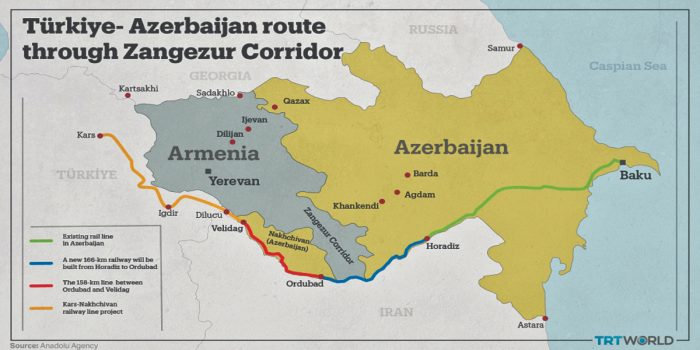
After Recep Tayyip Erdoğan’s victory in the elections and his visit to Baku, assessing the situation with the Zangezur corridor in Armenia, the Turkish leader, not by chance, stressed that the main reason for blocking this corridor was not Yerevan, but Tehran. Iran indeed publicly through the mouths of Ayatollah Ali Khomenei, President Ibrahim Raisi and Foreign Minister Hossein Amir Abdollahian has repeatedly noted that for it the Zangezur corridor remains a “red line,” it is unacceptable to change the borders of neighboring republics of the South Caucasus (in particular, Armenia) and it is important to maintain the direct multi-millenial border of Iran with Armenia.
Tehran does not want NATO to strengthen in the region on the shoulders of its member Turkey, nor does it want to see the Turan project implemented with pan-Turkic content. Otherwise, Iran will be blocked by unfriendly forces on its northern borders, including the emergence of a bridgehead of Zionist Israel on the banks of the Arax River.
With his statement, Erdoğan not only expresses his dissatisfaction with the regional policy of Iran that three Muslim states (Turkey, Azerbaijan, and Iran) through the fault of Persians can’t solve the road question peacefully and get economic dividends but actually says that Iran is not allowing the Turkish-Azerbaijani tandem to start a war with Armenia again and take by force the Meghri segment of the Zangezur corridor (if not all of Zangezur – Syunik Province) from the latter.
Given that Russia is now forced to engage in the western flank of the geopolitical confrontation with the West in Ukraine and is therefore interested in maintaining a partnership with Turkey for the same transit and out into the world, it cannot strain relations with Ankara in Armenia (Transcaucasus). Iran becomes the main opponent of Turkey in this theater.
In the second half of June 2023, Turkey and Azerbaijan announced the formation of a unified system of control and management of airspace from the Aegean Sea to the Caspian Sea according to NATO standards (the Turkish HAKİM Air Command Control System). The latter is practically capable of establishing airspace control in the South Caucasus region and threatening not only Armenia but also Iran. Given the existence of a common air defense system between Armenia and Russia within the CSTO, such a move by the tandem of Ankara and Baku is in some ways a challenge for Russia’s regional interests as well.
Since the beginning of 2023, trade turnover between Iran and Turkey has decreased by 20%, where the main export commodity for the Turkish side remains gas. Apparently, such a decline in economic relations between these countries was the result of a number of objective and subjective reasons (such as the crisis in the energy market due to anti-Russian sanctions and rising prices, the earthquake and rising inflation in Turkey, the devaluation of the Turkish lira, and Ankara’s pressure on the issue of the Zangezur corridor). In response to Moscow’s proposal to create a gas hub in Turkey, Iran came up with an equally ambitious similar project in the Persian Gulf. All these processes testify to the growing Iranian-Turkish contradictions.
Moreover, the information about the ongoing closed-door talks between Iran and the USA on the subject of the deblocking of Iranian assets in exchange for American prisoners and, most importantly, about the end of the “tanker war” between Tehran and Washington in the waters of the Strait of Hormuz and the Gulf of Oman and the export of Iranian oil to world markets (as we know, in the USA itself there is a rise in gasoline prices and an increasing need for oil) creates additional tension in Turkish politics as well.
The US is not yet interested in the implementation of alternative communications from China to Europe through the territory of Turkey (under the One Belt, One Road Initiative). Perhaps Washington is proposing an Indian project through Iran to Europe as an alternative to Chinese transit. And in this geographic preference of the states, a new confrontation between Iran and Turkey is created.
Accordingly, if Iran develops strategic partnerships with countries such as China and India, and can establish certain relationships with the US administration on the nuclear program and oil exports, Turkey will find it difficult to count on success in a battle with Tehran. Moreover, today’s Iranian authorities are interested in strengthening President Erdoğan’s policy independent of the United States, which makes it possible to weaken Washington’s pressure on the region. These are the complicated patterns of the contemporary geopolitical mosaic in the Greater Middle East.
Aleksandr SVARANTS, PhD in political science, professor.
The US can’t stop the rise of Iran, but it can make a truce
By Timur Fomenko | RT | June 25, 2023
In 2018, the Donald Trump administration ripped up the Joint Comprehensive Plan of Action (JCPOA), known as the “Iran nuclear deal,” which had been signed by his predecessor Barack Obama.
The decision to scrap the deal was thoroughly influenced by neoconservative members of his cabinet, including National Security Advisor John Bolton and Secretary of State Mike Pompeo, who not only saw the opportunity to take a swipe at Trump’s predecessor, but argued that placing crippling unilateral sanctions on Tehran would bring the country to the negotiating table, and if not, bring the regime down altogether.
Thus began a five-year campaign of brutal pressure against Iran, which sought to destroy its economy and attempted to coerce third-party countries away from doing business with it. But the initiative didn’t go according to plan. Rather, the world changed. The flagrant disregard of international law by Washington was a catalyst in the emergence of de-dollarization. The global shake-ups that came next, including the Covid-19 pandemic, US competition with China, and the war in Ukraine, gave Tehran strategic space and leverage it had previously lacked.
Now, Iran has substantially increased its uranium enrichment, has continued to build its drone and missile capabilities, has an enhanced military relationship with Russia, and thanks to Beijing, has been able to normalize its relationship with its regional arch-rival Saudi Arabia. In the process of doing so, it has reduced the regional influence of the US and its partner, Israel. US foreign policy on Iran has revolved around exploiting regional tensions in order to justify its own security footprint, but Iran has seemingly been able to begin to supersede a campaign of US containment against it while not being overtly belligerent.
This has set alarm bells off in Washington. The US has been desperate to try and reinforce its relationship with Saudi Arabia, but has reportedly been engaging in secret negotiations with Tehran not to revive the JCPOA, but to keep it away from further uranium enrichment and off the nuclear path, a move which of course will have to come with sanctions relief. While the US, presumably with the support of Israel, has threatened unspecified military action if Tehran goes further, it seems clear that Iran now has all of the cards and that a temporary “truce” must therefore come at the expense of the US containment campaign.
Because of the regional dynamic shifting in its favor, Tehran is highly unlikely to actually go down the path to developing a full-fledged nuclear bomb, given the opportunities it would provide to Washington. Unlike a country like North Korea, Iran doesn’t truly need nukes in order to establish a doctrine of deterrence for its own regime’s survival. It is a large country with a population of over 80 million. While the United States could hypothetically conduct air or missile strikes on key Iranian facilities to try and impede its nuclear program, what the US could not do, especially in this environment, is a full-scale invasion and occupation of the country. It would cost trillions of dollars, and there would be no support for it.
Rather, Iran’s deterrence ability is premised on its drone and missile programs, which have grown in their capabilities over the years despite US sanctions. The country recently claimed to have developed hypersonic missiles, which while some skepticism is warranted, is not completely fictional. Tehran has, after all, in response to the assassination of Revolutionary Guards Corps commander Qasem Soleimani, shown its ability to destroy US military bases within its range, and therefore demonstrate what it could do to Israel if things turned nasty. In doing so, it is demonstrating that regardless of US sanctions, it is a significant regional player, and will continue to be.
US foreign policy towards adversaries has repeatedly attempted to seek maximum strategic gain, eschewing the idea of compromise, be it China or Russia. But when it comes to Iran, Washington is stumped on what to do without taking the risk of provoking a wider conflict. This is why the Biden administration is leaning towards giving in, knowing that the regional dynamic of the Middle East is shifting away from its favor, and taking punitive action which may provoke war is unwelcome. In other words, Iran is winning. The only question which remains is whether or not the US wants a truce or to keep pressuring Tehran until it snaps? Even if the outcome ends in a sheer stalemate, with no nuclear lines crossed, it’s still a lose-lose situation for Washington in the end as Iran re-establishes itself diplomatically.
Jordanians reject ties with Israel, welcome normalization with Iran, Syria: Poll
The Cradle | June 20, 2023
An overwhelming majority of Jordanians say they oppose “all sorts of cooperation” with Israel, including receiving humanitarian aid in the case of a natural disaster, according to a public opinion poll commissioned by the Washington Institute and conducted between March and April.
While 84 percent of respondents say they oppose “having business deals with Israeli companies,” 76 percent agreed with the following statement: “In case of an earthquake or other natural disaster … Arab countries should refuse any humanitarian aid from Israel.”
Furthermore, at least 60 percent of Jordanians have a favorable view of Palestinian resistance factions firing missiles at Israel. In comparison, only 12 percent expressed a positive opinion of the Abraham Accords.

While a sizable minority of Jordanians (42 percent) see Iran as an “enemy,” over half of the respondents (53 percent) positively welcomed the Iran-Saudi rapprochement, while 58 percent say Arab normalization with Syria is a positive development for the region.
Jordanians also vehemently oppose US or Israeli attacks against Iran, with 65 percent of respondents agreeing that such a move “would be too dangerous and a bad idea.”

In addition, only 13 percent believe Washington should do “more to help counter the threats we face from Iran,” while 59 percent oppose the idea of an Arab country developing a nuclear weapon “to counter Iran.”
While Jordan was among the first nations to normalize relations with neighboring Israel, a large majority of the country’s population has historically stood against the occupation of Palestine and in support of a free Palestinian state.
This is a reality widely shared across West Asia, as earlier this year the Arab Center for Research and Policy Studies (ACRPS) released the findings of the largest opinion survey conducted in the Arab world, showing that 84 percent of Arabs reject recognizing Israel for political and cultural reasons.
A similar poll conducted in September revealed that the Arab youth also prefer building ties with Russia and China over the US.
US analytics and advisory firm Gallup in April of this year released a poll that shows an overwhelming majority of citizens in 13 countries across West Asia and North Africa do not trust US claims about “encouraging the development of democracy” or about “improving the economic lot of people.”
Qatar ready to ink new 27-year gas deal with China
The Cradle | June 20, 2023
China National Petroleum Corporation (CNPC) and QatarEnergy are expected to sign a 27-year agreement, which will allow China to purchase 4 million metric tons of liquefied natural gas (LNG) a year, Reuters reported today, 20 June.
Sources familiar with the deal told Reuters that CNPC also will take an equity stake in the eastern expansion of Qatar’s North Field LNG project. The stake is the equivalent of 5 percent of one LNG train with a capacity of 8 million tonnes per year.
Despite selling equity shares in the North Field expansion to foreign firms, QatarEnergy plans to retain a 75 percent stake in the project, which will cost at least $30 billion, including the construction of liquefaction export facilities.
In April, China’s Sinopec signed a deal to become a “value-added” partner in Qatar’s North Field expansion project.
The project, with a total investment cost of $28.75 billion, aims to raise Qatar’s LNG export capacity from the current 77 million metric tonnes per annum (MTPA) to 110 MTPA, making it one of the largest LNG projects in the world, Sinopec said in a statement.
“The cooperation will help Sinopec optimize the energy consumption mix in China and secure a long-term and reliable clean energy supply to the nation. The partnership represents another model of bilateral cooperation between China and Qatar,” Sinopec said.
China is seeking increased imports of LNG from Qatar, the world’s top LNG supplier, in part to reduce dependence on LNG imports from the United States, the world’s second-largest supplier.
Some US lawmakers have touted Chinese reliance on US-produced LNG as an opportunity to exert influence over the nation with the world’s second-largest economy.
“If you want to think of it geopolitically, why wouldn’t we want China dependent on our natural gas for their own economy?” House Speaker Kevin McCarthy said in an interview reported by Politico. “Would the world not be safer, and would we not be stronger? Why wouldn’t we create more American jobs at the same time?”
However, Senator Bill Cassidy of Louisiana explained that Chinese purchases of US-produced LNG are mutually beneficial, stating that “China gets guaranteed shipments at a certain price by providing upfront capital. That, in turn, helps U.S. companies build export terminals, which drives demand for more US drilling in places like Louisiana and Texas.”
“Right now, China is a frenemy,” he said. “If they – just like India, South Korea, Japan, the EU – are purchasing or buying, helping to pay for the capitalization of LNG export terminals, well, that’s a good thing.”
Competition for LNG has intensified since the start of the Ukraine war in February 2022. Europe needs new sources of natural gas to help replace the Russian pipeline gas that used to make up almost 40 percent of the continent’s imports. Europe cut off its own supply of Russian gas by imposing sanctions against Moscow after the start of the war.
Biden regime top aide in Saudi Arabia to further push for normalization with Israel after Blinken failure
Press TV – June 18, 2023
A top advisor to US President Joe Biden has reportedly traveled to Saudi Arabia as part of Washington’s relentless push to broker a normalization deal between Riyadh and Tel Aviv.
The US-based news website Axios reported on Saturday that Brett McGurk, Biden’s senior Middle East adviser, had arrived in Saudi Arabia to hold “talks with Saudi officials that will focus on the administration’s efforts to reach a normalization agreement between the Israel and the kingdom as well as other issues.”
According to the report, McGurk was also expected to meet with Saudi Crown Prince Muhammed bin Salman to discuss the kingdom’s normalization of relations with Israel.
McGurk’s visit is part of attempts by the White House to push for a Saudi-Israeli deal in the next six to seven months before Biden’s presidential election campaigns.
The top advisor’s trip to Saudi Arabia comes less than two weeks after US Secretary of State Tony Blinken visited the kingdom and met bin Salman, with Saudi officials having snubbed the US diplomat’s latest push for the normalization deal.
Saudi Foreign Minister Prince Faisal bin Farhan Al Saud said at a joint press conference with Blinken that “without finding a pathway to peace for the Palestinian people… any normalization will have limited benefits.”
Saudi Arabia cautiously welcomed the US-brokered normalization deals between the Israeli regime and the United Arab Emirates, Bahrain, Sudan and Morocco in 2020.
The oil-rich kingdom itself, however, has been expected to jump on the bandwagon since then, as the two sides have seen growing contacts and de-facto rapprochement in recent years, despite claims that it is committed to the 2002 so-called Arab Peace Initiative, which conditions normalizing ties with Israel on the establishment of an independent, sovereign Palestinian state within the 1967 borders.
The Riyadh regime in November 2020 granted permission for Israeli airlines to use its airspace, hours before the first Israeli flight to the UAE was set to take off.
Palestinian leaders, activists and ordinary people have repeatedly rejected Arab-Israeli normalization deals as “a stab in the back of the Palestinian cause and the Palestinian people.”
US sends more fighter jets to its Middle East
RT | June 15, 2023
The US military has sent additional fighter jets to the Middle East after accusing Russia of “increasingly unsafe” aircraft activity in the region, including during several incidents in Syria.
F-22 Raptors with the 94th Fighter Squadron have been deployed from Langley Air Force Base in Virginia, according to Central Command (CENTCOM), which oversees US military operations in the Middle East, Central Asia and parts of Africa.
The decision was part of a “multifaceted show of US support and capability in the wake of increasingly unsafe and unprofessional behavior by Russian aircraft,” CENTCOM said in a press release on Wednesday.
Pentagon officials have accused Moscow of reckless flights over US bases in Syria in recent weeks, with CENTCOM chief General Erik Kurilla claiming there has been a “significant spike” in “provocative” actions since March.
In an interview with the Wall Street Journal in April, Air Force Lieutenant General Alexus Grynkewich warned that the rise in tensions could lead to a “miscalculation” among Russian and American pilots operating in Syria, stating there were 60 separate incidents between March and April alone.
Moscow has similarly accused Washington of unprofessional behavior in Syria. Last month, Rear Admiral Oleg Gurinov, deputy head of the Russian Center for the Reconciliation of Warring Parties in Syria, said American warplanes continued to commit “gross violations” of deconfliction protocols.
“US Air Force pilots continue to activate weapons systems when approaching in the air with Russian Aerospace Forces aircraft performing planned flights in eastern Syria,” the official added.
The US currently maintains about 900 ground troops in Syria and operates a network of air bases around the region. The new aircraft deployment also comes after CENTCOM said it would strengthen the US “defense posture” in the Middle East with additional naval assets, vowing to carry out “heightened patrols” in the Persian Gulf in response to “destabilizing” actions by Tehran.
Featured Video

The Empire Enters the Cocaine Trade
or go to
Aletho News Archives – Video-Images
Book Summary
The Whole Soy Story: The Dark Side of America’s Favorite Health Food

Lies Are Unbekoming | January 20, 2026
Soybeans generate approximately $80 million annually in mandatory producer assessments alone, funding a marketing apparatus that has transformed an industrial commodity into one of America’s most trusted “health foods.” The campaign succeeded. Soy milk lines supermarket shelves beside dairy. Soy protein fortifies everything from infant formula to energy bars. Vegetarians rely on tofu and tempeh as dietary staples. Doctors recommend soy to menopausal women. School lunch programs serve soy-based meat substitutes to children. An estimated 60 percent of processed foods contain soy derivatives. The premise underlying this proliferation—that Asians have thrived on soy for millennia and that modern science validates its health benefits—has been repeated so often it functions as established fact.
Kaayla T. Daniel’s The Whole Soy Story dismantles this premise through systematic examination of the scientific literature. The book documents that traditional Asian soy consumption averaged roughly one tablespoon daily, consumed as fermented condiments after processing methods that neutralized inherent toxins—a pattern bearing no resemblance to American consumption of industrially processed soy protein isolate, soy flour, and soy oil. Daniel catalogs the antinutrients that survive modern processing (protease inhibitors, phytates, lectins, saponins), the toxic compounds created by industrial methods (nitrosamines, lysinoalanine, hexane residues), and the heavy metals concentrated in soy products (manganese, aluminum, fluoride, cadmium). She traces the mechanisms by which soy isoflavones—plant estrogens present at pharmacologically significant levels—disrupt thyroid function, impair fertility, and interact with hormone-sensitive cancers. The evidence emerges from peer-reviewed journals, FDA documents, and industry sources themselves.
The stakes extend beyond individual dietary choices. Infants fed soy formula receive isoflavone doses equivalent to several birth control pills daily, with blood concentrations 13,000 to 22,000 times higher than their natural estrogen levels. Soy protein isolate—the ingredient in formula, protein bars, and thousands of products—has never received GRAS (Generally Recognized as Safe) status; its only pre-1960s use was as an industrial paper sealant. Two senior FDA scientists formally protested their own agency’s approval of soy health claims, citing evidence of thyroid damage and reproductive harm. The Honolulu Heart Program found that men consuming tofu twice weekly showed accelerated brain aging and increased dementia. These findings have not penetrated public awareness because the institutions responsible for consumer protection have been compromised by the industry they regulate. The Whole Soy Story presents the evidence that has been systematically excluded from mainstream health messaging, enabling readers to evaluate for themselves what the soy industry prefers they never learn. … continue
Blog Roll
Recent Comments
seversonebcfb985d9 on French court jails pro-Palesti… eddieb on Fourteen Incredible Facts Abou… Bill Francis on European leaders’ shift in the… seversonebcfb985d9 on Villains of Judea: Philip Esfo… loongtip on Report warns that ‘Jewish terr… Craig Nelms on New study shows that toxic gas… loongtip on A Funny Thing Happened on the… loongtip on EU free trade pact on hold as… John Edward Kendrick on Regime Change In Iran Is The F… Bill Francis on Australia Passes New Hate Spee… seversonebcfb985d9 on Australia Passes New Hate Spee… Bill Francis on Britain’s AI Policing Plan Tur…


 Aletho News
- Germany to build 10GW of baseload gas plants (disguised as “future” hydrogen plants)
- French court jails pro-Palestine activist and mother over Gaza genocide speech
- Shot, amputated, and imprisoned: Palestinian man seeks to rebuild life after being maimed and tortured by Israeli forces
- Building Disney Land on the Moon More Likely than Kushner’s Gaza Plan
- U.S. Funds Continue to Flow to Ecuadorian Groups Despite Trump-Era Suspension
- A pro-EU regime is moving to suppress this proud nation. Will they be able to withstand it?
- US-Russia Arms Control May Face ‘Very Dark Period’ – Scott Ritter
- Israel moves to restrict Palestinian re-entry to Gaza, ‘encourage outflow’: Report
- Trump aims to create new UN and own it, Brazil’s Lula warns
- UN rapporteur says Israeli demolition of UNRWA compound reflects broader attack on UN system
- If Americans Knew
- Israeli drone strike kills two children collecting firewood in Gaza – Not a ceasefire Day 107
- Another Gaza baby freezes to death on Netanyahu’s watch – Not a ceasefire Day 106
- Oppose Israel’s Abuses While You Still Can
- UNRWA Heads Tell Ha’aretz: ‘We Don’t Radicalize Palestinians – Their Lived Existence Does’
- Plans Call for “New Rafah” Built in Israel’s Image — Without Palestinians
- Posing as priest, reporter is spat at many times, highlighting anti-Christian sentiment in Israel
- Leaked Documents: “Planned Community” in Rafah Would Force Palestinians Into Israeli Panopticon
- ‘Permits of Humiliation’: How Israel Strangles Christian Education in Jerusalem
- “The world sees death, destruction and injustice – and they see dollar signs” – Not a ceasefire Day 105
- War criminal Netanyahu kills 11 in Gaza, joins Board of Peace – Not a ceasefire Day 104
- No Tricks Zone
- Germany’s Natural Gas Crisis Escalates … One Storage Site Near Empty …Government Silent
- Polar Colding…Antarctica Saw Its Coldest October In 44 Years!
- New Study: Sea Levels Rose 20 Times The Modern Rate During The Roman Warm Period
- As German Gas Storage Dips Dangerously Low…Shortage Hardly Avoidable
- New Study: Brazil’s Relative Sea Level Was 2+ Meters Higher And SSTs 3-4°C Warmer 6000 Years Ago
- Philosopher Schopenhauer: Climate Science Certainty Stems From Stupidity, Ignorance
- New Study: Species Extinction Rates Declining Since 1980 – ‘Climate Change Is Not An Important Threat’
- Denmark Places Climate Protection Above Animal Welfare, Poisoning And Culling Cows
- New Study: Greenland Was 3-7°C Warmer And Far Less Glaciated Than Today 6000-8000 Years Ago
- German Media Report That Current Frigid Weather Can Be Explained By Arctic Warming!
 Aletho News