US pressures Saudi Arabia to postpone imminent peace deal with Yemen
The Cradle | December 18, 2023
The US is exerting pressure on Saudi Arabia to delay the signing of a peace agreement with Yemen and instead join an expanded maritime protection task force to confront Yemeni attacks against Israeli-linked ships in the Red Sea.
According to a report by Lebanese daily Al-Akhbar, a draft peace deal between Sanaa and Riyadh has been finalized. It could be signed before the end of the year, potentially ending a NATO-backed war that has decimated the Arab world’s poorest country for eight years.
“Saudi Arabia is going through a difficult test between two options […] Either it will emerge from the Yemeni quagmire under a roadmap agreed upon with Sanaa, or it will submit to US dictates and join the international maritime coalition, and this means remaining vulnerable to [western] blackmail,” the Al-Akhbar report details.
Despite the pressure from Washington, the kingdom is reportedly “continuing on the path to peace” and is working to “speed up” the completion of the peace agreements to avoid “further obstruction by the Emiratis or local agents.”
Saudi and Yemeni negotiators have given their final comments on the agreement. The revised version was recently delivered to UN special envoy for Yemen, Hans Grundberg, who has started coordinating an official peace ceremony.
According to Al-Akhbar’s sources in Riyadh and Sanaa, the peace deal includes the complete lifting of a land, sea, and air blockade imposed on Yemen by the Saudi-led coalition, a “consensual mechanism” to pay the salaries of public employees, and the free export of oil from Saudi-controlled regions.
“The ball is in Riyadh’s court, which is under US pressure to delay the signing and enter into a war alliance against Yemen in the Red Sea,” Al-Akhbar highlights, adding that UAE-backed forces are also looking to derail the peace process.
A peace agreement between Saudi Arabia and Yemen would significantly hamper US efforts to deploy an international naval task force to the Red Sea to protect Israel’s maritime trade.
“The force, provisionally entitled Operation Prosperity Guardian, is due to be announced by the defense secretary, Lloyd Austin, when he visits [West Asia],” UK daily The Guardian reported on 17 December.
The US war chief is set to visit Israel later this week to meet with senior officials. According to the British outlet, western officials believe Washington has secured the involvement of Jordan, the UAE, Qatar, Oman, Egypt, and Bahrain.
For the past several weeks, the Yemeni armed forces have been launching attacks on Israeli-linked commercial vessels attempting to cross the Bab al-Mandab Strait south of the Suez Canal.
In response, five of the world’s largest shipping companies have announced a complete cessation of activities in the vital sea route. These are Hong Kong-based OOCL, France’s CMA CGM, the Danish Maersk, the German Hapag-Lloyd, and the Italian-Swiss-owned Mediterranean Shipping Co.
The dangers NATO names and makes
By Radhika Desai | CGTN | November 28, 2023
NATO Secretary-General Jens Stoltenberg stated in his pre-ministerial press conference on the eve of the NATO Foreign Ministers’ meeting in Brussels on November 28 and 29, that the almost 75-year-old organization faces “the most dangerous world in decades.”
However, little that the military alliance does seems designed to diminish those dangers. Instead, by holding out the hope of prevailing in these conflicts, most of which it has been instrumental in causing in carefully selected theaters outside itself, it is exacerbating them.
There is, upper-most on the world’s mind, the six-week-old Israel-Hamas conflict. While U.S. officials routinely invoke the danger that it will spiral out of control into a Middle Eastern war and even a World War III, rather than damping it down, the U.S. and NATO seem hell-bent on stoking it further. They back Israel militarily, financially, and diplomatically (with NATO members routinely vetoing or abstaining from numerous UN Resolutions calling for even a pause in the conflict) so one-sidedly that NATO governments face veritable revolts, not only on the streets but in its own ranks and those of the normally loyal national media.
The U.S. and NATO’s hopes of victory against Middle East countries are vain and hubristic. This is already clear from their failure to win the war in Ukraine. With defeat all but announced, the search for scapegoats is already on in Kyiv. If, after 20 months of war, billions in aid and armaments, boomeranging sanctions and unrelenting propaganda the war could not be won, the addition of new wars can hardly bring victory closer.
Finally, Stoltenberg referred to “growing global competition,” a code word for the aggression towards China into which the U.S. is trying to dragoon its NATO allies. It has, in recent years, entailed the revitalization of the Quad of Japan, Australia, India and the U.S., the launching of the AUKUS alliance between Australia, the United Kingdom and the U.S. and the shift from “Asia Pacific” to “Indo-Pacific” to designate the U.S. concerns and commitments beyond its western sphere with India positioned as a key U.S. and Western ally in the region.
It has also entailed unprecedented explicit mention of Asian objectives in NATO communiques since the Madrid Summit in 2022, and the attendance of leaders and ministers of Japan, the Republic of Korea, Australia and New Zealand as regular guests at NATO meetings and summits.
However, this strategy is far from assured. Quite simply, China’s winning, development- and growth-based diplomacy continues to engage all these countries and even NATO members with considerable success. While enervated and financialized Western economies offer only subjection, political and financial, China’s vibrant economy, productive and technological dynamism and benign international [ism] offer/exert an economic gravity that leaves no country untouched.
There are many reasons why NATO is being too hubristic and vain: It is too used to being the top dog, too many of its governments have invested too much into these wars and potential wars and it needs achievements to celebrate next July, not failures. But, as became clear in U.S. President Joe Biden’s speech a few days ago, when he once again delusionally called his country the “indispensable nation,” he wishes to fight the next election as a war president and then some: with wars on two and possibly three fronts.
Given his abysmal ratings, that is the thin thread on which his victory hangs.
Radhika Desai, a special commentator on current affairs for CGTN, is a professor of political studies at the University of Manitoba in Canada.
Iran ready to further strengthen all-out ties with Kuwait: Foreign minister
Press TV – December 17, 2023
Iranian Foreign Minister Hossein Amir-Abdollahian says Tehran is ready to further improve relations with Kuwait in various fields.
Amir-Abdollahian made the remark in a meeting with new Kuwaiti Emir Sheikh Mishal al-Ahmad al-Jaber al-Sabah in Kuwait City on Sunday.
He offered condolences of the Iranian president and nation to Kuwait over the passing of former Emir Sheikh Nawaf al-Ahmad al-Jaber al-Sabah and congratulated Sheikh Mishal on his appointment as the new Emir of the country.
The top Iranian diplomat reiterated Tehran’s support for Kuwait City.
The new Kuwaiti Emir, for his part, said he has instructed foreign minister and other cabinet members of the government to put the expansion of all-out ties with Iran on their agenda.
Sheikh Nawaf died at the age of 86 on Saturday.
Putin’s Middle East Trip Deals a Blow to Washington
By Salman Rafi Sheikh – New Eastern Outlook – 11.12.2023
Russian President Vladimir Putin’s recent visit to the Middle East – and the 21-gun salute welcome he received there – shows the failure of Washington’s consistent attempts to ‘isolate’ and defeat Russia. The visit also points to the Middle East’s increasing shift away from, and sole reliance on, Washington. Ever since the beginning of the Gaza War on October 7, the Middle East has been keeping contact with China, rather than the US, its first priority. The reason for this is not simply the fact that the US is supporting, militarily and diplomatically, Israel against Palestine, but also because the Middle East is strategically realigning itself with the realities of what is increasingly – and undeniably – a multipolar world. To the extent that the Middle East, a region where the US remained the most dominant extra-regional force for many decades, has made this shift also reflects the ongoing demise of US dominance more generally in the world. To the extent that China and Russia are two major proponents of multipolarity, connect the dots of this anti-US but pro-China and pro-Russia shift.
Putin’s trip to the UAE and Saudi Arabia has many dimensions. One of these dimensions is bilateral. Between 2017-2022, the trade turnover between Russia and the UAE has grown by almost six times. In 2022, the overall trade increased by almost 68% amounting to US$9 billion. The UAE is Russia’s largest trading partner in the Gulf Region, accounting for 55% of Russia’s total trade with the Persian Gulf.
It, therefore, makes sense for Washington to pressure the UAE government to drastically limit their trade ties with Moscow. Earlier in September, several Western officials from the United Kingdom, EU and US visited the UAE to persuade the UAE to review its trade ties with Russia. Western officials have been assuming that, in the wake of the threats of the Israel-Gaza war spreading to other parts of the Middle East, the UAE would go back to its ultimate security guarantor: the US. This would, however, happen only if the UAE has good ties with the US. Good ties, under the present context of the Russia-Ukraine conflict, mean the UAE ending its trade ties with Russia, especially the ones that may have military implications.
The UAE has been resisting these pressures. In fact, its decision to welcome Putin himself means that the UAE is considering an alternative means of protecting itself in the wake of a wider war in the region. It is ensuring Russian (and Chinese support), and it is using this (possible) source of support to send a message to Washington, i.e., multiple options are possible in a multipolar world. The message is quite similar to the message that the Saudis have been giving to the Americans since the beginning of the Russia-Ukraine military conflict.
If the Americans have been doing their best to convince the Saudis to break out of the OPEC+ deal and increase the production of oil to help reduce its prices and consequently help control the inflation in the West, the Saudis have not submitted. In this context, Putin’s visit to Saudi Arabia sought to reinforce the ‘oil alliance’ – which is also a major dimension of Russia-Saudi bilateral ties – at a time when the burden of wars (supporting Ukraine plus Israel) on the West is increasing manifold. For Putin, an appropriate message to the Middle East in particular and the Global South in general is this: the West supports aggression against all states, regardless of whether it is Russia or Palestine, and it expects other states (e.g., the Middle East) to support that aggression.
Russia understands that the West is fighting two wars, and it does not have any narrative to justify them both simultaneously. As even the US-based Carnegie Endowment said in one of its recent reports, “Washington’s pro-Israel stance undermines the legitimacy of the West’s broader reasons for supporting Ukraine in the eyes of many in the Global South. The moral argument against Russia’s invasion of Ukraine now looks like empty words, particularly in Middle East nations”. In this sense, the timing of Putin’s visit was far from coincidental. It aimed to tap into the opportunity to wean powerful states in the Middle East, who are also keen to expand ties with the non-Western world via BRICS, away from the US as much as possible.
Therefore, the purpose of Putin’s visit, as some Western media analysed and sought to trivialise, was not simply to “discuss” the Gaza war. It was part of Moscow’s wider outreach to the Middle East at an appropriate time to reorient the Middle East’s strategic priorities. Soon after coming back, Putin hosted Iran’s president in Moscow to build on the success of his visit and deepen Russia’s foothold in the region, a region that allows Russia to fight the West in the economic field by, for instance, coordinating the production of oil.
Still, the Gaza war was discussed. But that discussion was underpinned by the strategic failure of Washington’s plans to create a new Middle East. The failure of the US in the Middle East becomes yet another opportunity for Moscow to present itself as a potential peace broker rather than, and unlike the US, a troublemaker. If it was simply a war of narratives, Russia (and China) are clearly winning it in the Middle East.
Doha Summit: US Risks Alienating Muslim World by Vetoing Gaza Ceasefire Resolutions
By Ekaterina Blinova – Sputnik – 10.12.2023
A DC think tank has pointed out that Washington could lose influence in the Arab and Muslim world by killing off the UN ceasefire resolutions.
The US was the only country that vetoed a UN Security Council Gaza ceasefire resolution on Friday. The 15-member gathering voted 13-1 in favor of the initiative – with the United Kingdom abstaining.
Israel’s military operation in the strip has already claimed the lives of more than 17,700 people with 70% of them estimated to be women and children, per Gaza’s Ministry of Health.
Judging from the opening remarks at the 21st Doha Forum in Qatar on Sunday, the Arab world is deeply frustrated by Washington’s veto, DC think tank The Quincy Institute of Responsible Statecraft pointed out.
In particular, Foreign Minister of Qatar Sheikh Mohammed bin Abdulrahman Al-Thani said that Washington’s move to kill the resolution exposed the “great gap between East and West… and double standards in the international community.”
He placed emphasis on the necessity to create a new multipolar world order that “respects justice and equality between the people where no people are more powerful than the other.” The Qatari leadership vowed to continue exerting pressure on Tel Aviv and Hamas to implement a new truce despite “narrowing” chances.
Palestine Prime Minister Mohammad Shtayyeh argued that the US gave the “greenest of green lights” to Israel’s brutal methods of waging war in Gaza. Per him, Washington should be held responsible for Israel’s attacks and the loss of Palestinian lives.
For his part, Jordan’s Foreign Minister Ayman Safadi accused Tel Aviv of implementing a policy of expelling Palestinians out of Gaza by military actions.
Addressing the forum, United Nations Secretary-General Antonio Guterres stated that the humanitarian system is currently under threat: “We are facing a severe risk of collapse of the humanitarian system. The situation is fast deteriorating into a catastrophe with potentially irreversible implications for Palestinians as a whole and for peace and security in the region.”
“Last week, I delivered a letter to the President of the UN Security Council invoking Article 99 of the Charter of the UN for the first time since I became Secretary General in 2017,” said Guterres. “I wrote that there is no effective protection of civilians in Gaza. As a matter of fact, during my mandate, the number of civilian casualties in Gaza in such a short period is totally unprecedented.”
Article 99 of the UN Charter states: “The Secretary-General may bring to the attention of the Security Council any matter which in his opinion may threaten the maintenance of international peace and security.”
Meanwhile, DC think tank The Quincy Institute of Responsible Statecraft highlighted that humanitarian advocates repeatedly called the situation in Gaza “unprecedented”, adding that UN agencies are continuing to lose people in the war zone. The United Nations Relief and Works Agency has lost 134 relief workers in Gaza since Tel Aviv’s military operation began.
The Quincy scholars also warn about the growing anti-American sentiment in the Arab world, as Washington is seen as the major obstacle on the way to peace in Gaza due to its repeated vetoes of ceasefire resolutions in the UN.
Khaled Saffuri, executive director of the National Interest Foundation in Washington, told the think tank that he was “struck by the backlash against American brands” during his travels in Kuwait and Qatar over the last week. Per him, Arab customers and restaurants are boycotting Coke, Pepsi, McDonald’s, and Starbucks. Saffuri called Washington’s latest veto in the UNSC “horrible.” “America is losing a lot in the Muslim world,” he told the think tank.
Putin and Steinmeier, different treatment in the Middle East indicates shifting geopolitical paradigm
By Drago Bosnic | December 9, 2023
Ever since Russia started its full-scale strategic counteroffensive against NATO aggression in Europe, the political West has been insisting on the idea that the Eurasian giant is supposedly “isolated” and an “international pariah.” However, time and again, Moscow keeps debunking this laughable notion. Recent events have not only confirmed this, but are showing that the opposite is happening.
The Qatar trip of German President Frank-Walter Steinmeier has been mired in controversy as he was left waiting at least 30 minutes for someone to greet him during his visit on November 29. This could be partially explained by the fact that Berlin’s position is decidedly pro-Israeli, while Doha is firmly on the Palestinian side, formally at least.
However, this doesn’t explain why Russian President Vladimir Putin got virtually a hero’s welcome in the United Arab Emirates (UAE) during a visit to the Middle Eastern country exactly a week after Steinmeier’s trip to Qatar. These sharply differing, albeit seemingly unrelated events demonstrate an enormous paradigm shift in the geopolitics of the Middle East, arguably the most strategically important region on the planet. After the start of the special military operation (SMO), the political West has been trying to isolate Russia and limit its (geo)political maneuverability. However, ever since, this has only backfired, becoming a sort of litmus test for sovereignty and actual independence from the political West’s diktat.
After the sanctions warfare proved to be a spectacular failure, resulting in Russia even becoming the largest economy in Europe and fifth largest in the world, the United States and its numerous vassals and satellite states tried to find other ways to isolate Moscow and its leadership. That was when the so-called “International Criminal Court” (ICC), effectively a glorified NGO under the full control of the political West, issued an arrest warrant for Putin for allegedly “kidnapping Ukrainian children”, despite the fact that their parents, including enemy combatants, were able to reach them and even take them out of Russia. In contrast, the Neo-Nazi junta’s blatant child trafficking (aided by Washington DC) is completely unreported in the US and European Union.
Worse yet, any information about this horrendous practice is being actively suppressed, along with the fact that pregnant women are being forcibly conscripted by the Kiev regime, as evidenced by the recent attempt by NewsGuard to censor such information. It seems that this blatant hypocrisy is so obvious to the rest of the world which simply decided that Western demands for isolating Russia are unacceptable and should simply be ignored. The UAE could’ve easily chosen to follow basic protocol and greet Putin without any pomp. However, the fact that he was welcomed by Emirati jets painting the colors of the Russian flag in the sky signals something completely different from basic diplomatic protocol.
It should be noted that this in and of itself isn’t only about Putin, but Russia as a whole. Frank-Walter Steinmeier’s role as the German President is largely ceremonial, as most of the political power is officially held by the Chancellor. However, he is the foremost representative of his country and the fact that he was not welcomed as expected shows the increasing isolation of the political West in the actual world, where truly sovereign countries aren’t compelled to follow every foreign demand. Obviously, Putin’s balanced position in regard to the Israel-Gaza conflict certainly contributes to his popularity in the Arab world, but so does his firm stand in the face of NATO aggression, demonstrating time and again that Moscow has a geopolitical backbone.
Putin’s follow-up visit to Saudi Arabia was no less important in this regard, while the mainstream propaganda machine is trying to denigrate both trips. In reality, alarm bells are going off in the US, as having nations that are effectively the cornerstones of the highly exploitative petrodollar system welcome the political West’s archenemy so warmly is certainly a bad omen (for the neocolonialists, obviously). The process of dedollarization is a long-term one and will certainly not be completed overnight, but it’s virtually unstoppable at this point. The blatant theft of hundreds of billions in Russia’s forex (foreign exchange) reserves has left numerous countries worried that their assets are simply not safe, prompting them to find alternatives to the USD.
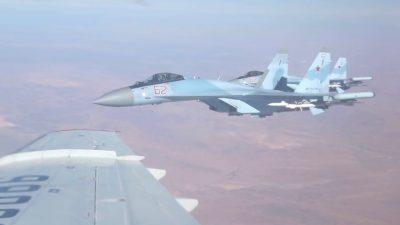
Another interesting aspect of Putin’s trip was the fact that his Ilyushin Il-96-300PU or “Russian Air Force One” was flanked by four Sukhoi Su-35S fighter jets all the way from Russia to the UAE, flying up to 2500 km nonstop, with no aerial refueling and no drop tanks. As if this technologically unprecedented accomplishment wasn’t brilliant enough, the Russian air superiority fighters did so while armed. They flew over the Caspian Sea, parts of Azerbaijan, the entirety of Iran and the Persian Gulf, touching down in Abu Dhabi. Now, it should be noted that countries rarely allow such escorts (much less armed) for state visits, but Moscow secured their free passage over three countries, including the temporary basing in the UAE. This has clear geopolitical implications.
Drago Bosnic is an independent geopolitical and military analyst.
USA and Israel Should be Worried: The Muslim Middle East is Moving Its Own Way
By Karsten Riise | Covert Geopolitics | December 7, 2023
Less than a month before Russia takes over the chairmanship of BRICS-11 where both UAE and Saudi Arabia will be full members, Russia makes a big move to bring cooperation with UAE and Saudi Arabia to an unprecedented level.
Russia ties everything together in this meeting: Head of States relations, Foreign Policy, Non-Dollar currency and Financial Policy, Industrial Policy, Nuclear Cooperation, Artificial Intelligence (AI), Space Development, International Direct Investments – and the whole private Business sector.
 Note also that Putin travels safely in person to both the UAE and Saudi Arabia.
Both UAE and Saudi Arabia are visited by President Putin, Foreign Minister Lavrov, First Deputy Prime Minister of the Russian Federation Andrei Belousov, head of the Ministry of Industry and Trade Denis Manturov, Deputy Prime Minister Alexander Novak, head of the Central Bank Elvira Nabiullina, head of Roscosmos Yuri Borisov, head Rosatom Alexey Likhachev, and head of Russian Direct Investment Fund (RDIF) Kirill Dmitriev.
The RDIF recently published a Russian international platform for AI services. The delegation also includes representatives of the business community. See this.
In cooperation with Russia and China, the UAE and Saudi Arabia are becoming not only oil powers, but powers in the modern AI, hi-tech knowledge and Space economy – and military powers.
The central Middle Eastern powers, UAE, Saudi Arabia, Iran, and even Türkiye, are emerging as pillars in the international policies of Russia and China – in all dimensions.
Algeria builds deeper relations with its biggest arms supplier Russia, and Algeria opens defense cooperation China. Russia and Egypt have also for years been reinforcing cooperation, including defense cooperation, nuclear cooperation (a Russian nuclear powerplant is being built) and trade-logistics (a Russian trade zone near the Suez Canal).
In Syria, Russia has already long ago stabilized the government in Damascus, and even in Iraq, Russia just a few days ago took over Iraq’s biggest oil field and kicked out the biggest western player in Iraq’s oil sector.
Recently, Russia as the Chairman of BRICS-11 after 1 January 2024 even gave its nod of approval for the admission of China’s best friend Pakistan into BRICS in spite of Indian hesitations.
The Muslim Middle East is moving its own way – independently of the West. At a time when all the non-Western world including the Muslim world is outraged by Israel’s Nakba pressing out Palestinians with genocide on over 16,000 civilians in Gaza, Israel and its US backer should be worried.
Karsten Riise is a Master of Science (Econ) from Copenhagen Business School and has a university degree in Spanish Culture and Languages from Copenhagen University. He is the former Senior Vice President and Chief Financial Officer (CFO) of Mercedes-Benz in Denmark and Sweden.
Middle East royal calls for end to Western ‘dominance’
RT | December 7, 2023
The current unfair world order dominated by the West needs to end, Omani Crown Prince Prince Theyazin bin Haitham Al Said said on Thursday, speaking with President Vladimir Putin.
Prince Theyazin was in Moscow for the ‘Russia Calling’ Forum hosted by VTB Bank. He met with the Russian leader on the sidelines of the investment conference.
“I listened very carefully to your opening speech,” said the prince, according to translated remarks published by the Kremlin. “I share all your assessments of the current international situation, primarily with regard to the need to end the current unfair world order and the dominance of the West, as well as to build a new fair world order and economic relations without double standards.”
In his opening remarks, Putin had described globalization as a phenomenon used by the US and the collective West to exploit both its allies and the “global periphery” instead of giving every nation an opportunity to develop and thrive.
That system is currently undergoing “radical and irreversible” changes into a more democratic and multipolar order, the Russian leader said.
Prince Theyazin said it was necessary to create new mechanisms for trade and international relations that would not “impose any ideologies,” and develop new economic centers in Africa and Asia. The Middle East was strategically positioned to play a promising role in strategic infrastructure projects, he added.
Oman is located on the southeastern tip of the Arabian peninsula, across the mouth of the Persian Gulf from Iran. Its longtime ruler, Sultan Qaboos bin Said Al Said, died in 2020 without any children – leaving the kingdom to his cousin Haitham bin Tariq. His son Prince Theyazin currently serves as Oman’s minister of youth, culture and sports.
EU ‘Overpaid’ €185 Bln for Gas Due to Russia Sanctions
By Svetlana Ekimenko – Sputnik – 06.12.2023
Disruption of Russian gas supplies due to Western sanctions on Moscow over Ukraine have left Europe grappling with spiraling inflation and surging energy bills, with the costs of liquefied natural gas (LNG) exports from the US adding to the pressures on European households’ budgets.
The European Union has been forced to overpay some €185 billion for gas imports since it imposed self-harming sanctions against Russia over Ukraine, according to Sputnik’s calculations based on Eurostat data.
Since February 2022, when Brussels first started to levy restrictions on Moscow, the EU’s average monthly gas import expenditures have risen to €15.2 billion. Of this, €7.7 billion has been spent on liquefied natural gas (LNG), while the remaining €7.5 billion has gone to pipeline gas. Meanwhile, during the year before the introduction of sanctions, European countries paid an average of €5.9 billion for gas (€3.6 billion for pipeline gas; €2.3 billion for liquefied gas).
Thus, it is estimated that EU member states over the course of 20 months spent a total of €304 billion on gas imports, while previously such expenses were accrued over several years. For example, from April 2017 to the end of 2021, the EU spent €186 billion on gas imports, and from 2013 to 2021 the value of such imports was at €292 billion.
While Europe has been reeling from the fallout from the backfiring sanctions, the United States has been raking in profits estimated to be worth €53 billion. Other countries that have benefited from the EU’s struggle to find alternatives to Russian energy are the UK (€27 billion), Norway (€24 billion), and Algeria (€21 billion).
Russia, on the other hand, despite the reduction in supply volumes, has received an additional €14 billion due to surging prices. The EU’s shortsighted crusade to limit Moscow’s energy-related income has resulted in Qatar earning the same amount – an additional €14 billion, while Azerbaijan brought in a bonus worth €12 billion. A look at some of the other beneficiaries of this EU gas policy revision shows that Angola banked €5 billion, Egypt – €4 billion, and Trinidad and Tobago – €3 billion. An additional €2 billion were received by Nigeria and Cameroon, and another billion each by Libya, Oman and Equatorial Guinea. Another 12 countries earned relatively small sums, totaling almost €2 billion.
Before the Ukraine crisis and the sanctions unleashed against Moscow over its special military operation in the neighboring country, Europe received approximately 40 percent of the gas it consumed from Russia. Ever since the Ukraine conflict escalated, Brussels has been cobbling together package after package of sanctions targeting Russia. However, to anyone with a clear understanding of the energy needs of the 27-member bloc, it was evident that it was backing itself into a corner by opting to “wean itself” off Russian gas. The Ukraine conflagration and the punitive restrictions have led to disruptions of supply chains and a surge in energy prices worldwide. Furthermore, the Nord Stream pipeline sabotage added to the continent’s woes.
The Nord Stream pipelines, built to deliver gas under the Baltic Sea from Russia to Germany, were hit by explosions on September 26, 2022. Denmark, Germany, and Sweden left Russia out of their investigations into the attack, prompting Moscow to launch its own probe with charges of international terrorism. In the absence of any official results so far, Pulitzer Prize-winning US investigative journalist Seymour Hersh published a report in February 2023 alleging that the blasts were organized by the US with Norway’s support. Washington has denied any involvement.
Western countries and their allies were left facing an energy crisis and struggling to fill their gas reserves. Overall, the sanctions have triggered in the West everything from raging inflation, recession fears, to looming deindustrialization, with Germany being hit the hardest.
At the same time, oil and gas revenues of the Russian budget have been significantly outpacing those of the last year since September despite external pressure, Russian Prime Minister Mikhail Mishustin said earlier in the autumn.
Furthermore, the World Bank reported in August that by the end of 2022, Russia’s wealth in purchasing power parity (PPP) terms had exceeded $5 trillion for the first time — putting it ahead of Western Europe’s three biggest economies, namely, France, financial giant the United Kingdom, and industrial powerhouse Germany.
Expert: Washington is Zionist-Controlled Territory
By Ian DeMartino – Sputnik – 06.12.2023
Speaking to Sputnik’s Political Misfits on Tuesday, scientist, author and activist for Palestinian Human Rights, Mazin Qumsiyeh said Israel’s actions in Gaza are a genocide that has been ignored by the world, and that Zionists in Israel want to dominate the Middle East and potentially beyond.
Asked what comes next in the conflict, Qumsiyeh said that soon disease, malnutrition and a lack of water and medicine will lead to a civilian death toll that will “quickly overtake the number of civilians killed by bombings.”
He then moved onto discussing what he believes to be Israel’s plans after Gaza.
“That is the long-term plan of Israel, a newly dominated Middle East, in which Israel holds hegemony. But I don’t think they will stop with the Middle East, they will continue because that is what colonialist powers do,” Qumsiyeh warned. “I think China and Russia and other countries need to pay attention very closely to what Israeli plans have been.”
Israel started heavily bombing Gaza days after a surprise attack by Hamas on October 7, which killed around 1,200 Israelis according to official numbers. It has since launched a ground campaign in Gaza, promising to eliminate Hamas. More than 16,200 Palestinians have been killed in Gaza since October 7, including over 7,000 children.
Multiple human rights organizations have described Israel’s actions as genocidal. Israel has targeted UN schools, refugee camps and hospitals, claiming that Hamas militants are hiding in those areas or using them as a base of operation.
“For the life of me, I don’t understand why so many countries are silent on this, on an ongoing holocaust, an ongoing genocide,” Qumsiyeh said, adding that he believes it is “not [just] a Palestinian problem, it’s a global problem.”
“The State Department now basically works 95% of its time for Israel,” Qumsiyeh said, pointing to a recent resignation by State Department official Josh Paul, who said in media interviews that there “has been no space allowed for debate” on the transfer of arms to Israel.
“… since Washington is a superpower, with the tails of Washington being the UK and many other countries like Canada and Australia follow suit. So we have a major global problem that could lead to world war,” Qumsiyeh said. “It also already led to the destruction of international law and order and already the UN has become a totally useless organization.”
Political Misfits co-host John Kiriakou asked Qumsiyeh if Israeli Prime Minister Benjamin Netanyahu could lose his position and if it would matter if he did.
“They need to be stopped as a collective, not as Netanyahu, let’s not make it personal about Netanyahu,” he added.
Israel has maintained that it is doing all that it can to protect civilians in Gaza while attempting to eliminate Hamas. It has repeatedly dismissed claims that has committed war crimes in Gaza.
Featured Video

Bombing Hitler’s Hometown
or go to
Aletho News Archives – Video-Images
From the Archives
‘Conspiracy Theory’ Now Fact: Greater Israel Has Arrived
By Kit Klarenberg | Mint Press News | January 28, 2025
Ever since Tel Aviv’s 1948 creation, much has been said and written about ‘Greater Israel’ – the notion Zionism’s ultimate end goal is the forcible annexation and ethnic cleansing of vast swaths of Arab and Muslim lands for Jewish settlement, based on Biblical claims this territory was promised to Jews by God. The mainstream media typically dismisses this concept as antisemitic conspiracy theory, or at most the fringe fantasy of a minuscule handful of extremist Israelis.
In reality … continue
Blog Roll
 Aletho News
- IRGC: Israeli, US universities in region legitimate targets after strikes on Iranian university
- Trump admits Iran hit USS Ford carrier: ‘We ran for our lives’
- Battle for Hungary: EU attacks on Orban are a sign of worse things to come
- Iraqi resistance conducts drone strike on US-run base in Syria
- Failing to Defeat Hezbollah, Israel & US Pressure Syria’s Ahmed al-Sharaa to Join War
- US-Israeli war on Iran drives global fertilizer prices up 40%
- Hezbollah’s Surprise Weapons Redefine Ground Battle with Israel
- Yemen joins fight against US, Israel by firing missiles at occupied territories
- Seizing the Kharg: Washington’s path to defeat in the Persian Gulf
- Iran reports 500 US casualties in strikes on covert US military sites
- If Americans Knew
- Over 300 US service members wounded, majority have brain injuries – Not a ceasefire Day 169
- Researchers at Human Rights Watch Resign Over Blocked Report on Palestinian Refugee Return
- Jewish Groups Are Backing a War Americans Don’t Want
- Eric Fingerhut Thinks He’s the President of the Jews
- Top Jewish Philanthropists, Rabbis Urge Israeli President to Take Action Against ‘Jewish Extremists’
- Don’t Be Fooled. Zionist Leaders Have Always Wanted to Control Southern Lebanon
- Israel’s widespread use of torture is a core element of its genocide against the Palestinian people
- In Israel’s War on Iran, Many Middle East US Bases Rendered “All But Uninhabitable”
- ‘Burn the lawn’: Israel pursues ‘Rafah model’ in southern Lebanon
- A genocide here, an amputation there
- No Tricks Zone
- Devastating Assessment Of Comirnaty Vaccine By Former Senior Pfizer Europe Toxicologist
- New Study: CO2 Is ‘Effectively Negligible’ As An Explanatory Climate Change Factor Since 2000
- Former Pfizer Toxicologist Dr. Helmut Sterz Tells Bundestag Hearing Pfizer Vaccine Should Have Never Been Approved
- Energy Expert: Germany’s Nuclear Phaseout Was A “500 Billion Euro Mistake”
- New Research: South Australia’s Mid-Holocene Sea Surface Temperatures Were 4°C Warmer Than Today
- Storing Green Energy To Last Germany 10 Days Would Require A 60-Million Tonne Battery
- New Studies: UK Sea Levels Were 4 Meters Higher Than Today During The Mid-Holocene
- Destructive Green New Deal: German Energy And Metal Group Warns Of Drastic Crisis
- New Study Documents A 20-Year Pause In Arctic Sea Ice Decline – Driven By Internal Variability
- Wake-up Call: Survey Shows Majority Of Germans Now Favor Postponing Climate Targets!
 Aletho News