The verdict of history: How political calculations betrayed Gaza
By Ramzy Baroud | MEMO | August 6, 2025
The Israeli human rights organization B’Tselem released a comprehensive report on 27 July describing the Israeli war on Gaza as genocide. However, the delay in publishing such an indictment is troubling and adds to an existing problem of politically motivated decision-making processes that have, in their own right, prolonged the ongoing Israeli war crimes.
The report accused Israel of committing genocide, a conclusion reached after a detailed analysis of the military campaign’s intent, the systematic destruction of civilian life, and the government-engineered famine. This finding is significant because it adds to the massive body of legal and testimonial evidence affirming the Palestinian position that Israel’s actions in Gaza constitute a genocide.
Moreover, the fact that B’Tselem is an Israeli organization is doubly important. It represents an insider’s indictment of the horrific massacres and the government-engineered famine in the Strip, directly challenging the baseless argument that accusing Israel of genocide is an act of antisemitism.
Western media were particularly interested in this report, despite the fact that numerous first-hand Palestinian reports and investigations are often ignored or downplayed. This double standard continues to feed into a chronic media problem in its perception of Palestine and Israel.
Claims by Palestinians of Israeli war crimes have historically been ignored by mainstream media or academia. Whether the Zionist militia’s massacre of Tantura in 1948, the actual number of Palestinians and Lebanese killed in the massacres of Sabra and Shatila in Lebanon in 1982, or the events resulting in the Jenin massacre in the West Bank in 2002, the media has frequently ignored the Palestinian account. It often gains a degree of validation only if it is backed by Israeli or Western voices.
The latest B’Tselem report is no exception. But another question must be asked: why did it take nearly two years for B’Tselem to reach such an obvious conclusion? Israeli rights groups, in particular, have far greater access to the conduct of the Israeli army, the statements of politicians, and Hebrew media coverage than any other entity. Such a conclusion, therefore, should have been reached in a matter of two months, not two years.
This kind of intentional delay has so far defined the position of many international institutions, organisations, and individuals whose moral authority would have helped Palestinians establish the facts of the genocide globally much earlier.
For example, despite the ICJ’s historic ruling on 26 January 2024, that determined that there are plausible grounds for South Africa’s accusation of Israel of committing genocide, the court is still unable, or unwilling, to produce a conclusive ruling. A definitive ruling would have been a significant pressure card on Israel to end its mass killing in Gaza.
Instead, for now, the ICJ expects Israel to investigate itself, a most unrealistic expectation at a time when Israeli Prime Minister Benjamin Netanyahu promises his extremist ministers that Israel will encourage the ethnic cleansing of Gaza.
The same indictment of intentional and politicised delays can be attributed to the International Criminal Court. While it issued arrest warrants for Netanyahu and his former defense minister on November 21, 2024, no concrete action has been taken. Instead, it is the Chief Prosecutor of the court, Karim Khan, who finds himself attacked by the US government and media for having the courage to follow through on the investigation.
Individuals, too, especially those who have been associated with ‘revolutionary’ politics, the likes of Congresswoman Alexandria Ocasio-Cortez and Senator Bernie Sanders, among others, have been reluctant to act. On 22 March 2024, Ocasio-Cortez refused to use the term genocide in Gaza, going as far as claiming that, while she saw an “unfolding genocide,” she was not yet ready to use the term herself.
Sanders, on the other hand, who has spoken out repeatedly and strongly against Netanyahu, describing him in an interview with CNN on 31 July as a “disgusting liar,” has had repeated moral lapses since the start of the war. When the term genocide was used by many, far less ‘radical’ politicians, Sanders doubled down during a lecture at a university in Ireland. He said that the word genocide “makes him queasy,” and he urged people to be “careful about it”.
These are not simply lost opportunities or instances of moral equivocation. They have had a profound and direct impact on Israel’s behavior. The timely intervention of governments, international institutions, high courts, media, and human rights groups would have fundamentally changed the dynamics of the war. Such collective pressure could have forced Israel and its allies to end the war, potentially saving thousands of lives.
Delays born of political calculation and fear of retribution have given Israel the critical space it needed to carry out its genocide. Israel is actively exploiting this lack of legal and moral clarity to persist in its mass slaughter of Palestinians.
This must change. The Palestinian perspective, their suffering, and their truths must be respected and honored without needing validation from Israeli or other sources. The Palestinian voice and their rights must be truly centered, not as an academic cliché or political jargon, but as an undeniable, everyday reality.
As for those who have delayed their verdict regarding the Israeli genocide, no rationale can possibly absolve them. They will be judged by history and by the desperate pleas of Gaza’s mothers and fathers, who tried and failed to save their children from the Israeli killing machine and the world’s collective silence or inaction.
Super PAC Targeting Massie Funded By Three Israel-Backing Billionaires

By Tyler Durden | Zero Hedge | August 3, 2025
Though it sports a Kentucky- and MAGA-branded name, the new Super PAC launched solely to support a primary challenge against popular Republican Congressman Thomas Massie is funded entirely by three Israel-backing billionaires from Nevada, New York and Florida, according to disclosure filings posted on Thursday.
The super PAC was launched in June, just days after President Trump threw a social media tantrum over Massie’s condemnation of Trump’s commitment of US forces to Israel’s war on Iran. Massie has long been a thorn in Trump’s side on domestic issues too, from opposing the $2 trillion, Trump-backed Covid-19 “relief package” in 2020 to voting against this year’s Big Beautiful Bill. However, Massie’s opposition to US involvement in Israel’s war seemed to have been the last straw. Trump assigned his top political operatives Tony Fabrizio and Chris LaCivita to start and run the super PAC. LaCivita told Axios the entity will spend “whatever it takes” to oust Massie.
The PAC’s only three donors have two things in common: they’re billionaires, and they’re ardent supporters of Israel. According to the PAC’s first funding disclosure filed with the Federal Election Commission on Thursday, it has received:
- $1 million from New Yorker hedge fund manager Paul Singer, who has also funded a Israel-favoring US think tank and other pro-Israel organizations, and urged Trump to withdraw from the Iran nuclear deal
- $250,000 from Floridian hedge fund manager John Paulson
- $750,000 from the Preserve America Super PAC, which has also been led by La Civita and primarily funded by Nevadan Miriam Adelson and earlier, her late husband Sheldon Adelson
The PAC is called “MAGA Kentucky,” a name that’s misleading on two levels. Not only are its funders not Kentuckians, their principal motive for destroying Massie is his opposition to US bankrolling of Israel and participation in its wars. That is anything but a MAGA motive. As Trump recently told a prominent Jewish donor, “My people are starting to hate Israel.”
MAGA Kentucky has already started running misleading attack ads that cherry-pick items from the sprawling Big Beautiful Bill and accuse Massie of voting “against” them, and also accuse him of “siding” with Iran’s ayatollah.
In addition to opposing aid to Israel, Massie has also voted against legislation designed to stop Americans from criticizing Israel. The Antisemitism Awareness Act would use an expansive definition of antisemitism to expose universities to federal enforcement action if students voiced opposition to Zionism — a political philosophy — or compared the actions of Israel’s government to those of Nazi Germany.
In April, Massie introduced the Dual Loyalty Disclosure Act, which would require candidates for federal office to disclose any non-American citizenships they hold. Advocates of Israel swiftly accused him of antisemitism, but Massie said his measure doesn’t target any specific country. “We swear an oath to the Constitution, and the question is, if you’re a citizen of two countries, which oath are you taking more seriously, or can you take them both seriously?” Massie asked Fox’s Will Cain.
First elected to Congress in 2012 and consistently advocating for fiscal discipline, the right of armed self-defense, and a non-interventionist foreign policy, Massie has built a large and loyal national following among the libertarian right and other conservatives, with many regarding him as the congressional successor to the iconic Ron Paul. In his latest aggravation of Trump and House Speaker Mike Johnson, Massie is leading the drive to compel the release of Epstein investigative files. He has introduced a discharge petition that’s predicted to secure enough signatures to force a vote on the Epstein Files Transparency Act (EFTA H.Res. 581), which he introduced with Democratic California Rep. Ro Khanna.
With Georgia GOP Rep Marjorie Taylor Greene recently introducing an amendment to remove military aid to Israel from the defense bill, and accusing Israel of committing genocide in Gaza, don’t be surprised to see a “MAGA Georgia” PAC created to oust her, too — funded by a similar cast of Israel-first characters. In the meantime, the drive to take out Massie is having unintended consequences:
Iraq’s PMF law seen as test of sovereignty amid US objections
Al Mayadeen | August 3, 2025
Iraqi Popular Mobilization Authority chief Faleh al-Fayyad affirmed on Sunday that the vote on the draft Popular Mobilization Forces (PMF) law represents a “national responsibility tied to the dignity of those who answered the call of the religious authority and defended Iraq’s sovereignty.”
In a message addressed to members of Iraq’s parliament, al-Fayyad described the moment as one that reflects loyalty to the history and sacrifices of PMF fighters, many of whom played key roles in the defeat of ISIS.
“Passing this law is not just a legislative step. It is an affirmation of the rights of those who wrote Iraq’s glory with their blood, and a recognition from the people for those who bore arms to defend Iraq and its unity,” al-Fayyad said.
Draft law guarantees rights of PMF fighters
The legislation seeks to enshrine the rights of PMF personnel and provide a legal framework governing their structure, responsibilities, and benefits. According to Al Mayadeen’s Baghdad correspondent, the law aims to better regulate the Popular Mobilization Authority’s operations and grant it stronger legal recognition under Iraqi law.
However, the law has drawn criticism from Washington. US Senator Marco Rubio reportedly expressed “deep concern” about the legislation during recent talks with Iraqi Prime Minister Mohammad Shia al-Sudani.
Rubio claimed the law would “entrench Iranian influence and empower armed groups that undermine Iraqi sovereignty,” reflecting US unease with Iraq’s growing military independence and refusal to marginalize the PMF, which has long been a target of US pressure.
PMF integral to Iraq state institutions
Al-Fayyad last year said the adoption of the service and retirement law for the PMF is the first sign of loyalty to the fighters, stressing that what has been achieved was in the spirit of Resistance and not in the spirit of a job.
Speaking at a conference marking the 10th anniversary of the founding of the PMF, al-Fayyad said, “The PMF did not achieve what it did in the spirit of paying for fighting, as we are not mercenaries.”
While stressing that he “does not underestimate the other armed forces formations,” al-Fayyad emphasized the uniqueness of the PMF as “an entity that arose from a legitimate basis and was built on volunteerism and self-motivation,” stressing that this “identity must be preserved.”
Al-Fayyad stressed, “Bearing very heavy burdens from both close and distant quarters to maintain this entity as one representing the spirit of jihad [fighting against the enemies] and rising above partial classifications and political categorizations, above parties and above any other designation,” explaining that “the Popular Mobilization is the present shield of the nation in every confrontation and battle.”
Zionism without borders: Annexation and normalization as tools of Arab subjugation
By Mohamad Hasan Sweidan | The Cradle | August 1, 2025
Four weeks after Israel signed the US-brokered Abraham Accords with the UAE and Bahrain on 15 September 2020, Tel Aviv’s Higher Planning Council approved 4,948 new settler units in the occupied West Bank. No public fanfare.
No tanks rolled in – just signatures authorizing another layer of occupation. The first wave of expansion advanced quietly, legitimized by the language of “peace.”
This sequencing deliberately reflects the core logic of Zionist expansion: Normalize when the region submits, colonize when the world blinks.
Where possible, the occupation state’s army conquers land directly. Where resistance or scrutiny makes that unfeasible, the occupation government builds a web of security pacts, trade routes, and intelligence partnerships that extend its reach without a single uniformed soldier. This dual formula, territorial conquest and hegemonic integration, has underpinned Israeli strategy since 1967, and today stretches unimpeded from the Jordan Valley to the Atlantic coast.
Two paths, one destination
“Greater Israel” represents the settler-colonial ambition to annex, settle, and absorb land across historic Palestine and beyond. It is rooted in the Zionist vision of Jewish dominion over the so-called “biblical Land of Israel.” In contrast, “Great Israel” describes the imperial design to dominate the surrounding region through proxies, economic leverage, and security alignments.
Where occupation is costly, Tel Aviv turns to influence. Through deals, destabilization, or coercion, it reshapes the sovereignty of its neighbors. Greater Israel devours land. Great Israel neutralizes independence. Together, they are one project.
Zionist literature makes this plain. Ze’ev Jabotinsky, founder of Revisionist Zionism, demanded sovereignty over all of Mandatory Palestine and Transjordan – “Greater Israel on both sides of the Jordan River” – and rejected compromise with Arabs. In The Iron Wall (1923), he declared that only an unyielding Jewish force could compel Arab acquiescence:
“Zionist colonization, even the most restricted, must either be terminated or carried out in defiance of the will of the native population.”
The occupation state’s first prime minister and Labor Zionist leader, David Ben-Gurion, publicly accepted a partition plan in 1937, but privately described it as “not the end but the beginning.” In a letter to his son, he wrote that a Jewish state on part of the land would strengthen the Zionist project and serve as a platform to “redeem the entire country.” In a June 1938 meeting of the Jewish Agency executive, he said:
“After the formation of a large army … we shall abolish partition and expand to the whole of Palestine.”
Early Zionist leaders did not view borders as final, but as phases. During its first two decades, Israel lacked the military strength or western backing to expand beyond its 1949 borders. Direct confrontation with Arab states risked catastrophe. Instead, Tel Aviv pioneered a subtler doctrine of peripheral infiltration.
Through the “periphery doctrine,” it cultivated covert ties with non-Arab states and oppressed minorities – Shah-era Iran, Turkiye, Kurdish groups in Iraq, and Christian separatists in Sudan. This strategy sowed chaos among Israel’s Arab rivals while embedding Israeli influence in strategic corners of West Asia and Africa. Most recently, the occupation state has made overtures to Druze communities in southern Syria, seeking to replicate this strategy amid renewed instability.
The corridor to colonization
Israel’s integration into the Arab world is now deeper than ever before. Through normalization, Tel Aviv has converted former enemies into partners economically, diplomatically, and militarily. While Egypt and Jordan first formalized ties through Camp David and Wadi Araba, it was the Abraham Accords that opened the floodgates. What followed was a deluge of tech deals, weapons transfers, and commercial partnerships linking the occupation state to the Persian Gulf.
By 2023, Israel’s trade with the UAE had reached $3 billion annually. That figure rose by 11 percent the following year, even as Israel waged genocide in Gaza. Israeli Consul General Liron Zaslansky described trade relations between Abu Dhabi and Israel as “growing, so that we ended 2024 at $3.24 billion, excluding software and services.”
In 2022, Morocco purchased $500 million worth of Israeli Barak MX air defense systems. Rabat also partnered with BlueBird, an Israeli drone firm, to become the first UAV manufacturer in West Asia and North Africa.
This has created a “corridor of influence” that grants Tel Aviv access to new markets, air and sea routes, and intelligence spaces stretching from Casablanca to Khor Fakkan.
On the ground, the war continues
While trade flourishes, colonization accelerates. In 2023, Israeli Prime Minister Benjamin Netanyahu’s ultranationalist government approved 12,855 settler homes – a record for any six-month period. More than 700,000 settlers now occupy the West Bank and East Jerusalem. That figure has grown sevenfold since the early 1990s.
In May 2025, Defense Minister Israel Katz confirmed cabinet approval for the construction of 22 new West Bank settlements, including multiple previously unauthorized outposts. Katz framed the move as necessary to “strengthen our hold on Judea and Samaria” and to “prevent the establishment of a Palestinian state.”
These settlements are not arbitrary. They are connected by Jewish-only bypass roads, fortified by the occupation army, and strategically designed to fragment the occupied West Bank into isolated Palestinian enclaves. This is de facto annexation, defined by a matrix of irreversible facts that eliminates the territorial basis for any future Palestinian state, while avoiding the international fallout of formal annexation.
The “logic” of expansion has also spilled beyond Palestine. In Syria, Tel Aviv now occupies 250 square kilometers across Quneitra, Rural Damascus, and Deraa – territory seized during the collapse of former Syrian president Bashar al-Assad’s government by Al-Qaeda rooted terrorists – Hayat Tahrir al-Sham (HTS) – who now occupy the seat of power in Damascus. HTS was under the leadership of former ISIS chief Abu Mohammad al-Julani. Upon ousting Assad, Julani began using his government name, Ahmad al-Sharaa, and became the de facto president of Syria.
In Lebanon, Israeli forces maintain a presence over 30–40 square kilometers, including Shebaa Farms, Kfar Shuba Hills, and the northern half of Ghajar. Additional outposts and buffer zones stretch along the so-called Blue Line.
Occupation rebranded
Israel’s expansion today is no longer confined to bulldozers and soldiers; it is mediated through trade, tech, and treaties. But make no mistake: normalization has not replaced occupation. It has enabled and accelerated it.
Every Emirati deal, every Moroccan drone line, every Bahraini handshake fuels Tel Aviv’s capacity to deepen its military presence and Judaize more land. Plans are underway to double the number of settlers in the Golan Heights and to deploy armored units along the demilitarized zone.
The ripple effects are already destabilizing the region. Egypt has begun constructing a concrete wall on its border with Gaza to prepare for mass displacement or military spillover. Jordan faces existential peril in the Jordan Valley, where settler expansion is displacing Bedouin communities and draining natural aquifers. Syria and Lebanon remain hemmed in by fortified Israeli positions, with both countries facing increasing pressure from Washington to normalize relations.
Greater Israel devours Arab land. Great Israel colonizes Arab decision-making. One swallows borders. The other swallows sovereignty.
In numbers: Arab people don’t want to normalize with ‘Israel’

Al Mayadeen | July 27, 2025
Almost 80 years after Israeli occupation of Palestine, the great majority of the Arab public refuses to normalise with “Israel”, with fresh polling data revealing a dramatic decline in support for normalization after the Israeli war on Gaza following October 7, 2023.
According to the latest Arab Barometer surveys conducted between 2023 and 2024, support for Arab normalization with the Israeli regime has plummeted to historic lows. In none of the eight surveyed West Asian and North African countries did public backing exceed 13%.
The Arab Barometer’s Wave VIII surveys, which covered Iraq, Jordan, Kuwait, Lebanon, Mauritania, Morocco, Palestine, and Tunisia, showed a consistent regional downturn in normalization sentiment. Morocco saw a drop from 31% in 2022 to 13% post-October 7; Lebanon from 17% to 12%; Iraq from 14% to 13%; Mauritania from 8% to 4%; and Jordan from 5% to 3%.
Prior to the 2020 normalization accords, support for normalization with “Israel” was already limited. In a 2018–2019 survey, Sudan recorded the highest level at 32%, while Yemen had the lowest at 5%.
‘Israel’ is the primary regional threat
Across the region, “Israel” was most frequently cited as the leading threat to regional stability. Lebanon had the highest perception at 79%, followed by Palestine at 63%, Egypt at 54%, Jordan at 42%, and Morocco at 27%.
In Egypt and Jordan, younger respondents were notably less likely to see “Israel” as the main threat, while in Palestine, the younger demographic showed heightened concern.
Protest movements
Public sentiment against normalization translated into protest activity across the region, per Foreign Affairs. In April 2025, Morocco’s largest labor union urged the government to prohibit the entry of such ships into Moroccan waters and organized a series of protests in solidarity with Gaza.
Jordan experienced daily protests since October 7, with authorities recalling their ambassador from “Israel” and enforcing a ban on the Muslim Brotherhood.
In Kuwait, where protests were restricted, 84% of citizens boycotted pro-Israel companies, 62% donated to Gaza, and many shared solidarity messages online.
Low favorability of ‘Israel’s’ allies, too
Public sentiment toward Western allies of “Israel” deteriorated sharply. Approval of the United States dropped by 23 points in Jordan and 19 in Mauritania. France’s favorability fell 20 points in Lebanon and 17 in Mauritania.
The United Kingdom experienced the steepest decline in Morocco, with a 38-point drop. In contrast, China saw a significant boost in public opinion: 16 points in Jordan, 15 in Morocco, 10 in Iraq, and 6 in Lebanon.
The Arab Barometer Wave VIII data was collected across nine countries between September 2023 and July 2024, with most surveys completed by March 2024. This timing means the findings do not capture Arab public opinion following several significant regional developments, including “Israel’s” war on Lebanon and later on Iran, and the Israeli aggression on Syria.
The survey data therefore represents public sentiment during the initial nine months following October 7, 2023, but predates these subsequent escalations that may have further influenced regional attitudes toward “Israel.”
Georges Abdallah returns to Beirut after over 40 years in French prison

The Cradle | July 25, 2025
Lebanese activist and resistance fighter Georges Abdallah has been released from French prison after over 40 years of incarceration, arriving in Beirut to a hero’s welcome on 25 July and renewing his call for armed resistance across the region.
“The resistance is rooted in this land and cannot be uprooted,” Abdallah expressed upon his arrival at Beirut’s Rafic Hariri International Airport.
Speaking from the VIP lounge, he said, “the prisoners’ steadfastness in their prisons depends on the steadfastness of their comrades outside.”
Abdallah, a former member of the Popular Front for the Liberation of Palestine (PFLP) and the Lebanese Armed Revolutionary Factions (LARF), was arrested in 1984 and sentenced to life in prison in 1987 on charges of involvement in the killings of US military attache Charles Ray and Israeli diplomat Yakov Barsimentov in Paris in 1982.
The Lebanese resistance icon was also accused of involvement in the attempted assassination of US consul General Robert Homme in Strasbourg.
The killings of Ray and Barsimentov were claimed by LARF and framed as a response to Washington and Tel Aviv’s involvement in the Lebanese civil war.
Held at Lannemezan Prison in southern France, Abdallah became eligible for parole in 1999, but 10 successive requests for release were rejected. A 2013 ruling approving his release on condition of expulsion from France was never implemented.
On 15 November 2023, the Paris Court of Appeal again approved his release, conditional on his permanent expulsion, with the decision confirmed on 17 July 2025 by the French Ministry of Justice.
His lawyer, Jean-Louis Chalanset, described the outcome as “a judicial victory and a political scandal,” confirming that repeated US and Israeli pressure had obstructed prior legal decisions.
Abdallah was the longest-held prisoner in western Europe.
Now 74 years of age, Abdallah returned to Beirut on Friday, where he emphasized the need for greater support for resistance, saying, “Our resistance is not weak, but strong.”
He added, “As long as there is resistance, there is a return to the homeland,” and saluted fallen fighters as “the foundation of any idea of liberation.”
He also called for the escalation of resistance in Palestine and condemned Arab governments for their inaction over Gaza.
“They must work to stop the genocide and famine in the besieged strip because they are capable of doing so,” he said, calling on the Egyptian people directly.
Interview with Pezeshkian by Carlson: Breaking Through the Wall of Western Lies
By Viktor Mikhin – New Eastern Outlook – July 25, 2025
In July 2025, Iranian President Masoud Pezeshkian gave a historic online interview to American journalist Tucker Carlson. This was not just a conversation—it was a powerful blow to the Western propaganda machine that has portrayed Iran as the world’s primary threat for decades. While the U.S. and Israel fuel the flames of war, bomb nuclear facilities, and sabotage diplomacy, Tehran advocates for dialogue while retaining its right to self-defense and sovereign development.
Amid rising tensions in West Asia, where the West habitually reduces Iranian politics to a caricature of menace, Pezeshkian’s appearance on one of the world’s most influential shows shatters stereotypes. This was not merely a statement—it was a challenge to entrenched narratives, a call for deeper and more critical engagement with Iran’s stance. The interview provides a detailed examination of Pezeshkian’s key arguments, their context, and the significance of this exchange as a reflection of the crisis in international relations. The world must understand the legitimacy of Iran’s concerns, allowing its voice to be heard—without undue demonization or idealization.
The conversation took place during a period of heightened tensions: the U.S. and Israel have attacked Iranian nuclear sites, and Tehran has responded with force. The region teeters on the brink of escalation, where diplomacy is giving way to military confrontation. In this climate, Pezeshkian emerges as a leader combining firmness with a willingness to engage. His assertion that Iran “has not started wars” and “has no interest in prolonging them” reflects both a principled position and an attempt to counter the perception of Iran as a source of instability. He presents himself as a pragmatic actor in international affairs—open to negotiations but deeply distrustful of the West.
Who Is Really Responsible for the Chaos?
The Middle East stands once again on the edge of catastrophe, and the blame lies with the aggressive policies of Washington and Tel Aviv, who choose to bomb over dialogue and provocation over diplomacy. In his interview, Iranian President Masoud Pezeshkian made it clear: Tehran did not initiate conflicts but will defend its people against external aggression. He stressed that Iran has always advocated peaceful coexistence yet faces relentless Western pressure—sanctions, threats, and interference in its internal affairs. Now, as Tehran demands compliance with international law and respect for its sovereignty, it is accused of “destabilizing the region,” while it is the actions of the U.S. and Israel—support for terrorist groups, assassinations of Iranian scientists, and provocative airstrikes—that drive escalation.
Pezeshkian particularly emphasized Iran’s nuclear program, noting that Tehran has always been open to IAEA inspections and operated within international agreements. Yet, Washington and Tel Aviv exploit intelligence—even inspectors’ data—not for oversight but for sabotage. The president recalled the assassinations of Iranian nuclear scientists, cyberattacks on infrastructure, and the deliberate undermining of trust in negotiations. “They offer us surrender under the guise of dialogue,” he said. “Every time there’s a chance for peace, the U.S. and its allies sabotage it—imposing impossible demands or tearing up existing agreements.”
Pezeshkian also accused the West of hypocrisy: while Europe and America preach human rights and stability, they have for years funded terrorist groups in the region, armed radicals, and blocked Iran’s independent development. “They want us to submit to their rules, abandon our security and technological progress,” he declared. “But Iran will no longer play by their imposed schemes. If the West chooses force over diplomacy, it will face a proportionate response.”
Pezeshkian reiterated that Tehran remains open to dialogue—but only on terms of equality and mutual respect. “We do not seek confrontation, but we will not allow our country to become another victim of Western hegemony. The responsibility for chaos lies with those who have sown war for years and now shift blame onto their victims.”
U.S. Double Standards: Peace for Themselves, War for Others
In the interview, Pezeshkian sharply criticized U.S. policy, exposing its hypocrisy and double standards. He argued that Washington has spent decades selling the false image of a “champion of democracy” while being the primary source of global instability. “Iran is always open to dialogue, but how can we trust a country that systematically violates its commitments?” he asked. He reminded viewers that the U.S. not only abandoned the nuclear deal (JCPOA) but continues to impose sanctions despite Tehran’s compliance. “You demand we follow rules you yourselves ignore. Where is the logic?”
The Iranian president listed examples of U.S. interference: the 1953 coup against democratically elected Mossadegh, support for Saddam Hussein in the Iran-Iraq war, funding of militant groups in the Middle East, and endless wars in Iraq, Afghanistan, and Syria. “You call us ‘sponsors of terror,’ but it is your allies—the Saudi regime and Israeli government—bombing hospitals and killing civilians. Who is the real aggressor?” He referenced the war in Yemen, where Saudi airstrikes—often lacking credible intelligence—have for years targeted not military bases but civilian areas, inflicting suffering primarily on ordinary Yemenis.
Pezeshkian also noted that the U.S. touts a “rules-based order” but disregards it when convenient. “You ignore UN resolutions when they don’t suit you but demand others obey them. You condemn our defense programs while selling billions in arms to dictatorships. This isn’t order—it’s the tyranny of the strong.”
Despite Carlson’s criticism of U.S. interventionism, he remained captive to Western propaganda, framing questions around stereotypes: Iran as a “threat to peace,” the U.S. as a “victim of Iranian aggression.” Pezeshkian countered: “You speak of ‘freedom’ while enforcing sanctions that kill our children by denying them medicine. You talk of ‘human rights’ while enabling genocide in Gaza. Your rhetoric is a smokescreen for maintaining hegemony.”
In closing, the Iranian leader stated that Tehran does not seek conflict but will not accept ultimatums. “We propose dialogue on equal footing, but if Washington prefers the language of force—it will receive a fitting response. History shows empires built on violence inevitably collapse.”
This interview made one thing clear: while the U.S. speaks of “peace and stability,” its actions bring only war and chaos. Iran, despite pressure, remains steadfast in defending its sovereignty and just international principles.
Pezeshkian’s interview is more than words—it is a call for peace that the West ignores because its elites thrive on chaos. As the U.S. and Israel escalate aggression, Iran stands as the sole power offering diplomacy over war. But peace is possible only when the West stops seeing itself as the planet’s master and recognizes other nations’ right to sovereignty. Until then, the bloodshed in the Middle East will stain the hands of Washington and Tel Aviv.
Viktor Mikhin, Corresponding Member of the Russian Academy of Natural Sciences, Middle East Expert
What Explains Washington’s and Israel’s Opposition to Questioning Ghislaine Maxwell?
By Paul Craig Roberts | Institute for Political Economy | July 24, 2025
Attorney Alan Dershowitz allegedly is on the Epstein client list, but he calls for the release of the Epstein files and for the release of Ghislaine Maxwell under “use immunity,” which compels her to testify. In other words Dershowitz wants to clear his name by getting to the bottom of the Epstein Saga.
The saga is that Epstein was a Mossad spy financed by Israel out of the billions of dollars that Israel extracts from American pocketbooks each year. Epstein’s job was to implicate the American ruling establishment in sex crimes that enabled Israel to blackmail Washington into conforming US Middle East policy with Israel’s policy.
That done, Washington destroyed at the expense of American lives, money and reputation five counties for Israel.
Now Netanyahu wants Americans to destroy Iran for Israel. Can Washington refuse when Netanyahu has the blackmail information accumulated by Epstein for Mossad?
The problem is that neither Washington nor Netanyahu want Ghislaine to testify.
How long will it be before we hear that Ghislaine has committed suicide in her suicide proof prison cell?
West Doubles Down on Failed Wars in Ukraine & Middle East
Glenn Diesen | July 22, 2025
Larry Johnson is a former intelligence analyst at the CIA, who also worked at the US State Department’s Office of Counterterrorism. Johnson discusses why the West is doubling down on the failed wars in Ukraine and the Middle East.
Al-Tanf and the Yinon Plan for Syria: Israel’s Fortress of Fragmentation
21st Century Wire | July 21, 2025
Oded Yinon, author of the 1982 paper “A Strategy for Israel in the 1980s,” is often cited regarding Israel’s aim to divide neighboring Arab and Muslim areas into ethnic mini-states. Yinon was a former advisor to Ariel Sharon, a former senior official with the Israeli Foreign Ministry, and a journalist for The Jerusalem Post. Although Yinon downplays the paper’s direct relevance to current geopolitics, its ideas have arguably become foundational to Zionist policy; balkanization was crucial for Israel’s establishment and continues to be a strategy for its military dominance in the Middle East, especially in Syria. His paper is commonly known as the “Yinon Plan.” Within it, you can read:
“The dissolution of Syria and Iraq later on into ethnically or religiously unqiue areas such as in Lebanon, is Israel’s primary target on the Eastern front in the long run, while the dissolution of the military power of those states serves as the primary short term target. Syria will fall apart, in accordance with its ethnic and religious structure, into several states such as in present day Lebanon, so that there will be a Shi’ite Alawi state along its coast, a Sunni state in the Aleppo area, another Sunni state in Damascus hostile to its northern neighbor, and the Druzes who will set up a state, maybe even in our Golan, and certainly in the Hauran and in northern Jordan. This state of affairs will be the guarantee for peace and security in the area in the long run, and that aim is already within our reach today.”
The fragmentation of Syria was always an integral part of the Yinon plan, with its operational headquarters not in Tel Aviv but at the US Al-Tanf base, located at the tri-border area between Syria, Jordan, and Iraq, and along one of the main highways between Baghdad and Damascus.
Syrian journalist and TV presenter, Haidar Mustafa, wrote for The Cradle on December 2, 2024, about the importance of the Al-Tanf base, one of the most strategic military garrisons for the US occupation in Syria, which acted as a launching platform for countless Israeli overt and covert operations:
“The US coalition’s mission against the Islamic State quickly evolved into a broader strategy of occupying parts of Syria, with the Al-Tanf base crucial to securing its influence and supporting Israeli interests amid growing local resistance.”
In a recent post on X, Lebanese analyst Ibrahim Majed articulated several points about the Al-Tanf base and the immense role the American base has played in advancing Israel’s Yinon Plan, describing it as a “Strategic Outpost for Greater Israel and Israel’s Fortress of Fragmentation.” His post inspired the title of our post today.
Recently, we covered the “David’s Corridor”, a land route in Israel that extends from the occupied Golan Heights through southern Syria to the Euphrates. This route represents Israel’s most crucial foothold in the centre of West Asia, which ultimately benefits from the protection provided by the Al-Tanf base. Should Israel manage to gain control over the southern provinces of Syria, it will be considerably closer to connecting with the territories held by the U.S.-backed Syrian Democratic Forces (SDF) in the east, through the American Al-Tanf base located near the Iraqi border, achieving several goals including the non-negligible control of the corridor, the fragementation of Syria and in time the replacement of the “Shiite Crescent” by an “Israeli Crescent”. Israel aims to establish a secure route that begins in the Golan Heights, traverses through the Suwayda province, continues across the eastern Syrian desert where the US base at Al-Tanf is situated, and extends to the Kurdish-controlled area of Hasakah, ultimately reaching Iraqi Kurdistan along the Iranian border. This explains the continued US military presence in north-east Syria and why last week, on two occasions, a large CIA delegation found itself at the Qasrak base in Al-Hasakah. This is how Israel intends to permanently cut off the Tehran-Beirut road.
Regarding the Druze community in Syria, Israel uses them primarily as a geographic instrument, a human “Maginot Line” of some sort, where the demographic acts as a human shield that, on one hand, hinders Sunnis’ expansion, while simultaneously stopping the Shiites from consolidating on the other. Local groups like Druze, Kurds and Bedouin tribes are all supported directly or indirectly with Western and Israeli logistics and intelligence, and it will remain so, as long as their presence helps Israel fill the vacuum.
The situation in Syria is no longer up for debate—it is laid bare, with each chapter shedding light on the Greater Israel Plan, or the so-called Yinon Plan. This plan provides neither peace nor solutions, nor does it reflect any sense of humanity; instead, it ensures chaos for geopolitical and financial profit, leading to the downfall of a nation we once recognised as Syria. Lebanon is undoubtedly next on Israel’s fragmentation map, and it is with great concern that one must anticipate Israel’s next move…
Darrin Waller writes Fountainbridge Substack…
Understanding the Yinon Plan: Syria is Gone — Is Lebanon Next?
The fall of Syria marks the beginning of a new era of Levantine chaos.
As I wrote when Assad fell, Syria ceased to exist. Fourteen years of sectarian carnage — unleashed by a Salafist proxy terrorist militia, trained by the US, UK, Israel, and Turkey in camps across Jordan and Turkey, and funded by Persian Gulf petrodollar monarchies to the tune of three trillion dollars — extinguished the last secular Levantine nation in December 2024.
As Hassan Nasrallah warned:
“If Syria were to fall into the hands of these groups, its present and future would spiral into chaos… a scene of endless infighting among factions devoid of reason or culture, drowning in extremism, bloodshed, sectarian rivalries…”
It is done. Sold to us as a revolution. A popular uprising.
Another regime change operation — brutally executed over 14 years — culminated in the installation of a mercenary leader: the Saudi-born takfiri Jolani, now styling himself as President Ahmed al-Sharaa.
What we are seeing is the prosecution of the Yinon Plan — a 1982 geopolitical blueprint calling for Israeli regional dominance through the fragmentation of Iraq, Syria, Lebanon, and Egypt along ethnic, sectarian, and tribal lines.
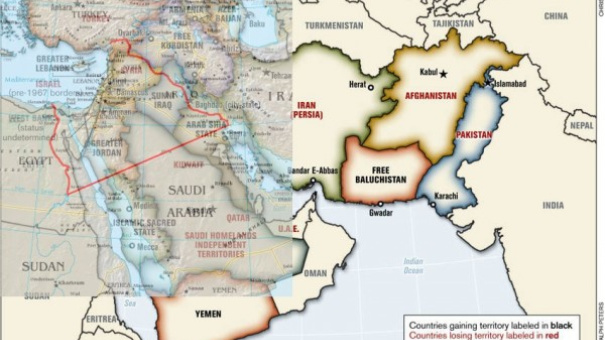
IMAGE: Project Balkanisation: Oded Yinon and an Enduring Plank of Israeli Foreign Policy (Source: Katehon)
It argues that Israel’s long-term survival hinges on one core premise: “The dissolution of all existing Arab states into small units.”
On the surface, the geopolitical win by the US-UK-Israel military-intelligence trifecta — backed by Turkey and the Persian Gulf monarchies — appears seismic. A Shīʿī-led country now falls under Sunni Salafism, severing the contiguous Shīʿī-controlled corridor linking Tehran to Hezbollah in Lebanon.
Another barrier to China’s Silk Road ambitions into the Mediterranean has been firmly set in place. Any revival of the ancient Via Maris — a trade corridor that once ran the Levantine coast, linking Asia to Europe and North Africa — remains a pipe dream.
Severed by the establishment of Israel and now buried beneath the rubble of Syria’s destruction, it ensures that any vision of unity from the Maghreb to the Arabian Peninsula remains just that — a vision.
But perhaps of greater immediate import — Israel’s ethno-supremacists and their vision of a ‘Greater Israel’ have just taken a giant leap forward. Southern Syria — and crucially, Mount Hermon, which overlooks Damascus and the Bekaa Valley in Lebanon, granting strategic military dominance over both — is now firmly under Israeli control. As is the tri-border area between Syria, Jordan, and Iraq — Al Tanf.
Yet there’s more. Israel now moves to establish its self-styled ‘David’s Corridor’ — a contiguous land route stretching from the occupied Golan Heights through southern Syria to the Euphrates. It cuts through the governorates of Deraa, Suwayda, Al-Tanf, and Deir Ezzor, reaching the Iraqi-Syrian border at Albu Kamal — granting Israel a strategic foothold deep in the heart of West Asia.
The corridor was already partially activated during the 12-day war with Iran, enabling standoff air strikes deep into Iranian territory.
With a direct land route to Iraq now viable, expect covert destabilisation efforts within the Shīʿī heartlands of Karbalāʾ and Najaf, alongside renewed backing for Kurdish separatists in both Iraq and Syria. Further vicious sectarian conflict across the region is now being baked in.
Whilst Israel’s bombing of the Defence Ministry and the Presidential Palace in Damascus was supposedly to protect the Druze community from Jolani’s Salafist mercenaries, no such protection was afforded to the Alawites, Armenians, Assyrians, or any of Syria’s other religious or ethnic minorities, who were left to be slaughtered.
The strikes on the Defence Ministry and Presidential Palace were telegraphed well in advance — and were thus performative. A warning to Jolani — Southern Syria is now firmly under Israel’s purview. No Syrian military forces will be allowed.
Meaning: Jolani and his hired guns are expendable, especially now that they’ve completed their task — extinguishing Syria’s sovereignty. As Hadi Nasrallah ruefully put it:
“You mean to tell me the very ones armed by Israel, treated in Israeli hospitals, coordinating with the IOF, shaking Netanyahu’s hand and thanking him for bombing Lebanon — are now being bombed by Israel after serving their purpose? Who would’ve thought?”
And yet, it remains far from clear if Jolani has outlived his usefulness, or if he still has his uses, at least from a US perspective.
Only days ago, whilst Jolani was in Baku, Syrian and Israeli officials were reportedly in talks. Rumours even swirled of a deal wherein Syria would launch attacks against Lebanon’s Shiʿī communities — either independently or in coordination with Israel.
Little wonder, then, that US envoy Tom Barrack warned Lebanon to ‘disarm Hezbollah or risk Syrian occupation’ — signalling that Lebanon, too, is likely slated for division and balkanisation.
The port of Tripoli and the Bekaʿa Valley, Lebanon’s agricultural heartland and a Shīʿī stronghold, are now in play. The only question is whether Ankara or West Jerusalem will seize them first, come to blows over Lebanon’s spoils, or quietly divide them, with Turkey taking the port and Israel the Bekaʿa.
But full control may yet require the chaos of full-on civil war. Syria and Lebanon edge closer — division and balkanisation becoming ever easier to enforce, until little remains but manageable fragments. The Yinon Plan made manifest.
“The attack on Lebanon is going to happen without a doubt… the question is when, and the other question is how. Is Israel going to do a ground invasion at the same time or just attack from the air?” (Ibrahim Majed)
Doubtless, the architects of today’s chaos are already patting themselves on the back, expecting handsome dividends to roll in. More division. More balkanisation. A weaker, fractured Arab world — and a stronger, more dominant Israel.
This is what Netanyahu means when he talks about “redrawing the Middle East”.
Yet the US and Israel are unravelling at an accelerating pace. Their seeming victory over the Levant is no triumph of providence — it courts the abyss and beckons the judgment to come.
Featured Video

Macgregor: We Haven’t Seen the Worst of the Iran War Yet
or go to
Aletho News Archives – Video-Images
From the Archives
15 Saudi ‘hijackers’ were CIA agents working for US: Scholar
Press TV – April 13, 2016
Fifteen of the 9/11 “hijackers” from Saudi Arabia were CIA agents working for the United States government, which was seeking to destroy the Middle East for Israel and to double the American military budget, says Dr. Kevin Barrett, an American academic who has been studying the events of 9/11 since late 2003…. continue
Blog Roll
 Aletho News
- Iran’s Plan to Shut Down AI in the Persian Gulf
- Israel seeks ‘compensation’ from Washington over Saudi F-35 sale
- Saudi crown prince seeks dialogue with Ansarullah after Yemeni blows: Report
- Damascus rejects Saudi request for Syrian fighters to counter Yemen: Report
- South Korea says will not send troops to join terrorist US war on Iran
- Russia Just Struck the Eyes of NATO’s War Machine in Ukraine
- Russia summons UK charge d’affaires over Kiev drone support
- NATO member warns bloc seeking pretext for war with Russia
- Macgregor: We Haven’t Seen the Worst of the Iran War Yet
- ‘We are not like everyone else’ laws that bind other nations do not apply to Israel, says Likud lawmaker
- If Americans Knew
- Debunking The Claim That Macklemore Has A “History Of Antisemitism”
- CPJ demands release of arrested Palestinian-US journalist near Bethlehem
- Robert Kraft: The Billionaire Friend of Netanyahu Pulling The Strings Behind the Macklemore/Ed Sheeran Blow Up
- Columbia Administered Fund Gives Big Money to Pro-Israel Groups
- Deportation Case of Palestinian Activist Salah Sarsour Tests First Amendment
- ‘We Will Not Forget’: Palestinians Mark 44 Years since Sabra and Shatila
- Why do we let Zionists decide what we can and can’t say?
- US welcomes Israeli, Iranian delegations to UN, but not Palestinians – Daily Update
- Biden’s Genocide Accomplices Targeted by New Accountability Campaign
- AIPAC’s Network Has Already Spent $67.2 Million to Shape the Midterm Elections
- No Tricks Zone
- New Study: ‘Global Drought Shows No Detectable Recent Acceleration Under Climate Warming’
- Economic Masterminds: German Socialists Suggest Taxing Productivity Gains Stemming From Using AI
- The South China Sea Has Not Been Cooperating With The Climate Change Narrative
- Energy Crisis: Germany Enters Heating Season With Historically Low Gas Reserve Fill Levels
- New Study: The Antarctic Ice Sheet Gained Mass From 2020-2024 Due To Staggering Snow And Ice Accumulation
- Study: Ocean Heating Rates From Thousands Of Years Ago ‘Dwarf’ Modern Ocean Heating Rates
- Climate Extremists Target, Attack Large-Scale Power Grid Infrastructure In Germany!
- New Study: Antarctic Ice Melt Has Contributed Less Than 1 Centimeter To Sea Level Rise In The Last 30 Years
- Fear Of Debate: Alarmist German Climate Scientist Calls On Mainstream Media To Discredit Skeptic Voices
- End-Of-August Arctic Sea Ice Extent Hasn’t Fallen In 20 Years, Official Data Show!
 Aletho News