Trump to ‘clean out’ and own Gaza?
Seyed Mohammad Marandi, Alexander Mercouris & Glenn Diesen
Glenn Diesen | February 9, 2025
I had a conversation with Alexander Mercouris and Prof. Seyed Mohammad Marandi (advisor to Iran’s nuclear negotiation team) about Trump’s recent comments about ethnically cleansing Gaza and the US seizing ownership over the territory. It is said that Trump should not be taken literally as much of his talk is either a negotiation tactic or he is simply improvising. Trump’s comments could have been aimed to ensure Israeli compliance with the ceasefire, to keep Netanyahu in power, or to have been part of a wider retrenchment strategy as the US must appear strong at a time when it is pulling back and shifting priorities.
Trump’s Foreign Policy – Strategy Behind the Noise?
Prof. Jeffrey Sachs with Prof. Glenn Diesen
Glenn Diesen | February 5, 2025
Trump’s actions in the international system are defined by the aims to remake US foreign policy, and the tendency to make noise that keeps him in the headlines. A key challenge for analysts is therefore to distinguish between the strategy and the noise. Some of Trump’s messaging has a deliberate purpose while at other times he is seemingly improvising.
US Secretary of State Marco Rubio dropped a bombshell by arguing that the unipolar world order is over and the natural condition is multipolarity. Does this represent Trump’s decision to retire the “hegemonic peace” in Europe through NATO expansion (that triggered a war in Ukraine), or was it simply an independent commentary by Rubio? Trump wants peace with Russia and recognises that NATO provoked the war, but he also attempts to threaten Russia to accept US terms. Trump wants to end the wars in the Middle East, but he also sends 2000-pound bombs to Israel and casually suggests ethnic cleansing of the Palestinians from Gaza. Trump wants to get along with China, but also to end China’s technological leadership. What is foreign policy and what is noise?
‘I much prefer a nuclear deal’: Trump dismisses talk of US–Israeli attacks on Iran
The Cradle | February 5, 2025
US President Donald Trump has denied that Washington and Tel Aviv are planning military attacks against the Islamic Republic of Iran, saying that he would “much prefer” a nuclear agreement preventing Tehran from acquiring an atomic weapon.
“I want Iran to be a great and successful Country, but one that cannot have a nuclear weapon. Reports that the United States, working in conjunction with Israel, is going to blow Iran into smithereens, ARE GREATLY EXAGGERATED,” Trump said early on 5 February on his social media platform Truth Social.
“I would much prefer a Verified Nuclear Peace Agreement, which will let Iran peacefully grow and prosper. We should start working on it immediately, and have a big Middle East celebration when it is signed and completed. God Bless the Middle East!” the president went on to state.
In early February, reports said that Trump shot down Israeli plans for an attack on Iranian nuclear facilities.
Trump expressed hope late last month that a nuclear deal could be “worked out without having to go that further step,” referring to an attack.
A Wall Street Journal report in December said Trump’s team was mulling options for strikes on the Iranian nuclear program and that there was a “rare opportunity to counter Iran’s nuclear buildup.”
This week, the US president signed an executive order restoring his “maximum pressure” policy of sanctions on the Islamic Republic, as reports had said he would prior to his second presidential term.
“If the main problem is Iran not having nuclear weapons, this problem can be solved,” Iranian Foreign Minister Abbas Araghchi said on Wednesday, adding that “maximum pressure is a failed experiment and testing it again will lead to another defeat.”
Trump withdrew from the 2015 US–Iranian nuclear deal in 2018 – during his first term – and restored harsh sanctions against Iran.
Tehran is subject to the Nuclear Non-Proliferation Treaty (NPT) of 1970, as well as a religious fatwa outlawing the development and use of any form of weapons of mass destruction.
Former CIA director said last month that “we do not see any sign” that Iran is planning to weaponize its nuclear program.
The Saudi–Israeli normalization ‘delusion’
By Stasa Salacanin | The Cradle | February 5, 2025
On 4 February, when asked if the Saudis demand the establishment of a Palestinian state as a condition for recognizing Israel, US President Donald Trump, sitting alongside Israeli Prime Minister Benjamin Netanyahu in the Oval Office, swiftly replied: “No, they’re not.”
The Saudi Ministry of Foreign Affairs was also quick to respond, stating that its stance on the establishment of a Palestinian state remains “firm and unwavering,” insisting that Riyadh would make no deal with Tel Aviv otherwise:
“His Royal Highness (Crown Prince Mohammed bin Salman – or MbS) emphasized that Saudi Arabia will continue its relentless efforts to establish an independent Palestinian state with East Jerusalem as its capital, and will not establish diplomatic relations with Israel without that.”
The statement further stressed that the Saudi position on this is “non-negotiable and not subject to compromises.”
Despite the fervent optimism of Trump’s newly appointed foreign policy team, the much-touted Saudi–Israeli normalization agreement remains an elusive goal, just as it was for his predecessor, Joe Biden. While Washington insists that such a deal is potentially around the corner, a more sober analysis suggests the pathway to a deal remains rife with obstacles.
Spanner in the works
The Abraham Accords, brokered under Trump’s first term, were hailed in Washington as a historic breakthrough in West Asian diplomacy, bringing the occupation state into official relations with the UAE, Bahrain, Morocco, and Sudan. Yet, the glaring absence of Saudi Arabia – the most influential Arab state – was the missing piece that the US and Israel craved most.
Biden’s tenure, rather than advancing Trump’s initiative, has arguably undermined it. His administration’s unyielding support for Israel’s genocidal war on Gaza and its brutal military campaign in Lebanon has alienated many Arab and Muslim states, further diminishing the likelihood of new normalization deals.
Meanwhile, China has capitalized on Washington’s waning credibility, scoring a major diplomatic coup in 2023 by brokering a historic rapprochement between Saudi Arabia and Iran – a relationship that, against the odds, remains intact.
Despite the changed reality on the ground, this US administration still believes that the deal between the world’s largest oil exporter and Israel is still attainable on its terms. Mike Waltz, the Trump administration’s new national security advisor, has stated that reaching a peace agreement between Riyadh and Tel Aviv is a “huge priority” for the new administration.
Saudis caution: A deal on whose terms?
While the Saudis drew a clear line and maintained it for a very long time by linking normalization with Israel to the establishment of a Palestinian state, neither Israel nor the new Trump administration have shown any willingness to accommodate Saudi intentions.
Many of Trump’s supporters and major donors, such as Miriam Adelson, as well as the Israeli government, not only oppose any form of a Palestinian state, but are openly talking about annexing the entire occupied West Bank. Therefore, it is still unclear how Trump intends to reconcile two vastly opposing views and expectations and expand the Abraham Accords.
According to Giuseppe Dentice, an analyst at the Mediterranean Observatory (OSMED) of the Italian Institute for Political Studies “San Pio V,” Trump will likely fall back on his tried-and-tested approach – leaning on the Abraham Accords as a framework while resurrecting elements of his so-called “deal of the century.”
Dentice explains to The Cradle that the ultimate goal of such efforts is to sideline the Palestinian cause entirely, pushing it to the periphery of both regional and global agendas.
Moreover, many believe that the Trump administration will launch a crusade against the “global intifada” and those who dare to criticize Israel or insist on prosecuting Israeli war crimes.
This approach, Dentice contends, essentially forces a single option in the negotiations: Take it or leave it.
“Trump’s aggressive approach to Riyadh could backfire for the US and its interests in the Middle East (West Asia), especially if the Al-Saud kingdom continues to reject these terms, risking closer alignment with the agendas of other international actors (such as China or Russia, if only in strategic or instrumental terms).”
Saudi investments in the US: Buying leverage or time?
Some observers speculate that Saudi Arabia’s recent announcement that Riyadh plans to invest $600 billion in the US over the next four years could be understood as a certain early bribe to Trump in return for easing his zealous pressure regarding the Saudi–Israeli normalization agreement and other geopolitical issues as well.
While it is true that convincing the Saudis will be a tough nut to crack, Dentice, for one, does not believe that even such a significant economic commitment could distract or dissuade the new government from its goals.
He believes that beyond the issue of normalization agreements with Israel, Riyadh wants to strengthen its understanding and cooperation with Washington, especially with this government. Nonetheless, it remains true that key figures associated with this administration, such as Jared Kushner, Trump’s son-in-law, could undermine Saudi processes and intentions through their own business relationships.
For Dr Paul Rogers, Emeritus Professor of Peace Studies in the Department of Peace Studies and International Relations at the College of Bradford, President Trump is far too unpredictable for anyone to conclude on the chances of a deal with Saudi Arabia, but his recent comments on the option of expelling the Palestinians from Gaza indicate a very close relationship with far-right Israeli political factions.
Dr Rogers tells The Cradle that he suspects “that the Saudis will stay away from any kind of agreement, no matter what offer they make.”
Arab public opinion: A hard sell
Beyond geopolitical calculations, public sentiment in the Arab world remains a major obstacle to normalization. The rejection of a Palestinian state, coupled with an aggressive push for Saudi–Israeli ties, is widely viewed as an attempt to erase the Palestinian cause altogether – an agenda that lacks legitimacy among Arab and Muslim populations.
Furthermore, many observers believe that Israel’s war crimes and the genocide in Gaza have made it very difficult and uncomfortable for Saudi Crown Prince Mohammed bin Salman (MbS) to continue peace talks.
But West Asian views against normalization precede even the brutal 15-month war. According to the Arab Opinion Index from 2022, for example, an average of 84 percent of citizens in 14 countries rejected diplomatic relations with Israel. These figures show that the Arab enforcers of the Abraham Accords ultimately failed to reach or sway wider Arab public opinion.
The war in Gaza has only cemented anti-Israeli views in Saudi Arabia, and an unconditional normalization agreement with Israel would only increase the risk of destabilizing the crown prince’s image in the kingdom and abroad. It would also humiliate MbS, who has publicly condemned Israel’s actions in Gaza, recognizing them as a “genocide.”
A mirage in the desert
Palestinian statehood is by no means a simple issue, even if an Israeli government supported the initiative, which the current one resolutely rejects.
Palestinian national aspirations can lose momentum due to internal divisions, the lack of an organized leadership capable of addressing current and future challenges, and the faltering support of traditional Arab sponsors – notably the loss of Syria following the ousting of former president Bashar al-Assad by Al-Qaeda-linked extremists – Hayat Tahrir al-Sham (HTS) – who now form the new government.
For all the speculation surrounding a Saudi–Israeli deal, the reality is that no proposal for Palestinian statehood has made meaningful progress in the past three decades. As a result, ad hoc unilateral initiatives have increasingly taken center stage, often yielding disastrous consequences.
In this context, the push for a Saudi–Israeli accord seems less like a diplomatic breakthrough and more like a mirage conjured by Washington and Tel Aviv.
Dentice believes that in such a context, and with the prospect of a possible Saudi–Israeli agreement, the Palestinians will have even less political relevance in the future. This will give space for radical and armed groups to gain ground and further exacerbate tensions on the Palestinian and Arab streets.
Trump’s aggressive tactics may succeed in strong-arming some leaders, but they are unlikely to change deep-seated regional attitudes. If anything, the pursuit of an agreement without major concessions for Palestinians could inflame tensions further, pushing the region into even greater instability.
For now, the notion of a Saudi–Israeli deal may be more fantasy than fact – an illusion sustained by wishful thinking rather than political reality.
Russian media reach soars as NATO eyes countermeasures – report
RT | January 30, 2025
A fresh NATO report highlights a sharp increase in the reach of Russian state media outlets RT and Sputnik, particularly in Africa and the Middle East, where the news outlets have gained millions of new followers.
The report, published on Tuesday by the NATO Strategic Communications Centre of Excellence (StratCom COE), examines how Russian media operations have expanded their influence after the escalation of the Ukrainian conflict in early 2022. With Russian state-backed media subjected to blanket bans in the West, the outlets diverted their resources elsewhere.
According to the report, RT Arabic saw its audience grow by ten million users since the breakout of fighting between Ukraine and Russia. Sputnik Arabic also significantly increased its content output, posting 30–35% more frequently, while the news agency’s engagement on social media surged by 80%. Russian embassies in Africa also saw a 41% rise in social media followers, reflecting a broader trend of growing Russian media influence in non-Western regions, the report notes.
It also claims the outlets have been capitalizing on “anti-colonial narratives” and overall frustration with Western policies, particularly in Africa, and blames this on historical ties to the Soviet Union that still shape public perceptions there. In some cases, the narratives have resonated strongly with audiences already skeptical of Western institutions like the International Monetary Fund and the International Criminal Court, the report notes.
While StratCom COE projected its findings to the entirety of the Global South, the report actually examined the work of Russian media – as well as social media activities it had linked to Russia without any solid evidence – in Egypt, Mali, Kenya, South Africa and the UAE.
The authors of the report appeared to struggle with terminology, rejecting the ‘Global South’ over an “increasing pushback” against the name, and shot down the term ‘majority countries,’ claiming it has been promoted by assorted “malign actors” to push their agenda. Instead, the report uses the term ‘Multi-aligned Community,’ vaguely defining it as “states existing outside of the Western environment who have exhibited a preference for aligning or partnering with chosen states depending on specific spheres or issues.”
In response to the expanding reach of Russian media, the NATO report proposes new countermeasures aimed at reducing Moscow’s ever-growing influence. One recommendation is to establish a NATO-led initiative to engage with audiences in Africa and the Middle East, improving direct communication and addressing concerns about Western policies.
The report also suggests that NATO should work with local media outlets to “counter disinformation” and to bankroll local “independent journalism.” It also calls for stronger partnerships with civil society organizations to promote diverse viewpoints and counter what it describes as “one-sided narratives” from Russian state media.
Leading War Criminal Benjamin Netanyahu Will Visit Donald Trump
By Philip Giraldi • Unz Review • January 30, 2025
President Donald Trump has invited Israeli Prime Minister Benjamin Netanyahu to meet with him at the White House on Tuesday February 4th. Netanyahu will be the first foreign head of state to visit America’s new president at the White House and the message being sent by virtue of that fact would seem inescapable, i.e. that Israel is in the minds of the country’s powerbrokers and media indeed America’s “best friend” and “closest ally.” Or is it? It is possible, though admittedly less likely, that Trump, he of the enormous ego, might well take the opportunity to suppress any thoughts that the Israeli leader is basically dictating the course of US foreign policy in the Middle East. Trump just might want to make it clear in the face-to-face that he is the one who is in charge.
I must admit that when the story broke my first thought was that Netanyahu might possibly discover that he has been lured to Washington. When his plane lands at Dulles International or Andrews AFB, I even hoped there would be an international police contingent waiting for him to show him the warrant for his arrest, read him his rights, shackle him, and send him off to The Hague to be tried for his numerous war crimes and his involvement in genocide. Hopefully, Joe Biden and Tony Blinken would be treated similarly and sent off on the same plane. But my dream outcome for the visit faded as reality set in and I came to accept that Bibi will be more likely feted as royalty by the neocons and other not-quite-human trash that now infests the US government.
There is however admittedly a distinct possibility that Trump will assert himself as he apparently did recently when a video was posted by him on the Trump social media site Truth Social. The video featured Columbia professor Jeffrey Sachs bad mouthing Bibi, saying “Netanyahu had from 1995 onward the theory that the only way we’re gonna get rid of Hamas and Hezbollah is by toppling the governments that support them. That’s Iraq, Syria, Lebanon and Iran. And the guy’s nothing if not obsessive. And he’s still trying to get us to fight Iran this day, this week. He’s a deep dark sonofabitch, sorry to tell you. ’Cause he’s gotten us into endless wars, and because of the power of all of this in the US politics, he’s gotten his way.”
Or, alternatively, Trump could easily continue the Middle East policy that prevailed in his first term as president, which was, like Genocide Joe Biden, to defer to Israel on nearly everything. Trump moved the US Embassy to Jerusalem and violated international law by declaring the city to be the true legal Israeli capital; he endorsed the annexation of the Syrian Golan Heights by Israel; he chose to ignore atrocities committed by Israeli settlers and soldiers directed against the Palestinians living on the West Bank; and he withdrew from the Joint Comprehensive Plan of Action (JCPOA) agreement to monitor and limit a possible Iranian nuclear program. Also regarding Iran, he ordered that country’s Quds Force commander Qassim Soleimani assassinated in January 2020 while Soleimani was on a peace mission to Baghdad.
Iran continues to be the target of both the US and Israel. Lest anyone should think that the JCPOA move was motivated to encourage Iran to develop a weapon, Trump’s argument was that the program was flawed because it did not go far enough in penetrating and investigating Iranian military sites and labs. It also created a national security pretext permitting Israel to insist that Iran was hiding a secret nuke program, an excuse for a preemptive attack on it jointly launched by Israel and the United States. Interestingly, outgoing CIA Director William Burns now claims that the Iranians have no nukes and have no capability to quickly produce one. He also maintains that there is no evidence that they even have any desire to acquire a nuclear weapon, a reality that clearly contradicts the Israeli propaganda regarding an “Iranian nuclear threat.”
Nevertheless, it is regularly reported by Israel and the neocon dominated media in the US that Team Trump and the Israeli security council have been discussing a preemptive strike on the Iranians. But perhaps contrary to that assessment Steve Witkoff, Trump’s Middle East envoy and the man who pressured Netanyahu into agreeing to a ceasefire with Hamas, has since the inauguration been given the portfolio for dealing with the Middle East including responsibility for Iran negotiations. The previous Trump appointee who had that responsibility was Brian Hook, who was a hardliner who believed in applying “maximum pressure” on the Iranians and has now been replaced.
Witkoff is also reported to be continuing to meet with and pressure Netanyahu to complete all three phases of the Gaza agreement, something which is contradicted by Israeli media reporting which suggests that Netanyahu believes that he can resume his military offensive with US support after the six weeks of phase one. In addition to Witkoff, another more recent appointment might give one hope for a gradual reversal of policy in line with Trump’s apparent belief that American involvement in the Middle East has been expensive, destructive, and contrary to the American national interest. Michael DiMino, a former CIA analyst and Department of Defense veteran, is the Trump pick to be deputy assistant secretary of defense with responsibility for the Middle East operations. DiMino is facing fierce Israel Lobby opposition to his appointment, but he continues to maintain very clearly that, in his opinion, Iranian conventional forces do not pose a threat to the US, meaning that war with Tehran should not be viewed as an option.
Some observers think that Trump’s intentions might be most clearly reflected in his choices as US Ambassadors to Israel. His first term produced David Friedman, Trump’s personal lawyer and a passionate Zionist. Friedman functioned more as a cheerleader for Israel and all its works than a promoter or defender of any actual US interest. The new ambassador Evangelical Christian Zionist Mike Huckabee might prove to be even worse than Friedman, which is saying a lot. When making the appointment, Trump said in a statement regarding Huckabee that “Mike has been a great public servant, Governor, and Leader in Faith for many years. He loves Israel, and the people of Israel, and likewise, the people of Israel love him. Mike will work tirelessly to bring about Peace in the Middle East!”
Huckabee’s vision of “peace” will likely be based on a mountain of dead and dispossessed Palestinians. He believes God gave historic Palestine to the modern state of Israel, and is an outspoken advocate of Israel’s planned expansion in the occupied West Bank. While visiting an Israeli West Bank settlement in in 2017, Huckabee claimed the land was not Israeli occupied. “I think Israel has title deed to Judea and Samaria. There are certain words I refuse to use. There is no such thing as a West Bank. It’s Judea and Samaria. There’s no such thing as a settlement… There’s no such thing as an occupation.” In 2008, during his own presidential campaign, Huckabee said there was “really no such thing as a Palestinian.”
Those concerned that Trump might be moving to favor Israel above all nations note that the administration’s directive to halt all spending on foreign assistance programs, which included Ukraine, exempted Israel and also Egypt, where Trump is hoping to dump upwards of a million Palestinians in the Sinai Desert to “clean up” the mess in Gaza. Trump has also approved the sale to Israel of 1800 M-84 2000 pound bombs which are used primarily to destroy large buildings and kill large numbers of people. The transfer of the weapons to Israel had been suspended by the Biden Administration but Trump announced that “A lot of things that were ordered and paid for by Israel, but have not been sent by Biden, are now on their way!” He did not mention that US weapons “sold” to Israel are often paid for by the US taxpayer as part of military aid. The sale of a large number of dual-use armored Caterpillar bulldozers to Israel, useful for knocking down whatever habitable spaces remain in Gaza, has also received the green light from the administration. Trump has also blocked the Biden-imposed sanctions on extremist settler groups that have been harassing, beating, and killing the Palestinians who are trying to survive on the West Bank. Finally, Trump has issued an executive order that will require American universities to monitor the political activities of foreign students in a bid to reduce antisemitism. Those who have gotten involved in pro-Palestinian demonstrations on campus could have their visas canceled and they will be subject to deportation.
That is quite a bit of pro-Israel movement for Donald Trump’s first week in office, don’t you think? Those who believe that Trump might be preparing to lay down the law with Netanyahu must understand that he will also have to contend with the hopelessly Zionist Congress, which gave the monstrous Netanyahu 56 standing ovations when last he appeared in Washington. We will know soon enough what the meeting between Netanyahu and Trump in the White House was all about and we shall also find out whether the bilateral relationship will continue to consist of Israel cracking the whip and the United States government performing. If Trump dares to challenge the status quo it could set the stage for a major conflict between the new president and the immensely powerful Israel Lobby. As Trump is a very stubborn man with a huge ego, that interplay could be very interesting to watch, particularly as it could lead to the United States finally freeing itself from the country that has been pulling its foreign and national security policy strings for so many years.
Philip M. Giraldi, Ph.D., is Executive Director of the Council for the National Interest, a 501(c)3 tax deductible educational foundation (Federal ID Number #52-1739023) that seeks a more interests-based U.S. foreign policy in the Middle East. Website is councilforthenationalinterest.org, address is P.O. Box 2157, Purcellville VA 20134 and its email is inform@cnionline.org.
‘Conspiracy Theory’ Now Fact: Greater Israel Has Arrived
By Kit Klarenberg | Mint Press News | January 28, 2025
Ever since Tel Aviv’s 1948 creation, much has been said and written about ‘Greater Israel’ – the notion Zionism’s ultimate end goal is the forcible annexation and ethnic cleansing of vast swaths of Arab and Muslim lands for Jewish settlement, based on Biblical claims this territory was promised to Jews by God. The mainstream media typically dismisses this concept as antisemitic conspiracy theory, or at most the fringe fantasy of a minuscule handful of extremist Israelis.
In reality, as The Guardian admitted in 2009, the idea of a Greater Israel has long-appealed to “religious and secular right-wing nationalists” alike at a state and public level in Tel Aviv. They have the shared objective of “[seeking] to fulfill divine commandments about the ‘beginning of redemption’, as well as create ‘facts on the ground’ to enhance Israel’s security.” The outlet acknowledged this motivation was a key contemporary driving force in mainstream Zionist entity politics, which “effectively turned the Palestinians into aliens on their own soil.”
The Nation has described the push to establish Greater Israel as “the central ideological goal” of Benjamin Netyahu’s Likud Party, which has dominated Israeli politics in recent decades. In July 2018 too, the Zionist entity passed the “Nation State of the Jewish People” law. It enshrines “the development of Jewish settlement as a national value.” Meanwhile, the state is legally obligated “to encourage and promote” the “establishment and consolidation” of settlements, in illegally occupied territory.

A proposed map of ‘Greater Israel’
This is based on the Jewish people’s “exclusive and inalienable right” to territory as far away from present Israel as Saudi Arabia. Old Testament terms such as “Judea and Samaria” are also employed. Markedly, this text is absent from the legislation’s official English translation. Zionist entity chiefs may not have wanted to make their irredentist, settler colonial ambitions quite so obvious at the time. Fast forward to today though, and Zionists at every level are wholly unabashed about their grand expansionist plans in West Asia.
The Syrian government’s fall has raised all manner of questions, concerns, and uncertainties locally and internationally. Can the country survive in its present form? Will Western-backed ‘former’ ultra-extremists be able to run a government? May the Iran-led Axis of Resistance, which inflicted such harm to the Zionist entity and its Western puppet masters throughout 2023/4, be under threat? The list goes on. But one thing is certain – Israel is seeking to profit handsomely from the chaos. If successful, the results will be revolutionary.
‘Defensive Position’
On December 8th, a triumphant, smart-casual-bedecked Benjamin Netanyahu made a public address from an Israeli Occupation Force observation point, in the illegally-occupied Golan Heights. Taking personal credit for Bashar Assad’s ouster, he hailed “a historic day” for the region, which offered “great opportunity.” The Israeli leader bragged that the Zionist entity’s “forceful action against Hezbollah and Iran” had “set off a chain reaction” of upheaval, showing no sign of abating. Nonetheless, he warned of “significant dangers”.
One of those hazards, Netanyahu declared, was “the collapse of the Separation of Forces Agreement from 1974.” This largely forgotten accord was signed by Damascus and Tel Aviv following the 1973 Yom Kippur War. Both sides agreed not to mount hostile military operations of any kind against one another from their shared Golan Heights border. Perhaps surprisingly, it was scrupulously adhered to for 50 years. Now, though, Assad’s fall has sparked a Syrian military withdrawal from the area, and, in turn, the IDF is moving in.
Netanyahu announced orders had been given to the IOF to push deep into the demilitarized zone created by the Agreement, which is legally and historically Syrian territory. He claimed this was merely a “temporary defensive position until a suitable arrangement is found.” Yet, ever since, it has become increasingly unambiguous that for the Zionist entity, Assad’s departure not only greenlights the tearing up of longstanding diplomatic agreements, but the entire map of West Asia as we know it.
For the time being, the IOF has captured strategically invaluable Mount Hermon, Syria’s tallest mountain, from which Damascus can be seen just 40 miles away. Concurrently, hundreds of Zionist entity airstrikes have obliterated what remained of Syria’s military infrastructure, leaving the country completely defenseless from any and all incursions by air, land, and sea. The stage is plainly set for a major escalation and attempt by Israel to absorb further territory, at its behest. Who or what could stop them?
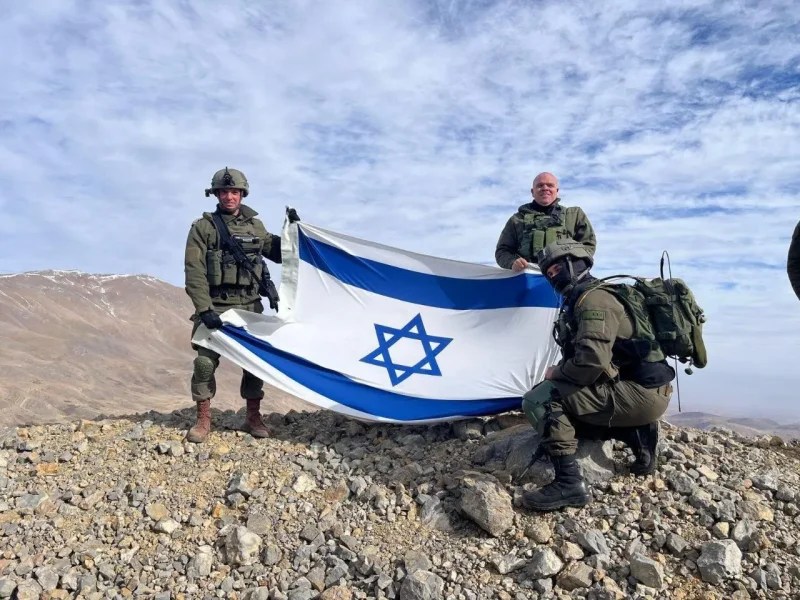
IOF militants unfurl an entity flag on Mount Hermon
On December 10th 2024, while testifying at his long-running trial for industrial scale corruption in office, Netanyahu used the occasion to hint strongly at Assad’s defeat heralding a major reshaping of the region afoot. “Something tectonic has happened here, an earthquake that hasn’t happened in the 100 years since the Sykes-Picot Agreement,” the Israeli leader said, referencing the 1916 treaty under which Britain and France carved up the Ottoman Empire.
In an ironic twist, destruction of the Sykes-Picot Agreement, which divided West Asia into artificial boundaries under Western colonial rule, was a regular feature of ISIS propaganda. The group cited the pact as a symbol of Western oppression against Islam, presenting its demise as a religious duty. With figures associated with ISIS now taking charge in Damascus, that vision could now be achieved, a prospect both serving Israel’s long-term goals, and aligning with Netanyahu’s long-standing ambitions.
‘Living Room’
In recent weeks, Israeli media has undergone a significant tonal shift. Historically, even critical Israeli news outlets and journalists have been careful to frame the Zionist entity’s most egregious actions – ranging from military operations against neighboring countries to settlement expansion and land confiscation – in terms of “security” and “defense”. However, in the days leading up to Tel Aviv’s invasion of Lebanon on October 1st 2024, The Jerusalem Post published a strikingly candid explainer guide for its readers, enquiring, “Is Lebanon part of Israel’s promised territory?”
The outlet leaned on a Brooklyn-based Rabbi to “graciously” explain in detail how, based on multiple passages in Jewish scripture, “Lebanon is within the borders of Israel,” and Jews are therefore “obligated and commanded to conquer it.” The article was subsequently deleted after mass backlash and condemnation. But lessons from the debacle evidently weren’t learned in some quarters.
On December 4th – four days before the Syrian government’s fall – The Times of Israel published an op-ed on how “Israel’s exploding population” urgently required “Lebensraum”, a notorious German concept meaning “living room”, typically associated with the Nazis. The piece noted the Zionist entity’s population was projected to grow to 15.2 million by 2048, meaning Tel Aviv’s territory rapidly needed to be greatly expanded – perhaps not to the size of Russia, but certainly considerably.
This extremist rant was likewise purged from the web, due to widespread public outcry and mockery. Yet, since Assad’s fall, the term “Greater Israel” abounds readily in Zionist media, and seizure of territory from Tel Aviv’s neighbors is openly and eagerly discussed on primetime entity TV. Geopolitical analyst and founder of The Cradle Sharmine Narwani tells MintPress News that in a sense, the blatant nature of these discussions is a welcome development, as it lays bare Tel Aviv’s most extreme ambitions. However, she warns, attempts to expand the entity’s borders could backfire in catastrophic ways:
“The good news is, Israel has completely dropped all its masks. The bad news is it will go for land grabs everywhere. But this will be done opportunistically, and without much forethought or strategic planning. In the end, which country besides the US will be able to support Israel publicly? Tel Aviv will corner itself because the dominant Western discourse and EU law are still premised on human rights and ‘rules’. Allowing Israel these land grabs will also sink the Western-led global order.”
‘Primary Target’
Academic David Miller concurs the Zionist mask is off once and for all. Gravely, he tells MintPress News, “the fact that the CIA backed regime in Damascus is openly saying it is no threat to Israel is another indication regime change in Syria is a planned attempt to destroy the Axis of Resistance, and finally genocide all Palestinians.” Furthermore, he believes the writings of Zionism’s founder Theodore Herzl make clear seizing Lebanese and Syrian territory was Israel’s plan all along.
This malign objective, Miller adds, was echoed in many statements of countless prominent Zionists over decades, and “even codified and published as the Yinon Plan.” Little-known today, this extraordinary document was published in February 1982 in Hebrew journal Kivunim, under the title “A Strategy for Israel in the 1980s”. Its title is derived from author Oded Yinon, a shadowy former Israeli Foreign Ministry official and advisor to Zionisty entity leader Ariel Sharon.
Some sources claim the Yinon Plan provided a precise blueprint for major future events in West Asia, such as the illegal 2003 Anglo-American invasion of Iraq, Syrian dirty war, and rise of ISIS. It may be an exaggeration to suggest the Plan precisely portended all these developments, but nonetheless, much of the document’s contents are eerily prescient. Moreover, while many of its proposals failed to subsequently materialise, we are left to ponder whether they may now do so in future.
For example, the Plan noted there was significant potential for “domestic trouble” to erupt in Syria between “the Sunni majority and the Shiite Alawi ruling minority” – the latter constituting a “mere 12% of the population” – to the extent of “civil war”. While Damascus’ “strong military regime” was considered formidable, Yinon declared “the dissolution of Syria into ethnically or religiously unique areas” and destruction of its military power should be “Israel’s primary target” on its Eastern front, “in the long run”.
The Plan envisaged similar outcomes for other countries in Israel’s immediate vicinity. Lebanon was to be broken up into “five provinces” along religious and ethnic lines, partition “[serving] as a precedent for the entire Arab world.” Yinon wrote, “this state of affairs will be the guarantee for peace and security in the area in the long run,and that aim is already within our reach today.” Four months later, the Zionist entity invaded Beirut, carrying out ethnic cleansing, massacres, and land theft along the way.
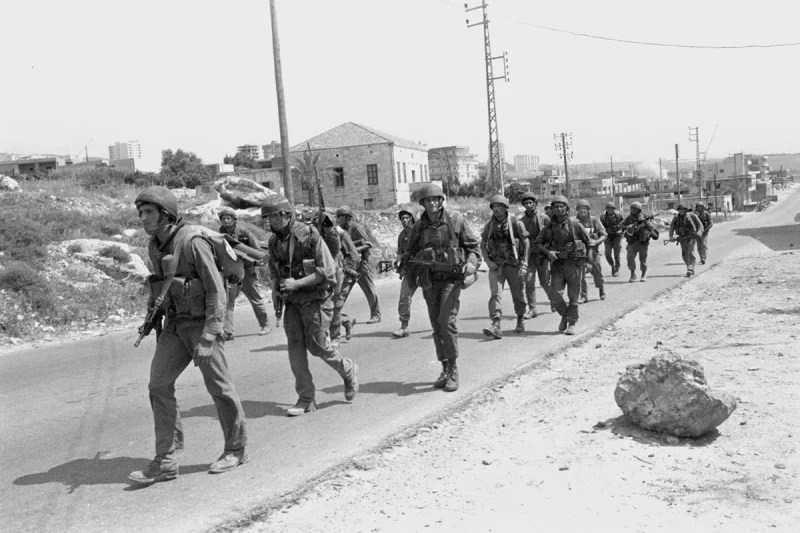
Israel’s June 1982 invasion of Lebanon
Once the Zionist entity’s immediate neighbors were neutralized, Iraq was to be crosshaired “later on”. Baghdad, “rich in oil” while “internally torn” between its Sunni and Shiite population, was “guaranteed as a candidate for Israel’s targets.” Its destruction was “even more important for us than that of Syria,” due to its “power” and strength relative to other regional adversaries. Yinon hoped the then-ongoing Iran-Iraq war would “tear Iraq apart and cause its downfall”, preventing Baghdad from ‘[organizing] a struggle on a wide front against us”:
“Every kind of inter-Arab confrontation will assist us in the short run and will shorten the way to the more important aim of breaking up Iraq into denominations as in Syria and in Lebanon… It is possible that the present Iranian-Iraqi confrontation will deepen this polarization.”
‘Permissive Approach’
Yinon also considered it a “political priority” to regain control of the Sinai peninsula, over which the Zionist entity had fought its Arab neighbors since inception, before relinquishing all claims to the region to Egypt under the March 1979 Camp David accords. He slammed these peace agreements, and looked forward to Cairo “[providing] Israel with the excuse [emphasis added] to take the Sinai back into our hands,” due to its vast “strategic, economic and energy” value:
“The economic situation in Egypt, the nature of the regime and its pan-Arab policy, will bring about a situation after April 1982 in which Israel will be forced to act directly or indirectly in order to regain control over Sinai… for the long run. Egypt does not constitute a military strategic problem due to its internal conflicts and it could be driven back to the post 1967 war situation in no more than one day.”
We are now well-past April 1982. In the intervening time, successive Israeli governments have demanded Egypt allow the IOF to relocate Gaza’s population to the Sinai. Netanyahu is particularly taken with the prospect. In the immediate wake of October 7th 2023, official Israeli government and Zionist think tank policy papers openly advocated driving Palestinians into the neighbouring desert. It has been reported entity officials begged the US to pressure Cairo into allowing this mass displacement.
For the Zionist entity, this strategy’s appeal is self-evident. On top of emptying Gaza for settlement, forcing Palestinians into Sinai would inevitably create mass chaos and tensions there, which could in Yinon’s phrase provide “the excuse” for Tel Aviv to militarily occupy the region, in the manner of the West Bank. Just as a “temporary defensive position until a suitable arrangement is found” of course, as Netanyahu said of the IOF’s brazen creation of a prospective beachhead on Mount Hermon.
In December 2024, Haaretz observed Netanyahu was “angling for a legacy as the leader who expanded Israel’s borders”, and “wants to be remembered as the one who created Greater Israel.” Simultaneously, neoconservative Brookings Institute vice president Suzanne Maloney wrote for Empire house journal Foreign Affairs that the incoming Trump administration “will surely take a permissive approach to Israeli territorial ambitions.” After all, recent developments showed “a maximalist military approach yields spectacular strategic dividends along with domestic political benefits” for the Zionist entity.
We must hope, as Sharmine Narwani prophesied, Netanyahu’s megalomaniacal reveries of Greater Israel are just that, and come to nothing. Despite understandable mass anti-imperialist mourning over the Assad government’s demise, Tel Aviv faces a panoply of intractable internal problems. Contrary to claims of Tel Aviv’s population “exploding”, tens of thousands of dual-citizenship residents are routinely fleeing due to Resistance attacks, while its economy has perhaps permanently been relegated to the doldrums, the entity entirely dependent on US financial largesse to endure.
New neocon manifesto: Keep US troops in the Middle East forever
The ‘Vandenberg Coalition’ wants Trump to prioritize Israel and maintain Iran as enemy number one
By Jim Lobe | Responsible Statecraft | January 28, 2025
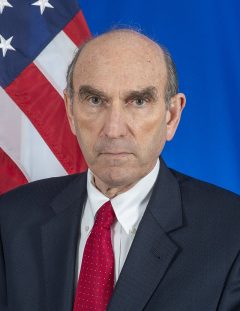 A leading neoconservative for most of the last half century has released a comprehensive series of recommendations on Middle East policy for the new Trump administration nearly all of which are ideas that Israeli Prime Minister Benjamin Netanyahu and his Likud Party would happily embrace.
The 16-page report, entitled “Deals of the Century: Solving the Middle East,” is published by the Vandenberg Coalition, which was founded and chaired by Elliott Abrams, who has held senior foreign policy posts in every Republican administration since Ronald Reagan (except George H.W. Bush’s), including as Special Envoy for Venezuela and later for Iran during Trump’s first term.
Created shortly after former President Biden took office, the Coalition has acted as a latter-day Project for the New American Century, a letterhead organization that acted as a hub and platform for pro-Likud neoconservatives, aggressive nationalists, and the Christian Right in mobilizing public support for the “Global War on Terror,” the 2003 invasion of Iraq, and the move away from a two-state solution to the Israel-Palestine conflict, particularly under the George W. Bush administration in which Abrams served as Special Assistant to the President and Senior Director for Near East and North African Affairs, surviving a number of purges of leading neoconservatives in that administration after the Iraq occupation went south.
The new report predictably calls for the new administration to “use all elements of [U.S.] national power” to prevent Iran, “the greatest threat to American interests in the Middle East and the cause of most of the region’s security problems,” from acquiring a nuclear bomb. It describes Israel as “our cornerstone ally in the region” to which Washington should provide all “the weapons it needs [to] help it win the war and prevent wider escalation.”
The recommendations also call for Washington to maintain its military presence in both Iraq and Syria, to suspend all aid to the Lebanese Armed Forces (LAF) “until it demonstrates a willingness to oppose Hezbollah, accelerate U.S. arms sales and broaden intelligence cooperation with the UAE,” and enhance military and security cooperation with Saudi Arabia provided it “pivot[s] away from China and Russia.”
It also calls for the Saudis to “increase [its] foreign direct investment commitments in U.S industries,” and “cease public statements” critical of Israel and supportive of Iran. “…[En]hanced cooperation with Saudi Arabia,” the report insists, “should be contingent on their being unequivocal about what side they are on.”
Washington should also designate Iraq’s Iran-backed Popular Mobilization Forces (PMF) and related militias as Foreign Terrorist Organizations (FTO) and stop engaging with them politically, and work with Yemen’s Saudi-backed Presidential Leadership Council against the Houthis whose designation as an FTO by the Trump administration last week was applauded in the report. On the new government in Syria, the report says that ongoing sanctions, which helped cripple the country’s economy, should not be lifted “unless the new government proves to be a responsible actor,” although it does not describe what that would mean in any detail.
Aside from Iran’s status as Enemy Number One in the report, special scorn was reserved for Qatar, which has played a central role in mediating between Israel and Hamas regarding the fate of Israelis held in Gaza and Palestinians detained in Israel. Similar contempt is reserved for the Palestinian Authority headed by Mahmoud Abbas, for various U.N. agencies, notably “the nefariousness [sic] UNRWA,” which has worked with Palestinian refugees and their families across the Middle East for more than 70 years, and for senior UN human rights officials who deal with the Israel-Palestine conflict in particular. Washington “should immediately cease all funding to UNRWA” and also to UNIFIL, the U.N. peacekeeping force deployed along the Lebanese-Israeli border unless its troops are given the authority and demonstrate the will to confront Hezbollah forces in the area.
As for Qatar, it “has worked to undermine U.S. interests by cooperating with Iran and sheltering terrorist groups like Hamas,” according to the report. “With much better friends like the Saudis, Washington no longer needs to tolerate destabilizing Qatari behavior,” and thus should move U.S. Central Command’s forward headquarters out of Qatar’s Al Udeid Air Base and revoke Doha’s “Major Non-Nato Ally status unless its behavior changes.” That status should be conferred on the UAE instead, according to the report, provided that it “reduce [its] reliance on Russian and Chinese vendors” of military equipment.
The report, which describes the politics of the Biden administration in the Middle East on more than one occasion as “appeasement,” mainly of Iran, reminds the reader that Trump declared only last month that “the Middle East is going to get solved,” a phrase that undoubtedly inspired the report’s title: “Deals of the Century: Solving the Middle East.” While the report says it was the product of a “working group of Middle East experts,” no names other than Abrams, Gabriel Scheinemann, and Daniel Samet, the latter two neoconservatives from the Alexander Hamilton Society, appear in the report. Normally, reports by letterhead organizations list their contributors.
In presenting what it calls “key American interests in the Middle East,” the report puts “preventing Iran from developing n nuclear weapon at the top of the list” but also expresses alarm at Chinese Communist Party inroads in the region, noting that CCP is Washington’s “key global adversary.” In an echo of the Global War on Terror, Washington, it says, should also “deny jihadi terrorists a safe haven,” a reference in part to the necessity, its authors feel, to retain U.S. forces in Syria and Iraq.
But “America’s alliance with Israel is central to U.S. interests in the region, given that it promotes American values within the Middle East and provides the first line of defense against Iranian aggression.” Moreover, Washington should try to expand the Abraham Accords, and “the Palestinian question must not impede Israel’s normalization with Arab and Muslim countries or otherwise compromise its security.” Washington must “ensure Israel has the tools to defend itself.”
Yet another interest is to expand access of our allies and partners in Europe and elsewhere to the region’s energy supplies, according to the report.
To increase pressure on Iran, Washington should not only reinstate a Trump’s “ maximum pressure” campaign, but include within it convincing Britain, France, and Germany to “snapback sanctions” against Tehran at the U.N. Remarkably perhaps, it offers the possibility of a new nuclear agreement that would “forbid Iranian uranium enrichment beyond the small amounts need for a civilian nuclear program,” something that the 2015 JCPOA, which Trump withdrew from in 2018, actually accomplished before Trump, under the influence of neoconservatives like Abrams, withdrew from in 2018. If a deal can be reached, according to the report, it should be dealt with as a treaty; that is, made subject to a 2/3 majority vote in the Senate.
With respect to the Palestinians in the wake of the last 15 months of war in Gaza, “American policy toward the Palestinians must prioritize the security of Israel and our Arab partners.” Washington “must impose standards for good governance. The U.S. should “allow an Arab trusteeship to control Gaza after the war.” In words that must warm Netanyahu’s heart, the report notes “the weakness and incompetence of the PA mean it cannot govern Gaza,” and “Israel will need to maintain security control to prevent Hamas from rebuilding but should not and does not wish to govern Gaza itself.”
Abrams has a long history with both Palestine and Gaza, notably during the Bush administration. After Hamas was an unexpected election victor over its rival Fatah in the 2006 elections – which were hailed as the freest and fairest elections in the Arab world at the time – Abrams and other senior officials encouraged the mounting of an armed coup against Hamas led by Fatah’s local leader and Abrams’ favorite Muhammad Dahlan which, in turn, sparked a brief civil war in the enclave in which Hamas emerged victorious and stronger than ever. After the fiasco, Dahlan moved to the UAE, and there has been much speculation that he stands to play a key role on behalf of the Emirates if the kind of “Arab trusteeship” alongside Israeli security forces is established as recommended by the report.
Perhaps the most novel recommendation is based on the report’s contention that Iran’s non-state allies in the region typically use non-combatants as human shields — an apparent endorsement of Israel’s defense of its bombing of apartment houses, schools and other buildings in Gaza and Lebanon during the past 15 months that have killed well over 46,000 people, most of them women and children. “The United States should propose a Security Council resolution that states the use of human shields is a crime under international law and that those who use human shields are responsible for the civilian deaths in which they result,” the report advised.
Jim Lobe is a Contributing Editor of Responsible Statecraft. He formerly served as chief of the Washington bureau of Inter Press Service from 1980 to 1985 and again from 1989 to 2015.
Iran War Hawks Getting Wrecked In Trump Personnel Fight
By Ryan Grim | Drop Site News | January 24, 2025
A major whisper campaign is underway, led by neoconservatives in Washington panicked at President Donald Trump’s elevation of a string of foreign policy advisers who have spoken out against war with Iran. The first whack to the wounded war-hawk wing came when Mike Pompeo was blocked from a position in the White House, followed yesterday by the stripping of his security detail. That followed similar snubs to John Bolton and Iran hawk Brian Hook, both of which lost their security and have been kept out of the administration.
Hook’s firing was a comical display of Trumpian humiliation. Trump, on Truth Social, said that his
Presidential Personnel Office is actively in the process of identifying and removing over a thousand Presidential Appointees from the previous Administration, who are not aligned with our vision to Make America Great Again.
Jose Andres from the President’s Council on Sports, Fitness and Nutrition, Mark Milley from the National Infrastructure Advisory Council, Brian Hook from the Wilson Center for Scholars, and Keisha Lance Bottoms from the President’s Export Council—YOU’RE FIRED!
What’s so amusing about Trump’s description of Hook as a member of the “previous Administration,” and his being lumped in with Democrats and a hated figure like Milley, is that Hook was named by Trump in November to chair the State Department transition. Anti-war Republicans vowed at the time to make sure he never got a job himself in the second Trump administration and sources tell me that Trump fired him after learning about his long record of criticizing Trump and his bellicose war rhetoric. Now he’s out, and is privately leading the rearguard fight against Trump’s nominees.
Much of that fight is leaking out into the pages of the magazine Jewish Insider. If you followed the effort by AIPAC to shape Democratic primaries in 2022 and 2024 by blocking critics of Israel, you already know that JI was the place to go to learn where AIPAC would be spending money. Articles warned that pro-Israel groups were “alarmed” at the rise of this or that candidate, often for entirely innocuous statements—or sometimes for just being related to somebody they didn’t like.
The same playbook is being rolled out against Trump’s nominees. In an article headlined, “Rumored for a Trump posting, Elbridge Colby’s dovish views on Iran stand out,” JI warned that Colby “has notably opposed direct military action against Iran.” He got the posting anyway, and is now one of the top officials at the Pentagon. This week, Trump rolled out more than a dozen more top appointments, without a single neocon in the list, raising the alarm in JI again. (Read our profile of Colby.)
JI panicked about Michael DiMino, who previously worked for the CIA and the Pentagon, and was named to be deputy assistant secretary of defense for the Middle East. “Last year, [DiMino] dismissed Iran’s second ballistic missile attack on Israel as a ‘fairly moderate’ response and urged against bombing the Houthis in Yemen, instead calling for U.S. pressure on Israel to tamp down regional conflict,” JI warned. The paper also expressed concern that Dan Caldwell, another conservative veteran skeptical of war with Iran, seemed to be playing a role in getting like-minded people into the Pentagon: “A leading opponent of traditional Republican foreign policy who advocates for a vastly reduced U.S. presence in the Middle East has been quietly involved in the transition process at the Defense Department, according to four people familiar with the matter, underscoring a distinct ideological shift in the Pentagon as President Donald Trump builds his new administration.”
The fight over Trump’s nominees is directly connected to the potential strength of the “ceasefire” in Gaza. Trump is expected to tap his Mideast envoy and real estate buddy Steve Witkoff, who browbeat Netanyahu into agreeing to the ceasefire, to negotiate with Iran. In order to get Saudi-Israel normalization and a nuclear deal with Iran, Trump needs the genocide in Gaza to end, which connects the three issues, and is why Israel is deeply hostile to Witkoff’s expanding portfolio. Trump created confusion about Witkoff’s growing role in comments to the press that JI eagerly but inaccurately reported as a rebuke of Witkoff.
Meanwhile, 11 Americans on a medical mission are being blocked by Israel from leaving northern Gaza despite having completed their scheduled mission. “This is not just about us–it’s about accountability,” Shehzad Batliwala, an ophthalmologist based in Dallas, told me. “The principle at stake is whether the Israeli military can arbitrarily detain U.S. citizens engaged in humanitarian work without even as much as giving a legitimate reason.” Two senior Trump officials, including Witkoff, have raised the issue with the Israeli government, according to sources involved.
The team is on a mission with Rahma Worldwide, Dr. Batliwala said. “Many of us have critical responsibilities back home, including U.S. patients awaiting urgent care. For example, I have over 40 cataract surgeries scheduled next week.” A request for comment sent to the Israeli military by Drop Site has yet to be returned.
Kuwait announces ‘significant’ oil discovery
MEMO | January 21, 2025
The Kuwait Oil Company yesterday announced the discovery of a new oil reserve in the Al-Julaiah offshore field within its territorial waters.
The company said in a statement, the discovery, estimated at around 950 million barrels of oil equivalent, is set to strengthen the nation’s standing as a global leader in crude oil production and exportation.
According to the statement, tests conducted on the Zubair geological reservoir in the Julaiah 2 exploratory well yielded promising production results. The field spans an area of 74 square kilometres, with reserves estimated at around 800 million barrels of medium-density oil, free of hydrogen sulphide and containing a low percentage of carbon dioxide.
Additionally, the field holds 600 billion standard cubic feet of associated gas, equivalent to 950 million barrels of oil equivalent.
The Julaiah field marks the second marine field discovered under the current exploration plan, following the discovery of the Al-Nukhadha marine field in July 2024.
The whitewashing of Western crimes in Syria
By Sonja van den Ende | Strategic Culture Foundation | January 18, 2025
After the fall of Syria and the partial collapse of the Axis of Resistance, a predictable smear campaign has been launched in Western media, which, like for Russia, is based on distortion and lies.
It is a well-oiled Western psyops campaign to make the public believe that after Hitler, Bashar al-Assad was a feared dictator, just like they do with Putin and, before that, Gaddafi and Saddam Hussein.
The world was surprised when, on December 8, 2024, the most feared terrorists took over the old Syria, a semi-secular state form, and immediately turned it into a caliphate.
But for the American imperial planners, their European allies, and their terrorist proxies, including those in Ukraine, there was no surprise. They knew about it. The NATO-sponsored terrorist militia was trained by the CIA in Idlib, and provided with drones by Ukraine, drones that are produced in Ukraine, from semi-finished products from a company in the Netherlands called Metinvest B.V.
Large parts of the Syrian army did not defect, as the Western media and so-called experts claim. About 9,000 soldiers are still held captive in the Syrian desert, or in the Sednaya prison, held by the terrorists.
Not only the terrorists but the American army is in charge everywhere in Syria. American rulers secretly prepared for the occupation of Syria, as they did with Iraq. They primed the terrorists in Idlib for the final offensive with Operation Dawn of Freedom.
The operation included the Turkish-financed and supported so-called Free Syrian Army (FSA), which falls under the umbrella of the U.S., also known as the Syrian National Army. As early as 2016, Turkey began to assemble a new coalition of so-called Syrian rebel groups, including many former FSA fighters, in an attempt to create a more cohesive and effective opposition force. This coalition consists of the terrorists most feared by the Syrian people, who have been massacring civilians since 2011. Among others, the Syrian National Army includes Chinese Uyghurs, notorious for their brutality among head-choppers.
Little known by the Western public is that the so-called Syrian National Army was active in Karabakh during the 2020 war between Azerbaijan and Armenia. Turkey provided military support to Azerbaijan by supplying the terrorists of the Syrian National Army. This proxy army of international mercenaries, controlled by the U.S. and Turkey, has been fighting in Ukraine for the NATO-backed Kiev regime. The most brutal of its senior members is Abu al Shishani, who has been hiding in Ukraine for years – despite his U.S. handlers declaring him dead in 2017.
Of course, the Western terrorist sponsors wash their hands of blood. After all, there are supposed to be no real U.S. “boots on the ground” in Syria, they will argue, but there is an army base coordinating the terrorists who fight for them. The same applies to Turkey.
Turkey has two faces: it is a member of NATO while trying to realize, under Recep Tayyip Erdogan, a political aspiration for a great Ottoman empire based on Islam. Some say it is utopian or a lie, but it is not. The Syrian people know this very well; for 14 years, this has been going on and, unfortunately, has come true.
Then there is the other “superpower” in the region, the tiny Zionist apartheid project called Israel. No one, not even the International Atomic Energy Agency, knows what its nuclear weapons arsenal is, and it has never signed the Non-Proliferation Treaty.
Since 2022, Israel has become a fully-fledged fascist regime, the most ultra-right government in the history of the colonialist project, which carries out the agenda of the settlers. These settlers are dangerous terrorists and, like ISIS (Daesh), use religion, racism and murder as weapons against all other beliefs and opinions. Yet the United States and its European lackeys continue to brazenly back the Zionist rogue state. The U.S. has supplied it with $20 billion in military aid over the past year despite the genocide in Gaza.
One of the seven political parties that govern Israel is the Otzma Yehudit Party. This party advocates for the deportation of those they consider to be the “enemies of Israel”, such as the Arabs. The party has been described in the international press and also in Israel itself as an extremist, ultra-nationalist, fascist, and racist organization.
One of the supporters of this party is Daniella Weiss, who watched with her extremist settler friends as “Gazans” were murdered on a boat off the coast of Gaza and cheered. She and her group are invited to the inauguration of Donald Trump, who himself is a Zionist and his entire incoming administration consists of nothing but Zionists.
After the attack of the U.S. and Turkish-sponsored terrorists in the north of Syria, Israel attacked the south, in Dara’a, which was agreed upon, planned and coordinated with the U.S. and Turkey. Dams and bridges were blown up, and large-scale bombardments on the Syrian army were carried out. Large parts of the army were captured and imprisoned, left in the desert, or the former prison Sednaya. They surrendered; the superior force was too great. Remnant army forces, mainly from the “Tiger Forces”, are fighting the terrorists in the hills around Hama and Latakia.
The Western media was there suspiciously quickly, after a day or so, visiting Sednaya for photo-ops. All kinds of so-called Western journalists arrived in Syria, mainly to promote the narrative that the terrible regime was gone, Syria was “free”, and Assad had turned the former Sednaya prison into a “human slaughterhouse”.
Many fake stories, especially by CNN, about so-called prisoners who were hung on ropes, photos were distributed, which later turned out to be photos from a museum in Iraq. There were also stories about prisoners in underground dungeons, yet no proof of this has ever been found.
Certainly, everything was prepared for the “journalists”; they were already waiting in Jordan, primed to cross into Syria when the “surprise fall” happened.
Years ago, there was a report made by Amnesty International called the “Slaughter House”, but now, in 2025, no evidence has been found for this fake report. What has become clear is that a large number of the prisoners were ISIS (Daesh) members, who have now been released and are imposing a terror regime on minorities such as the Alawites, Christians, and Kurds.
The West is now professing innocence and wants good relations with what they call the new government. All kinds of Western politicians have visited the terrorist leader Abu Mohammed al-Golani. He is dressed up in a new suit and his beard is trimmed. The West wants to send the Syrian refugees back from Europe. There are also flight connections again. The airport of Damascus is changed into a mosque. Is the new caliphate going to send its terrorists on holiday? To do what? Commit attacks, perhaps? Russia, in particular, must be careful, especially after the mass murder at the Crocus City shopping complex last March when 145 people were killed by Daesh-linked terrorists. Many terrorists in the new Syria are from the Caucasus and have years of experience.
Transferring terrorists to Idlib after the fall of Aleppo in 2016 was never a good idea. History has proven it.
The U.S. and its European partners want to freeze the conflict in Donbass, which can result in the same problem as in Syria. That was the biggest mistake by Assad and the former government, which took too humane a position on terrorists.
Featured Video

Macgregor: We Haven’t Seen the Worst of the Iran War Yet
or go to
Aletho News Archives – Video-Images
New Book
Breast Cancer: Before You Consent
A new Unbekoming paperback
Lies are Unbekoming | September 18, 2026
Peter Gøtzsche reviewed every randomised mammography screening trial ever conducted for the Cochrane Collaboration. Cochrane’s headline is that, assuming a 15% mortality reduction, one woman in 2000 avoids dying of breast cancer over ten years. Ten are overdiagnosed and treated. Two hundred experience false alarms.
But that headline assumes the reduction. When Gøtzsche looked only at the trials with adequate randomisation — the higher-quality ones — the reduction disappeared. No effect on breast cancer mortality. No effect on all-cause mortality.
This is the Cochrane finding, published in the establishment’s own database of systematic reviews.
No woman being asked to consent to a mammogram this week knows it.
That is why the new Unbekoming paperback exists. … continue
Blog Roll
 Aletho News
- Araghchi: Military intervention cannot create security; coercion cannot bring peace
- Fraud Squared
- Breast Cancer: Before You Consent
- Iran’s Plan to Shut Down AI in the Persian Gulf
- Israel seeks ‘compensation’ from Washington over Saudi F-35 sale
- Saudi crown prince seeks dialogue with Ansarullah after Yemeni blows: Report
- Damascus rejects Saudi request for Syrian fighters to counter Yemen: Report
- South Korea says will not send troops to join terrorist US war on Iran
- Russia Just Struck the Eyes of NATO’s War Machine in Ukraine
- Russia summons UK charge d’affaires over Kiev drone support
- If Americans Knew
- Inside the siege, the ruined buildings of Gaza – Daily Update
- Debunking The Claim That Macklemore Has A “History Of Antisemitism”
- CPJ demands release of arrested Palestinian-US journalist near Bethlehem
- Robert Kraft: The Billionaire Friend of Netanyahu Pulling The Strings Behind the Macklemore/Ed Sheeran Blow Up
- Columbia Administered Fund Gives Big Money to Pro-Israel Groups
- Deportation Case of Palestinian Activist Salah Sarsour Tests First Amendment
- ‘We Will Not Forget’: Palestinians Mark 44 Years since Sabra and Shatila
- Why do we let Zionists decide what we can and can’t say?
- US welcomes Israeli, Iranian delegations to UN, but not Palestinians – Daily Update
- Biden’s Genocide Accomplices Targeted by New Accountability Campaign
- No Tricks Zone
- New Study: ‘Global Drought Shows No Detectable Recent Acceleration Under Climate Warming’
- Economic Masterminds: German Socialists Suggest Taxing Productivity Gains Stemming From Using AI
- The South China Sea Has Not Been Cooperating With The Climate Change Narrative
- Energy Crisis: Germany Enters Heating Season With Historically Low Gas Reserve Fill Levels
- New Study: The Antarctic Ice Sheet Gained Mass From 2020-2024 Due To Staggering Snow And Ice Accumulation
- Study: Ocean Heating Rates From Thousands Of Years Ago ‘Dwarf’ Modern Ocean Heating Rates
- Climate Extremists Target, Attack Large-Scale Power Grid Infrastructure In Germany!
- New Study: Antarctic Ice Melt Has Contributed Less Than 1 Centimeter To Sea Level Rise In The Last 30 Years
- Fear Of Debate: Alarmist German Climate Scientist Calls On Mainstream Media To Discredit Skeptic Voices
- End-Of-August Arctic Sea Ice Extent Hasn’t Fallen In 20 Years, Official Data Show!
 Aletho News