Russia’s Security Council is reportedly considering a ban on supplying the US with powerful RD-180 rocket engines for military communications satellites as Russia focuses on building its own new space launch center, Vostochny, in the Far East.
A ban on the rockets supply to the US heavy booster, Atlas V, which delivers weighty military communications satellites and deep space exploration vehicles into orbit, could put a stop to NASA’s space programs – not just military satellites.
An unnamed representative of Russia’s Federal Space Agency told the Izvestia newspaper that the Security Council is reconsidering the role of Russia’s space industry in the American space exploration program, particularly the 2012 contract on delivering to the US heavy-duty RD-180 rocket engines.
Previously, Moscow has not objected to the fact that America’s Atlas V boosters rigged with Russian rocket engines deliver advanced space armament systems into orbit. If a ban is put in place, however, engine delivery to the US would probably stop altogether, starting from 2015.
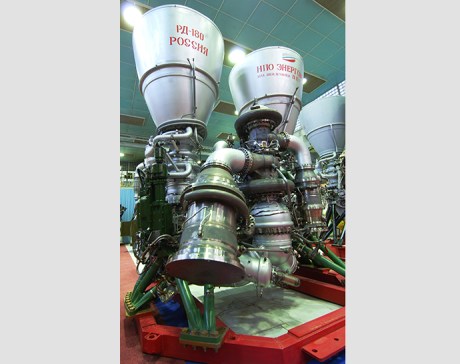
RD-180 rocket engine used in the first stages of American rockets Atlas-3 and Atlas-5. (RIA Novosti / Sergey Pyatakov)
Over the last decade, most of NASA’s Atlas V heavy rocket launches, performed by the United Launch Alliance (a Boeing/Lockheed Martin joint venture), were carried out using Russian RD-180 dual-nozzle rocket engines, a legacy of the Soviet Buran space shuttle program and its unparalleled rocket booster Energia, which could put 100 tons of spacecraft or satellites into orbit.
Military payloads
It is widely believed that many Atlas V launches have a military payload. Such Lockheed Martin-designed military spacecraft include the Advanced Extremely High Frequency (AEHF) series of communications satellites launched for Air Force Space Command, the mysterious super-secret Palladium at Night communication platform designed for the US Navy’s Ultra-High Frequency (UFO) Follow-On program and most certainly all three launches of Boeing’s X-37 unmanned demonstrator spacecraft. These are only a part of the military space missions undertaken by Atlas V rockets, boosted by RD-180 engines
A ban could also affect the US’s non-military space exploration launches, which are also highly dependent on the Atlas V rocket and RD-180 engines. The most famous and challenging among them are NASA’s New Horizons spacecraft mission, now traveling to Pluto and the Kuiper Belt (launched in 2006), and the Curiosity Mars rover (launched in 2011) currently operating on the Red Planet
A number of experts told Izvestia that termination of the rocket engine contract would not be a good idea commercially for NPO Energomash, which produces the rockets, because at the moment it makes RD-180 engines exclusively for the US space industry. The rockets typically take Energomash 16 months to produce.
If production of the RD-180 engine is stopped, the enterprise would have to find other contracts to keep the production line and experienced staff busy.
“In my opinion, stopping the export of rocket engines to the US is stupid, as we would suffer financial and reputational losses,” Ivan Moiseyev, scientific head of the Space Policy Institute, told Izvestia. “The US would not suffer much and would definitely continue with military space launches, while Russia would have to stop production of the RD-180, because no one else needs the RD-180 engine.”
However, many space experts believe that the US would find it difficult to quickly replace the Russian rockets. Also, Energomash could find other orders soon. Russia plans to start space launches from its new, multibillion-dollar Vostochny cosmodrome in the Far East in 2015. Vostochny will host a heavy rocket class launch pad, which means the producer of the world’s most powerful rocket engines will be kept busy for many years to come.
The RD-180 is equivalent to half of the Soviet-era Energia booster, the most powerful liquid rocket engine ever made by man. With 20 million horsepower output, the Soviet-era RD-170 was about 5 percent more powerful, yet 1.5 times smaller, than American’s F-1 first stage rocket engine made for the Saturn V booster of the Apollo lunar program.
Reportedly, when the Energia booster with the Buran space shuttle was launched in November 1988, the massive concrete bays paving the Baikonur cosmodrome in Kazakhstan were flying around like dry leaves, due to the immense power coming from the four RD-170 engines, which blasted the 2,400-ton rocket booster into space.
In the post-Soviet era, Russian-US rocket engine cooperation started back in 1996, when America’s General Dynamics Company bought exclusive rights for use of RD-180 in the US, later selling it to Lockheed Martin for its Atlas rocket program. NPO Energomash, the producer of unique engines based in Moscow’s suburb Khimki, signed a contract for production of 50 RD-180 engines and an option for the production of another 51 units.
A specially created joint venture, RD-AMROSS, between NPO Energomash and Pratt & Whitney Rocketdyne, has already delivered 63 engines to the US worth $11-15 million apiece, reportedly 40 of them have already been used. In December 2012, a new contract was signed to deliver another 31 engines. But this contract is now being reconsidered by Russia’s Security Council, according to Izvestia.
Rocket engines: space at stake
The RD-AMROSS joint venture has always been controversial for Russia’s military.
In 2011 Russia’s Audit Chamber announced that the RD-180 rocket engines delivered to the US according to the 1996 contract were sold for only a half of their real production value. The total loss in 2008-09 reached 880 million rubles (about $30 million) or 68 percent of all financial losses of NPO Energomash at the time, the Audit Chamber said.
In an interview, the general director of RKK Energia Corporation, Vitaly Lopota, estimated that at the time of the RD-180 first launch in the late 1980s, USSR was “at least” 50 years ahead of America’s liquid fuel rocket engine technology.
In the 1990s Russia agreed not only to sell unique engines to the US, but also provided the Americans with full documentation on the engine’s design specifications. But the US space industry opted to buy ready made engines instead of trying to make them on their own, because of the technological and material engineering gap between the two countries’ space industries.
And today the situation appears to be pretty much the same.
In December 2012, the head of Roskosmos, the Russian Federal Space Agency, Vladimir Popovkin, commented to Izvestia on the engines: “Americans are buying RD-180 engines and are negotiating to buy promising new RD-193 engines, because they’ve learned that we’re making a quality product, the best liquid-fueled rocket engines in the world. For them it’s easier to buy than to make up with us, [while] for us it is important to ensure the development of the NPO Energomash enterprise.”
In June 2013, the US Federal Trade Commission launched an antitrust investigation into United Launch Alliance, which was accused of “monopolizing” the rocket engine market and thus barring its direct rival, Orbital Sciences Corporation, from obtaining RD-180 engines for its Antares rocket booster to break into the lucrative market for US government rocket launches.
Experts say that the fact that Orbital Sciences Corporation is battling for the RD-180 could only mean that the company has so far failed to acquire anything similar on either the American, or the international space industry market.
Orbital Sciences’ Antares rocket is powered by Aerojet AJ-26 engines, which are actually Soviet NK-33 engines produced for the super-heavy N-1 rocket booster of USSR lunar program. Orbital Sciences once managed to buy 43 NK-33 engines stored for decades in Russian space corporation’s depots, and then adopted them for their needs. Now Orbital Sciences would like to restart production of the NK-33, but Energomash announced that this engine is out of production for the time being. In this situation, Orbital Sciences is taking ULA to court for the right to buy Russia’s RD-180 rocket engines.
SpaceNews reported earlier this month that NASA’s internal agency audit is warning that the Orion deep-space manned spacecraft program faces a “difficult budget environment” that ultimately could cause delays and cost increases. The Orion capsule could be launched with various rockets, including ULA’s Atlas V and Space Exploration Technologies’ Falcon 9.
In spring this year, Amazon founder and space enthusiast Jeff Bezos, owner of the Blue Origin space exploration start-up, financed a successful expedition recovering two F-1 engines for Apollo project’s Saturn V rocket from the Atlantic sea bed near Florida’s Kennedy Space Center. Bezos said that his fascination with space began back in 1969 with the Apollo program, when he saw astronaut Neil Armstrong walk on the Moon.
The rocket engines still remain property of NASA and the US government, and Bezos has promised have NASA put them on display at a museum in Seattle as “testament to the Apollo program.”
August 27, 2013
Posted by aletho |
Aletho News | Atlas V, NASA, Russia |
Leave a comment
World Nuclear News, the information arm of the World Nuclear Association which seeks to boost the use of atomic energy, last week heralded a NASA Mars rover slated to land on Mars on Monday, the first Mars rover fueled with plutonium.
“A new era of space exploration is dawning through the application of nuclear energy for rovers on Mars and the Moon, power generation at future bases on the surfaces of both and soon for rockets that enable interplanetary travel,” began a dispatch from World Nuclear News. It was headed: “Nuclear ‘a stepping stone’ to space exploration.”
In fact, in space as on Earth there are safe, clean alternatives to nuclear power. Indeed, right now a NASA space probe energized by solar energy is on its way to Jupiter, a mission which for years NASA claimed could not be accomplished without nuclear power providing on board electricity. Solar propulsion of spacecraft has begun. And also, scientists, including those at NASA, have been working on using solar energy and other safe power sources for human colonies on Mars and the Moon.
The World Nuclear Association describes itself as “representing the people and organizations of the global nuclear profession.” World Nuclear News says it “is supported administratively and with technical advice by the World Nuclear Association and is based within its London Secretariat.”
Its July 27th dispatch notes that the Mars rover that NASA calls Curiosity and intends to land on August 6th, is “powered by a large radioisotope thermal generator instead of solar cells” as previous NASA Mars rovers had been. It is fueled with 10.6 pounds of plutonium.
“Next year,” said World Nuclear News, “China is to launch a rover for the Moon” that also will be “powered by a nuclear battery.” And “most significant of all” in terms of nuclear power in space, continued World Nuclear News, “could be the Russian project for a ‘megawatt-class’ nuclear-powered rocket.” It cites Anatoly Koroteev, chief of Russia’s Keldysh Research Centre, as saying the system being developed could provide “thrust… 20 times that of current chemical rockets, enabling heavier craft with greater capabilities to travel further and faster than ever before.” There would be a “launch in 2018.”
The problem—a huge one and not mentioned whatsoever by World Nuclear News—involves accidents with space nuclear power systems releasing radioactivity impacting on people and other life on Earth. That has already happened. With more space nuclear operations, more atomic mishaps would be ahead.
NASA, before last November’s launch of Curiosity, acknowledged that if the rocket lofting it exploded at launch in Florida, plutonium could be released affecting an area as far as 62 miles away—highly-populated and including Orlando. Further, if the rocket didn’t break out of the Earth’s gravitational field, it and the rover would fall back into the atmosphere and break up, potentially releasing plutonium over a massive area. In its Final Environmental Impact Statement for the mission, NASA said in this situation plutonium could impact on “Earth surfaces between approximately 28-degrees north latitude and 28-degrees south latitude.” That includes Central America and much of South America, Asia, Africa and Australia.
The EIS said the costs of decontamination of plutonium in areas would be $267 million for each square mile of farmland, $478 million for each square mile of forests and $1.5 billion for each square mile of “mixed-use urban areas.” The Curiosity mission itself, because of $900 million in cost overruns, now has a price of $2.5 billion.
NASA set the odds very low for a plutonium release for Curiosity. The EIS said “overall” on the mission, the likelihood of plutonium being released was 1-in-220.
Bruce Gagnon, coordinator of the Global Network Against Weapons & Nuclear Power in Space, for more than 20 years the leading opposition group to space nuclear missions, declared that “NASA sadly appears committed to maintaining its dangerous alliance with the nuclear industry. Both entities view space as a new market for the deadly plutonium fuel… Have we not learned anything from Chernobyl and Fukushima? We don’t need to be launching nukes into space. It’s not a gamble we can afford to take.”
Plutonium has long been described as the most lethal radioactive substance. And the plutonium isotope used in the space nuclear program, and on the Curiosity rover, is significantly more radioactive than the type of plutonium used as fuel in nuclear weapons or built up as a waste product in nuclear power plants. It is Plutonium-238 as distinct from Plutonium-239. Plutonium-238 has a far shorter half-life–87.8 years compared to Plutonium-239 with a half-life of 24,500 years. An isotope’s half-life is the period in which half of its radioactivity is expended.
Dr. Arjun Makhijani, a nuclear physicist and president of the Institute for Energy and Environmental Research, explains that Plutonium-238 “is about 270 times more radioactive than Plutonium-239 per unit of weight.” Thus in radioactivity, the 10.6 pounds of Plutonium-238 being used on Curiosity is the equivalent of 2,862 pounds of Plutonium-239. The atomic bomb dropped on Nagasaki used 15 pounds of Plutonium-239.
The far shorter half-life of Plutonium-238 compared to Plutonium-239 results in it being extremely hot. This heat is translated in a radioisotope thermoelectric generator into electricity.
The pathway of greatest health concern for plutonium is breathing in a particle leading to lung cancer. A millionth of a gram of plutonium can be a fatal dose. The EIS for Curiosity speaks of particles that would be “transported to and remain in the trachea, bronchi, or deep lung regions.” The particles “would continuously irradiate lung tissue.”
There hasn’t been an accident on the Curiosity mission. But the EIS acknowledged that there have been mishaps previously—in this space borne game of nuclear Russian roulette. Of the 26 earlier U.S. space missions that have used plutonium listed in the EIS, three underwent accidents, it admitted. The worst occurred in 1964 and involved, it noted, the SNAP-9A plutonium system aboard a satellite that failed to achieve orbit and dropped to Earth, disintegrating as it fell. The 2.1 pounds of Plutonium-238 fuel on board dispersed widely over the Earth. Dr. John Gofman, professor of medical physics at the University of California at Berkeley, long linked this accident to an increase in global lung cancer. With the SNAP-9A accident, NASA switched to solar energy on satellites. Now all satellites and the International Space Station are solar powered.
The worst accident of several involving a Soviet or Russian nuclear space systems was the fall from orbit in 1978 of the Cosmos 954 satellite powered by a nuclear reactor. It also broke up in the atmosphere as it fell, spreading radioactive debris over 77,000 square miles of the Northwest Territories of Canada.
In 1996, the Russian Mars 96 space probe, energized with a half-pound of Plutonium-238 fuel, failed to break out of the Earth’s gravity and came down—as a fireball—over northern Chile. There was fall-out in Chile and neighboring Bolivia.
Initiatives in recent years to power spacecraft safely and cleanly include the launch by NASA last August 8th of a solar-powered space probe it calls Juno to Jupiter. NASA’s Juno website currently reports: “The spacecraft is in excellent health and is operating nominally.” It is flying at 35,200 miles per hour and is to reach Jupiter in 2016. Even at Jupiter, “nearly 500 million miles from the Sun,” notes NASA, its solar panels will be providing electricity.
Solar power has also begun to be utilized to propel spacecraft through the friction-less vacuum of space. The Japan Aerospace Exploration Agency in 2010 launched what it termed a “space yacht” called Ikaros which got propulsion from the pressure on its large sails from ionizing particles emitted by the Sun. The sails also feature “thin-film solar cells to generate electricity and creating,” said Yuichi Tsuda of the agency, “a hybrid technology of electricity and pressure.”
As to power for colonies on Mars and the Moon, on Mars, not only the sun is considered as a power source but also energy from the Martian winds. And, on the Moon, as The Daily Galaxy has reported: “NASA is eying the Moon’s south polar region as a possible site for future outposts. The location has many advantages; for one thing, there is evidence of water frozen in deep dark south polar craters. Water can be split into oxygen to breathe and hydrogen to burn as rocket fuel—or astronauts could simply drink it. NASA’s lunar architects are also looking for what they call ‘peaks of eternal light’—polar mountains where the sun never sets, which might be perfect settings for a solar power station.”
Still, the pressure by promoters of nuclear energy on NASA and space agencies around the world to use atomic energy in space is intense—as is the drive of nuclear promoters on governments and the public for atomic energy on Earth.
Critically, nuclear power systems for space use must be fabricated on Earth—with all the dangers that involves, and launched from Earth—with all the dangers that involves (1 out of 100 rockets destruct on launch), and are subject to falling back to Earth and raining deadly radioactivity on human beings and other life on this planet.
Karl Grossman, professor of journalism at the State University of New York/College of New York, is the author of the book, The Wrong Stuff: The Space’s Program’s Nuclear Threat to Our Planet. Grossman is an associate of the media watch group Fairness and Accuracy in Reporting (FAIR). He is a contributor to Hopeless: Barack Obama and the Politics of Illusion.
July 30, 2012
Posted by aletho |
Environmentalism, Nuclear Power, Timeless or most popular | Institute for Energy and Environmental Research, NASA, Plutonium, Plutonium-238, World Nuclear Association |
Leave a comment
Recent months have seen a flurry of headlines about cuts (often called “threats”) to the U.S. defense budget. Last week, lawmakers in the House of Representatives even passed a bill that was meant to spare national security spending from future cuts by reducing school-lunch funding and other social programs.
Here, then, is a simple question that, for some curious reason, no one bothers to ask, no less answer: How much are we spending on national security these days? With major wars winding down, has Washington already cut such spending so close to the bone that further reductions would be perilous to our safety?
In fact, with projected cuts added in, the national security budget in fiscal 2013 will be nearly $1 trillion — a staggering enough sum that it’s worth taking a walk through the maze of the national security budget to see just where that money’s lodged.
If you’ve heard a number for how much the U.S. spends on the military, it’s probably in the neighborhood of $530 billion. That’s the Pentagon’s base budget for fiscal 2013, and represents a 2.5% cut from 2012. But that $530 billion is merely the beginning of what the U.S. spends on national security. Let’s dig a little deeper.
The Pentagon’s base budget doesn’t include war funding, which in recent years has been well over $100 billion. With U.S. troops withdrawn from Iraq and troop levels falling in Afghanistan, you might think that war funding would be plummeting as well. In fact, it will drop to a mere $88 billion in fiscal 2013. By way of comparison, the federal government will spend around $64 billion on education that same year.
Add in war funding, and our national security total jumps to $618 billion. And we’re still just getting started.
The U.S. military maintains an arsenal of nuclear weapons. You might assume that we’ve already accounted for nukes in the Pentagon’s $530 billion base budget. But you’d be wrong. Funding for nuclear weapons falls under the Department of Energy (DOE), so it’s a number you rarely hear. In fiscal 2013, we’ll be spending $11.5 billion on weapons and related programs at the DOE. And disposal of nuclear waste is expensive, so add another $6.4 billion for weapons cleanup.
Now, we’re at $636 billion and counting.
How about homeland security? We’ve got to figure that in, too. There’s the Department of Homeland Security (DHS), which will run taxpayers $35.5 billion for its national security activities in fiscal 2013. But there’s funding for homeland security squirreled away in just about every other federal agency as well. Think, for example, about programs to secure the food supply, funded through the U.S. Department of Agriculture. So add another $13.5 billion for homeland security at federal agencies other than DHS.
That brings our total to $685 billion.
Then there’s the international affairs budget, another obscure corner of the federal budget that just happens to be jammed with national security funds. For fiscal 2013, $8 billion in additional war funding for Iraq and Afghanistan is hidden away there. There’s also $14 billion for what’s called “international security assistance” — that’s part of the weapons and training Washington offers foreign militaries around the world. Plus there’s $2 billion for “peacekeeping operations,” money U.S. taxpayers send overseas to help fund military operations handled by international organizations and our allies.
That brings our national security total up to $709 billion.
We can’t forget the cost of caring for our nation’s veterans, including those wounded in our recent wars. That’s an important as well as hefty share of national security funding. In 2013, veterans programs will cost the federal government $138 billion.
That brings us to $847 billion — and we’re not done yet.
Taxpayers also fund pensions and other retirement benefits for non-veteran military retirees, which will cost $55 billion next year. And then there are the retirement costs for civilians who worked at the Department of Defense and now draw pensions and benefits. The federal government doesn’t publish a number on this, but based on the share of the federal workforce employed at the Pentagon, we can estimate that its civilian retirees will cost taxpayers around $21 billion in 2013.
By now, we’ve made it to $923 billion — and we’re finally almost done.
Just one more thing to add in, a miscellaneous defense account that’s separate from the defense base budget. It’s called “defense-related activities,” and it’s got $8 billion in it for 2013.
That brings our grand total to an astonishing $931 billion.
And this will turn out to be a conservative figure. We won’t spend less than that, but among other things, it doesn’t include the interest we’re paying on money we borrowed to fund past military operations; nor does it include portions of the National Aeronautics and Space Administration that are dedicated to national security. And we don’t know if this number captures the entire intelligence budget or not, because parts of intelligence funding are classified.
For now, however, that whopping $931 billion for fiscal year 2013 will have to do. If our national security budget were its own economy, it would be the 19th largest in the world, roughly the size of Australia’s. Meanwhile, the country with the next largest military budget, China, spends a mere pittance by comparison. The most recent estimate puts China’s military funding at around $136 billion.
Or think of it this way: National security accounts for one quarter of every dollar the federal government is projected to spend in 2013. And if you pull trust funds for programs like Social Security out of the equation, that figure rises to more than one third of every dollar in the projected 2013 federal budget.
Yet the House recently passed legislation to spare the defense budget from cuts, arguing that the automatic spending reductions scheduled for January 2013 would compromise national security. Secretary of Defense Leon Panetta has said such automatic cuts, which would total around $55 billion in 2013, would be “disastrous” for the defense budget. To avoid them, the House would instead pull money from the National School Lunch Program, the Children’s Health Insurance Program, Medicaid, food stamps, and programs like the Social Services Block Grant, which funds Meals on Wheels, among other initiatives.
Yet it wouldn’t be difficult to find savings in that $931 billion. There’s plenty of low-hanging fruit, starting with various costly weapons systems left over from the Cold War, like the Virginia class submarine, the V-22 Osprey tiltrotor aircraft, the missile defense program, and the most expensive weapons system on the planet, the F-35 jet fighter. Cutting back or cancelling some of these programs would save billions of dollars annually.
In fact, Congress could find much deeper savings, but it would require fundamentally redefining national security in this country. On this issue, the American public is already several steps ahead of Washington. Americans overwhelmingly think that national security funding should be cut — deeply.
If lawmakers don’t pay closer attention to their constituents, we already know the alternative: pulling school-lunch funding.
Chris Hellman and Mattea Kramer are research analysts at the National Priorities Project. They wrote the soon-to-be-published book A People’s Guide to the Federal Budget, and host weekly two-minute Budget Brief videos on YouTube.
Copyright 2012 Chris Hellman and Mattea Kramer
May 22, 2012
Posted by aletho |
Deception, Economics, Militarism | Department of Homeland Security, NASA, National security, Pentagon, United States, United States Department of Defense, United States Department of Energy |
Leave a comment
The Folly of Nuclear Drones and Other Mad Schemes
The crash last week of a U.S. drone on the Seychelles Islands—the second crash of a U.S. drone on Seychelles in four months—underlines the deadly folly of a plan of U.S. national laboratory scientists and the Northrop Grumman Corp. for nuclear-powered drones.
The drone that “bounced a few times on the runway” at Seychelles International Airport on April 4 “before ending” up in the sea, according to a statement from the Seychelles Civil Aviation Authority, was conventionally powered. So was the drone which had a similar accident on Seychelles in December. From the Indian Ocean island nation the U.S. flies drones over Somalia and over waters off East Africa looking for pirates.
But the use of nuclear power on U.S. drones was “favorably assessed by scientists at Sandia National Laboratories and the Northrop Grumman Corp.,” revealed Steven Aftergood of the Project on Government Secrecy of the Federation of American Scientists.
Their report said that “technology and systems designs evaluated… have previously never been applied to unmanned air vehicles” and “use of these technologies” could provide “system performance unparalleled by existing technologies.” It acknowledged, however, that “current political conditions will not allow use of the results.” Thus “it is doubtful that they will be used in the near-term or mid-term future.”
Just consider if the two drones which crashed on the Seychelles used nuclear power—and the impacts if the radioactive fuel they contained was released. […] Drones, not too incidentally, have a record of frequently crashing.
The nuclear-powered drone scheme is ostensibly not going anywhere now—because of “current political considerations.” But other schemes to use nuclear power overhead—which also threaten nuclear disaster—are on the planning table and some are moving ahead.
These include:
- A new U.S. Air Force plan which supports “nuclear powered flight.” Titled Energy Horizons, issued in January, it states that “nuclear energy has been demonstrated on several satellite systems” and “this source provides consistent power…at a much higher energy and power density than current technologies.” It does admit that “the implementation of such a technology should be weighed heavily against potential catastrophic outcomes.” Indeed, the worst accident involving a U.S. space nuclear system occurred with the fall to Earth in 1964 of a satellite powered by an RTG, the SNAP-9A. It failed to achieve orbit and fell to Earth, disintegrating upon hitting the atmosphere causing its Plutonium-238 fuel to be dispersed as dust widely over the Earth. Dr. John Gofman, professor of medical physics at the University of California, Berkeley, long linked the SNAP-9A accident to a global rise in lung cancer. The Air Force report sees nuclear power as an energy source that would assist it in taking the “ultimate high ground” which would provide it with “access to every part of the globe including denied areas.”
- “A ground-breaking Russian nuclear space travel propulsion system will be ready by 2017 and will power a ship capable of long-haul interplanetary missions by 2025,” the Russian state news agency, Ria Novosti, reported last week. The April 3 article, headlined “Plutonium to Pluto: Russian nuclear space travel breakthrough,” said, “The megawatt-class nuclear drive will function for up to three years and produce 100-150 kilowatts of energy at normal capacity.” It is “under development at Skolkovo, Russia’s technology innovation hub, where nuclear cluster head Dennis Kovalevich confirmed the breakthrough.” It said, “Scientists expect to start putting the new engine through its paces in operational tests as early as 2014.” Earlier, Ria Novosti reported that the director of Roscosmos , the Russian space agency, believes the “development of megawatt-class nuclear power systems for manned spacecraft was crucial if Russia wanted to maintain a competitive edge in the space race, including the exploration of the moon and Mars.” It also said the Russian rocket company, Energia, is “ready to design a space-based nuclear power station with a service life of 10-to-15 years, to be initially placed on the moon or Mars.” The worst accident involving a Soviet or Russian nuclear space system was the fall from orbit in 1978 of the Cosmos 954 satellite powered by a nuclear reactor. It also broke up in the atmosphere spreading radioactive debris which scattered over 77,000 square miles of the Northwest Territories of Canada.
- The U.S. is moving again to produce Plutonium-238 for space use. In recent years, the U.S. stopped making Plutonium-238. It is 270 times more radioactive than the more commonly known Plutonium-239, used as fuel in atomic bombs, and thus its manufacture has resulted in significant radioactive pollution. Instead, it obtained Plutonium-238 from Russia. RTGs powered by Plutonium-238 had been used by the U.S. as a source of electricity on satellites—as the Energy Horizons report noted. But that was until the SNAP-9A accident which caused a turn to generating electricity with solar photovoltaic panels. Now all satellites are powered by solar panels, as is the International Space Station. But RTGs using Plutonium-238 have remained a source of on board electricity for space probes such as Cassini which NASA launched to Saturn in 1999. The Department of Energy plans to produce Plutonium-238 at both Oak Ridge National Laboratory and Idaho National Laboratory. “Over the next two years, Oak Ridge National Laboratory will carry out a $20 million pilot project to demonstrate the lab’s ability to produce and process Plutonium-238 for use in the space program,” reported the Knoxville News Sentinel last month.
- The U.S. is also developing nuclear-powered rockets. NASA Director Charles Bolden, a former astronaut and U.S. Marine Corps major general, is a booster of a design of a Houston-based company, Ad Astra, of which another former astronaut, Franklin Chang-Diaz, is president and chief executive officer. “He launched Ad Astra after he retired from NASA in 2005, but the company continues a close association with the U.S. space agency,” the U.S. government’s Voice of America noted in its article on the project last year. The Variable Specific Impulse Magnetoplasma Rocket or VASMIR could be energized by solar power but, the article relates, “Chang-Diaz says replacing solar panels with a nuclear reactor would provide the necessary power to VASMIR for a much faster trip.” It quotes him as saying “we could do a mission to Mars that would take about 39 days, one way.” And, although “such a mission is still many years away, Chang-Diaz says his rocket could be used much sooner for missions to the International Space Station or to retrieve or position satellites in Earth orbit.”
Challenging what is going on is the Global Network Against Weapons & Nuclear Power in Space. Bruce Gagnon, coordinator of the group, comments:
“Who can deny that the nuclear power industry isn’t working overtime to spread its deadly product onto every possible military application? The recent disclosure that the Pentagon has been strongly considering sticking nuclear engines on-board drones is dangerously ‘more of the same.’”
“Nuclear-powered devices flying around on drones or on-board rockets that frequently blow up on launch is pure insanity,” says Gagnon. “The people need to push back hard.”
What is happening has deep roots. A key rationale by Sandia and Northrop Grumman for nuclear-powered drones was, as the British newspaper, The Guardian, reported last week, long—very long—flight times. “American scientists have drawn up plans for a new generation of nuclear-powered drones capable of flying over remote regions of the world for months on end without refueling,” it reported. The same rationale, noted Gagnon, was behind the U.S. development in the 1940s and 50s of nuclear-propelled bombers.
The strategy was for these nuclear-powered bombers to stay up in the air for extensive periods of time. There would thus be no need to scramble crews and have bombers take off to drop nuclear weapons on the Soviet Union—they’d already be airborne waiting for the command. The Nuclear Energy for the Propulsion of Aircraft or NEPA project was begun in 1946 and involved the conversion of two B-36 bombers for nuclear propulsion. The first operation of an aircraft engine using nuclear power occurred in 1956. The U.S. national laboratories—a string of facilities that got their start in the crash program to build atomic weapons, the Manhattan Project—were integral to the scheme. Oak Ridge National Laboratory, then run by the since disbanded U.S. Atomic Energy Commission, did much of the research work. Much of the testing was done at what is now Idaho National Laboratory where today two nuclear aircraft engines are on public display and there is also still remaining a gargantuan hangar built for nuclear aircraft. General Electric was a major contractor.
The plan for nuclear-powered bombers was finally scuttled because of the problem of providing heavy lead shielding to protect the crew from radiation and, as then U.S. Secretary of Defense Robert McNamara told Congress in 1961, an atomic airplane would “expel some fraction of radioactive fission products into the atmosphere, creating an important public relations problem if not an actual physical hazard.”
A subsequent program linking nuclear power and weapons was the Star Wars program under President Ronald Reagan. It was “predicated,” as Gagnon notes, “on nuclear power in space.” Reactors and also a “Super RTG” to be built by General Electric were to provide the energy on orbiting battle platforms for lasers, hypervelocity guns and particle beam weapons.
In my book, The Wrong Stuff: The Space Program’s Nuclear Threat to Our Planet,” and TV documentary, Nukes in Space: The Nuclearization and Weaponization of the Heavens, I noted the 1988 declaration of Lt. General James Abramson, first head of the Strategic Defense Initiative, that “without reactors in orbit [there is] going to be a long, long light cord that goes down to the surface of Earth” bringing up power. He stated: “Failure to develop nuclear power in space could cripple efforts to deploy anti-missile sensors and weapons in orbit.”
As to nuclear-propelled rockets, the U.S. has a long history of seeking to build them from the 1950s onward. There was a program called Nuclear Engine for Rocket Vehicle Application or NERVA followed by Projects Pluto, Rover and Poodle. And in the 1980s, the Timberwind nuclear-powered rocket was developed to loft heavy Star Wars equipment into space and also for trips to Mars. Most recently, the Project Prometheus program to build nuclear-powered rockets was begun by NASA in 2003. Through the years there have been major concerns over a nuclear rocket blowing up on launch or crashing back to Earth.
The Soviet Union, Russia, conducted a parallel space nuclear program—including nuclear-powered satellites, development of a nuclear bomber and nuclear-powered rockets.
Now, meanwhile, nuclear power above our heads has been shown as unnecessary.
NASA has persisted in using Plutonium-238-powered RTGs on space probes claiming there was no choice. But last year it launched the Juno space probe which is now on its way to Jupiter—getting all its on-board electricity only from solar photovoltaic panels. It’s to arrive in 2016 and make 32 orbits around Jupiter and perform a variety of scientific missions. As NASA stated last week on its website for Juno: “As of April 4, Juno was approximately209 million miles from Earth… The Juno spacecraft is in excellent health.” This is despite NASA claiming for decades that only nuclear power could provide on-board power in deep space.
Likewise, the European Space Agency in 2004 launched a space probe it calls Rosetta, also using solar energy rather than nuclear power for on-board electricity. It is to rendezvous in 2014 with a comet named 67P/Churyumov-Gerasimenko and send out a lander which will investigate the comet’s surface. At that point it will be 500 million miles from the Sun, a small ball in the sky at that distance, yet Rosetta will still be harvesting solar energy.
As to propulsion in space, a highly promising energy source are the ionized particles in space that can be utilized in the frictionless environment with what are being called solar sails.
In May 2010, the Japan Exploration Agency launched an experimental spacecraft, Ikaros, that seven months later reached Venus—propelled only by its solar sail. The Planetary Society is readying a similar mission using a spacecraft named LightSail-1 powered by solar sails and planning for two more ambitious solar sail flights of LightSail-2 and LightSail-3.
These missions do not present threats to life on Earth—as does the use of nuclear power overhead. And the threats of nuclear power overhead can be enormous. For example, consider the projection in NASA’s Final Environmental Impact Statement for the Cassini Mission about the impacts if there were an “inadvertent reentry” of Cassini into Earth’s atmosphere during one of its two “flybys”—whips around the Earth but a few hundred miles high to increase its velocity so it could get to Saturn. If it fell to Earth, broke up in the atmosphere and its 72.3 pounds of Plutonium-238 were released, “5 billion… of the world population… could receive 99 percent or more of the radiation exposure,” projected NASA.
Moreover, the production of nuclear fuel on Earth for use in space—or in the atmosphere for drones—constitutes danger, too. Facilities that had been used earlier by the U.S. to produce Plutonium-238, Los Alamos National Laboratory and Mound Laboratory, ended up as hotspots for worker contamination and radioactive pollution.
James Powell, executive director of the organization Keep Yellowstone Nuclear Free, which has been opposing the restart of Plutonium-238 production at nearby Idaho National Laboratory, comments: “Aside from the looming danger of nuclear powered craft above Earth, we should also realize that the nuclear material is to be produced in our backyards with 1960′s era nuclear reactors and then transported back and forth from [Oak Ridge National Laboratory in] Tennessee to Idaho. Every single part of this process deeply concerns us.”
Karl Grossman, professor of journalism at the State University of New York/College of New York, is the author of the book, The Wrong Stuff: The Space’s Program’s Nuclear Threat to Our Planet (Common Courage Press) and wrote and presented the TV program Nukes In Space: The Nuclearization and Weaponization of the Heavens (www.envirovideo.com). He is a contributor to Hopeless: Barack Obama and the Politics of Illusion, forthcoming from AK Press.
April 11, 2012
Posted by aletho |
Militarism, Nuclear Power, Timeless or most popular | NASA, Northrop Grumman, Nuclear power, Oak Ridge National Laboratory, Sandia National Laboratories, Seychelles, Variable Specific Impulse Magnetoplasma Rocket |
Leave a comment

 Aletho News
 Aletho News